
Science Worksheets
44,295 subject resources
Balancing Equations Assessment | BC Standards Grade 8 Science
 Created byPrism Point Learning
Learning Objectives
- Understand the purpose of coefficients in balanced chemical equations and their role in atom conservation.
- Identify how coefficients reflect molar proportions, not formulas, in chemical reactions.
- Interpret how balancing equations reflects the law of conservation of mass and aids in stoichiometry calculations.
Also included in: Grade 8 Science Lesson – Reaction Types & Evidence Assessment Bundle
Instant download
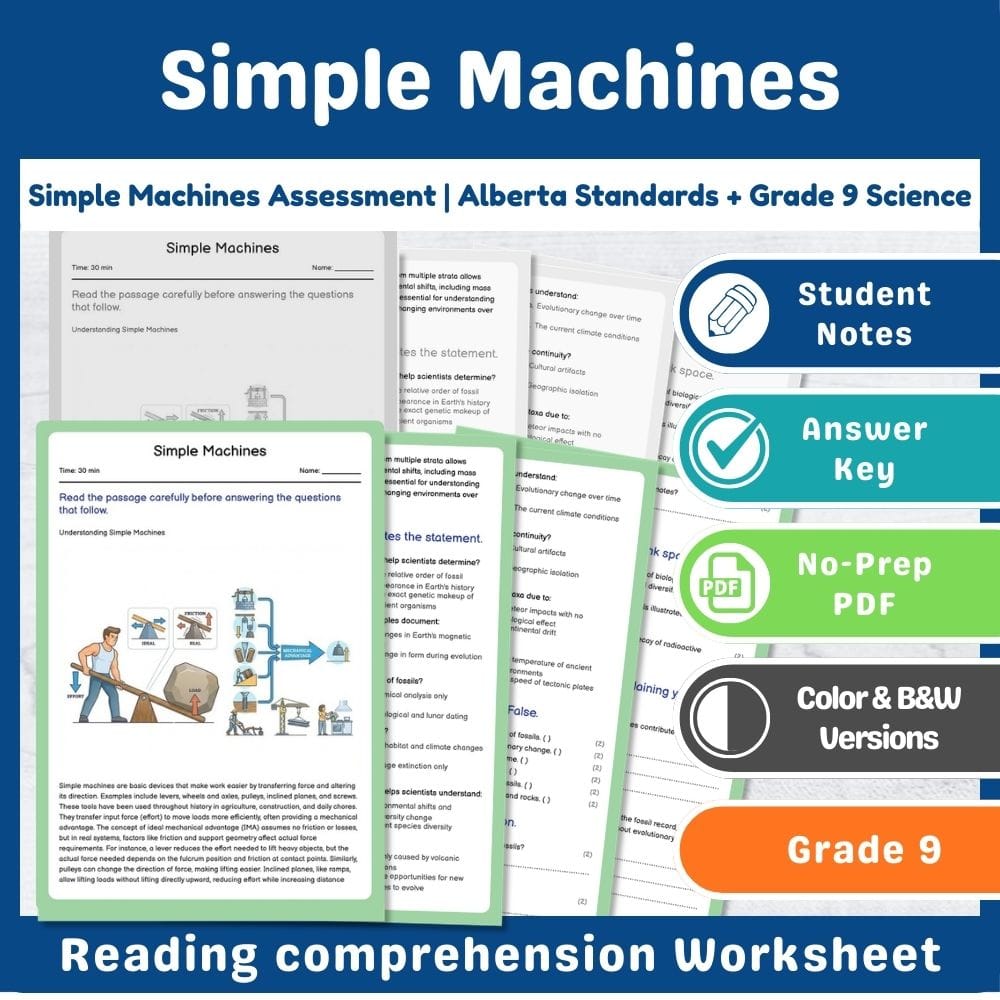
Simple Machines Assessment | Alberta Standards + Grade 9 Science
Created byPrism Point LearningLearning Objectives
- Describe the different types of simple machines and their functions.
- Explain how simple machines reduce effort and change the direction of force.
- Differentiate between ideal and actual mechanical advantage in systems involving simple machines.
Also included in: Grade 9 Forces and Motion Science Lesson Bundle Alberta Framework +1 more
Instant download

Thermal Expansion Assessment Grade 7 Science California Standards
Created byPrism Point LearningLearning Objectives
- Explain how increasing temperature affects particle motion and spacing in solids, liquids, and gases
- Describe and predict contraction and expansion when materials are heated or cooled
- Connect thermal expansion to real-world situations such as tight metal fits and gas pressure in sealed containers
Also included in: Grade 7 Forces and Matter Science Lesson Bundle: California Standards +1 more
Instant download

Protein Synthesis Assessment for Grade 11 Science TEKS Standards
Created byPrism Point LearningLearning Objectives
- Explain the process of transcription and translation in protein synthesis.
- Identify the roles of RNA polymerase, mRNA, tRNA, ribosomes, and amino acids.
- Describe the significance of codon redundancy and wobble in genetic decoding.
Also included in: Grade 11 Molecular Genetics Science Lesson Bundle: TEKS Assessments
Instant download

DNA Maintenance Assessment for Grade 11 Science | Standards-Aligned Assessment
Created byPrism Point LearningLearning Objectives
- Explain the molecular mechanisms of DNA replication and repair that maintain genetic information.
- Describe the roles of DNA polymerase fidelity, proofreading, and excision repair pathways in preserving genome integrity.
- Understand the causes and consequences of mutations, their rates, and how repair failures impact genome stability.
Instant download
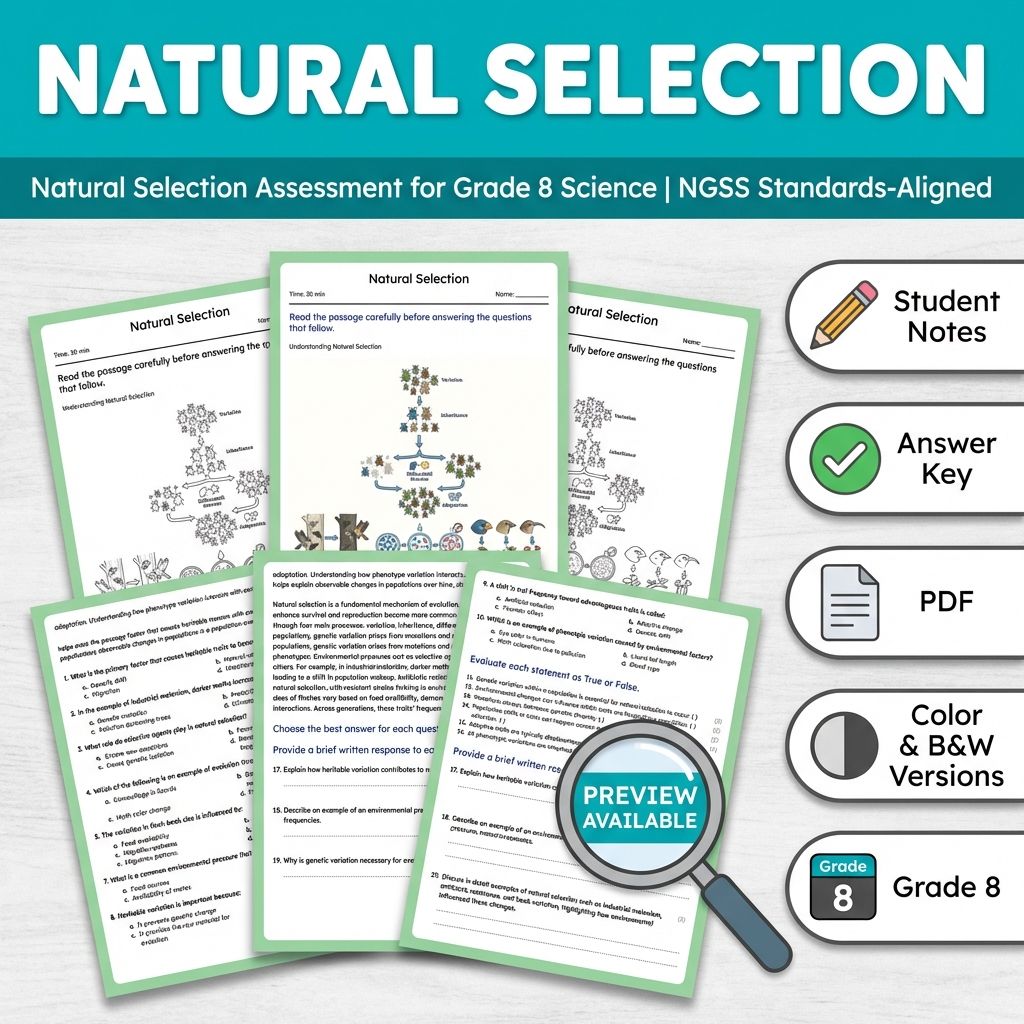
Natural Selection Assessment for Grade 8 Science | NGSS Standards-Aligned
Created byPrism Point LearningLearning Objectives
- Understand the mechanisms of variation and natural selection that drive adaptive change in populations.
- Identify examples of natural selection such as industrial melanism, antibiotic resistance, and beak variation.
- Link phenotypic variation and environmental factors to changes in trait frequencies over generations.
Also included in: Grade 8 Science Mini Bundle | Biological Evolution & Diversity Standards-Aligned +1 more
Instant download

Science Assessment: Water Cycle Pathways (Grade 6) – Florida NGSSS
Created byPrism Point LearningLearning Objectives
- Describe the major pathways of the water cycle, including evaporation, condensation, precipitation, runoff, and infiltration
- Explain how energy transfer affects water’s state changes and movement between land and the atmosphere
- Use evidence from the water cycle to predict how changes can lead to droughts or flooding
Instant download
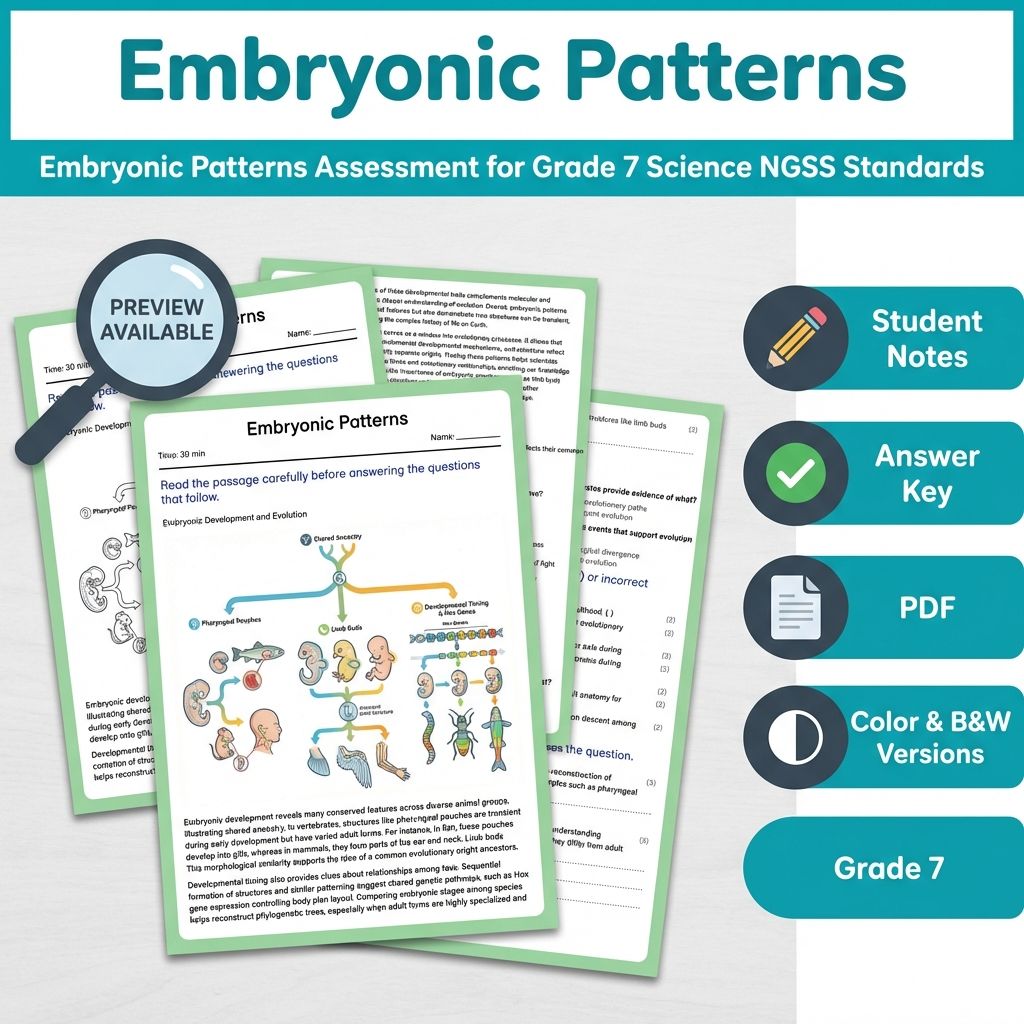
Embryonic Patterns Assessment for Grade 7 Science NGSS Standards
Created byPrism Point LearningLearning Objectives
- Compare embryonic development stages across different taxa to identify conserved features.
- Analyze morphological similarities in embryonic structures such as pharyngeal pouches and limb buds.
- Understand how developmental timing aids in reconstructing evolutionary relationships.
Also included in: Grade 7 Science Mini Bundle – Biological Evolution: Unity & Diversity +1 more
Instant download

Decomposition Recycling Assessment | Florida NGSSS Grade 6 Science
Created byPrism Point LearningLearning Objectives
- Explain how decomposers break down dead organisms and waste into simpler materials.
- Describe how decomposition returns nutrients to the environment for producers to use again.
- Connect decomposition to matter cycling and ecosystem stability over time.
Also included in: Grade 6 Ecosystems Science Lesson Bundle | Florida NGSSS Assessment
Instant download

Carbon Pathways Assessment | AP Standards for Grade 11 Science
Created byPrism Point LearningLearning Objectives
- Explain how carbon is stored and transferred among air, ocean, terrestrial biosphere, and sediments.
- Utilize flux diagrams and isotopic tracers to distinguish natural from anthropogenic carbon sources.
- Analyze the impact of ocean uptake, soil carbon, and fossil fuel emissions on atmospheric CO2 levels.
Also included in: Lesson Grade 11 Science Assessment Bundle | Earth Systems & Climate
Instant download

Evidence Supporting Evolution Assessment | General Grade 10 Science
Created byPrism Point LearningLearning Objectives
- Understand the different types of evidence used to support claims about biological change over time.
- Identify how fossil records, comparative anatomy, molecular data, and biogeography contribute to evolutionary understanding.
- Analyze how multiple lines of evidence reinforce conclusions about evolution despite limitations in individual datasets.
Also included in: Grade 10 Evolution and Genetics Science Lesson Bundle: General Unit
Instant download

Graphical Reasoning Assessment Grade 8 Science TEKS Standards-Aligned
Created byPrism Point LearningLearning Objectives
- Interpret slopes, areas under curves, and rates of change in mathematical graphs.
- Connect graphical representations with physical phenomena such as motion and energy transfer.
- Translate between equations, data tables, and graphical formats to analyze scientific data.
Also included in: Grade 8 Scientific Inquiry & Data Analysis Science Lesson Bundle TEKS
Instant download

Physiological Traits Assessment | Standards-Aligned Assessment Grade 6 Science
Created byPrism Point LearningLearning Objectives
- Explain how physiological adaptations help organisms survive in specific environments
- Identify examples of internal traits related to water balance, metabolism, and ion regulation
- Interpret statements about physiological adaptations as true or false
Also included in: Grade 6 Ecosystems Science Lesson Bundle | Florida NGSSS Assessment
Instant download
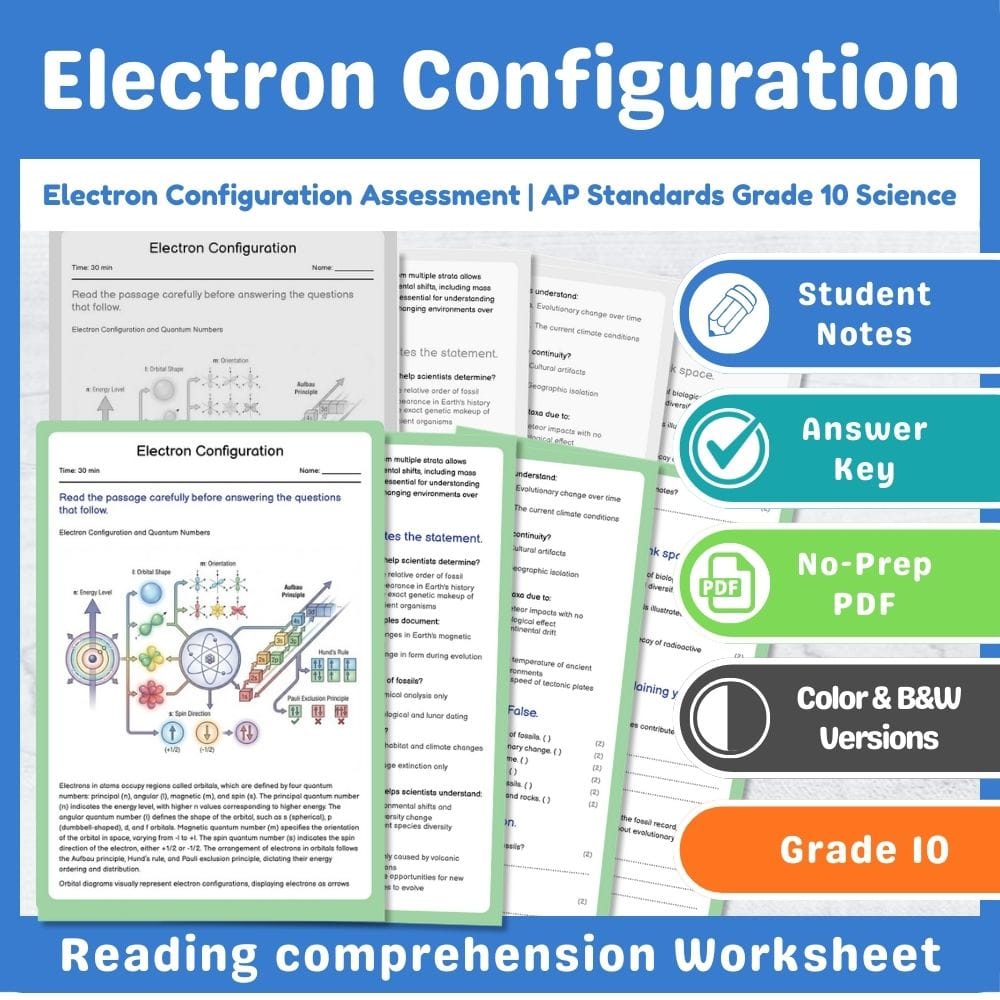
Electron Configuration Assessment | AP Standards Grade 10 Science
Created byPrism Point LearningLearning Objectives
- Understand quantum numbers and how they describe electron distribution in atoms
- Identify orbital shapes and energy ordering for electrons in atoms
- Link microscopic electron arrangements to spectral lines and chemical properties
Also included in: Lesson Bundle | Grade 10 Science Assessment Paired with AP Standards
Instant download

Quantitative Modeling Assessment | Advanced Placement Grade 11 Science
Created byPrism Point LearningLearning Objectives
- Understand the application of differential equations, network models, and statistical inference in biological systems.
- Learn to parameterize models, perform sensitivity analysis, and validate models with empirical data.
- Compare different modeling approaches and recognize their limitations in biological research.
Instant download

Model Validation Assessment for Grade 11 Science | AP Standards-Aligned
Created byPrism Point LearningLearning Objectives
- Understand methods for evaluating the credibility of scientific models.
- Identify techniques such as cross-validation, residual analysis, and dataset comparison.
- Evaluate the risks of overfitting and the importance of identifying limitations in models.
Also included in: Grade 11 Science Mini Bundle | AP Science Practices & Skills
Instant download

Condensation and Clouds Assessment | California Standards Grade 6 Science
Created byPrism Point LearningLearning Objectives
- Explain how cooling and vapor pressure changes lead to condensation or ice crystal formation in the atmosphere
- Describe how clouds form from condensed droplets or ice crystals and how this relates to the water cycle
- Compare how clouds affect Earth’s energy balance by reflecting sunlight and trapping infrared radiation
Also included in: Grade 6 Water in Earth Systems Science Lesson Bundle: California Standards +1 more
Instant download

Bond Polarity Assessment | Alberta Standard 12 Science
Created byPrism Point LearningLearning Objectives
- Understand the concept of bond polarity and how electronegativity differences influence molecular dipole moments.
- Explain how bond polarity affects solubility, intermolecular forces, and industrial applications.
- Analyze molecular structures to predict polarity and related physical properties such as boiling point and miscibility.
Also included in: Grade 12 Chemistry Science Lesson Bundle Assessments | Alberta Framework +1 more
Instant download

Atomic Particles Assessment | BC Standards Grade 10 Science
Created byPrism Point LearningLearning Objectives
- Describe the structure of an atom, including protons, neutrons, and electrons.
- Explain how the number of protons determines an element and contributes to atomic mass.
- Identify the arrangement of electrons in shells and how it influences chemical behavior.
Instant download
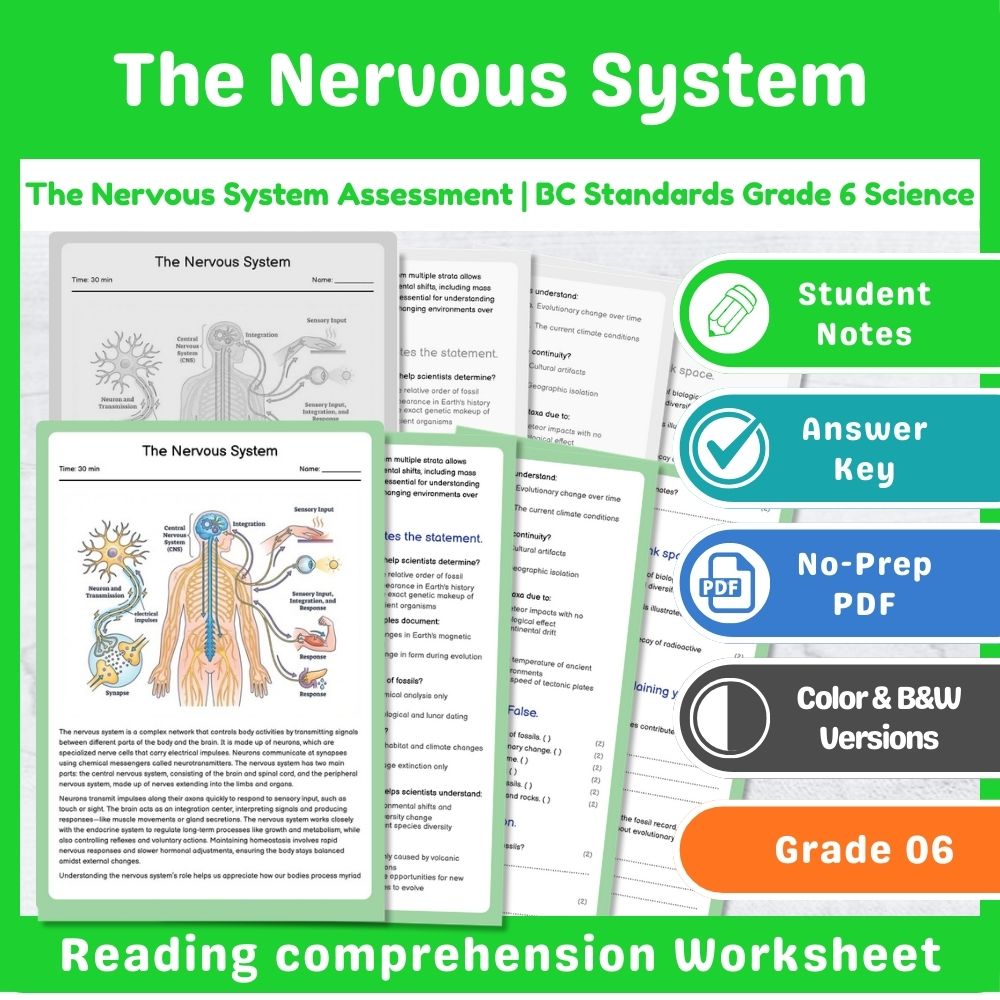
The Nervous System Assessment | BC Standards Grade 6 Science
Created byPrism Point LearningLearning Objectives
- Describe the basic structure and function of neurons.
- Explain how the nervous system collects, processes, and responds to sensory information.
- Identify the role of integration centers in coordinating responses.
Instant download

Advanced Circuit Analysis Assessment | BC Standards Grade 6 Science
Created byPrism Point LearningLearning Objectives
- Explain how power dissipation in resistive elements converts electrical energy into thermal energy.
- Analyze how internal source resistance affects terminal voltage under load conditions.
- Describe the relationship between current, voltage, and power in complex circuits.
Instant download

Radioactive Decay Dating Assessment | NGSSS Standards Grade 12 Science
Created byPrism Point LearningLearning Objectives
- Explain how radioactive decay and half-life enable absolute (numerical) age dating of rocks
- Interpret parent-to-daughter isotope information to infer elapsed time since formation
- Evaluate how radioactive dating complements relative dating methods in building geologic timelines
Also included in: Grade 12 Science Assessment Lesson Bundle: Florida NGSSS Standards +1 more
Instant download

Waves and Technology Assessment for Grade 6 Science | BC Standards
Created byPrism Point LearningLearning Objectives
- Explain how sound and light waves transfer energy in technological devices.
- Describe the conversion processes in speakers and microphones.
- Understand how cameras utilize wave properties to produce images.
Instant download

Producers And Consumers Assessment | BC Standards Grade 6 Science
Created byPrism Point LearningLearning Objectives
- Understand the roles of producers and consumers in food webs and ecosystems.
- Identify different types of consumers and their feeding habits.
- Explain energy transfer efficiency between trophic levels and its ecological impact.
Instant download

Reaction Classification Assessment | BC Standards Grade 10 Science
Created byPrism Point LearningLearning Objectives
- Identify and classify different types of chemical reactions based on reactant and product characteristics.
- Understand the characteristic features and observable evidence of various reaction types.
- Relate reaction classes to the periodic properties of reactants to predict products and energy changes.
Instant download

Trophic Transfers And Efficiency Assessment Grade 9 Science Printable
Created byPrism Point LearningLearning Objectives
- Explain how energy is transferred among organisms in a food chain.
- Describe the concept of energy transfer efficiency and its impact on biomass.
- Interpret evidence like population sizes, biomass trends, and nutrient concentrations to analyze trophic levels.
Also included in: Grade 9 Ecology, Genetics, and Cells Science Lesson Bundle – General
Instant download

Respiratory System Assessment for Grade 6 Science | BC Standards
Created byPrism Point LearningLearning Objectives
- Describe the structure and function of the respiratory system and its role in gas exchange.
- Identify adaptations that increase respiratory efficiency in different organisms.
- Explain how respiratory and circulatory systems work together to maintain homeostasis.
Instant download
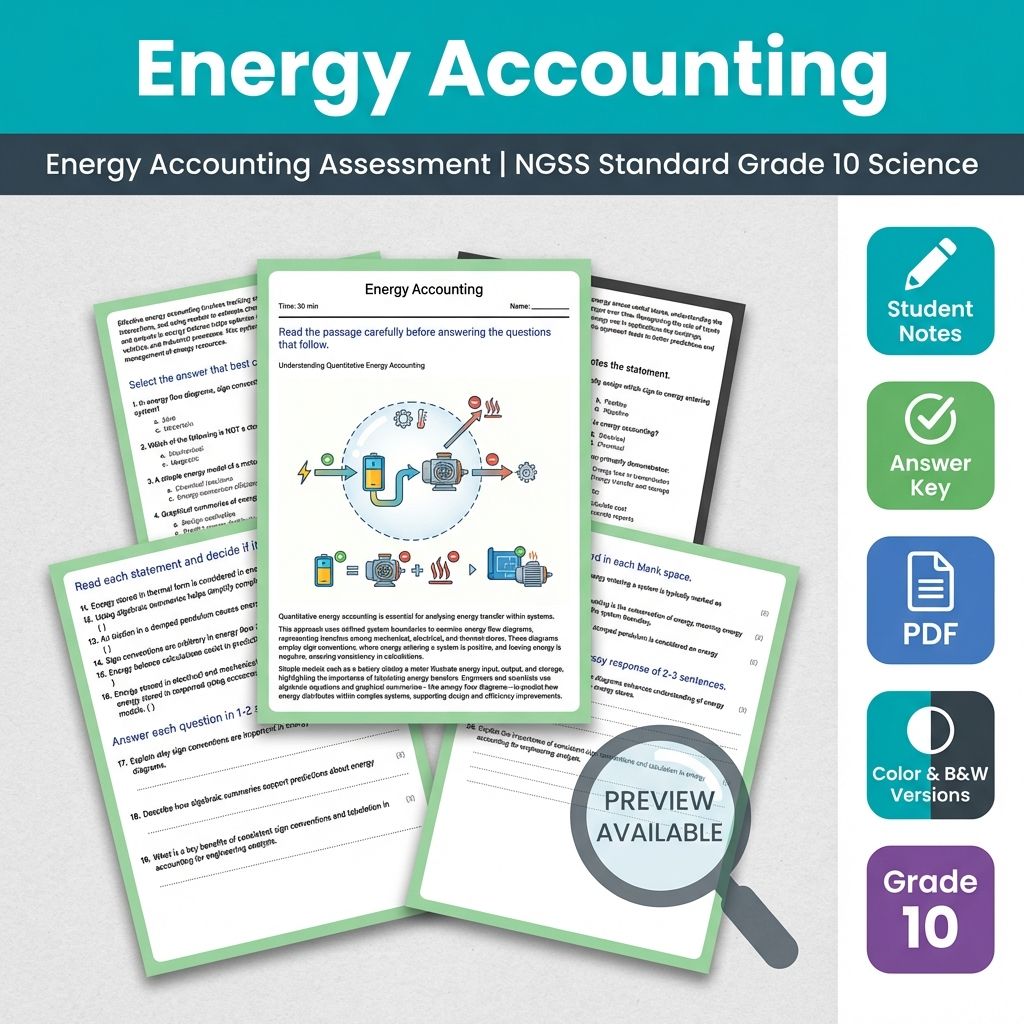
Energy Accounting Assessment | NGSS Standard Grade 10 Science
Created byPrism Point LearningLearning Objectives
- Understand and apply system boundaries, energy flow diagrams, and computational models in energy accounting.
- Identify energy transfer processes among mechanical, electrical, and thermal stores.
- Use sign conventions and tabulate energy transfers to analyze system energy distribution.
Also included in: Grade 10 Science | Work & Power NGSS Assessment Mini Bundle – Printable
Instant download
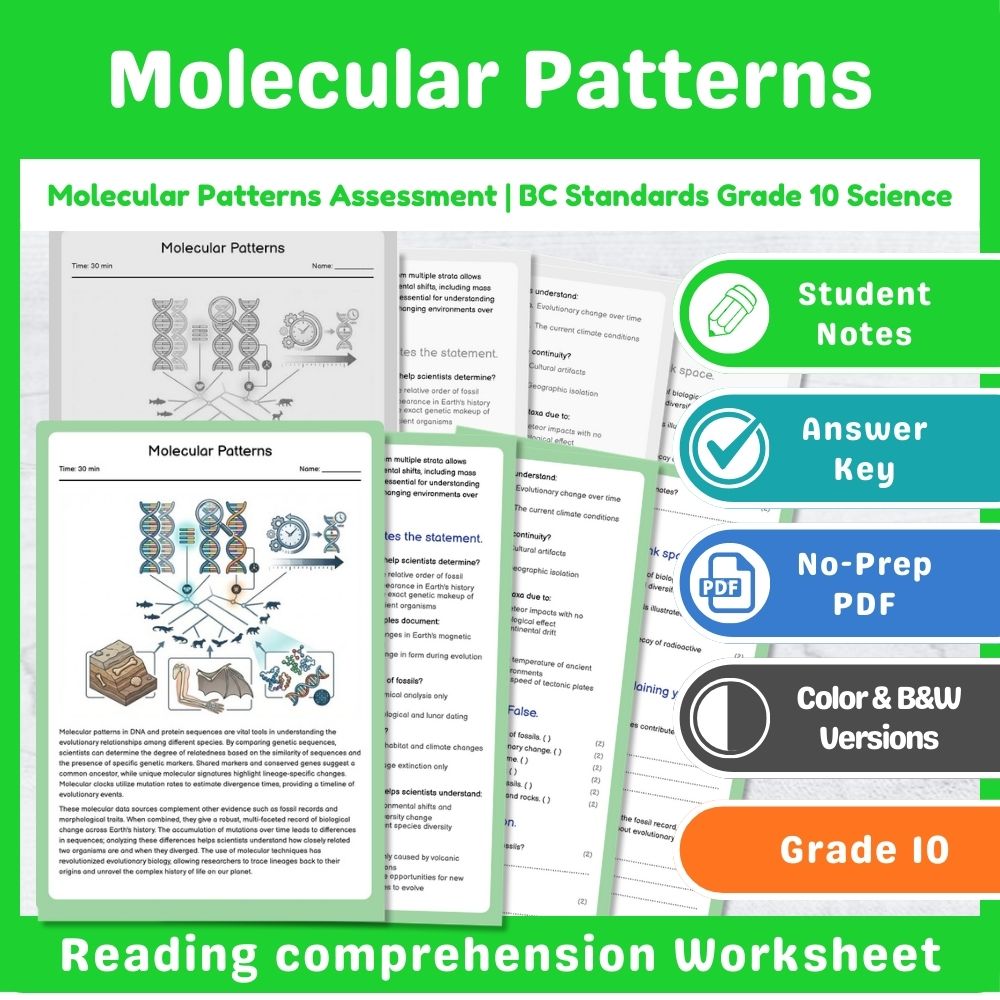
Molecular Patterns Assessment | BC Standards Grade 10 Science
Created byPrism Point LearningLearning Objectives
- Explain how molecular patterns in DNA and proteins reveal genetic relatedness among organisms.
- Describe how molecular clocks estimate divergence times and the significance of shared genetic markers.
- Identify conserved genes and lineage-specific molecular signatures as evidence of common ancestry.
Instant download

Battery Storage Assessment | BC Standards Grade 10 Science
Created byPrism Point LearningLearning Objectives
- Describe how chemical energy is converted to electrical energy in batteries.
- Explain the factors affecting the efficiency and longevity of battery storage.
- Analyze the energy flow during charge and discharge cycles and their impact on battery performance.
Also included in: Grade 10 Science | Energy Assessment - BC Standards-Aligned Mini Bundle
Instant download
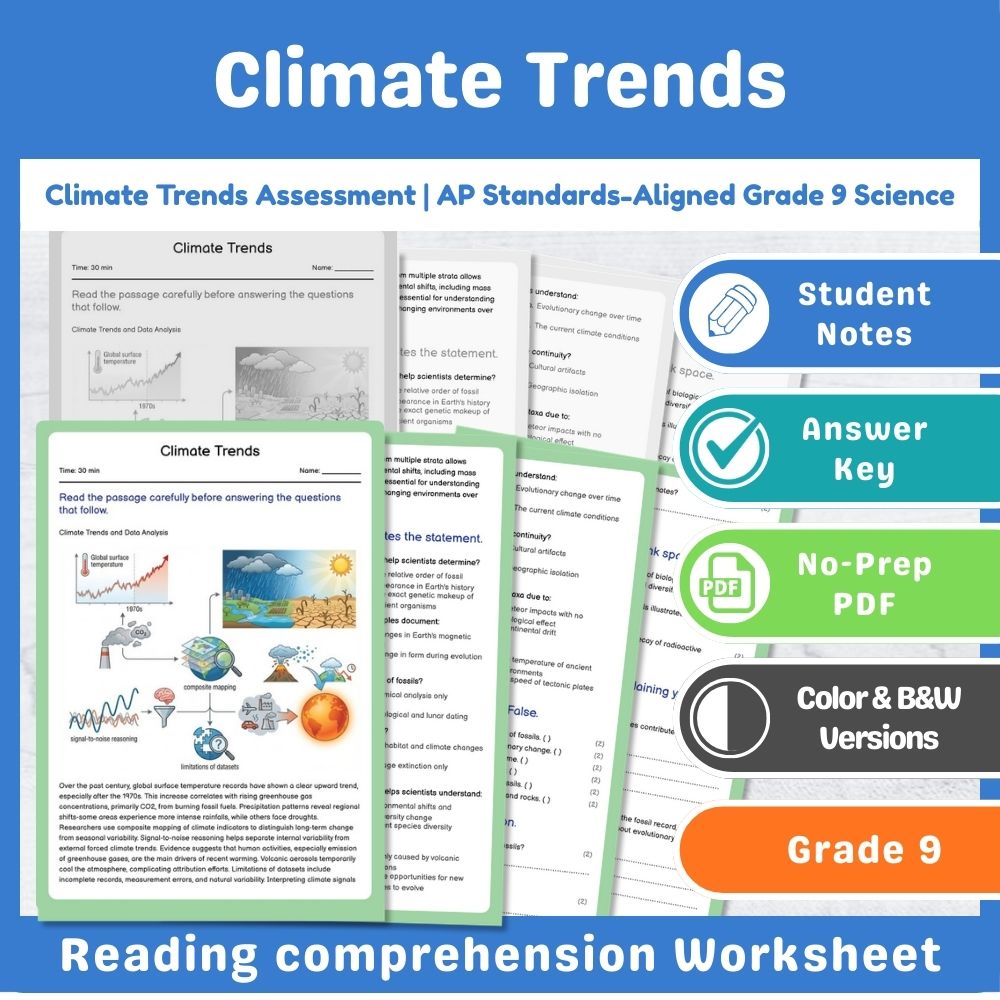
Climate Trends Assessment | AP Standards-Aligned Grade 9 Science
Created byPrism Point LearningLearning Objectives
- Analyze spatial and temporal climate datasets to identify trends and anomalies.
- Apply statistical trend analysis and composite mapping techniques.
- Interpret potential climate drivers by comparing datasets with external forcings.
Also included in: Grade 9 Science Mini Bundle | Earth and Space Sciences AP Standards
Instant download

Reflection and Refraction Assessment | BC Grade 6 Science Standards
Created byPrism Point LearningLearning Objectives
- Understand the principles of light reflection and refraction.
- Identify the factors affecting how light bends and reflects.
- Explain how lenses and optical phenomena like mirages form images.
Instant download

Ecological Succession Assessment | BC Standards Grade 6 Science
Created byPrism Point LearningLearning Objectives
- Understand the processes of primary and secondary succession.
- Identify pioneer species and their role in succession.
- Explain how succession affects biodiversity and community structure.
Instant download
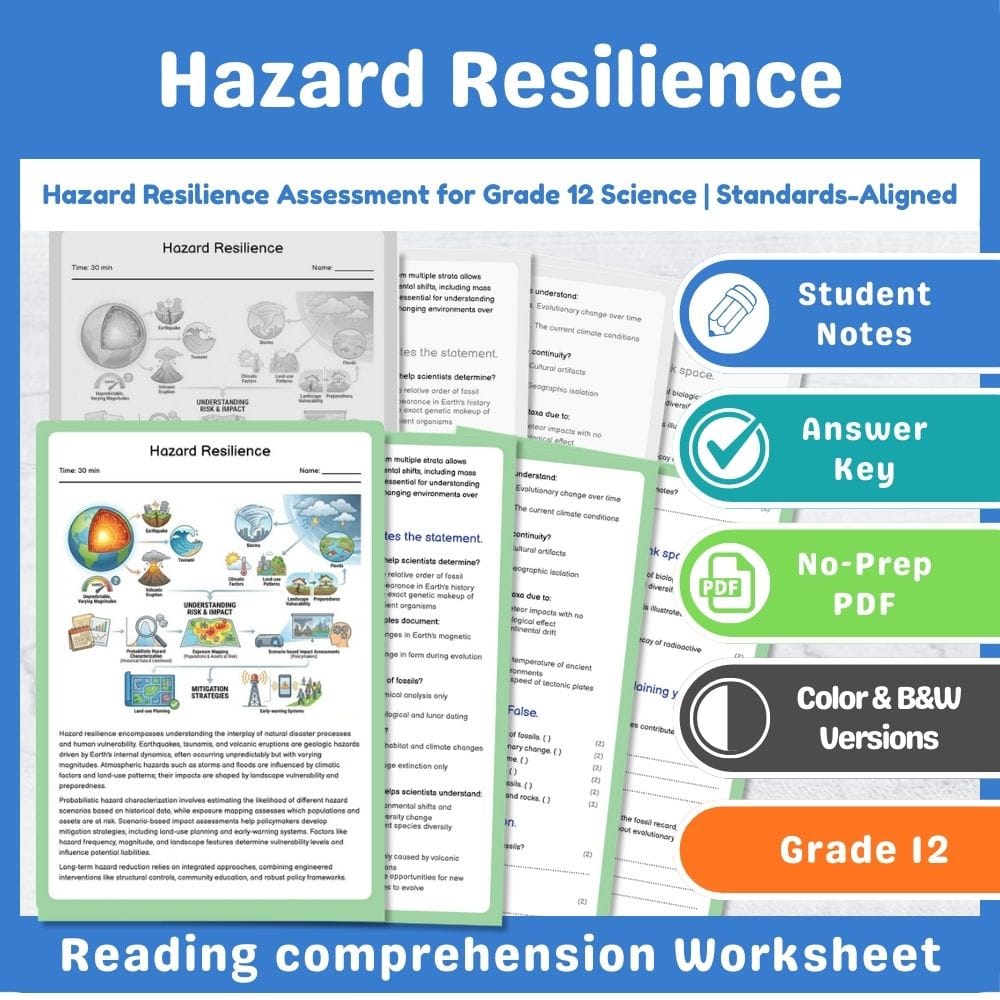
Hazard Resilience Assessment for Grade 12 Science | Standards-Aligned
Created byPrism Point LearningLearning Objectives
- Understand the key hazard processes including earthquakes, tsunamis, volcanic eruptions, landslides, floods, and extreme storms.
- Evaluate probabilistic hazard characterization, exposure mapping, and impact assessment methods.
- Analyze how hazard frequency, magnitude, and vulnerability affect landscapes and communities.
Instant download
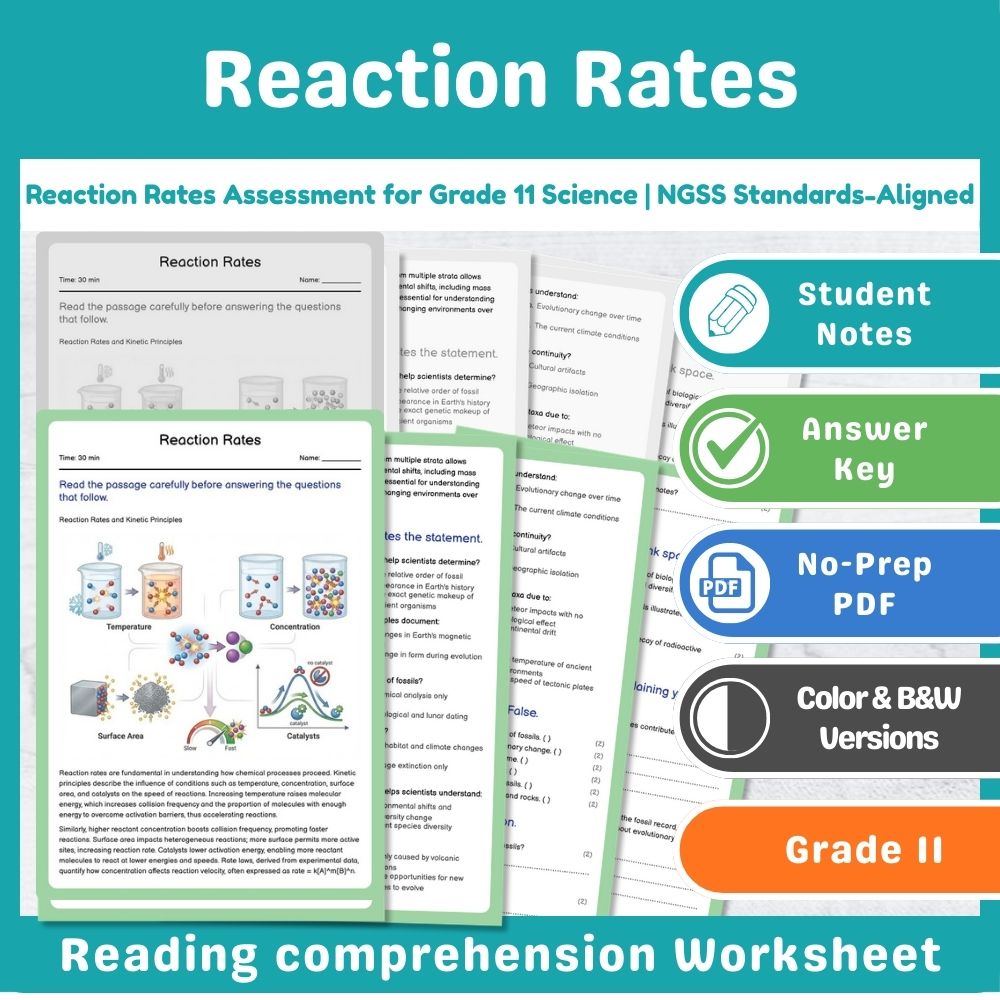
Reaction Rates Assessment for Grade 11 Science | NGSS Standards-Aligned
Created byPrism Point LearningLearning Objectives
- Explain how temperature, concentration, surface area, and catalysts influence reaction rates through collision and activation energies.
- Apply rate laws and concentration dependencies to elementary reaction steps.
- Interpret potential energy diagrams and Arrhenius parameters to understand temperature's effect on reaction rates.
Also included in: Grade 11 Science Mini Bundle – Matter and Its Interactions NGSS Unit
Instant download

Theories And Laws Assessment | Florida NGSSS Grade 12 Science
Created byPrism Point LearningLearning Objectives
- Differentiate scientific theories from scientific laws based on purpose and how each is used to explain or predict natural phenomena.
- Analyze how evidence supports both theories and laws and explain why each can change with new findings.
- Apply the distinction between theories and laws to scientific statements in everyday and academic contexts.
Also included in: Grade 12 Science Claims & Evidence Lesson Bundle Assessment | Florida NGSSS +1 more
Instant download
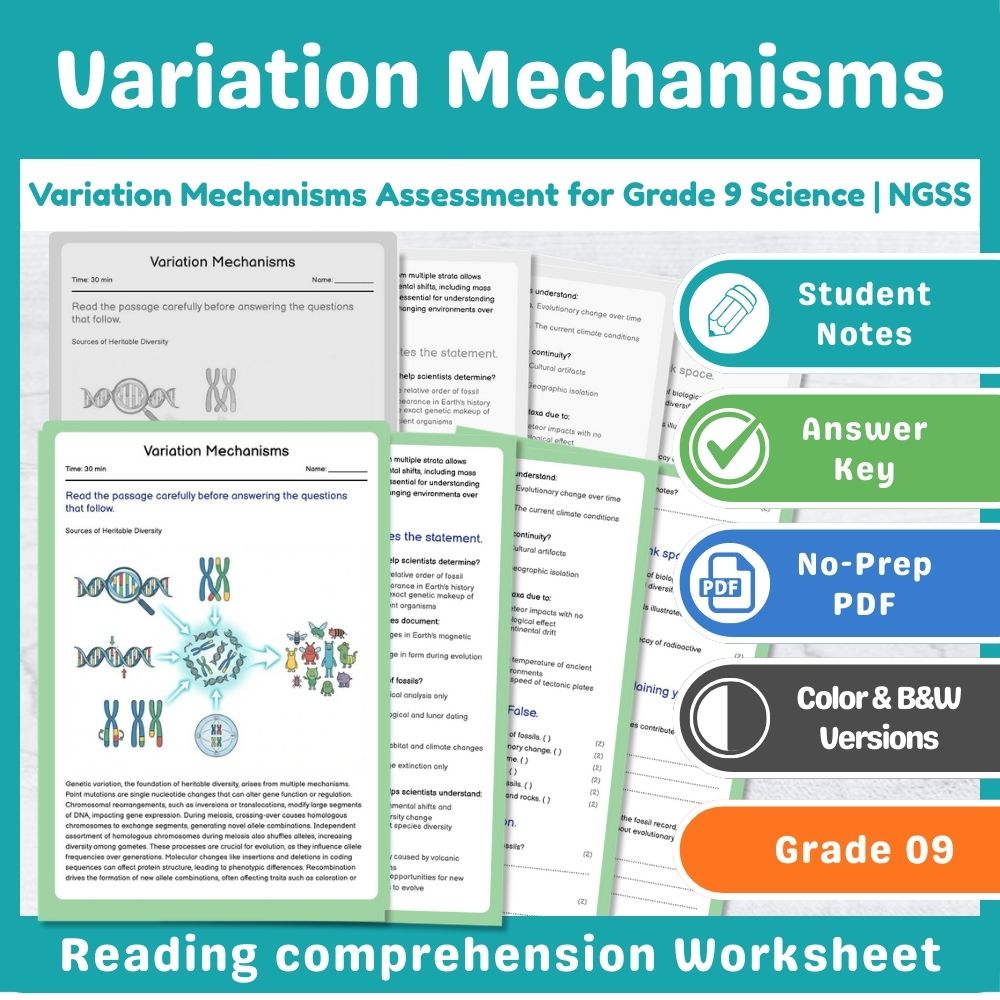
Variation Mechanisms Assessment for Grade 9 Science | NGSS
Created byPrism Point LearningLearning Objectives
- Describe the main sources of heritable genetic variation such as point mutations, chromosomal rearrangements, and recombination.
- Explain how mechanisms like crossing-over and independent assortment contribute to allelic and phenotypic diversity.
- Connect molecular changes to effects on gene expression, protein function, and trait variation at the population level.
Instant download
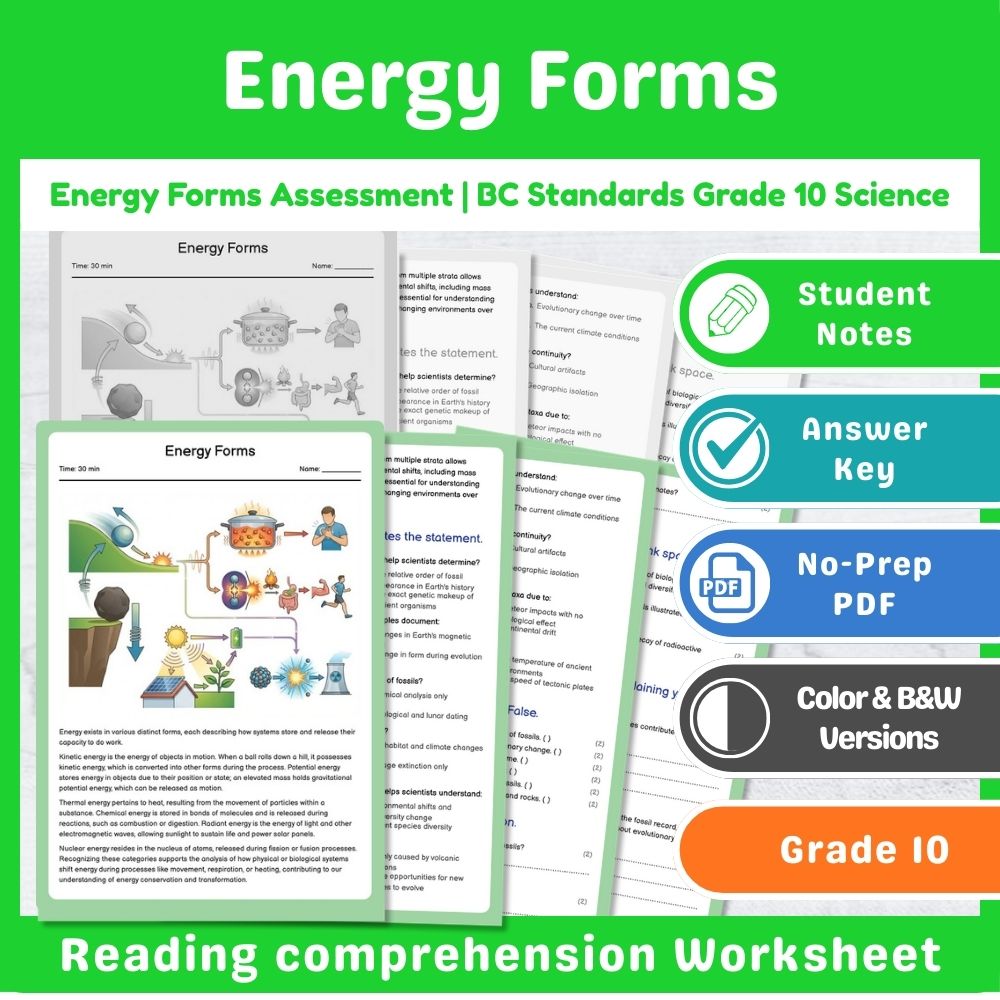
Energy Forms Assessment | BC Standards Grade 10 Science
Created byPrism Point LearningLearning Objectives
- Identify and describe different forms of energy such as kinetic, potential, thermal, chemical, radiant, and nuclear.
- Explain how energy transforms from one form to another during physical and biological processes.
- Analyze examples of energy transfer in systems like movement, respiration, or heating.
Also included in: Grade 10 Science | Energy Assessment - BC Standards-Aligned Mini Bundle
Instant download

Newton's Laws Assessment for Grade 7 Science | TEKS Standards
Created byPrism Point LearningLearning Objectives
- Understand the core principles of Newton's three laws of motion.
- Identify real-world examples illustrating inertia, acceleration, and action–reaction pairs.
- Explain how mass, force, and motion are related through qualitative relationships.
Also included in: Grade 7 Motion and Energy Science: Lesson Bundle TEKS Unit Assessment
Instant download
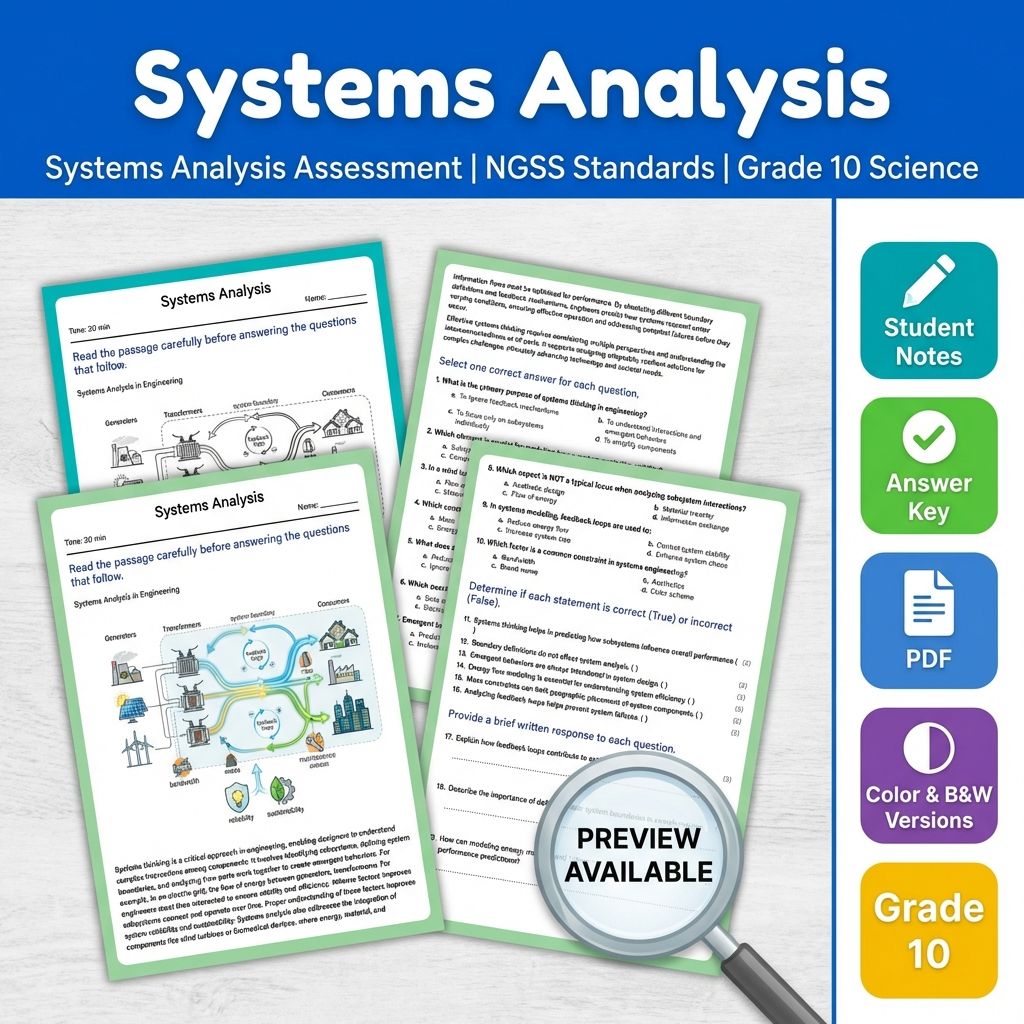
Systems Analysis Assessment | NGSS Standards | Grade 10 Science
Created byPrism Point LearningLearning Objectives
- Understand systems thinking principles and their application to engineering problems.
- Identify interactions between subsystems and define system boundaries accurately.
- Analyze emergent behaviors and feedback loops within complex systems.
Also included in: Grade 10 Science Assessment Mini Bundle | Engineering Design & Systems
Instant download
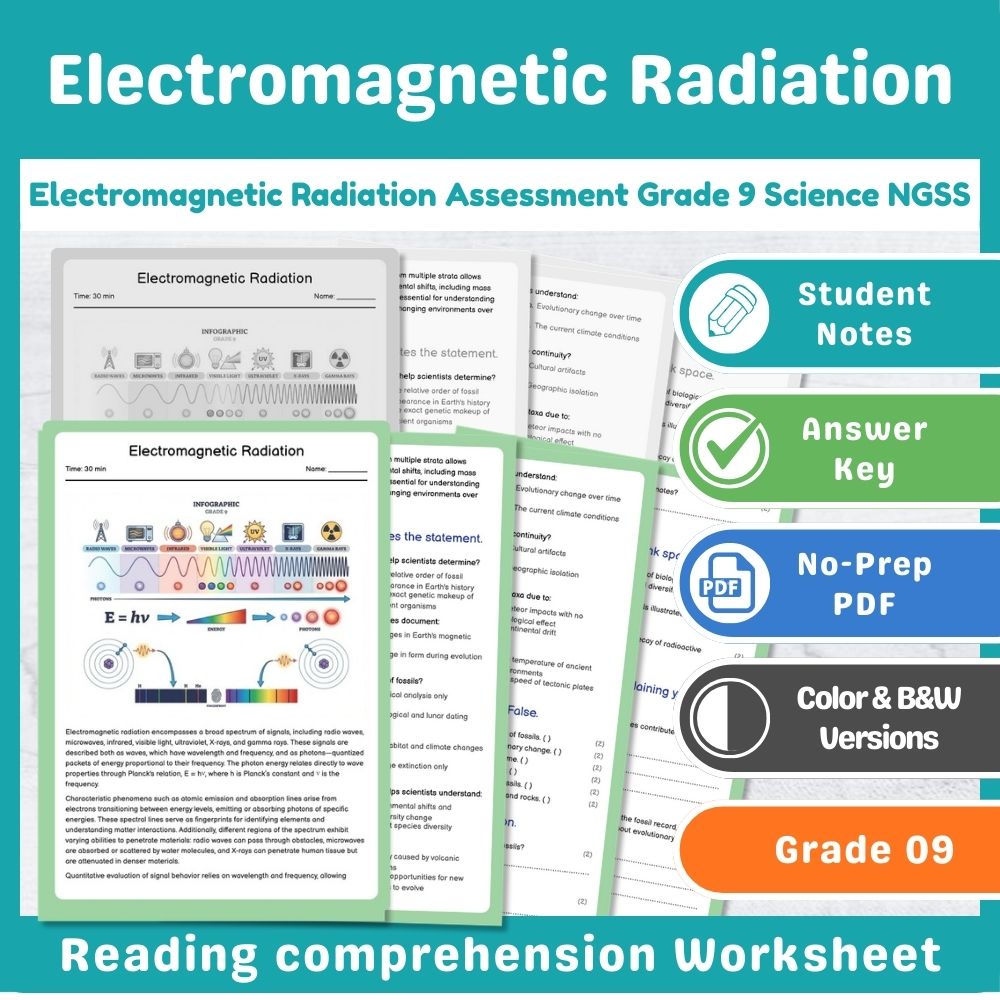
Electromagnetic Radiation Assessment Grade 9 Science NGSS
Created byPrism Point LearningLearning Objectives
- Explain the wave and photon descriptions of electromagnetic signals across the spectrum.
- Relate frequency to photon energy and their interactions with matter.
- Identify characteristic phenomena such as atomic emission and absorption lines, and spectral attenuation.
Instant download
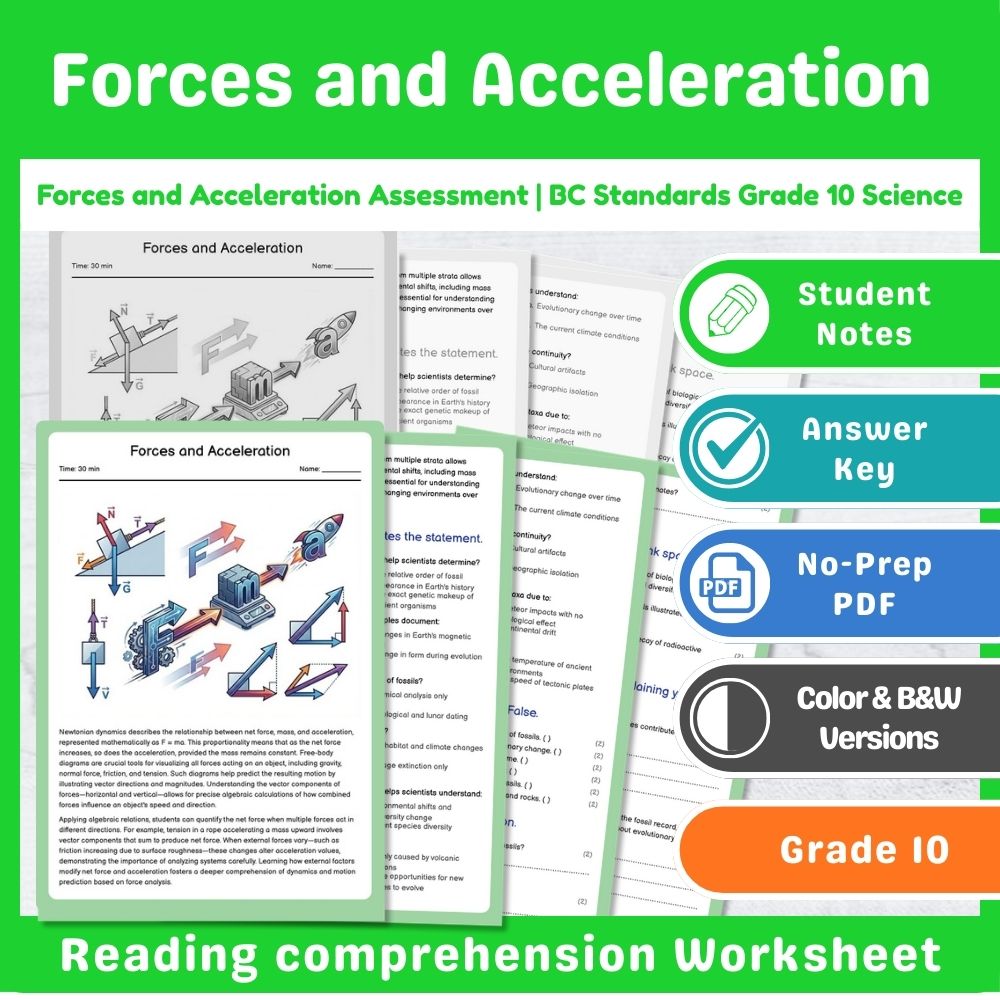
Forces and Acceleration Assessment | BC Standards Grade 10 Science
Created byPrism Point LearningLearning Objectives
- Understand how net force affects acceleration according to Newton's Second Law.
- Identify and interpret free-body diagrams representing forces like gravity, normal force, friction, and tension.
- Apply algebraic and vector methods to analyze how forces combine to change motion.
Instant download
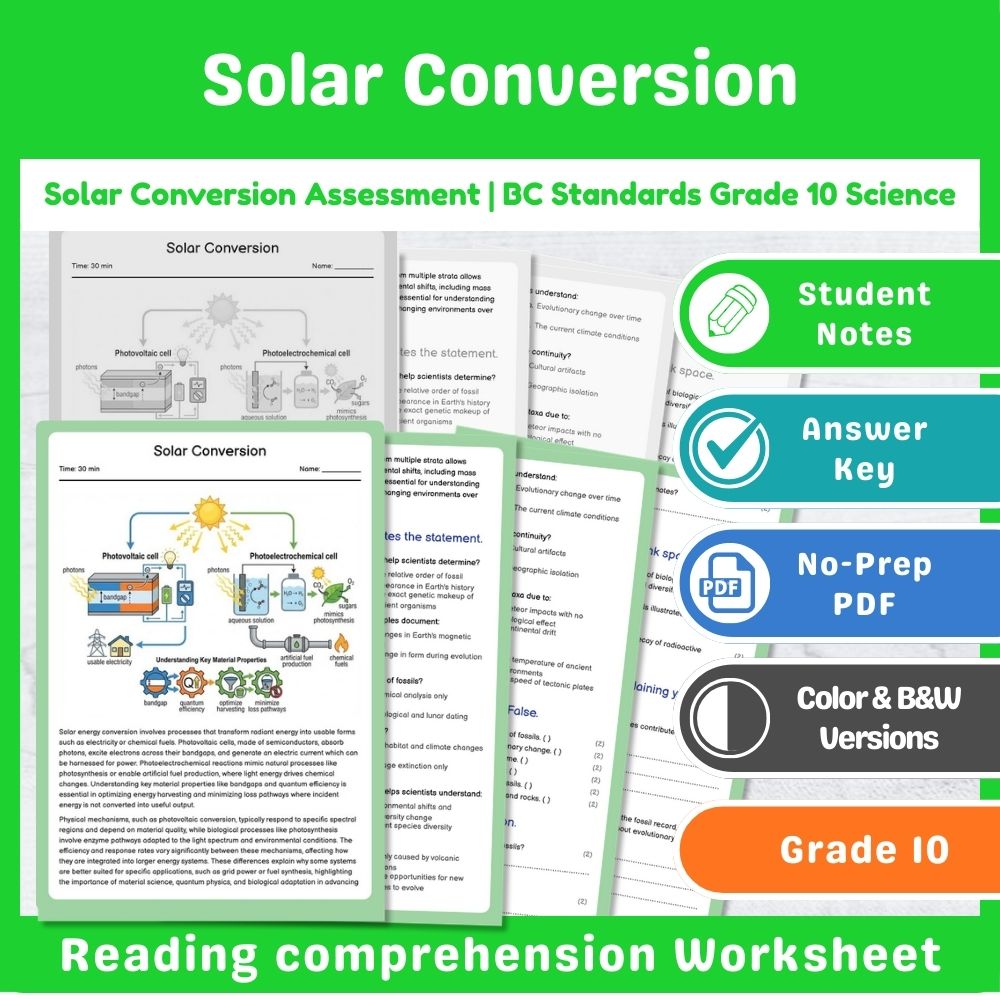
Solar Conversion Assessment Grade 10 Science | BC Standards-Aligned
Created byPrism Point LearningLearning Objectives
- Explain the processes involved in solar energy conversion, including photovoltaic and photoelectrochemical methods.
- Describe how semiconductors absorb photons and generate electrical current.
- Understand material properties such as bandgaps and quantum efficiency relevant to solar conversion.
Also included in: Grade 10 Science | Energy Assessment - BC Standards-Aligned Mini Bundle
Instant download
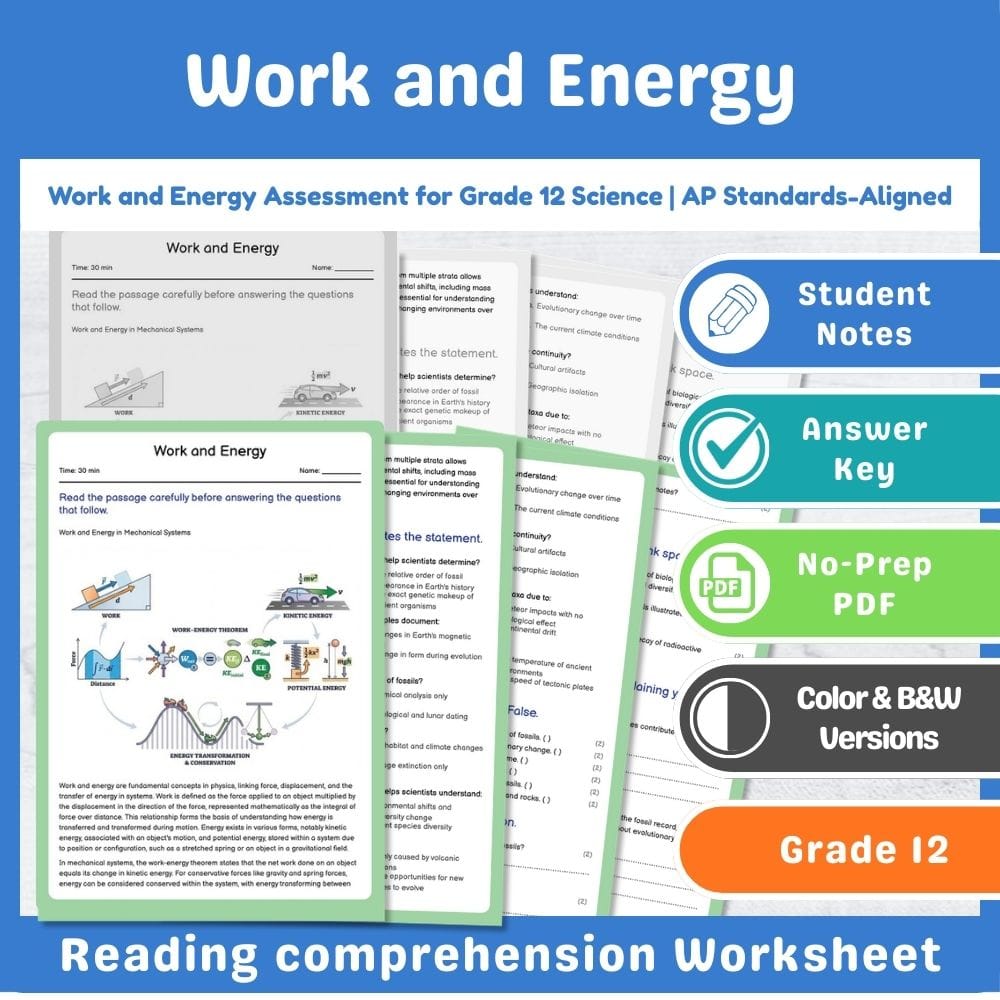
Work and Energy Assessment for Grade 12 Science | AP Standards-Aligned
Created byPrism Point LearningLearning Objectives
- Understand the concepts of work, energy, and power in mechanical systems.
- Apply force-displacement integrals to derive kinetic and potential energy.
- Differentiate between conservative and nonconservative forces and their effects on energy.
Also included in: Grade 12 Science Mini Bundle | Physics Principles AP Standards-Aligned
Instant download
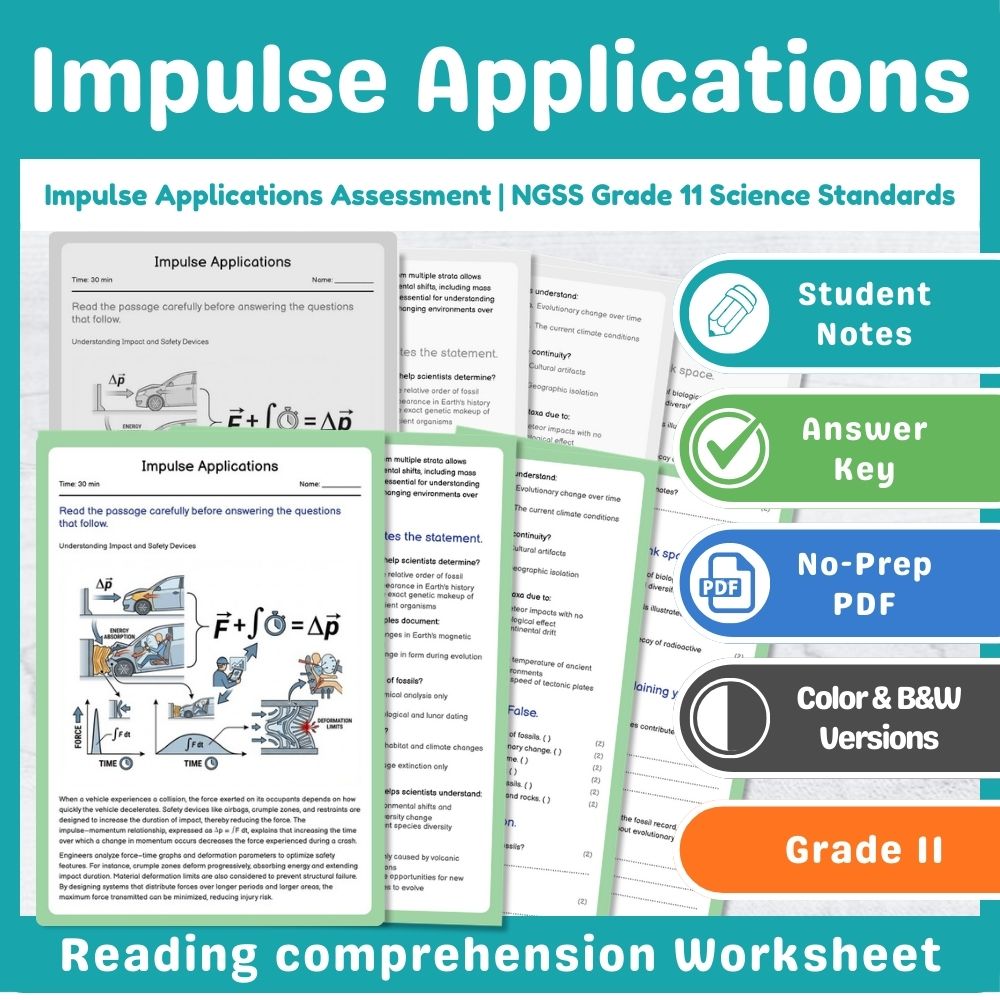
Impulse Applications Assessment | NGSS Grade 11 Science Standards
Created byPrism Point LearningLearning Objectives
- Understand the relationship between impulse and momentum in collision scenarios.
- Apply the impulse–momentum theorem to analyze crash-protection systems.
- Evaluate and refine design parameters to minimize forces during collisions.
Also included in: Grade 11 Physics Mini Bundle – Impulse, Forces & Conservation Assessment
Instant download
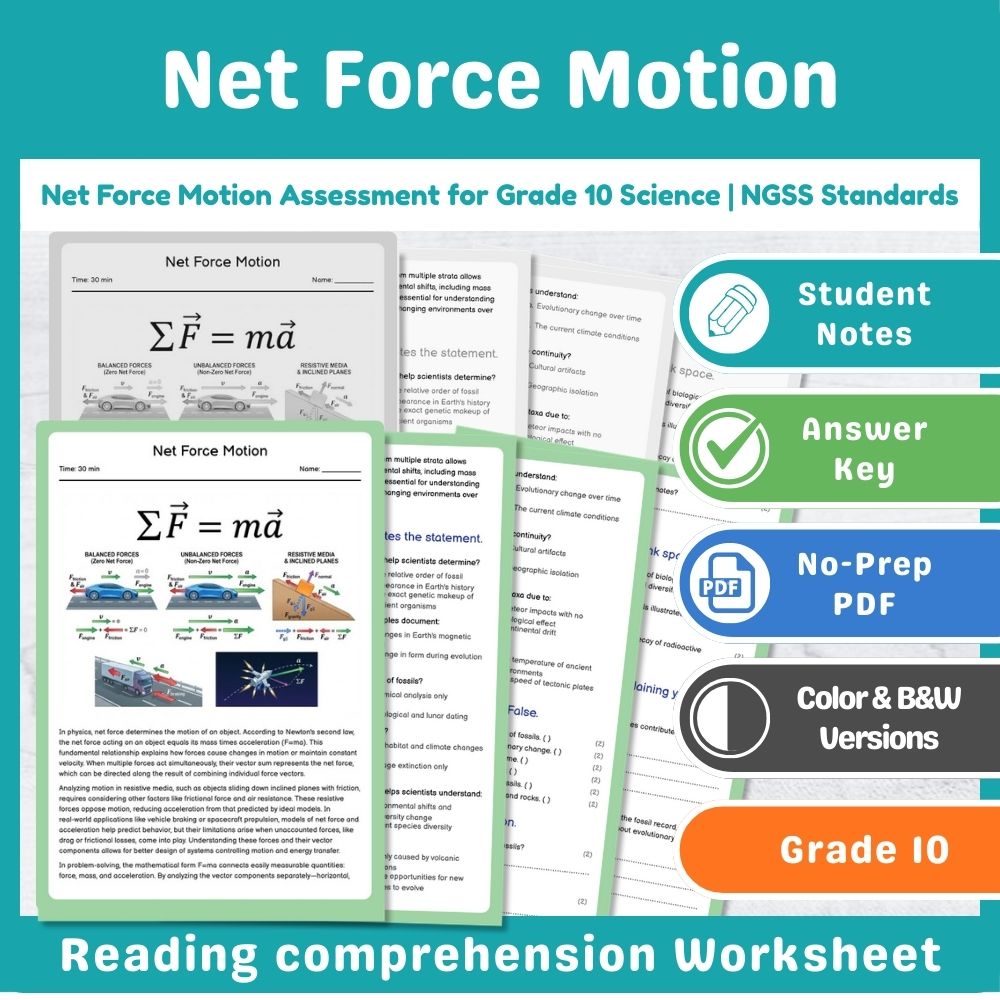
Net Force Motion Assessment for Grade 10 Science | NGSS Standards
Created byPrism Point LearningLearning Objectives
- Understand the quantitative relationship between net force, mass, and acceleration as described by Newton's second law.
- Apply vector summation to analyze net force in different motion scenarios, including inclined planes and friction.
- Use F=ma to connect force, mass, and acceleration in problem contexts like braking and constant-thrust motions.
Instant download

Conservation Principle Assessment | BC Standards Grade 6 Science
Created byPrism Point LearningLearning Objectives
- Understand the concept of energy conservation within a closed system.
- Identify various forms of energy and how they transform and transfer.
- Explain the significance of the conservation principle in different physical processes.
Instant download

Reaction Rates Assessment for Grade 6 Science BC Standards-Aligned
Created byPrism Point LearningLearning Objectives
- Understand the factors that influence the speed of chemical reactions.
- Identify how concentration, temperature, surface area, and catalysts affect reaction rates.
- Connect microscopic particle collisions to observable signs of chemical change.
Instant download
Browse more categories
About Science Worksheets
Find Science worksheets spanning core skills, practice, and review. All 44,295 resources are instant PDF downloads for the classroom or home.
Every worksheet on MyTeachingSheets is created by independent teacher-authors and reviewed before publication. All resources download as printable PDFs for classroom, homework, or at-home practice, and many include answer keys. Preview any worksheet free before buying.