
Science Worksheets
44,295 subject resources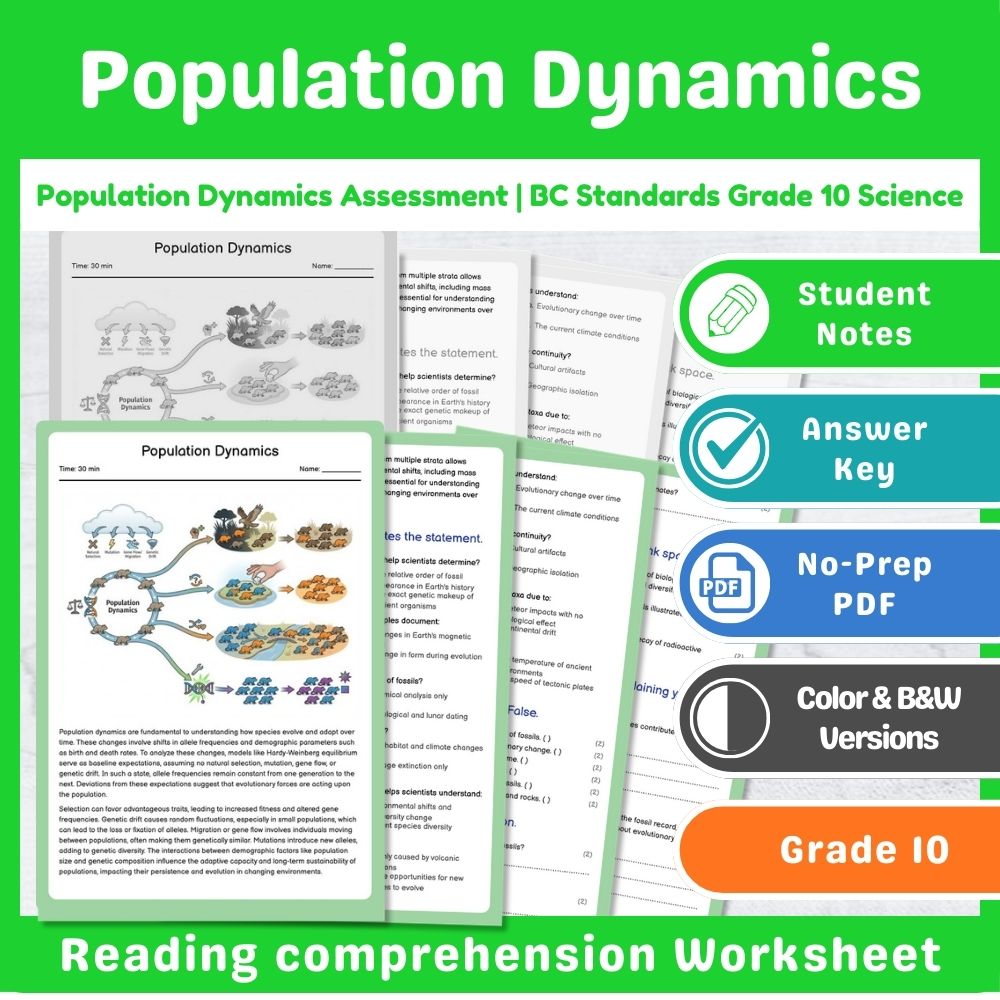
Population Dynamics Assessment | BC Standards Grade 10 Science
 Created byPrism Point Learning
Learning Objectives
- Understand basic concepts of population dynamics and evolutionary forces.
- Identify the role of models like Hardy-Weinberg equilibrium in population studies.
- Analyze how factors such as selection, mutation, migration, and drift influence genetic variation.
Instant download

Adaptation Overview Assessment – BC Standard Grade 6 Science Worksheet
Created byPrism Point LearningLearning Objectives
- Understand the concept of adaptation and its importance for survival.
- Identify different types of adaptations in animals and plants.
- Analyze real-world examples of adaptations and their functions.
Instant download

Decomposers And Nutrients Assessment | BC Standards Grade 6 Science
Created byPrism Point LearningLearning Objectives
- Understand the role of decomposers in nutrient cycling and ecosystem health.
- Identify different types of decomposers including fungi, bacteria, and detritivores.
- Explain how environmental factors affect decomposer efficiency.
Instant download
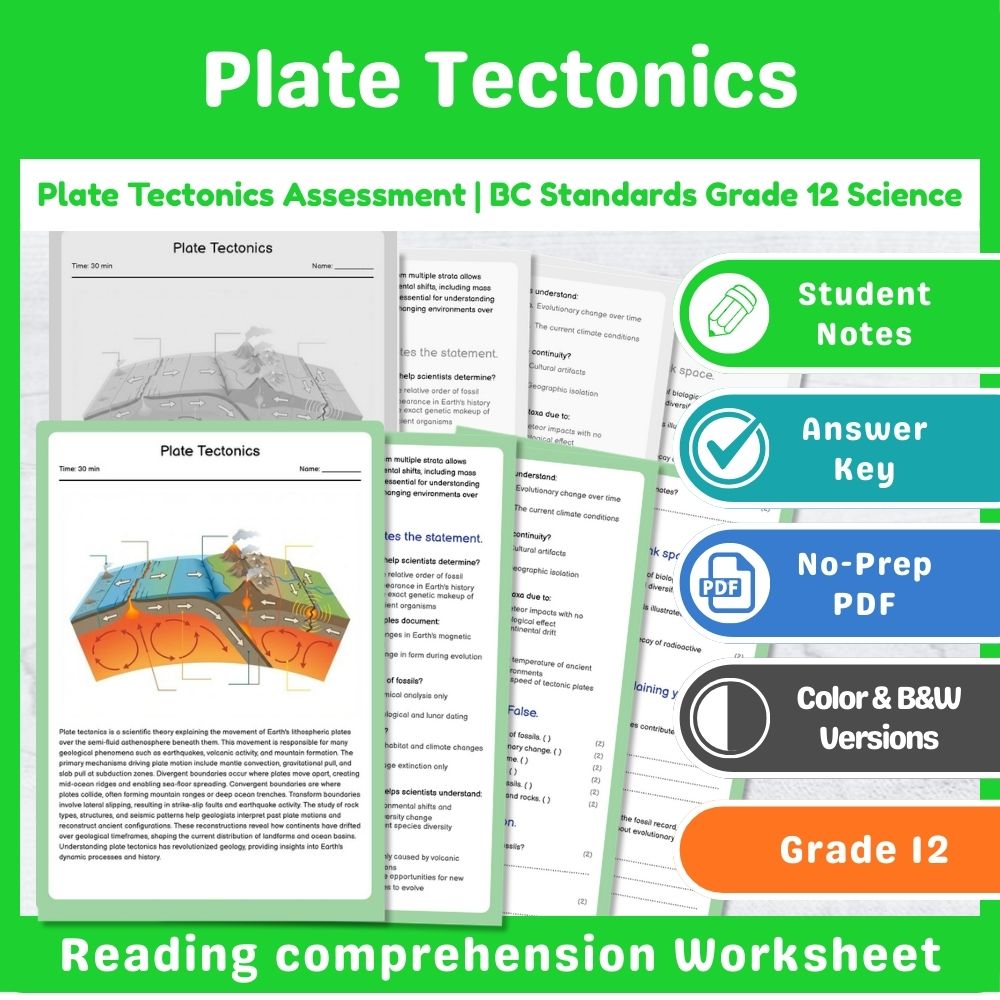
Plate Tectonics Assessment | BC Standards Grade 12 Science
Created byPrism Point LearningLearning Objectives
- Understand the fundamental concepts of plate tectonics and the mechanisms driving the movement of Earth's lithospheric plates.
- Identify different types of plate boundaries and associated geological features.
- Interpret structural relationships and distribution of rocks to reconstruct past plate configurations.
Also included in: Grade 12 Science Mini Bundle – Plate Tectonics & Geoscience Assessment
Instant download

Reaction Energetics Assessment | BC Standards Grade 10 Science
Created byPrism Point LearningLearning Objectives
- Understand the principles of energy changes during chemical reactions.
- Identify differences between exothermic and endothermic reactions.
- Relate bond energies to reaction thermodynamics and feasibility.
Instant download

Light Properties Assessment | BC Standards Grade 6 Science
Created byPrism Point LearningLearning Objectives
- Describe the wave and particle nature of light and their properties such as wavelength, frequency, and energy.
- Explain how visible, ultraviolet, and infrared light differ in wavelength and energy.
- Understand how different materials transmit, absorb, or reflect specific colours based on light properties.
Instant download

Ecosystem Matter Cycling Assessment | Standards-Aligned Grade 8 Science
Created byPrism Point LearningLearning Objectives
- Understand how matter cycles through ecosystems involving living and nonliving components.
- Identify processes such as decomposition, gas exchange, and nutrient transformation that return elements to the environment.
- Explain how producers and consumers transfer matter within ecosystems over time.
Also included in: Grade 8 Life Science Science Lesson Bundle – General Framework Resources
Instant download

Electron Configuration Assessment | BC Standards Grade 10 Science
Created byPrism Point LearningLearning Objectives
- Describe how electrons occupy energy levels and orbitals around an atomic nucleus.
- Explain the significance of valence electrons in bonding and chemical reactivity.
- Apply principles of quantized energy levels to determine electron distribution in elements.
Instant download
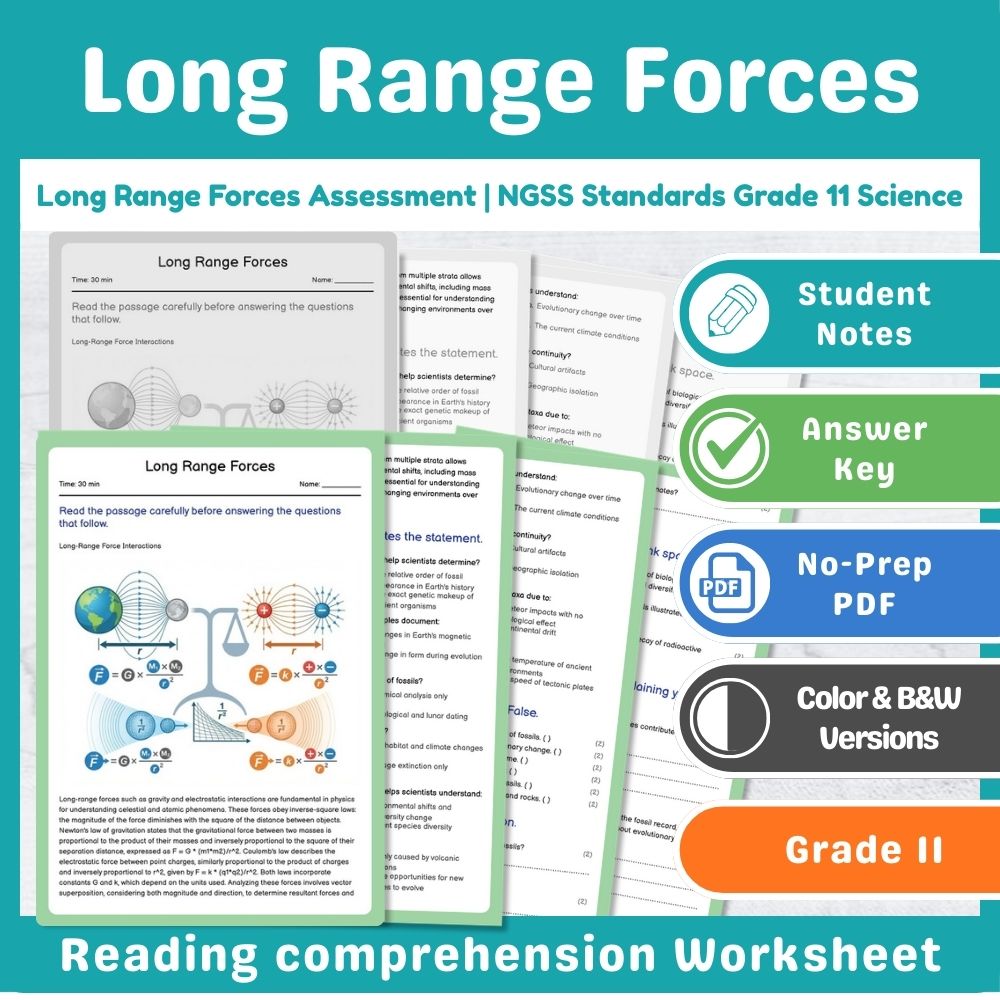
Long Range Forces Assessment | NGSS Standards Grade 11 Science
Created byPrism Point LearningLearning Objectives
- Understand how inverse-square laws describe gravitational and electrostatic forces.
- Apply Newton's law of universal gravitation and Coulomb's law to solve force problems.
- Use vector addition to determine net forces and predict motion trajectories.
Also included in: Grade 11 Physics Mini Bundle – Impulse, Forces & Conservation Assessment
Instant download
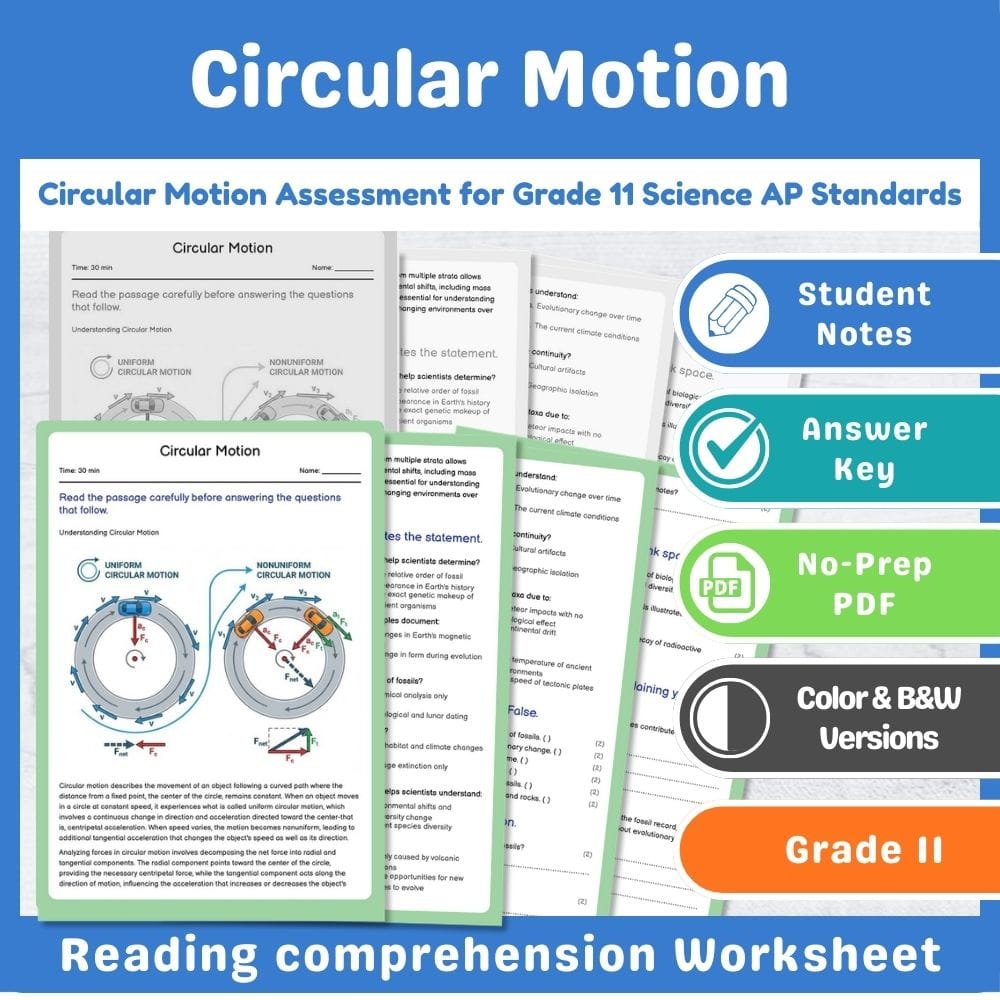
Circular Motion Assessment for Grade 11 Science AP Standards
Created byPrism Point LearningLearning Objectives
- Describe uniform and nonuniform circular motion with emphasis on centripetal and tangential accelerations.
- Model net forces in circular motion by analyzing radial and tangential components.
- Express acceleration vectors in polar coordinates and relate them to the change in velocity direction.
Instant download

Diffusion Rates Assessment | BC Grade 6 Science Standards
Created byPrism Point LearningLearning Objectives
- Explain the process of diffusion and the factors that influence its rate.
- Connect microscopic particle movement to observable phenomena like scent dispersion and gas mixing.
- Identify how temperature, particle size, and medium viscosity affect diffusion speed.
Instant download
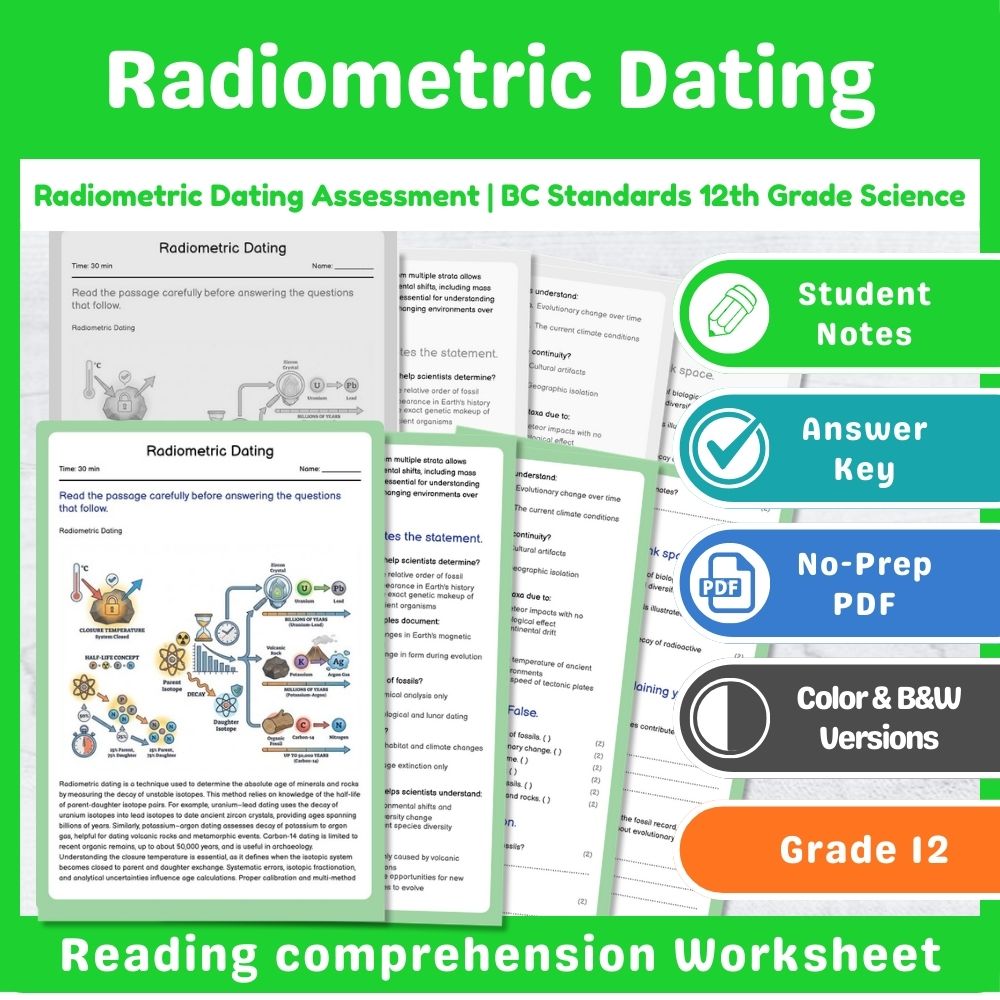
Radiometric Dating Assessment | BC Standards 12th Grade Science
Created byPrism Point LearningLearning Objectives
- Understand the principles of radiometric dating and isotopic decay.
- Identify different radiometric dating methods and their applications.
- Analyze factors affecting the accuracy of radiometric age determinations.
Also included in: Grade 12 Science Mini Bundle – Plate Tectonics & Geoscience Assessment
Instant download
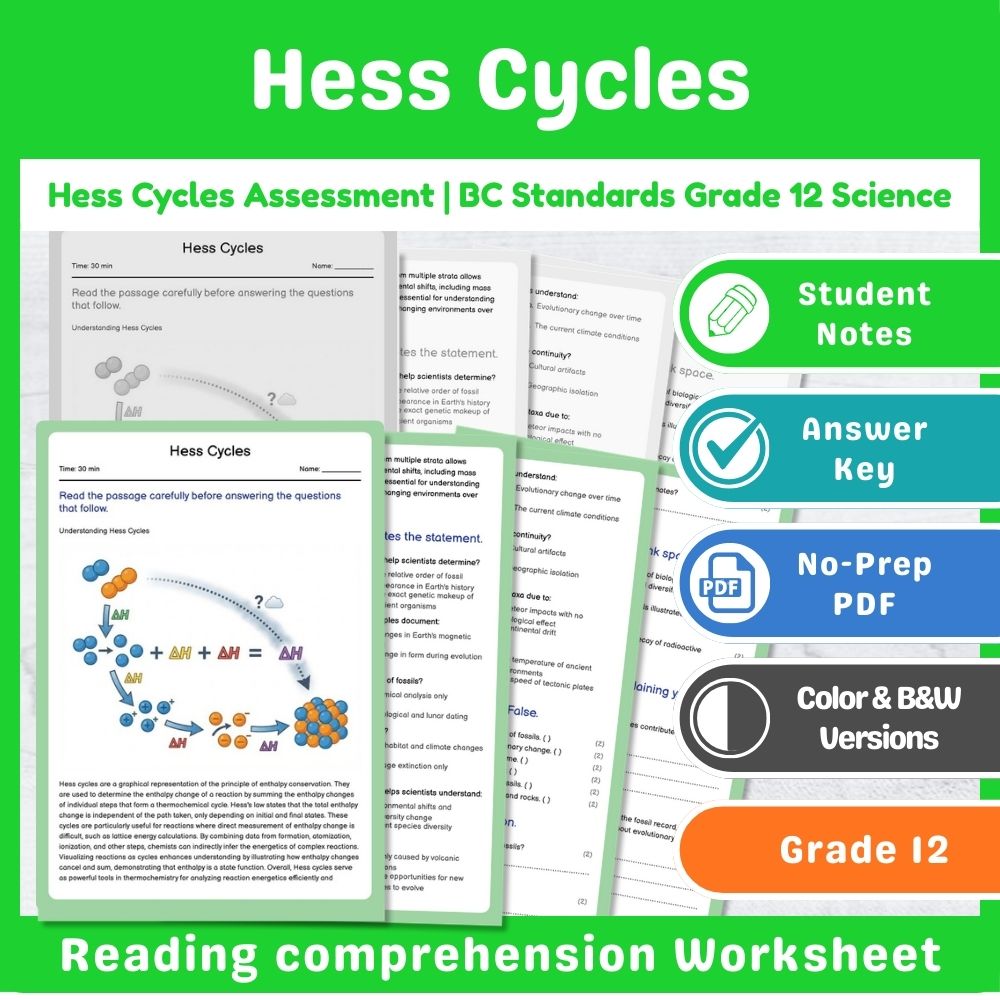
Hess Cycles Assessment | BC Standards Grade 12 Science
Created byPrism Point LearningLearning Objectives
- Understand the principle of enthalpy conservation as applied in Hess cycles.
- Analyze how thermochemical cycles can be used to determine reaction energetics indirectly.
- Explain the significance of state functions and how enthalpy changes cancel in cycles.
Also included in: Grade 12 Science Mini Bundle – Thermochemistry & Equilibrium Assessment
Instant download

Digestive System Assessment for Grade 6 Science | Standards-Aligned
Created byPrism Point LearningLearning Objectives
- Describe the organs involved in the digestive process and their functions.
- Explain how mechanical and chemical digestion work together to break down food.
- Identify the role of enzymes and acids in digesting proteins, fats, and carbohydrates.
Instant download

Energy Efficiency Assessment | BC Grade 6 Science Standards-Aligned
Created byPrism Point LearningLearning Objectives
- Understand the concept of energy efficiency and how it relates useful output to total input.
- Identify common sources of energy loss in machines, lighting, and heating systems.
- Evaluate the trade-offs involved in different energy technologies and systems.
Instant download

Clouds and Precipitation Assessment | California Standards Grade 7 Science
Created byPrism Point LearningLearning Objectives
- Explain how cooling air leads to condensation and cloud formation.
- Describe how temperature and moisture determine cloud type and precipitation type.
- Connect energy transfers during phase changes to weather patterns.
Also included in: Grade 7 Earth Systems Science Lesson Bundle Assessments | California Standards +1 more
Instant download
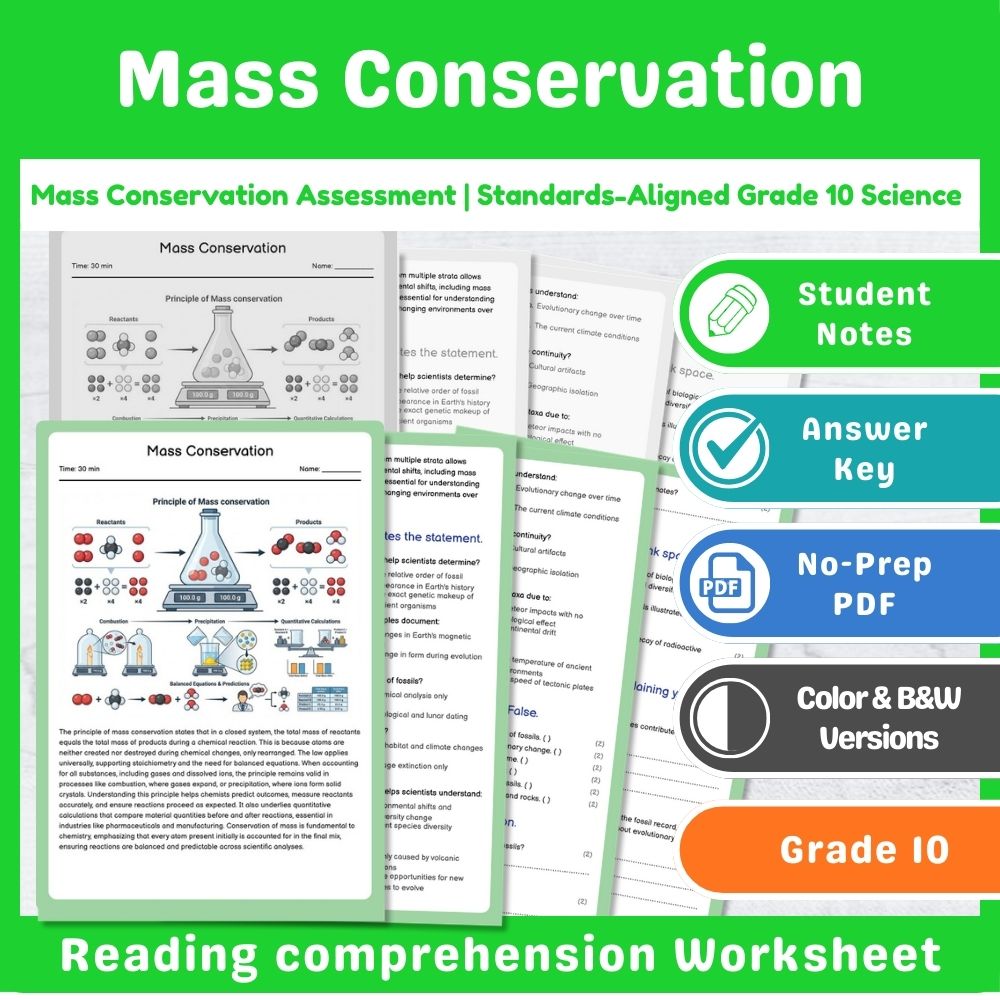
Mass Conservation Assessment | Standards-Aligned Grade 10 Science Worksheet
Created byPrism Point LearningLearning Objectives
- Understand the principle of conservation of mass in chemical reactions.
- Identify how mass is conserved in different types of chemical processes.
- Apply the concept of mass conservation to balance chemical equations.
Instant download

Species Interactions Assessment for Grade 8 Science | Florida NGSSS
Created byPrism Point LearningLearning Objectives
- Explain how competition, predation, mutualism, commensalism, and parasitism affect survival and reproduction
- Describe how species interactions can change population sizes over time
- Use evidence from examples to identify the type of species interaction and its ecosystem impact
Also included in: Grade 8 Evolution and Genetics Science Lesson Bundle | Florida NGSSS
Instant download
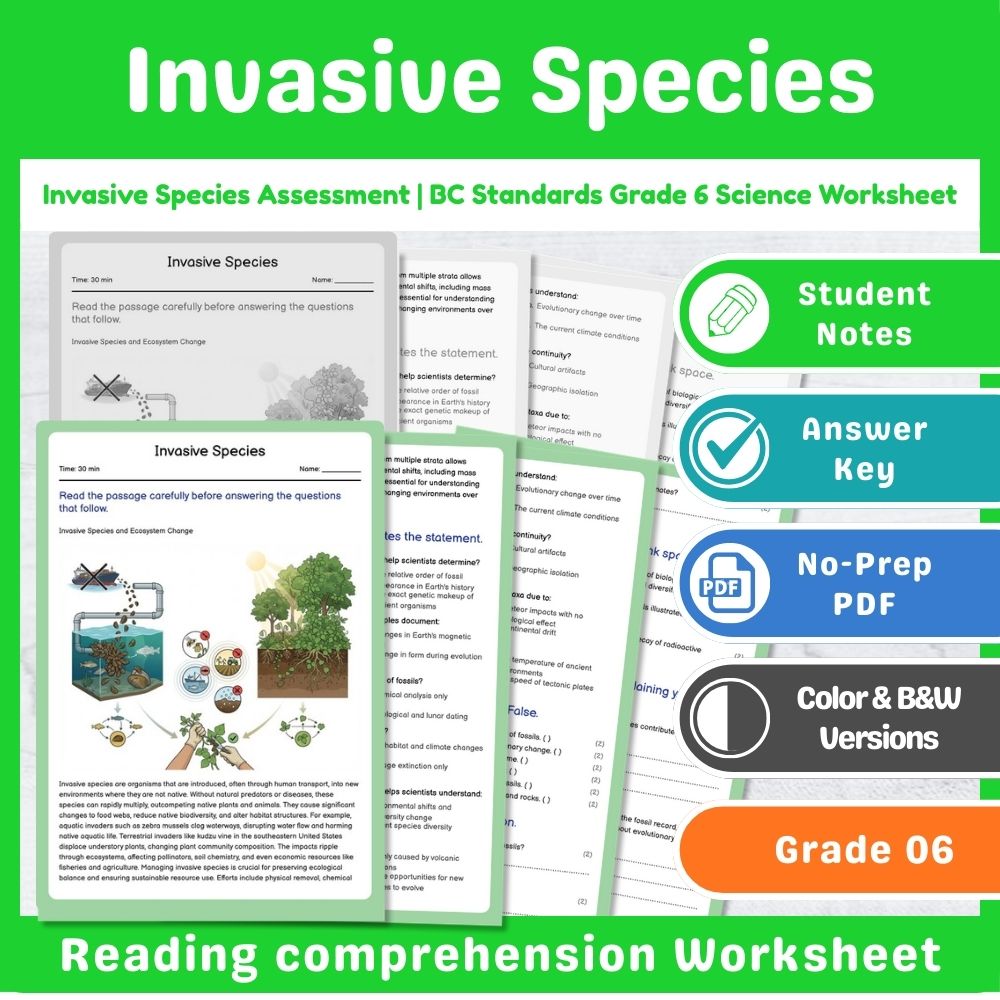
Invasive Species Assessment | BC Standards Grade 6 Science Worksheet
Created byPrism Point LearningLearning Objectives
- Understand the definition and characteristics of invasive species.
- Identify examples and impacts of invasive species on ecosystems.
- Analyze how invasive species outcompete native organisms and alter habitats.
Instant download

Gene Expression Pathway Assessment for Grade 12 Science | Standards-Aligned
Created byPrism Point LearningLearning Objectives
- Explain how transcription and translation enable cells to express genetic information as proteins.
- Describe how regulation at multiple steps can create different phenotypes from the same genome.
- Analyze how timing and cell-type specific control of gene expression influence traits.
Instant download
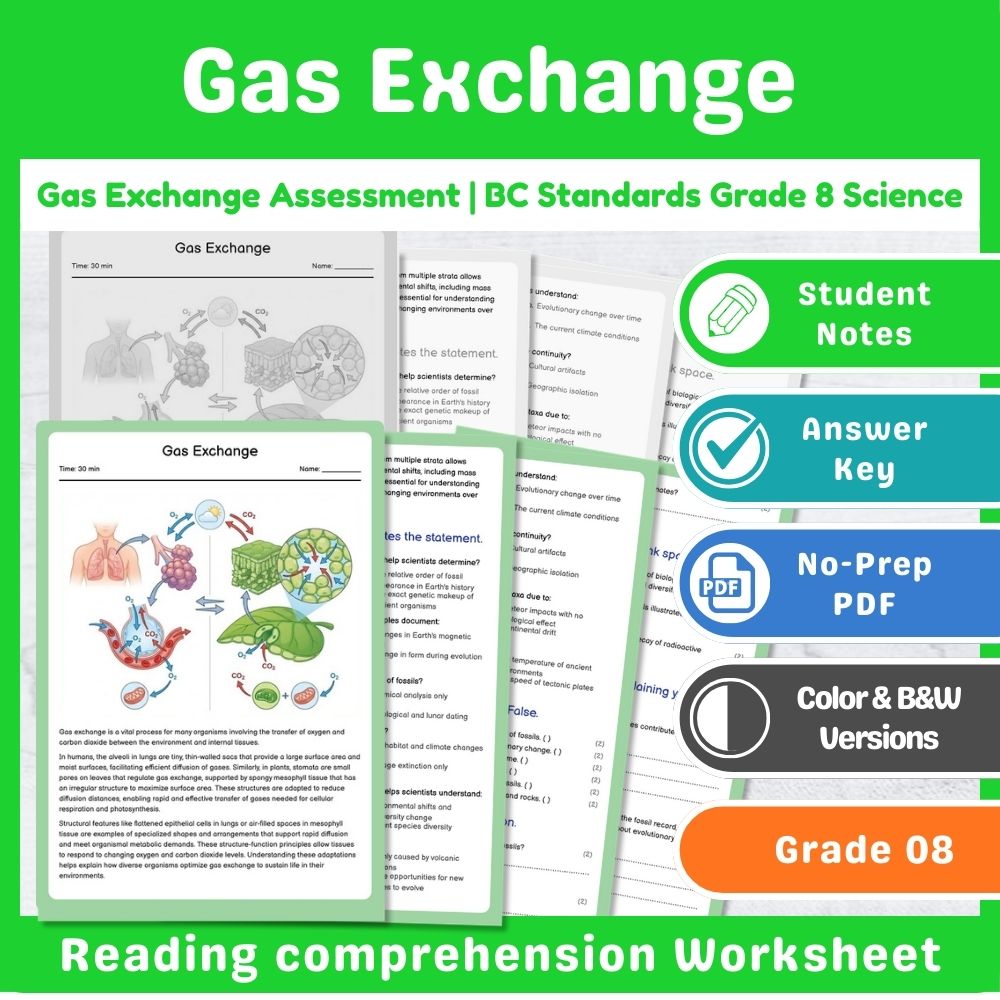
Gas Exchange Assessment | BC Standards Grade 8 Science
Created byPrism Point LearningLearning Objectives
- Understand how thin, moist surfaces facilitate gas exchange in organisms.
- Identify different structures involved in gas exchange, such as alveoli and stomata.
- Explain structural adaptations that support efficient diffusion of gases.
Instant download
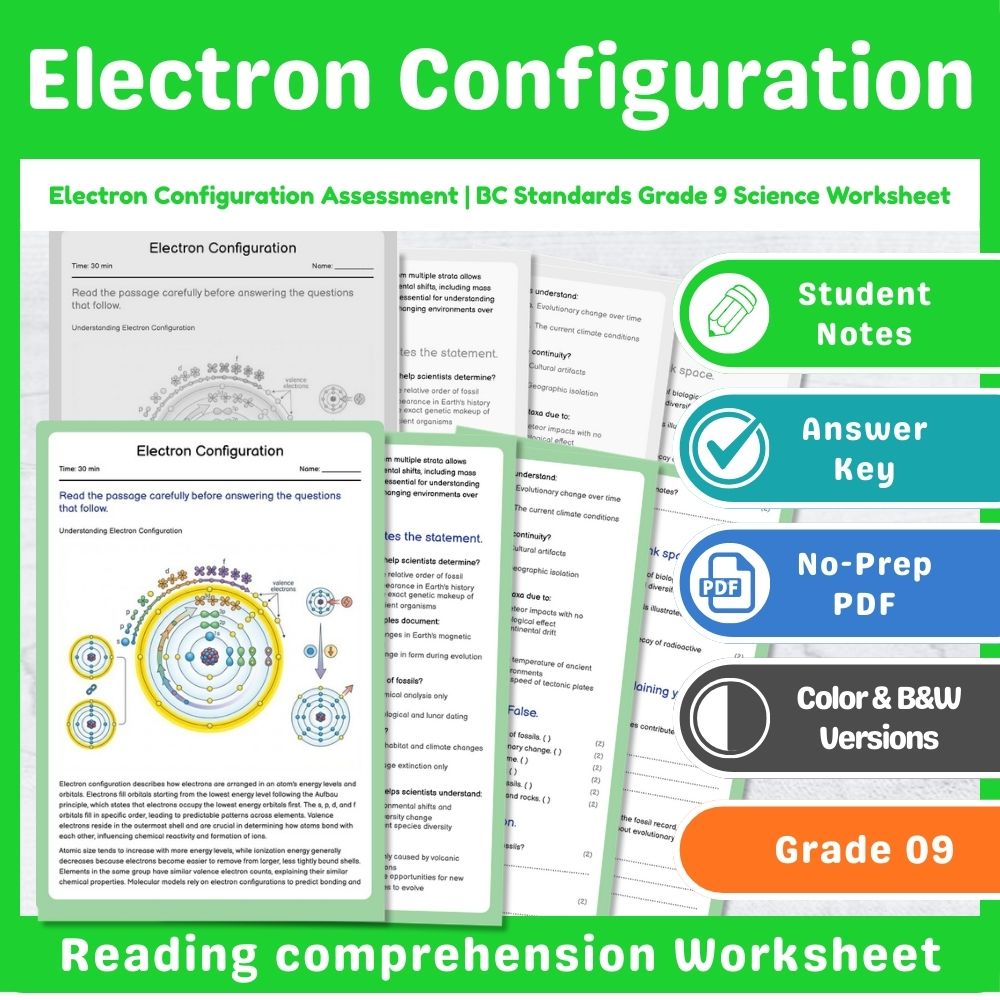
Electron Configuration Assessment | BC Standards Grade 9 Science Worksheet
Created byPrism Point LearningLearning Objectives
- Describe the distribution of electrons in atoms using electron configuration notation.
- Explain the significance of valence electrons in chemical bonding and reactivity.
- Identify trends in atomic size and ionization energy based on electron configurations.
Instant download

Transport and Sediment Assessment | General Standards Grade 6 Science
Created byPrism Point LearningLearning Objectives
- Understand how streams and wind transfer particles of different sizes based on energy and strength.
- Explain the process of sorting of sediments during transportation and deposition.
- Identify natural structures formed by sediment sorting, such as sandbars and deltas.
Also included in: Grade 6 Life Science Science Lesson Bundle – General Framework Unit
Instant download

Survival Changes Assessment | NGSSS Grade 6 Science Standards
Created byPrism Point LearningLearning Objectives
- Explain how environmental conditions affect which traits help organisms survive and reproduce.
- Describe how changes in survival and reproduction can shift traits in a population over generations.
- Connect adaptation to ecosystem change and resilience when resources or conditions shift.
Also included in: Grade 6 Ecosystems Science Lesson Bundle | Florida NGSSS Assessment
Instant download

Properties and Classification Assessment | TEKS Grade 7 Science Worksheet
Created byPrism Point LearningLearning Objectives
- Define physical and chemical properties used to classify substances.
- Identify measurable attributes such as density, solubility, hardness, and conductivity.
- Distinguish between elements, compounds, and mixtures based on observable properties.
Also included in: Grade 7 Matter and Energy Science Lesson Bundle: TEKS assessments
Instant download

Climate Data Trends Assessment for Grade 8 Science | NGSSS Standards
Created byPrism Point LearningLearning Objectives
- Interpret climate indicators by comparing temperature, precipitation, and storm-frequency data over time.
- Distinguish long-term climate trends from short-term weather variability and single extreme events.
- Explain how El Niño and La Niña can affect rainfall patterns using evidence from data records.
Also included in: Grade 8 Earth Systems Science Lesson Bundle: Florida NGSSS Assessment
Instant download

Seafloor Spreading Assessment | BC Standards Grade 9 Science
Created byPrism Point LearningLearning Objectives
- Explain the process of seafloor spreading at mid-ocean ridges.
- Identify the evidence supporting episodic seafloor spreading rates.
- Describe how magnetic striping patterns provide evidence for oceanic crust formation.
Also included in: Grade 9 Science Mini Bundle – Earth & Space Assessment & Activities
Instant download

Magnetic Separation Assessment for Grade 6 Science – Standards Aligned
Created byPrism Point LearningLearning Objectives
- Understand the principle of magnetic separation and its applications.
- Identify materials that respond to magnetic forces versus those that do not.
- Describe how magnetic separation can be used in everyday technology and recycling.
Also included in: Grade 6 Physical Science Science Lesson Bundle: General Framework
Instant download
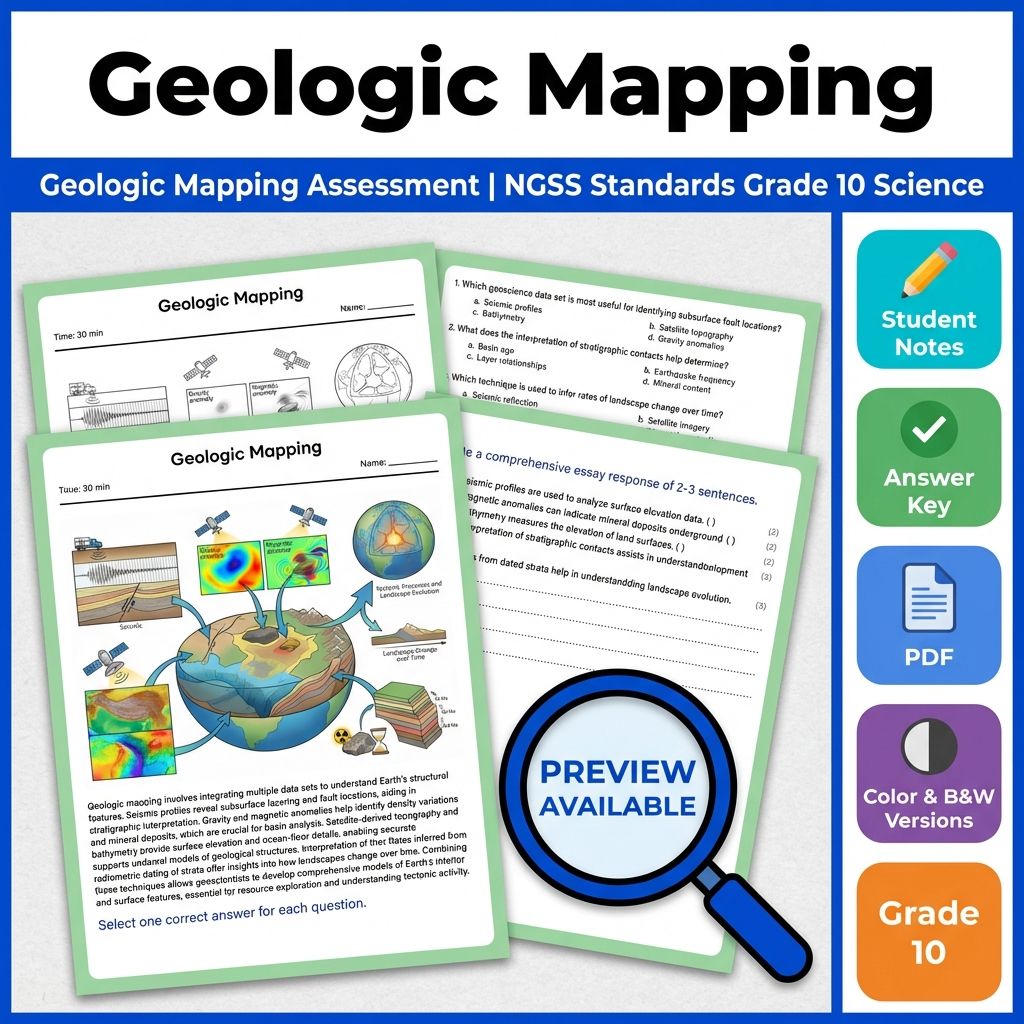
Geologic Mapping Assessment | NGSS Standards Grade 10 Science
Created byPrism Point LearningLearning Objectives
- Understand the components and data sources used in geologic mapping.
- Interpret stratigraphic contacts, fault systems, and basin structures from geological data.
- Explain how rates from geochronology support landscape evolution models.
Instant download

Bond Types Assessment Grade 9 | BC Science Standards-Aligned Assessment
Created byPrism Point LearningLearning Objectives
- Identify the three main types of chemical bonds: ionic, covalent, and metallic.
- Describe the electron arrangements involved in each bond type.
- Explain how bond types influence physical and chemical properties of substances.
Instant download

Innovation History Assessment | TEKS Grade 7 Science Standards
Created byPrism Point LearningLearning Objectives
- Trace the causes and diffusion of technological inventions across history.
- Identify factors that enable invention, such as needs, materials, and incremental improvements.
- Differentiate between invention and innovation through historical examples.
Instant download

Inclined Planes Assessment | BC Standards Grade 9 Science
Created byPrism Point LearningLearning Objectives
- Explain how inclined planes decompose gravitational force into components parallel and perpendicular to the surface.
- Calculate the mechanical advantage of inclined planes and understand the trade-off between force and distance.
- Assess how friction and slope angle affect net acceleration and energy transfer during motion.
Instant download

Evaporation and Transpiration Assessment | California Standards Grade 6 Science
Created byPrism Point LearningLearning Objectives
- Explain how evaporation and transpiration add water vapor to the atmosphere
- Describe how temperature and available liquid water affect the amount of water vapor
- Connect phase changes to the water cycle, including condensation and precipitation
Also included in: Grade 6 Water in Earth Systems Science Lesson Bundle: California Standards +1 more
Instant download

Crystal Structures Assessment | BC Grade 6 Science Standards-Aligned
Created byPrism Point LearningLearning Objectives
- Understand the differences between crystalline and amorphous solids based on particle arrangement.
- Identify observable behaviors associated with crystalline and amorphous structures.
- Explain how particle bonding strength influences solid properties.
Instant download
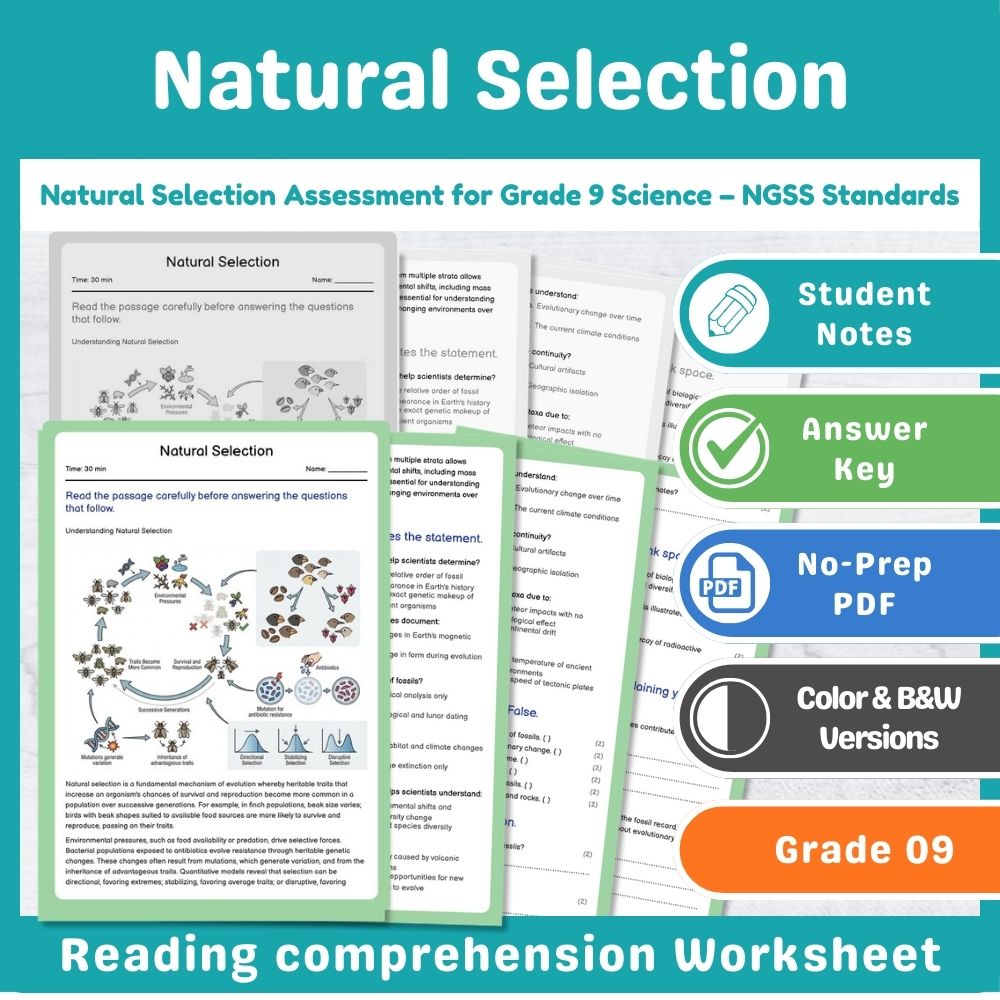
Natural Selection Assessment for Grade 9 Science – NGSS Standards
Created byPrism Point LearningLearning Objectives
- Explain the mechanisms of natural selection, including variation, inheritance, and selection pressures.
- Identify classic examples of natural selection, such as finch beak morphology and bacterial resistance.
- Describe how models of fitness and allele frequency determine different types of selection.
Instant download
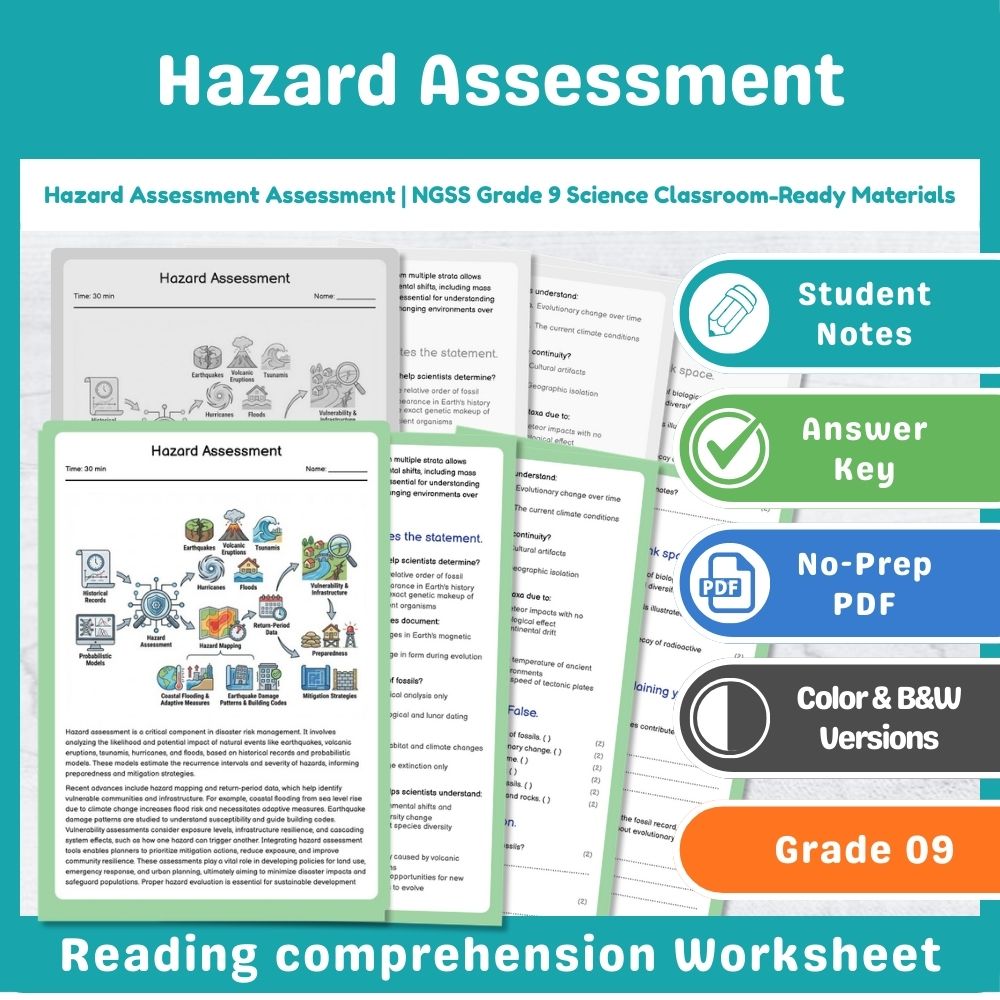
Hazard Assessment Assessment | NGSS Grade 9 Science Classroom-Ready Materials
Created byPrism Point LearningLearning Objectives
- Understand the methods used to evaluate hazard risks such as earthquakes, volcanoes, tsunamis, hurricanes, and floods.
- Analyze hazard occurrence, frequency, and consequences using historical data and probabilistic models.
- Recognize the importance of hazard mapping, return-period data, and mitigation strategies in assessing community susceptibility.
Instant download
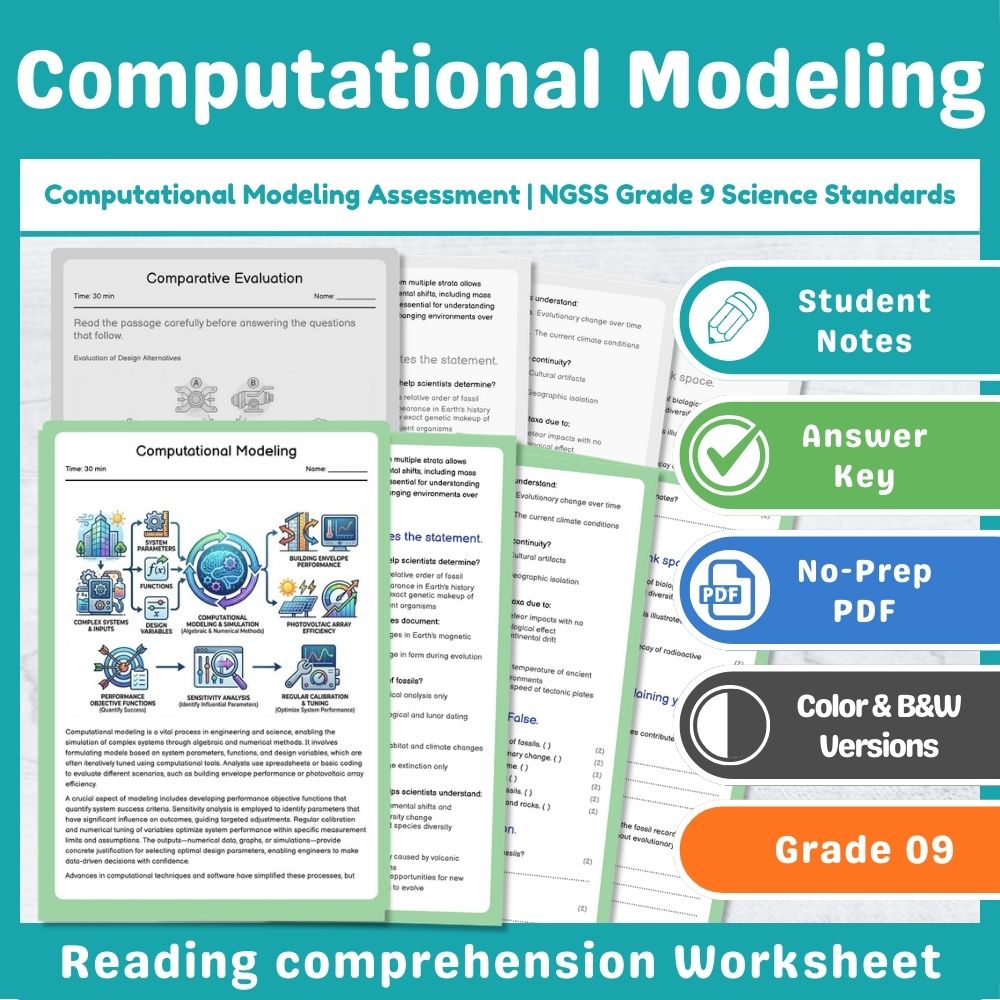
Computational Modeling Assessment | NGSS Grade 9 Science Standards
Created byPrism Point LearningLearning Objectives
- Understand the application of mathematical and computational methods in system modeling.
- Analyze how parameters and variables influence system performance.
- Develop and evaluate models using spreadsheets and simple code simulations.
Instant download
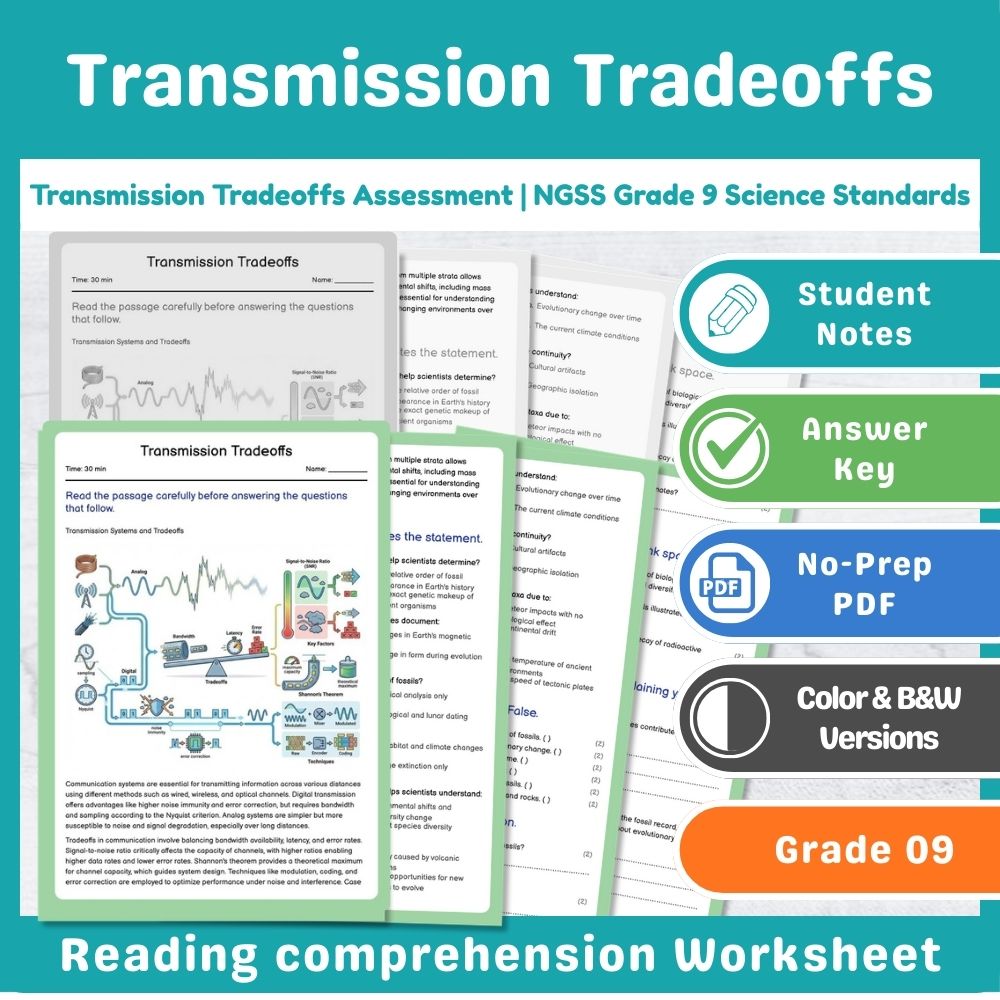
Transmission Tradeoffs Assessment | NGSS Grade 9 Science Standards
Created byPrism Point LearningLearning Objectives
- Understand the tradeoffs involved in digital and analog communication systems.
- Analyze the impact of bandwidth constraints, signal-to-noise ratio, and sampling criteria on transmission quality.
- Evaluate error-correcting techniques and their effect on data integrity in noisy environments.
Instant download
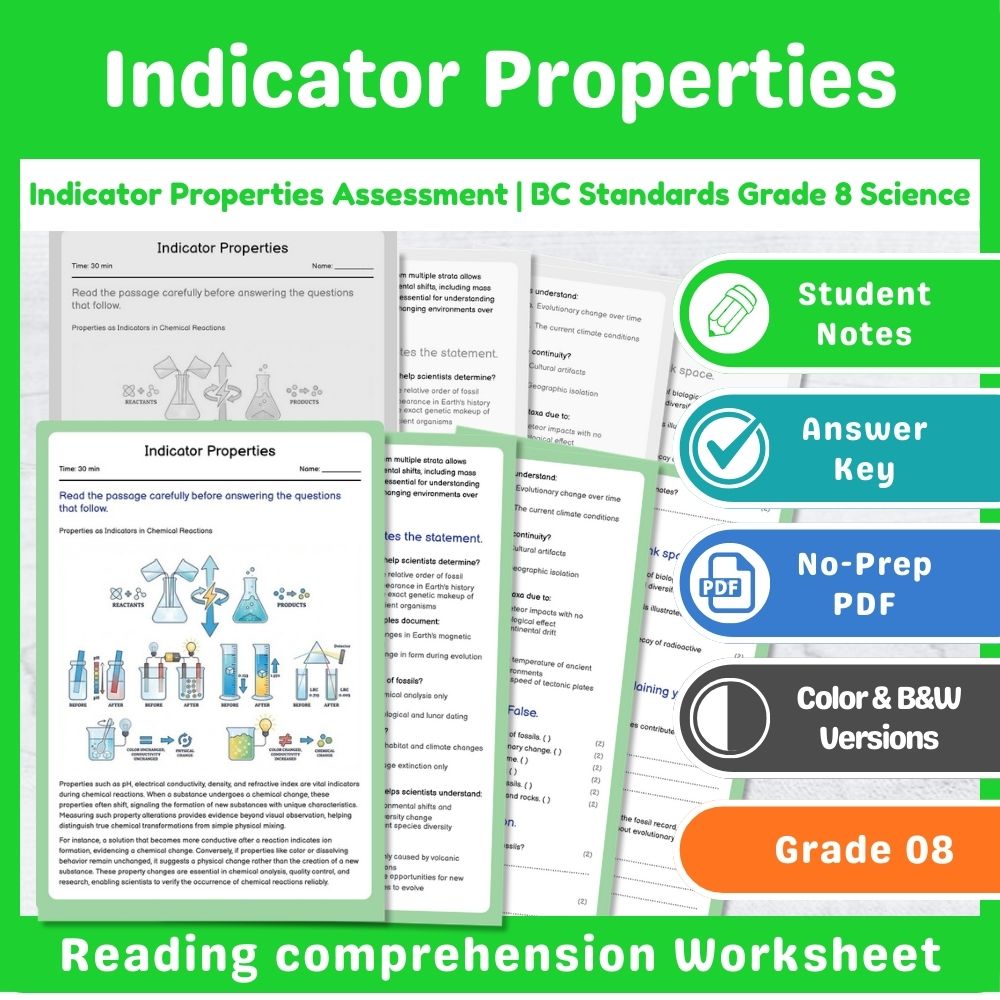
Indicator Properties Assessment | BC Standards Grade 8 Science
Created byPrism Point LearningLearning Objectives
- Understand how properties such as pH, conductivity, density, and refractive index change during chemical reactions.
- Identify property shifts indicating formation of new substances with distinct traits.
- Differentiate between physical and chemical changes using property measurements.
Also included in: Grade 8 Science Lesson – Reaction Types & Evidence Assessment Bundle
Instant download
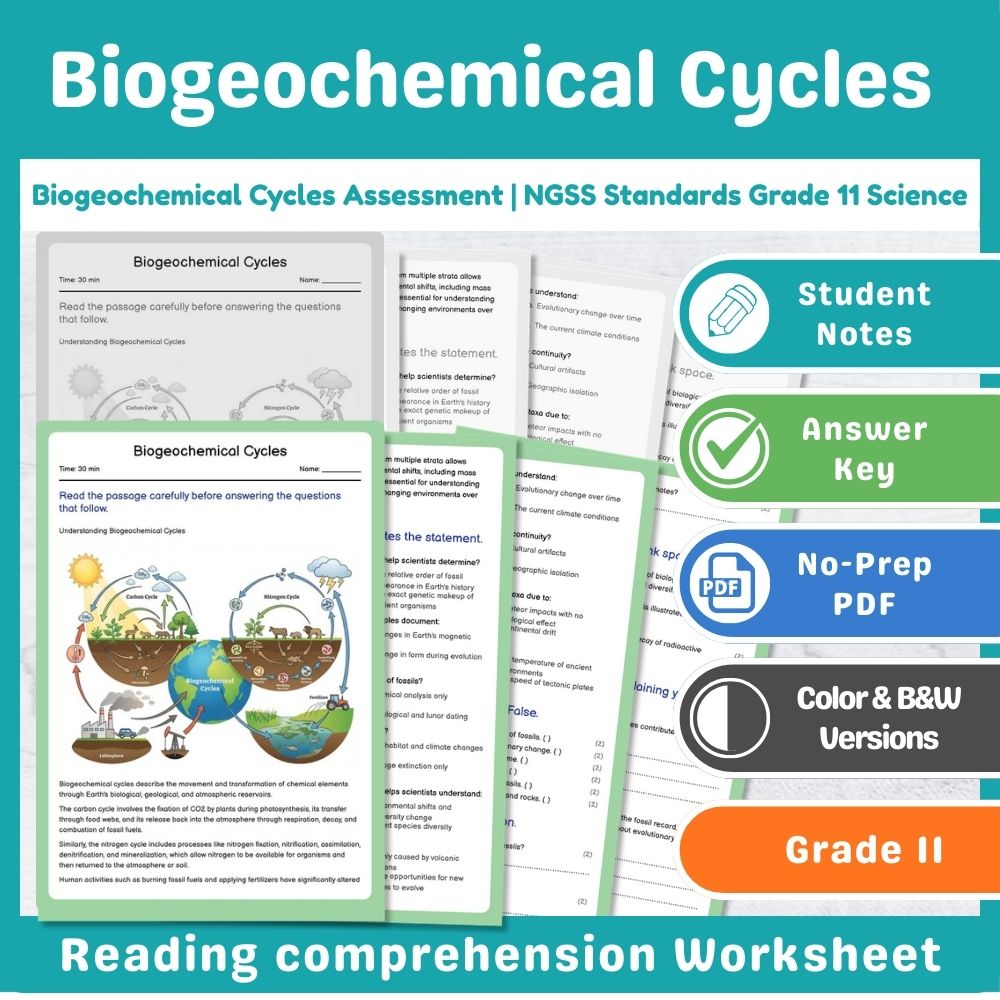
Biogeochemical Cycles Assessment | NGSS Standards Grade 11 Science
Created byPrism Point LearningLearning Objectives
- Understand the key processes involved in biogeochemical cycles such as carbon, nitrogen, phosphorus, and water.
- Identify the reservoirs and flow pathways of elements through biological, geological, and atmospheric systems.
- Explain human impacts like fossil fuel combustion and fertilizer use on nutrient pools and fluxes.
Also included in: Grade 11 Science Mini Bundle | Ecosystems Interactions & Energy NGSS
Instant download

Aerobic Versus Anaerobic Assessment | TEKS Grade 10 Science Printable
Created byPrism Point LearningLearning Objectives
- Compare and contrast aerobic and anaerobic respiration pathways.
- Identify the products and energy yields of aerobic and anaerobic processes.
- Explain the significance of oxygen in cellular respiration.
Instant download
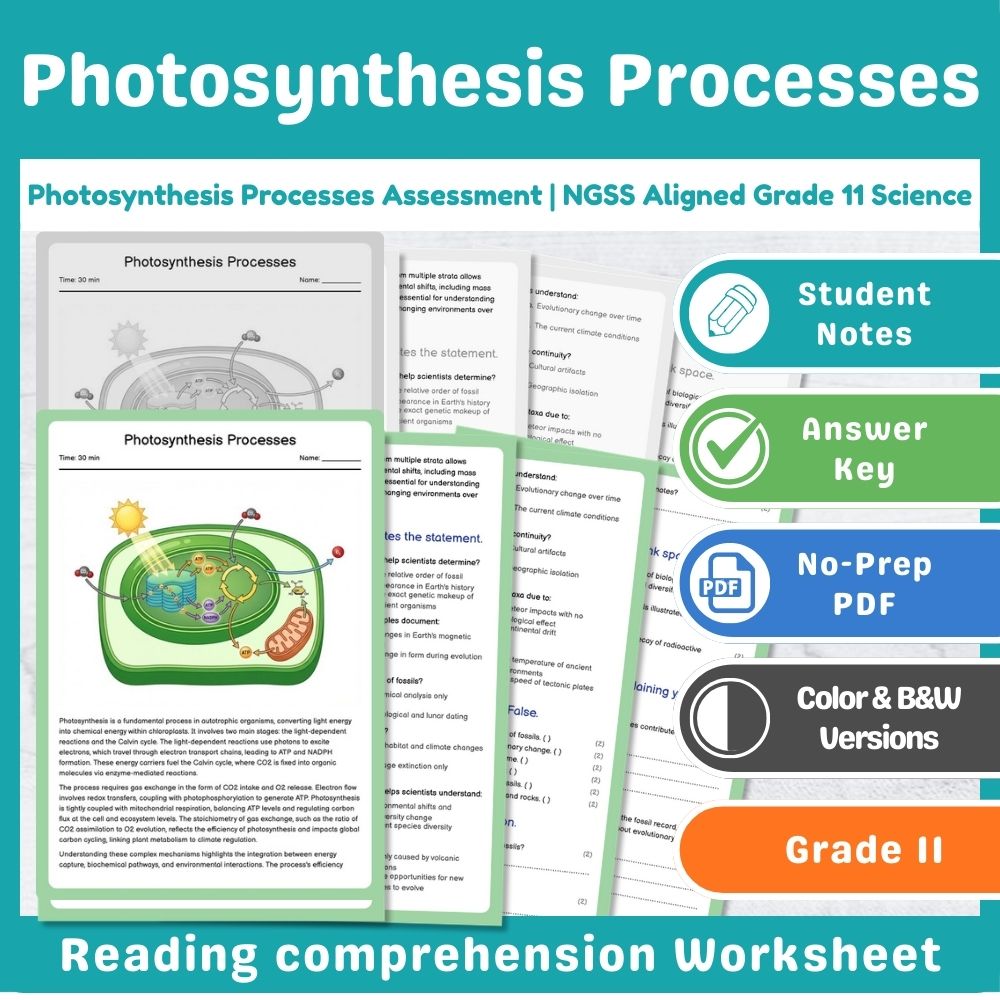
Photosynthesis Processes Assessment | NGSS Aligned Grade 11 Science
Created byPrism Point LearningLearning Objectives
- Explain the light-driven and biochemical stages of photosynthesis, including electron transport, photophosphorylation, and the Calvin cycle.
- Describe the integration of photosynthesis with mitochondrial respiration, focusing on gas exchange, ATP balance, and carbon flux.
- Analyze the stoichiometry of CO2 uptake and O2 release during photosynthesis and respiration.
Instant download

Energy Flow in Ecosystems Assessment | General Grade 8 Science
Created byPrism Point LearningLearning Objectives
- Explain how energy flows through trophic levels in an ecosystem.
- Identify the roles of producers, consumers, and decomposers in energy transfer.
- Describe why energy decreases as it moves along a food chain.
Also included in: Grade 8 Life Science Science Lesson Bundle – General Framework Resources
Instant download

Climate Drivers Over Time Assessment | General Grade 7 Science
Created byPrism Point LearningLearning Objectives
- Understand how natural records and measurements are used to assess past and present climate conditions.
- Identify key climate drivers that influence long-term climate change.
- Explain how factors like greenhouse gases, ocean currents, and volcanic activity affect Earth's energy balance.
Also included in: Grade 7 Earth & Space Science Lesson Bundle: General Science Framework
Instant download
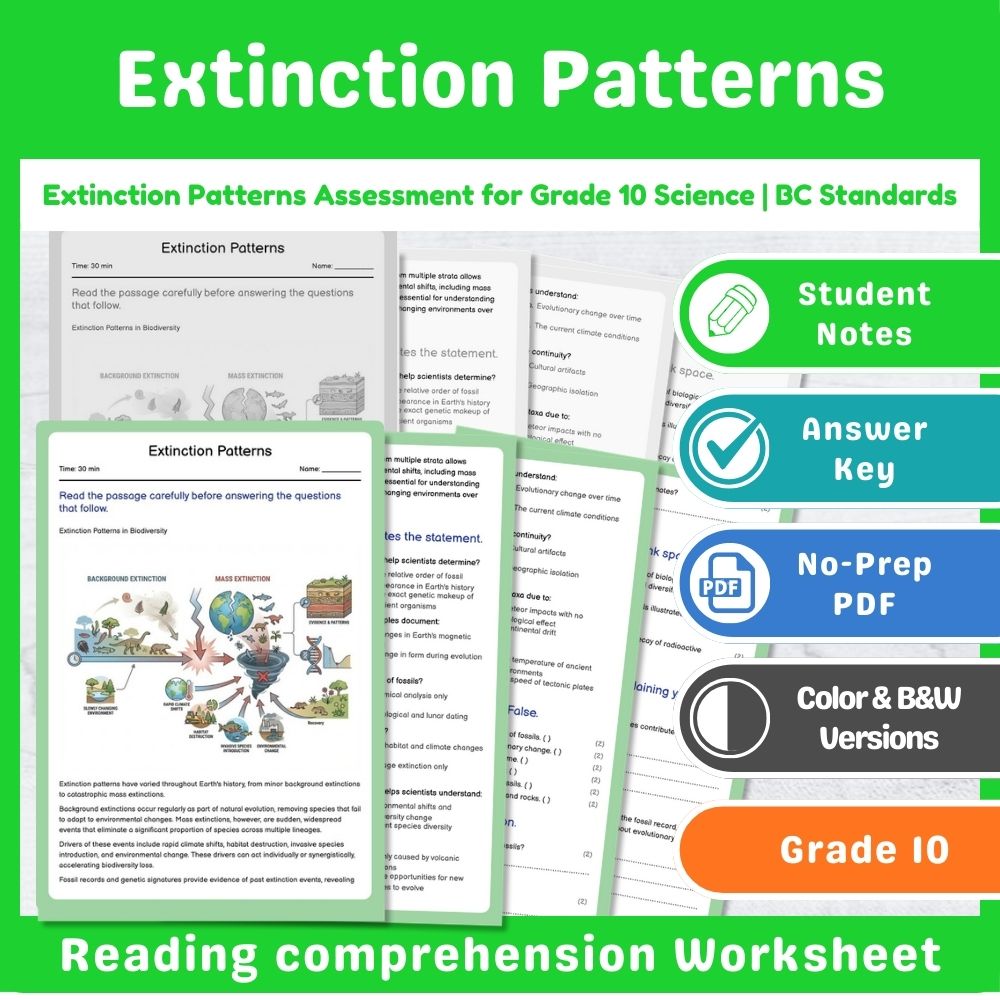
Extinction Patterns Assessment for Grade 10 Science | BC Standards
Created byPrism Point LearningLearning Objectives
- Understand various extinction patterns from background losses to mass extinctions.
- Identify causes and drivers of extinction events such as environmental changes and invasive species.
- Explain how fossil and genetic signatures reveal past biodiversity crises.
Instant download

Phylogenetic Trees Assessment Grade 10 Science TEKS | Printable Worksheet
Created byPrism Point LearningLearning Objectives
- Understand the concept of phylogenetic trees and their role in evolutionary biology.
- Identify shared derived traits, molecular data, and fossil evidence used to construct trees.
- Interpret branching diagrams to analyze relationships among species.
Also included in: Grade 10 Evolution and Heredity Science Lesson Bundle for TEKS Standards
Instant download

Surface Process Evidence Assessment | General Grade 7 Science
Created byPrism Point LearningLearning Objectives
- Understand how Earth's surface is shaped by internal and external processes.
- Identify evidence of surface processes in landform patterns and rock formations.
- Explain how landforms such as deltas and floodplains are formed through external processes.
Also included in: Grade 7 Earth & Space Science Lesson Bundle: General Science Framework
Instant download
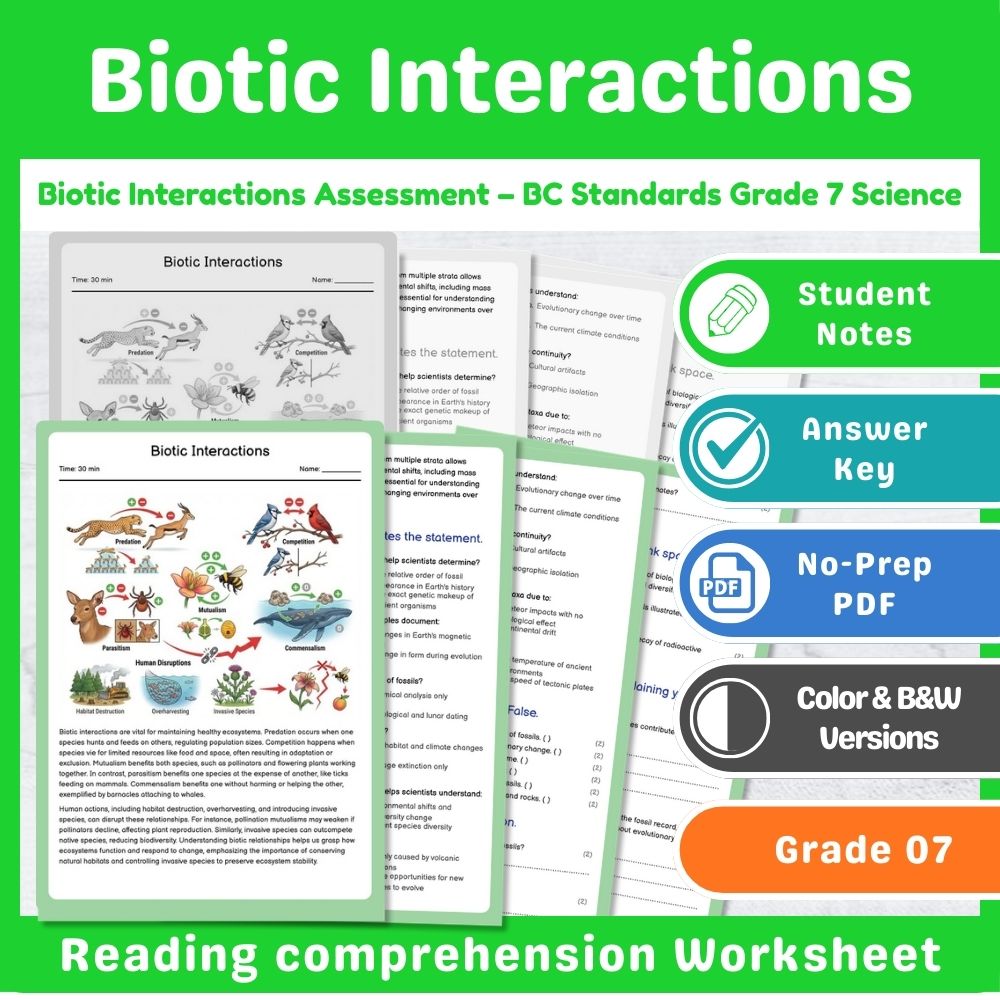
Biotic Interactions Assessment – BC Standards Grade 7 Science
Created byPrism Point LearningLearning Objectives
- Understand the different types of biotic interactions such as predation, competition, mutualism, commensalism, and parasitism.
- Explain how human activities can disrupt biotic relationships and affect ecosystems.
- Describe how changes in one species can influence community structure and biodiversity.
Instant download
Browse more categories
About Science Worksheets
Find Science worksheets spanning core skills, practice, and review. All 44,295 resources are instant PDF downloads for the classroom or home.
Every worksheet on MyTeachingSheets is created by independent teacher-authors and reviewed before publication. All resources download as printable PDFs for classroom, homework, or at-home practice, and many include answer keys. Preview any worksheet free before buying.