
Grade 10 Science Worksheets
7,038 worksheets
Grade 10 Bonding Types Worksheet | Practice & Assessment PDF
 Created byClear Sky Classroom
Learning Objectives
- Differentiate ionic, covalent, and metallic bonding using particle-level descriptions.
- Predict macroscopic properties (conductivity, melting point, and solubility) from bonding type.
- Connect lattice structures and electron behavior to real-world examples (deicers, fuels, and alloys).
Instant download

Resource Availability Tradeoffs Worksheet | Grade 10 Science Activity
 Created byPrism Point Learning
Learning Objectives
- Explain how finite and renewable resources influence ecosystem health and human growth.
- Analyze tradeoffs involved in using limited resources for infrastructure, food, and energy.
- Evaluate how population decisions and land-use choices can increase or reduce risk.
Instant download

Technology And Society Assessment | Florida NGSSS Grade 10 Science
Created byPrism Point LearningLearning Objectives
- Explain how technological development and scientific knowledge influence each other and are shaped by societal priorities.
- Analyze how technology-enabled scientific measurement can change scientific questions and scientific explanations.
- Evaluate how scientific findings affect public policy, risk management, and ethical decision-making.
Also included in: Grade 10 Scientific Reasoning Science Lesson Bundle – Florida NGSSS +1 more
Instant download

Grade 10 AP Science Membrane Dynamics Worksheet | Practice Pack
Created byPrism Point LearningLearning Objectives
- Explain how membrane composition and selective permeability help cells maintain compartmentalization and ionic homeostasis.
- Compare carrier-mediated transport, diffusion, and vesicular trafficking by relating them to electrochemical gradients and energetic costs.
- Use Nernst-type ideas and flux-rate comparisons to predict ion distribution and signal propagation across membranes.
Also included in: Grade 10 AP Science Life Systems Lesson Bundle | Worksheet Pack
Instant download
Transmission Losses Worksheet for Grade 10 Science – Alberta Standards
 Created byCoral Reef Learning
Learning Objectives
- Understand how current, conductor resistance, and voltage affect power transmission losses.
- Explain the use of transformers in reducing energy losses during long-distance transmission.
- Analyze the trade-offs involved in current reduction strategies and insulation challenges.
Instant download

DNA Replication Worksheet for Grade 10 Science | TEKS Standards Practice
JCreated byJ.S SheetsLearning Objectives
- Explain how semiconservative DNA replication uses parental strands as templates.
- Describe the roles of helicase, primase, DNA polymerase, and proofreading during replication.
- Compare leading and lagging strand synthesis, including Okazaki fragments.
Instant download

Reference Frames Worksheet & AP Physics Activity with Answer Key
 Created byBright Quill Resources
Learning Objectives
- Explain how a reference frame (origin and positive direction) defines position and displacement in one-dimensional motion
- Use algebraic relationships among position, velocity, and acceleration to describe constant-velocity and constant-acceleration motion
- Interpret position–time and velocity–time graphs to determine velocity and acceleration
Instant download

Grade 10 Science – Seismic Tomography & Earth's Interior | Reading Worksheet
 Created byBright Mind Resources
Learning Objectives
- Understand the different types of seismic waves and their properties.
- Learn how seismic travel times and attenuation help image Earth's structure.
- Interpret velocity variations of P- and S-waves to infer temperature, composition, and phase changes.
Also included in: Earth Science Grade 10 Science Daily Reading Worksheets Lesson Bundle | Ontario +1 more
Instant download

Grade 10 Science – Meiosis & Cell Division | Daily Reading Worksheet
Created byBright Mind ResourcesLearning Objectives
- Understand the basic process of meiosis
- Identify the stages of meiosis and their significance
- Explain how meiosis contributes to genetic diversity
Also included in: DNA & Genetics Grade 10 Science Daily Reading Worksheets Lesson Bundle | TEKS +2 more
Instant download

Ecosystem Modeling Worksheet for Grade 10 Science NGSS Standards
JCreated byJ.S SheetsLearning Objectives
- Understand the development and interpretation of ecosystem models such as Lotka–Volterra equations.
- Analyze how models predict flows of energy and matter in ecosystems.
- Evaluate the use of empirical data in calibrating ecosystem models to assess system responses.
Instant download
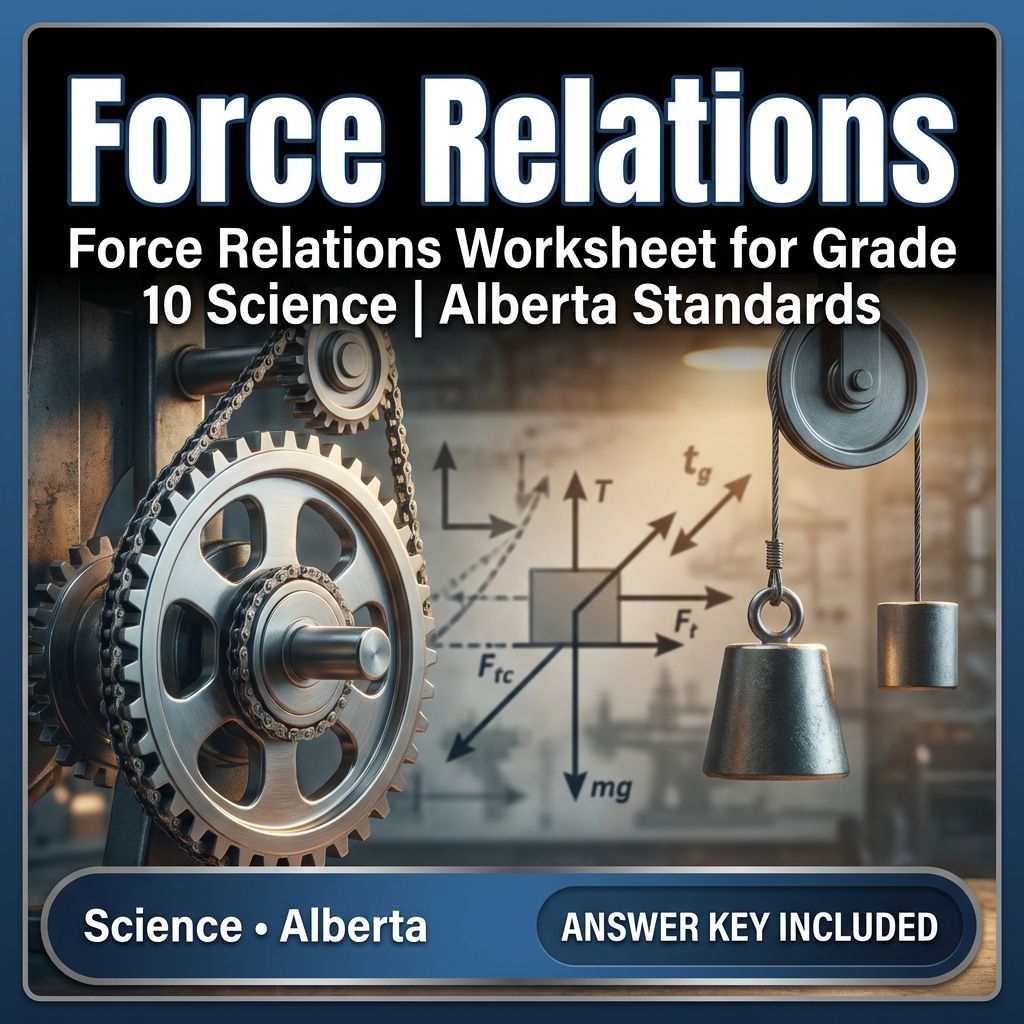
Force Relations Worksheet for Grade 10 Science | Alberta Standards
Created byCoral Reef LearningLearning Objectives
- Understand how forces, mass, and acceleration are related through Newton's laws.
- Identify the effects of varying mass and applied forces on motion outcomes.
- Analyze regional examples such as heavy machinery and vehicle braking to understand force effects.
Instant download

Grade 10 Science – Genetic Mutations & DNA Changes | Daily Reading Worksheet
Created byBright Mind ResourcesLearning Objectives
- Understand the concept of point mutations and their classifications
- Identify different types of point mutations and their effects on genes
- Recognize how mutations can be silent, missense, or nonsense
Also included in: DNA & Genetics Grade 10 Science Daily Reading Worksheets Lesson Bundle | TEKS +2 more
Instant download

Grade 10 Science | Introduction to Gene Expression Control - Daily Reading Comprehension
Created byCoral Reef LearningLearning Objectives
- Understand the basic mechanisms that regulate gene expression in cells.
- Identify key components such as promoters, transcription factors, and chromatin modifications.
- Explain how signals influence gene regulation and phenotypic outcomes.
Also included in: Biology and Ecosystems Lesson Bundle – Grade 10 Science Advanced Placement +1 more
Instant download

Science Grade 10 Cell Membrane Transport Worksheet | Standards-Aligned Practice
JCreated byJ.S SheetsLearning Objectives
- Explain how the cell membrane’s selective permeability controls what enters and leaves the cell
- Compare diffusion and osmosis and describe how concentration gradients and water potential affect transport
- Evaluate how energy-dependent transport and membrane structure support movement of large molecules
Also included in: Grade 10 Life Science Evolution, Genetics & Cells Lesson Bundle – Florida NGSSS +1 more
Instant download

Succession Processes Worksheet | Standards-Aligned Grade 10 Science Practice
JCreated byJ.S SheetsLearning Objectives
- Distinguish primary and secondary ecological succession based on substrate and soil conditions.
- Explain how colonization, competition, and facilitation shape changes in community composition.
- Describe how disturbance frequency and intensity influence successional pathways and biodiversity.
Instant download

Plate Tectonics Worksheet Grade 10 Science Activities | NGSSS Earth Science
Created byPrism Point LearningLearning Objectives
- Explain how lithospheric plates move and how those movements reshape Earth’s surface
- Compare the effects of divergent, convergent, and transform plate boundaries
- Describe evidence that supports plate tectonics, including seafloor magnetic patterns and earthquake distribution
Also included in: Space & Earth Systems Lesson Bundle | Grade 10 Science | Florida NGSSS
Instant download

Systems Interactions Worksheet Grade 10 Science Practice TEKS
Created byPrism Point LearningLearning Objectives
- Explain how multiple organ systems work together to maintain homeostasis during challenges like exercise and dehydration.
- Describe feedback and regulation pathways that coordinate cardiovascular, respiratory, renal, endocrine, and musculoskeletal responses.
- Identify emergent properties of whole-body systems that are not predictable from a single organ system alone.
Instant download

Grade 10 Science – Classification & States of Matter Daily Reading Worksheet
 Created byQuiet Forest Education
Learning Objectives
- Understand the fundamental schemes for classifying matter
- Distinguish between pure substances and mixtures
- Identify states of matter and their characteristics
Also included in: Matter and Chemical Change Grade 10 Science Daily Reading Bundle | Ontario +1 more
Instant download

Grade 10 Science – DNA & Protein Pathway Reading Worksheet | Standards-Aligned
Created byBright Mind ResourcesLearning Objectives
- Identify and describe the structure of DNA
- Understand the process of transcription and translation
- Explain how changes in DNA affect protein synthesis and cell function
Also included in: Grade 10 Genetics & Evolution Science Lesson Bundle | California Standards +1 more
Instant download

Grade 10 Science – Endocrine Coordination & Hormone Regulation | Worksheet
Created byBright Mind ResourcesLearning Objectives
- Identify major endocrine glands and their hormones
- Understand how hormones regulate growth, metabolism, and reproduction
- Explain feedback mechanisms controlling hormone levels
Also included in: Systems Interactions Grade 10 Science Daily Reading Worksheets Bundle | TEKS +2 more
Instant download

Grade 10 Science | Measurable Criteria in Scientific Design - Reading Comp.
Created byCoral Reef LearningLearning Objectives
- Understand the difference between criteria and constraints in scientific and engineering contexts.
- Identify measurable performance criteria in design projects.
- Recognize constraints that restrict design options, including material, budget, and regulations.
Instant download

Grade 10 Periodic Trends Worksheet with Answer Key | Florida NGSSS Science
 Created byEvergreen Desk Education
Learning Objectives
- Explain how effective nuclear charge and electron shielding drive periodic trends in atomic size, ionization energy, and ionic formation.
- Predict how elements form typical ions based on valence electrons and periodic group position.
- Use periodic patterns to justify bonding tendencies and common ion charges for representative elements.
Instant download
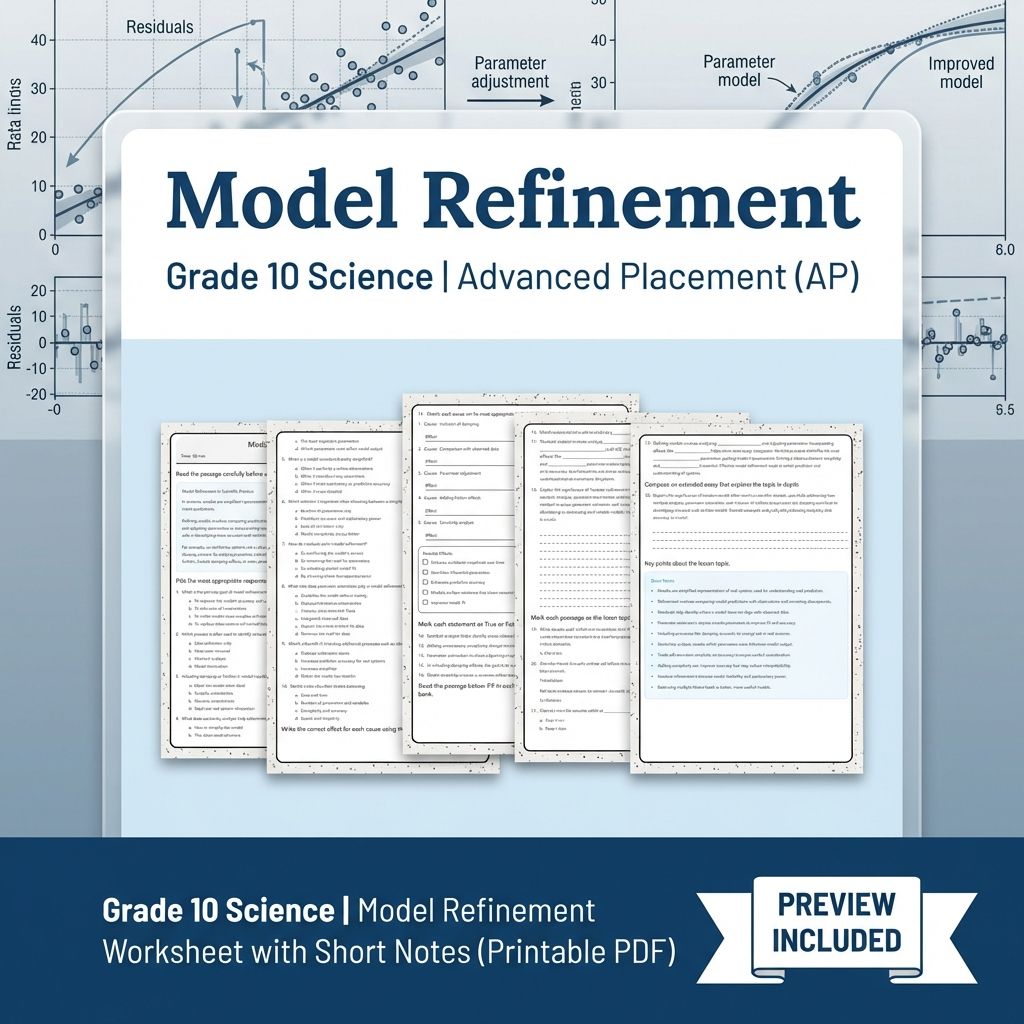
Grade 10 Science | Model Refinement Worksheet with Short Notes (Printable PDF)
 Created byMeadowlark Worksheets
Learning Objectives
- Understand the process of iteratively improving models through comparison with observed data.
- Learn how parameter estimation enhances model accuracy and predictive power.
- Recognize the importance of including additional factors like damping or friction in models.
Also included in: Grade 10 Science Unit | Data Analysis, Modelling Worksheet Pack
Instant download

Grade 10 Science – Microbe Diversity Worksheet (Ontario Standards)
Created byEvergreen Desk EducationLearning Objectives
- Compare major groups of microorganisms by cellular organization, genetic material type, and reproduction strategies.
- Explain how viruses depend on host cellular machinery and why they are not considered cells.
- Describe how different microbial groups occupy distinct ecological niches and contribute to ecosystems and human contexts.
Also included in: Grade 10 Cell Functions & Energy Science Lesson Bundle - Ontario Framework +1 more
Instant download

Grade 10 Worksheet B: Land Use Effects on Earth Systems Worksheet | NGSS
Created byClear Sky ClassroomLearning Objectives
- Explain how land-cover change can alter ecosystem function, hydrologic cycles, and biodiversity
- Interpret indicators such as habitat fragmentation, nutrient loading, soil erosion rates, and coral reef degradation
- Use evidence from land-use maps, remote sensing, and biotic surveys to connect human land changes to ecological outcomes
Also included in: Grade 10 Climate & Natural Hazards Science Lesson Bundle (NGSS) +1 more
Instant download

Kinematic Graphs Analysis Assessment | Alberta Grade 10 Science Standards
Created byPrism Point LearningLearning Objectives
- Interpret position, velocity, and acceleration graphs to analyze motion.
- Calculate slopes and areas under curves to determine instantaneous and average quantities.
- Apply graph analysis to real-world vehicle and sled motion on hilly terrain.
Also included in: Grade 10 Energy, Motion and Electricity Science Lesson Bundle: Alberta +1 more
Instant download

Grade 10 Science | Adaptation Planning Worksheet (NGSS)
 Created bySilver Birch Teaching
Learning Objectives
- Evaluate infrastructural and policy responses to natural hazards and environmental change.
- Analyze trade-offs among economic, social, and ecological factors in adaptation strategies.
- Interpret risk maps, hazard analyses, and cost–benefit data to assess feasibility and resilience.
Also included in: Grade 10 Climate Change & Land Use Science Lesson Bundle Worksheets – NGSS +1 more
Instant download
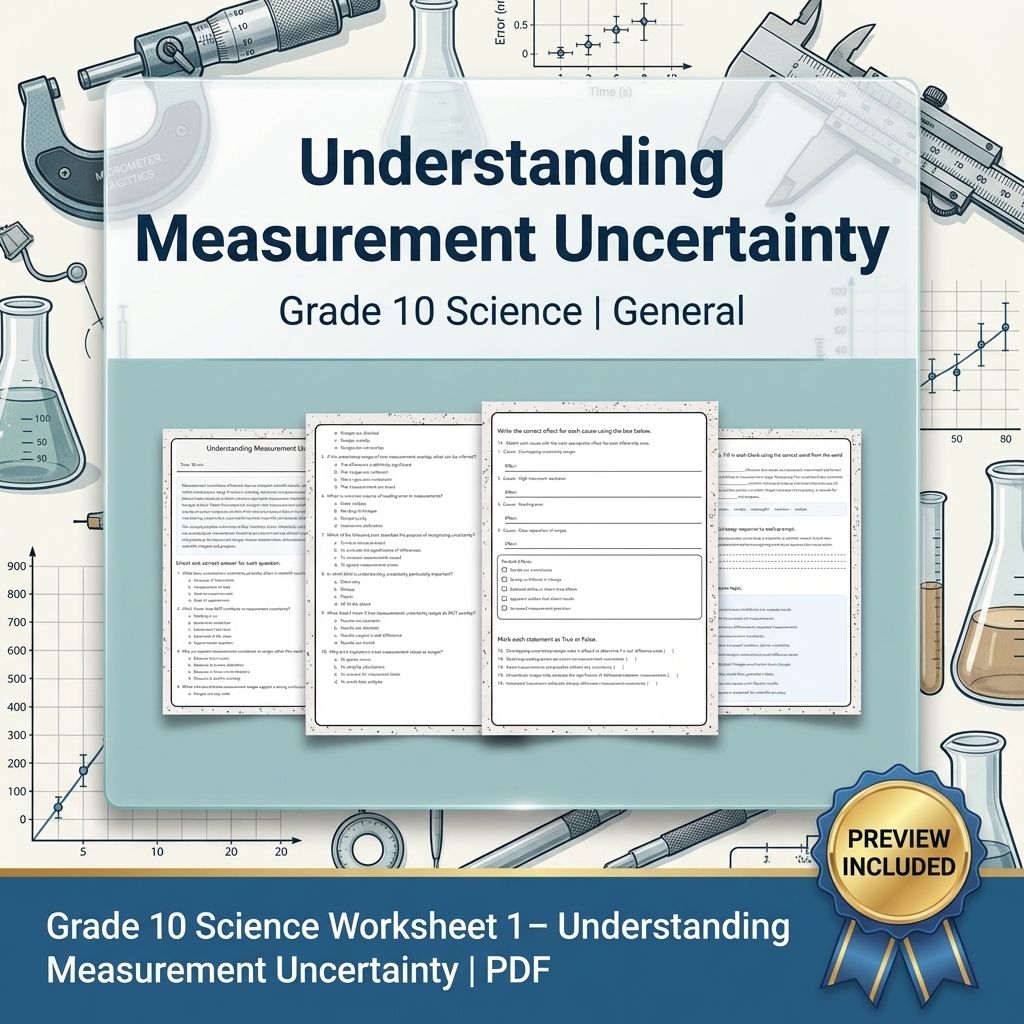
Grade 10 Science Worksheet Understanding Measurement Uncertainty | PDF
Created byMeadowlark WorksheetsLearning Objectives
- Explain how measurement uncertainty affects data interpretation.
- Identify factors that contribute to measurement uncertainty.
- Evaluate whether differences in data are meaningful considering uncertainty ranges.
Also included in: Grade 10 Measurement Uncertainty Science Lesson Bundle: General +1 more
Instant download

Biogeochemical Cycles Assessment for Grade 10 Science TEKS Standards
Created byPrism Point LearningLearning Objectives
- Describe the key processes involved in major biogeochemical cycles such as carbon, nitrogen, phosphorus, and water.
- Explain how biological, physical, and chemical processes interact within nutrient cycles.
- Analyze human impacts on biogeochemical cycles and their effects on ecosystems.
Also included in: Grade 10 Ecosystems Science Lesson Bundle for TEKS Assessment Worksheets
Instant download

Grade 10 Science – Thermodynamic Limits Worksheet (BC Standards) (PDF)
Created byEvergreen Desk EducationLearning Objectives
- Explain how the first law of thermodynamics enforces conservation of energy in physical processes.
- Describe how the second law introduces entropy and restricts the amount of work that can be extracted.
- Use Carnot efficiency ideas to compare ideal and real heat engines and refrigerators.
Instant download
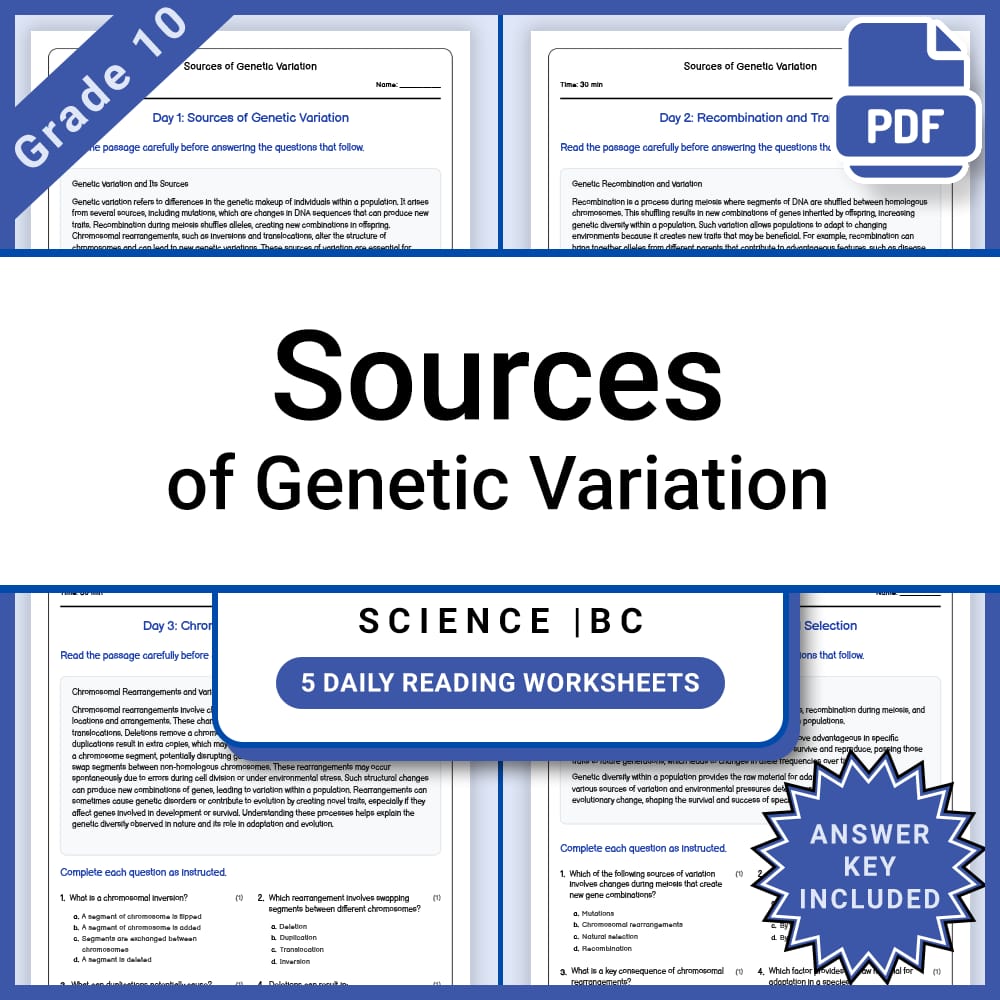
Grade 10 Science – Sources of Genetic Variation Daily Worksheet + Answer Key
JCreated byJ.S SheetsLearning Objectives
- Identify different sources of heritable variation such as mutations, recombination, and chromosomal rearrangements.
- Understand how natural selection acts on genetic variation to influence evolution.
- Explain the importance of genetic diversity within populations for adaptation.
Also included in: Grade 10 Science Lesson Bundle | Genetics, Evolution, Biodiversity & More +1 more
Instant download

Energy Loss and Efficiency Worksheet | California Standards Grade 10 Science
JCreated byJ.S SheetsLearning Objectives
- Understand the concept of energy transfer and the sources of energy loss in systems.
- Explain the meaning of efficiency and how it relates to energy conservation.
- Identify common energy loss mechanisms such as friction, sound, and heat dissipation.
Also included in: Grade 10 Energy, Forces, and Reactions Science Lesson Bundle +1 more
Instant download

Grade 10 Science – Circular Motion & AP Standards | Daily Reading Worksheet
Created byBright Mind ResourcesLearning Objectives
- Define uniform and non-uniform circular motion.
- Explain the relationship between angular velocity, period, and linear velocity.
- Describe centripetal acceleration and the forces involved in circular motion.
Also included in: Motion, Energy & Electricity Grade 10 Science Reading Worksheets Bundle | AP +2 more
Instant download
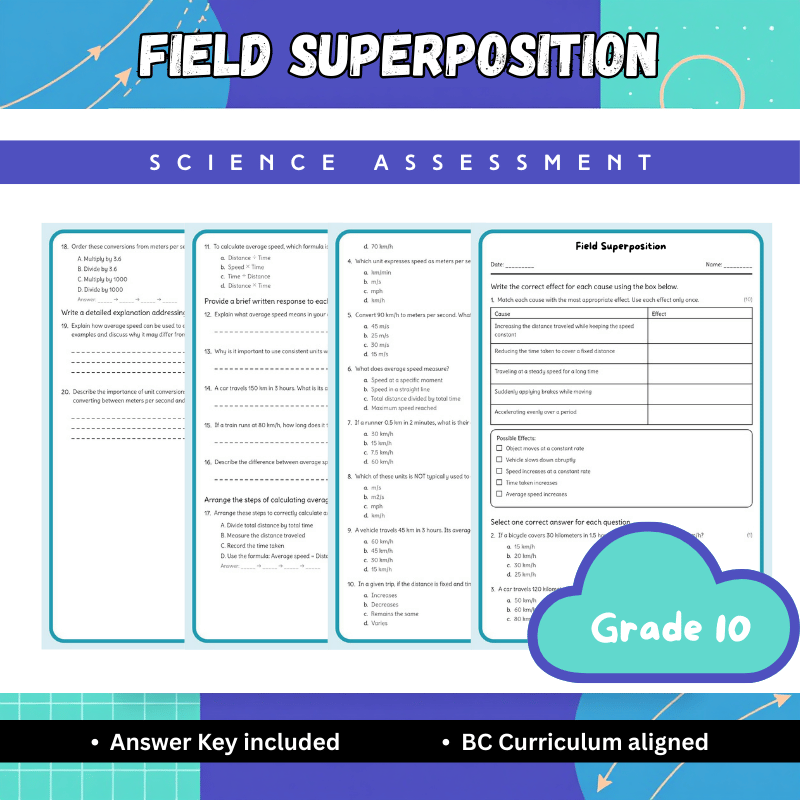
Grade 10 Science | Field Superposition Worksheet (PDF) aligned with BC standards
Created byBright Mind ResourcesLearning Objectives
- Understand the principle of field superposition and its applications.
- Analyze how multiple sources contribute to the net field at a point.
- Calculate the resulting field pattern from combined sources.
Instant download

Grade 10 Science – Nomenclature in Ionic Compounds Daily Reading Worksheet
Created byBright Mind ResourcesLearning Objectives
- Understand the systematic naming conventions for binary ionic compounds
- Identify and name common polyatomic ions
- Comprehend the concept of variable oxidation states in transitional metals
Also included in: Grade 10 Chemistry Science Daily Reading Worksheets Lesson Bundle | Ontario +1 more
Instant download

Grade 10 Science – Fluid Balance Daily Reading Worksheet with Answer Key
JCreated byJ.S SheetsLearning Objectives
- Identify key organs involved in fluid regulation
- Understand processes of glomerular filtration, reabsorption, and secretion
- Explain the role of hormones like antidiuretic hormone and aldosterone
Also included in: Grade 10 Science Lesson Bundle | Human Physiology & Regulatory Systems +1 more
Instant download

Grade 10 Science – Equilibrium Systems & Forces | Daily Reading Worksheet
Created byQuiet Forest EducationLearning Objectives
- Understand key concepts related to Science
- Apply knowledge through practice questions
- Demonstrate comprehension of the material
Also included in: Motion and Forces Grade 10 Science Daily Reading Worksheets Bundle | Ontario +1 more
Instant download

Cell Types Worksheet | Grade 10 Science Activities
Created byPrism Point LearningLearning Objectives
- Differentiate prokaryotic and eukaryotic cells by structure, genome organization, and organelles.
- Explain how structural differences affect DNA replication and genetic control.
- Use cell-type criteria to predict likely ecological roles of organisms.
Also included in: Cell Organization & Homeostasis Grade 10 Science Lesson Bundle | Alberta
Instant download

Grade 10 Science | Population Growth Worksheet (NGSS Aligned PDF)
Created bySilver Birch TeachingLearning Objectives
- Understand the principles of exponential and logistic population growth models.
- Identify factors affecting population dynamics, including density-dependent and density-independent factors.
- Analyze real-world data such as fisheries harvests and algal bloom records to interpret population trends.
Also included in: Grade 10 Ecosystem Stability and Biodiversity Science Lesson Bundle NGSS +1 more
Instant download

Motors and Generators Worksheet | Grade 10 Science | Alberta Standards
JCreated byJ.S SheetsLearning Objectives
- Explain how electromechanical devices convert electrical energy to mechanical energy and vice versa.
- Describe the interaction between coils and magnetic fields in motors and generators.
- Identify regional and industrial applications of motors and generators, including renewable energy sources.
Also included in: Grade 10 Science Practice Worksheets: Alberta Science Full-Year Bundle
Instant download

Rock Transformations Practice Worksheet | Grade 10 Science NGSS
Created byPrism Point LearningLearning Objectives
- Explain how processes of the rock cycle (weathering, lithification, metamorphism, and crystallization) transform rocks over time
- Use mineral/texture/geochemical clues to infer pressure–temperature history in metamorphic settings
- Describe how radiometric dating and stratigraphic correlation help order igneous, sedimentary, and metamorphic events
Also included in: Grade 10 Earth Systems Science lesson bundle: NGSS practice worksheets
Instant download

Grade 10 Science – Energy Transfer Worksheet (PDF) | General Standards
Created byEvergreen Desk EducationLearning Objectives
- Explain how energy transfers between systems and changes form using examples (heating, work, and radiation).
- Relate kinetic energy to particle motion, gravitational potential energy to height, and elastic energy to deformation.
- Use observed changes (temperature, speed, height) to determine the direction of energy transfer.
Also included in: Grade 10 Conservation Laws in Science Lesson Bundle – General Framework +1 more
Instant download

Grade 10 Science | Energy Changes in Chemical Reactions - Reading Comprehension
Created byCoral Reef LearningLearning Objectives
- Understand the difference between endothermic and exothermic reactions.
- Identify energy changes during bond breaking and bond formation.
- Explain basic concepts of enthalpy and reaction heat.
Also included in: Chemistry Foundations Lesson Bundle: Grade 10 Science Advanced Placement (AP) +1 more
Instant download

Physiological Systems Practice Test | Grade 10 Science NGSS Worksheet
Created byPrism Point LearningLearning Objectives
- Compare how major physiological systems coordinate to move materials through the body (transport, gas exchange, nutrient delivery, and waste removal).
- Explain how structure supports function in circulatory, respiratory, digestive, excretory, and integumentary systems.
- Use surface area-to-volume and transport ideas to describe how organism demands are met.
Also included in: Grade 10 Cellular Regulation and Energy Science Lesson Bundle (NGSS)
Instant download
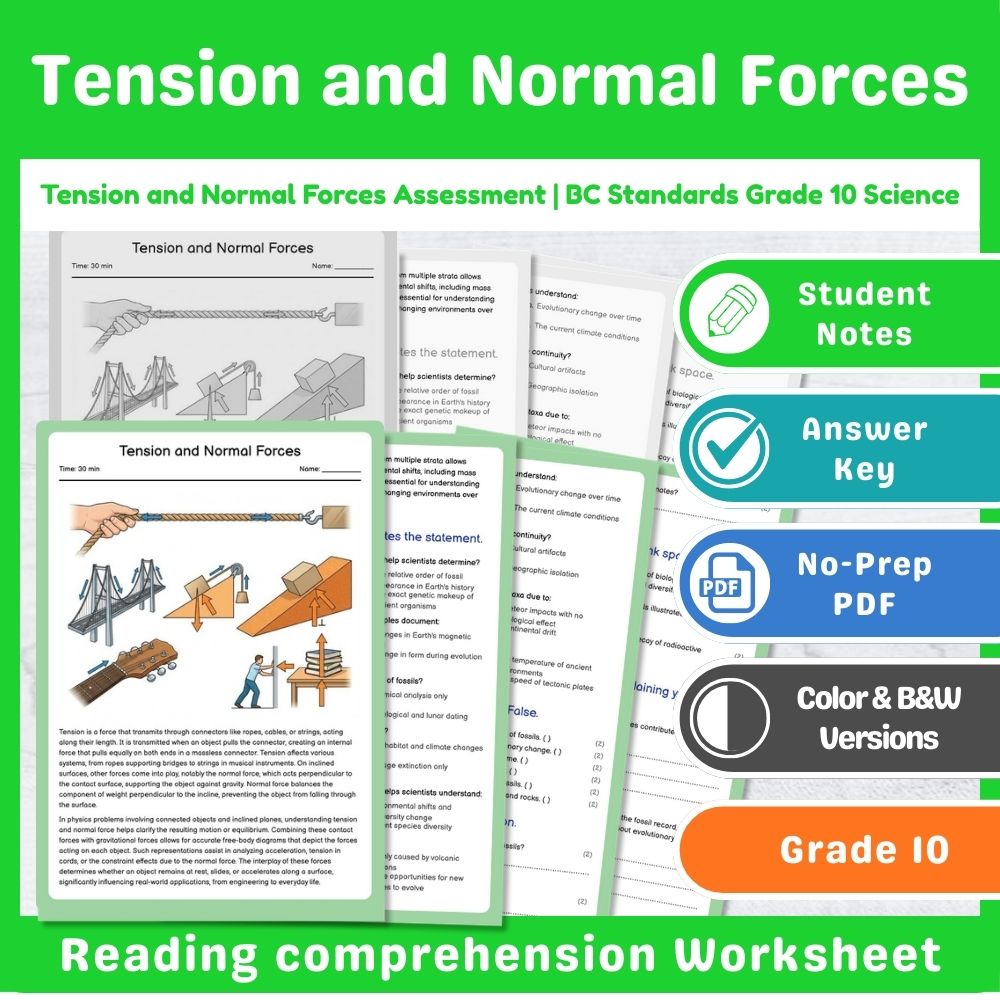
Tension and Normal Forces Assessment | BC Standards Grade 10 Science
Created byPrism Point LearningLearning Objectives
- Understand how tension transmits forces through connectors and acts along their length.
- Explain the role of normal force in supporting objects and balancing components of weight.
- Apply free-body diagrams to analyze the effects of tension and normal forces on objects.
Instant download

Evolutionary Predictions Worksheet for Grade 10 Biology Science Activities
Created byPrism Point LearningLearning Objectives
- Explain how natural selection can change allele frequencies and lead to shifts in trait distributions over time.
- Use evidence (molecular similarity, fossils, and present-day variation) to support evolutionary predictions.
- Connect environmental change to expected future outcomes for populations under evolutionary models.
Instant download

Grade 10 Science | Ecosystem Basics Worksheet (PDF) – TEKS Aligned
Created byEvergreen Desk EducationLearning Objectives
- Explain how ecosystems include living organisms and nonliving physical components that interact
- Differentiate producers, consumers, and decomposers and describe their roles in nutrient and energy flow
- Analyze how climate and habitat structure affect species distributions and population support
Instant download

Gene Regulation Worksheet | Standards-Aligned Science Practice for Grade 10
JCreated byJ.S SheetsLearning Objectives
- Explain how promoters, enhancers, and transcription factors control RNA polymerase binding during transcription
- Describe how post-transcriptional mechanisms such as alternative splicing and RNA interference change mRNA outcomes
- Summarize how epigenetic modifications (DNA methylation and histone changes) affect chromatin accessibility and long-term gene expression
Instant download
About Grade 10 Science Worksheets
Find Science worksheets built for Grade 10. All 7,038 cover core skills, practice, and review, each an instant PDF download.
Every worksheet on MyTeachingSheets is created by independent teacher-authors and reviewed before publication. All resources download as printable PDFs for classroom, homework, or at-home practice, and many include answer keys. Preview any worksheet free before buying.