
Grade 10 Science Worksheets
7,038 worksheets
Grade 10 Science – Circuit Power & Energy Consumption | Daily Reading Worksheet
 Created byBright Mind Resources
Learning Objectives
- Understand the concept of electrical power, voltage, and current in circuits.
- Calculate energy consumption based on power and time.
- Apply theoretical concepts to real-world electrical systems and devices.
Also included in: Energy & Systems Interactions Grade 10 Science lesson bundle | Alberta +1 more
Instant download
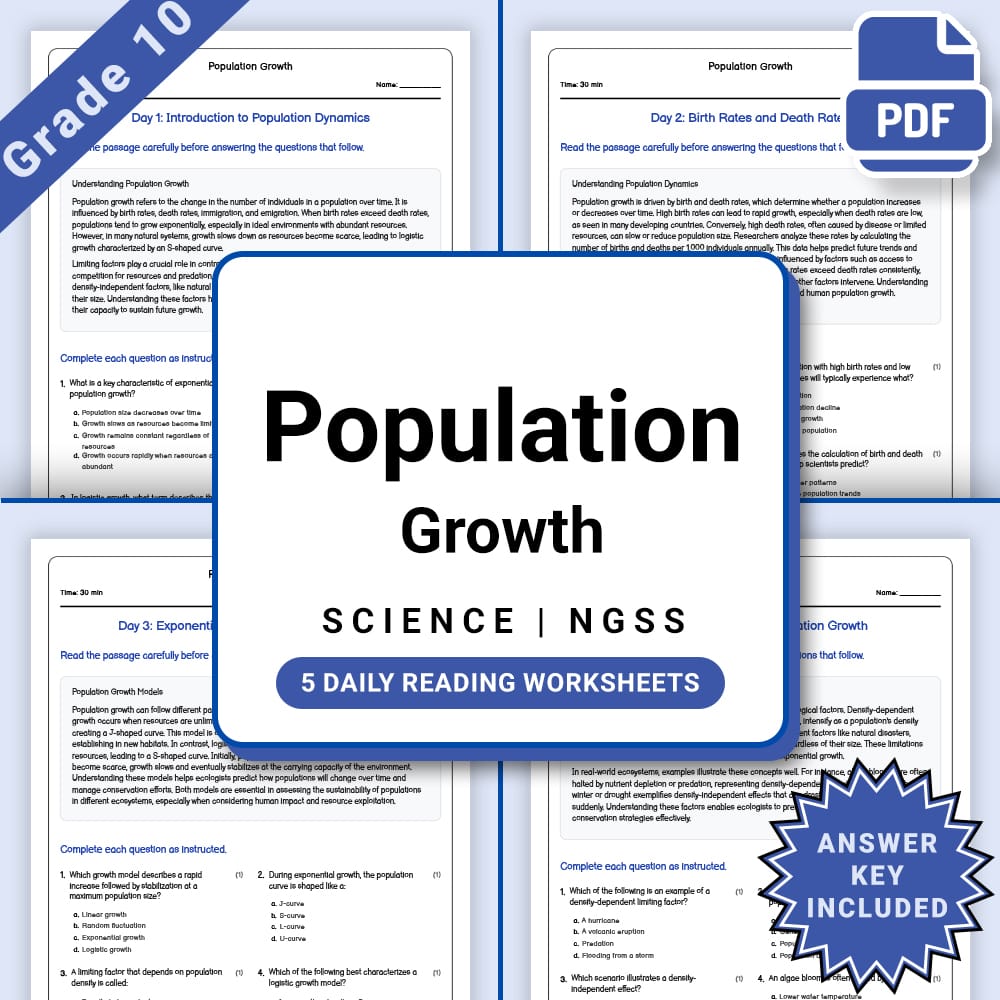
Grade 10 Science – Population Growth Worksheet (PDF +Answer Key)
 Created byCopper Leaf Classroom
Learning Objectives
- Explain factors affecting population size and growth patterns
- Differentiate between exponential and logistic growth models
- Identify density-dependent and density-independent limiting factors
Instant download
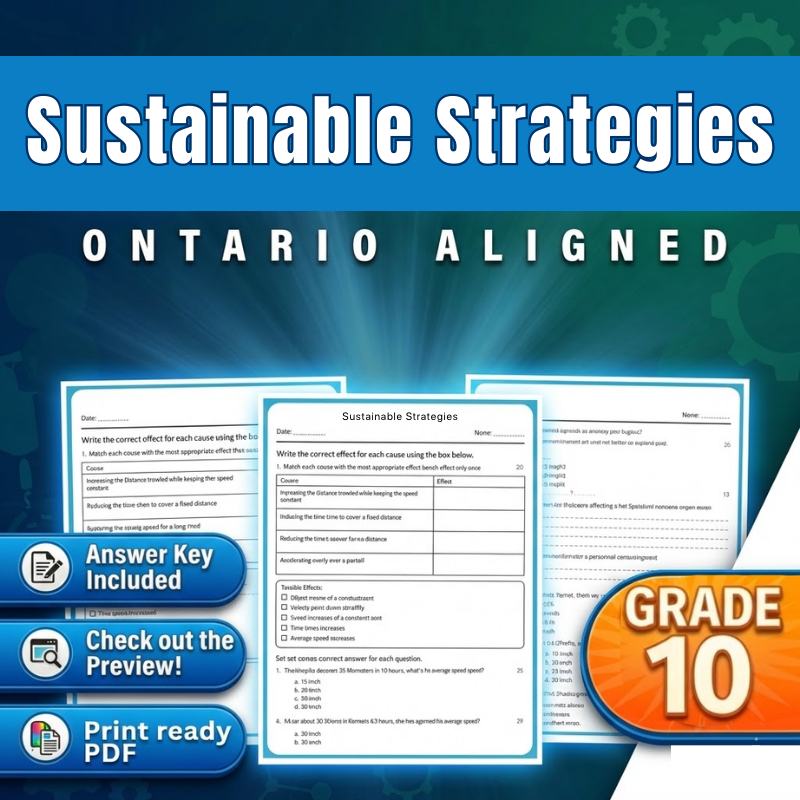
Grade 10 Science – Sustainable Strategies Worksheet (Answer Key) | Ontario
Created byBright Mind ResourcesLearning Objectives
- Understand approaches to reducing environmental impacts of resource extraction.
- Identify principles of circular economy, recycling, and substitution.
- Explain the importance of landscape restoration and watershed management.
Instant download
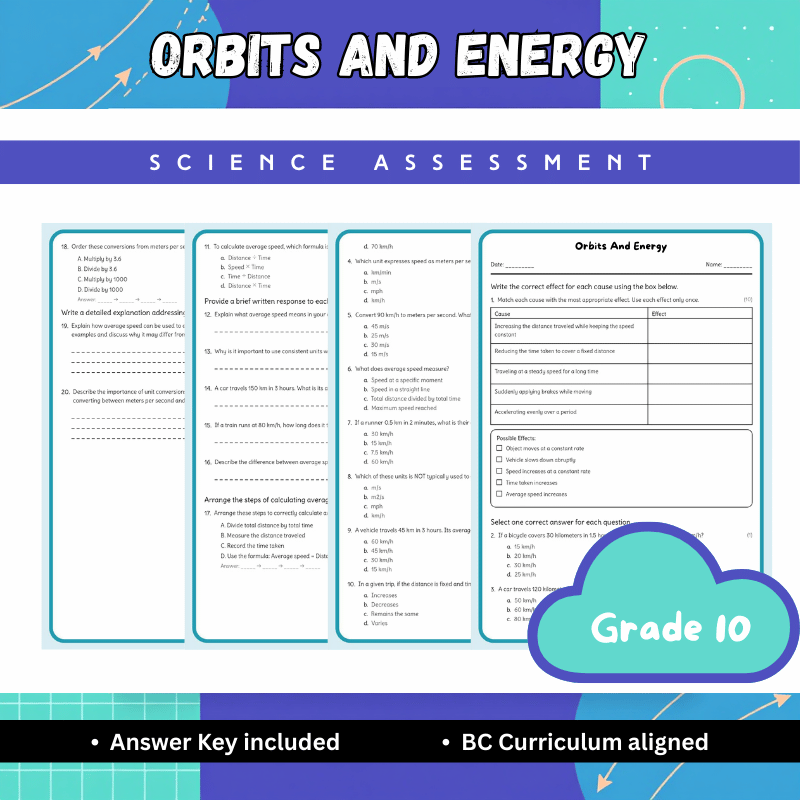
Grade 10 Science | Orbits and Energy Worksheet (PDF) – BC Standards Practice
Created byBright Mind ResourcesLearning Objectives
- Understand how gravitational attraction provides the centripetal force for orbital motion.
- Explain the relationship between orbital speed, central mass, and orbital radius.
- Differentiate between circular and elliptical orbits and their energy characteristics.
Instant download

Grade 10 Worksheet B: Electromagnetic Forces Practice | NGSS + Use PDF
 Created byClear Sky Classroom
Learning Objectives
- Explain how electric and magnetic fields exert forces on charges using vector relationships.
- Apply the Lorentz force law to determine force direction and qualitative motion paths.
- Describe magnetic interactions between current-carrying wires and induced motion from changing fields.
Also included in: Grade 10 Forces & Motion Science Lesson Bundle (NGSS) +1 more
Instant download

Grade 10 Science — Ionic Solids Worksheet MCQ Paper for Mastery
 Created byThe Resource Hub
Learning Objectives
- Understand the lattice structures and coordination numbers in ionic solids.
- Explain how lattice energy influences melting point, solubility, and electrical conductivity.
- Describe Coulombic interactions and ion packing models in salts.
Also included in: Grade 10 Science Chemistry Foundations Lesson Bundle for AP Curriculum +1 more
Instant download

Grade 10 Worksheet B: Momentum and Impulse Practice | NGSS PDF
Created byClear Sky ClassroomLearning Objectives
- Apply vector concepts to momentum and analyze two-dimensional collisions using components
- Use impulse-momentum ideas to relate force-time graphs to changes in velocity
- Distinguish elastic and inelastic collisions using conservation of momentum in closed systems
Also included in: Grade 10 Forces & Motion Science Lesson Bundle (NGSS) +1 more
Instant download

Energy Conservation Worksheet for Grade 10 Science | Standards-Aligned Practice
JCreated byJ.S SheetsLearning Objectives
- Develop potential energy models for gravitational and elastic systems.
- Explain the conservation of total mechanical energy in isolated systems.
- Analyze energy transfer and conversions, including the effects of nonconservative forces.
Also included in: Grade 10 Motion, Waves & Electricity Science Lesson Bundle
Instant download

Conservation of Energy in Metabolism Worksheet | Grade 10 TEKS Science
 Created byBRIGHT PATH RESOURCES
Learning Objectives
- Identify the main idea of how energy is conserved in metabolic reactions
- Recognize key details that explain energy flow and transformations in cells
- Use vocabulary from thermodynamics (energy, system, surroundings) to answer science questions
Also included in: Grade 10 Metabolism & Energy Processes Science Worksheets Bundle | TEKS +1 more
Instant download

Grade 10 Science | Collisions & Momentum - Daily Reading Comprehension
 Created byCoral Reef Learning
Learning Objectives
- Define linear momentum and impulse and explain their relationship in collision scenarios.
- Identify types of collisions: elastic, inelastic, and perfectly inelastic.
- Understand and apply the conservation of momentum principle in isolated systems.
Instant download

Grade 10 Science | Mineral Overview - Daily Reading Comprehension
Created byCoral Reef LearningLearning Objectives
- Understand the properties that define minerals.
- Identify different classifications of minerals.
- Recognize formation environments of minerals.
Instant download

Grade 10 Energy Changes & Thermochemistry Worksheet PDF | Alberta
 Created byEvergreen Desk Education
Learning Objectives
- Distinguish between endothermic and exothermic chemical changes using temperature and energy flow descriptions.
- Connect enthalpy changes (ΔH) to bond breaking and bond formation during thermochemical reactions.
- Interpret calorimetry information to explain how heat measurements reflect molecular-level energy changes.
Instant download

Evidence-Based Communication Assessment | Standards-Aligned Grade 10 Science
 Created byPrism Point Learning
Learning Objectives
- Understand how to connect claims to evidence using scientific language.
- Interpret data and observations to support scientific explanations.
- Justify conclusions through logical reasoning and alternative interpretations.
Instant download

Grade 10 Science | Gravitational Fields Worksheet | BC-Aligned
 Created byLumora Learning
Learning Objectives
- Understand the concept of a gravitational field and how it influences mass.
- Describe how field strength decreases with distance according to an inverse-square law.
- Compare gravitational fields with other interaction fields based on their effects and behaviors.
Instant download

Limiting Reagent Worksheet | Standards-Aligned Grade 10 Science Practice
JCreated byJ.S SheetsLearning Objectives
- Understand the concept of a limiting reagent in chemical reactions.
- Learn how to identify the limiting species using stoichiometric ratios and mole calculations.
- Connect the concept of limiting reagent to theoretical yield and conservation of mass.
Instant download

Ion Formation Worksheet Grade 10 Chemistry Activities & Practice
Created byPrism Point LearningLearning Objectives
- Explain how incomplete outer energy levels lead to predictable ion charges
- Use electron models to determine whether an atom forms a cation or an anion
- Connect electron transfer to properties of ionic substances such as conductivity and reactivity
Instant download

Climate Projections Test Prep Worksheet | Grade 10 Science NGSS
Created byPrism Point LearningLearning Objectives
- Interpret how instrument records, proxy evidence, and model scenarios are used to characterize climate change
- Explain radiative forcing and attribution at a basic conceptual level for observed warming
- Evaluate sources of projection uncertainty using ensemble spreads and scenario differences
Instant download

Grade 10 Science Worksheet on Gravitational Fields | Standards-Aligned Practice
JCreated byJ.S SheetsLearning Objectives
- Understand the concept of a gravitational field and how it influences space.
- Explain how field strength varies with distance according to the inverse-square law.
- Describe the effects of gravitational fields on objects and orbital motion.
Instant download

Grade 10 Science Measurement Accuracy Worksheet | Precision & Uncertainty
 Created byChalk and Compass
Learning Objectives
- Distinguish between precision and accuracy and explain how errors affect measurement results.
- Use significant figures and calibration concepts to report measurements appropriately.
- Estimate and interpret measurement uncertainty and propagate uncertainty in simple calculations.
Also included in: Grade 10 Science Variables & Control Data Analysis Lesson Bundle | Ontario +1 more
Instant download
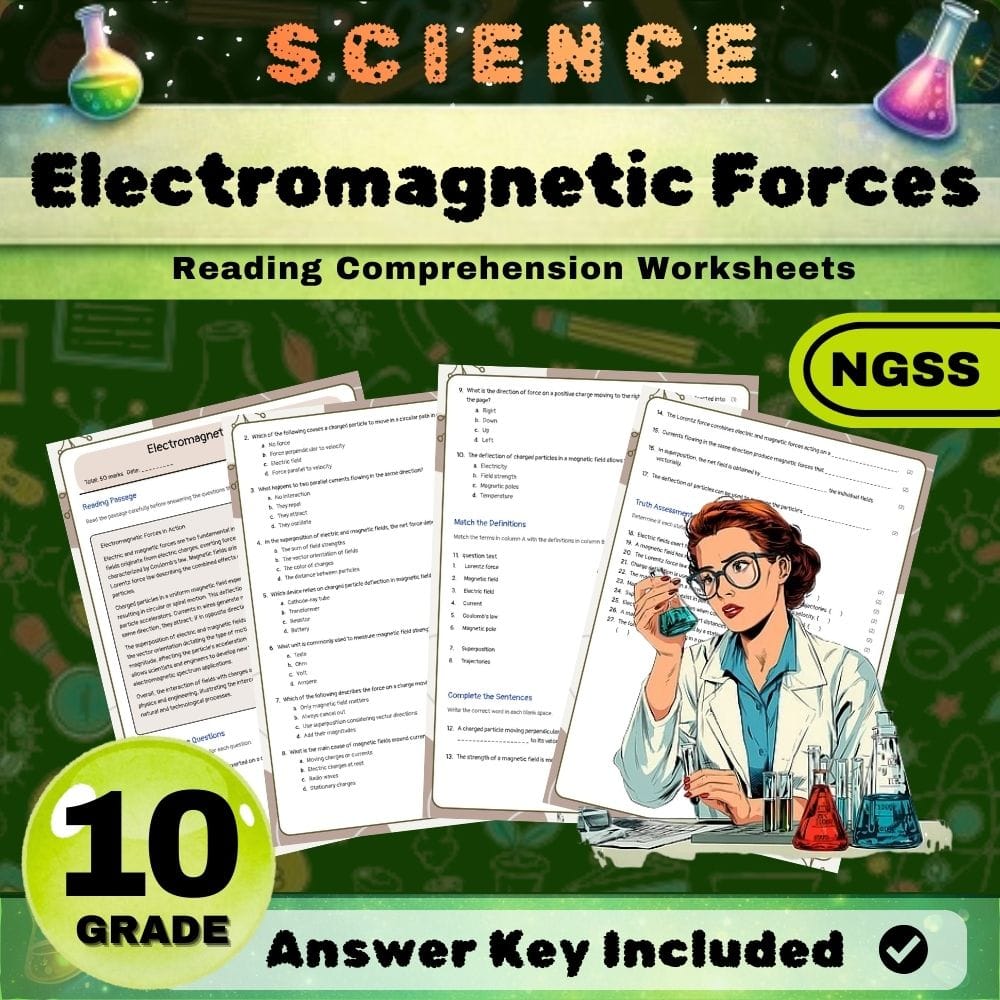
Grade 10 Science | Electromagnetic Forces Worksheet (NGSS PDF)
 Created byMaple Path Learning
Learning Objectives
- Describe how electric and magnetic fields interact with charges and currents.
- Explain the Lorentz force law and its application in simple contexts.
- Identify phenomena such as charged particle deflection and magnetic interactions between wires.
Also included in: Grade 10 Science Motion and Stability Forces and Interactions NGSS Lesson Bundle +1 more
Instant download

Grade 10 Science | Thermal Transfer Worksheet (NGSS10) PDF
 Created bySilver Birch Teaching
Learning Objectives
- Explain the mechanisms of heat transfer: conduction, convection, and radiation.
- Analyze heat flux and temperature gradients in various systems.
- Apply calorimetric reasoning to determine thermal energy changes during phase changes.
Also included in: Grade 10 Energy Transfer and Work Power Science Lesson Bundle NGSS +1 more
Instant download

Grade 10 Science – Measurement Accuracy & Precision | Daily Reading Worksheet
Created byBright Mind ResourcesLearning Objectives
- Understand the difference between precision and accuracy in measurements
- Identify sources of measurement uncertainty and errors
- Learn methods to improve measurement reliability
Also included in: Inquiry Grade 10 Science Daily Reading Worksheets Lesson Bundle | Ontario +1 more
Instant download

Population Genomics Worksheet | AP Science Grade 10 Practice
JCreated byJ.S SheetsLearning Objectives
- Understand the role of mutation, gene flow, selection, and drift in shaping genomic diversity.
- Interpret sequence-based evidence to connect molecular mechanisms with population processes.
- Analyze models of allele frequency changes and their implications for evolutionary trajectories.
Also included in: Grade 10 Genetics & Cellular Systems Science Lesson Bundle – AP Unit
Instant download

Grade 10 Thermochemistry Worksheet | Practice & Assessment PDF
Created byClear Sky ClassroomLearning Objectives
- Interpret thermochemical representations, including energy changes and reaction stoichiometry.
- Calculate enthalpy changes using calorimetric energy accounting and reaction mole ratios.
- Apply Hess's law and bond enthalpy approximations to estimate reaction enthalpies.
Also included in: Grade 10 Chemistry Foundations Science Lesson Bundle: AP Worksheet Set +1 more
Instant download

Grade 10 Science | Atmospheric Patterns Worksheet (AP Standards) (PDF)
Created byEvergreen Desk EducationLearning Objectives
- Explain how atmospheric structure and pressure systems create weather patterns.
- Use wind-field and pressure-surface ideas to interpret frontal systems and storm tracks.
- Connect synoptic-scale circulation (including monsoons and mid-latitude cyclones) to regional climate signals.
Also included in: Grade 10 Earth and Climate Systems Science Lesson Bundle Worksheets (AP) +1 more
Instant download
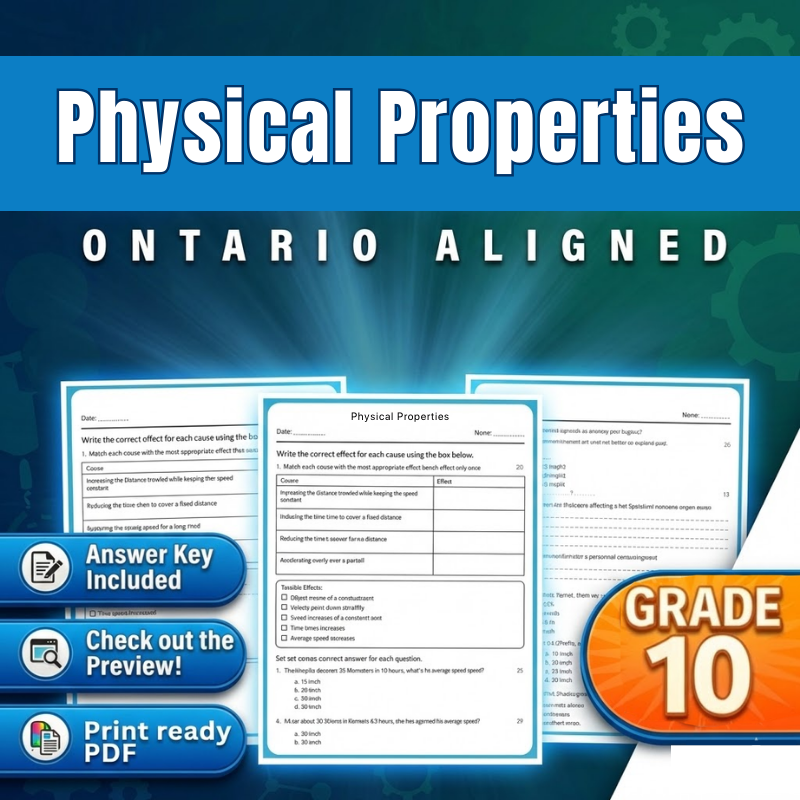
Grade 10 Science | Physical Properties Worksheet (Ontario) – PDF
Created byBright Mind ResourcesLearning Objectives
- Identify and describe measurable physical properties such as density, melting point, boiling point, and conductivity.
- Differentiate between intensive and extensive properties of matter.
- Interpret graphs and tables related to physical property measurements.
Instant download

Bonding Types Worksheet | Grade 10 Science Practice
Created byPrism Point LearningLearning Objectives
- Distinguish ionic, covalent, and metallic bonding based on how electrons move or behave.
- Use periodic trends to predict properties such as electrical conductivity and melting point.
- Explain how electron configuration stability is achieved in different bonding types.
Also included in: Grade 10 Science Chemical Reactions & Atomic Structure Lesson Bundle | Bc +1 more
Instant download

Grade 10 Hazard Influence on People and Places Worksheet | NGSS Science
 Created byAmber Owl Education
Learning Objectives
- Explain how freshwater availability, natural hazards, and climate variability influence where people live and how land is used.
- Analyze evidence from data sources such as flood frequency and paleoclimate records to support claims about hazard influence.
- Evaluate how societies adapt their economic systems and infrastructure in response to changing hazard risk and water supply.
Instant download

Grade 10 Science | Phase Change Energy - Daily Reading Comprehension
Created byCoral Reef LearningLearning Objectives
- Understand the concept of phase changes and energy requirements
- Identify different phase changes such as melting, vaporization, freezing, and condensation
- Explain how energy transfer occurs during phase changes and how temperature behavior relates to particle interactions
Instant download

Energy Transfer Worksheet | Grade 10 Science Activities
Created byPrism Point LearningLearning Objectives
- Explain how energy can transfer between systems by heating, work, and radiation
- Relate kinetic, gravitational potential, and elastic energy to particle motion, height, and deformation
- Predict the direction of energy transfer from observable changes such as temperature, speed, and height
Instant download

Atomic Models Worksheet Pack | Grade 10 Science Practice
Created byPrism Point LearningLearning Objectives
- Explain how particulate atomic models connect microscopic particle arrangement to macroscopic properties such as density, phase, and conductivity.
- Compare atomic models by describing what they predict about particle motion and interactions.
- Use evidence from everyday materials (solids, liquids, gases, and mixtures) to justify particulate explanations.
Also included in: Grade 10 Chemistry & Dynamic Equilibrium Lesson Bundle | Alberta Science
Instant download
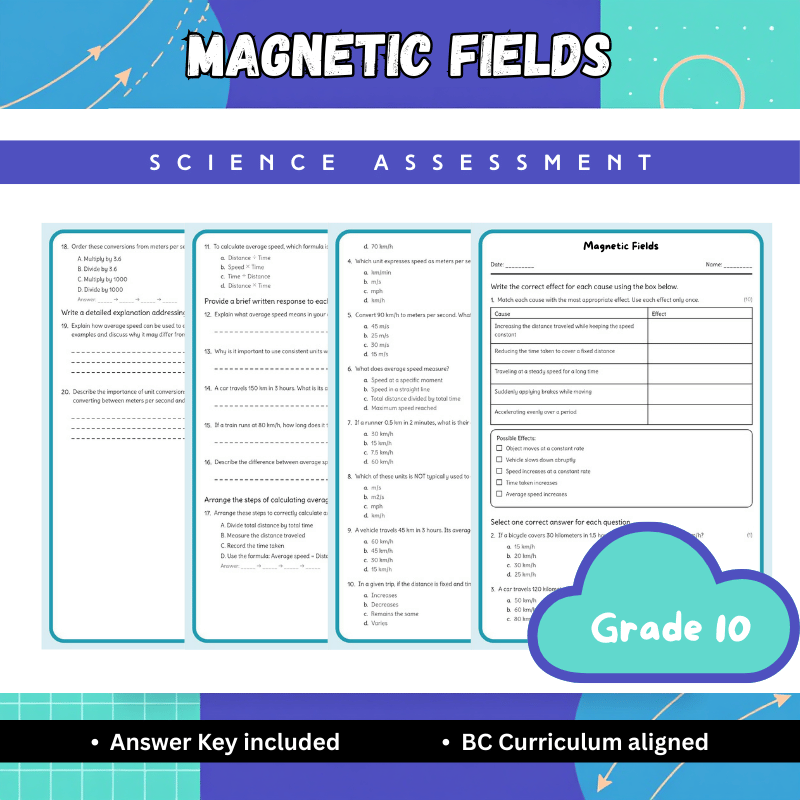
Grade 10 Science | Magnetic Fields Worksheet + Answer Key (BC Standard)
Created byBright Mind ResourcesLearning Objectives
- Understand how magnetic fields arise from moving charges and currents.
- Describe the properties and behavior of magnetic field lines.
- Explain how magnetic forces act on moving charges and their effect on particle trajectories.
Instant download
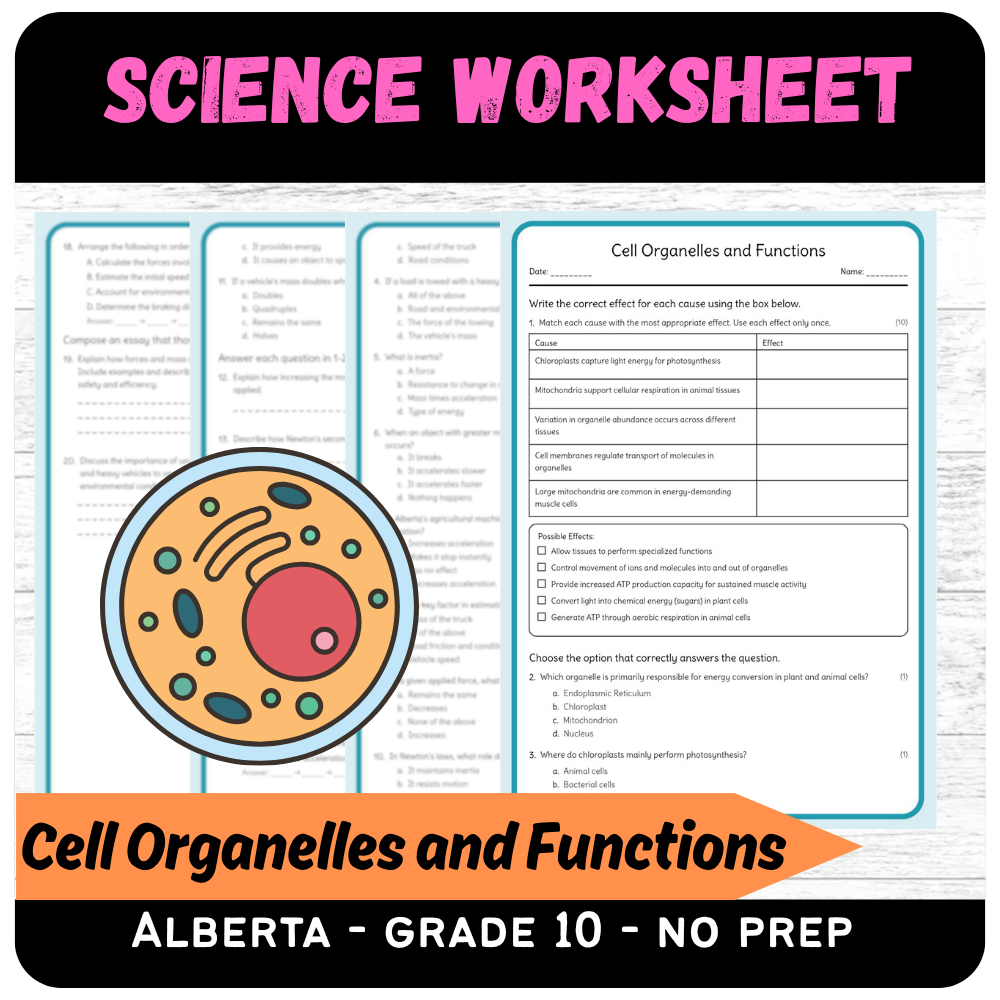
Grade 10 Science | Cell Organelles & Functions Worksheet (PDF)
Created byBright Mind ResourcesLearning Objectives
- Identify the different types of membrane-bound and non-membrane-bound organelles within eukaryotic cells.
- Explain how the structure of organelles relates to their specific functions in plant and animal cells.
- Describe the roles of chloroplasts and mitochondria in energy conversion and adaptation across Alberta landscapes.
Instant download
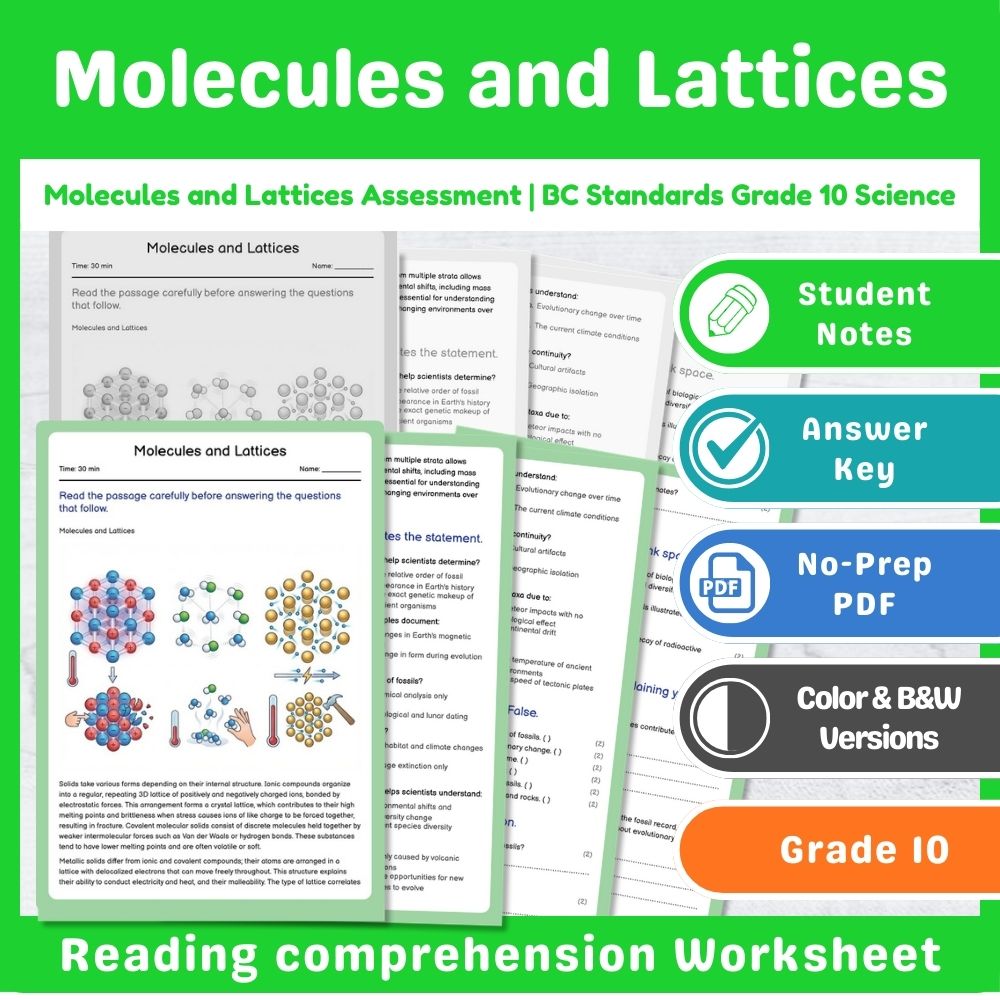
Molecules and Lattices Assessment | BC Standards Grade 10 Science
Created byPrism Point LearningLearning Objectives
- Describe the structural differences among ionic, covalent molecular, and metallic lattices.
- Explain how lattice structures influence material properties such as melting point, hardness, and conductivity.
- Correlate element positions on the periodic table with types of chemical bonding and lattice arrangements.
Instant download
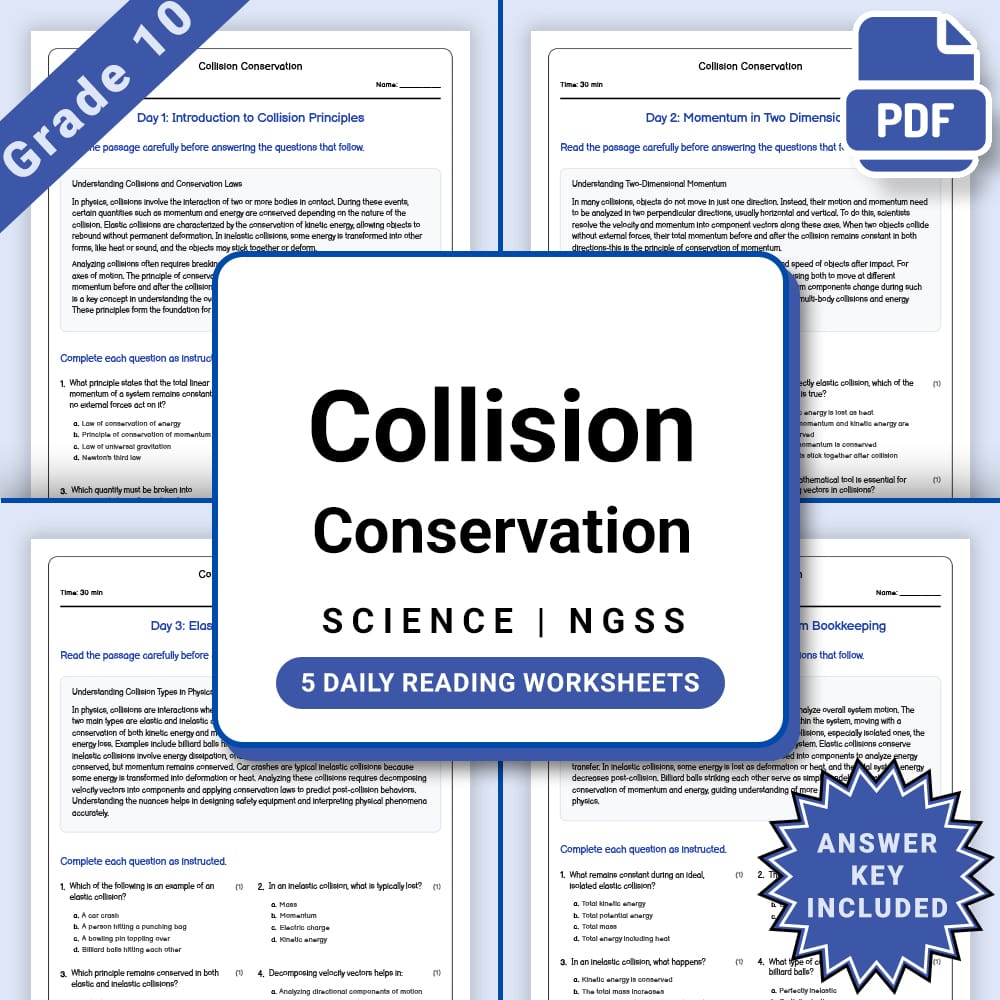
Grade 10 Science – Collision Conservation Worksheet (PDF +Answer Key)
Created byCopper Leaf ClassroomLearning Objectives
- Understand key concepts related to Science
- Apply knowledge through practice questions
- Demonstrate comprehension of the material
Instant download
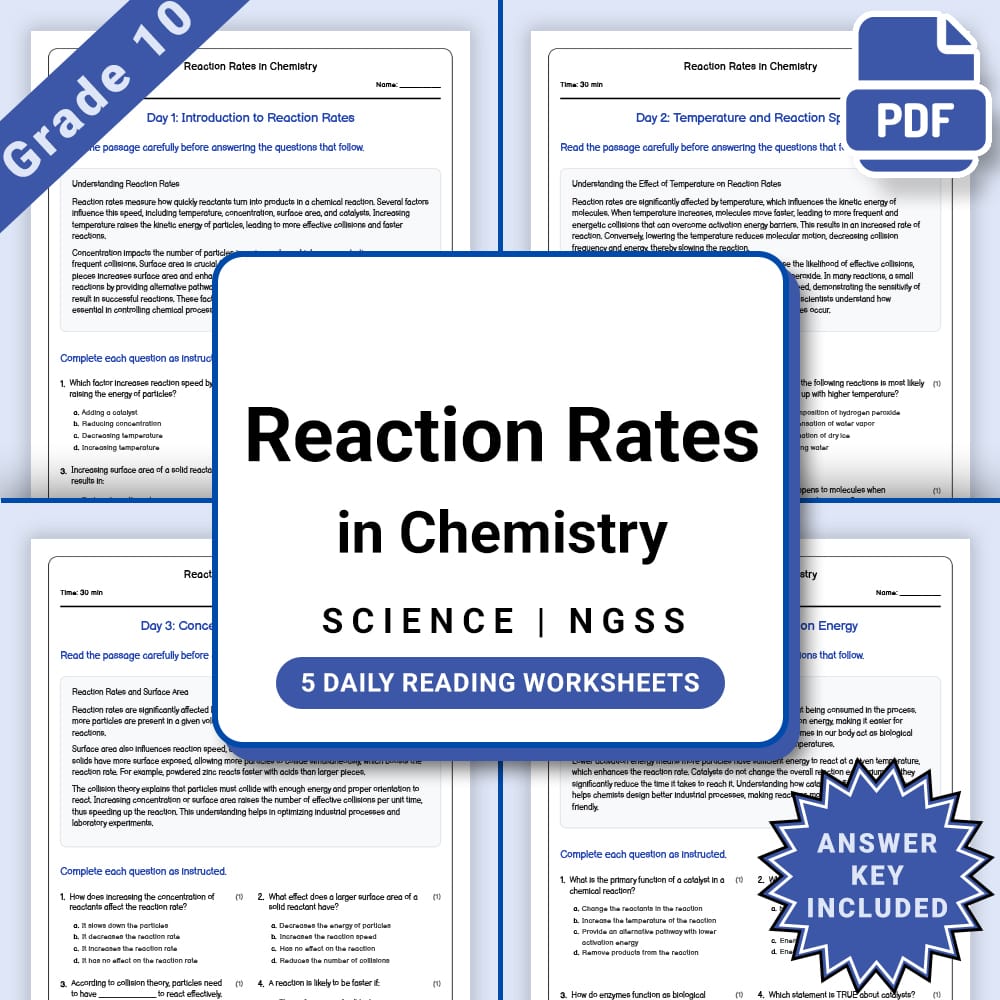
Grade 10 Science – Reaction Rates Worksheet (PDF +Answer Key)
Created byCopper Leaf ClassroomLearning Objectives
- Understand the factors that influence the speed of chemical reactions.
- Describe how temperature, concentration, surface area, and catalysts affect reaction rates.
- Interpret empirical data related to reaction kinetics and rate laws.
Instant download

Thermodynamic Limits Worksheet | Grade 10 Science Practice
Created byPrism Point LearningLearning Objectives
- Explain how the first and second laws of thermodynamics constrain energy use and work production
- Use Carnot’s relationship to describe the maximum efficiency between two temperature reservoirs
- Describe how irreversibility (entropy production) reduces the performance of real heat engines and refrigerators
Also included in: Grade 10 Energy, Efficiency & Conservation Science Lesson Bundle | BC +1 more
Instant download
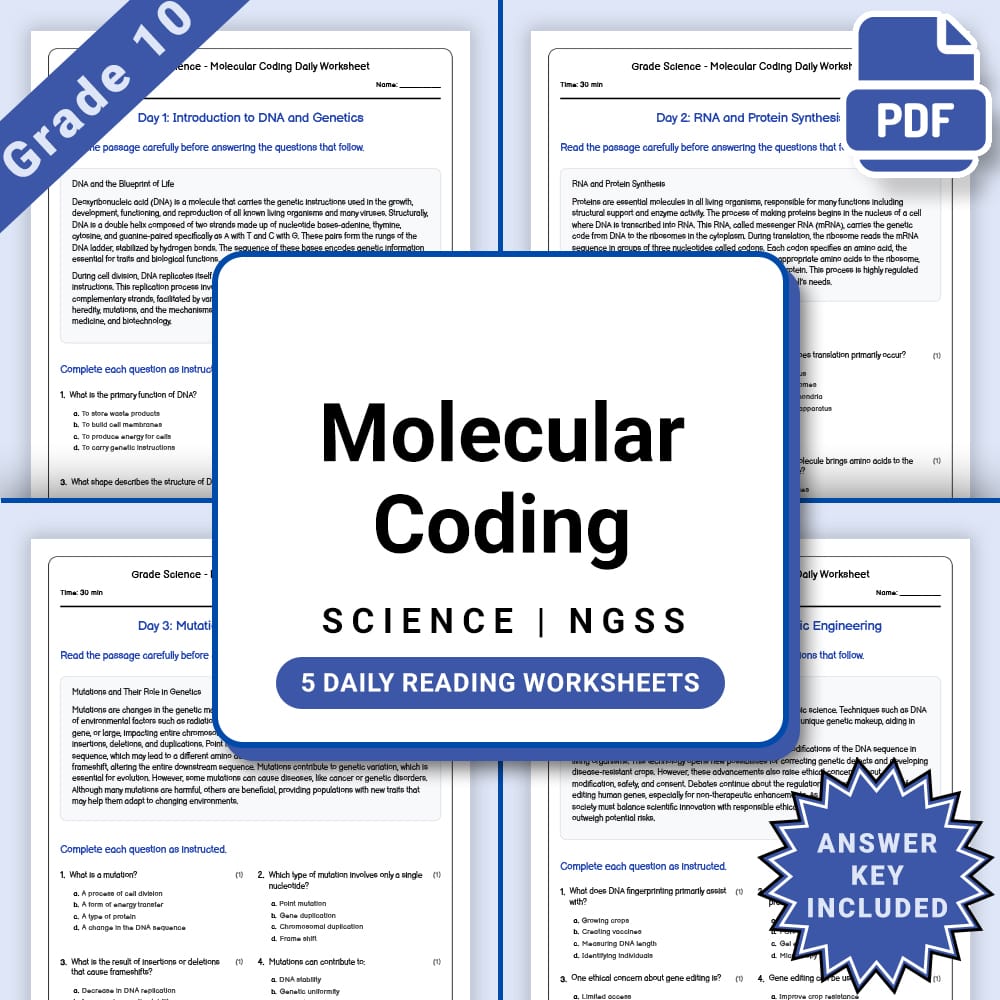
Grade 10 Science – Molecular Coding Daily Worksheet (PDF +Answer Key)
Created byCopper Leaf ClassroomLearning Objectives
- Understand key concepts related to Science
- Apply knowledge through practice questions
- Demonstrate comprehension of the material
Instant download

Understanding Uncertainty Ranges Assessment for Grade 10 Science
Created byPrism Point LearningLearning Objectives
- Explain how measurement spread indicates uncertainty in data.
- Differentiate between central tendency and variability in measurements.
- Compare ranges to assess if differences are due to random variation.
Instant download

Energy Loss and Efficiency Worksheet | Grade 10 Science CA Standards
Created byEvergreen Desk EducationLearning Objectives
- Explain how real systems involve useful energy transfer and unavoidable energy losses
- Interpret efficiency as the fraction of total energy transfer that produces the intended outcome
- Use energy accounting ideas to justify why reducing loss mechanisms improves performance
Instant download

Grade 10 Science | Mutations & Traits - Daily Reading Comprehension
Created byCoral Reef LearningLearning Objectives
- Understand the concept of mutations and how they alter DNA
- Identify different types of mutations and their effects on genes
- Explain how mutations can influence traits and evolution
Instant download

Astronomical Scale Grade 10 Science Worksheet | Standards-Aligned Practice
JCreated byJ.S SheetsLearning Objectives
- Explain how astronomers use scale and models to interpret space phenomena involving size, distance, and motion.
- Convert conceptual understanding of distances inside vs. beyond the solar system using astronomical units (AU) and light-years.
- Use angular size and brightness to reason about how apparent appearance relates to distance and intrinsic power.
Also included in: Grade 10 Earth and Space Systems Science Lesson Bundle – Florida NGSSS +1 more
Instant download

Grade 10 Science — Worksheet MCQ Paper for Mastering Motion Graphs
Created byThe Resource HubLearning Objectives
- Understand how the slope of position vs. time graphs relates to velocity.
- Interpret areas under velocity graphs to determine displacement.
- Connect features of acceleration graphs to changes in velocity and force.
Also included in: Grade 10 Science AP Bundle – Comprehensive Curriculum with 60 Worksheets
Instant download

Molecular Geometry Worksheet Pack | AP Grade 10 Chemistry Practice
Created byPrism Point LearningLearning Objectives
- Define molecular geometry using electron-domain (VSEPR) ideas and explain how bonding and nonbonding electron domains control 3D shape.
- Use simple orbital hybridization and electron-domain reasoning to predict molecular shapes.
- Explain how molecular shape affects molecular polarity and can influence macroscopic properties like boiling point and solvent interactions.
Instant download

Grade 10 Science – Paleoclimate Evidence & Climate Records | Reading Worksheet
Created byBright Mind ResourcesLearning Objectives
- Identify various proxy records used in paleoclimate studies.
- Explain how isotopic ratios, microfossil assemblages, and sedimentary facies provide climate information.
- Compare paleoclimate records with instrumental data to understand climate change.
Also included in: Earth Systems Grade 10 Science Daily Reading Worksheets Bundle | NGSS +2 more
Instant download

Grade 10 Mineral Overview Worksheet | Ontario Science Resource
Created byClear Sky ClassroomLearning Objectives
- Identify major mineral properties (crystal habit, hardness, cleavage, specific gravity, and chemical composition) and explain how each property helps mineral identification.
- Distinguish ores, industrial minerals, and gemstones using economic geology concepts.
- Describe common mineral formation settings (hydrothermal veins, magmatic segregation, and sedimentary concentration) and link them to mineral deposits.
Instant download

Pedigree Analysis Inheritance Patterns Worksheet | TEKS Grade 10 Science
Created byBRIGHT PATH RESOURCESLearning Objectives
- Distinguish affected and unaffected patterns across generations in a pedigree
- Use transmission patterns to infer likely inheritance modes
- Connect phenotypes to possible genotypes using meiosis logic
Also included in: Grade 10 Genetics & Molecular Biology Science Worksheets Bundle | TEKS +1 more
Instant download
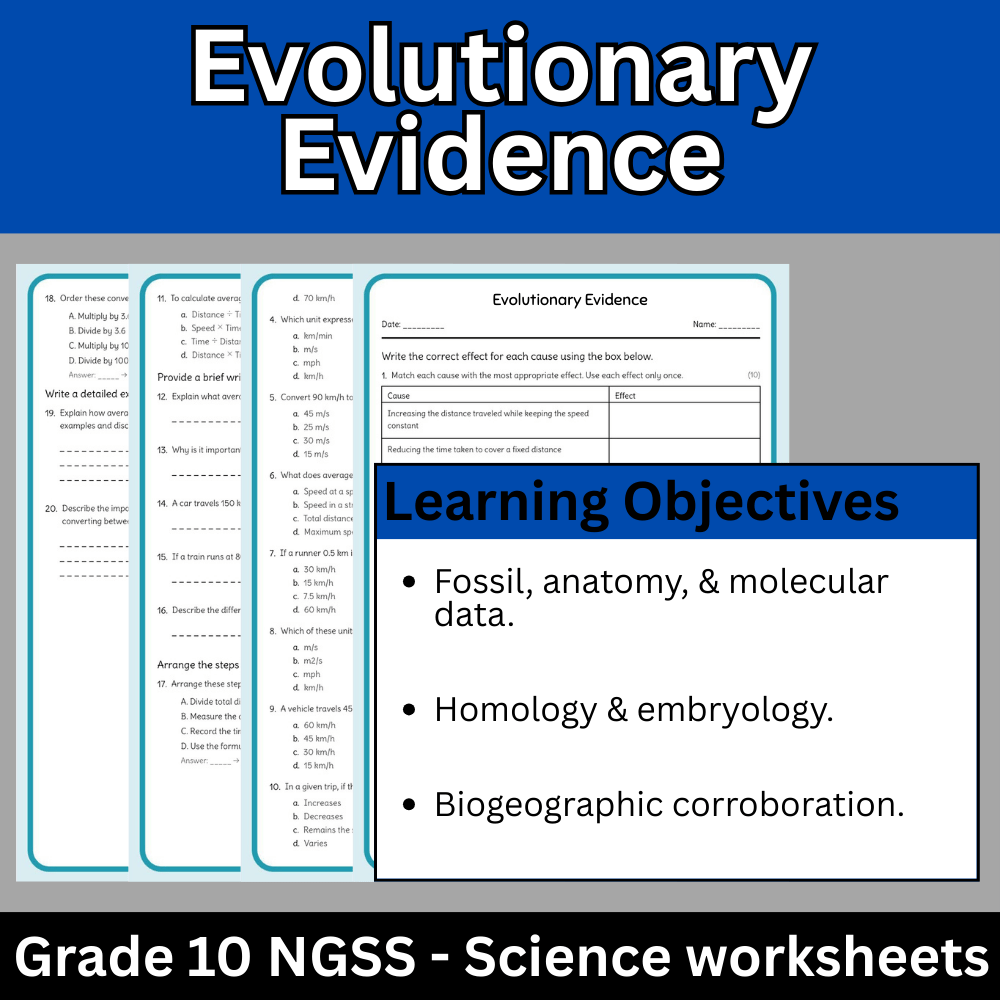
Grade 10 Science | Evidence for Evolution Worksheet (Answer Key) – NGSS Aligned
Created byBright Mind ResourcesLearning Objectives
- Identify different types of evidence supporting common ancestry and evolution.
- Interpret data from fossil records, comparative anatomy, embryology, and molecular sequences.
- Understand how molecular and biogeographic data corroborate evolutionary relationships.
Instant download
About Grade 10 Science Worksheets
Find Science worksheets built for Grade 10. All 7,038 cover core skills, practice, and review, each an instant PDF download.
Every worksheet on MyTeachingSheets is created by independent teacher-authors and reviewed before publication. All resources download as printable PDFs for classroom, homework, or at-home practice, and many include answer keys. Preview any worksheet free before buying.