
Grade 10 Science Worksheets
7,038 worksheets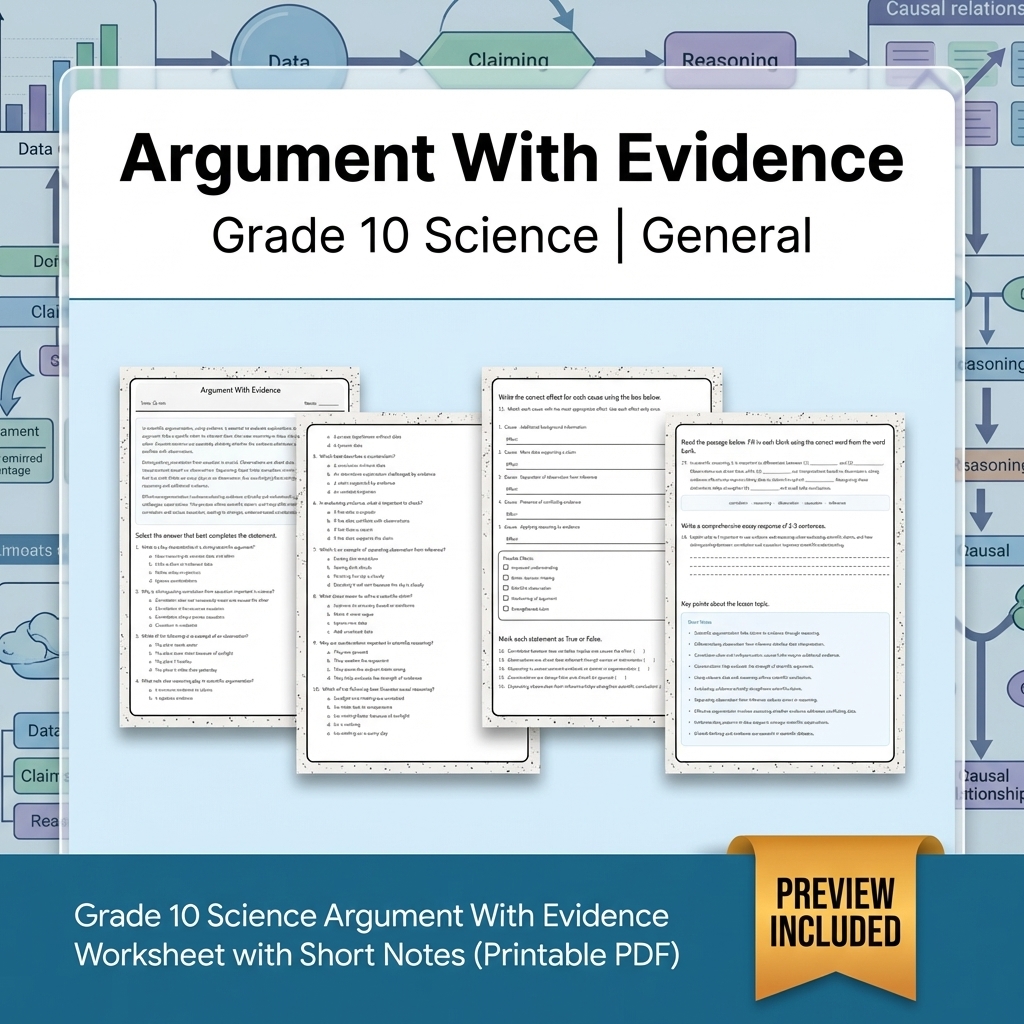
Grade 10 Science Argument With Evidence Worksheet with Short Notes
 Created byMeadowlark Worksheets
Learning Objectives
- Understand how evidence supports scientific claims in argumentation.
- Distinguish between correlation and causation in scientific reasoning.
- Identify how observations and inferences contribute to scientific claims.
Also included in: Grade 10 Measurement Uncertainty Science Lesson Bundle: General +1 more
Instant download

Grade 10 Science | Speciation and Diversity Worksheet | NGSSS Assessment
 Created byLumora Learning
Learning Objectives
- Explain how reproductive isolation can limit gene flow and lead to speciation
- Describe how divergent selection pressures and genetic drift contribute to evolutionary divergence
- Connect speciation to biodiversity and adaptive radiation in ecosystems
Instant download

Grade 10 Science – Species Interactions & Ecology | Daily Reading Worksheet
 Created byBright Mind Resources
Learning Objectives
- Understand different types of species interactions including competition, predation, parasitism, mutualism, and commensalism
- Identify examples of species interactions in natural communities
- Analyze how interactions influence biodiversity and community structure
Also included in: Grade 10 Evolution & Genetics Science Daily Reading Lesson Bundle | BC +1 more
Instant download

Wave Properties Assessment for Grade 10 Science | Florida NGSSS
 Created byPrism Point Learning
Learning Objectives
- Explain wave properties (amplitude, wavelength, frequency, and wave speed) and how they describe repeating disturbances.
- Use the relationships among frequency, wavelength, and wave speed for waves traveling at the same speed.
- Interpret how reflection, refraction, and superposition affect wave behavior in real scenarios.
Also included in: Grade 10 Waves Energy Forces Science Lesson Mini Bundle | Florida NGSSS +1 more
Instant download

Grade 10 Science | Bond Polarity Worksheet (AP Standards) (PDF)
 Created byEvergreen Desk Education
Learning Objectives
- Characterize bond polarity using electronegativity differences and describe how uneven electron distribution creates a bond dipole.
- Represent bond polarity with dipole moments (direction and magnitude) and relate vector ideas to electron density.
- Explain how polar covalent vs. ionic character varies on a continuum and connect polarity to intermolecular attractions and solubility.
Also included in: Grade 10 Chemistry Science Lesson Bundle AP Framework Worksheets Practice +1 more
Instant download

Energy in Cells Assessment | Florida NGSSS Standard Grade 10 Science
Created byPrism Point LearningLearning Objectives
- Explain how cells obtain and use energy to perform work such as building molecules and maintaining organization
- Describe how cellular respiration converts chemical energy from carbohydrates into ATP
- Compare energy transformation in cellular respiration with energy capture in photosynthesis
Also included in: Grade 10 Cells, Genetics & Evolution Science Lesson Bundle | Florida NGSSS +1 more
Instant download

Grade 10 Reaction Rates Worksheet | NGSS Chemistry Science Activity
 Created byBRIGHT PATH RESOURCES
Learning Objectives
- Understand factors affecting reaction speed such as temperature, concentration, surface area, and catalysts.
- Explain collision theory and how it relates to reaction rates.
- Interpret empirical data on reaction rates using rate laws and collision theory concepts.
Also included in: Matter and Its Interactions Grade 10 Science Lesson Bundle | NGSS +1 more
Instant download

Grade 10 AP Science Molecular Messages Worksheet | Practice Pack
Created byPrism Point LearningLearning Objectives
- Explain how DNA structure supports faithful information storage and accurate replication.
- Describe how transcription and translation convert a DNA sequence into a protein outcome.
- Use genetic code ideas to connect codons to amino acids and protein function.
Also included in: Grade 10 AP Science Life Systems Lesson Bundle | Worksheet Pack
Instant download

Grade 10 Science | Testable Questions Worksheet | General Standards
Created byLumora LearningLearning Objectives
- Explain how a testable scientific question connects a claim to measurable variables
- Distinguish between a scientific question, a hypothesis, and expected measurable outcomes
- Identify whether an investigation approach matches the type of question and the scale of observation
Instant download

Grade 10 Science – Mass Conservation & Chemical Reactions | Reading Worksheet
Created byBright Mind ResourcesLearning Objectives
- Define the law of conservation of mass.
- Explain how atoms are conserved in chemical reactions.
- Apply balancing techniques to chemical equations.
Also included in: Chemical Reactions Grade 10 Science Daily Reading Worksheets Bundle | NGSS +2 more
Instant download
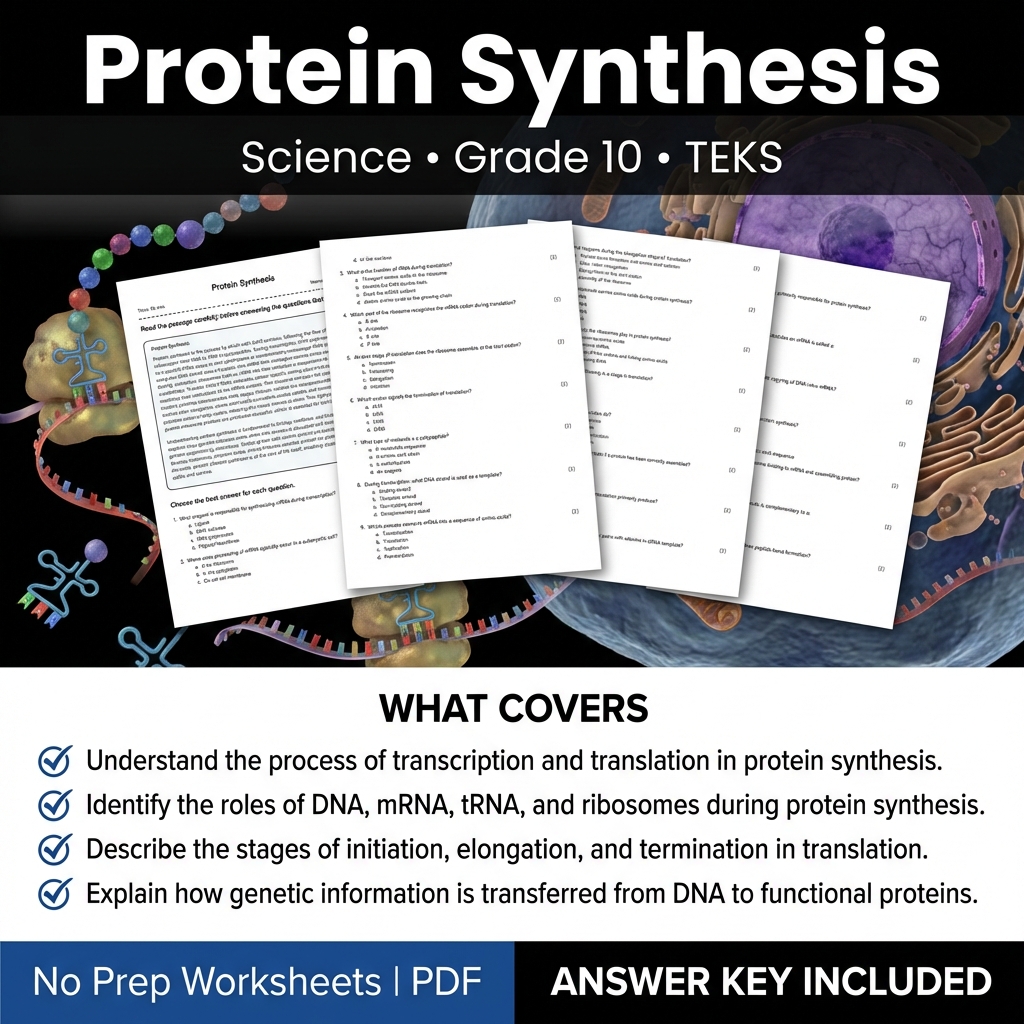
Protein Synthesis Worksheet for Grade 10 Science | TEKS Aligned
 Created byCoral Reef Learning
Learning Objectives
- Understand the process of transcription and translation in protein synthesis.
- Identify the roles of DNA, mRNA, tRNA, and ribosomes during protein synthesis.
- Describe the stages of initiation, elongation, and termination in translation.
Instant download

Grade 10 Science – Cell Organization & Structures | Daily Reading Worksheet
Created byBright Mind ResourcesLearning Objectives
- Identify major organelles within eukaryotic cells
- Understand functions of cellular membrane-bound organelles
- Compare structural differences between prokaryotic and eukaryotic cells
Also included in: Homeostasis Grade 10 Science Daily Reading Worksheets Lesson Bundle | NGSS +2 more
Instant download

Protein Synthesis Assessment | TEKS Standards Grade 10 Science Worksheet
Created byPrism Point LearningLearning Objectives
- Describe the process of transcription and translation in protein synthesis.
- Identify the roles of DNA, RNA, ribosomes, and tRNA during protein synthesis.
- Explain the stages of transcription and translation, including initiation, elongation, and termination.
Also included in: Lesson Grade 10 Genetics: DNA, RNA, Protein Science Lesson Bundle TEKS
Instant download

Field Superposition Worksheet | Grade 10 Science Practice
Created byPrism Point LearningLearning Objectives
- Explain how field superposition relates the net field at a point to the vector sum of individual source fields.
- Use superposition to predict where gravitational or electric field magnitudes are enhanced or reduced.
- Identify equilibrium points by reasoning about vector cancellation between two sources.
Also included in: Forces, Motion & Fields Lesson Bundle | Grade 10 Science | BC +1 more
Instant download

Carrying Capacity Factors Worksheet | Grade 10 Ecology Practice
Created byPrism Point LearningLearning Objectives
- Explain what carrying capacity means and why populations often level off over time.
- Identify how resource availability, competition, and biotic pressures (predators and disease) affect carrying capacity.
- Describe how energy flow and nutrient availability can influence which populations persist at larger ecosystem scales.
Also included in: Grade 10 Life Science Lesson Bundle | California Standards Framework
Instant download

Electric Circuits Worksheet | Grade 10 Science Activities
Created byPrism Point LearningLearning Objectives
- Explain how electric circuits move energy from sources through components to the load
- Describe how resistance, reactance, and transmission distance affect power delivery and efficiency
- Compare centralized and distributed generation using reliability and environmental impacts
Also included in: Grade 10 Energy, Efficiency & Conservation Science Lesson Bundle | BC +1 more
Instant download

Fields Overview Worksheet for AP Science Grade 10 + Answer Key
 Created byBright Quill Resources
Learning Objectives
- Explain what an electric field represents as force per unit charge and how to interpret its direction and strength.
- Use field-line diagrams to describe how electric forces vary with position for simple charge configurations.
- Relate electric potential energy changes to the work done by electric fields and connect field ideas to motion and energy.
Instant download

Grade 10 Science | Electric Circuits - Daily Reading Comprehension
Created byCoral Reef LearningLearning Objectives
- Identify the basic components of an electric circuit
- Describe the functions of resistors, batteries, switches, and wires
- Understand how electrical energy is transported through circuits
Instant download

Grade 10 Science – Efficiency Metrics in Energy Systems | Reading Worksheet
Created byBright Mind ResourcesLearning Objectives
- Understand the concept of percent efficiency and its calculation
- Interpret efficiency metrics to compare different systems
- Identify factors affecting efficiency metrics such as boundaries and external impacts
Also included in: Grade 10 Energy Science Daily Reading Worksheets Lesson Bundle | BC +1 more
Instant download
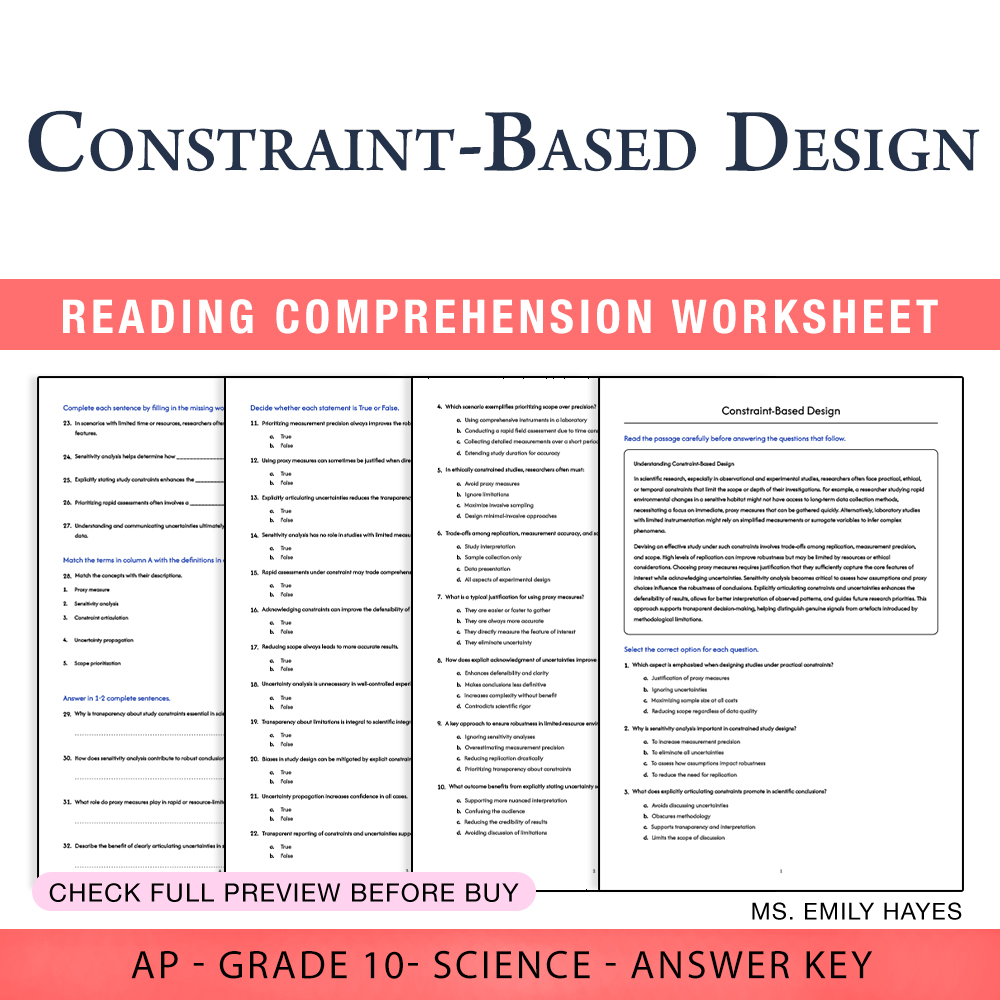
Grade 10 Science | Constraint-Based Design Worksheet (PDF+ Answer Key)
 Created byCopper Leaf Classroom
Learning Objectives
- Understand the challenges and trade-offs involved in constraint-based experimental design.
- Identify strategies for prioritizing observational and experimental constraints.
- Evaluate the role of proxy measures and sensitivity analyses in robust conclusions.
Also included in: Grade 10 Science AP | Data Analysis & Modeling Skills (PDF + Answer Key) +1 more
Instant download

Grade 10 Science | Measurement Uncertainty - Daily Reading Practice
Created byCoral Reef LearningLearning Objectives
- Define measurement uncertainty and its significance in scientific experiments.
- Explain how ranges and limits relate to measurement accuracy.
- Interpret overlapping and non-overlapping ranges to assess the confidence in scientific results.
Instant download

Grade 10 Multiple Evidence Lines Worksheet | Science CER Practice
Created byPrism Point LearningLearning Objectives
- Explain how multiple independent evidence types support common ancestry and evolutionary change
- Describe how fossils, molecular data, and biogeographic patterns provide converging evidence
- Evaluate claims about evolution by checking whether they are supported by more than one line of evidence
Also included in: Grade 10 Life Science Lesson Bundle | California Standards Framework
Instant download

Grade 10 Science – Cell Organelle Architecture & Function | Reading Worksheet
Created byBright Mind ResourcesLearning Objectives
- Identify the major cellular organelles and describe their structures.
- Differentiate between prokaryotic and eukaryotic cell organization.
- Understand how cellular compartmentalization supports cell functions.
Also included in: Grade 10 Cell Processes & Energy Science Daily Reading Lesson Bundle | Ontario +1 more
Instant download

Grade 10 Science – Hazard Risk Reduction & Natural Disasters | Reading Worksheet
Created byBright Mind ResourcesLearning Objectives
- Identify different types of natural hazards
- Understand the effects of natural disasters on communities
- Analyze how human choices can mitigate or exacerbate disaster impacts
Also included in: Grade 10 Climate Linkages Science Daily Reading Worksheets Bundle | CA Standards +1 more
Instant download

Atmospheric Processes Worksheet | Grade 10 Science Practice
Created byPrism Point LearningLearning Objectives
- Explain how pressure, temperature, and moisture differences drive regional weather patterns
- Describe how fronts, Chinook winds, and convection affect precipitation distribution
- Relate atmospheric composition and surface albedo to the Earth’s energy balance
Instant download

Grade 10 Science – Orbital Geometry & Seasons | Daily Reading Worksheet
Created byBright Mind ResourcesLearning Objectives
- Explain how Earth's axial tilt influences seasons and sunlight distribution.
- Describe the relationship between Earth's revolution around the Sun and seasonal changes.
- Identify how the Moon's orbit causes different lunar phases.
Also included in: Climate Grade 10 Science Daily Reading Worksheets Lesson Bundle | General +1 more
Instant download

Grade 10 Systems Analysis in Engineering Worksheet | NGSS STEM Activity
Created byBRIGHT PATH RESOURCESLearning Objectives
- Understand the components and interactions within electric grid systems.
- Identify systems thinking concepts such as feedback loops and boundary definitions.
- Analyze how energy, material, and information flow through complex engineering systems.
Also included in: Engineering Design Foundations Grade 10 Science Daily Reading Bundle | NGSS +1 more
Instant download

Grade 10 Science | Periodic Trends - Daily Reading Comprehension
Created byCoral Reef LearningLearning Objectives
- Understand how atomic size varies across different periods and groups in the periodic table.
- Explain the factors influencing atomic size, including effective nuclear charge and electron shielding.
- Identify trends in atomic size for alkali metals, halogens, and other element groups.
Instant download

Grade 10 Science | Natural Selection Worksheet | General Standards
Created byLumora LearningLearning Objectives
- Explain how heritable variation and differential survival or reproduction lead to changes in populations over generations
- Use the idea of allele frequency shifts to describe adaptation and evolution by natural selection
- Compare convergent and divergent evolution as outcomes of different or similar selective pressures
Instant download

Grade 10 Science Worksheet | Constant Acceleration | Ontario Standards
JCreated byJ.S SheetsLearning Objectives
- Use kinematic equations to determine displacement and velocity for one-dimensional motion with constant acceleration, including negative acceleration and sign conventions.
- Apply boundary conditions (initial position, initial velocity, and time intervals) to multi-stage problems such as launch and braking.
- Interpret results physically, including when velocity changes sign and motion reverses direction.
Instant download

Grade 10 Science Worksheet | Biotic and Abiotic Concepts (PDF) – TEKS Aligned
Created byEvergreen Desk EducationLearning Objectives
- Distinguish biotic factors from abiotic factors in an ecosystem
- Explain how abiotic gradients affect species distribution and physiological limits
- Describe how biotic interactions (competition and predation) influence population outcomes
Instant download
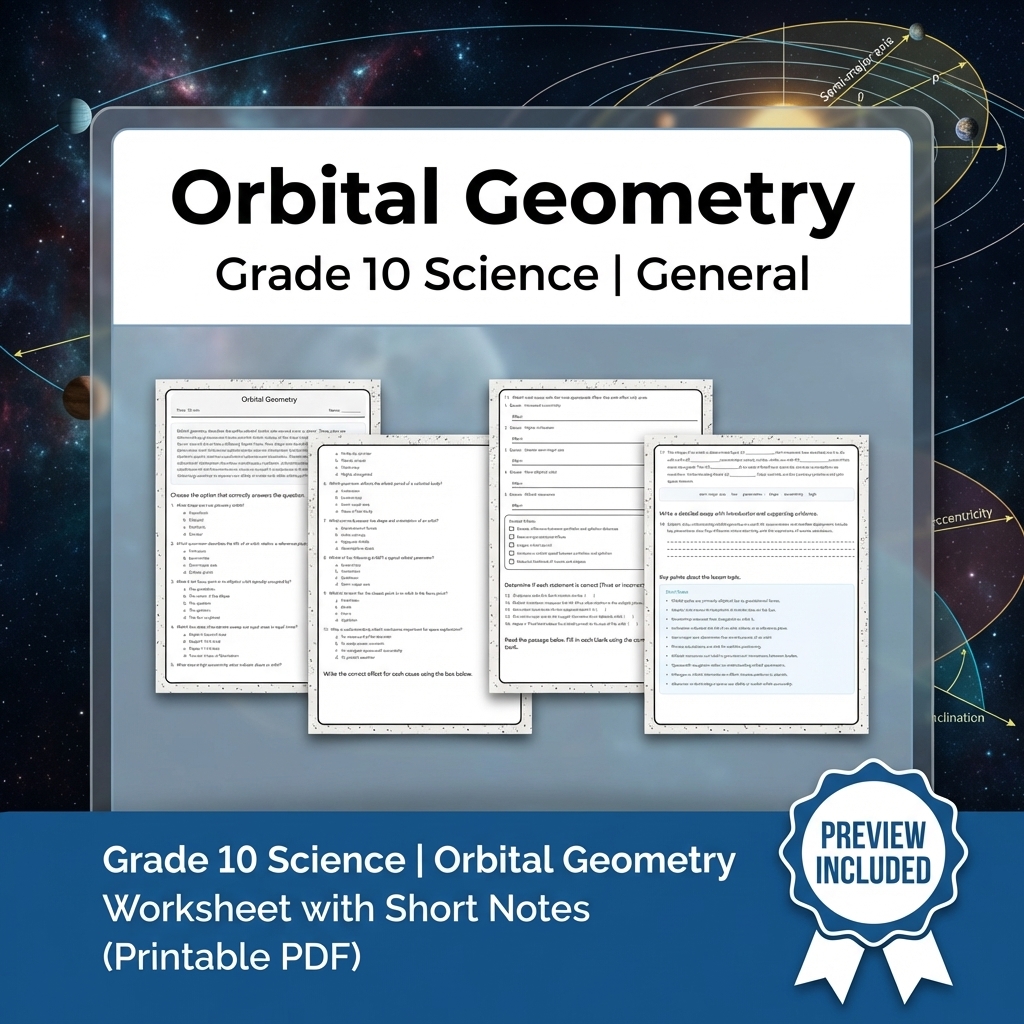
Grade 10 Science | Orbital Geometry Worksheet with Short Notes (Printable PDF)
Created byMeadowlark WorksheetsLearning Objectives
- Understand the basic concepts of orbital geometry and how celestial bodies orbit.
- Identify key terms related to orbital paths and shapes.
- Explain the significance of orbital parameters in space science.
Also included in: Grade 10 Earth Systems Science Lesson Bundle: General Framework Worksheets +1 more
Instant download

Grade 10 Science – Forces and Acceleration Worksheet (PDF) BC Standards
Created byEvergreen Desk EducationLearning Objectives
- Explain Newton’s second law using the relationship between net force, mass, and acceleration
- Interpret and construct free-body diagrams to determine the net force on an object
- Use vector reasoning (components and direction) to predict changes in speed and direction
Instant download

Work and Energy Change Worksheet for Grade 10 Science
JCreated byJ.S SheetsLearning Objectives
- Understand how work done by forces results in changes in a system's energy components.
- Interpret graphical relationships between energy and variables to analyze energy transfer.
- Connect force-based descriptions with measurable energy outcomes in moving and deforming systems.
Also included in: Grade 10 Energy, Forces, and Reactions Science Lesson Bundle +1 more
Instant download

Grade 10 Population Growth Worksheet | Ecology & NGSS Science Activity
Created byBRIGHT PATH RESOURCESLearning Objectives
- Understand the concepts of birth rates, death rates, and how they influence population size
- Analyze data related to population changes and identify growth patterns
- Differentiate between exponential and logistic growth models
Also included in: Grade 10 Ecology Lesson Bundle | Daily Reading | ngss Science +1 more
Instant download

Mutation Sources and Genetic Variation Worksheet | NGSS Grade 10 Science
 Created byAmber Owl Education
Learning Objectives
- Explain how point mutations, insertions/deletions, and chromosomal rearrangements create genetic variation
- Describe common mechanisms that cause mutations, including replication errors, chemical changes, and environmental mutagens
- Connect gene mutations to altered protein function and observable phenotypes
Instant download

Grade 10 Science – Adaptation Types & Morphological Adaptations | Worksheet
Created byBright Mind ResourcesLearning Objectives
- Understand the concept of morphological adaptations
- Identify physical traits that help organisms survive in their environment
- Analyze how certain features provide advantages or disadvantages
Also included in: Grade 10 Evolution & Genetics Science Daily Reading Lesson Bundle | BC +1 more
Instant download

Grade 10 Science | Seismic Tomography: Understanding Earth's Interior
Created byCoral Reef LearningLearning Objectives
- Identify and differentiate between P-waves and S-waves.
- Explain how seismic waves are used to image crustal and mantle structures.
- Interpret variations in seismic wave velocities to infer geological features.
Instant download

Grade 10 Science – Effective Nuclear Charge & Atomic Properties | Worksheet
Created byBright Mind ResourcesLearning Objectives
- Understand the concept of nuclear charge and shielding effect
- Learn how to calculate effective nuclear charge (Zeff)
- Explore how Zeff influences atomic properties such as atomic radius, ionization energy, and electron affinity
Also included in: Grade 10 Stoichiometry & Atomic Structure Science Reading Lesson Bundle | AP +2 more
Instant download
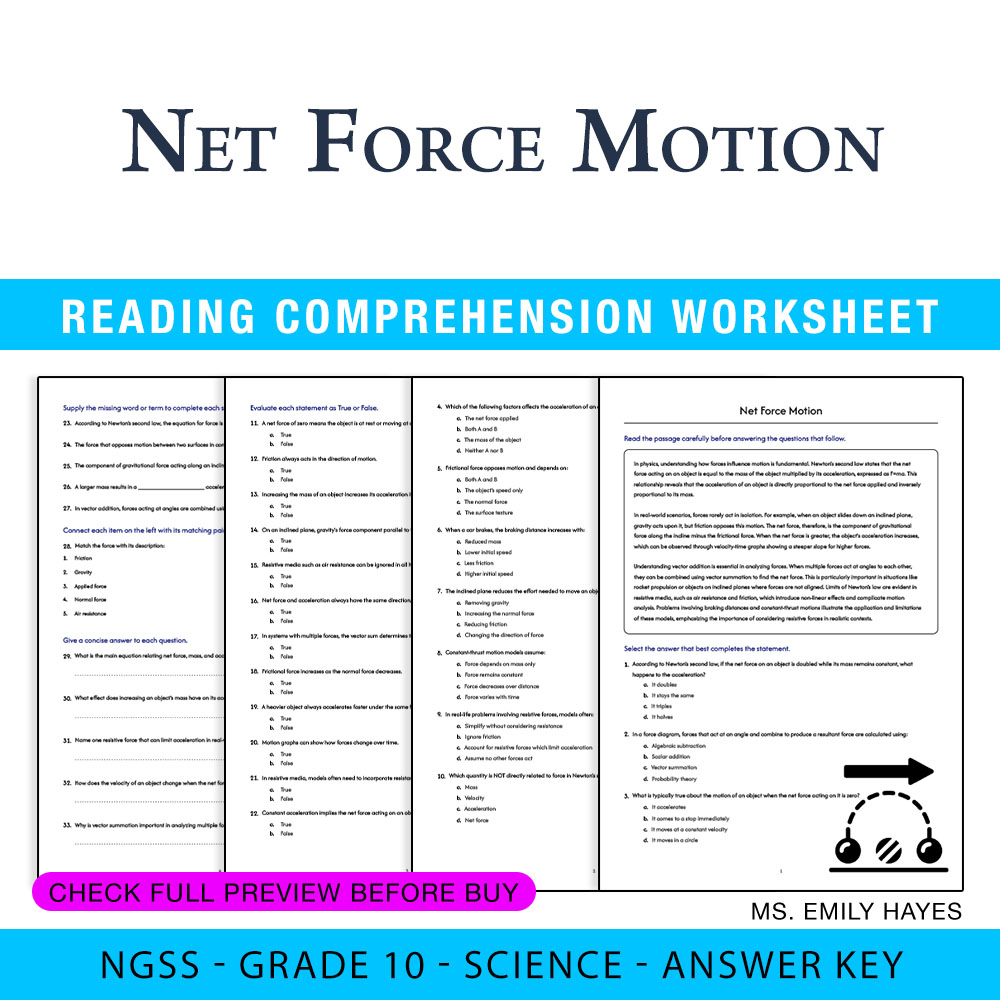
10th Grade Science | Net Force and Motion Worksheet (PDF + Answer Key)
Created byCopper Leaf ClassroomLearning Objectives
- Understand the relationship between net force, mass, and acceleration through Newton's second law.
- Analyze motion graphs to interpret the effects of net force on an object's movement.
- Apply vector summation to calculate net forces in various scenarios.
Instant download

Grade 10 Phase Change Energy Worksheet | California Standards Practice PDF
 Created byClear Sky Classroom
Learning Objectives
- Explain why temperature can stay nearly constant during a phase change even as energy is added or removed
- Differentiate heating-curve intervals that increase particle kinetic energy from intervals that reorganize particles
- Use particle-level ideas to interpret melting and boiling in terms of energy transfer
Instant download
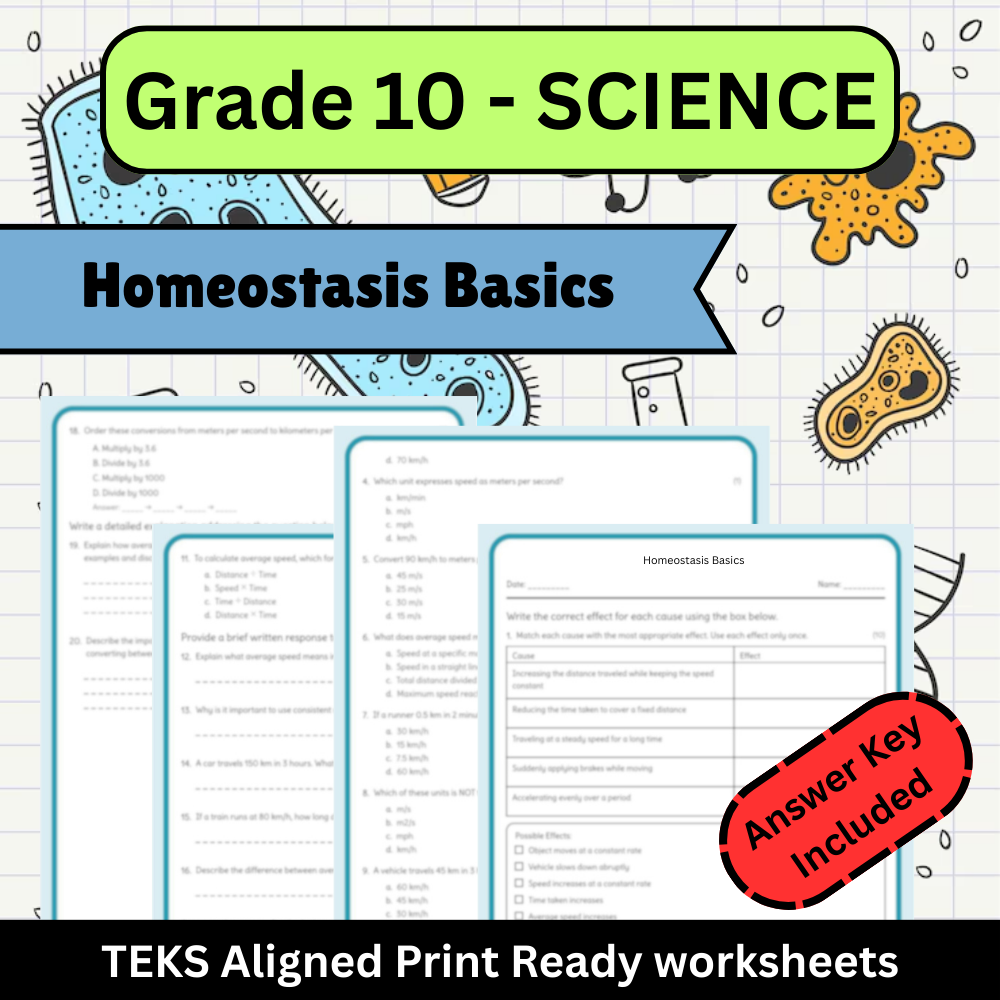
Grade 10 Science | Homeostasis Basics Worksheet (Worksheet + Answer Key) - TEKS Aligned
Created byBright Mind ResourcesLearning Objectives
- Understand the key components of homeostasis, including set points, sensors, and effectors.
- Identify physiological processes that maintain internal stability, such as temperature regulation and blood glucose control.
- Explain how different organ systems coordinate through feedback mechanisms to preserve homeostasis.
Also included in: Grade 10 Science | Body Systems & Homeostasis Worksheet Bundle (TEKS Aligned) +5 more
Instant download

Light and Carbon Science Worksheet | TEKS-Aligned 10th Grade Practice
JCreated byJ.S SheetsLearning Objectives
- Explain how light reactions in thylakoid membranes produce ATP and NADPH and release oxygen through water splitting
- Describe the main steps of the Calvin cycle, including the role of RuBisCO in carbon fixation
- Compare how pigment absorption spectra and reaction localization affect photosynthesis efficiency across plants, algae, and cyanobacteria
Instant download

Grade 10 Science – Risk Management & Laboratory Safety | Daily Reading Worksheet
Created byBright Mind ResourcesLearning Objectives
- Identify chemical, biological, and physical hazards commonly found in laboratories.
- Understand systematic hazard identification and risk assessment methods.
- Learn principles of hazard control including elimination, substitution, engineering controls, and administrative procedures.
Also included in: Inquiry Grade 10 Science Daily Reading Worksheets Lesson Bundle | Ontario +1 more
Instant download

Grade 10 Science – Molecules & Lattices in Solid Materials | Reading Worksheet
Created byBright Mind ResourcesLearning Objectives
- Understand the structural arrangements of ionic, covalent, and metallic solids.
- Identify key properties associated with each type of lattice.
- Explain how atomic arrangements influence material properties such as melting point, brittleness, and conductivity.
Also included in: Chem Reactions Grade 10 Science Daily Reading Worksheets Lesson Bundle | BC +1 more
Instant download

Grade 10 Science | Thermochemistry in Chemical Reactions - Reading Comprehension
Created byCoral Reef LearningLearning Objectives
- Understand the concept of enthalpy and heat flow in chemical reactions.
- Interpret thermochemical equations and calorimetric data.
- Apply Hess's law to determine enthalpy changes via pathway decomposition.
Also included in: Chemistry Foundations Lesson Bundle: Grade 10 Science Advanced Placement (AP) +1 more
Instant download

Biological Feedback Control Worksheets: Grade 10 Science
 Created bySunny Desk Resources
Learning Objectives
- Describe how negative feedback stabilizes physiological variables using input, control, and response
- Differentiate positive feedback from negative feedback in terms of amplification and stability
- Explain how regulatory failure can harm organism health and affect population dynamics
Also included in: Cell Structure, Homeostasis & Energy Lesson Bundle: Grade 10 Science Alberta +1 more
Instant download

Gravity And Orbits Assessment Grade 10 | NGSSS Standards-Aligned Assessment
Created byPrism Point LearningLearning Objectives
- Explain how gravity governs the motion of planets and other celestial bodies
- Describe how elliptical orbits change a satellite’s speed as its distance from the focus changes
- Connect gravitational interactions to observable effects on Earth, such as tides
Also included in: Grade 10 Earth and Space Systems Science Lesson Bundle – Florida NGSSS +1 more
Instant download
About Grade 10 Science Worksheets
Find Science worksheets built for Grade 10. All 7,038 cover core skills, practice, and review, each an instant PDF download.
Every worksheet on MyTeachingSheets is created by independent teacher-authors and reviewed before publication. All resources download as printable PDFs for classroom, homework, or at-home practice, and many include answer keys. Preview any worksheet free before buying.