
Grade 10 Science Worksheets
7,038 worksheets
Grade 10 Environmental Chemistry Worksheet PDF | Alberta Science
 Created byEvergreen Desk Education
Learning Objectives
- Explain how environmental chemical transformations (air, water, and soil) affect ecosystem health.
- Interpret reaction types and rate factors to predict pollution formation and breakdown.
- Use chemical pathway ideas (sources, transport, fate) to describe mass flow in real landscapes.
Instant download

Grade 10 Science | Astronomical Climate Cycles Worksheet | California Standards
 Created byLumora Learning
Learning Objectives
- Explain how Earth’s tilt, orbital eccentricity, and precession can change patterns of incoming solar energy (insolation).
- Describe how astronomical forcing can influence seasonal intensity and long-term climate rhythms.
- Use evidence from paleoclimate records to support claims about repeating climate cycles.
Instant download

Radiation Energy Transfer Worksheet | Grade 10 Science Standards Practice
JCreated byJ.S SheetsLearning Objectives
- Understand how energy is transferred through electromagnetic radiation.
- Explain how radiation interacts with matter to cause physical or chemical changes.
- Describe the characteristics of radiation that influence energy transfer.
Also included in: Grade 10 Energy, Forces, and Reactions Science Lesson Bundle +1 more
Instant download

Systems Interactions Assessment | TEKS Standards Grade 10 Science
 Created byPrism Point Learning
Learning Objectives
- Explain how multiple organ systems coordinate to maintain homeostasis during activities like exercise and dehydration.
- Identify key feedback mechanisms that regulate organ system responses under stress.
- Analyze how emergent properties arise from interactions among organ systems in human physiology.
Also included in: Grade 10 Homeostasis and Feedback Science Lesson Bundle | TEKS
Instant download

Grade 10 Science – Kinematics Graphs Worksheet (PDF) | General Standards
Created byEvergreen Desk EducationLearning Objectives
- Interpret displacement-time, velocity-time, and acceleration-time graphs to describe motion.
- Use slope and sign (positive/negative) to relate graphical features to velocity and acceleration.
- Connect acceleration-time patterns to whether acceleration is constant, changing, or reversing direction.
Also included in: Grade 10 Conservation Laws in Science Lesson Bundle – General Framework +1 more
Instant download

Grade 10 Science | Reaction Rates Worksheet | AP Aligned
Created byLumora LearningLearning Objectives
- Describe how collision frequency, orientation, and activation energy influence reaction rates.
- Interpret graphical and mathematical representations of concentration versus time to determine reaction order.
- Explain the effects of temperature and catalysts on reaction pathways and rates.
Instant download

Grade 10 Science | Photosynthesis Basics - Daily Reading Comprehension
 Created byCoral Reef Learning
Learning Objectives
- Understand the process of photosynthesis and its significance for autotrophic organisms.
- Identify key components involved in photosynthesis, including chloroplasts and pigments.
- Explain the stages of light-dependent reactions and the Calvin cycle.
Instant download
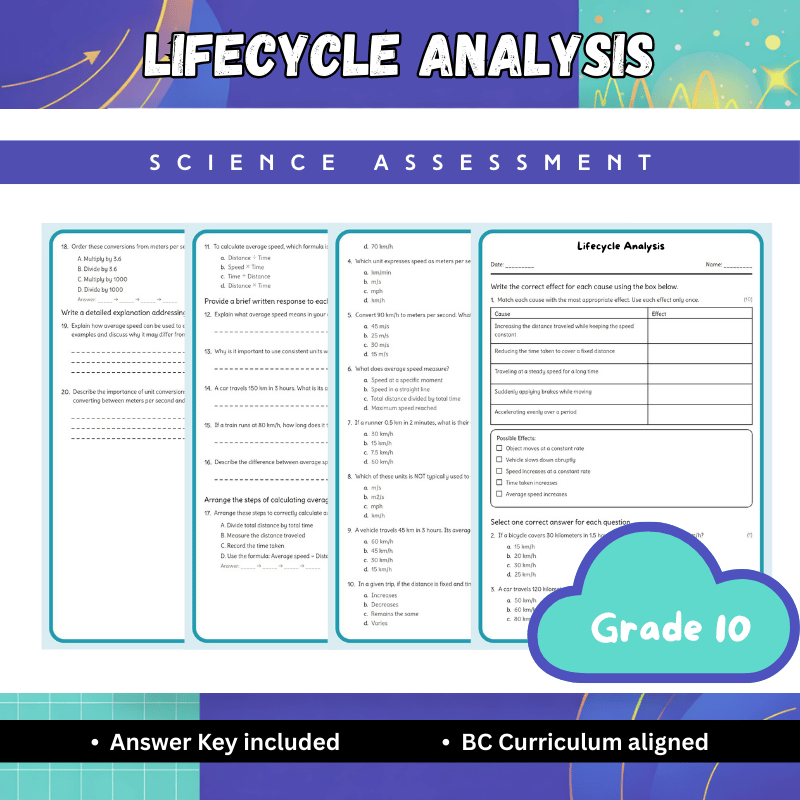
Grade 10 Science | Lifecycle Analysis Worksheet – BC Standards (PDF)
 Created byBright Mind Resources
Learning Objectives
- Understand the concept of lifecycle analysis and its importance in evaluating energy inputs and outputs.
- Identify the stages involved in the cradle-to-grave lifecycle of a technology.
- Apply conservation principles to sum embodied energy, operational consumption, and waste heat.
Instant download

Grade 10 Science – Seismic Tomography Worksheet (Ontario) (PDF)
Created byEvergreen Desk EducationLearning Objectives
- Explain the main types of seismic waves (P-waves and S-waves) and how they travel through Earth.
- Describe how seismic travel times and attenuation relate to seismic wave speeds and energy loss.
- Interpret P-wave and S-wave velocity variations to infer possible changes in temperature, composition, and phase.
Also included in: Grade 10 Earth Systems Geology Science Lesson Bundle: Ontario Worksheets +1 more
Instant download
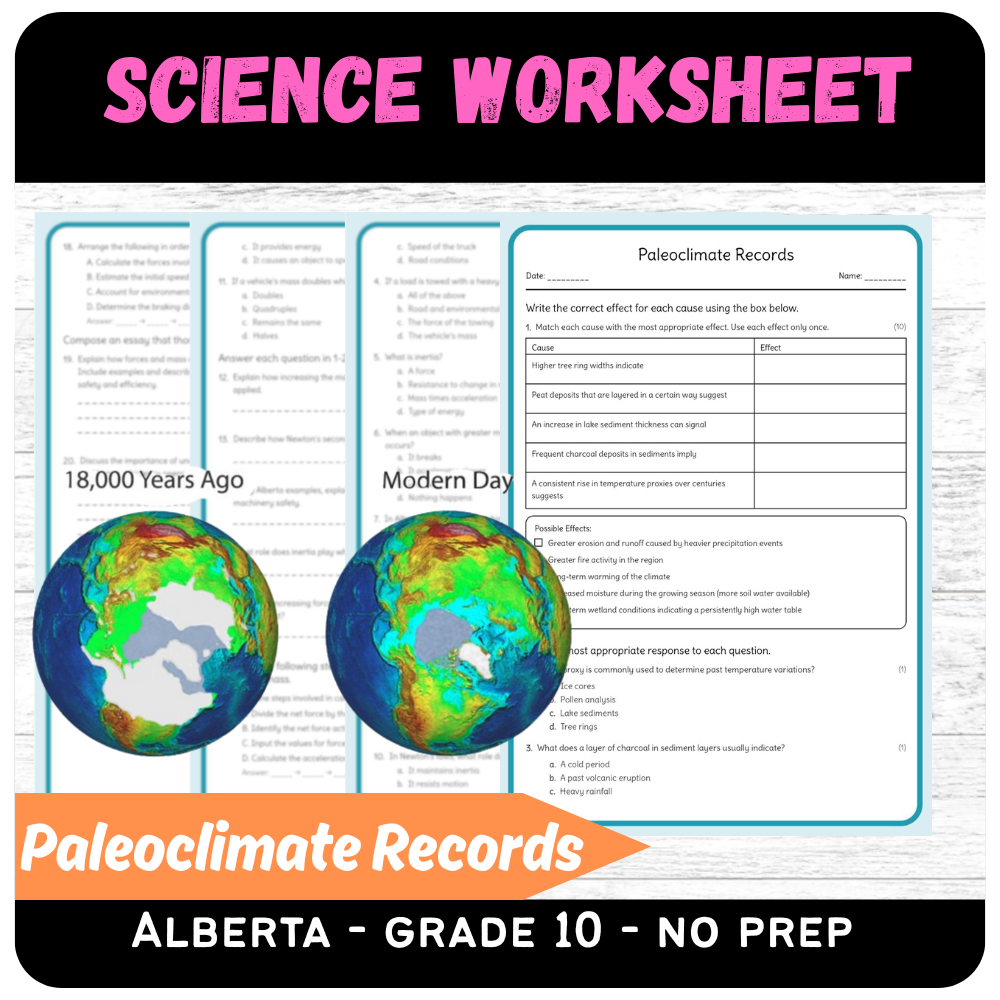
Grade 10 Science – Paleoclimate Records Worksheet (PDF) – Alberta Standards
Created byBright Mind ResourcesLearning Objectives
- Understand what proxy archives are and how they preserve evidence of past climate.
- Learn how scientists extract and interpret data from paleoclimate proxies to reconstruct historical climate trends.
- Analyze the use of multi-proxy records to distinguish natural variability from recent climate change.
Instant download

Grade 10 Science | Transport Mechanisms Worksheet | TEKS Aligned
Created byLumora LearningLearning Objectives
- Understand the different types of transport mechanisms across cell membranes.
- Identify passive and active transport processes such as diffusion, osmosis, facilitated diffusion, and active pumps.
- Explain how molecules like glucose and ions are transported in cells.
Also included in: Grade 10 Science | Cell Structure, Transport & Communication Bundle | TEKS +1 more
Instant download

Grade 10 Science — Worksheet MCQ Paper for Mastering Gene Expression Regulation
 Created byThe Resource Hub
Learning Objectives
- Understand the mechanisms controlling gene expression in prokaryotic and eukaryotic systems.
- Identify key components such as promoters, transcription factors, and chromatin modifications.
- Explain how signal integration influences transcriptional output and phenotypic plasticity.
Also included in: Grade 10 Biology and Ecosystems Lesson Bundle | AP Science +1 more
Instant download

Grade 10 Argument With Evidence Worksheet | Practice & PDF
 Created byClear Sky Classroom
Learning Objectives
- Construct scientific arguments that connect a specific claim to relevant evidence and reasoning.
- Evaluate competing explanations by assessing whether evidence supports expected patterns or contradicts observations.
- Distinguish correlation from causation and separate observations from inferences to strengthen conclusions.
Instant download

Grade 10 Science | Evaluating Solutions Worksheet | California Standards
Created byLumora LearningLearning Objectives
- Explain how evaluation compares proposed solutions to criteria and constraints
- Identify safety, performance, and environmental factors used to evaluate engineering designs
- Use evidence from evaluation results to revise solutions and improve tradeoffs
Instant download

Grade 10 Science Pedigree Analysis Worksheet (TEKS) Practice PDF
Created byEvergreen Desk EducationLearning Objectives
- Interpret pedigree patterns to infer likely modes of inheritance (autosomal dominant, autosomal recessive, and X-linked).
- Estimate genotype probabilities for individuals in a pedigree using allele-based reasoning.
- Predict recurrence risks by linking phenotypes, meiosis, and inheritance rules.
Instant download

Grade 10 Science | Uncertainty and Error Worksheet | NGSSS Aligned
Created byLumora LearningLearning Objectives
- Distinguish between random error and systematic error and predict how each affects measurement results.
- Explain the roles of precision and accuracy when interpreting experimental data.
- Use margin of error and uncertainty intervals to judge whether differences between data sets are likely meaningful.
Instant download

Grade 10 Science – Fossils & Earth's History | Daily Reading Worksheet
Created byBright Mind ResourcesLearning Objectives
- Understand key concepts related to Science
- Apply knowledge through practice questions
- Demonstrate comprehension of the material
Also included in: Grade 10 Evolution & Genetics Science Daily Reading Lesson Bundle | BC +1 more
Instant download

Causal Complexity Worksheet | AP Science | Grade 10 Practice
JCreated byJ.S SheetsLearning Objectives
- Understand methods for disentangling multivariable causal relationships using frameworks like control matrices, causal graphs, and stratified comparisons.
- Apply causal analysis strategies to contexts such as ecosystem productivity influenced by temperature, nutrients, and moisture.
- Identify confounding factors and interaction effects in complex systems.
Instant download

Grade 10 Adaptation Planning in Environmental Hazards | NGSS Science Worksheet
 Created byBRIGHT PATH RESOURCES
Learning Objectives
- Understand different types of environmental hazards and their characteristics.
- Learn how hazard risk assessments inform adaptation strategies.
- Analyze various infrastructural and policy responses to environmental challenges.
Also included in: Env Hazards Grade 10 Sci Daily Reading Worksheets Lesson Bundle | NGSS +1 more
Instant download

Momentum Transfer Worksheet | Grade 10 Science Activities
Created byPrism Point LearningLearning Objectives
- Explain linear momentum and how it relates to mass and velocity
- Use the impulse–momentum relationship to predict changes during collisions
- Apply conservation of momentum to analyze interactions in closed systems
Also included in: Grade 10 Work, Energy & Electricity Lesson Bundle | Alberta Science
Instant download

Resource Limitation Worksheet for Grade 10 Science
JCreated byJ.S SheetsLearning Objectives
- Understand how limiting resources affect population growth and ecosystem stability.
- Identify different types of limiting factors and their impact on species survival.
- Analyze how resource depletion influences carrying capacity and species dominance.
Also included in: Grade 10 Genetic Variation and Evolution Science Lesson Bundle +1 more
Instant download

Grade 10 Motion Graphs Worksheet | AP Practice & PDF
Created byClear Sky ClassroomLearning Objectives
- Interpret position, velocity, and acceleration graphs by linking slopes and areas to instantaneous rate and accumulated change.
- Use graphical features (slope, sign, and curvature in piecewise-linear models) to infer kinematic quantities for non-uniform motion.
- Extract and justify kinematic variables from experimental-like data, including error considerations in graph-based reasoning.
Also included in: Grade 10 Physics Concepts Science Lesson Bundle: Advanced Placement (AP) +1 more
Instant download

Cell Types From Regulation Worksheet | California Standards Grade 10 Science
JCreated byJ.S SheetsLearning Objectives
- Understand how gene regulation influences cell specialization in multicellular organisms.
- Identify different mechanisms by which genes are turned on or off during development.
- Explain the importance of timing and intensity of gene expression in cellular functions.
Also included in: Grade 10 Genetic Variation and Evolution Science Lesson Bundle +1 more
Instant download

Grade 10 Science | Forces & Acceleration - Daily Reading Comprehension
Created byCoral Reef LearningLearning Objectives
- Identify various forces acting on objects
- Draw and interpret free-body diagrams
- Understand how net force affects acceleration
Instant download

Grade 10 Science | Specialized Cells in the Nervous System - Comprehension
Created byCoral Reef LearningLearning Objectives
- Understand the structure of nerve cells
- Identify how nerve cells transmit information quickly
- Recognize the adaptations of nerve cells for their functions
Instant download
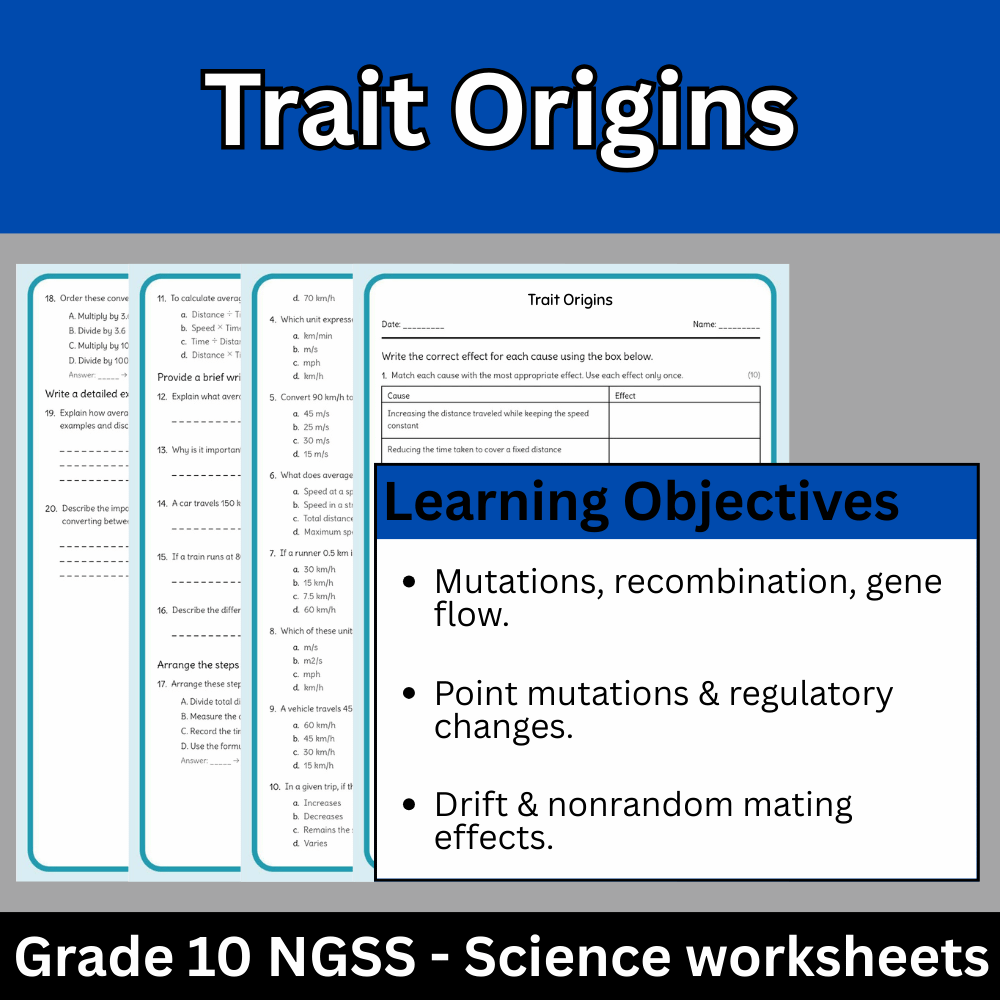
Grade 10 Science | Trait Origins NGSS-Aligned Worksheet (PDF)
Created byBright Mind ResourcesLearning Objectives
- Explain how mutations, recombination, gene flow, and chromosomal changes influence heritable traits.
- Identify examples of genetic variations like point mutations and regulatory changes.
- Describe population-level processes such as genetic drift and nonrandom mating that affect trait distribution.
Instant download

Grade 10 Tissue Organization Worksheet | Alberta Science Cells
Created byEvergreen Desk EducationLearning Objectives
- Explain how cells with similar structure and function organize into tissues that perform specific roles.
- Describe tissue types in plants and animals and connect tissue architecture to transport, support, secretion, and barrier functions.
- Analyze how differentiation and tissue properties influence organ-level performance in different Alberta biomes and agricultural settings.
Instant download

Predator Prey Dynamics Worksheet | Standards-Based Practice for Grade 10 Science
JCreated byJ.S SheetsLearning Objectives
- Understand how predator-prey interactions influence ecosystem stability and resource use.
- Identify the effects of predation on prey populations and predator survival.
- Analyze the feedback mechanisms between community structure and resource availability.
Also included in: Grade 10 Genetic Variation and Evolution Science Lesson Bundle +1 more
Instant download
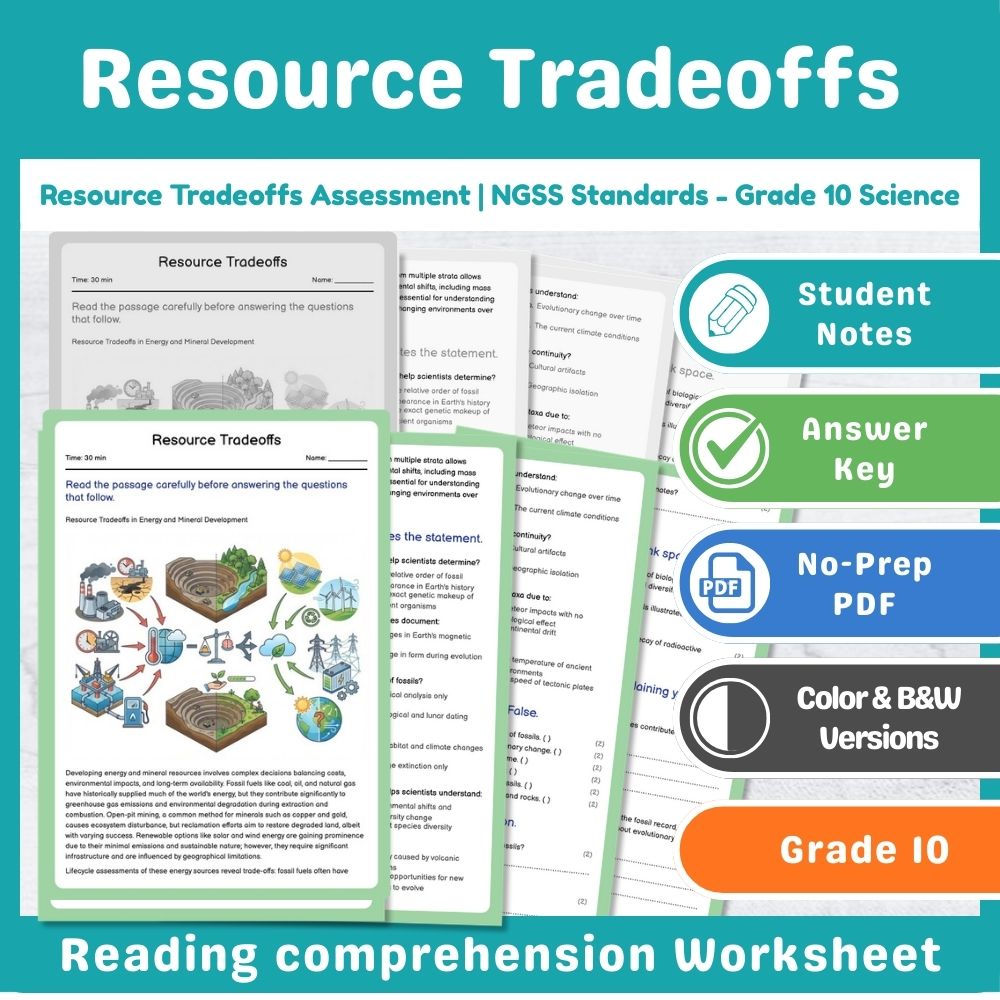
Resource Tradeoffs Assessment | NGSS Standards - Grade 10 Science
Created byPrism Point LearningLearning Objectives
- Analyze the economic, environmental, and sustainability trade-offs in energy and mineral resource development.
- Compare and evaluate different resource management strategies such as fossil fuels, solar, wind, and mining reclamation.
- Apply criteria like resource depletion, ecosystem impact, greenhouse gas emissions, and infrastructure constraints to assess trade-offs.
Also included in: Grade 10 Science Resource Tradeoffs Assessment | NGSS Standards-Aligned
Instant download

Biodiversity Value Worksheet | TEKS Grade 10 Science Practice PDF
JCreated byJ.S SheetsLearning Objectives
- Explain how biodiversity at genetic, species, and ecosystem levels supports ecosystem resilience and ecosystem services.
- Describe how functional redundancy and multiple pathways help ecosystems remain stable after disturbances.
- Evaluate how species loss can reduce adaptive capacity and disrupt ecological interactions.
Instant download

Grade 10 Science – Reaction Stoichiometry & Mass Conservation | Worksheet
Created byBright Mind ResourcesLearning Objectives
- Understand the principles of reaction stoichiometry in industrial chemical processes
- Learn how to balance chemical equations accurately
- Recognize the importance of mass conservation in process design
Also included in: Grade 10 Chemistry Science Lesson Bundle Daily Reading Worksheets | Alberta +1 more
Instant download

Grade 10 Atomic Models Worksheet | Practice & Assessment PDF
Created byClear Sky ClassroomLearning Objectives
- Explain how particulate theory uses atoms and molecules to interpret observable macroscopic properties.
- Compare atomic models by relating evidence to particle-level ideas (mass, motion, forces).
- Use particle arrangements to reason about density, phase changes, and electrical conductivity.
Instant download
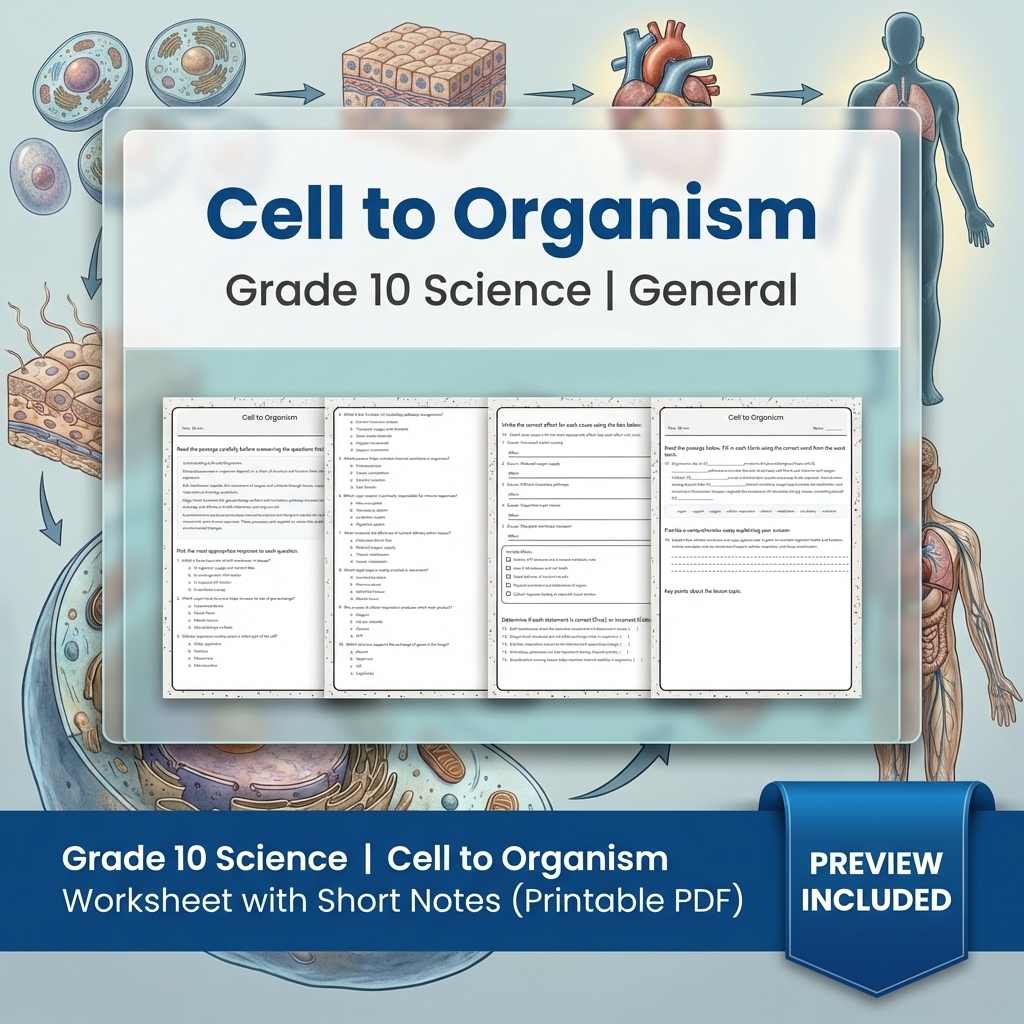
Grade 10 Science | Cell to Organism Worksheet with Short Notes (Printable PDF)
 Created byMeadowlark Worksheets
Learning Objectives
- Understand the relationship between cellular structures and organism functions.
- Explain how membrane transport and cellular respiration contribute to organism survival.
- Describe how organ-level structures facilitate exchange and transport within organisms.
Also included in: Grade 10 Natural Selection & Heredity Science Lesson Bundle - General +1 more
Instant download

Grade 10 Science | Magnetic Fields Reading Worksheet (PDF + Answer Key)
JCreated byJ.S SheetsLearning Objectives
- Describe the origin of magnetic fields from moving charges and currents.
- Explain how magnetic field lines form closed loops and their directional meanings.
- Differentiate between magnetic and electrostatic fields in terms of work done on charges.
Instant download
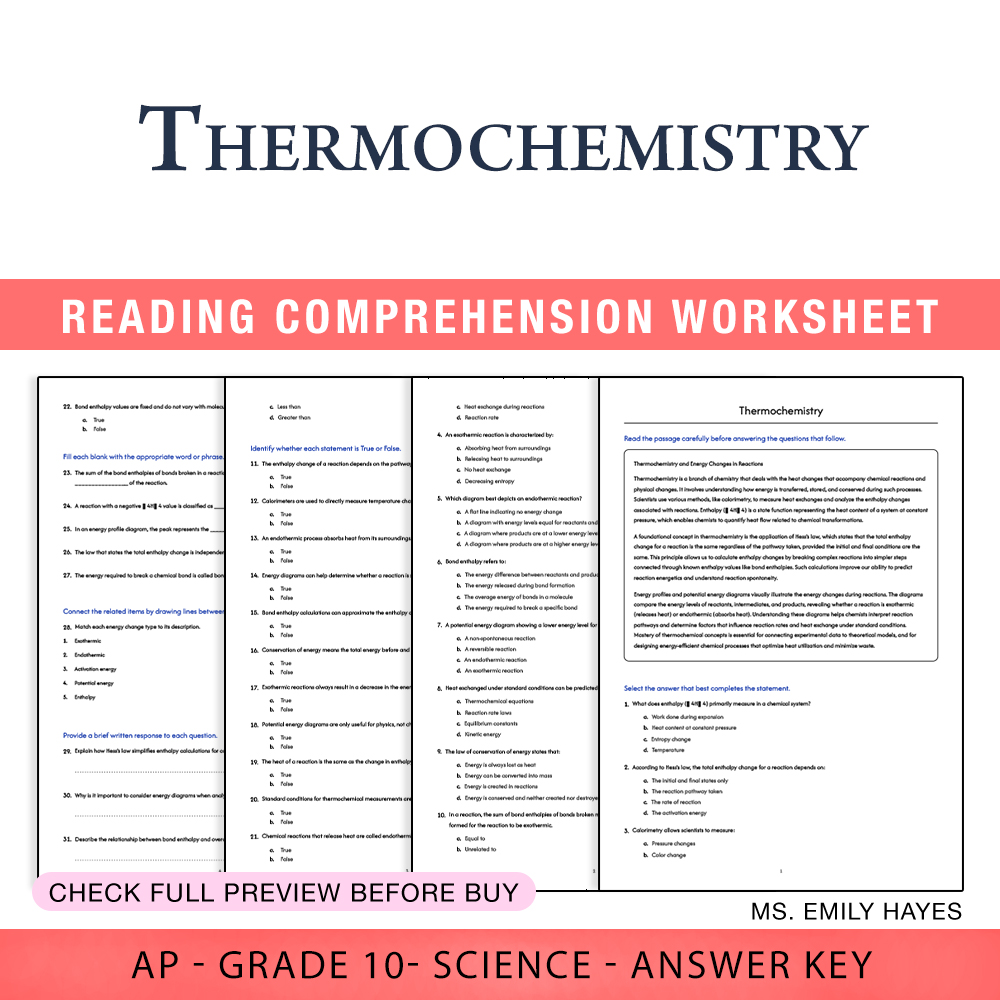
Grade 10 Science | Thermochemistry Worksheet (PDF+ Answer Key)
 Created byCopper Leaf Classroom
Learning Objectives
- Understand how enthalpy changes are represented and calculated in chemical reactions.
- Interpret calorimetric data and apply Hess's law to reaction pathways.
- Relate bond enthalpy to overall reaction enthalpy and analyze energy diagrams for chemical processes.
Also included in: Grade 10 Science -Atomic Structure & Chemical Reactions (PDF+ Answer Key) +1 more
Instant download

Grade 10 Science — Worksheet MCQ Paper for Mastering Force Concepts
Created byThe Resource HubLearning Objectives
- Understand the vector nature of forces and how to determine net force.
- Frame Newton’s three laws as core principles explaining motion and equilibrium.
- Analyze free-body diagrams to represent forces acting on objects.
Also included in: Grade 10 Science AP Bundle – Comprehensive Curriculum with 60 Worksheets
Instant download

Grade 10 Science – Energy Conversion Worksheet (NGSS) (PDF)
 Created bySilver Birch Teaching
Learning Objectives
- Understand the different forms of energy and how they convert from one to another.
- Analyze the efficiency and loss channels in energy conversion devices.
- Compare energy conversion pathways in practical systems like photovoltaic cells and engines.
Also included in: Grade 10 Energy Transfer and Work Power Science Lesson Bundle NGSS +1 more
Instant download

Multi Criteria Optimization Worksheet Grade 10 STEM Science Activities
Created byPrism Point LearningLearning Objectives
- Explain how data trends can guide optimization toward target performance while using realistic constraints.
- Identify and justify trade-offs when multiple goals must be optimized at the same time.
- Use evidence such as sensitivity to decide which parameter changes are meaningful and which have limited benefit.
Instant download
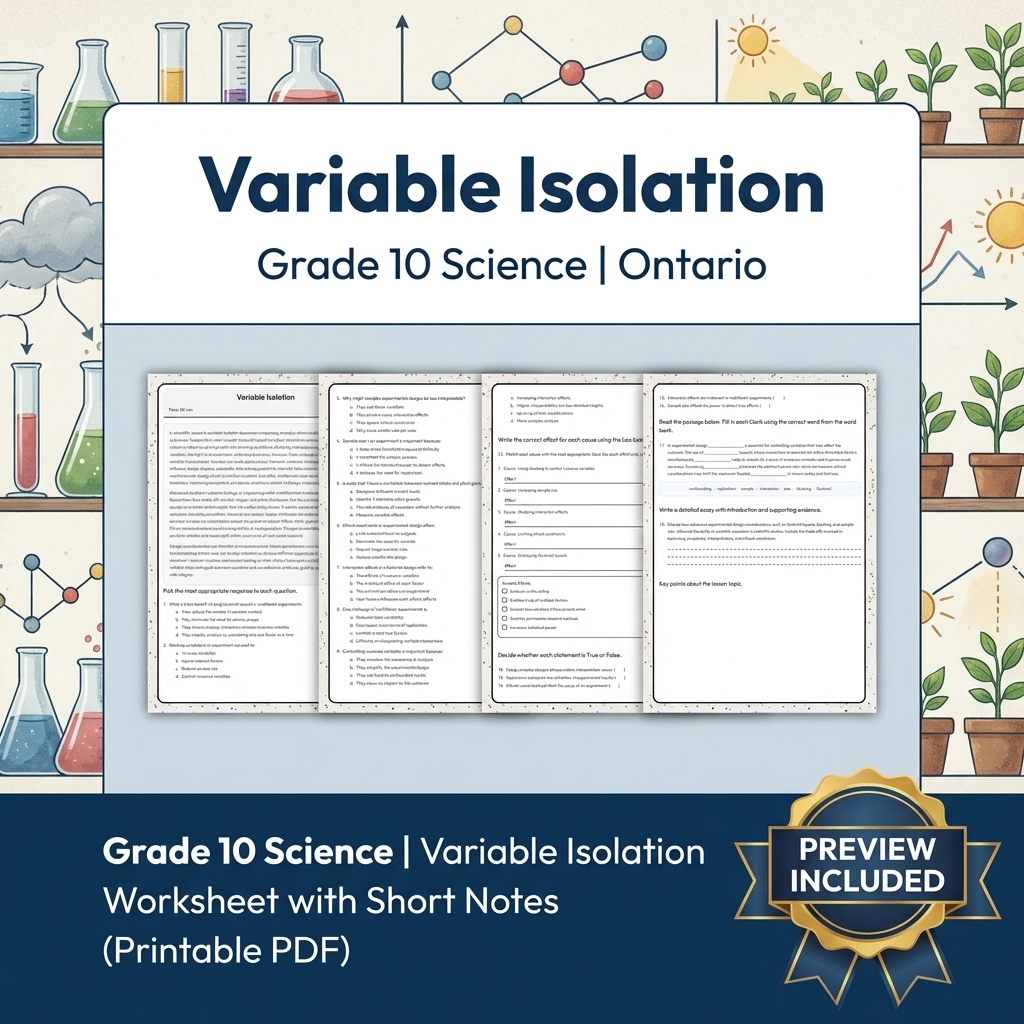
Grade 10 Science | Variable Isolation Worksheet with Short Notes (Printable PDF)
Created byMeadowlark WorksheetsLearning Objectives
- Understand advanced considerations in designing multifactor experiments.
- Analyze the effects of interactions, blocking, and sample size on experimental validity.
- Evaluate trade-offs between complexity and interpretability in variable isolation studies.
Also included in: Grade 10 Science Lesson Group Bundle | Ontario Curriculum Worksheets +1 more
Instant download

Grade 10 Science | Intercellular Communication - Daily Reading Comprehension
Created byCoral Reef LearningLearning Objectives
- Identify different modes of cell signaling: autocrine, paracrine, endocrine, and synaptic.
- Understand receptor–ligand specificity and signal transduction mechanisms.
- Describe structures like gap junctions and plasmodesmata involved in direct cell communication.
Instant download

Grade 10 Science Worksheet | Understanding Circular Motion (PDF)
Created byEvergreen Desk EducationLearning Objectives
- Explain how net centripetal force and centripetal acceleration maintain circular motion
- Differentiate radial (centripetal) and tangential components and predict changes in speed vs. direction
- Use qualitative relationships involving mass, speed squared, and radius to reason about centripetal force in real situations
Instant download

Grade 10 Science – Modeling Evidence & Scientific Models | Daily Worksheet
 Created byQuiet Forest Education
Learning Objectives
- Understand key concepts related to Science
- Apply knowledge through practice questions
- Demonstrate comprehension of the material
Also included in: Scientific Investigation Grade 10 Science Daily Worksheets Bundle | Ontario +1 more
Instant download

Grade 10 Science – Circuit Fundamentals & Electrical Concepts | Worksheet
Created byBright Mind ResourcesLearning Objectives
- Identify basic components of electrical circuits and understand their functions.
- Explain the relationship between voltage, current, and resistance using Ohm's Law.
- Differentiate between series and parallel circuit configurations.
Also included in: Energy & Systems Interactions Grade 10 Science lesson bundle | Alberta +1 more
Instant download

Grade 10 Science | Biodiversity Overview Worksheet | BC Standards
Created byLumora LearningLearning Objectives
- Understand the key factors influencing biodiversity at genetic, species, and ecosystem levels.
- Recognize patterns and interactions that lead to variations in biodiversity across regions.
- Explain the importance of habitat, climate, and disturbance in shaping biodiversity.
Also included in: Grade 10 Science | Evolution & Biodiversity Lesson Bundle | BC Framework
Instant download

Orbital Gravity Models Worksheet | Grade 10 Space Science Practice
Created byPrism Point LearningLearning Objectives
- Explain how gravitational force provides the centripetal acceleration needed for orbital motion
- Connect orbital period and orbital shape to predictions from an orbital gravity model
- Interpret evidence from planetary and satellite orbits to support a single underlying gravitational explanation
Instant download

Grade 10 Science | Trait Origins NGSS Worksheet (PDF) for NGSS10
Created bySilver Birch TeachingLearning Objectives
- Understand the molecular and population-level processes that lead to heritable trait variation.
- Identify examples of mutations, recombination, gene flow, and chromosomal changes in traits.
- Explain how population processes like genetic drift and nonrandom mating influence trait distribution.
Also included in: Grade 10 Evolution Evidence & Biodiversity Science Lesson Bundle NGSS +1 more
Instant download

Gas Laws and Kinetic Theory Worksheets | Grade 10 Science
 Created bySunny Desk Resources
Learning Objectives
- Explain how kinetic theory links molecular motion to gas pressure and temperature
- Use relationships among pressure, volume, and temperature to predict qualitative changes in a gas
- Describe how real gases deviate from ideal behaviour and what that means for storage and transport
Also included in: Grade 10 Chemistry Lesson Bundle | Alberta Science Reaction & Analysis +1 more
Instant download

Grade 10 Mass Conservation Worksheet PDF | Stoichiometry & Chemistry
Created byEvergreen Desk EducationLearning Objectives
- Explain the law of conservation of mass in chemical reactions and closed systems.
- Balance chemical equations and interpret what balanced coefficients mean for mass relationships.
- Use mass accounting and stoichiometric thinking to quantify reactants and products from measurements.
Instant download
About Grade 10 Science Worksheets
Find Science worksheets built for Grade 10. All 7,038 cover core skills, practice, and review, each an instant PDF download.
Every worksheet on MyTeachingSheets is created by independent teacher-authors and reviewed before publication. All resources download as printable PDFs for classroom, homework, or at-home practice, and many include answer keys. Preview any worksheet free before buying.