
Grade 10 Science Worksheets
7,038 worksheets
Communication Systems Optimization Worksheets | Grade 10 Science
 Created byTeachers Club
Learning Objectives
- Compare how power, distance, and losses affect received signal strength
- Explain how antenna gain and impedance matching improve power transfer
- Evaluate trade-offs among reliability, throughput, transmission rate, and range
Also included in: Grade 10 Science Waves & Information Transfer NGSS Worksheets Bundle +1 more
Instant download

Engineering Design Process: Criteria, Constraints & Models Worksheets
Created byTeachers ClubLearning Objectives
- Describe criteria and constraints in complex engineering problems
- Distinguish qualitative criteria from quantitative performance targets
- Compare solution concepts using benchmarks and performance metrics
Also included in: Engineering Design Worksheets Grade 10 Science NGSS Bundle +1 more
Instant download

Momentum and Impulse Collisions Worksheets | Grade 10 Science
Created byTeachers ClubLearning Objectives
- Calculate momentum from an object's mass and velocity
- Explain why momentum is a vector quantity
- Relate impulse to force, time, and momentum change
Also included in: Grade 10 Science Motion and Stability Forces & Interactions Bundle +1 more
Instant download

Biogeochemical Cycling: Carbon & Nitrogen Fluxes Worksheets Grade 10
Created byTeachers ClubLearning Objectives
- Explain carbon movement among Earth's major biogeochemical reservoirs
- Describe nitrogen transformations from atmospheric nitrogen to plant-usable forms
- Interpret how human activities alter nutrient reservoirs and flux rates
Also included in: Grade 10 Science Ecosystems NGSS Worksheets & Lesson Bundle +1 more
Instant download

Evidence for Evolutionary Descent With Modification Worksheets Grade 10
Created byTeachers ClubLearning Objectives
- Identify evidence that supports common ancestry among organisms
- Explain how radiometric dating frames interpretation of fossils
- Compare homologous structures and conserved genetic sequences
Also included in: Grade 10 Science Evolution Worksheets | NGSS Unit Bundle +1 more
Instant download

Net Force and Acceleration Worksheets: Grade 10 Science Practice
Created byTeachers ClubLearning Objectives
- Calculate acceleration from net force and mass
- Resolve gravity into parallel and perpendicular components
- Determine acceleration direction from the net force
Also included in: Grade 10 Science Motion and Stability Forces & Interactions Bundle +1 more
Instant download

Grade 10 Orbital Gravity Models Worksheet | Practice & PDF
 Created byClear Sky Classroom
Learning Objectives
- Explain how centripetal acceleration is connected to orbital motion around a massive body
- Use evidence from orbital timing and shape to support claims about gravity-based orbital models
- Interpret and apply relationships between orbital radius, period, and recurring motion
Instant download
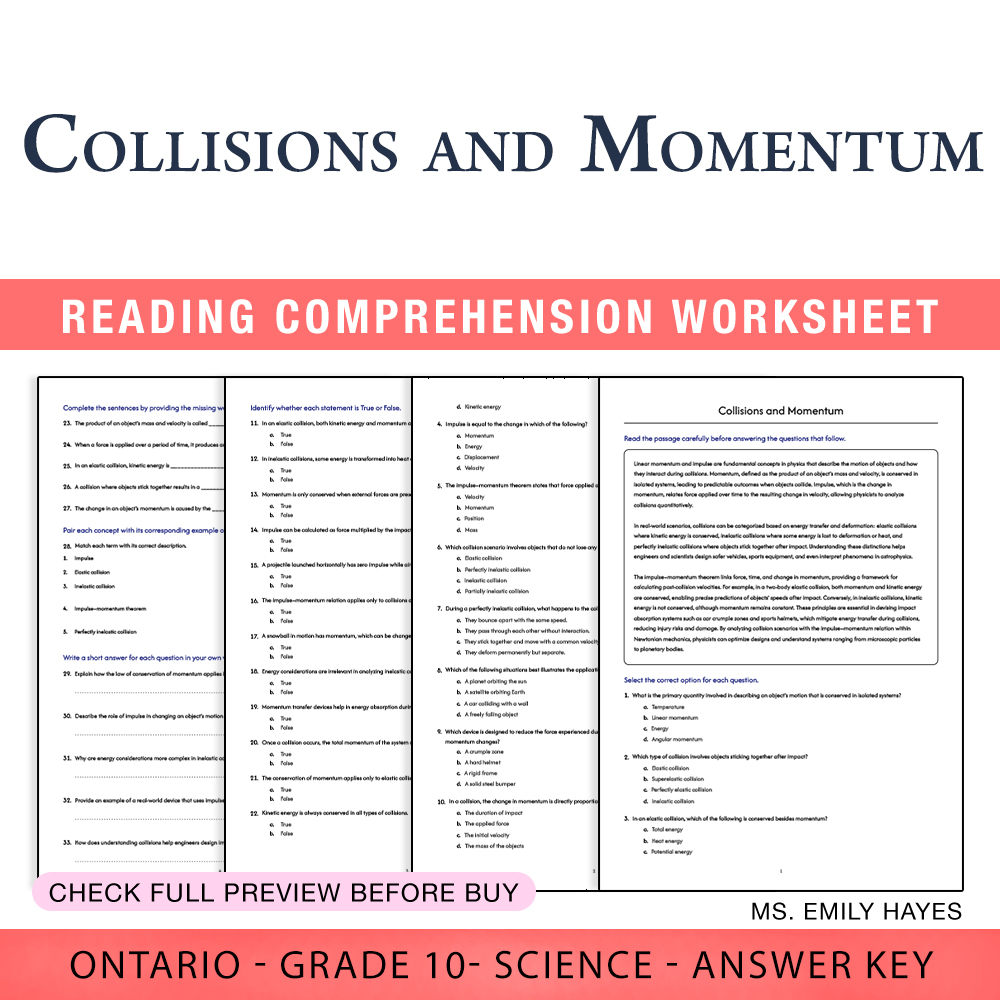
Grade 10 Science | Collisions and Momentum Worksheet (PDF + Answer Key)
 Created byCopper Leaf Classroom
Learning Objectives
- Understand the concepts of linear momentum and impulse and how they relate to changes in motion.
- Explain the conservation of momentum in different types of collisions: elastic, inelastic, and perfectly inelastic.
- Differentiate between energy considerations in various collision scenarios and apply impulse–momentum relations to real-world problems.
Instant download

Grade 10 Science | Kinematics Graphs Worksheet | General Standards
 Created byLumora Learning
Learning Objectives
- Interpret displacement-time graphs to determine velocity using slope and direction using sign.
- Interpret velocity-time graphs to determine acceleration using slope and direction using graph position.
- Use acceleration-time graph patterns to describe whether acceleration is constant, changing, or reversing.
Instant download

Grade 10 Science – Technology & Society Impacts | Daily Reading Worksheet
 Created byBright Mind Resources
Learning Objectives
- Understand how communication technologies influence society
- Analyze cause-and-effect relationships in technological development
- Evaluate the benefits and risks of new communication tools
Also included in: Grade 10 Science Trade-Off Design Daily Reading Worksheet Lesson Bundle-General +1 more
Instant download
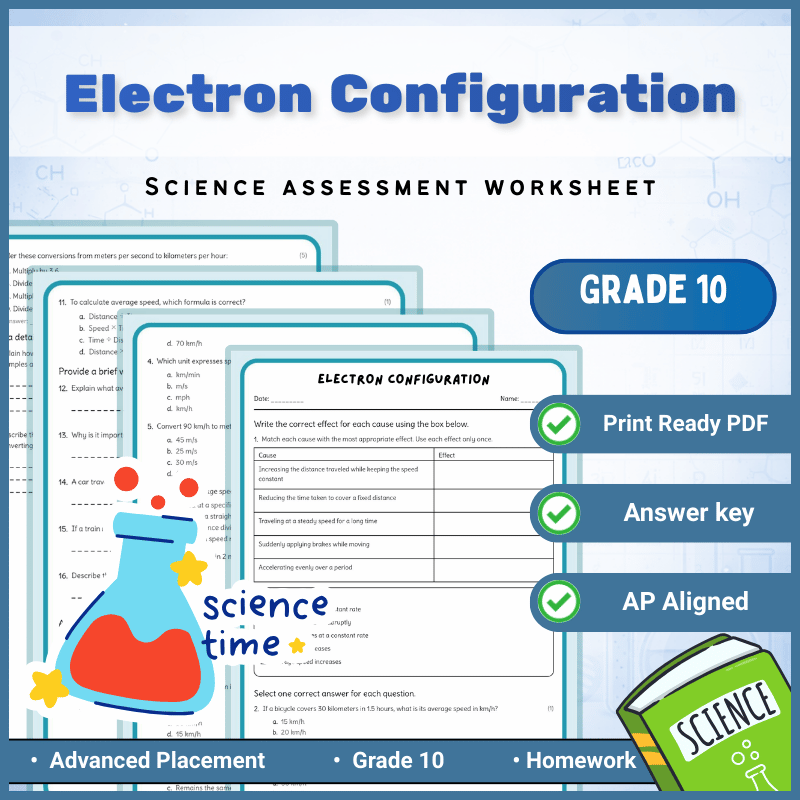
Grade 10 Science | Electron Configuration Worksheet (AP Standards) – PDF
Created byBright Mind ResourcesLearning Objectives
- Understand quantum numbers and how they describe electron positions in atoms.
- Identify different orbital shapes and their energy levels.
- Link orbital arrangements to spectral lines and chemical valence.
Instant download

Mass Conservation Worksheet | Grade 10 Science Printable PDF Assessment
Learning Objectives
- Use balanced chemical equations to show conservation of atoms across reactants and products
- Apply mole and molar mass relationships to connect measured mass with predicted product amounts
- Use quantitative atom counts to verify invariant totals in combustion, synthesis, and precipitation reactions
Also included in: Matter and Its Interactions Lesson Bundle | Grade 10 Science | NGSS
Instant download

Grade 10 Science | Projectile Motion Worksheet (BC Standards) (PDF)
 Created byEvergreen Desk Education
Learning Objectives
- Explain projectile motion using independent horizontal and vertical components under gravity
- Apply kinematics relationships to determine time of flight, range, and maximum height
- Interpret and evaluate statements about projectile motion concepts and assumptions
Instant download

Grade 10 Science Worksheet: Scientific Reasoning | NGSSS Standards-Aligned
JCreated byJ.S SheetsLearning Objectives
- Explain how evidence supports scientific claims using logical relationships
- Distinguish correlation from causation when interpreting data
- Evaluate hypotheses and alternative explanations using observational patterns
Also included in: Grade 10 Scientific Reasoning, Models & Evidence Science Lesson Bundle +1 more
Instant download

Grade 10 Science | Stoichiometric Ratios Worksheet | BC Aligned
Created byLumora LearningLearning Objectives
- Understand how molar ratios connect reactants and products in chemical reactions.
- Apply the mole concept to translate between mass and amount of substance.
- Utilize balanced chemical equations to determine proportional relationships in reactions.
Instant download

Grade 10 TEKS Carrying Capacity in Populations Science Worksheet
 Created byBRIGHT PATH RESOURCES
Learning Objectives
- Define carrying capacity and explain why it matters for population growth.
- Identify the main idea of an informational science passage about carrying capacity.
Also included in: Grade 10 Ecology & Environmental Interactions Science Worksheets | TEKS +1 more
Instant download

Aerobic Versus Anaerobic Worksheet Pack | Grade 10 Science Practice
 Created byPrism Point Learning
Learning Objectives
- Compare aerobic and anaerobic respiration based on oxygen use, ATP yield, and end products.
- Explain how fermentation regenerates NAD+ when oxygen is unavailable.
- Use cellular respiration concepts to predict how organisms respond to oxygen-limited conditions.
Also included in: Metabolism & Energy Processes Lesson Bundle — Grade 10 Science TEKS
Instant download

Grade 10 Science NGSS | Trade Off Optimization Worksheet (Worksheet + Answer Key)
 Created bySilver Birch Teaching
Learning Objectives
- Analyze trade-offs and optimization strategies using cost-benefit matrices and Pareto fronts.
- Apply quantitative methods to compare design options considering multiple objectives.
- Evaluate the impact of constraints such as mass, cost, and environmental factors on design choices.
Also included in: Grade 10 NGSS Science: Models, Systems, and Trade-Off Design Lesson Bundle +1 more
Instant download

Grade 10 System Responses Worksheet | Stress, Signals & Alberta Bio
Created byEvergreen Desk EducationLearning Objectives
- Explain how signaling networks coordinate responses from the cellular level to organ and whole-organism outcomes
- Describe how environmental signals can trigger acclimation, including limits of plasticity and costs/trade-offs
- Evaluate how resource reallocation affects short-term survival and long-term fitness in populations and ecosystems
Instant download

Grade 10 Science Worksheet: Climate Feedbacks | Standards-Aligned Practice
JCreated byJ.S SheetsLearning Objectives
- Explain how increased greenhouse gases can lead to temperature change through water-vapor feedbacks
- Describe how surface and cloud processes (albedo and cloud changes) can amplify or reduce warming
- Evaluate how aerosols from combustion can affect radiation and precipitation patterns
Also included in: Grade 10 Earth and Space Systems Models Science lesson bundle – General +1 more
Instant download

Membrane Structure Phospholipid Bilayer Worksheet | TEKS Grade 10 Science
Created byBRIGHT PATH RESOURCESLearning Objectives
- Identify key details about the plasma membrane’s phospholipid bilayer and asymmetry.
- Explain how lipid composition and orientation help the membrane function.
Also included in: Grade 10 Cell Structure & Function Science Worksheets Bundle | TEKS Biology +1 more
Instant download

Grade 10 Science – Volcanism & Orogeny Reading Worksheet | Ontario Standards
Created byBright Mind ResourcesLearning Objectives
- Understand the process of magma formation beneath Earth's crust
- Identify different styles of volcanic eruptions and their landforms
- Explain the roles of partial melting, volatile content, and tectonic settings in volcanism
Also included in: Earth Science Grade 10 Science Daily Reading Worksheets Lesson Bundle | Ontario +1 more
Instant download

Gas Behavior Worksheet | Grade 10 Science Activities
Created byPrism Point LearningLearning Objectives
- Use kinetic theory to explain how gas particle motion relates to temperature and pressure
- Apply the pressure–volume–temperature relationships to predict how changes affect a gas
- Explain how partial pressures determine gas behavior in mixtures and why real gases deviate from ideality
Also included in: Grade 10 Chemistry & Dynamic Equilibrium Lesson Bundle | Alberta Science
Instant download

Grade 10 Science | Understanding Relative Velocity - Daily Reading Comprehension
 Created byCoral Reef Learning
Learning Objectives
- Define relative velocity and explain its significance in physics.
- Identify reference frames and describe how they affect motion perception.
- Apply basic vector subtraction to determine relative velocities in simple scenarios.
Instant download

Grade 10 Science Selection Types Worksheet (PDF) BC Standards
Created byEvergreen Desk EducationLearning Objectives
- Explain directional, stabilizing, and disruptive selection and how each changes a population’s trait distribution.
- Use fitness concepts to predict how selection pressures affect mean phenotype and genetic variation.
- Compare how frequency-dependent and sexual selection change fitness based on interactions with other individuals.
Instant download

Grade 10 Science — Worksheet MCQ Paper for Mastering Plate Tectonics
 Created byThe Resource Hub
Learning Objectives
- Understand the mechanisms of plate motion, mantle convection, and subduction.
- Interpret tectonic settings through maps, cross-sections, and seismic evidence.
- Connect plate interactions to geological phenomena such as mountain building, volcanism, and earthquakes.
Also included in: Grade 10 Earth and Space Sciences Lesson Bundle | AP Curriculum +1 more
Instant download

Grade 10 Science Solution Concentration Worksheet PDF | Alberta
Created byEvergreen Desk EducationLearning Objectives
- Explain how solution concentration can be described by molarity, mass percent, and parts per million (ppm).
- Convert between concentration ideas and dilution or mixing scenarios using quantitative reasoning.
- Interpret concentration in real-world environmental contexts, including nutrient levels and contaminant monitoring.
Instant download

Grade 10 Science – Cell Regulation & Differentiation | Daily Reading Worksheet
Created byBright Mind ResourcesLearning Objectives
- Understand the concept of gene regulation in cell development.
- Identify different cell types and their functions in multicellular organisms.
- Explain how differential gene expression contributes to cell specialization.
Also included in: Grade 10 Genetics & Evolution Science Lesson Bundle | California Standards +1 more
Instant download

Grade 10 Science – Introduction to Cell Theory | Daily Reading Worksheet
 Created byQuiet Forest Education
Learning Objectives
- Understand the basic principles of cell theory
- Identify the historical development of microscopy and its impact
- Differentiate between unicellular and multicellular organisms
Also included in: Cell Biology Grade 10 Science Daily Reading Worksheets Bundle | Ontario +1 more
Instant download
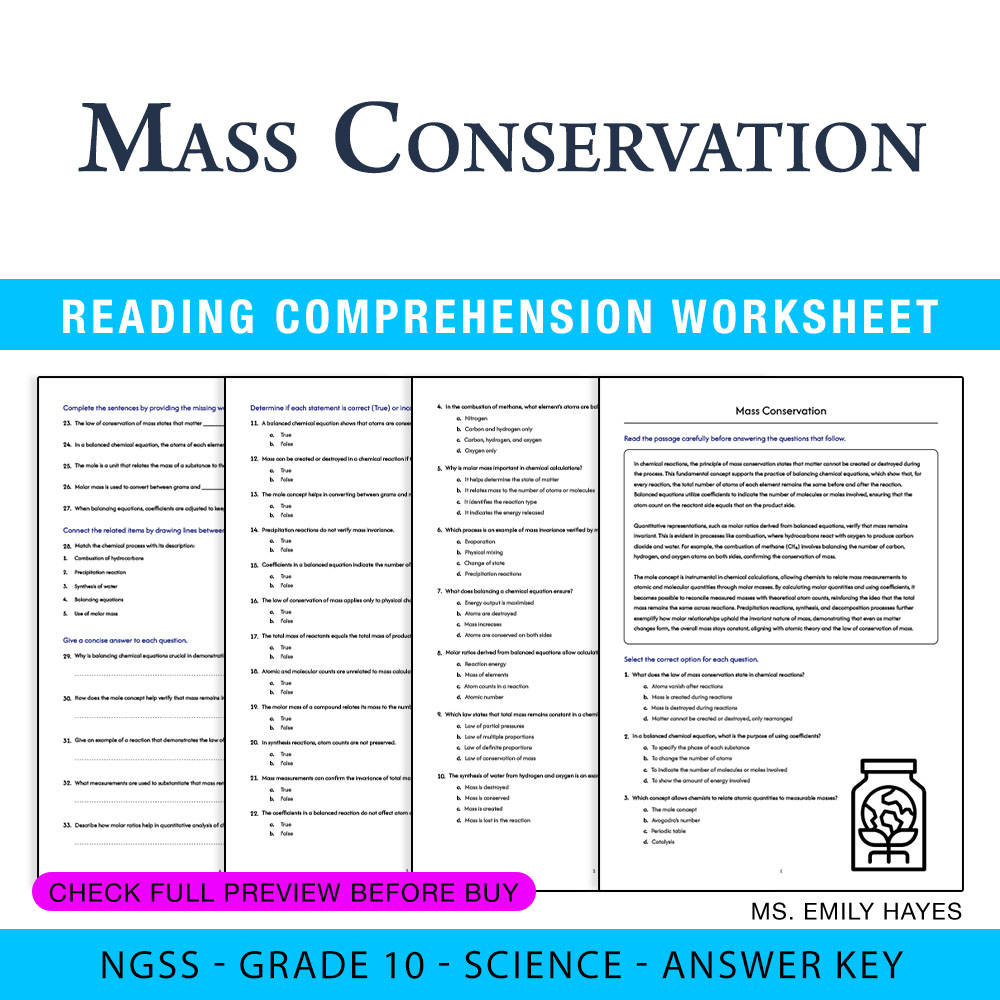
Grade 10 Science | Mass Conservation Worksheet (PDF+ Answer Key)
Created byCopper Leaf ClassroomLearning Objectives
- Understand the principle of mass conservation in chemical reactions and its importance in balancing equations.
- Apply the mole concept, molar masses, and coefficients to demonstrate the invariance of atom counts across reactants and products.
Instant download

Grade 10 Science | Measurement Based Prototyping Worksheet | General Standard
Created byLumora LearningLearning Objectives
- Explain how measurements connect design features to performance outcomes in prototype testing.
- Interpret results from measurement-based comparisons across different conditions.
- Identify sources of variation and measurement limits that affect reliability of conclusions.
Instant download

Microbe Diversity Test Prep Worksheets | Grade 10 Science Ontario
Created byPrism Point LearningLearning Objectives
- Compare the major groups of microorganisms (bacteria, archaea, viruses, fungi, and protists) using cellular organization and genetic material type
- Explain how replication strategies differ across microbial groups, especially the host dependence of viruses
- Connect microbial diversity to different ecological niches and roles in ecosystems and human contexts
Also included in: Grade 10 Cells & Energy Science Lesson Bundle Ontario Framework Pack
Instant download

Selection and Adaptation Worksheet | Standards-Aligned Grade 10 Science
JCreated byJ.S SheetsLearning Objectives
- Understand the process of natural selection and how it leads to adaptation in populations.
- Identify examples of traits that increase survival and reproductive success.
- Explain how selective pressures influence population characteristics over generations.
Also included in: Grade 10 Genetic Variation and Evolution Science Lesson Bundle +1 more
Instant download

Testable Questions Assessment | General Standards + Grade 10 Science
Created byPrism Point LearningLearning Objectives
- Understand the importance of formulating testable questions in scientific inquiry.
- Identify the characteristics that distinguish testable questions from non-testable ones.
- Connect claims about systems to measurable variables through testable questions.
Instant download
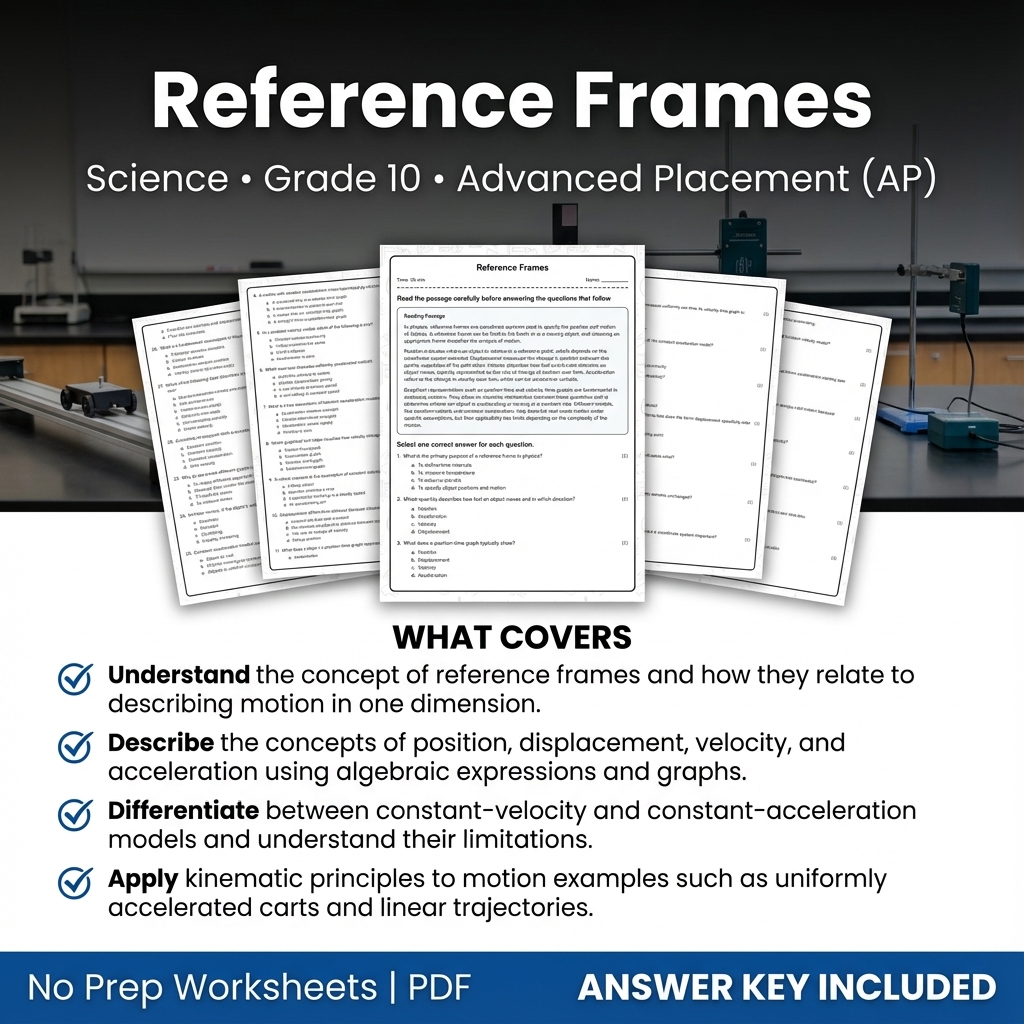
Grade 10 Science | Reference Frames Worksheet (Printable PDF + Answer Key)
Created byCoral Reef LearningLearning Objectives
- Understand the concept of reference frames and how they relate to describing motion in one dimension.
- Describe the concepts of position, displacement, velocity, and acceleration using algebraic expressions and graphs.
- Differentiate between constant-velocity and constant-acceleration models and understand their limitations.
Also included in: Grade 10 Science Unit Worksheet Bundle – Motion, Energy & Forces (PDF Answers) +1 more
Instant download

Genomic Technologies Assessment | TEKS Grade 10 Science Standards
Created byPrism Point LearningLearning Objectives
- Explain how polymerase chain reaction amplifies specific DNA sequences.
- Describe the process of DNA sequencing and its applications.
- Understand the mechanism and uses of CRISPR for gene editing.
Also included in: Lesson Grade 10 Genetics: DNA, RNA, Protein Science Lesson Bundle TEKS
Instant download
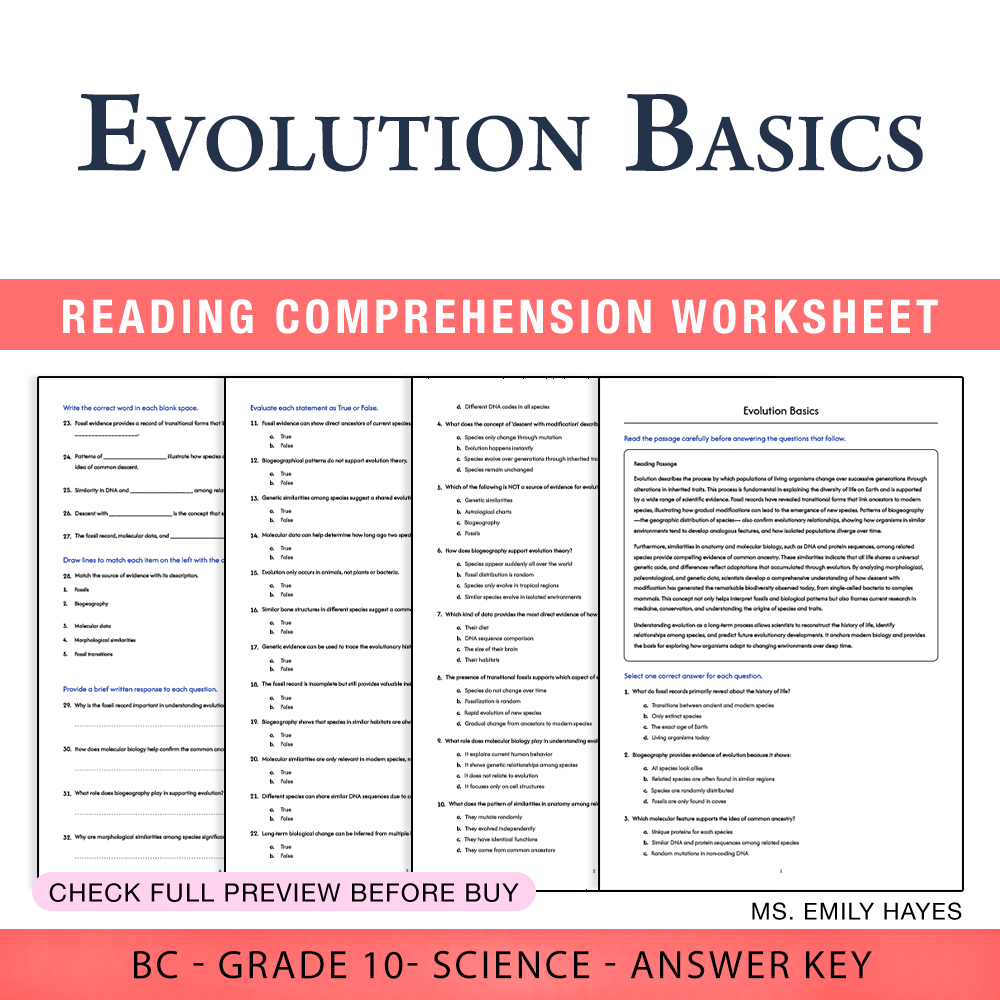
Grade 10 Science | Evolution Basics Worksheet (PDF+ Answer Key)
Created byCopper Leaf ClassroomLearning Objectives
- Understand the fundamental concepts of evolution and natural selection.
- Identify evidence supporting the theory of evolution from fossil records, biogeography, and molecular data.
- Explain how common ancestry provides insight into biological diversity.
Also included in: Grade 10 Science BC | Evolution, Biodiversity & Ecology (PDF + Answer Key) +1 more
Instant download

Grade 10 Science – Feedback Mechanisms & Biological Systems | Reading Worksheet
Created byBright Mind ResourcesLearning Objectives
- Define positive feedback and explain its role in biological processes.
- Identify examples of positive feedback mechanisms.
- Differentiate between positive feedback and negative feedback.
Also included in: Systems Interactions Grade 10 Science Daily Reading Worksheets Bundle | TEKS +2 more
Instant download
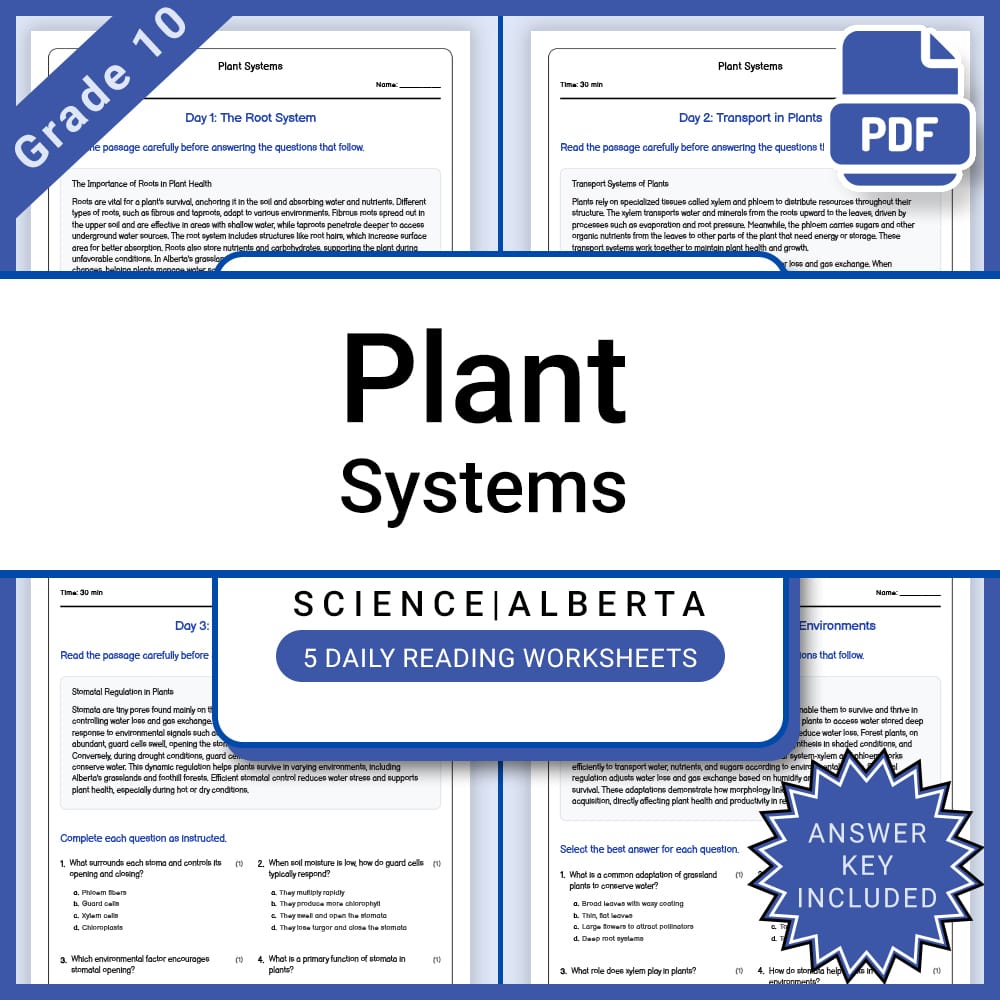
Grade 10 Science – Plant Systems Daily Reading Worksheet + Answer Key
JCreated byJ.S SheetsLearning Objectives
- Identify various root structures and understand their functions
- Explain how roots contribute to water and nutrient absorption
- Describe the role of plant organ systems in resource allocation
Also included in: Grade 10 Science Lesson Group: Alberta Curriculum — Daily Reading Worksheets +1 more
Instant download

Grade 10 Science Worksheet | Earth's Interior Layers (Ontario Standard) (PDF)
Created byEvergreen Desk EducationLearning Objectives
- Explain how Earth’s internal structure is described using chemical layers and mechanical layers.
- Compare the lithosphere and asthenosphere using concepts of rigidity, temperature, and strength.
- Use seismic wave behavior and density/mineral-physics ideas to infer properties of the mantle and core.
Also included in: Grade 10 Earth Systems Geology Science Lesson Bundle: Ontario Worksheets +1 more
Instant download
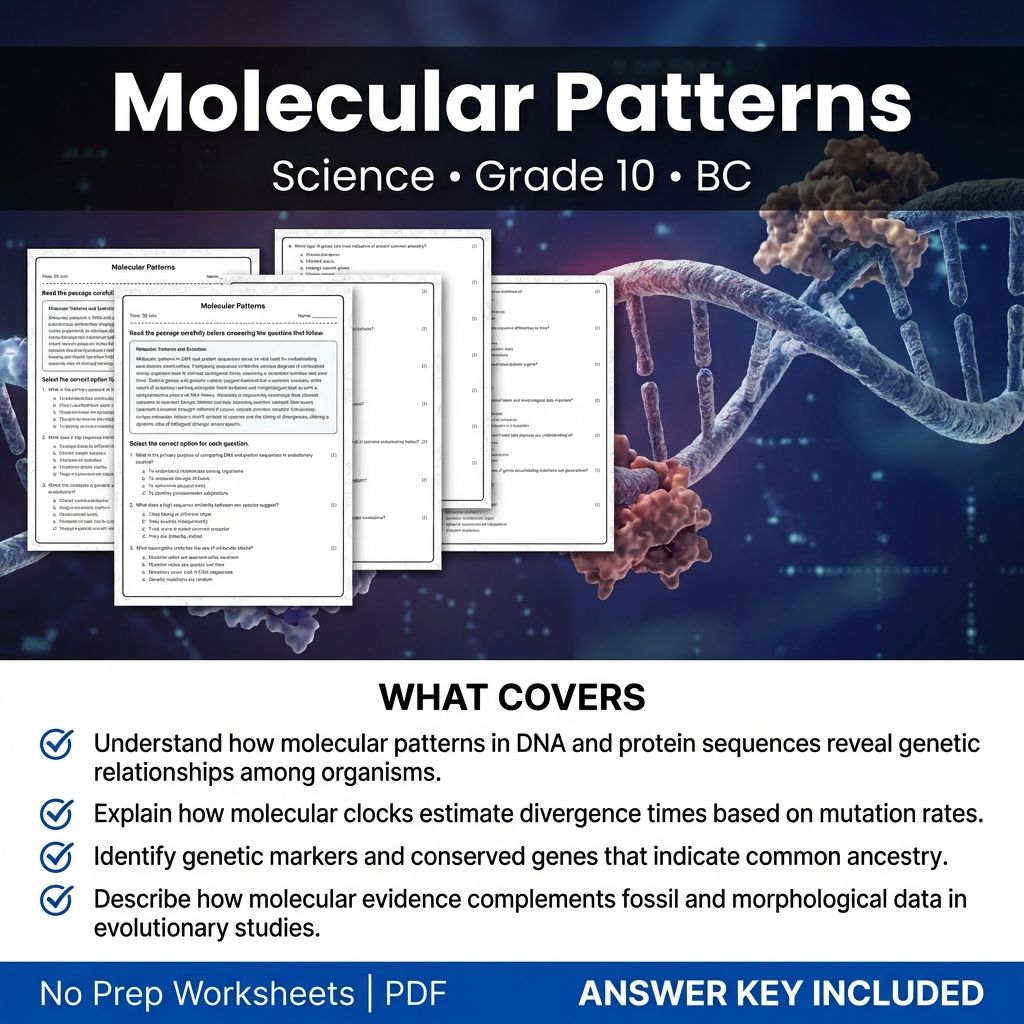
Grade 10 Science Worksheet | Molecular Patterns in DNA & Proteins (Answer Key)
Created byCoral Reef LearningLearning Objectives
- Understand how molecular patterns in DNA and protein sequences reveal genetic relationships among organisms.
- Explain how molecular clocks estimate divergence times based on mutation rates.
- Identify genetic markers and conserved genes that indicate common ancestry.
Instant download

Weather–Climate Links Worksheet for Grade 10 Science
JCreated byJ.S SheetsLearning Objectives
- Explain how unequal heating of Earth drives pressure differences and winds.
- Describe how rising air, condensation, and fronts contribute to cloud and precipitation formation.
- Connect short-term weather processes to long-term climate patterns using atmospheric circulation and statistics.
Also included in: Grade 10 Earth and Space Systems Models Science lesson bundle – General +1 more
Instant download
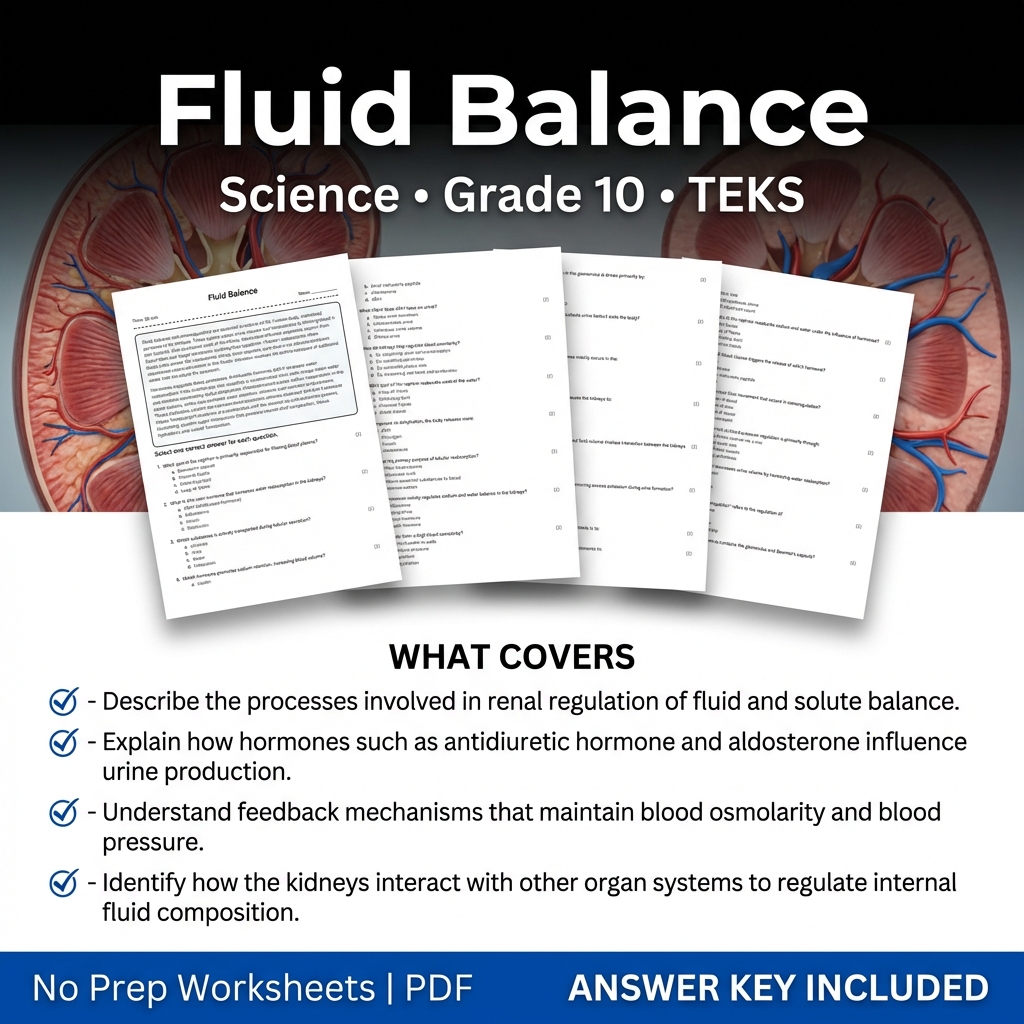
Fluid Balance Worksheet for Grade 10 Science | TEKS Aligned Practice
Created byCoral Reef LearningLearning Objectives
- Describe the processes involved in renal regulation of fluid and solute balance.
- Explain how hormones such as antidiuretic hormone and aldosterone influence urine production.
- Understand feedback mechanisms that maintain blood osmolarity and blood pressure.
Instant download

Graphical Statistics Assessment | General Grade 10 Science Standards
Created byPrism Point LearningLearning Objectives
- Understand how to interpret various types of graphs used in data analysis.
- Identify patterns, clusters, outliers, and trends in graphical data representations.
- Apply basic statistical ideas to describe relationships between variables shown in graphs.
Instant download
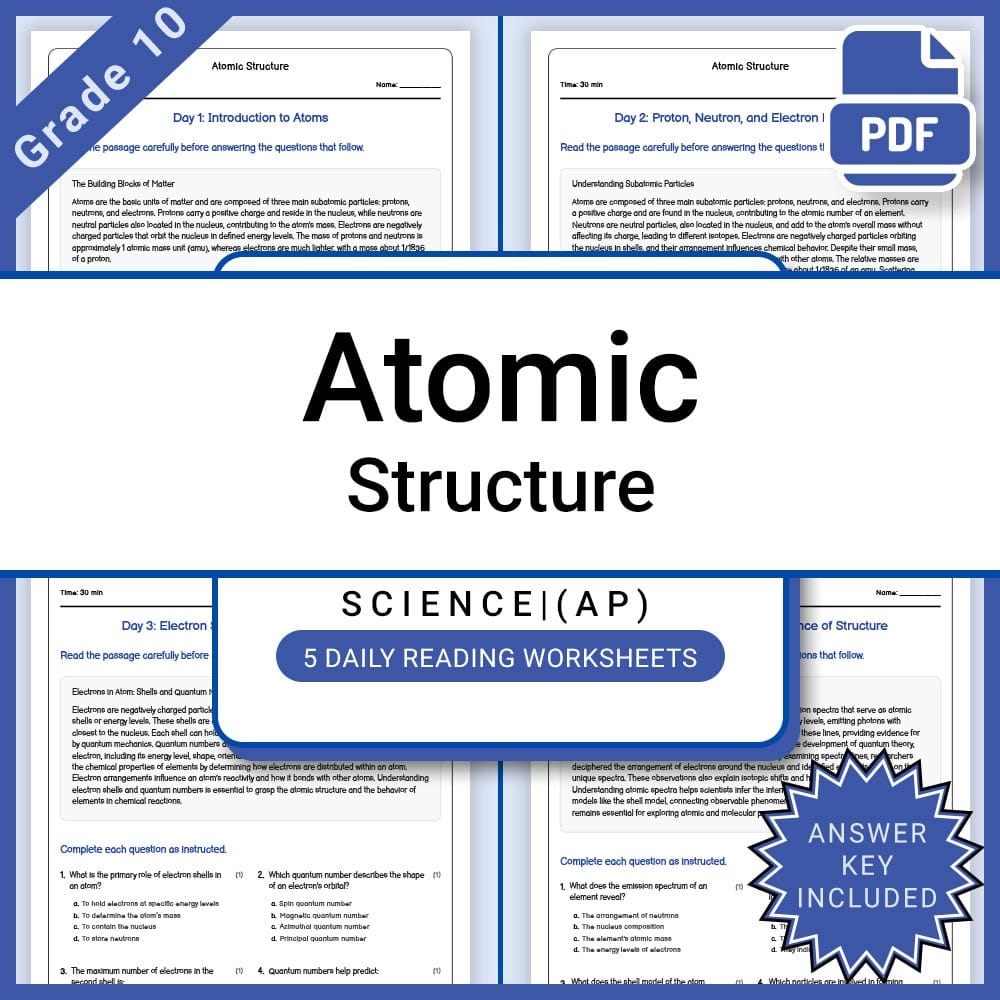
Grade 10 Science – Atomic Structure Daily Reading Worksheet + Answer Key
JCreated byJ.S SheetsLearning Objectives
- Identify subatomic particles and their roles within an atom.
- Understand the relative masses of protons, neutrons, and electrons.
- Explain how emission spectra and scattering experiments provide evidence for atomic structure.
Also included in: Grade 10 Science Lesson Group - AP Curriculum - Daily Reading Worksheets
Instant download

Design Problem Constraints Worksheet Grade 10 STEM Science Activities
Created byPrism Point LearningLearning Objectives
- Explain how constraints such as time, cost, safety, energy use, and available materials shape the design space.
- Evaluate whether a proposed solution meets requirements while limiting unwanted effects.
- Connect specific design choices to the constraints they satisfy and explain why the solution is feasible.
Instant download

Grade 10 Science – Chemical Properties & Reactions | Daily Reading Worksheet
Created byBright Mind ResourcesLearning Objectives
- Define chemical properties and recognize examples.
- Identify indicators of chemical changes such as gas evolution and color change.
- Differentiate between physical and chemical changes.
Also included in: Grade 10 Chemistry Science Daily Reading Worksheets Lesson Bundle | Ontario +1 more
Instant download

Grade 10 Science | Physiological Systems - Daily Reading Comprehension
Created byCoral Reef LearningLearning Objectives
- Understand the structure and function of the circulatory system
- Identify key components such as blood vessels, heart chambers, and blood flow pathways
- Analyze how vascular networks facilitate transport within the body
Instant download
About Grade 10 Science Worksheets
Find Science worksheets built for Grade 10. All 7,038 cover core skills, practice, and review, each an instant PDF download.
Every worksheet on MyTeachingSheets is created by independent teacher-authors and reviewed before publication. All resources download as printable PDFs for classroom, homework, or at-home practice, and many include answer keys. Preview any worksheet free before buying.