
Grade 10 Science Worksheets
7,038 worksheets
DNA Structure Worksheet for Grade 10 Science | NGSS-Aligned Practice
JCreated byJ.S SheetsLearning Objectives
- Describe the structural features of DNA, including the double helix and complementary base pairing.
- Explain the mechanisms of DNA replication, including roles of DNA polymerase and helicase.
- Connect DNA structure to processes like transcription, translation, and mutation effects.
Instant download

Genetic Drift Worksheet | Grade 10 Evolution Biology Activities
 Created byPrism Point Learning
Learning Objectives
- Explain how genetic drift can change allele frequencies due to chance events rather than natural selection
- Analyze why smaller populations experience stronger effects of genetic drift
- Predict possible outcomes of genetic drift over time, including reduced genetic diversity and divergence among populations
Instant download

Phylogenetic Trees Worksheet | TEKS-Aligned Grade 10 Science Practice
JCreated byJ.S SheetsLearning Objectives
- Explain how phylogenetic trees represent hypotheses about evolutionary relationships using branching patterns and nodes.
- Identify how clades and nested classification reflect shared ancestry and more recent common ancestors.
- Use evidence from shared derived traits, DNA/molecular sequences, and fossil placements to interpret or refine phylogenetic trees.
Instant download
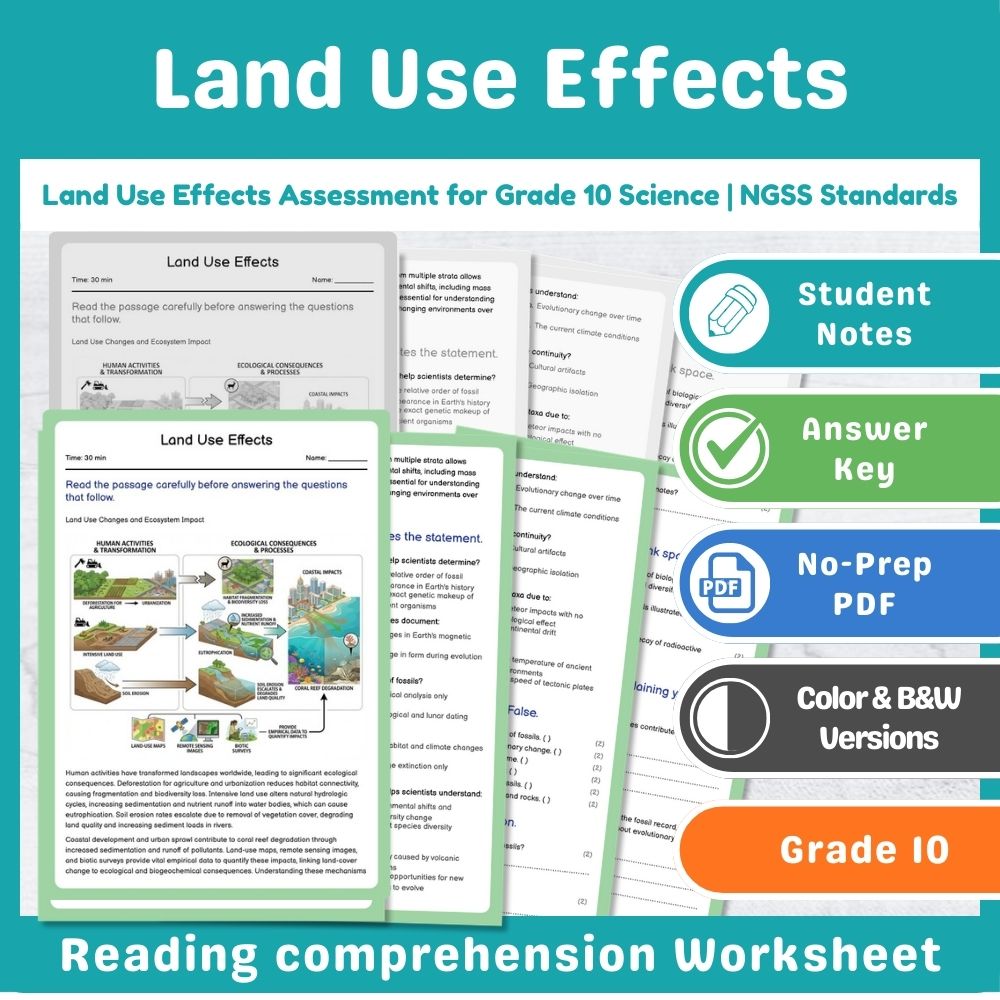
Land Use Effects Assessment for Grade 10 Science | NGSS Standards
Created byPrism Point LearningLearning Objectives
- Analyze human impacts on Earth systems through land-cover changes.
- Identify indicators such as habitat fragmentation, nutrient loading, soil erosion, and coral reef degradation.
- Interpret empirical land-use data from maps, remote sensing, and surveys to assess ecological consequences.
Also included in: Grade 10 Science Resource Tradeoffs Assessment | NGSS Standards-Aligned
Instant download

Carbon Cycling Worksheet | Standards-Aligned Grade 10 Science Practice
JCreated byJ.S SheetsLearning Objectives
- Describe the components and fluxes involved in the global carbon cycle.
- Identify sources, sinks, and feedback mechanisms affecting atmospheric CO₂ levels.
- Analyze the magnitudes, residence times, and feedback loops within the carbon cycle.
Also included in: Grade 10 Climate Change Science Lesson Bundle | NGSS Practice Worksheets
Instant download
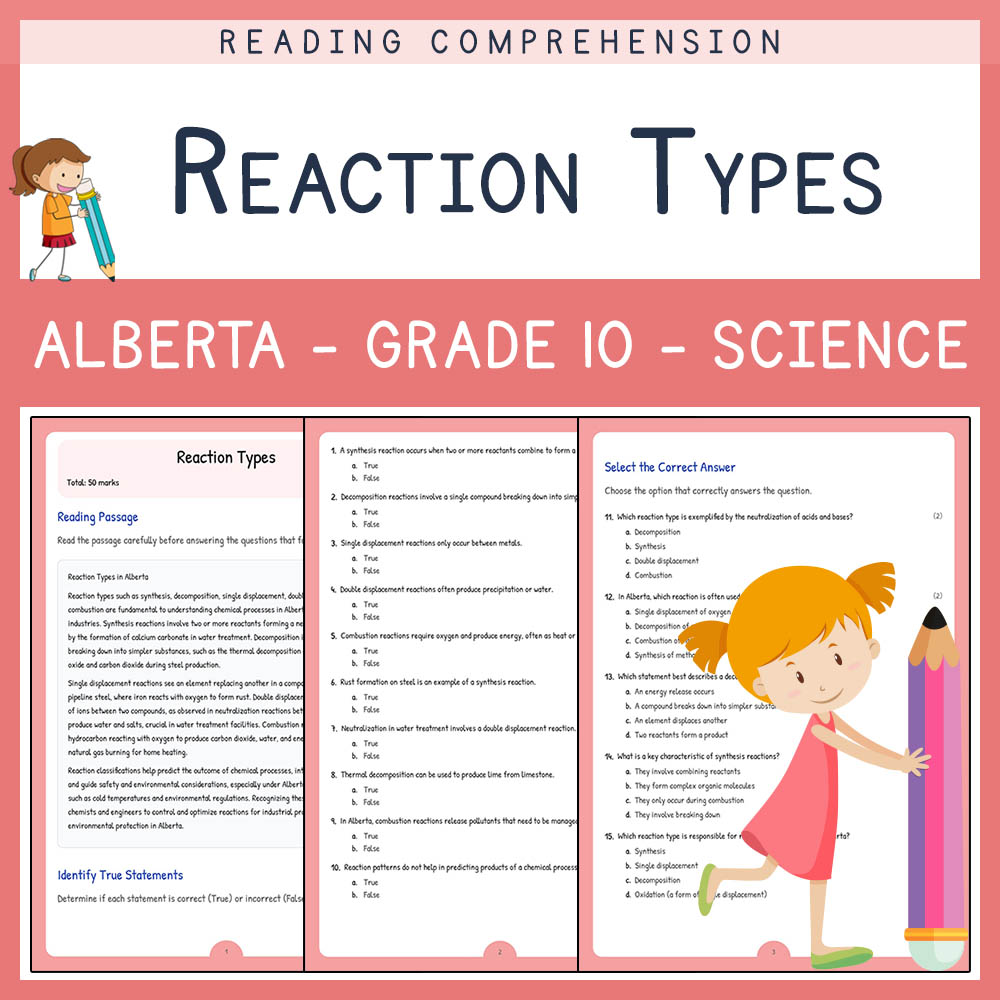
Grade 10 Science | Reaction Types Worksheet | Alberta Standards
 Created byLumora Learning
Learning Objectives
- Identify and describe common reaction types including synthesis, decomposition, single and double displacement, and combustion.
- Interpret reaction patterns and predict products based on reaction classification.
- Analyze representative equations and Alberta-relevant examples such as steel oxidation, natural gas combustion, and water neutralization.
Instant download

Grade 10 System Interactions Worksheet | Ecosystems & Alberta Science
 Created byEvergreen Desk Education
Learning Objectives
- Explain how biological systems exchange matter and information and how this coupling affects organisms and ecosystems.
- Analyze examples (pollination networks, predator–prey dynamics, and plant–microbe partnerships) to predict changes in resilience and function.
- Use system-thinking vocabulary (inputs, outputs, feedback, and emergent properties) to describe interactions across scales.
Instant download

Plate Dynamics Worksheet | Science Practice for Grade 10 | Alberta
JCreated byJ.S SheetsLearning Objectives
- Understand how tectonic plate interactions influence surface features and geological processes.
- Identify the different types of plate boundaries and their associated landforms and seismic activity.
- Explain the role of deep Earth processes in shaping mountain ranges, sedimentary basins, and resource distribution.
Also included in: Grade 10 Earth Systems & Climate Science Lesson Bundle – Alberta Framework +1 more
Instant download

Newtonian Forces Worksheet for Grade 10 Science | Net Force and Motion Practice
JCreated byJ.S SheetsLearning Objectives
- Explain how net force determines whether an object’s motion changes or stays the same.
- Use Newton’s second law (a = Fnet/m) to predict how changes in force and mass affect acceleration.
- Connect equilibrium to balanced forces and zero acceleration.
Also included in: Grade 10 Matter, Energy, and Waves Science Lesson Bundle – Florida (NGSSS) +1 more
Instant download
Grade 10 Science | Space Scale Motion Worksheet with Short Notes (Printable PDF)
 Created byMeadowlark Worksheets
Learning Objectives
- Understand the relationship between scale, motion, and observable features of space objects.
- Identify how gravity and orbital dynamics influence the movement of celestial bodies.
- Interpret angular size and motion to distinguish between nearby and distant space objects.
Also included in: Grade 10 Earth Systems Science Lesson Bundle: General Framework Worksheets +1 more
Instant download
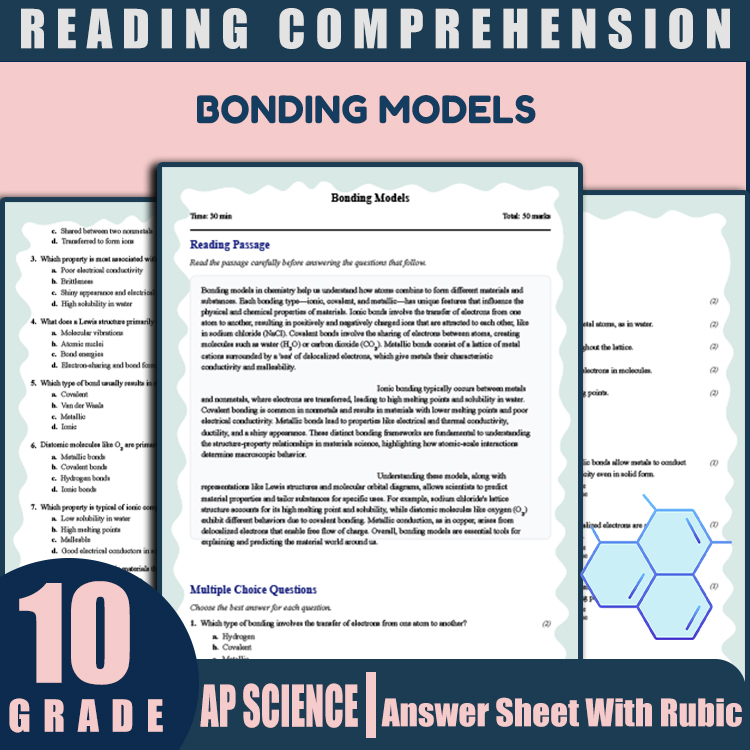
10th Grade Science | Bonding Models Reading Worksheet & Answer Key (PDF)
JCreated byJ.S SheetsLearning Objectives
- Understand and distinguish between ionic, covalent, and metallic bonding.
- Relate bonding types to observable material properties such as conductivity, melting point, and solubility.
- Interpret electron-sharing and electron-transfer models, including Lewis structures and molecular orbital concepts.
Also included in: Grade 10 Science Unit Worksheet Bundle | Chemical Reactions & Atomic Structure +1 more
Instant download

Grade 10 Science | Energy Currency Worksheet | TEKS-Aligned
Created byLumora LearningLearning Objectives
- Understand how ATP functions as the primary energy carrier within cells.
- Describe the processes of ATP hydrolysis and regeneration.
- Identify the roles of ATP in biosynthesis, transport, and mechanical work.
Also included in: Grade 10 Science | Metabolism & Energy Processes Lesson Bundle | TEKS Aligned +1 more
Instant download

Net Force and Acceleration Worksheets: Grade 10 Physical Science
 Created byBRIGHT PATH RESOURCES
Learning Objectives
- Explain how net force relates to velocity changes
- Identify gravity, contact forces, and friction affecting motion
- Describe inertia as resistance to changes in motion
Also included in: Grade 10 Physical Science Worksheets Bundle | Forces, Energy & More +1 more
Instant download
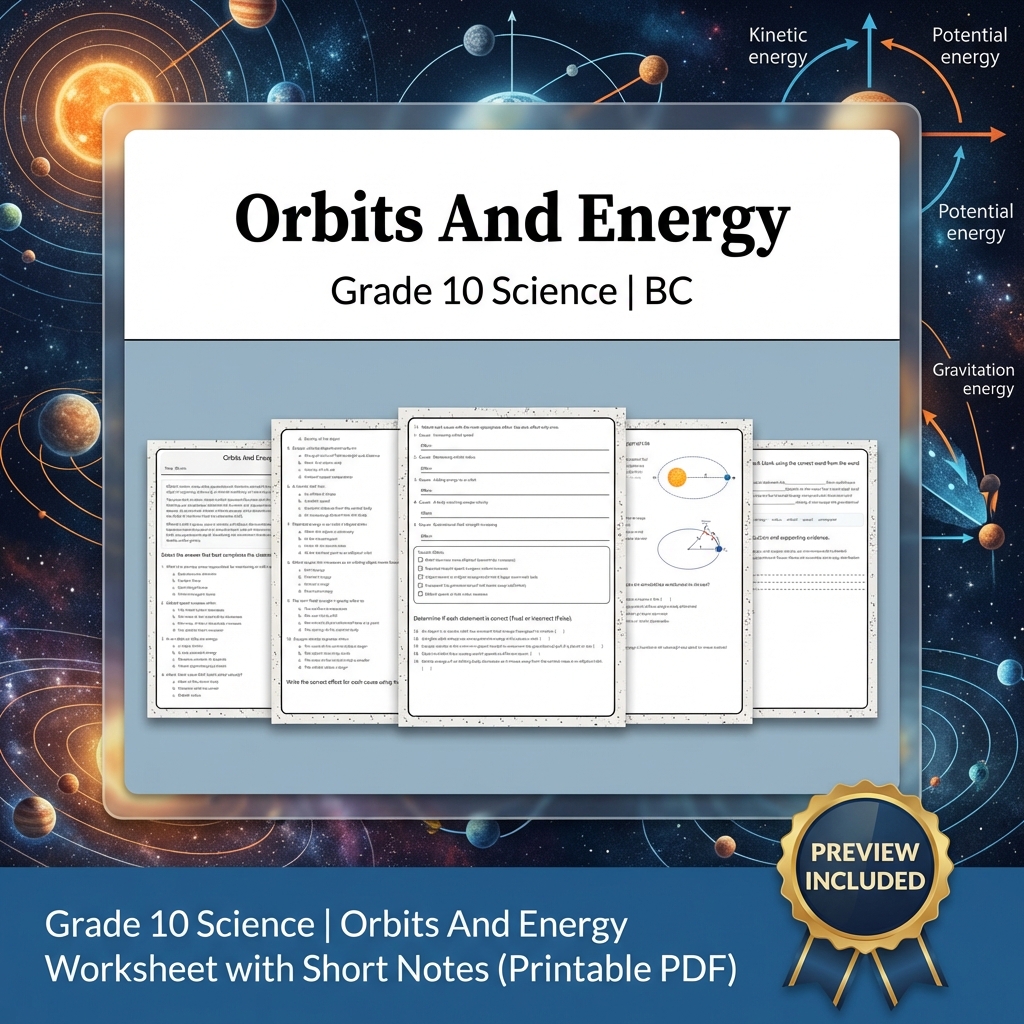
Grade 10 Science | Orbits And Energy Worksheet with Short Notes (Printable PDF)
Created byMeadowlark WorksheetsLearning Objectives
- Understand how gravitational attraction influences orbital motion and the formation of different orbit types.
- Describe the relationship between orbital speed, energy, and mass.
- Explain concepts such as energy partitioning, escape velocity, and field strength in celestial mechanics.
Also included in: Grade 10 Science Lesson Bundle | Physics and Forces Worksheets | BC Framework +1 more
Instant download
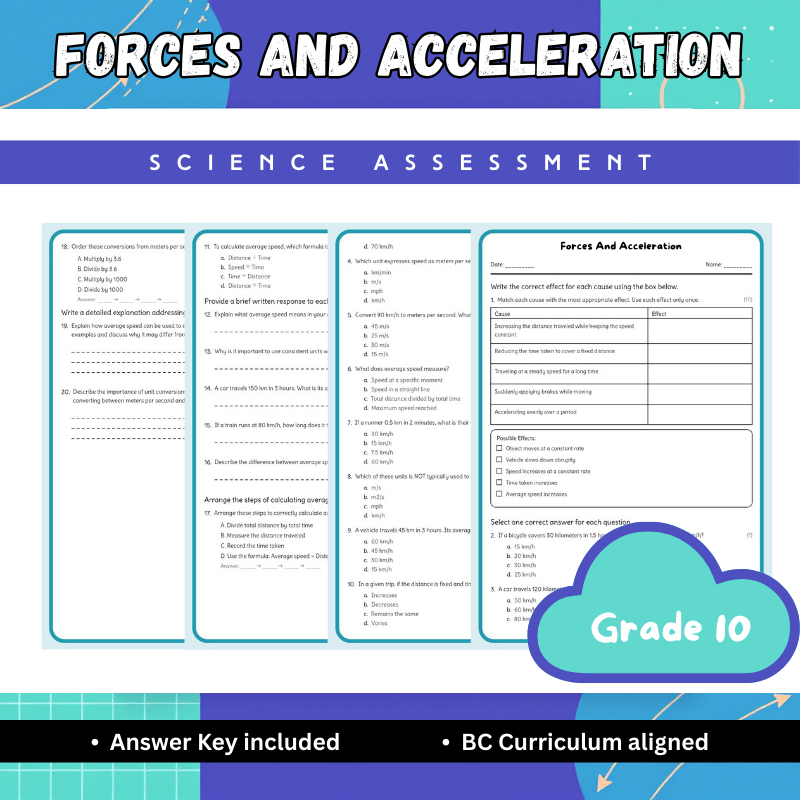
Grade 10 Science – Forces And Acceleration Worksheet (PDF) with Answer Key
 Created byBright Mind Resources
Learning Objectives
- Understand how net force influences acceleration according to Newton's second law.
- Identify and represent individual forces using free-body diagrams.
- Use algebraic and vector components to analyze combined forces and motion changes.
Instant download
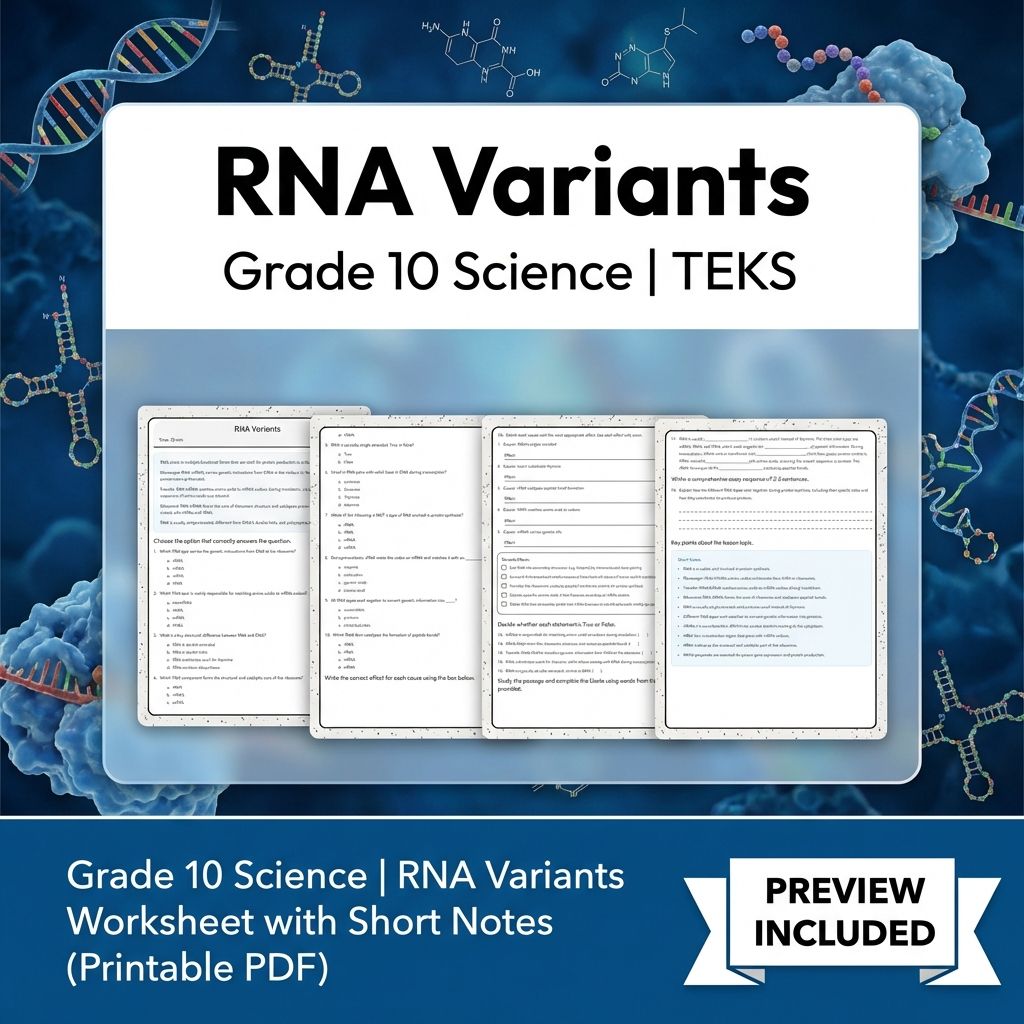
Grade 10 Science | RNA Variants Worksheet with Short Notes (Printable PDF)
Created byMeadowlark WorksheetsLearning Objectives
- Identify the different types of RNA and their functions in protein synthesis.
- Explain the structural differences between RNA and DNA.
- Describe how RNA variants work together during transcription and translation.
Instant download
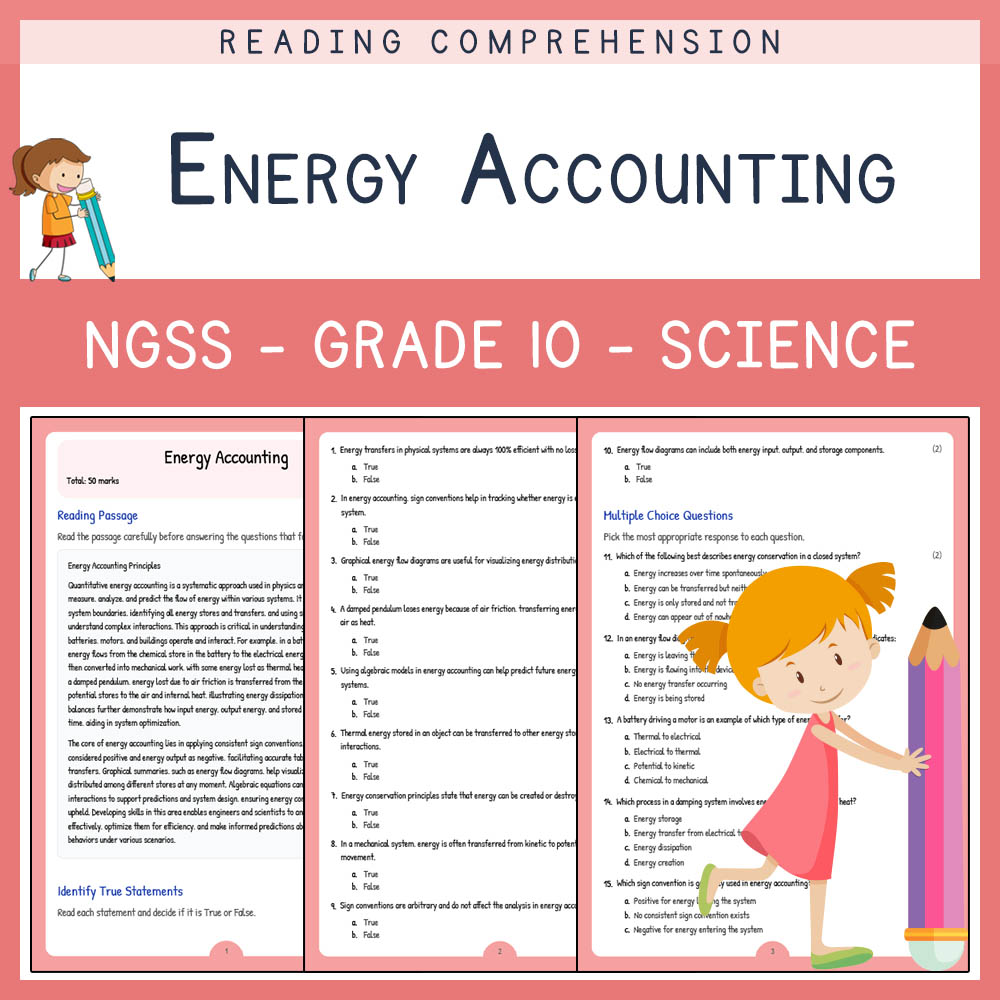
Grade 10 Science | Energy Accounting Worksheet & Answer Key (NGSS Aligned)
Created byLumora LearningLearning Objectives
- Understand how to quantify energy transfers within different systems using energy flow diagrams.
- Apply system boundary concepts and sign conventions to analyze energy distribution in mechanical, electrical, and thermal stores.
- Use computational and graphical models to predict the energy distribution in various scenarios.
Instant download

Grade 10 Periodic Trends Worksheet | BC Practice & PDF
 Created byClear Sky Classroom
Learning Objectives
- Explain how nuclear charge and electron shielding affect atomic radius, ionization energy, and electronegativity across periods and down groups
- Predict the general direction of periodic trends for elements based on their position on the periodic table
- Use periodic trends to reason about electron gain/loss, metallic character, and bond polarity
Instant download
Grade 10 Science – Wave Properties Worksheet (PDF +Answer Key)
 Created byCopper Leaf Classroom
Learning Objectives
- Understand key concepts related to Science
- Apply knowledge through practice questions
- Demonstrate comprehension of the material
Instant download

Engineering Trade-Off Decisions with Evidence Worksheets Grade 10
Created byBRIGHT PATH RESOURCESLearning Objectives
- Explain how measurable criteria help compare alternative solutions.
- Identify trade-offs when improving one outcome reduces another.
- Justify a design choice by linking evidence to criteria and limitations.
Also included in: Grade 10 Engineering Design Worksheets Bundle | Science Trade-Offs +4 more
Instant download
Grade 10 Science | Balancing Equations Worksheet with Short Notes
Created byMeadowlark WorksheetsLearning Objectives
- Understand the concept of balancing chemical equations based on conservation of mass.
- Distinguish between coefficients and subscripts in chemical formulas.
- Apply systematic strategies to balance multi-step chemical equations.
Also included in: Grade 10 Science Lesson Group Bundle with Ontario Framework +1 more
Instant download

Carrying Capacity Worksheet | Grade 10 Science Activities
Created byPrism Point LearningLearning Objectives
- Define carrying capacity and explain how it depends on resources, habitat, and ecosystem interactions.
- Identify factors that lower or raise carrying capacity, including predation, disease, and waste accumulation.
- Describe how populations typically fluctuate around carrying capacity and what happens when they exceed it.
Instant download

Design Constraints Worksheets: Feasible Engineering Solutions Grade 10
Created byBRIGHT PATH RESOURCESLearning Objectives
- Identify common design constraints (time, cost, safety, energy use, and available materials) in a design problem.
- Explain how each major design choice addresses a specific constraint while limiting unwanted effects.
- Use evidence and clear reasoning to justify why a proposed solution is feasible and appropriate.
Also included in: Grade 10 Engineering Design Worksheets Bundle | Science Trade-Offs +4 more
Instant download

Grade 10 Science – Thermochemistry & Chemical Reactions | Reading Worksheet
Created byBright Mind ResourcesLearning Objectives
- Understand the concepts of heat transfer and work in chemical reactions
- Interpret thermochemical equations and their relation to enthalpy changes
- Apply Hess's law to reaction pathways and calculate reaction enthalpies
Also included in: Grade 10 Stoichiometry & Atomic Structure Science Reading Lesson Bundle | AP +2 more
Instant download
Grade 10 Science – Energy Currency in Cells Worksheet with Answer Key
JCreated byJ.S SheetsLearning Objectives
- Understand the role of ATP as the primary energy carrier in cells
- Describe the processes of ATP synthesis and hydrolysis
- Explain the importance of phosphorylation in cellular metabolism
Also included in: Grade 10 Science Lesson Group: Alberta Curriculum — Daily Reading Worksheets +1 more
Instant download

Climate Projections Trends Attribution & Uncertainty Worksheet | NGSS Grade 10
 Created byAmber Owl Education
Learning Objectives
- Explain how instrumental records and proxy data are used to identify climate trends in temperature, precipitation, and sea level.
- Describe radiative forcing and how it helps attribute observed climate change to human and natural influences.
- Interpret ensemble climate model outputs, including scenario differences and uncertainty.
Instant download

Carbon and Nitrogen Cycling Worksheet | NGSS Grade 10 Earth Systems
Created byAmber Owl EducationLearning Objectives
- Explain how carbon and nitrogen move among the atmosphere, biosphere, hydrosphere, and lithosphere
- Describe key processes in nutrient cycling, including photosynthesis, respiration, nitrification, denitrification, and decomposition
- Evaluate how human activities alter nutrient reservoirs and flux rates and can lead to eutrophication and hypoxia
Instant download
Grade 10 Science | Metabolic Pathways Worksheet (AP Standard) PDF
Created byBright Mind ResourcesLearning Objectives
- Map and describe the core metabolic pathways including glycolysis, the TCA cycle, and oxidative phosphorylation.
- Explain how cells conserve energy through ATP generation and electron flow in these pathways.
- Identify regulatory checkpoints and pathway branch points that maintain cellular function under different conditions.
Instant download

Grade 10 Science – Atmospheric Patterns & Layers | Daily Reading Worksheet
Created byBright Mind ResourcesLearning Objectives
- Identify the layers of Earth's atmosphere and understand their functions.
- Explain how pressure systems influence weather
- Describe circulation cells and their role in climate.
Also included in: Grade 10 Earth Science Daily Reading Worksheets Lesson Bundle | AP +2 more
Instant download

Grade 10 Science | Safe Data Collection Daily Reading Practice
 Created byCoral Reef Learning
Learning Objectives
- Understand the importance of safety in scientific data collection.
- Recognize appropriate methods for gathering accurate and reliable data.
- Identify variables, controls, and proper data recording practices.
Instant download

Earth System Resource Cycles and Transfers Worksheets Grade 10
 Created bySunny Desk Resources
Learning Objectives
- Describe how materials move through Earth system resource cycles using reservoirs and pathways
- Compare how residence time affects the timing of resource availability and fluxes
- Explain how changes in flux rates can alter ecosystem function and long-term availability of resources
Also included in: Earth Systems, Climate, and Sustainability Lesson Bundle | Grade 10 Science | Alberta +1 more
Instant download

Grade 10 Science | Statistical Reasoning Worksheet (AP) PDF
Created byEvergreen Desk EducationLearning Objectives
- Summarize quantitative data using central tendency and spread metrics and explain what each metric reveals.
- Interpret confidence intervals, effect sizes, and comparisons between datasets in context.
- Use null models and basic hypothesis logic to judge whether observed differences exceed expected variability.
Also included in: Grade 10 Scientific Modeling & Quantitative Reasoning Science Lesson Bundle (AP) +1 more
Instant download

Grade 10 Science | Ecosystem Basics Worksheet | TEKS-Aligned
Created byLumora LearningLearning Objectives
- Understand the key components and functions of an ecosystem.
- Identify interactions among producers, consumers, decomposers, and the environment.
- Explain how energy flows and elements cycle within ecosystems.
Instant download

Science Lab Report Communication Worksheet | Standards-Aligned Grade 10
JCreated byJ.S SheetsLearning Objectives
- Use conventions for clear, evidence-based reporting by connecting data to specific scientific claims.
- Present and interpret data using tables, graphs, and statistical indicators (including uncertainty).
- Explain limitations and data provenance to support peer evaluation and reproducibility.
Instant download

Reaction Energy Worksheet Grade 10 Chemistry Activities & NGSSS Practice
Created byPrism Point LearningLearning Objectives
- Explain how energy changes in chemical reactions by comparing the total energy of reactants and products.
- Distinguish endothermic and exothermic processes using energy profiles and the direction of heat transfer.
- Relate bond breaking, bond forming, and activation energy to the overall energy change and reaction pathway.
Also included in: Grade 10 Physical Science Lesson Bundle | Florida NGSSS
Instant download

Grade 10 TEKS Selective Permeability & Phospholipid Bilayer Worksheet
Created byBRIGHT PATH RESOURCESLearning Objectives
- Explain how the cell membrane is selectively permeable.
- Describe how the phospholipid bilayer forms a barrier to many substances.
- Identify roles of membrane components in transport and recognition.
Also included in: Grade 10 Cell Structure & Function Science Worksheets Bundle | TEKS Biology +1 more
Instant download

Grade 10 Science | Ecosystem Management - Daily Reading Comprehension
Created byCoral Reef LearningLearning Objectives
- Identify key components of ecosystems and their interactions
- Understand ecological principles used in management strategies
- Recognize human impact on ecosystems and ways to mitigate it
Instant download

Grade 10 Science Worksheet Motion Graphs Position-Time Velocity-Time
JCreated byJ.S SheetsLearning Objectives
- Interpret the slope of position-time graphs as velocity and the slope of velocity-time graphs as acceleration.
- Use changes in sign and curvature on motion graphs to identify changing direction and changing acceleration.
- Connect motion graphs to real motion by reasoning about how forces affect acceleration over time.
Also included in: Grade 10 Matter, Energy, and Waves Science Lesson Bundle – Florida (NGSSS) +1 more
Instant download
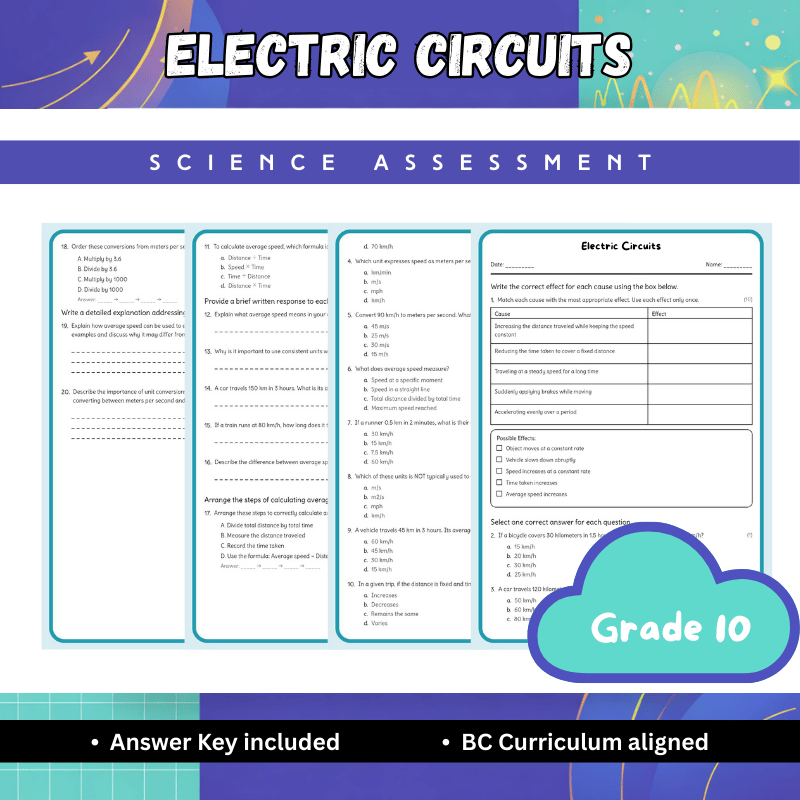
Grade 10 Science | Electric Circuits Worksheet + Answer Key (BC Standard)
Created byBright Mind ResourcesLearning Objectives
- Understand the components and functions of electric circuits.
- Analyze the factors affecting energy transmission efficiency.
- Compare centralized versus distributed power generation systems.
Instant download
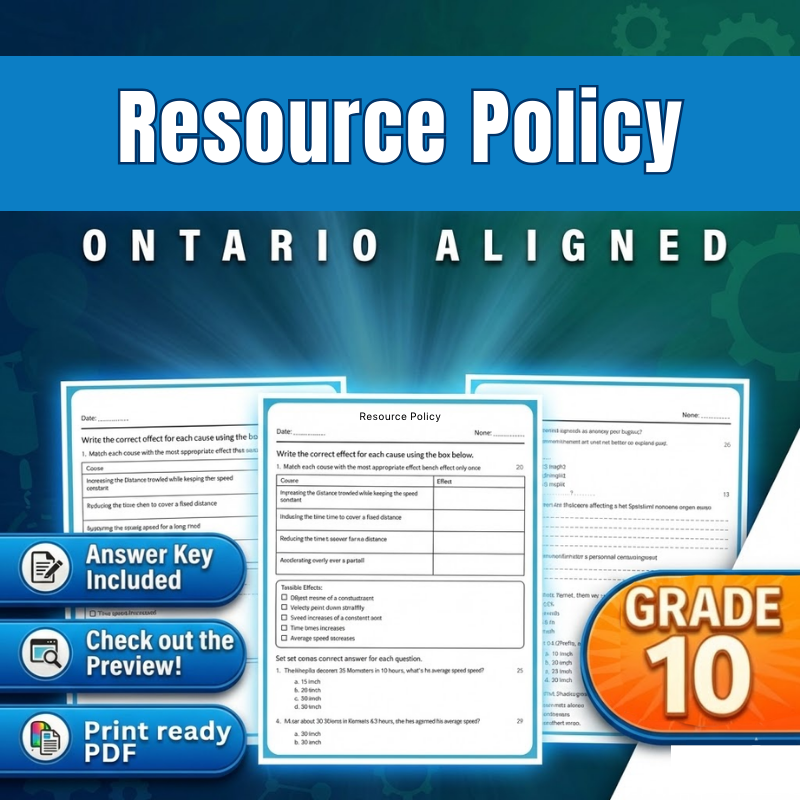
Grade 10 Science | Resource Policy Worksheet (Ontario) (PDF)
Created byBright Mind ResourcesLearning Objectives
- Understand governance instruments and economic mechanisms that influence natural resource use.
- Analyze the role of permitting, land‑use planning, and environmental assessment in resource management.
- Recognize the importance of Indigenous rights, consultation, and international markets in resource policies.
Instant download

Grade 10 Worksheet B: Biodiversity Drivers Worksheet | NGSS Practice PDF
Created byClear Sky ClassroomLearning Objectives
- Evaluate how habitat fragmentation, invasive species, land-use change, and climate-driven range shifts affect species richness and community composition.
- Explain how genetic diversity and metapopulation connectivity influence extinction risk and recovery potential.
- Synthesize evidence about biodiversity change to predict impacts on ecosystem function and long-term viability of native assemblages in terrestrial and aquatic biomes.
Also included in: Grade 10 Ecosystem Energy Transfer & Biodiversity Science Lesson Bundle: NGSS +1 more
Instant download

Grade 10 Science | Gene Regulation Switches Worksheet | California Standards
Created byLumora LearningLearning Objectives
- Explain how gene regulation controls when and where genes are expressed by changing transcription rates
- Identify how DNA regulatory regions and molecular signals can activate or repress transcription
- Describe how gene regulatory networks and epigenetic changes can produce different protein patterns from the same genome
Instant download
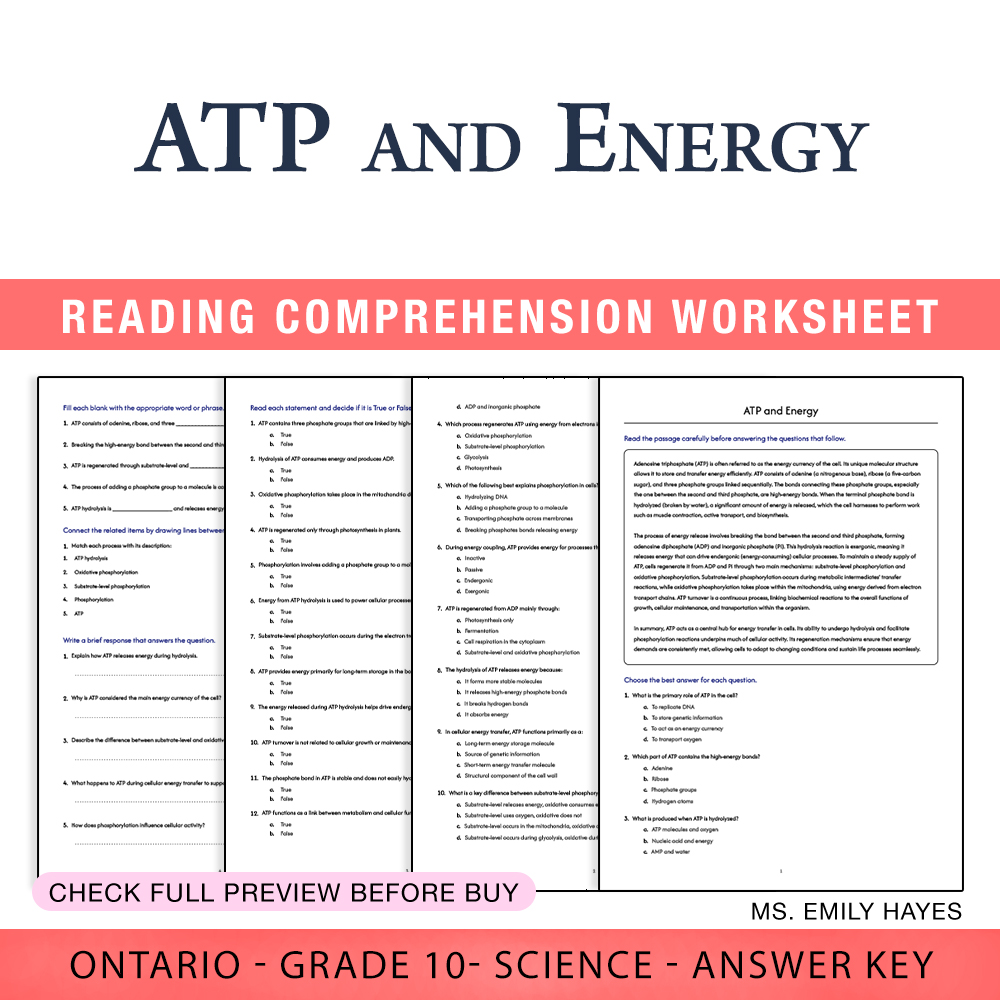
10th Grade Science | ATP and Energy Worksheet (PDF + Answer Key)
Created byCopper Leaf ClassroomLearning Objectives
- Describe the molecular structure of ATP and its role as the central energy carrier in cells.
- Explain how ATP releases energy through phosphate bond hydrolysis and how this energy is coupled to cellular processes.
- Understand mechanisms of ATP regeneration via substrate-level and oxidative phosphorylation.
Instant download

Natural Selection and Evolution Worksheets Grade 10 Science
Created byBRIGHT PATH RESOURCESLearning Objectives
- Explain how heritable variation changes population allele frequencies
- Relate reproductive success to natural selection
- Predict how natural selection leads to adaptation
Also included in: Grade 10 Life Science Worksheets Bundle | Evolution & Genetics +4 more
Instant download

Conservation Energy Worksheet | Grade 10 Science Practice
Created byPrism Point LearningLearning Objectives
- Explain energy conservation using the idea that energy is transferred and transformed but not created or destroyed.
- Use qualitative energy accounting to track energy forms in a closed system as they change.
- Describe how nonconservative forces (like friction) can reduce mechanical energy and increase thermal energy.
Instant download
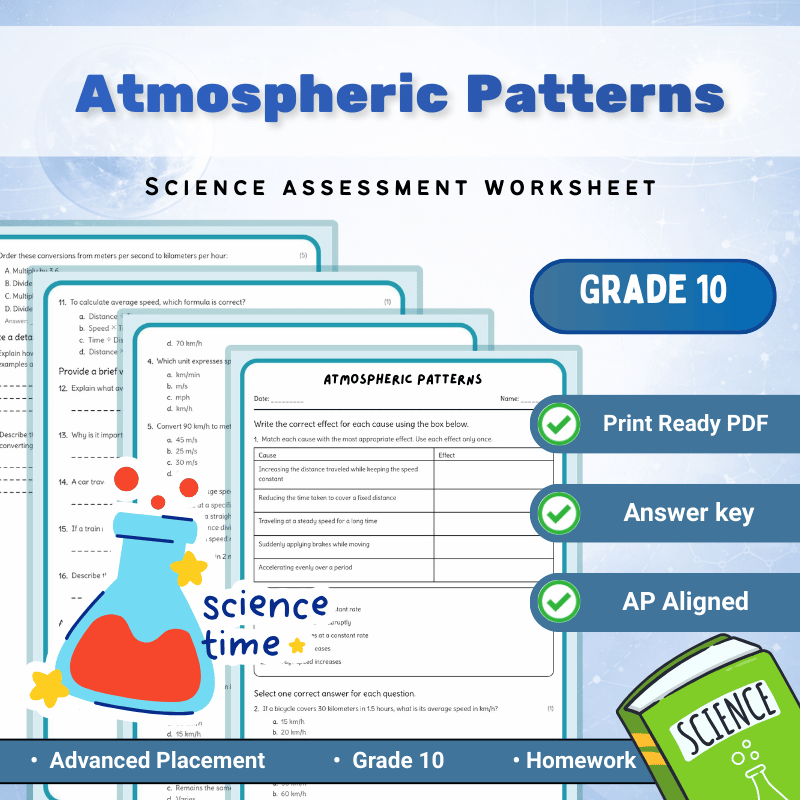
Grade 10 Science – Atmospheric Patterns Worksheet (AP | Science 1) PDF
Created byBright Mind ResourcesLearning Objectives
- Describe the basic structure and pressure systems in Earth's atmosphere.
- Explain the role of circulation cells in climate and weather patterns.
- Identify and interpret various atmospheric representations such as hypsometric and wind-field maps.
Instant download
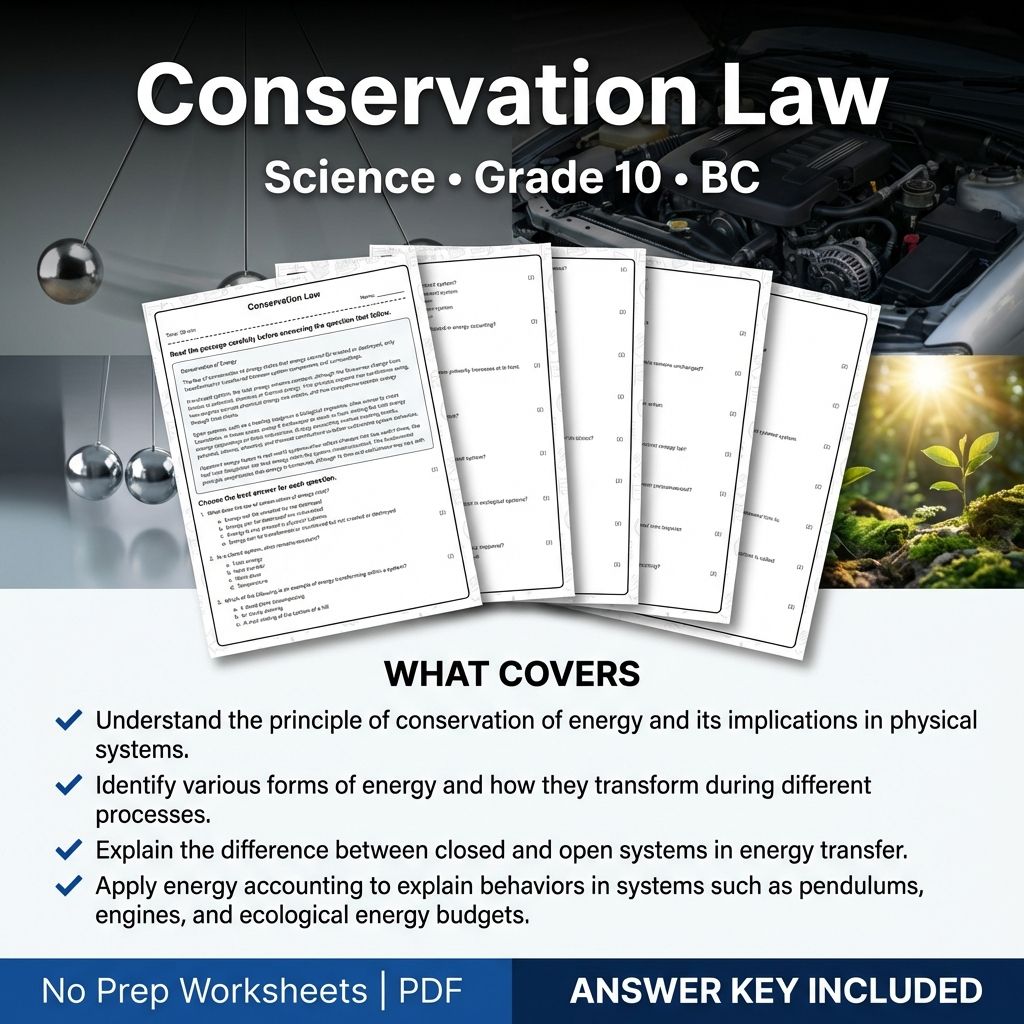
Grade 10 Science | Conservation Law Worksheet & Answer Key (Printable PDF)
Created byCoral Reef LearningLearning Objectives
- Understand the principle of conservation of energy and its implications in physical systems.
- Identify various forms of energy and how they transform during different processes.
- Explain the difference between closed and open systems in energy transfer.
Instant download

Climate Projections Worksheet | NGSS Grade 10 Science printable PDF
Learning Objectives
- Analyze how instrumental temperature, precipitation, and sea-level records are interpreted alongside proxy data and observations.
- Explain how radiative forcing can be linked to observed climate trends and used to inform climate model scenarios.
- Evaluate uncertainty in climate projections by comparing ensemble spreads across different scenarios.
Also included in: Earth and Human Activity Lesson Bundle Grade 10 Science NGSS
Instant download
About Grade 10 Science Worksheets
Find Science worksheets built for Grade 10. All 7,038 cover core skills, practice, and review, each an instant PDF download.
Every worksheet on MyTeachingSheets is created by independent teacher-authors and reviewed before publication. All resources download as printable PDFs for classroom, homework, or at-home practice, and many include answer keys. Preview any worksheet free before buying.