
Grade 10 Science Worksheets
7,038 worksheets
Grade 10 Evidence-Based Communication Worksheet | Practice & PDF
 Created byClear Sky Classroom
Learning Objectives
- Connect scientific claims to specific evidence using logical reasoning.
- Use appropriate scientific language to interpret observations and patterns.
- Communicate conclusions clearly with representations (graphs, tables, or models) that trace back to data.
Instant download

Meiosis Assessment for Grade 10 Science – Standards-Aligned Worksheet
 Created byPrism Point Learning
Learning Objectives
- Explain the stages of meiosis and their functions.
- Understand how meiosis contributes to genetic diversity.
- Identify key differences between meiosis and mitosis.
Also included in: Lesson Grade 10 Genetics: DNA, RNA, Protein Science Lesson Bundle TEKS
Instant download

Industrial Processes Worksheet | Grade 10 Science Activities
Created byPrism Point LearningLearning Objectives
- Explain how mass conservation and reaction stoichiometry are used for reagent and yield calculations in industrial chemical processes.
- Describe how reactor design and reaction rate (kinetics) affect product formation and overall process efficiency.
- Evaluate process optimization choices using ideas such as yield estimation, energy considerations, and Alberta industry examples.
Also included in: Grade 10 Chemistry & Dynamic Equilibrium Lesson Bundle | Alberta Science
Instant download

Genetic Code Meaning Worksheet | Science Assessment for Grade 10
JCreated byJ.S SheetsLearning Objectives
- Understand how nucleotide sequences are translated into amino acids during protein synthesis.
- Identify the role of codons in determining amino acid sequences.
- Explain how genetic information influences protein structure and cellular traits.
Also included in: Grade 10 Genetic Variation and Evolution Science Lesson Bundle +1 more
Instant download
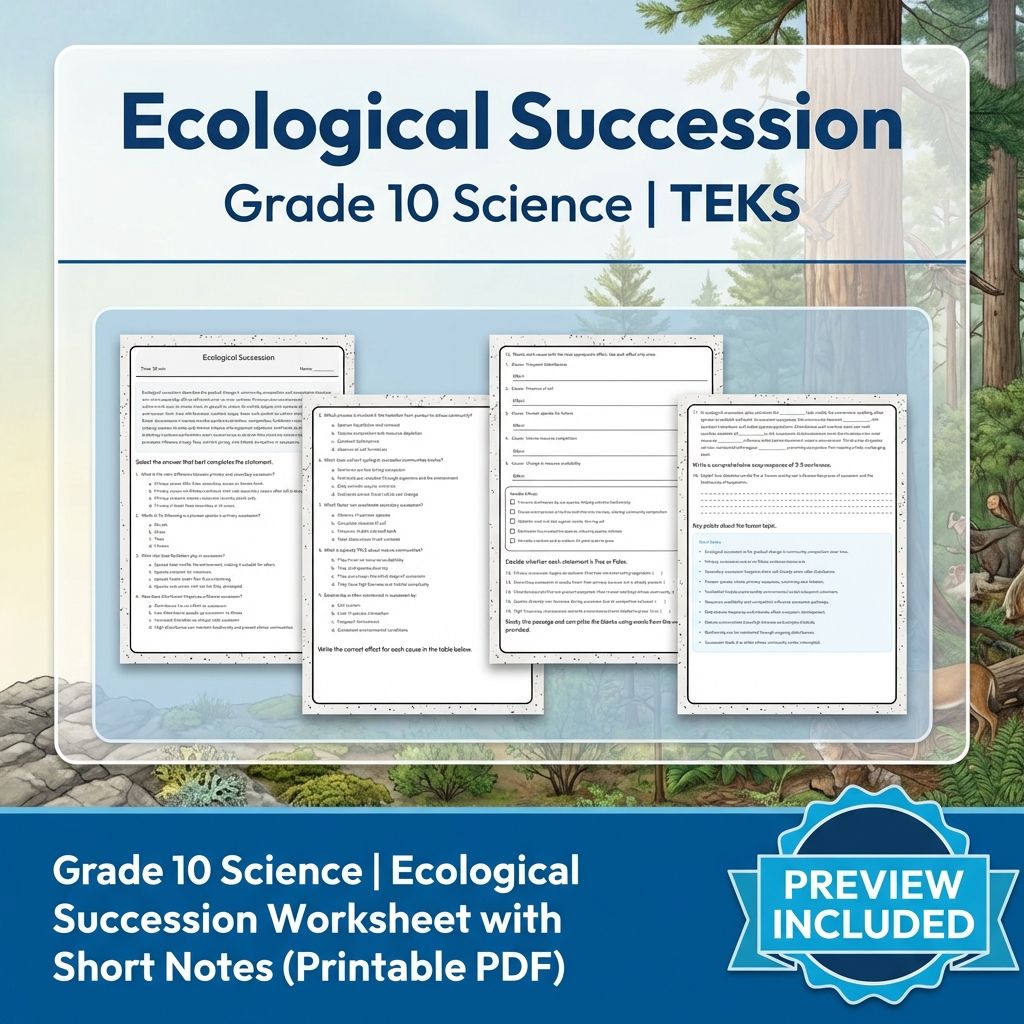
Grade 10 Science | Ecological Succession Worksheet with Short Notes (PDF)
 Created byMeadowlark Worksheets
Learning Objectives
- Understand the process and stages of primary and secondary succession.
- Identify factors influencing succession pathways and community changes.
- Explain the roles of species colonization, competition, and facilitation in succession.
Instant download

Grade 10 Science – Constructing Claims & Scientific Arguments | Worksheet
 Created byBright Mind Resources
Learning Objectives
- Identify key components of evidence-based claims: claim, evidence, and reasoning.
- Distinguish between data and interpretation in scientific arguments.
- Understand how warrants connect data to explanations.
Also included in: Grade 10 Scientific Reasoning Science Lesson Bundle | AP Daily Reading +2 more
Instant download

Earth System Cycles Worksheet for Grade 10 Science | Standards-Aligned Practice
JCreated byJ.S SheetsLearning Objectives
- Explain how matter cycles and energy transforms through interactions among the geosphere, hydrosphere, atmosphere, and biosphere.
- Describe how solar energy and internal heat drive the water cycle, atmospheric circulation, and plate tectonics.
- Connect the carbon cycle to ocean chemistry and atmospheric CO2 and describe how these links influence long-term climate.
Also included in: Grade 10 Earth and Space Systems Science Lesson Bundle – Florida NGSSS +1 more
Instant download

Mechanical Energy With Friction and Springs Worksheets Grade 10
 Created bySunny Desk Resources
Learning Objectives
- Apply conservation of energy to systems affected by friction
- Calculate final speeds or heights using energy relationships
- Interpret energy equations involving friction and stored spring energy
Also included in: Energy, Electricity & Momentum Transfer Lesson Bundle | Grade 10 Science | Alberta +1 more
Instant download

Matter Conservation Worksheet Grade 10 Science Activities & Review
Created byPrism Point LearningLearning Objectives
- Explain how the total amount of matter is conserved during both physical and chemical changes.
- Use particle and atom models to track conservation (particles for phase changes; atoms for chemical reactions).
- Distinguish physical changes from chemical changes using evidence from what is rearranged and what remains constant.
Instant download

Argument Critique Worksheet Grade 10 AP Science CER Reasoning Skills
Created byPrism Point LearningLearning Objectives
- Evaluate explanatory claims by analyzing evidence quality, statistical strength, and methodological limits
- Compare competing hypotheses by checking internal consistency and considering alternative explanations
- Use criteria for refutation and corroboration to judge which explanation is more plausible
Also included in: AP Science Inquiry Skills Lesson Bundle | Grade 10 | Modeling & CER
Instant download

Grade 10 Science | Comparative Anatomy - Daily Reading Comprehension
 Created byCoral Reef Learning
Learning Objectives
- Understand the concept of homologous structures and their importance in evolution
- Differentiate between homologous and analogous structures
- Recognize vestigial organs and their significance in the study of evolution
Instant download

Grade 10 Science | Momentum and Collisions Worksheet | BC Standards
 Created byLumora Learning
Learning Objectives
- Understand the concept of linear momentum and its conservation in isolated systems.
- Differentiate between elastic and inelastic collisions and their energy implications.
- Explain the relationship between impulse, force, time, and change in momentum.
Instant download

Feedback Control Worksheet for Grade 10 Science | NGSS Aligned Assessment
JCreated byJ.S SheetsLearning Objectives
- Understand the mechanisms of negative and positive feedback loops in homeostasis.
- Identify the roles of sensors, control centers, and effectors in maintaining internal stability.
- Describe how hormonal, vascular, and buffering systems regulate physiological parameters.
Instant download
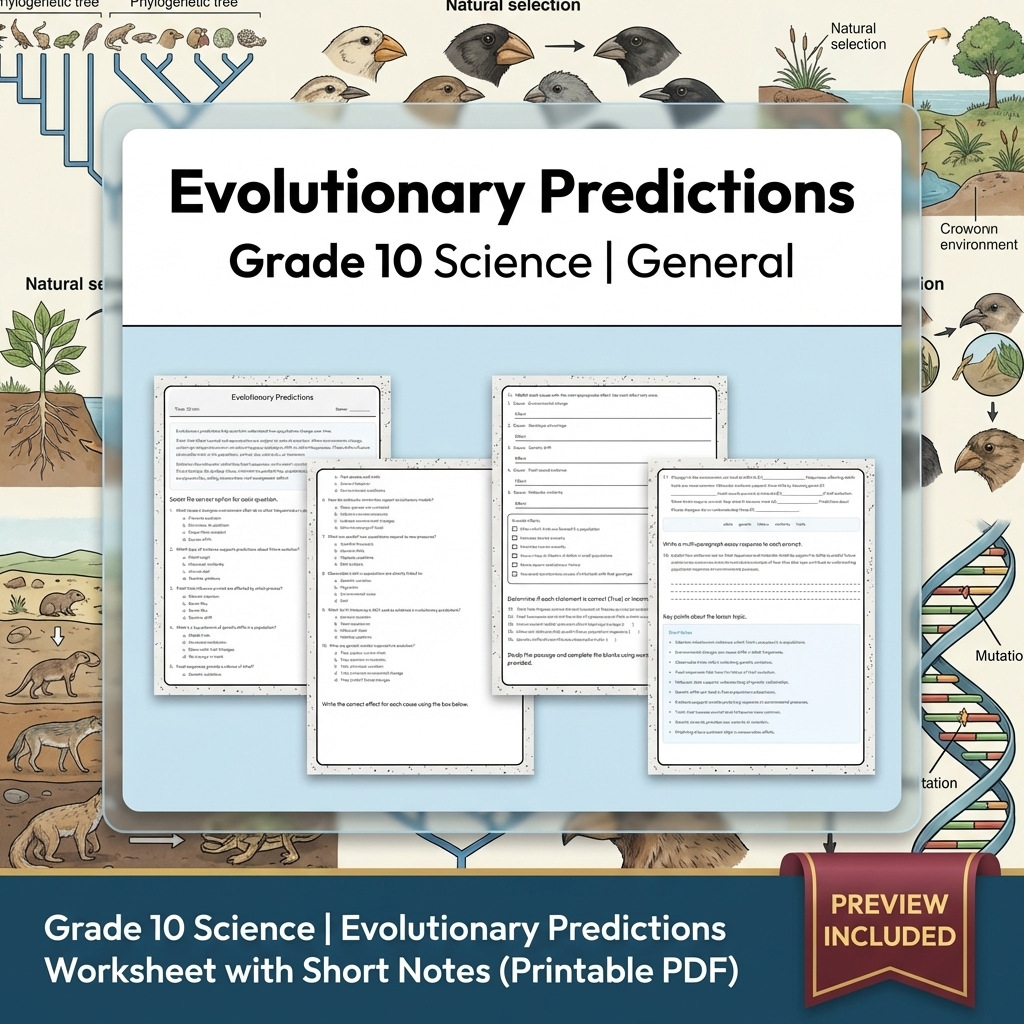
Grade 10 Science | Evolutionary Predictions Worksheet with Short Notes
Created byMeadowlark WorksheetsLearning Objectives
- Understand how selection mechanisms influence population traits over time.
- Identify evidence used to support models of evolution.
- Explain how environmental changes can alter allele frequencies.
Also included in: Grade 10 Natural Selection & Heredity Science Lesson Bundle - General +1 more
Instant download

Stoichiometry Balance Worksheet for Grade 10 Chemistry Science Practice
Created byPrism Point LearningLearning Objectives
- Use conservation of atoms to explain why chemical equations must be balanced
- Interpret balanced-equation coefficients as whole-number particle ratios
- Apply mole/particle ratio reasoning to predict relative amounts of reactants and products and recognize limiting reagents
Instant download

Protein Synthesis DNA to RNA Worksheet | Grade 10 TEKS Biology Activity
 Created byBRIGHT PATH RESOURCES
Learning Objectives
- Explain the roles of DNA and RNA in protein synthesis.
- Describe how transcription creates an mRNA copy using base pairing.
- Identify key vocabulary such as template, complementary, and codon.
Also included in: Grade 10 Genetics & Molecular Biology Science Worksheets Bundle | TEKS +1 more
Instant download

Grade 10 Science – Evidence for Evolution | Daily Reading Worksheet
Created byBright Mind ResourcesLearning Objectives
- Learn how fossils provide evidence for changes in species over time.
- Recognize different types of empirical evidence supporting evolution.
- Analyze patterns found in fossil and molecular data.
Also included in: Grade 10 Genetics & Evolution Science Lesson Bundle | California Standards +1 more
Instant download

Grade 10 Quantitative Uncertainty Worksheet | Practice & Assessment PDF
Created byClear Sky ClassroomLearning Objectives
- Identify common sources of measurement uncertainty and explain how uncertainty affects confidence in results.
- Use significant figures and uncertainty reporting conventions to present measurements appropriately.
- Apply uncertainty propagation and dimensional consistency to combine uncertainties and check equations.
Also included in: Grade 10 Science Practices in Science: Lesson Bundle for Advanced Placement (AP) +1 more
Instant download

Energy Pathways Practice Worksheet | Grade 10 Science NGSS Review
Created byPrism Point LearningLearning Objectives
- Explain how photosynthesis and cellular respiration are coupled energy pathways that convert light and chemical energy into ATP and biomass.
- Describe major steps in energy transfer (electron transport, carbon fixation, glycolysis, Krebs cycle, and oxidative phosphorylation) and their roles in ATP yield.
- Use mass-flow reasoning to track carbon and oxygen through biochemical pathways.
Also included in: Grade 10 Cellular Regulation and Energy Science Lesson Bundle (NGSS)
Instant download

Endothermic and Exothermic Energy Profiles Worksheet | Grade 10
Created byBRIGHT PATH RESOURCESLearning Objectives
- Describe energy changes in endothermic and exothermic reactions
- Interpret energy profiles using relative reactant and product energy
- Connect temperature and light observations to energy changes
Also included in: Grade 10 Physical Science Worksheets Bundle | Forces, Energy & More +1 more
Instant download
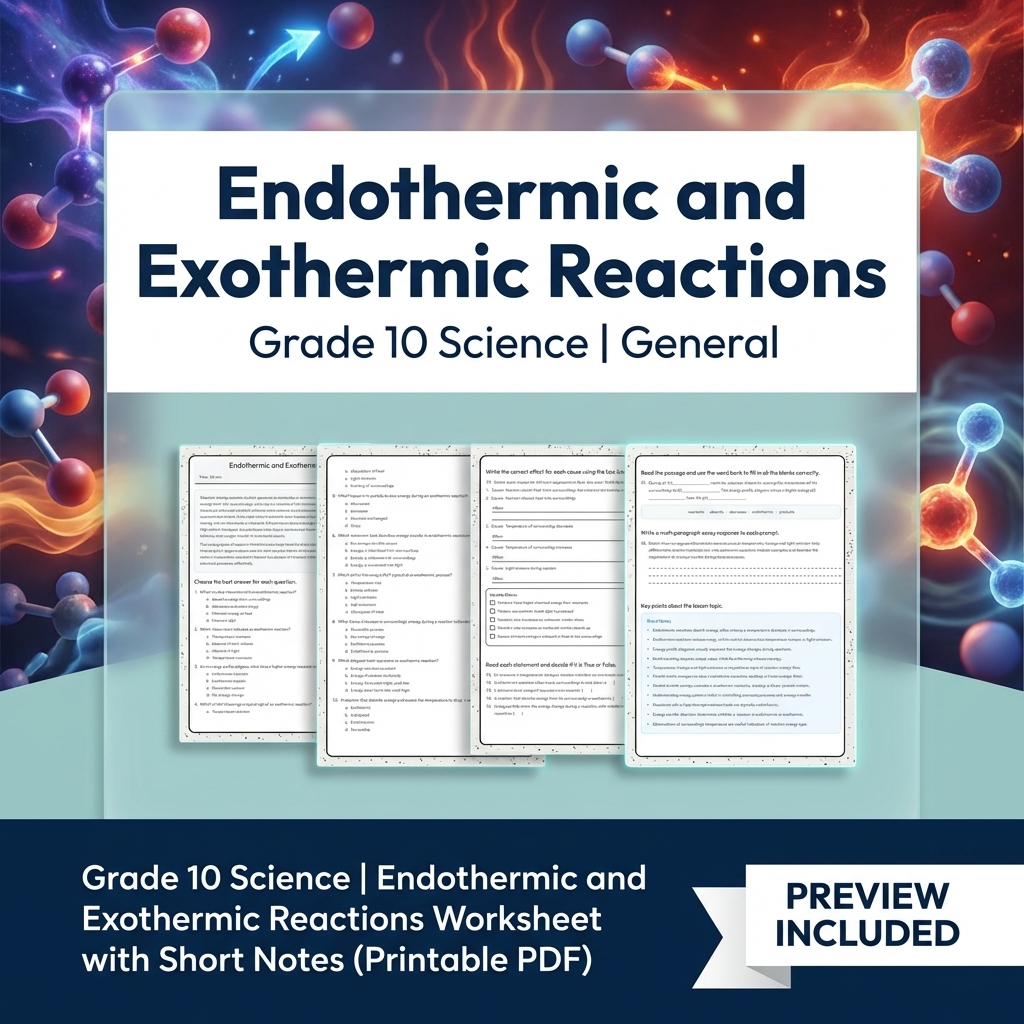
Grade 10 Science | Endothermic and Exothermic Reactions Worksheet
Created byMeadowlark WorksheetsLearning Objectives
- Understand the energy flow patterns in endothermic and exothermic reactions.
- Identify qualitative signs of energy absorption or release during chemical processes.
- Relate energy profiles and observations to bond changes and particle energies.
Also included in: Grade 10 Forces and Energy Science Lesson Bundle for General Framework +1 more
Instant download

Grade 10 Science – Environmental Chemistry & Pollution | Daily Reading Worksheet
Created byBright Mind ResourcesLearning Objectives
- Understand key concepts related to Science
- Apply knowledge through practice questions
- Demonstrate comprehension of the material
Also included in: Grade 10 Chemistry Science Lesson Bundle Daily Reading Worksheets | Alberta +1 more
Instant download

System Responses Worksheet | Grade 10 Science Activities
Created byPrism Point LearningLearning Objectives
- Explain how cellular signaling coordinates organ function to produce adaptive responses to environmental stress.
- Identify examples of resource reallocation during system responses (e.g., drought acclimation or pathogen resistance).
- Evaluate the limits of plasticity and describe trade-offs between short-term compensation and long-term fitness.
Also included in: Cell Organization & Homeostasis Grade 10 Science Lesson Bundle | Alberta
Instant download
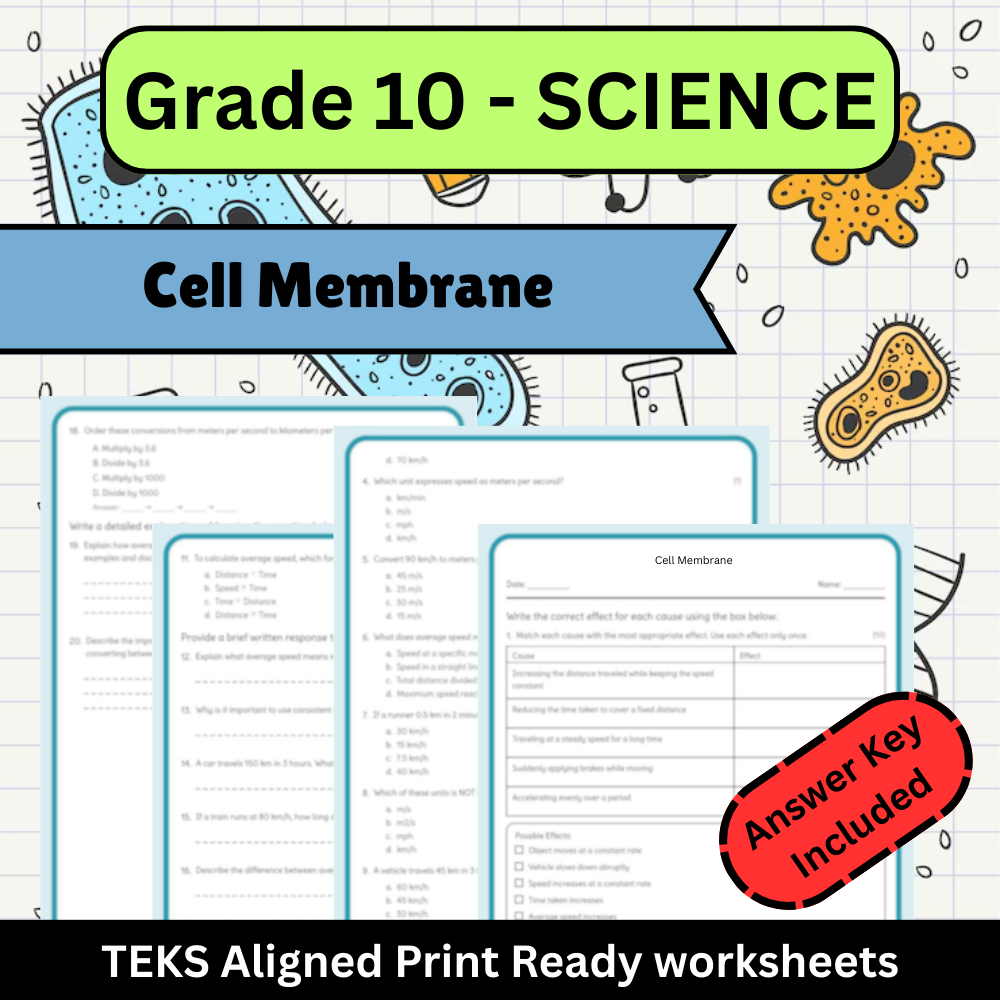
Grade 10 Science | Cell Membrane Concepts (Worksheet + Answer Key) – TEKS Aligned
Created byBright Mind ResourcesLearning Objectives
- Describe the structure and composition of the cell membrane.
- Explain how membrane components influence fluidity and cell recognition.
- Identify examples of membrane transport and signaling processes.
Also included in: Grade 10 Science | Cell Structure & Function Unit Worksheet Bundle(TEKS-Aligned) +5 more
Instant download
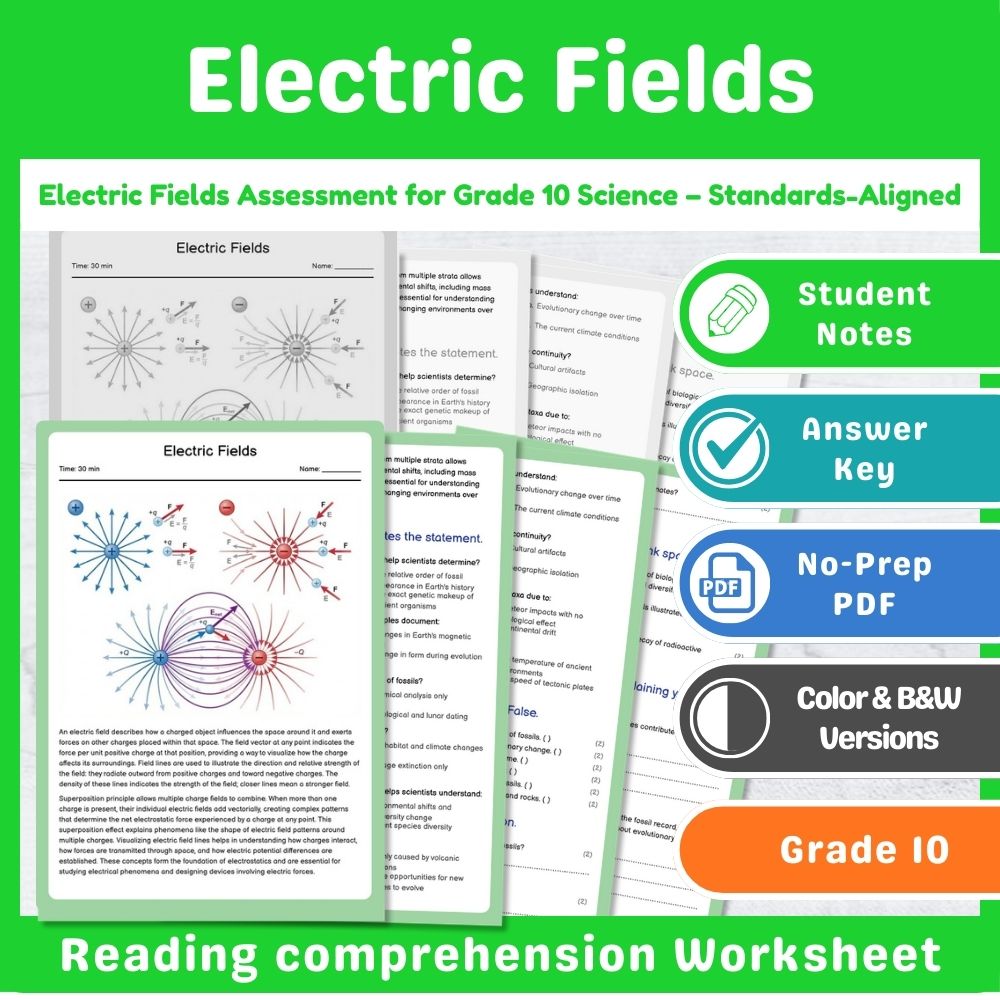
Electric Fields Assessment for Grade 10 Science – Standards-Aligned
Created byPrism Point LearningLearning Objectives
- Understand how electric fields influence space around charged objects.
- Interpret electric field vectors and field lines in diagrams.
- Explain the superposition principle and how multiple charges interact.
Instant download

Orbital Geometry and Earth’s Seasons Worksheets | Grade 10 Science
Created byBRIGHT PATH RESOURCESLearning Objectives
- Explain how Earth’s axial tilt and yearly revolution change the angle and duration of sunlight for different latitudes
- Describe how Earth’s rotation causes the apparent daily movement of stars
- Connect the Moon’s changing position relative to the Sun with observable phases
Also included in: Grade 10 Earth Science Worksheets Bundle | Climate & Earth Systems +4 more
Instant download

Grade 10 Rock Cycle Processes Worksheet | NGSS Geology Activity & Notes
 Created byAmber Owl Education
Learning Objectives
- Explain how weathering, transport, deposition, burial, lithification, crystallization, and metamorphism move rocks through the rock cycle
- Identify petrologic indicators (mineral assemblages and textures) that provide evidence for pressure–temperature history
- Use radiometric dating and stratigraphic correlation to sequence igneous, sedimentary, and metamorphic events
Instant download

Atomic Structure Practice Worksheet | Grade 10 Science NGSS Review
Created byPrism Point LearningLearning Objectives
- Explain how electron configurations relate to valence electrons and periodic trends.
- Connect nuclear composition (protons, neutrons, isotopes) to atomic mass and stability.
- Predict common ion charges and oxidation states using periodic-table patterns and energy levels.
Also included in: Grade 10 Reaction Rates and Equilibrium Science Lesson Bundle NGSS
Instant download

Astronomical Climate Cycles Worksheet | Grade 10 Earth Science Activity
Created byPrism Point LearningLearning Objectives
- Explain how Earth’s tilt, orbital eccentricity, and precession can change seasonal intensity and long-term solar energy patterns.
- Interpret how geological and paleoclimate evidence (like ice cores and sediment layers) supports repeating climate rhythms.
- Connect space-science variables to Earth-system climate responses using cause-and-effect reasoning.
Instant download

Atomic Structure Worksheet AP Science Practice Grade 10 Chemistry
Created byPrism Point LearningLearning Objectives
- Explain the roles of protons, neutrons, and electrons in determining atomic number, mass number, and isotopes.
- Relate electron distribution and quantum-number ideas to observed atomic properties and spectra.
- Use emission spectra and scattering evidence to support models of atomic structure and electron behavior.
Instant download

Force Interactions Worksheet for Grade 10 Science NGSS | Assessment Practice
JCreated byJ.S SheetsLearning Objectives
- Classify contact and noncontact forces and understand their vector representations.
- Explain Newton's third law and identify pairwise interactions of forces.
- Draw free-body diagrams to analyze concurrent forces and equilibrium conditions.
Also included in: Grade 10 Forces, Momentum & Collisions Science Lesson Bundle – NGSS
Instant download

Immune Responses and Pathogen Transmission Worksheets | Grade 10
Created byPrism Point LearningLearning Objectives
- Differentiate bacterial, viral, and fungal mechanisms of disease
- Explain how innate immunity responds to infection
- Describe how antibodies recognize pathogen antigens
Also included in: Grade 10 Science Worksheets Ontario | Life Systems Cell Bundle
Instant download

Mineral Properties and Ore Formation Worksheets Grade 10 Science
Created byPrism Point LearningLearning Objectives
- Identify mineral properties used to distinguish minerals
- Classify mineral materials as ores, industrial minerals, or gemstones
- Describe hydrothermal, magmatic, and sedimentary formation settings
Also included in: Earth and Space Systems Grade 10 Science Ontario Bundle
Instant download

Friction and Air Resistance Worksheets: Forces & Motion Grade 10
Created byPrism Point LearningLearning Objectives
- Differentiate static friction from kinetic friction in motion scenarios
- Relate normal force and surface properties to friction
- Explain how velocity affects air resistance and viscous drag
Instant download

Forces and Motion Worksheets: Mechanics, Braking & Stopping Distance
Created byPrism Point LearningLearning Objectives
- Apply kinematic relations to predict motion along inclines and during stopping
- Relate net force, mass, and acceleration using Newton's laws
- Explain how braking force affects stopping distance and stopping time
Also included in: Grade 10 Science Worksheets Ontario Forces and Motion Bundle
Instant download

Volcanism and Mountain Belt Formation Worksheets | Grade 10 Science
Created byPrism Point LearningLearning Objectives
- Explain how slab-released fluids promote partial melting in mantle wedges
- Compare effusive and explosive volcanism using eruption characteristics
- Describe how volatile content influences magma and eruption behaviour
Also included in: Earth and Space Systems Grade 10 Science Ontario Bundle
Instant download

Graphing and Trend Evidence Worksheets: Grade 10 Science
Created byPrism Point LearningLearning Objectives
- Select appropriate chart types for different scientific data sets
- Justify graph choices using features of the data
- Interpret how axis scaling affects trend readability
Also included in: Grade 10 Science Worksheets Ontario Scientific Investigation Bundle
Instant download

Rock Cycle Processes and Plate Tectonics Worksheets | Grade 10
Created byPrism Point LearningLearning Objectives
- Explain how igneous, sedimentary, and metamorphic rocks transform
- Distinguish physical and chemical weathering processes
- Sequence processes involved in sedimentary rock formation
Also included in: Earth and Space Systems Grade 10 Science Ontario Bundle
Instant download

Uniform Circular Motion Worksheets: Grade 10 Science
Created byPrism Point LearningLearning Objectives
- Calculate linear speed using radius and angular speed
- Calculate centripetal acceleration using speed and radius
- Explain why centripetal force acts toward the circle's center
Also included in: Grade 10 Science Worksheets Ontario Forces and Motion Bundle
Instant download

Statistics and Evidence Worksheets: Grade 10 Science Investigation
Created byPrism Point LearningLearning Objectives
- Calculate mean, median, range, and standard deviation for sample data
- Interpret confidence intervals and limits of statistical inference
- Distinguish statistical significance from practical significance
Also included in: Grade 10 Science Worksheets Ontario Scientific Investigation Bundle
Instant download

Friction and Air Resistance Worksheets: Forces & Motion Grade 10
Created byPrism Point LearningLearning Objectives
- Distinguish static friction from kinetic friction during changes in motion.
- Explain how normal force affects kinetic friction using its coefficient.
- Describe how air resistance and viscous drag change with speed.
Also included in: Grade 10 Science Worksheets Ontario Forces and Motion Bundle
Instant download

Mining Environmental Impacts Worksheets: Grade 10 Science
Created byPrism Point LearningLearning Objectives
- Describe how mining alters landscapes and local ecosystems
- Explain how tailings can increase water contamination risks
- Explain how acid rock drainage mobilizes metals
Also included in: Earth and Space Systems Grade 10 Science Ontario Bundle
Instant download

Resource Governance and Environmental Economics Worksheets | Grade 10
Created byPrism Point LearningLearning Objectives
- Describe how permitting and land-use planning shape resource use
- Explain how environmental assessments identify and reduce potential harm
- Interpret how economic valuation influences conservation and development decisions
Also included in: Earth and Space Systems Grade 10 Science Ontario Bundle
Instant download

Seismic Tomography Worksheets: Earth’s Interior | Grade 10 Science
Created byPrism Point LearningLearning Objectives
- Describe how P-waves and S-waves travel through Earth
- Explain how travel times constrain crustal and mantle structure
- Interpret seismic velocity variations using physical evidence
Also included in: Earth and Space Systems Grade 10 Science Ontario Bundle
Instant download

Uniformly Accelerated Motion Worksheets: Sign Conventions Grade 10
Created byPrism Point LearningLearning Objectives
- Select kinematic equations for constant-acceleration motion
- Interpret negative velocity and acceleration as direction information
- Apply consistent sign conventions to one-dimensional motion
Also included in: Grade 10 Science Worksheets Ontario Forces and Motion Bundle
Instant download

Separation of Mixtures by Key Properties Worksheets: Grade 10
Created byPrism Point LearningLearning Objectives
- Explain how solubility guides the choice of a separation method
- Compare solutions, suspensions, and colloids using particle dispersion
- Relate particle size and boiling point to separation techniques
Also included in: Matter & Chemical Change Grade 10 Science Worksheets Ontario Bundle
Instant download

Conservation in Reactions Worksheet Grade 10 Chemistry Practice NGSSS
Created byPrism Point LearningLearning Objectives
- Explain chemical reactions using evidence that atoms are conserved from reactants to products
- Interpret balanced chemical equations as models that conserve atoms (and mass) across both sides
- Use system boundaries to account for measured mass changes in chemical systems
Also included in: Grade 10 Physical Science Lesson Bundle | Florida NGSSS
Instant download

Reaction Outcomes Worksheet | Grade 10 Chemistry Reactions Practice
Created byPrism Point LearningLearning Objectives
- Explain reaction outcomes by connecting atomic rearrangements to observed changes
- Use conservation of atoms as evidence that reactions rearrange atoms rather than create or destroy them
- Describe how electron structures and bonding changes help predict products
Instant download
About Grade 10 Science Worksheets
Find Science worksheets built for Grade 10. All 7,038 cover core skills, practice, and review, each an instant PDF download.
Every worksheet on MyTeachingSheets is created by independent teacher-authors and reviewed before publication. All resources download as printable PDFs for classroom, homework, or at-home practice, and many include answer keys. Preview any worksheet free before buying.