
Grade 10 Science Worksheets
7,038 worksheets
Sustainability Assessment Worksheet Grade 10 Science Activities
 Created byPrism Point Learning
Learning Objectives
- Explain how environmental, economic, and social indicators work together in sustainability assessment
- Identify metrics used to evaluate long-term viability of resource use (e.g., renewal rates and pollutant loads)
- Apply assessment ideas to decisions about extraction, conservation, and restoration in a regional context
Instant download
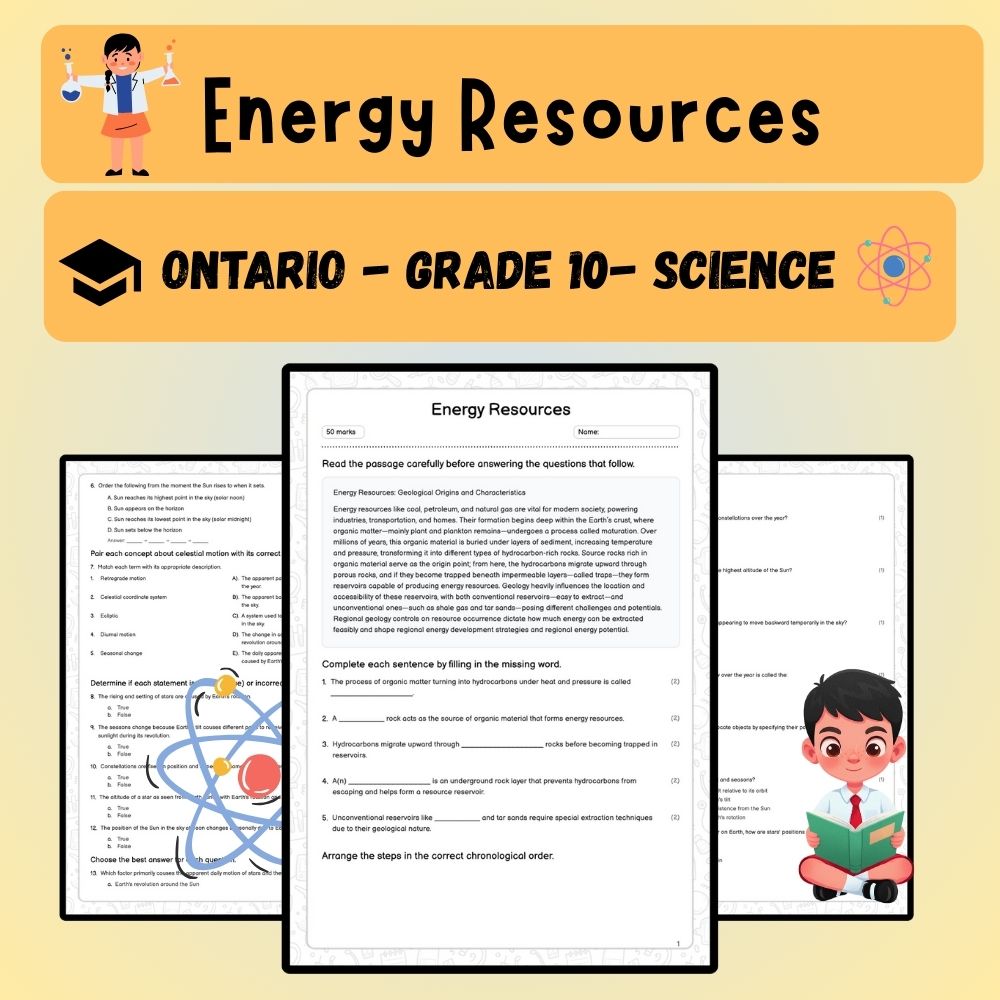
Grade 10 Science | Energy Resources Worksheet (PDF) - Ontario Standards
Created byPrism Point LearningLearning Objectives
- Explain the geological origins and formation processes of coal, petroleum, and natural gas.
- Identify the characteristics and distribution of different energy resources.
- Differentiate between conventional and unconventional reservoirs and their significance.
Also included in: Grade 10 Science UNIT Bundle | Earth Processes & Resources Ontario Standards +1 more
Instant download

Grade 10 Science – Conservation of Mass Worksheet (NGSS - PDF)
 Created bySilver Birch Teaching
Learning Objectives
- Understand how to balance chemical equations to demonstrate atom and mass conservation.
- Apply the mole concept and molar masses to track atom counts in reactions.
- Use quantitative representations to verify invariant total mass across chemical reactions.
Also included in: Grade 10 Chemical Reactions & Equilibrium Science Lesson Bundle NGSS +1 more
Instant download

Technology and Society Worksheet Grade 10 Science Activities | NGSSS
Created byPrism Point LearningLearning Objectives
- Explain how scientific progress and social needs influence each other through examples from real life.
- Describe how technology supports scientific observation, measurement, and new questions.
- Evaluate how scientific findings affect risk management, policy decisions, and ethical choices.
Instant download

Cell to Organism Worksheet for Grade 10 Biology Science Activities
Created byPrism Point LearningLearning Objectives
- Explain how structure and function connect from cells to organs in multicellular organisms.
- Describe how membrane transport and cellular respiration help move oxygen and nutrients through tissues.
- Connect organ-level features (gas-exchange surfaces and circulation) to higher rates of exchange and delivery.
Instant download

Grade 10 Science – Vectors & Components | Daily Reading Worksheet
 Created byBright Mind Resources
Learning Objectives
- Define a vector and distinguish it from a scalar quantity.
- Explain the concept of vector components along perpendicular axes.
- Use trigonometric functions to resolve vectors into horizontal and vertical components.
Also included in: Grade 10 Forces & Motion Science Daily Reading Worksheets Lesson Bundle | BC +1 more
Instant download

Photosynthesis Basics Worksheet | Grade 10 Science Activities
Created byPrism Point LearningLearning Objectives
- Explain how the light reactions convert light energy into ATP and NADPH in chloroplasts
- Describe how the Calvin cycle uses ATP and NADPH to convert carbon dioxide into sugars
- Connect photosynthesis to primary production and energy flow in ecosystems
Also included in: Metabolism & Energy Processes Lesson Bundle — Grade 10 Science TEKS
Instant download
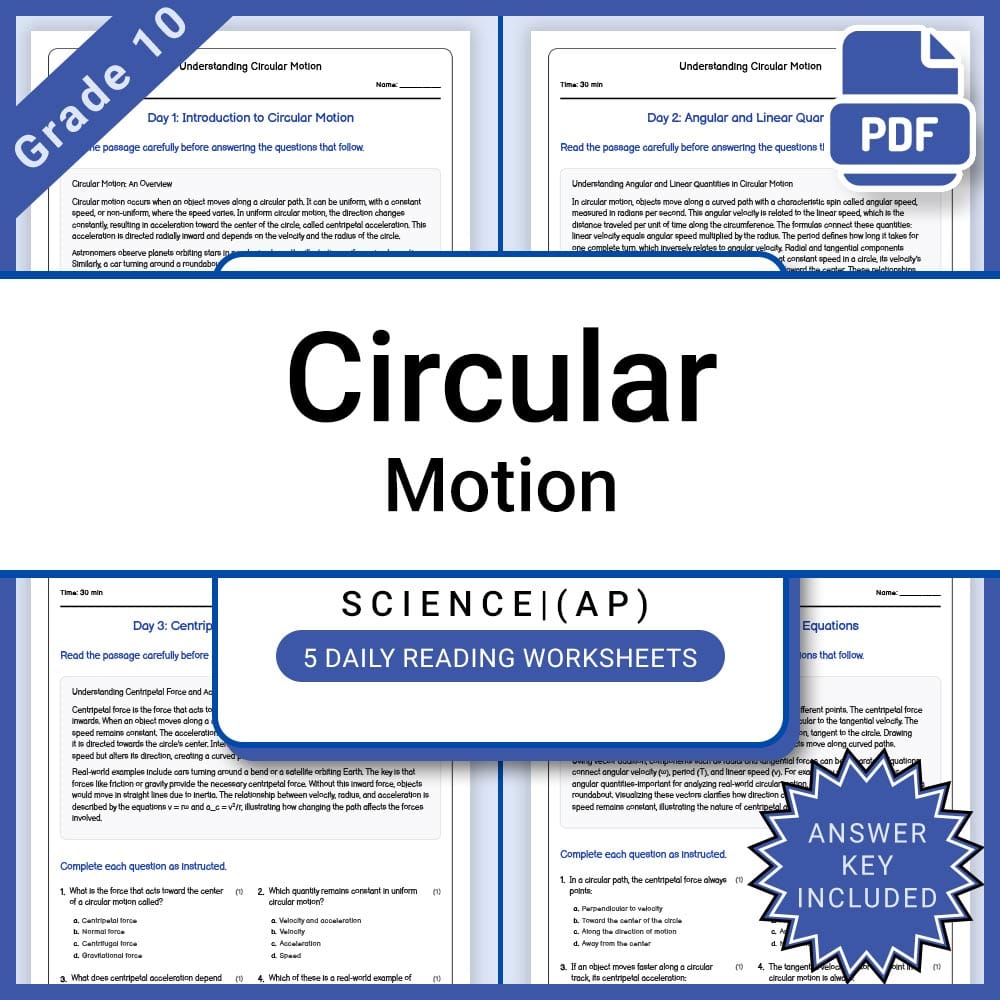
Grade 10 Science – Circular Motion Daily Reading Worksheet with Answer Key
JCreated byJ.S SheetsLearning Objectives
- Define uniform and non-uniform circular motion.
- Explain the relationship between angular and linear quantities in circular motion.
- Describe centripetal acceleration and its components.
Instant download
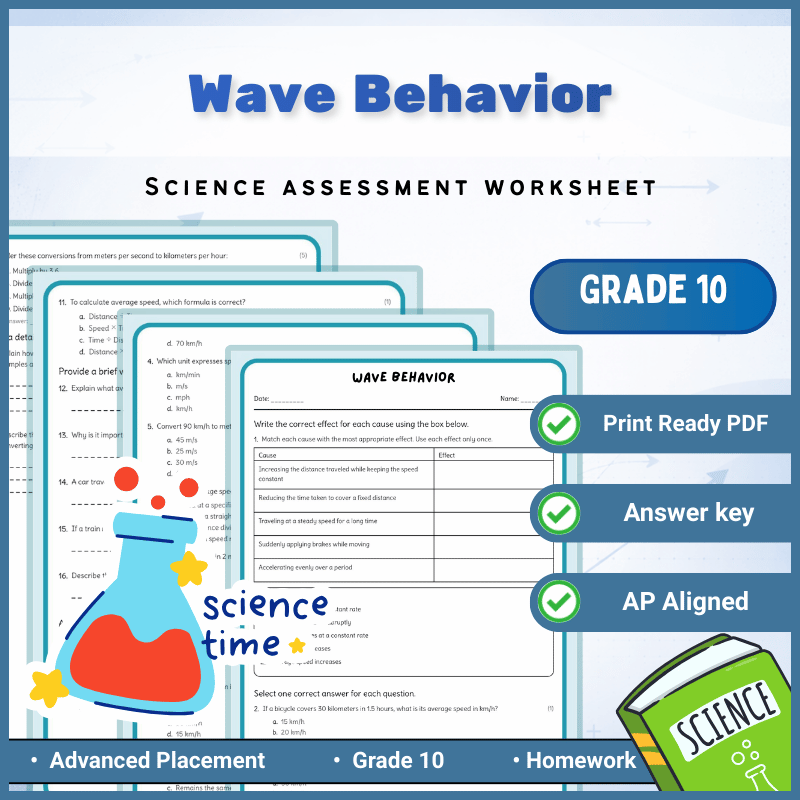
Grade 10 Science | Wave Behavior Worksheet (AP Standard) – PDF & Answer Key
Created byBright Mind ResourcesLearning Objectives
- Identify and differentiate between transverse and longitudinal waves using parameters such as wavelength, frequency, amplitude, and wave speed.
- Explain wave phenomena including reflection, refraction, interference, superposition, and standing waves through graphical and mathematical descriptions.
- Relate wave parameters to energy and information transfer in various wave types, with examples like string waves and sound pulses.
Instant download

Grade 10 Science | Understanding Geologic Time - Daily Reading Comprehension
 Created byCoral Reef Learning
Learning Objectives
- Learn the basic concepts of relative dating in geology.
- Identify key principles such as superposition and cross-cutting relationships.
- Understand the significance of unconformities and the fossil record in determining Earth's history.
Instant download

Grade 10 Science | Conservation Law Worksheet | BC Standards
 Created byLumora Learning
Learning Objectives
- Understand the principle of conservation of energy and its implications in physical systems.
- Identify different forms of energy and how they transform in various scenarios.
- Explain the concept of energy transfer in open and closed systems.
Instant download

Grade 10 Genetic Drift Worksheet | NGSS Practice & PDF
 Created byClear Sky Classroom
Learning Objectives
- Explain how genetic drift changes allele frequencies through random events rather than natural selection.
- Compare the effects of genetic drift in small vs. large populations.
- Describe how genetic drift can reduce genetic diversity and influence long-term evolutionary outcomes.
Instant download

Grade 10 Science | Stoichiometric Ratios - Daily Reading Comprehension
Created byCoral Reef LearningLearning Objectives
- Understand what balanced chemical equations are and how coefficients represent mole ratios.
- Learn how to translate between mass and moles using molar mass.
- Apply the coefficients in balanced equations to calculate yields and reactant amounts.
Instant download

Grade 10 Science | Force Types in Science - Daily Reading Comprehension
Created byCoral Reef LearningLearning Objectives
- Understand key concepts related to Science
- Apply knowledge through practice questions
- Demonstrate comprehension of the material
Instant download

Grade 10 Science Geologic Time and Stratigraphy Worksheet | NGSS Activity
 Created byBRIGHT PATH RESOURCES
Learning Objectives
- Understand the concept of stratigraphic sequences and how they relate to relative dating.
- Identify key methods used to determine the absolute ages of rocks and planetary surfaces.
- Interpret graphical and textual information on Earth's geologic history.
Also included in: Next Generation Science Standards Space Science Daily Reading Bundle | Grade 10 +1 more
Instant download

Grade 10 Science Model Evaluation Worksheet | Quantitative Evidence | NGSS
 Created byAmber Owl Education
Learning Objectives
- Interpret how model predictions are compared to measured data using clear performance metrics
- Use uncertainty and error ideas to judge whether a model is reliable and valid
- Identify how simulation and prototype results can be used to refine models and document design decisions
Instant download

Energy Flow From Sunlight to Producers Worksheet | Grade 10 TEKS Science
Created byBRIGHT PATH RESOURCESLearning Objectives
- Summarize how energy enters ecosystems through sunlight and moves to producers
- Use key terms such as trophic level, producers, consumers, decomposers, and net primary productivity
- Explain why only part of energy becomes biomass at each stage
Also included in: Grade 10 Metabolism & Energy Processes Science Worksheets Bundle | TEKS +1 more
Instant download

Grade 10 Conservation In Reactions Worksheet | Practice & PDF
Created byClear Sky ClassroomLearning Objectives
- Explain conservation of mass and conservation of atoms using balanced chemical equations
- Use atomic models to connect reactants and products during chemical reactions
- Account for mass changes by identifying what is included within a system boundary
Instant download

Orbital Forcing Worksheet | Grade 10 Science Practice
Created byPrism Point LearningLearning Objectives
- Explain how variations in Earth’s orbital shape, axial tilt, and precession change where and when solar energy reaches the planet.
- Describe how orbital forcing can contribute to slow climate cycles and glacial–interglacial rhythms over tens to hundreds of thousands of years.
- Distinguish long-term orbital drivers from shorter-term atmospheric and human influences on regional climate.
Instant download

Grade 10 Worksheet B: Hydrologic Systems Worksheet | NGSS Practice PDF
Created byClear Sky ClassroomLearning Objectives
- Explain how precipitation, runoff, infiltration, and groundwater storage interact within a watershed.
- Describe aquifer recharge and discharge and how the water table can fluctuate over time.
- Interpret how stream hydrographs and residence time relate to watershed response and freshwater availability.
Also included in: Grade 10 Earth Systems Science Lesson Bundle: NGSS Worksheet B +1 more
Instant download

Grade 10 Science Momentum and Impulse Worksheet | NGSS Physics Activity
Created byBRIGHT PATH RESOURCESLearning Objectives
- Understand the concept of momentum as the product of mass and velocity
- Learn how impulse relates to the change in momentum
- Explore the impulse-momentum theorem and its application in real-world scenarios
Also included in: Forces & Motion Grade 10 Science Daily Reading Worksheets Lesson Bundle | NGSS +1 more
Instant download

Testable Questions Worksheet for Grade 10 Science Inquiry Skills
Created byPrism Point LearningLearning Objectives
- Distinguish testable questions from questions that cannot be answered with evidence
- Identify which variables (independent, dependent, controlled) connect to a claim or hypothesis
- Write or evaluate hypotheses using expected relationships that can be measured
Instant download

Photosynthesis Worksheets: Energy Capture in Ecosystems Grade 10
 Created bySunny Desk Resources
Learning Objectives
- Describe how photosynthesis captures light energy and stores it as chemical energy in carbohydrates.
- Explain the role of chlorophyll and light-dependent reactions in producing energy-rich molecules.
- Analyze how environmental factors like light availability and seasons affect biomass production.
Also included in: Cell Structure, Homeostasis & Energy Lesson Bundle: Grade 10 Science Alberta +1 more
Instant download

Grade 10 Plate Dynamics Worksheet | Practice & Assessment PDF
Created byClear Sky ClassroomLearning Objectives
- Explain how tectonic plate interactions drive mountain building, uplift, and long-term landscape evolution.
- Describe how crustal deformation and faulting influence sedimentary basins, drainage patterns, and seismicity.
- Connect deep Earth processes to surface outcomes such as rock formation and natural resource distribution.
Instant download

Grade 10 Science - Solar Conversion Worksheet (PDF) | BC Standards
 Created byEvergreen Desk Education
Learning Objectives
- Explain how photovoltaic (PV) cells convert radiant energy into electrical energy using semiconductor band structure.
- Compare physical and biological solar-conversion pathways based on rates, spectral response, and system integration.
- Interpret why conversion efficiency is limited by bandgap constraints, quantum efficiency, and loss mechanisms.
Instant download

Evidence for Evolution Worksheet | NGSS Aligned Grade 10 Science Assessment
JCreated byJ.S SheetsLearning Objectives
- Identify the various lines of evidence supporting common ancestry and evolution.
- Explain how fossil records, comparative anatomy, embryology, and molecular data contribute to understanding evolution.
- Describe how radiometric dating and genetic sequences help establish evolutionary timelines and relationships.
Also included in: Grade 10 Evolution and Speciation Science Lesson Bundle – NGSS Framework
Instant download

Grade 10 Science Cell to Organism Worksheet (General Standards) (PDF)
Created byEvergreen Desk EducationLearning Objectives
- Explain how structure and function at the cellular level connect to tissue and organ function in an organism.
- Describe how membrane transport and cellular respiration support the movement of oxygen and nutrients.
- Compare how organ-level structures increase rates of exchange and delivery to body tissues.
Also included in: Grade 10 Evolution & Genetics Science Lesson Bundle: General Framework +1 more
Instant download

Chemical Equilibrium Worksheet | Science Grade 10 Printable PDF Assessment
Learning Objectives
- Explain how Le Chatelier’s principle predicts shifts in equilibrium when pressure, concentration, and temperature change
- Use equilibrium concepts to describe the Haber process and factors that increase product yield
- Interpret equilibrium constants and compare qualitative vs. quantitative descriptions of equilibrium
Also included in: Matter and Its Interactions Lesson Bundle | Grade 10 Science | NGSS
Instant download

Model Evaluation Test Prep Worksheet | Grade 10 Science NGSS Review
Created byPrism Point LearningLearning Objectives
- Compare simulation predictions with prototype or field measurements using quantitative metrics
- Use uncertainty quantification to judge whether model results are reliable enough for decisions
- Describe validation and refinement steps, including identifying likely failure modes
Also included in: Grade 10 NGSS Science Design & Systems Review Practice Lesson Bundle
Instant download

Grade 10 Physical Properties Worksheet | Ontario Science + Answer Key
Created byClear Sky ClassroomLearning Objectives
- Differentiate intensive and extensive physical properties and explain how each is measured.
- Describe physical changes as reversible and identify examples of state/shape changes without forming new substances.
- Use quantitative physical-property data (e.g., density, melting point, conductivity) to compare materials and support identification.
Instant download

Grade 10 Science – Photosynthesis & Photosynthesis Basics | Reading Worksheet
Created byBright Mind ResourcesLearning Objectives
- Understand the main stages of photosynthesis
- Identify the role of pigments in capturing light energy
- Explain how light reactions produce ATP, NADPH, and oxygen
Also included in: Grade 10 Energy in Biological Systems Science Daily Reading Lesson Bundle | TEKS +2 more
Instant download

Systems Analysis Worksheet for Grade 10 Science | NGSS Aligned
JCreated byJ.S SheetsLearning Objectives
- Understand the principles of systems thinking and how they apply to engineering problems.
- Identify subsystem interactions, boundary definitions, and emergent behaviors in complex systems.
- Model interfaces and feedback loops to predict system-level performance.
Also included in: Grade 10 Engineering Design Science Lesson Bundle worksheets – NGSS
Instant download

Grade 10 Science | Organelles Worksheet (TEKS) (PDF)
Created byEvergreen Desk EducationLearning Objectives
- Identify major organelles and describe whether they are membrane-bound or non-membrane-bound
- Match organelles to their cellular functions (energy conversion, protein synthesis, processing, digestion, and genetic control)
- Explain how compartmentalization improves efficiency and coordination inside cells
Instant download
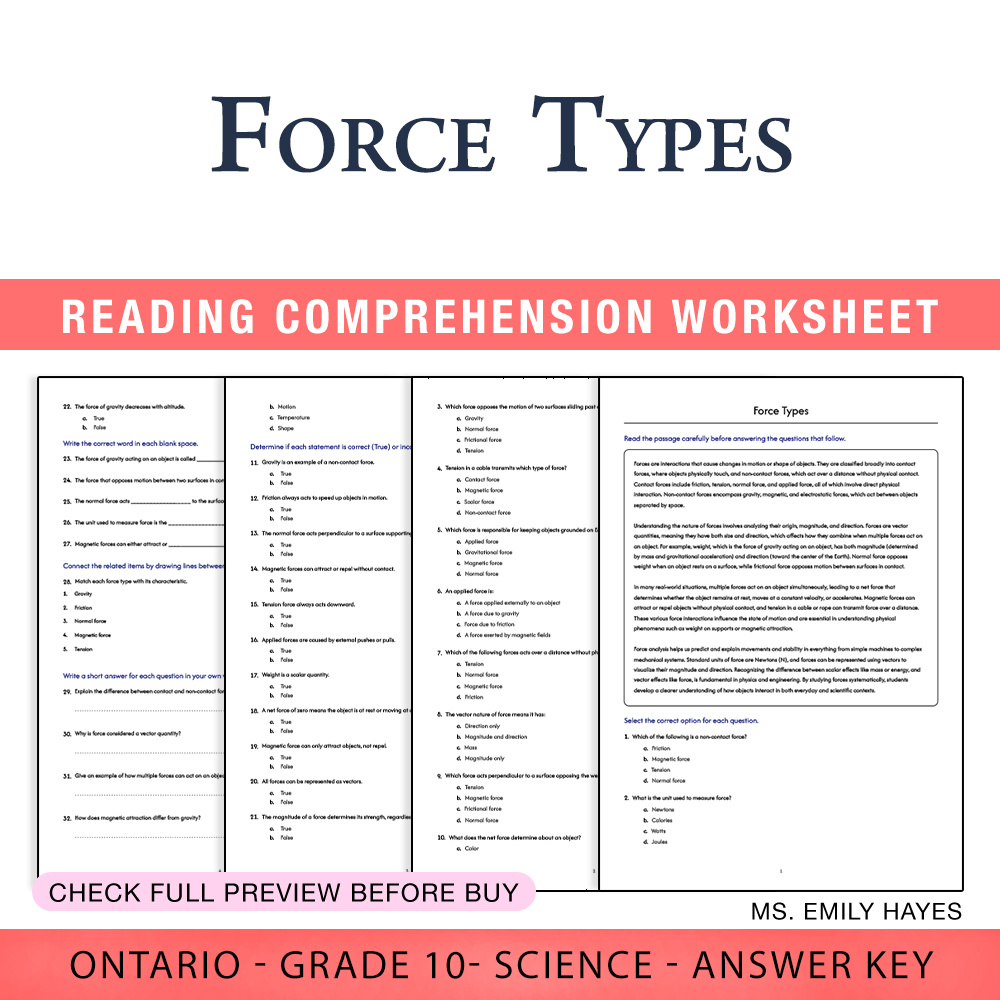
Grade 10 Science | Force Types Worksheet (PDF + Answer Key)
 Created byCopper Leaf Classroom
Learning Objectives
- Identify different types of forces including contact and non-contact forces.
- Explain the characteristics of force as a vector quantity including magnitude and direction.
- Describe how various forces such as weight, normal, frictional, tension, applied, and magnetic forces influence motion.
Instant download

Grade 10 Science – Force Types & Contact Forces | Daily Reading Worksheet
Created byBright Mind ResourcesLearning Objectives
- Understand the different types of contact forces such as normal, frictional, and tension forces
- Explain the origin, direction, and magnitude of these forces
- Distinguish between scalar and vector effects of forces
Also included in: Grade 10 Force & Motion Science Daily Reading Lesson Bundle – Ontario +1 more
Instant download

Grade 10 Science | Endothermic Exothermic Worksheet | General Standards
Created byLumora LearningLearning Objectives
- Distinguish endothermic and exothermic processes using qualitative energy flow between reactions and surroundings
- Interpret energy (potential energy) profiles to determine whether a reaction absorbs or releases energy
- Explain how changes in chemical potential energy relate to bond breaking/forming and particle kinetic energy
Instant download
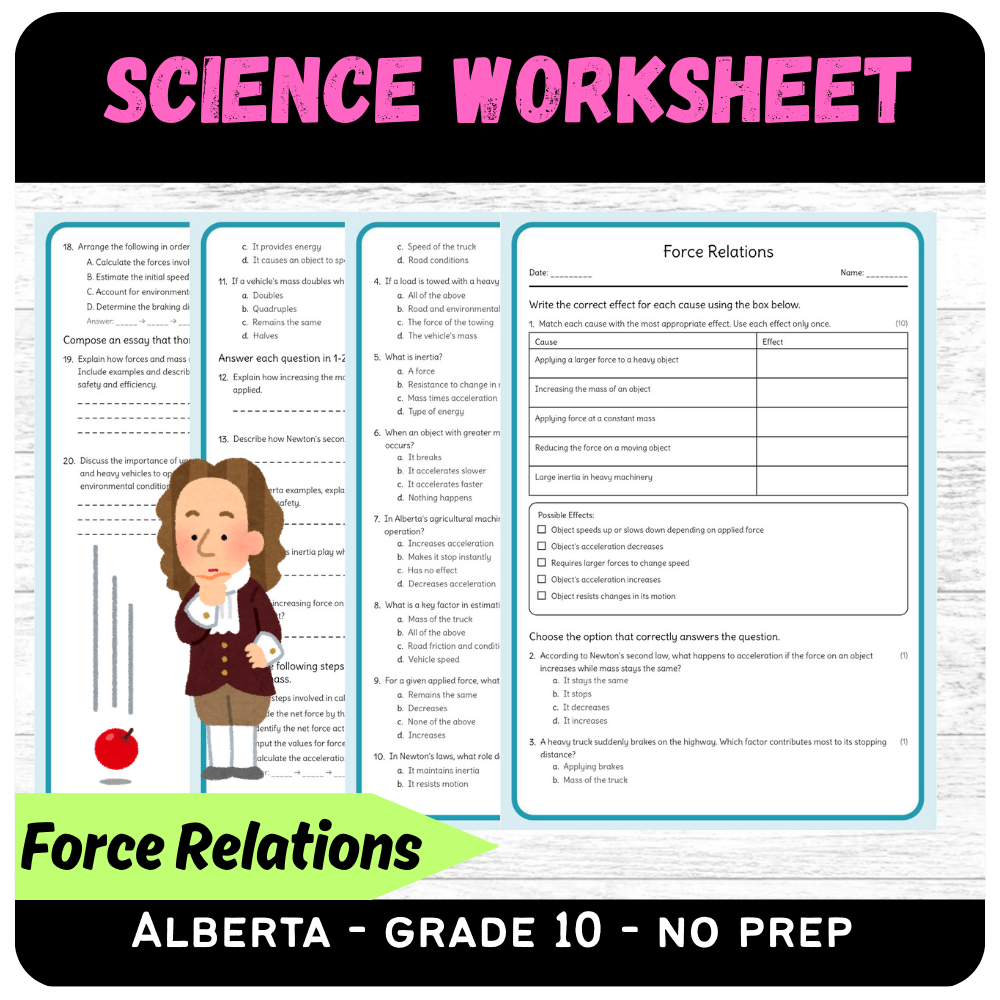
Grade 10 Science – Force Relations Worksheet (Worksheet + Answer Key) | Alberta Standards
Created byBright Mind ResourcesLearning Objectives
- Explain how forces, mass, and acceleration are related through Newton's laws.
- Describe how variations in mass and applied forces affect motion outcomes in real-world Alberta examples.
- Analyze net force, inertia, and how to estimate safe operational parameters for machinery and vehicles.
Instant download
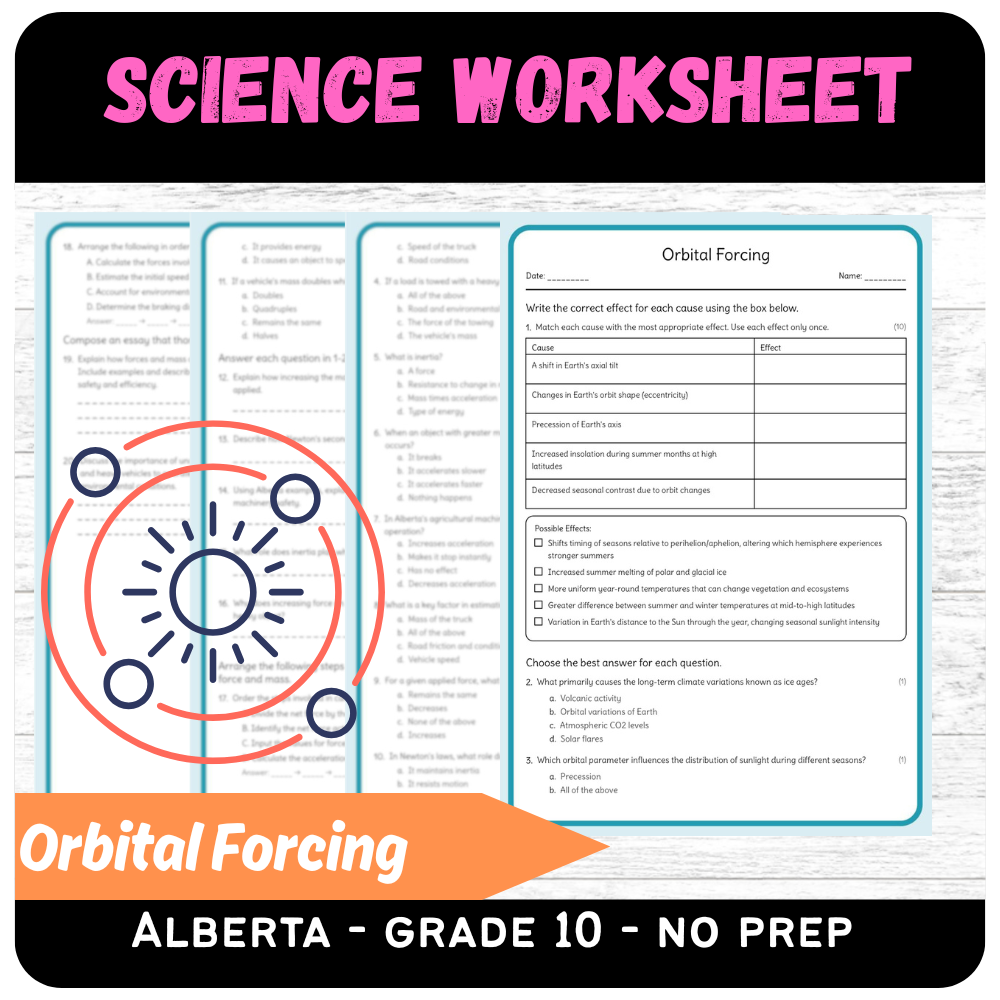
Grade 10 Science | Orbital Forcing Worksheet (PDF) – Alberta Standards
Created byBright Mind ResourcesLearning Objectives
- Understand how variations in Earth's orbital parameters influence climate cycles.
- Explain the connection between orbital forcing and glacial-interglacial rhythms.
- Distinguish between orbital drivers and other short-term climate influences.
Instant download

Grade 10 Science | Reaction Outcomes Worksheet Elena | California Standards
Created byLumora LearningLearning Objectives
- Explain chemical reactions using an atomic model of rearrangement from reactants to products
- Use conservation of atoms to justify why the number of each type of atom is unchanged during a reaction
- Connect electron structures to bonding changes that help predict reaction products
Instant download

Chemical Properties Test Prep Printable | Grade 10 Science
Created byPrism Point LearningLearning Objectives
- Explain how chemical properties describe a substance’s tendency to undergo specific reactions
- Identify indicators of chemical change such as pH change and gas evolution
- Predict possible products using reactivity trends and describe safety considerations
Instant download

Model Predictions Worksheet for Grade 10 Science Inquiry Skills
Created byPrism Point LearningLearning Objectives
- Explain how models represent relationships among variables to make predictions.
- Identify common assumptions and simplifications in models and how they affect predictions.
- Evaluate predictive power by comparing model results with observed patterns.
Instant download

Motion Graphs Worksheet | AP Physics Graph Analysis Activity & Key
 Created byBright Quill Resources
Learning Objectives
- Interpret slopes and areas on position-time, velocity-time, and acceleration-time graphs for non-uniform motion
- Connect graphical features to derivatives (instantaneous rates) and integrals (accumulated change)
- Use piecewise-linear models to extract kinematic quantities from experimental-like data while considering error
Instant download
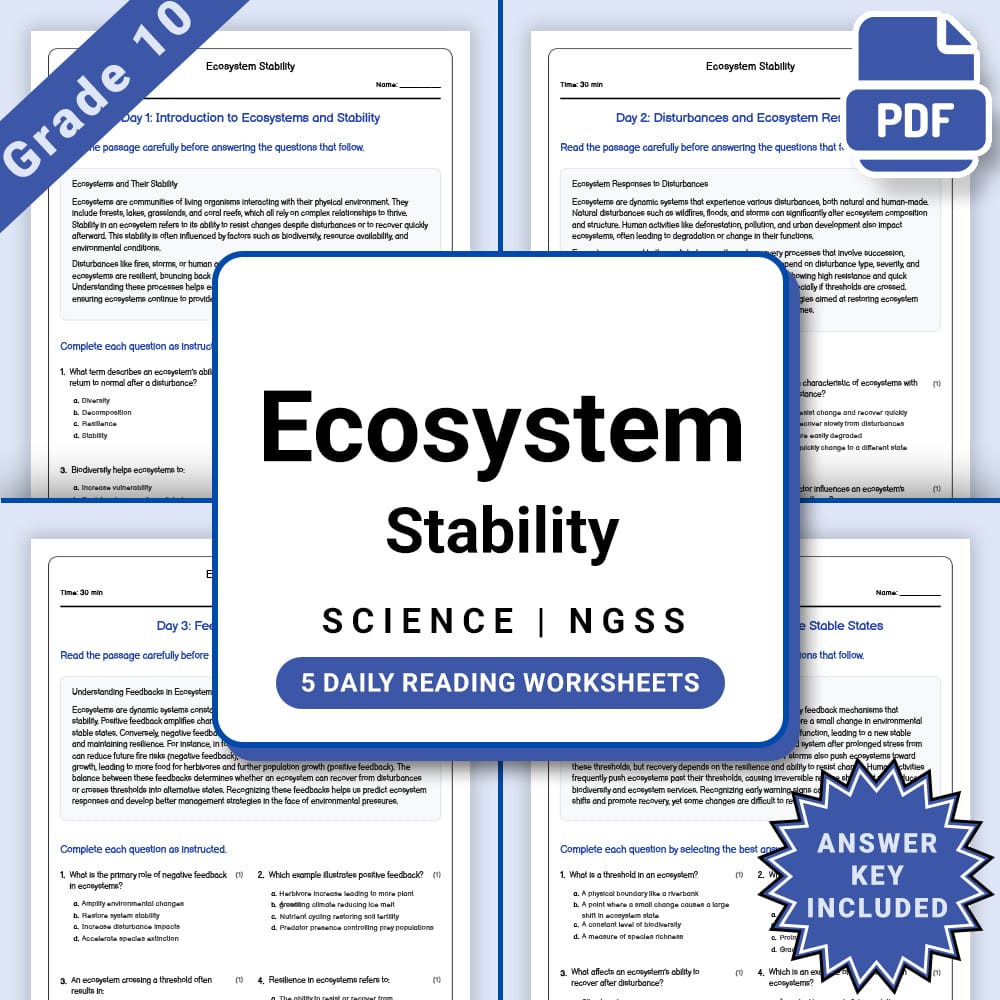
Grade 10 Science Ecosystem Stability Worksheet (PDF +Answer Key)
Created byCopper Leaf ClassroomLearning Objectives
- Understand the basic concepts of ecosystems and stability
- Identify factors that influence ecosystem resilience and thresholds
- Analyze the effects of natural and human disturbances on ecosystems
Instant download

Grade 10 Science – Reaction Types Worksheet (Ontario Standards) (PDF)
Created byEvergreen Desk EducationLearning Objectives
- Classify chemical reactions as synthesis, decomposition, single displacement, double displacement, or combustion using reactant-product patterns.
- Predict the likely product class for common reaction templates while considering conservation of atoms.
- Explain how redox (oxidation and reduction) can be relevant when identifying reaction outcomes.
Also included in: Grade 10 Chemistry Fundamentals Science Lesson Bundle Worksheets: Ontario +1 more
Instant download

Science Systems Trade Interactions Worksheet | Standards-Aligned Grade 10
JCreated byJ.S SheetsLearning Objectives
- Explain how systems thinking connects components, constraints, dependencies, and feedback in real designs
- Identify trade-offs that occur when changing one part of a system affects other outcomes
- Use cause-and-effect reasoning to describe how system failures can propagate through interactions
Also included in: Grade 10 Trade-Offs and Prototyping Science Lesson Bundle | General +1 more
Instant download

Grade 10 Science | Specialized Cells Worksheet (Ontario) PDF
Created byEvergreen Desk EducationLearning Objectives
- Explain how cellular specialization supports specific functions through changes in shape and structure
- Describe how tissue organization results from specialized cell types working together
- Connect stem cell differentiation to gene expression patterns and structural changes
Also included in: Grade 10 Cell Functions & Energy Science Lesson Bundle - Ontario Framework +1 more
Instant download
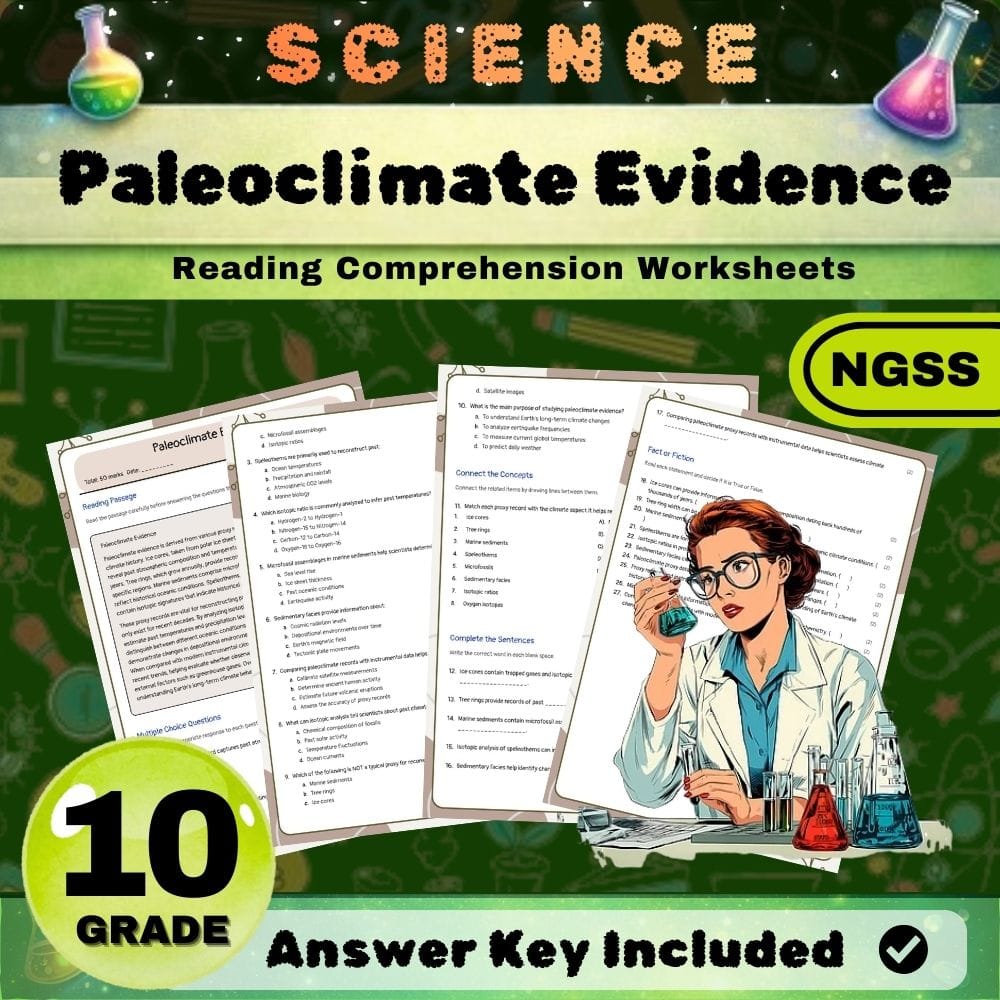
Grade 10 Science - Paleoclimate Evidence Worksheet (NGSS) PDF
 Created byMaple Path Learning
Learning Objectives
- Understand the types of proxy records used to reconstruct past climate conditions.
- Identify methods of analyzing geological and biological evidence for past climates.
- Explain how paleoclimate data compares with current instrumental climate records.
Also included in: Grade 10 Earth’s Systems Science Worksheets Bundle | NGSS +1 more
Instant download

Selection Types Worksheet | Grade 10 Science Activities
Created byPrism Point LearningLearning Objectives
- Explain how directional, stabilizing, and disruptive selection change trait distributions in populations.
- Describe how frequency-dependent and sexual selection alter fitness based on traits of other individuals.
- Use key vocabulary (phenotype, mean, variance, fitness, polymorphism) to justify predictions about evolution.
Also included in: Grade 10 Evolution, Speciation & Biodiversity Lesson Bundle | BC Science +1 more
Instant download
About Grade 10 Science Worksheets
Find Science worksheets built for Grade 10. All 7,038 cover core skills, practice, and review, each an instant PDF download.
Every worksheet on MyTeachingSheets is created by independent teacher-authors and reviewed before publication. All resources download as printable PDFs for classroom, homework, or at-home practice, and many include answer keys. Preview any worksheet free before buying.