
Grade 10 Science Worksheets
7,038 worksheets
Grade 10 Science | Forces And Motion Worksheet | General Standards
 Created byLumora Learning
Learning Objectives
- Explain how net force relates to changes in velocity and acceleration
- Differentiate gravity, contact forces, and friction as forces that affect motion
- Use qualitative reasoning to predict the direction of acceleration from the direction of the net force
Instant download

Earth Moon Sun Worksheet | NGSS Science Practice for Grade 10
JCreated byJ.S SheetsLearning Objectives
- Describe the relative positions and motions of Earth, Moon, and Sun that produce lunar phases, eclipses, and seasons.
- Explain how axial tilt and orbital inclination cause seasonal variations and changes in daylength.
- Understand the gravitational interactions between Earth and Moon that generate tidal cycles and their predictability.
Also included in: Grade 10 Cosmic Origins Space Science lesson bundle – NGSS worksheet set
Instant download

Grade 10 Science | Reaction Evidence Worksheet (NGSS10 PDF)
 Created bySilver Birch Teaching
Learning Objectives
- Explain how conservation of atoms and atomic rearrangement support evidence of chemical reactions.
- Identify observable signs of chemical reactions such as gas evolution, color change, temperature change, and precipitate formation.
- Correlate reactant properties with product identities using balanced chemical formulas.
Also included in: Grade 10 Chemical Reactions & Equilibrium Science Lesson Bundle NGSS +1 more
Instant download

Grade 10 Science – Meiosis & Genetic Variation Reading Worksheet | Florida NGSSS
 Created byBright Mind Resources
Learning Objectives
- Understand the process of meiosis and its role in reducing chromosome number.
- Describe how genetic recombination occurs during meiosis.
- Explain how variation among gametes contributes to genetic diversity in populations.
Also included in: Life Science Grade 10 Science Daily Reading Worksheets Lesson Bundle | FL NGSSS +1 more
Instant download

Grade 10 Science | Systems Interactions Reading Worksheet with Answer Key (PDF)
JCreated byJ.S SheetsLearning Objectives
- Understand how multiple organ systems cooperate to maintain homeostasis during various physiological challenges.
- Identify the roles of cardiovascular, respiratory, renal, endocrine, and musculoskeletal systems in the body's response to stress.
- Explain the concept of emergent properties arising from integrated organ system actions and feedback mechanisms.
Instant download

Grade 10 Science | Ethics & Safety in Scientific Work - Reading Comprehension
 Created byCoral Reef Learning
Learning Objectives
- Understand the importance of honesty and integrity in data collection and reporting
- Recognize ethical responsibilities in scientific experiments
- Identify the role of oversight and certification in safety practices
Instant download

Resource Cycles Worksheet | Grade 10 Science Assessment
 Created byPrism Point Learning
Learning Objectives
- Explain how Earth systems move and transform resources through cycle pathways and reservoirs
- Interpret residence time and flux as factors that influence ecosystem function and resource availability
- Connect examples from Alberta (snowpack runoff, peat carbon storage, prairie nitrogen flux, and mineral sources) to resource cycles
Instant download

Grade 10 Worksheet B: Design Foundations Practice | NGSS PDF
 Created byClear Sky Classroom
Learning Objectives
- Explain how criteria and constraints guide engineering design for complex problems.
- Use performance metrics and benchmark comparisons to evaluate design concepts quantitatively.
- Connect qualitative goals (e.g., safety, effectiveness) to measurable targets and feasible constraints.
Also included in: Grade 10 Trade-Off Optimization Science Lesson Bundle: NGSS +1 more
Instant download

Grade 10 Science | Momentum and Impulse Worksheet (PDF + Answer Key)
 Created byCopper Leaf Classroom
Learning Objectives
- Understand the quantitative relationship between impulse and momentum.
- Apply the impulse-momentum theorem to analyze elastic and inelastic collisions.
- Explain the conservation of momentum in closed systems under various forces.
Instant download

Grade 10 Worksheet B: Rock Transformations (Rock Cycle) Practice | NGSS PDF
Created byClear Sky ClassroomLearning Objectives
- Describe how crystallization, lithification, metamorphism, and weathering connect to the rock cycle.
- Use petrologic indicators (mineral assemblages and textures) to infer pressure–temperature conditions.
- Explain how radiometric dating and stratigraphic correlation help order geologic events.
Also included in: Grade 10 Earth Systems Science Lesson Bundle: NGSS Worksheet B +1 more
Instant download

Ohm's Law Assessment | Alberta Standards for Grade 10 Science
Created byPrism Point LearningLearning Objectives
- Understand the principles of Ohm's Law and its application in electrical circuits.
- Calculate total resistance in series and parallel resistor networks.
- Analyze the temperature dependence of resistance in conductors.
Also included in: Grade 10 Energy, Motion and Electricity Science Lesson Bundle: Alberta +1 more
Instant download

Grade 10 Science | Trophic Relationships in Ecosystems - Reading Comprehension
Created byCoral Reef LearningLearning Objectives
- Understand the concept of trophic levels and energy flow in food chains
- Identify the roles of producers, consumers, and decomposers
- Analyze the efficiency of energy transfer between trophic levels
Instant download

Grade 10 Science – Food Chains Worksheet (TEKS) PDF
 Created byEvergreen Desk Education
Learning Objectives
- Explain how energy flows through trophic levels in a food chain and food web.
- Describe the role of primary producers, consumers, and decomposers in transferring matter and recycling nutrients.
- Analyze how changes in one species can create cascading effects in an ecosystem.
Instant download

Grade 10 Resource Policy & Environmental Governance Science Worksheet
 Created byChalk and Compass
Learning Objectives
- Explain how governance instruments such as permitting, land-use planning, and environmental assessment influence natural resource use.
- Describe how regulatory standards and economic valuation can balance resource development with conservation goals.
- Evaluate how monitoring, compliance, and adaptive management reduce environmental damage and support better decisions over time.
Also included in: Grade 10 Science Earth Processes & Resource Use Lesson Bundle | Ontario +1 more
Instant download

Grade 10 Science – Balancing Equations Worksheet (Ontario) PDF
Created byEvergreen Desk EducationLearning Objectives
- Explain why balancing chemical equations preserves the conservation of mass.
- Differentiate stoichiometric coefficients from subscripts in chemical formulas.
- Identify common strategies for systematically balancing multi-step chemical equations.
Also included in: Grade 10 Chemistry Fundamentals Science Lesson Bundle Worksheets: Ontario +1 more
Instant download

Grade 10 Control Strategies Worksheet | Ontario Science + Answer Key
Created byClear Sky ClassroomLearning Objectives
- Explain why control groups, randomization, blocking, and replication help isolate causal effects.
- Identify common sources of bias and confounding in experiments and describe ways to reduce them.
- Use examples (temperature-controlled reactions and standardized circuits) to justify control selection and procedure fidelity.
Instant download

Grade 10 Stoichiometry Basics Worksheet | Mole Concept & Molar Mass Activity
Created byChalk and CompassLearning Objectives
- Explain the mole concept using Avogadro’s number.
- Use molar mass to convert between mass and amount of substance.
- Use balanced chemical equations to determine molar ratios for mass-to-mass reasoning.
Also included in: Chemistry Foundations & Chemical Reactions Lesson Bundle: Grade 10 Science +1 more
Instant download

Grade 10 Science | Respiratory Exchange Reading Worksheet (PDF + Answer Key)
JCreated byJ.S SheetsLearning Objectives
- Explain the process of alveolar gas diffusion and its role in respiration.
- Describe how changes in carbon dioxide levels influence blood pH and respiratory rate.
- Understand the interaction between respiratory and circulatory systems in maintaining homeostasis.
Instant download
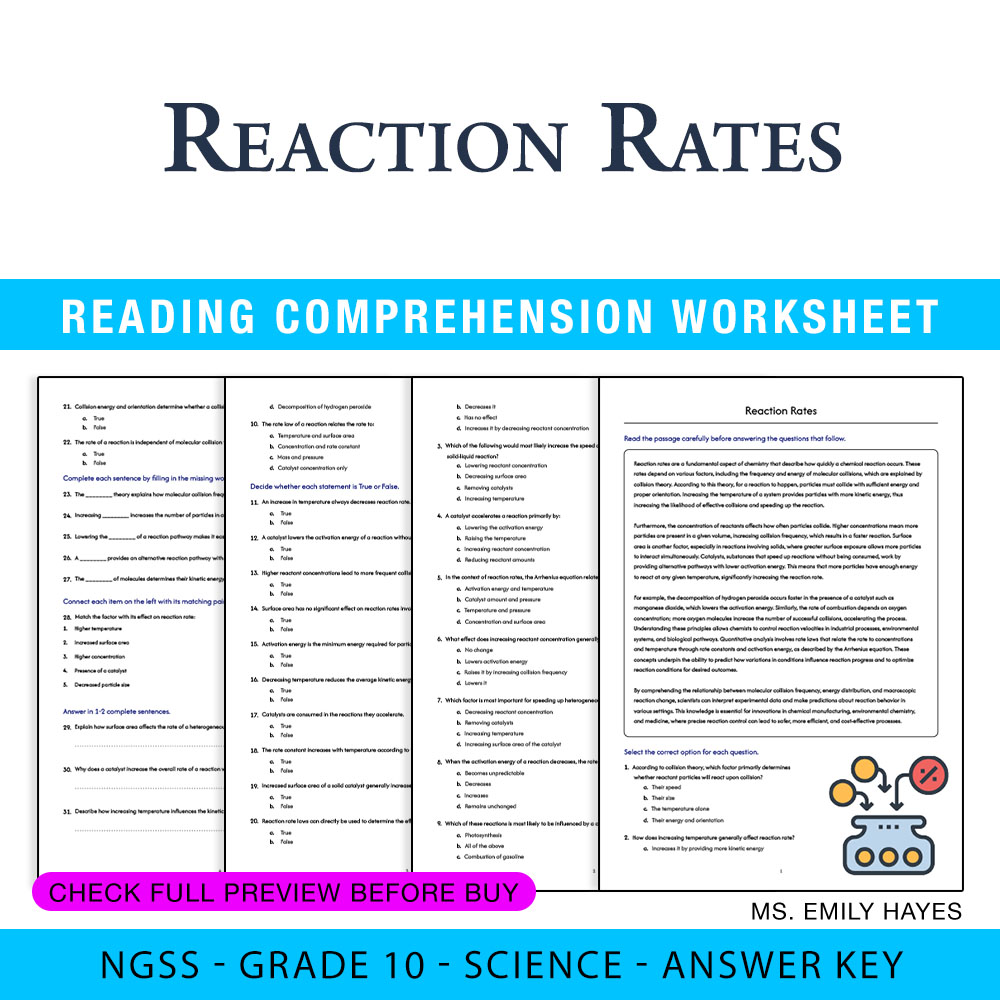
Grade 10 Science | Reaction Rates Worksheet (PDF+ Answer Key)
Created byCopper Leaf ClassroomLearning Objectives
- Explain how collision theory relates to reaction rates and identify factors that influence collision frequency and energy.
- Describe how temperature, concentration, surface area, and catalysts affect reaction speed based on rate laws.
- Interpret empirical data linking molecular collisions, activation energy, and rate constants.
Instant download
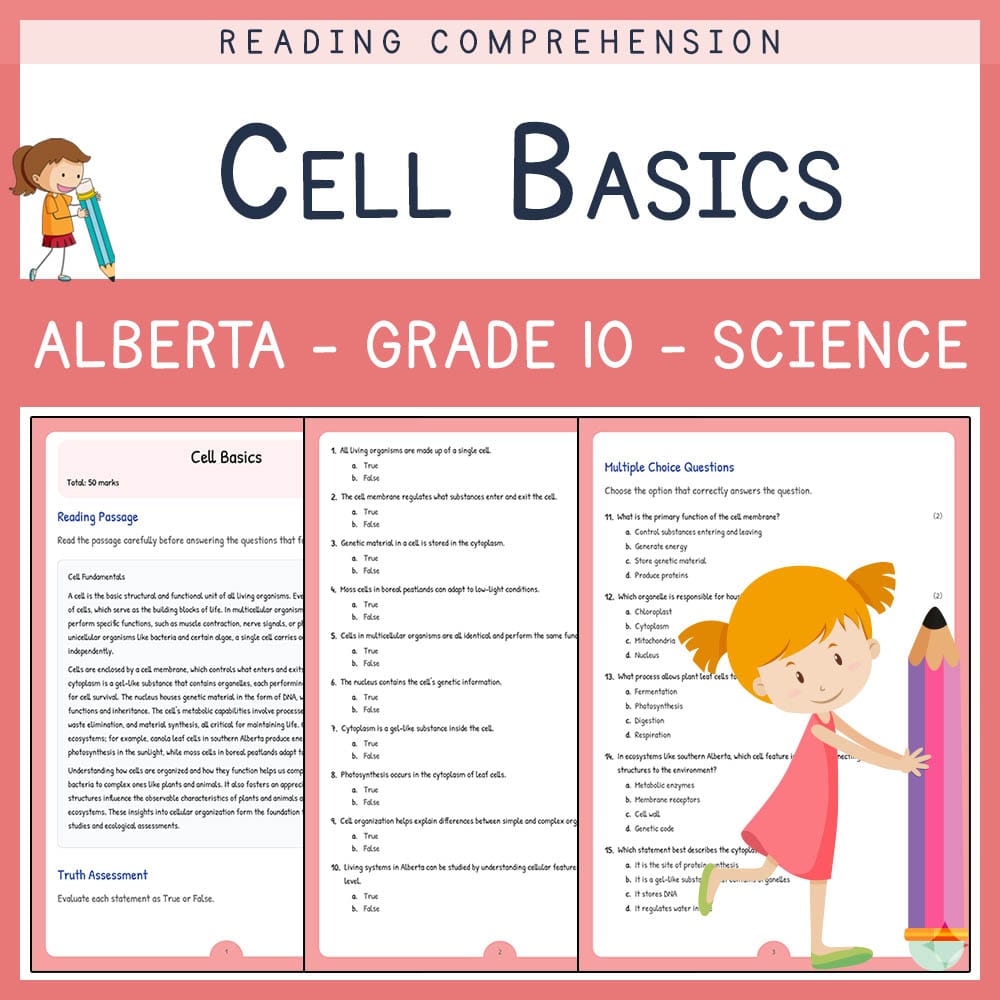
Grade 10 Science | Cell Basics Worksheet | Alberta Standards
Created byLumora LearningLearning Objectives
- Understand the fundamental structure and functions of cells.
- Identify key features such as membranes, cytoplasm, and genetic material.
- Compare cellular organization in different ecosystems.
Also included in: Grade 10 Science | Cells and Systems Custom Bundle Worksheets | Alberta
Instant download
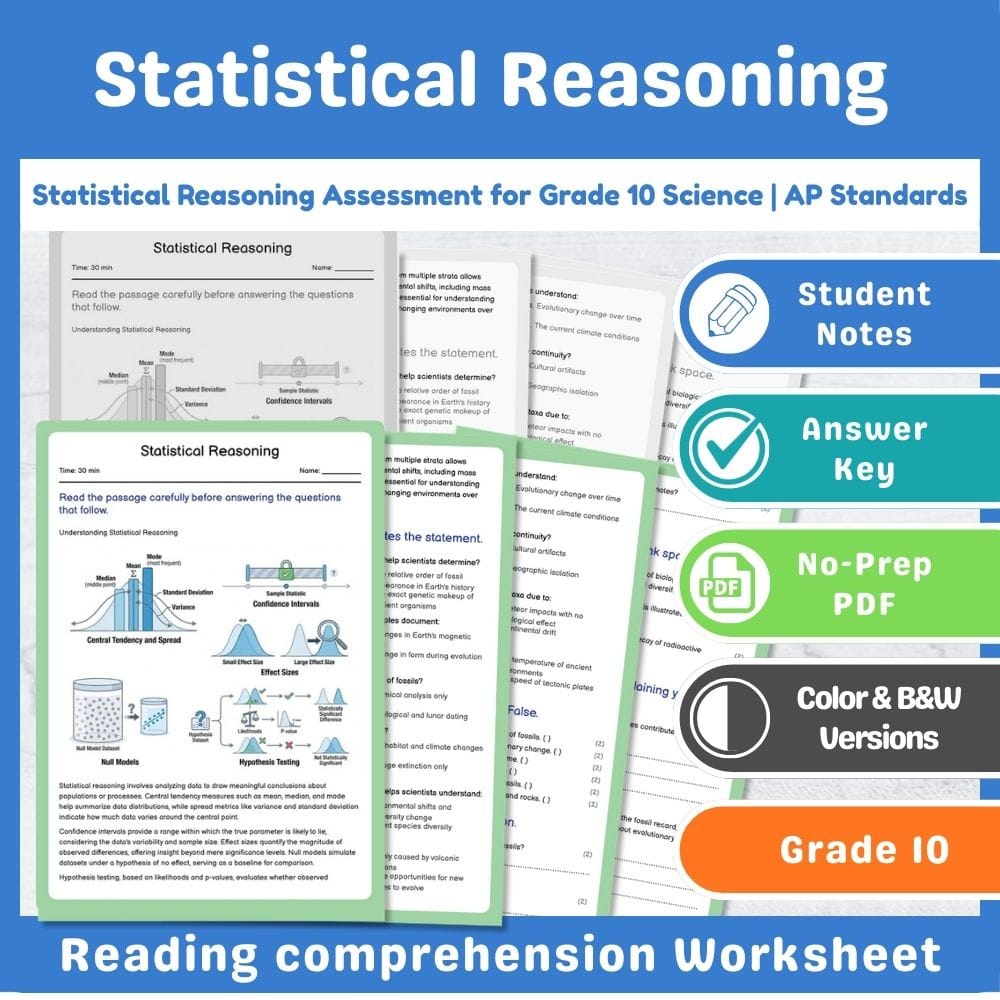
Statistical Reasoning Assessment for Grade 10 Science | AP Standards
Created byPrism Point LearningLearning Objectives
- Understand how to summarize and compare datasets using measures of central tendency.
- Interpret spread metrics and confidence intervals to assess data variability.
- Apply concepts of null models and hypothesis testing to evaluate observed differences.
Instant download

Grade 10 Science | Energy Changes in Chemical Reactions - Reading Comprehension
Created byCoral Reef LearningLearning Objectives
- Understand the concepts of energy absorption and release during chemical reactions.
- Distinguish between endothermic and exothermic processes.
- Relate molecular bonding changes to macroscopic heat transfer.
Also included in: Matter and Chemical Change Lesson Bundle: Grade 10 Science Alberta +1 more
Instant download

Grade 10 Science | Energy Capture in Photosynthesis - Reading Comprehension
Created byCoral Reef LearningLearning Objectives
- Understand the basic process of photosynthesis
- Identify the roles of chlorophyll and pigments in energy absorption
- Explain how environmental factors influence photosynthetic efficiency
Also included in: Cells and Systems Lesson Bundle | Grade 10 Science | Alberta Framework +1 more
Instant download

Grade 10 Science – Mining Impacts & Environmental Damage | Reading Worksheet
Created byBright Mind ResourcesLearning Objectives
- Understand how mining activities alter landscapes
- Identify environmental consequences of mineral extraction
- Assess methods for impact evaluation and reclamation
Also included in: Earth Science Grade 10 Science Daily Reading Worksheets Lesson Bundle | Ontario +1 more
Instant download

Endocrine Coordination Worksheet for Grade 10 Science TEKS aligned
JCreated byJ.S SheetsLearning Objectives
- Explain how hormones coordinate body functions using specific receptors and signaling cascades
- Describe the roles of the hypothalamus and pituitary in feedback regulation of hormone levels
- Compare short-term and long-term effects of hormonal signaling on growth, metabolism, reproduction, and stress responses
Instant download

Mechanics Applications Worksheet | Standards-Aligned Grade 10 Science Practice
JCreated byJ.S SheetsLearning Objectives
- Apply kinematic relationships to predict motion in real systems with constant acceleration
- Use Newton’s second law to connect net force, mass, and acceleration for inclined planes and braking scenarios
- Relate work and energy or momentum ideas to practical performance measures such as stopping distance and safety limits
Instant download

Grade 10 Science – Membrane Structure & Transport | Daily Reading Worksheet
Created byBright Mind ResourcesLearning Objectives
- Understand the basic structure and components of cell membranes.
- Explain how membrane permeability influences ion distribution.
- Describe the mechanisms of membrane transport such as diffusion, carrier-mediated transport, and vesicular trafficking.
Also included in: Grade 10 AP Science Daily Reading Lesson Bundle: Ecology, Genetics & Cells +2 more
Instant download

Grade 10 Genetic Code Meaning Worksheet | Practice & PDF
Created byClear Sky ClassroomLearning Objectives
- Explain how mRNA codons specify the order of amino acids during protein synthesis.
- Describe how small changes in a nucleotide sequence can change a protein’s primary structure and function.
- Interpret statements about the genetic code using accurate true/false and short-answer responses.
Instant download

Atomic Structure Assessment | Florida NGSSS Grade 10 Science Worksheet
Created byPrism Point LearningLearning Objectives
- Explain how protons, neutrons, and electrons determine the identity and mass of an atom
- Describe isotopes and how differences in neutron number affect mass
- Use energy-level concepts to interpret electron transitions and spectral lines
Also included in: Grade 10 Waves Energy Forces Science Lesson Mini Bundle | Florida NGSSS +1 more
Instant download

Grade 10 Science | Stoichiometry Balance Worksheet | General Standard
Created byLumora LearningLearning Objectives
- Explain how conservation of atoms leads to balanced chemical equations
- Interpret balanced-equation coefficients as whole-number particle (mole) ratios for stoichiometry
- Use qualitative reasoning to predict relative reactant and product amounts
Instant download

Grade 10 Science | Work and Energy Change Worksheet | California Standards
Created byLumora LearningLearning Objectives
- Explain how forces acting through displacement transfer energy to a system
- Use the work-energy relationship to predict changes in kinetic, elastic, and gravitational potential energy
- Interpret energy–position or energy graphs to connect slope/trends with net work and energy transfer
Instant download

Grade 10 Science – Systems & Trade Interactions Daily Reading Worksheet
Created byBright Mind ResourcesLearning Objectives
- Understand the concept of systems and their components.
- Identify different parts of a system and explain their functions.
- Recognize how changes in one component affect other parts of the system.
Also included in: Grade 10 Science Trade-Off Design Daily Reading Worksheet Lesson Bundle-General +1 more
Instant download

Grade 10 Science – Communicating Results Worksheet (Ontario PDF)
Created byEvergreen Desk EducationLearning Objectives
- Use evidence-based conventions to write clear scientific results and conclusions.
- Link data (tables, graphs, and statistics) to specific claims and explain interpretive choices.
- Describe limitations and uncertainty transparently to support peer evaluation and reproducibility.
Also included in: Grade 10 Scientific Inquiry & Data Reasoning Science Lesson Bundle: Ontario +1 more
Instant download

Grade 10 Science | Multi Criteria Optimization Worksheet | General Standard
Created byLumora LearningLearning Objectives
- Explain how multi criteria optimization uses data to balance competing goals under constraints
- Identify how measurement trends and evidence inform parameter choices in an engineering design
- Apply multi criteria optimization ideas to evaluate trade-offs among multiple outcomes
Instant download

Grade 10 Science – Motion Graphs Worksheet (AP Standards, PDF)
Created byEvergreen Desk EducationLearning Objectives
- Interpret position–time, velocity–time, and acceleration–time graphs to determine slope and area meanings for non-uniform motion.
- Connect graphical features of kinematics graphs to derivatives (instantaneous rate) and integrals (accumulated change).
- Extract kinematic quantities from piecewise-linear or experimentally estimated graph data and assess possible error sources.
Also included in: Grade 10 Motion & Forces Science Lesson Bundle (AP) Worksheet Set +1 more
Instant download

Grade 10 Science | Molar Relationships - Daily Reading Comprehension
Created byCoral Reef LearningLearning Objectives
- Define the mole and explain its importance in chemistry.
- Perform basic mole-to-mass and mole-to-mole conversions.
- Identify limiting reagents using molar calculations.
Also included in: Matter and Chemical Change Lesson Bundle: Grade 10 Science Alberta +1 more
Instant download

Grade 10 Science | Energy Currency in Cells - Daily Reading Comprehension
Created byCoral Reef LearningLearning Objectives
- Understand the role of ATP as the primary energy source in cellular processes.
- Describe how ATP is synthesized and hydrolyzed to release energy.
- Explain the significance of phosphorylation in metabolic networks.
Also included in: Cells and Systems Lesson Bundle | Grade 10 Science | Alberta Framework +1 more
Instant download

Grade 10 Science | Energy in Cells Worksheet | NGSSS Activities
Created byLumora LearningLearning Objectives
- Explain how cells obtain and use energy to perform biological work
- Describe how cellular respiration converts energy stored in carbohydrates into ATP
- Compare photosynthesis and cellular respiration as energy-conversion pathways
Instant download

Grade 10 Science Wave Behavior Worksheet (AP) | Comprehensive Practice PDF
Created byEvergreen Desk EducationLearning Objectives
- Characterize transverse and longitudinal waves using wavelength, frequency, amplitude, and wave speed.
- Explain how wave interactions such as reflection, refraction, interference, superposition, and standing-wave formation occur.
- Connect wave parameters to energy transfer and information transfer in real-life contexts (e.g., sound pulses and signal spectra).
Also included in: Grade 10 Motion & Forces Science Lesson Bundle (AP) Worksheet Set +1 more
Instant download

Grade 10 Science – Gravity & Orbits | Daily Reading Worksheet
Created byBright Mind ResourcesLearning Objectives
- Understand the concept of gravity and its effects on Earth and celestial bodies
- Describe how gravity influences orbital motion of planets and satellites
- Explain the relationship between gravity, velocity, and distance in orbital paths
Also included in: Stellar Evolution Grade 10 Science Daily Reading Worksheets Bundle | FL NGSSS +1 more
Instant download

Grade 10 Atomic Structure Worksheet | Isotopes & Electron Configuration
Created byChalk and CompassLearning Objectives
- Explain how protons, neutrons, and electrons determine atomic number and mass number
- Describe isotopes and use nuclear notation to relate isotopic composition to average atomic mass
- Use basic electron configuration ideas (including valence electrons) to predict bonding tendencies
Also included in: Chemistry Foundations & Chemical Reactions Lesson Bundle: Grade 10 Science +1 more
Instant download

Projectile Motion Worksheet | Standards-Aligned Science Practice for Grade 10
JCreated byJ.S SheetsLearning Objectives
- Understand the components of projectile motion and their independence.
- Apply kinematic equations to calculate time of flight, range, and maximum height.
- Explain how initial velocity and launch angle affect projectile trajectory.
Instant download

Solution Concentration Assessment | Standards-Aligned Grade 10 Science
Created byPrism Point LearningLearning Objectives
- Understand different measures of solution concentration such as molarity, mass percent, and parts per million.
- Apply concentration concepts to environmental and regional contexts, including water testing and nutrient management.
- Perform quantitative reasoning about solutions, dilution, and mixture calculations.
Also included in: Grade 10 Matter and Chemical Change Science Lesson Bundle: Alberta +1 more
Instant download

Grade 10 Science – Solution Concentration Daily Reading Worksheet | Alberta
Created byBright Mind ResourcesLearning Objectives
- Understand different types of solution concentration measurements such as molarity, mass percent, and parts per million.
- Interpret how concentration affects physical properties and chemical reactivity.
- Apply knowledge of solution concentration to environmental and regional contexts like irrigation water and watershed monitoring.
Also included in: Grade 10 Chemistry Science Lesson Bundle Daily Reading Worksheets | Alberta +1 more
Instant download

Cosmic Origins Practice Worksheet | Grade 10 Science NGSS Review
Created byPrism Point LearningLearning Objectives
- Explain how cosmic microwave background (CMB) anisotropies support an expanding-universe model
- Use galaxy redshifts and large-scale structure to interpret cosmic expansion and matter distribution
- Describe how primordial hydrogen-to-helium abundance constrains early-universe conditions
Also included in: Grade 10 Space & Earth Science NGSS Lesson Bundle: Test Prep Worksheets
Instant download

Grade 10 Atomic Structure Worksheet | Electrons, Nucleus & Periodic Trends
 Created byAmber Owl Education
Learning Objectives
- Connect electron configuration to valence electrons and predicted ion charge.
- Describe how isotopes and atomic mass relate to nuclear structure and periodic behavior.
- Use periodic trends (such as atomic radius and ionization energy) to predict elemental properties.
Instant download

Grade 10 Science – Friction & Dynamics | Daily Reading Worksheet
Created byBright Mind ResourcesLearning Objectives
- Understand the difference between static and kinetic friction.
- Learn how normal force and surface properties affect frictional forces.
- Explore friction's role in motion on inclined planes and contact surfaces.
Also included in: Motion, Energy & Electricity Grade 10 Science Reading Worksheets Bundle | AP +2 more
Instant download

Grade 10 Science | Oscillations Basics - Daily Reading Comprehension
Created byCoral Reef LearningLearning Objectives
- Understand key concepts related to Science
- Apply knowledge through practice questions
- Demonstrate comprehension of the material
Also included in: Physics Principles Reading Lesson Bundle Grade 10 Science Advanced placement +1 more
Instant download
About Grade 10 Science Worksheets
Find Science worksheets built for Grade 10. All 7,038 cover core skills, practice, and review, each an instant PDF download.
Every worksheet on MyTeachingSheets is created by independent teacher-authors and reviewed before publication. All resources download as printable PDFs for classroom, homework, or at-home practice, and many include answer keys. Preview any worksheet free before buying.