
Grade 10 Science Worksheets
7,069 worksheets
Grade 10 Science – Force Interactions Worksheet (NGSS10) PDF
 Created bySilver Birch Teaching
Learning Objectives
- Classify contact and noncontact forces and understand their vector representations.
- Explain Newton's third law and identify action-reaction force pairs.
- Interpret free-body diagrams and apply vector addition to analyze concurrent forces.
Also included in: Grade 10 Forces, Motion, and Fields Science Lesson Bundle for NGSS +1 more
Instant download

Grade 10 Science | Net Force and Motion Worksheet (NGSS-Aligned PDF)
Created bySilver Birch TeachingLearning Objectives
- Analyze the quantitative relationships between net force, mass, and acceleration using Newton's second law.
- Interpret motion graphs and understand their relation to constant acceleration and force.
- Apply vector summation to determine net force in various scenarios including inclined planes and frictional effects.
Also included in: Grade 10 Forces, Motion, and Fields Science Lesson Bundle for NGSS +1 more
Instant download

Grade 10 Science | Momentum & Impulse NGSS Worksheet (PDF)
Created bySilver Birch TeachingLearning Objectives
- Understand the relationship between impulse and momentum and their mathematical formulations.
- Explain the impulse-momentum theorem and its application in analyzing collisions and interactions.
- Describe conservation of momentum in closed systems during elastic and inelastic collisions.
Also included in: Grade 10 Forces, Motion, and Fields Science Lesson Bundle for NGSS +1 more
Instant download
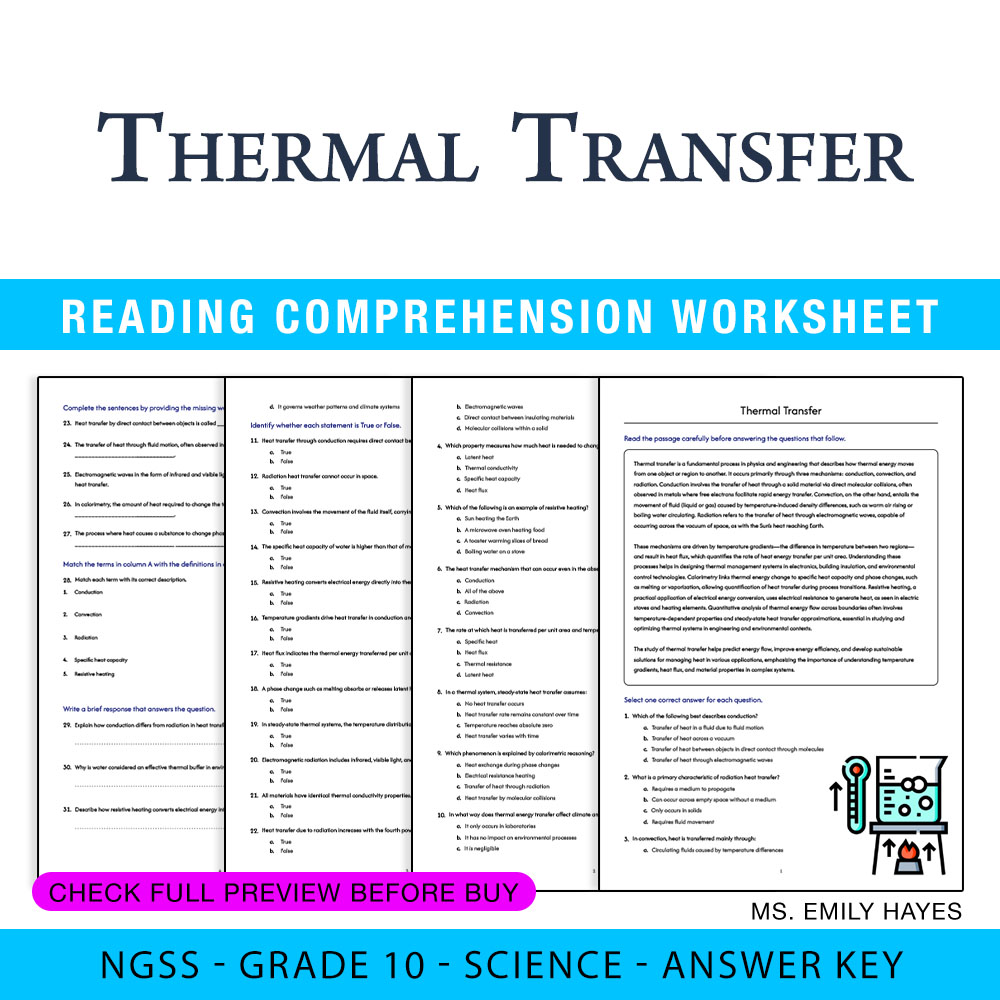
10th Grade Science | Thermal Transfer Worksheet (PDF+ Answer Key)
 Created byCopper Leaf Classroom
Learning Objectives
- Describe the mechanisms of heat transfer: conduction, convection, and radiation.
- Analyze heat flux and temperature gradients in thermal systems.
- Apply calorimetric reasoning to relate thermal energy change to specific heat and phase changes.
Instant download
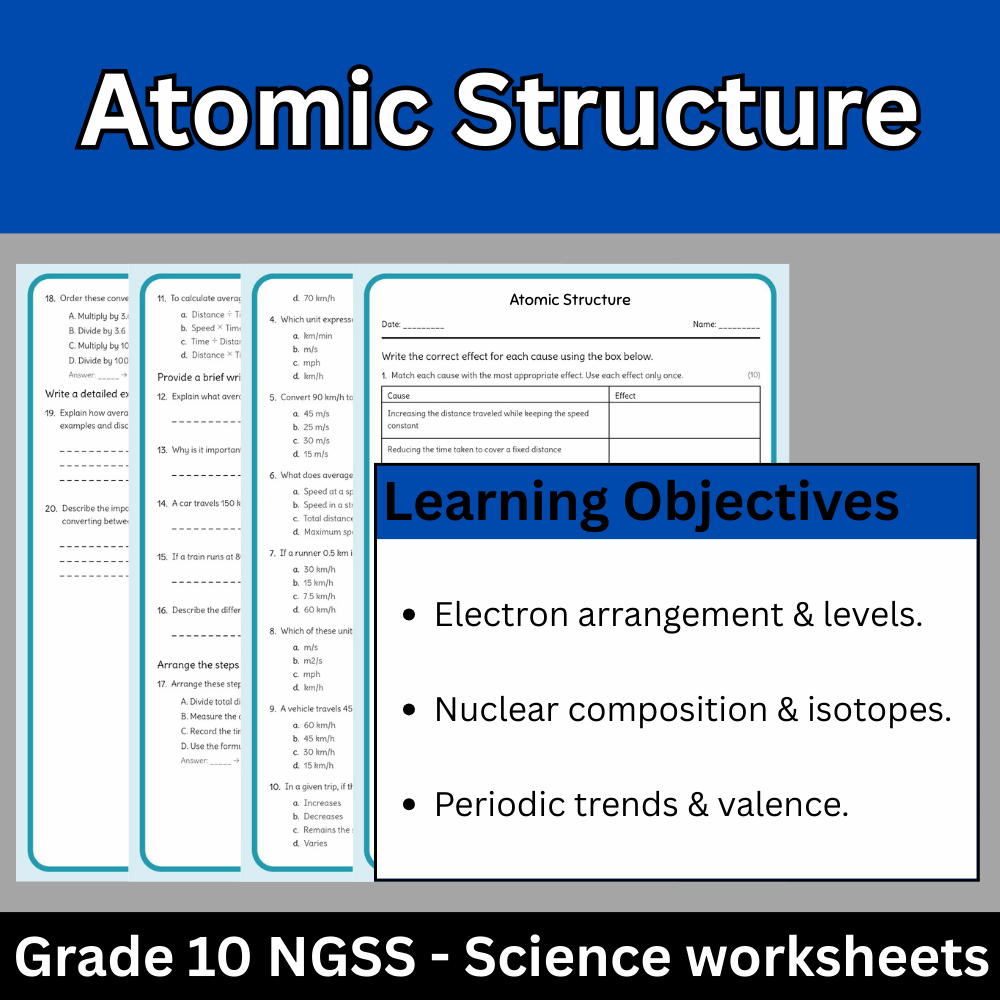
Grade 10 Science | Atomic Structure Worksheet (Answer Key) | NGSS Aligned
 Created byBright Mind Resources
Learning Objectives
- Understand the arrangement of electrons in atoms and their energy levels.
- Connect nuclear composition and isotopes to atomic mass and reactivity.
- Interpret periodic trends based on electron configuration and valence electrons.
Instant download

Grade 10 Science | Immune System & Homeostasis - Daily Reading Comprehension
 Created byCoral Reef Learning
Learning Objectives
- Identify the main components of the immune system.
- Understand how the immune system contributes to maintaining homeostasis.
- Recognize the mechanisms of inflammatory responses and fever.
Instant download
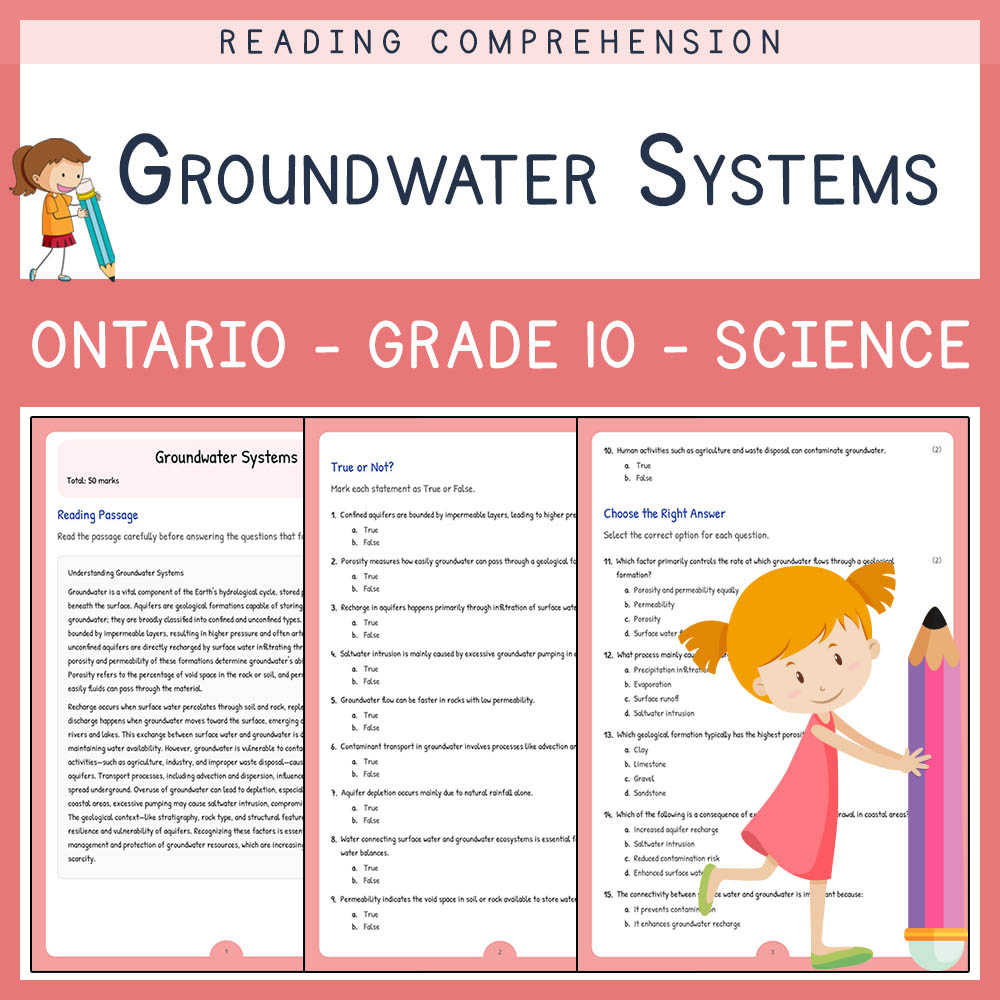
Grade 10 Science | Groundwater Systems Worksheet Elena | Ontario Standard
 Created byLumora Learning
Learning Objectives
- Understand the types and properties of aquifers and their influence on groundwater flow.
- Explain the concepts of porosity and permeability and their effects on recharge and discharge dynamics.
- Analyze the vulnerability of groundwater to contamination and the processes involved in contaminant transport.
Instant download
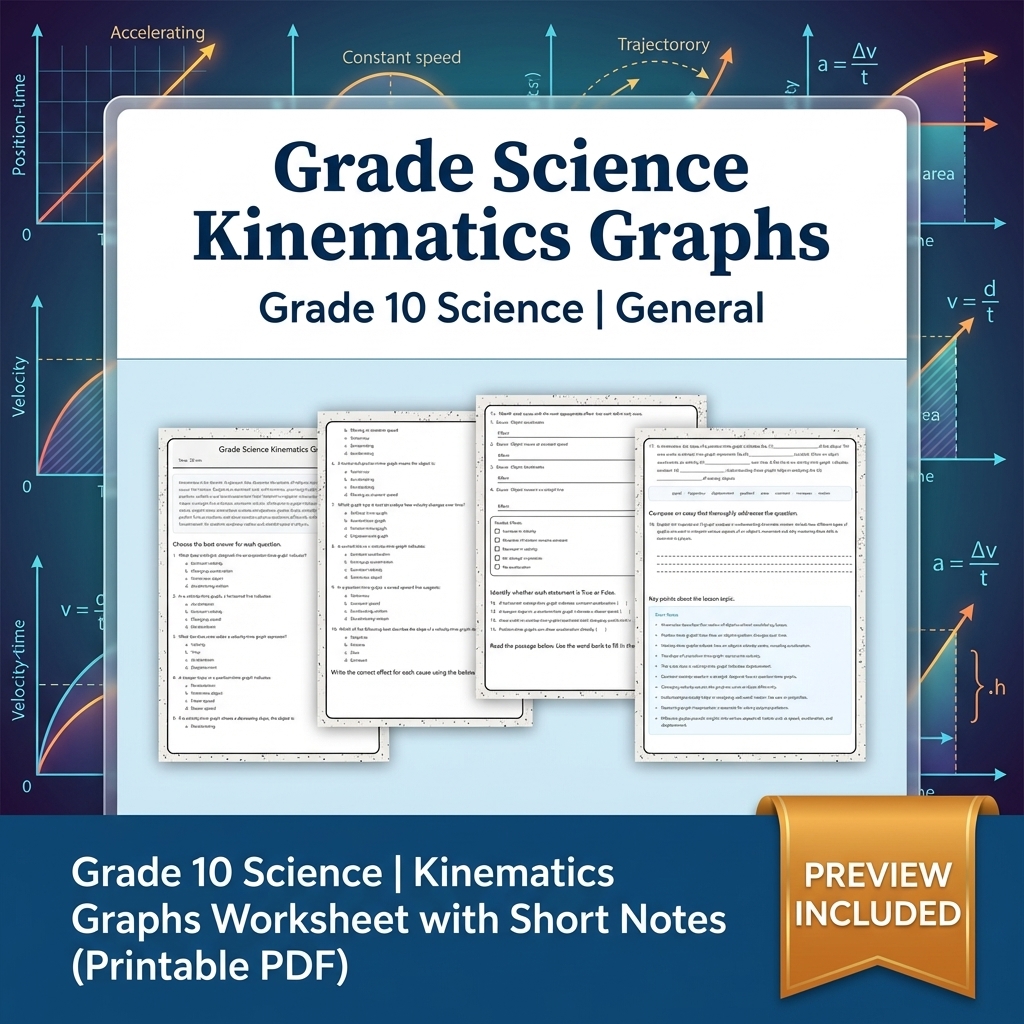
Grade 10 Science | Kinematics Graphs Worksheet with Short Notes (Printable PDF)
 Created byMeadowlark Worksheets
Learning Objectives
- Understand the different types of kinematic graphs and their significance.
- Interpret motion data from position-time and velocity-time graphs.
- Draw and analyze graphs representing various types of motion.
Also included in: Grade 10 Forces and Energy Science Lesson Bundle for General Framework +1 more
Instant download
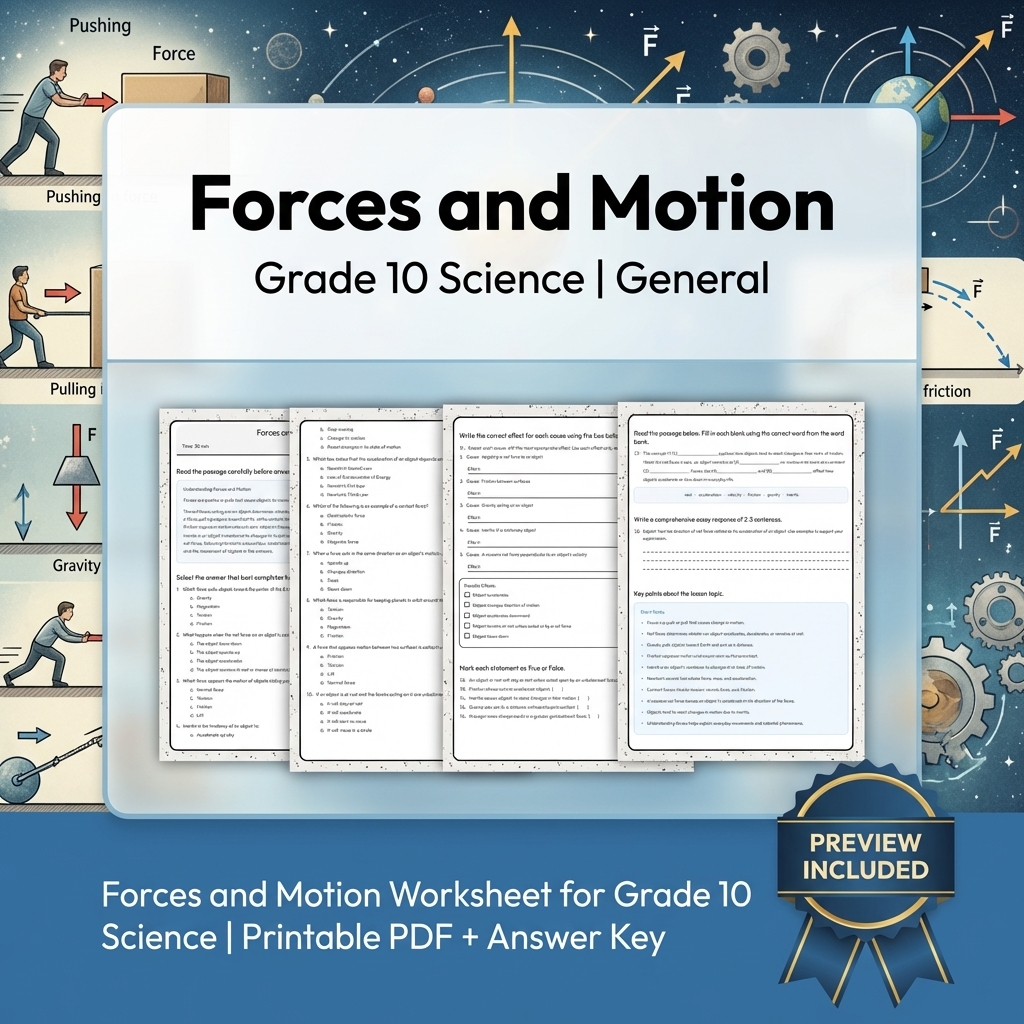
Forces and Motion Worksheet for Grade 10 Science | Printable PDF
Created byMeadowlark WorksheetsLearning Objectives
- Explain how net force affects the motion of objects.
- Identify different types of forces such as gravity, friction, and contact forces.
- Describe the concept of inertia and how it resists changes in motion.
Also included in: Grade 10 Forces and Energy Science Lesson Bundle for General Framework +1 more
Instant download
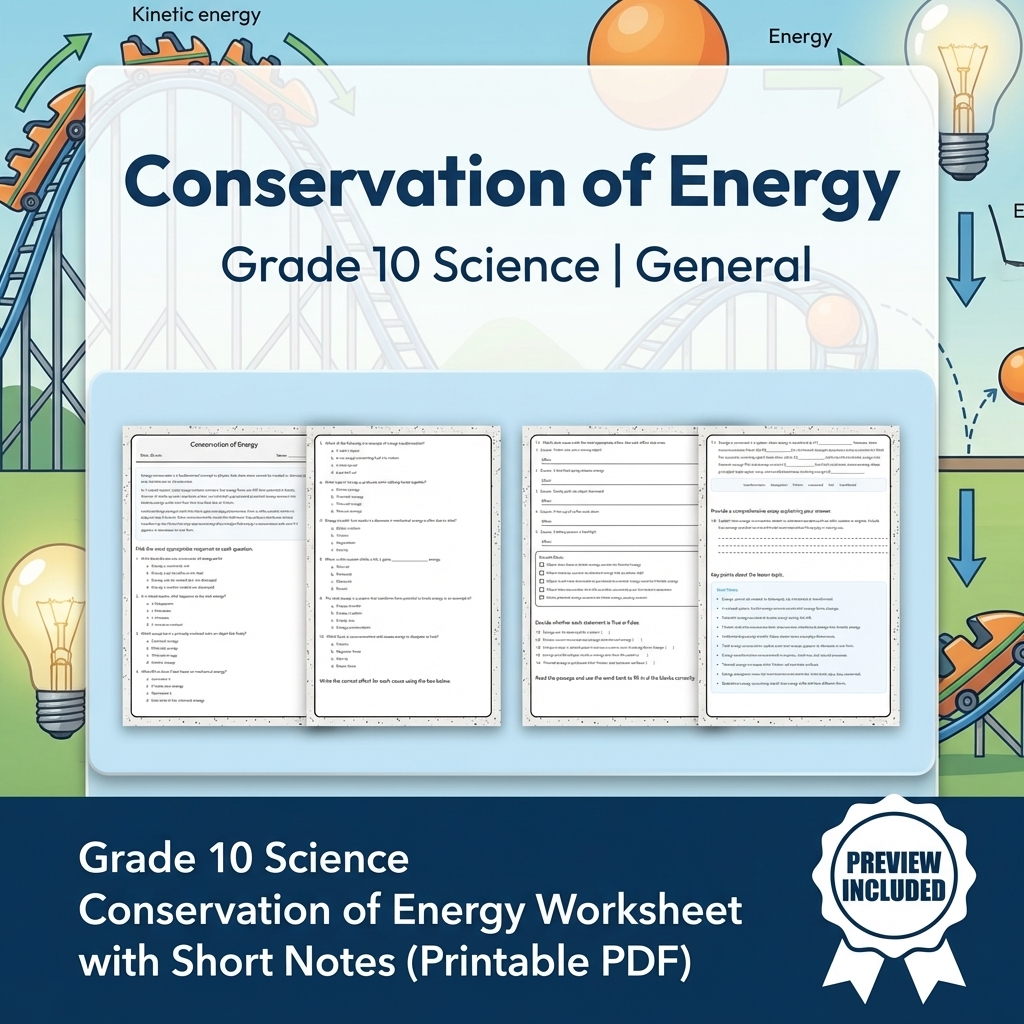
Grade 10 Science Conservation of Energy Worksheet with Short Notes
Created byMeadowlark WorksheetsLearning Objectives
- Understand the principle that energy is neither created nor destroyed but transferred and transformed.
- Explain how energy forms change in a closed system during different processes.
- Identify real-world examples of energy transfer, such as gravitational to kinetic energy.
Also included in: Grade 10 Forces and Energy Science Lesson Bundle for General Framework +1 more
Instant download
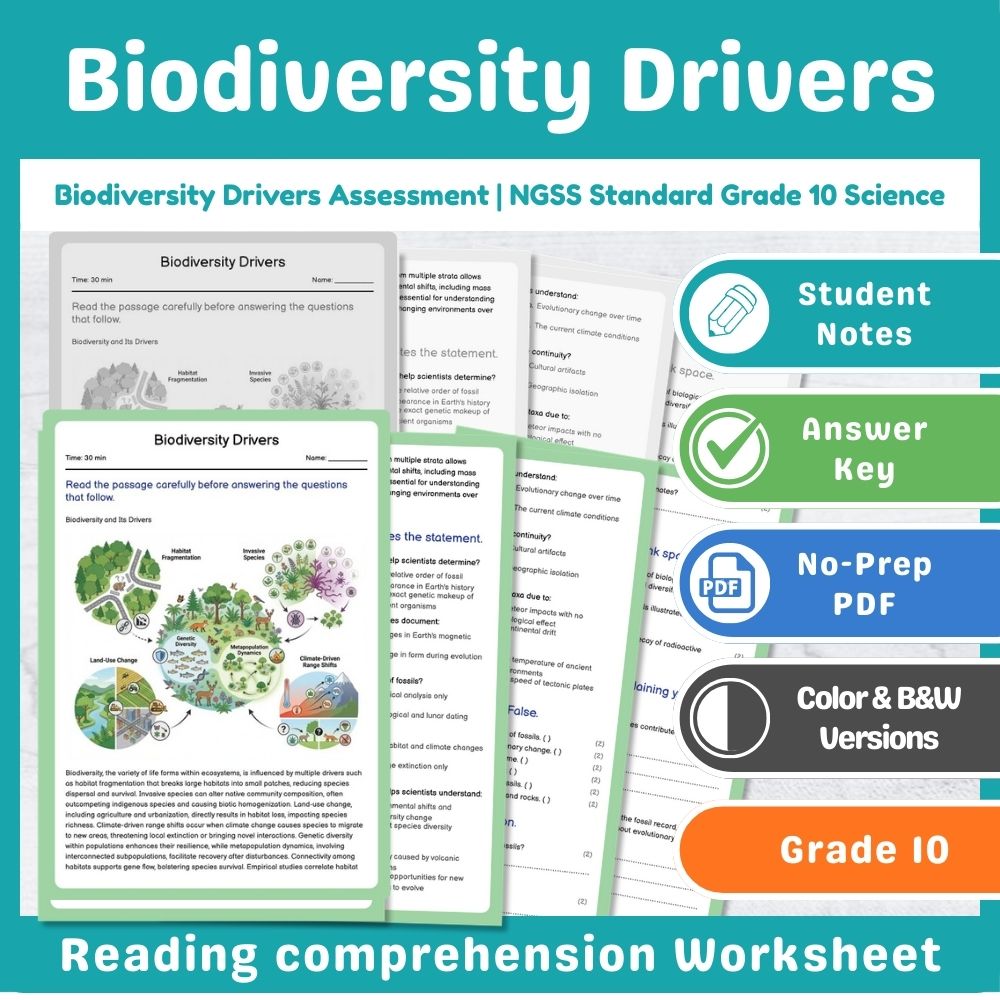
Biodiversity Drivers Assessment | NGSS Standard Grade 10 Science
 Created byPrism Point Learning
Learning Objectives
- Identify key factors influencing species richness and composition in ecosystems.
- Evaluate the impacts of habitat fragmentation, invasive species, and climate shifts on biodiversity.
- Understand mechanisms like genetic diversity and metapopulation structure that mediate extinction risk.
Instant download
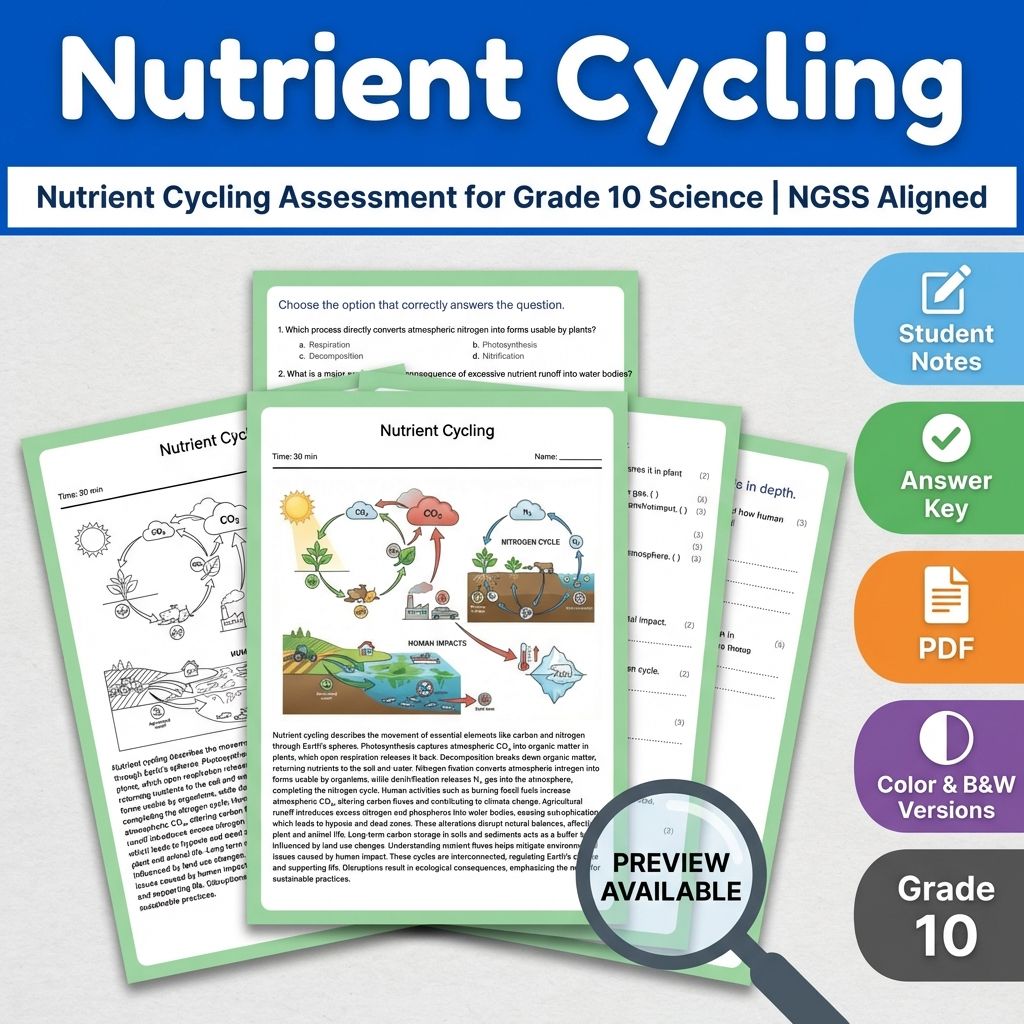
Nutrient Cycling Assessment for Grade 10 Science | NGSS Aligned
Created byPrism Point LearningLearning Objectives
- Understand the major biogeochemical cycles, including carbon and nitrogen fluxes.
- Describe the processes such as photosynthesis, respiration, nitrification, denitrification, and decomposition.
- Analyze how human activities alter nutrient reservoirs and flux rates.
Instant download
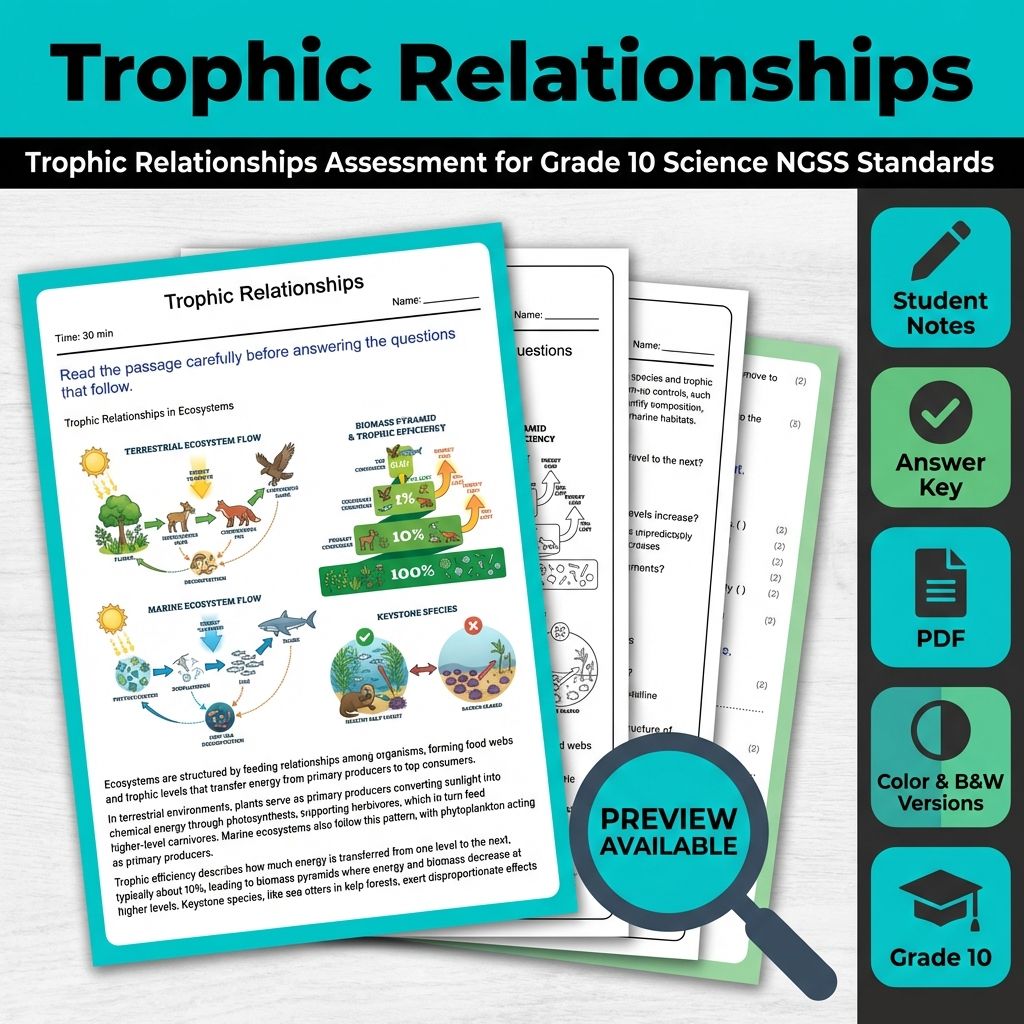
Trophic Relationships Assessment for Grade 10 Science NGSS Standards
Created byPrism Point LearningLearning Objectives
- Explain the concept of energy transfer within food webs and trophic levels.
- Analyze the effects of keystone species and trophic cascades on ecosystem stability.
- Evaluate how trophic efficiency influences biomass distribution in terrestrial and marine ecosystems.
Instant download
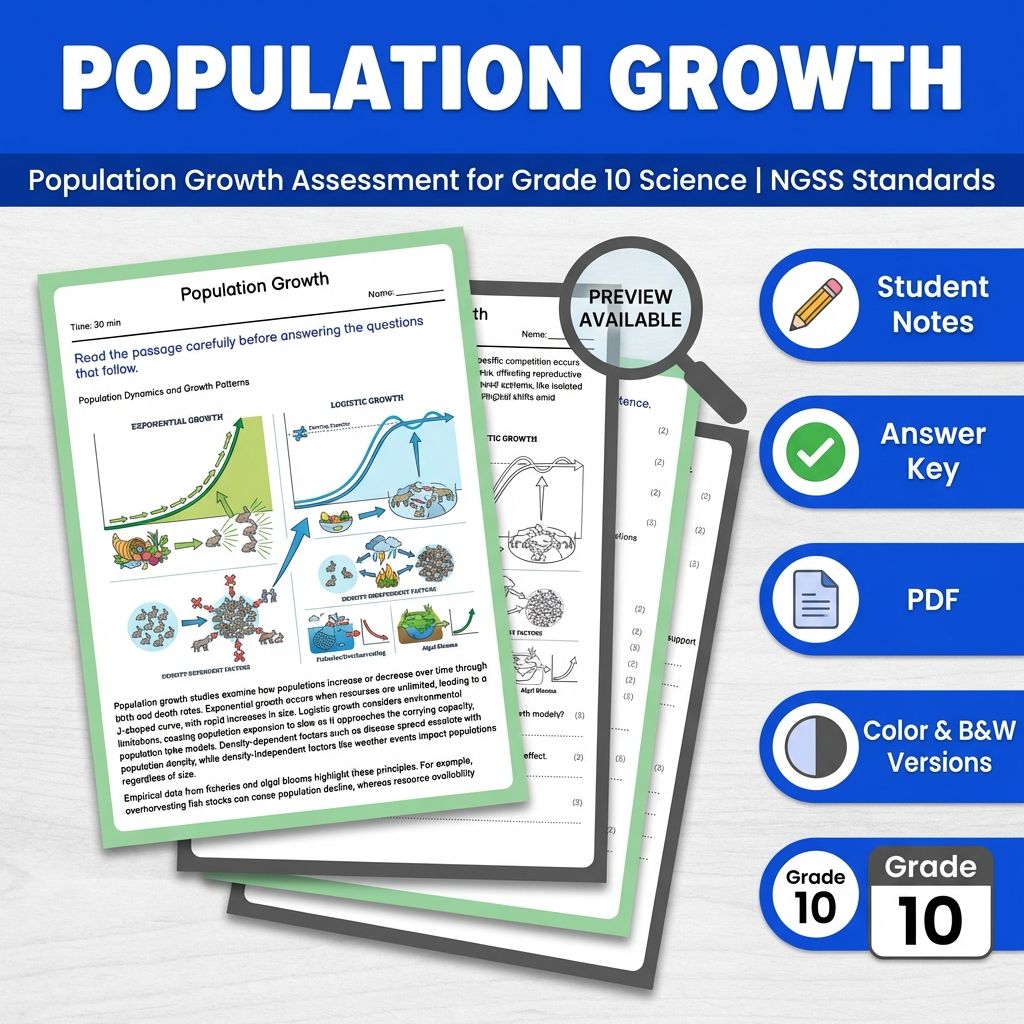
Population Growth Assessment for Grade 10 Science | NGSS Standards
Created byPrism Point LearningLearning Objectives
- Understand the principles of exponential and logistic population growth models.
- Analyze factors affecting population dynamics, including limiting factors and carrying capacity.
- Evaluate biological and environmental data to interpret population patterns and interactions.
Instant download
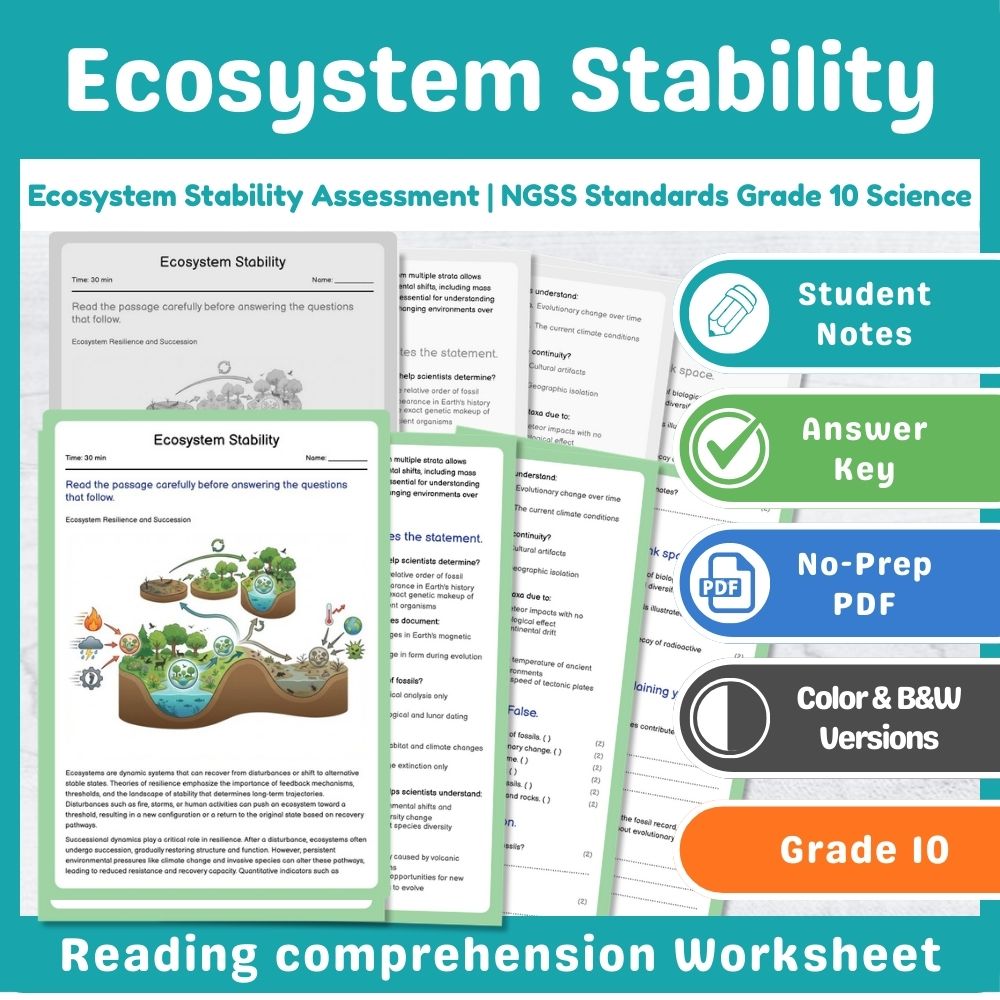
Ecosystem Stability Assessment | NGSS Standards Grade 10 Science
Created byPrism Point LearningLearning Objectives
- Understand the concepts of resilience and stability landscapes in ecosystems.
- Describe how natural and human disturbances affect ecosystem recovery pathways and thresholds.
- Identify indicators used to assess resistance, recovery time, and functional redundancy in ecosystems.
Instant download
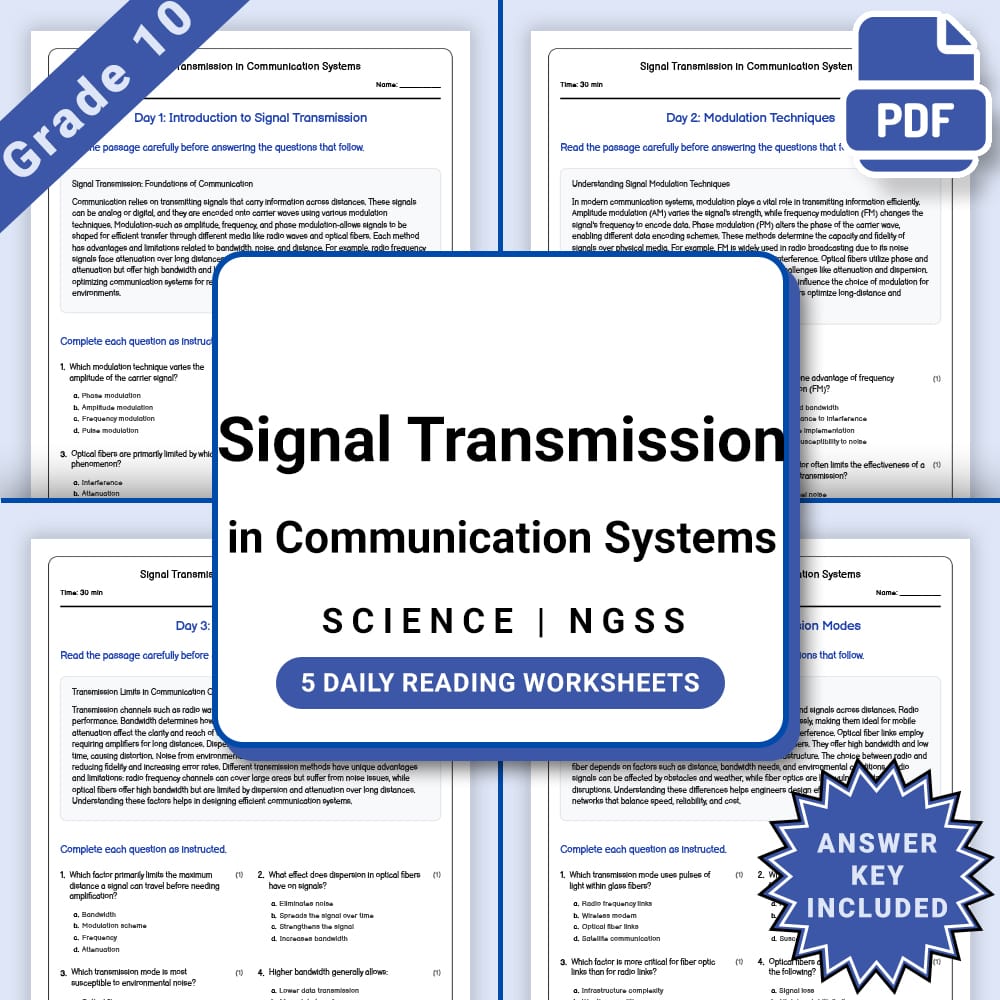
Grade 10 Science – Signal Transmission Worksheet (PDF +Answer Key)
Created byCopper Leaf ClassroomLearning Objectives
- Understand key concepts related to Science
- Apply knowledge through practice questions
- Demonstrate comprehension of the material
Instant download

Circuit Fundamentals Worksheet | Science | Standards-Aligned Grade 10
JCreated byJ.S SheetsLearning Objectives
- Define current, voltage, and resistance and understand their interrelationships in electrical circuits.
- Explain Ohm's law and apply it to simple circuit calculations.
- Differentiate between series and parallel circuit configurations and their effects on current and voltage.
Also included in: Grade 10 Science Practice Worksheets: Alberta Science Full-Year Bundle
Instant download
10th Grade Science | Collision Conservation Reading Worksheets (Answer Key)
JCreated byJ.S SheetsLearning Objectives
- Identify and explain the principles of conservation of momentum in multi-body collisions.
- Analyze two-dimensional collision problems using vector components and system bookkeeping.
- Distinguish between elastic and inelastic collisions based on energy and speed distributions.
Instant download
10th Grade Science | Communicating Results Worksheet (PDF + Answer Key)
Created byCopper Leaf ClassroomLearning Objectives
- Understand conventions for clear and evidence-based reporting of scientific investigations
- Learn to integrate tables, graphs, and statistical indicators to substantiate conclusions
- Develop skills for transparent presentation of data, limitations, and uncertainty
Instant download
10th Grade Science | Comparative Design in Science Worksheet (PDF)
Created byMeadowlark WorksheetsLearning Objectives
- Understand the concept of comparative design and its applications in science.
- Identify differences and similarities between various scientific models and experiments.
- Analyze the advantages of using comparative methods in scientific investigations.
Also included in: Grade 10 Science Unit | Data Analysis, Modelling Worksheet Pack
Instant download
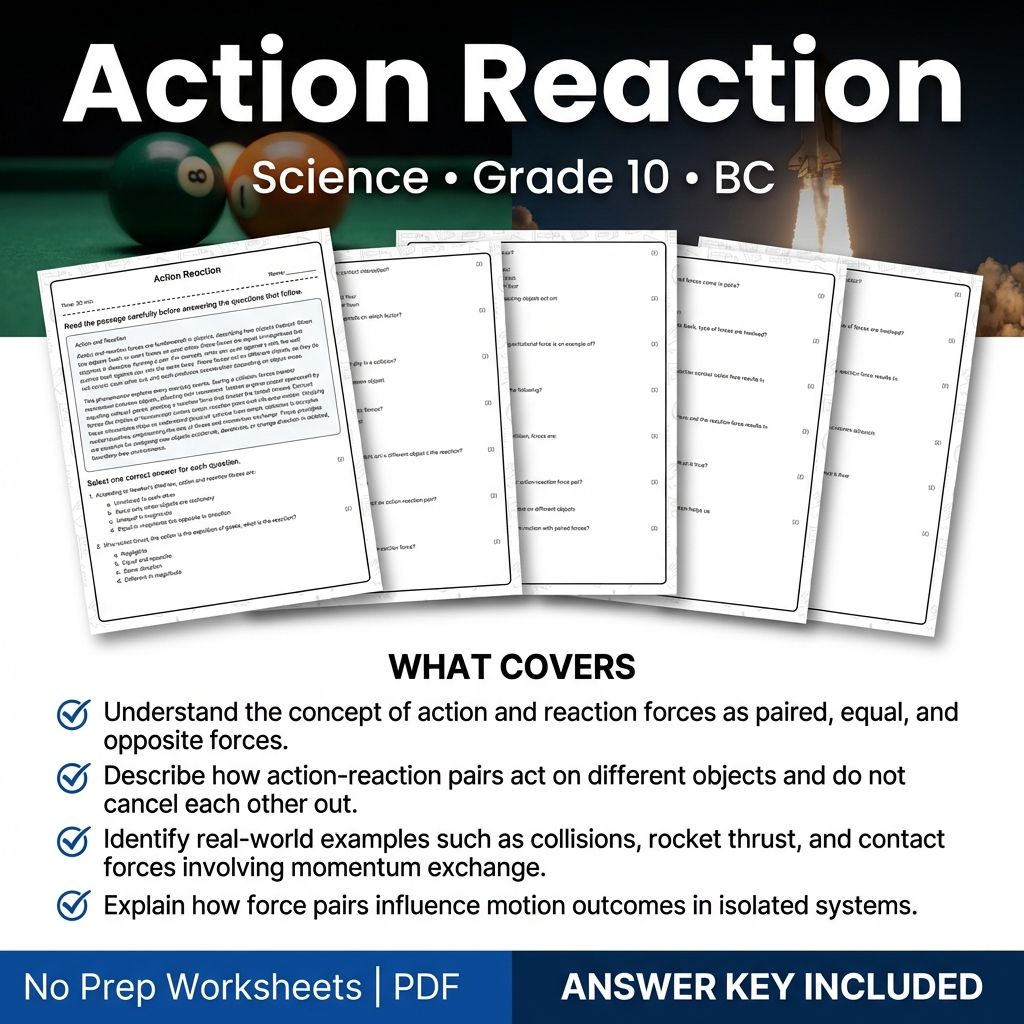
Grade 10 Science | Action and Reaction Forces Worksheet with Answer Key (PDF)
Created byCoral Reef LearningLearning Objectives
- Understand the concept of action and reaction forces as paired, equal, and opposite forces.
- Describe how action-reaction pairs act on different objects and do not cancel each other out.
- Identify real-world examples such as collisions, rocket thrust, and contact forces involving momentum exchange.
Instant download
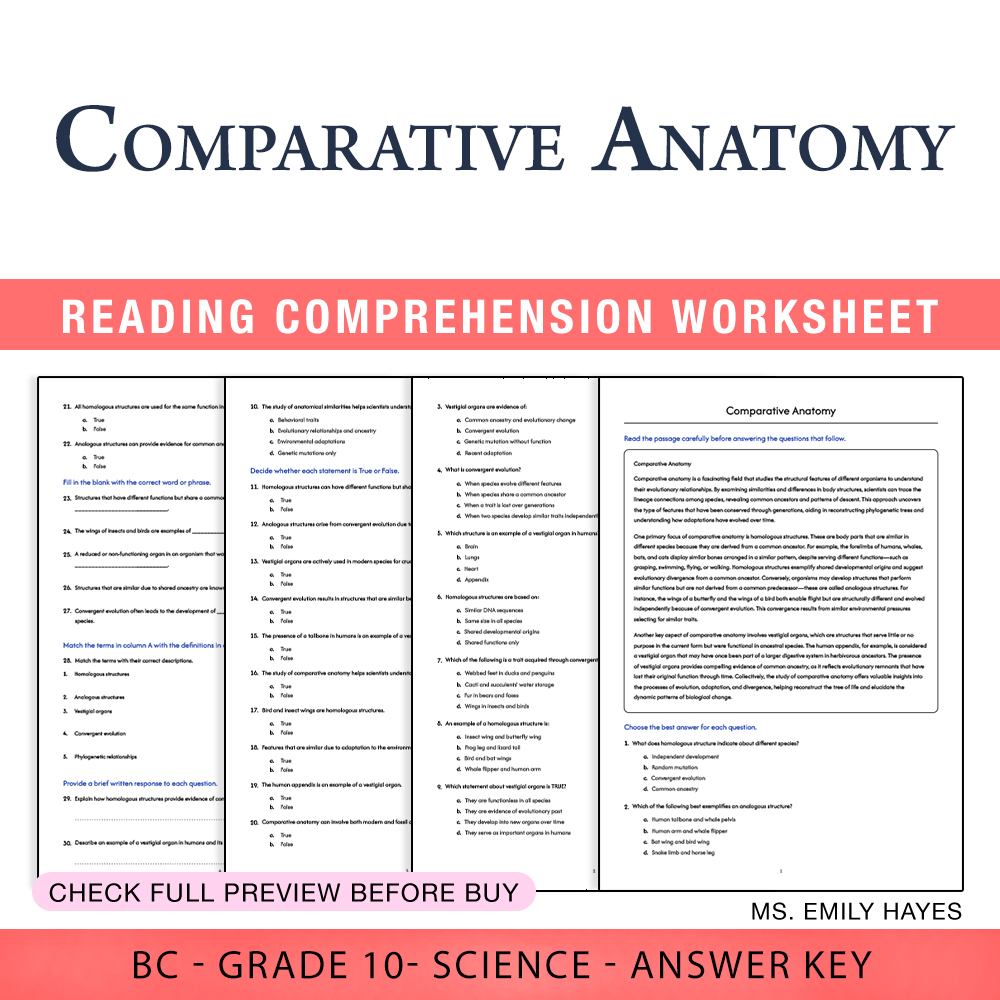
10th Grade Science | Comparative Anatomy Worksheet (PDF+ Answer Key)
Created byCopper Leaf ClassroomLearning Objectives
- Understand the concept of homologous and analogous structures and their significance in evolution.
- Differentiate between homologous, analogous, and vestigial structures in various organisms.
- Explain how comparative anatomy supports phylogenetic and evolutionary studies.
Also included in: Grade 10 Science BC | Evolution, Biodiversity & Ecology (PDF + Answer Key) +1 more
Instant download

Grade 10 Balancing Equations Worksheet | Practice & BC Standards PDF
 Created byClear Sky Classroom
Learning Objectives
- Explain why balancing chemical equations preserves the total number of each type of atom across reactants and products
- Use coefficients (not subscripts) to balance chemical equations and interpret what balanced ratios mean
- Connect balanced equations to conservation of mass and to quantitative ideas such as limiting reactants and theoretical yield
Instant download

Grade 10 Science Worksheet | Cell Theory TEKS Alignment (PDF)
 Created byEvergreen Desk Education
Learning Objectives
- Explain the three main statements of cell theory
- Compare unicellular and multicellular organization in terms of structure and function
- Use evidence from microscopy to describe how cells differ across major groups of living organisms
Instant download

Grade 10 Science – Homeostasis Basics Worksheet (TEKS) PDF
Created byEvergreen Desk EducationLearning Objectives
- Explain how homeostasis maintains stable internal conditions using set points, sensors, and effectors
- Describe how negative feedback loops counteract changes in temperature, fluid balance, or blood glucose
- Connect organs and body systems (nervous, endocrine, renal, and digestive) to biochemical equilibrium
Instant download

Grade 10 Science – Reaction Types & Chemistry | Daily Reading Worksheet
Created byBright Mind ResourcesLearning Objectives
- Understand the different types of chemical reactions: synthesis, decomposition, single and double displacement, and combustion.
- Identify reaction patterns and characteristic reactant-product relationships.
- Recognize the conservation of atoms and use symbolic representation in reactions.
Also included in: Grade 10 Chemistry Science Daily Reading Worksheets Lesson Bundle | Ontario +1 more
Instant download
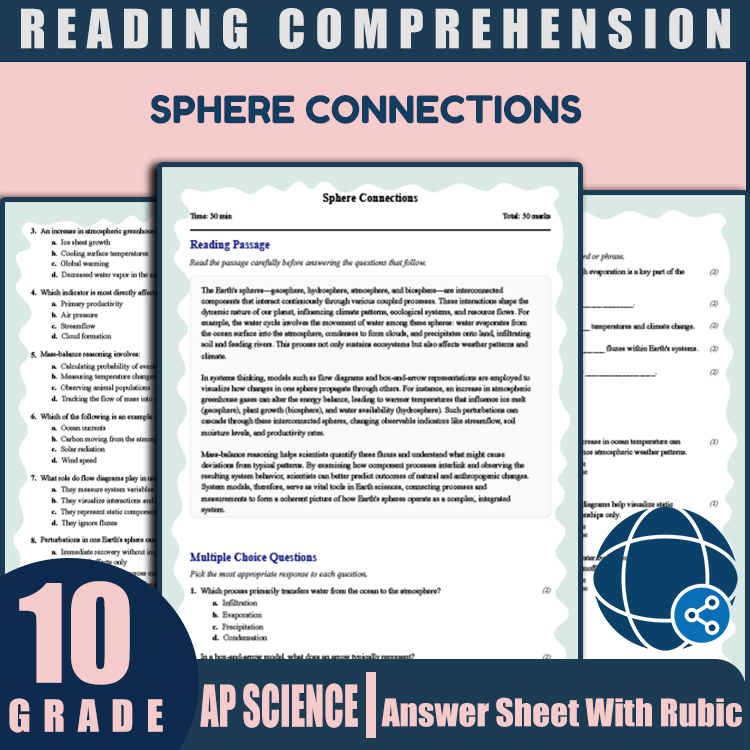
10th Grade Science | Sphere Connections Reading Worksheet (PDF + Answer Key)
JCreated byJ.S SheetsLearning Objectives
- Understand the interactions among the geosphere, hydrosphere, atmosphere, and biosphere through coupled processes such as the water cycle, biogeochemical fluxes, and ocean-atmosphere exchange.
- Use systems thinking tools like box-and-arrow models, flow diagrams, and mass-balance reasoning to analyze how perturbations propagate across Earth's spheres and influence observable indicators.
- Establish conceptual links between component processes and measurable system behaviors such as streamflow, soil moisture, and primary productivity.
Also included in: Grade 10 Science Unit | Earth Processes & Climate Worksheets (PDF + Answer Key) +1 more
Instant download
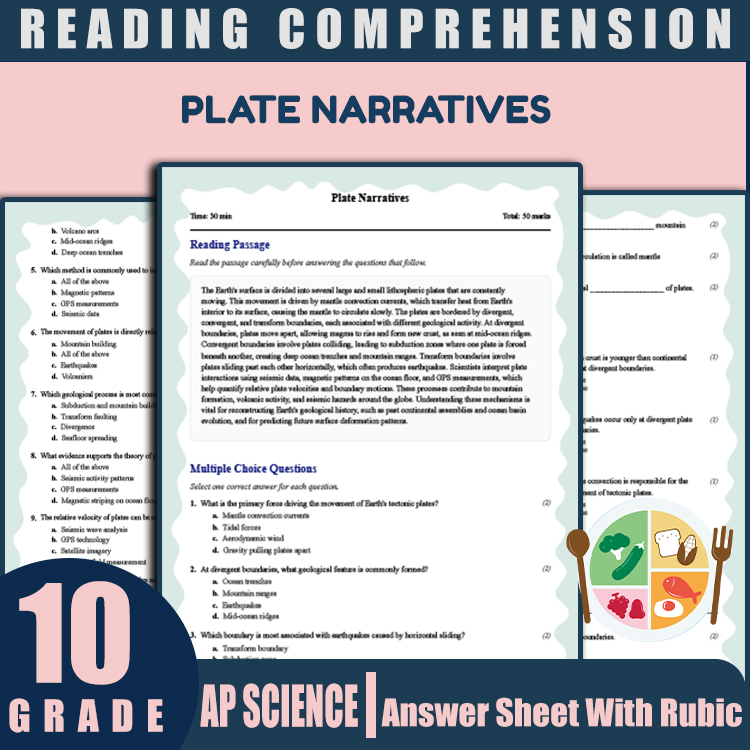
10th Grade Science | Plate Narratives Reading Worksheet (PDF + Answer Key)
JCreated byJ.S SheetsLearning Objectives
- Describe the mechanisms of plate motion, including mantle convection and subduction.
- Interpret tectonic settings using maps, cross-sections, and seismic evidence.
- Connect plate interactions to geological phenomena such as mountain building, volcanism, and earthquakes.
Also included in: Grade 10 Science Unit | Earth Processes & Climate Worksheets (PDF + Answer Key) +1 more
Instant download
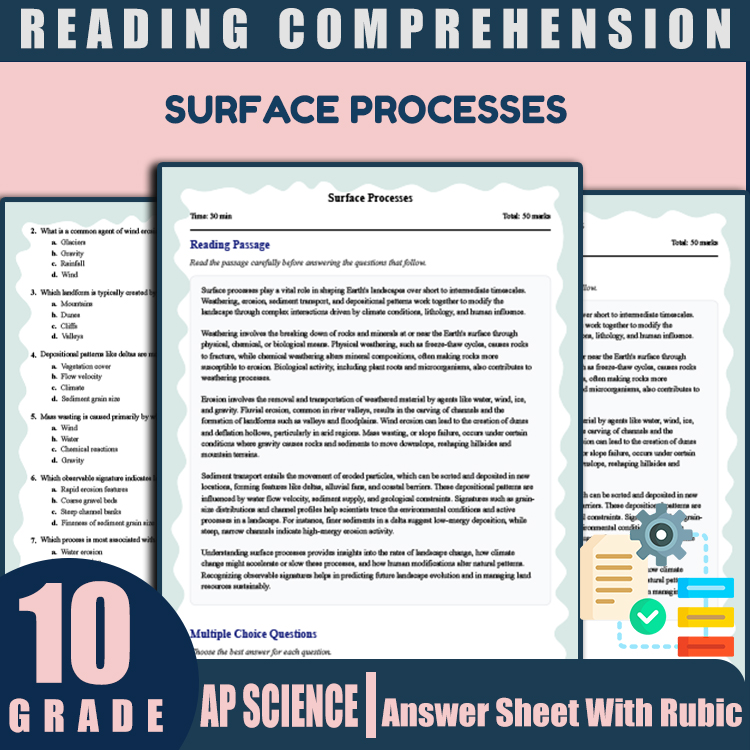
10th Grade Science | Surface Processes Reading Worksheet & Answer Key (PDF)
JCreated byJ.S SheetsLearning Objectives
- Describe the key surface processes such as weathering, erosion, sediment transport, and deposition.
- Interpret morphological changes in landscapes due to surface processes.
- Relate surface process patterns to climate, lithology, and human activities.
Also included in: Grade 10 Science Unit | Earth Processes & Climate Worksheets (PDF + Answer Key) +1 more
Instant download
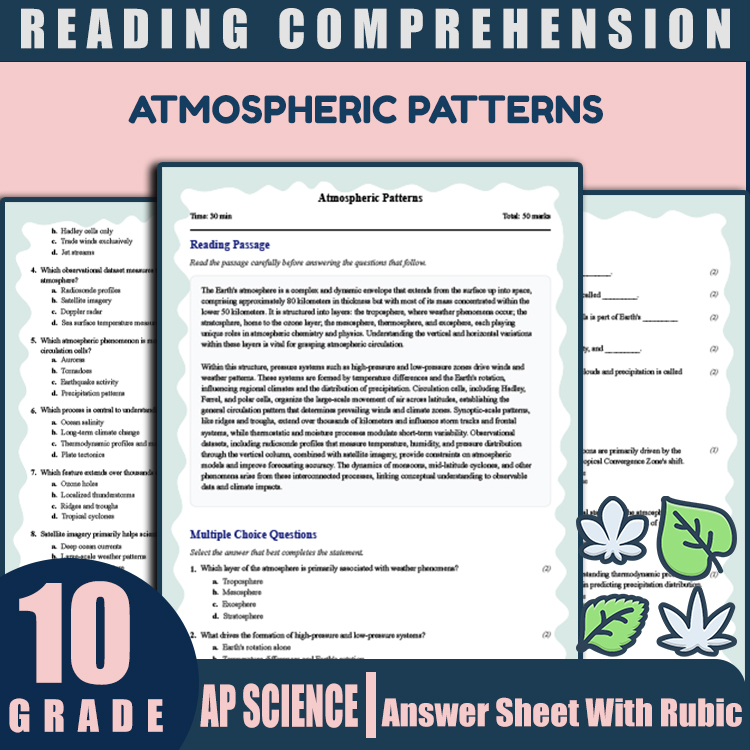
Grade 10 Science | Atmospheric Patterns Reading Worksheet (PDF + Rubric)
JCreated byJ.S SheetsLearning Objectives
- Describe the basic structure and components of Earth's atmosphere.
- Explain how pressure systems and circulation cells influence regional weather patterns.
- Understand how synoptic-scale atmospheric patterns relate to phenomena such as monsoons and cyclones.
Also included in: Grade 10 Science Unit | Earth Processes & Climate Worksheets (PDF + Answer Key) +1 more
Instant download
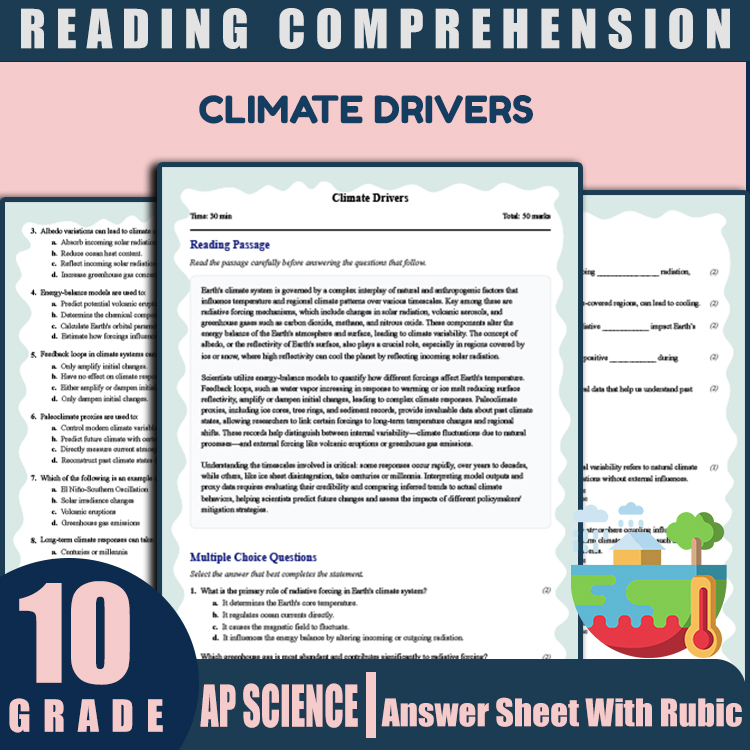
Grade 10 Science | Climate Drivers Reading Worksheet (PDF + Rubric)
JCreated byJ.S SheetsLearning Objectives
- Understand the key factors that influence Earth's climate, including radiative forcing, greenhouse gases, albedo variations, and ocean-atmosphere interactions.
- Analyze how energy-balance models and feedback mechanisms help explain climate variability and change.
- Interpret proxy records and model outputs to assess long-term climate trends and regional shifts.
Also included in: Grade 10 Science Unit | Earth Processes & Climate Worksheets (PDF + Answer Key) +1 more
Instant download
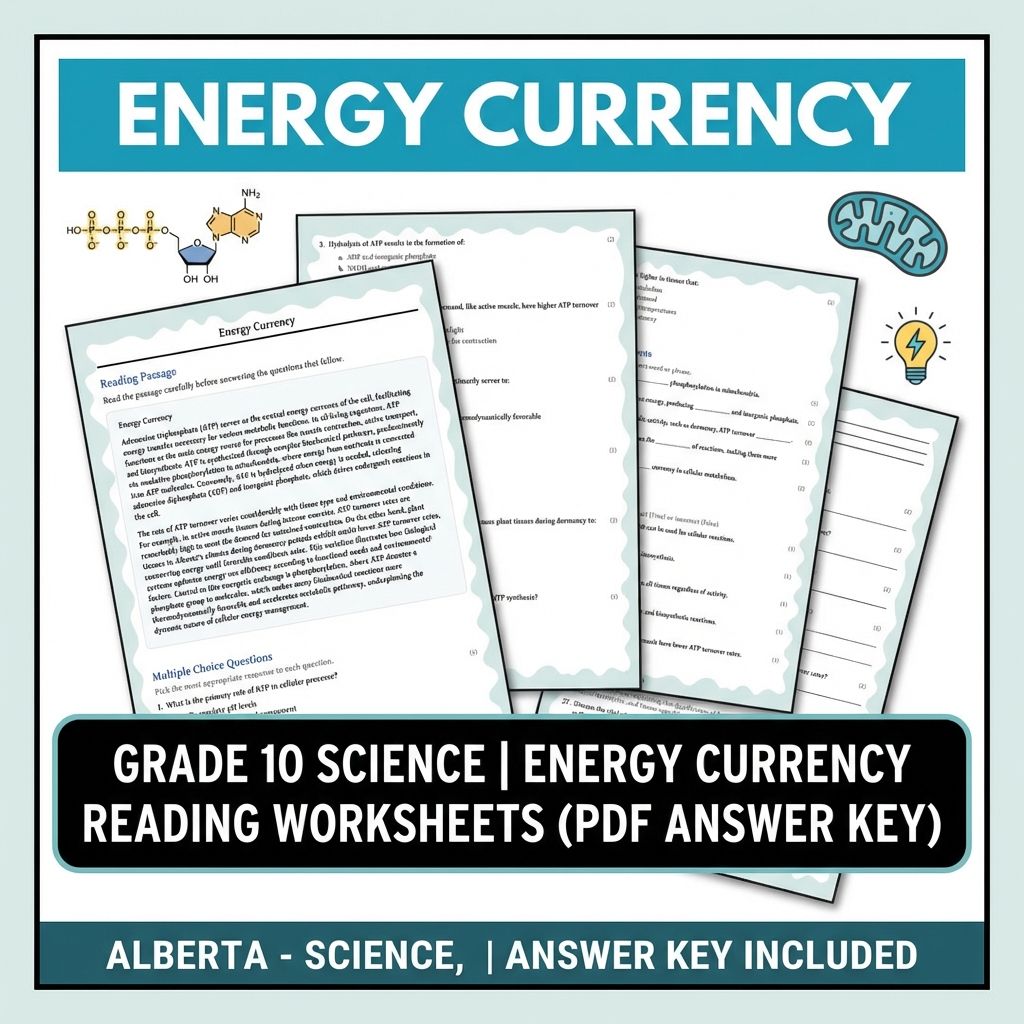
Grade 10 Science | Energy Currency Reading Worksheets (PDF Answer Key)
JCreated byJ.S SheetsLearning Objectives
- Understand the role of ATP as the primary energy currency in cellular processes.
- Explain how ATP synthesis and hydrolysis power metabolic reactions.
- Compare ATP turnover rates across different tissues and environmental contexts.
Also included in: Grade 10 Science | Cell Systems, Energy, & Homeostasis (Standards-Aligned) +1 more
Instant download

Grade 10 Science — Worksheet MCQ Paper for Mastering Work Concepts
 Created byThe Resource Hub
Learning Objectives
- Define work as the product of force component along displacement.
- Understand the scalar nature of work in various contexts.
- Connect work done to changes in kinetic energy via the work-energy theorem.
Also included in: Grade 10 Science AP Bundle – Comprehensive Curriculum with 60 Worksheets
Instant download

Grade 10 Science — Worksheet MCQ Paper for Mastering Computational Concepts
Created byThe Resource HubLearning Objectives
- Understand basic computational approaches for representing dynamic systems.
- Recognize assumptions and limitations in numerical simulations.
- Interpret simulation outputs in relation to analytical models.
Also included in: Grade 10 Science Bundle: Master Scientific Modeling & Data Analysis +1 more
Instant download
10th Grade Science | Comparative Anatomy Mastery (PDF + Answer Key)
JCreated byJ.S SheetsLearning Objectives
- Understand the concept of homologous and analogous structures in different organisms.
- Identify vestigial organs and explain their significance in evolution.
- Connect anatomical similarities with embryological and molecular data.
Instant download
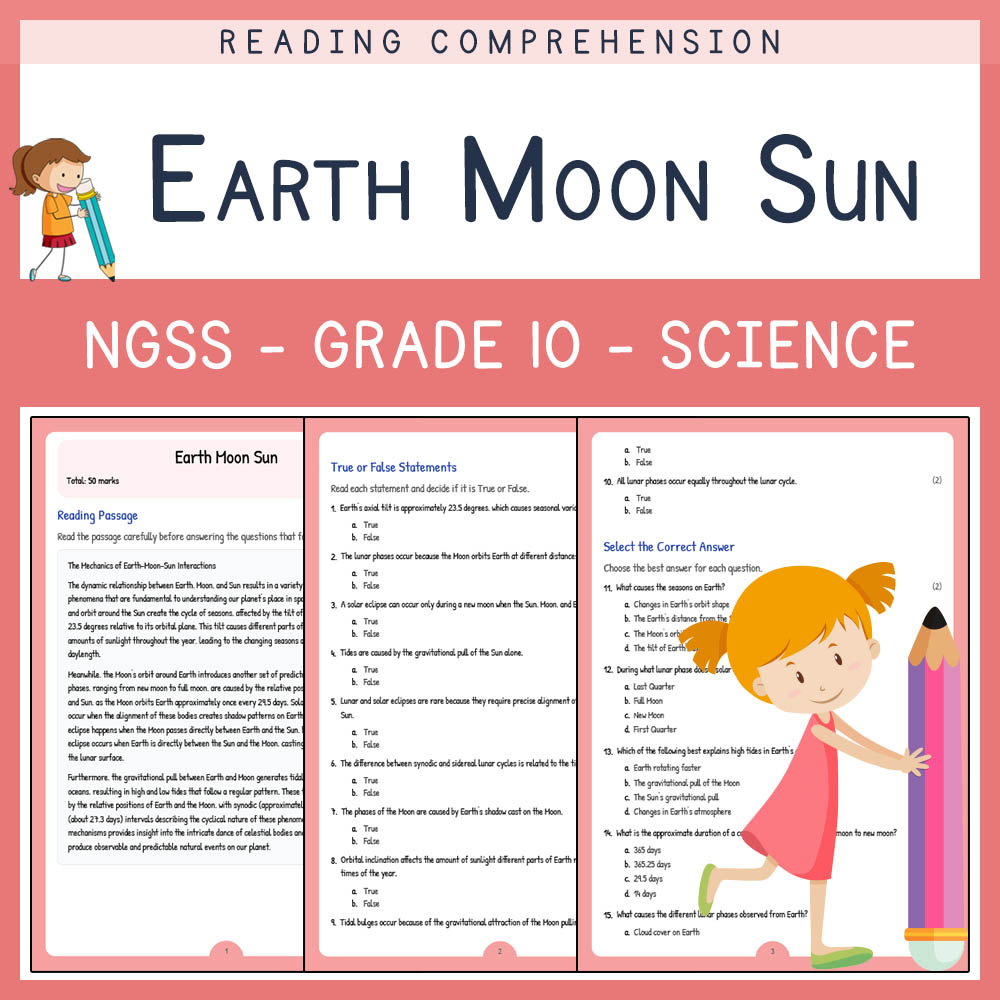
Grade 10 Science | Earth Moon Sun Worksheet (PDF + Answer Key) - NGSS Aligned
Created byLumora LearningLearning Objectives
- Explain the relative positions and motions of Earth, Moon, and Sun that produce lunar phases, eclipses, and seasonal changes.
- Describe how axial tilt and orbital inclination influence daylength and insolation.
- Understand gravitational interactions between Earth and Moon that create tidal cycles and their predictable intervals.
Instant download
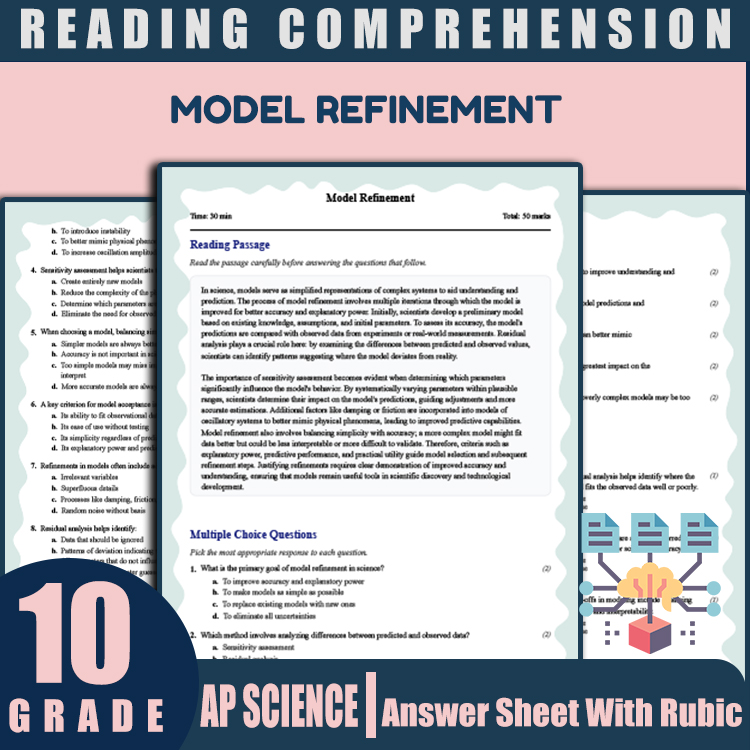
Grade 10 Science Reading Worksheets | Model Refinement Practice PDF (Answer Key)
JCreated byJ.S SheetsLearning Objectives
- Understand the iterative process of refining scientific models based on observed data and comparisons.
- Recognize methods such as residual analysis and sensitivity assessment to guide model improvements.
- Evaluate criteria for selecting appropriate models considering simplicity and accuracy.
Also included in: Grade 10 Science Unit Worksheet Pack – Data Analysis & Scientific Reasoning +1 more
Instant download
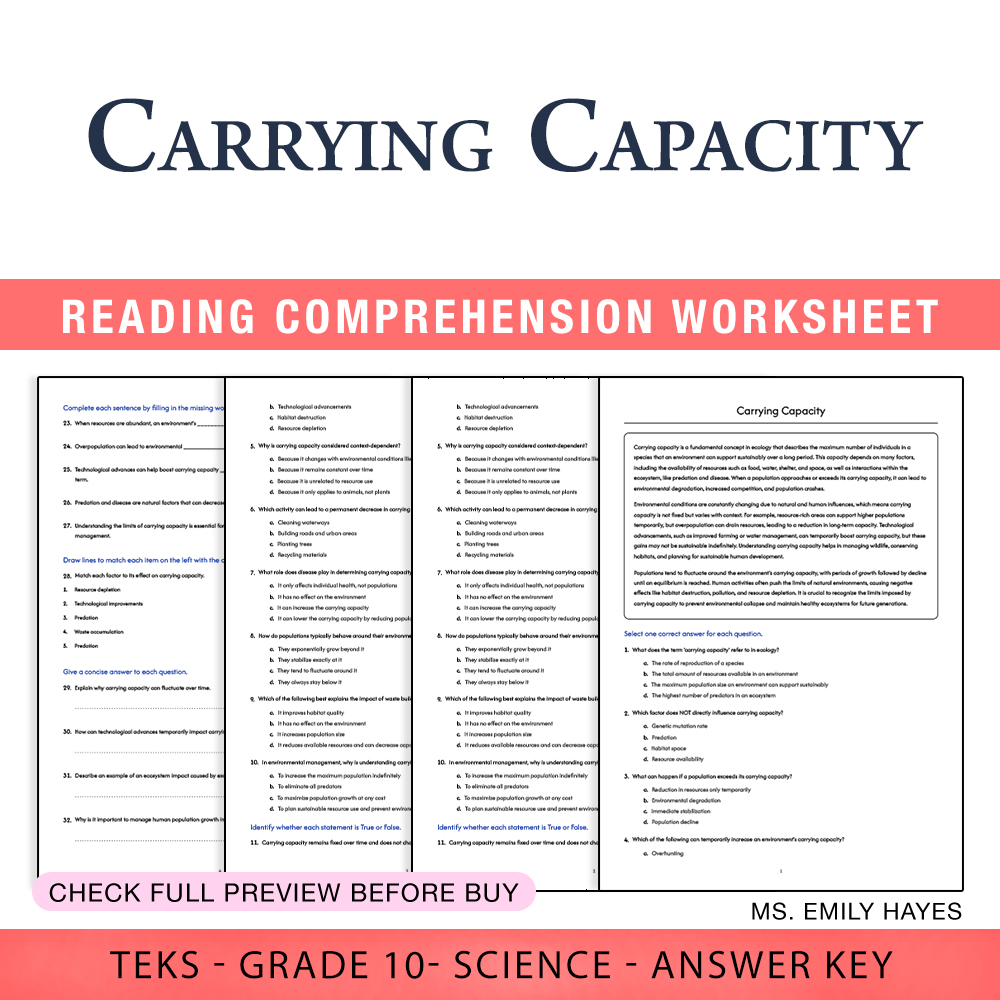
10th Grade Science | Carrying Capacity Worksheet (PDF+ Answer Key)
Created byCopper Leaf ClassroomLearning Objectives
- Define carrying capacity and explain its significance in ecosystems.
- Describe factors that influence an environment's carrying capacity.
- Analyze how resource limitations, predation, disease, and waste impact populations.
Instant download
Grade 10 Science | Carrying Capacity Worksheet with Short Notes (PDF)
Created byMeadowlark WorksheetsLearning Objectives
- Define carrying capacity and explain its significance in ecology.
- Identify factors that influence an environment's carrying capacity.
- Analyze how human activities can impact population sustainability.
Instant download
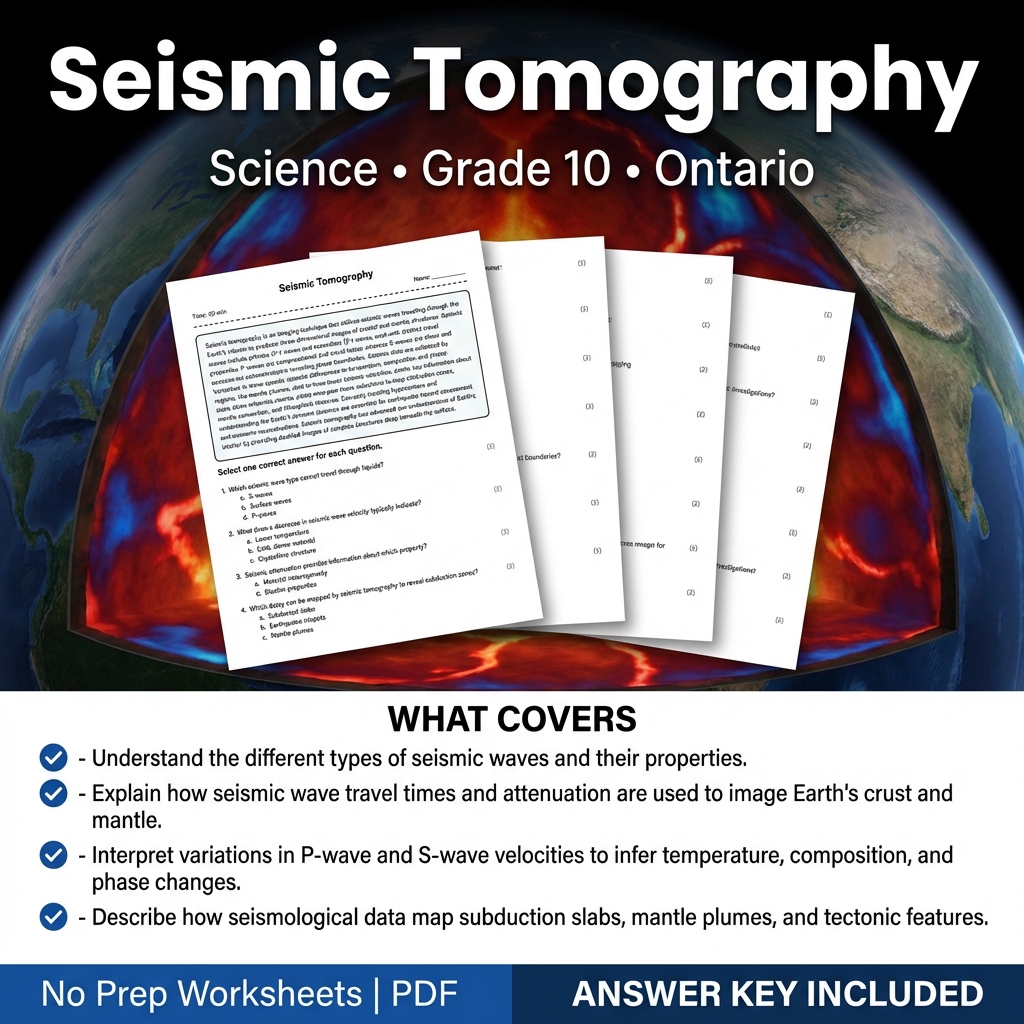
Grade 10 Science Worksheet on Seismic Tomography | Ontario Standards
Created byCoral Reef LearningLearning Objectives
- Understand the different types of seismic waves and their properties.
- Explain how seismic wave travel times and attenuation are used to image Earth's crust and mantle.
- Interpret variations in P-wave and S-wave velocities to infer temperature, composition, and phase changes.
Instant download
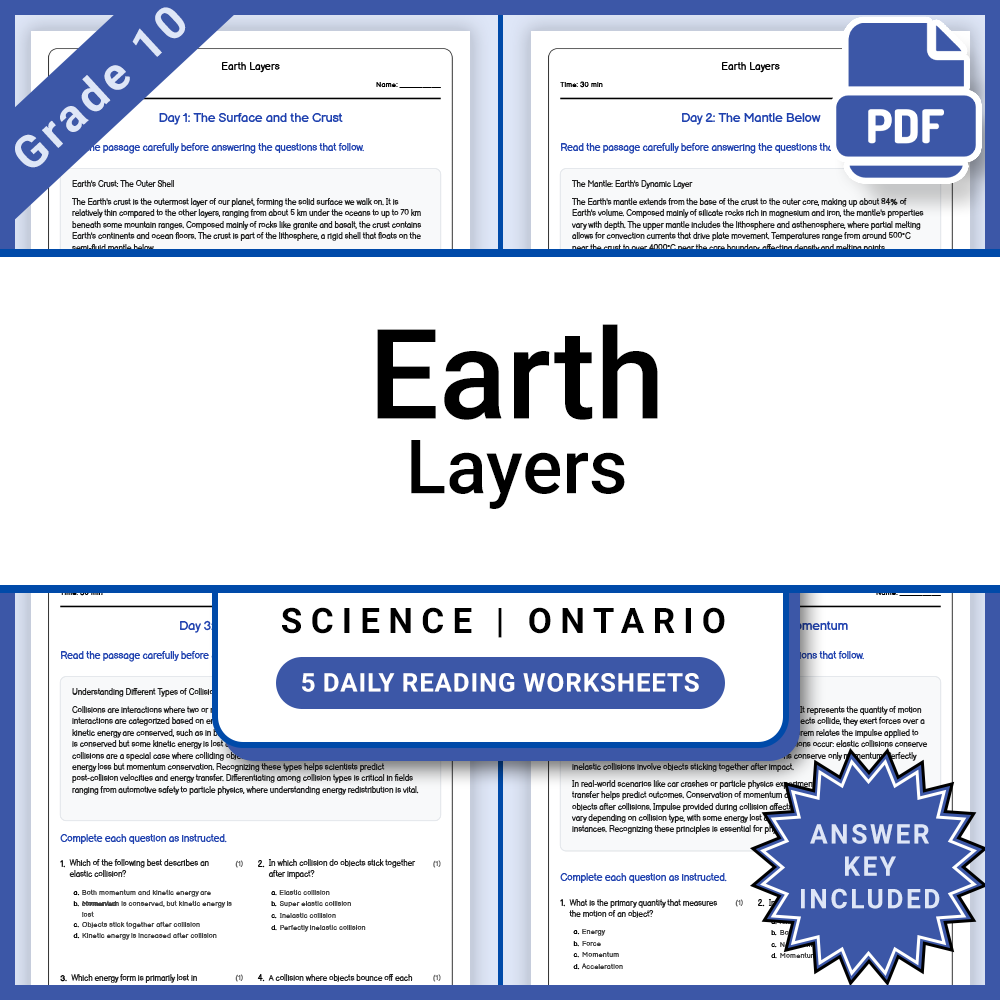
Grade 10 Science – Earth Layers Daily Reading Worksheet + Answer Key
JCreated byJ.S SheetsLearning Objectives
- Identify Earth's crust and distinguish it from other layers.
- Understand the composition and characteristics of Earth's crust.
- Learn how seismic waves inform scientists about Earth's internal structure.
Also included in: Grade 10 Science Lesson Bundle | Earth and Resource Management +1 more
Instant download
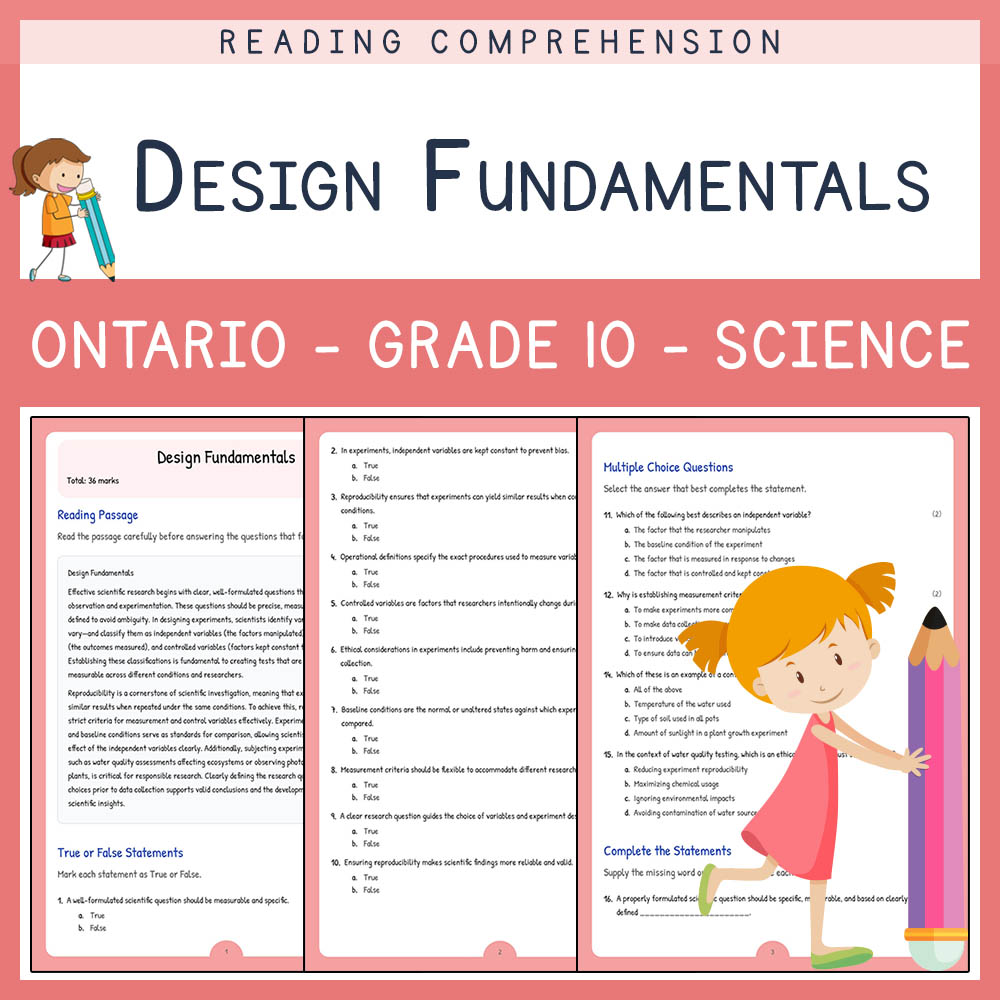
Grade 10 |Science | Design Fundamentals Worksheet Elena | Ontario Standards
Created byLumora LearningLearning Objectives
- Understand the core principles behind formulating testable scientific questions.
- Define and apply operational definitions to variables.
- Classify variables as independent, dependent, or controlled in experiments.
Instant download
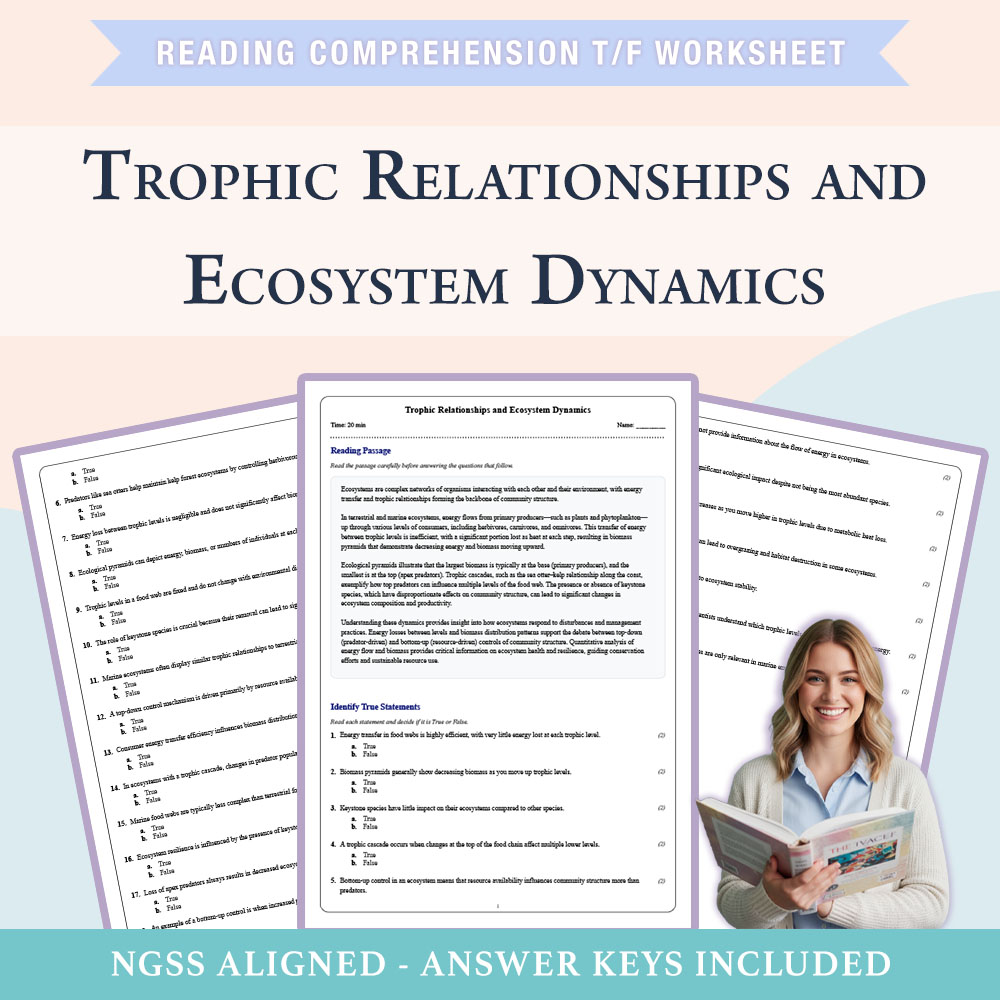
10th Grade Science | Trophic Relationships and Ecosystem Dynamics (PDF +Answers)
Created byCopper Leaf ClassroomLearning Objectives
- Understand the concept of trophic levels and energy transfer within food webs.
- Identify key features of biomass pyramids and their implications for ecosystem structure.
- Recognize the roles of keystone species and trophic cascades in maintaining community stability.
Also included in: Grade 10 Science Unit | Ecosystem Dynamics & Biodiversity (PDF +Answer Key) +1 more
Instant download

Grade 10 Science – Plate Boundaries & Divergent Boundaries | Reading Worksheet
Created byBright Mind ResourcesLearning Objectives
- Explain what divergence at plate boundaries involves.
- Identify key features associated with divergent boundaries.
- Describe the process of seafloor spreading and mid-ocean ridge formation.
Also included in: Earth Systems Grade 10 Science Daily Reading Worksheets Bundle | NGSS +2 more
Instant download
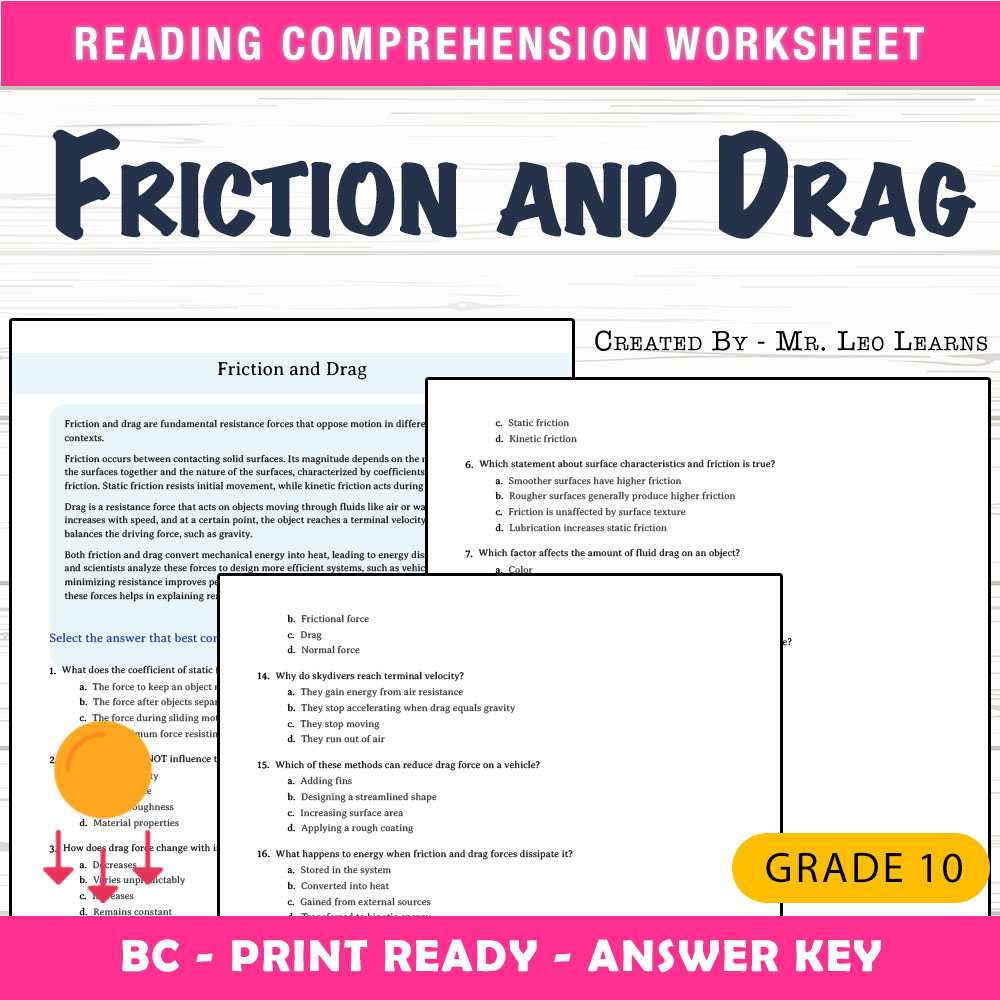
Grade 10 Science — Friction and Drag Worksheet MCQ Practice
Created byThe Resource HubLearning Objectives
- Understand the mechanisms of friction and drag and their effects on motion.
- Identify factors influencing the magnitude of friction and drag forces.
- Explain the concept of terminal velocity resulting from drag forces.
Also included in: Grade 10 Science | Forces, Motion & Fields UNIT Worksheet Bundle +1 more
Instant download
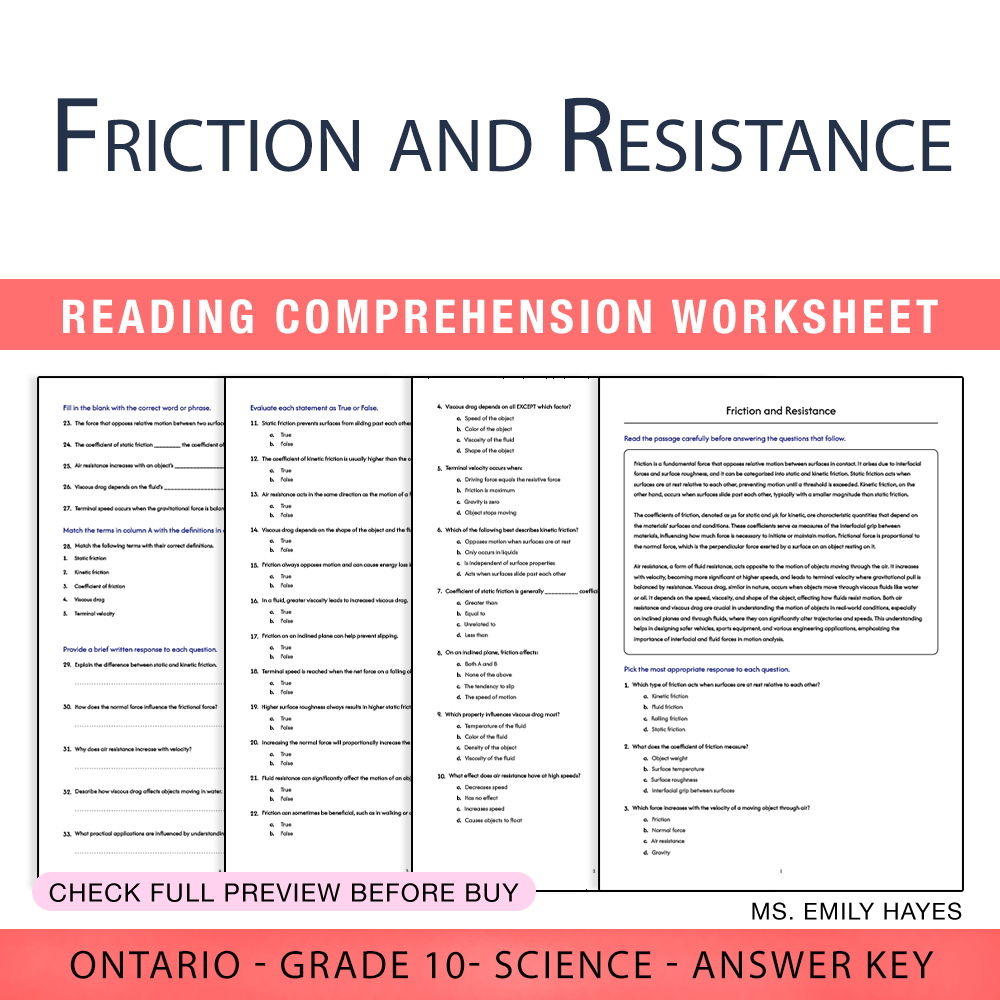
Grade 10 Science | Friction and Resistance Worksheet (PDF + Answer Key)
Created byCopper Leaf ClassroomLearning Objectives
- Describe the types of friction and their differences.
- Explain how the coefficients of friction relate to surface properties.
- Assess the effects of air resistance and viscous drag on moving objects.
Instant download
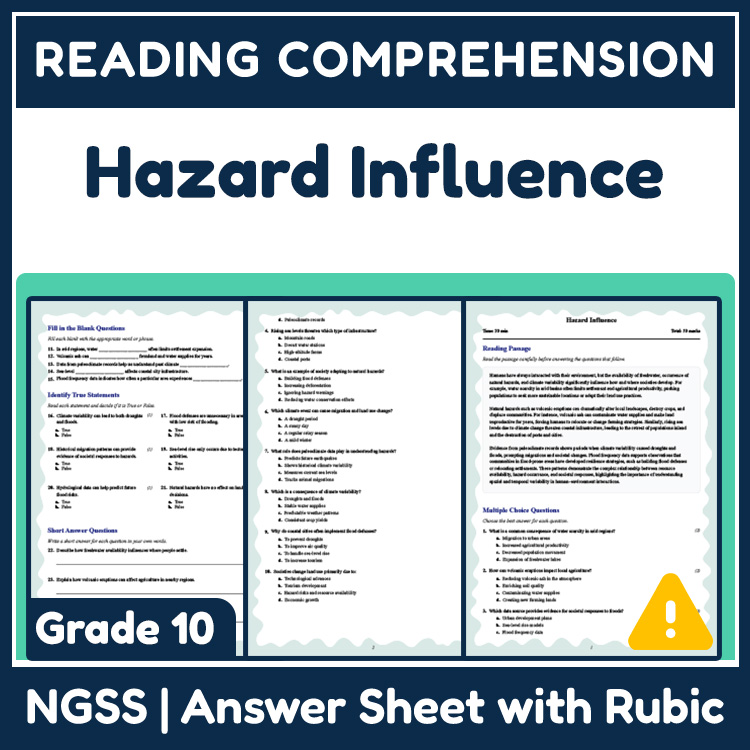
10th Grade Science | Hazard Influence Reading Worksheet & Answer Key (PDF)
JCreated byJ.S SheetsLearning Objectives
- Explain how freshwater availability affects human settlement patterns.
- Describe the impact of natural hazards like volcanic eruptions and sea-level rise on land use.
- Analyze evidence from paleoclimate and historical data to understand societal responses to hazards.
Also included in: Grade 10 Science | Climate Change & Land Use Unit Worksheet Bundle
Instant download
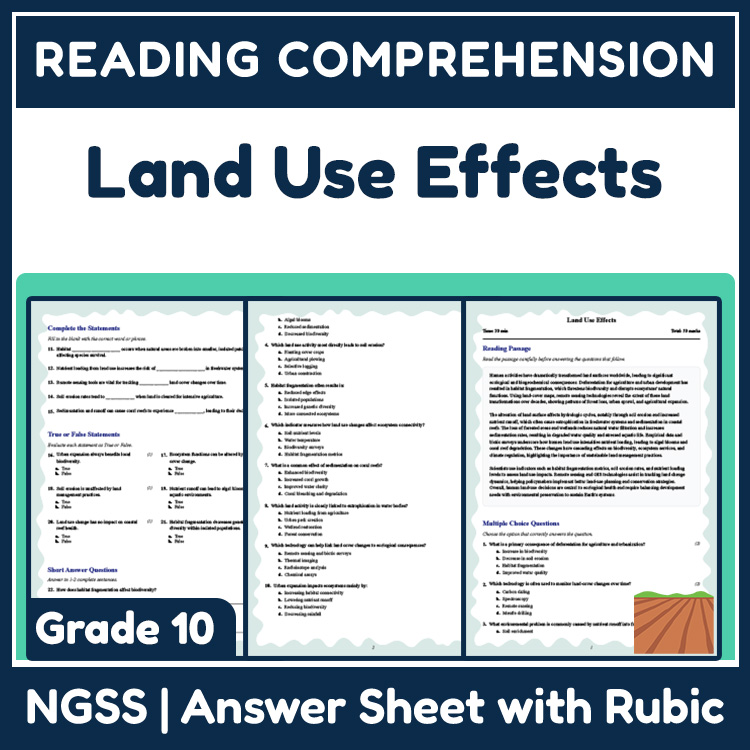
10th Grade Science | Land Use Effects Reading Worksheet (PDF & Rubric)
JCreated byJ.S SheetsLearning Objectives
- Understand how land-use changes impact ecosystems and Earth systems
- Identify indicators of land-use impacts such as habitat fragmentation and soil erosion
- Analyze empirical data from land cover maps and remote sensing to interpret ecological consequences
Also included in: Grade 10 Science | Climate Change & Land Use Unit Worksheet Bundle
Instant download
About Grade 10 Science Worksheets
Find Science worksheets built for Grade 10. All 7,069 cover core skills, practice, and review, each an instant PDF download.
Every worksheet on MyTeachingSheets is created by independent teacher-authors and reviewed before publication. All resources download as printable PDFs for classroom, homework, or at-home practice, and many include answer keys. Preview any worksheet free before buying.