
Grade 10 Science Worksheets
7,069 worksheets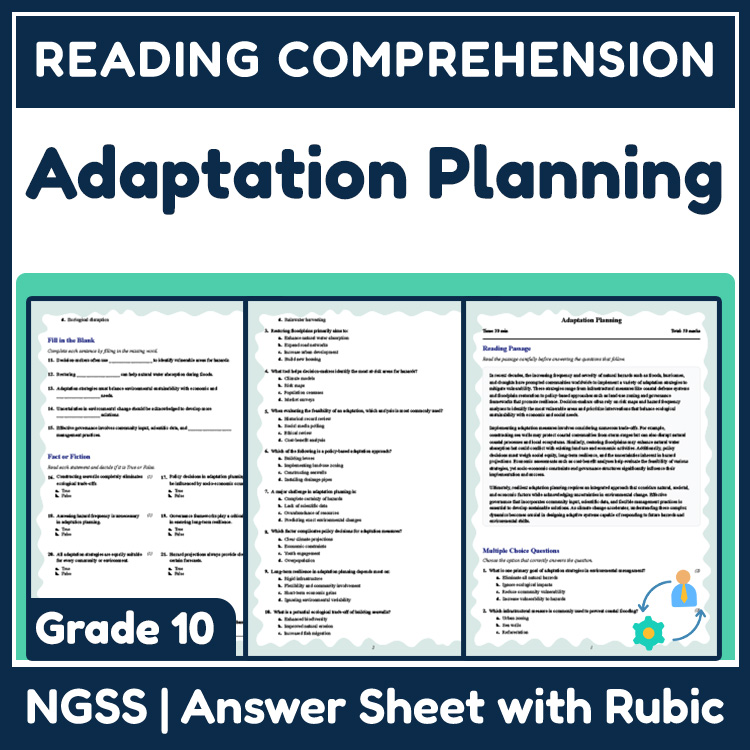
10th Grade Science | Adaptation Planning Reading Worksheet & Answer Key (PDF)
JCreated byJ.S SheetsLearning Objectives
- Understand the concept of environmental adaptation responses to natural hazards.
- Evaluate the trade-offs involved in infrastructural and policy responses to reduce vulnerability.
- Analyze risk maps, hazard analyses, and governance frameworks to assess adaptation feasibility.
Also included in: Grade 10 Science | Climate Change & Land Use Unit Worksheet Bundle
Instant download
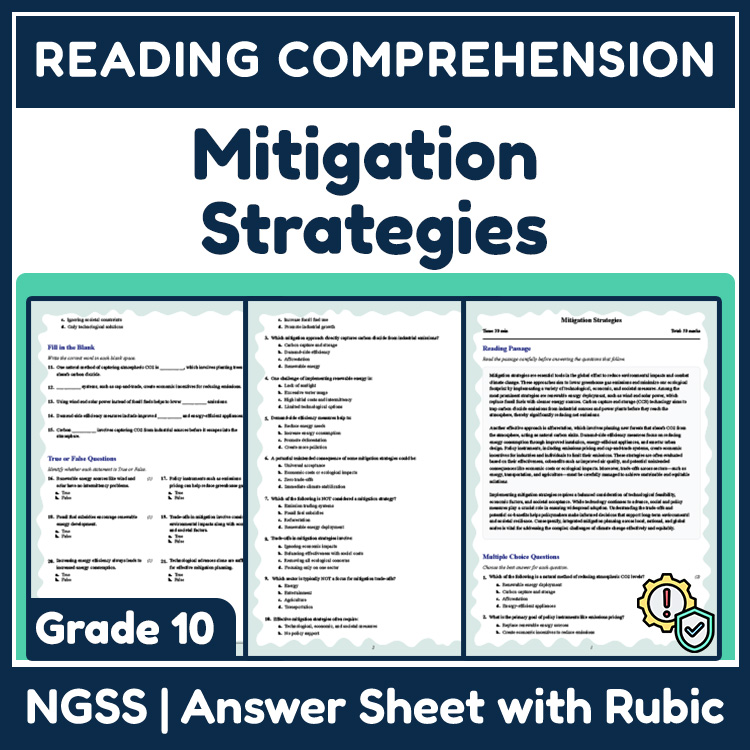
10th Grade Science | Mitigation Strategies Reading Worksheet with Answer Key
JCreated byJ.S SheetsLearning Objectives
- Understand various mitigation strategies to reduce environmental impacts and greenhouse gases.
- Analyze the effectiveness and trade-offs of different mitigation approaches across sectors.
- Evaluate technological, economic, and societal constraints affecting mitigation options.
Also included in: Grade 10 Science | Climate Change & Land Use Unit Worksheet Bundle
Instant download
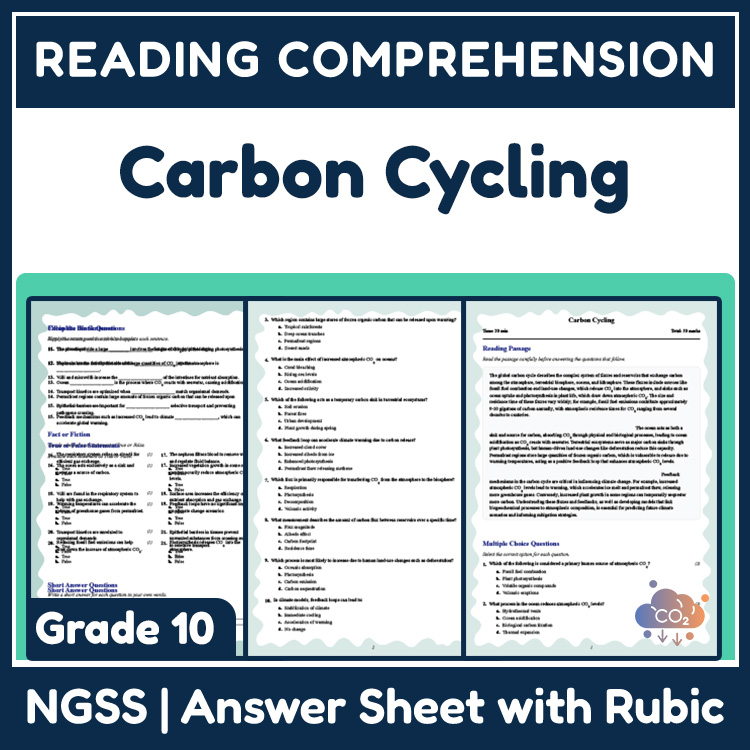
10th Grade Science | Carbon Cycling Reading Worksheet (PDF & Answer Key)
JCreated byJ.S SheetsLearning Objectives
- Explain the components and processes involved in the carbon cycle.
- Analyze the impact of human activities on atmospheric carbon levels and climate change.
- Describe feedback mechanisms within the carbon cycle and their effects on global climate.
Also included in: Grade 10 Science | Climate Change & Land Use Unit Worksheet Bundle
Instant download
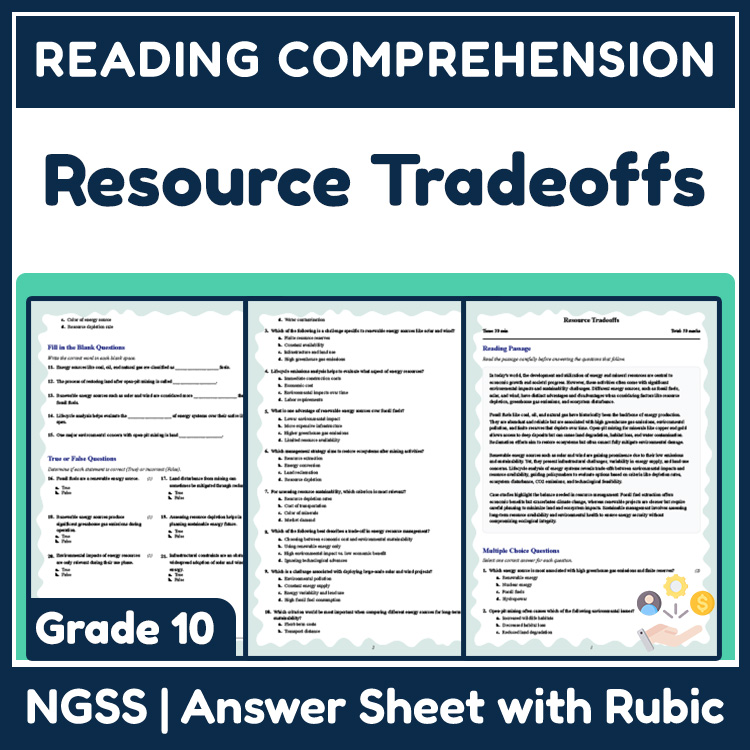
10th Grade Science | Resource Tradeoffs Reading Worksheet & Answer Key (PDF)
JCreated byJ.S SheetsLearning Objectives
- Understand the different types of energy and mineral resources and their impacts on the environment and economy.
- Evaluate trade-offs involved in resource development and management strategies.
- Analyze case studies involving fossil fuels, renewable energy, and mining impacts to compare sustainability and environmental effects.
Also included in: Grade 10 Science | Climate Change & Land Use Unit Worksheet Bundle
Instant download
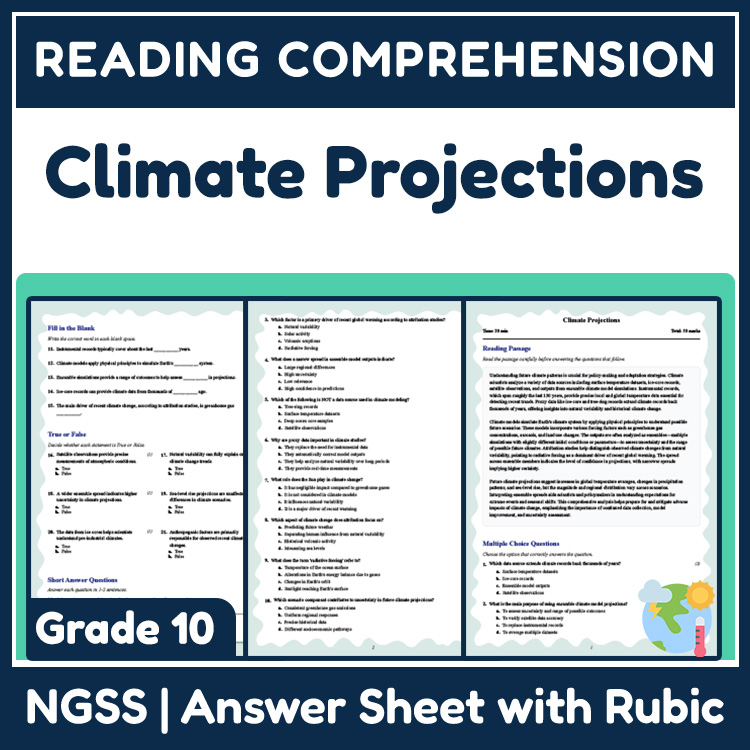
Grade 10 Science | Climate Projections Reading Worksheet & Answer Key (PDF)
JCreated byJ.S SheetsLearning Objectives
- Understand how instrumental records, proxy data, and model outputs contribute to climate trend analysis.
- Interpret differences between observed climate data and model projections.
- Identify key factors influencing global and regional climate changes and uncertainties.
Also included in: Grade 10 Science | Climate Change & Land Use Unit Worksheet Bundle
Instant download
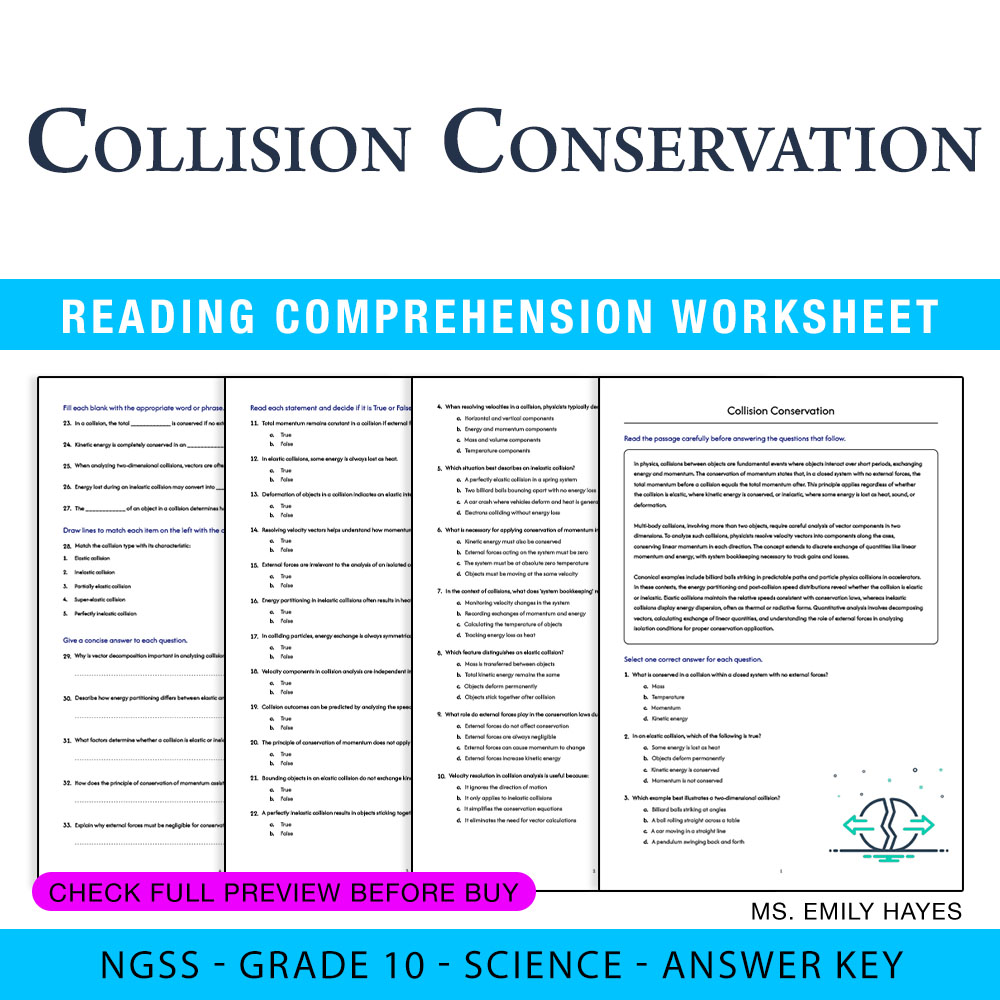
10th Grade Science | Collision Conservation Worksheet (PDF+ Answer Key)
 Created byCopper Leaf Classroom
Learning Objectives
- Understand the principles of conservation of momentum and energy in multi-body collisions.
- Analyze two-dimensional collision components using vector resolution.
- Differentiate between elastic and inelastic collisions based on energy and speed distributions.
Instant download
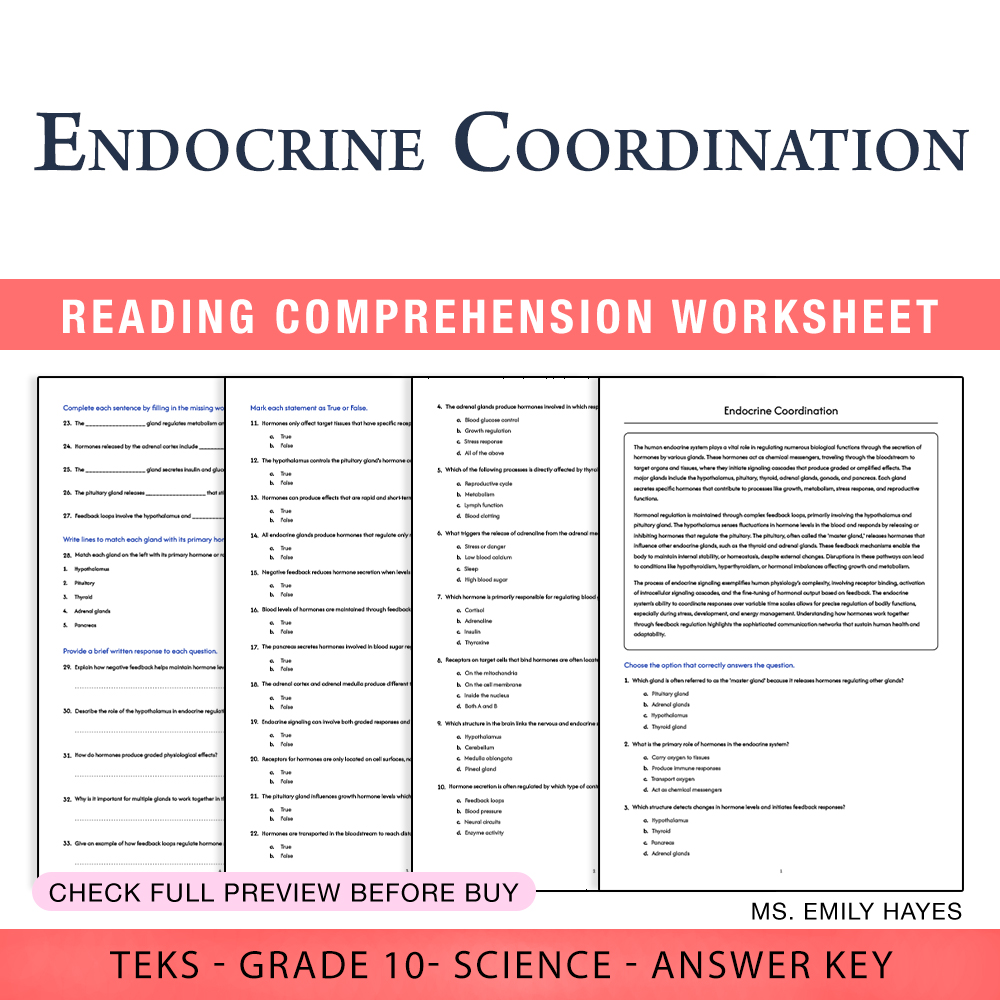
Grade 10 Science | Endocrine Coordination Worksheet (PDF+ Answer Key)
Created byCopper Leaf ClassroomLearning Objectives
- Explain how hormones regulate growth, metabolism, and reproductive processes.
- Describe the feedback mechanisms involving the hypothalamus and pituitary gland.
- Identify different glands involved in endocrine coordination and their functions.
Instant download
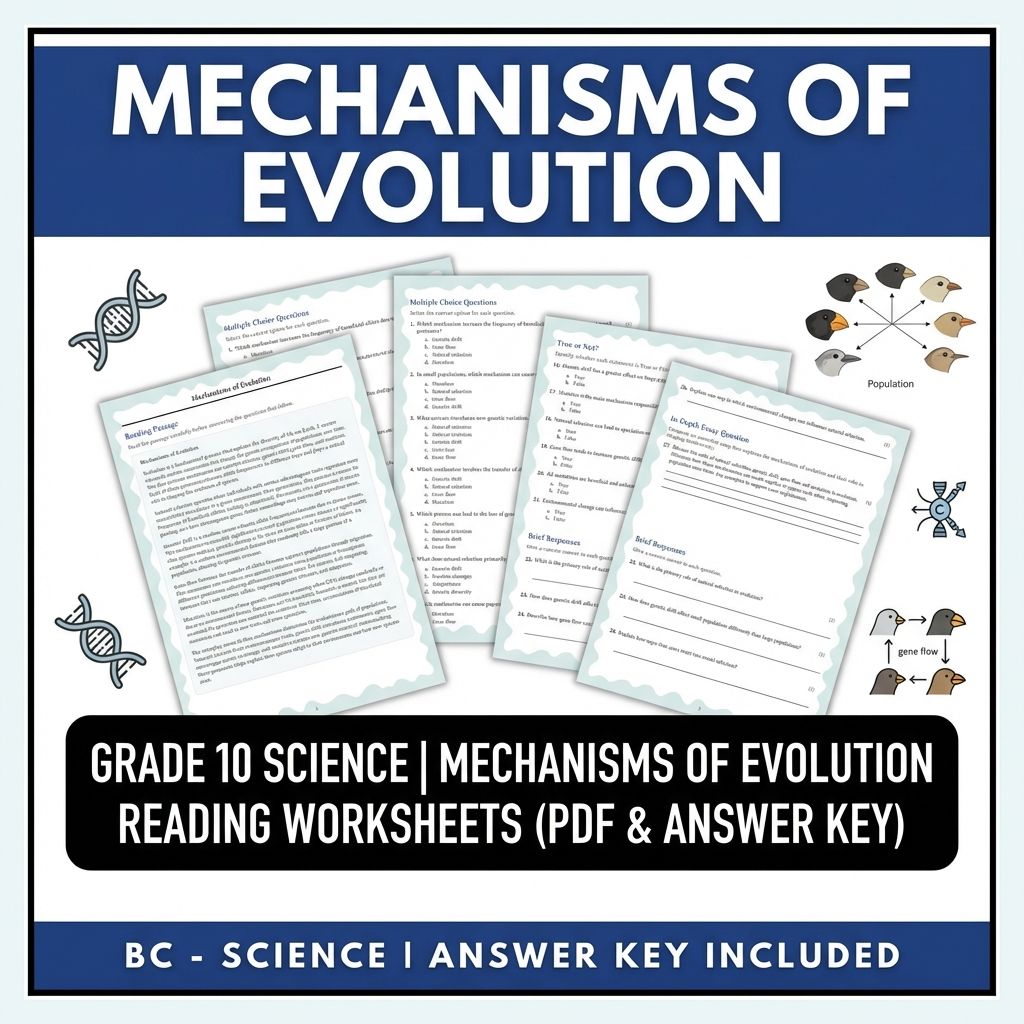
Grade 10 Science | Mechanisms of Evolution Reading Worksheets (PDF & Answer Key)
JCreated byJ.S SheetsLearning Objectives
- Understand the four main mechanisms of evolution: natural selection, genetic drift, gene flow, and mutation.
- Explain how each mechanism alters allele frequencies within populations.
- Describe the role of natural selection in adaptation and reproductive advantage.
Instant download
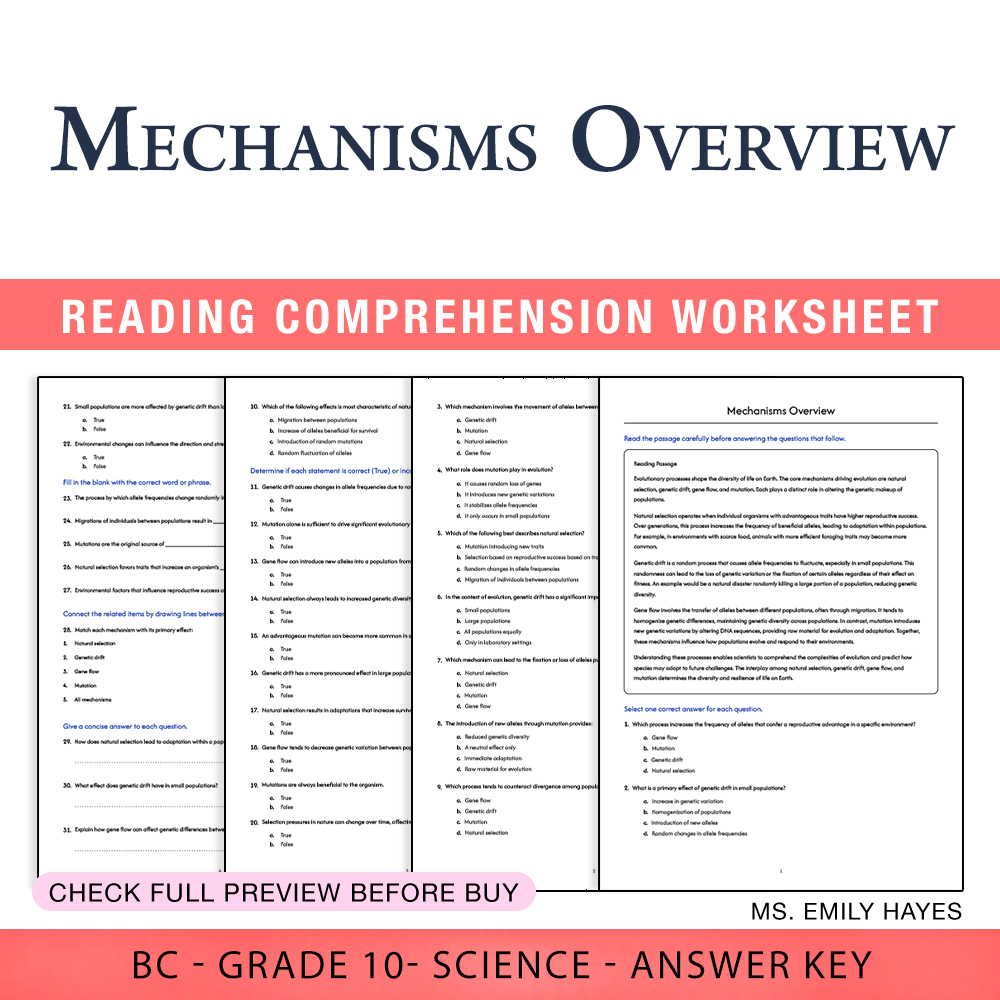
Grade 10 Science | Mechanisms of Evolution Worksheet (PDF+ Answer Key)
Created byCopper Leaf ClassroomLearning Objectives
- Identify and describe the four main mechanisms of evolution: natural selection, genetic drift, gene flow, and mutation.
- Explain how each mechanism influences allele frequencies within populations.
- Analyze the effects of natural selection and genetic drift on population adaptation and variation.
Also included in: Grade 10 Science BC | Evolution, Biodiversity & Ecology (PDF + Answer Key) +1 more
Instant download

Grade 10 Worksheet B: Particle Interactions Practice | NGSS PDF
 Created byClear Sky Classroom
Learning Objectives
- Explain how crystal structure and particle arrangement influence bulk properties such as melting point, solubility, and electrical conductivity.
- Compare ionic, molecular (covalent), and metallic solids using intermolecular/interionic forces (lattice energy, dispersion forces, and hydrogen bonding).
- Relate the strength and type of particle attractions to macroscopic phase transitions and electrical behavior.
Also included in: Grade 10 Reaction Rates & Chemical Change Science Lesson Bundle – NGSS +1 more
Instant download

Grade 10 Worksheet B: Chemical Equilibrium and Le Chatelier’s Principle | NGSS
Created byClear Sky ClassroomLearning Objectives
- Explain chemical equilibrium as a dynamic, rate-balanced process and relate it to measurable outcomes.
- Predict how changes in pressure, concentration, and temperature shift equilibria using Le Chatelier’s principle.
- Interpret the equilibrium constant K as a quantitative description of equilibrium composition at a given temperature.
Also included in: Grade 10 Reaction Rates & Chemical Change Science Lesson Bundle – NGSS +1 more
Instant download

Grade 10 Worksheet B: Reaction Evidence Practice | NGSS PDF
Created byClear Sky ClassroomLearning Objectives
- Explain chemical reaction outcomes using conservation of atoms and atomic rearrangement.
- Connect observable evidence (gas, color, temperature, precipitate) to predicted products.
- Use balanced formulations to support evidence-based claims about reactions.
Also included in: Grade 10 Reaction Rates & Chemical Change Science Lesson Bundle – NGSS +1 more
Instant download

Grade 10 Worksheet B: Mass Conservation in Chemical Reactions Practice | NGSS
Created byClear Sky ClassroomLearning Objectives
- Explain mass conservation using balanced chemical equations and atomic accounting.
- Use coefficients, mole concepts, and molar masses to relate reactant and product amounts.
- Verify that total mass of reactants equals total mass of products by tracking atom counts in examples.
Also included in: Grade 10 Reaction Rates & Chemical Change Science Lesson Bundle – NGSS +1 more
Instant download
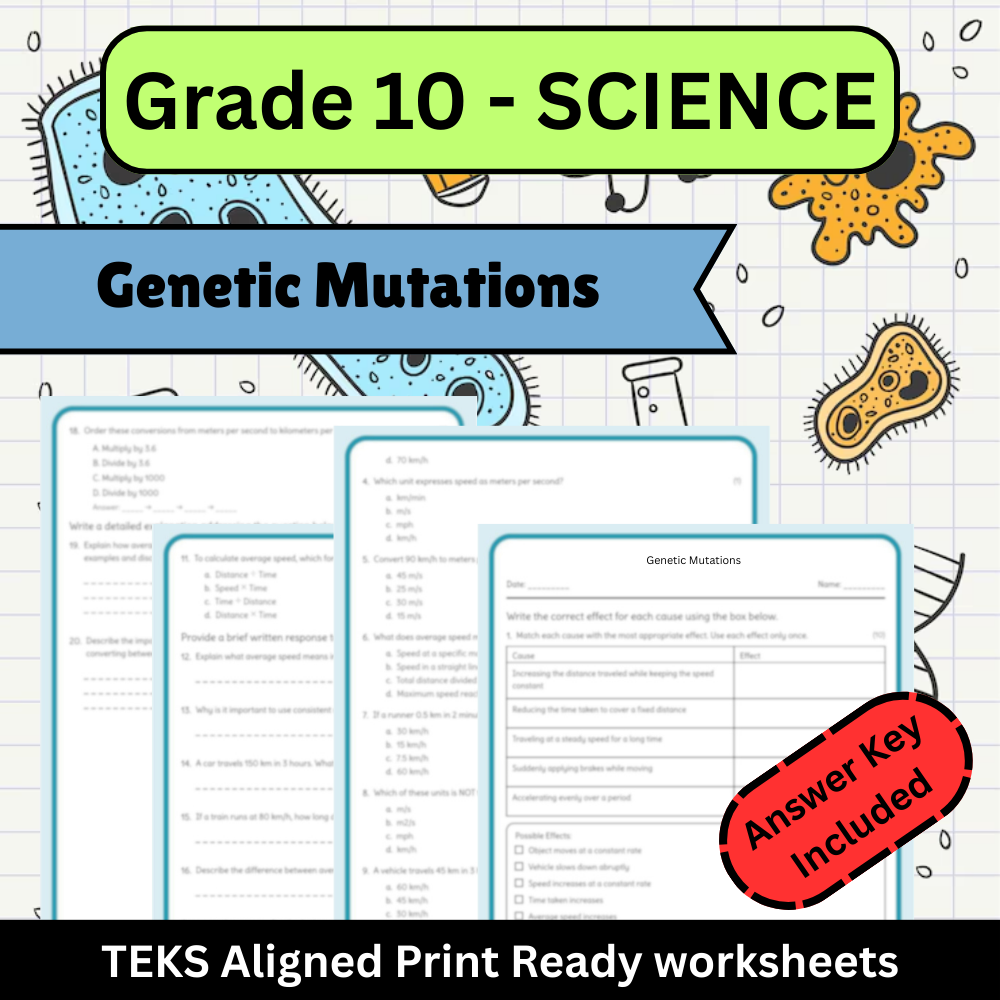
Grade 10 Science | Genetic Mutations Practice Worksheet (Answer Key) – TEKS Aligned
 Created byBright Mind Resources
Learning Objectives
- Understand the different types of genetic mutations and their effects on genes and proteins.
- Identify examples of point mutations, insertions, deletions, and chromosomal alterations.
- Explain how mutations can influence phenotype and hereditary disorders.
Also included in: Grade 10 Science | Genetics & DNA Unit Worksheet Pack (TEKS Aligned) +5 more
Instant download
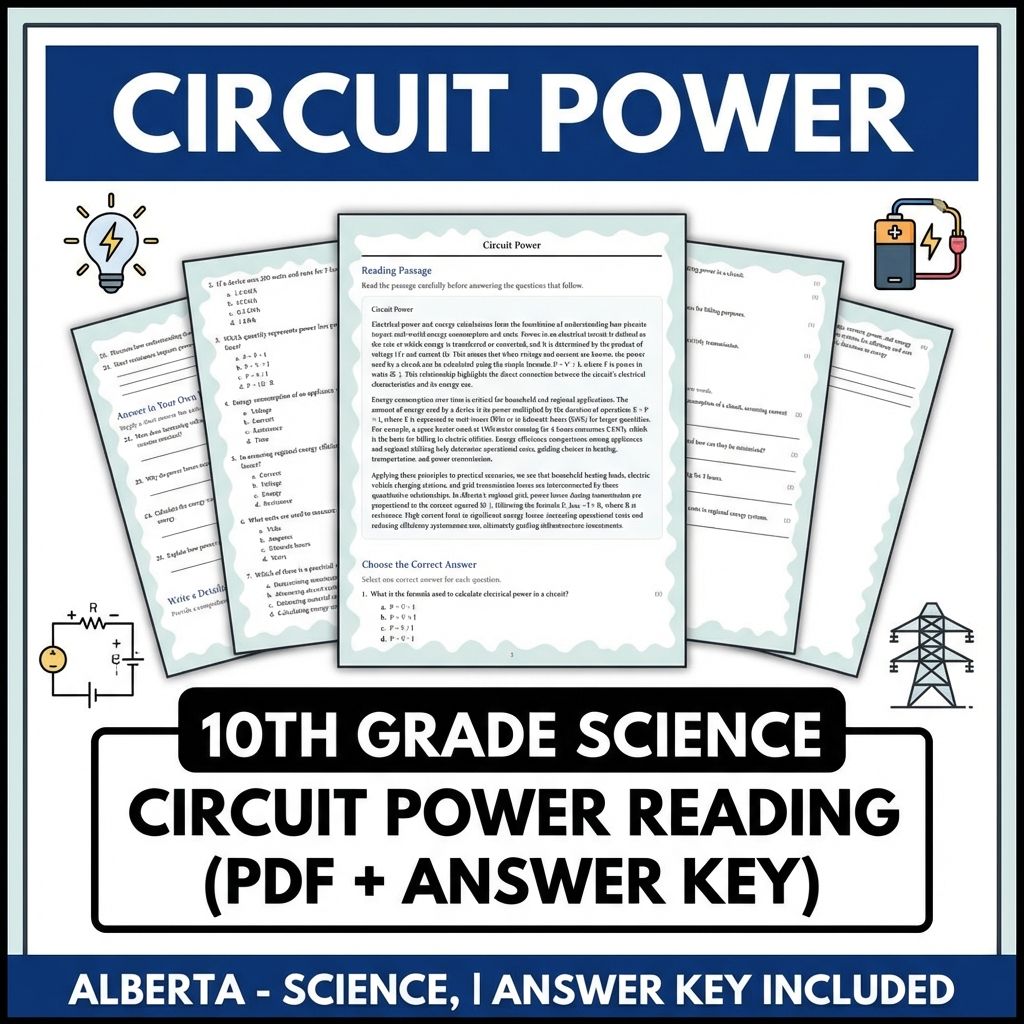
10th Grade Science | Circuit Power Reading Worksheets (PDF + Answer Key)
JCreated byJ.S SheetsLearning Objectives
- Define electrical power in terms of voltage and current.
- Explain how energy consumption relates to circuit quantities over time.
- Apply power and energy calculations to household and regional electrical scenarios.
Also included in: Grade 10 Science Bundle | Energy, Circuits & Mechanics (Answer Keys Included) +1 more
Instant download
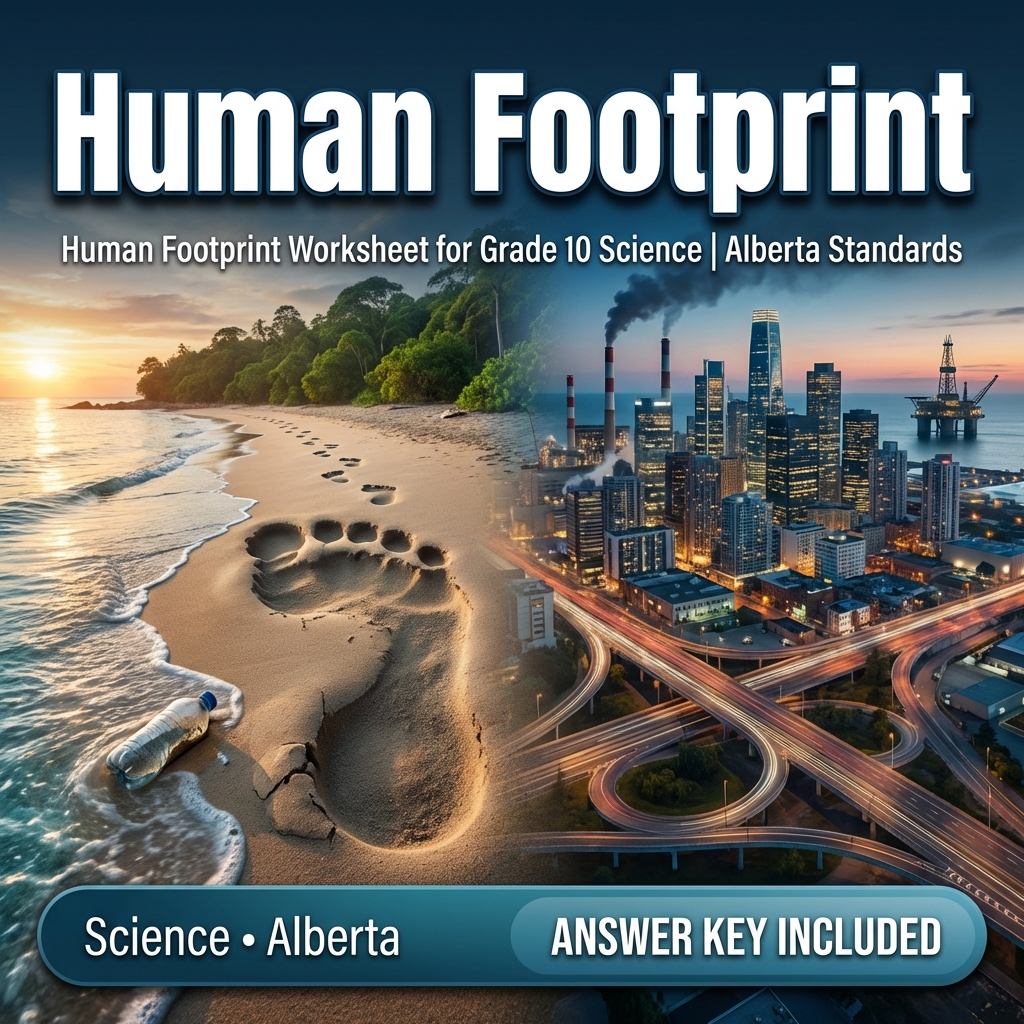
Human Footprint Worksheet for Grade 10 Science | Alberta Standards
 Created byCoral Reef Learning
Learning Objectives
- Understand how human activities impact Earth systems including land, water, and atmosphere.
- Identify regional examples of land-use change and resource extraction effects.
- Evaluate the long-term environmental consequences of urban expansion and resource development.
Instant download
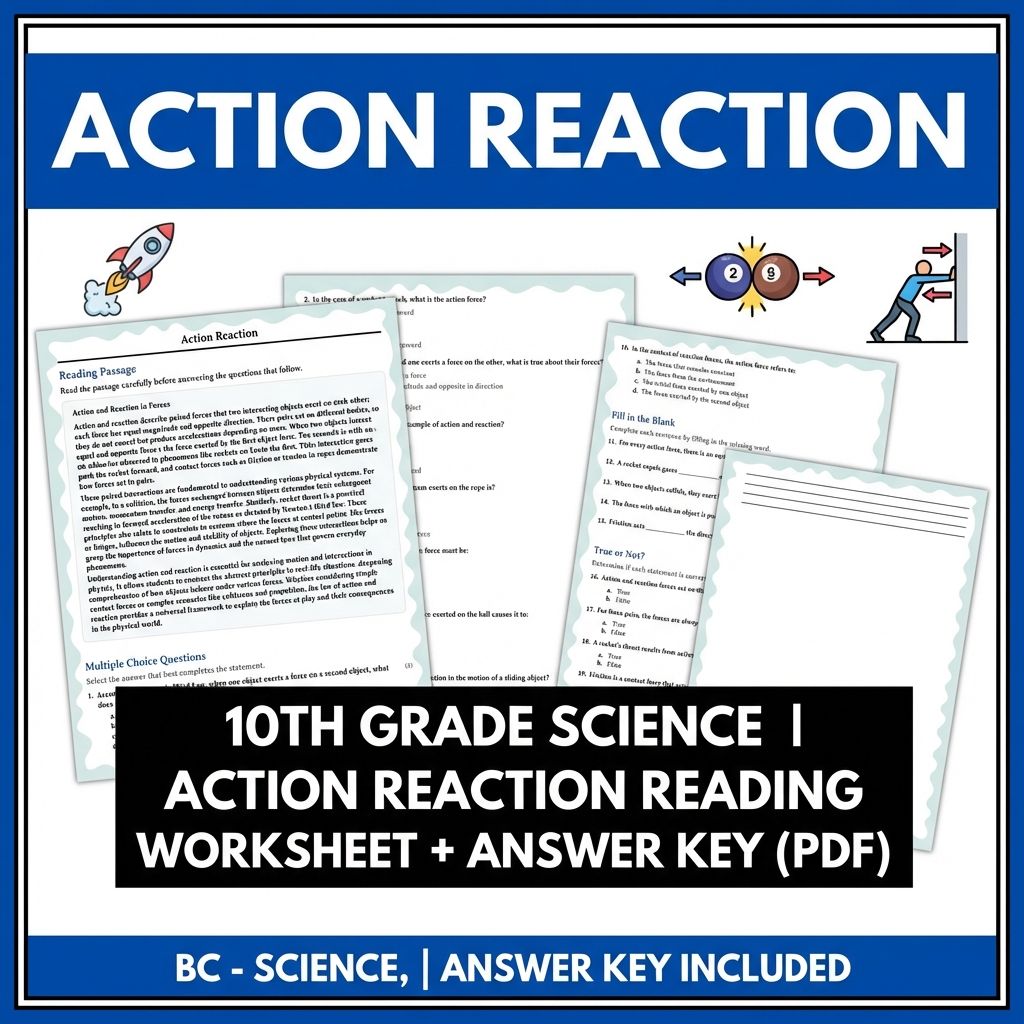
10th Grade Science | Action Reaction Reading Worksheet + Answer Key (PDF)
JCreated byJ.S SheetsLearning Objectives
- Explain the concept of paired forces in action and reaction.
- Describe how equal and opposite forces affect different objects.
- Analyze real-world examples like collisions and rocket thrust using Newton's Third Law.
Instant download
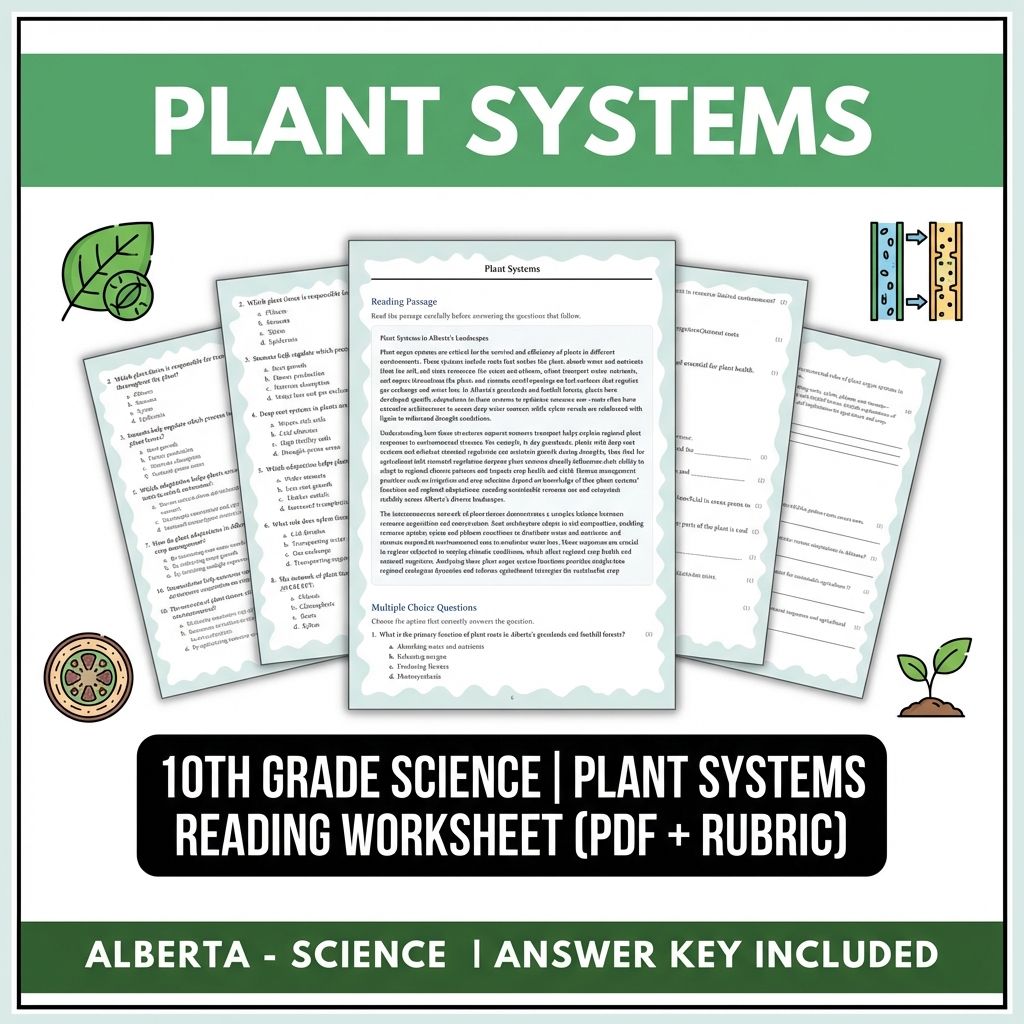
10th Grade Science | Plant Systems Reading Worksheet (PDF + Rubric)
JCreated byJ.S SheetsLearning Objectives
- Describe the structure and function of plant organ systems in water, nutrient, and resource transport.
- Explain how plant adaptations for resource acquisition vary in Alberta's grasslands and foothill forests.
- Identify the roles of roots, xylem, phloem, and stomata in plant water and nutrient movement.
Also included in: Grade 10 Science | Cell Systems, Energy, & Homeostasis (Standards-Aligned) +1 more
Instant download
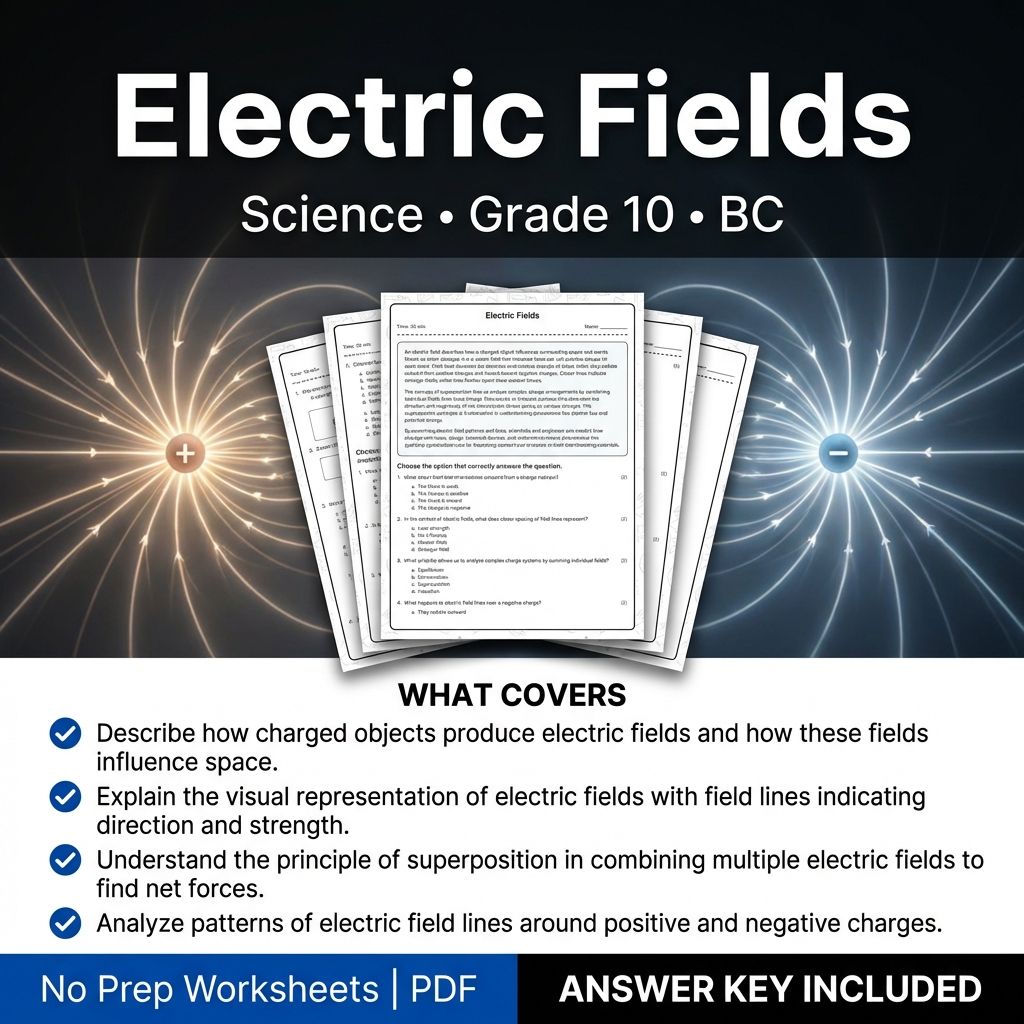
10th Grade Science | Electric Fields Worksheet with Answer Key (Printable PDF)
Created byCoral Reef LearningLearning Objectives
- Describe how charged objects produce electric fields and how these fields influence space.
- Explain the visual representation of electric fields with field lines indicating direction and strength.
- Understand the principle of superposition in combining multiple electric fields to find net forces.
Instant download

10th Grade Science | Impulse and Momentum Worksheet (PDF+ Answer Key)
Created byCopper Leaf ClassroomLearning Objectives
- Explain the concept of impulse and how it relates to change in momentum.
- Understand the conservation of momentum in isolated collisions.
- Differentiate between elastic, inelastic, and perfectly inelastic collisions.
Also included in: Grade 10 Science AP | Physics & Energy Concepts (PDF+ Answer Key) +1 more
Instant download
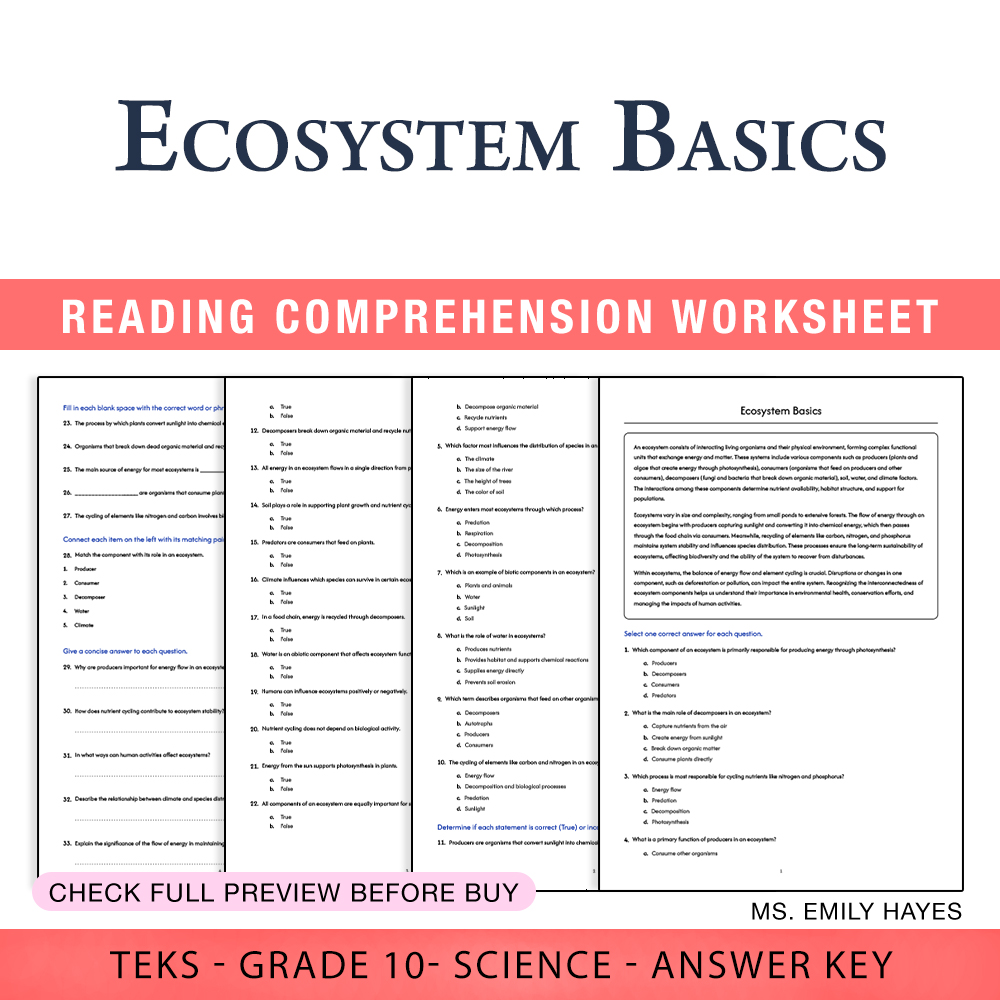
10th Grade Science | Ecosystem Basics Worksheet (PDF+ Answer Key)
Created byCopper Leaf ClassroomLearning Objectives
- Define and describe the components of an ecosystem.
- Explain the interactions among producers, consumers, decomposers, and the environment.
- Identify the flow of energy and cycling of elements within different ecosystems.
Instant download
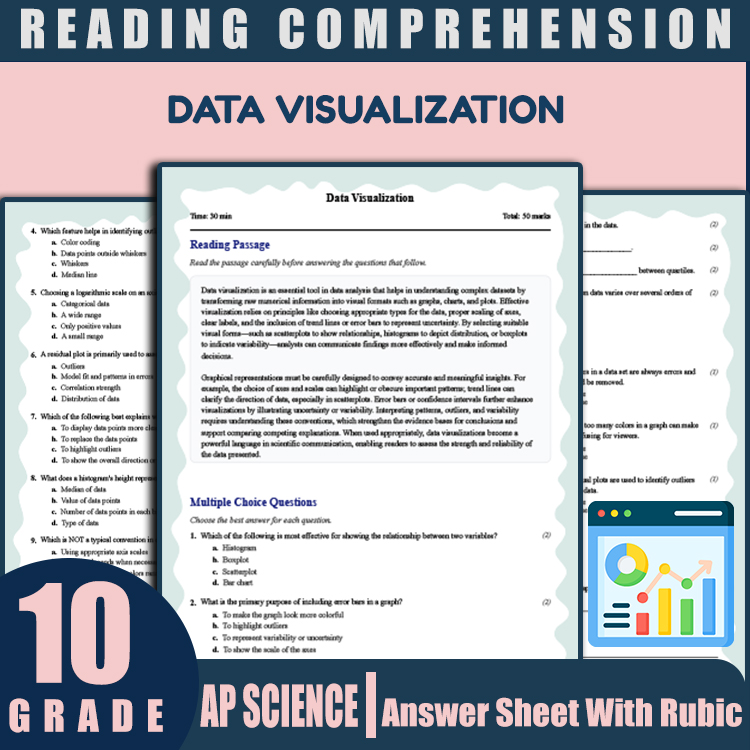
Grade 10 Science | Data Visualization Reading Worksheet (PDF + Rubric)
JCreated byJ.S SheetsLearning Objectives
- Understand principles and conventions of graphical and tabular data representation.
- Identify different types of data visualizations such as scatterplots, histograms, and boxplots.
- Interpret data patterns, variability, outliers, and assess the strength of evidence from visualizations.
Also included in: Grade 10 Science Unit Worksheet Pack – Data Analysis & Scientific Reasoning +1 more
Instant download
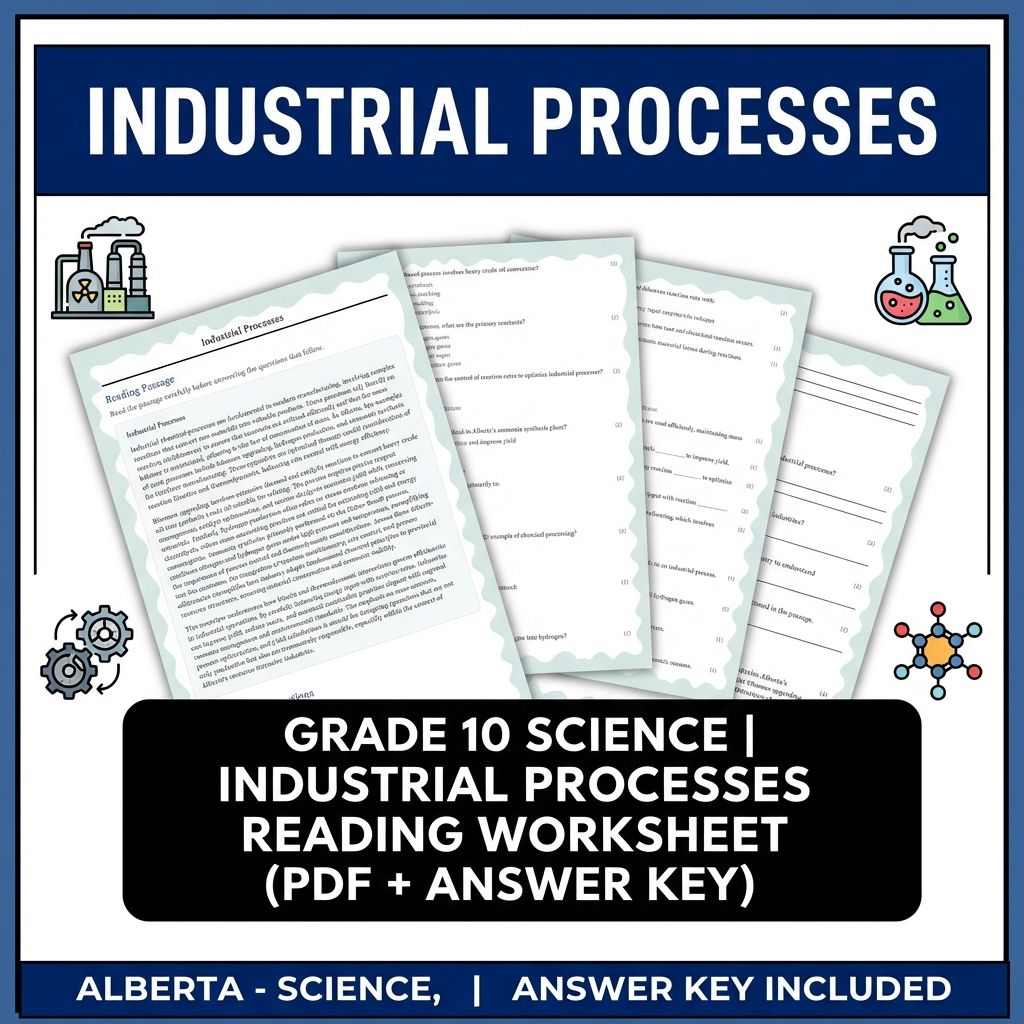
Grade 10 Science | Industrial Processes Reading Worksheet (PDF + Answer Key)
JCreated byJ.S SheetsLearning Objectives
- Understand the role of reaction stoichiometry and mass conservation in industrial chemical processes.
- Identify factors affecting process efficiency, including kinetics and thermodynamics.
- Explore Alberta-specific examples such as bitumen upgrading, hydrogen production, and ammonia synthesis.
Also included in: Grade 10 Science Unit Bundle | Chemical Reactions & Properties Worksheets +1 more
Instant download
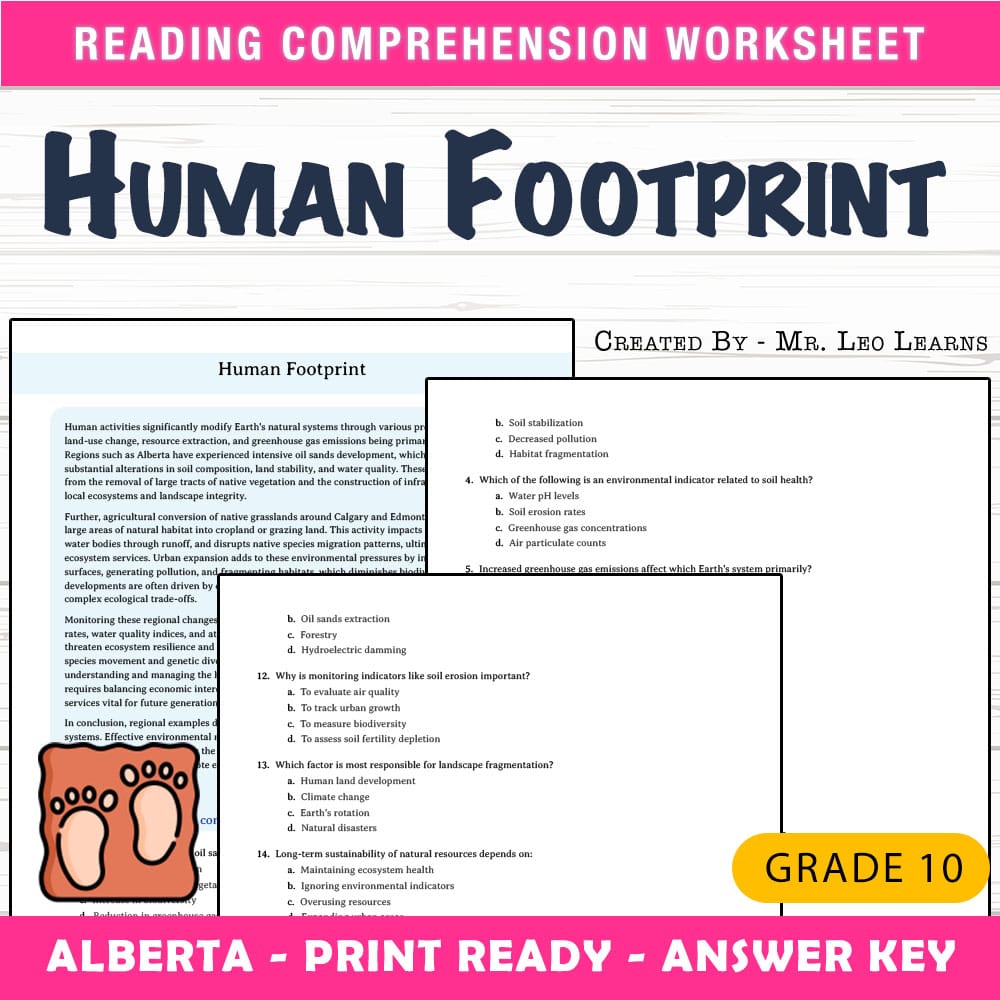
Grade 10 Science — Human Footprint Worksheet MCQ Paper for Mastery
 Created byThe Resource Hub
Learning Objectives
- Understand how human activities such as land-use change and resource extraction impact Earth's systems.
- Identify examples of regional human footprint activities and their environmental effects.
- Analyze the long-term sustainability of ecosystems affected by human development.
Also included in: Grade 10 Science Bundle | Earth and Space Systems Worksheets +1 more
Instant download
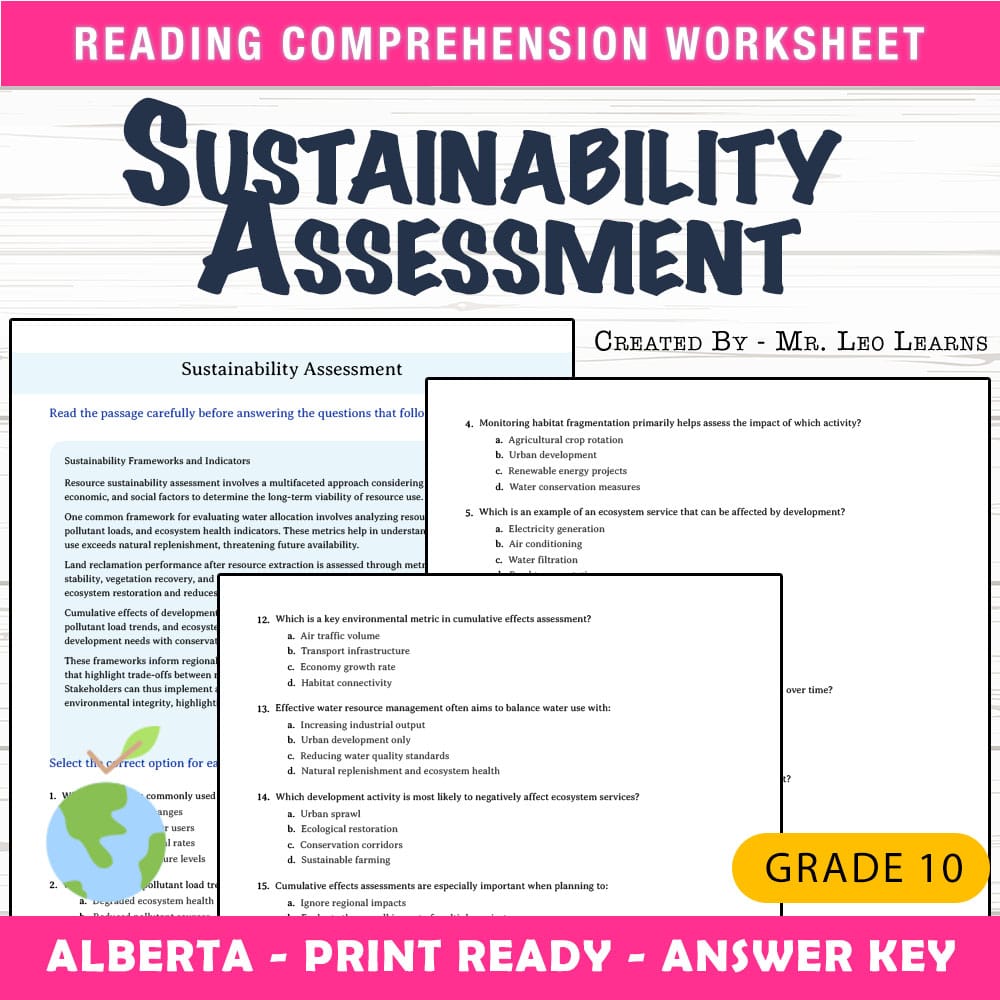
Grade 10 Science — Sustainability Assessment Worksheet MCQ Paper
Created byThe Resource HubLearning Objectives
- Understand the indicators used to assess resource sustainability including environmental, economic, and social metrics.
- Identify frameworks for evaluating water allocation, land reclamation, and cumulative effects of development.
- Analyze how sustainability assessments inform resource management decisions for regional well-being.
Also included in: Grade 10 Science Bundle | Earth and Space Systems Worksheets +1 more
Instant download
Grade 10 Science — Worksheet MCQ Paper for Mastering Orbital Forcing
Created byThe Resource HubLearning Objectives
- Understand how Earth's orbital parameters influence long-term climate cycles.
- Identify the mechanisms by which insolation distribution affects glacial and interglacial periods.
- Distinguish orbital forcing effects from short-term atmospheric or human influences on climate.
Also included in: Grade 10 Science Bundle | Earth and Space Systems Worksheets +1 more
Instant download
Grade 10 Science — Worksheet MCQ Paper on Carbon Balance
Created byThe Resource HubLearning Objectives
- Understand the major carbon pools and flux pathways in the Earth's ecosystem.
- Identify the natural controls that influence carbon uptake and release.
- Analyze how regional climate feedbacks are affected by shifts in carbon fluxes.
Also included in: Grade 10 Science Bundle | Earth and Space Systems Worksheets +1 more
Instant download
Grade 10 Science — Worksheet MCQ Paper for Mastering Remote Sensing
Created byThe Resource HubLearning Objectives
- Understand the types of sensors used in satellite and aerial remote sensing.
- Identify how spectral information is utilized in environmental monitoring.
- Recognize common derived products such as snowpack maps and vegetation indices.
Also included in: Grade 10 Science Bundle | Earth and Space Systems Worksheets +1 more
Instant download
Grade 10 Science — Plate Dynamics Worksheet MCQ Paper for Mastery
Created byThe Resource HubLearning Objectives
- Understand the processes involved in plate tectonics and their surface effects.
- Identify how deep Earth processes influence mountain building, sedimentary basins, and resource distribution.
- Relate faulting, uplift, erosion, and landscape evolution to regional geology and ecosystems.
Also included in: Grade 10 Science Bundle | Earth and Space Systems Worksheets +1 more
Instant download
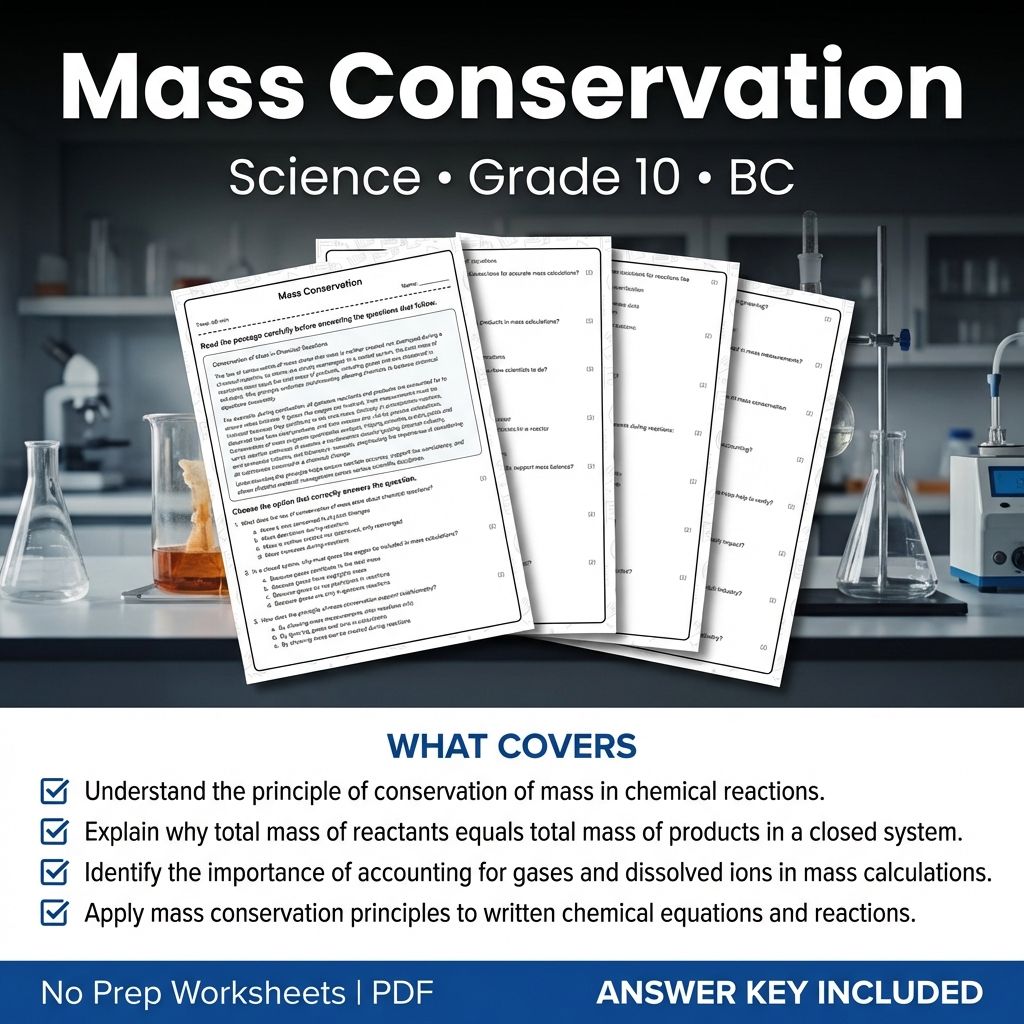
10th Grade Science | Mass Conservation Worksheet & Answer Key (Printable PDF)
Created byCoral Reef LearningLearning Objectives
- Understand the principle of conservation of mass in chemical reactions.
- Explain why total mass of reactants equals total mass of products in a closed system.
- Identify the importance of accounting for gases and dissolved ions in mass calculations.
Instant download
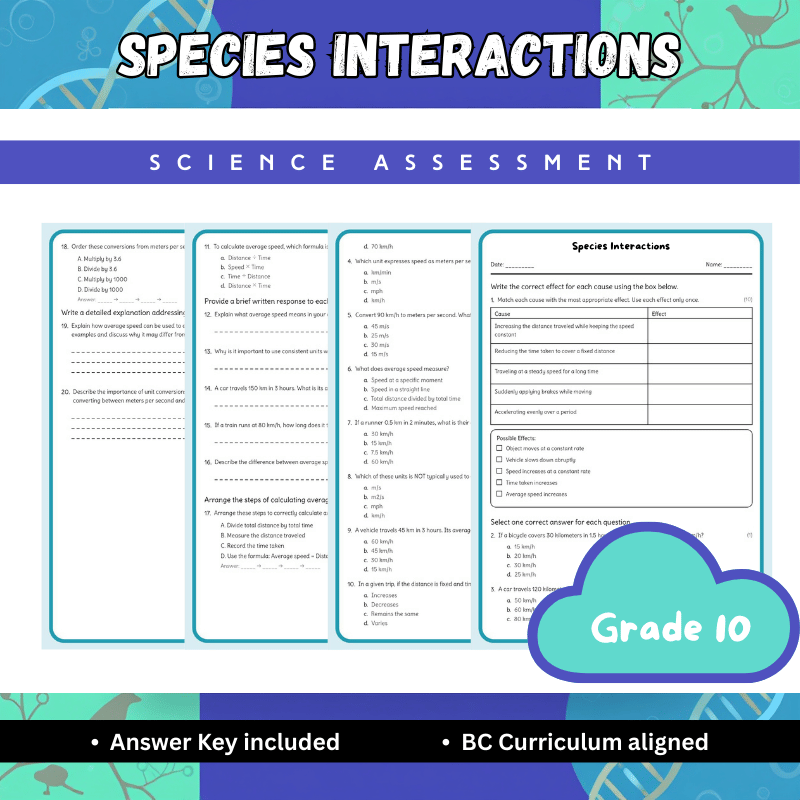
Grade 10 Science | Species Interactions Worksheet (Answer Key) – BC Standards
Created byBright Mind ResourcesLearning Objectives
- Understand the different types of species interactions and their effects on communities.
- Identify examples of competition, predation, parasitism, mutualism, and commensalism.
- Analyze how keystone species influence ecosystem stability.
Instant download

Grade 10 Science – Mass Conservation Worksheet (PDF) BC Standards
 Created byEvergreen Desk Education
Learning Objectives
- Explain the law of conservation of mass and describe when it applies (closed systems).
- Analyze chemical reactions to account for total mass of reactants and products, including gases and dissolved ions.
- Use mass conservation to evaluate and interpret balanced equations and quantitative results.
Instant download

Motion Description Worksheet | Grade 10 Science Practice
 Created byPrism Point Learning
Learning Objectives
- Explain how position, displacement, speed, velocity, and acceleration describe motion in words and equations
- Interpret motion using reference frames and time intervals, including predictions for constant acceleration
- Distinguish scalar and vector quantities and connect kinematics variables to motion graphs
Also included in: Forces, Motion & Fields Lesson Bundle | Grade 10 Science | BC +1 more
Instant download
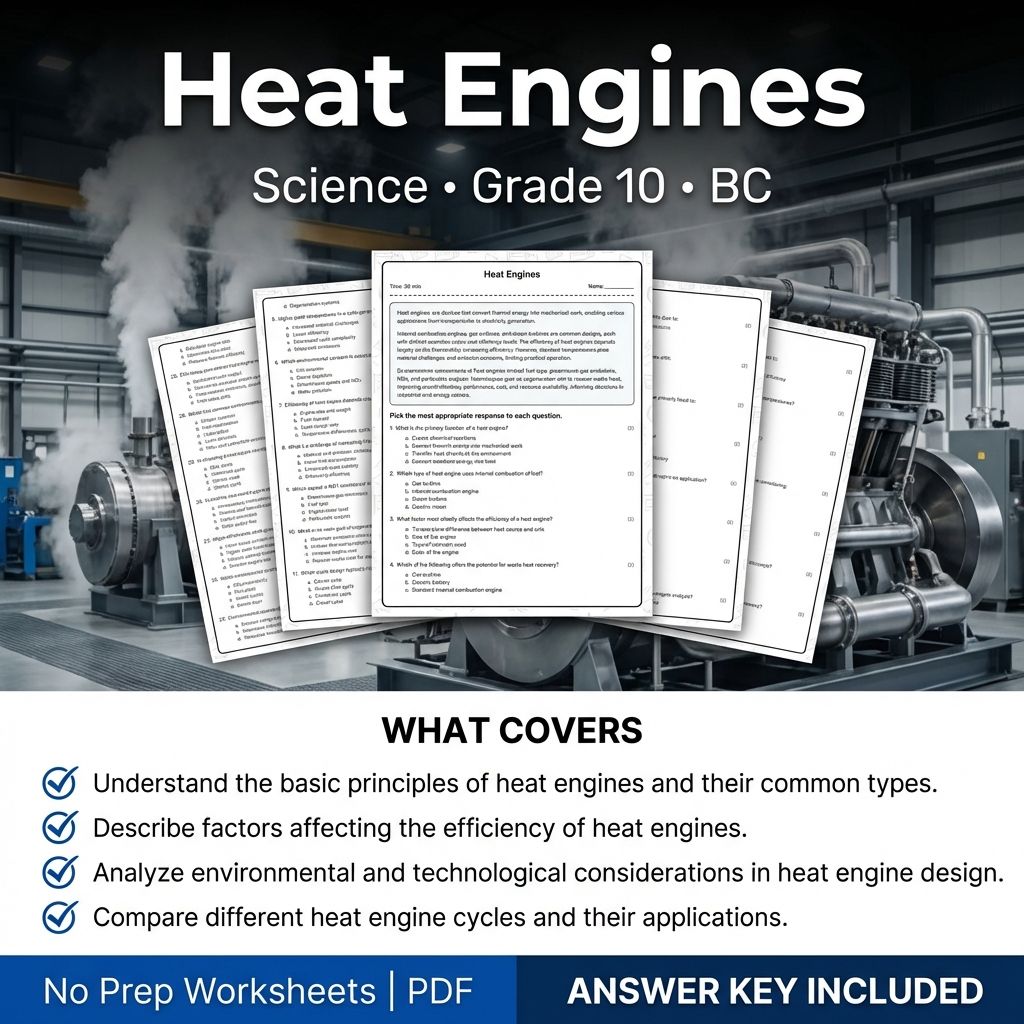
10th Grade Science Worksheet | Heat Engines Practice with Answer Key (PDF)
Created byCoral Reef LearningLearning Objectives
- Understand the basic principles of heat engines and their common types.
- Describe factors affecting the efficiency of heat engines.
- Analyze environmental and technological considerations in heat engine design.
Instant download
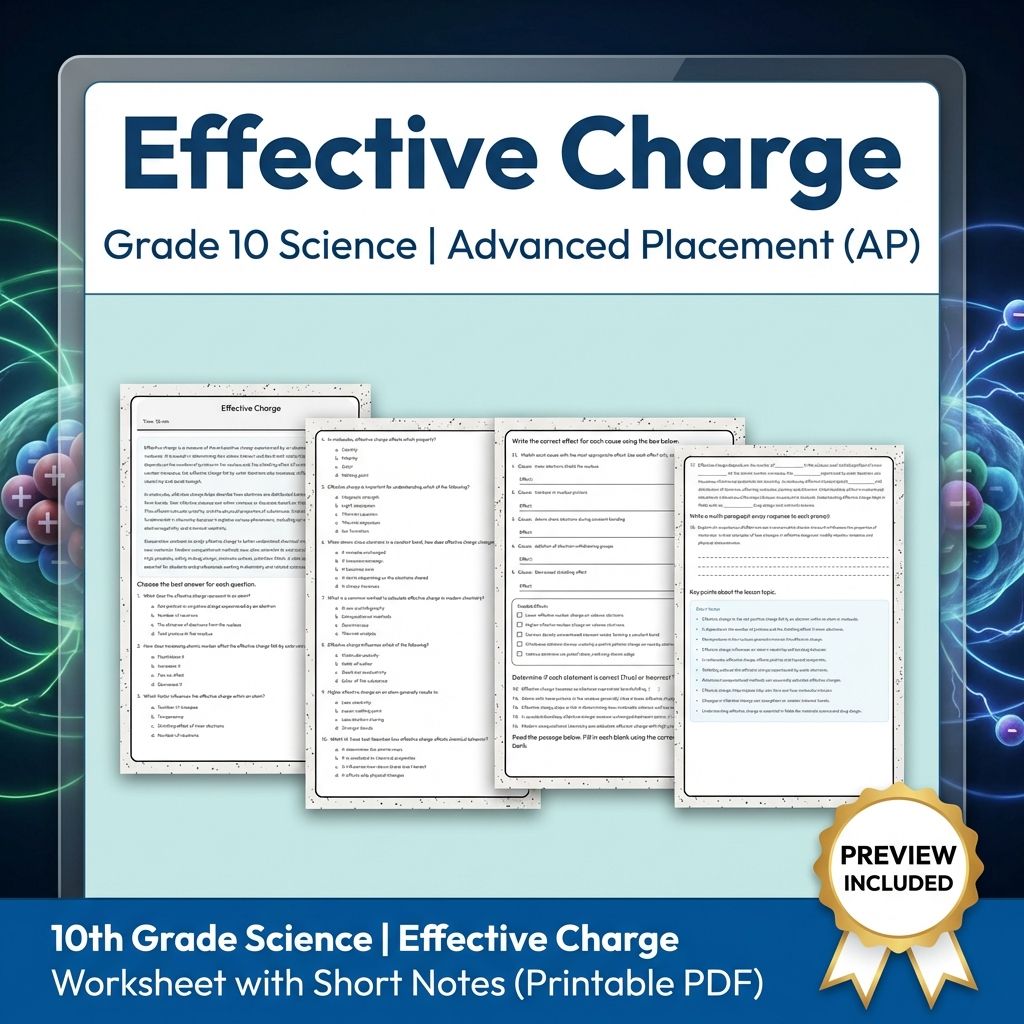
10th Grade Science | Effective Charge Worksheet with Short Notes (Printable PDF)
 Created byMeadowlark Worksheets
Learning Objectives
- Understand the concept of effective charge in atoms and molecules.
- Explain how effective charge influences chemical bonding and interactions.
- Identify factors that affect the magnitude of effective charge.
Also included in: Grade 10 Science | Comprehensive Unit Bundle on Atomic Structure
Instant download

Grade 10 Science Water Cycle Exploration Daily Reading Worksheet with Answer Key
JCreated byJ.S SheetsLearning Objectives
- Understand the processes involved in the water cycle
- Identify key components such as evaporation, condensation, precipitation, and collection
- Describe the significance of the water cycle for Earth's ecosystem
Also included in: Grade 10 Science Full Year Bundle | Human Physiology & Ecosystems
Instant download

Grade 10 Science – Human Footprint & Land Use | Daily Reading Worksheet
Created byBright Mind ResourcesLearning Objectives
- Understand how human activities alter land use patterns
- Identify regional examples of land modification
- Analyze the environmental impacts of land-use change
Also included in: Grade 10 Sustainability Science Daily Reading Worksheets lesson bundle | Alberta +1 more
Instant download
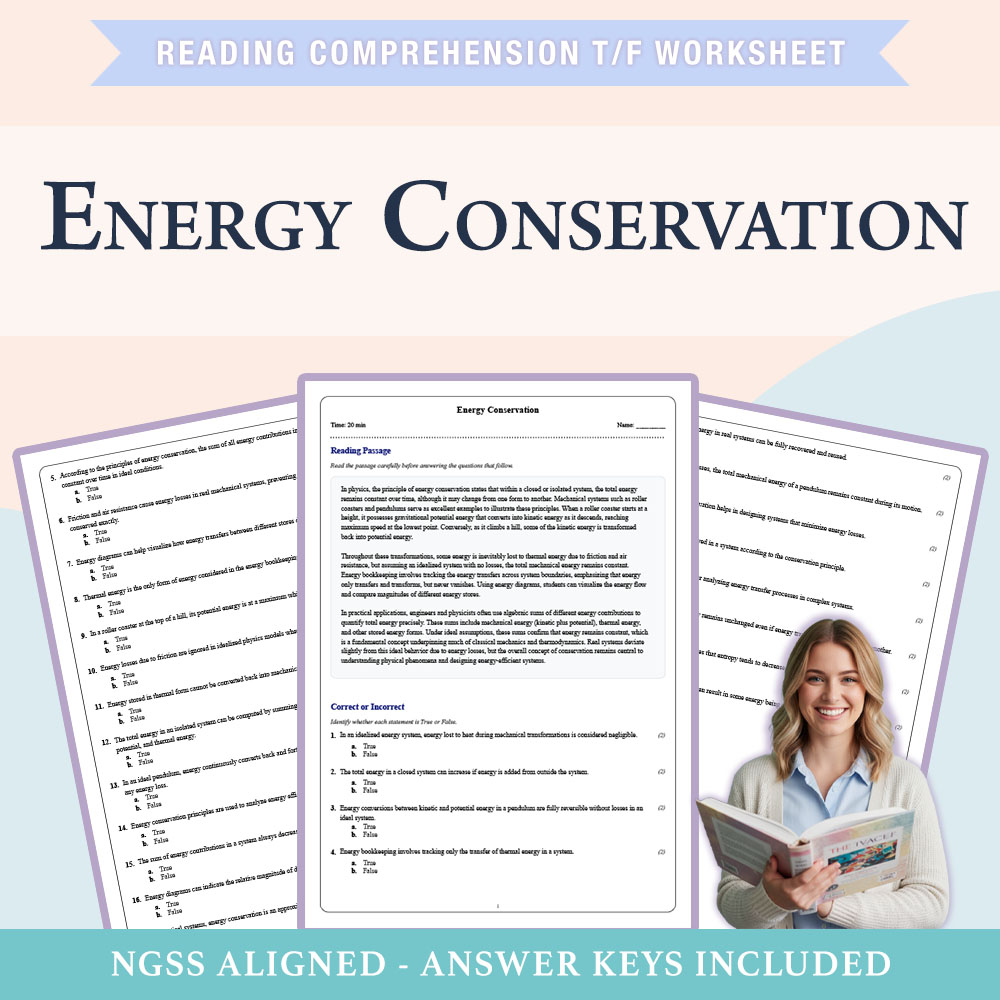
10th Grade Science | Energy Conservation Worksheet (PDF +Answer Key)
Created byCopper Leaf ClassroomLearning Objectives
- Understand the principles of energy conservation in closed and isolated systems.
- Explain the energy transfers between kinetic, potential, and thermal stores in mechanical systems.
- Apply energy bookkeeping concepts using diagrams and algebraic sums under idealized assumptions.
Also included in: Grade 10 Science | Energy and Work Worksheets Bundle (PDF + Answer Key) +1 more
Instant download
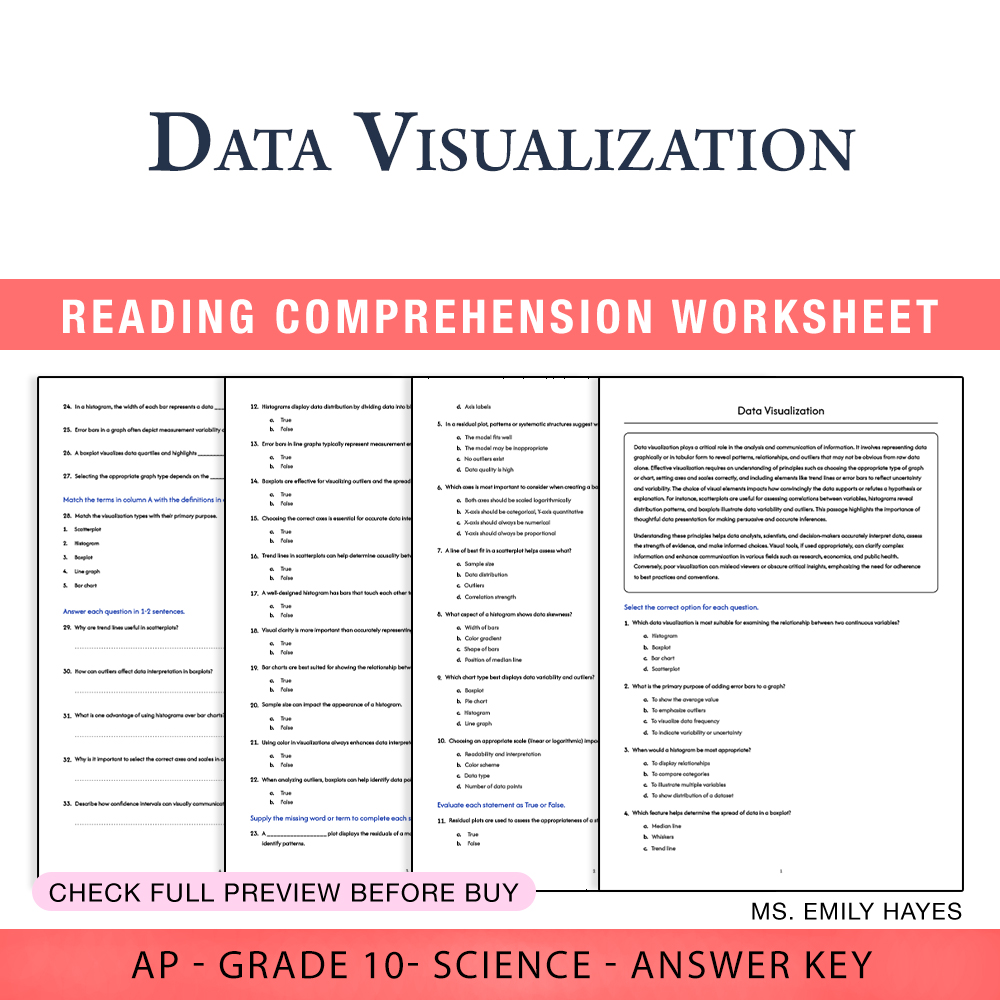
Grade 10 Science | Data Visualization Worksheet (PDF+ Answer Key)
Created byCopper Leaf ClassroomLearning Objectives
- Understand principles and conventions for graphical and tabular data representations.
- Interpret patterns, outliers, and variability in data visualizations.
- Select appropriate visualization types and options based on data type and analysis needs.
Also included in: Grade 10 Science AP | Data Analysis & Modeling Skills (PDF + Answer Key) +1 more
Instant download
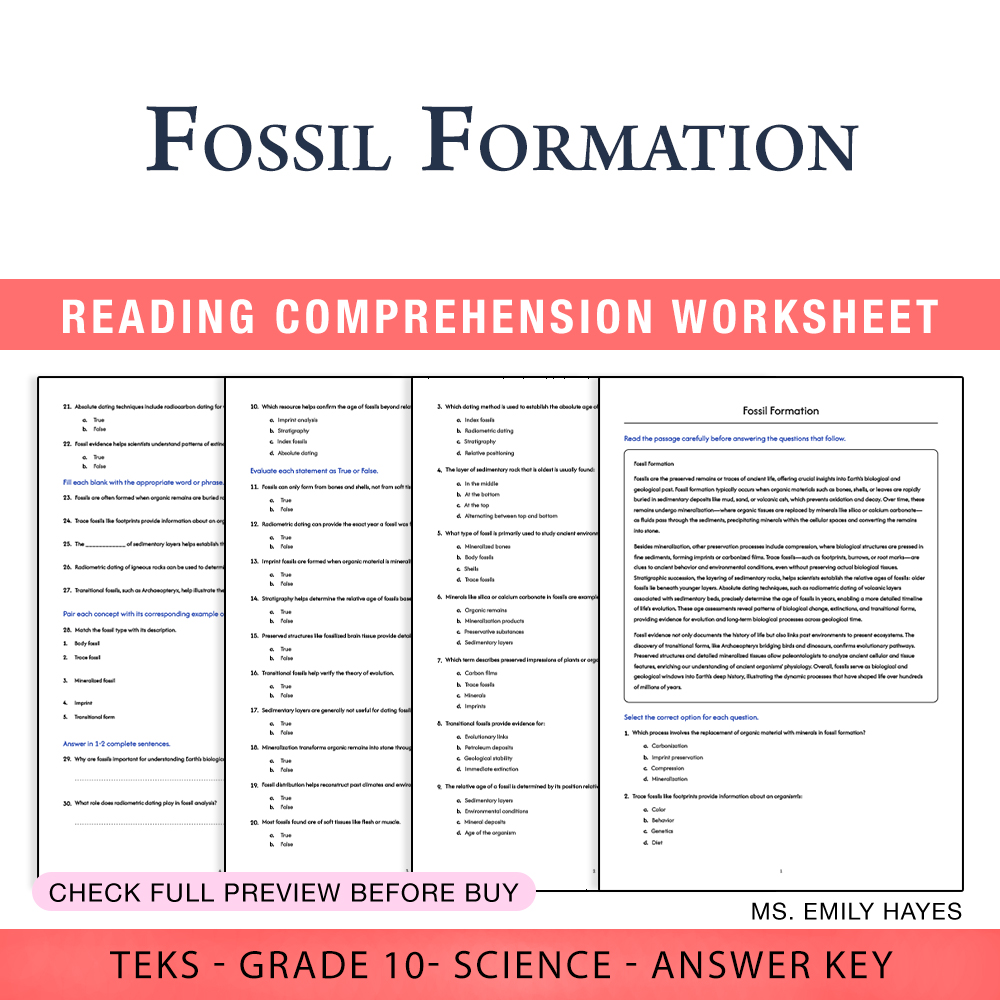
10th Grade Science | Fossil Formation Worksheet (PDF+ Answer Key)
Created byCopper Leaf ClassroomLearning Objectives
- Understand the processes involved in fossil formation and preservation.
- Identify methods used for dating fossils and understanding Earth's biological history.
- Recognize different types of fossil evidence and their significance.
Instant download
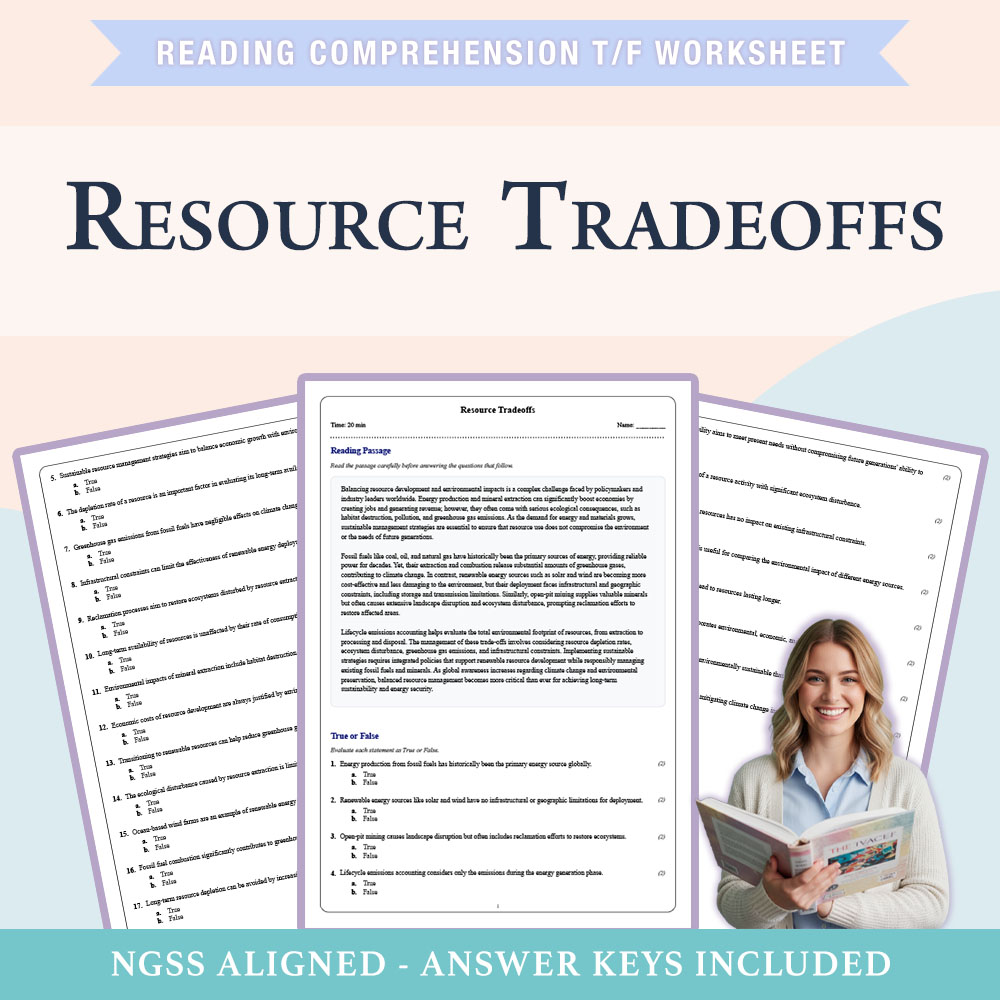
10th Grade Science | Resource Tradeoffs Worksheet (PDF + Answer Key)
Created byCopper Leaf ClassroomLearning Objectives
- Understand the various factors involved in assessing energy and mineral resource development options.
- Evaluate trade-offs between economic, environmental, and sustainability considerations in resource management.
- Analyze case studies related to fossil fuels, renewable energy, open-pit mining, and reclamation efforts.
Also included in: Grade 10 Science | Environmental Management & Climate Change (PDF + Answer Key) +1 more
Instant download
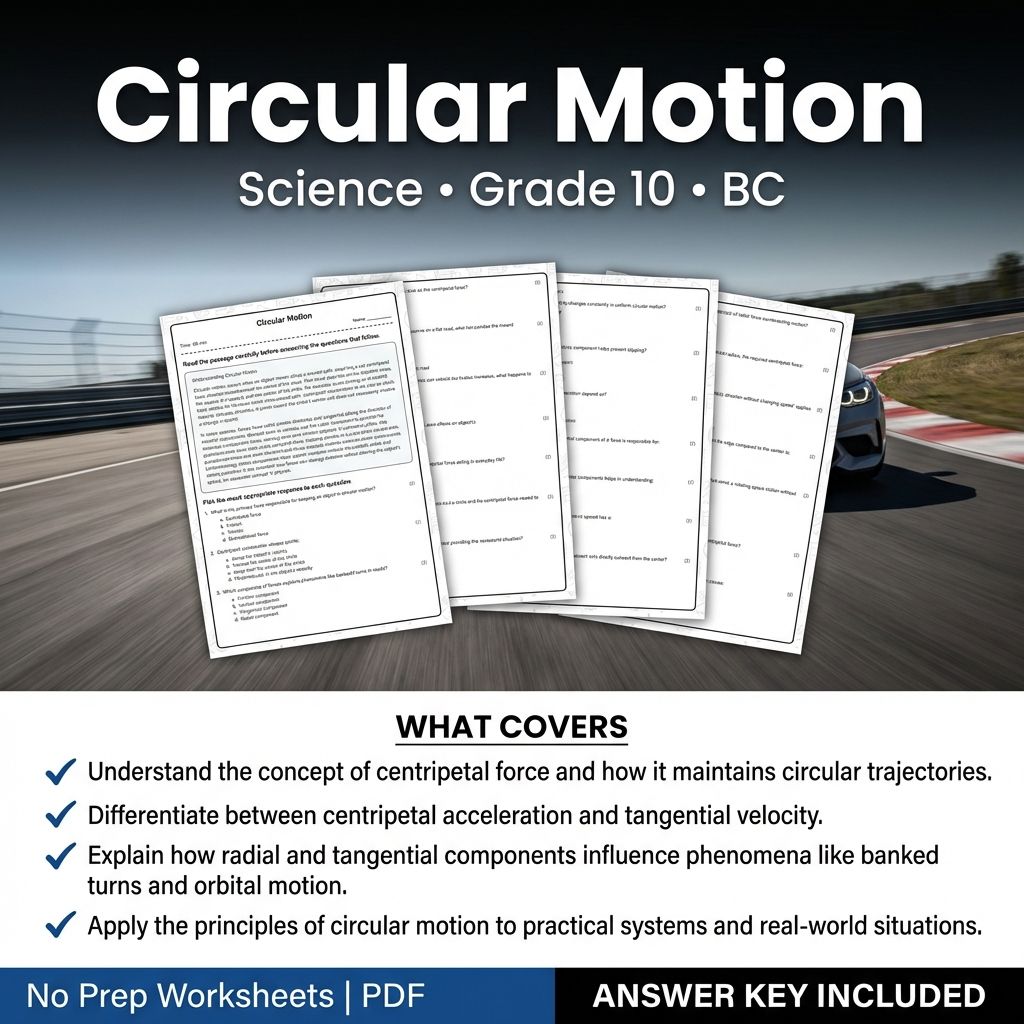
10th Grade Science | Circular Motion Worksheet + Answer Key (Printable PDF)
Created byCoral Reef LearningLearning Objectives
- Understand the concept of centripetal force and how it maintains circular trajectories.
- Differentiate between centripetal acceleration and tangential velocity.
- Explain how radial and tangential components influence phenomena like banked turns and orbital motion.
Instant download

Grade 10 Science | Cellular Specialization in Science - Reading Comprehension
Created byCoral Reef LearningLearning Objectives
- Understand the functions of key organelles involved in cellular activities
- Explain how organelle abundance relates to cell function
- Describe how specialized cells form tissues and organ systems
Instant download
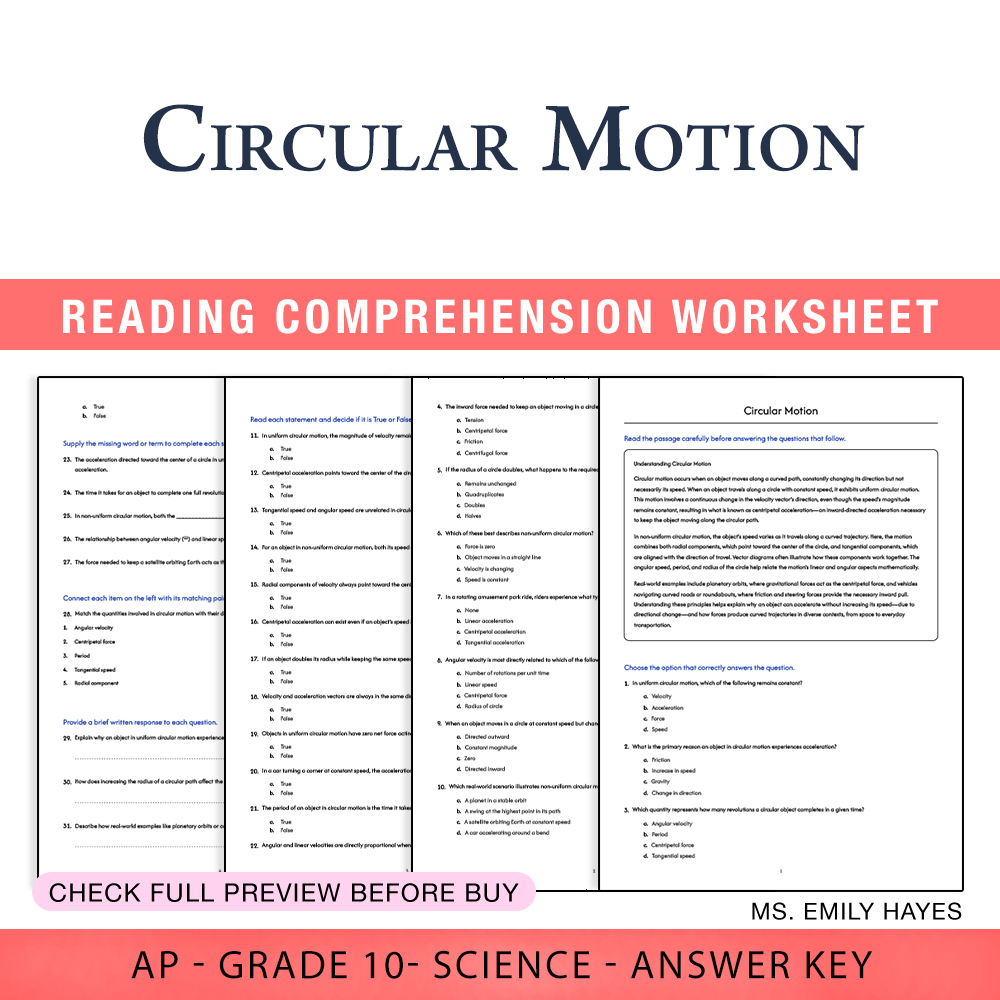
10th Grade Science | Circular Motion Worksheet (PDF+ Answer Key)
Created byCopper Leaf ClassroomLearning Objectives
- Explain the difference between uniform and non-uniform circular motion.
- Relate angular quantities such as angular speed, period, and radius to linear velocity.
- Describe the concept of centripetal acceleration and how it causes change in direction without change in speed.
Also included in: Grade 10 Science AP | Physics & Energy Concepts (PDF+ Answer Key) +1 more
Instant download
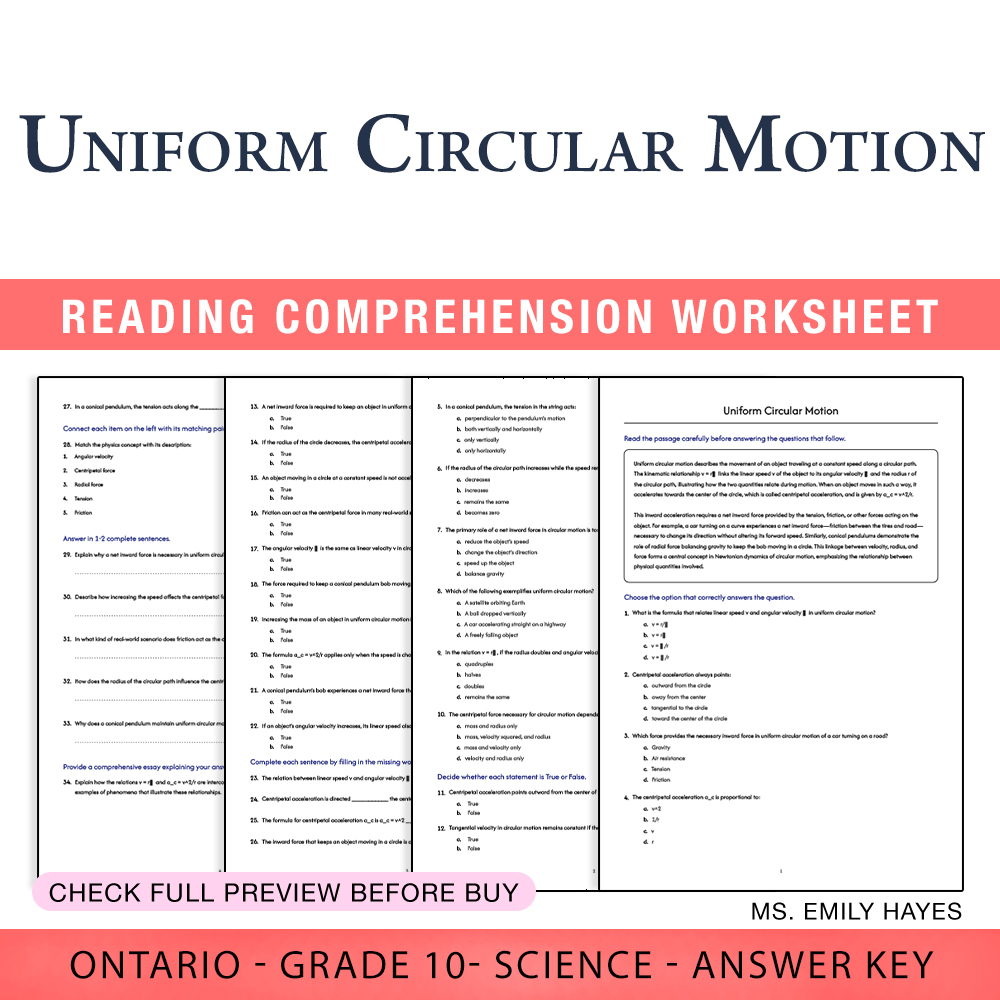
10th Grade Science | Uniform Circular Motion Worksheet (PDF + Answer Key)
Created byCopper Leaf ClassroomLearning Objectives
- Explain the kinematic relationships v = rω and a_c = v^2/r for objects moving in a circle.
- Describe how centripetal force acts towards the center of a circular path to maintain curved motion.
- Apply mathematical relations to real-world phenomena such as vehicle turning and conical pendulums.
Instant download
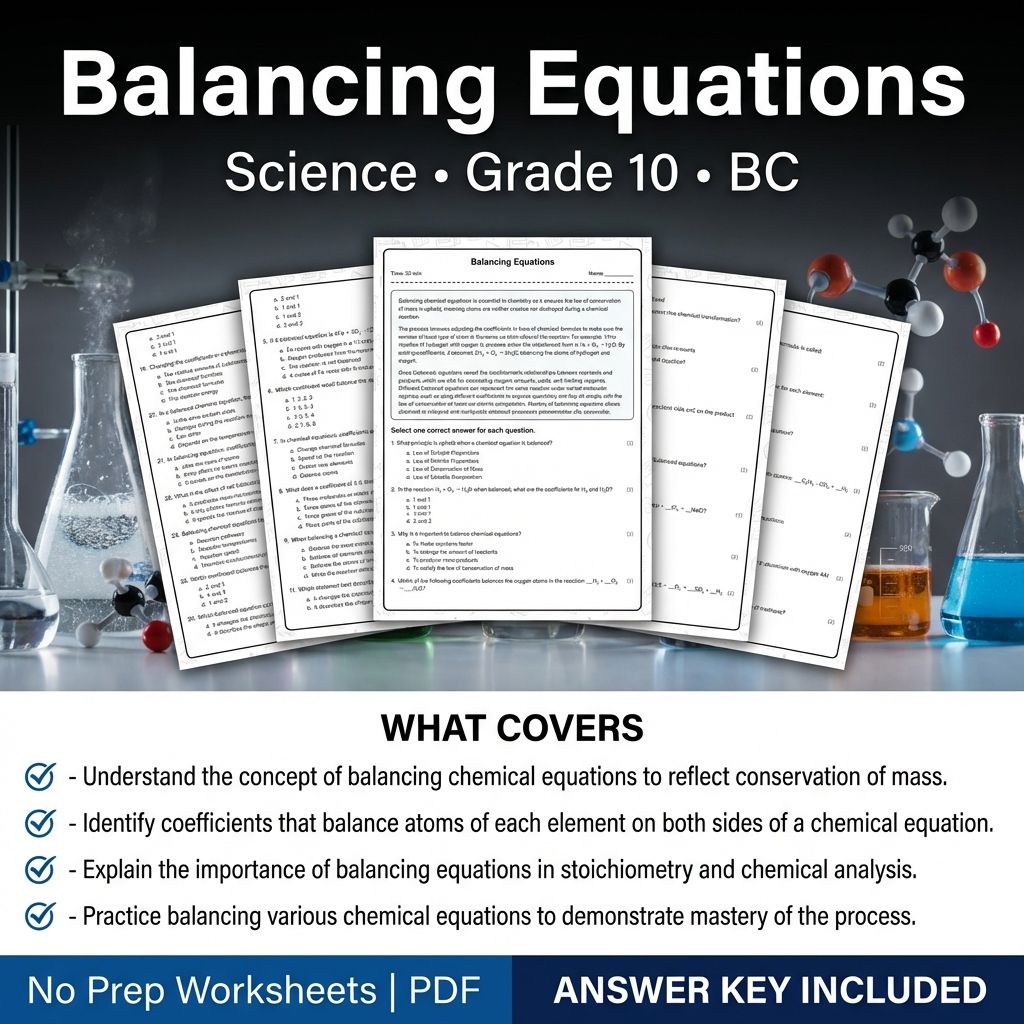
10th Grade Science | Balancing Equations Worksheet & Answer Key (PDF)
Created byCoral Reef LearningLearning Objectives
- Understand the concept of balancing chemical equations to reflect conservation of mass.
- Identify coefficients that balance atoms of each element on both sides of a chemical equation.
- Explain the importance of balancing equations in stoichiometry and chemical analysis.
Instant download
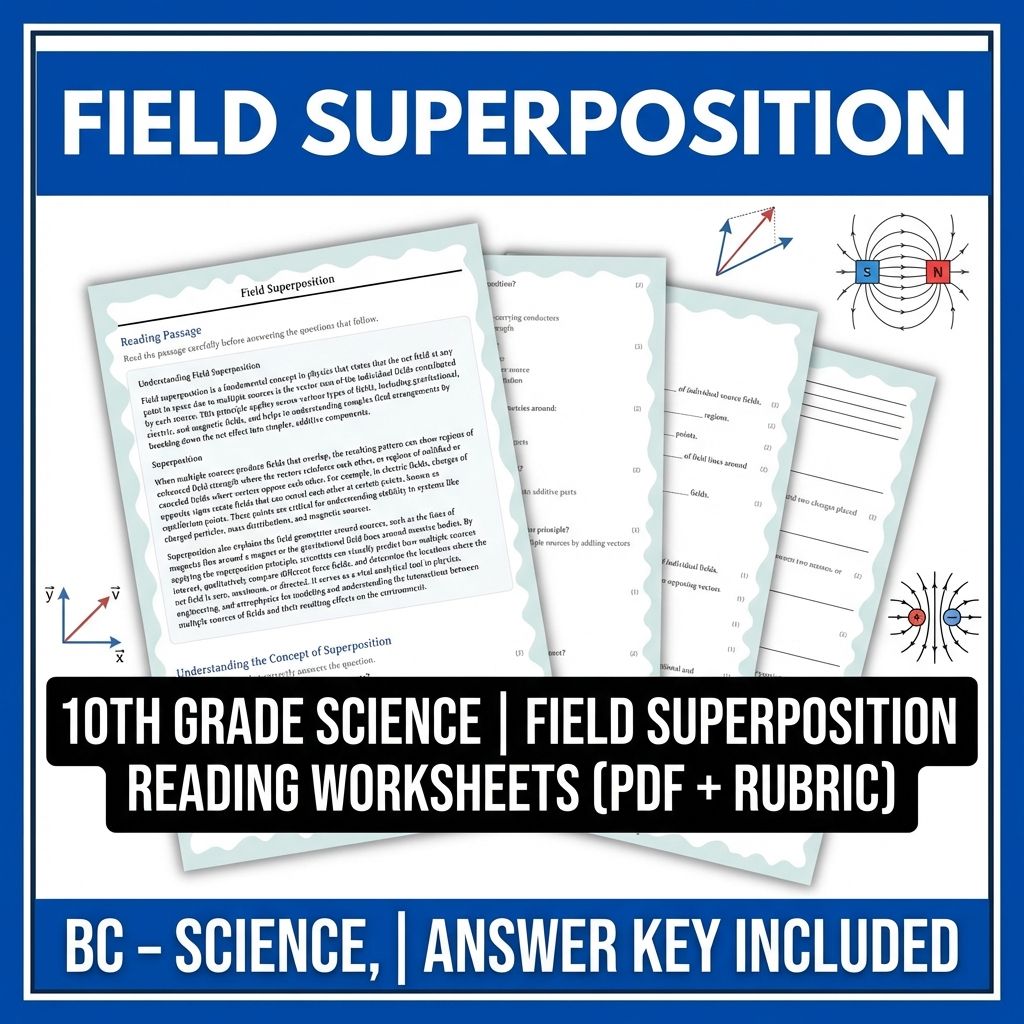
10th Grade Science | Field Superposition Reading Worksheets (PDF + Rubric)
JCreated byJ.S SheetsLearning Objectives
- Understand the principle of field superposition and how it applies to multiple sources.
- Describe how net fields are calculated by vector addition of individual contributions.
- Explain the phenomena of regions with enhanced or canceled fields resulting from superposition.
Instant download
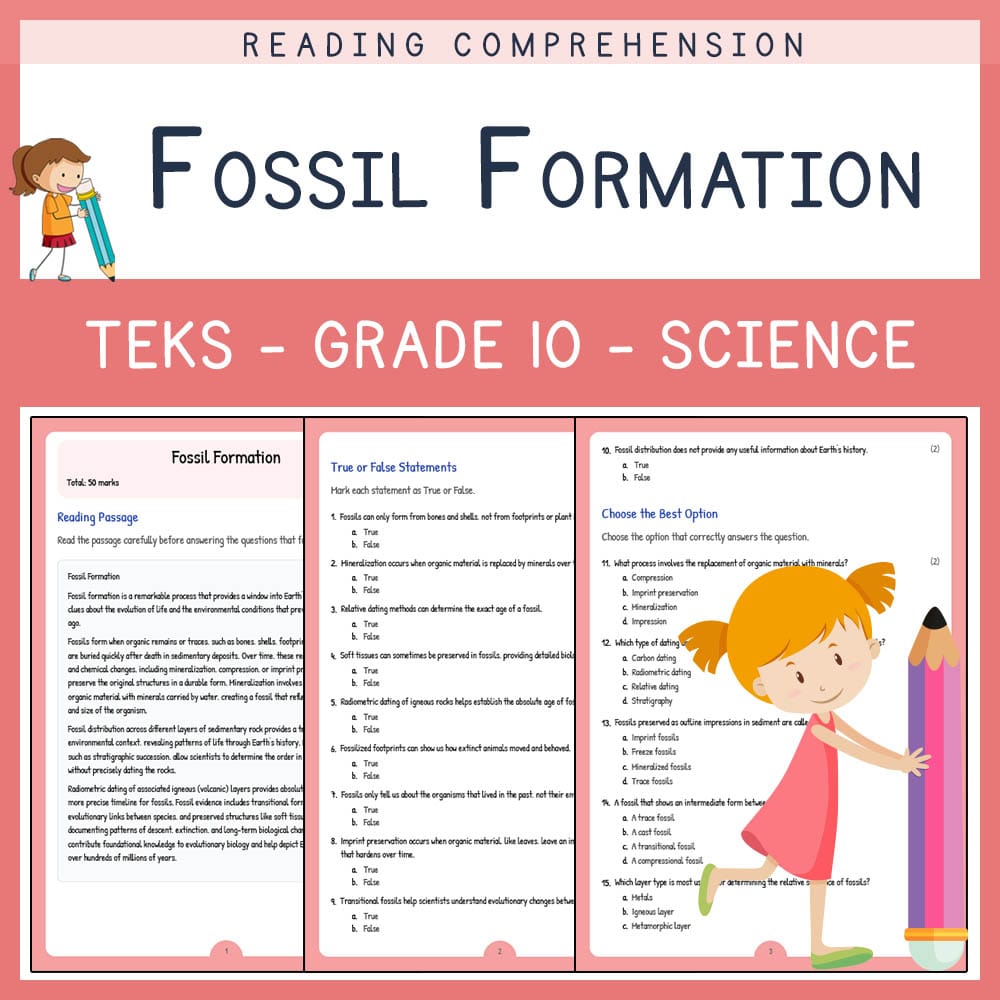
Grade 10 Science | Fossil Formation Worksheet | TEKS Aligned
 Created byLumora Learning
Learning Objectives
- Explain the processes involved in the formation of fossils and their significance.
- Identify methods used to date fossils and interpret their distribution.
- Describe different types of fossil preservation and what they reveal about Earth's past.
Also included in: Grade 10 Science | Evolution & Classification Lesson Bundle | TEKS Aligned +1 more
Instant download
About Grade 10 Science Worksheets
Find Science worksheets built for Grade 10. All 7,069 cover core skills, practice, and review, each an instant PDF download.
Every worksheet on MyTeachingSheets is created by independent teacher-authors and reviewed before publication. All resources download as printable PDFs for classroom, homework, or at-home practice, and many include answer keys. Preview any worksheet free before buying.