
Grade 10 Science Worksheets
7,069 worksheets
Grade 10 Mitigation Strategies in Environmental Science | NGSS Worksheet
 Created byBRIGHT PATH RESOURCES
Learning Objectives
- Understand the concept of renewable energy sources and their environmental benefits
- Identify different types of renewable energy and their advantages
- Analyze how renewable energy contributes to reducing pollution and greenhouse gases
Also included in: Env Hazards Grade 10 Sci Daily Reading Worksheets Lesson Bundle | NGSS +1 more
Instant download
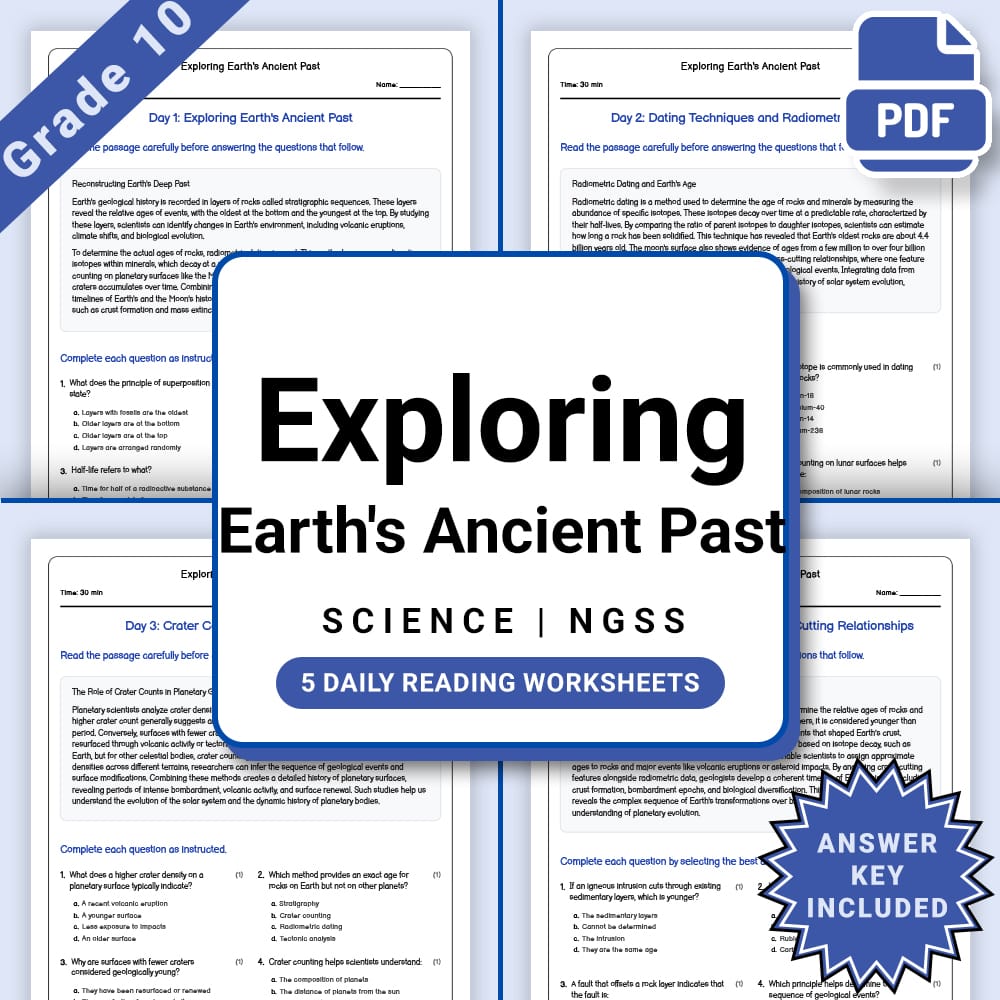
Grade 10 Science – Exploring Earth's Ancient Past Worksheet (PDF +Answer Key)
 Created byCopper Leaf Classroom
Learning Objectives
- Understand how stratigraphic sequences reveal Earth's history.
- Explain the principles of relative and absolute dating methods.
- Describe how radiometric decay and crater counting help determine ages of planetary surfaces.
Instant download
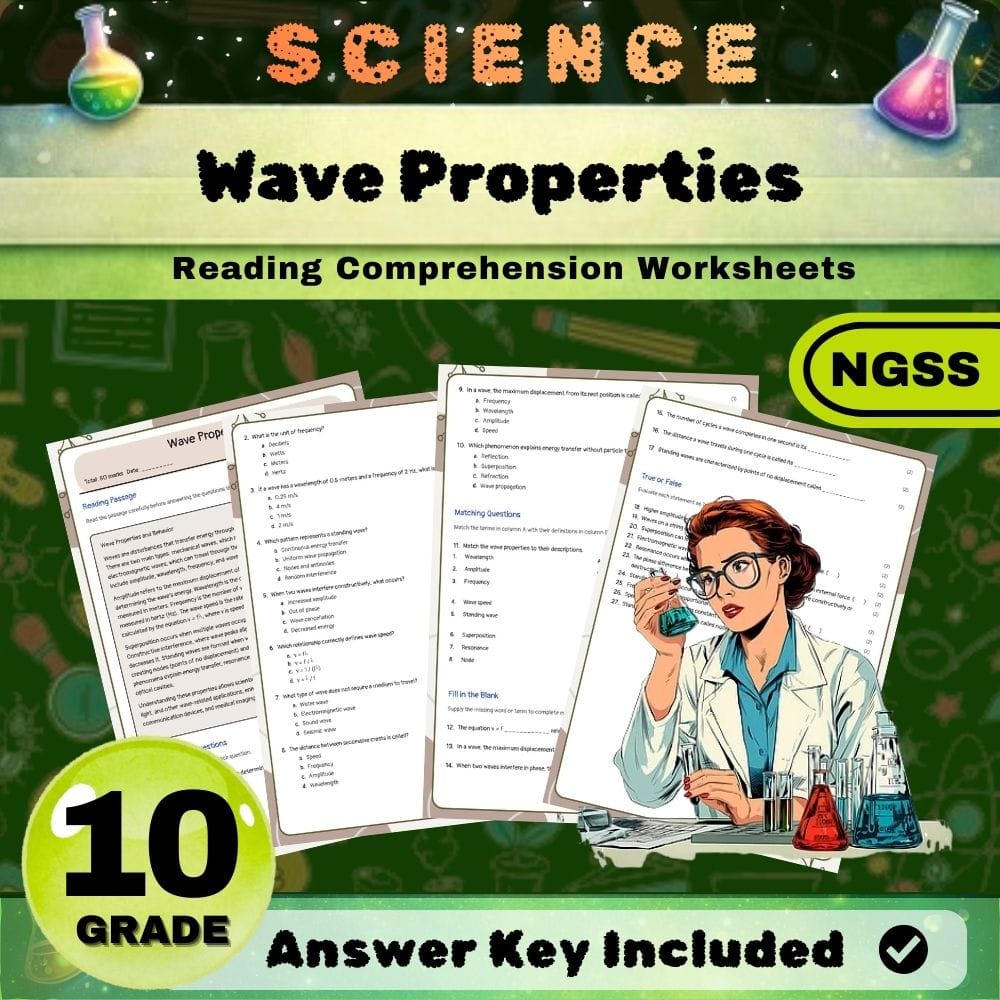
Grade 10 Science – Wave Properties Worksheet (NGSS) (PDF)
 Created byMaple Path Learning
Learning Objectives
- Understand the fundamental properties of waves, including amplitude, wavelength, frequency, and propagation speed.
- Apply the relationship v = fλ to calculate wave speed in various contexts.
- Interpret sinusoidal wave models and understand superposition and interference patterns.
Also included in: Grade 10 Science Waves and Their Applications in Technologies Bundle +1 more
Instant download

Grade 10 Science – Uncertainty Ranges Worksheet (PDF) | General Standards
 Created byEvergreen Desk Education
Learning Objectives
- Explain how uncertainty ranges reflect measurement spread and uncertainty in repeated or independent data.
- Distinguish central tendency from variability and describe how each affects interpretation of results.
- Use overlap (or lack of overlap) between uncertainty ranges to judge whether an apparent difference is likely meaningful.
Also included in: Grade 10 Uncertainty & Evidence Data Science Lesson Bundle (General) +1 more
Instant download

Force Relations Worksheet | Grade 10 Science Practice
 Created byPrism Point Learning
Learning Objectives
- Explain how net force affects acceleration using Newton’s second law
- Describe inertia and predict how mass changes motion when forces vary
- Connect force–mass–acceleration ideas to real driving and equipment scenarios
Also included in: Grade 10 Work, Energy & Electricity Lesson Bundle | Alberta Science
Instant download

Grade 10 Science – Speciation & Processes | Daily Reading Worksheet
 Created byBright Mind Resources
Learning Objectives
- Understand different mechanisms of speciation, including geographic isolation, ecological divergence, polyploidy, and behavioral shifts.
- Identify examples of speciation from empirical studies.
- Explain the role of reproductive barriers in the formation of new species.
Also included in: Evolution Grade 10 Science Daily Reading Worksheets Lesson Bundle | NGSS +2 more
Instant download
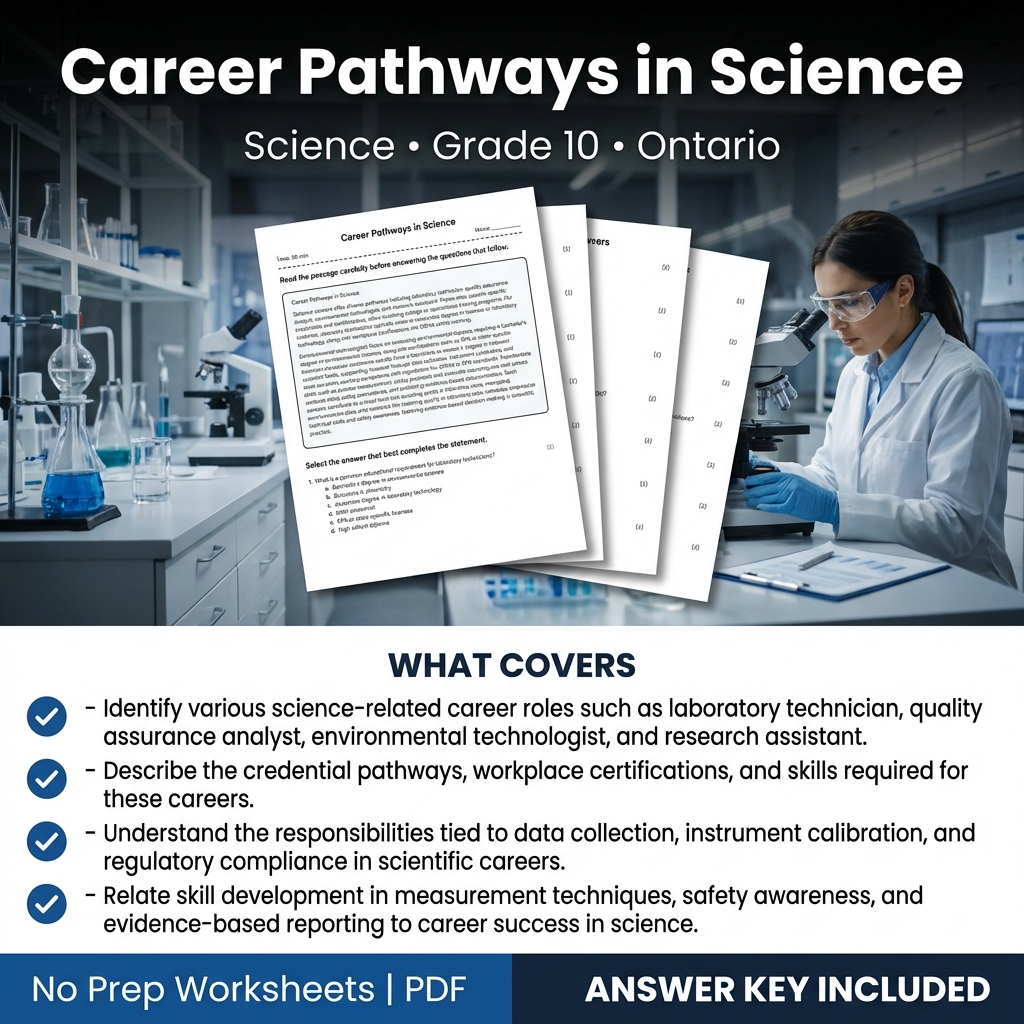
Career Pathways in Science Grade 10 Worksheet | Ontario Standard
 Created byCoral Reef Learning
Learning Objectives
- Identify various science-related career roles such as laboratory technician, quality assurance analyst, environmental technologist, and research assistant.
- Describe the credential pathways, workplace certifications, and skills required for these careers.
- Understand the responsibilities tied to data collection, instrument calibration, and regulatory compliance in scientific careers.
Instant download
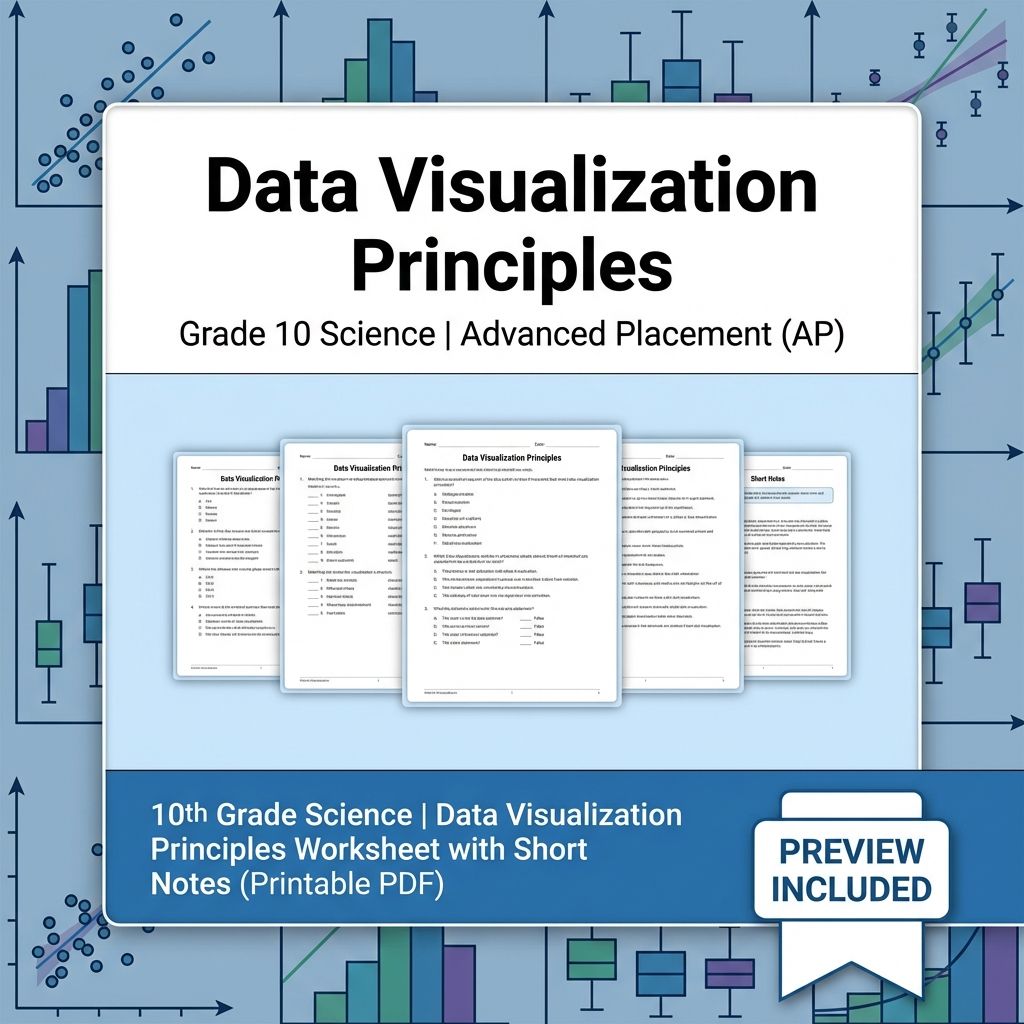
10th Grade Science | Data Visualization Principles Worksheet with Short Notes
 Created byMeadowlark Worksheets
Learning Objectives
- Understand key concepts and conventions in graphical and tabular data representation.
- Identify appropriate visualization types for different data types and analysis goals.
- Interpret patterns, variability, and outliers from various plots, including scatterplots and histograms.
Also included in: Grade 10 Science Unit | Data Analysis, Modelling Worksheet Pack
Instant download

Astronomical Scale Assessment | Florida NGSSS Grade 10 Science
Created byPrism Point LearningLearning Objectives
- Explain how units like astronomical units (AU) and light-years are used to describe distance in and beyond the solar system.
- Use angular size and brightness ideas to reason about distance and intrinsic power.
- Describe how scale supports models of motion and helps organize the universe’s structure from planets to galaxies.
Also included in: Grade 10 Earth and Space Systems Science Lesson Bundle – Florida NGSSS +1 more
Instant download

Physical Properties Test Prep Worksheet | Grade 10 Science | Ontario
Created byPrism Point LearningLearning Objectives
- Differentiate intensive and extensive physical properties using measurable examples.
- Describe physical changes as reversible changes in state or form without forming new substances.
- Use quantitative physical data (e.g., density, melting point) to compare materials and support material selection.
Instant download
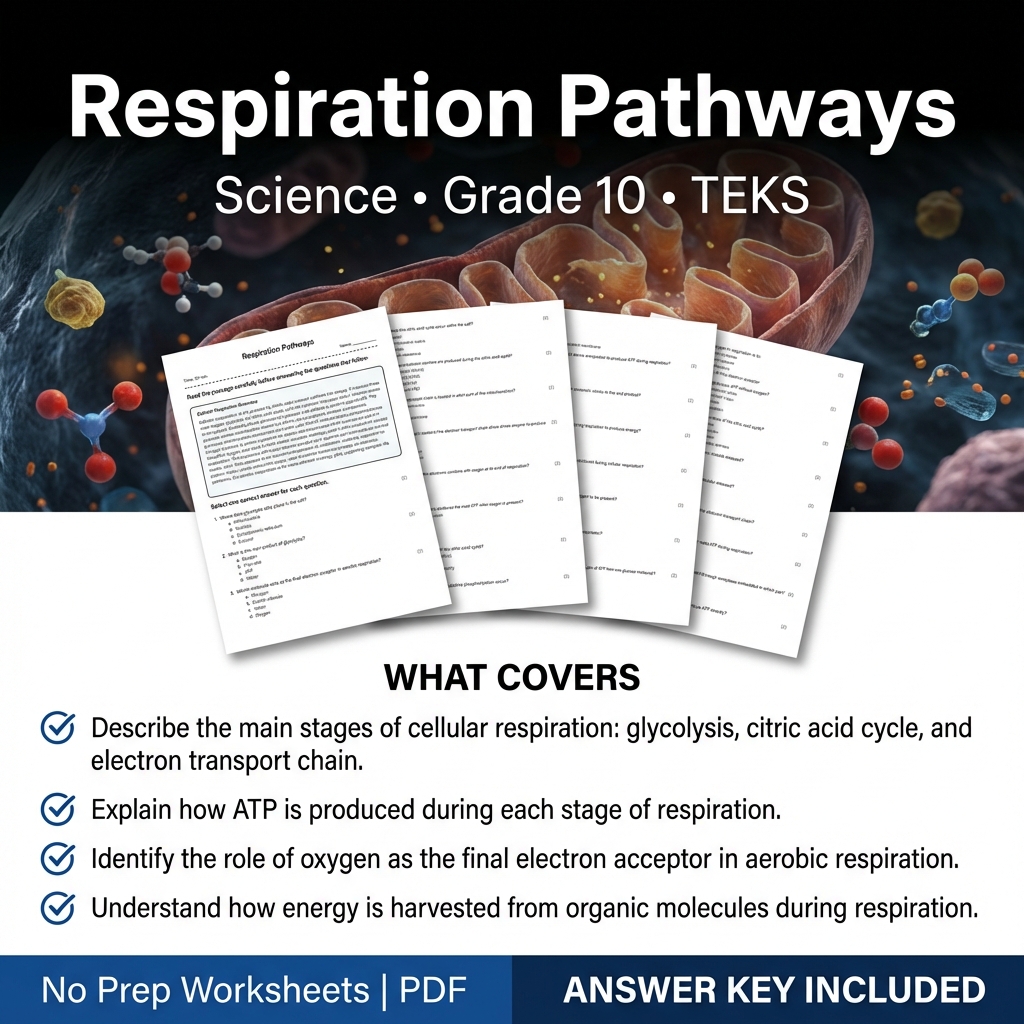
Respiration Pathways Grade 10 Science Worksheet | TEKS Aligned
Created byCoral Reef LearningLearning Objectives
- Describe the main stages of cellular respiration: glycolysis, citric acid cycle, and electron transport chain.
- Explain how ATP is produced during each stage of respiration.
- Identify the role of oxygen as the final electron acceptor in aerobic respiration.
Instant download
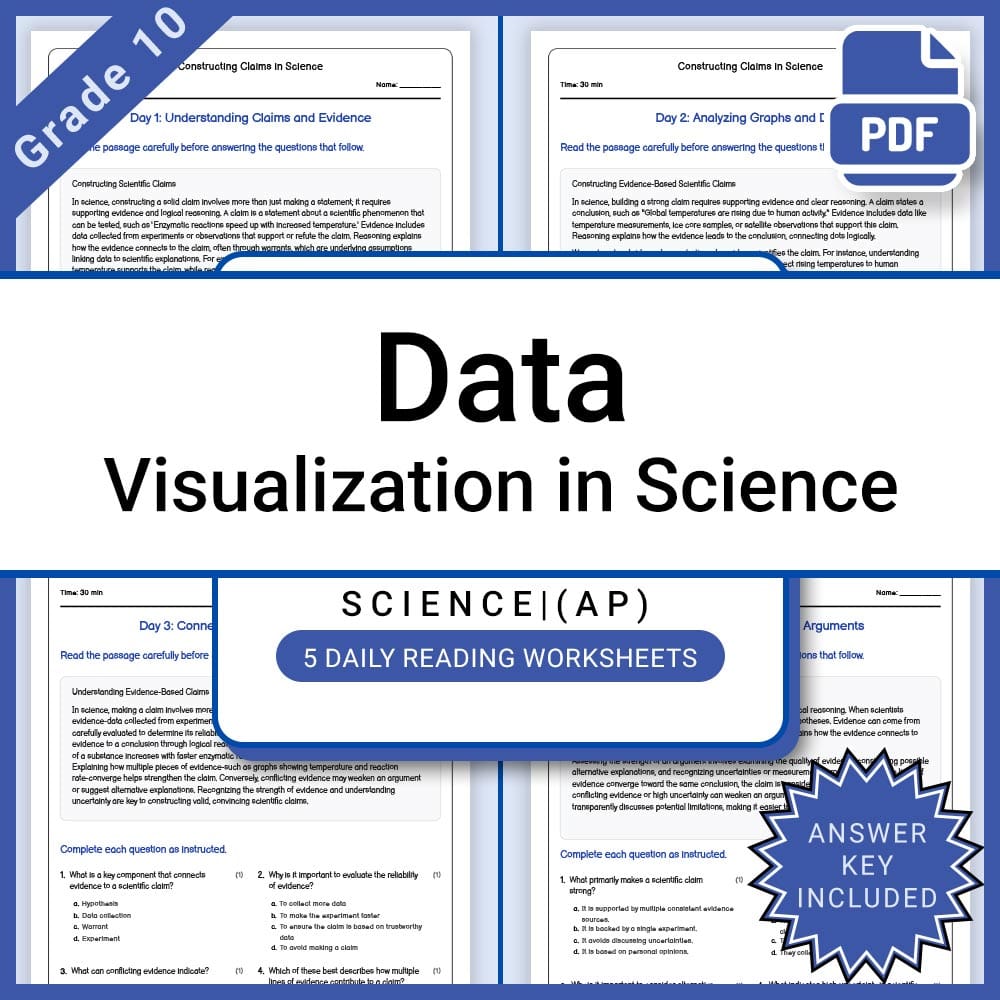
Grade 10 Science – Data Visualization Daily Reading Worksheet with Answer Key
JCreated byJ.S SheetsLearning Objectives
- Understand different types of graphs and their purposes
- Identify principles of effective data presentation
- Interpret patterns, outliers, and variability in graphs
Also included in: Grade 10 Science Lesson Group – AP Curriculum Worksheets Bundle
Instant download
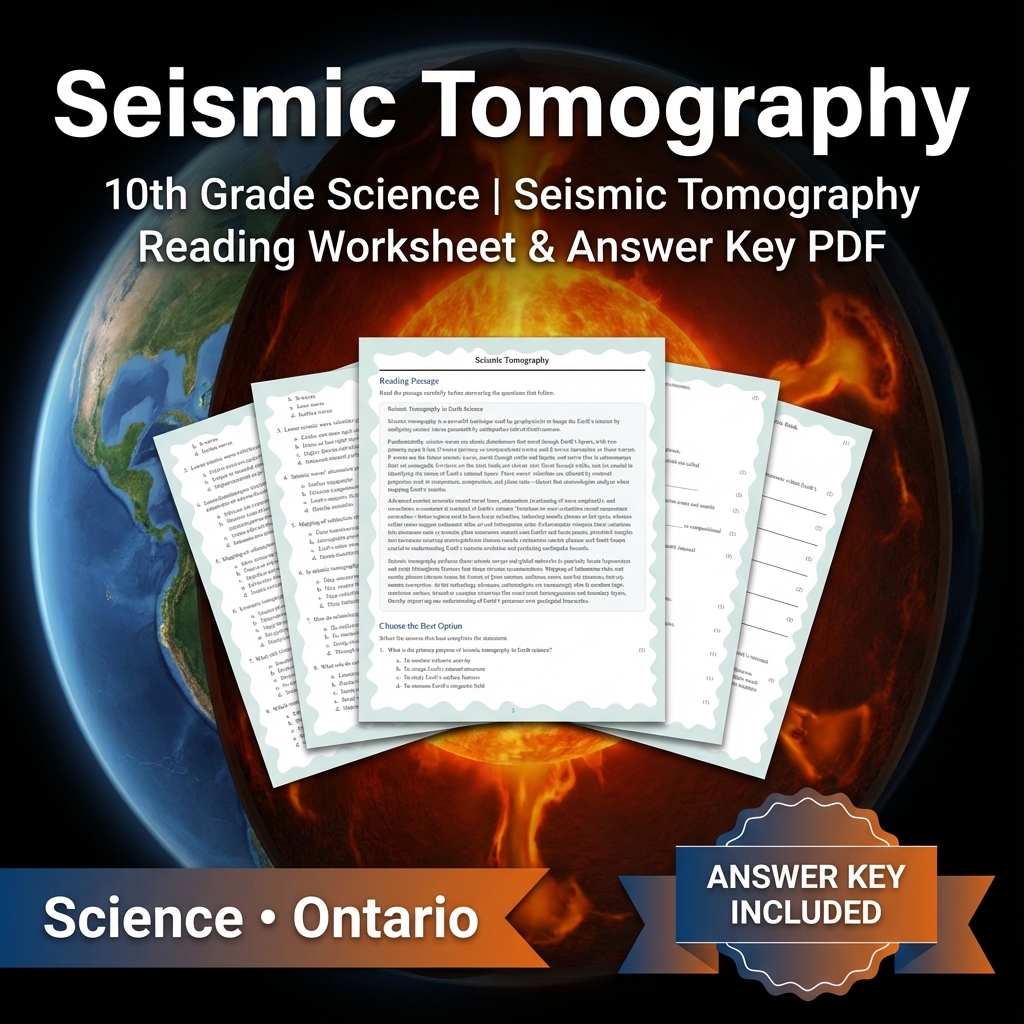
10th Grade Science | Seismic Tomography Reading Worksheet & Answer Key PDF
JCreated byJ.S SheetsLearning Objectives
- Understand the different types of seismic waves and their properties.
- Explain how seismic waves' travel times and attenuation are used to image Earth's internal structure.
- Interpret variations in P- and S-wave velocities to infer temperature, composition, and phase changes in the crust and mantle.
Also included in: Grade 10 Science Unit Bundle – Earth Dynamics & Resources (PDF + Rubrics) +1 more
Instant download
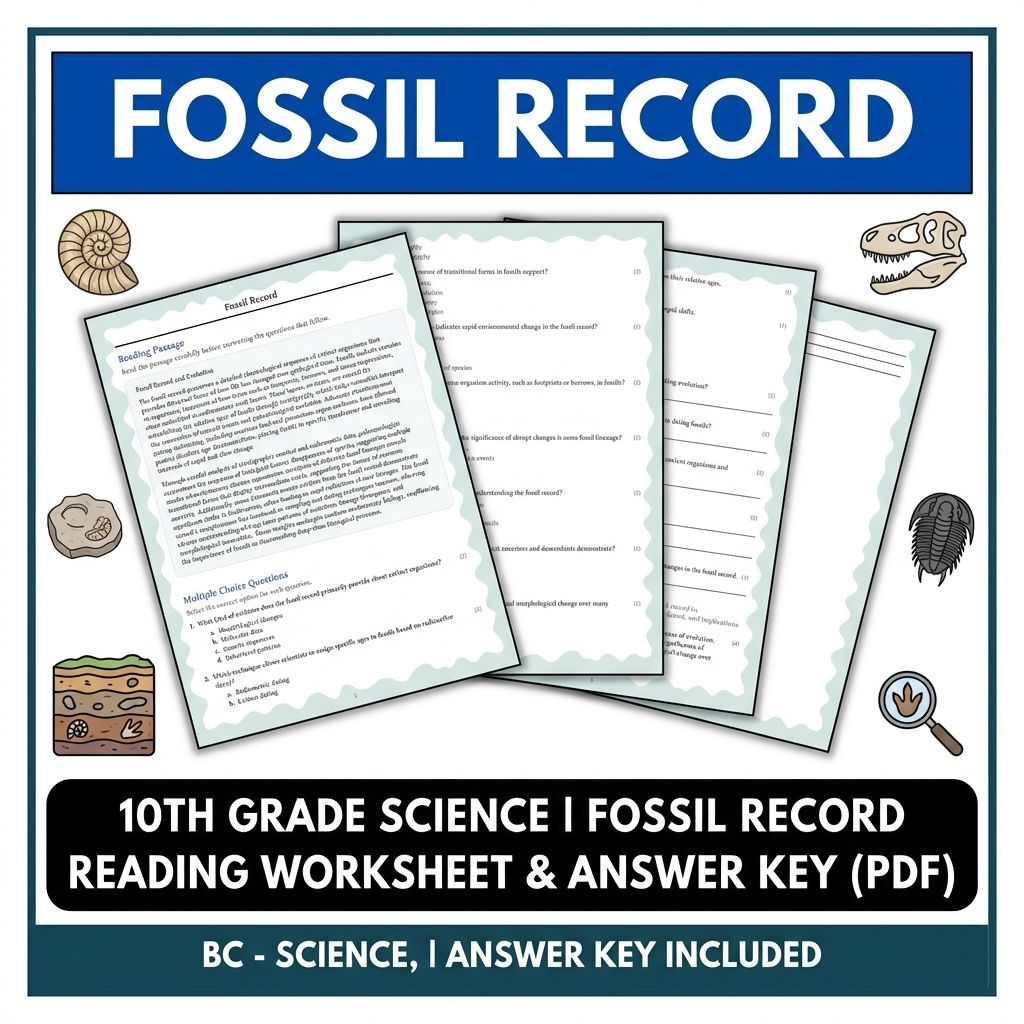
10th Grade Science | Fossil Record Reading Worksheet & Answer Key (PDF)
JCreated byJ.S SheetsLearning Objectives
- Understand how the fossil record documents morphological changes over geological time.
- Learn methods used to interpret stratigraphic and radiometric data for dating fossils.
- Compare gradual and abrupt changes in fossil lineages to interpret evolutionary patterns.
Instant download

Grade 10 Science – Nutrient Cycles & Human Impact | Daily Reading Worksheet
Created byBright Mind ResourcesLearning Objectives
- Understand the major biogeochemical cycles, including carbon and nitrogen fluxes.
- Recognize the processes that drive nutrient movement such as photosynthesis, respiration, nitrification, denitrification, and decomposition.
- Analyze the impact of human activities on nutrient reservoirs and flux rates.
Also included in: Ecosystems Grade 10 Science Daily Reading Worksheets Bundle | NGSS +2 more
Instant download
Grade 10 Science – Dynamic Equilibrium Daily Reading Worksheet + Answer Key
JCreated byJ.S SheetsLearning Objectives
- Explain the concept of chemical equilibrium
- Identify factors affecting equilibrium shifts
- Interpret equilibrium constant expressions
Also included in: Grade 10 Science Lesson Group Bundle Alberta | Worksheets & Activities +1 more
Instant download
Grade 10 Science — Ecosystem Basics Worksheet for Mastering TEKS Standards
 Created byThe Resource Hub
Learning Objectives
- Describe the components and functions of an ecosystem.
- Identify different types of components such as producers, consumers, and decomposers.
- Explain the flow of energy and cycling of nutrients within an ecosystem.
Also included in: Grade 10 Science Unit Bundle | Ecosystems & Ecology Worksheets +1 more
Instant download
10th Grade Science – Trophic Efficiency Worksheet for Mastery
Created byThe Resource HubLearning Objectives
- Understand the concept of trophic efficiency and its role in ecosystems.
- Identify factors that influence energy transfer between trophic levels.
- Explain how trophic efficiency affects biomass pyramids and food web structure.
Also included in: Grade 10 Science Unit Bundle | Ecosystems & Ecology Worksheets +1 more
Instant download
Grade 10 Science – Biodiversity Value Worksheet for Mastery
Created byThe Resource HubLearning Objectives
- Understand the components and importance of biodiversity in ecosystems.
- Recognize how biodiversity contributes to ecosystem resilience and services.
- Identify threats to biodiversity and conservation strategies.
Also included in: Grade 10 Science Unit Bundle | Ecosystems & Ecology Worksheets +1 more
Instant download
Grade 10 Science | Biogeochemical Cycles Worksheet for Mastery
Created byThe Resource HubLearning Objectives
- Understand the key elements involved in biogeochemical cycles and their pathways.
- Explain how biological and physical processes interact in nutrient cycling.
- Analyze human impacts on biogeochemical cycles and ecosystems.
Also included in: Grade 10 Science Unit Bundle | Ecosystems & Ecology Worksheets +1 more
Instant download
Grade 10 Science — Carrying Capacity Worksheet for Understanding Ecology
Created byThe Resource HubLearning Objectives
- Define carrying capacity and explain its significance in ecosystems.
- Identify factors that influence the carrying capacity of environments.
- Analyze how resource limitations and population fluctuations relate to carrying capacity.
Also included in: Grade 10 Science Unit Bundle | Ecosystems & Ecology Worksheets +1 more
Instant download
Grade 10 Science – Adaptation Strategies in Earth Systems Worksheet + Answer Key
JCreated byJ.S SheetsLearning Objectives
- Understand different adaptation strategies used in ecosystems.
- Analyze ecological responses to environmental changes.
- Evaluate potential effectiveness and unintended consequences of adaptation measures.
Also included in: Grade 10 Science Lesson Bundle | AP Earth & Environmental Topics
Instant download

Grade 10 Science | Ecosystem Stability Worksheet with Short Notes (PDF)
Created byMeadowlark WorksheetsLearning Objectives
- Understand the concepts of ecosystem resilience, thresholds, and feedback mechanisms.
- Analyze the impact of disturbances on long-term system trajectories and stable states.
- Evaluate indicators such as recovery time and functional redundancy in ecosystem management.
Also included in: Grade 10 Science Ecosystems Interactions & Energy NGSS Unit Bundle +1 more
Instant download

Grade 10 Science | Ecosystem Modeling Worksheet with Short Notes (Printable PDF)
Created byMeadowlark WorksheetsLearning Objectives
- Understand the development and interpretation of ecological models such as Lotka–Volterra equations and mass-balance nutrient models.
- Analyze how models predict system responses to perturbations like species loss or altered fluxes.
- Evaluate the methods used for model calibration using empirical data to assess resilience and tipping points.
Also included in: Grade 10 Science Ecosystems Interactions & Energy NGSS Unit Bundle +1 more
Instant download

Grade 10 Science | Population Growth Worksheet with Short Notes PDF
Created byMeadowlark WorksheetsLearning Objectives
- Understand the principles of exponential and logistic population models.
- Analyze the impact of density-dependent and density-independent factors on population dynamics.
- Interpret data related to birth rates, death rates, and carrying capacity.
Also included in: Grade 10 Science Ecosystems Interactions & Energy NGSS Unit Bundle +1 more
Instant download

Grade 10 Science | Biodiversity Drivers Worksheet with Short Notes (PDF)
Created byMeadowlark WorksheetsLearning Objectives
- Identify key factors influencing species richness and composition.
- Explain the impact of habitat fragmentation, invasive species, land-use change, and climate shifts.
- Analyze mechanisms like genetic diversity, metapopulation structure, and connectivity in species survival.
Also included in: Grade 10 Science Ecosystems Interactions & Energy NGSS Unit Bundle +1 more
Instant download

Grade 10 Science Ecosystem Structure Worksheet with Short Notes (Printable PDF)
Created byMeadowlark WorksheetsLearning Objectives
- Understand the key components and structure of ecosystems.
- Identify the roles of producers, consumers, and decomposers.
- Explain how energy flows through an ecosystem.
Also included in: Grade 10 Science Ecosystems Interactions & Energy NGSS Unit Bundle +1 more
Instant download

Grade 10 Science | Trophic Relationships Worksheet with Short Notes (PDF)
Created byMeadowlark WorksheetsLearning Objectives
- Understand the flow of energy through different trophic levels in ecosystems.
- Identify and analyze ecological pyramids and biomass distribution.
- Explain the role of keystone species and trophic cascades in community dynamics.
Also included in: Grade 10 Science Ecosystems Interactions & Energy NGSS Unit Bundle +1 more
Instant download
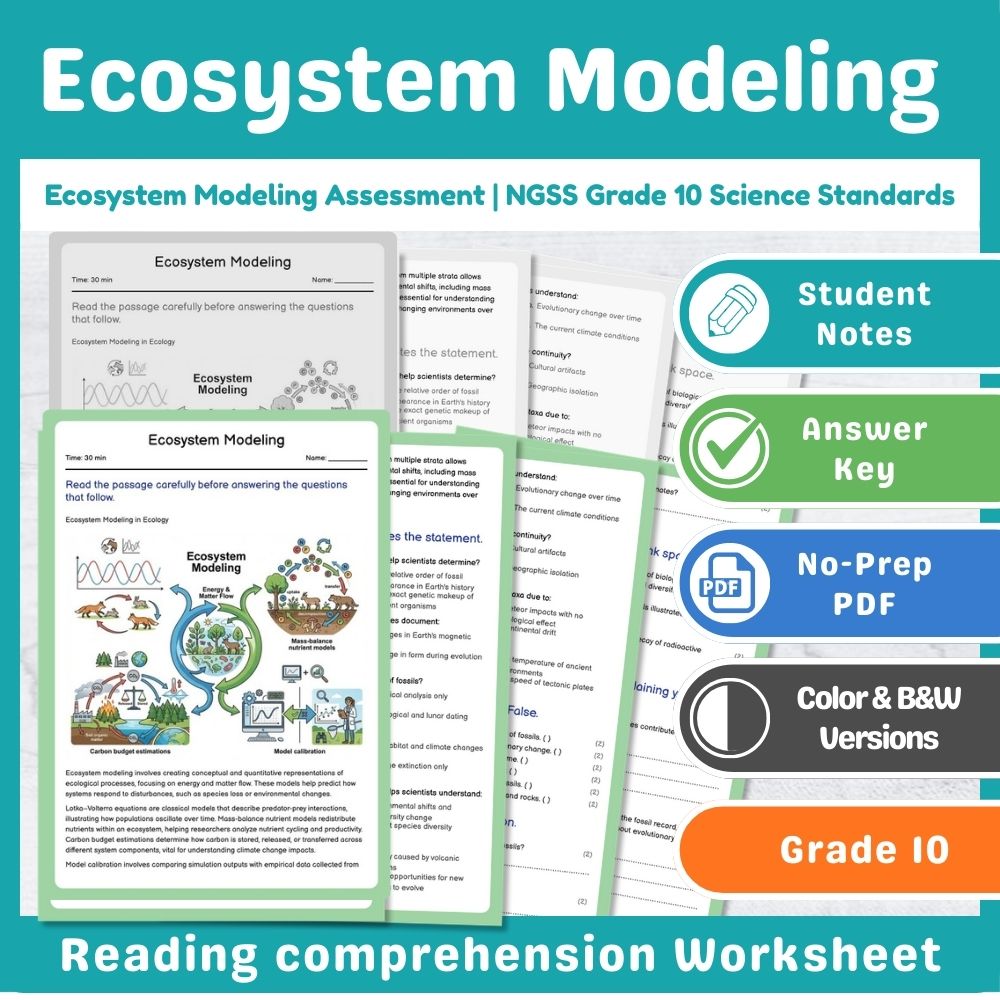
Ecosystem Modeling Assessment | NGSS Grade 10 Science Standards
Created byPrism Point LearningLearning Objectives
- Understand the development and interpretation of ecological models such as Lotka–Volterra equations.
- Analyze how energy and matter flows are represented in ecosystem models.
- Evaluate the impact of perturbations, species loss, and altered fluxes on ecosystem stability and resilience.
Instant download
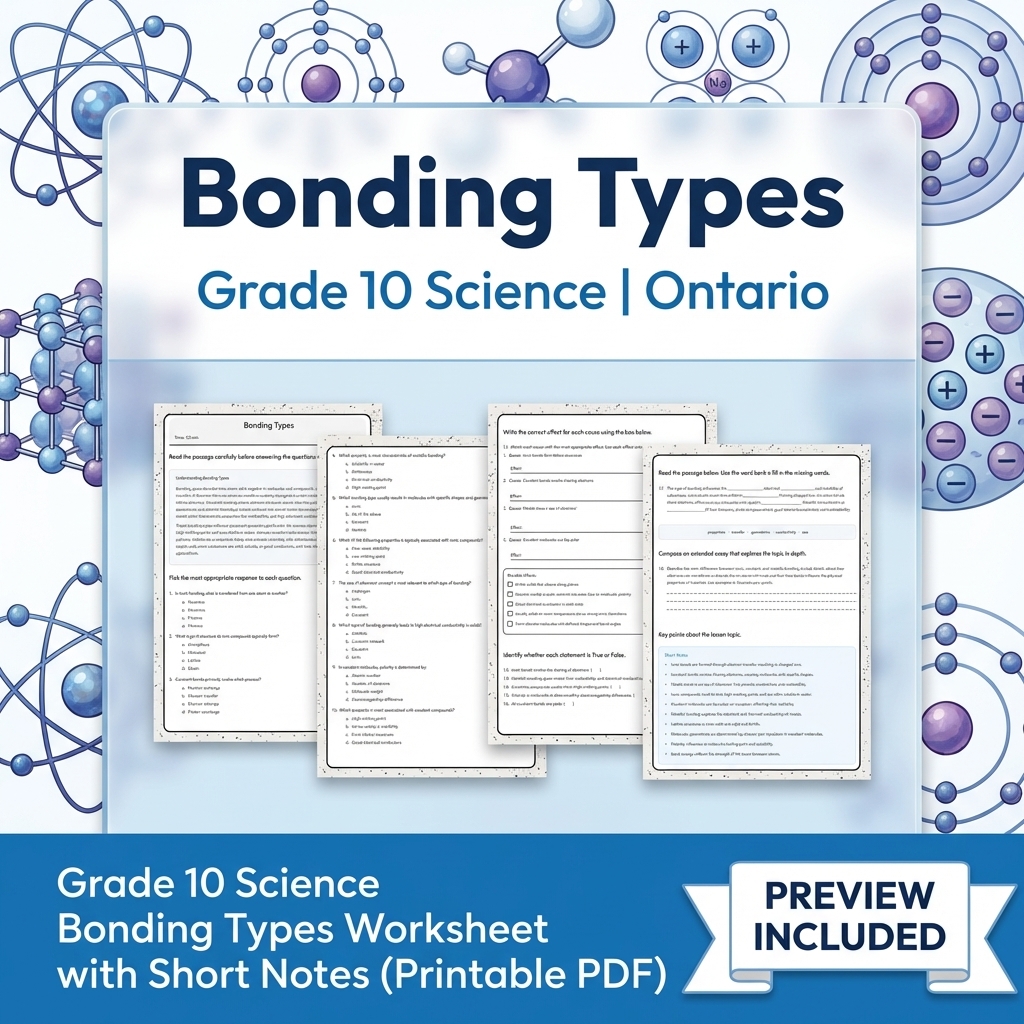
Grade 10 Science Bonding Types Worksheet with Short Notes (Printable PDF)
Created byMeadowlark WorksheetsLearning Objectives
- Understand the differences between ionic, covalent, and metallic bonding.
- Explain electron transfer and sharing models in bonding.
- Identify molecular geometries and lattice structures resulting from bonding types.
Also included in: Grade 10 Science Lesson Group Bundle with Ontario Framework +1 more
Instant download
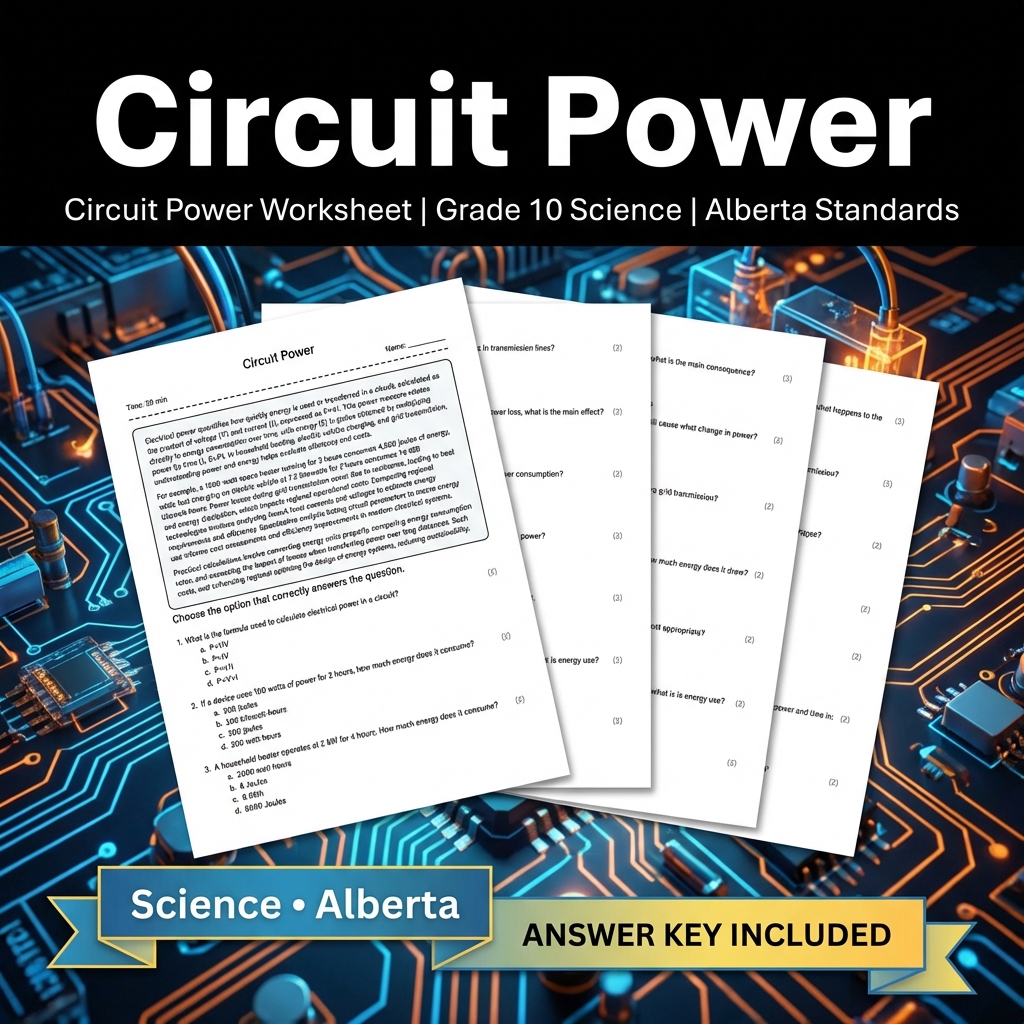
Circuit Power Worksheet | Grade 10 Science | Alberta Standards
Created byCoral Reef LearningLearning Objectives
- Understand how electrical power is calculated using voltage and current.
- Apply power, energy, and time relationships to practical electrical scenarios.
- Analyze energy consumption in household appliances, electric vehicles, and transmission systems.
Instant download

Grade 10 Science – Genomic Technologies & DNA Applications | Reading Worksheet
Created byBright Mind ResourcesLearning Objectives
- Understand the basic structure of DNA and how it functions as the blueprint of life.
- Learn about key genomic technologies such as PCR, DNA sequencing, and CRISPR.
- Explore how recombinant DNA methods are used in biotechnology.
Also included in: DNA & Genetics Grade 10 Science Daily Reading Worksheets Lesson Bundle | TEKS +2 more
Instant download

Grade 10 Science – Inheritance Patterns & Genetics | Daily Reading Worksheet
Created byBright Mind ResourcesLearning Objectives
- Understand basic Mendelian principles such as segregation and independent assortment.
- Learn how to interpret Punnett squares for mono- and dihybrid crosses.
- Identify dominant and recessive traits and predict phenotype probabilities.
Also included in: DNA & Genetics Grade 10 Science Daily Reading Worksheets Lesson Bundle | TEKS +2 more
Instant download
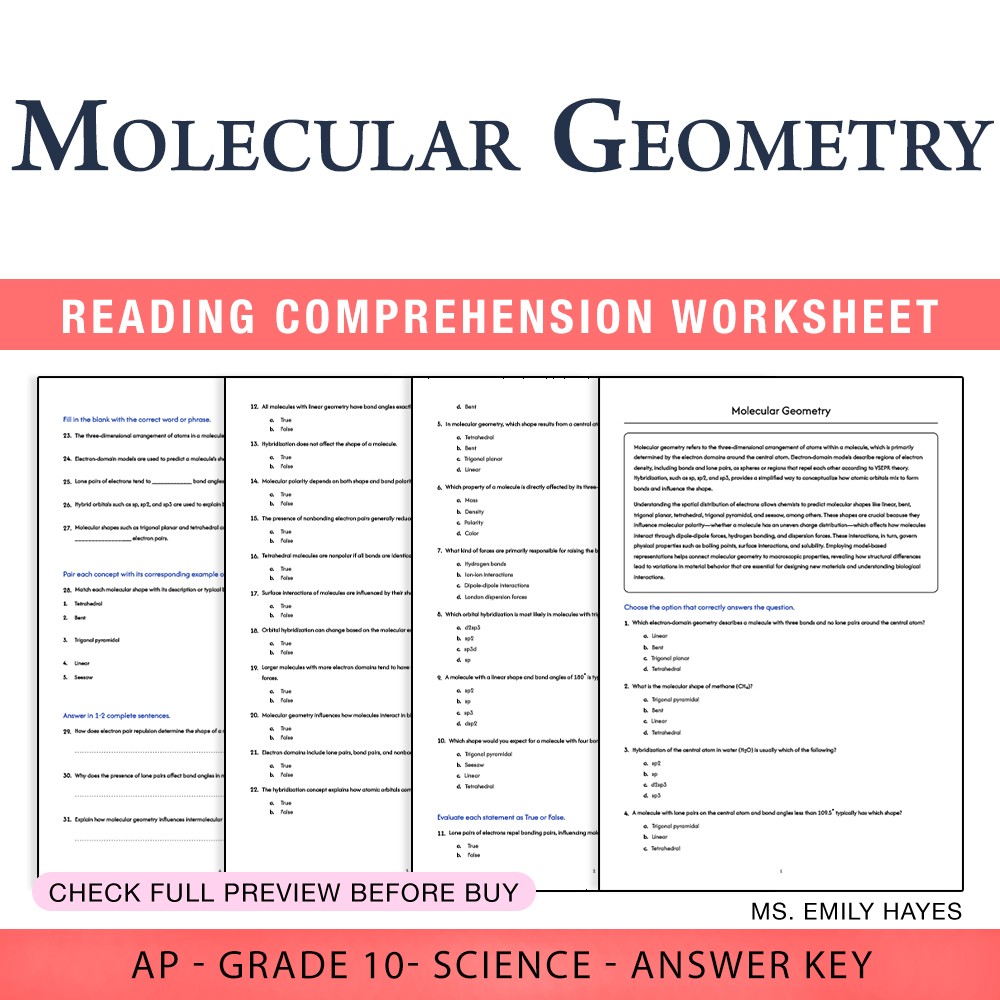
Grade 10 Science | Molecular Geometry Worksheet (PDF+ Answer Key)
Created byCopper Leaf ClassroomLearning Objectives
- Define molecular geometry using electron-domain models and hybridization concepts.
- Predict three-dimensional molecular arrangements based on electron pair distribution.
- Explain how geometry impacts molecular polarity and intermolecular forces.
Also included in: Grade 10 Science -Atomic Structure & Chemical Reactions (PDF+ Answer Key) +1 more
Instant download
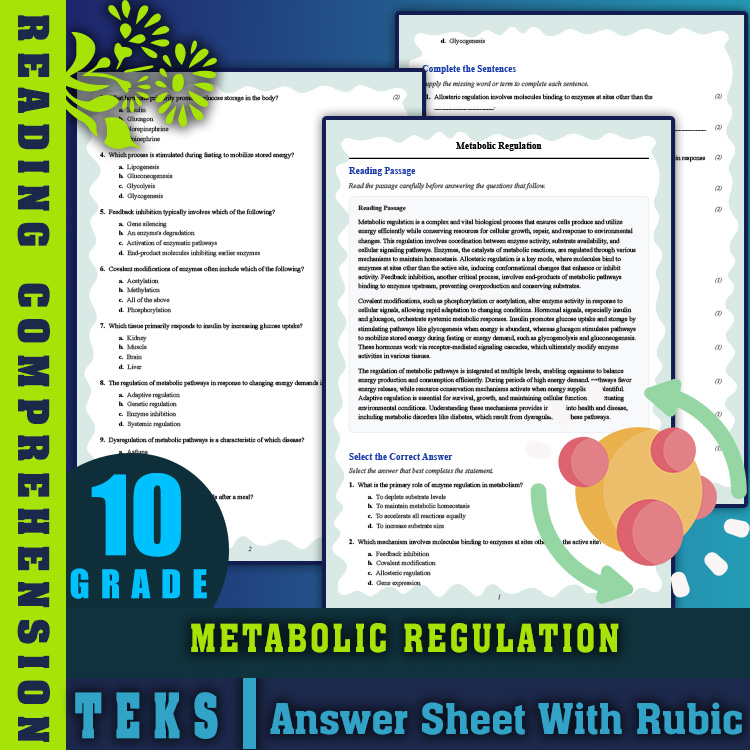
Grade 10 Science | Metabolic Regulation Reading Worksheet (PDF + Rubric)
JCreated byJ.S SheetsLearning Objectives
- Understand how enzyme activity is regulated in metabolic pathways.
- Identify different mechanisms of metabolic regulation, including allosteric and covalent modification.
- Explain the role of hormonal signals like insulin and glucagon in carbohydrate metabolism.
Instant download
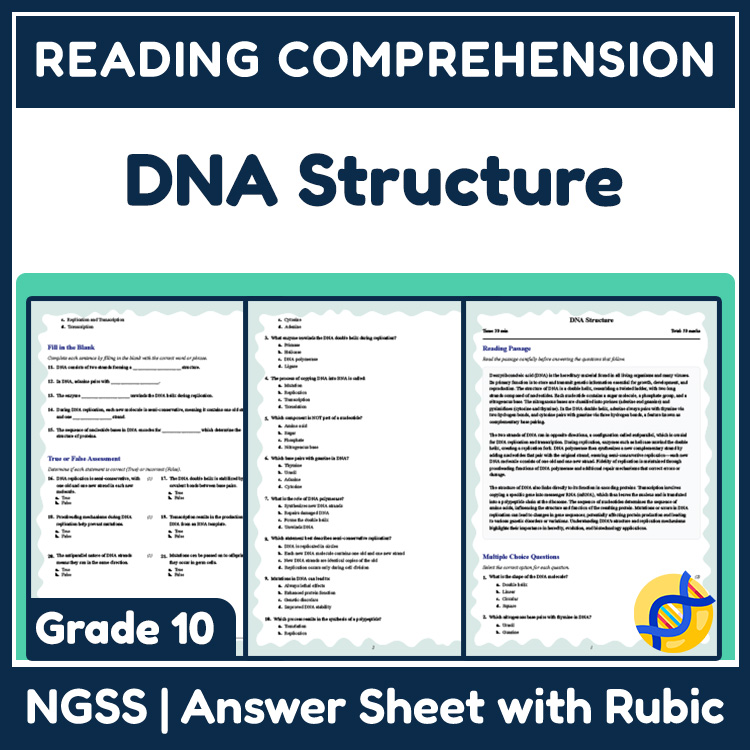
10th Grade Science | DNA Structure Reading Worksheet (PDF + Answer Key)
JCreated byJ.S SheetsLearning Objectives
- Describe the basic structural features of DNA, including the double helix, complementary base pairing, and antiparallel strands.
- Explain the mechanisms of DNA replication, including the roles of DNA polymerase and helicase, and how fidelity is maintained through proofreading and repair.
- Connect DNA structure to processes such as transcription and translation, illustrating how nucleotide sequences encode proteins.
Instant download
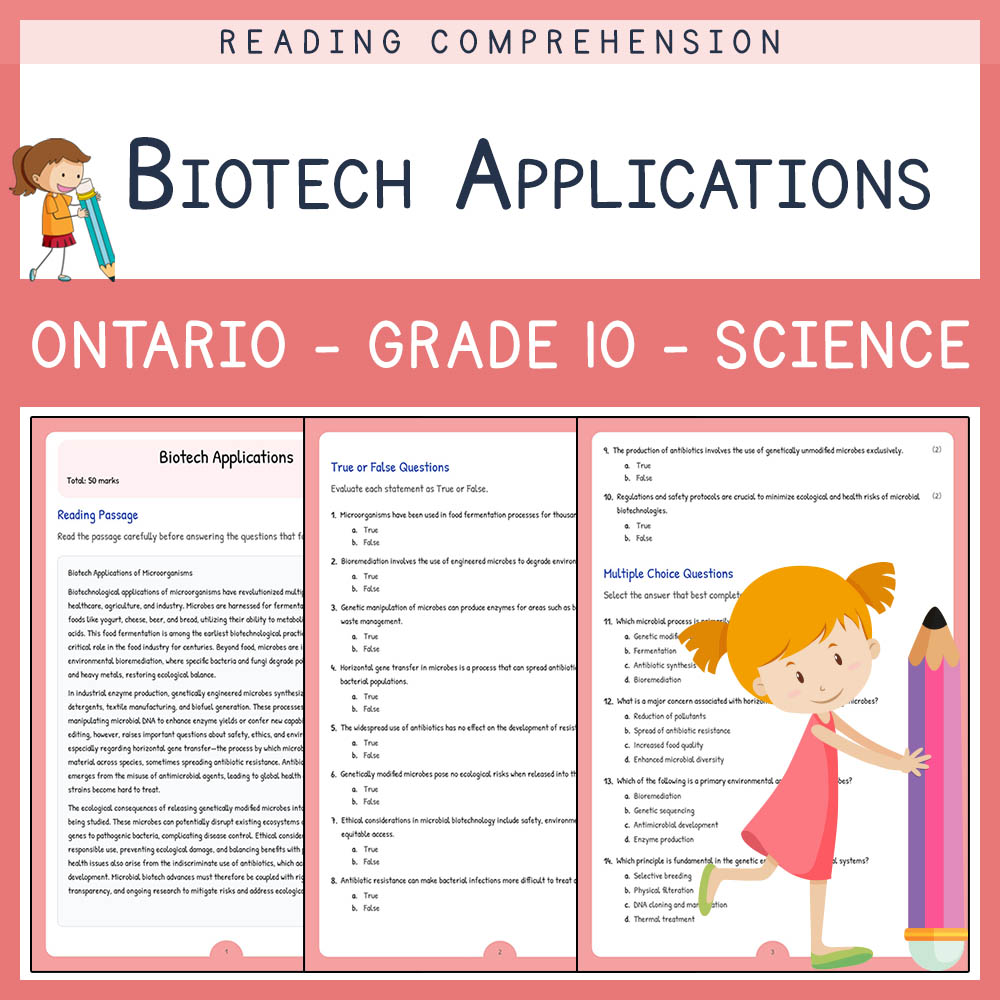
Grade 10 Science | Biotech Applications Worksheet Elena | Ontario Standard
 Created byLumora Learning
Learning Objectives
- Understand the various biotechnological applications of microorganisms in food production, pollution remediation, and enzyme manufacturing.
- Explain the principles of genetic manipulation and its rôle in microbial biotech products.
- Analyze issues related to antibiotic resistance and horizontal gene transfer in microbial systems.
Instant download

Grade 10 Science | Astronomical Scale Worksheet | Florida NGSSS Aligned
Created byLumora LearningLearning Objectives
- Explain why astronomers use different distance units (astronomical units and light-years) to describe space accurately
- Use scale reasoning to compare apparent size and brightness of celestial objects and relate them to distance and intrinsic power
- Describe how the solar system fits within the larger hierarchy of the Milky Way
Instant download

Energy Conservation Test Prep Worksheets | Grade 10 Science NGSS
Created byPrism Point LearningLearning Objectives
- Explain how energy is conserved in closed and isolated systems using mechanical examples.
- Use energy bookkeeping to track transfers between kinetic, potential, and thermal stores.
- Apply basic algebra to compare energy before and after motion, using idealized assumptions.
Instant download

Work And Power Worksheet | Grade 10 Science NGSS Review and Practice
Created byPrism Point LearningLearning Objectives
- Use the work–energy theorem to relate net work to changes in kinetic energy.
- Calculate average power and apply the power as a rate of energy transfer idea.
- Perform unit conversions among joules (J), watts (W), and common engineering time units.
Instant download

Energy Accounting Practice Worksheet | Grade 10 Science
Created byPrism Point LearningLearning Objectives
- Use a consistent sign convention to track energy transfers between system boundaries and identify inputs, outputs, and storage changes.
- Create and interpret energy flow statements and simple energy-balance tables for mechanical, electrical, and thermal stores.
- Use algebraic energy accounting to predict how energy is distributed after transfers and losses.
Instant download

10th Grade Science | Energy Currency Worksheet (PDF+ Answer Key)
Created byCopper Leaf ClassroomLearning Objectives
- Explain the role of ATP as the energy currency in cells.
- Compare exergonic and endergonic reactions in biological energy transfer.
- Describe how redox reactions and bond energy changes relate to cellular energetics.
Also included in: Grade 10 Science | Key Concepts in Biology & Ecosystems (PDF+ Answer Key) +1 more
Instant download

Grade 10 Mechanics Applications Worksheet | Ontario Science Physics
 Created byClear Sky Classroom
Learning Objectives
- Apply kinematic relationships to predict motion in real mechanical systems such as inclines and braking scenarios.
- Use Newton’s laws to relate forces, mass, and acceleration when analyzing engineered designs.
- Connect energy and momentum ideas (work, stopping distance, and impulse) to explain safety trade-offs.
Instant download

Friction Dynamics Worksheet | AP Science Grade 10 Practice PDF
JCreated byJ.S SheetsLearning Objectives
- Understand the differences between static and kinetic friction and their dependence on normal force and surface properties.
- Apply coefficient-based models to analyze frictional effects on motion in inclined-plane and surface-contact scenarios.
- Relate frictional forces to energy dissipation pathways and adjust net force calculations in dynamic situations.
Also included in: Grade 10 Motion, Waves & Electricity Science Lesson Bundle
Instant download
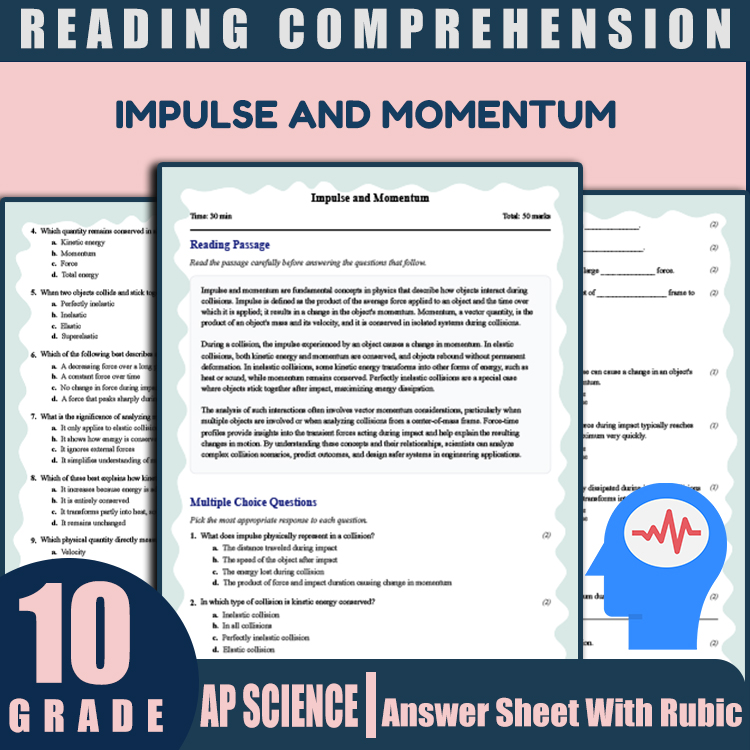
10th Grade Science | Impulse and Momentum Reading Worksheet (PDF + Rubric)
JCreated byJ.S SheetsLearning Objectives
- Understand the relationship between impulse and change in momentum in collision events.
- Differentiate between elastic, inelastic, and perfectly inelastic collisions and analyze energy transformations.
- Apply vector momentum principles to analyze multi-object interactions and collision outcomes.
Also included in: Grade 10 Science Unit Bundle | Motion, Forces & Energy Worksheets (PDF) +1 more
Instant download

Grade 10 Dynamic Equilibrium Worksheet PDF | Alberta Science Resource
Created byEvergreen Desk EducationLearning Objectives
- Explain dynamic equilibrium as a balance of forward and reverse reaction rates
- Interpret how equilibrium expressions and equilibrium constants relate to concentrations or pressures
- Predict how changes in concentration, pressure, or temperature shift a system toward or away from equilibrium
Instant download
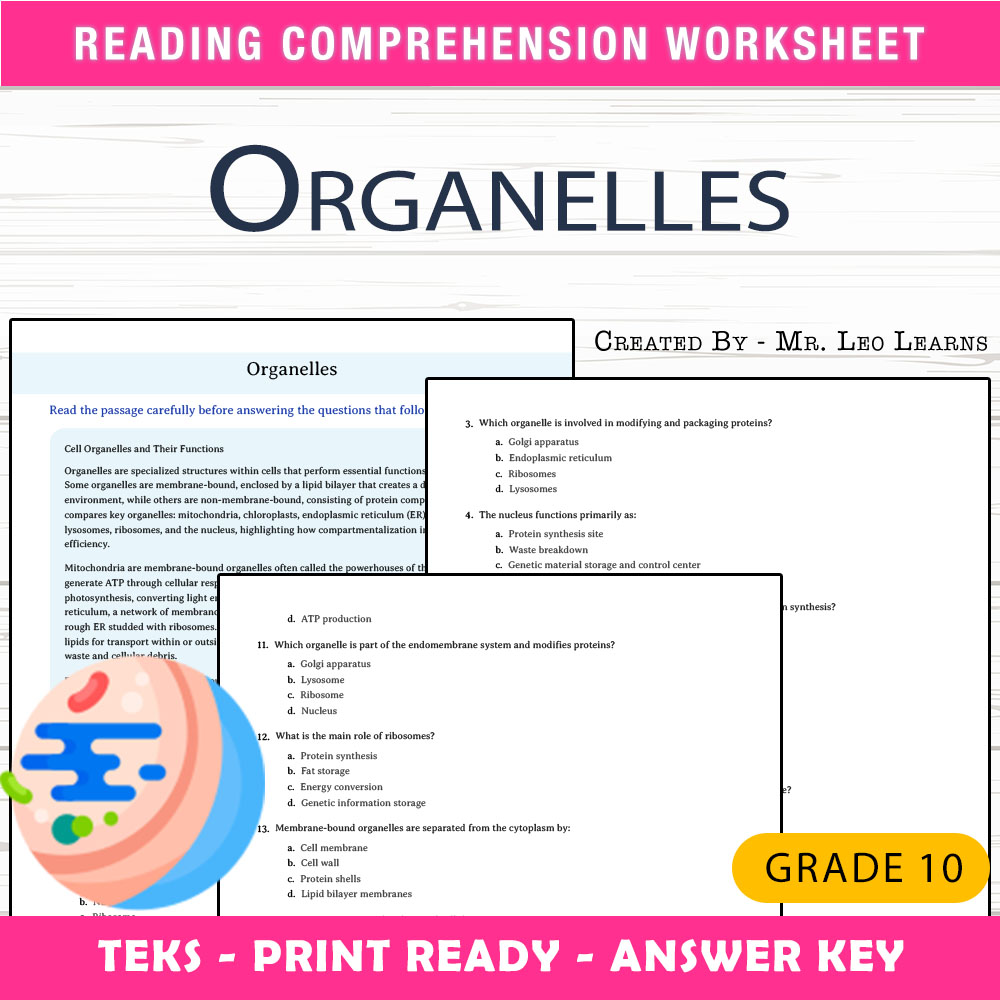
Grade 10 Science – Organelles Worksheet for Mastering Cell Structures
Created byThe Resource HubLearning Objectives
- Understand the structure and functions of various cellular organelles.
- Explain how compartmentalization enhances cell efficiency.
- Identify examples of energy conversion, synthesis, storage, and genetic control in organelles.
Also included in: Grade 10 Science Cell Biology Unit | Cell Structures & Functions Worksheet Pack +1 more
Instant download

Grade 10 Science | Electromagnetic Forces Worksheet (NGSS10 PDF)
 Created bySilver Birch Teaching
Learning Objectives
- Explain how electric and magnetic fields interact with charges and currents.
- Describe the Lorentz force law and its application in simple contexts.
- Analyze phenomena such as charged particle deflection and magnetic interactions between currents.
Also included in: Grade 10 Forces, Motion, and Fields Science Lesson Bundle for NGSS +1 more
Instant download
About Grade 10 Science Worksheets
Find Science worksheets built for Grade 10. All 7,069 cover core skills, practice, and review, each an instant PDF download.
Every worksheet on MyTeachingSheets is created by independent teacher-authors and reviewed before publication. All resources download as printable PDFs for classroom, homework, or at-home practice, and many include answer keys. Preview any worksheet free before buying.