
Grade 10 Science Worksheets
7,038 worksheets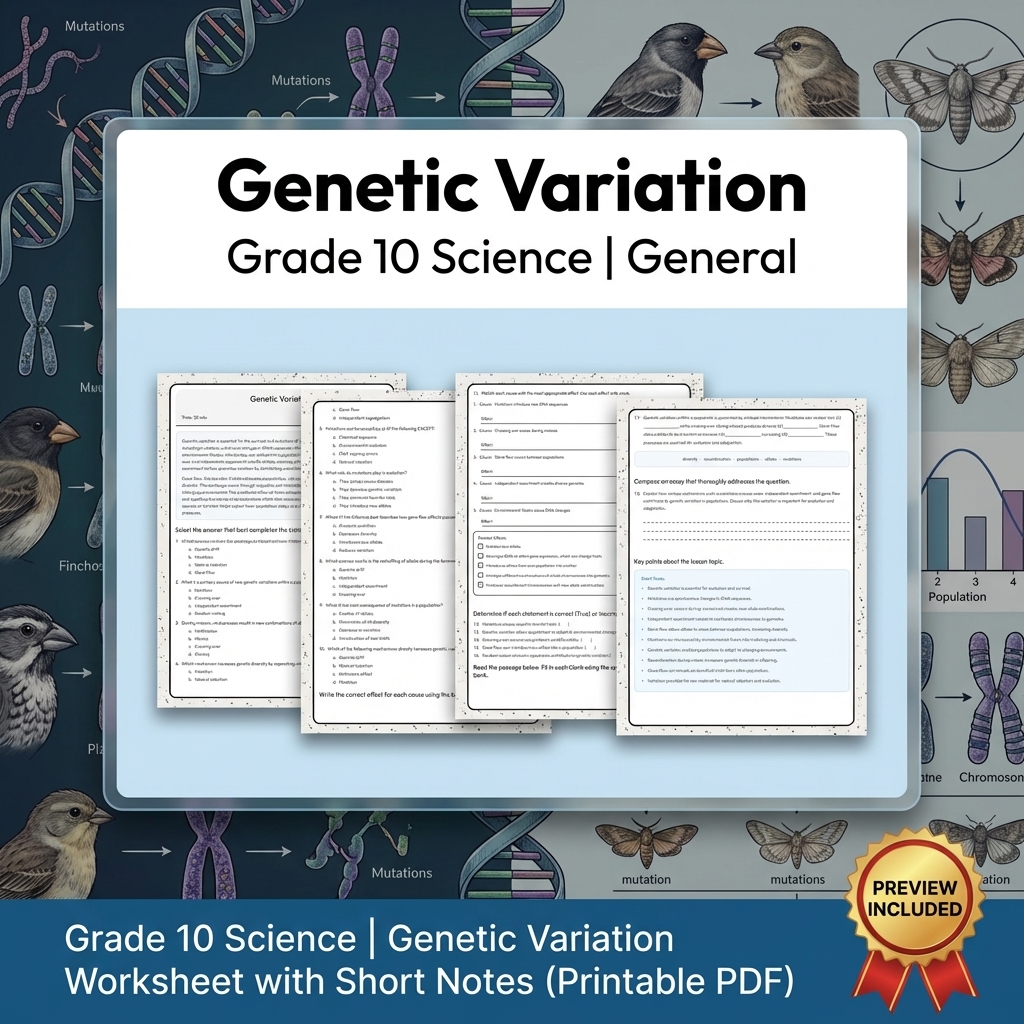
Grade 10 Science | Genetic Variation Worksheet with Short Notes (Printable PDF)
 Created byMeadowlark Worksheets
Learning Objectives
- Understand sources of genetic variation within populations.
- Identify mechanisms like meiosis, mutations, and gene flow that generate variation.
- Explain how genetic variation influences evolution and adaptation.
Also included in: Grade 10 Natural Selection & Heredity Science Lesson Bundle - General +1 more
Instant download

Grade 10 Energy Currency Worksheet | Practice & PDF
 Created byClear Sky Classroom
Learning Objectives
- Explain why ATP is considered the primary energy currency of cells
- Describe how ATP hydrolysis and ATP synthesis are coupled to cellular processes
- Interpret how ATP turnover changes with tissue type and environmental conditions
Instant download

Grade 10 Science | Ocean Atmosphere Coupling Worksheet | General Standard
 Created byLumora Learning
Learning Objectives
- Explain how the ocean and atmosphere exchange heat and moisture to influence climate variability
- Describe why the ocean responds more slowly than the atmosphere due to its high heat capacity
- Interpret how sea-surface temperature changes can shift evaporation, storm development, and wind patterns
Instant download

Chemical Pathways and Reaction Rates Worksheets Grade 10 Science
 Created bySunny Desk Resources
Learning Objectives
- Explain how reaction types and rates influence air, water, and soil chemistry.
- Interpret chemical pathways that form and remove ozone and smog in urban air.
- Describe nutrient cycling and pollutant fate using mass-flow ideas over seasons.
Also included in: Grade 10 Chemistry Lesson Bundle | Alberta Science Reaction & Analysis +1 more
Instant download

Grade 10 Science – Bonding Models & Properties | Daily Reading Worksheet
 Created byBright Mind Resources
Learning Objectives
- Understand the basic types of chemical bonds: ionic, covalent, and metallic.
- Describe how electrons are transferred or shared in different bonding models.
- Relate molecular structures to observable material properties such as conductivity and melting points.
Also included in: Grade 10 Stoichiometry & Atomic Structure Science Reading Lesson Bundle | AP +2 more
Instant download
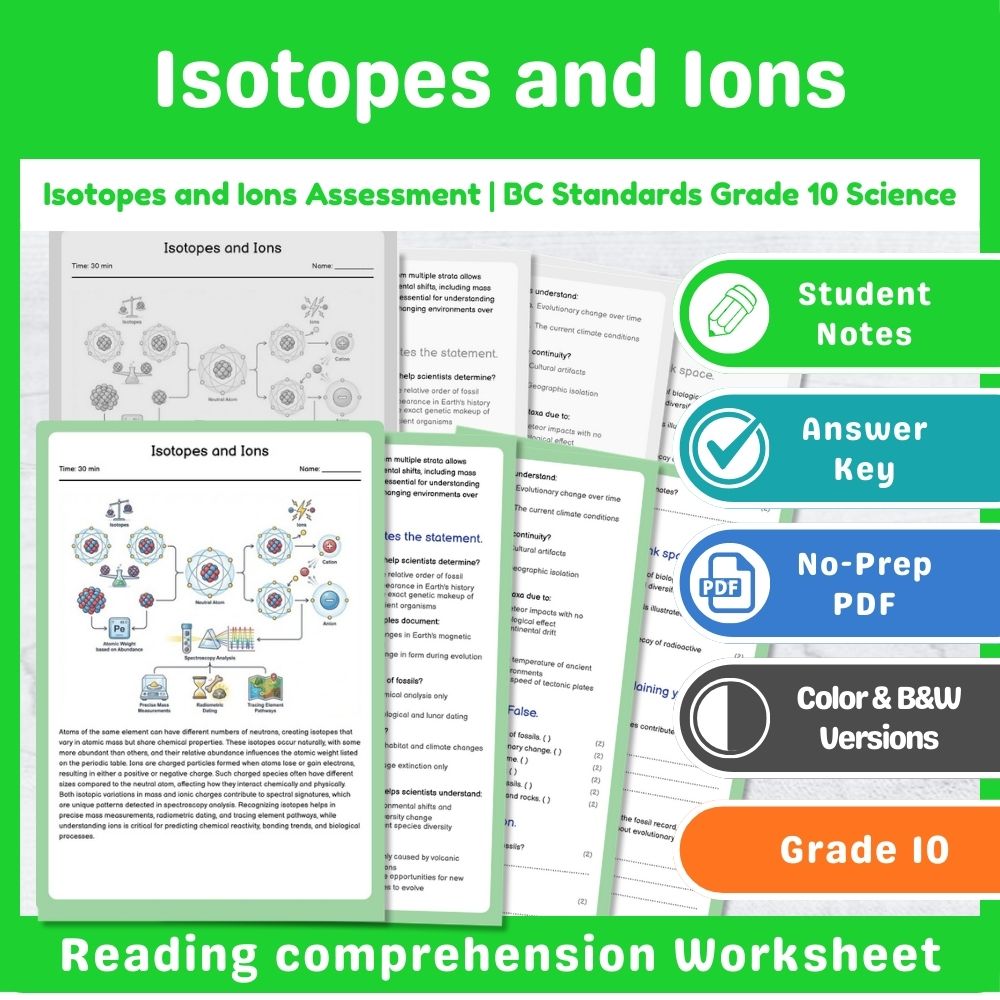
Isotopes and Ions Assessment | BC Standards Grade 10 Science
 Created byPrism Point Learning
Learning Objectives
- Define and differentiate between isotopes and ions, understanding their atomic structure and charge.
- Explain how isotopes affect atomic mass and spectral signatures.
- Describe the formation of ions through electron gain or loss and their chemical properties.
Instant download

Grade 10 Circuit Power Worksheet | Alberta Practice & PDF
Created byClear Sky ClassroomLearning Objectives
- Explain how electrical power relates to voltage and current using P = IV.
- Calculate electrical energy used over time using E = Pt and connect units to real-world consumption.
- Evaluate how efficiency and power losses affect operational cost and energy use in practical systems.
Instant download

Grade 10 Science | Cell Structure & Types - Daily Reading Comprehension
 Created byCoral Reef Learning
Learning Objectives
- Understand and differentiate between eukaryotic and prokaryotic cells
- Identify core structures of cells and their functions
- Recognize how cell structure relates to cell roles and specialization
Instant download

Grade 10 Homology and Commonality Worksheet | California Science Standards
 Created byEvergreen Desk Education
Learning Objectives
- Explain how homologous structures provide evidence of shared ancestry between organisms
- Identify examples of homology in anatomy, development, and molecular features
- Distinguish homology from similarity due to convergent evolution
Instant download

Grade 10 Bonding Types Worksheet | Chemical Bonds Activity + Answer Key
Created byClear Sky ClassroomLearning Objectives
- Differentiate ionic, covalent, and metallic bonding using electron transfer vs. sharing vs. delocalization.
- Explain how bonding and structure influence melting point, solubility, electrical conductivity, and hardness.
- Use polarity and bond energy ideas to predict molecular behavior and material suitability for applications.
Instant download
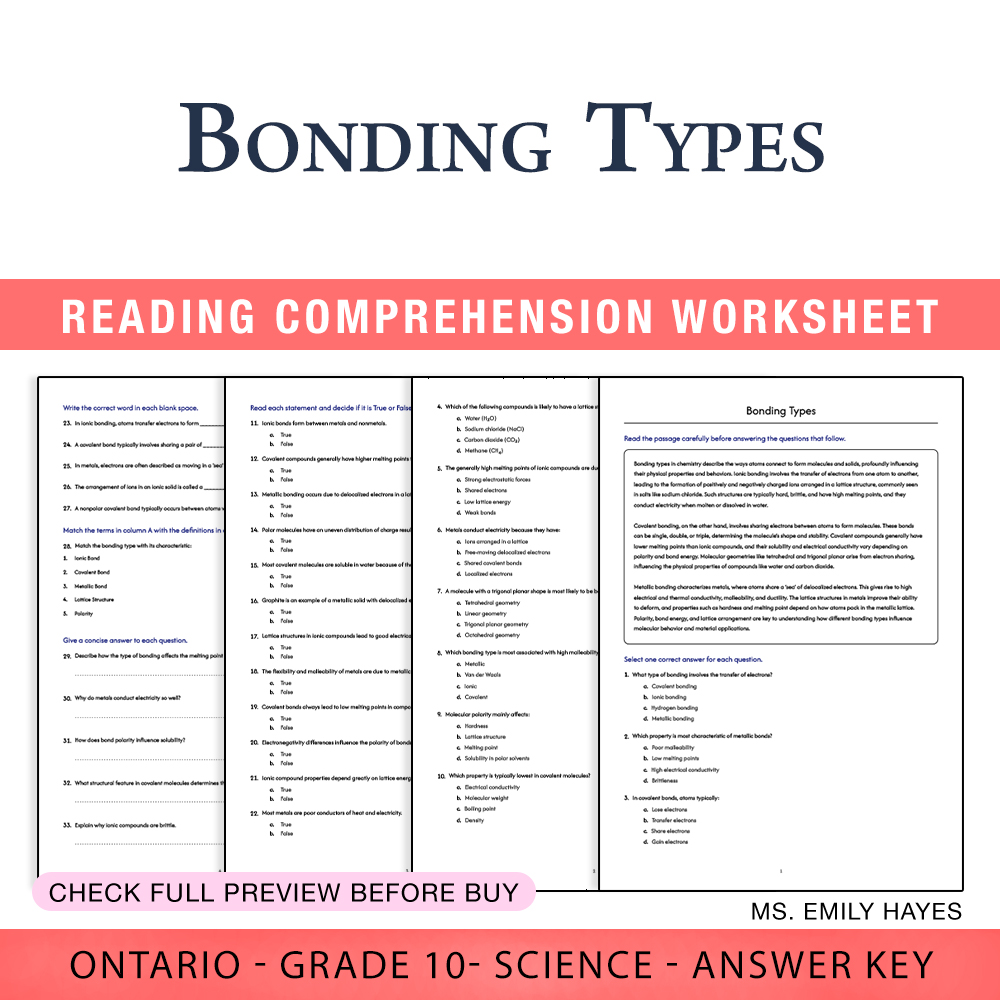
Grade 10 Science | Bonding Types Worksheet (PDF + Answer Key)
 Created byCopper Leaf Classroom
Learning Objectives
- Describe the main types of bonding: ionic, covalent, and metallic.
- Explain how electron transfer and sharing determine bonding properties.
- Identify features of lattice structures and molecular geometries associated with each bonding type.
Instant download
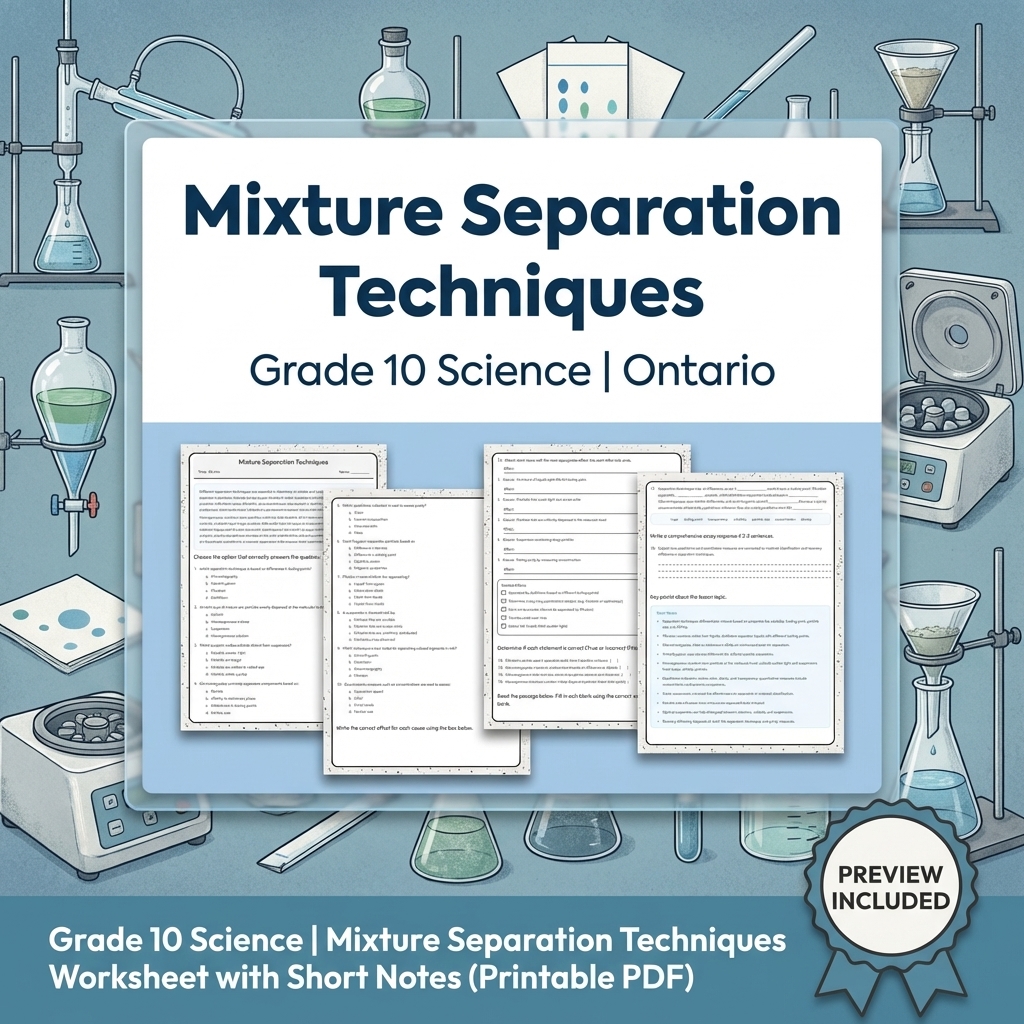
Grade 10 Science | Mixture Separation Techniques Worksheet with Short Notes
Created byMeadowlark WorksheetsLearning Objectives
- Explain the principles of various separation techniques such as filtration, distillation, chromatography, and centrifugation.
- Distinguish between homogeneous solutions, colloids, and suspensions based on particle dispersion and optical properties.
- Understand qualitative and quantitative measures used in purity assessment of materials.
Also included in: Grade 10 Science Lesson Group Bundle with Ontario Framework +1 more
Instant download

Surface Atmosphere Worksheet | NGSS Grade 10 Science Practice and Assessment
JCreated byJ.S SheetsLearning Objectives
- Understand the interactions between surface properties and atmospheric processes.
- Explain the concepts of albedo, radiative forcing, and greenhouse gas effects.
- Analyze how surface and atmospheric interactions influence climate variability.
Instant download
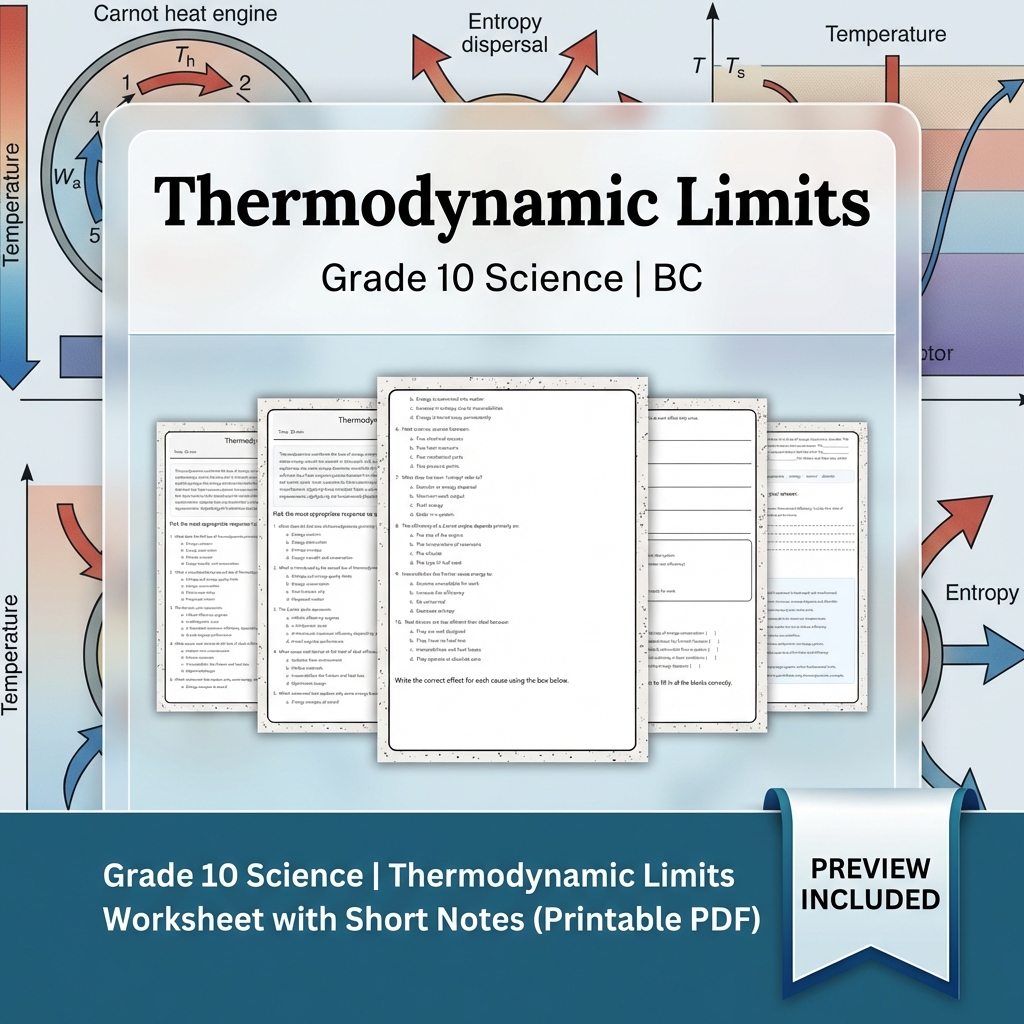
Grade 10 Science | Thermodynamic Limits Worksheet with Short Notes (PDF)
Created byMeadowlark WorksheetsLearning Objectives
- Understand the fundamental principles of energy conservation and entropy in thermodynamics.
- Explain how heat engines and refrigerators operate between temperature reservoirs.
- Calculate maximum theoretical efficiencies using Carnot relationships.
Also included in: Grade 10 Science Lesson Bundle | Energy & Thermodynamics Worksheets +1 more
Instant download

Fossil Formation and Preservation Processes Worksheet | Grade 10 TEKS
 Created byBRIGHT PATH RESOURCES
Learning Objectives
- Summarize the main steps that lead to fossil formation.
- Identify how burial and preservation conditions affect what kinds of fossils remain.
- Explain why sedimentary environments and time are important for fossil records.
Also included in: Grade 10 Evolution & Classification Science Worksheets Bundle | TEKS Biology +1 more
Instant download

Grade 10 Science | Microscopic Thermal Model Worksheet | California Standards
Created byLumora LearningLearning Objectives
- Explain temperature as being related to the average kinetic energy of microscopic particles
- Use the microscopic thermal model to describe how heat transfer changes particle motion and interactions
- Distinguish the meanings of temperature change and heat flow in macroscopic systems using particle-level reasoning
Instant download

Grade 10 Science | Acceleration Effects Worksheet (PDF) - General Standards
Created byEvergreen Desk EducationLearning Objectives
- Interpret the sign of acceleration and relate it to changes in velocity (speeding up, slowing down, or reversing direction).
- Use velocity-time and position-time graph features (slope, curvature) to reason about acceleration qualitatively.
- Explain acceleration trends using consistent sign conventions and connect them to observed motion outcomes.
Also included in: Grade 10 Conservation Laws in Science Lesson Bundle – General Framework +1 more
Instant download

Grade 10 Science | Ecosystem Carrying Capacity - Daily Reading Comprehension
Created byCoral Reef LearningLearning Objectives
- Define carrying capacity in the context of ecosystems.
- Identify factors that influence an ecosystem's capacity to support populations.
- Explain how resource availability, competition, predators, and disease impact populations.
Instant download

Redox Reactions Worksheet | Grade 10 Science | Standards-Aligned Practice
JCreated byJ.S SheetsLearning Objectives
- Understand the concept of oxidation and reduction in chemical reactions.
- Learn how to assign oxidation numbers to atoms in compounds.
- Identify oxidation and reduction processes in various chemical equations.
Instant download

Grade 10 Science – Hydroecological Links in River Systems | Reading Worksheet
Created byBright Mind ResourcesLearning Objectives
- Understand the interactions between river flow and floodplain ecosystems.
- Identify the ecological functions of wetlands and riparian zones.
- Analyze how groundwater-vegetation coupling influences habitat productivity.
Also included in: Grade 10 Sustainability Science Daily Reading Worksheets lesson bundle | Alberta +1 more
Instant download

Groundwater Systems Worksheet Grade 10 Science Ontario Curriculum
Created byClear Sky ClassroomLearning Objectives
- Explain how aquifer type, porosity, and permeability control groundwater storage and flow.
- Describe recharge and discharge processes and how they affect groundwater levels over time.
- Analyze how surface water and groundwater can be hydraulically connected and how this affects contamination risk.
Instant download

Grade 10 Science | Evolutionary Evidence - Daily Reading Comprehension
Created byCoral Reef LearningLearning Objectives
- Understand various types of evidence supporting the theory of evolution
- Analyze fossil records, comparative anatomy, and molecular data
- Explore how radiometric dating and biogeography contribute to evolution studies
Instant download

Grade 10 Science | Constraint-Based Design in Science - Daily Reading Comprehension
Created byCoral Reef LearningLearning Objectives
- Understand the impact of time constraints on designing observational studies.
- Identify trade-offs involved in data collection under practical limitations.
- Justify the use of proxy measures and sensitivity analysis in constrained experiments.
Also included in: Science Practices Reading Comprehension Lesson Bundle: Grade 10 Science AP +1 more
Instant download

Electric Circuits Worksheet for Grade 10 Science | Standards-Aligned Practice
JCreated byJ.S SheetsLearning Objectives
- Understand the basic components and functions of electric circuits.
- Identify different types of circuit diagrams and their symbols.
- Evaluate factors affecting the efficiency of electrical energy transmission.
Instant download
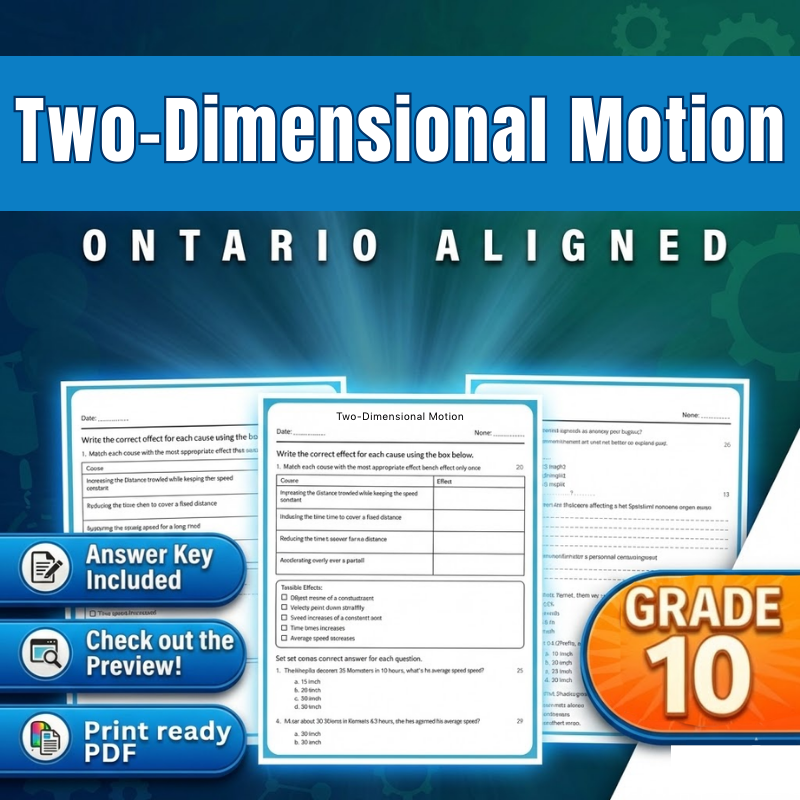
Grade 10 Science | Two-Dimensional Motion Worksheet (Ontario) (PDF)
Created byBright Mind ResourcesLearning Objectives
- Understand the decomposition of initial velocity into horizontal and vertical components in projectile motion.
- Analyze projectile trajectories under uniform gravitational acceleration, neglecting air resistance.
- Interpret the independence of perpendicular components of motion and apply trigonometry for kinematic analysis.
Instant download

DNA Replication Worksheet | Grade 10 Science Activities
Created byPrism Point LearningLearning Objectives
- Explain how semiconservative DNA replication uses each parental strand as a template for a new complementary strand
- Describe the roles of helicase, primase, DNA polymerase, and proofreading during DNA replication
- Differentiate leading and lagging strand synthesis and explain how Okazaki fragments form
Also included in: Genetics & Molecular Biology Lesson Bundle | Grade 10 Science | TEKS
Instant download

Grade 10 Science – Kepler's Laws Daily Reading Worksheet | NGSS Aligned
Created byBright Mind ResourcesLearning Objectives
- Explain Kepler's three laws of planetary motion
- Describe how gravitational forces influence orbital motion
- Interpret observational data related to planetary orbits
Also included in: Grade 10 Space & Geologic Time Science Lesson Bundle | NGSS Daily Reading +2 more
Instant download

Grade 10 Science | Understanding the Mole Concept - Daily Reading Comprehension
Created byCoral Reef LearningLearning Objectives
- Define the mole as a counting unit in chemistry.
- Understand the relationship between the mole, Avogadro's number, and particles.
- Calculate molar mass from chemical formulas.
Instant download

Grade 10 Science | Biodiversity Overview Worksheet (BC Standards) (PDF)
Created byEvergreen Desk EducationLearning Objectives
- Explain biodiversity at genetic, species, and ecosystem levels
- Describe how habitat availability, climate stability, and disturbance influence biodiversity
- Analyze how species richness and evenness are shaped by environmental gradients and evolutionary history
Instant download

Grade 10 Science – Electron Configuration & Quantum Numbers | Reading Worksheet
Created byBright Mind ResourcesLearning Objectives
- Understand key concepts related to Science
- Apply knowledge through practice questions
- Demonstrate comprehension of the material
Also included in: Grade 10 Stoichiometry & Atomic Structure Science Reading Lesson Bundle | AP +2 more
Instant download

Chemical Bonding Types Worksheets: Ionic, Covalent & Metallic Grade 10
Created bySunny Desk ResourcesLearning Objectives
- Compare ionic, covalent, and metallic bonding using particle-level descriptions.
- Predict macroscopic properties such as conductivity, melting point, and solubility from bonding type.
- Relate electron transfer, electron sharing, and electron delocalization to observed behaviours.
Also included in: Grade 10 Chemistry Lesson Bundle | Alberta Science Reaction & Analysis +1 more
Instant download

Battery Storage Worksheet | Standards-Aligned Science Practice for Grade 10
JCreated byJ.S SheetsLearning Objectives
- Explain how battery storage converts chemical energy to electrical energy and back.
- Describe factors affecting the efficiency and longevity of batteries.
- Analyze how charge–discharge cycles impact battery performance over time.
Instant download

Grade 10 Science – Wave Properties & Behavior | Daily Reading Worksheet
Created byBright Mind ResourcesLearning Objectives
- Identify basic wave features such as amplitude, wavelength, and frequency
- Understand the mathematical relationships between wave speed, frequency, and wavelength
- Describe phenomena like superposition and interference patterns
Also included in: Signal Modulation Grade 10 Science Daily Reading Worksheets Bundle | NGSS +2 more
Instant download

Plate Dynamics Worksheet | Grade 10 Science Activities
Created byPrism Point LearningLearning Objectives
- Explain how plate interactions drive uplift, faulting, and mountain building.
- Describe how crustal deformation can create sedimentary basins and influence resource distribution.
- Connect long-term erosion and drainage patterns to tectonic processes.
Instant download

Atomic Models and Particulate Matter Worksheets | Grade 10 Science
Created bySunny Desk ResourcesLearning Objectives
- Describe how particulate models explain macroscopic properties of matter.
- Use atomic-scale ideas to relate density, phase, and conductivity to particle arrangement and motion.
- Differentiate among atomic model features and the role of intermolecular forces.
Also included in: Grade 10 Chemistry Lesson Bundle | Alberta Science Reaction & Analysis +1 more
Instant download
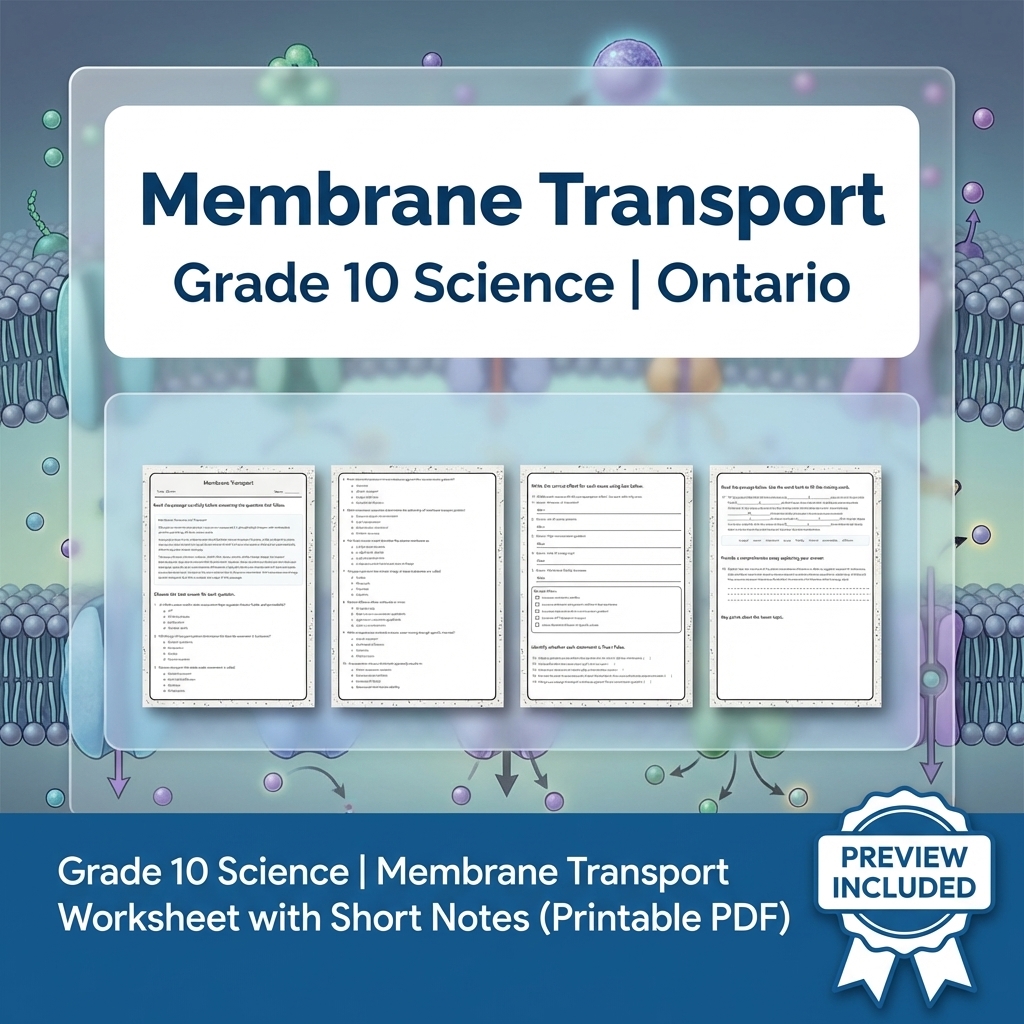
Grade 10 Science | Membrane Transport Worksheet with Short Notes (Printable PDF)
Created byMeadowlark WorksheetsLearning Objectives
- Describe the structural features of the plasma membrane according to the fluid mosaic model.
- Differentiate between types of transport proteins such as channels, carriers, and pumps.
- Explain passive transport mechanisms like diffusion, facilitated diffusion, and osmosis.
Also included in: Grade 10 Science Lesson Group Bundle | Ontario Curriculum +1 more
Instant download

Grade 10 Science | Battery Storage Worksheet | BC Aligned
Created byLumora LearningLearning Objectives
- Understand how battery storage converts chemical energy to electrical energy and back.
- Explain the concepts of state of charge, storage capacity, and charge–discharge cycles.
- Analyze the factors affecting battery efficiency, including heat loss and internal resistance.
Instant download

Grade 10 Science – Electromagnetic Forces & Fields | Daily Reading Worksheet
Created byBright Mind ResourcesLearning Objectives
- Understand the concept of electric fields and how they are represented
- Identify how electric field lines indicate the direction and strength of electric fields
- Explain the interaction between charges within an electric field
Also included in: Forces & Motion Grade 10 Science Daily Reading Worksheets Lesson Bundle | NGSS +2 more
Instant download

Grade 10 Science | Chemical Equations - Daily Reading Comprehension
Created byCoral Reef LearningLearning Objectives
- Identify the parts of a chemical equation, including reactants and products.
- Understand the significance of coefficients and state symbols.
- Interpret basic chemical equations and recognize reaction components.
Instant download

Grade 10 Introduction to Geologic Mapping Worksheet | NGSS Earth Science
Created byBRIGHT PATH RESOURCESLearning Objectives
- Understand the basic concepts of geologic mapping
- Identify types of geoscience data involved in mapping
- Describe methods used to interpret Earth's structural features
Also included in: Earth Systems Grade 10 Science Daily Reading Worksheets Lesson Bundle | NGSS +1 more
Instant download

Biotech Applications of Microorganisms Worksheet | Grade 10 Science Ontario
JCreated byJ.S SheetsLearning Objectives
- Explain how microorganisms are used in biotechnological processes such as fermentation, bioremediation, and industrial enzyme production.
- Describe how genetic manipulation in microbes can support product synthesis and the development of antimicrobial agents.
- Evaluate why antibiotic resistance can emerge and spread, including roles of horizontal gene transfer and ecological impacts.
Instant download
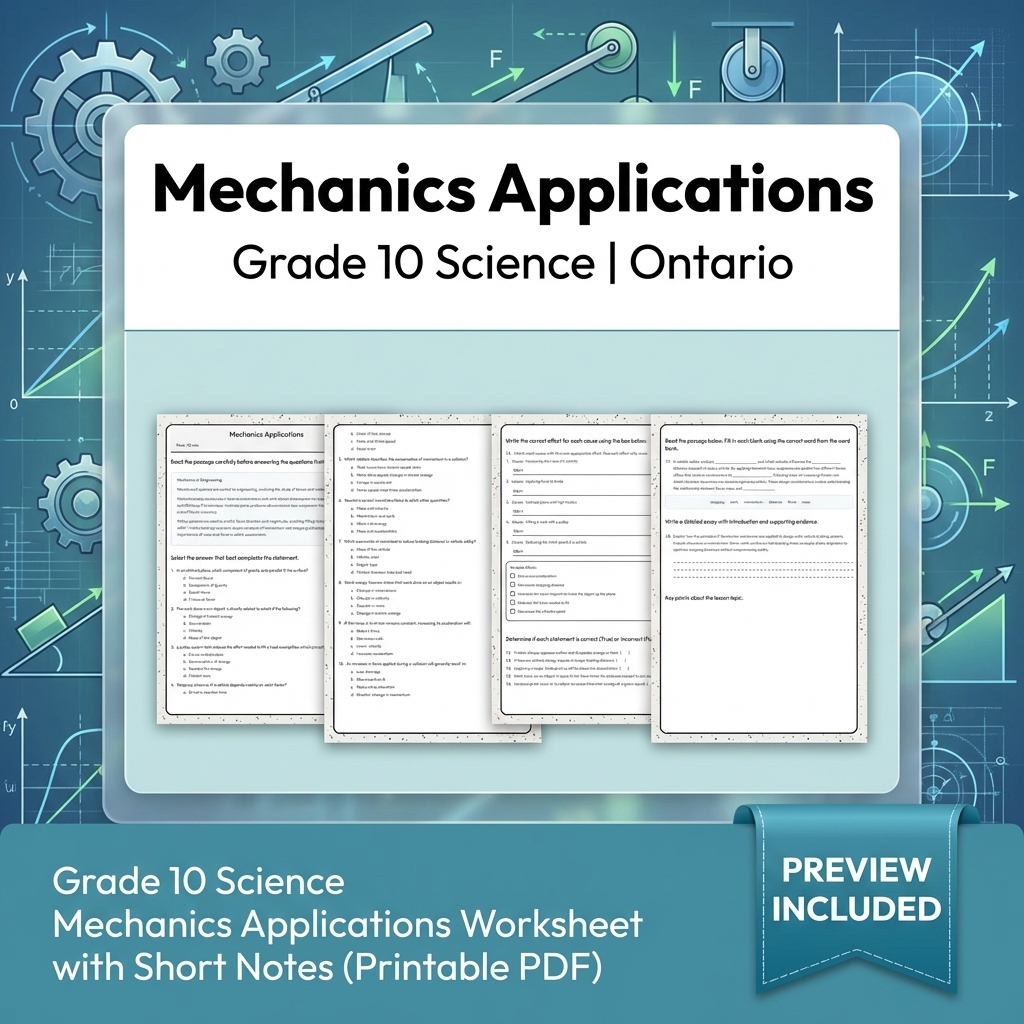
Grade 10 Science Mechanics Applications Worksheet with Short Notes
Created byMeadowlark WorksheetsLearning Objectives
- Understand how kinematic relations integrate with Newtonian dynamics in practical systems.
- Apply physics principles to analyze real-world mechanical scenarios such as inclined planes, pulleys, and braking systems.
- Relate forces, mass, acceleration, work, and momentum to system behavior and safety parameters.
Also included in: Grade 10 Science Lesson Group: Motion & Forces Ontario Curriculum Bundle +1 more
Instant download

Grade 10 Science | Fossil Formation Worksheet (TEKS) (PDF)
Created byEvergreen Desk EducationLearning Objectives
- Explain the main processes that lead to fossil formation, including mineralization, compression, and imprint preservation.
- Describe how fossil distributions and stratigraphic succession provide evidence for environmental change and the relative sequence of life forms.
- Compare relative dating and radiometric (absolute) dating and interpret what each method contributes to geological time.
Instant download
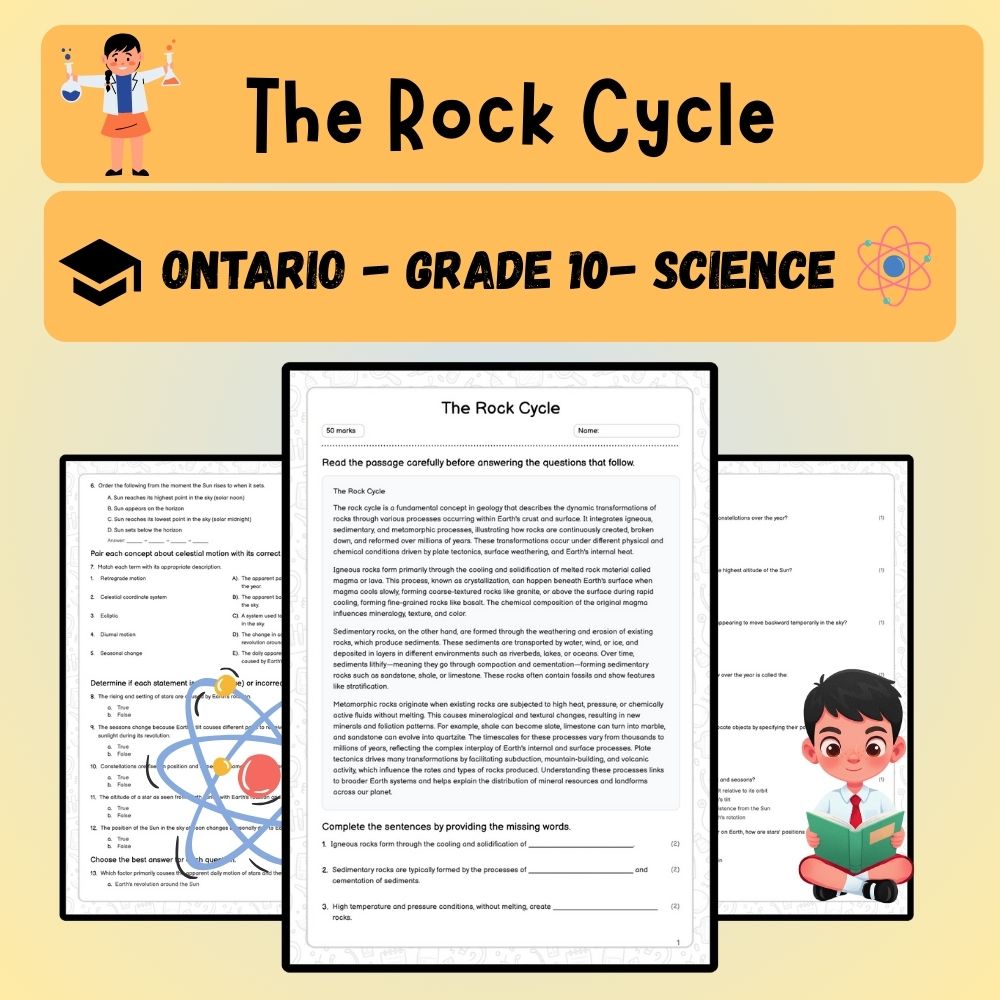
Grade 10 Science | The Rock Cycle Worksheet (PDF) – Ontario Standards
Created byPrism Point LearningLearning Objectives
- Explain the processes involved in the formation and transformation of rocks within the rock cycle.
- Describe the roles of heat, pressure, weathering, and chemical processes in changing rock types.
- Identify how plate tectonics and surface processes drive the rock cycle over geological timescales.
Also included in: Grade 10 Science UNIT Bundle | Earth Processes & Resources Ontario Standards +1 more
Instant download

Grade 10 Science | Stratigraphic Record Worksheet | AP Aligned
Created byLumora LearningLearning Objectives
- Interpret stratigraphic sequences and fossil assemblages to determine Earth's history.
- Explain principles such as superposition, correlation, and unconformities.
- Apply radiometric decay methods and error considerations in dating rocks.
Instant download
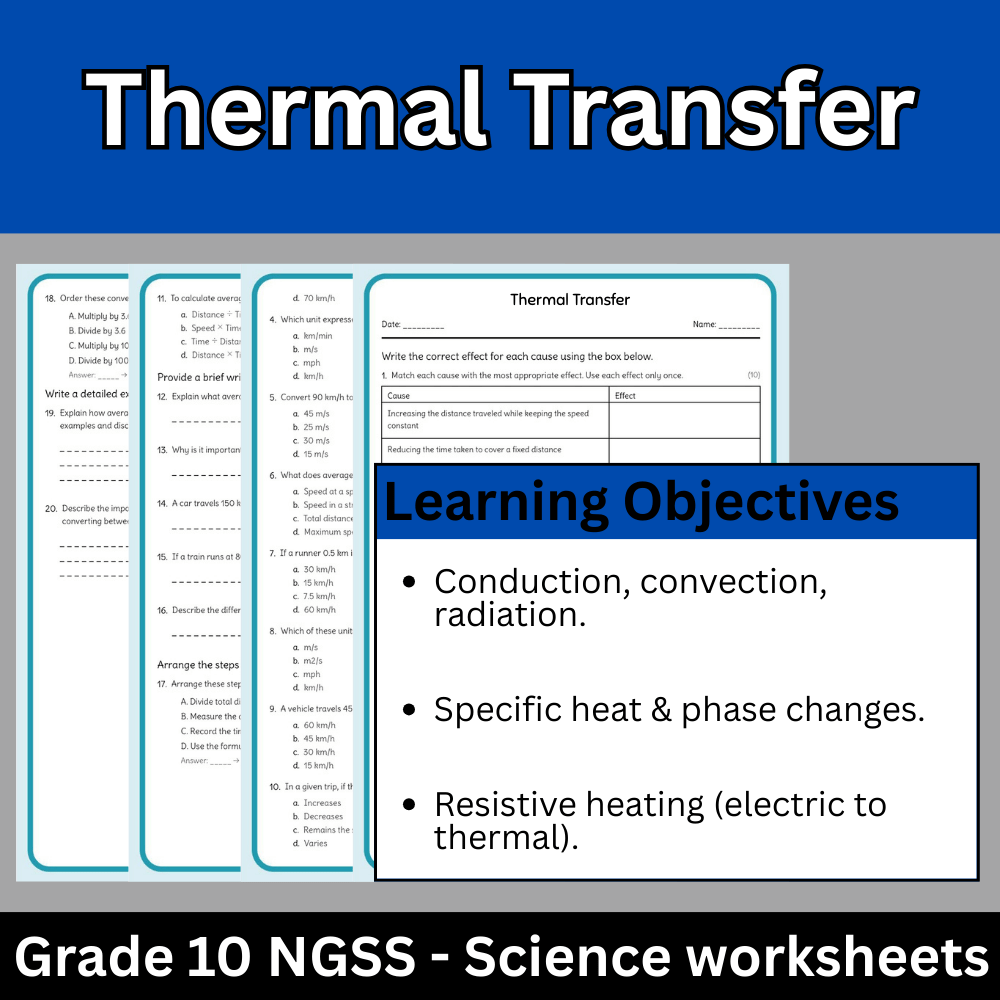
Grade 10 Science | Thermal Transfer Worksheet (Answer Key) – NGSS Aligned
Created byBright Mind ResourcesLearning Objectives
- Explain the mechanisms of heat transfer: conduction, convection, and radiation.
- Connect thermal energy changes to specific heat and phase changes.
- Analyze resistive heating and its conversion of electrical energy to thermal energy.
Instant download

Conservation of Mass Worksheets: Chemical Reactions Grade 10 Science
Created bySunny Desk ResourcesLearning Objectives
- Explain that atoms are rearranged but not created or destroyed during chemical reactions in a closed system
- Interpret balanced symbolic equations using mass relationships between reactants and products
- Use mass accounting to identify how and why measurement discrepancies can occur in real settings
Also included in: Grade 10 Chemistry Lesson Bundle | Alberta Science Reaction & Analysis +1 more
Instant download

Climate Drivers Worksheet for Grade 10 Science | AP Standard Practice
JCreated byJ.S SheetsLearning Objectives
- Identify key factors that influence Earth's climate, including radiative forcing, greenhouse gases, and albedo variations.
- Explain how ocean-atmosphere coupling affects climate patterns over different timescales.
- Analyze model outputs and proxy records to evaluate long-term climate trends and regional shifts.
Instant download
About Grade 10 Science Worksheets
Find Science worksheets built for Grade 10. All 7,038 cover core skills, practice, and review, each an instant PDF download.
Every worksheet on MyTeachingSheets is created by independent teacher-authors and reviewed before publication. All resources download as printable PDFs for classroom, homework, or at-home practice, and many include answer keys. Preview any worksheet free before buying.