
Grade 10 Science Worksheets
7,038 worksheets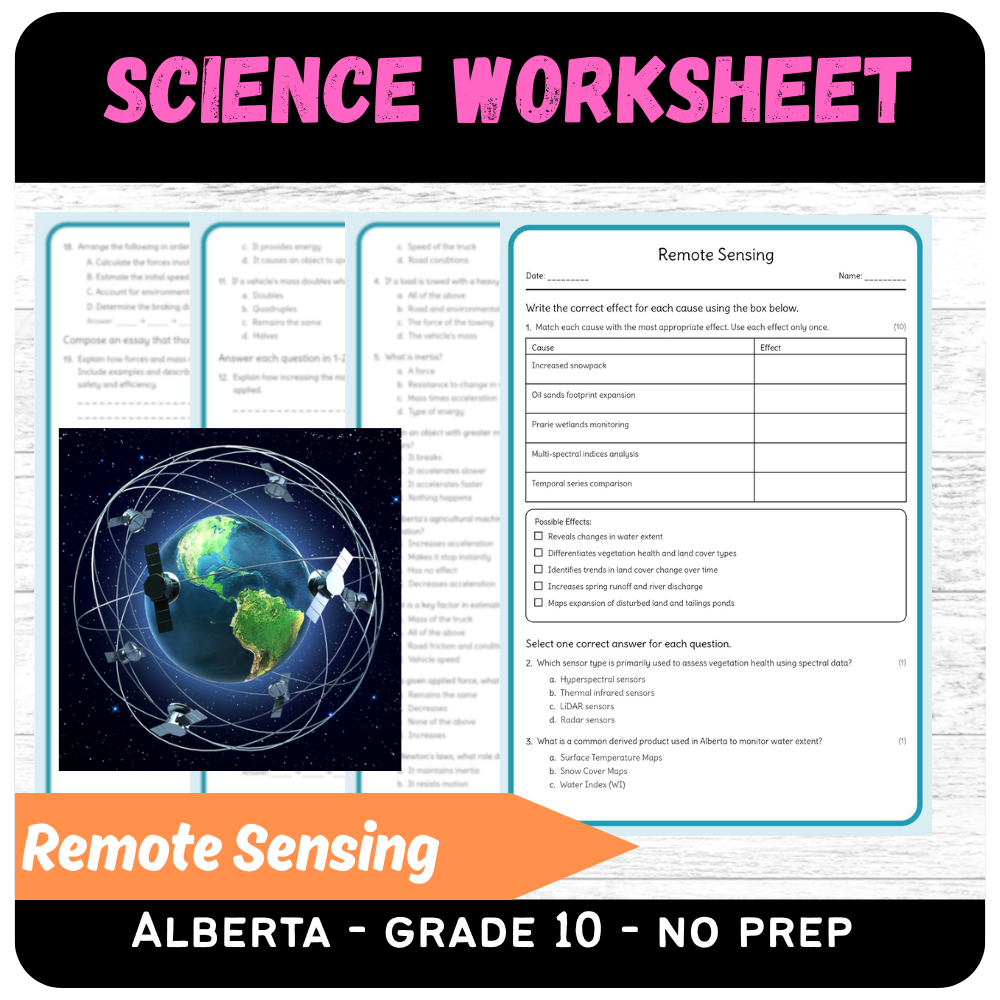
Grade 10 Science | Remote Sensing (Worksheet + Answer Key) – Alberta Standards
 Created byBright Mind Resources
Learning Objectives
- Understand the basic concepts of satellite and aerial remote sensing techniques.
- Identify different sensor types and their spectral information used in environmental monitoring.
- Explain how derived products from remote sensing data support land cover and vegetation analysis.
Instant download

Grade 10 Science – Measurable Criteria & Constraints in Scientific Design
Created byBright Mind ResourcesLearning Objectives
- Understand the difference between constraints and criteria in scientific goals.
- Identify constraints and criteria in given scenarios.
- Explain how criteria influence performance measurement.
Also included in: Design Grade 10 Science Daily Reading Worksheets Bundle | California Standards +1 more
Instant download

Mendelian Patterns Practice Worksheet | Grade 10 Science NGSS Review
 Created byPrism Point Learning
Learning Objectives
- Explain how dominance, segregation, and independent assortment relate to meiosis and gamete formation.
- Use Punnett squares and pedigree reasoning to predict possible offspring phenotypes from parental genotypes.
- Interpret inheritance patterns using probability, including how linked genes and polygenic traits can alter simple Mendelian ratios.
Instant download
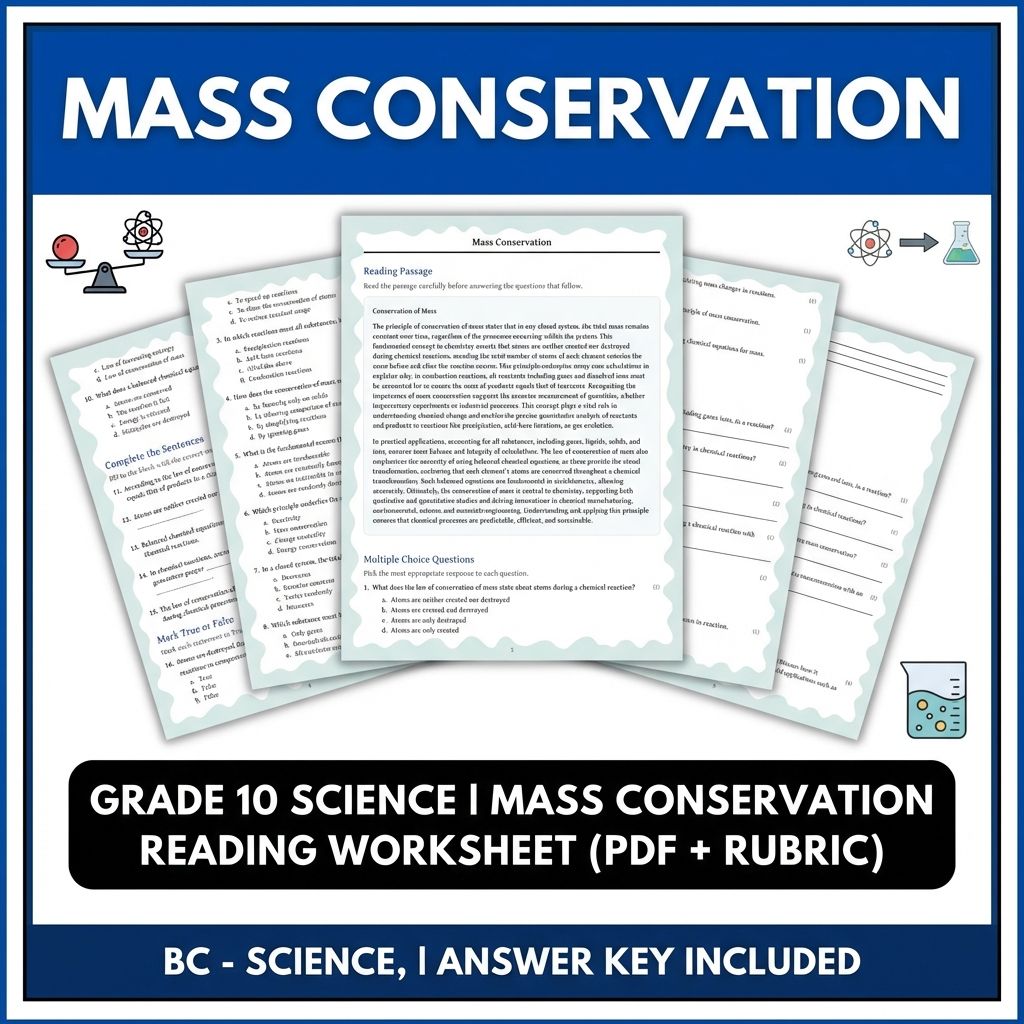
Grade 10 Science | Mass Conservation Reading Worksheet (PDF + Rubric)
JCreated byJ.S SheetsLearning Objectives
- Understand the principle of conservation of mass in chemical reactions.
- Explain why atoms are neither created nor destroyed during reactions.
- Identify how mass balance is maintained in combustion and precipitation reactions.
Instant download

Grade 10 Science — Worksheet MCQ Paper for Mastering Constructing Claims
 Created byThe Resource Hub
Learning Objectives
- Understand the structure and components of evidence-based claims, including claim, evidence, reasoning, and warrant.
- Distinguish between different parts of an argument and understand how they connect to form strong scientific explanations.
- Apply the claim-evidence-reasoning framework to interpret data and analyze conflicts or convergences among evidence from case studies.
Also included in: Grade 10 Science Bundle: Master Scientific Modeling & Data Analysis +1 more
Instant download

Mendelian Patterns Worksheet | NGSS-Aligned Grade 10 Science Practice
JCreated byJ.S SheetsLearning Objectives
- Understand the principles of Mendelian inheritance, including dominance, segregation, and independent assortment.
- Analyze inheritance patterns using Punnett squares and pedigree charts.
- Relate chromosome behavior during meiosis to Mendelian ratios and inheritance.
Instant download

Collisions and Momentum Practice Worksheet | Grade 10 Science
Created byPrism Point LearningLearning Objectives
- Define linear momentum and impulse and relate impulse to the change in momentum using Newtonian assumptions
- Apply conservation of momentum to isolated two-body collision scenarios to predict post-collision motion
- Differentiate elastic, inelastic, and perfectly inelastic collisions using momentum and kinetic energy ideas
Also included in: Grade 10 Motion & Forces Kinematics Science Lesson Bundle for Ontario
Instant download

Grade 10 Science – Force Interactions & Concepts | Daily Reading Worksheet
Created byBright Mind ResourcesLearning Objectives
- Identify different types of contact and noncontact forces.
- Understand pairwise force interactions such as Newton's third law.
- Interpret free-body diagrams and vector addition of forces.
Also included in: Forces & Motion Grade 10 Science Daily Reading Worksheets Lesson Bundle | NGSS +2 more
Instant download

Newton's Laws Practice Worksheet | Grade 10 Science Assessment
Created byPrism Point LearningLearning Objectives
- Explain Newton’s three laws using conceptual reasoning and everyday examples
- Use the second law to predict how acceleration depends on net force and mass
- Interpret action–reaction pairs in the third law and connect them to conservation of momentum
Also included in: Grade 10 Motion & Forces Kinematics Science Lesson Bundle for Ontario
Instant download

Grade 10 Science | Biogeochemical Cycles - Daily Reading Comprehension
 Created byCoral Reef Learning
Learning Objectives
- Understand the movement of carbon through different earth systems
- Identify the processes involved in the carbon cycle
- Explain the impact of human activities on biogeochemical cycles
Instant download

Grade 10 Science – Control Strategies & Experimental Design | Daily Worksheet
 Created byQuiet Forest Education
Learning Objectives
- Understand the purpose of control groups in scientific experiments
- Identify different control strategies such as randomization, blocking, and replication
- Recognize sources of bias and confounding factors in experiments
Also included in: Scientific Investigation Grade 10 Science Daily Worksheets Bundle | Ontario +1 more
Instant download

Energy Flow Assessment for Grade 10 Science | TEKS Standards
Created byPrism Point LearningLearning Objectives
- Describe how energy flows through ecosystems from sunlight to various trophic levels.
- Explain the concept of energy transfer efficiency and its effect on ecosystem structure.
- Identify the role of net primary productivity in ecosystem energy balance and population dynamics.
Instant download

Grade 10 Science | Electron Configuration Worksheet | BC-Aligned
 Created byLumora Learning
Learning Objectives
- Explain how electrons occupy energy levels and orbitals around an atom's nucleus.
- Describe the significance of valence electrons in chemical bonding and reactivity.
- Understand the principles governing electron distribution across shells and orbitals.
Instant download

Grade 10 Worksheet B: Molecular Coding (DNA → Protein) Practice | NGSS PDF
 Created byClear Sky Classroom
Learning Objectives
- Explain how DNA nucleotide order determines mRNA codons and the amino acid sequence of a protein.
- Describe how translation and ribosomes help build proteins and how proteins fold into functional 3D structures.
- Compare effects of point mutations and frameshifts on protein structure and function.
Also included in: Grade 10 Cellular Regulation and Energy Pathways Science Lesson Bundle | NGSS +1 more
Instant download

Bond Energetics Worksheet for Grade 10 Science | NGSS Aligned Practice
JCreated byJ.S SheetsLearning Objectives
- Explain how bond formation and breaking relate to energy changes in chemical reactions.
- Differentiate between exothermic and endothermic processes based on energy flow.
- Interpret potential energy diagrams and bond enthalpy values to understand reaction heat changes.
Also included in: Grade 10 Chemical Reactions and Equilibrium Science – Lesson Bundle NGSS
Instant download

Grade 10 Motors And Generators Worksheet | Alberta Use Practice PDF
Created byClear Sky ClassroomLearning Objectives
- Explain how motors and generators convert between electrical energy and mechanical energy using electromagnetic forces
- Describe how a magnetic field and current in a coil produce torque or electrical induction
- Use quantitative relationships between current, magnetic field strength, and mechanical output to predict design trade-offs
Instant download
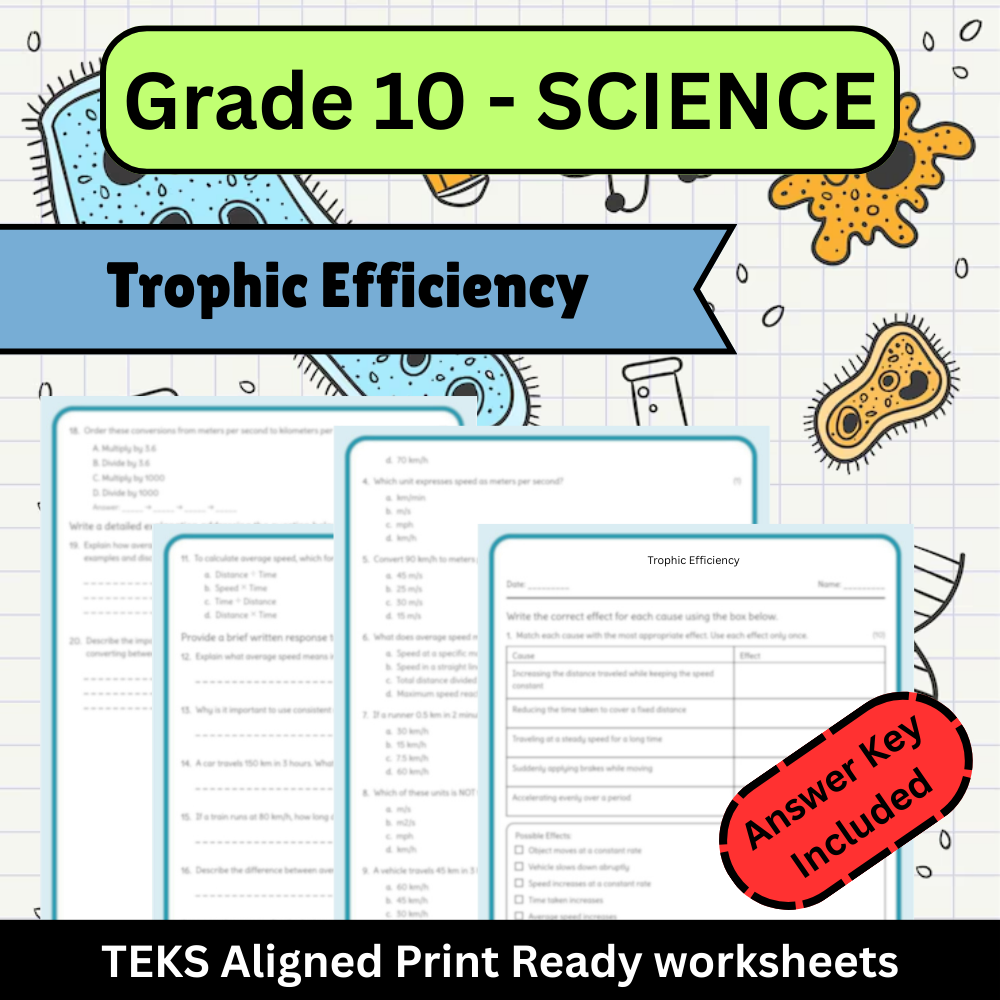
Grade 10 Science – Trophic Efficiency Worksheet (Worksheet + Answer Key) | TEKS Aligned
Created byBright Mind ResourcesLearning Objectives
- Define trophic efficiency and explain its significance in ecosystems.
- Identify factors that influence energy transfer between trophic levels.
- Analyze how variations in trophic efficiency affect food web structure and biomass pyramids.
Also included in: Grade 10 Science | Ecosystems & Biodiversity Unit Worksheet Bundle(TEKS-Aligned) +5 more
Instant download

Grade 10 Science | Wave Properties NGSS Worksheet (PDF)
 Created bySilver Birch Teaching
Learning Objectives
- Understand the mathematical relationships between wave parameters such as amplitude, wavelength, frequency, and wave speed.
- Interpret sinusoidal and periodic wave models using trigonometric functions and phase relationships.
- Explain the phenomena of superposition, interference patterns, and standing waves in wave systems.
Also included in: Grade 10 Waves and Signals Science Lesson Bundle: NGSS System & EM Behavior +1 more
Instant download
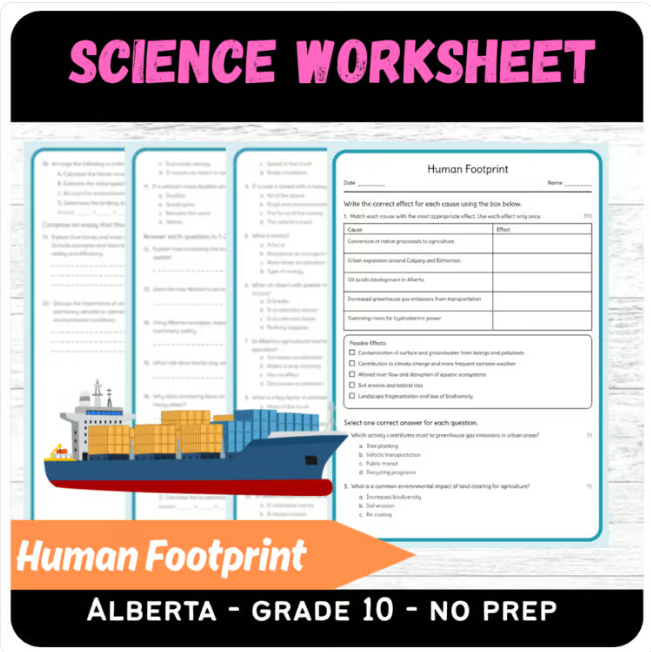
Grade 10 Science – Human Footprint Worksheet (PDF) | Alberta Standards
Created byBright Mind ResourcesLearning Objectives
- Understand how human activities impact Earth's land, water, and atmosphere.
- Identify regional examples of land-use change and their environmental effects.
- Analyze the long-term sustainability of resource management practices.
Instant download

Design Tradeoffs Worksheet | Grade 10 Engineering Science Practice
Created byPrism Point LearningLearning Objectives
- Explain how improving one design criterion can worsen another when constraints are present
- Identify common engineering design criteria (stiffness, safety margin, fatigue resistance, mass, and cost) and how they trade off
- Use tradeoff reasoning to justify a best overall design choice for a given set of requirements
Instant download
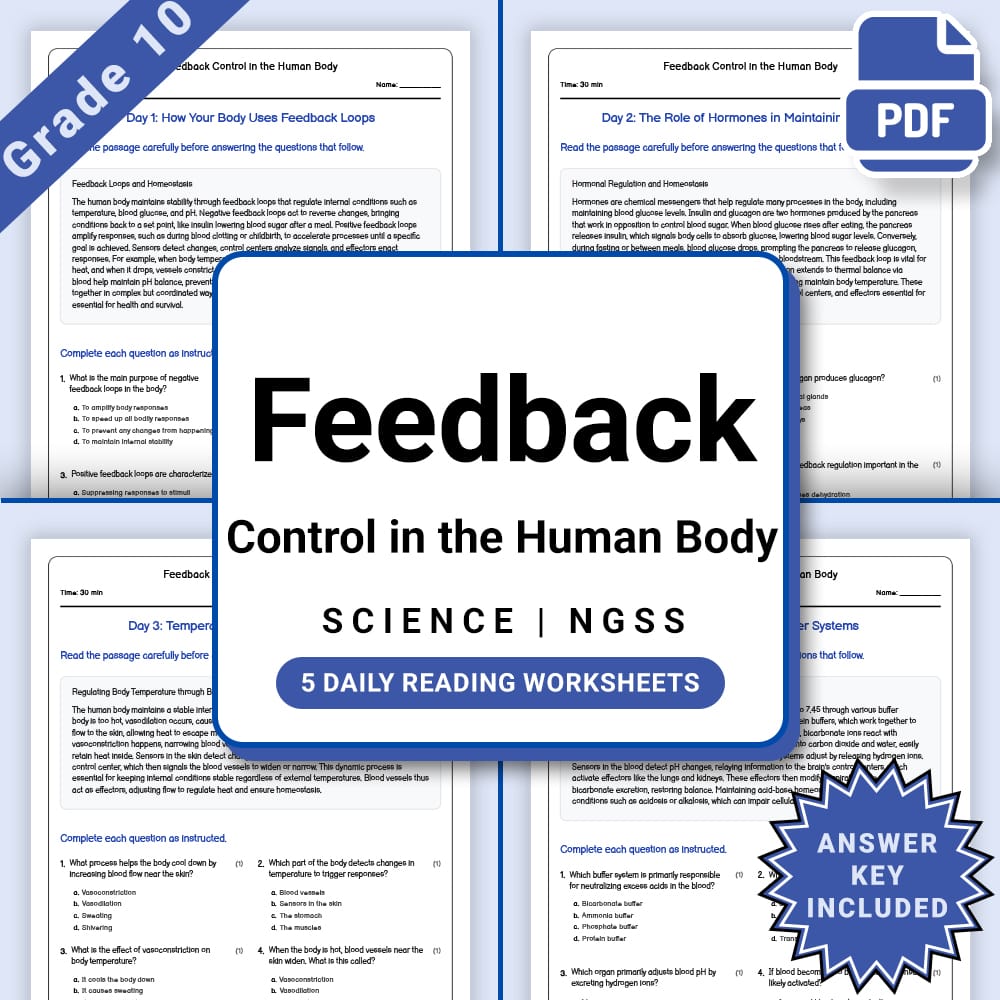
Grade 10 Science – Feedback Control in the Human Body Worksheet(PDF +Answer Key)
 Created byCopper Leaf Classroom
Learning Objectives
- Understand the concepts of negative and positive feedback loops
- Identify how feedback mechanisms regulate blood glucose, temperature, and pH
- Describe the roles of sensors, control centers, and effectors in homeostasis
Instant download

Reaction Outcomes Worksheet | Grade 10 Chemistry Science CA Standards
 Created byEvergreen Desk Education
Learning Objectives
- Explain chemical reaction outcomes using an atomic-level model that focuses on rearrangement of atoms.
- Connect conservation of atoms to evidence for balanced chemical reactions.
- Use electron structure and bonding ideas to predict how reactants form new product combinations.
Instant download

Grade 10 Science – Factors Influencing Reaction Speed | Daily Reading Worksheet
Created byBright Mind ResourcesLearning Objectives
- Identify variables that affect chemical reaction rates
- Understand how temperature, concentration, surface area, and catalysts influence reactions
- Analyze real-world examples of reaction rate changes
Also included in: Grade 10 Chemistry Science Lesson Bundle Daily Reading Worksheets | Alberta +1 more
Instant download

Grade 10 Science | Cell Theory Basics - Daily Reading Comprehension
Created byCoral Reef LearningLearning Objectives
- Understand key concepts related to Science
- Apply knowledge through practice questions
- Demonstrate comprehension of the material
Instant download
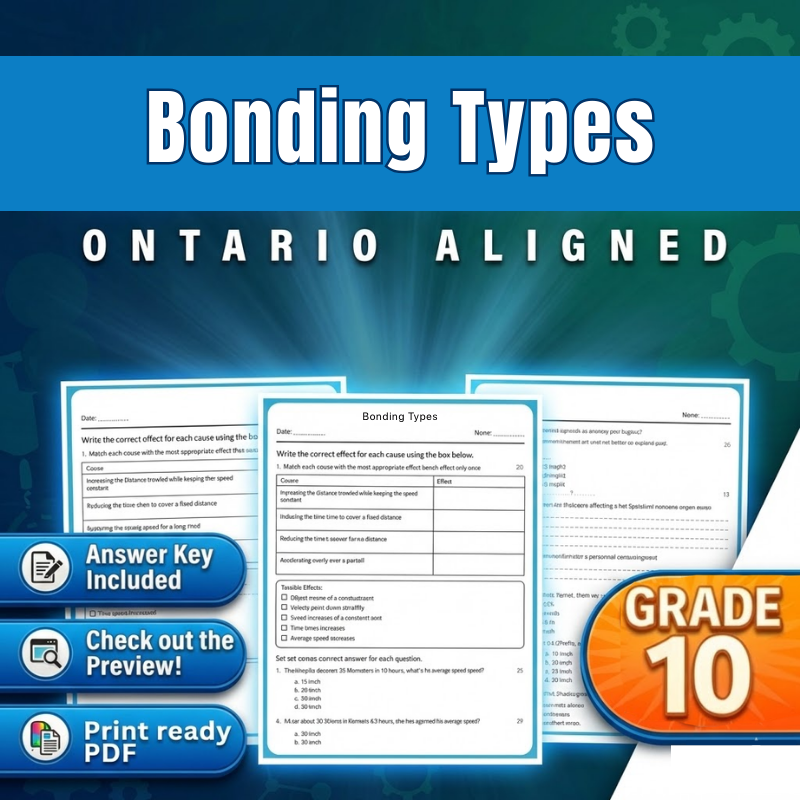
Grade 10 Science | Bonding Types Worksheet (Ontario) (PDF)
Created byBright Mind ResourcesLearning Objectives
- Understand the three main bonding types: ionic, covalent, and metallic.
- Explain how electron transfer and sharing influence bonding and structure.
- Identify properties associated with different bonding types, such as melting point and conductivity.
Instant download
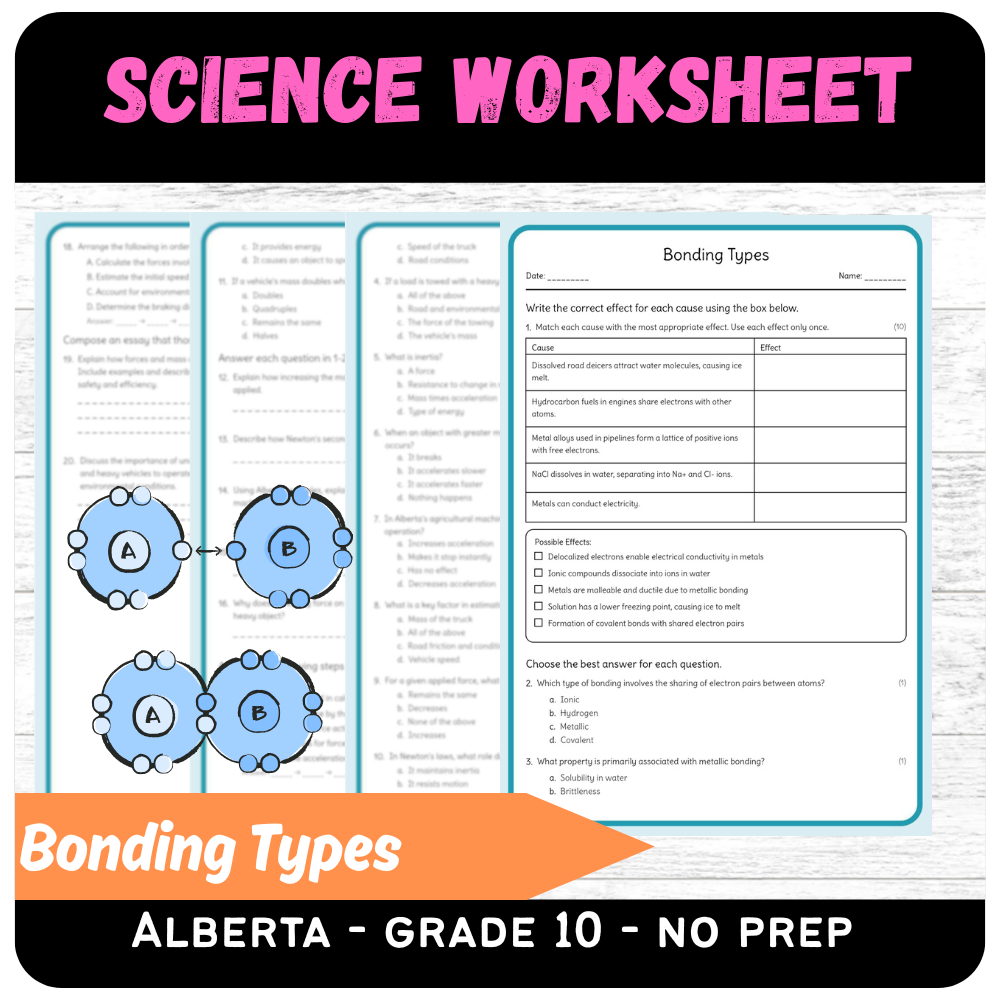
Grade 10 Science – Bonding Types Worksheet (PDF) – Alberta Standards
Created byBright Mind ResourcesLearning Objectives
- Identify the different types of bonding (ionic, covalent, metallic) at the particle level
- Explain how bonding types influence the physical properties of substances
- Predict physical properties based on atomic interactions and bonding types
Instant download

Grade 10 Science – Energy Pathways & Photosynthesis Daily Reading Worksheet
Created byBright Mind ResourcesLearning Objectives
- Describe the process of photosynthesis and its significance in energy capture
- Understand how light energy is converted into chemical energy within chloroplasts
- Identify the role of the Calvin cycle in carbon fixation
Also included in: Homeostasis Grade 10 Science Daily Reading Worksheets Lesson Bundle | NGSS +2 more
Instant download
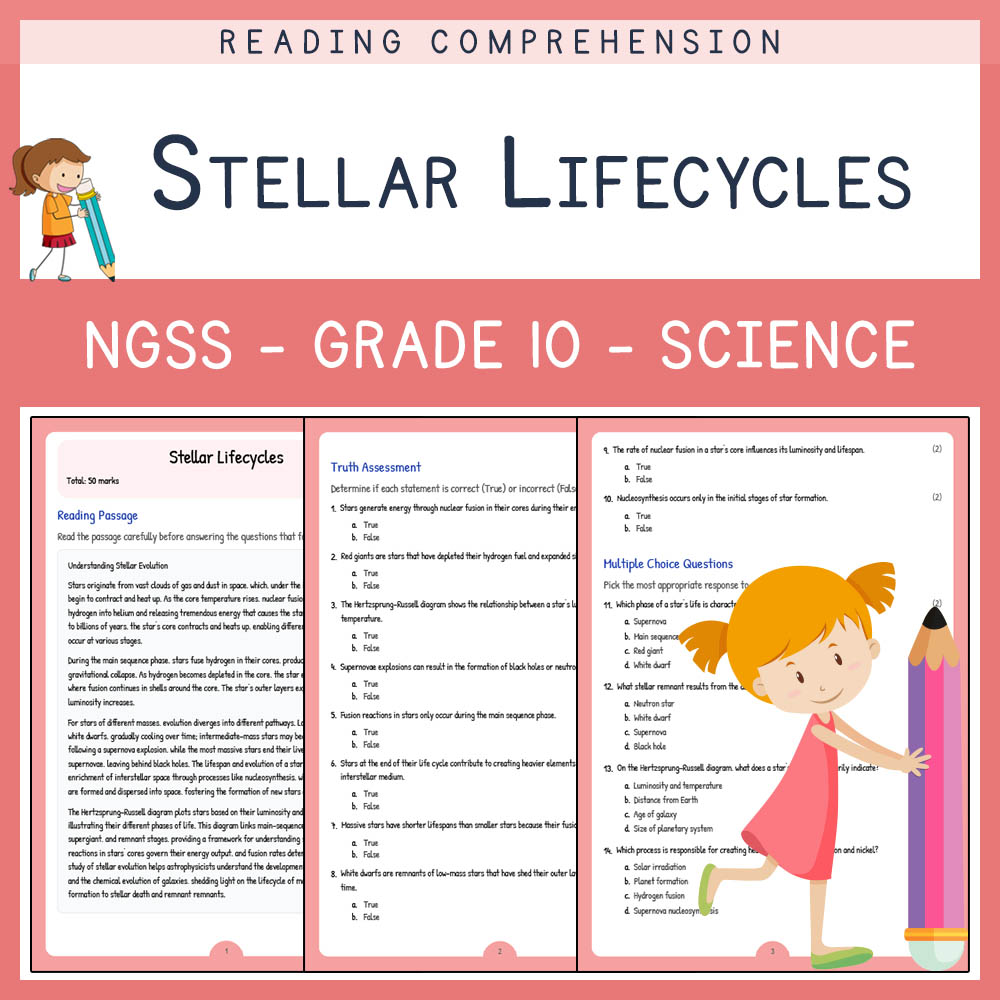
Grade 10 Science | Stellar Lifecycles Worksheet & Answer Key (NGSS Aligned)
Created byLumora LearningLearning Objectives
- Describe the key stages of stellar evolution and the processes involved.
- Interpret the Hertzsprung-Russell diagram and understand stellar nucleosynthesis pathways.
- Explain the different end-stage outcomes of stars and their significance in cosmic evolution.
Instant download

Grade 10 Science | Kinematics Graphs - Daily Reading Comprehension
Created byCoral Reef LearningLearning Objectives
- Understand key concepts related to Science
- Apply knowledge through practice questions
- Demonstrate comprehension of the material
Instant download

Energy in Cells Worksheet | Cellular Respiration & Photosynthesis Grade 10
Created byPrism Point LearningLearning Objectives
- Explain how cells convert energy to power cellular processes.
- Compare cellular respiration and photosynthesis as energy-conversion pathways.
- Describe how ATP connects energy release to work inside cells.
Instant download

Grade 10 Meiosis & Variation Worksheet | Practice & Assessment PDF
Created byClear Sky ClassroomLearning Objectives
- Explain how prophase I processes (homologous pairing and crossing-over) create genetic variation
- Describe how independent assortment and meiotic chromosomal segregation affect genotype outcomes
- Analyze how nondisjunction can lead to altered genotypes and phenotypes (including aneuploidy)
Also included in: Grade 10 Population, Genetics, and Cellular Processes Science Lesson Bundle AP +1 more
Instant download

Grade 10 Science – Adaptive Radiation Daily Reading Worksheet + Answer Key
JCreated byJ.S SheetsLearning Objectives
- Define adaptive radiation and explain its significance in evolution.
- Identify examples of adaptive radiation in nature.
- Describe the environmental factors that trigger adaptive radiation.
Also included in: Grade 10 Science Lesson Bundle: Evolution and Genetics TEKS Framework +1 more
Instant download

Grade 10 Science | Positive Feedback in Human Physiology - Reading Comprehension
Created byCoral Reef LearningLearning Objectives
- Define positive feedback and distinguish it from negative feedback.
- Identify examples of positive feedback mechanisms in the human body.
- Explain the physiological significance of positive feedback during critical processes.
Instant download

Grade 10 Science | Positive Feedback Worksheet (PDF) aligned to TEKS
Created byEvergreen Desk EducationLearning Objectives
- Explain how positive feedback amplifies an initial change in a biological system.
- Identify real-world examples of positive feedback in human physiology and other processes.
- Compare positive feedback with negative feedback in terms of direction and outcome.
Instant download
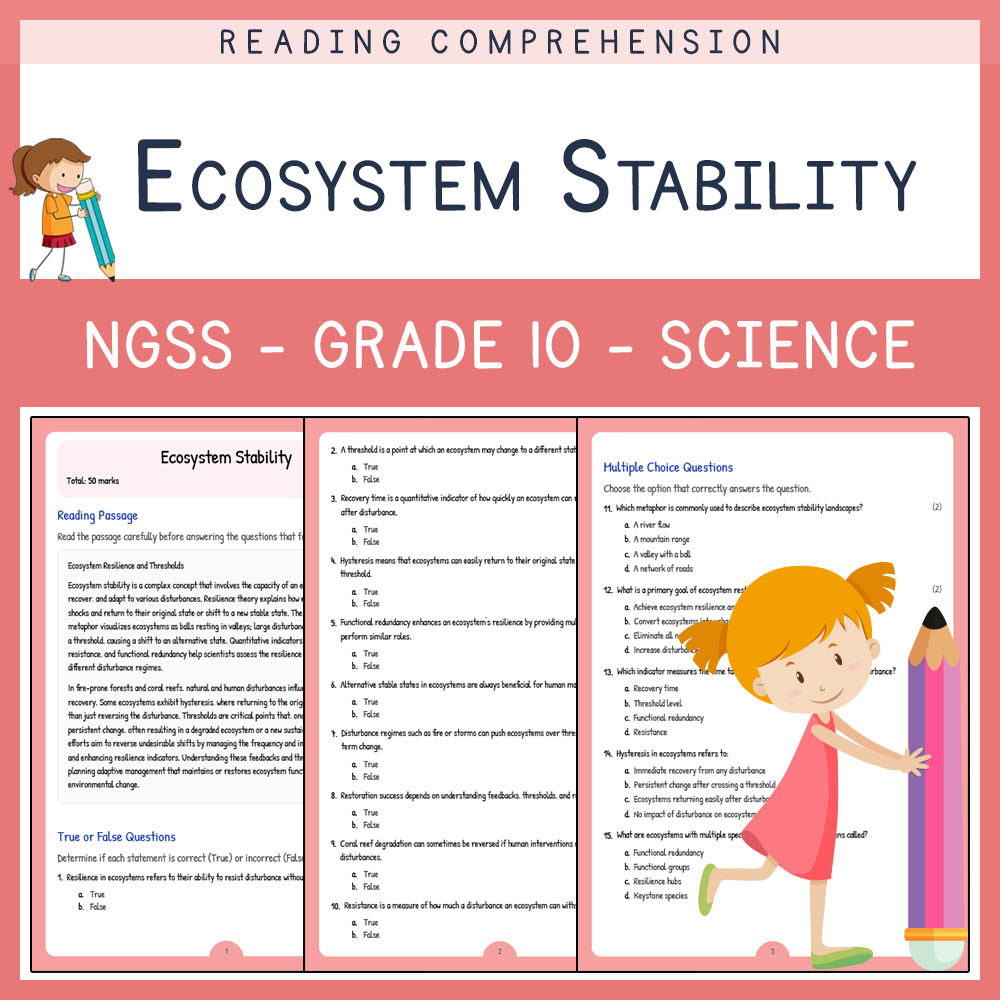
Grade 10 Science | Ecosystem Stability Worksheet and Answer Key (NGSS Aligned)
Created byLumora LearningLearning Objectives
- Understand the concept of resilience and thresholds in ecosystems.
- Analyze how disturbances impact ecosystem recovery pathways.
- Evaluate management scenarios for ecosystem restoration.
Instant download

Uncertainty And Error Assessment | Florida NGSSS Grade 10 Science Worksheet
Created byPrism Point LearningLearning Objectives
- Distinguish between random error and systematic error and explain how each affects measurement results.
- Use precision, accuracy, and margin of error to interpret and compare experimental data sets.
- Explain how uncertainty bounds and repeat trials influence the strength of scientific evidence.
Also included in: Grade 10 Scientific Reasoning Science Lesson Bundle – Florida NGSSS +1 more
Instant download

Grade 10 Science | Circuit Fundamentals Worksheet (AP Standards) (PDF)
Created byEvergreen Desk EducationLearning Objectives
- Apply Ohm’s law and Kirchhoff-style reasoning to analyze simple DC circuits with series and parallel resistive elements.
- Use circuit algebra to determine current, voltage, resistance, and power dissipation in equivalent circuit representations.
- Connect energy transfer rates in circuits (electrical power) to broader mechanical and thermal energy ideas.
Also included in: Grade 10 Motion & Forces Science Lesson Bundle (AP) Worksheet Set +1 more
Instant download

Grade 10 Science – Evolutionary Predictions & Adaptation | Reading Worksheet
Created byBright Mind ResourcesLearning Objectives
- Explain how environmental changes influence genetic traits in populations.
- Identify the role of selection mechanisms in evolution.
- Analyze evidence supporting evolutionary models and predictions.
Also included in: Evolution Grade 10 Science Daily Reading Worksheets Lesson Bundle | General +1 more
Instant download

Grade 10 Photosynthesis Worksheet | Energy Capture Alberta Science PDF
Created byEvergreen Desk EducationLearning Objectives
- Explain how photosynthesis converts light energy into chemical energy stored in carbohydrates.
- Describe the role of chlorophyll and other pigments in capturing different wavelengths of light.
- Analyze how environmental factors (light intensity, seasons, water availability) affect energy capture and biomass production.
Instant download
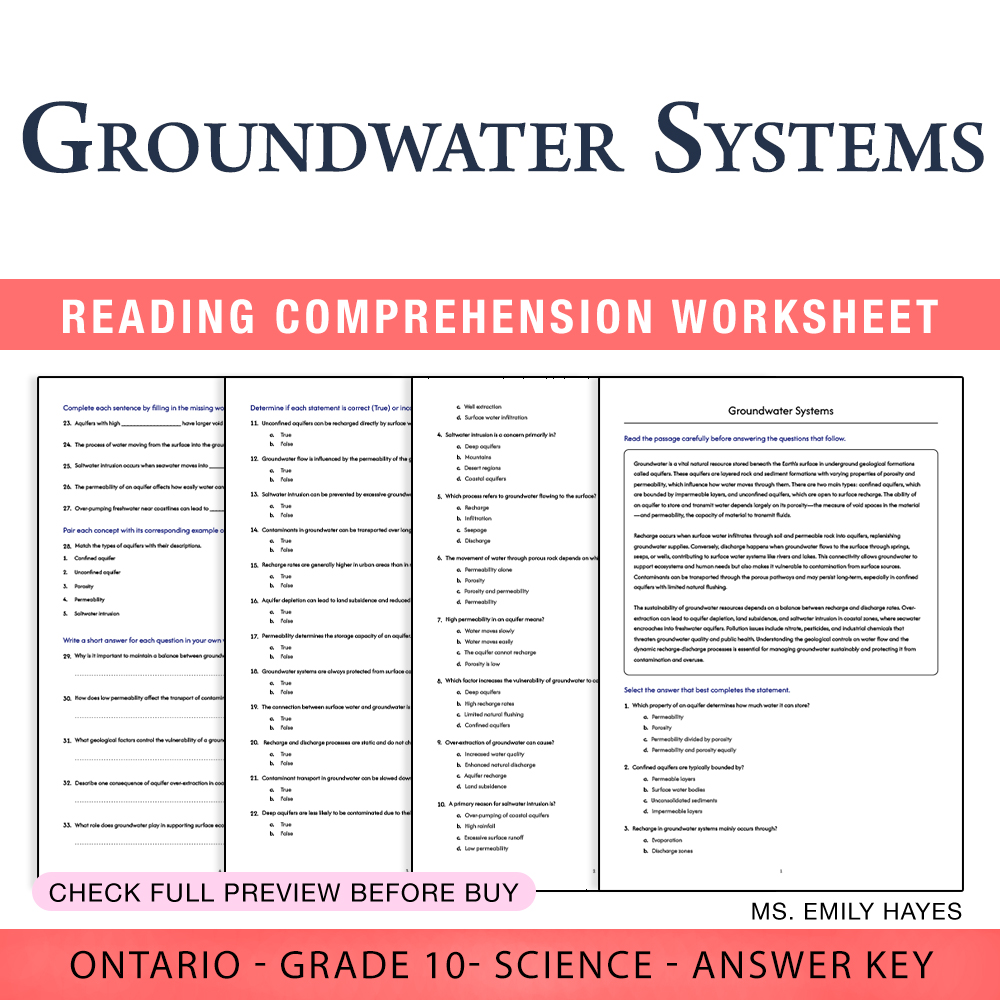
Grade 10 Science | Groundwater Systems Worksheet (PDF + Answer Key)
Created byCopper Leaf ClassroomLearning Objectives
- Describe the types and properties of aquifers and their significance in groundwater flow.
- Explain the concepts of porosity and permeability and how they affect groundwater movement.
- Analyze the processes of recharge and discharge in groundwater systems and their environmental impacts.
Instant download

Grade 10 Transmission Losses Worksheet | Practice & Assessment PDF
Created byClear Sky ClassroomLearning Objectives
- Explain how transmission current and conductor resistance contribute to power loss in long-distance electrical lines.
- Describe how increasing transmission voltage reduces current and lowers resistive energy loss.
- Evaluate infrastructure choices (transformers, line voltage, insulation) that affect efficiency and reliability of regional grids.
Instant download

Grade 10 Science – Pedigree Analysis Daily Reading Worksheet + Answer Key
JCreated byJ.S SheetsLearning Objectives
- Understand what pedigrees are and how they are used to study inheritance.
- Identify different inheritance patterns such as autosomal dominant, autosomal recessive, and X-linked traits from pedigree diagrams.
- Interpret phenotypic data and predict genotypes and possible genetic risks.
Also included in: Grade 10 Science Lesson Group Bundle – TEKS | Genetics & Genomic Technologies +1 more
Instant download
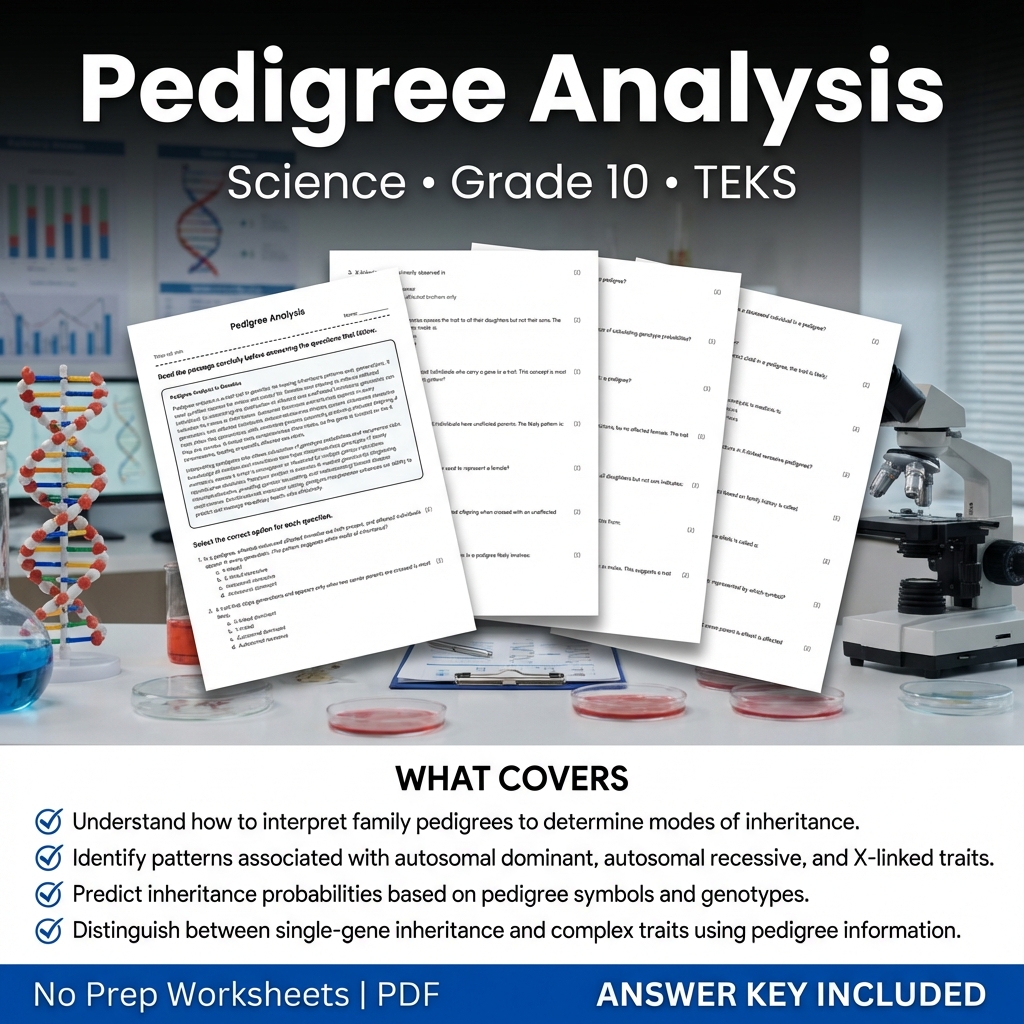
Grade 10 Science Pedigree Analysis Worksheet with Answer Key | TEKS
Created byCoral Reef LearningLearning Objectives
- Understand how to interpret family pedigrees to determine modes of inheritance.
- Identify patterns associated with autosomal dominant, autosomal recessive, and X-linked traits.
- Predict inheritance probabilities based on pedigree symbols and genotypes.
Instant download

Grade 10 Molar Relationships Worksheet | Practice & Assessment PDF
Created byClear Sky ClassroomLearning Objectives
- Use Avogadro’s number to relate moles to number of particles
- Convert between moles, mass, and molar mass using correct units
- Solve mole-to-mole and limiting reagent problems to estimate reactant consumption and product yield
Instant download

Grade 10 Science | Evolutionary Predictions - Daily Reading Comprehension
Created byCoral Reef LearningLearning Objectives
- Understand how traits influence survival and reproduction
- Recognize how environmental changes impact gene frequencies
- Learn the evidence supporting evolutionary models
Instant download

Mole-to-Mass and Mole-to-Mole Relationships Chemistry Worksheets Grade 10
 Created bySunny Desk Resources
Learning Objectives
- Convert between moles and grams using molar mass and track units correctly
- Use mole ratios from a balanced chemical equation to convert between reactant and product amounts
- Identify the limiting reagent and predict expected yield using mole relationships
Also included in: Grade 10 Chemistry Lesson Bundle | Alberta Science Reaction & Analysis +1 more
Instant download

Grade 10 Science | Electric Circuits Worksheet | BC Standard
Created byLumora LearningLearning Objectives
- Understand the basic components and functions of electric circuits.
- Identify the factors that affect the efficiency of electrical energy transmission.
- Compare centralized and distributed generation systems in terms of resource use and resilience.
Instant download

Grade 10 Science – Understanding Constant Acceleration & Motion |Daily Worksheet
Created byQuiet Forest EducationLearning Objectives
- Define constant acceleration and its effects on motion.
- Identify key variables involved in uniformly accelerated motion.
- Apply basic kinematic formulas to simple acceleration problems.
Also included in: Motion and Forces Grade 10 Science Daily Reading Worksheets Bundle | Ontario +1 more
Instant download
About Grade 10 Science Worksheets
Find Science worksheets built for Grade 10. All 7,038 cover core skills, practice, and review, each an instant PDF download.
Every worksheet on MyTeachingSheets is created by independent teacher-authors and reviewed before publication. All resources download as printable PDFs for classroom, homework, or at-home practice, and many include answer keys. Preview any worksheet free before buying.