
Grade 10 Science Worksheets
7,038 worksheets
Grade 10 Science – Heat Engines & Components | Daily Reading Worksheet
 Created byBright Mind Resources
Learning Objectives
- Understand what a heat engine is and how it converts thermal energy into mechanical work.
- Identify common types of heat engines such as internal combustion engines, gas turbines, and steam turbines.
- Explain the factors affecting the efficiency of heat engines, including temperature differences and cycle design.
Also included in: Grade 10 Energy Science Daily Reading Worksheets Lesson Bundle | BC +1 more
Instant download

Grade 10 Energy Diagrams Worksheet | Practice & Assessment PDF
 Created byClear Sky Classroom
Learning Objectives
- Interpret energy diagrams and bar charts to identify where energy is stored, where it moves, and where it is lost.
- Quantify energy transfer by reading changes in potential and kinetic energy from graphs.
- Connect friction and thermal energy loss to conservation of energy using conservation principles.
Instant download
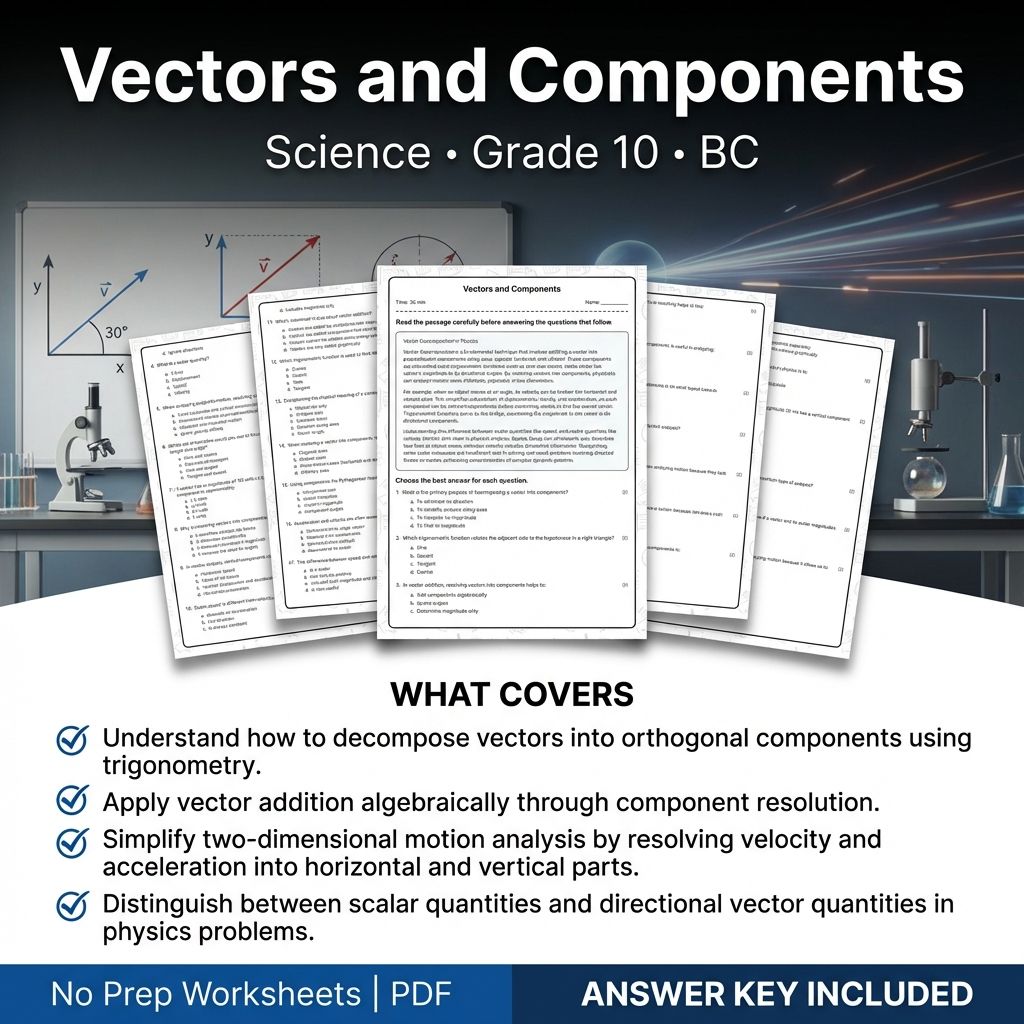
10th Grade Science | Vectors and Components Worksheet with Answer Key (PDF)
 Created byCoral Reef Learning
Learning Objectives
- Understand how to decompose vectors into orthogonal components using trigonometry.
- Apply vector addition algebraically through component resolution.
- Simplify two-dimensional motion analysis by resolving velocity and acceleration into horizontal and vertical parts.
Instant download

Grade 10 Science | Trade Off Optimization in Engineering - Reading Comprehension
Created byCoral Reef LearningLearning Objectives
- Understand the concept of trade-offs in engineering design.
- Identify different objectives and how they compete in real-world problems.
- Learn methods to quantify and compare trade-offs, such as cost-benefit analysis and Pareto fronts.
Instant download

Grade 10 AP Science Circuit Fundamentals Worksheet | Physics Practice Pack
 Created byPrism Point Learning
Learning Objectives
- Use Ohm’s law to relate voltage, current, and resistance in simple DC circuits
- Analyze series and parallel circuits using Kirchhoff-style reasoning (current and voltage rules)
- Calculate equivalent resistance and use power/energy ideas to interpret circuit behavior
Instant download

Grade 10 Stellar Lifecycles Worksheet | NGSS Space Science Activity
 Created byBRIGHT PATH RESOURCES
Learning Objectives
- Understand key concepts related to Science
- Apply knowledge through practice questions
- Demonstrate comprehension of the material
Also included in: Next Generation Science Standards Space Science Daily Reading Bundle | Grade 10 +1 more
Instant download

Grade 10 Science – Reaction Evidence & Chemical Reactions | Reading Worksheet
Created byBright Mind ResourcesLearning Objectives
- Identify observable signs of chemical reactions such as gas evolution, color changes, temperature shifts, and precipitate formation.
- Understand how conservation of atoms and atomic rearrangement explain chemical reaction outcomes.
- Correlate reactant properties with the identities of products in chemical reactions.
Also included in: Chemical Reactions Grade 10 Science Daily Reading Worksheets Bundle | NGSS +2 more
Instant download

Energy in Reactions Worksheet | Grade 10 Chemistry Science CA Standards
 Created byEvergreen Desk Education
Learning Objectives
- Explain reaction energy changes using particle-level reasoning about atoms and bonds.
- Interpret an energy profile to determine whether a reaction absorbs or releases energy.
- Connect bond restructuring to temperature changes and observable reaction rates.
Instant download

Organelles Worksheet | Grade 10 Science Activities
Created byPrism Point LearningLearning Objectives
- Explain how membrane-bound and non-membrane-bound organelles contribute to specialized functions in eukaryotic cells.
- Connect organelle structure to function (e.g., chloroplasts for photosynthesis and mitochondria for cellular respiration).
- Describe how organelle abundance can vary by tissue type and environmental conditions in Alberta landscapes.
Also included in: Cell Organization & Homeostasis Grade 10 Science Lesson Bundle | Alberta
Instant download

Grade 10 Science – Impulse and Momentum Worksheet (AP Standards) (PDF)
Created byEvergreen Desk EducationLearning Objectives
- Explain how impulse relates to the change in momentum using the vector form of Newton’s 2nd law
- Apply momentum conservation to analyze collisions in an isolated system
- Distinguish elastic, inelastic, and perfectly inelastic collisions and describe what happens to kinetic energy
Also included in: Grade 10 Motion & Forces Science Lesson Bundle (AP) Worksheet Set +1 more
Instant download
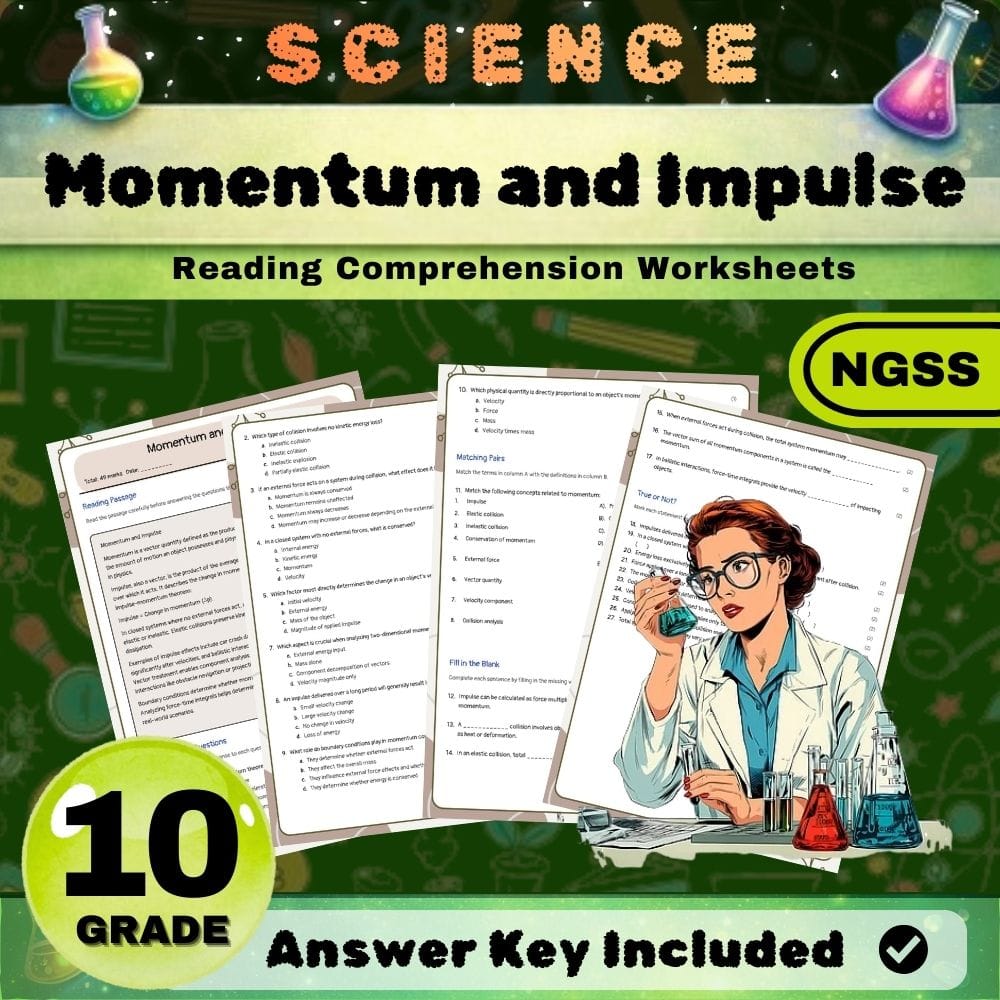
Grade 10 Science | Momentum and Impulse Worksheet (NGSS PDF)
 Created byMaple Path Learning
Learning Objectives
- Explain the relationship between force, time, and change in momentum using the impulse-momentum theorem.
- Apply the concept of conservation of momentum to elastic and inelastic collisions in two dimensions.
- Calculate the change in velocity and momentum for systems involving external forces and closed boundaries.
Also included in: Grade 10 Science Motion and Stability Forces and Interactions NGSS Lesson Bundle +1 more
Instant download

Grade 10 Science – Energy Changes & Reactions | Daily Reading Worksheet
Created byBright Mind ResourcesLearning Objectives
- Understand the differences between endothermic and exothermic reactions.
- Describe the concepts of enthalpy and potential energy diagrams.
- Explain how bond breaking and forming affect reaction heat.
Also included in: Grade 10 Stoichiometry & Atomic Structure Science Reading Lesson Bundle | AP +2 more
Instant download

Grade 10 Feedback Control Worksheet | Alberta Use Practice PDF
Created byClear Sky ClassroomLearning Objectives
- Explain how negative feedback stabilizes physiological variables in organisms
- Compare positive feedback to negative feedback in terms of system change and amplification
- Use feedback control concepts to interpret real biological examples such as thermoregulation and blood glucose control
Instant download

Grade 10 Science – Evolution Evidence & Fossil Records | Daily Reading Worksheet
Created byBright Mind ResourcesLearning Objectives
- Understand how fossil records provide evidence of evolution
- Identify different patterns and transitions in fossils
- Analyze how fossils support the idea of common ancestry
Also included in: Life Science Grade 10 Science Daily Reading Worksheets Lesson Bundle | FL NGSSS +1 more
Instant download
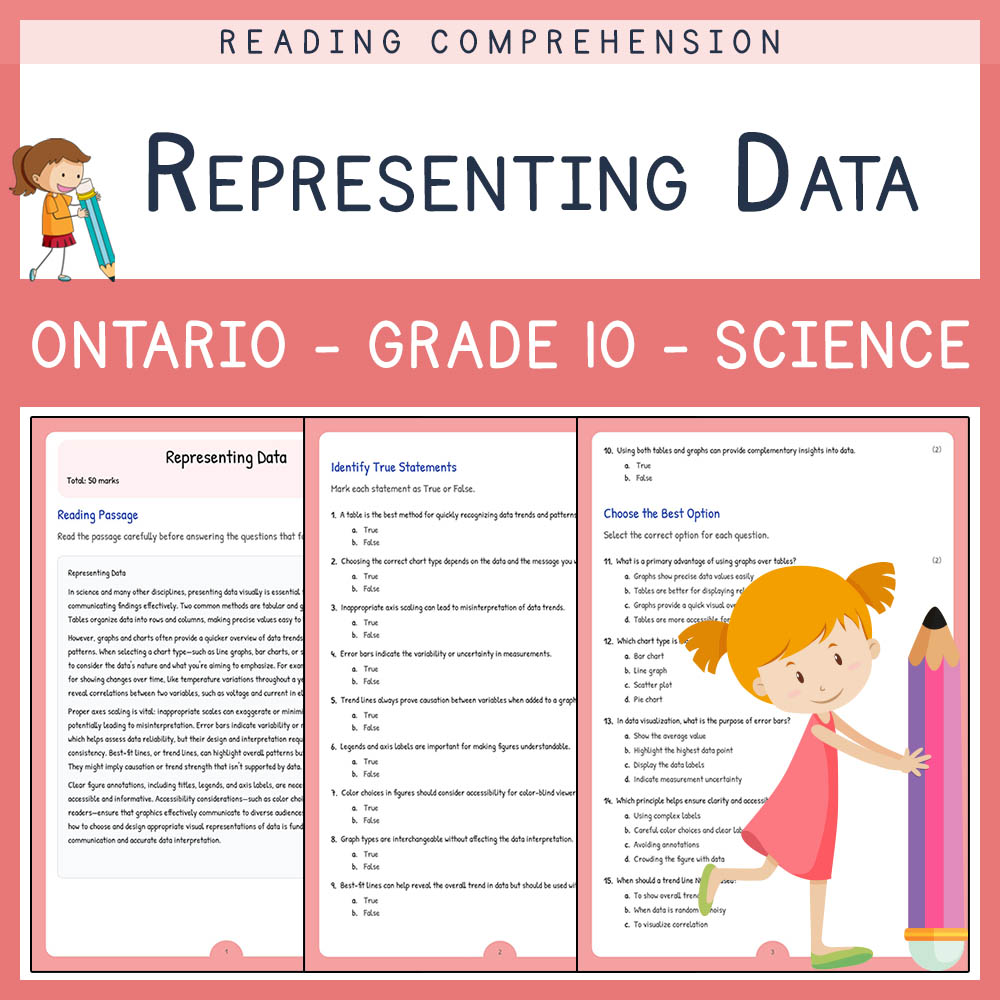
Grade 10 Science | Representing Data Worksheet Elena | Ontario Standards
 Created byLumora Learning
Learning Objectives
- Understand conventions for tabular and graphical data representation.
- Identify appropriate chart types and interpret axis scaling, error bars, and best-fit lines.
- Analyze how visual choices affect trend recognition and potential misinterpretation.
Instant download

Grade 10 Science – Plate Tectonics & Earth's Surface | Daily Reading Worksheet
Created byBright Mind ResourcesLearning Objectives
- Describe the main types of plate boundaries and their features.
- Explain how Earth's lithosphere moves and causes surface changes.
- Identify evidence supporting the theory of plate tectonics.
Also included in: Stellar Evolution Grade 10 Science Daily Reading Worksheets Bundle | FL NGSSS +1 more
Instant download
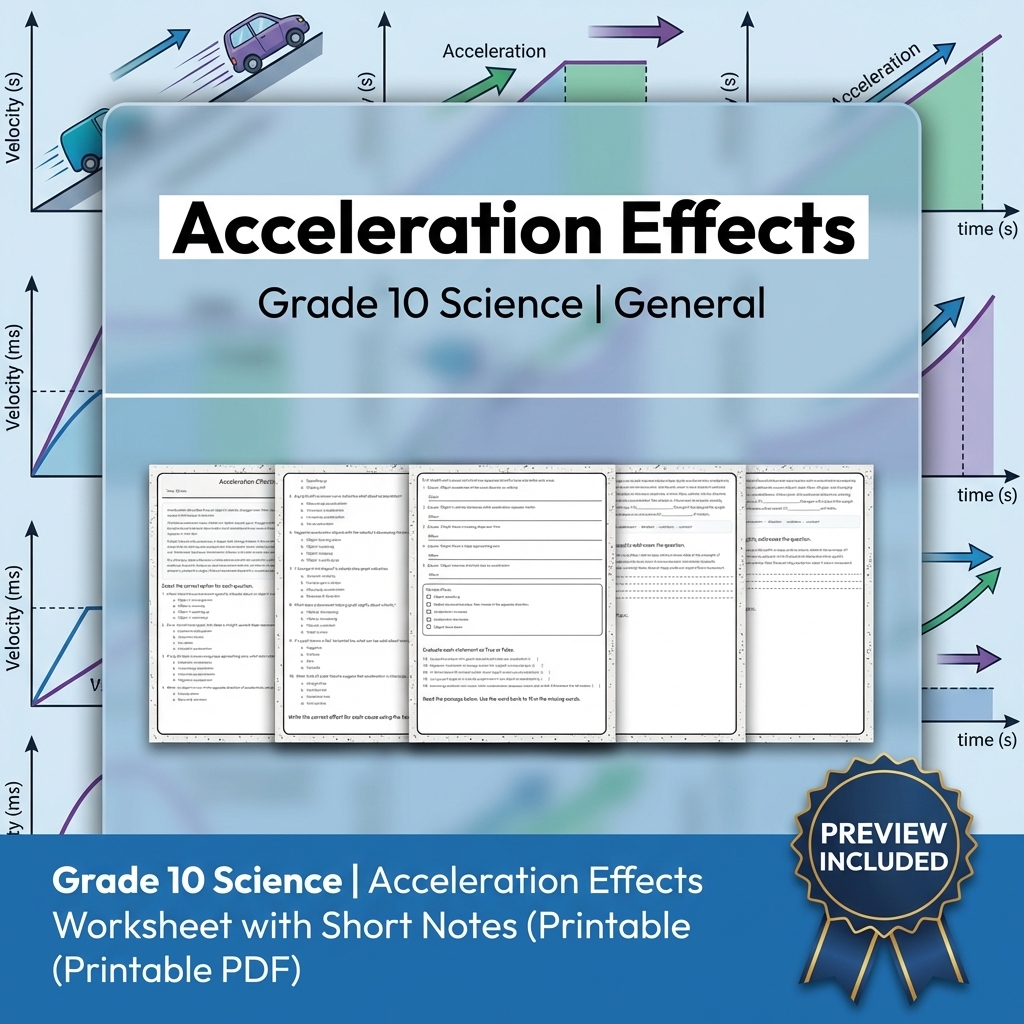
Grade 10 Science | Acceleration Effects Worksheet with Short Notes
 Created byMeadowlark Worksheets
Learning Objectives
- Understand how acceleration influences velocity over time.
- Interpret graph features such as curvature and slope changes to determine acceleration variations.
- Relate the direction of acceleration to the resulting trend in velocity and motion changes.
Also included in: Grade 10 Forces and Energy Science Lesson Bundle for General Framework +1 more
Instant download

Grade 10 Science | Vectors & Components - Daily Reading Comprehension
Created byCoral Reef LearningLearning Objectives
- Understand the concept of vectors and how they differ from scalars.
- Identify the characteristics of vectors, including magnitude and direction.
- Learn how to decompose a vector into perpendicular components.
Instant download

Grade 10 Science | Measurable Criteria Worksheet | California Standards
Created byLumora LearningLearning Objectives
- Differentiate criteria from constraints in engineering or scientific design problems.
- Translate goals into measurable requirements using observable performance targets.
- Evaluate design choices by checking whether they satisfy criteria while respecting constraints.
Instant download

Grade 10 Quantitative Communication Worksheet | NGSS Practice PDF
Created byClear Sky ClassroomLearning Objectives
- Explain how significant digits and uncertainty notation affect the credibility of quantitative claims.
- Use confidence intervals and graphical annotations to support conclusions from data.
- Communicate assumptions, limitations, and methods transparently when reporting experimental results.
Also included in: Grade 10 Science Practices in Science: Lesson Bundle for Advanced Placement (AP) +1 more
Instant download
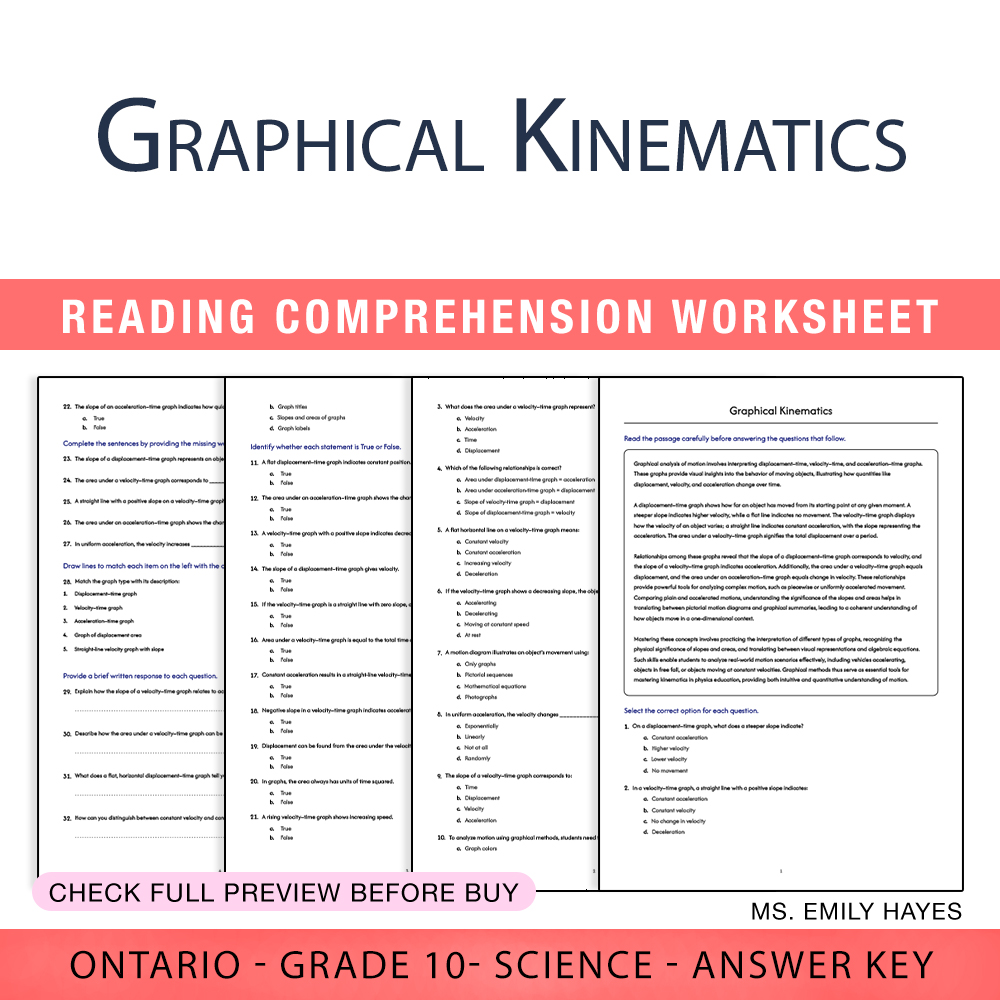
Grade 10 Science | Graphical Kinematics Worksheet (PDF + Answer Key)
 Created byCopper Leaf Classroom
Learning Objectives
- Interpret and analyze displacement–time, velocity–time, and acceleration–time graphs.
- Understand the relationships among slope, area, and kinematic quantities such as displacement, velocity, and acceleration.
- Compare piecewise and uniformly accelerating motions using graphical representations.
Instant download

Grade 10 Science – Mechanics Applications Worksheet (Ontario | PDF)
Created byEvergreen Desk EducationLearning Objectives
- Apply kinematic relations to predict motion on inclined planes, in pulley systems, and during braking.
- Use Newton’s laws to relate net force, mass, and acceleration in real engineering scenarios.
- Connect work, momentum, and stopping distance to reason about design trade-offs for safety and performance.
Also included in: Grade 10 Kinematics Forces & Mechanics Science Lesson Bundle Ontario Worksheets +1 more
Instant download

Grade 10 Reaction Energy Worksheet with Answer Key | Florida NGSSS Science
Created byEvergreen Desk EducationLearning Objectives
- Explain how reaction energy changes from reactants to products and distinguish endothermic and exothermic reactions.
- Use energy profiles to interpret bond breaking, bond forming, and overall energy change.
- Describe the role of activation energy and connect it to the energy barrier between reactants and products.
Instant download

Grade 10 Science | Cell Structure Worksheet | Florida NGSSS
Created byLumora LearningLearning Objectives
- Explain how cell structure supports essential life processes in living systems
- Compare eukaryotic and prokaryotic cells based on the presence or absence of a nucleus and membrane-bound organelles
- Identify how cell membrane, cytoplasm, and genetic material coordinate cellular functions
Instant download

Grade 10 Science Worksheet | Understanding Genetic Drift (PDF)
Created byEvergreen Desk EducationLearning Objectives
- Explain how genetic drift changes allele frequencies in small populations through chance events.
- Differentiate founder effects and population bottlenecks as two drivers of drift.
- Predict how drift can reduce genetic diversity and cause divergence among isolated groups over generations.
Instant download

Electromagnetic Waves Grade 10 Assessment | Florida NGSSS Standards
Created byPrism Point LearningLearning Objectives
- Explain how electromagnetic waves can travel through a vacuum and relate frequency to wavelength
- Describe how the electromagnetic spectrum connects frequency, wavelength, and energy
- Compare reflection, transmission, and absorption based on wave-material interactions
Also included in: Grade 10 Waves Energy Forces Science Lesson Mini Bundle | Florida NGSSS +1 more
Instant download
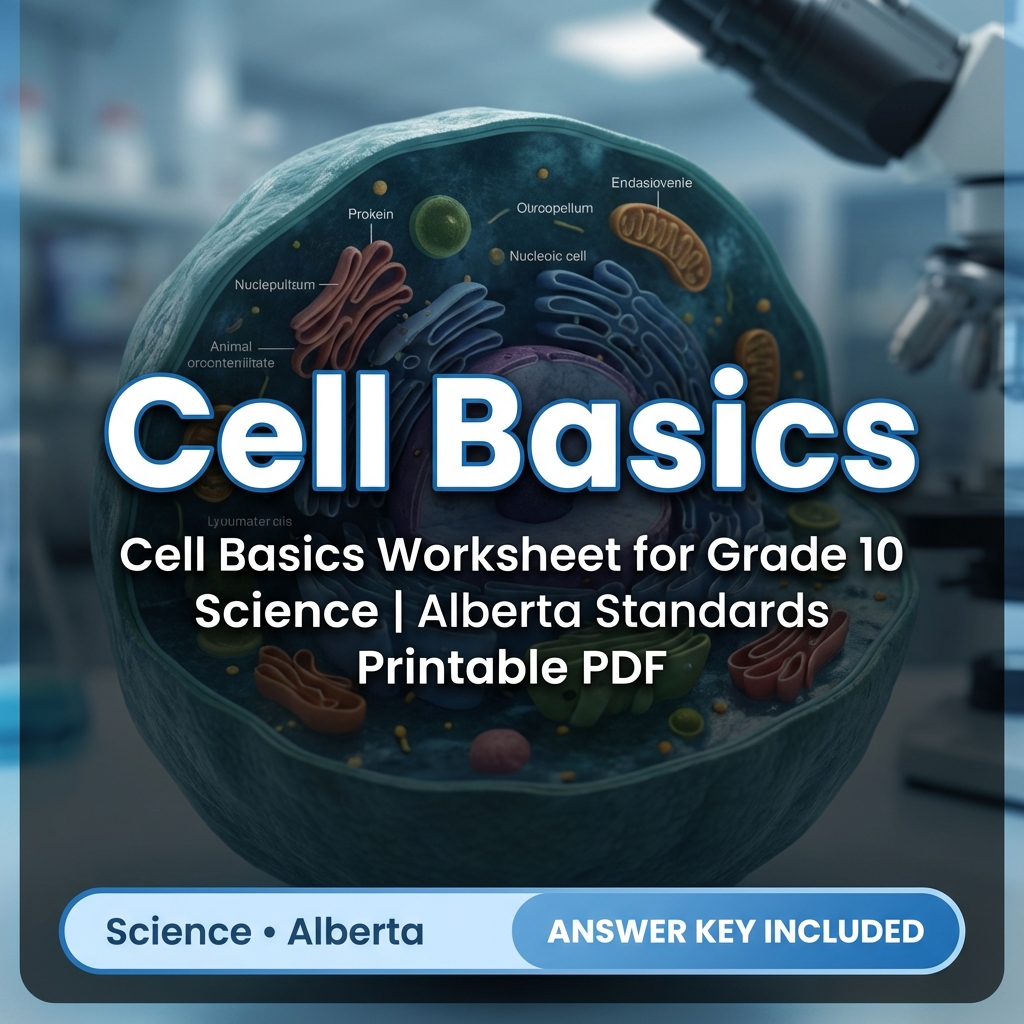
Cell Basics Worksheet for Grade 10 Science | Alberta Standards Printable PDF
Created byCoral Reef LearningLearning Objectives
- Describe the fundamental features of a cell, including membrane boundaries, cytoplasm, and genetic material.
- Identify regional examples of plant and moss cells in Alberta ecosystems.
- Explain how cellular organization relates to organism complexity and ecological traits.
Instant download

Grade 10 Science – Plant Systems & Transport | Daily Reading Worksheet
Created byBright Mind ResourcesLearning Objectives
- Identify the main plant organ systems and their functions.
- Explain how root architecture supports plant resource acquisition.
- Describe the roles of xylem and phloem in transporting water, nutrients, and sugars.
Also included in: Grade 10 Science Daily Reading: Cells & Systems Lesson Bundle | Alberta +1 more
Instant download

Grade 10 Science – Mass Conservation & Chemical Reactions | Reading Worksheet
Created byBright Mind ResourcesLearning Objectives
- Understand the principle of mass conservation during chemical reactions.
- Identify how atoms are rearranged without being created or destroyed.
- Learn to interpret balanced chemical equations using mass relations.
Also included in: Grade 10 Chemistry Science Lesson Bundle Daily Reading Worksheets | Alberta +1 more
Instant download
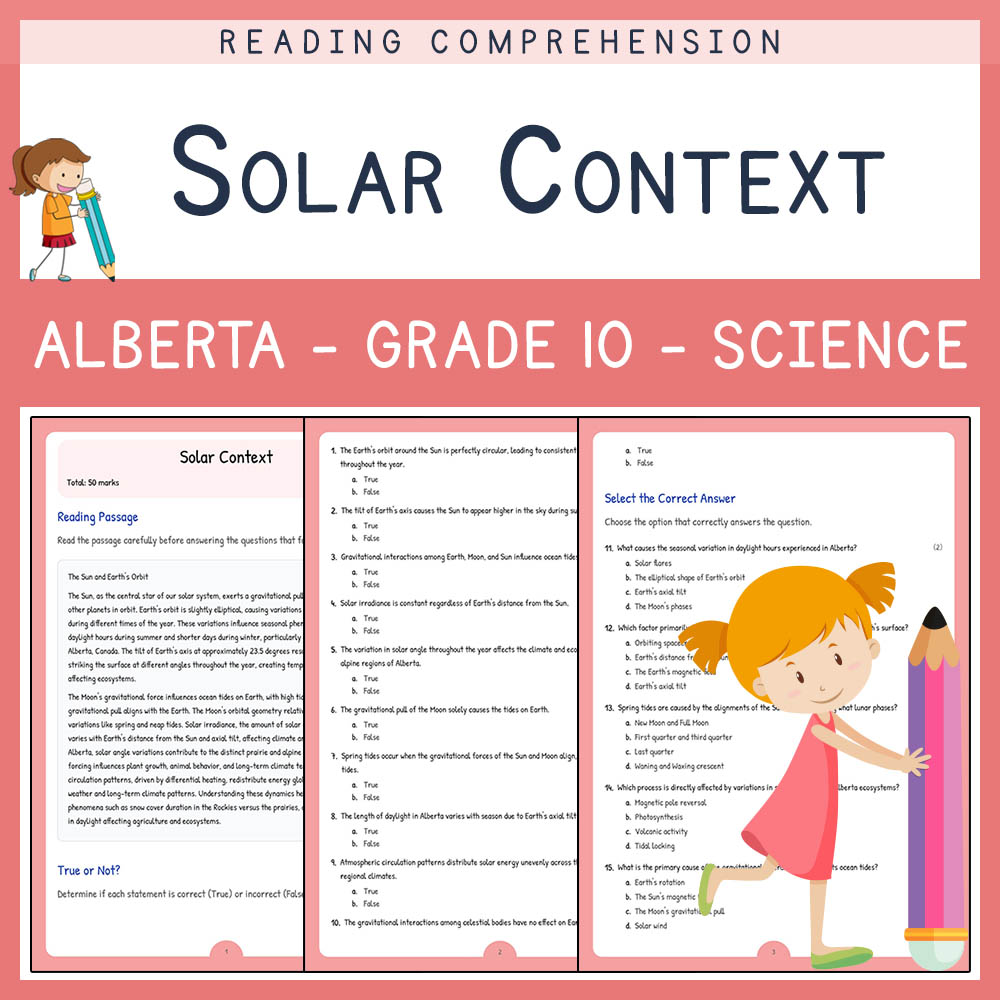
Grade 10 Science Worksheet | Solar Context | Alberta Standards
Created byLumora LearningLearning Objectives
- Describe the orbital motions of Earth, Moon, and Sun, and how these influence seasonal and daily patterns on Earth.
- Explain the concept of solar irradiance and its effect on regional ecosystems, particularly in Alberta.
- Analyze the gravitational interactions among Earth, Moon, and Sun and their impact on tides and orbital dynamics.
Also included in: Grade 10 Science | Earth and Space Systems Unit Bundle | Alberta
Instant download

Grade 10 Science Cell Membrane Daily Reading Worksheet with Answer Key
JCreated byJ.S SheetsLearning Objectives
- Identify the main components of the cell membrane
- Understand how membrane components influence fluidity and cell recognition
- Describe examples of membrane functions such as diffusion, osmosis, and ion transport
Also included in: Grade 10 Science Lesson Group Bundle | Cell Structure & Function TEKS +1 more
Instant download

Grade 10 Carrying Capacity Factors Worksheet | California Science Standards
Created byEvergreen Desk EducationLearning Objectives
- Explain how resource availability, competition, predators, disease, and other pressures affect carrying capacity in ecosystems.
- Analyze how changes in carrying capacity influence population growth and long-term ecosystem stability.
- Evaluate how energy flow and nutrient cycling at larger scales can determine which populations persist.
Instant download

Collisions and Momentum Worksheet Grade 10 Science | Standards-Aligned Practice
JCreated byJ.S SheetsLearning Objectives
- Define linear momentum and impulse and relate them using impulse–momentum (Δp = I).
- Use conservation of momentum to analyze collisions in isolated two-body systems.
- Differentiate elastic, inelastic, and perfectly inelastic collisions using both momentum and kinetic energy.
Instant download
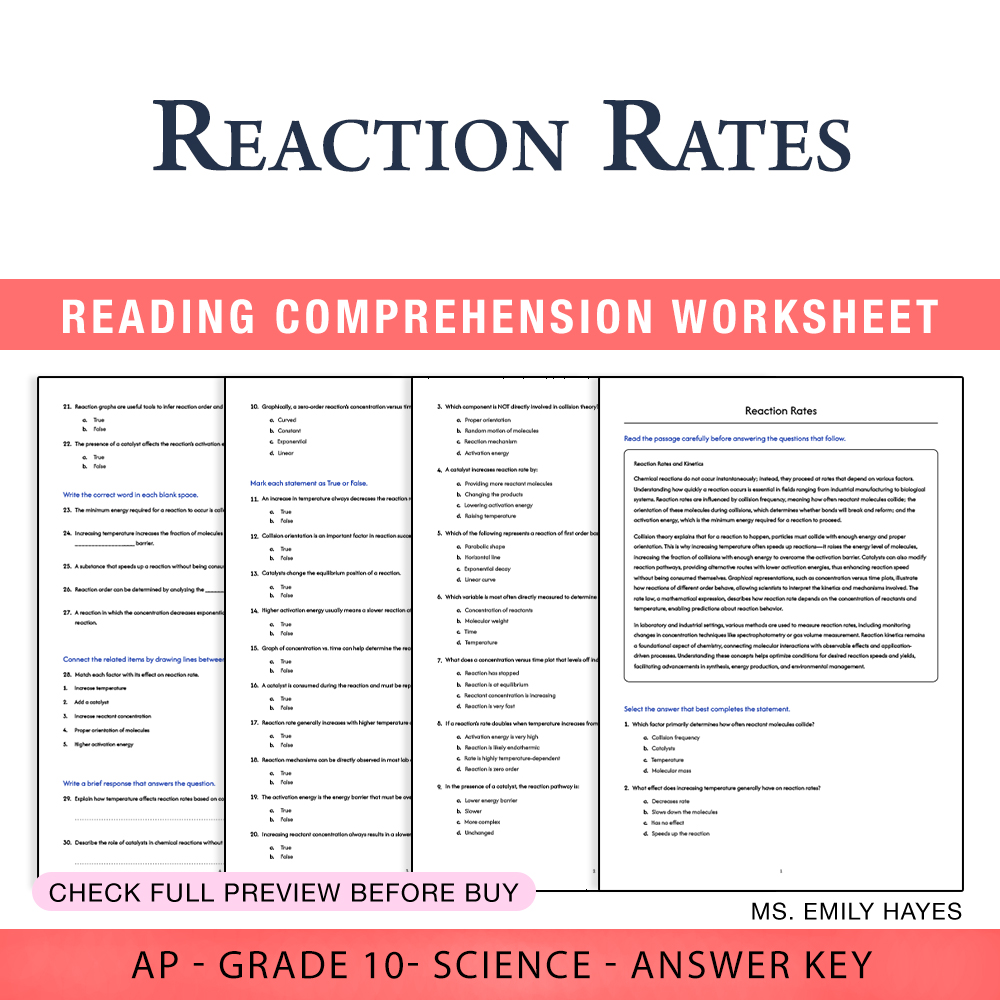
Grade 10 Science | Reaction Rates Worksheet (PDF+ Answer Key)
Created byCopper Leaf ClassroomLearning Objectives
- Explain the factors affecting chemical reaction rates, including collision frequency, orientation, and activation energy.
- Interpret graphical data of concentration versus time to determine reaction order.
- Describe the impact of temperature and catalysts on reaction pathways and rates.
Also included in: Grade 10 Science -Atomic Structure & Chemical Reactions (PDF+ Answer Key) +1 more
Instant download

Grade 10 Membrane Transport Worksheet | Diffusion & Osmosis Ontario
Created byClear Sky ClassroomLearning Objectives
- Describe the plasma membrane using the fluid mosaic model, including the roles of phospholipids, cholesterol, and proteins
- Differentiate transport protein types (channels, carriers, and pumps) by structure and selectivity
- Explain passive transport mechanisms (simple diffusion, facilitated diffusion, and osmosis) using concentration gradients and permeability
Instant download

Grade 10 Science | Ecosystem Basics - Daily Reading Comprehension
Created byCoral Reef LearningLearning Objectives
- Identify the key components of an ecosystem.
- Understand how producers, consumers, and decomposers interact within an ecosystem.
- Explain the flow of energy and cycling of nutrients in ecosystems.
Instant download
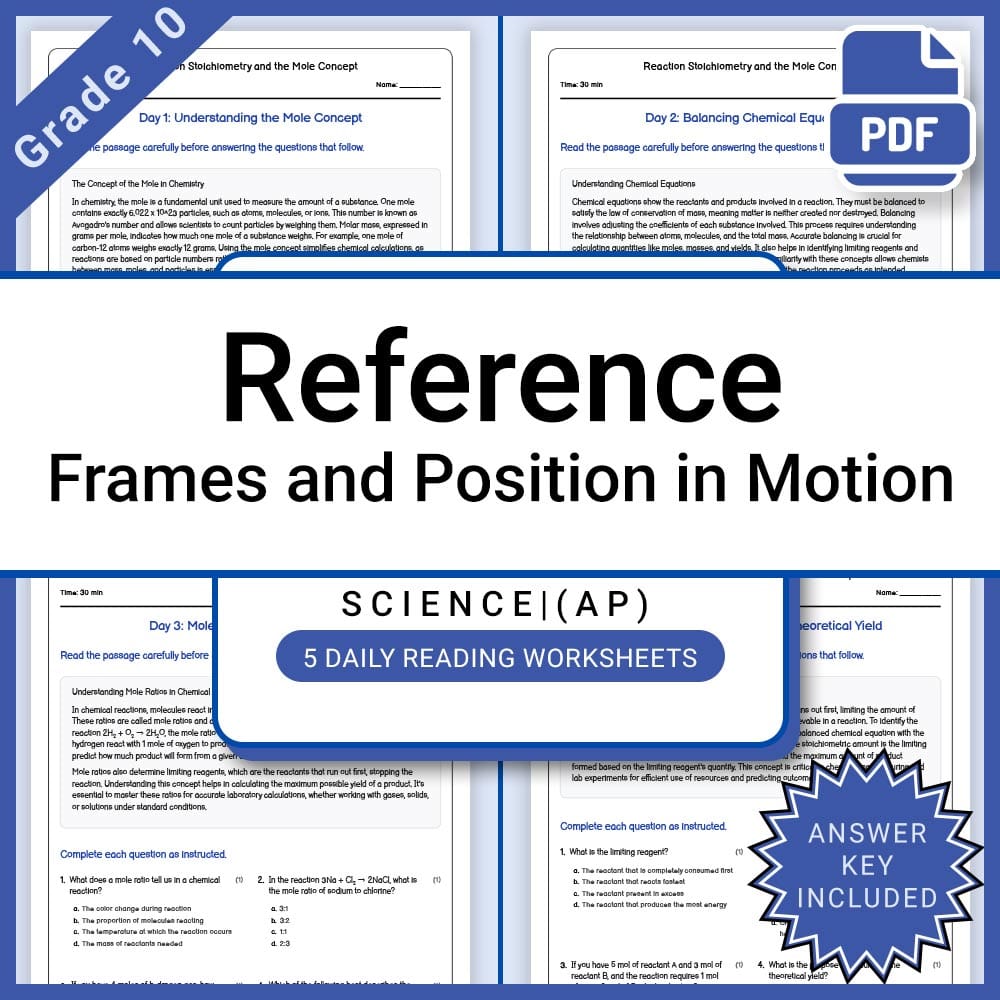
Grade 10 Science – Reference Frames Daily Reading Worksheet + Answer Key
JCreated byJ.S SheetsLearning Objectives
- Define and explain the concept of reference frames in one-dimensional motion.
- Describe how position and displacement are measured relative to a chosen coordinate system.
- Illustrate relationships among position, velocity, and acceleration using graphs and algebraic expressions.
Instant download

Grade 10 Science | Model-Data Fit in Projectile Motion - Reading Comprehension
Created byCoral Reef LearningLearning Objectives
- Understand the concept of residuals in data analysis
- Differentiate between model predictions and observed data
- Assess model adequacy using goodness-of-fit criteria
Also included in: Science Practices Reading Comprehension Lesson Bundle: Grade 10 Science AP +1 more
Instant download

ATP and Cellular Energy Worksheets: Grade 10 Science
 Created bySunny Desk Resources
Learning Objectives
- Explain how ATP couples energy released from catabolism to energy needed for biosynthesis and transport.
- Describe ATP hydrolysis and ATP synthesis as connected processes in metabolic pathways.
- Justify why phosphorylation is useful in cellular energy networks.
Also included in: Cell Structure, Homeostasis & Energy Lesson Bundle: Grade 10 Science Alberta +1 more
Instant download

Grade 10 Science | Surface & Atmospheric Interactions - Reading Comprehension
Created byCoral Reef LearningLearning Objectives
- Understand how surface features influence atmospheric conditions
- Identify key processes involved in energy exchange between surface and atmosphere
- Recognize the role of albedo and radiative forcing in climate variability
Instant download

Grade 10 Specialized Cells Worksheet | NGSS Practice & PDF
Created byClear Sky ClassroomLearning Objectives
- Explain how specialized cell structures relate to specific cell functions in multicellular organisms
- Use evidence from cell structure and surface features to predict how a cell supports transport, protection, absorption, or signaling
- Connect cell adaptations to tissue and organ performance in maintaining overall system function
Instant download

Grade 10 Science – Reaction Particles Worksheet (Worksheet + Answer Key)
Created byEvergreen Desk EducationLearning Objectives
- Explain how collision frequency affects reaction rate using a particle-based model
- Describe how activation energy and energy distribution influence whether collisions produce products
- Use particle and energy-based reasoning to predict how temperature, concentration, and catalysts change reaction probability
Also included in: Grade 10 Conservation Laws in Science Lesson Bundle – General Framework +1 more
Instant download

Grade 10 Science | Energy Forms in Science - Daily Reading Comprehension
Created byCoral Reef LearningLearning Objectives
- Understand the concepts of kinetic and potential energy
- Identify examples of energy forms in real-world scenarios
- Explain the conservation of energy principle
Also included in: Energy, Motion and Electricity Lesson Bundle | Grade 10 Science | Alberta +1 more
Instant download

Genomic Technologies Worksheet | TEKS-Aligned Science Practice Grade 10
JCreated byJ.S SheetsLearning Objectives
- Explain how PCR, DNA sequencing, CRISPR, and recombinant DNA are used to analyze genetic material.
- Describe how genomic technologies support genetic diagnosis and comparative genomics.
- Evaluate potential societal and ecological impacts of modifying genomes using genomic tools.
Instant download

Grade 10 Ore Formation Processes & Deposit Controls Science Worksheet
 Created byChalk and Compass
Learning Objectives
- Explain how ore deposits form through magmatic differentiation, hydrothermal circulation, sedimentary concentration, and metamorphic remobilization
- Describe how spatial controls such as structure, permeability contrasts, and host-rock chemistry influence where ore concentrates
- Identify typical mineral assemblages that help distinguish between major ore-deposit types
Also included in: Grade 10 Science Earth Processes & Resource Use Lesson Bundle | Ontario +1 more
Instant download
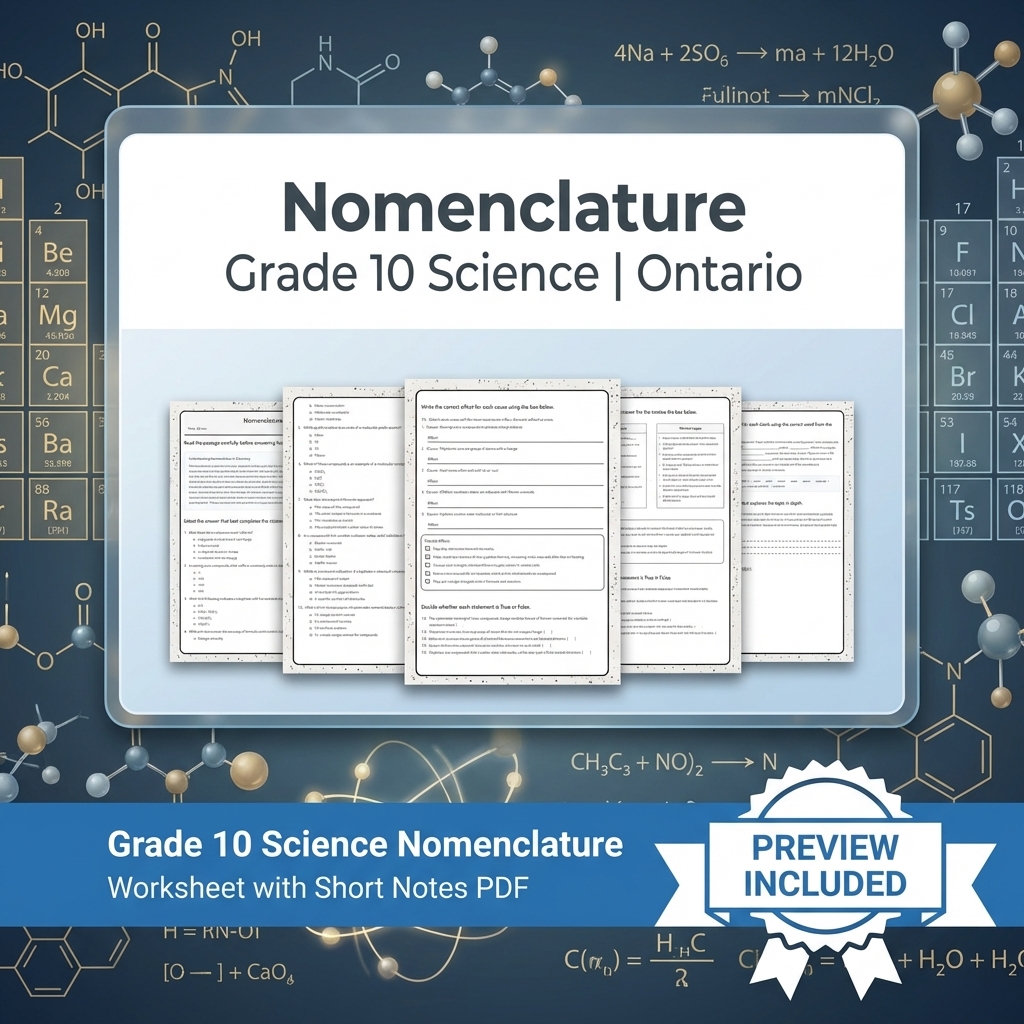
Grade 10 Science Nomenclature Worksheet with Short Notes PDF
Created byMeadowlark WorksheetsLearning Objectives
- Understand and apply systematic naming conventions for ionic and molecular compounds.
- Identify polyatomic ions and understand their role in compound formulas.
- Construct empirical and molecular formulas from charge and mass data.
Also included in: Grade 10 Science Lesson Group Bundle with Ontario Framework +1 more
Instant download

Energy Component Accounting Worksheet Grade 10 Science Practice Activity
Created byPrism Point LearningLearning Objectives
- Model energy conservation by tracking how energy changes between system components using an energy budget.
- Connect observed changes in component energy to specified energy transfers (work, heat, and energy flow between system and surroundings).
- Use consistency between representations to explain why total energy remains constant during redistribution.
Instant download

Work, Power, and Energy Transfer Worksheets | Grade 10 Science
Created bySunny Desk ResourcesLearning Objectives
- Calculate work using force and displacement in the force direction
- Explain power as the rate of doing work
- Interpret work and power relationships in practical situations
Also included in: Energy, Electricity & Momentum Transfer Lesson Bundle | Grade 10 Science | Alberta +1 more
Instant download
About Grade 10 Science Worksheets
Find Science worksheets built for Grade 10. All 7,038 cover core skills, practice, and review, each an instant PDF download.
Every worksheet on MyTeachingSheets is created by independent teacher-authors and reviewed before publication. All resources download as printable PDFs for classroom, homework, or at-home practice, and many include answer keys. Preview any worksheet free before buying.