
Grade 10 Science Worksheets
7,038 worksheets
Science Worksheet Classification Basics Grade 10 | Standards-Aligned Practice
JCreated byJ.S SheetsLearning Objectives
- Differentiate elements, compounds, and mixtures using purity and atomic/compositional criteria
- Explain how chemical formulas and empirical relationships support classification of substances
- Distinguish homogeneous versus heterogeneous mixtures and relate them to separation methods
Instant download

Earth Sphere Interactions Worksheets: Earth Systems Modeling Grade 10
 Created byBRIGHT PATH RESOURCES
Learning Objectives
- Explain how energy and matter transfers link Earth’s air, water, land, and living things over time.
- Use a system model to predict how a change in one reservoir can affect another reservoir.
- Interpret data and models by connecting inputs (temperature, rainfall, aerosols) to outcomes (runoff, precipitation, flooding).
Also included in: Grade 10 Earth Science Worksheets Bundle | Climate & Earth Systems +4 more
Instant download

Grade 10 Science | Friction & Resistance - Daily Reading Comprehension
 Created byCoral Reef Learning
Learning Objectives
- Understand the difference between static and kinetic friction
- Identify how the coefficients of friction affect surface interactions
- Explain the concepts of air resistance and viscous drag in fluid environments
Instant download

Grade 10 Science | Circuit Power - Daily Reading Comprehension
Created byCoral Reef LearningLearning Objectives
- Understand the definition of electrical power in terms of voltage and current.
- Learn how electrical energy is calculated over time.
- Apply power and energy concepts to real-world scenarios, such as household heating and electric vehicle charging.
Also included in: Energy, Motion and Electricity Lesson Bundle | Grade 10 Science | Alberta +1 more
Instant download

Science Worksheet Evolutionary Predictions Grade 10 | Standards-Aligned Practice
JCreated byJ.S SheetsLearning Objectives
- Explain how selection mechanisms change allele frequencies over generations
- Connect allele-frequency shifts to observable trait distributions at the population level
- Use evidence (molecular, fossil, and present-day variation) to justify evolutionary predictions
Also included in: Grade 10 Genetics, Evolution, and Cell Science Lesson Bundle: General +2 more
Instant download
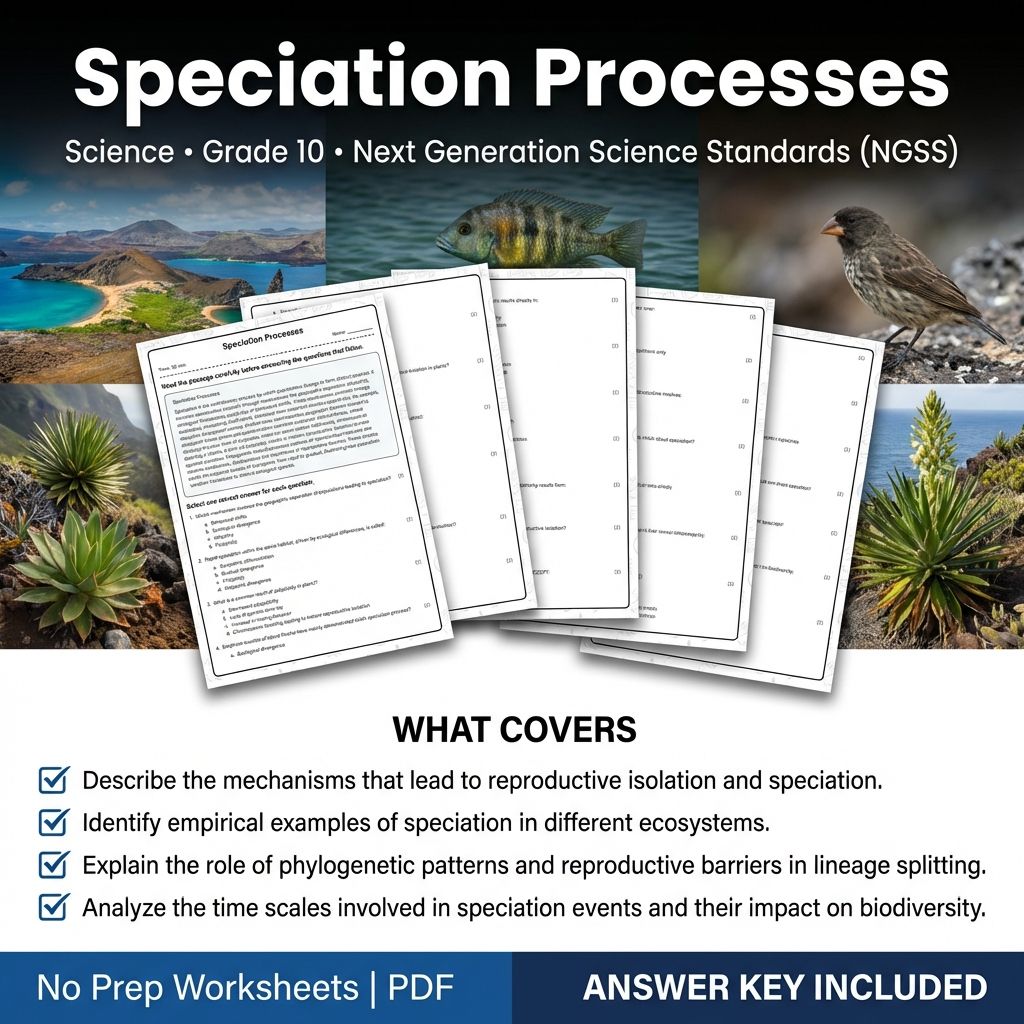
10th Grade Science | Speciation Processes Worksheet & Answer Key (Printable PDF)
Created byCoral Reef LearningLearning Objectives
- Describe the mechanisms that lead to reproductive isolation and speciation.
- Identify empirical examples of speciation in different ecosystems.
- Explain the role of phylogenetic patterns and reproductive barriers in lineage splitting.
Also included in: Grade 10 Science Unit Worksheet Bundle – Genetics, Evolution & Biodiversity +1 more
Instant download

Grade 10 Science – Graphical Kinematics Worksheet (Ontario Standards) (PDF)
 Created byEvergreen Desk Education
Learning Objectives
- Interpret displacement–time, velocity–time, and acceleration–time graphs to describe one-dimensional motion.
- Connect graph features (slope and area) to kinematic quantities such as velocity, acceleration, and displacement.
- Compare piecewise motion and uniformly accelerated motion using graphical reasoning.
Also included in: Grade 10 Kinematics Forces & Mechanics Science Lesson Bundle Ontario Worksheets +1 more
Instant download

Grade 10 Science – Feedback Control Systems & Ecosystem Regulation | Worksheet
 Created byBright Mind Resources
Learning Objectives
- Understand the concepts of negative and positive feedback mechanisms
- Identify real-world examples of feedback control in living organisms
- Analyze the importance of feedback loops for maintaining homeostasis
Also included in: Grade 10 Science Daily Reading: Cells & Systems Lesson Bundle | Alberta +1 more
Instant download

Constructing Claims Worksheet Pack Grade 10 AP Science CER Practice
 Created byPrism Point Learning
Learning Objectives
- Identify the components of an evidence-based claim: claim, evidence, and reasoning.
- Explain how a warrant connects data (evidence) to a conclusion (claim).
- Evaluate the strength of an argument by considering alternative explanations and measurement uncertainty.
Also included in: AP Science Inquiry Skills Lesson Bundle | Grade 10 | Modeling & CER
Instant download

Grade 10 Plate Dynamics Worksheet | Alberta Earth Science Resource
Created byEvergreen Desk EducationLearning Objectives
- Describe how satellite and aerial remote sensing collect information about Earth’s surface using sensors and spectral bands.
- Interpret common remote sensing products (e.g., vegetation indices, snow cover mapping, surface temperature estimates, wetland indicators) and explain what they reveal.
- Use the ideas of temporal series and multi-spectral indices to explain how environmental change can be detected and compared with ground observations.
Instant download
Grade 10 Science — Worksheet MCQ Paper for Mastering Molecular Patterns
 Created byThe Resource Hub
Learning Objectives
- Understand how molecular patterns in DNA and protein sequences reveal relatedness among organisms.
- Learn how molecular clocks estimate divergence times based on sequence differences.
- Identify shared genetic markers and conserved genes as indicators of common ancestry.
Also included in: Grade 10 Science Unit on Evolution & Biodiversity +1 more
Instant download

Grade 10 Science | Understanding the Rock Cycle - Daily Reading Comprehension
Created byCoral Reef LearningLearning Objectives
- Identify the main types of rocks and their properties
- Describe processes involved in the formation and transformation of rocks
- Understand the role of plate tectonics and surface processes in the rock cycle
Instant download
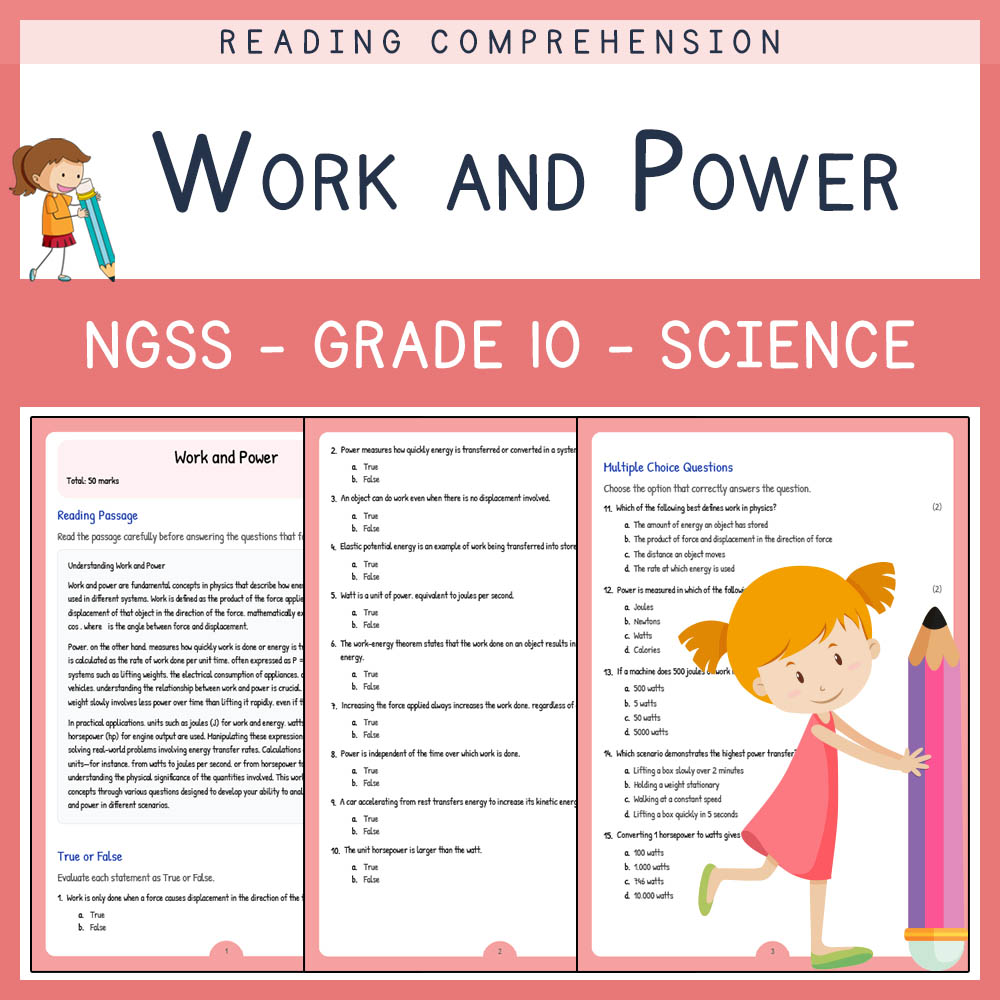
Grade 10 Science | Work and Power Worksheet with Answer Key (NGSS-Aligned)
 Created byLumora Learning
Learning Objectives
- Understand the relationship between work, force, displacement, and energy as described by the work–energy theorem.
- Calculate power as the rate of energy transfer in various contexts such as lifting weights, appliance wattage, and vehicle acceleration.
- Manipulate algebraic expressions involving work integrals and convert between units like joules, watts, and other engineering units.
Instant download

Grade 10 Science | Ecosystem Networks - Daily Reading Comprehension
Created byCoral Reef LearningLearning Objectives
- Identify components of ecosystems including producers, consumers, and decomposers.
- Understand the basic flow of energy through food chains and food webs.
- Recognize the concept of trophic levels in ecosystems.
Also included in: Biology and Ecosystems Lesson Bundle – Grade 10 Science Advanced Placement +1 more
Instant download

Effects of Unbalanced Forces Worksheet | Standards-Aligned Grade 10 Science
JCreated byJ.S SheetsLearning Objectives
- Understand how unbalanced forces cause changes in motion such as acceleration, deceleration, or change in direction.
- Interpret data and descriptions to connect net force with specific changes in an object's motion.
- Relate force descriptions to measurable outcomes like speed increase, decrease, or directional changes.
Also included in: Grade 10 Energy, Forces, and Reactions Science Lesson Bundle +1 more
Instant download

Grade 10 Science | Solar Conversion - Daily Reading Comprehension
Created byCoral Reef LearningLearning Objectives
- Understand how photovoltaic cells convert radiant energy into electrical energy.
- Learn about the structure and function of semiconductors in solar panels.
- Identify the processes involved in photoelectrochemical reactions.
Instant download

Grade 10 Net Force Outcomes Worksheet | Practice & PDF
 Created byClear Sky Classroom
Learning Objectives
- Identify how the net force direction determines the direction of acceleration when multiple forces act on an object.
- Predict whether motion speeds up, slows down, or changes direction using qualitative comparisons of opposing forces.
- Explain how friction affects net force and acceleration during everyday sliding situations.
Instant download
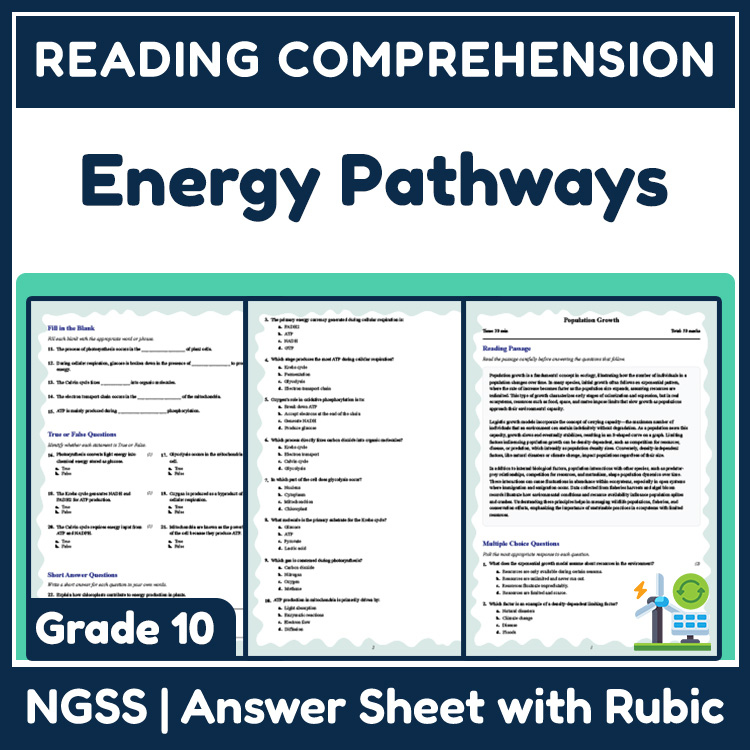
Grade 10 Science | Energy Pathways Reading Worksheet PDF (Answer Key)
JCreated byJ.S SheetsLearning Objectives
- Explain how photosynthesis converts light energy into chemical energy within chloroplasts.
- Describe the process of cellular respiration, including glycolysis, Krebs cycle, and oxidative phosphorylation.
- Understand how energy transfer supports biosynthesis, movement, and thermoregulation at cellular and organismal levels.
Also included in: Grade 10 Science Unit | Cellular & Physiological Systems Worksheets
Instant download

Shared Genetic Mechanisms Worksheet | Standards-Aligned Grade 10 Science
JCreated byJ.S SheetsLearning Objectives
- Understand how genetic and biochemical similarities across organisms provide evidence for common ancestry.
- Identify conserved genes, regulatory systems, and metabolic pathways as indicators of evolution.
- Explain how sequence similarity in DNA and shared protein functions support the concept of descent with modification.
Also included in: Grade 10 Genetic Variation and Evolution Science Lesson Bundle +1 more
Instant download
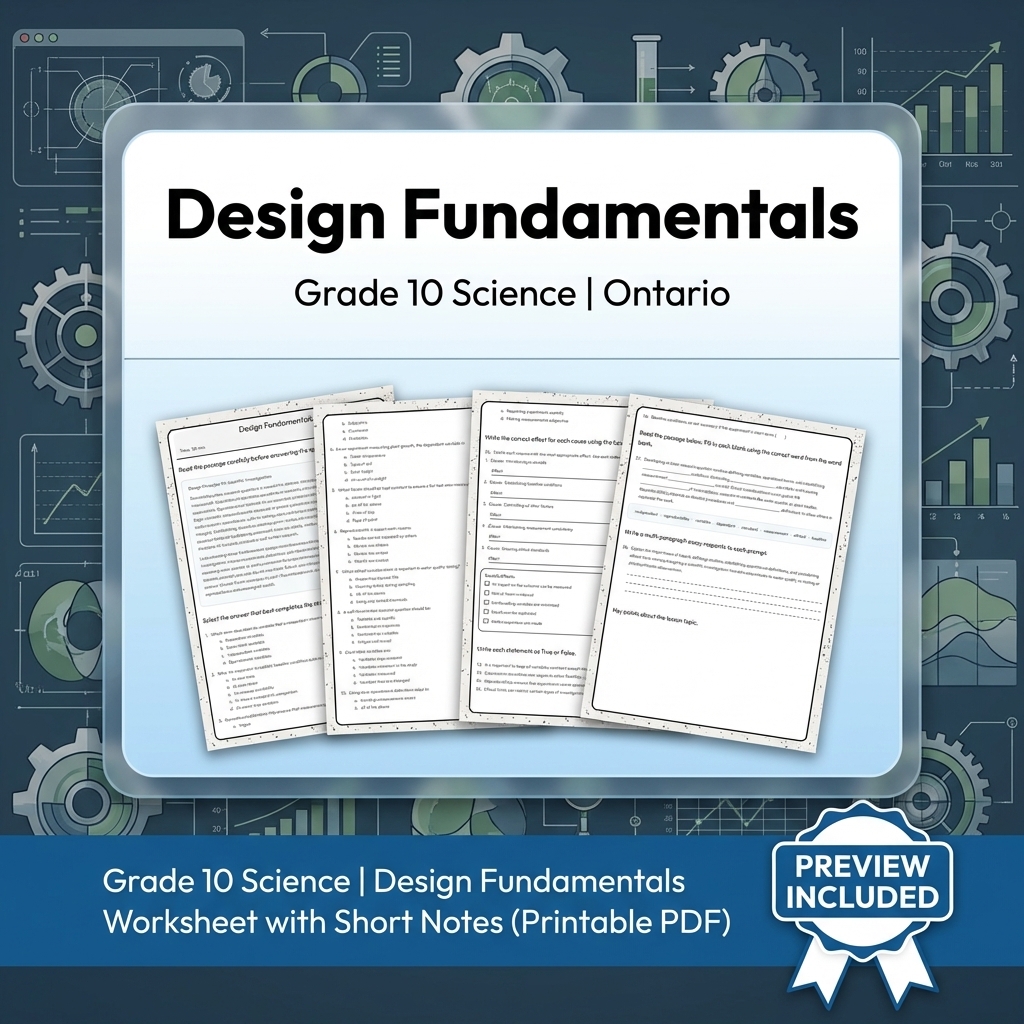
Grade 10 Science | Design Fundamentals Worksheet with Short Notes
 Created byMeadowlark Worksheets
Learning Objectives
- Understand the key principles of formulating testable research questions.
- Learn how to define operational definitions and classify variables.
- Distinguish between independent, dependent, and controlled factors in experiments.
Also included in: Grade 10 Science Lesson Group Bundle | Ontario Curriculum Worksheets +1 more
Instant download

Reaction Stoichiometry Worksheet Grade 10 AP Science Practice Chemistry Pack
Created byPrism Point LearningLearning Objectives
- Use balanced chemical equations and mole ratios to relate reactant amounts to product amounts.
- Convert between mass, moles, and molar mass using unit analysis.
- Identify limiting reactants and estimate theoretical yield from stoichiometric calculations.
Instant download
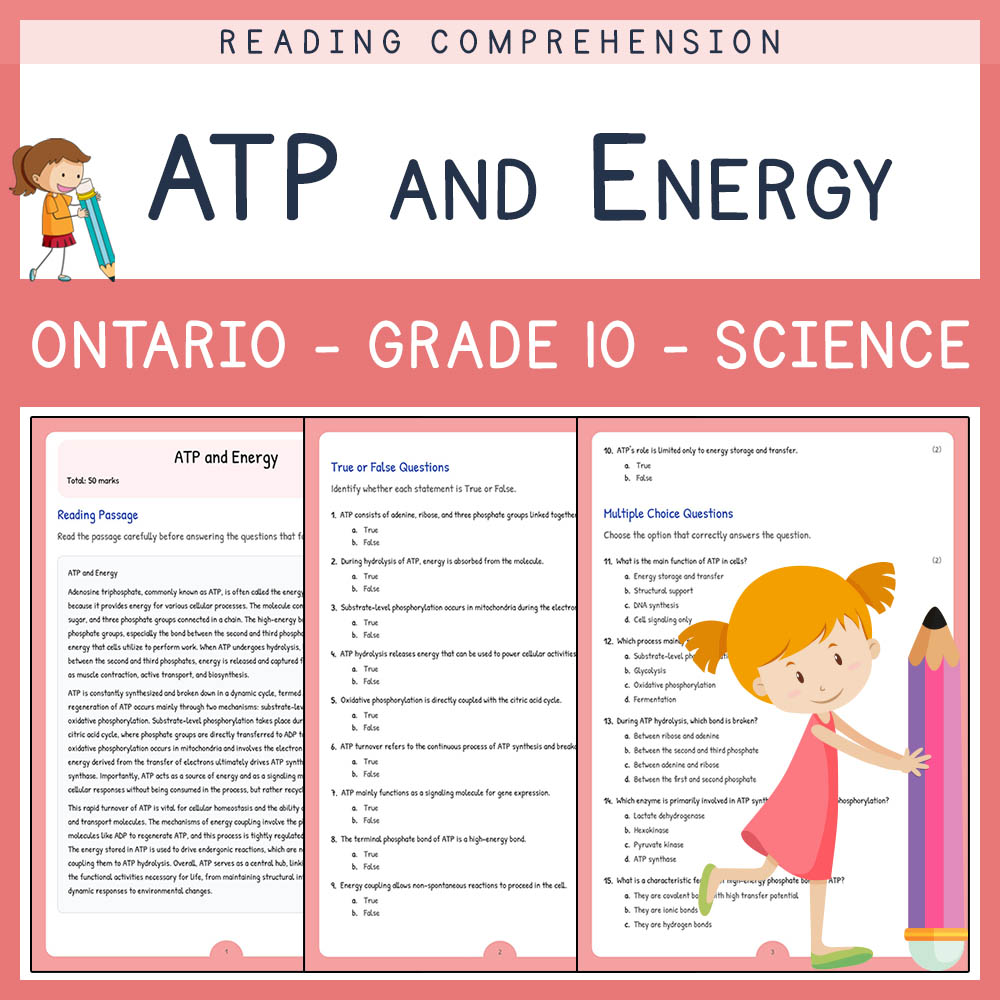
Grade 10 Science | ATP and Energy Worksheet Elena | Ontario Standards
Created byLumora LearningLearning Objectives
- Explain the molecular structure of ATP and its role as an energy carrier in cells.
- Describe the process of energy release through phosphate bond hydrolysis.
- Understand the mechanisms of ATP regeneration via substrate-level and oxidative phosphorylation.
Instant download

Energy Forms Worksheet | Grade 10 Science Practice Activities
Created byPrism Point LearningLearning Objectives
- Identify major forms of energy (kinetic, potential, thermal, chemical, radiant, and nuclear) and describe what systems store them.
- Explain how energy can shift between forms during everyday processes such as heating, motion, or respiration.
- Distinguish between different kinds of potential energy and relate them to real-world examples.
Also included in: Grade 10 Energy, Efficiency & Conservation Science Lesson Bundle | BC +1 more
Instant download

Grade 10 Science | Gravitation Fields - Daily Reading Comprehension
Created byCoral Reef LearningLearning Objectives
- Understand the concept of a gravitational field and how it is represented.
- Explain the inverse-square behavior of gravitational force.
- Describe how gravitational fields affect objects in space and near Earth.
Instant download

Grade 10 Science | Natural Selection - Daily Reading Comprehension
Created byCoral Reef LearningLearning Objectives
- Understand the principles of natural selection
- Identify traits and environmental pressures involved in selective processes
- Recognize real-world examples of natural selection
Instant download

Cell Membrane Transport Assessment for Grade 10 Science | NGSSS
Created byPrism Point LearningLearning Objectives
- Explain selective permeability and how it supports maintaining stable internal conditions in cells.
- Compare passive transport (diffusion and osmosis) with active transport (energy-requiring transport).
- Describe how water movement by osmosis affects cell size and function.
Also included in: Grade 10 Cells, Genetics & Evolution Science Lesson Bundle | Florida NGSSS +1 more
Instant download

Grade 10 Balancing Equations Worksheet | Ontario Chemistry + Answer Key
Created byClear Sky ClassroomLearning Objectives
- Distinguish coefficients from subscripts in chemical equations and explain why coefficients change atom counts.
- Apply the conservation of mass concept to justify why balanced equations have equal numbers of each type of atom on both sides.
- Identify strategies for systematically balancing multi-step chemical equations without relying on procedural “guess-and-check.”
Instant download

Evidence for Human Impact on Earth Systems Worksheets | Grade 10
Created byBRIGHT PATH RESOURCESLearning Objectives
- Describe how fossil-fuel use changes atmospheric greenhouse gases and radiative balance.
- Explain how land clearing affects albedo, surface roughness, and habitat.
- Identify evidence types (climate records, satellite observations, chemical measurements) used to support human-impact claims.
Also included in: Grade 10 Earth Science Worksheets Bundle | Climate & Earth Systems +4 more
Instant download

Grade 10 Science – Energy in Cells & Cellular Processes | Reading Worksheet
Created byBright Mind ResourcesLearning Objectives
- Understand the process of cellular respiration and photosynthesis.
- Identify the role of ATP in cellular activities.
- Explain the importance of energy conversion in living organisms.
Also included in: Life Science Grade 10 Science Daily Reading Worksheets Lesson Bundle | FL NGSSS +1 more
Instant download

Grade 10 Science | Models & Explanations in Science - Daily Reading Practice
Created byCoral Reef LearningLearning Objectives
- Understand what models are in scientific practice.
- Identify different types of scientific models.
- Learn how explanations connect data to mechanisms.
Instant download

Grade 10 Industrial Processes Worksheet PDF | Alberta Chemistry
Created byEvergreen Desk EducationLearning Objectives
- Apply reaction stoichiometry and mass conservation to write and interpret industrial process mass balances.
- Estimate theoretical and actual yields using limiting reactants and percent yield.
- Explain how reaction kinetics and thermodynamics affect reactor performance and achievable conversion.
Instant download
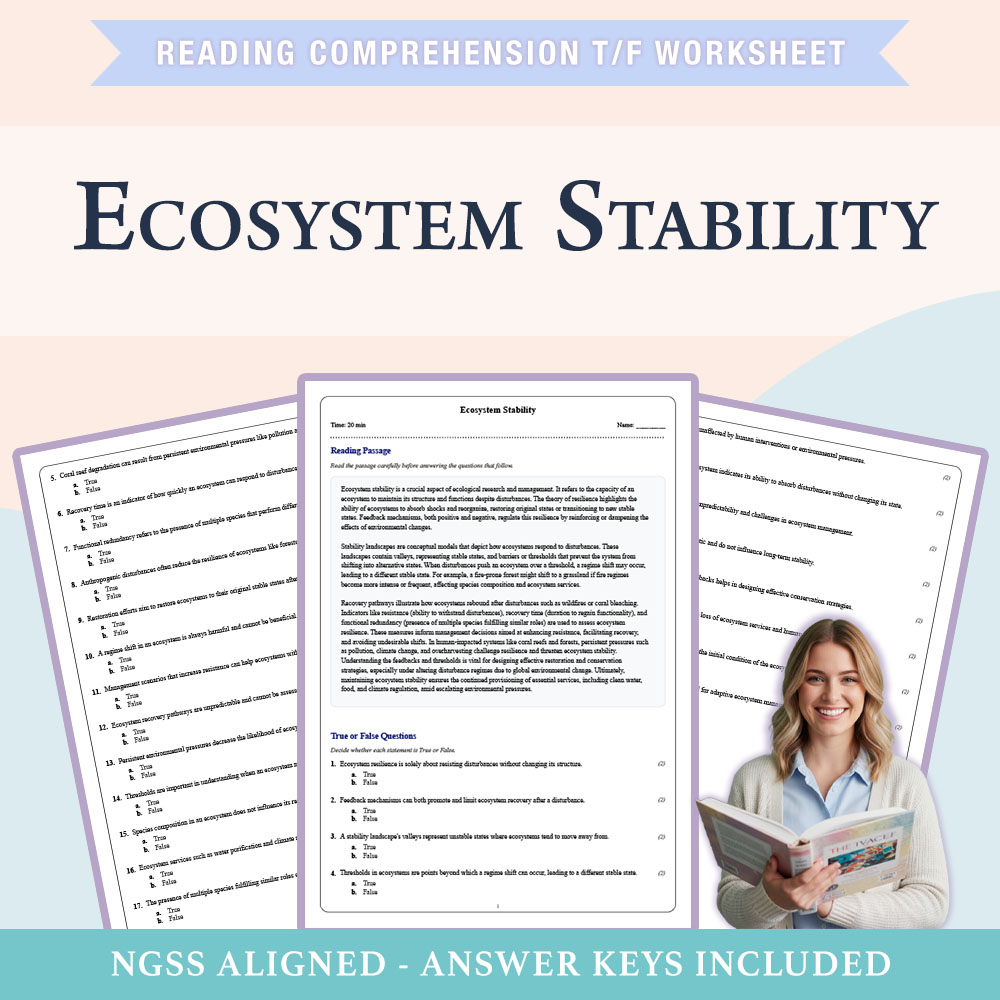
Grade 10 Science | Ecosystem Stability Worksheet (PDF + Answer Key)
 Created byCopper Leaf Classroom
Learning Objectives
- Understand the concepts of resilience theory, feedbacks, and stability landscapes in ecosystems.
- Identify the impacts of natural and anthropogenic disturbances on ecosystems like forests and coral reefs.
- Evaluate indicators such as resistance, recovery time, and redundancy in assessing ecosystem health.
Also included in: Grade 10 Science Unit | Ecosystem Dynamics & Biodiversity (PDF +Answer Key) +1 more
Instant download

Grade 10 Science Worksheet | Argument With Evidence (PDF)
Created byEvergreen Desk EducationLearning Objectives
- Write a science argument that connects a clear claim to relevant evidence and sound reasoning.
- Evaluate competing scientific explanations by analyzing how well evidence supports each claim or counterclaim.
- Distinguish correlation from causation and separate observations from inferences in scientific reasoning.
Also included in: Grade 10 Uncertainty & Evidence Data Science Lesson Bundle (General) +1 more
Instant download
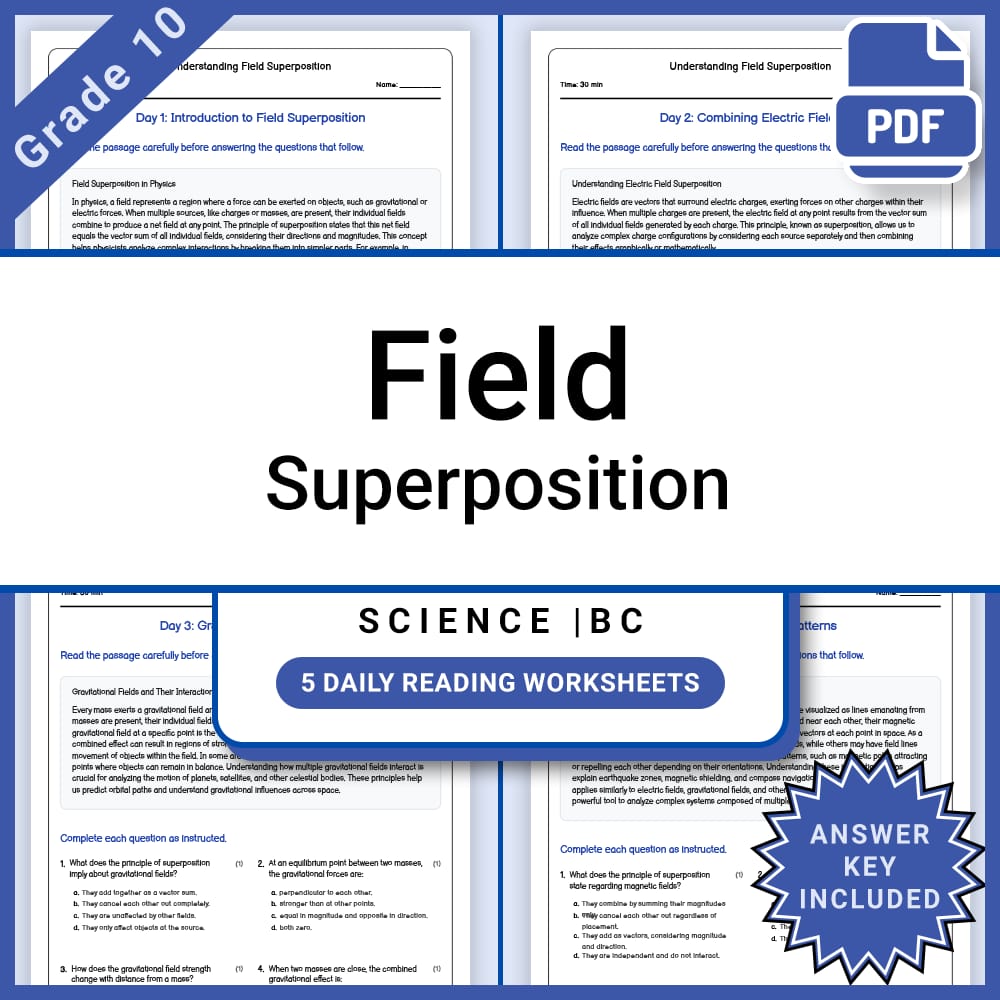
Grade 10 Science – Field Superposition Daily Reading Worksheet + Answer Key
JCreated byJ.S SheetsLearning Objectives
- Define the concept of field superposition in physics.
- Explain how multiple sources influence a net field at a point.
- Describe patterns such as cancellation, reinforcement, and equilibrium in fields.
Also included in: Grade 10 Science Lesson Group Bundle – Physics and Fields +1 more
Instant download
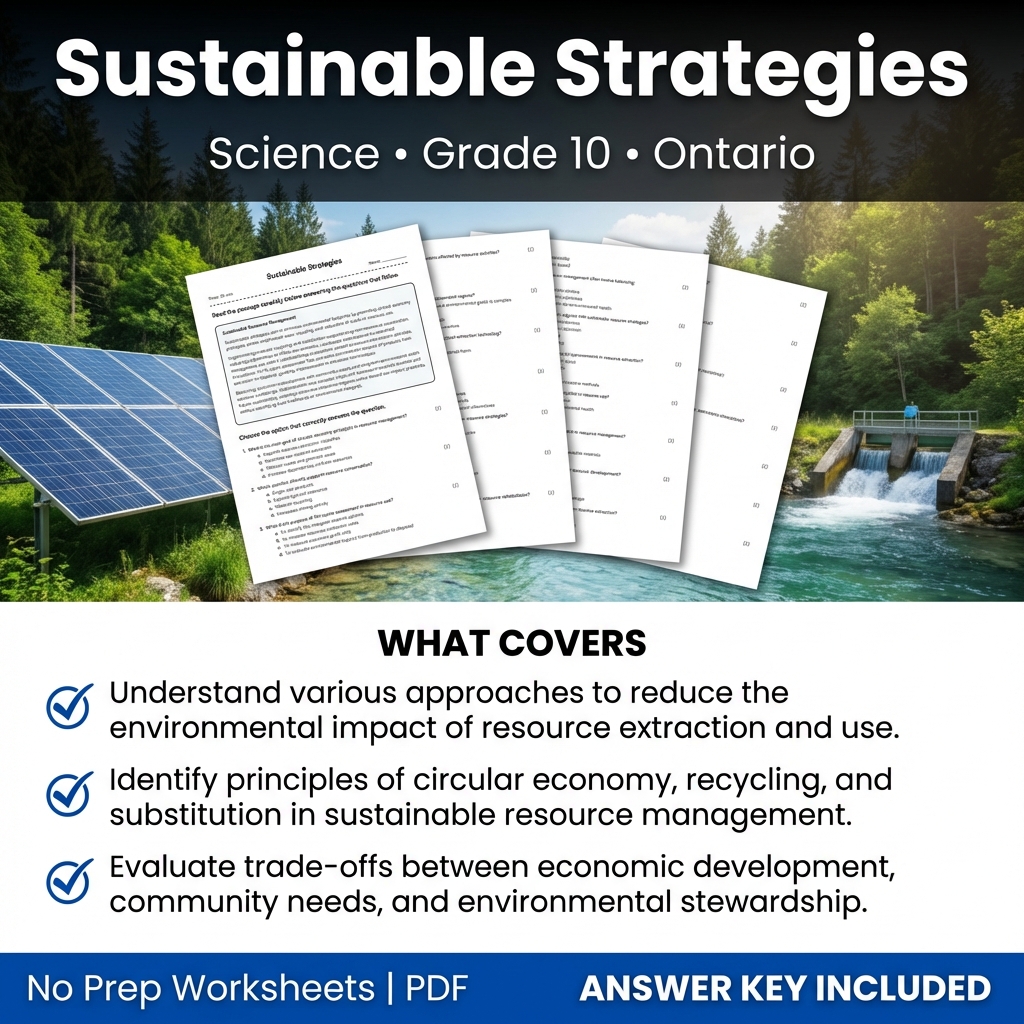
Grade 10 Science Worksheet on Sustainable Strategies | Ontario Standards
Created byCoral Reef LearningLearning Objectives
- Understand various approaches to reduce the environmental impact of resource extraction and use.
- Identify principles of circular economy, recycling, and substitution in sustainable resource management.
- Evaluate trade-offs between economic development, community needs, and environmental stewardship.
Instant download

Grade 10 – RNA Variants in Protein Synthesis Daily Worksheet + Answer Key
JCreated byJ.S SheetsLearning Objectives
- Understand the different types of RNA and their functions
- Explain how mRNA transmits genetic information from DNA to the ribosome
- Identify the structure and role of messenger RNA in cells
Also included in: Grade 10 Science Lesson Group Bundle – TEKS | Genetics & Genomic Technologies +1 more
Instant download

Molar Relationships Worksheet | Grade 10 Science Practice
Created byPrism Point LearningLearning Objectives
- Convert between moles, particle counts, and mass using Avogadro’s number and molar mass.
- Use mole-to-mole ratios from balanced equations to apply stoichiometry and predict amounts of products.
- Identify the limiting reagent and estimate theoretical yield while tracking units for consistency.
Also included in: Grade 10 Chemistry & Dynamic Equilibrium Lesson Bundle | Alberta Science
Instant download
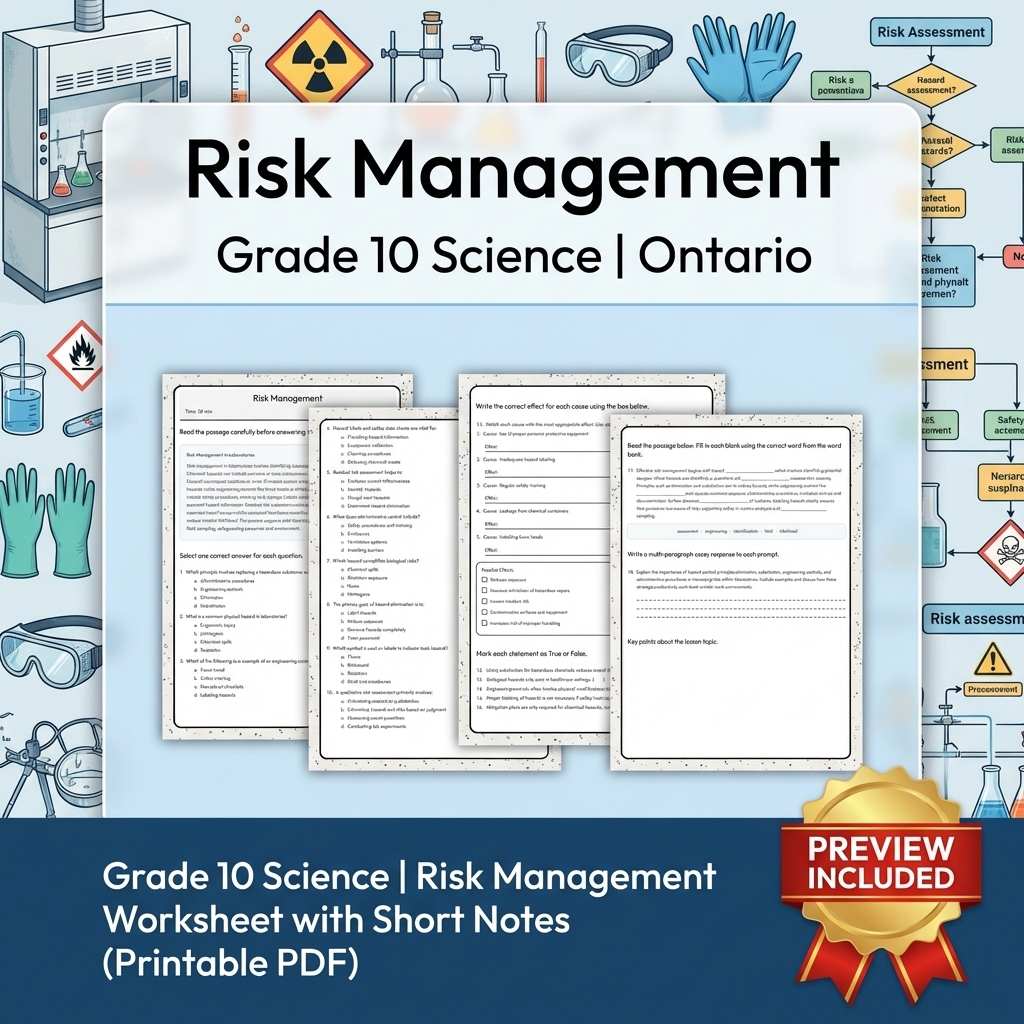
Grade 10 Science | Risk Management Worksheet with Short Notes (Printable PDF)
Created byMeadowlark WorksheetsLearning Objectives
- Understand systematic hazard identification processes in laboratory settings.
- Identify qualitative risk assessment techniques for chemical, biological, and physical hazards.
- Learn principles of hazard elimination, substitution, engineering controls, and administrative procedures.
Also included in: Grade 10 Science Lesson Group Bundle | Ontario Curriculum Worksheets +1 more
Instant download

Grade 10 Spheres Overview Worksheet | Alberta Earth Systems Science
Created byEvergreen Desk EducationLearning Objectives
- Identify the geosphere, hydrosphere, atmosphere, and biosphere and describe basic properties of each.
- Explain how matter and energy move through sphere interactions using Alberta examples.
- Interpret how physical structure and processes create observable regional landscape and climate patterns.
Instant download

Grade 10 Science Worksheet on Biodiversity Value | TEKS Aligned
Created byCoral Reef LearningLearning Objectives
- Understand the components and significance of biodiversity in ecosystems.
- Identify the ecological roles that biodiversity plays in maintaining system stability.
- Recognize the threats to biodiversity and the importance of conservation efforts.
Instant download

Comparative Design Worksheet for Grade 10 Science | AP Standards Practice
JCreated byJ.S SheetsLearning Objectives
- Understand principles of comparative observational approaches and controlled trials.
- Identify and differentiate between independent and dependent variables.
- Recognize strategies for replication, matching, and randomization in experimental design.
Instant download

Grade 10 Science | Action Reaction Worksheet | BC-Aligned
Created byLumora LearningLearning Objectives
- Understand the concept of action and reaction as paired forces exerted on interacting objects.
- Explain how equal and opposite forces influence motion and acceleration in systems.
- Apply the principle of action and reaction to real-world scenarios such as collisions and rocket propulsion.
Instant download

Grade 10 Science – Momentum Transfer & Conservation | Daily Reading Worksheet
Created byBright Mind ResourcesLearning Objectives
- Understand the concept of linear momentum and impulse.
- Explain the conservation of momentum in closed systems.
- Analyze different types of collisions and how momentum redistributes.
Also included in: Energy & Systems Interactions Grade 10 Science lesson bundle | Alberta +1 more
Instant download
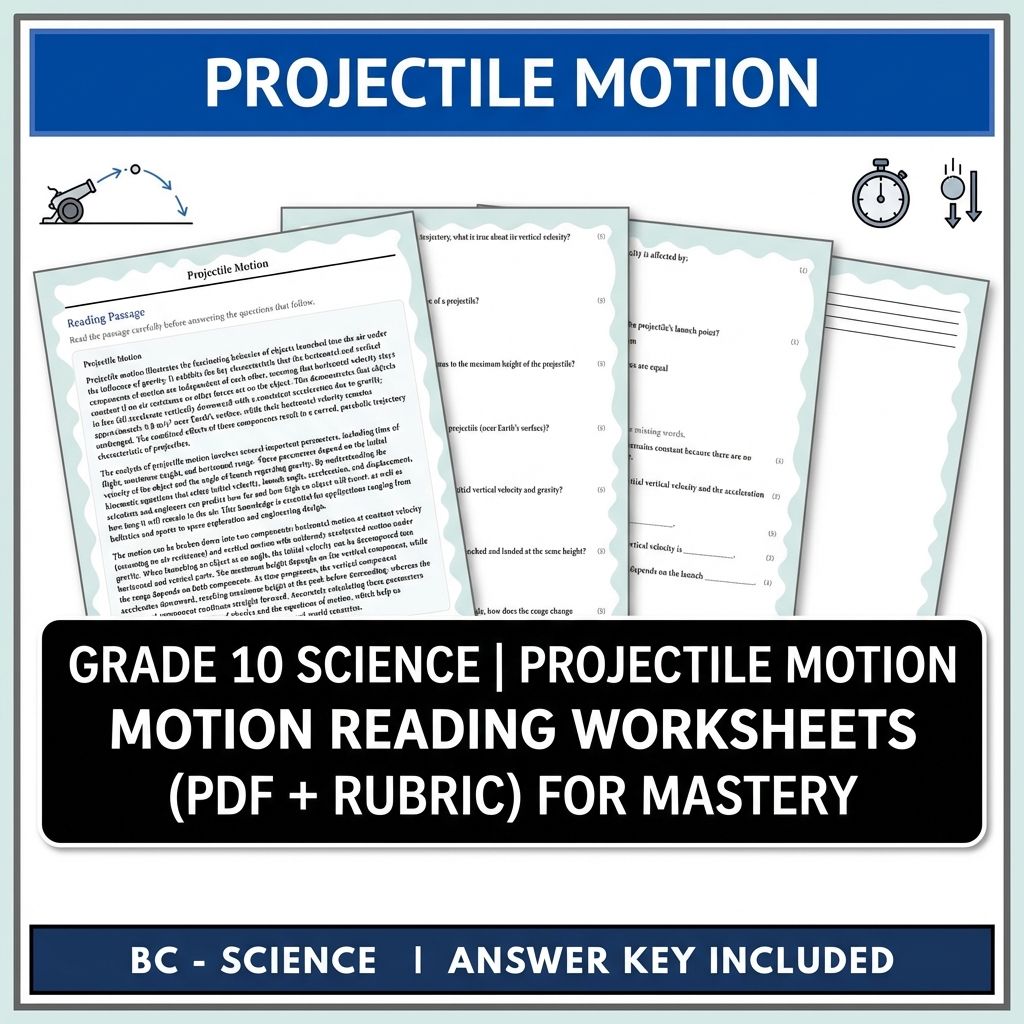
Grade 10 Science | Projectile Motion Worksheets (PDF + Rubric) for Mastery
JCreated byJ.S SheetsLearning Objectives
- Understand the components of projectile motion and their independence.
- Explain how horizontal velocity remains constant absent horizontal forces.
- Analyze vertical motion under gravity and its impact on projectile trajectories.
Instant download

Grade 10 Science – Cell Types & Structures | Daily Reading Worksheet
Created byBright Mind ResourcesLearning Objectives
- Identify the main differences between prokaryotic and eukaryotic cells
- Understand examples of each cell type in ecological contexts
- Describe how structural differences influence cell function and classification
Also included in: Grade 10 Science Daily Reading: Cells & Systems Lesson Bundle | Alberta +1 more
Instant download

Grade 10 Human Footprint Worksheet | Alberta Science Environmental Impact
Created byEvergreen Desk EducationLearning Objectives
- Explain how human activities modify Earth systems through land-use change, resource extraction, and greenhouse-gas emissions.
- Identify how these changes can alter soil, water, and atmospheric processes in Alberta regions.
- Use measurable environmental indicators to describe cumulative impacts on ecosystem services and sustainability.
Instant download

Organ Systems Worksheet | Grade 10 Science Practice Activities
Created byPrism Point LearningLearning Objectives
- Explain how organ structure supports specific functions in organ systems (structure–function relationships).
- Describe how vascularization and material exchange (nutrients, gases, wastes) help organs maintain homeostasis.
- Connect examples from plants and mammals to how organs interact with their environments in Alberta’s varied conditions.
Also included in: Cell Organization & Homeostasis Grade 10 Science Lesson Bundle | Alberta
Instant download
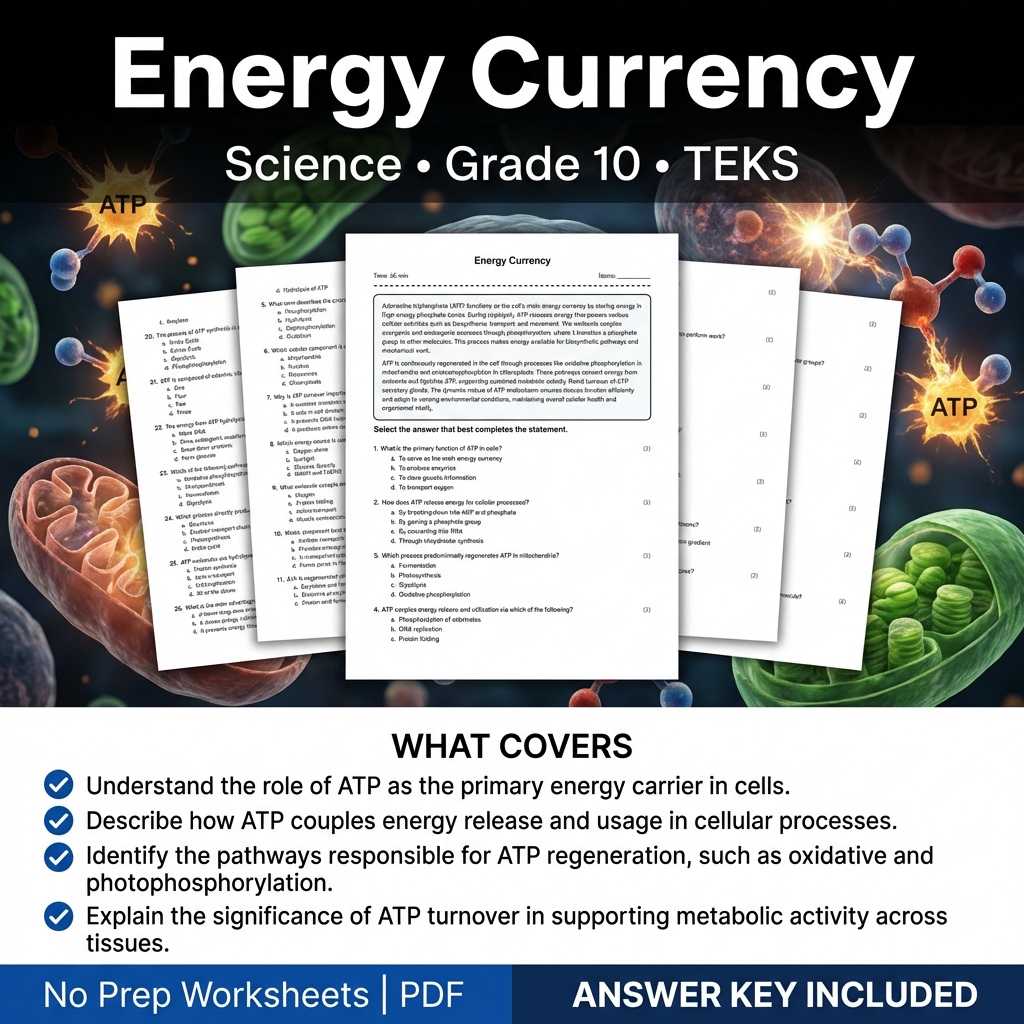
Grade 10 Science Worksheet on Energy Currency | TEKS Aligned
Created byCoral Reef LearningLearning Objectives
- Understand the role of ATP as the primary energy carrier in cells.
- Describe how ATP couples energy release and usage in cellular processes.
- Identify the pathways responsible for ATP regeneration, such as oxidative and photophosphorylation.
Instant download
About Grade 10 Science Worksheets
Find Science worksheets built for Grade 10. All 7,038 cover core skills, practice, and review, each an instant PDF download.
Every worksheet on MyTeachingSheets is created by independent teacher-authors and reviewed before publication. All resources download as printable PDFs for classroom, homework, or at-home practice, and many include answer keys. Preview any worksheet free before buying.