
Grade 11 Science Worksheets
6,616 worksheets
Grade 11 Science – Natural Selection & Evolution | Daily Reading Worksheet
 Created byBright Mind Resources
Learning Objectives
- Understand the basic concepts of natural selection.
- Identify examples of natural selection in nature.
- Learn about different modes of selection: directional, stabilizing, and disruptive.
Also included in: Grade 11 Evolution Science Lesson Bundle Daily Reading Worksheets | TEKS +2 more
Instant download

Grade 11 Science – Reliability Metrics & Testing | Daily Reading Worksheet
Created byBright Mind ResourcesLearning Objectives
- Understand the concept of reliability in engineering and science.
- Identify key metrics used to evaluate system reliability, such as stability and failure rates.
- Explain how models and simulations help assess reliability under various scenarios.
Also included in: Grade 11 System Design & Trade-offs Science Lesson Bundle | General +1 more
Instant download

Grade 11 Science – Nutrient Cycling & Pathways | Daily Reading Worksheet
Created byBright Mind ResourcesLearning Objectives
- Understand how carbon moves through ecosystems via photosynthesis and respiration
- Identify roles of decomposers in nutrient cycling
- Explain the connection between food webs and biogeochemical cycles
Also included in: Evolution Grade 11 Science Daily Reading Worksheets Lesson Bundle | CA Standards +1 more
Instant download

Grade 11 Science – Climate Forecasting & Models | Daily Reading Worksheet
Created byBright Mind ResourcesLearning Objectives
- Understand the basics of climate models and their role in forecasting
- Identify key indicators used in climate predictions
- Analyze how climate models support predictions about Earth's future changes
Also included in: Earth Systems Grade 11 Science Daily Reading Worksheets Bundle | CA Standards +1 more
Instant download

Grade 11 Science – Understanding pH & Solutions | Daily Reading Worksheet
Created byBright Mind ResourcesLearning Objectives
- Define pH and its significance in chemistry and biology.
- Describe how pH measures hydrogen ion concentration in a solution.
- Explain the relationship between pH, pOH, and water dissociation at 25°C.
Also included in: Grade 11 Acid-Base & Titration Science Daily Reading Lesson Bundle | Alberta +1 more
Instant download

Grade 11 Science – Bonding Types & Materials | Daily Reading Worksheet
Created byBright Mind ResourcesLearning Objectives
- Identify the features of ionic bonding and ionic lattices.
- Differentiate between ionic, covalent, and metallic bonds.
- Link bonding types to real-world materials and their properties.
Also included in: Grade 11 VSEPR & Mol. Geometry Science Daily Reading Lesson Bundle | Alberta +1 more
Instant download

Grade 11 Science – Kinetic & Potential Energy | Daily Reading Worksheet
Created byBright Mind ResourcesLearning Objectives
- Understand the difference between kinetic and potential energy.
- Identify examples of potential energy in different objects and situations.
- Describe how height affects gravitational potential energy.
Also included in: Physical Science Grade 11 Science Worksheets Lesson Bundle | Florida NGSSS +1 more
Instant download

Grade 11 Science – Population Growth & Ecology | Daily Reading Worksheet
Created byBright Mind ResourcesLearning Objectives
- Understand the basic concepts of population growth
- Distinguish between exponential and logistic growth models
- Identify factors affecting population changes
Also included in: Grade 11 Ecosystem & Ecology Science Lesson Bundle | TEKS Daily Reading +2 more
Instant download

Grade 11 Science – Speciation & Reproductive Barriers Daily Reading Worksheet
Created byBright Mind ResourcesLearning Objectives
- Understand the basic concepts of speciation and reproductive isolation.
- Identify different mechanisms that lead to speciation, including geographic, ecological, and environmental factors.
- Distinguish between prezygotic and postzygotic reproductive barriers.
Also included in: Grade 11 Evolution Science Lesson Bundle Daily Reading Worksheets | TEKS +2 more
Instant download

Grade 11 Science – Phylogenetic Trees & Evolutionary Relationships | Worksheet
Created byBright Mind ResourcesLearning Objectives
- Define and identify the basic components of a phylogenetic tree.
- Explain the purpose and significance of branching patterns, nodes, and roots.
- Differentiate between rooted and unrooted trees.
Also included in: Grade 11 Evolution Science Lesson Bundle Daily Reading Worksheets | TEKS +2 more
Instant download

Grade 11 Science – Work & Power Daily Reading Worksheet | Florida NGSSS
Created byBright Mind ResourcesLearning Objectives
- Understand the concept of work as force times displacement when force and movement are in the same direction
- Identify real-life situations where work is and is not being done
- Differentiate between work and power in various physical activities
Also included in: Physical Science Grade 11 Science Worksheets Lesson Bundle | Florida NGSSS +1 more
Instant download

Grade 11 Science – Chemical Reactions Daily Worksheet | Ontario Standards
 Created byQuiet Forest Education
Learning Objectives
- Understand the basic concepts of chemical reactions and their indicators.
- Identify different types of chemical reactions and how they are classified.
- Learn about reaction energetics, conservation laws, and equilibrium.
Also included in: Science Grade 11 Daily Reading Worksheets Bundle | Ontario Framework +1 more
Instant download

Grade 11 Science – Earth Systems & Tectonics Daily Reading Worksheet
Created byBright Mind ResourcesLearning Objectives
- Identify key components of Earth's systems and their interactions.
- Understand how models are used to synthesize Earth system processes.
- Analyze data sources that constrain Earth system models.
Also included in: Earth Systems Grade 11 Science Daily Reading Worksheets Bundle | NGSS +2 more
Instant download

Grade 11 Science – Power Analysis in Mechanical & Electrical Systems | Worksheet
Created byBright Mind ResourcesLearning Objectives
- Understand the concept of power in mechanical and electrical contexts.
- Calculate power using work and time (P = W/t).
- Calculate power in electrical systems using voltage and current (P = IV).
Also included in: Grade 11 Energy Transfers Science Daily Reading Worksheets Lesson Bundle | NGSS +2 more
Instant download

Grade 11 Science – Chemical Design in Synthesis Reading Worksheet | NGSS Aligned
Created byBright Mind ResourcesLearning Objectives
- Understand key concepts related to Science
- Apply knowledge through practice questions
- Demonstrate comprehension of the material
Also included in: Grade 11 Reaction Stoichiometry Science Daily Reading Lesson Bundle | NGSS +2 more
Instant download

Grade 11 Science – Predictive Models & Climate Science | Daily Reading Worksheet
Created byBright Mind ResourcesLearning Objectives
- Understand the purpose and types of climate models
- Identify key components of predictive climate modeling
- Analyze the importance of model validation and uncertainty
Also included in: Science Data & Modeling Grade 11 Science Daily Reading Worksheets Bundle | NGSS +2 more
Instant download

Grade 11 Science – Energy Flow in Ecosystems & Food Webs | Reading Worksheet
Created byBright Mind ResourcesLearning Objectives
- Identify different types of producers within food webs.
- Understand the process of photosynthesis and its role in energy capture.
- Recognize the importance of producers for ecosystem stability.
Also included in: Grade 11 Ecosystem Ecology Science Lesson Bundle Daily Reading Worksheets | NGSS +2 more
Instant download

Grade 11 Science – Sustainable Management & Energy Resources | Reading Worksheet
Created byBright Mind ResourcesLearning Objectives
- Understand the principles of renewable energy sources and their role in sustainability.
- Identify key concepts related to sustainable resource management.
- Analyze the differences between renewable and non-renewable energy sources.
Also included in: Science Data & Modeling Grade 11 Science Daily Reading Worksheets Bundle | NGSS +2 more
Instant download

Grade 11 Science– Reaction Stoichiometry & Calculations |Daily Reading Worksheet
Created byBright Mind ResourcesLearning Objectives
- Understand the concept of mole ratios in chemical reactions
- Interpret and balance chemical equations accurately
- Apply stoichiometry concepts to calculate reactants and products
Also included in: Grade 11 Reaction Stoichiometry Science Daily Reading Lesson Bundle | NGSS +2 more
Instant download

Grade 11 Science – DNA & Protein Synthesis | Daily Reading Worksheet
Created byBright Mind ResourcesLearning Objectives
- Understand the process of transcription and translation in protein synthesis
- Identify how DNA sequences influence amino acid chains and protein structure
- Explain the relationships between molecular variations and physiological effects
Also included in: Metabolism Grade 11 Science Daily Reading Worksheets Lesson Bundle|NGSS +2 more
Instant download

Grade 11 Science – Geologic Change & Stratigraphy | Daily Reading Worksheet
Created byBright Mind ResourcesLearning Objectives
- Understand the process of stratigraphy and how rock layers record Earth's history.
- Identify different types of sedimentary layers and what they reveal about past environments.
- Explain how radiometric dating and fossils help in determining the age of Earth's features.
Also included in: Earth Systems Grade 11 Science Daily Reading Worksheets Bundle | NGSS +2 more
Instant download

Grade 11 Science – Biogeochemical Cycles & Human Impact | Daily Worksheet
Created byBright Mind ResourcesLearning Objectives
- Understand the processes involved in the carbon cycle
- Identify human impacts on the carbon cycle
- Describe the flow of carbon through biological, geological, and atmospheric reservoirs
Also included in: Grade 11 Ecosystem Ecology Science Lesson Bundle Daily Reading Worksheets | NGSS +2 more
Instant download

Grade 11 Science – Periodic Table & Trends | Reading Worksheet
Created byBright Mind ResourcesLearning Objectives
- Identify elements and their positions on the periodic table.
- Understand how the periodic table is organized by atomic number, groups, and periods.
- Recognize patterns in element properties such as reactivity, atomic radius, and ionization energy.
Also included in: Grade 11 Reaction Stoichiometry Science Daily Reading Lesson Bundle | NGSS +2 more
Instant download

Grade 11 Science – Mass Conservation & Chemical Reactions | Reading Worksheet
Created byBright Mind ResourcesLearning Objectives
- Understand the principle of mass conservation in chemical reactions
- Analyze how mass is conserved through atomic accounting
- Describe the role of balanced chemical equations in mass conservation
Also included in: Grade 11 Reaction Stoichiometry Science Daily Reading Lesson Bundle | NGSS +2 more
Instant download

Grade 11 Science – Understanding Long Range Forces & NGSS | Reading Worksheet
Created byBright Mind ResourcesLearning Objectives
- Describe the basic concepts of gravitational and electrostatic forces.
- Understand and write the mathematical expressions of Newton's law of universal gravitation and Coulomb's law.
- Apply vector addition to analyze forces between objects at a distance.
Also included in: Grade 11 Forces & Conservation Laws Science Lesson Bundle Daily Reading | NGSS +2 more
Instant download

Grade 11 Science – Metabolic Integration & Regulation | Daily Reading Worksheet
Created byBright Mind ResourcesLearning Objectives
- Understand how interconnected metabolic pathways regulate energy flow in cells.
- Identify key enzymes involved in carbohydrate, lipid, and protein metabolism.
- Recognize examples of metabolic regulation, such as fermentation and gluconeogenesis.
Also included in: Metabolism Grade 11 Science Daily Reading Worksheets Lesson Bundle|NGSS +2 more
Instant download

Grade 11 Science – Biological Organization & Cell Function | Reading Worksheet
Created byBright Mind ResourcesLearning Objectives
- Understand the hierarchical levels of biological systems from organelles to organ systems
- Identify and describe the structure and function of key cell organelles
- Explore how cell specialization affects tissue and organ functions
Also included in: Metabolism Grade 11 Science Daily Reading Worksheets Lesson Bundle|NGSS +2 more
Instant download

Grade 11 Science – Inheritance Patterns & Genetics | Daily Reading Worksheet
Created byBright Mind ResourcesLearning Objectives
- Understand Mendel's laws of inheritance
- Identify different inheritance patterns including incomplete dominance, codominance, sex linkage, and polygenic traits
- Use probability to predict inheritance outcomes in genetic crosses
Also included in: Grade 11 Mutation & Genetics Science Lesson Bundle: Daily Reading | NGSS +2 more
Instant download

Grade 11 Science – Impact Monitoring & Water Quality | Daily Reading Worksheet
Created byBright Mind ResourcesLearning Objectives
- Understand sampling protocols for monitoring water quality in rivers.
- Identify techniques for detecting anthropogenic effects on water systems.
- Analyze case studies related to nutrient runoff and river monitoring.
Also included in: Science Data & Modeling Grade 11 Science Daily Reading Worksheets Bundle | NGSS +2 more
Instant download

Grade 11 Science – Receptor-Ligand Interactions & Cell Signaling | Worksheet
Created byBright Mind ResourcesLearning Objectives
- Describe the molecular mechanisms of receptor-ligand interactions in cellular signaling.
- Identify key features of receptor specificity and ligand binding.
- Explain how receptor activation initiates cellular responses.
Also included in: Metabolism Grade 11 Science Daily Reading Worksheets Lesson Bundle|NGSS +2 more
Instant download
Grade 11 Science | Oscillations and Waves Worksheet (Ontario) (PDF)
Created byBright Mind ResourcesLearning Objectives
- Understand the principles of simple harmonic motion and how oscillations relate to wave properties.
- Relate amplitude, period, angular frequency, and phase to restoring forces in oscillating systems.
- Explain the relationships between wavelength, frequency, period, and wave speed, including the v = fλ formula.
Instant download
Grade 11 Science | Hybrid Orbitals Worksheet (Ontario) PDF
Created byBright Mind ResourcesLearning Objectives
- Explain the concept of atomic hybridization and its role in molecular geometry.
- Differentiate between sigma and pi bonds based on orbital overlap.
- Describe how molecular orbital theory explains delocalized bonding in conjugated systems.
Instant download
Grade 11 Science – Conservation Analysis in Physics Worksheet (PDF +Answer Key)
 Created byCopper Leaf Classroom
Learning Objectives
- Understand the principles of conservation laws in physics
- Identify examples of conservation in collision and recoil scenarios
- Analyze system independence from external influences using vector diagrams and algebraic balances
Instant download
Grade 11 Science – Resource Influences Worksheet (PDF +Answer Key)
Created byCopper Leaf ClassroomLearning Objectives
- Analyze how natural resource availability affects land use decisions.
- Understand the relationship between resource distribution and agricultural expansion.
- Evaluate the impact of natural hazards and climate change on human settlement patterns.
Instant download
Grade 11 Science | Field Sampling Techniques Worksheet (Ontario, PDF)
Created byBright Mind ResourcesLearning Objectives
- Understand systematic approaches to field sampling used in ecological assessments.
- Identify different sampling methods such as transects, quadrats, timed searches, and mark-recapture.
- Explain key sampling design principles including replication, randomization, and stratification.
Instant download
Grade 11 Science | Population Dynamics Worksheet (Ontario, PDF)
Created byBright Mind ResourcesLearning Objectives
- Understand the key models of population growth, including exponential and logistic formulations.
- Identify factors influencing population size such as birth rates, death rates, and resource availability.
- Interpret growth curves and the role of carrying capacity in population regulation.
Instant download
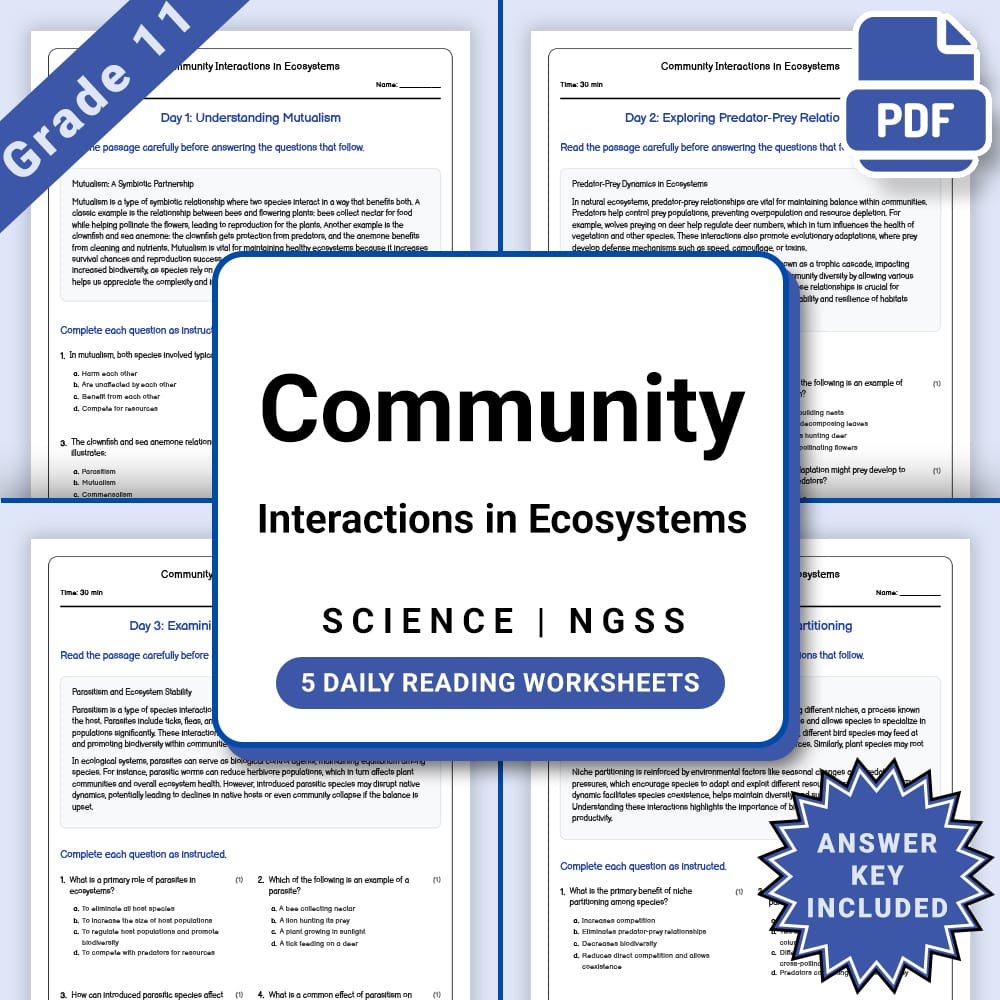
Grade 11 Science – Community Interactions Worksheet (PDF +Answer Key)
Created byCopper Leaf ClassroomLearning Objectives
- Identify examples of mutualism in ecosystems
- Understand the role of mutualism in community stability
- Analyze how mutualistic relationships benefit both species involved
Instant download
Grade 11 Science – Nutrient Cycling Worksheet (Ontario) PDF
Created byBright Mind ResourcesLearning Objectives
- Describe the key processes and pathways involved in the carbon and nitrogen biogeochemical cycles.
- Explain how human activities such as fossil fuel combustion and fertilization influence cycle rates and environmental outcomes.
- Identify the pools, fluxes, and residence times of nutrients within ecosystems.
Instant download
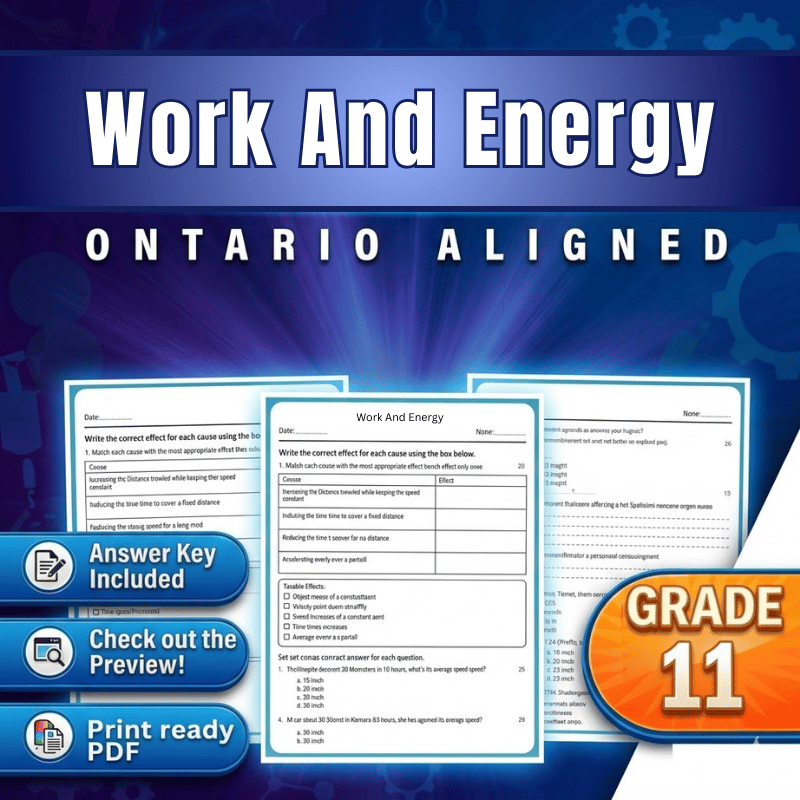
Grade 11 Science | Work and Energy Worksheet (Ontario Standards) (PDF)
Created byBright Mind ResourcesLearning Objectives
- Understand the formalism of work and energy in quantifying mechanical energy transfer.
- Identify and distinguish between kinetic, gravitational, and elastic potential energies.
- Explain the concept of power as the rate of energy transfer.
Instant download
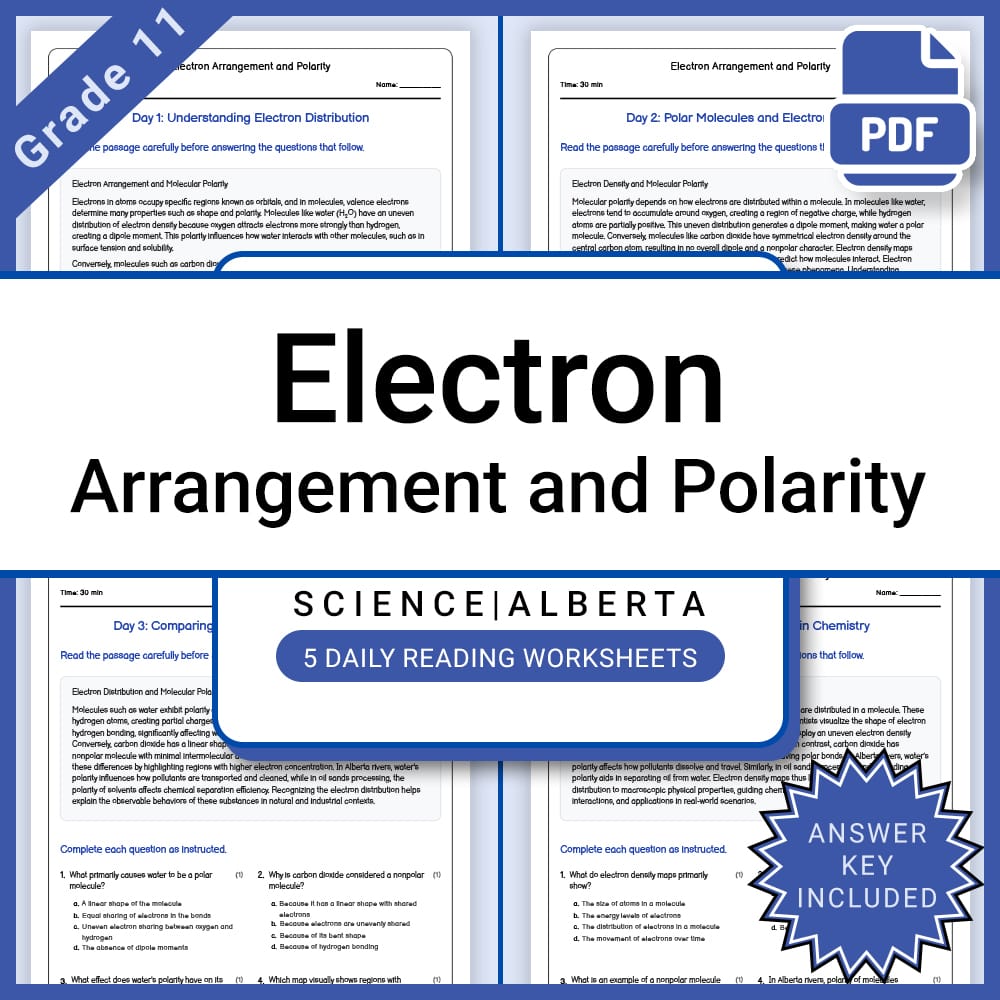
Grade 11 Science – Electron Arrangement | Daily Reading Worksheet + Answer Key
JCreated byJ.S SheetsLearning Objectives
- Understand how valence electrons are distributed in molecules
- Identify the relationship between electron distribution and molecular polarity
- Analyze examples like water and carbon dioxide to distinguish polar and nonpolar molecules
Also included in: Grade 11 Science Lesson Bundle | Molecular Structure and Bonding +1 more
Instant download
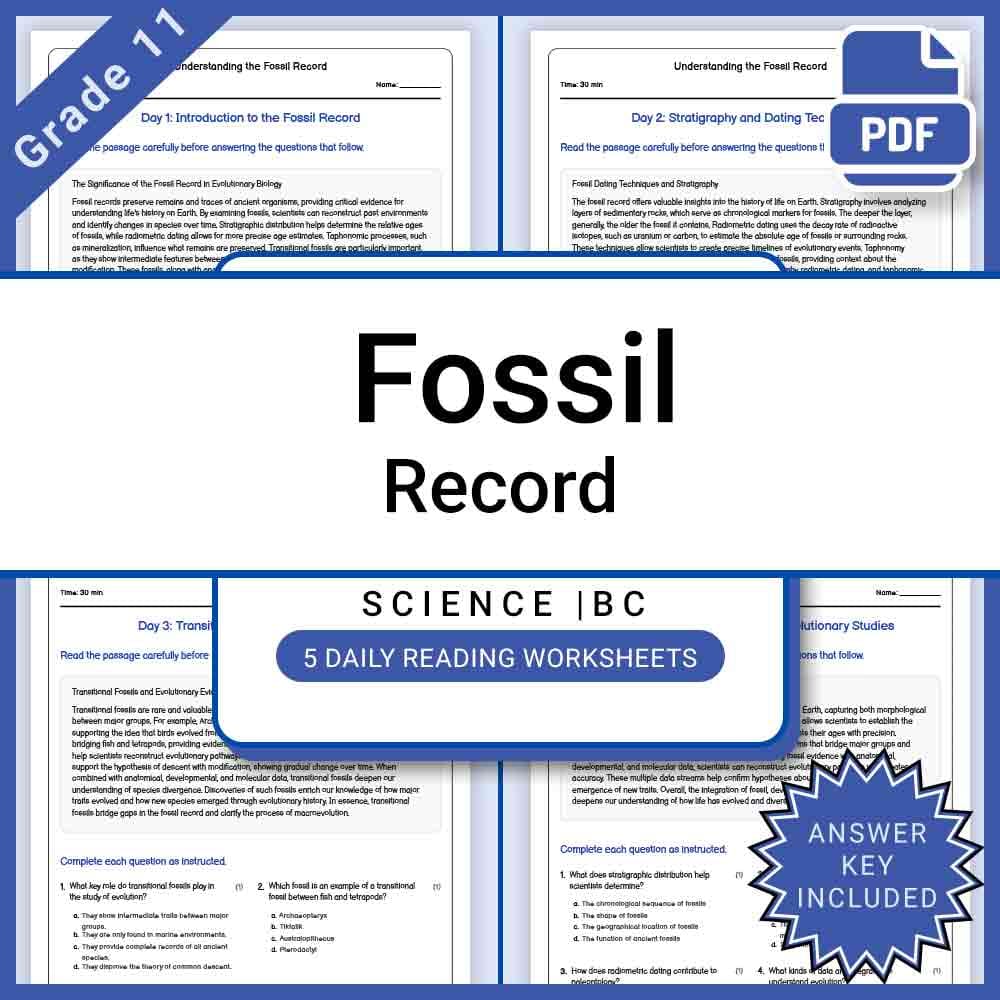
Grade 11 Science – Fossil Record Daily Reading Worksheet + Answer Key
JCreated byJ.S SheetsLearning Objectives
- Understand what the fossil record reveals about past life.
- Identify methods used to date fossils and interpret their significance.
- Recognize the importance of transitional fossils in evolutionary theory.
Also included in: Grade 11 Science Lesson Bundle BC Framework | STEM & Core Concepts +1 more
Instant download

Grade 11 Science — Worksheet MCQ Paper for Atomic Structure
 Created byThe Resource Hub
Learning Objectives
- Understand the subatomic particles and their roles in atomic structure.
- Explain the evidence supporting discrete energy levels through emission spectra and mass spectrometry.
- Describe quantum numbers, orbitals, and their significance in electron distribution.
Also included in: Grade 11 Science AP Worksheet Bundle: Mastering Key Concepts +1 more
Instant download
Grade 11 Science – Light Reactions Worksheet (Ontario) (PDF)
Created byBright Mind ResourcesLearning Objectives
- Describe photon capture by pigment–protein complexes in photosynthesis.
- Explain the sequence of electron transport in light-dependent reactions.
- Differentiate between noncyclic and cyclic electron flow in photosynthesis.
Instant download

Limiting Reagents Worksheet | Grade 11 Science Practice
 Created byPrism Point Learning
Learning Objectives
- Explain how to identify the limiting reactant using mole ratios from a balanced chemical equation
- Determine the theoretical yield and interpret it in terms of maximum possible product formation
- Connect limiting and excess reagents to industrial optimization and waste minimization
Instant download
Grade 11 Science | Sustainability Strategies Worksheet (Ontario, PDF)
Created byBright Mind ResourcesLearning Objectives
- Identify different frameworks and policy instruments for sustainable resource use and ecosystem management.
- Evaluate trade-offs among economic, social, and ecological objectives in sustainability planning.
- Understand indicators used for sustainability assessment such as ecological footprints, carrying capacity, and ecosystem service valuation.
Instant download
Grade 11 Science | Glycolysis Pathways Worksheet (Ontario) (PDF)
Created byBright Mind ResourcesLearning Objectives
- Describe the sequence of reactions involved in glycolysis from glucose to pyruvate.
- Identify key enzymes and regulation points within the glycolytic pathway.
- Explain the role of substrate-level phosphorylation and redox cofactors in energy production.
Instant download
Grade 11 Science – Energy Conservation Worksheet (Ontario) – Science 1 (PDF)
Created byBright Mind ResourcesLearning Objectives
- Understand the principles of energy conservation in closed systems.
- Identify different forms of energy and how they convert during motion.
- Explain the impact of non-conservative forces on energy within systems.
Instant download
Balancing Equations Worksheet for Grade 11 Science | Alberta Standard
 Created byCoral Reef Learning
Learning Objectives
- Explain the principle of conservation of atoms during chemical reactions
- Identify and classify different types of chemical reactions: synthesis, decomposition, single- and double-displacement, combustion
- Understand the role of stoichiometric coefficients as ratios that conserve elements
Instant download
About Grade 11 Science Worksheets
Browse 6,616 printable Grade 11 Science worksheets — ready-to-print PDFs with answer keys where available.
Each resource here is built by an independent educator and reviewed for quality. Worksheets print straight from PDF and suit classroom use, homework, or extra practice; most come with answer keys, and you can preview before purchasing.