
Grade 11 Science Worksheets
6,616 worksheets
Grade 11 Science – Understanding Mantle Convection | Daily Reading Worksheet
 Created byBright Mind Resources
Learning Objectives
- Describe the process of mantle convection within Earth's interior.
- Identify the role of mantle convection in driving plate tectonics.
- Explain how geophysical observations reveal mantle flow patterns.
Also included in: Geology Grade 11 Science Daily Reading Worksheets Lesson Bundle | BC +1 more
Instant download

Impulse and Momentum Worksheet | Grade 11 Science Practice
 Created byPrism Point Learning
Learning Objectives
- Explain linear momentum as a product of mass and velocity and describe how it changes
- Use the impulse–momentum relationship to predict how force and time affect motion
- Interpret real-world collisions and braking situations using force-time ideas
Also included in: Grade 11 Science Lesson Bundle — Work, Energy & Motion (BC)
Instant download

Grade 11 Science | Genetic Systems - Daily Reading Comprehension
 Created byCoral Reef Learning
Learning Objectives
- Understand the structural differences between prokaryotic and eukaryotic genomes
- Learn how these differences influence gene expression and regulation
- Recognize key features such as operons, chromatin, introns, and plasmids
Instant download

Population Dynamics Worksheet | NGSS Grade 11 Science MCQ Assessment
 Created byCedar Grove Learning
Learning Objectives
- Understand the factors influencing population size changes, including birth, death, immigration, and emigration.
- Identify different population growth models such as exponential and logistic growth.
- Analyze the impact of predator-prey interactions and environmental disturbances on populations.
Instant download
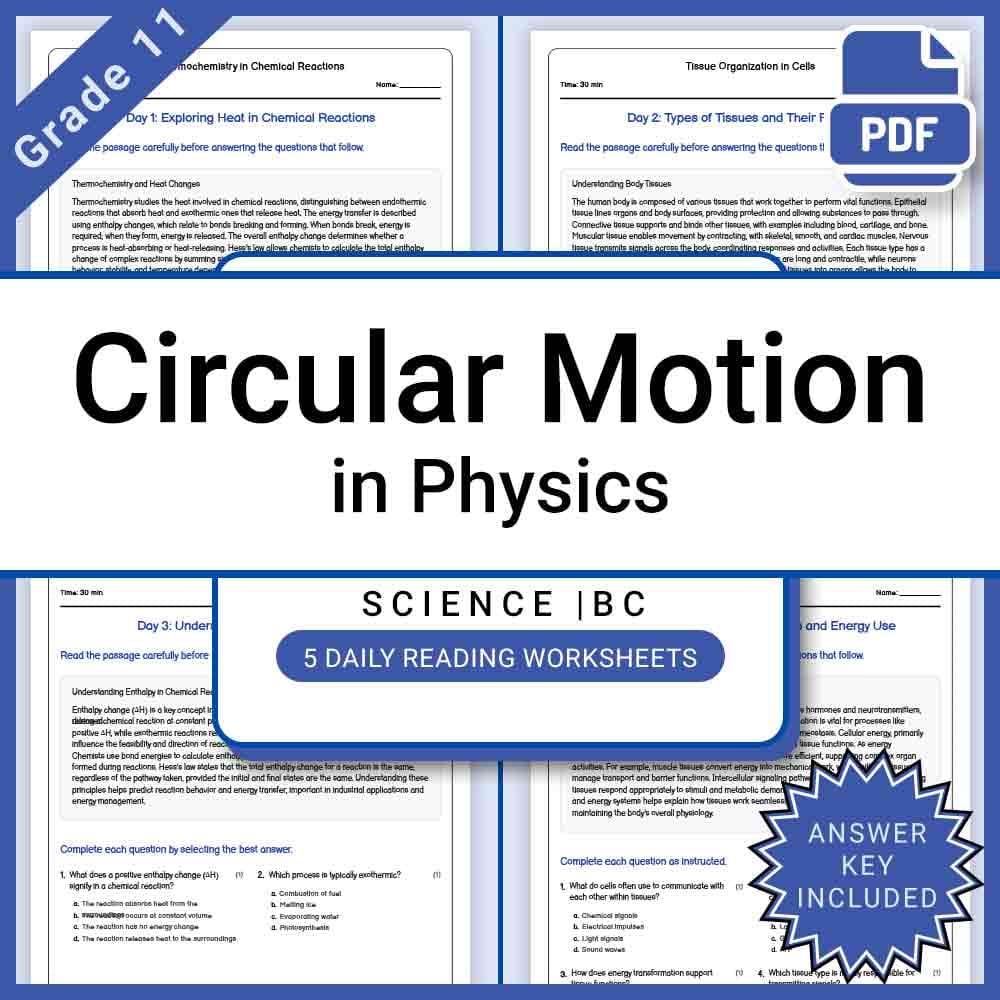
Grade 11 Science – Circular Motion Daily Reading Worksheet + Answer Key
JCreated byJ.S SheetsLearning Objectives
- Define uniform circular motion and identify the involved forces.
- Explain the concept of centripetal acceleration and its formula.
- Analyze how forces like tension, gravity, and friction contribute to circular motion.
Also included in: Grade 11 Science Lesson Bundle BC Framework | Physics and Energy Concepts +1 more
Instant download

Genetic Code Worksheet | Grade 11 AP Biology Practice Activities
Created byPrism Point LearningLearning Objectives
- Explain how DNA base-pairing and nucleic acid structure support faithful information storage and inheritance.
- Describe how transcription and translation transfer genetic information using codons, reading frames, and genetic code rules.
- Analyze how mutations and recombination can change gene expression and phenotype.
Also included in: AP Biology Systems Integration Lesson Bundle: Grade 11 Science | AP
Instant download
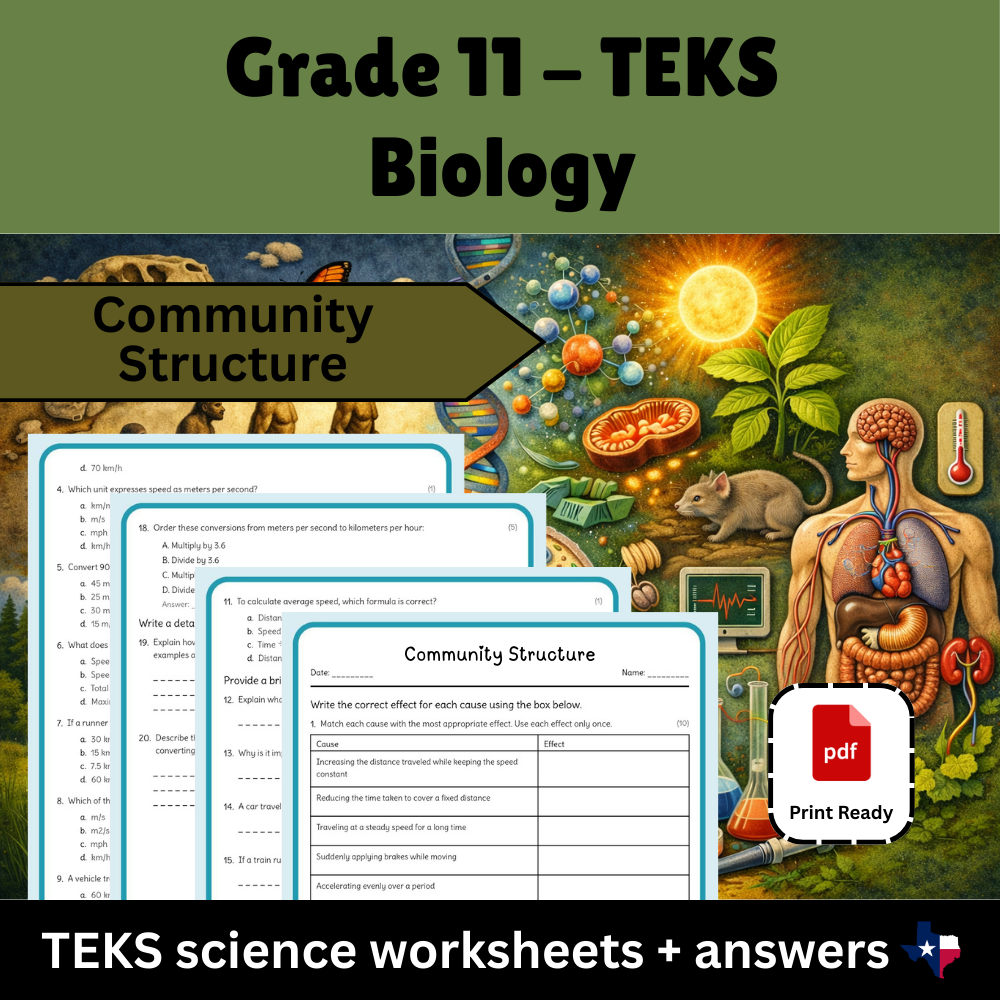
Grade 11 Science | Community Structure Worksheet (TEKS Aligned) – PDF
Created byBright Mind ResourcesLearning Objectives
- Understand the components that define community structure, including species composition and spatial arrangement.
- Describe the impact of biodiversity metrics and keystone species on ecosystem stability.
- Explain successional stages following disturbance and their effects on community trajectories.
Also included in: Grade 11 Science - Ecosystem & Biogeochemical Cycles Unit Worksheet Pack - TEKS +2 more
Instant download
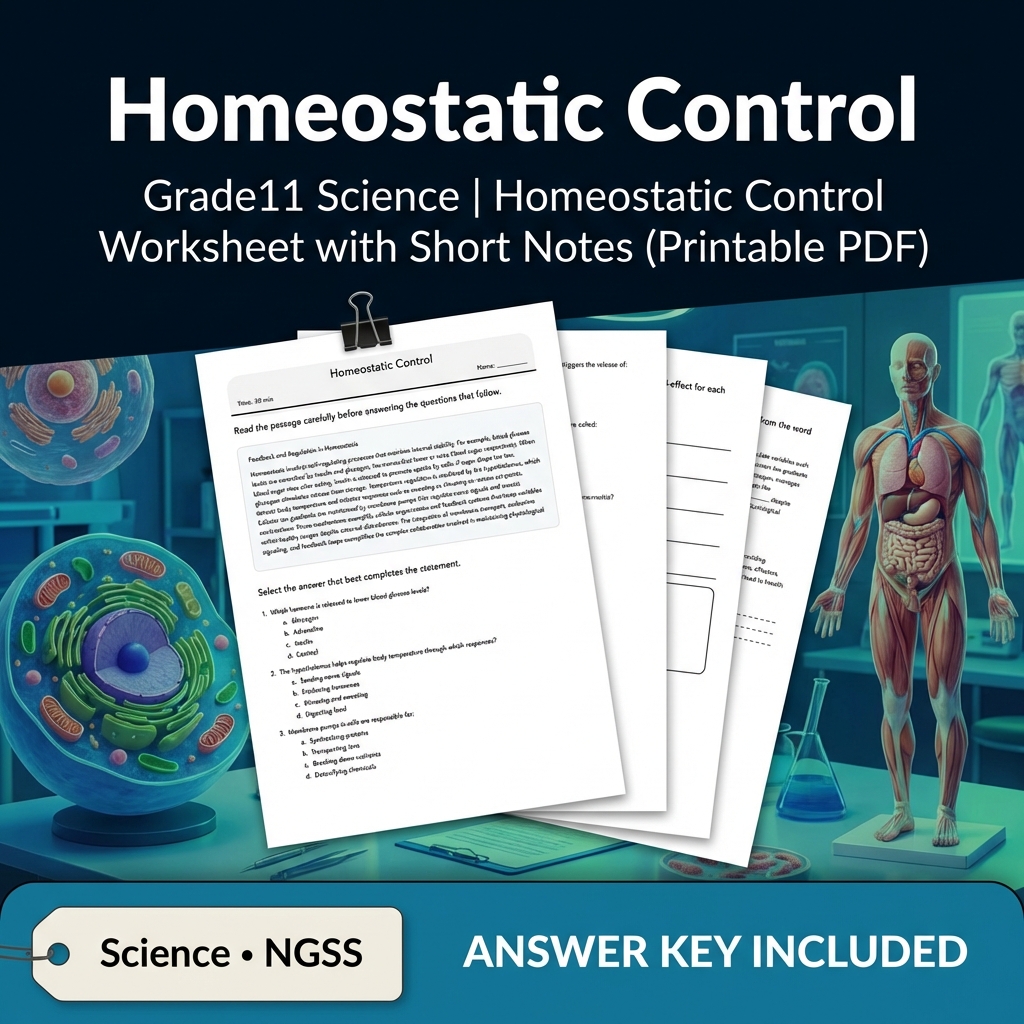
Grade 11 Science | Homeostatic Control Worksheet with Short Notes (PDF)
 Created byMeadowlark Worksheets
Learning Objectives
- Understand the mechanisms of feedback loops that regulate internal variables.
- Identify examples of homeostasis in the human body, such as blood glucose and temperature regulation.
- Explain the roles of cellular components and endocrine systems in maintaining constancy.
Also included in: Grade 11 Science NGSS | From Molecules to Organisms: Structures & Processes +1 more
Instant download

Polyprotic Systems Assessment | Alberta Standards Grade 11 Science
Created byPrism Point LearningLearning Objectives
- Understand the sequential dissociation steps of polyprotic acids and their dissociation constants.
- Analyze buffer regions and equivalence points in titrations involving polyprotic acids like carbonate and phosphate systems.
- Perform calculations of stepwise dissociation, cumulative acidity, and interpret titration curves considering multiple dissociation constants.
Also included in: Grade 11 Acids, Bases & pH Chemistry Science Lesson Bundle | Alberta +1 more
Instant download

Grade 11 Population Genetics Worksheet | AP Practice & PDF
 Created byClear Sky Classroom
Learning Objectives
- Explain how allele frequencies change over generations due to selection, genetic drift, migration, and mutation.
- Use Hardy–Weinberg equilibrium to model a population when evolutionary forces are not acting.
- Calculate genotype frequencies from allele frequencies and interpret what those frequencies imply about genetic variation and fitness.
Also included in: Grade 11 Systems Integration and Genetics Science Lesson Bundle: AP +1 more
Instant download
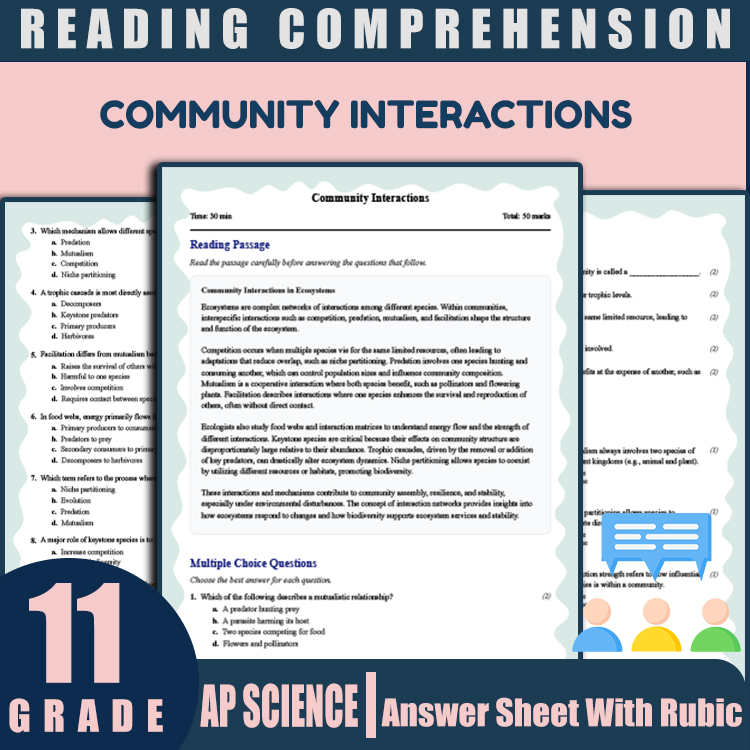
Grade 11 Science Reading Worksheet | Community Interactions
JCreated byJ.S SheetsLearning Objectives
- Understand the different types of interspecific interactions within ecological communities.
- Explain the roles of keystone species, trophic cascades, and niche partitioning in community assembly and resilience.
- Analyze food web diagrams and interaction matrices to interpret energy flow and interaction strength.
Also included in: Grade 11 Science Unit Bundle – Cellular Systems, Genetics Ecosystems Worksheets +1 more
Instant download
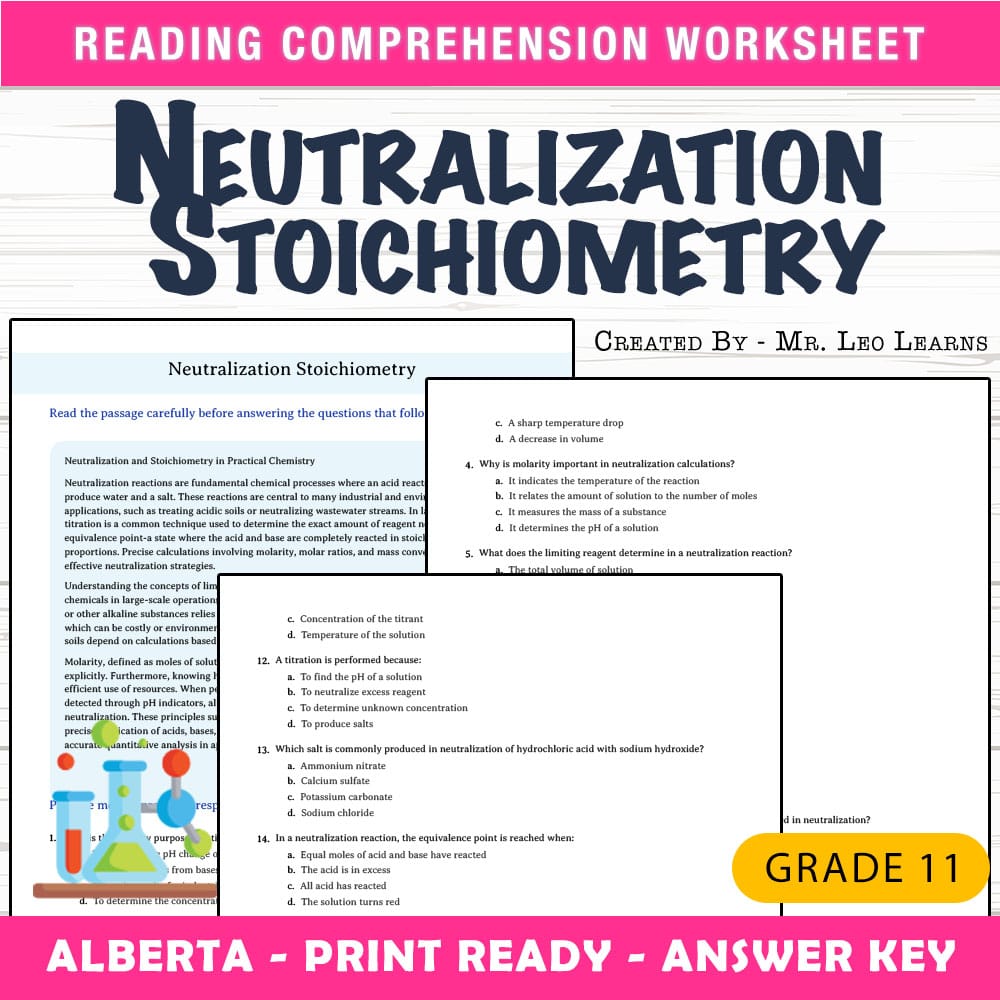
Grade 11 Science — Neutralization Stoichiometry Worksheet for Mastery
 Created byThe Resource Hub
Learning Objectives
- Understand the fundamental concepts of neutralization reactions and their applications.
- Apply stoichiometric calculations to determine reagent amounts in neutralization scenarios.
- Analyze the roles of molarity, limiting reagent, and titration equivalence in practical chemistry processes.
Also included in: Grade 11 Science Acids Bases and pH Worksheets Bundle | Alberta +1 more
Instant download
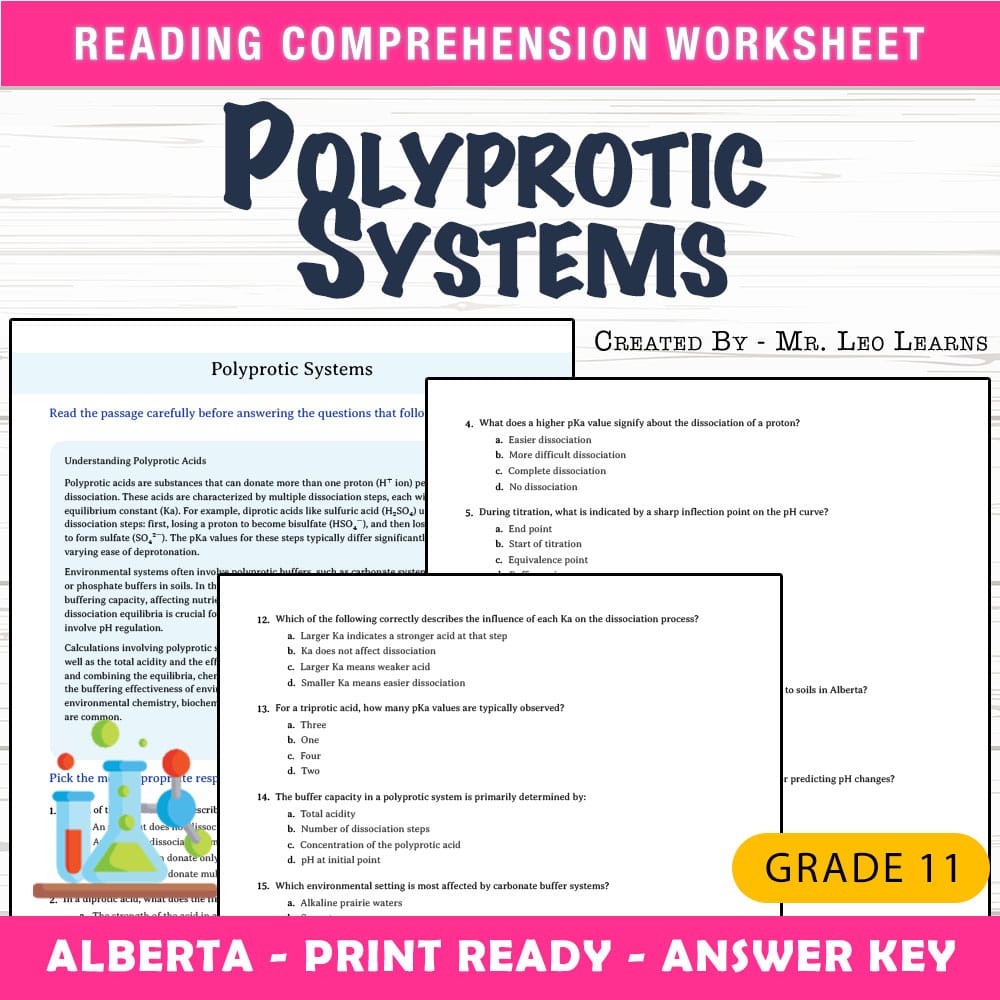
Grade 11 Science — Worksheet MCQ Paper for Mastering Polyprotic Systems
Created byThe Resource HubLearning Objectives
- Understand the concept of polyprotic acids and their dissociation steps.
- Identify the significance of successive dissociation constants in titration curves.
- Apply calculations related to stepwise dissociation, cumulative acidity, and pH changes.
Also included in: Grade 11 Science Acids Bases and pH Worksheets Bundle | Alberta +1 more
Instant download
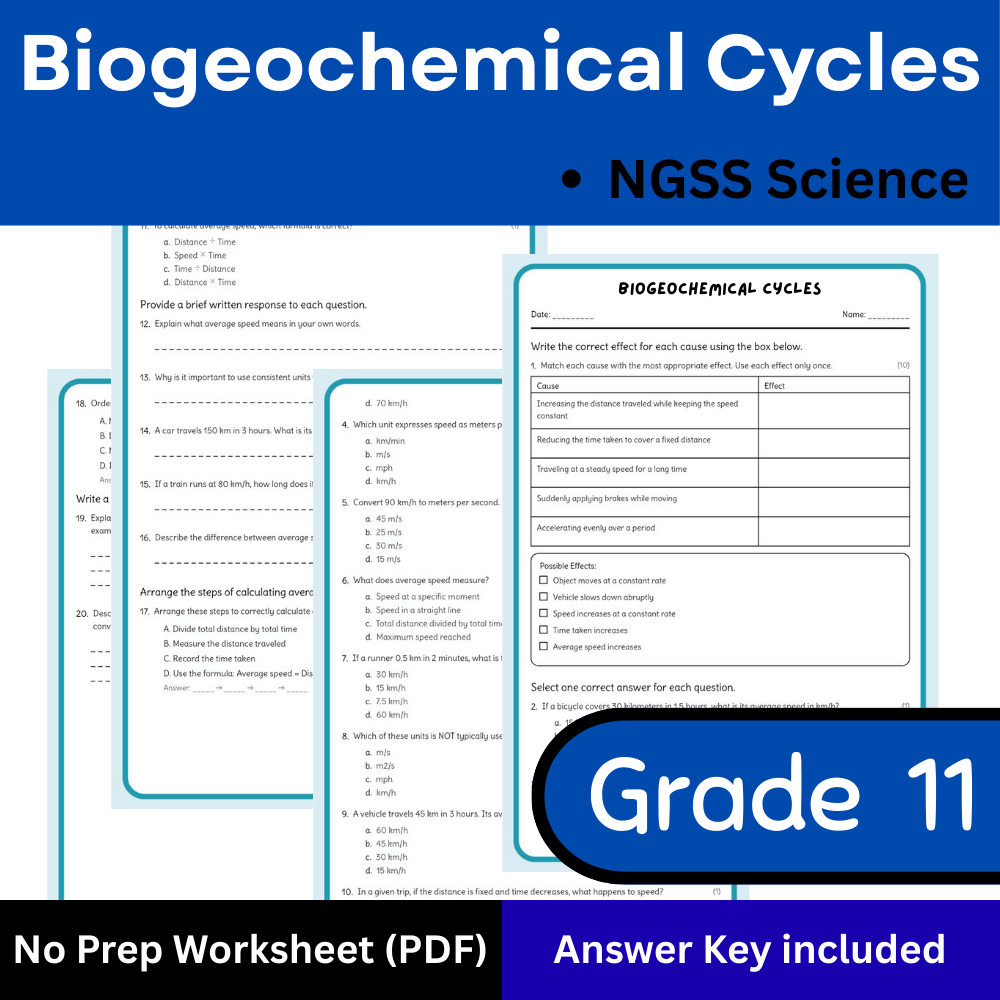
Grade 11 Science | Biogeochemical Cycles Worksheet (Answer Key) – NGSS Aligned
Created byBright Mind ResourcesLearning Objectives
- Understand the pathways and reservoirs involved in carbon, nitrogen, and phosphorus cycles.
- Identify various fluxes and residence times within biogeochemical cycles.
- Explain the impact of natural and anthropogenic perturbations on nutrient cycles and atmospheric composition.
Instant download

Grade 11 Science | Speciation Mechanisms - Daily Reading Comprehension
Created byCoral Reef LearningLearning Objectives
- Understand the concept of speciation and its importance in evolution.
- Identify different mechanisms that lead to reproductive isolation.
- Explain how genetic divergence occurs during speciation.
Instant download
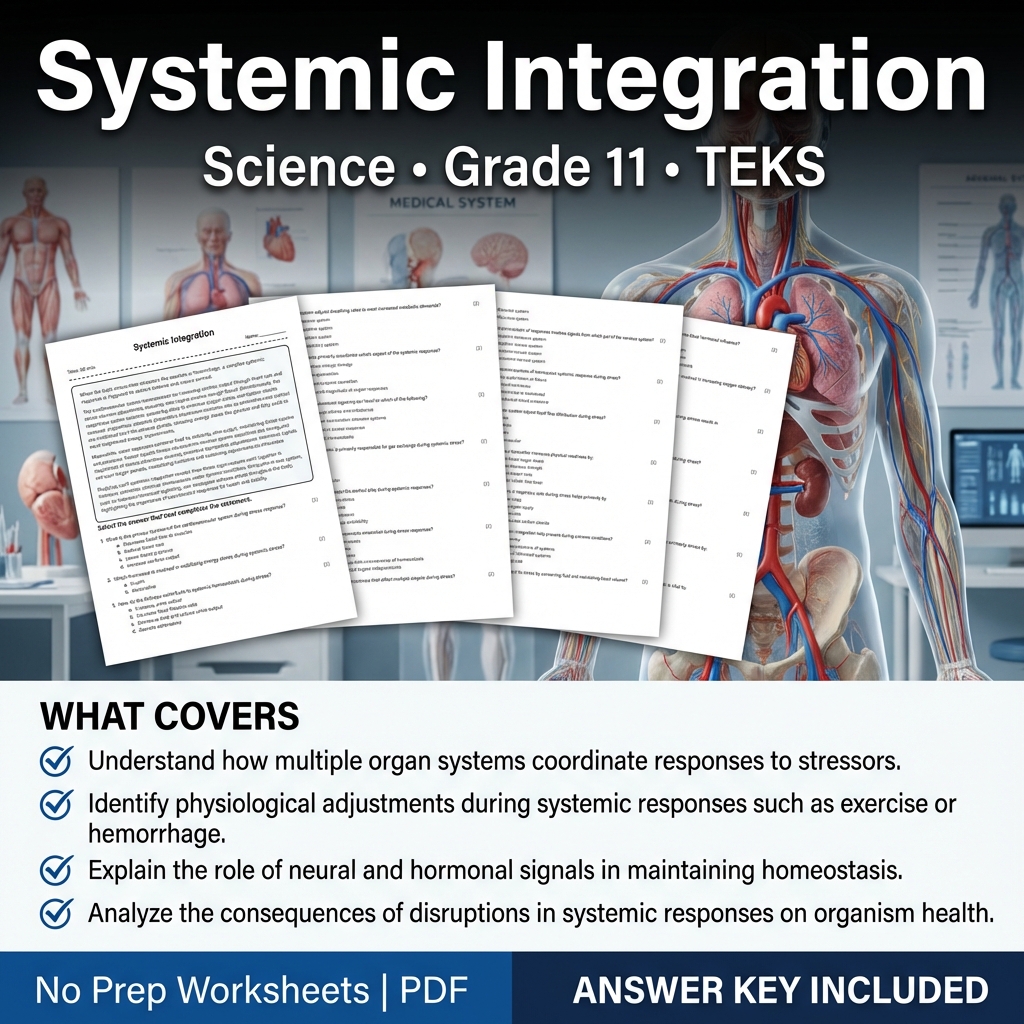
Systemic Integration Worksheet for Grade 11 Science | TEKS-Aligned Practice
Created byCoral Reef LearningLearning Objectives
- Understand how multiple organ systems coordinate responses to stressors.
- Identify physiological adjustments during systemic responses such as exercise or hemorrhage.
- Explain the role of neural and hormonal signals in maintaining homeostasis.
Instant download

Mantle Convection Worksheet | Grade 11 Science Activities
Created byPrism Point LearningLearning Objectives
- Explain how mantle convection transfers heat through slow, thermal-driven circulation in Earth’s mantle.
- Describe how upwelling, downwelling, and mantle plumes relate to plate motion and surface tectonics.
- Use geophysical evidence (seismic tomography and gravity anomalies) to interpret mantle flow patterns.
Instant download
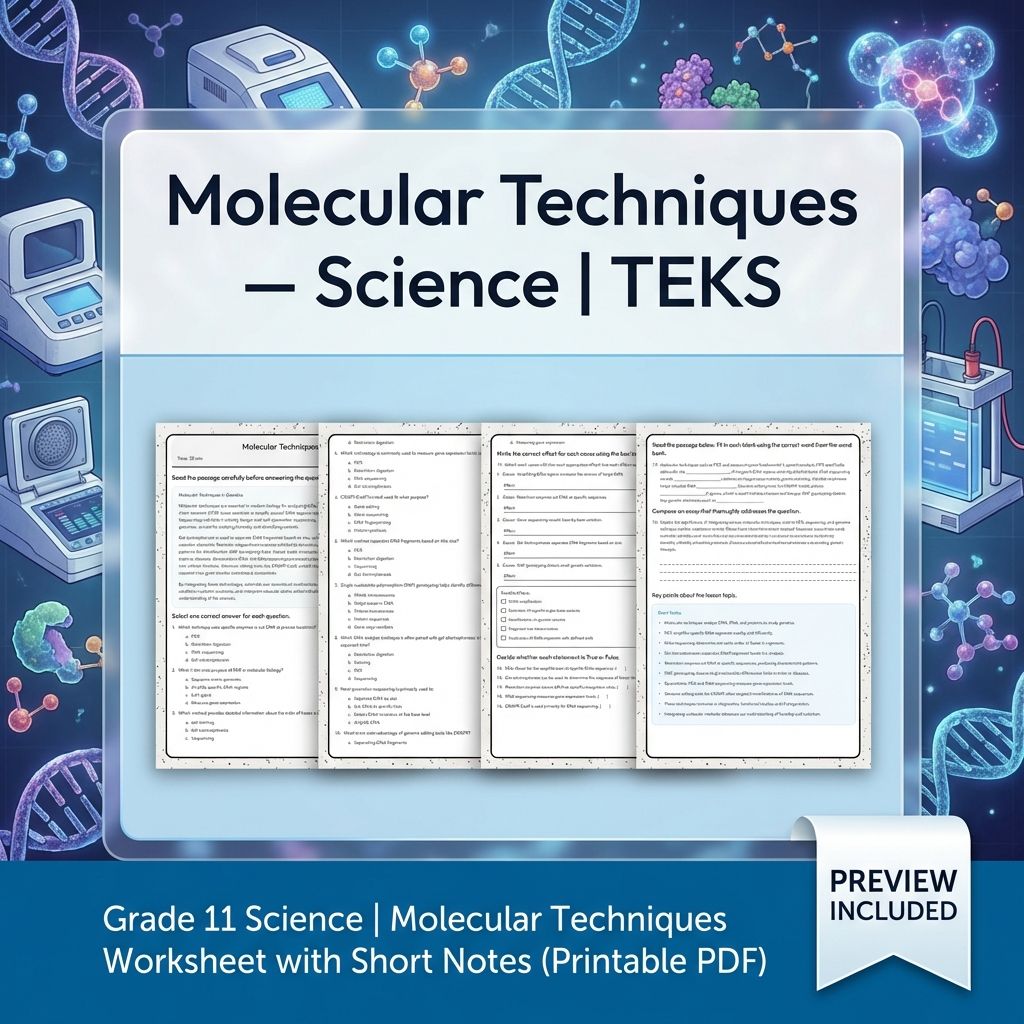
Grade 11 Science | Molecular Techniques Worksheet with Short Notes (PDF)
Created byMeadowlark WorksheetsLearning Objectives
- Understand the purpose and applications of different molecular techniques.
- Identify methods used for gene amplification, sequencing, and analysis.
- Explain how gel electrophoresis and restriction digestion are used in DNA analysis.
Instant download
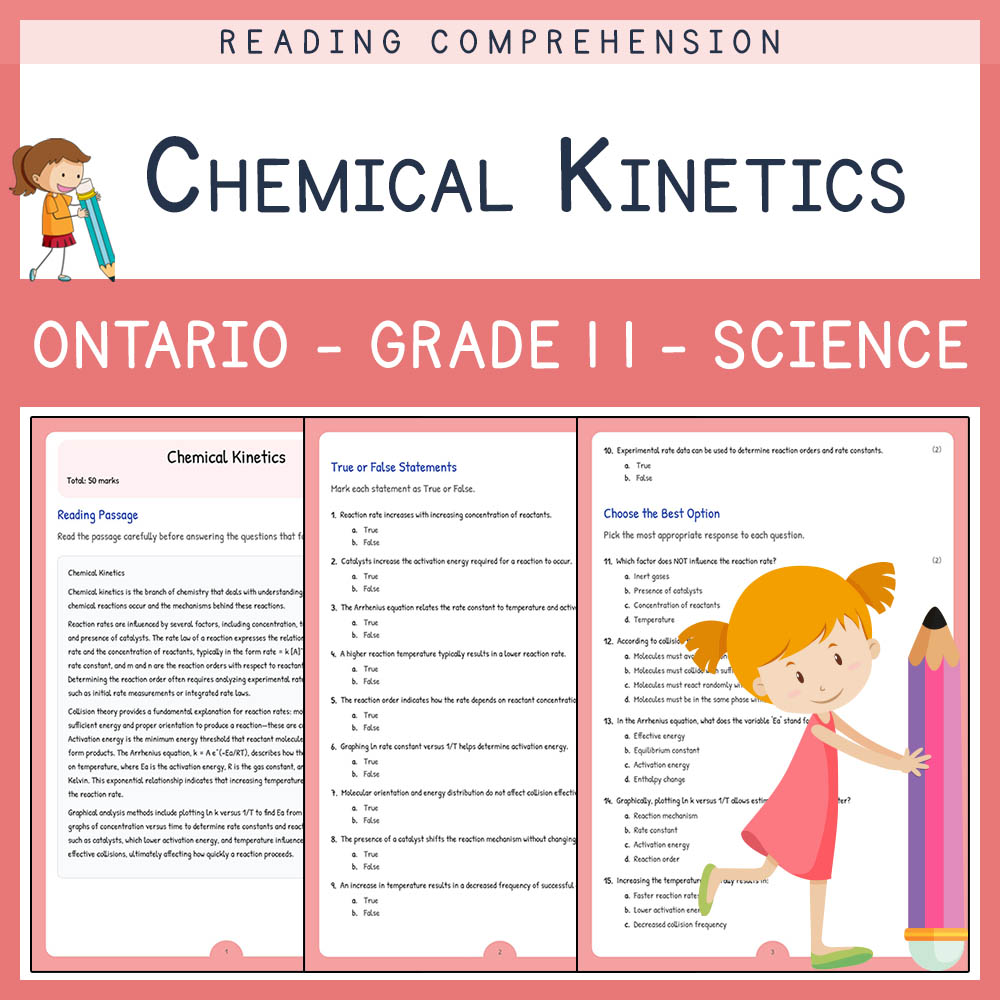
Grade 11 Science | Chemical Kinetics Worksheet Elena | Ontario Standard
 Created byLumora Learning
Learning Objectives
- Understand the factors affecting reaction rates and how to interpret experimental data.
- Explain the collision theory and the role of activation energy in chemical reactions.
- Apply the Arrhenius equation to describe the temperature dependence of reaction rates.
Also included in: Grade 11 Science | Chemistry Lesson Bundle | Ontario Framework
Instant download
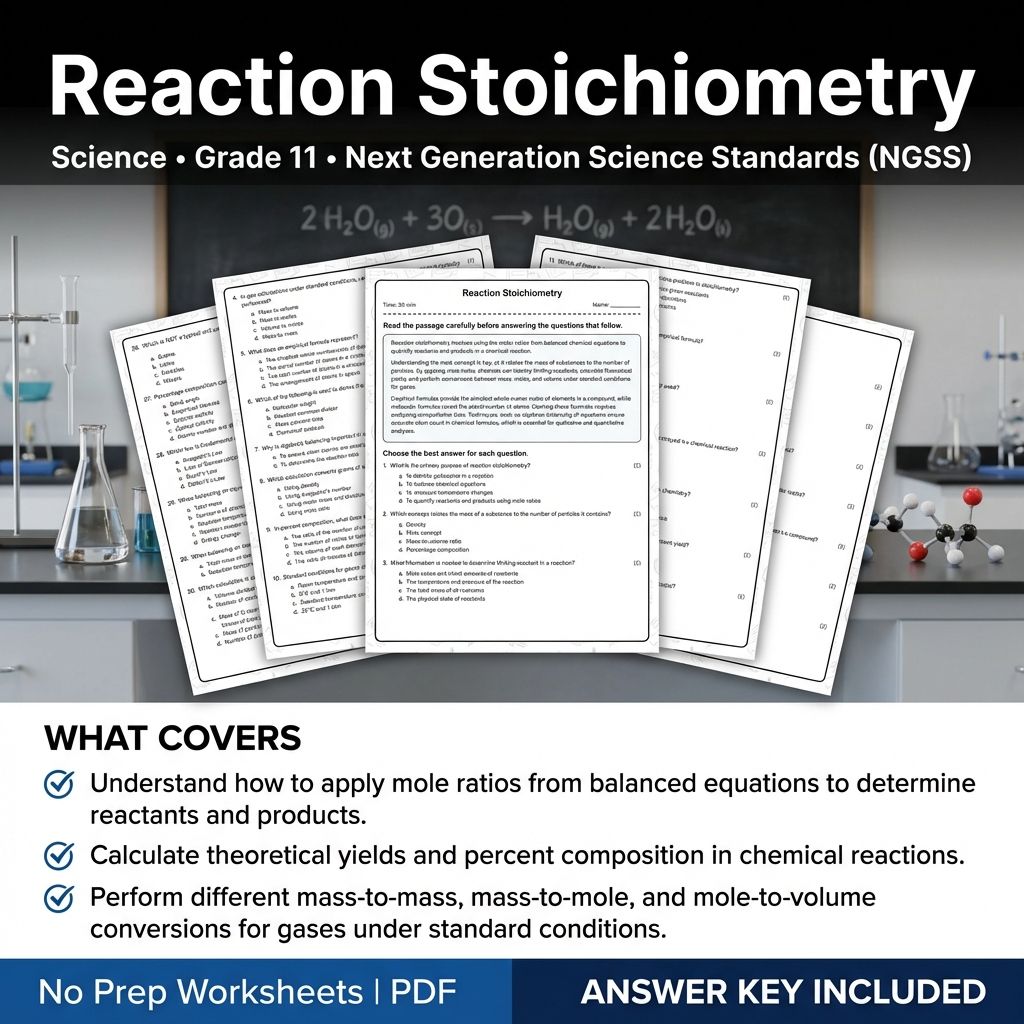
11th Grade Science | Reaction Stoichiometry Worksheet & Answer Key (PDF)
Created byCoral Reef LearningLearning Objectives
- Understand how to apply mole ratios from balanced equations to determine reactants and products.
- Calculate theoretical yields and percent composition in chemical reactions.
- Perform different mass-to-mass, mass-to-mole, and mole-to-volume conversions for gases under standard conditions.
Also included in: Grade 11 Science Unit Bundle – Chemical Reactions & Periodic Trends Worksheets +1 more
Instant download
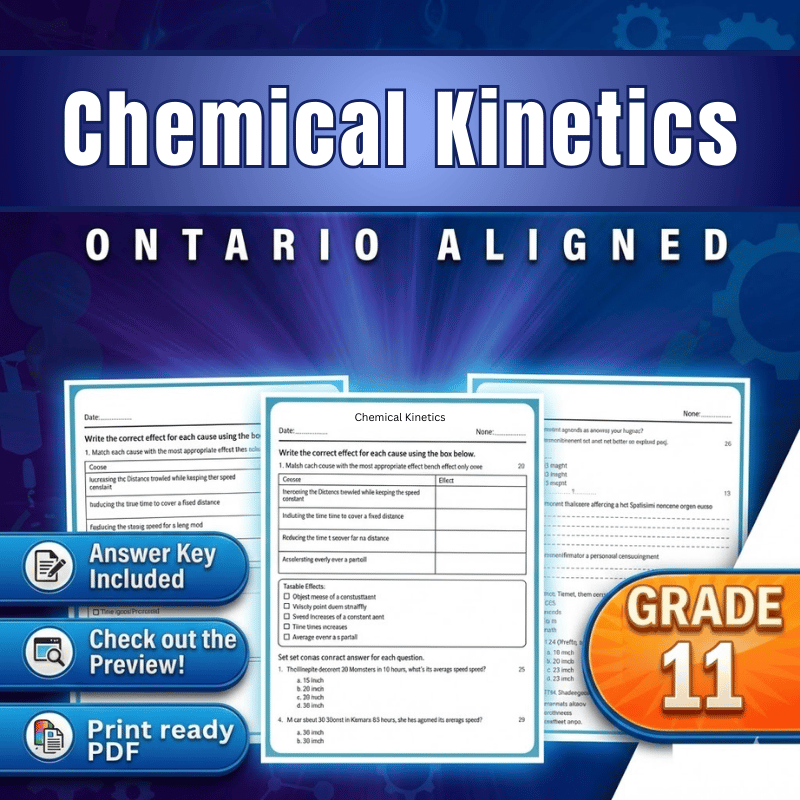
Grade 11 Science Worksheets | Chemical Kinetics (PDF) – Ontario Standards
Created byBright Mind ResourcesLearning Objectives
- Understand the principles of rate laws and reaction order determination.
- Interpret experimental rate data and graphical methods for extracting rate constants.
- Explain collision theory and activation energy concepts in relation to reaction rates.
Instant download
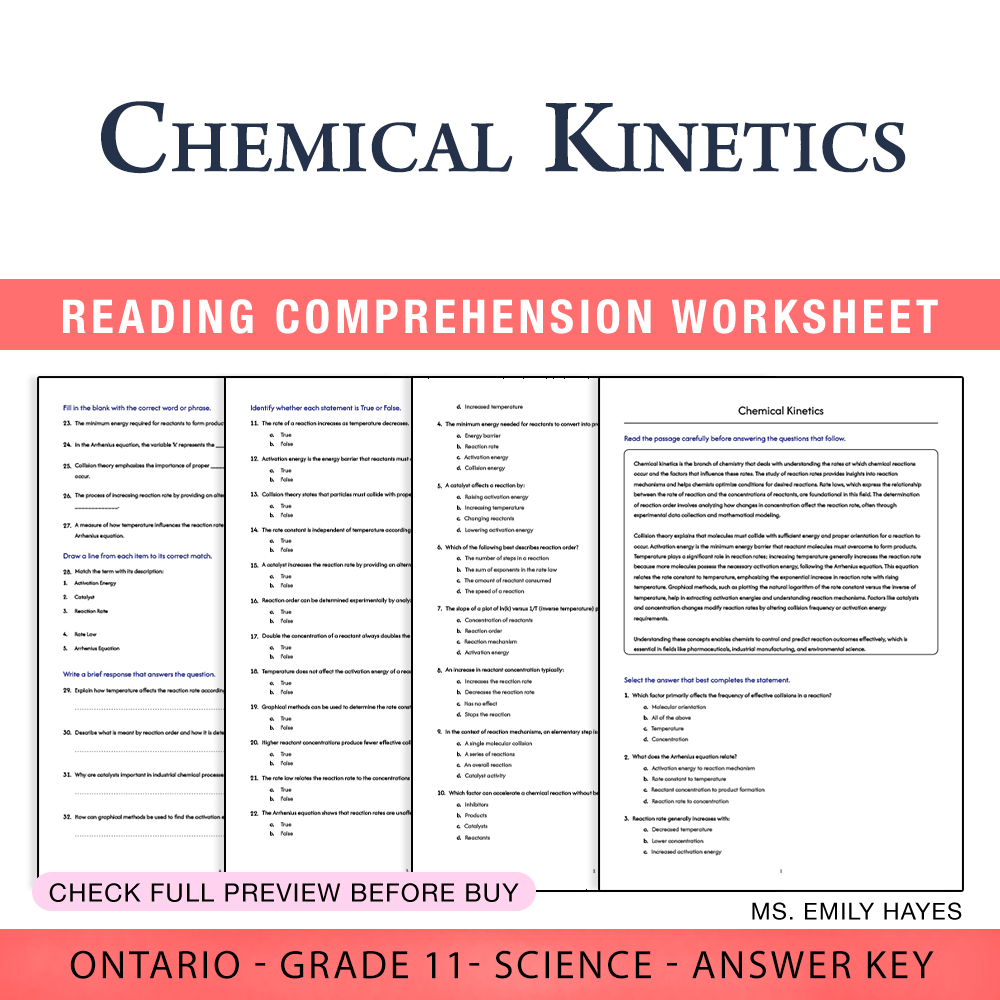
Grade 11 Science | Chemical Kinetics Worksheet (PDF + Answer Key)
 Created byCopper Leaf Classroom
Learning Objectives
- Understand the principles of reaction rates and how they are characterized.
- Interpret experimental data to determine reaction orders and rate constants.
- Explain collision theory, activation energy, and their roles in reaction mechanisms.
Instant download
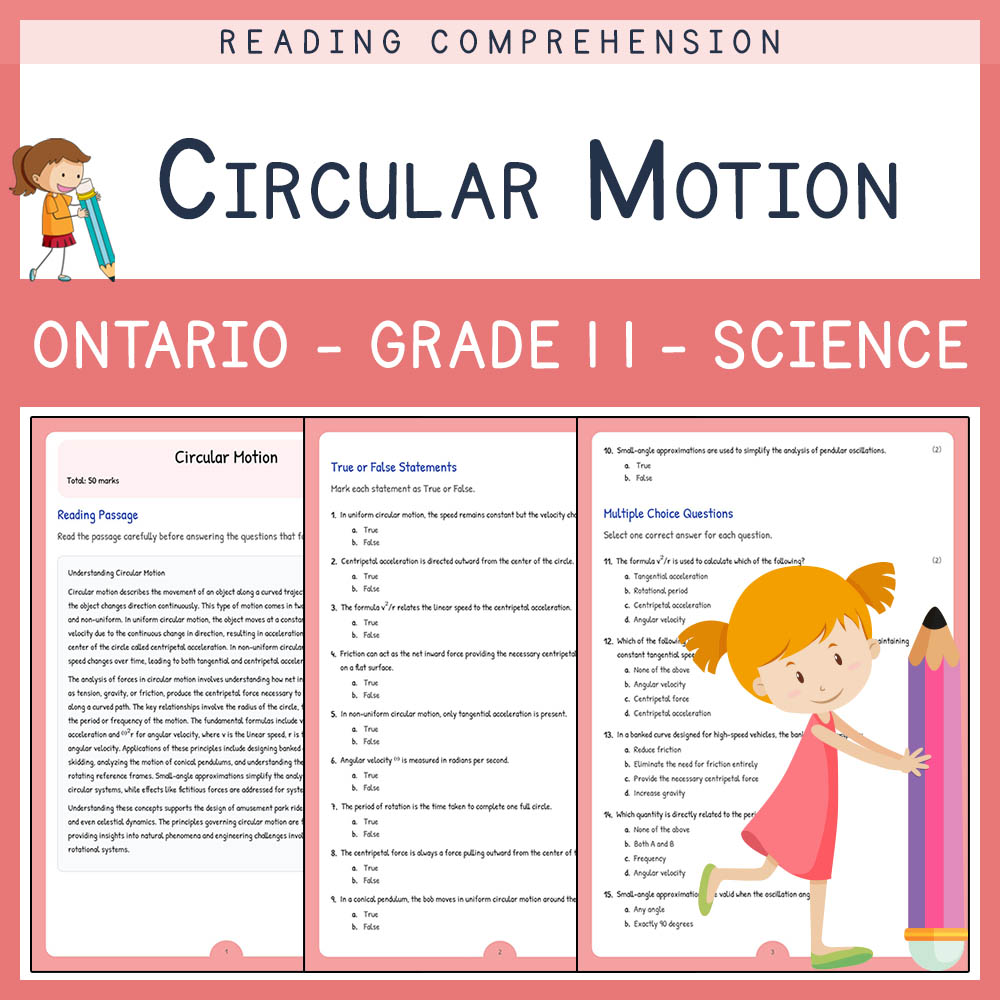
Grade 11 Science Assessment | Circular Motion Worksheet Elena | Ontario
Created byLumora LearningLearning Objectives
- Understand the concepts of uniform and non-uniform circular motion.
- Analyze the relationships among speed, angular velocity, radius, and centripetal force.
- Explain centripetal acceleration and tangential acceleration in curved paths.
Also included in: Grade 11 Science | Physics Lesson Bundle | Ontario Standard
Instant download
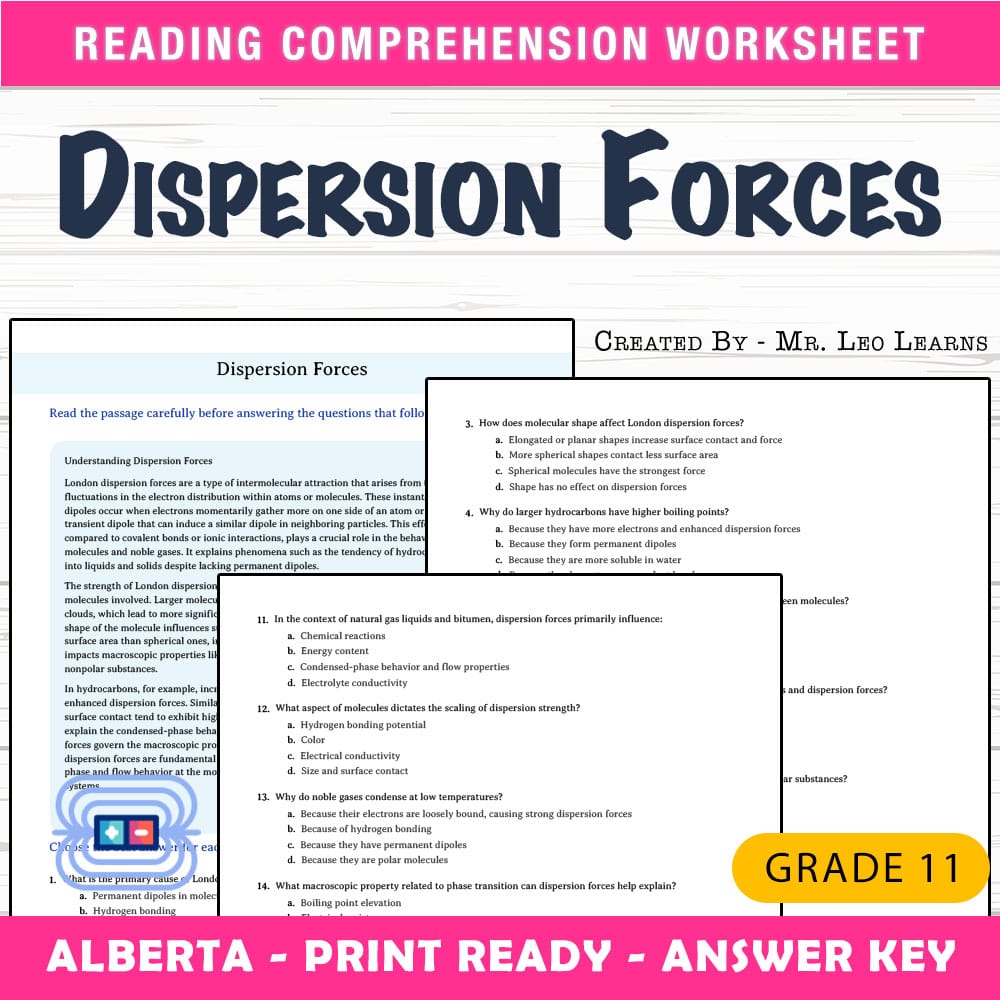
Grade 11 Science — Worksheet MCQ Paper for Mastering Dispersion Forces
Created byThe Resource HubLearning Objectives
- Explain the concept of London dispersion forces and their role in intermolecular interactions.
- Describe how size and shape influence the strength of dispersion forces.
- Understand the relationship between molar mass, surface contact, and macroscopic properties such as melting points and viscosities of nonpolar substances.
Also included in: Grade 11 Science Matter and Chemical Bonding Lesson Bundle | Alberta +1 more
Instant download
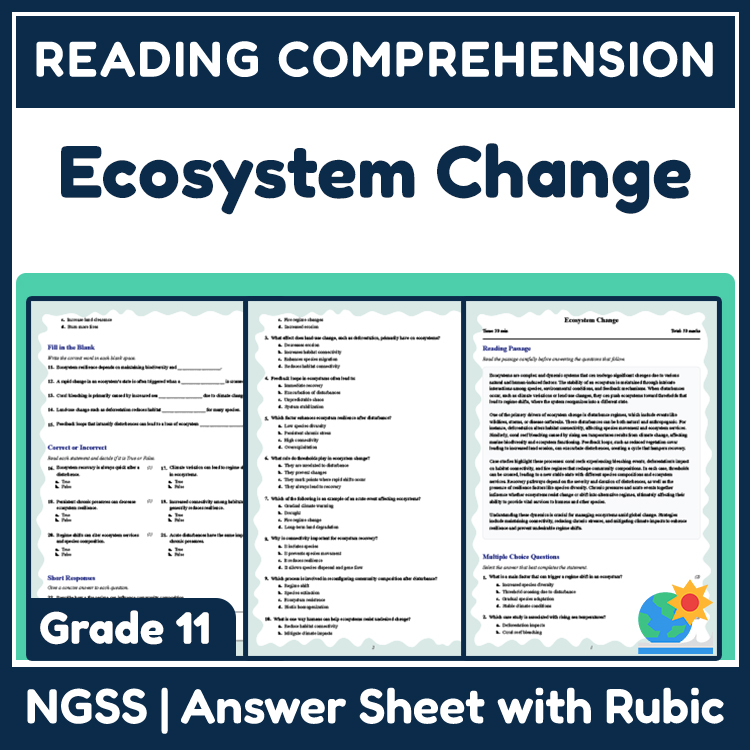
11th Grade Science | Ecosystem Change Reading Worksheet (PDF + Rubric)
JCreated byJ.S SheetsLearning Objectives
- Understand the key drivers that cause ecosystem stability and change.
- Identify real-world case studies of ecosystem responses to disturbances.
- Analyze how thresholds, feedback loops, and recovery pathways influence ecosystem resilience.
Also included in: Grade 11 Science | Ecosystems & Population Dynamics Worksheet Bundle
Instant download

Empirical Formulas and Percent Composition Worksheets Grade 11 Chemistry
 Created bythe curious pencil
Learning Objectives
- Define empirical formulas as simplest whole-number atomic ratios.
- Convert elemental masses and percentages into mole amounts.
- Calculate empirical formulas by simplifying elemental mole ratios.
Instant download

Gas Stoichiometry Worksheets | Gas Laws and Volume Calculations Grade 11
Created bythe curious pencilLearning Objectives
- Identify mole ratios from balanced equations involving gaseous substances.
- Apply the ideal gas law to relate pressure, volume, moles, and temperature.
- Explain how temperature and pressure affect gas volume.
Instant download

Conservation of Mass Worksheets: Chemical Stoichiometry Grade 11
Created bythe curious pencilLearning Objectives
- Explain conservation of mass during chemical reactions
- Compare atom counts in reactants and products
- Calculate expected mass in a closed reaction system
Instant download
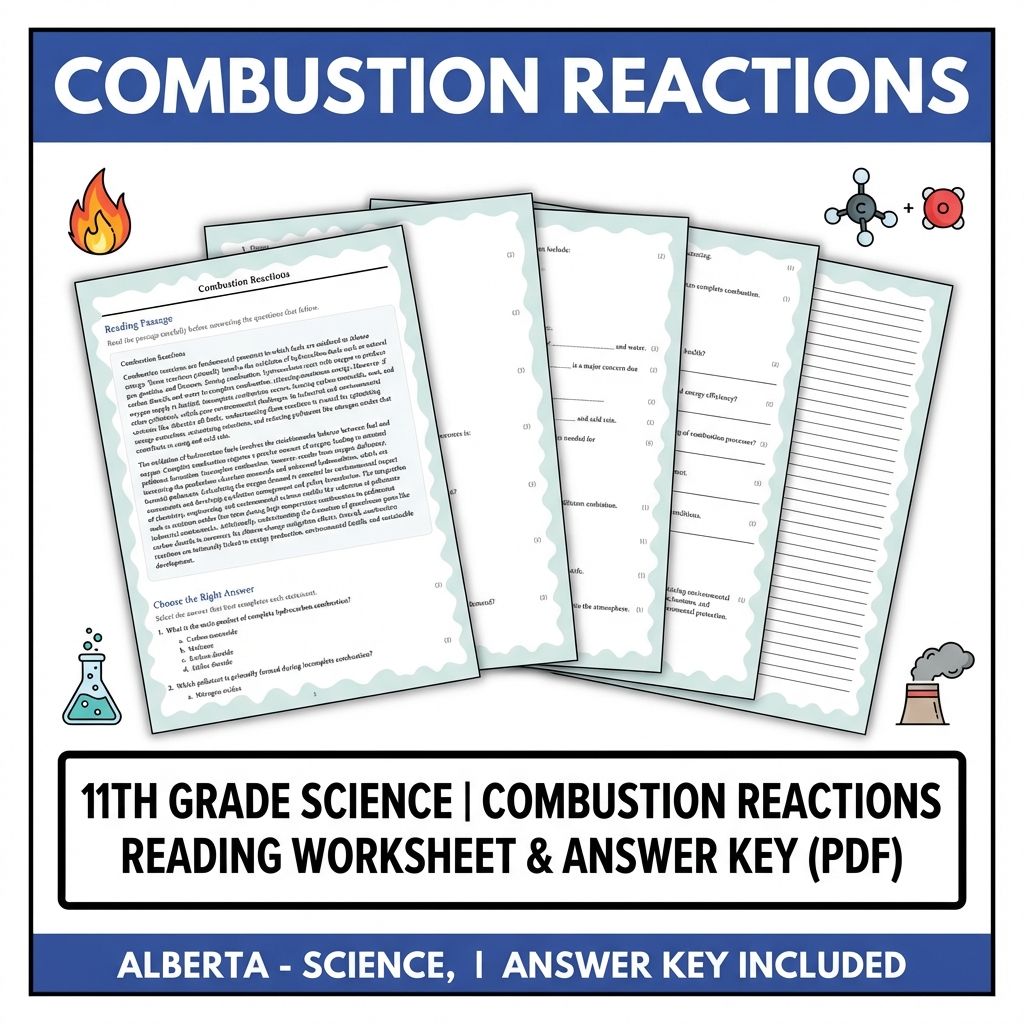
11th Grade Science | Combustion Reactions Reading Worksheet & Answer Key (PDF)
JCreated byJ.S SheetsLearning Objectives
- Explain the chemical process of combustion and oxidation of fuels.
- Describe stoichiometric requirements for complete and incomplete combustion.
- Identify pollutants formed during combustion and understand their environmental impact.
Instant download
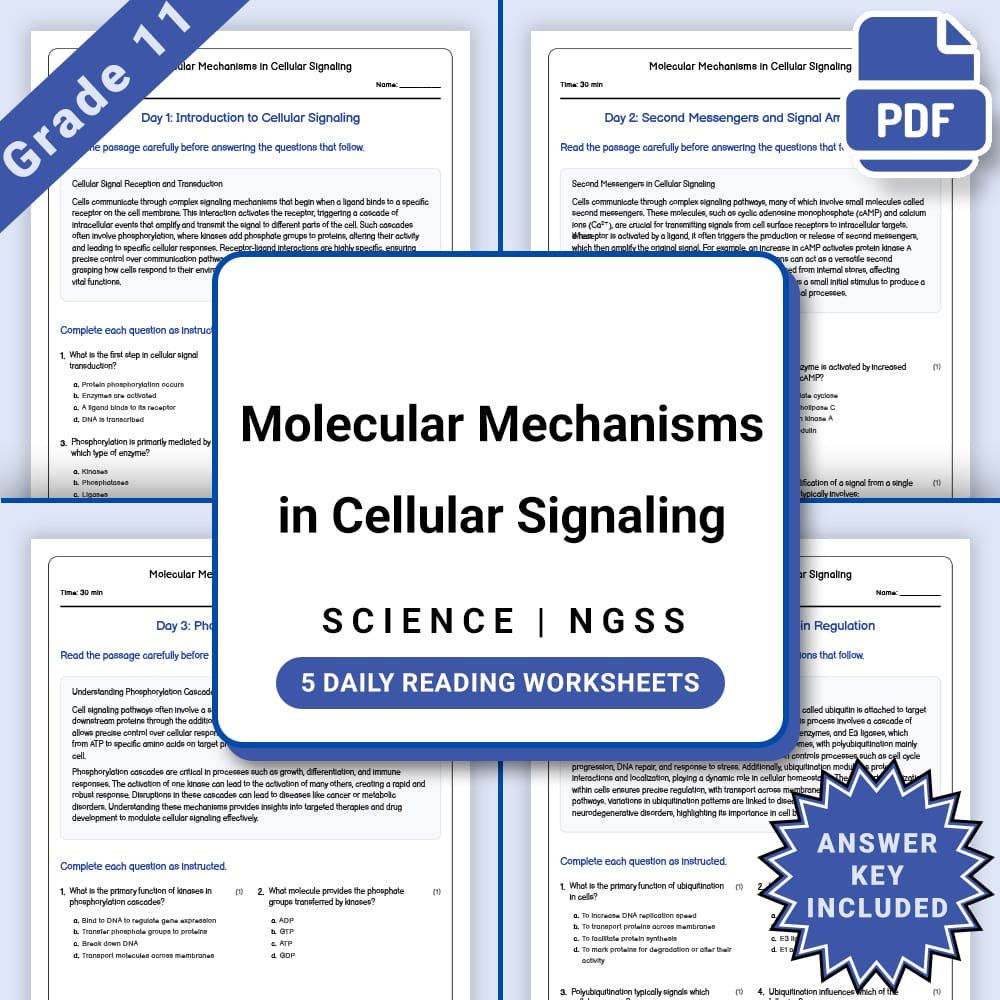
Grade 11 Science – Cellular Signaling Worksheet (PDF +Answer Key)
Created byCopper Leaf ClassroomLearning Objectives
- Describe how receptor-ligand interactions initiate signal transduction pathways.
- Explain the role of phosphorylation cascades, ubiquitination, and gene regulatory motifs in cellular responses.
- Understand the importance of intracellular compartmentalization and membrane transport in molecular signaling.
Instant download
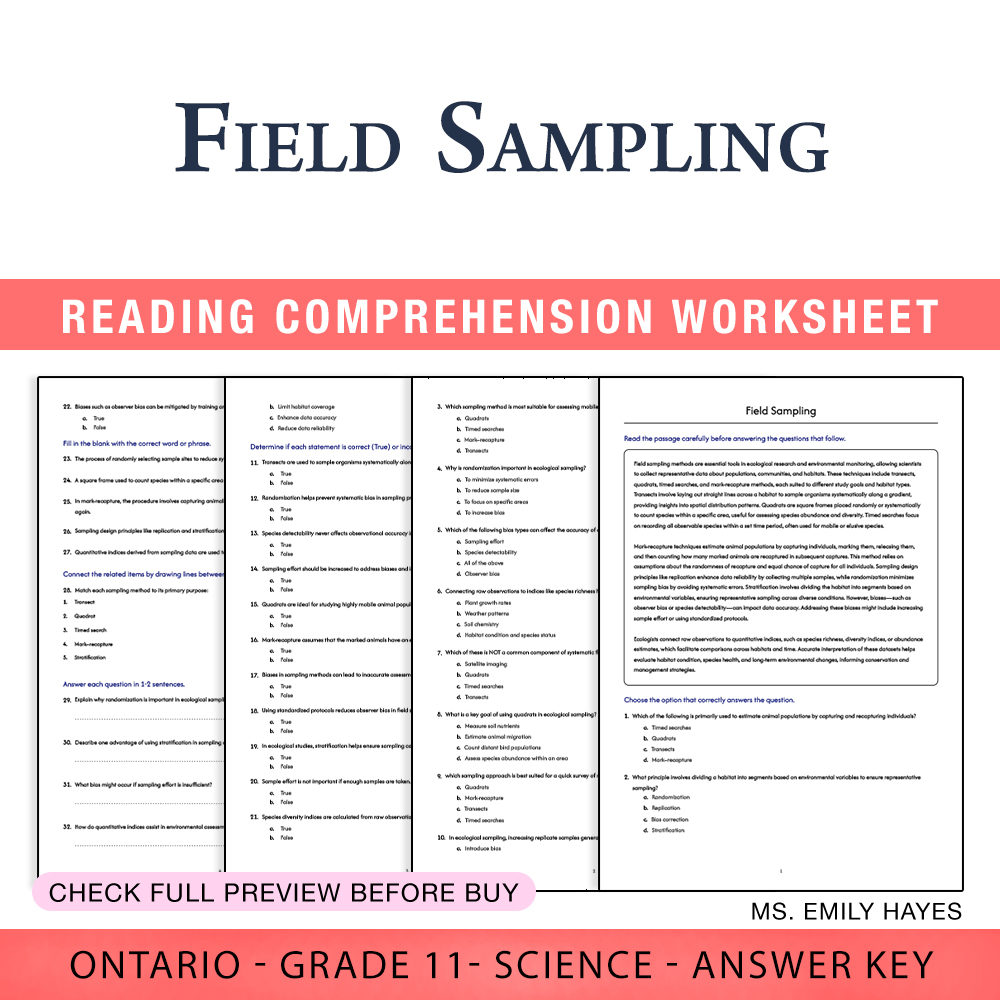
Grade 11 Science | Field Sampling Techniques Worksheet (PDF + Answer Key)
Created byCopper Leaf ClassroomLearning Objectives
- Understand various systematic approaches to field sampling such as transects, quadrats, and mark-recapture techniques.
- Identify principles of sampling design including replication, randomization, and stratification.
- Evaluate potential biases, detectability issues, and sample effort requirements in environmental sampling.
Instant download
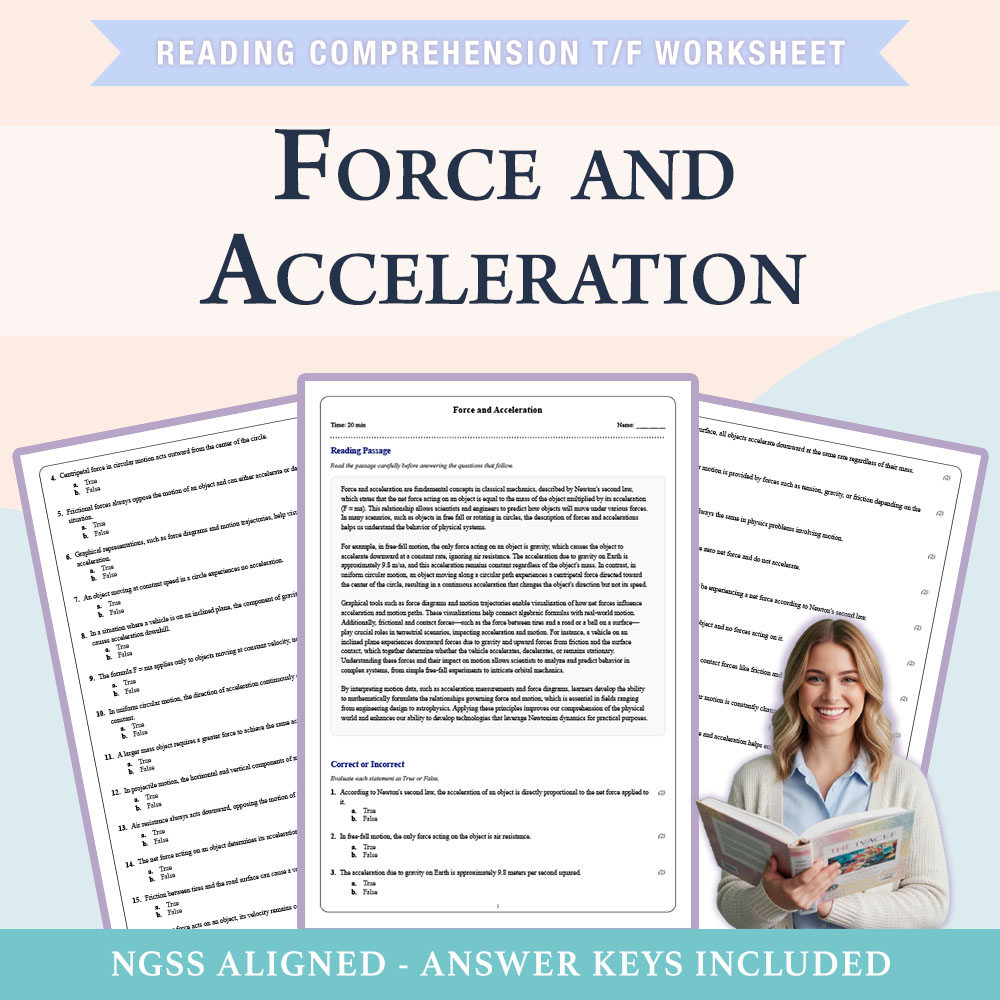
11th Grade Science | Force and Acceleration Worksheet (PDF + Answer Key)
Created byCopper Leaf ClassroomLearning Objectives
- Understand Newton's second law and the relationship between net force, mass, and acceleration.
- Analyze free-fall motion and uniform circular motion scenarios to interpret force vectors and resulting acceleration.
- Apply graphical and algebraic representations to connect force, motion trajectories, and acceleration.
Also included in: Grade 11 Science | Force & Energy Unit Worksheet Pack (PDF + Answer Key) +1 more
Instant download
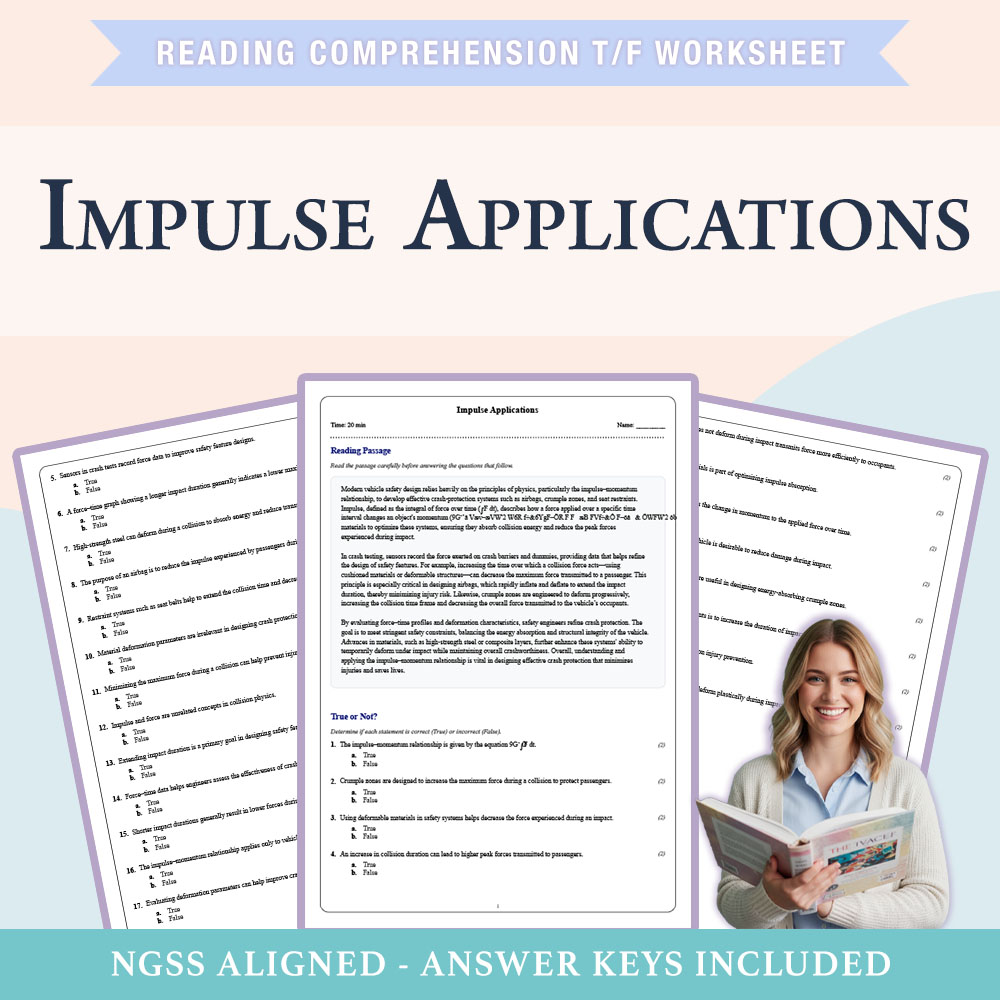
Grade 11 Science | Impulse Applications Worksheet (PDF + Answer Key)
Created byCopper Leaf ClassroomLearning Objectives
- Understand the impulse–momentum relationship and how it applies to crash-protection systems.
- Evaluate force–time data and material deformation parameters to assess safety performance.
- Analyze and interpret information to determine the correctness of statements about impulse and collision safety.
Also included in: Grade 11 Science | Force & Energy Unit Worksheet Pack (PDF + Answer Key) +1 more
Instant download
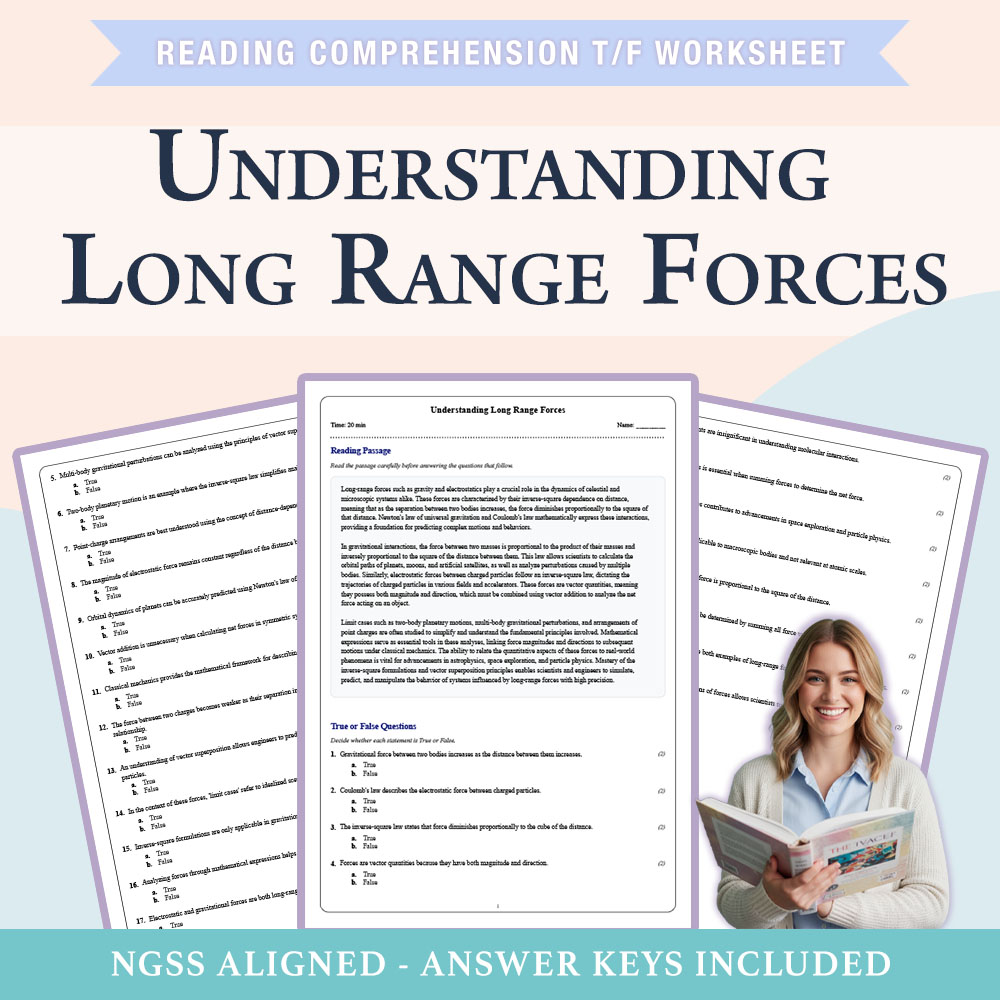
11th Grade Science |Understanding Long Range Forces Worksheet (PDF + Answer Key)
Created byCopper Leaf ClassroomLearning Objectives
- Explain the mathematical principles behind gravitational and electrostatic forces.
- Apply inverse-square law formulations to real-world problems involving long-range interactions.
- Analyze vector addition of forces to predict the motion of bodies under classical mechanics.
Also included in: Grade 11 Science | Force & Energy Unit Worksheet Pack (PDF + Answer Key) +1 more
Instant download
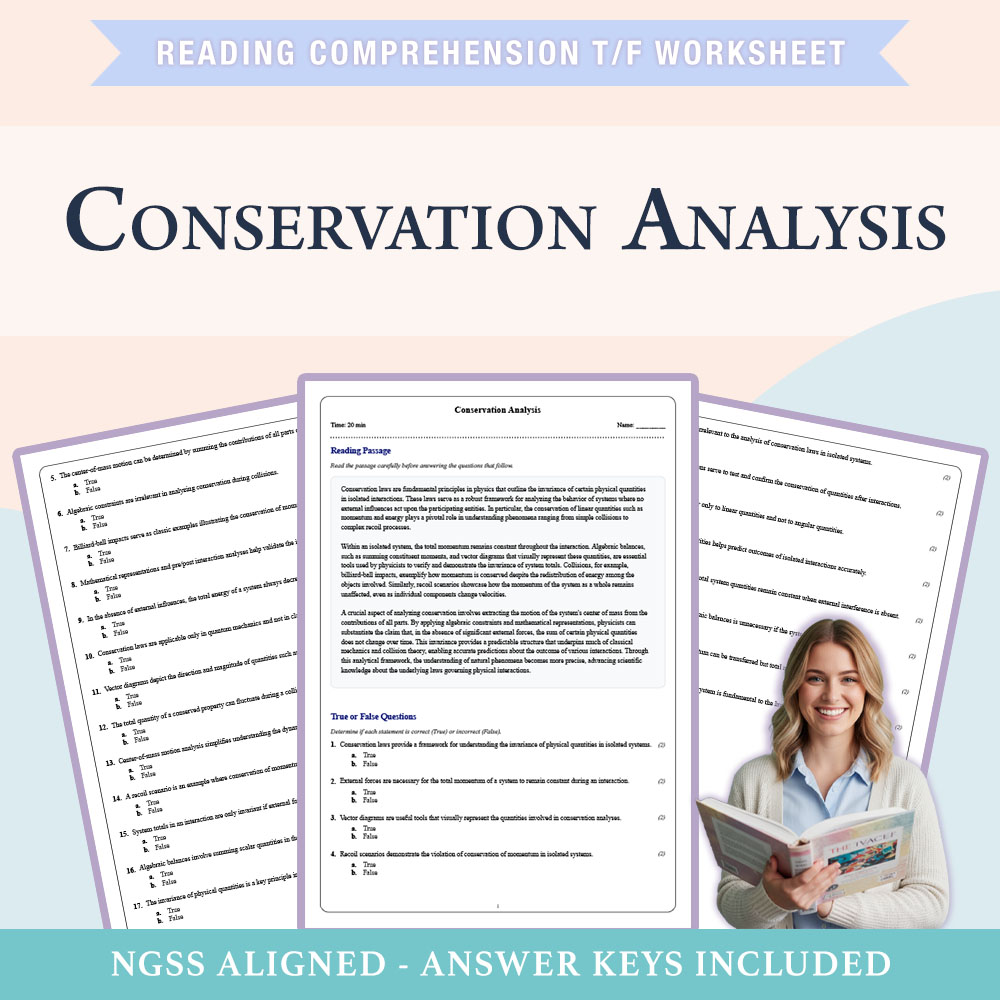
11th Grade Science | Conservation Analysis Worksheet (PDF + Answer Key)
Created byCopper Leaf ClassroomLearning Objectives
- Understand the principles of conservation laws in physical interactions.
- Recognize how algebraic balances and vector diagrams are used in analyzing conservation.
- Explain the significance of system invariance during isolated interactions.
Also included in: Grade 11 Science | Force & Energy Unit Worksheet Pack (PDF + Answer Key) +1 more
Instant download
Grade 11 Science | Force and Acceleration Worksheet with Short Notes (PDF)
Created byMeadowlark WorksheetsLearning Objectives
- Explain Newton's second law and how net force affects acceleration.
- Apply the formula F = ma to different physical scenarios.
- Analyze free-fall motion and identify acceleration due to gravity.
Also included in: Grade 11 Science NGSS Motion and Stability Forces & Interactions Unit Bundle +1 more
Instant download
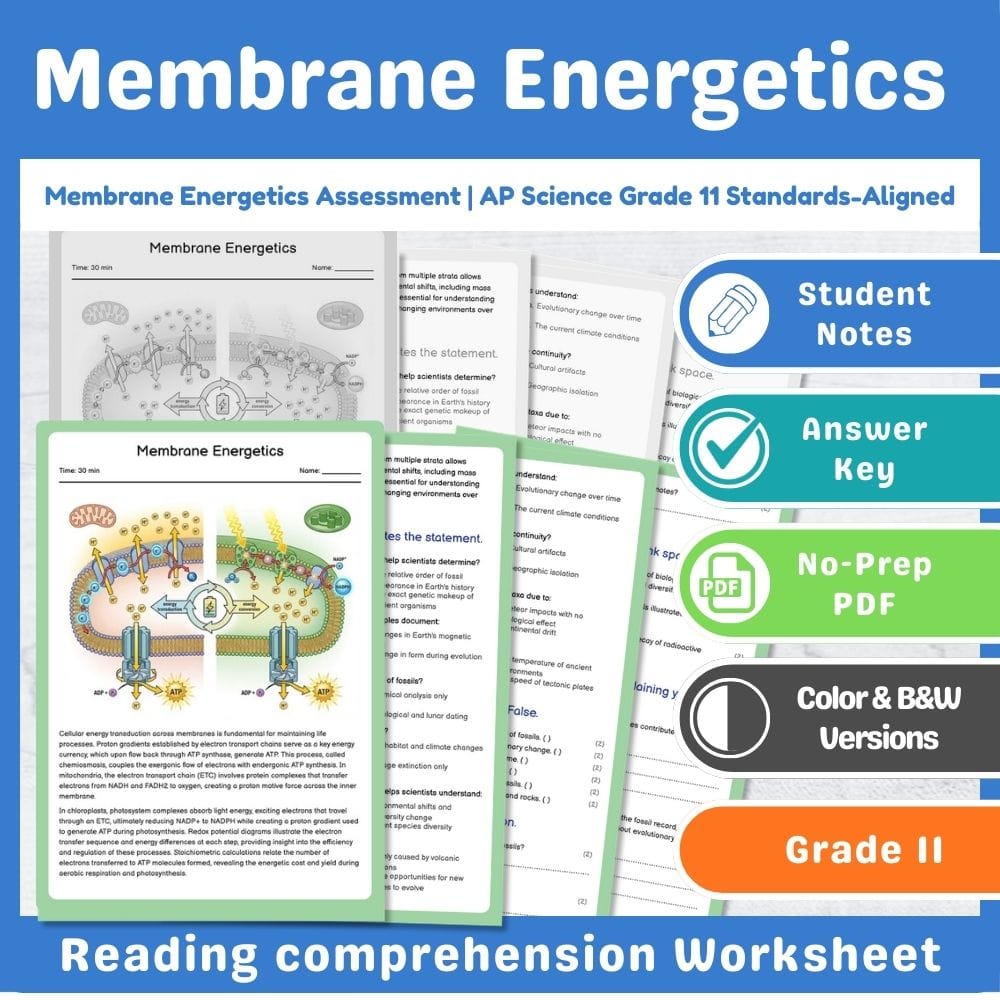
Membrane Energetics Assessment | AP Science Grade 11 Standards-Aligned
Created byPrism Point LearningLearning Objectives
- Explain the principles of membrane-associated energy transduction including proton gradients and chemiosmosis.
- Analyze electron transport chains in aerobic and photosynthetic systems using redox potential diagrams.
- Calculate ATP yield based on electron flow and proton gradients.
Instant download
Grade 11 Science | Mendelian Patterns Worksheet (Ontario, PDF)
Created byBright Mind ResourcesLearning Objectives
- Explain monohybrid and dihybrid inheritance patterns.
- Describe segregation and independent assortment in genetics.
- Interpret phenotypic ratios and genetic notation in inheritance scenarios.
Instant download

Grade 11 Science – Petroleum Systems & Formation | Daily Reading Worksheet
Created byBright Mind ResourcesLearning Objectives
- Identify the key components of petroleum systems
- Understand how organic-rich source rocks generate hydrocarbons
- Describe the process of hydrocarbon migration and trapping
Also included in: Geology Grade 11 Science Daily Reading Worksheets Lesson Bundle | BC +1 more
Instant download
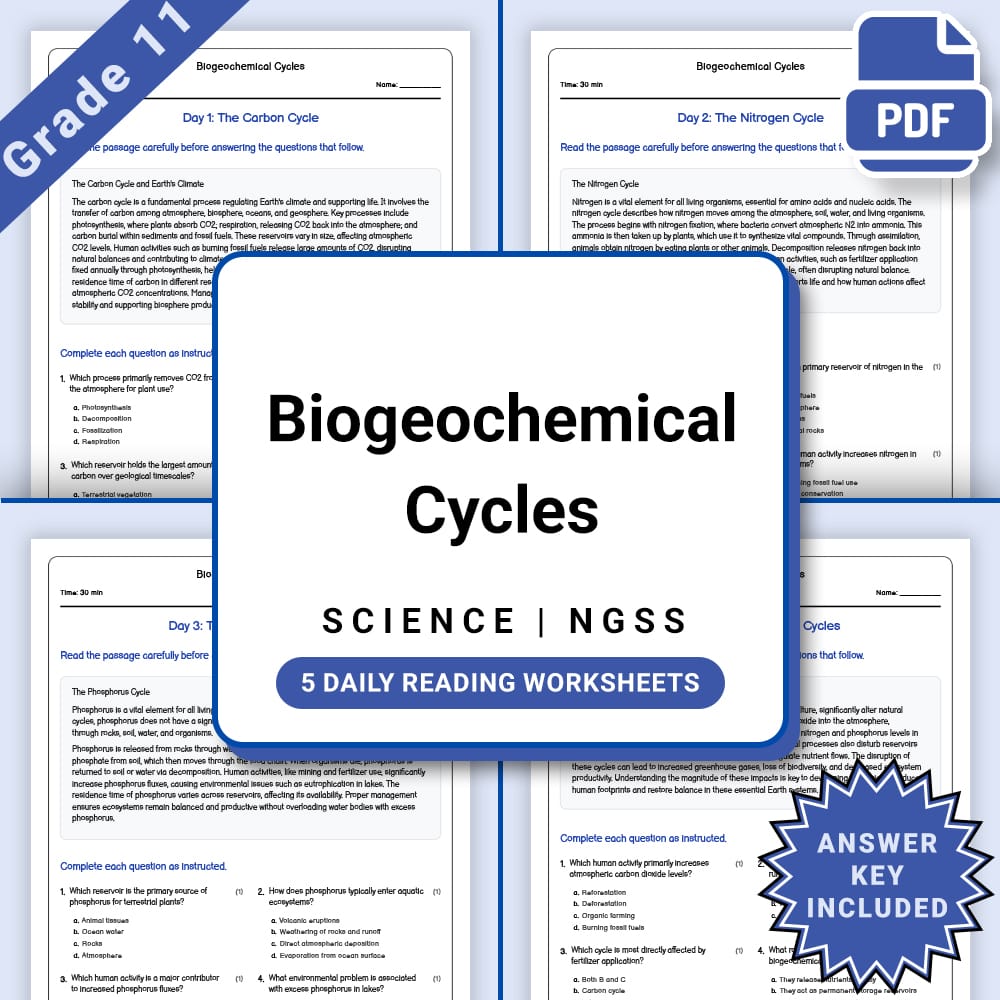
Grade 11 Science – Biogeochemical Cycles Worksheet(PDF +Answer Key)
Created byCopper Leaf ClassroomLearning Objectives
- Understand the main processes of the carbon cycle
- Identify reservoirs and fluxes involved in biogeochemical cycles
- Explain how human activities influence nutrient cycling
Instant download
Grade 11 Science – Resources and Hazards Daily Reading Worksheet + Answer Key
JCreated byJ.S SheetsLearning Objectives
- Understand key concepts related to Science
- Apply knowledge through practice questions
- Demonstrate comprehension of the material
Also included in: Grade 11 Science Lesson Bundle | Earth Science and Plate Tectonics +1 more
Instant download
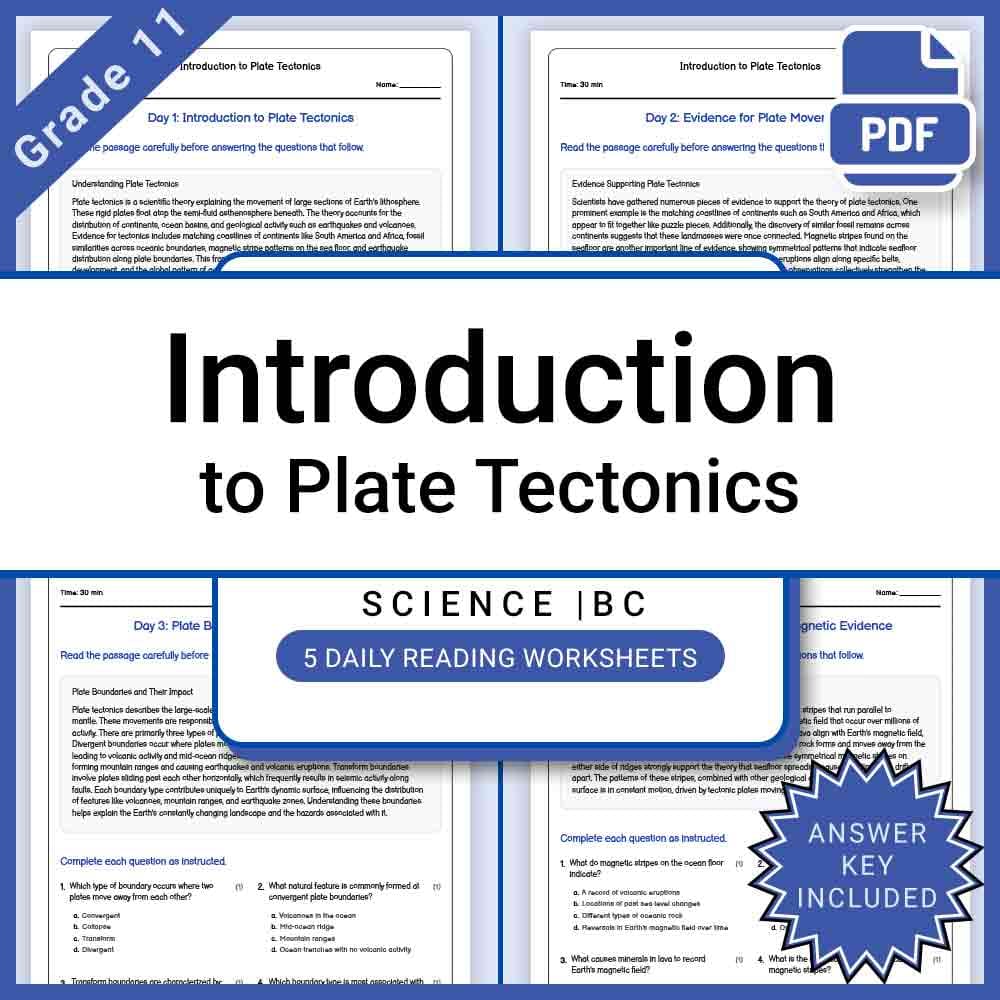
Grade 11 Science – Plate Tectonics Daily Reading Worksheet + Answer Key
JCreated byJ.S SheetsLearning Objectives
- Understand key concepts related to Science
- Apply knowledge through practice questions
- Demonstrate comprehension of the material
Also included in: Grade 11 Science Lesson Bundle | Earth Science and Plate Tectonics +1 more
Instant download
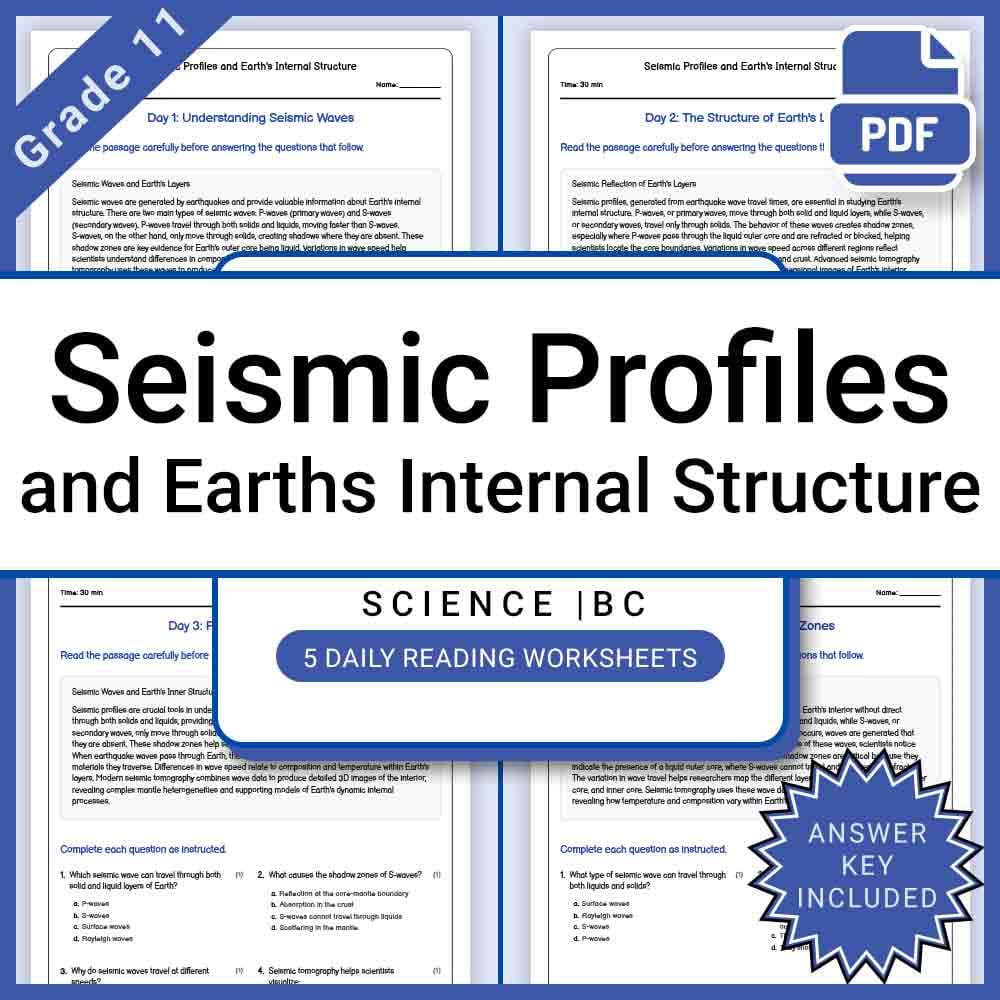
Grade 11 Science – Seismic Profiles and Earth's Interior Worksheet + Answer Key
JCreated byJ.S SheetsLearning Objectives
- Understand the different types of seismic waves and their paths through Earth's layers.
- Identify the significance of shadow zones in determining Earth's internal composition.
- Explain how variations in seismic wave speeds reveal information about Earth's interior.
Also included in: Grade 11 Science Lesson Bundle | Earth Science and Plate Tectonics +1 more
Instant download

Grade 11 Science – Groundwater Systems Daily Reading Worksheet with Answer Key
JCreated byJ.S SheetsLearning Objectives
- Identify key parts of groundwater systems such as aquifers, recharge zones, and wells.
- Understand how confined and unconfined aquifers differ in response to recharge and pumping.
- Describe the effects of over-extraction on water tables, river flow, and land stability.
Also included in: Grade 11 Science Lesson Bundle | Earth Science and Plate Tectonics +1 more
Instant download
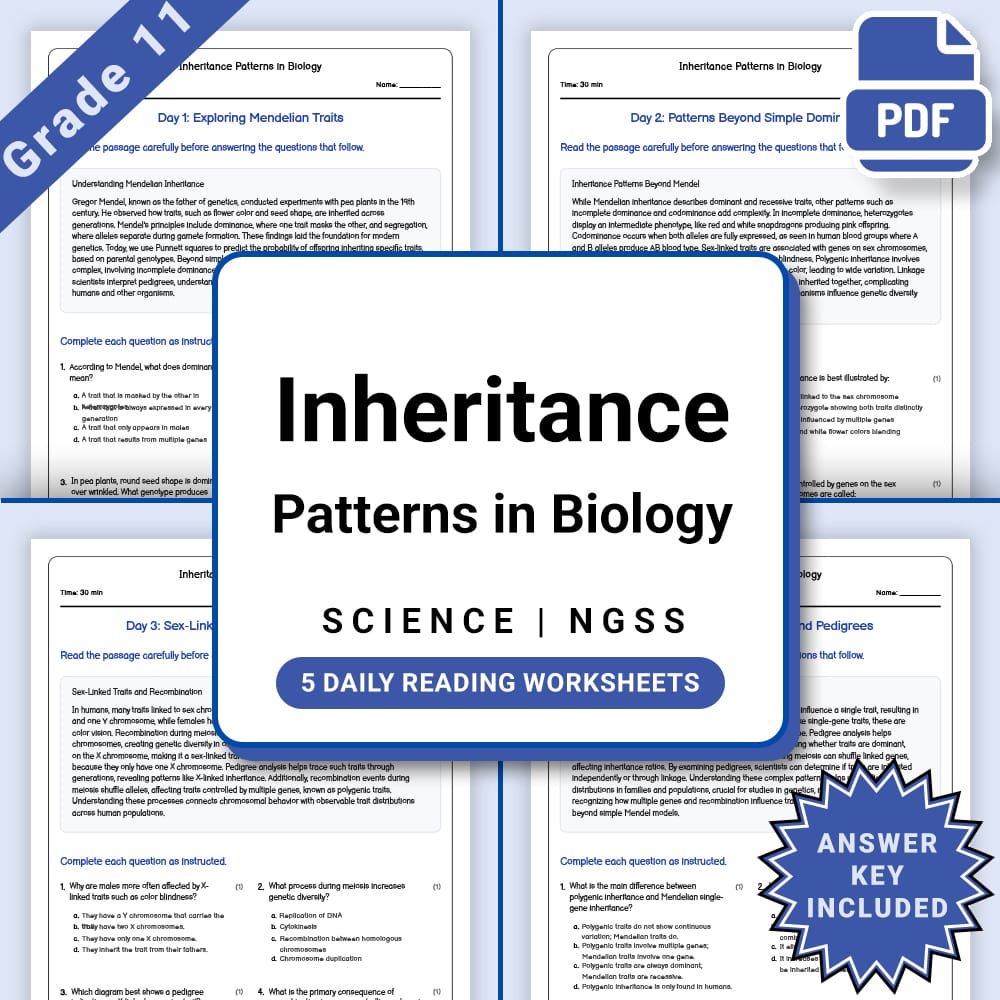
Grade 11 Science Inheritance Patterns Daily Worksheet(PDF +Answer Key)
Created byCopper Leaf ClassroomLearning Objectives
- Understand key concepts related to Science
- Apply knowledge through practice questions
- Demonstrate comprehension of the material
Instant download
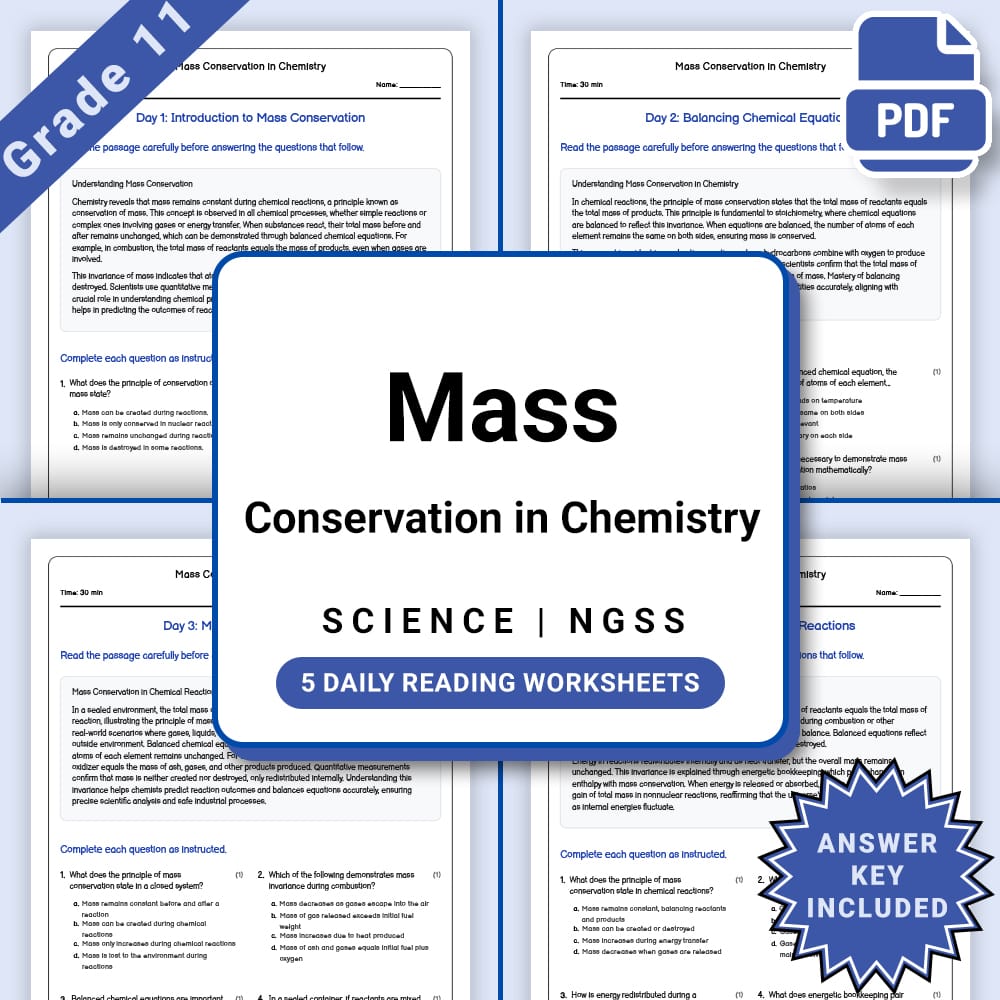
Grade 11 Science – Mass Conservation Worksheet(PDF +Answer Key)
Created byCopper Leaf ClassroomLearning Objectives
- Understand that mass is conserved in chemical reactions.
- Explain how balanced equations demonstrate mass conservation.
- Recognize that mass and energy are related through atomic accounting.
Instant download

Grade 11 Indicator Selection Worksheet | Alberta Use Practice PDF
Created byClear Sky ClassroomLearning Objectives
- Explain why matching an indicator’s pH transition range to the expected equivalence pH improves titration accuracy.
- Select an appropriate indicator for different acid–base titration types based on the equivalence pH (basic vs. acidic).
- Justify indicator choice using titration type, indicator transition interval, and expected endpoint clarity.
Instant download
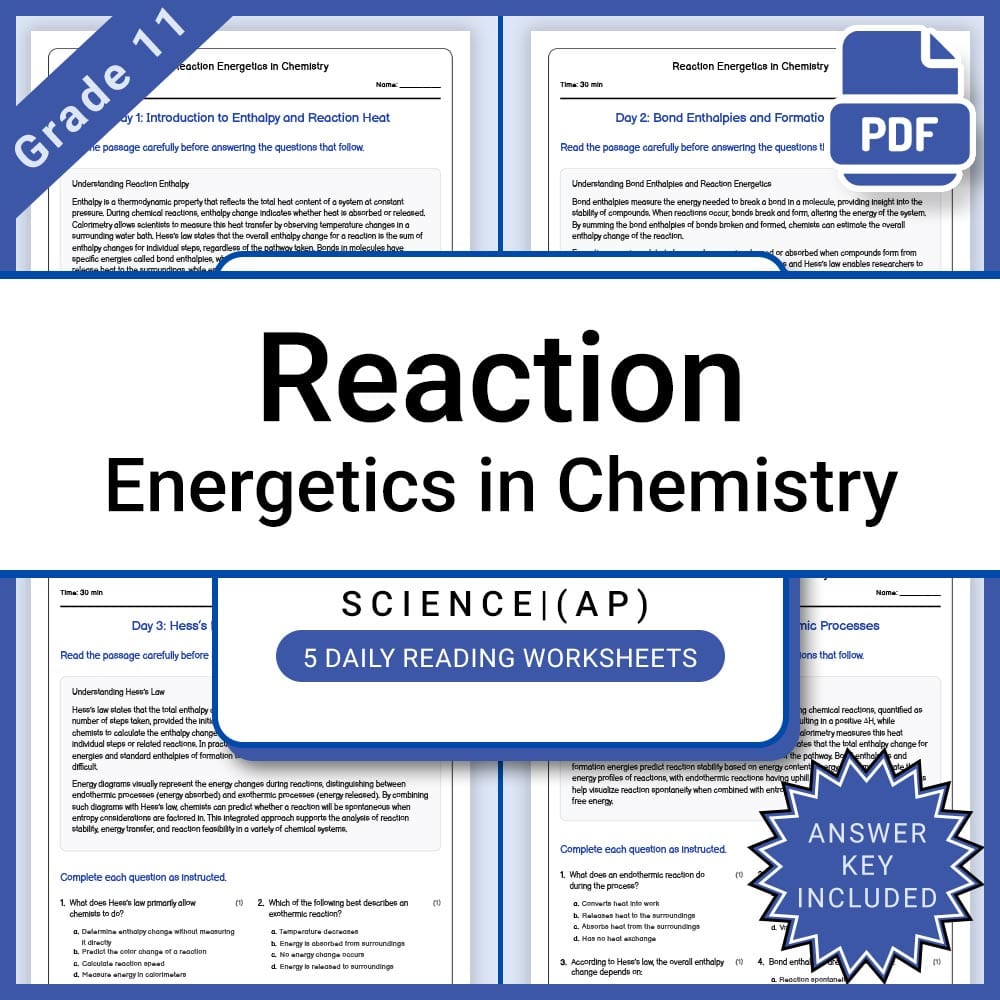
Grade 11 Science – Reaction Energetics Daily Reading Worksheet + Answer Key
JCreated byJ.S SheetsLearning Objectives
- Understand key concepts related to Science
- Apply knowledge through practice questions
- Demonstrate comprehension of the material
Also included in: AP Physics Principles Activities & Worksheets | Grade 11 Advanced Placement +1 more
Instant download
About Grade 11 Science Worksheets
Browse 6,616 printable Grade 11 Science worksheets — ready-to-print PDFs with answer keys where available.
Each resource here is built by an independent educator and reviewed for quality. Worksheets print straight from PDF and suit classroom use, homework, or extra practice; most come with answer keys, and you can preview before purchasing.