
Grade 12 Science Worksheets
4,240 worksheets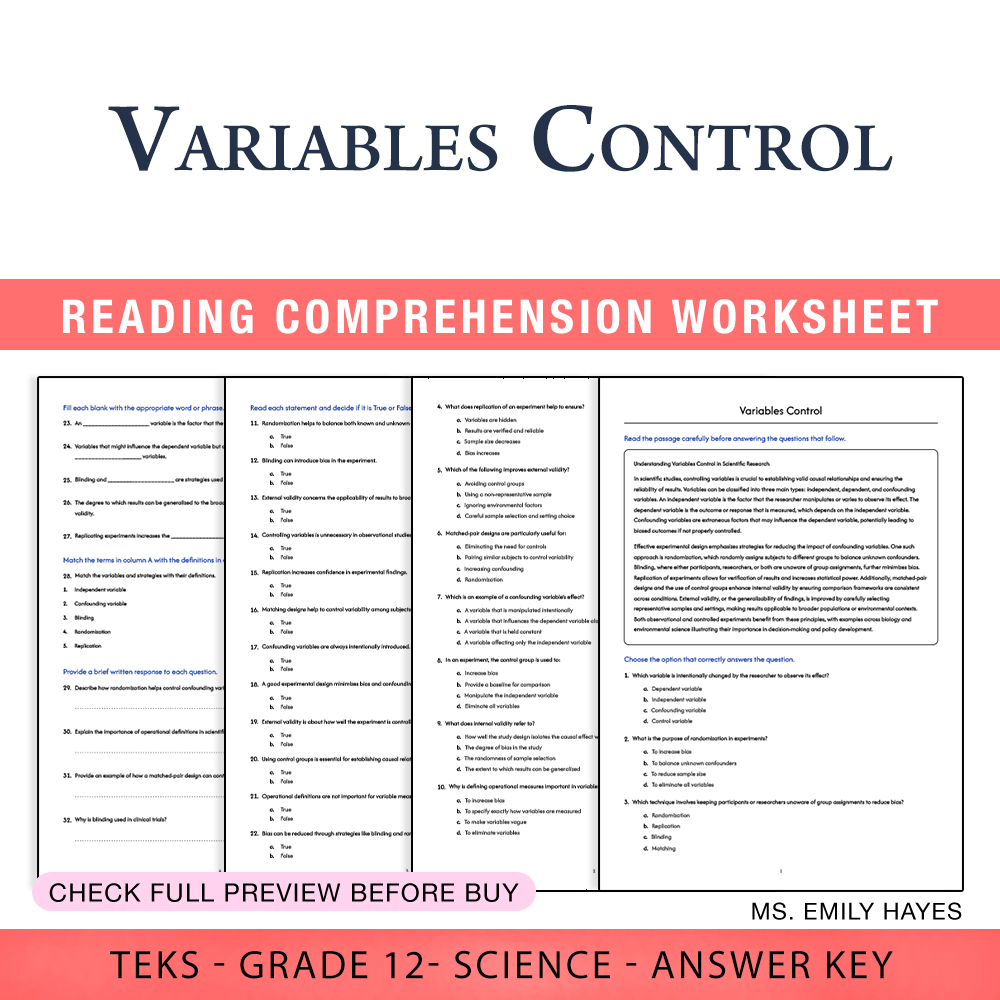
12th Grade Science | Variables Control Worksheet (PDF+ Answer Key)
 Created byCopper Leaf Classroom
Learning Objectives
- Identify and distinguish between independent, dependent, and confounding variables in experimental design.
- Understand strategies for controlling variables, including randomization and blinding techniques.
- Analyze the role of replication and comparison frameworks in reducing bias and interpreting causal relationships.
Instant download
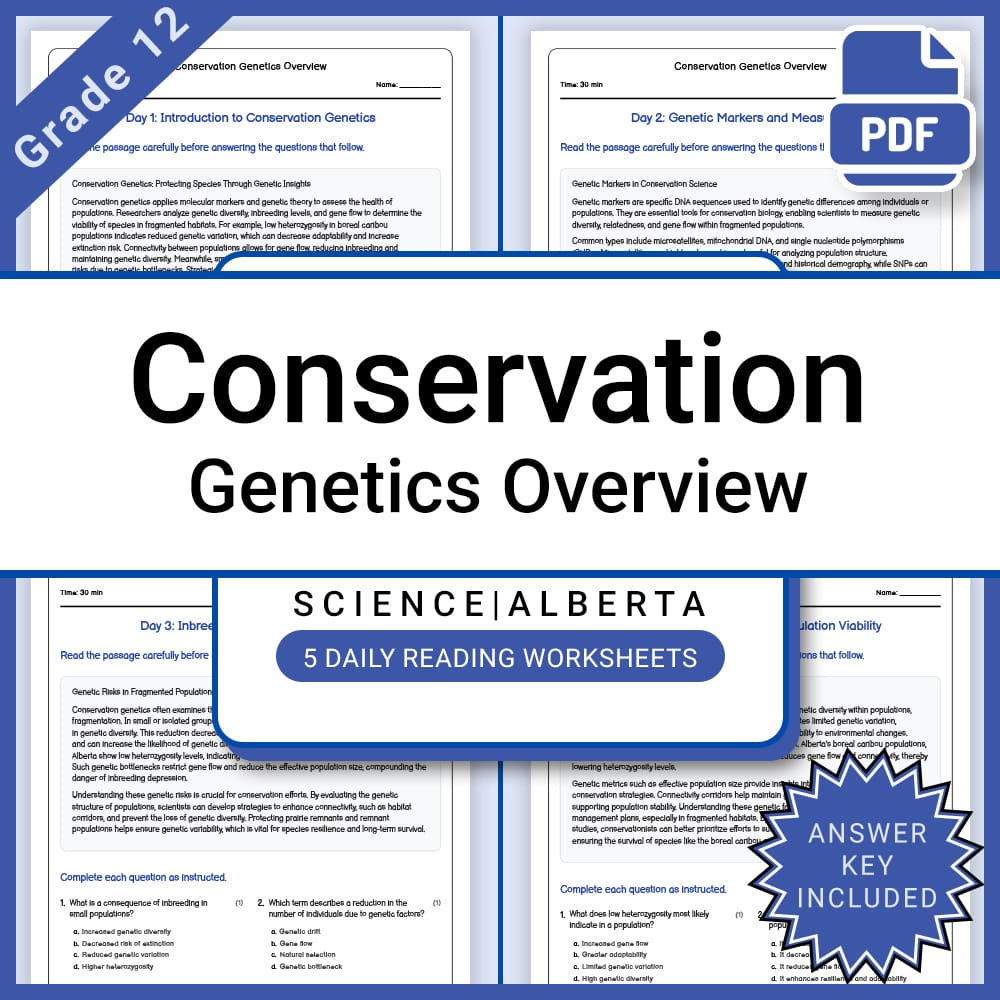
Grade 12 Science – Conservation Genetics Daily Reading Worksheet + Answer Key
JCreated byJ.S SheetsLearning Objectives
- Understand the concept of genetic diversity and its significance in conservation
- Identify how molecular markers are used to assess genetic health in populations
- Explain the importance of gene flow and connectivity for species survival
Also included in: Grade 12 Science Lesson Bundle | Daily Reading Worksheets +1 more
Instant download
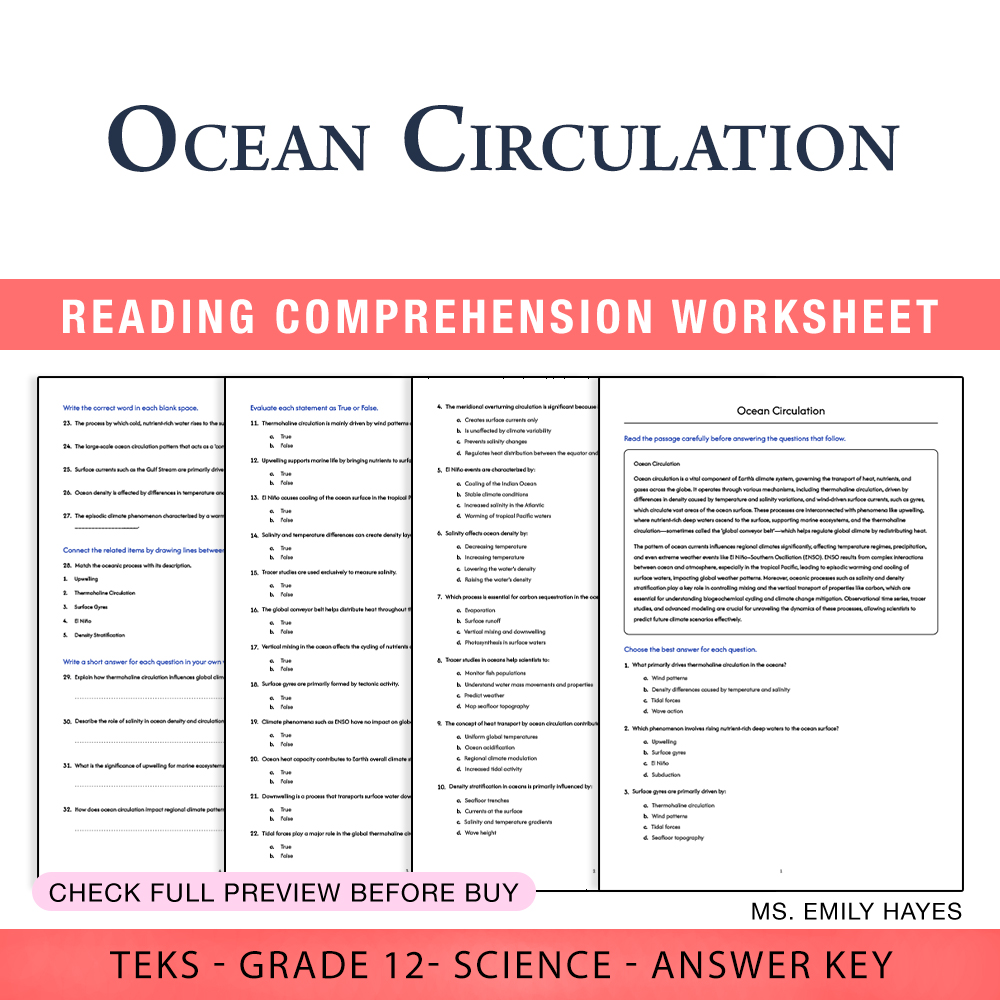
12th Grade Science | Ocean Circulation Worksheet (PDF+ Answer Key)
Created byCopper Leaf ClassroomLearning Objectives
- Understand the mechanisms of thermohaline and wind-driven ocean circulation.
- Analyze the role of surface gyres, upwelling, and the meridional overturning circulation in heat and nutrient transport.
- Explain how oceanic heat capacity and circulation affect regional climate and phenomena like El Niño.
Instant download

Grade 12 Science | Bonding Models Worksheet | BC-Aligned
 Created byLumora Learning
Learning Objectives
- Describe the different types of chemical bonding: ionic, covalent, and metallic.
- Predict bond polarity based on electronegativity differences.
- Explain bond strength and length in relation to bond order and bond energy.
Also included in: Grade 12 Science | Chemistry Custom Bundle Worksheets | BC-Aligned
Instant download
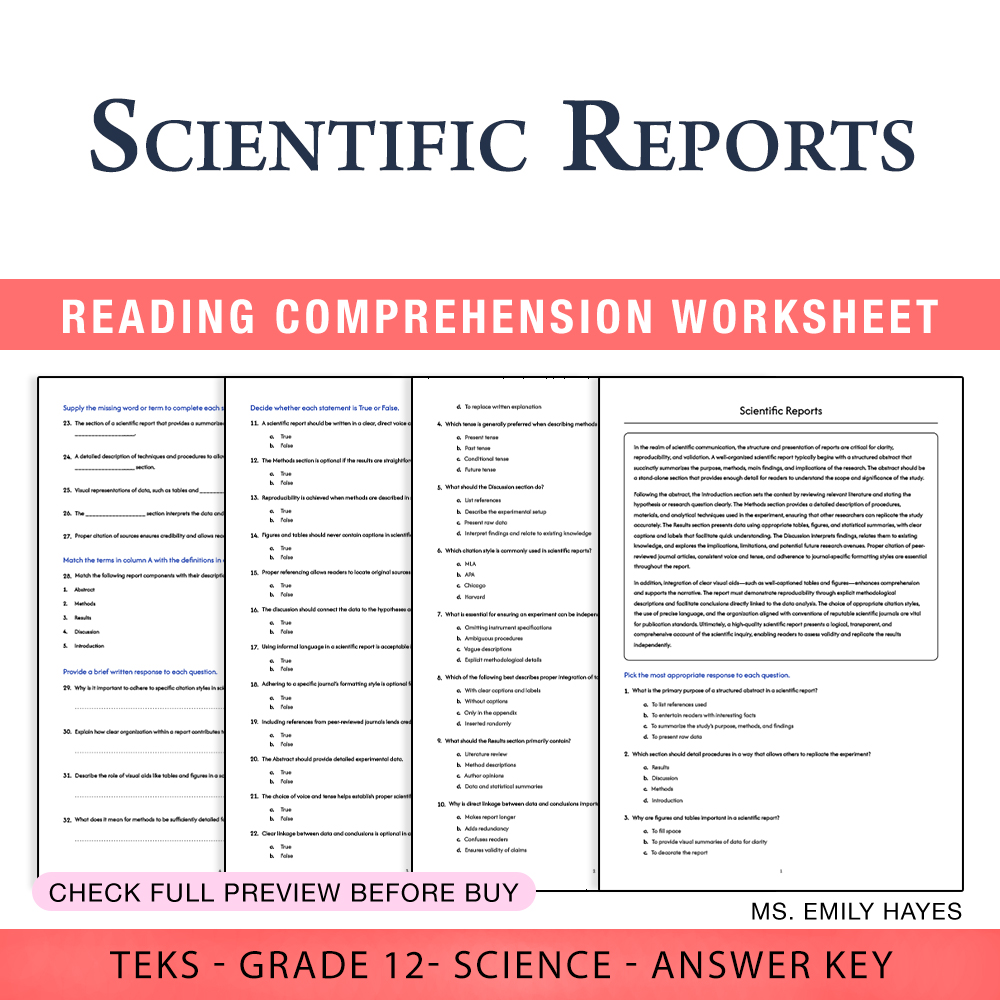
12th Grade Science | Scientific Reports Worksheet (PDF+ Answer Key)
Created byCopper Leaf ClassroomLearning Objectives
- Understand the key components and structure of formal scientific reports.
- Identify conventions related to abstract organization, hypothesis framing, and data presentation.
- Evaluate proper use of voice, tense, and citation styles in scientific writing.
Instant download
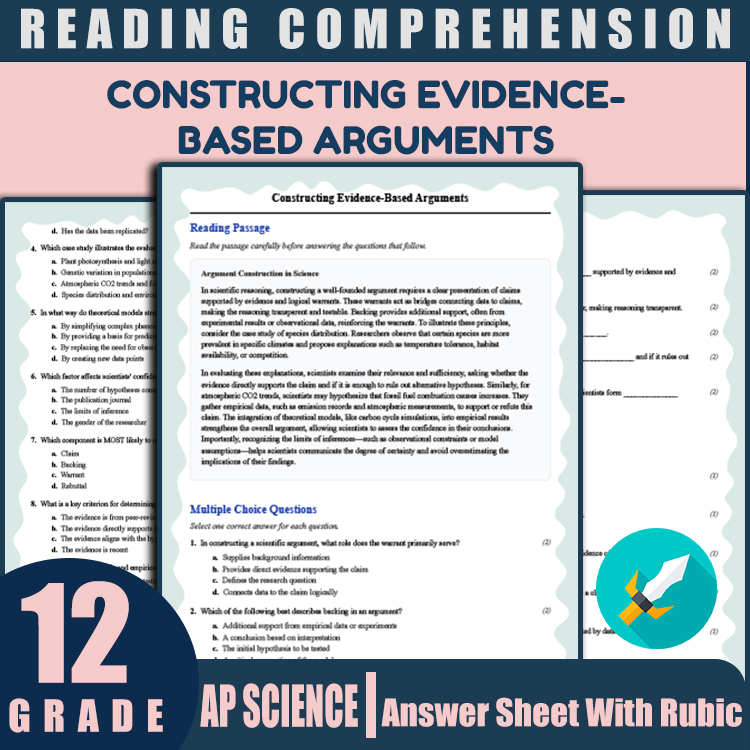
12th Grade Science | Constructing Evidence-Based Arguments Reading Worksheet
JCreated byJ.S SheetsLearning Objectives
- Understand the structure of scientific arguments, including claims, warrants, and backing.
- Analyze case studies involving species distribution and atmospheric CO2 using relevance, sufficiency, and alternative hypotheses.
- Learn how to integrate theoretical models and empirical data into coherent scientific arguments.
Also included in: Grade 12 Science Unit | Data, Modeling & Evidence Reading Worksheets Pack +1 more
Instant download

Resource Systems Worksheet | Grade 12 AP Science Environmental Systems Activity
 Created byPrism Point Learning
Learning Objectives
- Explain how geological resources, extraction processes, and societal demand interact in mineral, groundwater, and hydrocarbon systems.
- Use ore deposit models, aquifer properties, and basin maturation ideas to predict supply limits and long-term change.
- Evaluate trade-offs among resource availability, environmental impacts, and technological or regulatory adaptations.
Instant download
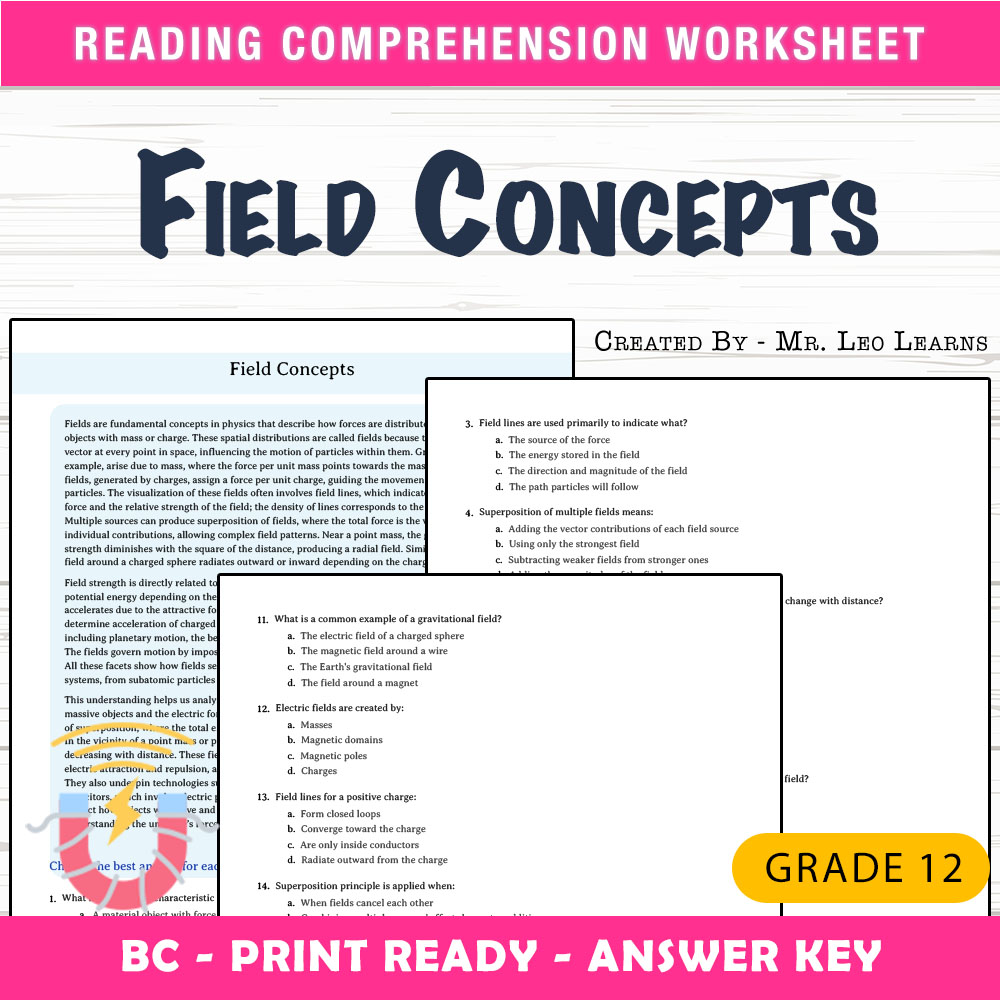
Grade 12 Science — Field Concepts Worksheet MCQ Paper for Mastery
 Created byThe Resource Hub
Learning Objectives
- Explain the nature of fields as spatial distributions that exert forces.
- Describe gravitational and electric fields as vector fields assigning forces at points.
- Understand the concept of field lines and superposition of multiple sources.
Also included in: Grade 12 Science | Physics 12 Wave & Quantum Concepts Worksheet Bundle +1 more
Instant download
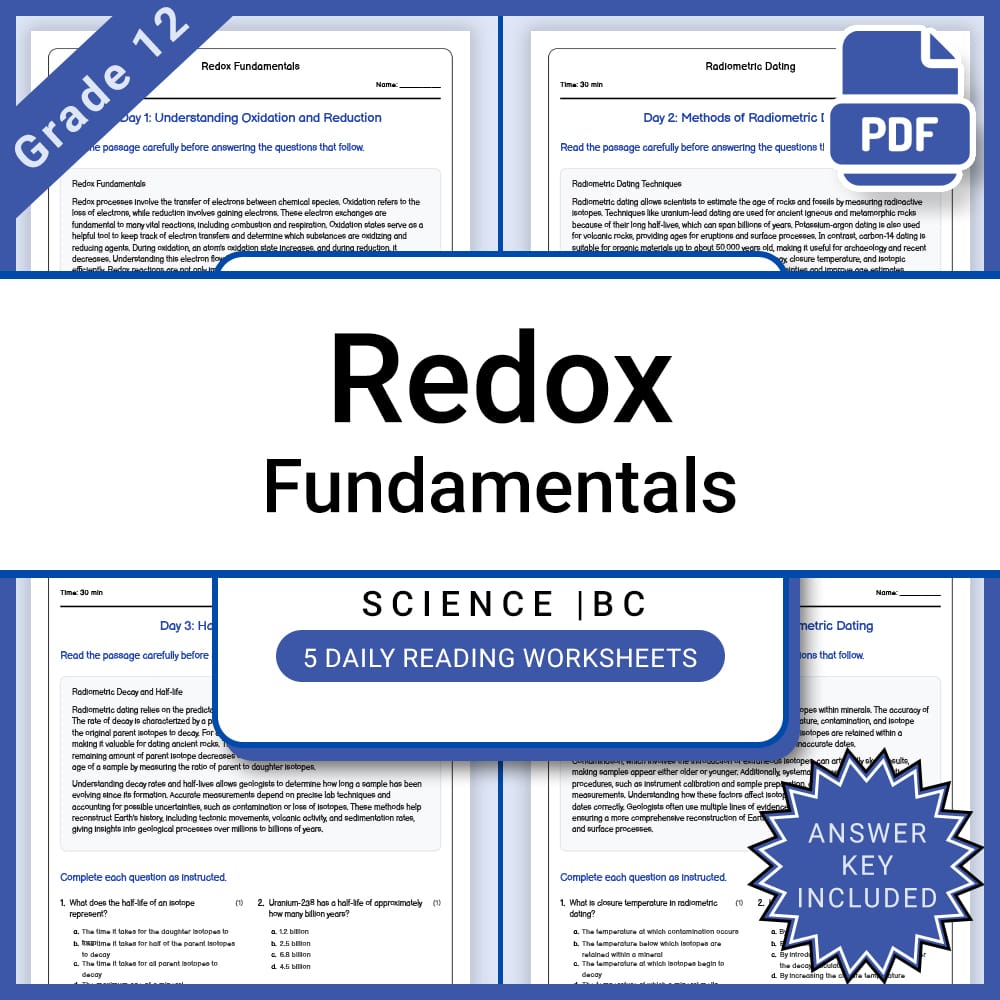
Grade 12 Science – Redox Fundamentals Daily Reading Worksheet + Answer Key
JCreated byJ.S SheetsLearning Objectives
- Understand the concept of oxidation and reduction
- Identify oxidation and reduction in chemical reactions
- Learn how electrons transfer in redox processes
Also included in: Grade 12 Science Lesson Bundle BC Framework | Daily Reading Worksheets +1 more
Instant download
Grade 12 Science – Population Dynamics (Worksheet + Answer Key) | Alberta Standards
 Created byBright Mind Resources
Learning Objectives
- Describe the key factors influencing population growth and decline.
- Differentiate between exponential and logistic growth models.
- Analyze examples of population changes in Alberta's ecosystems.
Instant download
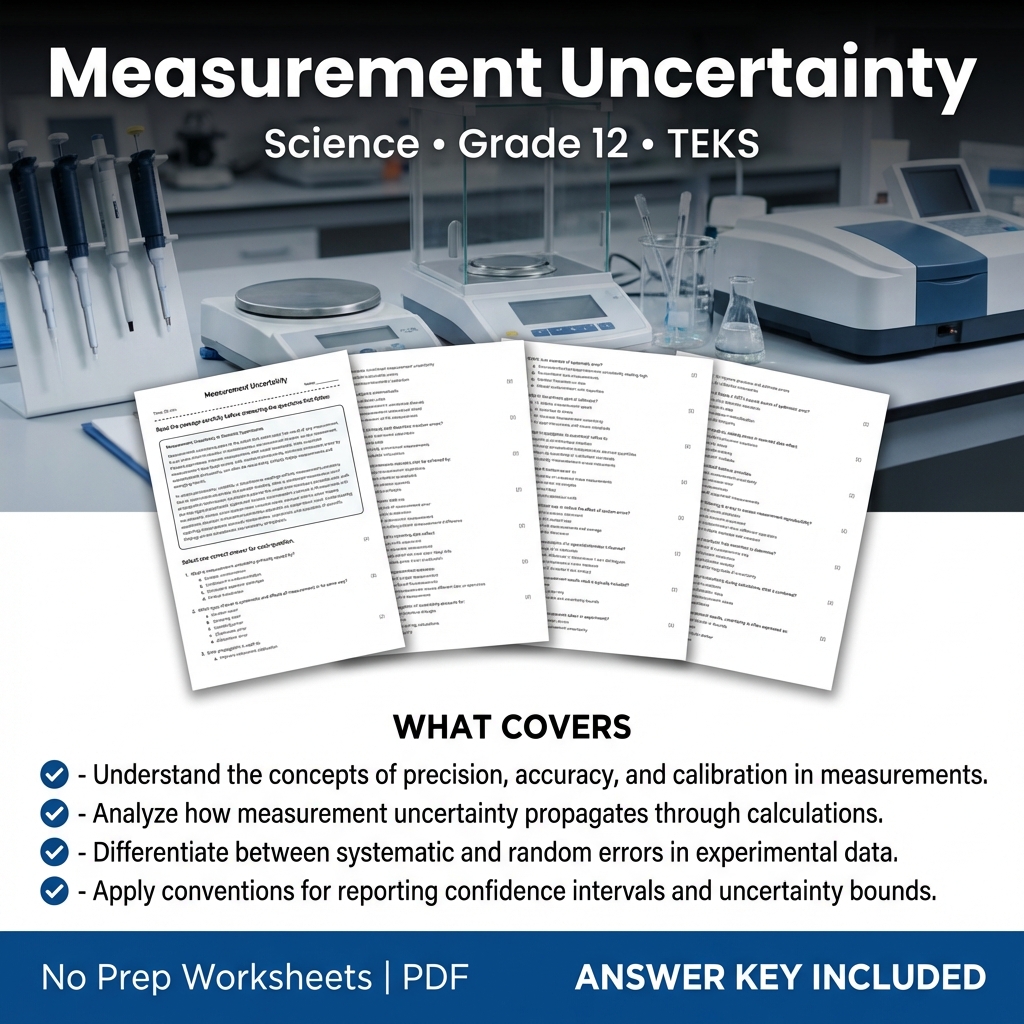
Measurement Uncertainty Worksheet for Grade 12 Science | TEKS aligned
 Created byCoral Reef Learning
Learning Objectives
- Understand the concepts of precision, accuracy, and calibration in measurements.
- Analyze how measurement uncertainty propagates through calculations.
- Differentiate between systematic and random errors in experimental data.
Instant download
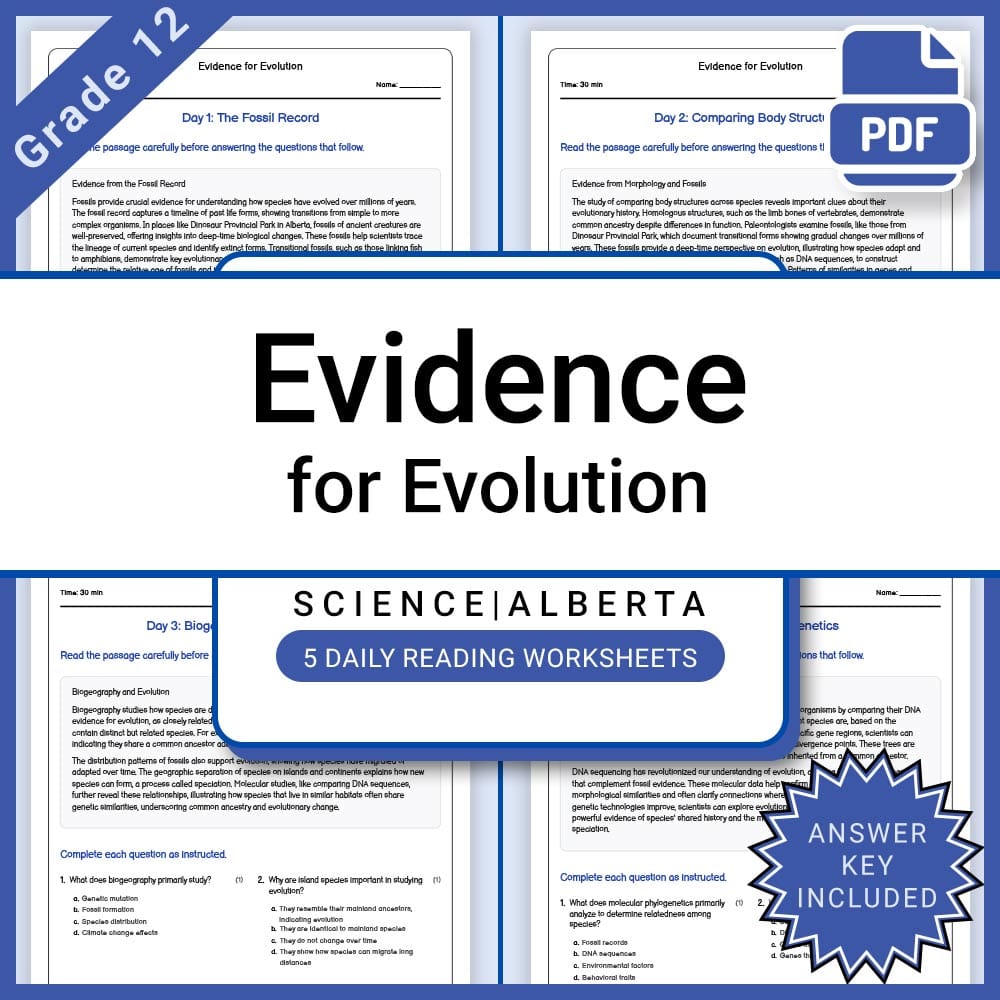
Grade 12 Science – Evidence for Evolution Daily Worksheet with Answer Key
JCreated byJ.S SheetsLearning Objectives
- Understand different types of evidence supporting evolution
- Analyze fossil records and what they reveal about past life
- Evaluate how molecular data supports evolutionary relationships
Also included in: Grade 12 Science Lesson Bundle | Daily Reading Worksheets +1 more
Instant download
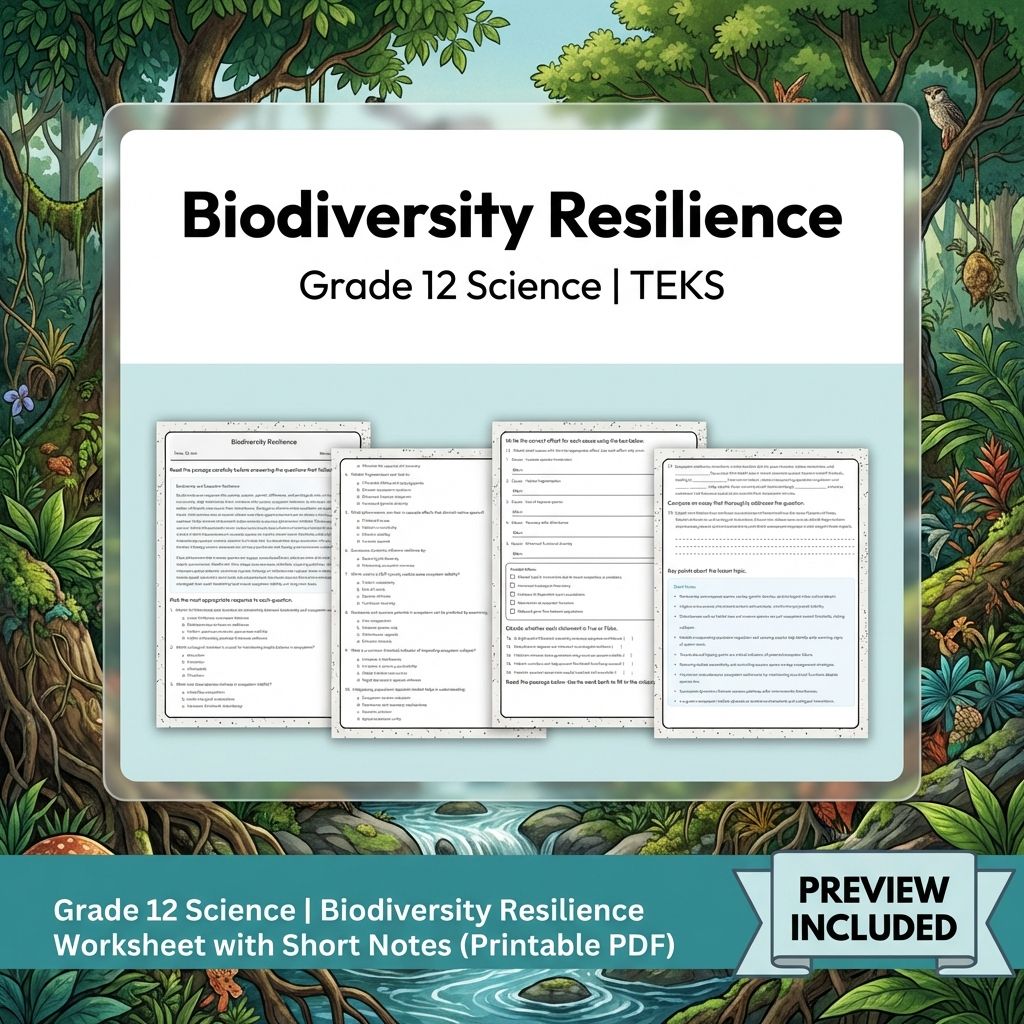
Grade 12 Science | Biodiversity Resilience Worksheet with Short Notes (PDF)
 Created byMeadowlark Worksheets
Learning Objectives
- Analyze the patterns and mechanisms that contribute to biodiversity resilience in ecosystems.
- Evaluate ecological interactions and their roles in system stability.
- Apply concepts such as species richness, functional diversity, and trophic structure to real-world scenarios.
Also included in: Grade 12 Science Unit | Environmental Management & Biodiversity Worksheets +2 more
Instant download

Grade 12 Science | Cycle Dynamics Worksheet with Short Notes (Printable PDF)
Created byMeadowlark WorksheetsLearning Objectives
- Understand the pathways of carbon and nitrogen in environmental systems.
- Apply quantitative reasoning to reservoir exchange rates and steady-state concepts.
- Analyze human activities' impacts on natural fluxes and system connectivity.
Also included in: Grade 12 Science Unit | Environmental Management & Biodiversity Worksheets +2 more
Instant download
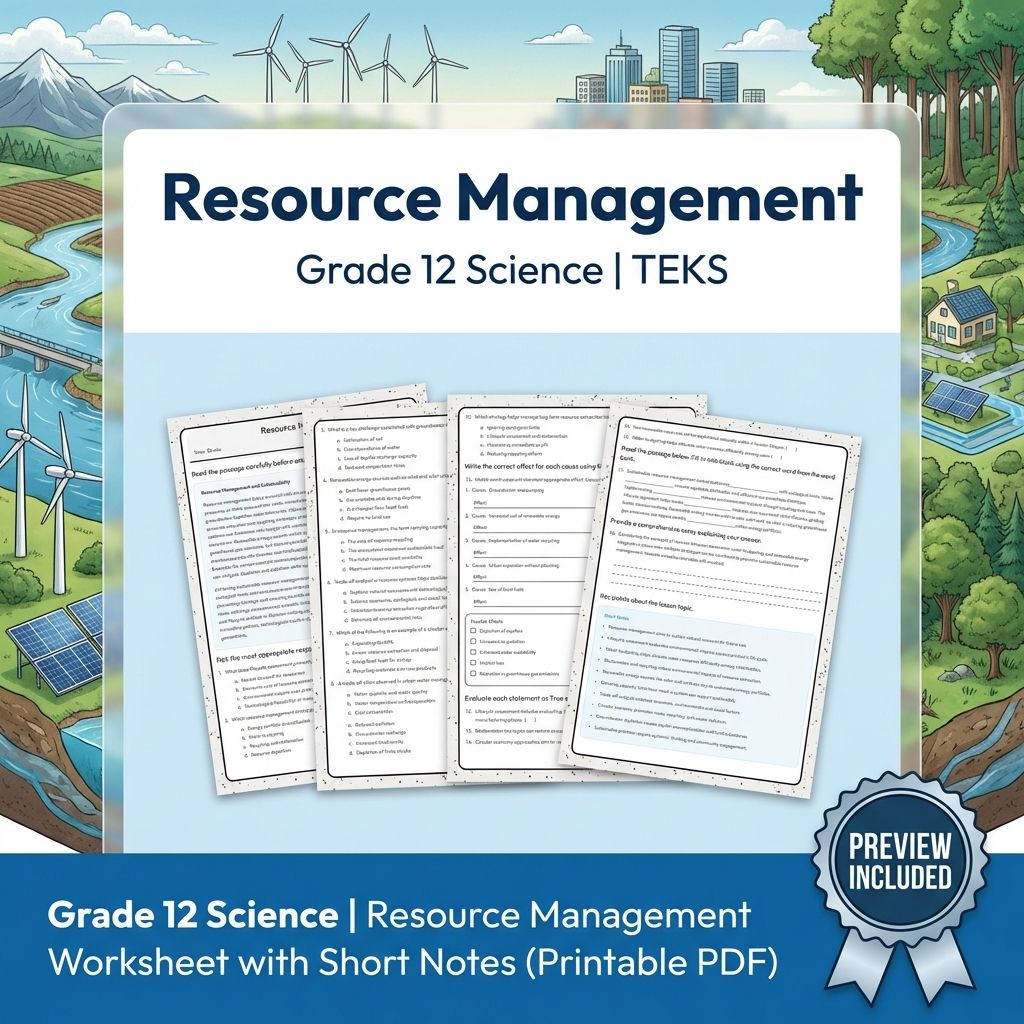
Grade 12 Science | Resource Management Worksheet with Short Notes (PDF)
Created byMeadowlark WorksheetsLearning Objectives
- Evaluate the sustainability of renewable and nonrenewable resources through lifecycle assessment and carrying-capacity constraints.
- Analyze water budgeting, energy portfolios, and waste handling strategies to understand their ecological and economic impacts.
- Apply trade-off analysis to resource extraction, reclamation, and urban water supply systems for sustainable decision-making.
Also included in: Grade 12 Science Unit | Environmental Management & Biodiversity Worksheets +2 more
Instant download

Grade 12 Science | Cell Architecture - Daily Reading Comprehension
Created byCoral Reef LearningLearning Objectives
- Identify the major organelles in prokaryotic and eukaryotic cells.
- Describe the structure and function of each organelle.
- Understand how microscopy techniques reveal cell structures.
Also included in: Grade 12 Science Daily Reading Worksheets Full-Year Bundle | TEKS
Instant download

Conservation Genetics Worksheet | Grade 12 Science Activities
Created byPrism Point LearningLearning Objectives
- Explain how molecular markers and genetic theory are used to measure diversity, inbreeding, and gene flow in fragmented populations.
- Interpret genetic metrics (heterozygosity, effective population size, and connectivity) to assess extinction risk and demographic viability.
- Evaluate how genetic information can guide conservation planning, such as habitat corridors and recovery strategies using Alberta examples.
Also included in: Grade 12 Evolution & Genetics Lesson Bundle | Alberta Science Framework
Instant download

Evidence for Evolution Worksheet | Grade 12 Science Practice
Created byPrism Point LearningLearning Objectives
- Explain how multiple lines of evidence support evolution, including fossils, homology, biogeography, and molecular phylogenetics.
- Use evidence patterns such as transitional forms and congruent trees to justify evolutionary relationships.
- Distinguish scientific interpretations of evidence from misconceptions about evolution.
Also included in: Grade 12 Evolution & Genetics Lesson Bundle | Alberta Science Framework
Instant download

Community Interactions Worksheet | Grade 12 Science Activities
Created byPrism Point LearningLearning Objectives
- Explain how interspecific interactions (competition, predation, parasitism, mutualism, commensalism) shape ecological communities and food webs.
- Describe how energy flow and trophic efficiency influence biomass distribution across ecosystems.
- Use Alberta examples to evaluate how species interactions can affect community composition, resilience, biodiversity, and stability.
Also included in: Grade 12 Evolution & Genetics Lesson Bundle | Alberta Science Framework
Instant download

Grade 12 Solar Fusion Cycle Worksheet | Nuclear Physics | California Standards
 Created byEvergreen Desk Education
Learning Objectives
- Explain how nuclear fusion in the Sun’s core converts mass into energy
- Describe how changes in fusion rate affect the Sun’s energy output and long-term evolution
- Connect stellar fusion processes to the formation of heavier elements and later generations of stars and planets
Instant download
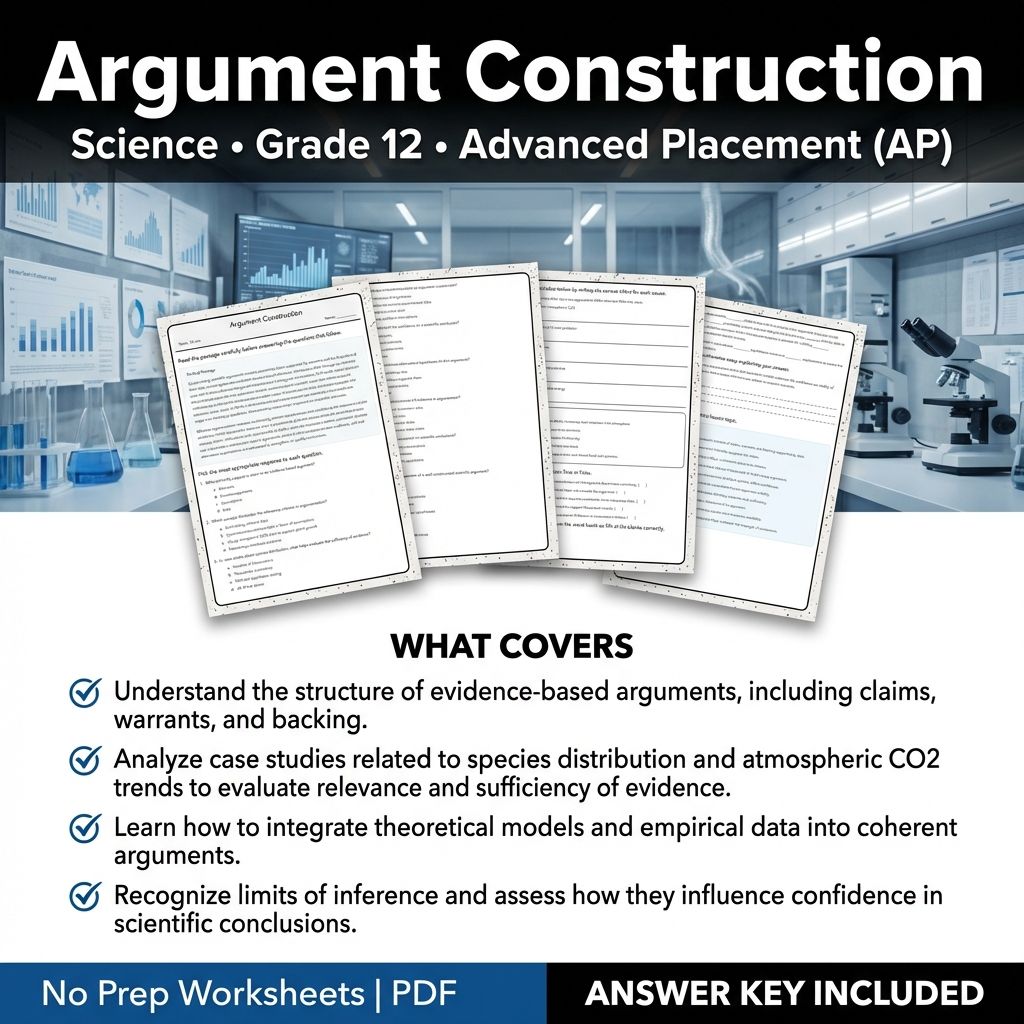
12th Grade Science | Argument Construction Worksheet & Answer Key (Printable PDF)
Created byCoral Reef LearningLearning Objectives
- Understand the structure of evidence-based arguments, including claims, warrants, and backing.
- Analyze case studies related to species distribution and atmospheric CO2 trends to evaluate relevance and sufficiency of evidence.
- Learn how to integrate theoretical models and empirical data into coherent arguments.
Also included in: Grade 12 Science Unit Bundle | Uncertainty, Data Analysis & Modeling Worksheets +1 more
Instant download

Grade 12 Science | Biotechnology Overview - Daily Reading Comprehension
Created byCoral Reef LearningLearning Objectives
- Understand the basic concepts and techniques of biotechnology.
- Identify various applications of biotechnology in medicine, agriculture, and industry.
- Recognize key ethical issues related to biotechnological advances.
Instant download

Grade 12 Science | Water Cycle Variability - Reading Comprehension Practice
Created byCoral Reef LearningLearning Objectives
- Understand the process of water evaporation and condensation
- Describe how water moves through different reservoirs on Earth
- Explain how energy from the sun drives changes in the water cycle
Instant download
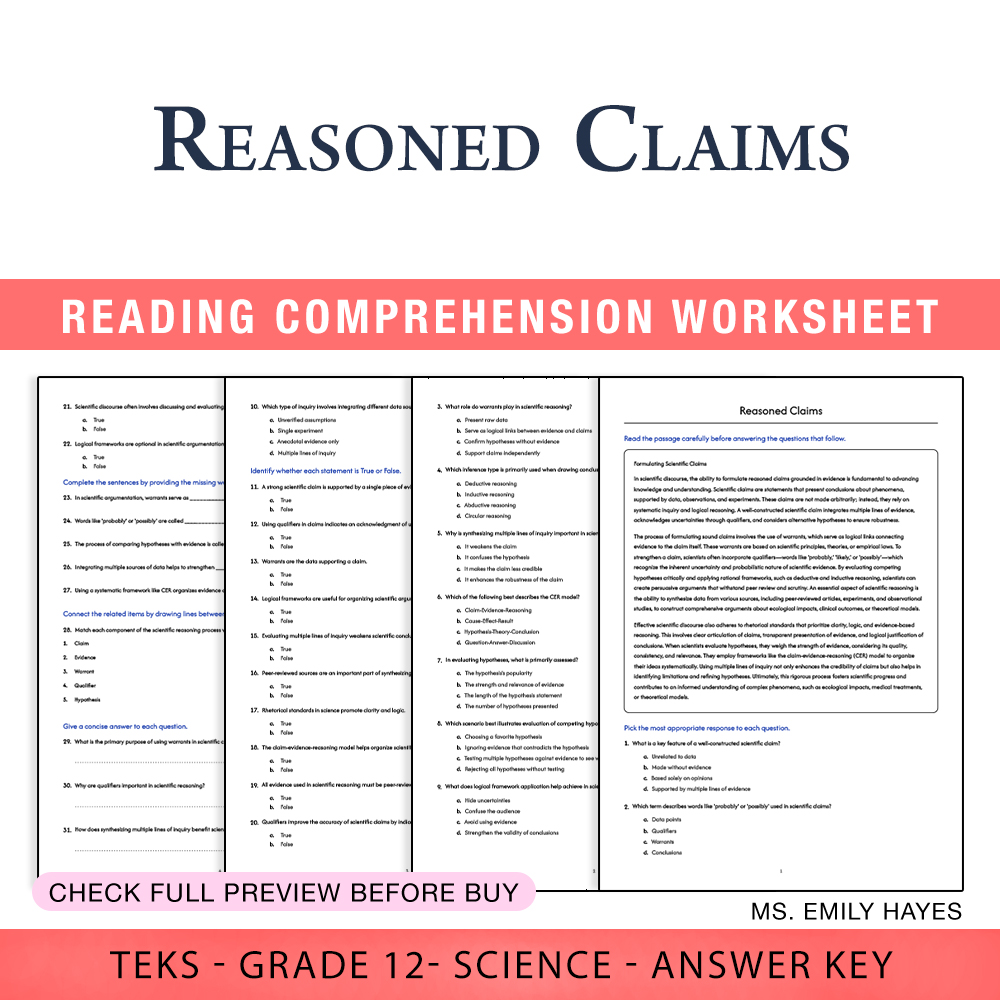
12th Grade Science | Reasoned Claims Worksheet (PDF+ Answer Key)
Created byCopper Leaf ClassroomLearning Objectives
- Understand the principles of scientific reasoning and how to formulate evidence-based claims.
- Evaluate and compare hypotheses using evidence, warrants, and qualifiers.
- Apply logical frameworks and rhetorical standards in scientific discourse.
Instant download
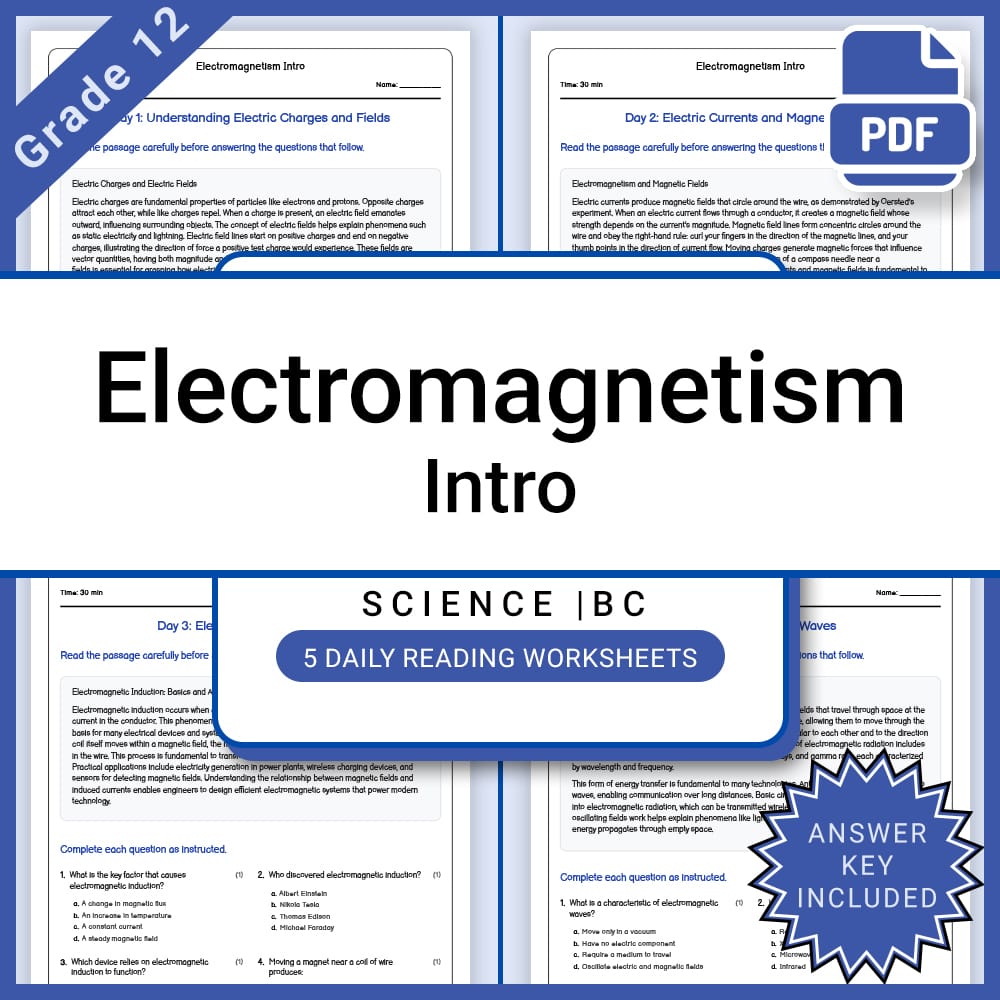
Grade 12 Science – Electromagnetism Daily Reading Worksheet with Answer Key
JCreated byJ.S SheetsLearning Objectives
- Understand the concept of electric charges and how they create electric fields
- Identify the relationship between electric charges and electric field lines
- Recognize the differences between positive and negative charges
Also included in: Grade 12 Science Lesson Group | Physics, Energy, Waves & Electromagnetism +1 more
Instant download

Grade 12 Science | Intermolecular Forces Worksheet | BC-Aligned
Created byLumora LearningLearning Objectives
- Explain the different types of intermolecular forces and their roles in molecular behavior.
- Identify and differentiate between London dispersion, dipole-dipole, and hydrogen bonding.
- Understand how intermolecular forces influence boiling points, solubility, and surface tension.
Also included in: Grade 12 Science | Chemistry Custom Bundle Worksheets | BC-Aligned
Instant download
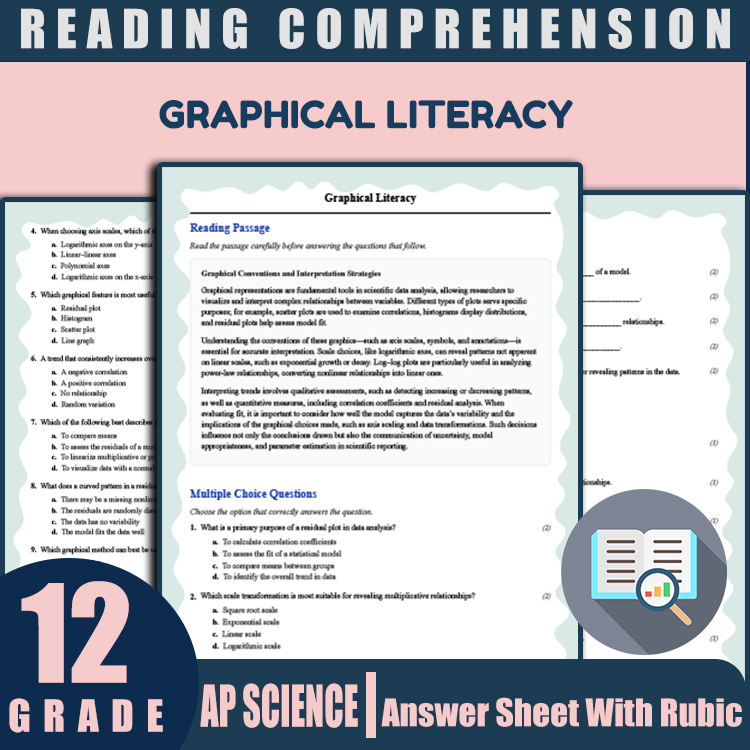
12th Grade Science | Graphical Literacy Reading Worksheet (PDF + Rubric)
JCreated byJ.S SheetsLearning Objectives
- Understand the conventions and interpretation strategies for different types of graphical representations, including scatter plots, residual plots, histograms, and log–log axes.
- Identify trends, assess model fit, and interpret the effects of scale transformations in various graphical data displays.
- Evaluate the appropriateness of graphical choices and comprehend their influence on model selection, parameter estimation, and uncertainty communication.
Also included in: Grade 12 Science Unit | Data, Modeling & Evidence Reading Worksheets Pack +1 more
Instant download
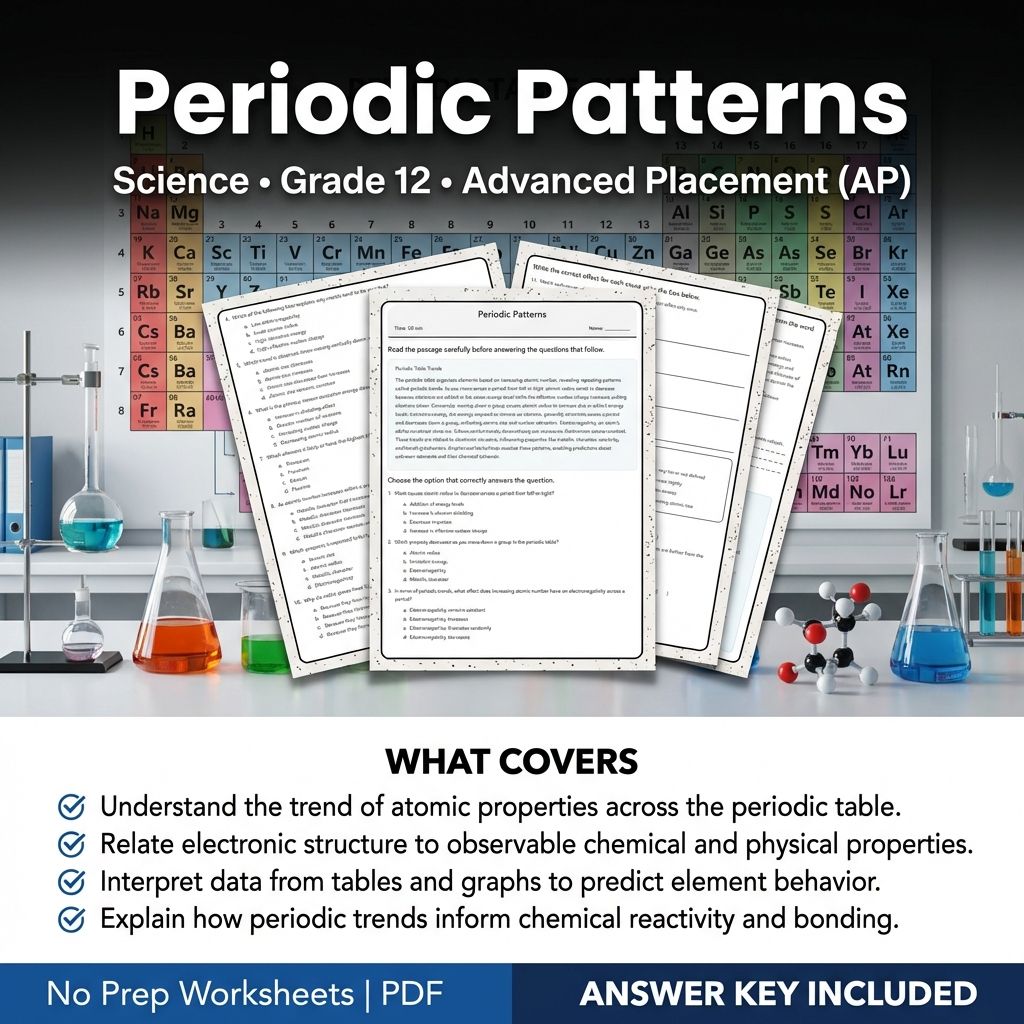
12th Grade Science | Periodic Patterns Worksheet & Answer Key (Printable PDF)
Created byCoral Reef LearningLearning Objectives
- Understand the trend of atomic properties across the periodic table.
- Relate electronic structure to observable chemical and physical properties.
- Interpret data from tables and graphs to predict element behavior.
Also included in: Grade 12 Science Unit Worksheet Bundle – Advanced Chemistry Concepts & Topics +1 more
Instant download
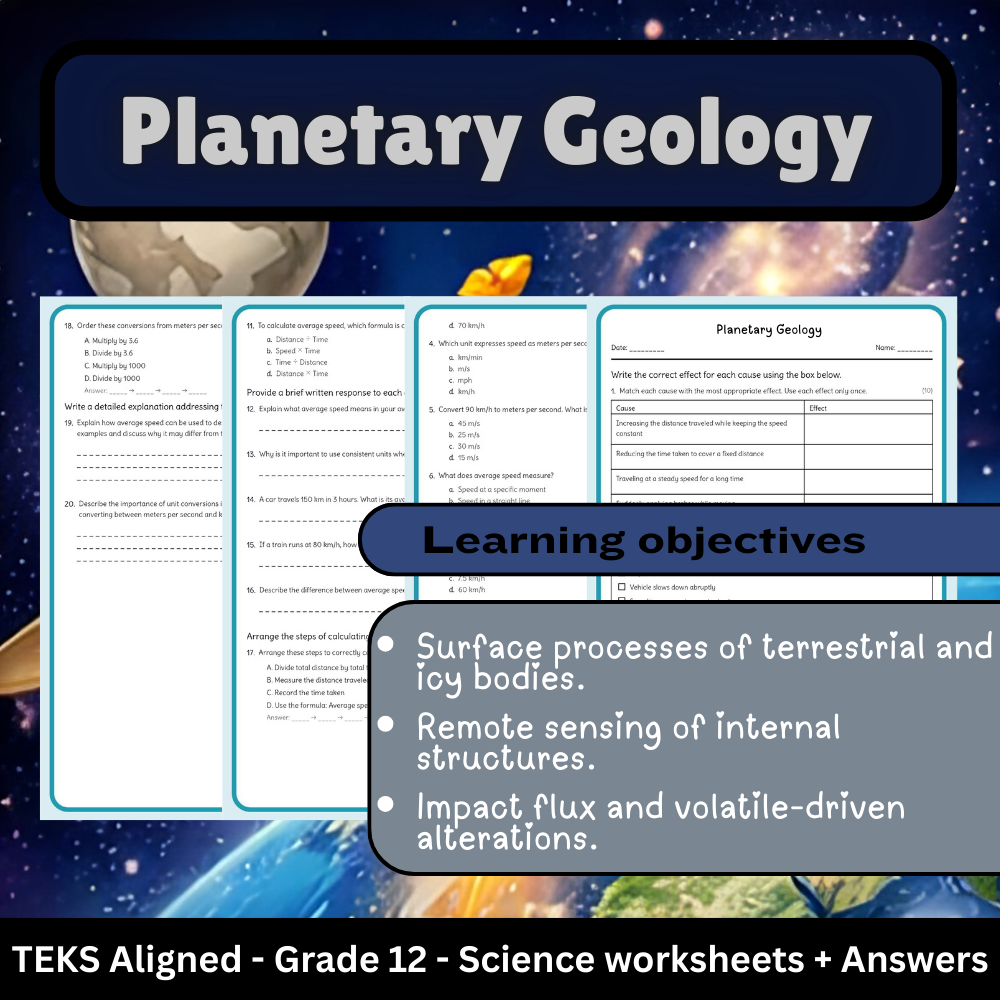
12th Grade Science | Planetary Geology Worksheet + Answer Key (TEKS Standards)
Created byBright Mind ResourcesLearning Objectives
- Compare surface processes of terrestrial and icy bodies beyond Earth.
- Analyze internal structure indicators and geologic history evidence from remote sensing and sample analysis.
- Evaluate impact flux, endogenic activity, and volatile-driven alterations in shaping planetary surfaces.
Instant download
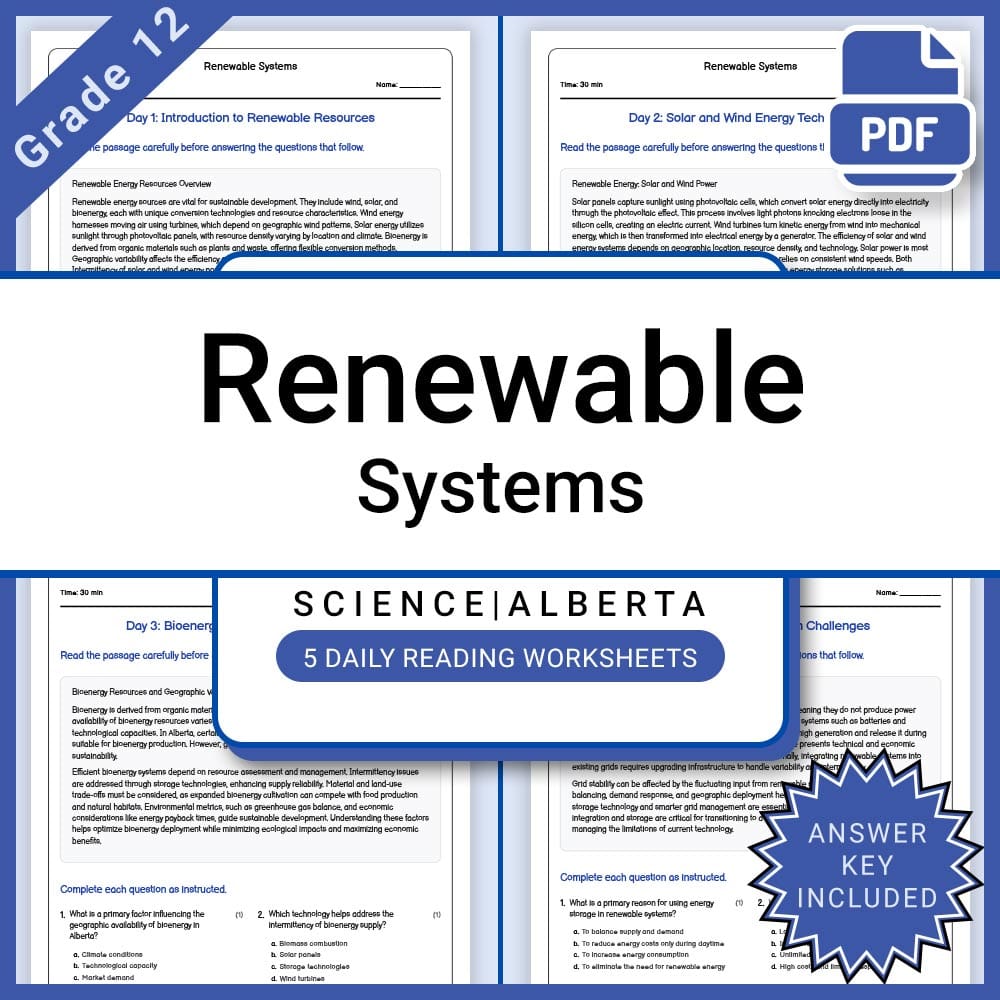
Grade 12 Science – Renewable Systems Daily Reading Worksheet + Answer Key
JCreated byJ.S SheetsLearning Objectives
- Identify different types of renewable energy sources such as wind, solar, and bioenergy.
- Understand the basic principles behind each renewable energy technology.
- Recognize geographic factors affecting resource availability.
Also included in: Grade 12 Science Lesson Bundle | Alberta Framework and Real-World Applications +1 more
Instant download
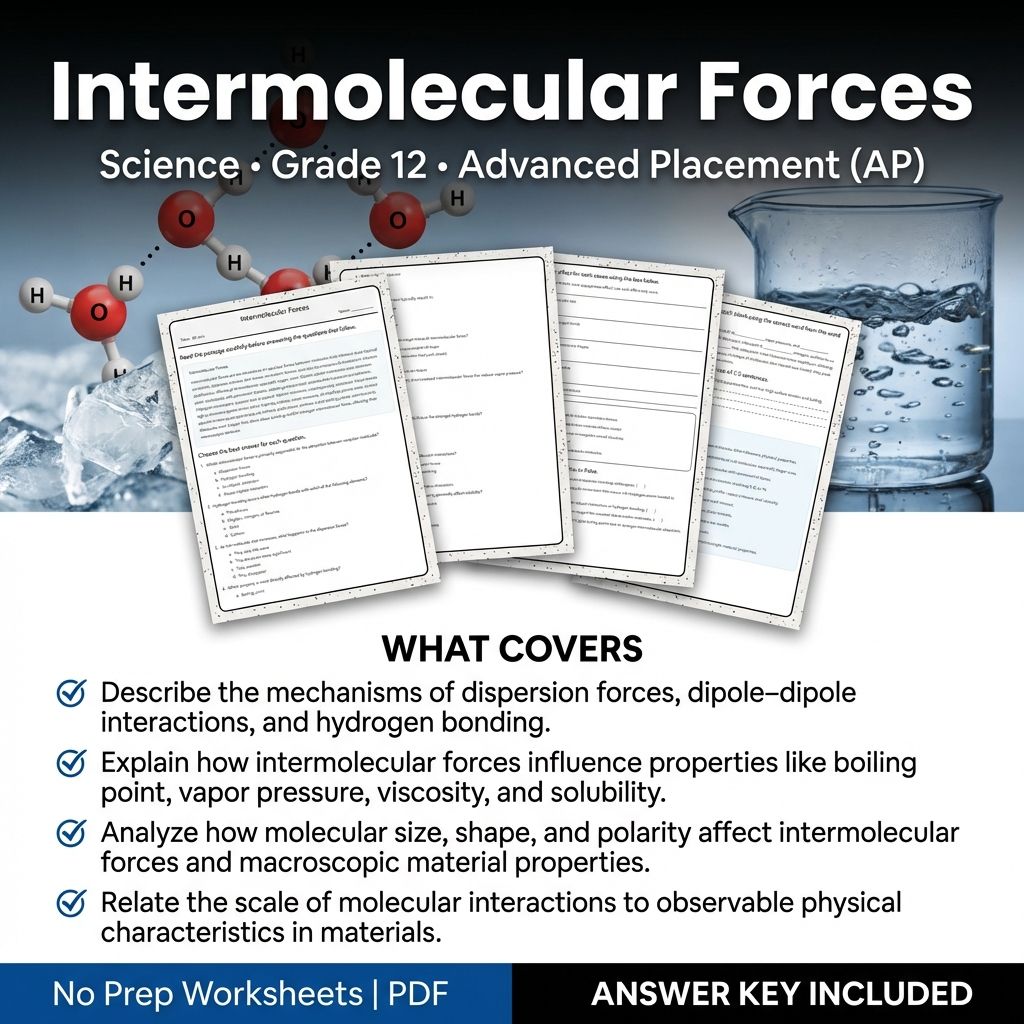
12th Grade Science | Intermolecular Forces Worksheet & Answer Key (Printable PDF)
Created byCoral Reef LearningLearning Objectives
- Describe the mechanisms of dispersion forces, dipole–dipole interactions, and hydrogen bonding.
- Explain how intermolecular forces influence properties like boiling point, vapor pressure, viscosity, and solubility.
- Analyze how molecular size, shape, and polarity affect intermolecular forces and macroscopic material properties.
Also included in: Grade 12 Science Unit Worksheet Bundle – Advanced Chemistry Concepts & Topics +1 more
Instant download
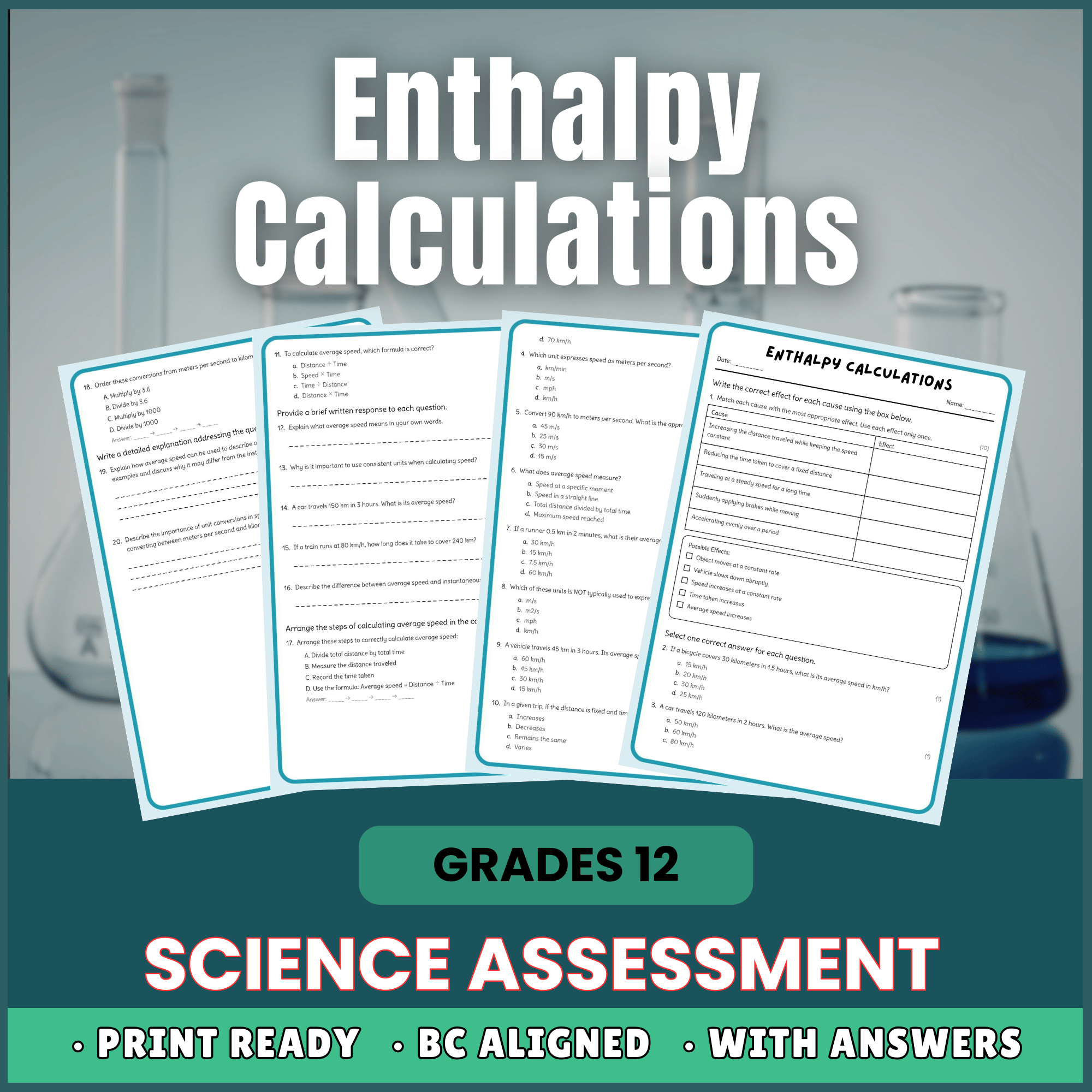
Grade 12 Science – Enthalpy Calculations Worksheet (Answer Key) | BC Standards
Created byBright Mind ResourcesLearning Objectives
- Understand how standard enthalpies of formation and combustion are used to calculate reaction enthalpies.
- Apply algebraic methods consistent with Hess's law to determine reaction enthalpies.
- Estimate reaction enthalpies using bond enthalpies and compare different energetic pathways.
Instant download
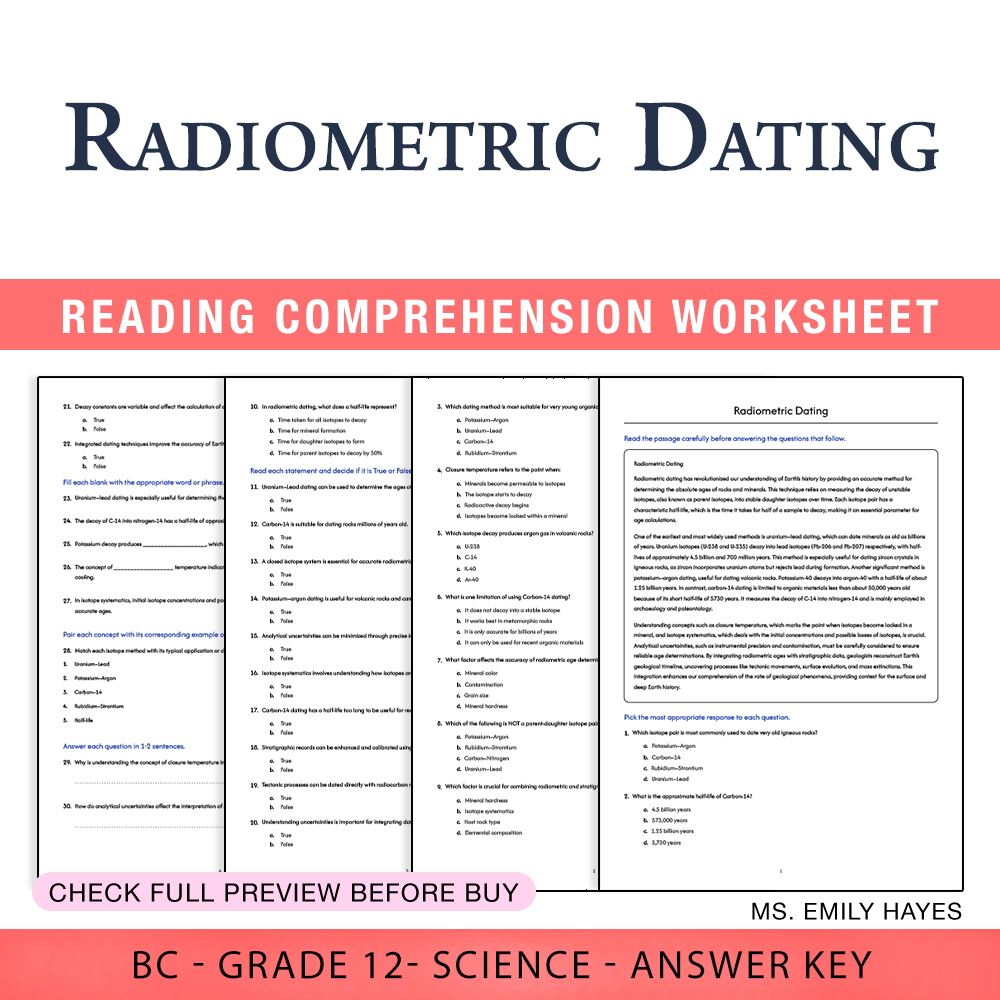
12th Grade Science | Radiometric Dating Worksheet (PDF + Answer Key)
Created byCopper Leaf ClassroomLearning Objectives
- Understand the principles of radiometric dating and isotope decay.
- Identify different radiometric methods and their applications in geology.
- Explain how isotopic systematics and uncertainties impact age calculations.
Also included in: Grade 12 Science BC | Earth Structures & Geology Bundle (PDF+ Answer Keys) +1 more
Instant download

Grade 12 Science | Systems Overview in Earth Science - Reading Comprehension
Created byCoral Reef LearningLearning Objectives
- Identify the major components of the Earth's atmosphere and understand their functions.
- Explain energy transfer processes within the atmosphere and between the atmosphere and other Earth systems.
- Describe the role of atmospheric fluxes in Earth's climate and biogeochemical cycles.
Also included in: Earth and Space Sciences Lesson Bundle | Grade 12 Science AP +1 more
Instant download

Rock Cycle Worksheet | Standards-Aligned Science Practice for Grade 12
JCreated byJ.S SheetsLearning Objectives
- Describe the processes involved in the rock cycle and how they transform different rock types.
- Identify key processes such as melting, weathering, erosion, and metamorphism in the rock cycle.
- Explain how surface and subsurface processes contribute to landscape evolution over geologic time.
Instant download
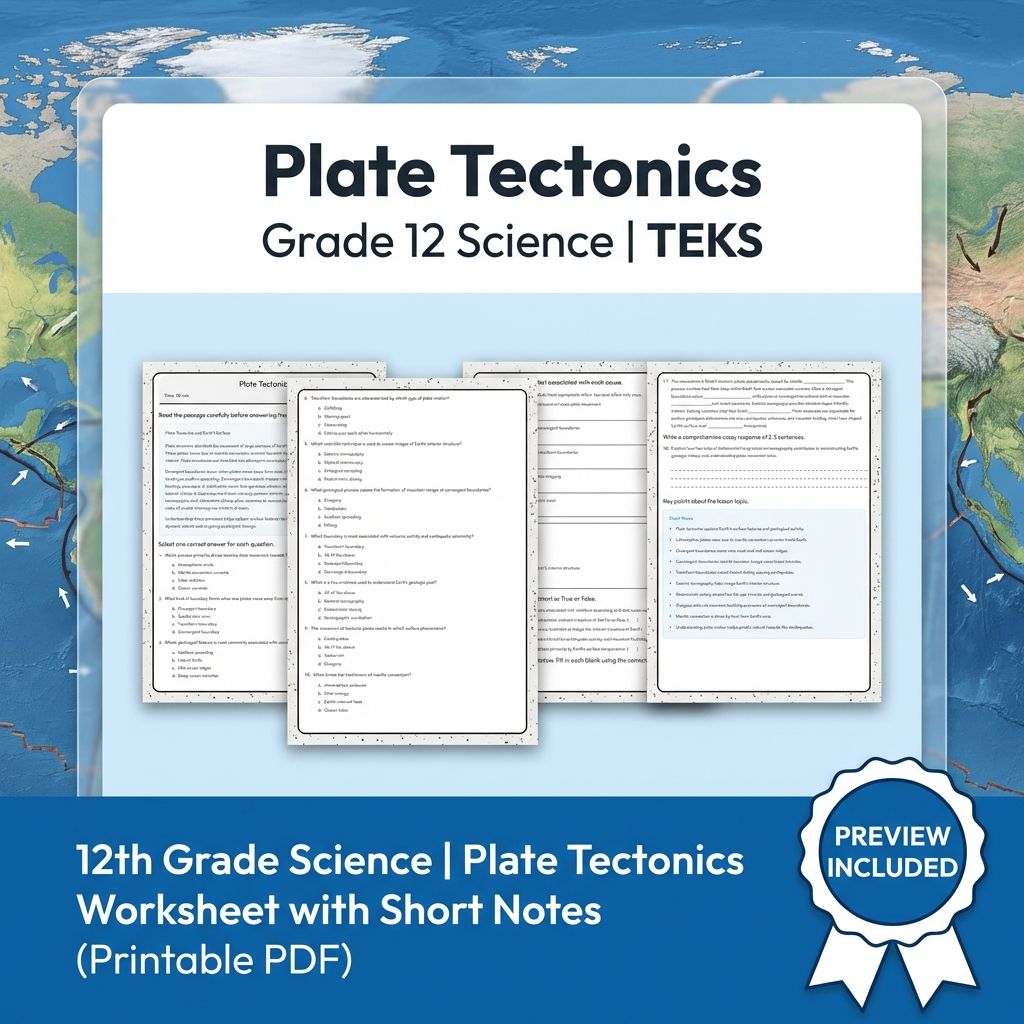
12th Grade Science | Plate Tectonics Worksheet with Short Notes (PDF)
Created byMeadowlark WorksheetsLearning Objectives
- Explain the mechanisms driving plate movements, including mantle convection and isostasy.
- Identify different types of plate boundaries and their surface geological features.
- Describe the methods used to reconstruct Earth's geologic history, such as radiometric dating and seismic tomography.
Also included in: Grade 12 Science Unit Bundle – Earth Systems & Space Topics (Worksheets) +2 more
Instant download
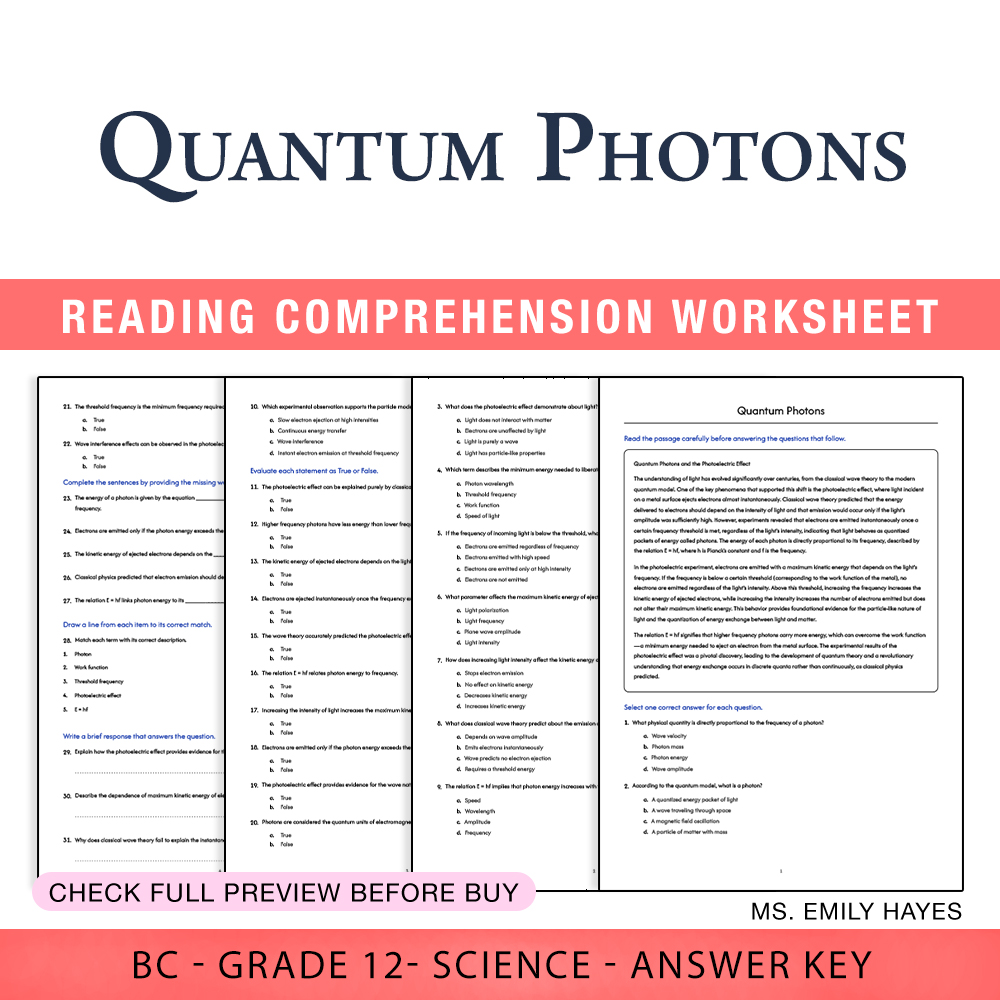
12th Grade Science | Quantum Photons Worksheet (PDF+ Answer Key)
Created byCopper Leaf ClassroomLearning Objectives
- Explain the concept of photon energy and its relation to frequency (E = hf).
- Describe the photoelectric effect and its significance in demonstrating quantized energy exchange.
- Define key terms such as work function and threshold frequency.
Also included in: Grade 12 Science BC– Physics, Quantum, and Energy Concepts (PDF+ Answer Keys) +1 more
Instant download
Grade 12 Science | Photoelectric Effect Worksheet (PDF) – Alberta Standard
Created byBright Mind ResourcesLearning Objectives
- Explain the principles underlying the photoelectric effect and its significance in quantum physics.
- Analyze how photon energy relates to work function and emitted electron kinetic energy.
- Interpret experimental data such as threshold frequency and stopping potential to demonstrate particle-like behavior of light.
Instant download
12th Grade Science | Bonding Structures Worksheet (PDF+ Answer Key)
Created byCopper Leaf ClassroomLearning Objectives
- Compare and classify ionic, covalent, and metallic bonding based on electrostatic interactions, lattice energy, polarity, and bond order.
- Interpret Lewis structures, assess formal charges, and determine molecular shapes using VSEPR theory to explain polarity and intermolecular forces.
- Relate bonding types to macroscopic properties such as melting point, conductivity, and solubility through lattice models and molecular orbital concepts.
Instant download
12th Grade Science | Entropy & Gibbs Free Energy Reading Worksheet (PDF)
JCreated byJ.S SheetsLearning Objectives
- Explain how entropy quantifies energy dispersal and microstates in a system.
- Describe how Gibbs free energy predicts the spontaneity of chemical reactions.
- Analyze the relationship between enthalpy, entropy, and temperature in Gibbs free energy.
Instant download

Genomic Technologies Worksheet | Grade 12 Science Practice
Created byPrism Point LearningLearning Objectives
- Explain how PCR, DNA sequencing, cloning, and CRISPR–Cas editing are used to analyze and modify genetic material
- Interpret genomic data by linking sequencing errors, SNPs, and copy number variation to inheritance and diagnosis
- Evaluate ethical considerations and limitations when using genomic technologies
Also included in: Population Genetics & Evolution Lesson Bundle: Grade 12 Science TEKS
Instant download

Grade 12 Science | Kinematic Relationships Worksheet | California Standards
Created byLumora LearningLearning Objectives
- Understand the mathematical relationships connecting position, velocity, and acceleration in motion.
- Explain how constant acceleration models predict trajectories and timing of moving objects.
- Analyze the influence of initial conditions on motion patterns using equations and graphs.
Instant download
12th Grade Science | Molecular Geometry Reading Worksheet & Answer Key (PDF)
JCreated byJ.S SheetsLearning Objectives
- Understand the principles of valence-shell electron-pair repulsion (VSEPR) theory to predict molecular shapes.
- Describe how hybridization affects molecular geometry and bond angles.
- Relate molecular geometry and polarity to observable properties such as dipole moments and intermolecular forces.
Also included in: Grade 12 Science Unit Bundle | Atomic Structure & Chemical Reactions Worksheets +1 more
Instant download
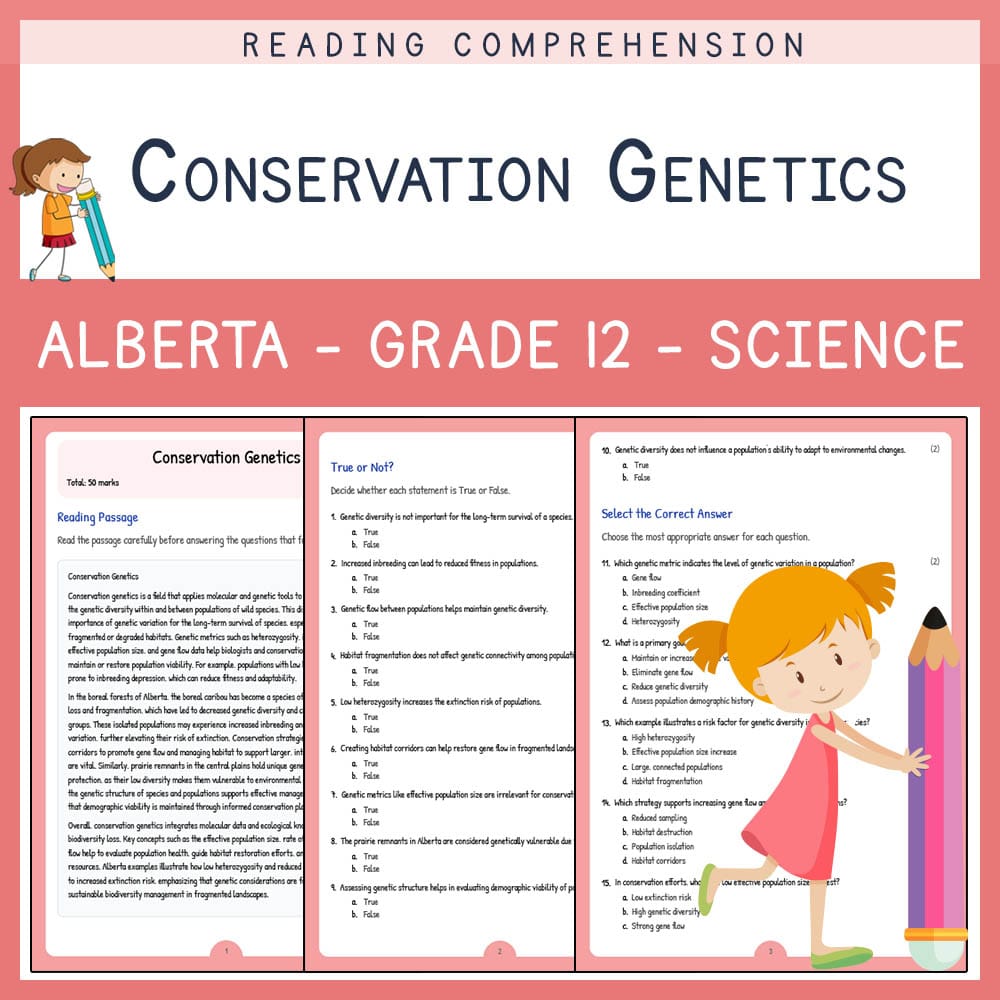
Grade 12 Science | Conservation Genetics Worksheet | Alberta Standards
Created byLumora LearningLearning Objectives
- Understand the application of molecular markers and genetic theory in conservation efforts.
- Recognize genetic metrics such as heterozygosity, population size, and gene flow in fragmented populations.
- Evaluate how genetic diversity impacts population survival and informs conservation strategies.
Also included in: Grade 12 Science | Biology Worksheet Pack Custom Bundle | Alberta
Instant download

12th Grade Science | Population Genetics Worksheet with Short Notes (PDF)
Created byMeadowlark WorksheetsLearning Objectives
- Understand the mathematical models describing allele and genotype frequency changes in populations.
- Interpret measures of genetic variation such as heterozygosity, fixation indices, and effective population size.
- Analyze case studies involving microevolutionary processes like genetic drift and migration.
Also included in: Grade 12 Science Unit Bundle | Genetics, Evolution & Cell Biology Worksheets +2 more
Instant download
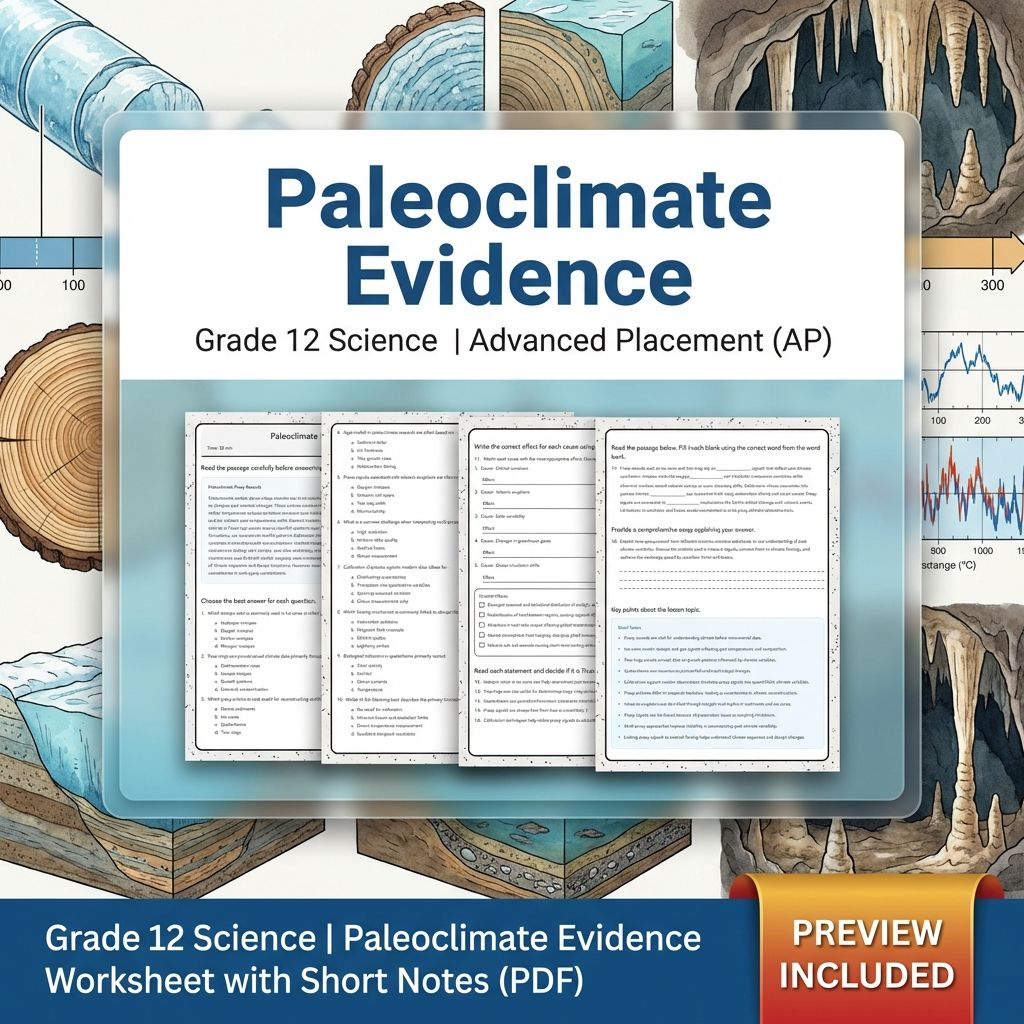
Grade 12 Science | Paleoclimate Evidence Worksheet with Short Notes (PDF)
Created byMeadowlark WorksheetsLearning Objectives
- Interpret proxy records from ice cores, sediments, tree rings, and speleothems to understand past climate variability.
- Identify isotopic, chemical, and biological indicators used in paleoclimate reconstruction.
- Connect proxy signals to climate forcings like orbital cycles and volcanic events.
Also included in: Grade 12 Science Unit Bundle: Earth Systems, Climate & Tectonics Worksheet Pack +1 more
Instant download
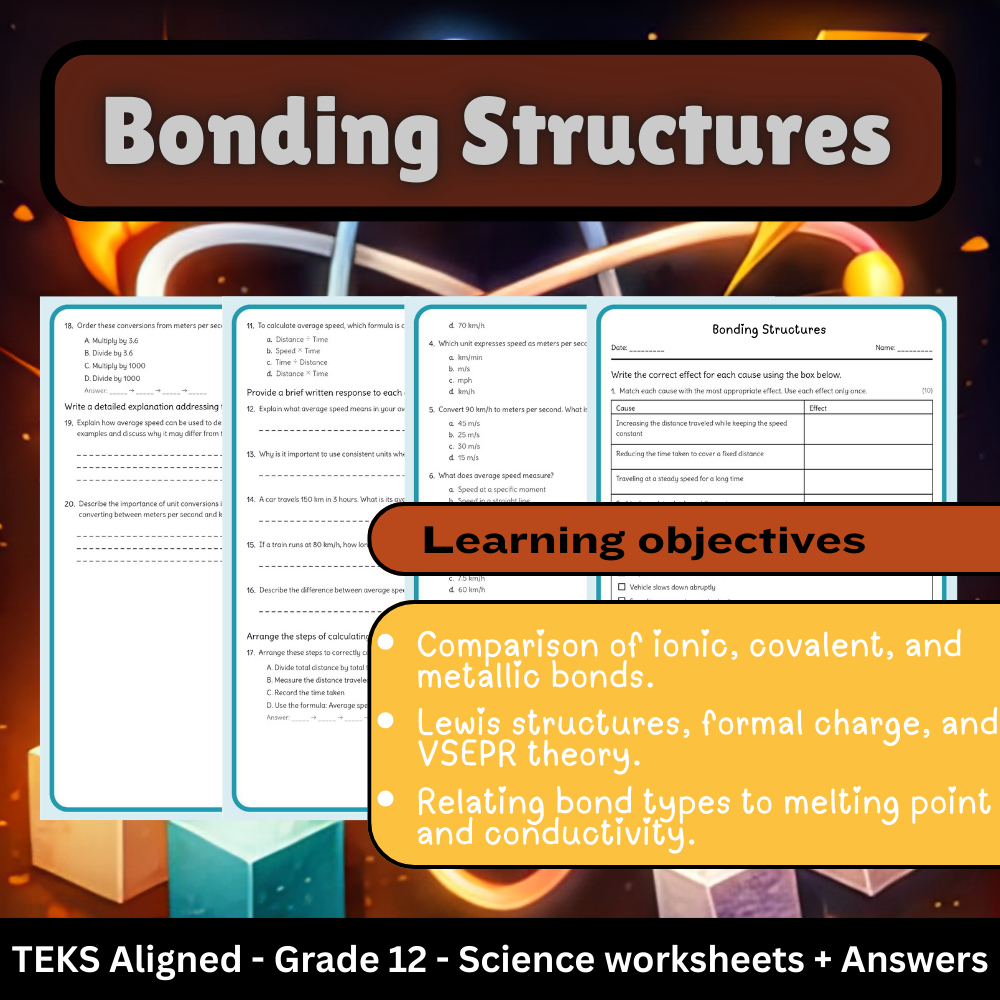
Grade 12 Science – Bonding Structures Worksheet + Answer Key (TEKS Aligned PDF)
Created byBright Mind ResourcesLearning Objectives
- Classify and compare ionic, covalent, and metallic bonding based on electrostatic interactions, lattice energy, polarity, and bond order.
- Draw Lewis structures, assess formal charge, and explain VSEPR-derived molecular shapes to rationalize molecular polarity and intermolecular forces.
- Relate bonding types to macroscopic properties such as melting point, conductivity, and solubility using lattice models and molecular orbital concepts.
Instant download
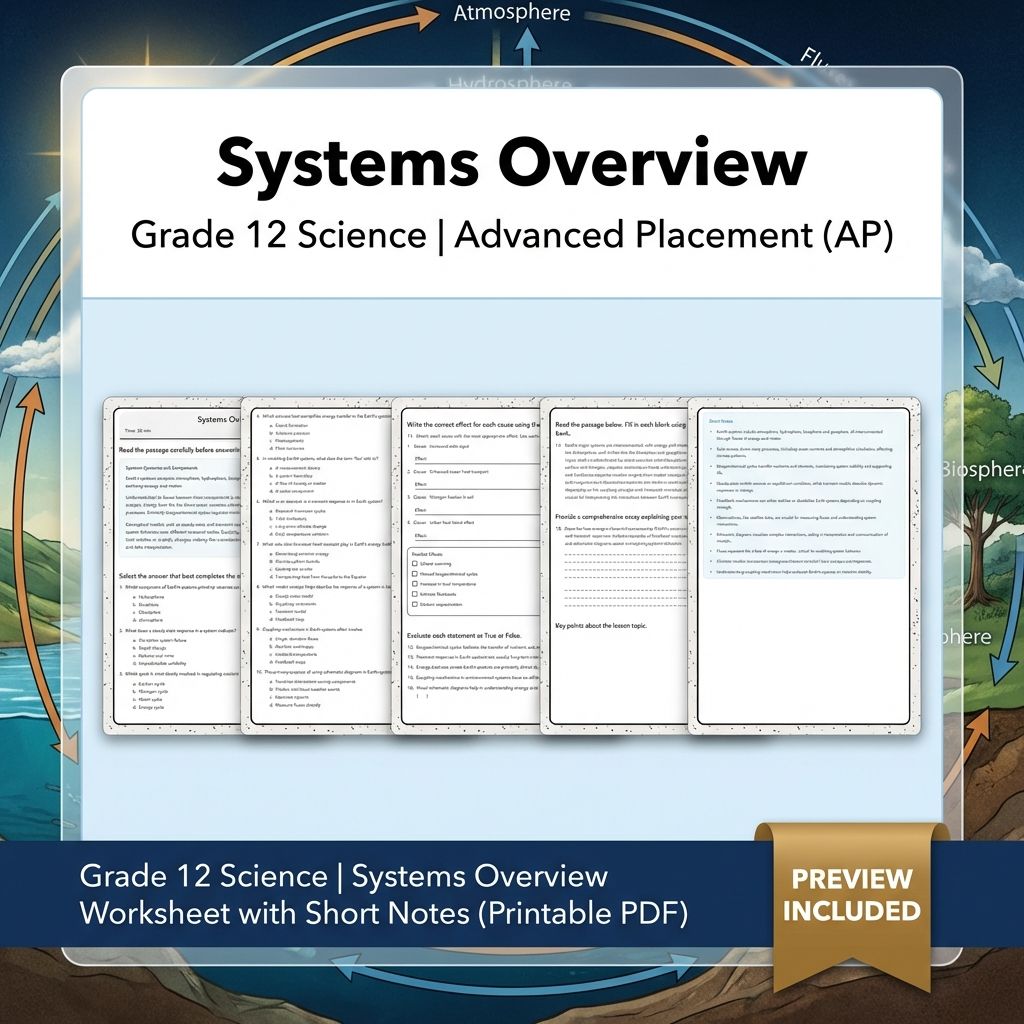
Grade 12 Science | Systems Overview Worksheet with Short Notes (Printable PDF)
Created byMeadowlark WorksheetsLearning Objectives
- Identify major Earth system components and understand their fluxes across atmosphere, hydrosphere, biosphere, and geosphere.
- Explain how energy and mass balance models link solar input, ocean heat transport, and biogeochemical cycles.
- Describe steady-state and transient responses of Earth systems and the coupling mechanisms involved.
Also included in: Grade 12 Science Unit Bundle: Earth Systems, Climate & Tectonics Worksheet Pack +1 more
Instant download
About Grade 12 Science Worksheets
Explore Grade 12 Science worksheets for classwork, homework, or review. Our 4,240 printables download instantly as PDFs.
MyTeachingSheets worksheets are made by real teacher-authors and checked before they go live. Download any as a print-ready PDF for lessons, homework, or independent practice — most include answer keys, and previews are always free.