
Grade 12 Science Worksheets
4,240 worksheets
Atmospheric Dynamics Worksheet | TEKS Science Practice for Grade 12
JCreated byJ.S SheetsLearning Objectives
- Explain how atmospheric composition, pressure gradients, and thermal structure drive large-scale circulation patterns
- Describe the roles of the Coriolis force, Hadley and Ferrel cells, and jet streams in shaping weather and climate
- Use concepts of atmospheric stability, lapse rates, and radiative heating to connect short-term weather variability to climate patterns
Instant download
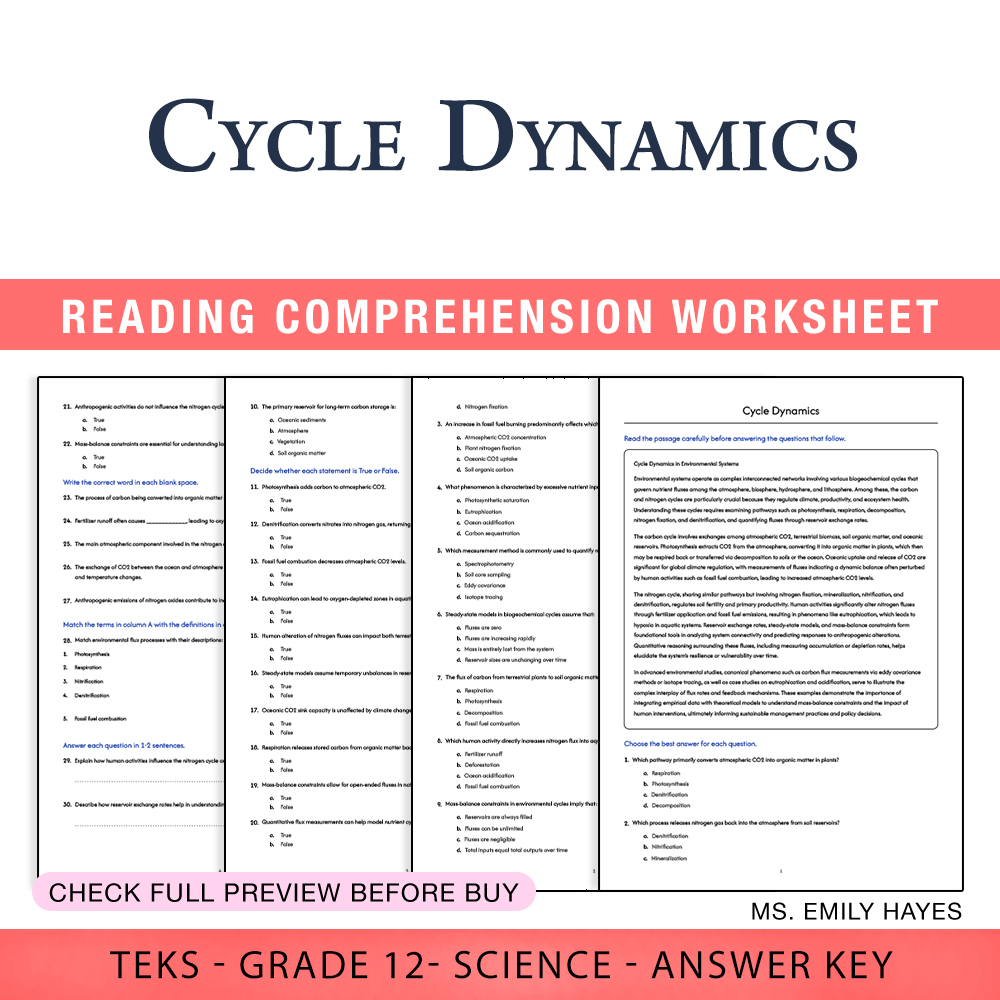
12th Grade Science | Cycle Dynamics Worksheet (PDF+ Answer Key)
 Created byCopper Leaf Classroom
Learning Objectives
- Describe the pathways and fluxes of carbon and nitrogen within environmental systems.
- Analyze the effects of human activities like fossil fuel combustion and fertilizer runoff on biogeochemical cycles.
- Apply reservoir exchange rates and steady-state concepts to model nutrient fluxes.
Instant download
Grade 12 Science | Technology Choice Impacts Worksheet with Short Notes
 Created byMeadowlark Worksheets
Learning Objectives
- Understand how technology choices influence system behavior in efficiency, safety, sustainability, and reliability.
- Identify different impacts of technology decisions on system performance.
- Analyze cause-and-effect relationships related to technology impacts.
Also included in: Grade 12 Engineering Design & Technology Impacts Science Lesson Bundle +1 more
Instant download
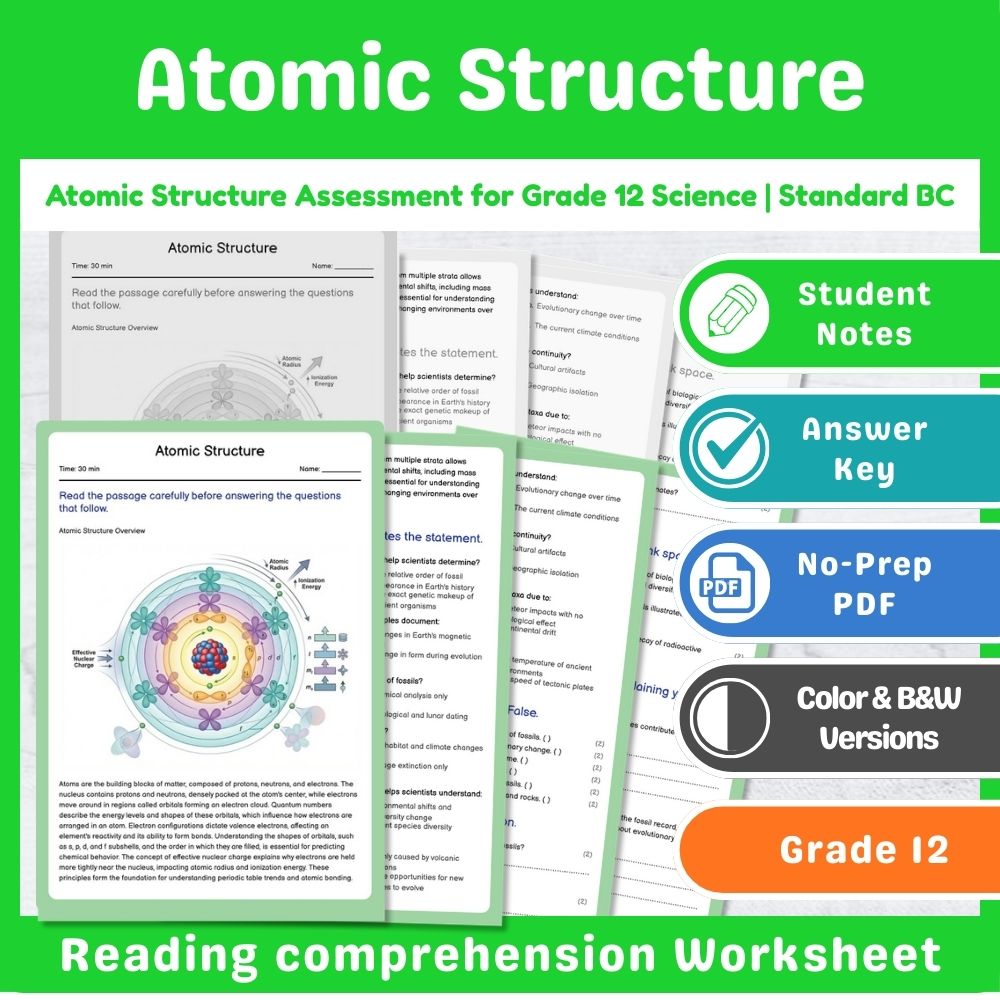
Atomic Structure Assessment for Grade 12 Science | Standard BC
 Created byPrism Point Learning
Learning Objectives
- Describe the components of the atomic model, including protons, neutrons, and electrons.
- Explain electron configurations and their influence on element reactivity.
- Analyze orbital shapes, subshell filling order, and effective nuclear charge.
Also included in: Grade 12 Science Mini Bundle – Thermochemistry & Equilibrium Assessment
Instant download

High School Biology | Biodiversity Conservation Worksheet (PDF) TEKS Aligned
 Created byEvergreen Desk Education
Learning Objectives
- Explain major patterns and causes of biodiversity loss, including habitat fragmentation, invasive species, overexploitation, and climate change.
- Compare species richness, evenness, functional diversity, and genetic diversity as different measures of biodiversity.
- Evaluate conservation strategies such as protected areas, restoration ecology, and genetic management using real-world examples.
Instant download

Grade 12 Science | Resource Systems Worksheet Elena | AP Aligned
 Created byLumora Learning
Learning Objectives
- Analyze interactions between geologic resources, extraction processes, and societal demands.
- Describe ore deposit models, aquifer properties, and basin maturation.
- Evaluate trade-offs among resource availability, environmental impact, and technological adaptation.
Also included in: Grade 12 Science | Earth Systems Science Custom Bundle | AP Aligned
Instant download

Science Grade 12 Adaptation Over Time Worksheet | NGSSS Standards Activity
JCreated byJ.S SheetsLearning Objectives
- Explain how heritable variation and fitness lead to changes in allele frequencies over generations
- Differentiate directional selection from selection that varies across habitats
- Analyze how ecological context influences the specific traits favored by natural selection
Also included in: Grade 12 Genetics, Evolution & Ecosystems Science Lesson Bundle | Florida NGSSS +1 more
Instant download

Wave Behavior Practice Worksheet Pack AP Physics Grade 12 Waves
Created byPrism Point LearningLearning Objectives
- Describe periodic wave motion using amplitude, wavelength, frequency, and phase relationships.
- Use the superposition principle to predict interference patterns for waves on strings and in air.
- Explain standing-wave formation with boundary conditions and relate mode structure to resonance frequencies.
Also included in: AP Physics Grade 12 Science Mechanics & Electricity Lesson Bundle | AP
Instant download

Grade 12 Science – Heat, Work & Change Reading Worksheet | California Standards
 Created byBright Mind Resources
Learning Objectives
- Understand how heat transfers energy without changing matter
- Identify different energy transfer mechanisms in thermodynamics
- Link thermodynamic variables to observable effects such as expansion and phase change
Also included in: Energy Grade 12 Science Daily Reading Worksheets Lesson Bundle | CA Standards +1 more
Instant download

Conservation Heat Assessment | General Standards 12th Grade Science
Created byPrism Point LearningLearning Objectives
- Explain how energy conservation applies to thermal processes between a system and its surroundings.
- Use calorimetry reasoning to relate temperature change to heat transfer using mass and specific heat.
- Apply sign conventions for heat gained and heat lost in closed systems involving physical and chemical changes.
Instant download

Grade 12 Atomic Spectra Worksheet | Practice & Review PDF
 Created byClear Sky Classroom
Learning Objectives
- Explain how atomic spectra arise from quantized electronic energy transitions
- Use spectral line patterns to infer element identity and related atomic structure information
- Describe how selection rules and line broadening affect observed emission/absorption spectra
Instant download

Senior Design Worksheet | Grade 12 Science Activities
Created byPrism Point LearningLearning Objectives
- Frame a senior design research question and define measurable variables for field or laboratory testing.
- Apply controlled comparisons by managing variables and choosing appropriate instrumentation for air or water monitoring.
- Use statistical reasoning to assess significance, quantify error/uncertainty, and document reproducible, ethical data handling.
Also included in: Grade 12 Science Lesson Bundle | Alberta STSE, Systems & Design
Instant download

Grade 12 Science | Orbital Motion Models - Daily Reading Comprehension
 Created byCoral Reef Learning
Learning Objectives
- Understand the basic principles of planetary orbits and gravitational forces.
- Identify key characteristics of orbital paths and motions.
- Recognize how gravity influences the motion of planets and satellites.
Instant download

Hierarchical Cell Systems Worksheet Grade 12 Biology Organization Cells
Created byPrism Point LearningLearning Objectives
- Explain how multicellular organization works from cell to tissue to organ to organ system.
- Describe how specialized structures at each level support coordinated body functions.
- Evaluate how disruption at one level can affect system-level stability, growth, and health.
Instant download

Reaction Evidence Assessment | Florida NGSSS Grade 12 Science
Created byPrism Point LearningLearning Objectives
- Identify multiple types of evidence that indicate a chemical reaction has occurred.
- Explain reaction evidence using particle-level reasoning and conservation of atoms.
- Distinguish endothermic and exothermic processes based on temperature changes.
Also included in: Grade 12 Momentum, Energy, and Reactions Science Assessment Lesson Bundle – Florida NGSSS +1 more
Instant download

Historical Context Worksheet for Grade 12 Science | TEKS Aligned Practice
JCreated byJ.S SheetsLearning Objectives
- Explain how empirical evidence, institutions, and economic forces influence whether scientific innovations are adopted by society.
- Analyze historical examples (germ theory, vaccines, the Green Revolution, and digital technologies) for patterns of technological diffusion and public perception.
- Evaluate how unintended consequences and policy choices can change long-term outcomes of scientific advancements.
Instant download

Grade 12 Science – Cosmic Distance Scale & Methods | Daily Reading Worksheet
Created byBright Mind ResourcesLearning Objectives
- Understand how apparent brightness relates to the distance of stars
- Identify different methods used to measure cosmic distances
- Explain the significance of redshift and standard candles in astronomy
Also included in: Grade 12 Earth & Space Science Daily Reading Worksheets Lesson Bundle | General +1 more
Instant download

Evidence-Based Explanations Worksheets: Scientific Reasoning Grade 12
 Created byBRIGHT PATH RESOURCES
Learning Objectives
- Construct claims supported by specific scientific evidence
- Explain how variables and controls support causal interpretations
- Evaluate alternative explanations against predictions and evidence
Also included in: Grade 12 Science Scientific Evidence & Experimental Design Bundle +4 more
Instant download
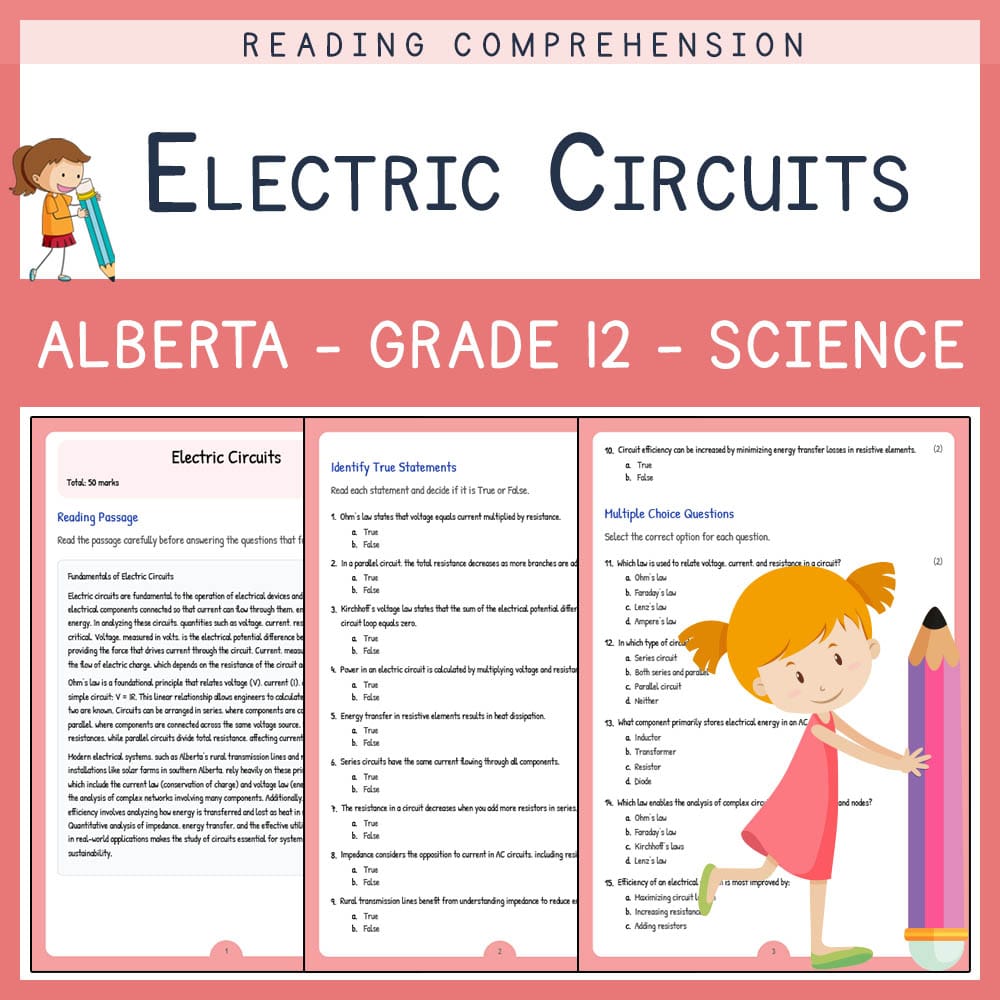
Grade 12 Science | Electric Circuits Worksheet | Alberta Standards
Created byLumora LearningLearning Objectives
- Understand the fundamental principles of electric circuits, including Ohm's law, series and parallel configurations.
- Analyze circuit quantities such as voltage, current, resistance, and power using quantitative laws.
- Apply Kirchhoff's rules to analyze complex circuits and understand energy transfer in resistive elements.
Also included in: Grade 12 Science | Physics Science Lesson Bundle Worksheet Set | Alberta
Instant download

Grade 12 Science – Meiosis & Genetic Diversity | Daily Reading Worksheet
Created byBright Mind ResourcesLearning Objectives
- Understand the key stages of meiosis
- Explain how crossing over and independent assortment increase genetic variation
- Recognize the importance of meiosis in maintaining chromosome number and promoting diversity
Also included in: Life Science Grade 12 Daily Reading Worksheets Lesson Bundle | Florida NGSSS +1 more
Instant download

Natural Selection Evidence Worksheets | Grade 12 Life Science
Created byBRIGHT PATH RESOURCESLearning Objectives
- Explain how natural selection changes allele frequencies
- Identify evidence that supports natural selection
- Connect heritable variation to reproductive success
Also included in: Grade 12 Science Genetics & Evolution Worksheets Lesson Bundle +4 more
Instant download

Membrane Dynamics Worksheet | AP Science Practice & Standards-Aligned
JCreated byJ.S SheetsLearning Objectives
- Describe the structure and organization of lipid bilayers and membrane proteins.
- Explain the mechanisms of passive and active transport across membranes.
- Analyze how electrochemical potentials influence membrane transport and cellular signaling.
Instant download

Grade 12 Science | Reasoned Claims in Scientific Discourse - Comprehension
Created byCoral Reef LearningLearning Objectives
- Understand how to formulate scientific claims grounded in evidence.
- Evaluate the strength and validity of scientific evidence.
- Apply logical frameworks to support scientific conclusions.
Also included in: Grade 12 Science Daily Reading Worksheets Full-Year Bundle | TEKS
Instant download

Grade 12 Science | Modeling Earth's Energy Balance - Daily Reading Comprehension
Created byCoral Reef LearningLearning Objectives
- Understand the concept of Earth's energy balance and how it influences climate.
- Interpret and analyze different models of energy flow in the Earth system.
- Evaluate the limitations and uncertainties associated with Earth system models.
Also included in: Earth and Space Sciences Lesson Bundle | Grade 12 Science AP +1 more
Instant download

Variable Mass Worksheet for Grade 12 Science | Standards-Aligned Practice
JCreated byJ.S SheetsLearning Objectives
- Explain how momentum conservation applies to systems with changing mass.
- Describe the relationship between mass flow rate, exhaust velocity, and vehicle acceleration.
- Analyze practical implications of variable mass in propulsion, staging, and energy costs.
Instant download

Phylogenetic Trees Worksheet | Grade 12 Science Activities
Created byPrism Point LearningLearning Objectives
- Explain how shared derived characters support hypotheses of evolutionary relationships in phylogenetic trees.
- Distinguish homologous similarities from analogous similarities caused by convergent evolution.
- Describe how molecular clock models and statistical methods can estimate divergence times and assess tree reliability.
Also included in: Evolution, Speciation & Genetics Lesson Bundle | Grade 12 Science | BC
Instant download

Energy Transformations Assessment for Grade 12 Science | TEKS Standards
Created byPrism Point LearningLearning Objectives
- Describe the biochemical pathways involved in energy capture and conversion in cells.
- Explain the processes of photosynthesis and cellular respiration, including light and dark reactions.
- Compare aerobic and anaerobic respiration pathways and their energy yields.
Also included in: Grade 12 Genetics and Evolution Science Lesson Bundle Unit | TEKS
Instant download

Grade 12 Science | Digitized Electromagnetic Signals - Reading Comprehension
Created byCoral Reef LearningLearning Objectives
- Understand the properties of electromagnetic waves
- Learn how electromagnetic signals transmit information
- Recognize the role of signal variations in encoding data
Instant download
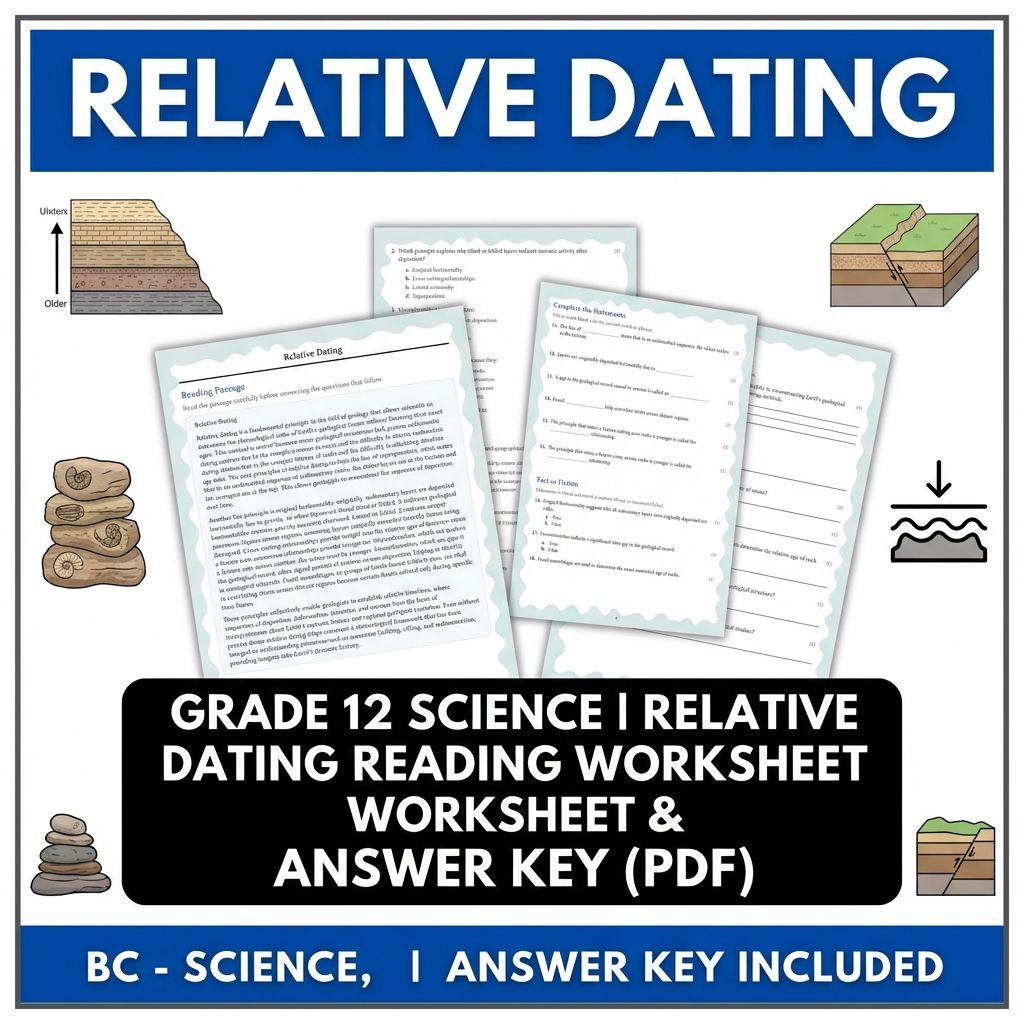
Grade 12 Science | Relative Dating Reading Worksheet & Answer Key (PDF)
JCreated byJ.S SheetsLearning Objectives
- Understand the principles of relative dating such as superposition, original horizontality, lateral continuity, and cross-cutting relationships.
- Explain how unconformities and fossil assemblages aid in correlating geological strata.
- Construct relative geologic timelines to interpret Earth's history in the absence of absolute ages.
Instant download

Grade 12 Geological Time Worksheet | BC Practice PDF
Created byClear Sky ClassroomLearning Objectives
- Explain how stratigraphy, fossil assemblages, and radiometric dating are used to organize Earth’s history into geological time intervals.
- Distinguish between relative dating and absolute dating methods in constructing timelines.
- Analyze how changes in the atmosphere, oceans, and biosphere can be interpreted through geological evidence across long time scales.
Instant download

Grade 12 Science | Population Dynamics Worksheet | BC-Aligned
Created byLumora LearningLearning Objectives
- Explain the key factors that influence population size, density, and age structure over time.
- Describe patterns of population growth such as exponential and logistic models.
- Identify interactions among populations like predation, competition, mutualism, and parasitism.
Also included in: Grade 12 | Biology 12 Science Custom Bundle (BC)| Genetics & Evolution
Instant download
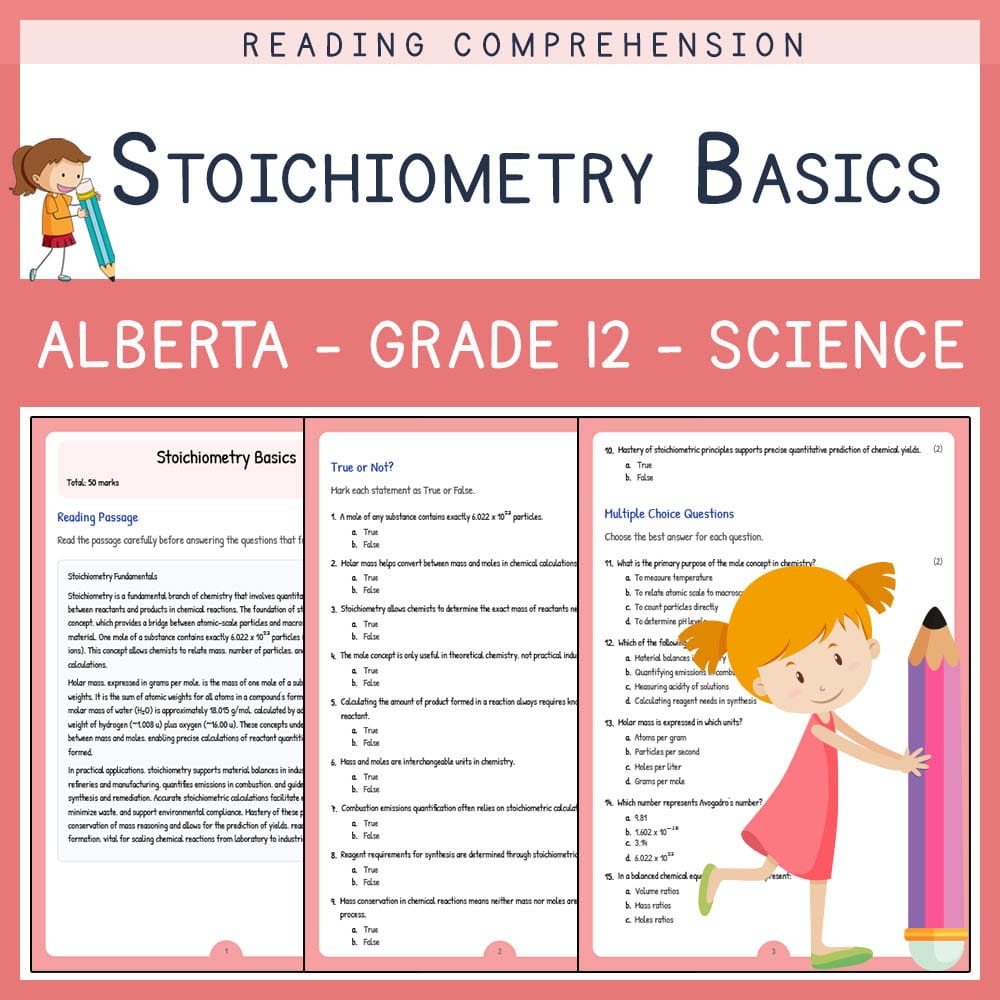
Grade 12 Science | Stoichiometry Basics Worksheet | Alberta Standards
Created byLumora LearningLearning Objectives
- Understand the mole concept and its significance in chemical calculations.
- Learn to calculate molar mass and convert between mass and moles.
- Apply mass and mole relationships to balanced chemical equations.
Instant download

Grade 12 Evidence for Evolution Worksheet | Practice & PDF
Created byClear Sky ClassroomLearning Objectives
- Explain how the fossil record, comparative morphology, biogeography, and molecular phylogenetics provide evidence for evolution
- Use homology, transitional forms, and congruent phylogenetic trees to support conclusions about common ancestry and evolutionary history
- Evaluate how different types of data can reinforce natural selection and speciation in real-world examples
Instant download

Thermochemistry Basics Worksheet | Grade 12 Science Activities
Created byPrism Point LearningLearning Objectives
- Explain how heat transfer during chemical reactions is quantified using enthalpy (ΔH).
- Differentiate exothermic and endothermic reactions based on the sign and magnitude of ΔH.
- Use calorimetry and specific heat concepts to relate temperature change to energy change.
Instant download
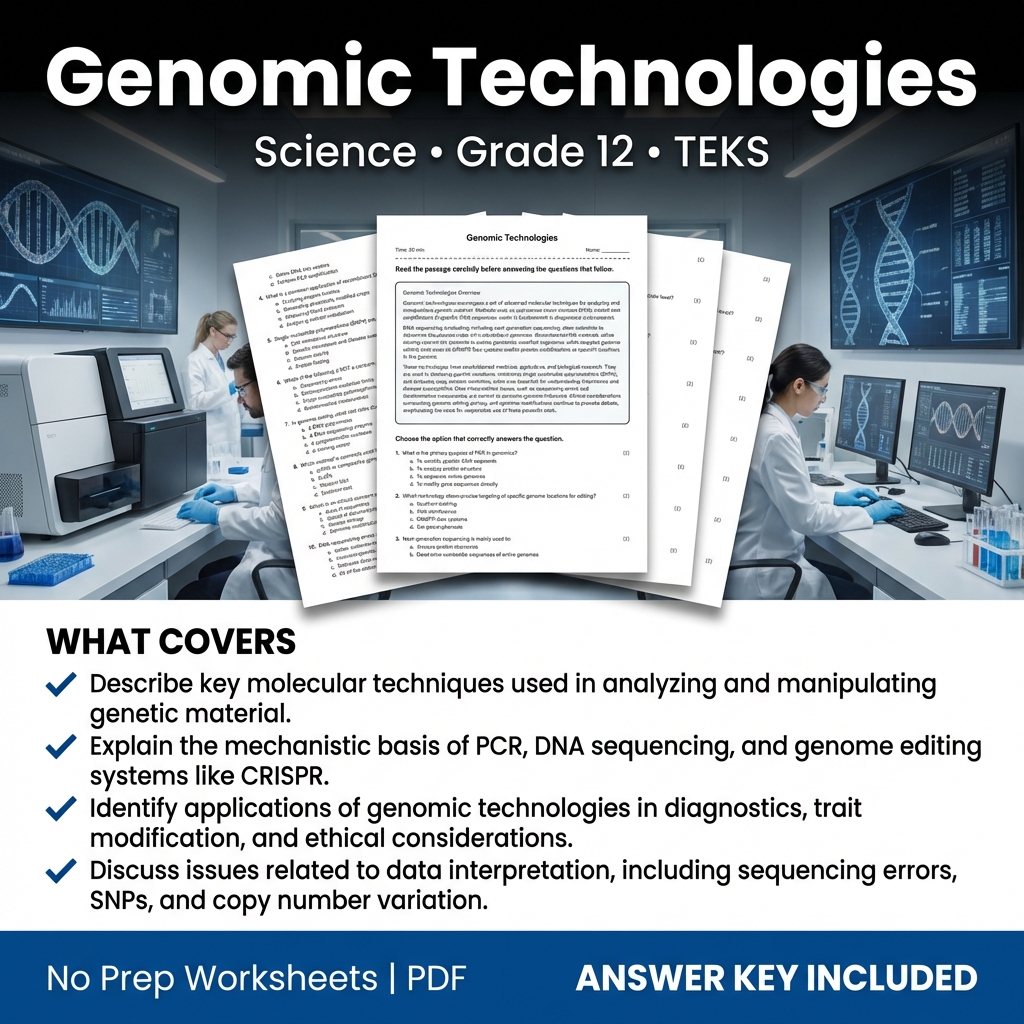
Genomic Technologies Worksheet for Grade 12 Science | TEKS aligned
Created byCoral Reef LearningLearning Objectives
- Describe key molecular techniques used in analyzing and manipulating genetic material.
- Explain the mechanistic basis of PCR, DNA sequencing, and genome editing systems like CRISPR.
- Identify applications of genomic technologies in diagnostics, trait modification, and ethical considerations.
Instant download

Grade 12 Science | Citation Ethics Worksheet | TEKS-Aligned
Created byLumora LearningLearning Objectives
- Understand principles of proper attribution and authorship in scientific publications.
- Recognize the importance of data provenance and persistent identifiers like DOIs.
- Identify ways to avoid plagiarism and maintain integrity in reporting research data.
Instant download

Grade 12 Science – Cycle Dynamics in Environmental Systems
JCreated byJ.S SheetsLearning Objectives
- Understand the pathways of carbon exchange among atmosphere, biosphere, oceans, and lithosphere.
- Analyze the processes of photosynthesis, respiration, and decomposition within biogeochemical cycles.
- Evaluate how human activities alter flux rates and affect system balance, including fossil fuel combustion and nutrient runoff.
Also included in: Grade 12 Science Lesson Bundle | Environmental Systems & Human Impact +1 more
Instant download

Grade 12 Science – Photosynthetic Systems & AP Daily Reading Worksheet
Created byBright Mind ResourcesLearning Objectives
- Identify the main pigments involved in photosynthesis and their organization within chloroplasts.
- Explain how pigments absorb light and transfer energy during photosynthesis.
- Understand the structure of photosynthetic membranes and the role of pigments within them.
Also included in: Grade 12 Evolution & Population Change Science Daily Reading Lesson Bundle | AP +2 more
Instant download
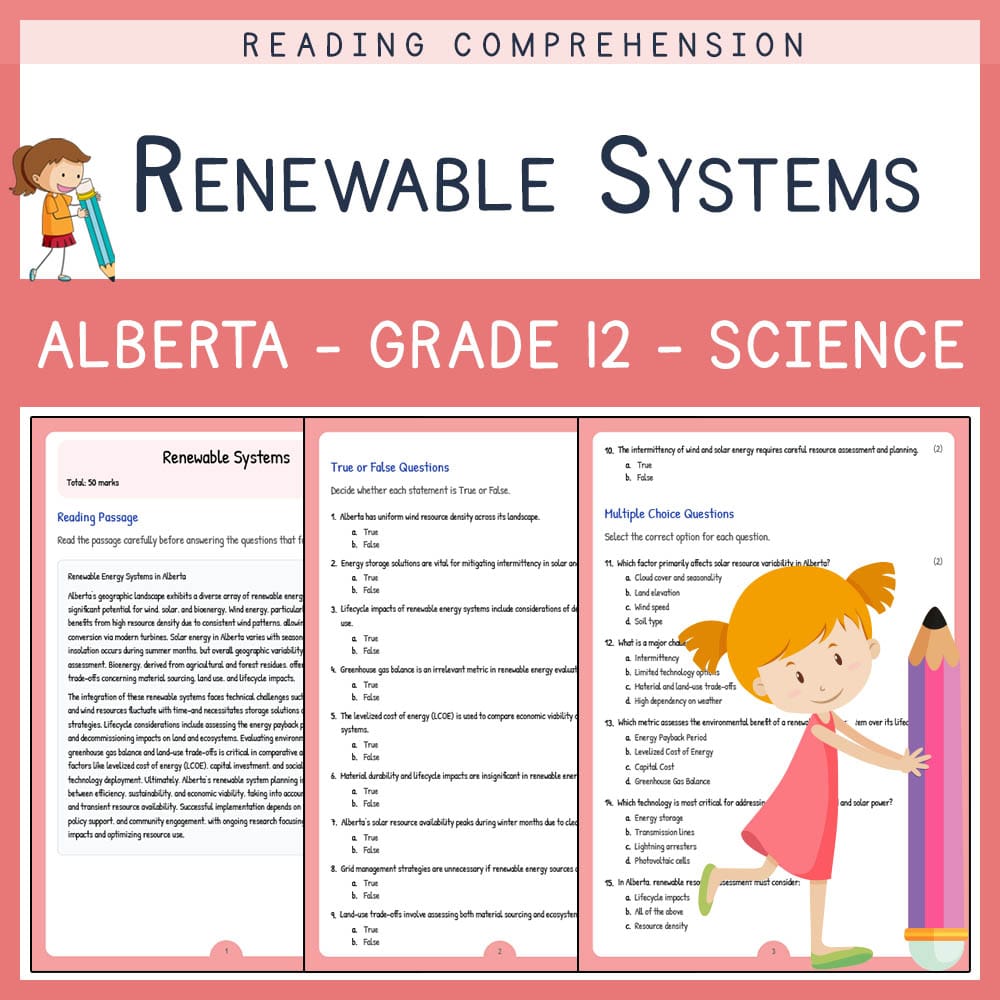
Grade 12 Science | Renewable Systems Worksheet | Alberta Standards
Created byLumora LearningLearning Objectives
- Understand the key concepts of resource assessment and conversion technologies for renewable energy in Alberta.
- Analyze challenges and lifecycle considerations of wind, solar, and bioenergy systems.
- Evaluate environmental and economic metrics used to compare renewable energy options.
Also included in: Grade 12 Science | Science Custom Bundle | Alberta Standards Worksheets
Instant download

Grade 12 Science | Newton's Second Law - Daily Reading Comprehension
Created byCoral Reef LearningLearning Objectives
- Define net force and explain its role in changing an object's motion.
- Describe how acceleration relates to net force and mass.
- Identify how multiple forces combine through vector addition.
Instant download

Digitized Electromagnetic Signals Worksheet | Grade 12 Physics Activity
Created byPrism Point LearningLearning Objectives
- Explain how digitization encodes information into electromagnetic signals using controlled signal variations
- Describe how electromagnetic waves carry energy through space while the data can be recovered from measurable signal properties
- Use evidence-based reasoning to connect frequency content and signal propagation to communication performance
Instant download

Grade 12 Science – Electron Configuration & Quantum Numbers | Reading Worksheet
Created byBright Mind ResourcesLearning Objectives
- Understand the principles of electron configuration and orbital filling order.
- Identify the orbitals filled in different elements based on quantum numbers.
- Apply Hund’s rule and recognize exceptions in transition elements.
Also included in: Grade 12 Chemistry Daily Reading Science Lesson Bundle | AP Standards +2 more
Instant download

Grade 12 Science | Energy and Matter Flow Worksheet Elena | California Standards
Created byLumora LearningLearning Objectives
- Explain how energy flows through ecosystems and decreases at higher trophic levels.
- Describe the cycling of chemical elements among producers, consumers, and decomposers.
- Analyze the role of food webs in transferring energy and nutrients.
Instant download

Quantum Photons Worksheet | Grade 12 Science Practice
Created byPrism Point LearningLearning Objectives
- Explain how photon energy relates to frequency using E = hf
- Describe the photoelectric effect using work function and threshold frequency
- Compare classical wave predictions with experimental evidence for quantized energy exchange
Also included in: Waves, Quantum & Electromagnetism Lesson Bundle | Grade 12 Science | BC
Instant download

Grade 12 Science – Gravitational Fields & Energy | Daily Reading Worksheet
Created byBright Mind ResourcesLearning Objectives
- Define gravitational fields and describe their properties
- Explain how gravitational potential and potential energy are related in two-body systems
- Describe how field strength varies with distance from a mass source
Also included in: Grade 12 Physics Energy & Fields Science Lesson Bundle: Daily Reading | BC +1 more
Instant download

Grade 12 Science Surface Processes Worksheet (AP) – Science 1 (PDF)
Created byBright Mind ResourcesLearning Objectives
- Describe the main surface processes such as weathering, erosion, transport, and deposition that shape landscapes.
- Explain how climate, vegetation, and tectonic activity influence rates of surface change.
- Analyze process-response diagrams and sediment budgets to understand landscape evolution.
Instant download

Grade 12 Science | Technology Choice Impacts Worksheet | General Standards
Created byLumora LearningLearning Objectives
- Explain how technology choices affect efficiency, safety, sustainability, and reliability in real systems.
- Identify key trade-offs among efficiency, safety, sustainability, and reliability when selecting technologies.
- Use cause-and-effect reasoning to predict how design changes can influence system performance over time.
Instant download

Grade 12 Science | Cell Division Worksheet (TEKS) PDF
Created byEvergreen Desk EducationLearning Objectives
- Compare mitosis and meiosis in terms of chromosome behavior, division steps, and resulting ploidy.
- Explain how homologous recombination (crossing over) increases genetic variation.
- Analyze how nondisjunction and chromosome segregation errors lead to aneuploidy and altered phenotypes.
Instant download
About Grade 12 Science Worksheets
Explore Grade 12 Science worksheets for classwork, homework, or review. Our 4,240 printables download instantly as PDFs.
MyTeachingSheets worksheets are made by real teacher-authors and checked before they go live. Download any as a print-ready PDF for lessons, homework, or independent practice — most include answer keys, and previews are always free.