
Grade 6 Worksheets
8,582 grade resources
Grade 6 Holiday | Securing Personal Data Worksheet | January Standards
 Created byLumora Learning
Learning Objectives
- Explain why strong, unique passwords help protect personal data online.
- Identify safer online behaviors when sharing information on websites, apps, and social media.
- Apply privacy and security strategies to common real-world scenarios.
Instant download

Comparing Algorithm Efficiency Worksheet | Grade 6 Computer Science
 Created byBright Mind Resources
Learning Objectives
- Compare two strategies for solving the same problem and describe which is more efficient and why
- Use vocabulary such as efficient, compare, optimize, and strategy to explain algorithm steps
- Choose the best algorithm for a scenario based on fewer steps, less time, or less repetition
Instant download

Grade 6 Forms Of Energy Worksheet | Practice & Assessment PDF
 Created byClear Sky Classroom
Learning Objectives
- Identify common forms of energy (kinetic, potential, thermal, chemical, electrical) in real-world situations
- Explain how energy transforms when one form changes into another in natural and engineered systems
- Use energy vocabulary to describe what energy is stored, what energy is moving, and what energy results
Instant download

Before After Properties Worksheet | Standards-Aligned Science Grade 6
JCreated byJ.S SheetsLearning Objectives
- Understand how to compare properties of substances before and after interaction.
- Identify evidence that indicates new substances are formed during interactions.
- Recognize changes in color, formation of solids, release of gases, and new material behaviors as signs of chemical change.
Also included in: Grade 6 Physical Science Lesson Bundle for Science – California Standards +1 more
Instant download

Interdependence Roles Worksheet Grade 6 Science NGSSS Florida
 Created byPrism Point Learning
Learning Objectives
- Explain how predators and prey populations can affect each other in an ecosystem.
- Describe competition and mutualism and how each relationship affects organisms.
- Use evidence to predict how changes in one population can ripple through a community.
Instant download

Grade 6 Holiday | Women’s History Month Kickoff Worksheet | PDF + Answer Key
 Created byShaNova Worksheets
Learning Objectives
- Analyze speeches, writings, or interviews of women advocating for social justice and equality.
- Identify persuasive language and techniques used in activism.
- Understand the importance of voice and activism in social change.
Also included in: Grade 6 Holiday Worksheets for Women's History Month Celebrations
Instant download

Adaptation and Speciation Test Prep Printables | Grade 6 Science
Created byPrism Point LearningLearning Objectives
- Explain how heritable variation and natural selection contribute to adaptation in populations.
- Describe how geographic separation and reproductive isolation lead to speciation.
- Use evidence (morphology, reproductive compatibility, and biogeography) to support claims about speciation.
Also included in: Grade 6 Evolution and Biodiversity Science lesson bundle | NGSS
Instant download

Matter Cycling Carbon Worksheet for Grade 6 Science | Standards-Aligned Practice
JCreated byJ.S SheetsLearning Objectives
- Explain how carbon atoms cycle through ecosystems, including processes like photosynthesis, respiration, and decomposition.
- Identify the roles of plants, animals, and the environment in the carbon cycle.
- Describe how matter is conserved and reused in ecosystems despite energy flow.
Also included in: Grade 6 Life Science Science Lesson Bundle – California Standards +1 more
Instant download

6th Grade ELA | Theme and Central Idea Worksheet (PDF) – CCSS
 Created byGolden Apple Studio
Learning Objectives
- Identify a story’s central idea by tracing how details work together across plot and characters.
- Explain how authors develop theme through character choices, conflicts, and setting.
- Use textual clues (evidence) to support interpretations of recurring messages or morals.
Also included in: Theme, Evidence & Character Analysis Lesson Bundle | Grade 6 ELA | CCSS +1 more
Instant download

6th Grade Math | Data Analysis Worksheet (Ontario Standards) (PDF)
Created byClear Sky ClassroomLearning Objectives
- Understand how to collect, organize, and display data effectively.
- Interpret data displays and use measures of central tendency to analyze information.
- Apply data analysis skills to real-world scenarios involving measurement, budgeting, and percentages.
Also included in: Grade 6 Maths Lesson Group Bundle – Data, Probability, Measures & Analysis +1 more
Instant download

Pollution Effects Test Prep Printables | Grade 6 Science
Created byPrism Point LearningLearning Objectives
- Explain how different pollutants enter ecosystems from industrial, agricultural, and urban sources
- Describe how pollution can harm organisms through habitat degradation, health effects, and reduced oxygen
- Use terms bioaccumulation and biomagnification to explain how pollutants increase in top predators
Also included in: Ecosystems & Interdependence Lesson Bundle | Grade 6 Science | BC +1 more
Instant download

Continuity and Change in Early Societies Worksheets | Grade 6 History
 Created byWorld Paper Hub
Learning Objectives
- Identify examples of cultural, technological, and political continuity across early historical periods.
- Describe how change can transform an ongoing pattern over time.
- Use evidence from sources to explain how patterns shaped later civilizations.
Also included in: Grade 6 Social Studies Worksheets History TEKS Unit Bundle +1 more
Instant download

Population Dynamics Practice Worksheet | Grade 6 Science Ontario
Created byPrism Point LearningLearning Objectives
- Explain how birth and death rates, immigration and emigration, and carrying capacity affect population size
- Compare exponential growth with logistic growth using real-world examples of organisms
- Describe density-dependent and density-independent limiting factors and how they influence populations over time
Also included in: Grade 6 Biodiversity & Adaptation Science Lesson Bundle Ontario
Instant download

Measuring Circuits Worksheet Practice | Grade 6 Science Ontario
Created byPrism Point LearningLearning Objectives
- Explain how current and voltage measurements describe circuit performance
- Identify conceptually where current and voltage instruments are connected in a circuit
- Interpret common measurement readings and patterns to infer component behavior
Also included in: Grade 6 Circuits & Electricity Science lesson bundle: Ontario
Instant download

Grade 6 Natural Selection Worksheet | NGSS Practice PDF
Created byClear Sky ClassroomLearning Objectives
- Understand how heritable traits influence survival and reproduction.
- Identify examples of natural selection in real-world scenarios.
- Explain the process by which populations change over generations due to environmental pressures.
Also included in: Grade 6 Biological Evolution: Unity & Diversity Science lesson bundle NGSS +1 more
Instant download
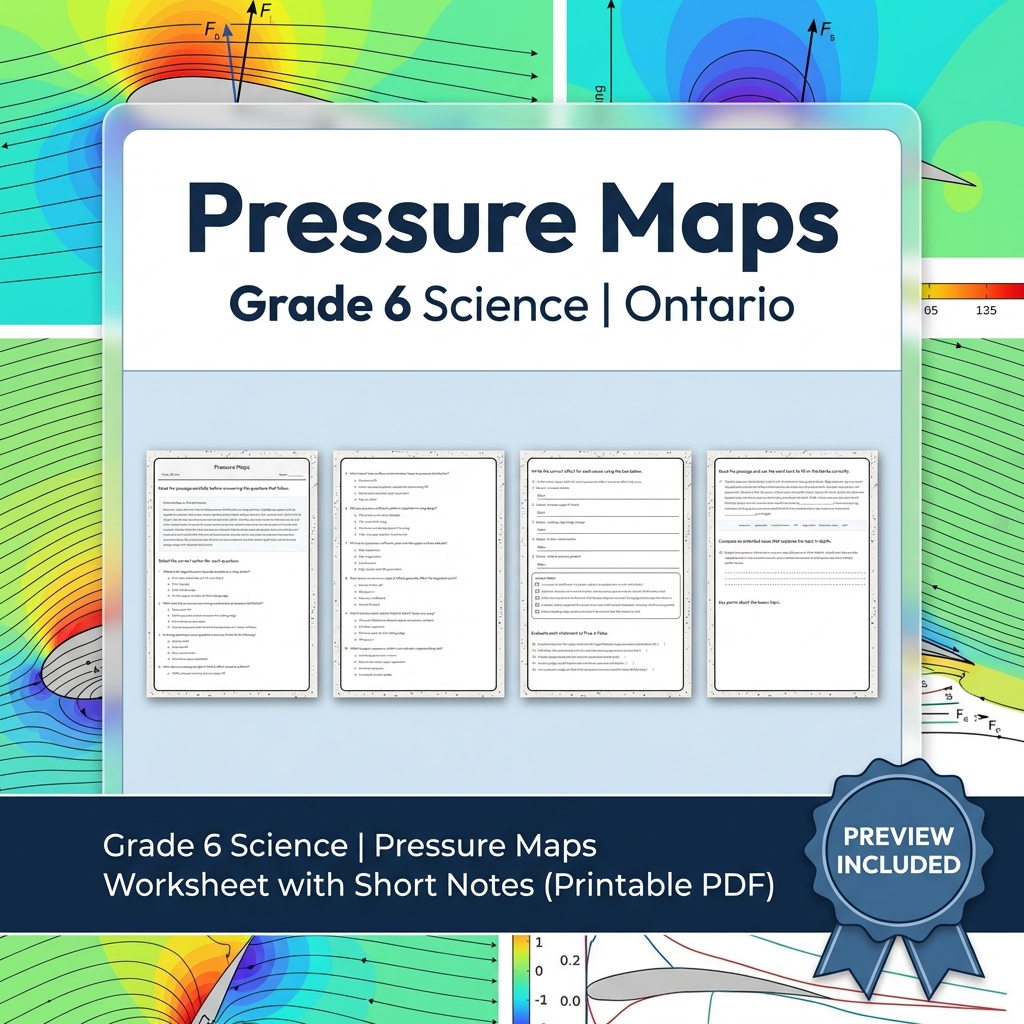
Grade 6 Science | Pressure Maps Worksheet with Short Notes (Printable PDF)
 Created byMeadowlark Worksheets
Learning Objectives
- Describe how surface pressure distribution around wing sections influences lift and pitching moments.
- Identify key pressure features such as stagnation points, suction peaks, and pressure coefficients.
- Explain how camber and angle of attack affect pressure minima and pressure patterns.
Also included in: Grade 6 Science Lesson Group Bundle – Ontario Framework Worksheets +1 more
Instant download

Niche Dynamics Worksheet | Ontario Grade 6 Science Assessment
 Created byCedar Grove Learning
Learning Objectives
- Distinguish between fundamental niche and realized niche using measurable environmental factors
- Explain how abiotic factors and species interactions affect where organisms can live and what resources they use
- Describe how spatial and temporal partitioning reduce competition among similar species
Also included in: Grade 6 Biodiversity and Adaptations Science Lesson Bundle Ontario +1 more
Instant download

6th Grade Science – Invasive Species Worksheet (Ontario Standards) (PDF)
 Created byEvergreen Desk Education
Learning Objectives
- Explain how invasive species are introduced and why they can become established in new ecosystems.
- Describe how invasive species affect native species through competition, predation, and habitat alteration.
- Use terms such as propagule pressure and lack of natural predators to predict invasion success.
Also included in: Grade 6 Biodiversity, Adaptation & Ecology Science Lesson Bundle | Ontario +1 more
Instant download
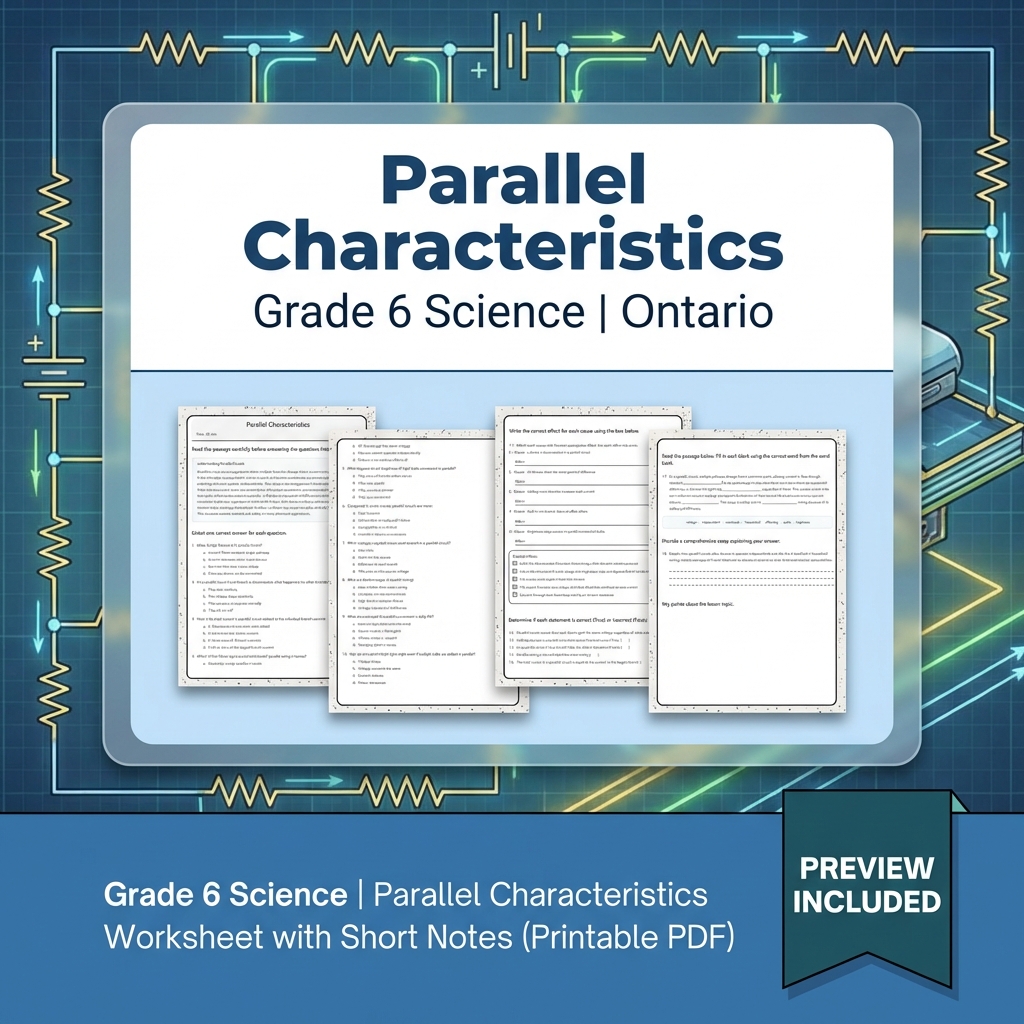
Grade 6 Science | Parallel Characteristics Worksheet with Short Notes ( PDF)
Created byMeadowlark WorksheetsLearning Objectives
- Understand the concept of parallel circuits, including multiple branching pathways.
- Explain the principles of equal potential difference across parallel branches.
- Describe how the overall current is the sum of branch currents in parallel wiring.
Also included in: Grade 6 Science Lesson Group on Energy, Circuits & Properties +1 more
Instant download

Satellite Systems Practice Worksheet | Grade 6 Science Assessment
Created byPrism Point LearningLearning Objectives
- Describe how artificial satellites support Earth observation, communication, navigation, and scientific monitoring.
- Explain the difference between geostationary and polar orbits and how orbit choice affects coverage.
- Identify how satellite sensor payloads and data help scientists track events like tides, solar activity, and surface changes on the Moon and planets.
Also included in: Grade 6 Space Systems Science Lesson Bundle for Ontario (10 Worksheets)
Instant download

Grade 6 Science | Comparative Flight - Daily Reading Comprehension
 Created byCoral Reef Learning
Learning Objectives
- Understand the differences in design features of kites, gliders, and round canopies.
- Identify how glide ratio, lift-to-drag performance, and control responsiveness affect flight.
- Explain how regional atmospheric conditions influence flying device performance.
Also included in: Air and Aerodynamics Lesson Bundle – Grade 6 Science Alberta Reading Comp. +1 more
Instant download
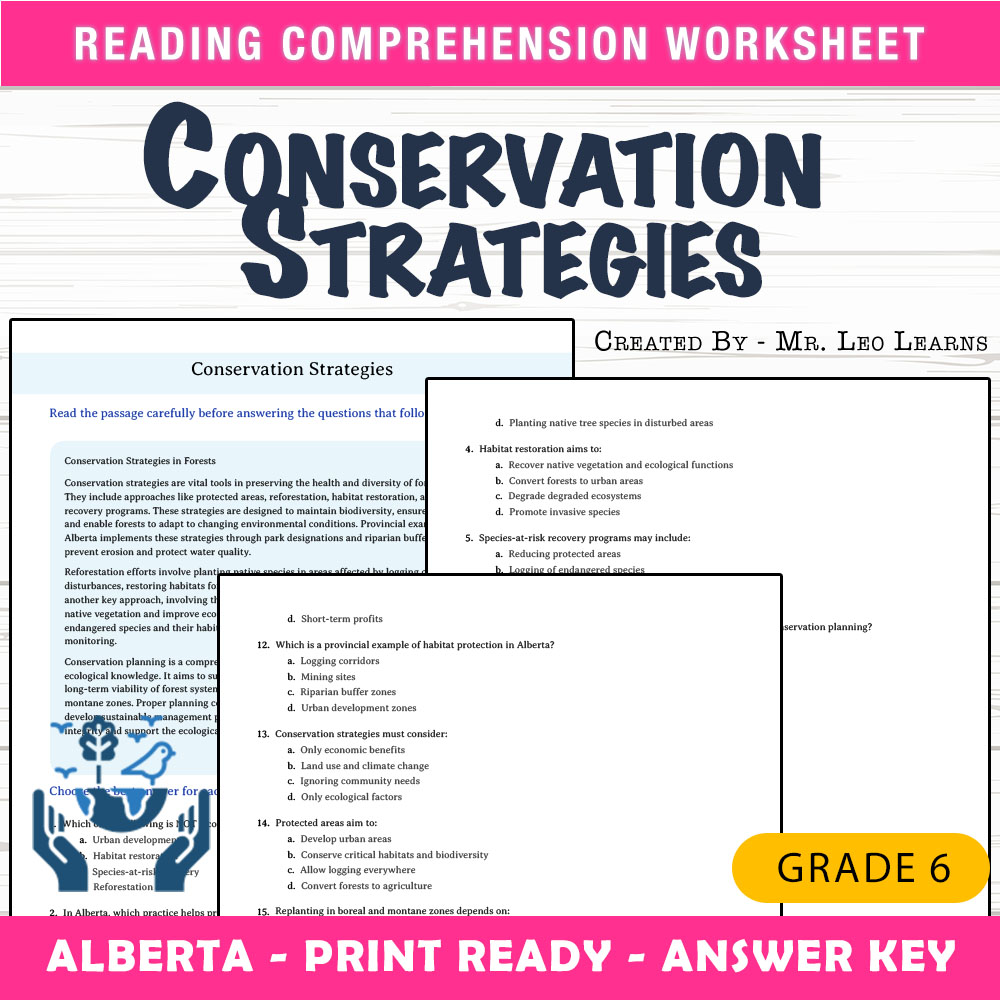
Grade 6 Science — Conservation Strategies Worksheet for Mastery
 Created byThe Resource Hub
Learning Objectives
- Understand various approaches used to conserve forest biodiversity and ecosystem functions.
- Identify examples of conservation strategies, including protected areas and habitat restoration.
- Recognize provincial examples of conservation planning in Alberta's landscapes.
Also included in: Grade 6 Science | Trees and Forests Unit Bundle for Alberta (Worksheet Pack) +1 more
Instant download

Building Knowledge Assessment | NGSSS Standards Grade 6 Science
Created byPrism Point LearningLearning Objectives
- Explain how scientific knowledge changes when new evidence becomes available.
- Differentiate scientific theories from scientific laws using examples.
- Describe how peer evaluation and reproducibility strengthen scientific claims.
Also included in: Grade 6 Scientific Assessment Science Lesson Bundle – Florida NGSSS
Instant download

6th Grade Social Studies Worksheet | Education Change & Indigenous Learning (PDF)
 Created bySunny Desk Resources
Learning Objectives
- Explain how education changed over time from community-based learning to institutional schooling
- Describe reasons governments and families supported educational reforms
- Analyze how schooling affected cultural continuity, assimilation, and community roles
Also included in: Grade 6 Communities Through Time Social Studies Lesson Bundle for Ontario +1 more
Instant download

Groundwater and Baseflow Worksheet for Grade 6 Science | California Standards
JCreated byJ.S SheetsLearning Objectives
- Understand how groundwater is stored and moves through the geosphere.
- Explain the role of groundwater in supplying streams as baseflow during dry periods.
- Describe factors affecting the connection between groundwater and surface water.
Also included in: Grade 6 Earth & Space Science Lesson Bundle: California Standards +1 more
Instant download

Grade 6 Science | Thrust Systems Worksheet (PDF) – Ontario Standards
Created byPrism Point LearningLearning Objectives
- Explain the principles of propeller-driven thrust and how it overcomes drag.
- Describe how reaction engines produce thrust through exhaust momentum.
- Compare propeller and jet propulsion methods in terms of efficiency, mass distribution, and noise.
Instant download

6th Grade Math | Evaluating Solutions Worksheet (PDF) - Ontario Standards
Created byClear Sky ClassroomLearning Objectives
- Develop skills to interpret and assess the reasonableness of mathematical solutions.
- Apply logical reasoning and calculation checks to verify solutions in real-world contexts.
- Evaluate different approaches to problem-solving for accuracy and consistency.
Also included in: Grade 6 Maths Social-Emotional Skills and Mathematical Processes Lesson Bundle +1 more
Instant download

Sampling Methods Worksheet | Grade 6 Science Activities
Created byPrism Point LearningLearning Objectives
- Explain the purpose of sampling methods and why samples must represent a larger population or area
- Compare random, stratified, and systematic sampling and describe when each may be useful
- Use sampling choices to predict how strong (or limited) the conclusions from data might be
Instant download

Grade 6 Science | Evaporation Separation Worksheet with Short Notes
Created byMeadowlark WorksheetsLearning Objectives
- Understand the process of evaporation as a method of separating soluble solids from liquids.
- Identify evidence that indicates evaporation has occurred.
- Differentiate evaporation from other separation methods based on state change.
Also included in: Grade 6 Science Lesson Bundle – Teaching Transfer, Mixtures, Motion & More +1 more
Instant download

Grade 6 Science | Flight Forces Worksheet with Short Notes (Printable PDF)
Created byMeadowlark WorksheetsLearning Objectives
- Understand the four aerodynamic forces: lift, drag, thrust, and weight.
- Describe how these forces interact to determine aircraft motion.
- Explain the concepts of vector addition and equilibrium in steady level flight.
Also included in: Grade 6 Science Lesson Group Bundle – Ontario Framework Worksheets +1 more
Instant download

Grade 6 Science – Flight Forces & Principles | Daily Reading Worksheet
Created byBright Mind ResourcesLearning Objectives
- Understand the concept of lift and how it helps objects rise in the air
- Identify the four primary forces involved in flight: lift, thrust, drag, and weight
- Describe how forces interact to produce controlled flight or descent
Also included in: Aerodynamics Grade 6 Science Daily Reading Worksheets Lesson Bundle | Alberta +2 more
Instant download

Fossil Occurrences Through Time Worksheets for Grade 6 Science
 Created byTeachers Club
Learning Objectives
- Explain how fossil occurrences and stratigraphic order support ideas about evolution, diversification, and extinction.
- Identify how relative dating and radiometric dating help establish the age order of rock layers.
- Use fossil assemblage comparisons to infer changes in biodiversity and environments.
Also included in: Biological Evolution & Unity and Diversity | Grade 6 Science NGSS +2 more
Instant download

Cloud and Precipitation Worksheet | Standards-Aligned Grade 6 Science Practice
JCreated byJ.S SheetsLearning Objectives
- Understand how clouds form through condensation of water vapor.
- Identify different types of precipitation and the conditions that cause them.
- Explain how cloud development provides evidence about atmospheric processes.
Also included in: Grade 6 Climate and Atmospheric Systems Science Lesson Bundle: Florida NGSSS +1 more
Instant download

6th Grade Math Worksheet | Estimating and Validating Calculations (PDF)
Created byClear Sky ClassroomLearning Objectives
- Understand how to use estimation to check the reasonableness of calculations.
- Apply rounding techniques to simplify complex math problems.
- Develop reasoning skills to compare estimated and exact results.
Also included in: Grade 6 Math Number Bundle | Ontario Standards for Operations & Patterns +1 more
Instant download

Human Body Systems Worksheet | Grade 6 Health NHES Activities
Created byPrism Point LearningLearning Objectives
- Describe how the circulatory, respiratory, and digestive systems work together to support health.
- Identify key organs in major body systems and explain their roles in keeping the body functioning.
- Use vocabulary related to body systems to answer health questions accurately.
Also included in: Grade 6 Health Lesson Bundle: Health, Environment & Body Systems NHES
Instant download

Grade 6 Science | Effects of Angles in Flight - Daily Reading Comprehension
Created byCoral Reef LearningLearning Objectives
- Identify parts of an angle related to flight mechanics
- Explain how small increases in angle of attack influence lift and drag
- Recognize the concept of stall caused by excessive angle adjustments
Also included in: Air and Aerodynamics Lesson Bundle – Grade 6 Science Alberta Reading Comp. +1 more
Instant download

Heat and Temperature Worksheet | Grade 6 Science Energy Transfer Activity
Created byPrism Point LearningLearning Objectives
- Differentiate heat and temperature based on what each describes and how energy moves.
- Explain how temperature relates to average particle kinetic energy.
- Predict how systems warm or cool when there is a temperature difference.
Also included in: Grade 6 Energy, Matter & Motion Lesson Bundle | Florida NGSSS
Instant download

Grade 6 |Easter Traditions and Celebrations Worksheet for Mastery|PDF+Answer Key
Created byShaNova WorksheetsLearning Objectives
- Understand various religious rituals and stories associated with Easter across different faith communities.
- Recognize the significance of practices such as prayer, fasting, and ceremonies in Easter celebrations.
- Develop cultural sensitivity and deepen comprehension of spiritual themes related to Easter.
Also included in: Grade 6 Easter Holiday Custom Bundle CCSS ELA Worksheets Practice
Instant download

6th Grade Health Worksheet | Building Daily Healthy Practices (NHES)
Created bySunny Desk ResourcesLearning Objectives
- Identify daily health habits that support hygiene, nutrition, physical activity, and sleep.
- Explain how healthy routines help prevent illness and reduce risk of injuries.
- Apply healthy-practice strategies to common situations at school and at home.
Also included in: Grade 6 Health: Health Enhancing Practices and Behaviors Lesson Bundle (NHES) +1 more
Instant download

6th Grade Maths | Experimental and Theoretical Probability Worksheet (Practice Set)
Created byClear Sky ClassroomLearning Objectives
- Understand the difference between experimental and theoretical probability.
- Apply probability concepts to real-world scenarios and data analysis.
- Calculate experimental probabilities from data and compare with theoretical values.
Also included in: Grade 6 Maths Lesson Group Bundle – Data, Probability, Measures & Analysis +1 more
Instant download

Grade 6 Holiday Memorical Day Worksheet for Honoring Equality | PDF + Answer Key
Created byShaNova WorksheetsLearning Objectives
- Explain how Memorial Day honors service while also emphasizing equality and respect for all people.
- Identify examples of how equality and empathy connect to everyday citizenship.
- Reflect on how diverse stories of service can strengthen unity and belonging.
Also included in: Grade 6 Holiday Memorial Day ELA Custom Bundle CCSS ELA Worksheets
Instant download

Grade 6 Science | Biodiversity Roles - Reading Comprehension Practice
Created byCoral Reef LearningLearning Objectives
- Understand the concept of keystone species and their influence on ecosystems.
- Recognize the roles of different species such as beavers, fungi, and birds in maintaining ecosystem health.
- Learn about interdependence among species and how it contributes to biodiversity.
Also included in: Trees and Forests Lesson Bundle | Grade 6 Science | Alberta +1 more
Instant download

Grade 6 Science – Speed & Velocity | Daily Reading Worksheet
Created byBright Mind ResourcesLearning Objectives
- Understand the difference between speed and velocity
- Calculate average speed
- Identify the importance of direction in motion analysis
Also included in: Grade 6 Science Energy & Matter Daily Reading Lesson Bundle | Florida NGSSS +1 more
Instant download

6th Grade Science – Population Change NGSS Worksheet (PDF)
 Created byMaple Path Learning
Learning Objectives
- Construct evidence-based explanations linking ecosystem changes to population trends.
- Analyze case studies involving predator reintroduction, invasive species, habitat fragmentation, and disease outbreaks.
- Interpret empirical data and population metrics to infer causal relationships.
Also included in: Grade 6 Science | Ecosystems & Biodiversity NGSS Worksheet Unit Pack +1 more
Instant download

Grade 6 Health – Benefits & Planning of Physical Activity | Daily Worksheet
 Created byQuiet Forest Education
Learning Objectives
- Identify the physical, mental, and social benefits of regular physical activity.
- Understand the importance of planning a balanced fitness routine.
- Recognize inclusive practices that make physical activity safe and enjoyable for all.
Also included in: Active Living Grade 6 Health Daily Reading Worksheets Bundle | Ontario +2 more
Instant download

Competition for Survival Worksheet Grade 6 Science Ecosystems Activity
Created byPrism Point LearningLearning Objectives
- Explain how organisms compete for limited resources and how that affects survival and reproduction
- Describe how competition can be direct or indirect when organisms share requirements
- Use evidence to predict which species is more likely to persist under different resource conditions
Also included in: Animals Matter Lesson Bundle | Grade 6 Science | California Standards
Instant download

Grade 6 Inheritance Modeling in Science Worksheet | NGSS Printable Activity
 Created byBRIGHT PATH RESOURCES
Learning Objectives
- Understand the concept of genes and how traits are inherited from parents.
- Identify different traits and determine their inheritance patterns.
- Use models to predict likelihoods of offspring traits based on parental traits.
Also included in: Variation & Inheritance Grade 6 Science Daily Reading Lesson Bundle | NGSS +2 more
Instant download

Grade 6 Science Communicating Evidence Worksheet & Doodle Note
 Created byChalk and Compass
Learning Objectives
- Explain how a scientific claim should connect to evidence and reasoning.
- Use graphs, diagrams, and models appropriately to communicate evidence.
- Select relevant data and cite sources when justifying conclusions.
Also included in: Grade 6 Science Scientific Inquiry and Evidence Lesson Bundle | Ontario +1 more
Instant download
Browse more categories
About Grade 6 Worksheets
Browse 8,582 printable Grade 6 worksheets across math, ELA, science, and social studies — each a ready-to-print PDF with optional answer keys.
MyTeachingSheets worksheets are made by real teacher-authors and checked before they go live. Download any as a print-ready PDF for lessons, homework, or independent practice — most include answer keys, and previews are always free.