
Grade 6 Worksheets
8,582 grade resources
6th Grade ELA | Summarizing Ideas Worksheet (PDF) – Alberta Standards
 Created byGolden Apple Studio
Learning Objectives
- Identify the central idea and key supporting points in a text when writing a summary.
- Differentiate factual information from opinions that appear in a text.
- Write summaries that keep logical order using transitions and paraphrasing.
Also included in: Grade 6 Reading Comprehension Skills in ELA Lesson Bundle: Alberta Framework +1 more
Instant download

Digital Environmental Data: Verification Worksheets Grade 6 Science
 Created bySunny Desk Resources
Learning Objectives
- Identify common examples of digital sources used for local environmental inquiry
- Explain how metadata, temporal resolution, and spatial coverage help evaluate digital data
- Determine how licensing and standardized formats affect sharing and comparing datasets
Also included in: Evidence & Investigation Grade 6 Science Worksheets | Alberta +1 more
Instant download

Safety And Reporting Worksheet Pack | Grade 6 Science Activities
 Created byPrism Point Learning
Learning Objectives
- Communicate science results using clear data presentation and accurate measurements.
- Describe and follow safety practices when using materials, including PPE, heat sources, and proper disposal.
- Report ethically by being honest about limitations and giving proper credit when using sources.
Instant download

Author's Purpose Worksheet Pack | Grade 6 ELA Practice
Created bySunny Desk ResourcesLearning Objectives
- Identify an author’s purpose in an informational text by distinguishing whether the author writes to inform, persuade, or entertain.
- Use textual clues such as tone, word choice, and evidence to support an author’s purpose claim.
- Evaluate how an author’s purpose may affect reliability and bias in a text.
Also included in: Grade 6 Reading Comprehension Strategies Lesson Bundle | ELA | CCSS +1 more
Instant download

Grade 6 Particle Models and Matter Worksheet | NGSS Science Activity
 Created byBRIGHT PATH RESOURCES
Learning Objectives
- Understand that all matter is made up of tiny particles
- Describe the behavior of particles in different states of matter
- Relate temperature and energy to particle motion
Also included in: Matter and Its Interactions Grade 6 Science Lesson Bundle | NGSS +2 more
Instant download
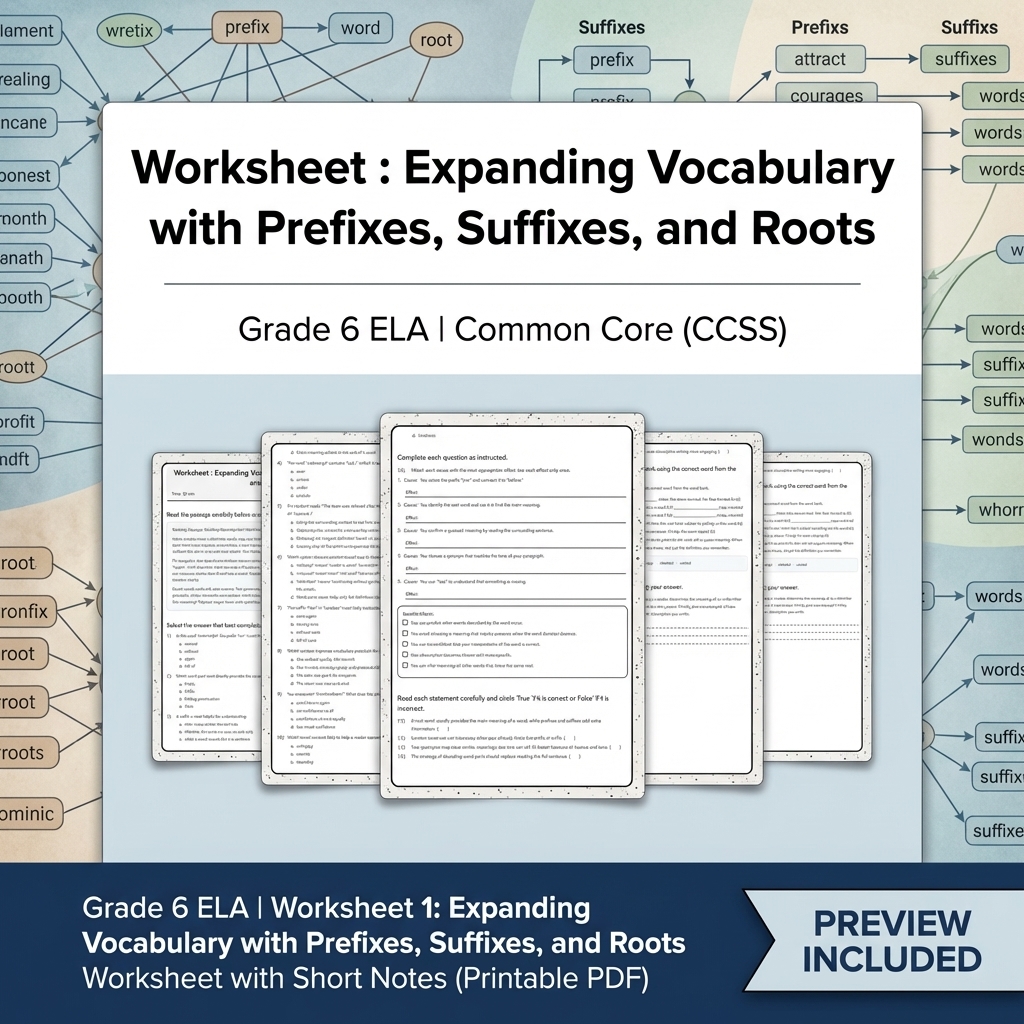
Grade 6 ELA Expanding Vocabulary with Prefixes, Suffixes, and Roots Worksheet
 Created byMeadowlark Worksheets
Learning Objectives
- Identify common prefixes, suffixes, and root words to determine the meaning of unfamiliar vocabulary.
- Use context clues to confirm or refine word meanings derived from word parts.
- Choose precise vocabulary that improves clarity and descriptive writing.
Also included in: Grade 6 ELA Grammar, Vocabulary, and Sentence Variety Lesson Bundle: CCSS +1 more
Instant download

Grade 6 Science | History of Care Worksheet (PDF)
 Created bySilver Birch Teaching
Learning Objectives
- Describe how nursing and healthcare practices have developed over time to improve community health.
- Explain how compassion and scientific thinking can work together in caring for patients.
- Connect historical contributions of nurses to modern healthcare and public well-being.
Also included in: Grade 6 Holiday Science Lesson Bundle | May Framework for Worksheets +1 more
Instant download

Habitat Fragmentation Worksheet & Doodle Notes | Grade 6 Science
 Created byChalk and Compass
Learning Objectives
- Explain how habitat fragmentation changes connectivity between habitat patches.
- Describe how reduced connectivity can affect gene flow, pollinator movement, and species interactions.
- Use habitat fragmentation metrics (such as patch size and corridor value) to predict biodiversity outcomes.
Also included in: Grade 6 Science Ecosystems, Adaptations & Biodiversity Lesson Bundle | Ontario +1 more
Instant download

Evidence Linking Worksheet Pack | Grade 6 ELA Practice
Created bySunny Desk ResourcesLearning Objectives
- Link a claim about meaning to specific evidence from media (words, images, captions, graphics, and sound).
- Distinguish what the text shows or says from what you infer or conclude.
- Explain how multiple media choices work together to shape an audience’s perspective.
Also included in: Grade 6 Media Literacy Lesson Bundle | ELA BC +1 more
Instant download

Grade 6 Science | Habitat Fragmentation Worksheet with Short Notes (PDF)
Created byMeadowlark WorksheetsLearning Objectives
- Explain what habitat fragmentation is and how it affects biodiversity.
- Identify causes and effects of landscape division in ecosystems.
- Analyze the impact of habitat fragmentation on species interactions and gene flow.
Also included in: Grade 6 Science Lesson Bundle for Ontario | Ecosystems & Genetics +1 more
Instant download

Machine Learning and Training Data Worksheet | Grade 6 Computer Science
Created byPrism Point LearningLearning Objectives
- Explain how machine learning uses training data to learn patterns.
- Use key vocabulary words including machine learning, training data, model, and pattern.
- Describe how examples can change a model’s predictions.
Also included in: Artificial Intelligence & Digital Ethics Lesson Bundle — Grade 6 Computer Science, General +1 more
Instant download

Machine Learning Worksheet: Training Data and Models for Grade 6
 Created byBright Mind Resources
Learning Objectives
- Define machine learning, training data, model, and pattern using accurate computer science vocabulary.
- Explain how training data examples help a model learn patterns over time.
- Identify ways a model can behave differently when training data changes.
Instant download

Properties of Matter Assessment | Standards-Aligned Grade 6 Science Worksheet
Created byPrism Point LearningLearning Objectives
- Identify and describe observable properties of different materials such as color, hardness, and texture.
- Explain how materials can be classified based on their measurable traits and physical states.
- Compare properties of common materials like copper, wood, and glass to distinguish their characteristics.
Also included in: Grade 6 Physical Science Science Lesson Bundle: General Framework
Instant download

Grade 6 Social Studies – Local Transformations Worksheet (PDF)
Created bySunny Desk ResourcesLearning Objectives
- Explain how technological innovation and migration can reshape a community over time.
- Describe how changes in transportation and industrial development affect jobs, social organization, and the local landscape.
- Identify continuities that remain even when a community transforms.
Also included in: Grade 6 Communities Through Time Social Studies Lesson Bundle for Ontario +1 more
Instant download

Grade 6 Science – Understanding Density & Buoyancy | Daily Reading Worksheet
Created byBright Mind ResourcesLearning Objectives
- Understand key concepts related to Science
- Apply knowledge through practice questions
- Demonstrate comprehension of the material
Also included in: Variables & Experiments Data Grade 6 Science Worksheets Lesson Bundle | General +1 more
Instant download

Limiting Factors Worksheet | Standards-Aligned Science Practice for Grade 6
JCreated byJ.S SheetsLearning Objectives
- Understand what limiting factors are and how they affect populations.
- Identify abiotic and biotic limiting factors in ecosystems.
- Explain how changes in limiting factors influence species survival and distribution.
Instant download

Grade 6 Cultural Exchange Festivals Worksheet | Global Interactions BC
 Created byQuiet Forest Education
Learning Objectives
- Understand the significance of multicultural festivals in promoting cultural exchange
- Analyze how festivals influence identities and bring communities together
- Recognize different types of intercultural contact and their impacts
Also included in: Cultures: Traditions, Contact & Change Lesson Bundle | Grade 6 Social Studies BC +1 more
Instant download

6th Grade Science | Decomposers and Nutrient Return Worksheet (PDF)
 Created byMaple Path Learning
Learning Objectives
- Understand the role of decomposers in ecosystems.
- Identify different types of decomposers such as fungi and bacteria.
- Explain how decomposers help recycle nutrients back into the environment.
Instant download

Energy Flow Worksheet | Grade 6 Science NGSS Practice & Assessment
Created byPrism Point LearningLearning Objectives
- Explain how energy moves through food webs from producers to consumers and finally to decomposers.
- Describe how matter cycles in ecosystems and how photosynthesis and cellular respiration support energy budgets.
- Use energy pyramids to predict how energy decreases at higher trophic levels.
Also included in: Grade 6 Species Interactions Science Lesson Bundle | NGSS
Instant download

Grade 6 Science – Solar System Survey & Daily Reading Worksheet
Created byBright Mind ResourcesLearning Objectives
- Understand the structure and layout of the solar system
- Identify major planets and components of the solar system
- Distinguish between terrestrial and gas giant planets
Also included in: Space Systems Grade 6 Science Daily Reading Worksheets Bundle | Ontario +1 more
Instant download

6th Grade Health Worksheet | Disease Prevention & Hygiene (PDF)
Created bySunny Desk ResourcesLearning Objectives
- Explain how hygiene habits reduce the spread of communicable diseases.
- Describe how vaccinations help protect individuals and communities.
- Identify healthy choices that lower the risk of illness and outbreaks.
Also included in: Grade 6 Functional Health Concepts in Health Lesson Bundle NHES Framework +1 more
Instant download

Grade 6 Science: Organ Systems in Action Worksheet |NGSS Aligned Grade 6 Science
 Created bySkylark Worksheets
Learning Objectives
- Explain how organ systems (circulatory, respiratory, digestive, and nervous) work together to support life.
- Describe the roles of tissues and organs and connect cellular activities to system-level outcomes.
- Use examples (like exercise) to show interdependence and homeostasis.
Also included in: Grade 6 Cell Systems and Energy Pathways Science Lesson Bundle NGSS +1 more
Instant download

Moon Relationships Worksheet | NGSS Grade 6 Science Practice Resources
JCreated byJ.S SheetsLearning Objectives
- Describe the geometric relationships among Earth, Moon, and Sun that produce lunar phases and eclipses.
- Explain the sequence of primary lunar phases and the conditions for solar and lunar eclipses.
- Use observational records to understand periodicity and predictability of Earth–Moon–Sun configurations.
Also included in: Grade 6 Earth-Moon Relationships Space Science Lesson Bundle | NGSS +1 more
Instant download

Grade 6 Social Studies — Indigenous Governance Worksheet MCQ Paper
 Created byThe Resource Hub
Learning Objectives
- Understand the different governance structures used by Indigenous nations.
- Describe the historical relationships between Indigenous governance and colonial administrations.
- Identify key elements of treaty agreements and traditional leadership roles.
Also included in: Grade 6 Social Studies BC: Indigenous Relationships & Knowledge Systems Bundle +1 more
Instant download

Grade 6 Science – Day & Night Cycle Daily Reading Worksheet | Alberta Standard
Created byBright Mind ResourcesLearning Objectives
- Understand how Earth's rotation causes day and night.
- Identify the effects of Earth's rotation on the position of the Sun in the sky.
- Recognize that Earth's rotation is a constant spinning motion.
Also included in: Grade 6 Solar System & Seasons Science Daily Reading Lesson Bundle | Alberta +2 more
Instant download

Central Idea Support Worksheet Grade 6 ELA TEKS Friendship & Resilience
Created bySunny Desk ResourcesLearning Objectives
- Identify a text’s central idea or theme using clues from the whole passage.
- Explain how supporting details connect to the central idea across paragraphs.
- Use evidence from key moments to support claims about what the text emphasizes.
Instant download

Trends and Patterns in Data Worksheet | Grade 6 Computer Science
Created byBright Mind ResourcesLearning Objectives
- Define trend and pattern and explain how each is identified in data
- Identify whether a data set shows an increase, decrease, or no overall change over time
- Use trend and pattern information to make an evidence-based prediction
Instant download

Grade 6 Science Worksheet | Pollution Effects & Ecosystem Impact (PDF)
 Created byEvergreen Desk Education
Learning Objectives
- Explain how nutrient loading causes eutrophication in aquatic ecosystems and how it affects dissolved oxygen.
- Describe how chemical contaminants can disrupt hormones in amphibians and harm biodiversity.
- Connect bioaccumulation and biomagnification to contaminant residues and effects on top predators.
Also included in: Grade 6 Biodiversity, Adaptation & Ecology Science Lesson Bundle | Ontario +1 more
Instant download

Water and Resources Water Cycle Worksheet | Grade 6 Science Practice
JCreated byJ.S SheetsLearning Objectives
- Explain how evaporation, condensation, and precipitation move water through the water cycle.
- Describe how runoff and infiltration affect where freshwater collects and flows.
- Explain how storage in glaciers and aquifers can release water slowly over time.
Also included in: Grade 6 Earth System Cycles Science Lesson Bundle: General Framework +1 more
Instant download

Grade 6 Science – Weather & Climate | Daily Reading Worksheet
Created byBright Mind ResourcesLearning Objectives
- Understand the difference between weather and climate.
- Identify various weather conditions based on a description.
- Describe how weather can change throughout a day.
Also included in: Earth Systems Grade 6 Science Daily Reading Worksheets Lesson Bundle | General +1 more
Instant download

Grade 6 Science – Earth's Tilt & Sun Path Daily Reading Worksheet
Created byBright Mind ResourcesLearning Objectives
- Describe how Earth's axial tilt affects seasons
- Identify regional sky phenomena linked to Earth's tilt
- Explain how models predict sunlight duration and solar angles
Also included in: Grade 6 Solar System & Seasons Science Daily Reading Lesson Bundle | Alberta +2 more
Instant download
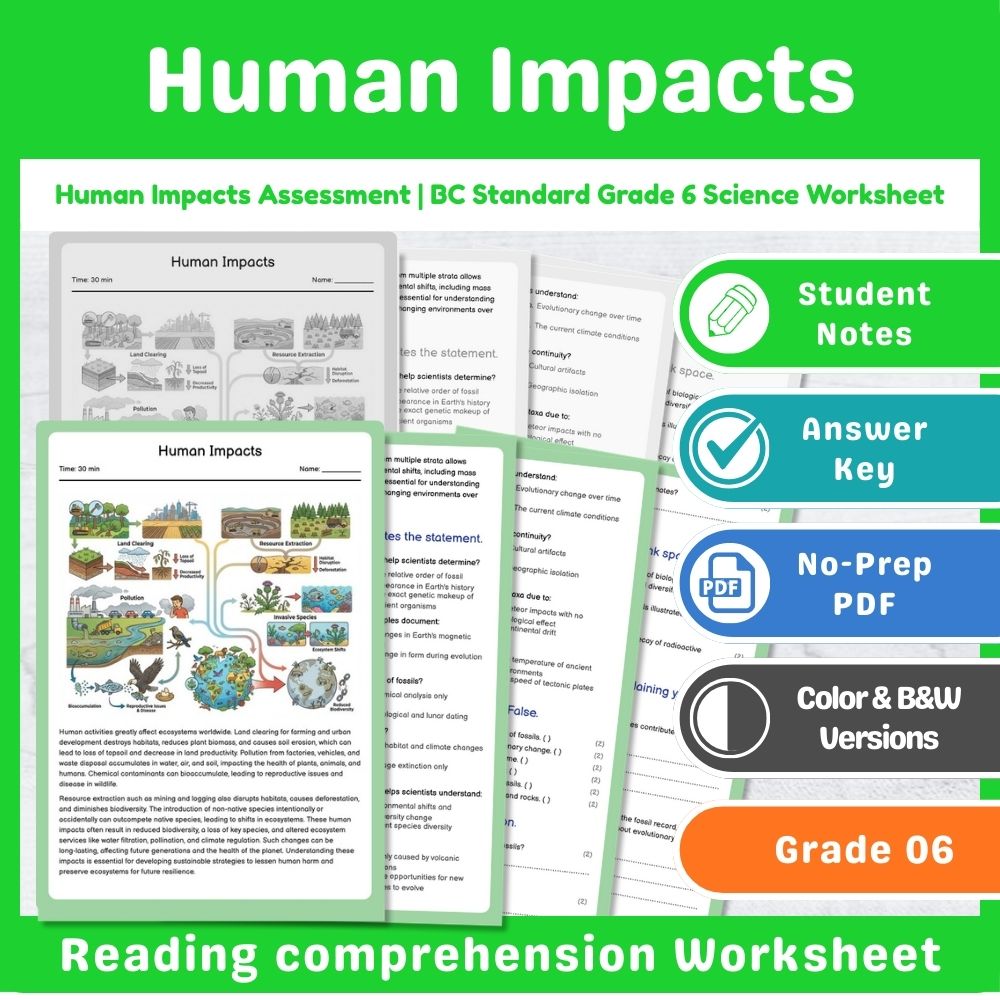
Human Impacts Assessment | BC Standards Grade 6 Science
Created byPrism Point LearningLearning Objectives
- Understand how human activities alter ecosystems through land clearing, pollution, resource extraction, and species introduction.
- Identify the effects of deforestation and pollution on biodiversity and ecosystem functions.
- Analyze how human impacts can lead to long-term environmental changes and reduced ecosystem services.
Instant download

Grade 6 Math Worksheet | Choosing Tools (Ontario Standard) (PDF)
 Created byClear Sky Classroom
Learning Objectives
- Understand how to select appropriate mathematical tools for different problems.
- Apply reasoning to interpret data representations and manipulate manipulatives.
- Evaluate the effectiveness of various tools like graphs, symbols, and digital apps in problem-solving.
Also included in: Grade 6 Maths Social-Emotional Skills and Mathematical Processes Lesson Bundle +1 more
Instant download

6th Grade Social Studies Worksheet | Land and Knowledge Ties (PDF)
Created bySunny Desk ResourcesLearning Objectives
- Explain how Indigenous worldviews connect land to identity, spirituality, and knowledge.
- Describe how traditional stories and ceremonies can teach responsibilities to a territory.
- Identify examples of practices that show land is treated as a living teacher and protector.
Also included in: Grade 6 Indigenous Governance & Land Social Studies Lesson Bundle (BC) +1 more
Instant download

Distributive Equivalence Worksheet | Grade 6 Math CCSS Printable PDF
 Created byElena Brooks
Learning Objectives
- Use the distributive property to rewrite equivalent expressions with multiplication over addition and subtraction
- Simplify equivalent expressions by distributing and combining like terms
- Determine whether two expressions are equivalent by comparing distributive rewrites
Also included in: Grade 6 Equations & Expressions Maths Lesson Bundle (CCSS) +1 more
Instant download
Grade 6 Science Worksheet 1 – Learn Safety and Ethics Easily | PDF
Created byMeadowlark WorksheetsLearning Objectives
- Understand foundational safety principles in scientific practice.
- Identify ethical considerations in research involving organisms and community data.
- Recognize protocols for hazard prevention and proper disposal of substances.
Also included in: Grade 6 Science Lesson Bundle | Ontario Framework & Inquiry Skills +1 more
Instant download

Communication Quality Worksheet | TEKS-Aligned Grade 6 Science Practice
JCreated byJ.S SheetsLearning Objectives
- Write scientific claims that are supported by evidence and justified with reasoning.
- Interpret and describe trends shown in standardized visual summaries such as graphs and tables.
- Use clear operational definitions and transparent methods, including uncertainties and replication.
Instant download

Cloud Storage and Syncing Worksheet Grade 6 Computer Science Activity
Created byPrism Point LearningLearning Objectives
- Explain how cloud storage lets users access files from different devices.
- Describe how syncing updates files to help avoid version confusion.
- Use key vocabulary (cloud storage, sync, file, access) in correct computer-science contexts.
Also included in: Grade 6 How the Internet Works Lesson Bundle | Computer Science | General +1 more
Instant download

Grade 6 Social Studies — Trade and Cultural Exchange Worksheet MCQ
Created byThe Resource HubLearning Objectives
- Understand the role of trade routes like the Silk Road in connecting regions.
- Identify the goods, ideas, and cultural practices exchanged through early trade networks.
- Explain how trade influenced religious beliefs, technology, and art.
Also included in: Grade 6 Ancient India and China Social Studies Lesson Bundle California +1 more
Instant download

Grade 6 Understanding Phenotypic Variation Worksheet | NGSS Science Activity
Created byBRIGHT PATH RESOURCESLearning Objectives
- Identify how genetic differences influence traits in organisms.
- Describe environmental factors that affect phenotypic variation.
- Explain the relationship between DNA, gene expression, and observable characteristics.
Also included in: From Molecules to Organisms Lesson Bundle | Grade 6 Science | NGSS +2 more
Instant download

Organ Systems Overview Test Prep Printable | Grade 6 Science
Created byPrism Point LearningLearning Objectives
- Identify major organ systems and describe their principal functions in the human body
- Explain how organ systems interact to maintain internal balance
- Use science vocabulary to describe transport, exchange, digestion, defense, and control
Also included in: Multicellular Systems & Functions Lesson Bundle | Grade 6 Science | BC +1 more
Instant download

Grade 6 Aerodynamic Design Worksheet | NCSS Practice PDF
Created byClear Sky ClassroomLearning Objectives
- Explain how lift, drag, and stability are affected by wing shape, smoothness, and orientation.
- Identify how design changes such as aspect ratio and surface area can improve or reduce flight performance.
- Use evidence from a passage to select main ideas and evaluate statements about aerodynamic principles.
Also included in: Grade 6 Air and Aerodynamics Science Lesson Bundle (Alberta Framework) +1 more
Instant download

Testing and Feedback in Digital Projects Grade 6 Computer Science
Created byPrism Point LearningLearning Objectives
- Explain how testing helps a digital project work correctly and be easy to use.
- Use feedback to revise and improve a project after finding problems.
- Identify common results from testing, such as errors, confusion, and missing features.
Also included in: Grade 6 Digital Projects Lesson Bundle | Computer Science | General +1 more
Instant download

Digital Final Product Worksheet | Presentation & Organization Grade 6
Created byBright Mind ResourcesLearning Objectives
- Define and use the vocabulary organize, presentation, final product, and audience when planning a digital project
- Identify features of a clear digital presentation, such as readable text, logical structure, and appropriate media
- Choose the best way to organize information so it is easy for an audience to understand
Instant download

Grade 6 Science Worksheet | Parallel Circuit Characteristics (PDF)
Created byEvergreen Desk EducationLearning Objectives
- Describe the key characteristics of parallel circuits, including multiple branching pathways and equal potential difference across branches.
- Explain how current divides in parallel circuits and how overall current equals the sum of branch currents.
- Compare how loads in parallel circuits behave independently and how parallel circuits differ from series circuits during faults.
Also included in: Grade 6 Electricity Circuits Science Lesson Bundle for Ontario Worksheets +1 more
Instant download

Digital Project Planning Worksheet | Goals, Audience & Features Grade 6
Created byBright Mind ResourcesLearning Objectives
- Define the key parts of a digital project plan: goal, audience, and plan for features and steps.
- Identify which project feature fits a given goal and target audience.
- Use project planning vocabulary to describe steps before coding or creating.
Instant download

Digital Project Presentation Worksheet | Presenting Creations Grade 6
Created byBright Mind ResourcesLearning Objectives
- Explain choices made in a digital project using clear reasons.
- Describe key features and how they help the audience understand the project.
- Present a digital creation by showing how it works and responding to questions.
Instant download

Grade 6 Science – Stewardship Strategies & Biodiversity Conservation | Worksheet
Created byBright Mind ResourcesLearning Objectives
- Understand the concept of habitat restoration and its significance.
- Identify different stewardship strategies used to protect ecosystems.
- Analyze the trade-offs involved in various conservation approaches.
Also included in: Grade 6 Ecology & Biodiversity Science Lesson Bundle | Ontario Daily Reading +1 more
Instant download
Browse more categories
About Grade 6 Worksheets
Browse 8,582 printable Grade 6 worksheets across math, ELA, science, and social studies — each a ready-to-print PDF with optional answer keys.
MyTeachingSheets worksheets are made by real teacher-authors and checked before they go live. Download any as a print-ready PDF for lessons, homework, or independent practice — most include answer keys, and previews are always free.