
Grade 6 Worksheets
8,582 grade resources
Opposite Rational Numbers Worksheet for Grade 6 | Maths Practice & Answer Key
 Created byElena Brooks
Learning Objectives
- Explain why opposite rational numbers are the same distance from 0 using absolute value
- Find absolute values for positive and negative rational numbers shown on a number line
- Use opposite relationships to compare absolute values and distances on a number line
Also included in: Grade 6 Rational Numbers, Percents & Inequalities Maths Bundle: Common Core +1 more
Instant download
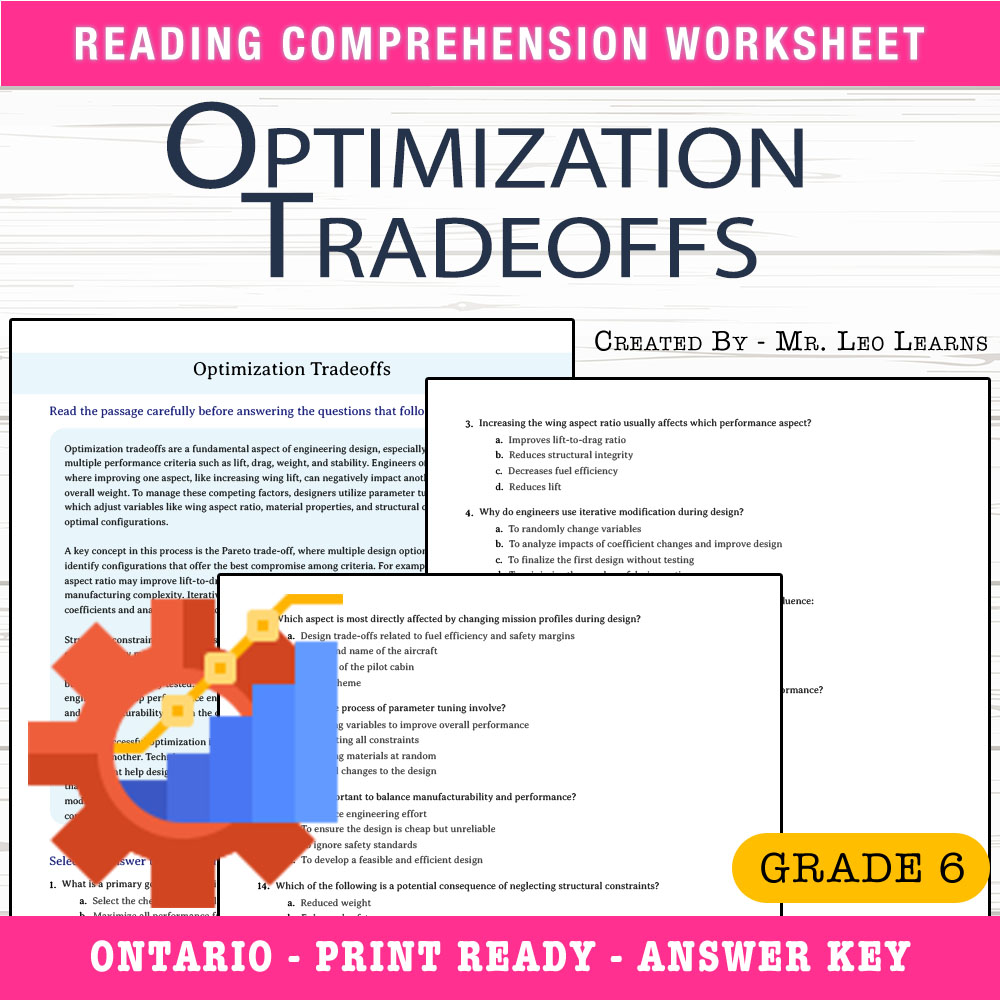
Grade 6 Science — Optimization Tradeoffs Worksheet for Mastering Engineering Concepts
 Created byThe Resource Hub
Learning Objectives
- Understand the concept of multi-criteria design in engineering.
- Identify how trade-offs affect performance in wing design.
- Explain the methods used to balance factors like lift, drag, and stability.
Also included in: Grade 6 Science | Aerodynamics & Engineering Unit Workbook (Worksheet Pack) +1 more
Instant download

Discussion Norms Test Prep Printable | Grade 6 ELA
 Created byMeadowlark Worksheets
Learning Objectives
- Explain how discussion norms support shared understanding in a small group.
- Identify behaviors that show respect, effective turn-taking, and staying on topic.
- Use sentence starters to build on others’ ideas while maintaining a courteous tone.
Also included in: Grade 6 Listening & Discussion Explanation ELA Lesson Bundle (Alberta) +1 more
Instant download

Organizing a Talk Practice Worksheet | Grade 6 ELA Review & Assessment
Created byMeadowlark WorksheetsLearning Objectives
- Identify how oral presentations use structure to guide an audience from introduction to conclusion.
- Use topic sentences, relevant details, and smooth transitions to keep ideas coherent.
- Select purposeful information and omit unrelated details during an explanation.
Also included in: Grade 6 Listening & Discussion Explanation ELA Lesson Bundle (Alberta) +1 more
Instant download

Grade 6 Pressure Patterns in Uneven Heating Science Worksheet Alberta
 Created byBRIGHT PATH RESOURCES
Learning Objectives
- Explain how uneven heating creates pressure differences in the atmosphere
- Describe how topography can redirect winds through pressure gradients
- Connect pressure patterns to everyday weather changes
Also included in: Aerodynamics & Flight Physics Grade 6 Science Worksheets Bundle | Alberta +1 more
Instant download

Community Action Strategies for Health Worksheet | Grade 6 NHES
 Created byPrism Point Learning
Learning Objectives
- Explain how communities can take action to address health concerns.
- Identify ways to coordinate teamwork and resources when planning a health initiative.
- Use persuasive communication to encourage healthy behaviors and supportive policies.
Also included in: Health Advocacy & Community Action Lesson Bundle | Grade 6 Health | NHES
Instant download

Adaptation Tradeoffs Worksheet | Grade 6 Science Assessment Ontario
Created byPrism Point LearningLearning Objectives
- Explain how adaptation trade-offs can favor specialists in stable conditions and generalists in variable conditions.
- Compare benefits and costs of narrow niche specialization versus broad tolerance using examples from plants, insects, and animal movement.
- Describe how fluctuating environments can change which traits improve survival and reproduction over time.
Also included in: Grade 6 Biodiversity & Adaptation Science Lesson Bundle Ontario
Instant download

Appreciating Art Worksheet for Grades 6, 7 & 8 | Holiday Assessment
Learning Objectives
- Analyze how artworks from different cultures express gratitude and respect.
- Use vocabulary related to gratitude and appreciation to interpret art and messages.
- Explain how recognition through art can strengthen community and teacher-student relationships.
Also included in: Grade 7 Holiday Lesson Bundle: Inquiry-Based Framework for Assessment +2 more
Instant download

Diagram Based Ratios Grade 6 Maths Worksheet | Common Core CCSS
Created byElena BrooksLearning Objectives
- Read ratio relationships from tape (strip) diagrams by using the part counts as equal ratio groups.
- Scale a diagram to find equivalent ratios and missing quantities while keeping the same comparison units.
- Use diagram reasoning to determine missing values in totals and part-to-part comparisons.
Also included in: Grade 6 Ratios & Unit Rate Maths Lesson Bundle with CCSS Worksheets +1 more
Instant download

Grade 6 Math | Volume of Composite Shapes Worksheet (PDF) Ontario Standards
 Created byClear Sky Classroom
Learning Objectives
- Understand how to disassemble complex shapes into simpler solids to find volume.
- Apply formulas for the volume of rectangular prisms and cylinders.
- Develop spatial reasoning skills to visualize composite shapes and calculate their total volume.
Also included in: Grade 6 Geometry and Spatial Sense Lesson Bundle for Ontario Maths +1 more
Instant download

Grade 6 Social Studies — Oral Histories Worksheet MCQ Paper
Created byThe Resource HubLearning Objectives
- Explain how oral traditions and testimonies function as primary sources of community memory.
- Analyze reasons why narratives in oral histories may change over time while still preserving core teachings.
- Compare oral and written accounts and evaluate how perspective and power can influence what is recorded and understood.
Instant download

Weather Elements Assessment | Florida NGSSS Grade 6 Science
Created byPrism Point LearningLearning Objectives
- Identify major weather elements (temperature, precipitation, wind speed/direction, cloud cover, humidity) and explain what each one describes.
- Use observations of multiple weather elements to describe current weather conditions and understand why forecasts can change.
- Interpret simple statements about weather elements using evidence from observations and basic cause-and-effect relationships.
Instant download

Grade 6 Science Signal Integration Worksheet | NGSS Standards Practice
JCreated byJ.S SheetsLearning Objectives
- Explain how cells communicate through chemical and electrical signals.
- Describe the processes of neurotransmission, hormonal regulation, and signal transduction cascades.
- Contrast rapid nervous impulses with longer-term endocrine effects.
Also included in: Grade 6 Cellular Processes and Feedback Science Lesson Bundle – NGSS +1 more
Instant download

Stewardship Strategies Test Prep Worksheet | Grade 6 Science Ontario
Created byPrism Point LearningLearning Objectives
- Describe how stewardship strategies like habitat restoration, protected areas, and community monitoring help maintain biodiversity.
- Compare trade-offs among conservation approaches and explain why some actions may be prioritized for species at risk.
- Explain how assisted migration and invasive species removal can affect ecosystems and why monitoring matters.
Also included in: Grade 6 Biodiversity & Adaptation Science Lesson Bundle Ontario
Instant download

Wing Shapes Worksheet Pack | Grade 6 Science Activities
Created byPrism Point LearningLearning Objectives
- Explain how wing features like camber, thickness, and aspect ratio affect lift and stall behavior.
- Compare wing designs for different mission profiles, such as gliders versus short-field agricultural aircraft.
- Use evidence from a passage to answer questions about pressure, drag, and maneuverability.
Also included in: Aerodynamics and Flight Design Lesson Bundle – Grade 6 Science Alberta
Instant download

Equivalent Properties Worksheet | Grade 6 Maths Worksheet – CCSS
Created byElena BrooksLearning Objectives
- Use commutative and associative properties to rewrite expressions as equivalent expressions.
- Use identity properties (0 and 1) and inverse operations to replace parts of an expression without changing its value.
- Check that two expressions are equivalent by showing the operation changes preserve the overall value.
Also included in: Grade 6 Equations & Expressions Maths Lesson Bundle (CCSS) +1 more
Instant download

Predator Prey Dynamics Assessment for Grade 6 Science Standards
Created byPrism Point LearningLearning Objectives
- Understand the interactions between predators and prey in ecosystems.
- Identify cause-and-effect relationships in food webs.
- Explain how predator and prey populations influence each other over time.
Instant download

Grade 6 Science | Energy & Power in Circuits - Daily Reading Comprehension
 Created byCoral Reef Learning
Learning Objectives
- Understand the concept of electrical energy transfer in circuits.
- Identify how power is related to energy transfer rate, current, and voltage.
- Recognize everyday examples of electrical power use, such as lighting and heating.
Instant download

6th Grade ELA | Figurative Meaning Worksheet (PDF) | General ELA
 Created byGolden Apple Studio
Learning Objectives
- Identify figurative language (metaphors, similes, idioms) and explain its meaning beyond literal definitions.
- Analyze how figurative wording affects tone and mood in a text.
- Use word relationships (synonyms, antonyms, and categories) to interpret meaning precisely.
Also included in: Grade 6 Language & Vocabulary Skills for ELA Lesson Bundle | General ELA +1 more
Instant download

Natural Selection Worksheets: Changing Trait Frequencies Grade 6
 Created byTeachers Club
Learning Objectives
- Explain how heritable variation and differential reproductive success can change trait frequencies over generations
- Identify examples of natural selection driven by environmental pressures
- Match key vocabulary terms to correct definitions related to natural selection
Also included in: Biological Evolution & Unity and Diversity | Grade 6 Science NGSS +2 more
Instant download

Grade 6 | World Water Day Worksheet for Water and Societies | PDF + Answer Key
 Created byShaNova Worksheets
Learning Objectives
- Understand how different cultures have historically relied on water resources.
- Explore stories of ancient water systems and modern innovations addressing water scarcity.
- Recognize the social and environmental impacts of water use globally.
Instant download

Grade 6 Social Studies Worksheet – Chronology & Causality (PDF)
 Created bySunny Desk Resources
Learning Objectives
- Identify the chronological order of historical events using time clues and timelines.
- Explain cause-and-effect relationships between events in a clear, logical sequence.
- Distinguish between causes, effects, and unrelated correlations in historical accounts.
Also included in: Grade 6 Source, Mapping & Perspectives Social Studies Lesson Bundle – TEKS +1 more
Instant download

Science Worksheet Evaporation Separation Grade 6
JCreated byJ.S SheetsLearning Objectives
- Explain how evaporation can separate a soluble solid from a liquid
- Identify the evidence that suggests evaporation occurred in a separation experiment
- Compare evaporation to size-based separation methods
Also included in: Grade 6 Matter, Motion, and Heat Science Lesson Bundle – General Framework +1 more
Instant download

Habitats And Niches Test Prep Printables | Grade 6 Science
Created byPrism Point LearningLearning Objectives
- Explain the difference between a habitat and a niche in an ecosystem
- Describe how niche overlap can lead to competition and limit population growth
- Use examples of resource partitioning to explain how species can coexist
Also included in: Ecosystems & Interdependence Lesson Bundle | Grade 6 Science | BC +1 more
Instant download

6th Grade ELA | Connotation and Tone Worksheet (Worksheet + Answer Key)
Created byGolden Apple StudioLearning Objectives
- Distinguish connotative meaning from dictionary (denotative) meaning.
- Analyze how word choice creates tone (for example, suspense, humor, anger, regret, or admiration).
- Use textual evidence such as imagery, sensory details, and comparisons to explain emotional impact.
Also included in: 6th Grade ELA Theme, Point of View & Evidence Lesson Bundle - General ELA +1 more
Instant download

6th Grade Social Studies | Indigenous Relations Worksheet (PDF)
Created bySunny Desk ResourcesLearning Objectives
- Explain how trade, treaties, conflict, and cooperation shaped relationships among First Nations, Métis, and Inuit and other groups
- Describe how causes of contact influenced community development, including land use and cultural exchange
- Identify how continuity and change appear through shifting alliances and evolving legal frameworks
Also included in: Grade 6 Communities Through Time Social Studies Lesson Bundle for Ontario +1 more
Instant download

Grade 6 | World Water Day Worksheet for Water Solutions | PDF + Answer Key
Created byShaNova WorksheetsLearning Objectives
- Explore innovative and community-led solutions to global water challenges.
- Analyze stories of young inventors and scientists developing sustainable water technologies.
- Encourage critical thinking about water conservation and environmental stewardship.
Instant download

Scientific Models Worksheet for Grade 6 Science | Standards-Aligned Practice
JCreated byJ.S SheetsLearning Objectives
- Understand how models are used to represent complex systems in science.
- Identify different types of scientific models and their purposes.
- Evaluate the limitations of models by comparing them with real measurements.
Also included in: Grade 6 Scientific Inquiry Evidence Reasoning Science Lesson Bundle +1 more
Instant download

6th Grade ELA – Integrating Knowledge Worksheet (PDF) – CCSS Aligned
Created byGolden Apple StudioLearning Objectives
- Integrate and compare information from two informational texts about related topics.
- Explain how different perspectives shape what each author emphasizes and how evidence is used.
- Synthesize key insights by combining ideas without confusing the sources.
Also included in: Grade 6 ELA Reading & Text Analysis Lesson Bundle | CCSS +1 more
Instant download

End-of-Month Reflection | Celebrating Achievements | Grades 6–8
Learning Objectives
- Identify how reflection connects effort to achievements in a graduation celebration context
- Use achievement-related vocabulary (milestone, pride, motivation, goal, reflection) to explain personal or community events
- Write short and extended responses that connect accomplishments to future goal setting
Also included in: End-of-Month Reflection Reading Comprehension Bundle | Grades 6–8 +2 more
Instant download
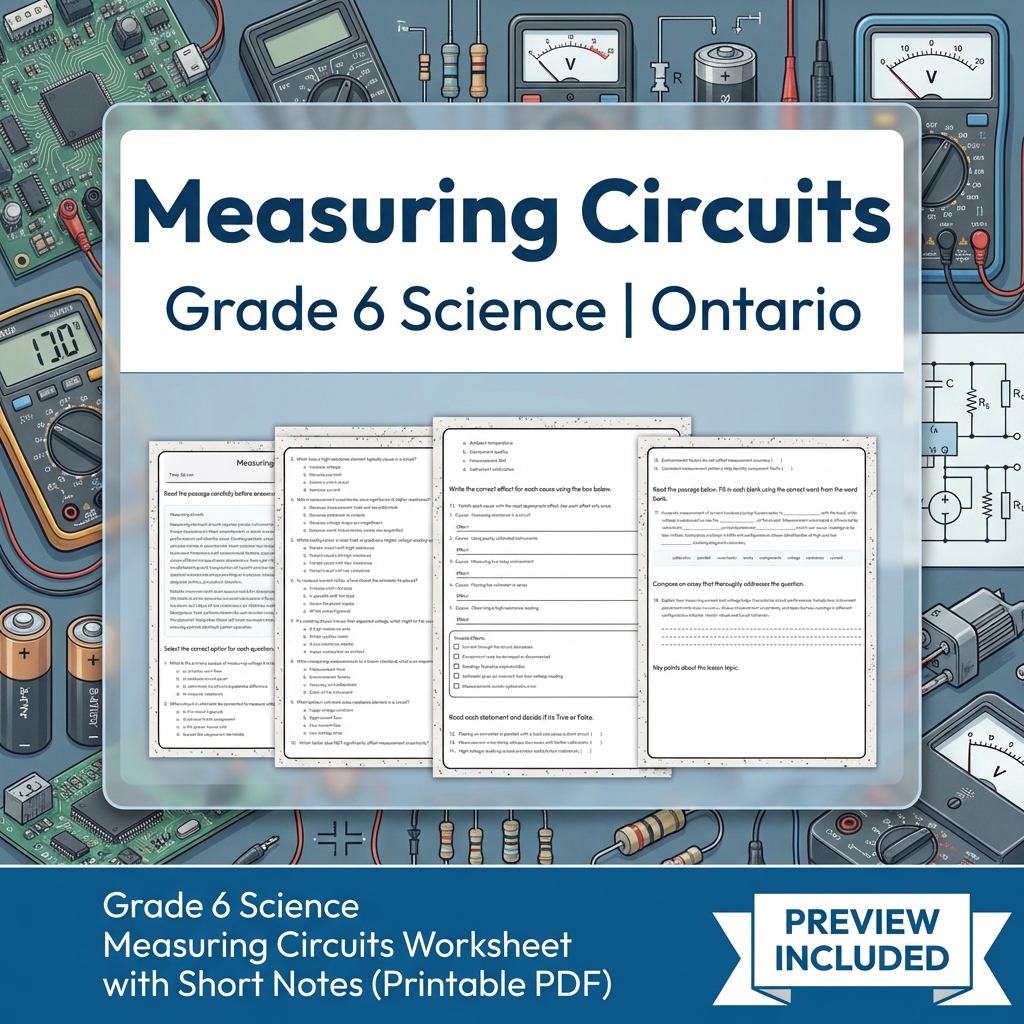
Grade 6 Science Measuring Circuits Worksheet with Short Notes (Printable PDF)
Created byMeadowlark WorksheetsLearning Objectives
- Understand how current and voltage measurements characterize circuit performance.
- Recognize proper instrument placement for circuit measurements.
- Interpret typical reading patterns in various circuit configurations.
Also included in: Grade 6 Science Lesson Group on Energy, Circuits & Properties +1 more
Instant download
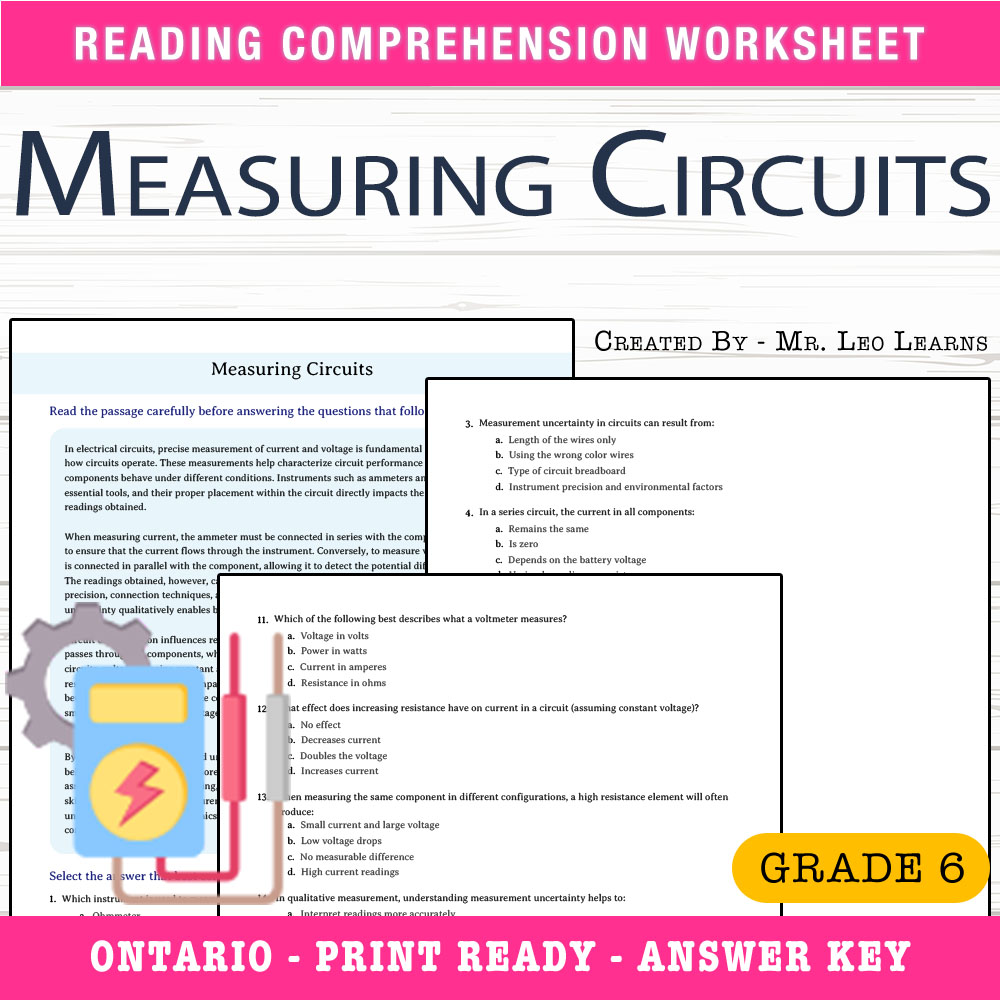
Grade 6 Science – Measuring Circuits Worksheet for Mastery
Created byThe Resource HubLearning Objectives
- Understand how current and voltage measurements characterize circuit performance.
- Identify proper instrument placement and reading patterns in various circuit configurations.
- Explain measurement uncertainty qualitatively and interpret readings in context.
Also included in: Grade 6 Science Unit Bundle – Circuits, Electricity & Energy Worksheets +1 more
Instant download

Scientific Models Worksheet Grade 6 Science NGSSS Inquiry Practice
Created byPrism Point LearningLearning Objectives
- Explain how scientific models help scientists represent systems that are too large, too small, or too complex to study directly.
- Describe how observable features and measurements provide evidence to support or refine scientific models.
- Identify the limits of a model by comparing what the model shows with real-world data.
Also included in: Scientific Inquiry Lesson Bundle | Grade 6 Science | Florida NGSSS
Instant download

Grade 6 Science | Solar Timekeeping - Daily Reading Comprehension
Created byCoral Reef LearningLearning Objectives
- Understand the concept of solar time and how it is based on the Sun's position.
- Learn about the differences between solar time and clock time.
- Recognize the factors that influence solar time, such as longitude and Earth's orbit.
Also included in: Sky Science Lesson Bundle | Grade 6 Science Daily Reading | Alberta +1 more
Instant download

Grade 6 Science – Respiratory System & Daily Reading Worksheet | BC Standards
 Created byBright Mind Resources
Learning Objectives
- Understand the basic functions of the respiratory system
- Identify key organs such as lungs and gills
- Describe how gas exchange occurs between the environment and tissues
Also included in: Grade 6 Science: Organ Systems & Adaptations Daily Reading Lesson Bundle | BC +1 more
Instant download

Grade 6 Science | Invasive Species Worksheet | BC Aligned
 Created byLumora Learning
Learning Objectives
- Understand what invasive species are and how they impact native ecosystems.
- Identify examples of invasive plants and animals introduced by human activities.
- Explain the ecological and economic effects of invasive species.
Instant download

Grade 6 Science | Decomposers And Nutrient Return Worksheet | General Standard
Created byLumora LearningLearning Objectives
- Explain how decomposers break down dead organisms and waste to return nutrients to ecosystems
- Describe the roles of fungi and bacteria in nutrient cycling through soil and water
- Connect nutrient availability to the growth and structure of producer populations over time
Instant download
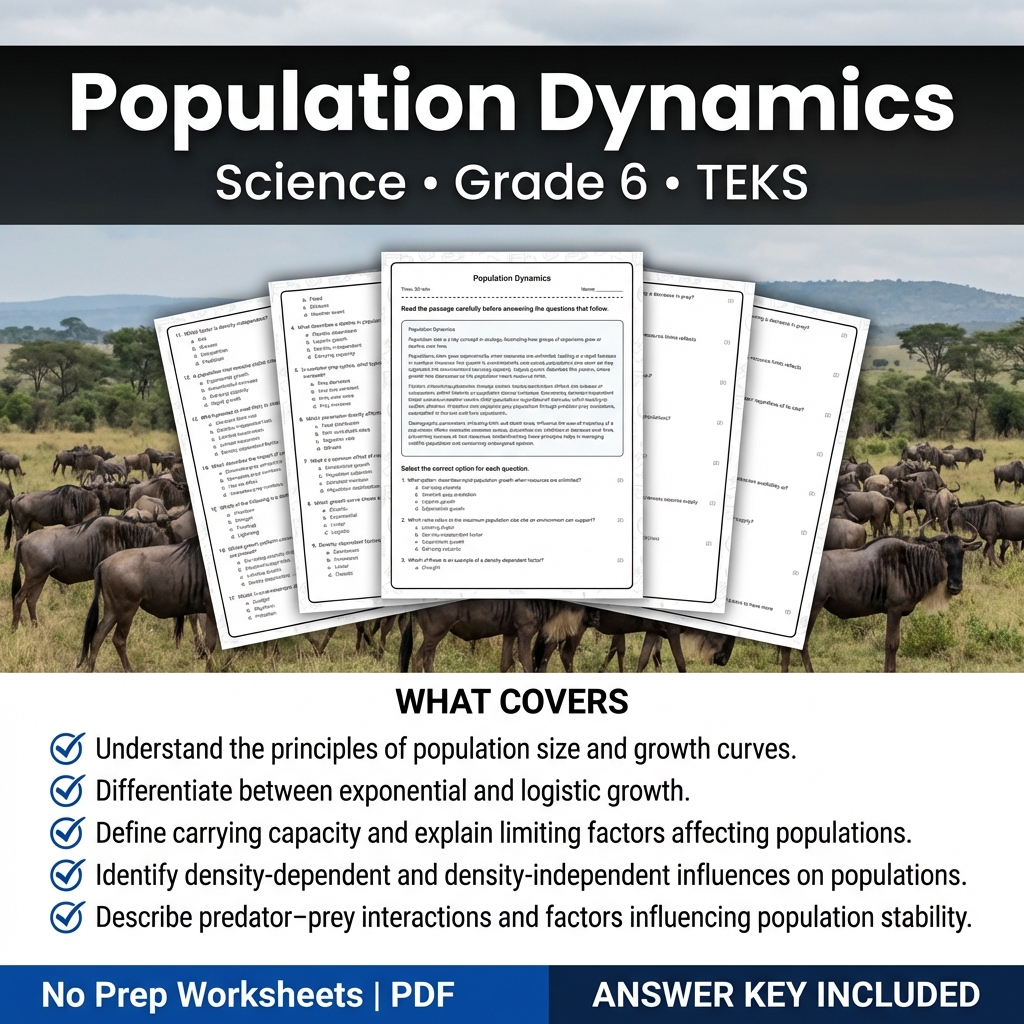
Grade 6 Science Worksheet on Population Dynamics | TEKS Standards
Created byCoral Reef LearningLearning Objectives
- Understand the principles of population size and growth curves.
- Differentiate between exponential and logistic growth.
- Define carrying capacity and explain limiting factors affecting populations.
Instant download

Grade 6 Signal Integration Worksheet | NGSS Practice PDF
Created byClear Sky ClassroomLearning Objectives
- Explain how cells communicate using chemical and electrical signals.
- Differentiate between rapid nervous responses and longer-term hormonal effects.
- Describe key signaling pathways such as synaptic transmission and receptor-mediated gene expression.
Also included in: Grade 6 Molecules to Organisms Science Lesson Bundle: Structures (NGSS) +1 more
Instant download

Grade 6 Science | Design Problem Worksheet with Short Notes (Printable PDF)
Created byMeadowlark WorksheetsLearning Objectives
- Understand the key elements of a design problem, including needs and requirements.
- Learn how to generate solution ideas using sketches, dimensions, and constraints.
- Apply knowledge to real-world examples such as designing protective cases for fragile items.
Also included in: Grade 6 Science Lesson Bundle | Critical Thinking & Problem Solving +1 more
Instant download

Grade 6 Pronoun Reference Worksheet | Ontario ELA Grammar Skills
Created byLumora LearningLearning Objectives
- Identify the antecedent that a pronoun refers to in a sentence.
- Choose pronouns with correct case based on their role (subject after linking verbs, objective after prepositions).
- Revise sentences to remove ambiguous pronoun references.
Instant download

Grade 6 Science – Food Webs & Ecosystem Interconnections | Reading Worksheet
Created byBright Mind ResourcesLearning Objectives
- Identify different organisms involved in a forest food web
- Understand the flow of energy among producers, consumers, and decomposers
- Analyze how seasonal changes and human disruptions impact food webs
Also included in: Grade 6 Forest Ecology Science Daily Reading Worksheets Lesson Bundle | Alberta +2 more
Instant download

Biodiversity Patterns Worksheet | NGSS Grade 6 Science Practice
JCreated byJ.S SheetsLearning Objectives
- Understand how species occurrence and richness reveal biodiversity patterns across ecosystems.
- Identify factors influencing biodiversity distribution, such as habitat heterogeneity and colonization events.
- Interpret data from ecological and historical records to analyze species turnover and community composition.
Also included in: Grade 6 Evolution and Natural Selection Science Lesson Bundle NGSS +1 more
Instant download

Conservation Strategies Test Prep | Grade 6 Science Worksheet PDF
Created byPrism Point LearningLearning Objectives
- Explain how protected areas, habitat restoration, sustainable harvesting, and invasive species control help maintain ecosystem balance.
- Describe trade-offs among ecological goals, economic needs, and social values when choosing conservation strategies.
- Use monitoring evidence to evaluate whether conservation efforts are improving habitat and species outcomes.
Also included in: Ecosystems & Interdependence Lesson Bundle | Grade 6 Science | BC +1 more
Instant download

Grade 6 Science | Seasonal Tilt Worksheet (PDF) – Alberta Standards
 Created bySilver Birch Teaching
Learning Objectives
- Explain how Earth’s axial tilt changes the solar angle and length of daylight during the year.
- Describe how seasonal changes affect temperature, snow cover, and living things in different regions (including Alberta).
- Connect seasonal effects to the geometry of Earth’s orbit and the resulting solar energy received at Earth’s surface.
Also included in: Grade 6 Celestial Motion & Seasons Science Lesson Bundle | Alberta +1 more
Instant download

Infographic Details Worksheet Pack Grade 6 ELA Practice
Created bySunny Desk ResourcesLearning Objectives
- Identify key parts of an infographic (axes, scales, categories, labels, and legends) and explain what they mean.
- Connect information from the visuals to claims or explanations in the accompanying text.
- Use visual evidence (such as graphs and timelines) to interpret comparisons accurately.
Also included in: Grade 6 Reading and Viewing Lesson Bundle | Alberta ELA Framework +1 more
Instant download

Science Worksheet Filtration Method Grade 6 | Standards-Aligned Practice
JCreated byJ.S SheetsLearning Objectives
- Explain how filtration separates a mixture using a barrier and particle size
- Identify what happens to sand and water in a water–sand filtration setup
- Use evidence (residue thickness and filtrate clarity) to describe separation results
Also included in: Grade 6 Matter, Motion, and Heat Science Lesson Bundle – General Framework +1 more
Instant download

Grade 6 Natural Hazards Worksheet | NGSS Practice PDF
Created byClear Sky ClassroomLearning Objectives
- Understand how observational and instrumental data help identify patterns in natural hazards.
- Learn methods for assessing recurrence intervals and estimating probable locations of hazards.
- Interpret examples such as earthquake catalogs, tsunami records, and flood statistics.
Also included in: Grade 6 Earth's Systems Science Lesson Bundle (NGSS-Aligned) Worksheets +1 more
Instant download
Browse more categories
About Grade 6 Worksheets
Browse 8,582 printable Grade 6 worksheets across math, ELA, science, and social studies — each a ready-to-print PDF with optional answer keys.
MyTeachingSheets worksheets are made by real teacher-authors and checked before they go live. Download any as a print-ready PDF for lessons, homework, or independent practice — most include answer keys, and previews are always free.