
Grade 6 Worksheets
8,582 grade resources
Community Skills Worksheets | Back to School Grade 6
 Created byShaNova Worksheets
Learning Objectives
- Explain how positive relationships can improve classroom harmony
- Identify social skills such as active listening, empathy, and respect
- Describe ways to welcome newcomers and cooperate in a diverse community
Instant download

Grade 6 Science – Competition for Survival in the Animal World | Worksheet
 Created byBright Mind Resources
Learning Objectives
- Understand how organisms compete for limited resources like food, water, and shelter
- Learn the ways in which competition affects survival and reproduction
- Identify examples of direct and indirect competition among animals
Also included in: Grade 6 Ecosystems and Energy Science Lesson Bundle | California Standards +1 more
Instant download

Health Advocacy Worksheet | Grade 6 Community Change NHES Activities
 Created byPrism Point Learning
Learning Objectives
- Define health advocacy and explain how it can improve community health.
- Identify how individuals and groups influence decision-making through persuasive communication.
- Use persuasive, respectful communication to propose a health improvement idea.
Also included in: Health Advocacy & Community Action Lesson Bundle | Grade 6 Health | NHES
Instant download

Grade 6 Health – Applying Health Information Worksheet (NHES) PDF
 Created bySunny Desk Resources
Learning Objectives
- Identify credible health information sources and explain how credibility affects health decisions.
- Apply health information to make personal wellness choices (e.g., treatments, vaccinations, and lifestyle changes).
- Use accurate health data to support prevention and to manage existing health conditions.
Also included in: 6th Grade Access Valid Health Information in Health Lesson Bundle NHES +1 more
Instant download

Grade 6 Social Studies — Cultural Perspectives Worksheet MCQ Paper
 Created byThe Resource Hub
Learning Objectives
- Understand how cultural backgrounds influence historical narratives.
- Analyze the impact of Indigenous and Western worldviews on interpreting history.
- Recognize how cultural lenses shape understanding of events such as practices, resistance, and treaties.
Also included in: Grade 6 Social Studies - Evidence & Narratives Lesson Bundle for BC Framework +1 more
Instant download

Purposeful Media Creation and Ethical Design Worksheets | Grade 6 ELA
 Created byGolden Apple Studio
Learning Objectives
- Explain how audience and intent shape purposeful media choices
- Identify visual composition techniques that guide audience attention
- Explain how text emphasis supports meaning in media
Also included in: Grade 6 ELA Media Literacy Worksheets | Framing & Bias | Ontario +1 more
Instant download
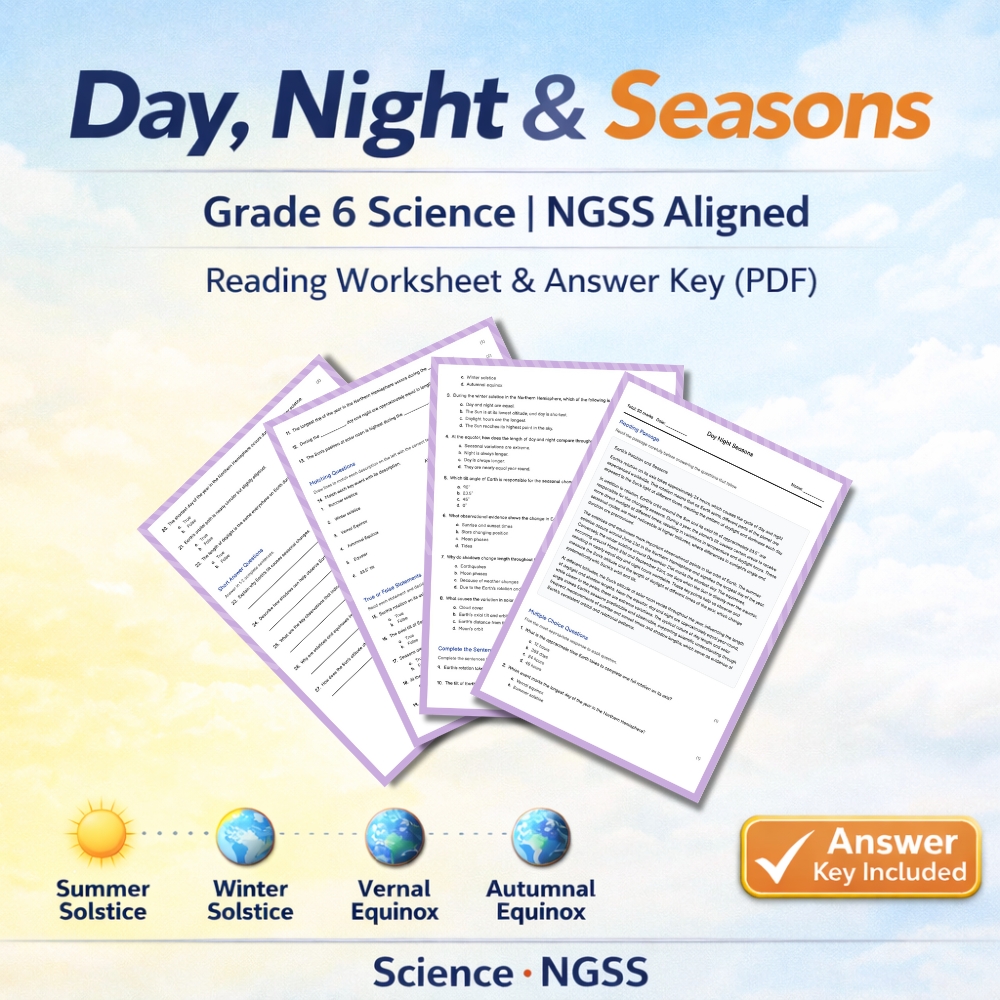
Grade 6 Science | Day, Night, Seasons | NGSS ( Worksheet + Answer Key )
 Created byCedar Grove Learning
Learning Objectives
- Understand Earth's rotation and its role in producing day and night.
- Explain how Earth's orbit and axial tilt create seasonal variations.
- Identify key moments like solstices and equinoxes as observational markers.
Also included in: Grade 6 Science Unit Bundle | Space, Motion & Earth Cycles NGSS Worksheets +1 more
Instant download

Grade 6 Phase Energy Worksheet | Practice & Assessment PDF
 Created byClear Sky Classroom
Learning Objectives
- Explain how energy transfer during phase changes affects particle motion and interactions without changing chemical identity.
- Describe why temperature can stay nearly constant during melting/freezing or boiling/condensation.
- Connect latent heat to the energy required to separate particles or form stronger attractions.
Instant download

Density Properties Worksheet | Standards-Aligned Grade 6 Science Practice
JCreated byJ.S SheetsLearning Objectives
- Understand the concept of density as the relationship between mass and volume.
- Explain how density affects whether objects float or sink.
- Identify the factors that can change the density of a material.
Also included in: Grade 6 Matter, Energy, and Forces Science lesson bundle – Florida (NGSSS) +1 more
Instant download

Aerodynamic Forces and Wing Design Tradeoffs Worksheets Grade 6
Created bySunny Desk ResourcesLearning Objectives
- Explain how lift, drag, and stability are affected by aerodynamic shape and surface smoothness
- Describe how changing wing curvature, aspect ratio, and surface area can change flight performance
- Use evidence from a passage to support claims about aerodynamic design choices
Also included in: Air and Aerodynamics Grade 6 Alberta Science Worksheets Bundle +1 more
Instant download

Energy Drives Change Grade 6 Science Worksheet | Standards-Aligned Practice
JCreated byJ.S SheetsLearning Objectives
- Understand how energy from the Sun influences Earth's water cycle and sediment movement.
- Identify the role of gravity in shaping Earth's surface and transporting materials.
- Explain how energy affects weathering and material cycling in Earth systems.
Also included in: Grade 6 Earth & Space Science Lesson Bundle: California Standards +1 more
Instant download

Rearrangement Explanation Worksheet Grade 6 Science Chemical Change
Created byPrism Point LearningLearning Objectives
- Explain how rearranging atoms in a chemical reaction leads to new substances
- Use evidence from particle models to describe what changes and what stays the same
- Predict how new atomic arrangements can change the properties of products
Instant download

Grade 6 Science – Comparative Flight Daily Reading Worksheet | Alberta Standards
Created byBright Mind ResourcesLearning Objectives
- Understand the basic principles of different flying devices.
- Analyze how design parameters affect flight performance.
- Compare glide ratio, lift-to-drag, and control responsiveness of kites, gliders, and round canopies.
Also included in: Aerodynamics Grade 6 Science Daily Reading Worksheets Lesson Bundle | Alberta +2 more
Instant download

Grade 6 Design Refinement for Safer Better Flight Science Worksheet
 Created byBRIGHT PATH RESOURCES
Learning Objectives
- Identify the main idea and key details about how flight designs are refined.
- Explain how trade-offs among speed, stability, and payload affect design choices.
- Use observation of flight paths and simple measurements to evaluate modifications.
Also included in: Aerodynamics & Flight Physics Grade 6 Science Worksheets Bundle | Alberta +1 more
Instant download

Sequencing Code Correctly Worksheet | Grade 6 Computer Science
Created byPrism Point LearningLearning Objectives
- Explain how program commands run in the order they are written.
- Identify how changing the order of commands changes the output.
- Use sequence and order vocabulary to describe working vs. non-working code.
Also included in: Interactive Coding Foundations Lesson Bundle | Grade 6 Computer Science | General +1 more
Instant download

Monitoring Progress Health Worksheet | Grade 6 NHES Goal Setting Activity
Created byPrism Point LearningLearning Objectives
- Explain why self-monitoring helps people meet health goals
- Use examples to distinguish between recording progress and making changes
- Identify effective ways to reflect on successes and challenges
Instant download

Grade 6 Science – Change Examples & Types | Daily Reading Worksheet
Created byBright Mind ResourcesLearning Objectives
- Identify different examples of physical and chemical changes.
- Understand how physical changes can be reversed and chemical changes cannot.
- Distinguish between appearance changes and substance changes in everyday processes.
Also included in: Matter & Change Grade 6 Science Daily Reading Worksheets Lesson Bundle | BC +1 more
Instant download

6th Grade Holiday | Celebrating Family Values Worksheet – May (PDF)
 Created bySilver Birch Teaching
Learning Objectives
- Explain how family values and bonds influence how people care for one another during holidays.
- Describe how gratitude and emotional connections show up in different family traditions.
- Compare how cultural backgrounds can affect the way families celebrate and nurture family relationships.
Also included in: Grade 6 May Holiday Lesson Bundle: Mother’s Day Writing, Art & Symbols +1 more
Instant download
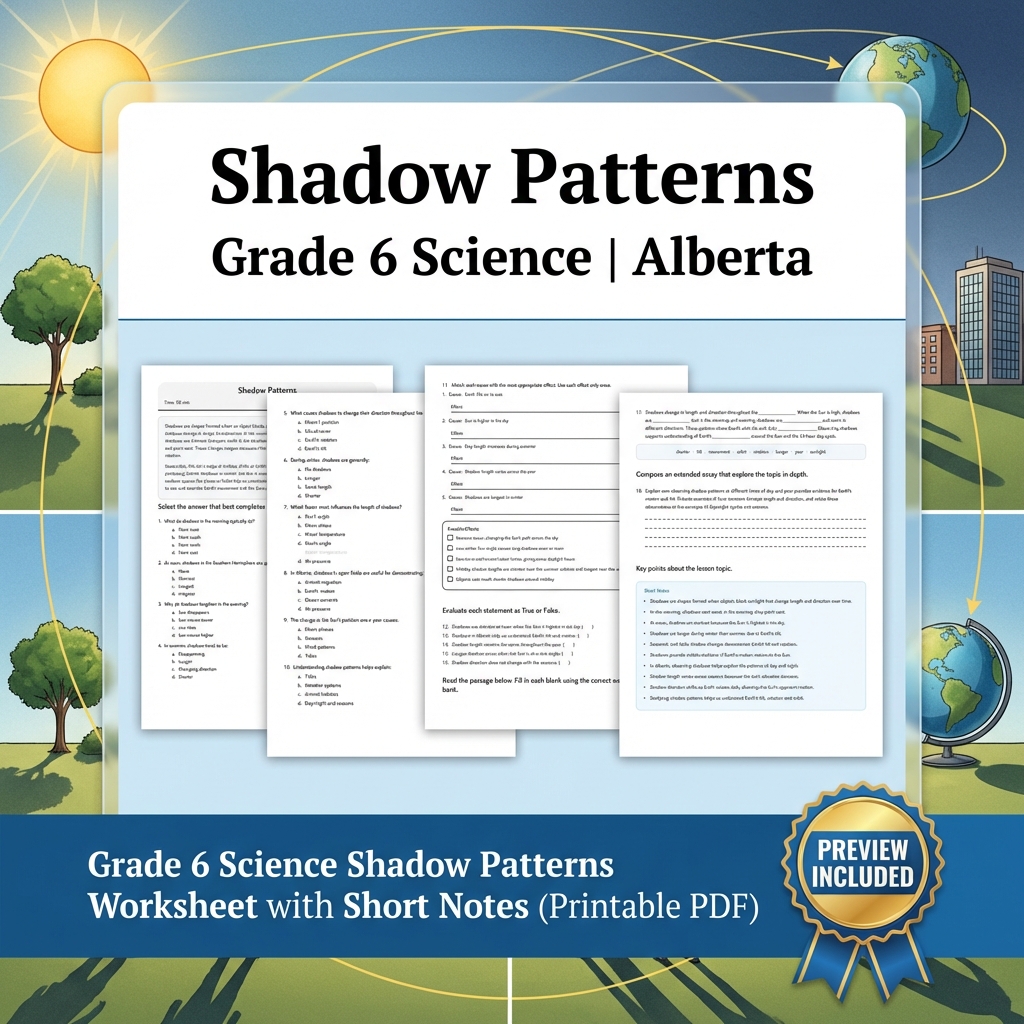
Grade 6 Science Shadow Patterns Worksheet with Short Notes (Printable PDF)
 Created byMeadowlark Worksheets
Learning Objectives
- Understand how daily and seasonal sun angles affect shadow length and direction.
- Observe and describe patterns of shadows at different times of day and year.
- Explain Earth's motion and axial tilt using shadow observations.
Also included in: Grade 6 Science Sky Science Unit Bundle | Alberta Curriculum Worksheets +1 more
Instant download

6th Grade Social Studies Worksheet | Resource Use & Management (PDF)
Created bySunny Desk ResourcesLearning Objectives
- Explain the difference between sustainable harvesting and industrial exploitation of resources.
- Assess how human choices about resources can affect local environments and communities.
- Evaluate case studies to determine which resource-management approach supports long-term sustainability.
Also included in: Grade 6 Sustainable Development Social Studies Lesson Bundle (BC) +1 more
Instant download

Grade 6 Science – Charge Concepts & Electricity | Daily Reading Worksheet
Created byBright Mind ResourcesLearning Objectives
- Define electric charge and understand its properties
- Distinguish between static and current electricity
- Identify phenomena caused by electrical charges
Also included in: Grade 6 Electricity Science Daily Reading Lesson Bundle | Ontario +1 more
Instant download

Grade 6 Social Studies — Daily Life Worksheet MCQ Paper for Mastery
Created byThe Resource HubLearning Objectives
- Describe how daily routines in work, education, housing, and celebration help define community life across time
- Explain causes of changes in habitual practices, such as technological innovation and policy shifts
- Analyze how continuity in cultural rituals can exist alongside changing labor patterns and social roles
Instant download

Grade 6 — Worksheet MCQ Paper for Mastering Comparative Perspectives
Created byThe Resource HubLearning Objectives
- Explain how geography and economy influence community life in different regions
- Compare how cultural practices shape people’s perspectives and responses to change
- Interpret how primary and secondary evidence can support different viewpoints
Instant download

Grade 6 Science – Eclipses & Celestial Mechanics | Daily Reading Worksheet
Created byBright Mind ResourcesLearning Objectives
- Understand the basic concepts of solar and lunar eclipses
- Identify the three main types of eclipses: total, partial, and annular
- Explain the celestial mechanics and alignment conditions that cause eclipses
Also included in: Grade 6 Solar System & Seasons Science Daily Reading Lesson Bundle | Alberta +2 more
Instant download

Grade 6 Science – Density & Properties of Materials | Daily Reading Worksheet
Created byBright Mind ResourcesLearning Objectives
- Define what density is and explain its significance.
- Understand how mass and volume relate to density.
- Identify objects with different densities based on their properties.
Also included in: Grade 6 Science Energy & Matter Daily Reading Lesson Bundle | Florida NGSSS +1 more
Instant download

Debugging Program Errors Worksheet | Grade 6 Computer Science
Created byPrism Point LearningLearning Objectives
- Explain what debugging is and why errors happen in programs.
- Use debugging steps to find where a program goes wrong and fix it.
- Identify common error causes such as incorrect order, missing code, and wrong values.
Also included in: Interactive Coding Foundations Lesson Bundle | Grade 6 Computer Science | General +1 more
Instant download

Policy and Decisions Assessment | TEKS Grade 6 Science Standards
Created byPrism Point LearningLearning Objectives
- Analyze decision-making processes that incorporate scientific evidence and technological options.
- Evaluate risk assessments, cost-benefit considerations, and stakeholder values in policymaking.
- Interpret data, weigh uncertainties, and justify choices transparently in societal contexts.
Instant download

Human Impacts on the Environment Worksheet | NGSS Grade 6 Science
 Created byAmber Owl Education
Learning Objectives
- Explain how land-use change, fossil fuel combustion, agriculture, and waste management can alter Earth systems.
- Describe causal links between human activities and environmental trends, including effects on biogeochemical cycles and climate drivers.
- Use examples (carbon sinks, nutrient runoff, heat islands, hypoxic zones) to predict how ecosystem structure may change over time and space.
Also included in: Grade 6 Science Sustainability and Natural Hazards Lesson Bundle | ngss +1 more
Instant download

Grade 6 Natural Hazards Worksheet | NGSS Earth Science Activity & Answer Key
 Created byNorthstar Worksheets
Learning Objectives
- Explain how tectonic, atmospheric, and hydrologic processes contribute to the formation of natural hazards.
- Describe patterns in hazard frequency, intensity, and spatial distribution using evidence such as records and data.
- Analyze cause-and-effect relationships between natural hazard events and impacts on communities and infrastructure.
Also included in: Sustainability & Human Impacts Lesson Bundle | Grade 6 Science | NGSS +1 more
Instant download
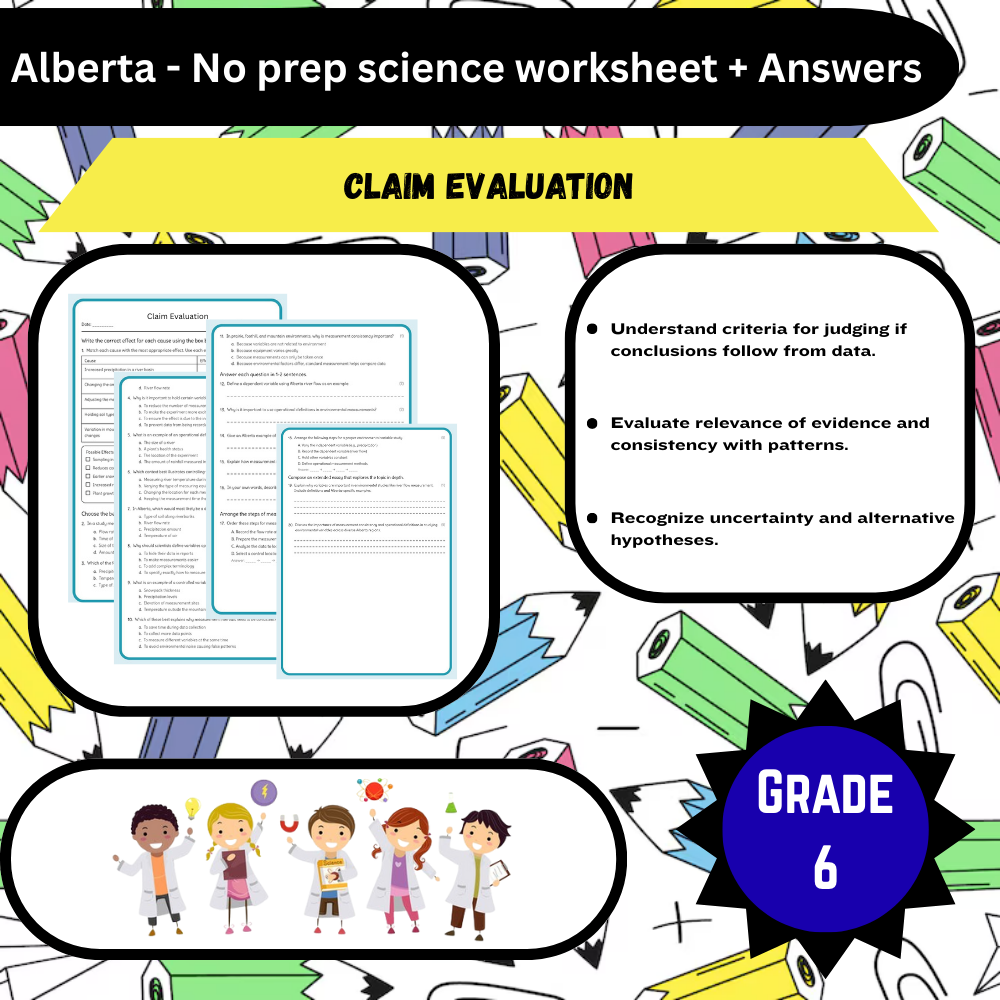
Grade 6 Science – Claim Evaluation Worksheet (PDF) | Alberta Standards
Created byBright Mind ResourcesLearning Objectives
- Understand criteria for judging whether conclusions follow from data and methods.
- Evaluate relevance of evidence and consistency with observed patterns.
- Recognize uncertainty and alternative hypotheses in claim evaluation.
Instant download

Grade 6 Health – Making Healthy Choices & Goals | Daily Reading Worksheet
 Created byQuiet Forest Education
Learning Objectives
- Understand the importance of evaluating options when making health-related decisions.
- Learn how setting realistic goals can improve personal health and well-being.
- Apply decision-making skills to everyday health scenarios.
Also included in: Social-Emotional Skills Grade 6 Health Daily Reading Worksheets Bundle | Ontario +2 more
Instant download

Creative Star Tales Worksheet | Grade 6 Holiday Printable PDF Assessment
Learning Objectives
- Identify elements of a narrative, including characters, setting, conflict, and resolution.
- Use vocabulary and grammar skills to complete sentences with precise word choices.
- Evaluate statements about plot, theme, and moral choices in a story.
Also included in: Grade 6 - 8 Holiday Science STEM in Space Unit Bundle - NGSS: 7 Worksheets +2 more
Instant download

Organizing a Talk Worksheet Pack | Grade 6 ELA Practice
Created bySunny Desk ResourcesLearning Objectives
- Explain how an oral presentation uses an introduction, body, and conclusion to guide the audience.
- Identify and apply smooth transitions and signposted relationships between ideas in a talk.
- Select relevant details for a purpose (informing/explaining) and remove unrelated information.
Also included in: Speaking and Listening Lesson Bundle | Grade 6 ELA | Alberta Framework +1 more
Instant download

Grade 6 Science – Human Water Disruptions | Daily Reading Worksheet
Created byBright Mind ResourcesLearning Objectives
- Understand how human actions can affect the water cycle
- Identify the impact of dams, pollution, and land use changes on water systems
- Analyze ways to protect and preserve water resources
Also included in: Water Cycle Grade 6 Science Lesson Bundle Daily Reading | California Standards +1 more
Instant download

Grade 6 Science – Weather Elements & Concepts | Daily Reading Worksheet
Created byBright Mind ResourcesLearning Objectives
- Identify and understand different weather elements such as temperature, precipitation, wind, cloud cover, and humidity.
- Read and interpret weather-related passages.
- Answer multiple choice, true/false, fill-in-the-blank, short answer, and essay questions about weather.
Also included in: Climate Grade 6 Science Daily Reading Worksheets Lesson Bundle | Florida NGSSS +1 more
Instant download

Grade 6 Science – Energy Decreases Upward | Daily Reading Worksheet
Created byBright Mind ResourcesLearning Objectives
- Understand how energy flows through different trophic levels in an ecosystem
- Recognize that energy is lost as heat at each level
- Explain why higher trophic levels have less energy than producers
Also included in: Grade 6 Ecosystems and Energy Science Lesson Bundle | California Standards +1 more
Instant download

Grade 6 Experimental Design Worksheet | Practice & Assessment PDF
Created byClear Sky ClassroomLearning Objectives
- Identify independent, dependent, and controlled variables when designing a fair scientific test.
- Explain how to choose a control condition and keep measurements consistent and repeatable.
- Interpret results by using clear testable questions and well-defined measurement procedures.
Also included in: Grade 6 Scientific Investigation Data Analysis Science Lesson Bundle | Alberta +1 more
Instant download

Grade 6 Introduction to Cell Evidence Worksheet | NGSS Life Science
Created byBRIGHT PATH RESOURCESLearning Objectives
- Identify features that distinguish single-celled organisms from multicellular organisms.
- Understand the relationship among cells, tissues, organs, and entire organisms.
- Observe and compare the characteristics of different cell types using microscopy and specimens.
Also included in: From Molecules to Organisms Lesson Bundle | Grade 6 Science | NGSS +2 more
Instant download

6th Grade Health Worksheet | Injury Prevention & Safety (NHES)
Created bySunny Desk ResourcesLearning Objectives
- Identify key safety behaviors that reduce injury risk at home, in sports, and in the community
- Explain how protective gear and safety rules work to prevent common injuries
- Recognize environmental hazards and choose appropriate safety responses
Also included in: Grade 6 Health: Health Enhancing Practices and Behaviors Lesson Bundle (NHES) +1 more
Instant download

Measurement Precision Worksheet Grade 6 Science NGSSS Data Skills
Created byPrism Point LearningLearning Objectives
- Explain the difference between precision and accuracy using measurement examples.
- Choose appropriate units and tools to improve measurement quality.
- Identify sources of error and describe how consistent procedures and calibration reduce error.
Also included in: Scientific Inquiry Lesson Bundle | Grade 6 Science | Florida NGSSS
Instant download

Grade 6 Science | Ecosystem Components Worksheet | NGSSS Aligned
 Created byLumora Learning
Learning Objectives
- Explain how abiotic factors (nonliving conditions) affect where organisms can live in an ecosystem.
- Identify biotic factors (living organisms) and describe producers, consumers, and decomposers.
- Compare ecosystem components in different environments such as ponds, deserts, and tropical forests.
Instant download

Cultural Evolution Worksheet | Grade 6 Social Studies BC Curriculum
Created byQuiet Forest EducationLearning Objectives
- Understand traditional cultural practices in different communities
- Recognize how external influences affect cultural identities
- Reflect on the importance of preserving cultural diversity amidst change
Also included in: Cultures: Traditions, Contact & Change Lesson Bundle | Grade 6 Social Studies BC +1 more
Instant download

Before & After Properties Chemical Change Worksheet Grade 6 Science
Created byPrism Point LearningLearning Objectives
- Explain how scientists compare properties of substances before and after an interaction to determine if a new substance forms.
- Identify evidence of chemical change, including changes in color, formation of a solid, gas release, and new material with different behavior.
- Distinguish between physical changes (appearance changes without new substances) and chemical changes (new substances with new properties).
Instant download

Grade 6 Science – Solar System & Celestial Motions | Daily Reading Worksheet
Created byBright Mind ResourcesLearning Objectives
- Identify key objects in the solar system and their positions relative to the Sun
- Describe the basic motions of planets, moons, and the Sun
- Understand how Earth's rotation and revolution cause day, night, and seasons
Also included in: Grade 6 Earth and Space Science Lesson Bundle Daily Reading | TEKS +2 more
Instant download

Water Cycle Processes and Mass Transfer Worksheets | Grade 6
 Created byTeachers Club
Learning Objectives
- Describe how water moves through the water cycle using key processes such as evaporation, condensation, precipitation, runoff, infiltration, and storage in groundwater.
- Explain how solar energy and gravity drive energy and movement in the water cycle.
- Trace water between reservoirs (ocean, ice, rivers, soil, and groundwater) using conceptual and graphical ideas.
Also included in: Earth's Systems Grade 6 Science Worksheets | NGSS Unit Bundle +2 more
Instant download

Grade 6 Angle of Attack & Lift Aerodynamics Worksheet | Alberta Science
Created byBRIGHT PATH RESOURCESLearning Objectives
- Explain how angle of attack affects lift and drag using cause-and-effect language.
- Identify the critical angle where airflow separates and lift drops (stall).
- Use examples to describe how small angle changes change how a glider or kite performs.
Also included in: Aerodynamics & Flight Physics Grade 6 Science Worksheets Bundle | Alberta +1 more
Instant download

Population Change Worksheet | NGSS Grade 6 Science Practice PDF
JCreated byJ.S SheetsLearning Objectives
- Construct evidence-based arguments linking ecosystem component changes to population increases or declines.
- Analyze case studies such as predator reintroduction, invasive species, habitat fragmentation, and disease outbreaks.
- Interpret empirical data sets and longitudinal observations to infer population responses and patterns.
Also included in: Grade 6 Ecosystem Interactions Science Lesson Bundle Worksheet Set – NGSS +1 more
Instant download

6th Grade ELA | Summarizing Ideas Worksheet (PDF) – Alberta Standards
Created byGolden Apple StudioLearning Objectives
- Identify the central idea and key supporting points in a text when writing a summary.
- Differentiate factual information from opinions that appear in a text.
- Write summaries that keep logical order using transitions and paraphrasing.
Also included in: Grade 6 Reading Comprehension Skills in ELA Lesson Bundle: Alberta Framework +1 more
Instant download
Browse more categories
About Grade 6 Worksheets
Browse 8,582 printable Grade 6 worksheets across math, ELA, science, and social studies — each a ready-to-print PDF with optional answer keys.
MyTeachingSheets worksheets are made by real teacher-authors and checked before they go live. Download any as a print-ready PDF for lessons, homework, or independent practice — most include answer keys, and previews are always free.