
Grade 6 Worksheets
8,582 grade resources
Grade 6 Collisions and Momentum Worksheet | NGSS Practice PDF
 Created byClear Sky Classroom
Learning Objectives
- Understand the principles of conservation of momentum in two-body collisions.
- Differentiate between elastic and inelastic collisions through examples.
- Identify the forces involved during contact in collisions and how they produce action-reaction pairs.
Also included in: Grade 6 Motion and Stability: Forces and Interactions Science Lesson Bundle NGSS +1 more
Instant download

Science Grade 6 Variable Control Worksheet | Standards-Aligned Practice
JCreated byJ.S SheetsLearning Objectives
- Identify the independent variable and the dependent variable in an investigation
- Explain why control variables must be kept constant to make evidence reliable
- Use an experiment plan to separate the changing factor from measured outcomes
Also included in: Grade 6 Scientific Investigation Science lesson bundle: General Framework +1 more
Instant download

Grade 6 Science | Digestive System - Daily Reading Comprehension
 Created byCoral Reef Learning
Learning Objectives
- Identify the main organs involved in digestion
- Understand the basic functions of the digestive organs
- Learn how food is broken down and nutrients are absorbed
Instant download

Strong Passwords Worksheet | Account Protection & Digital Safety Grade 6
 Created byBright Mind Resources
Learning Objectives
- Compare weak and strong passwords and explain why strong passwords are harder to guess.
- Identify habits that protect accounts, including not reusing passwords and keeping login details private.
- Use security vocabulary (password, secure, authentication, account) to describe how sign-in protection works.
Instant download

Grade 6 Health – Signs of Well-Being Daily Reading Worksheet | Ontario Standards
 Created byQuiet Forest Education
Learning Objectives
- Understand key concepts related to Health
- Apply knowledge through practice questions
- Demonstrate comprehension of the material
Also included in: Social-Emotional Skills Grade 6 Health Daily Reading Worksheets Bundle | Ontario +2 more
Instant download

Grade 6 Science – Mass & Density Daily Reading Worksheet | TEKS Aligned
Created byBright Mind ResourcesLearning Objectives
- Define and measure mass and volume of objects.
- Understand how density relates mass and volume.
- Calculate density with simple formulas.
Also included in: Matter & Energy Grade 6 Science Daily Reading Worksheets Bundle | TEKS +2 more
Instant download
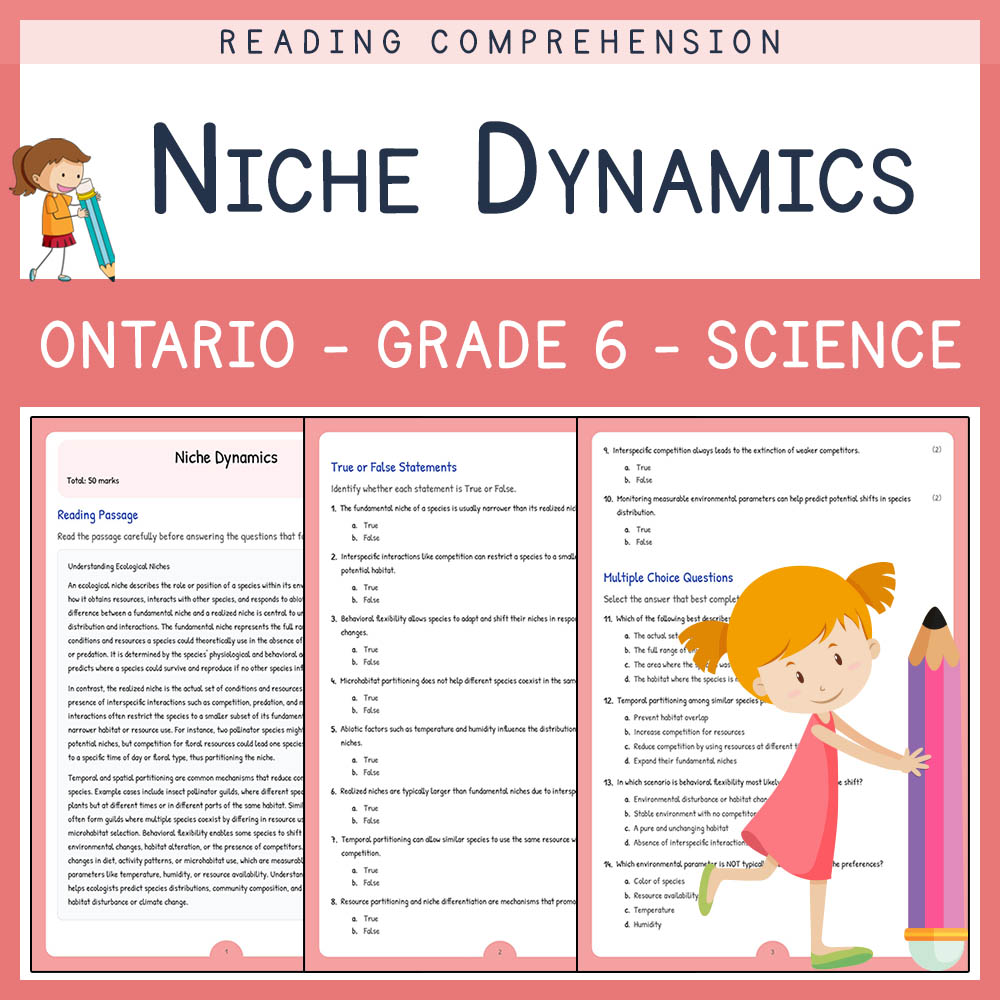
Grade 6 Science | Niche Dynamics Worksheet & Answer Key | Ontario Standards
 Created byLumora Learning
Learning Objectives
- Describe the difference between fundamental and realized ecological niches.
- Explain how abiotic factors and interspecific interactions influence resource use and habitat occupation.
- Analyze examples of spatial and temporal partitioning among species.
Also included in: Grade 6 Science | Biodiversity Custom Unit Resource | Ontario Framework
Instant download

Eclipses And Tides Practice Test Printables | Grade 6 Science
 Created byPrism Point Learning
Learning Objectives
- Explain how solar and lunar eclipses happen using Earth–Moon–Sun alignment and the ideas of umbra and penumbra.
- Distinguish the causal mechanisms behind eclipse visibility and tidal range by relating them to the Earth–Moon–Sun system.
- Describe how spring and neap tides form and why some coasts experience stronger tide effects.
Also included in: Grade 6 Space Systems Science Lesson Bundle for Ontario (10 Worksheets)
Instant download

Grade 6 Holiday Celebration | Family Values Worksheet (PDF)
 Created bySilver Birch Teaching
Learning Objectives
- Explain how family bonds and shared traditions support emotional resilience and community connection.
- Analyze how cultural stories and family rituals help people understand belonging and responsibility.
- Compare how different societies celebrate special occasions and show respect for diverse family practices.
Also included in: Grade 6 Holiday Family Values & Diversity Lesson Bundle - May +1 more
Instant download

File Sharing and Collaboration Worksheet Grade 6 Computer Science Activity
Created byPrism Point LearningLearning Objectives
- Explain how collaboration tools support shared files using share, collaborate, and permission.
- Choose safe sharing settings that protect privacy and prevent unwanted changes.
- Describe how commenting and version history can help groups work together effectively.
Also included in: Grade 6 How the Internet Works Lesson Bundle | Computer Science | General +1 more
Instant download

File Sharing and Collaboration Worksheet | Grade 6 Computer Science Practice
Created byBright Mind ResourcesLearning Objectives
- Define key vocabulary related to file sharing and collaboration, including share, collaborate, file, and permission.
- Identify safe sharing choices by matching scenarios to appropriate permissions and sharing settings.
- Explain how version history helps teams track changes during collaboration.
Instant download
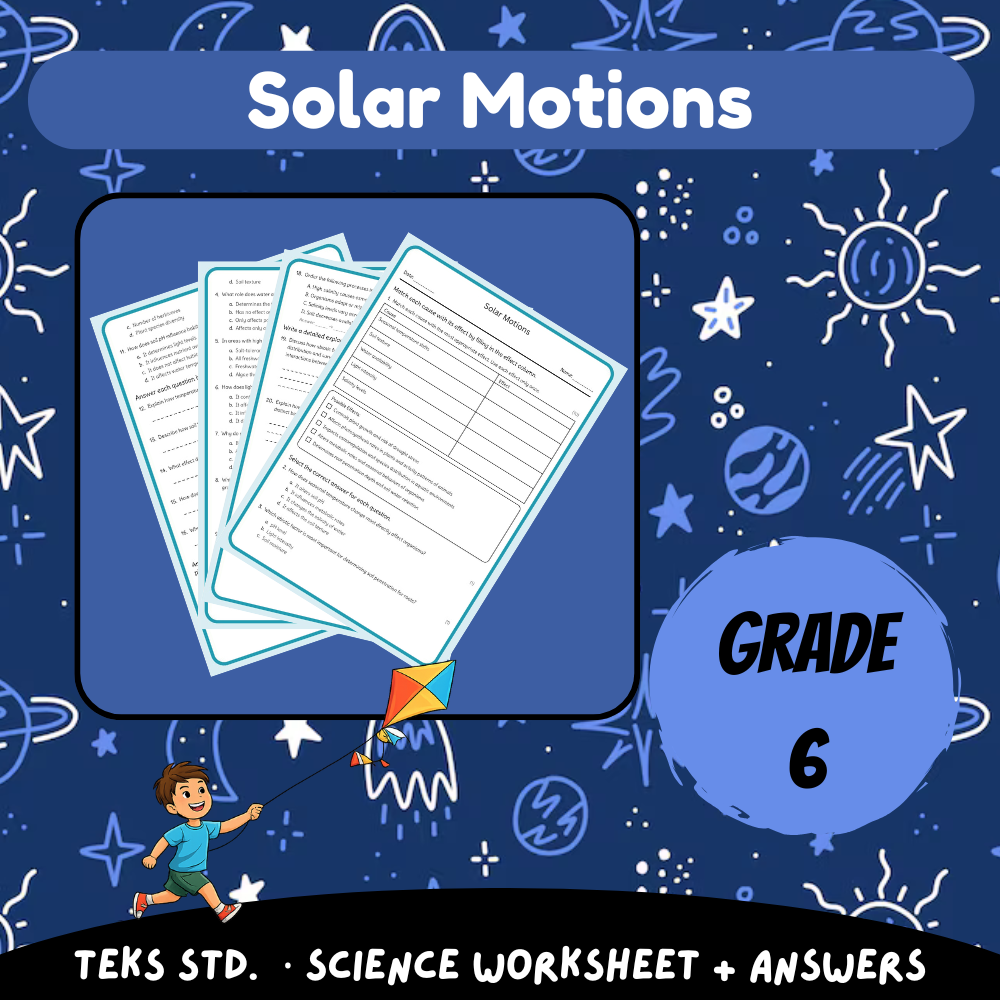
Grade 6 Science | Solar Motions Worksheet (Answer Key) – TEKS Aligned
Created byBright Mind ResourcesLearning Objectives
- Describe the orbital motions of planets and the Moon.
- Explain how gravitational interactions influence celestial bodies.
- Identify how Earth's tilt and revolution cause seasons and climate changes.
Instant download

6th Grade Science Worksheets | Collaborative Practices & Reproducibility (PDF)
 Created byEvergreen Desk Education
Learning Objectives
- Explain how roles, shared documentation standards, and communication protocols improve team science projects.
- Use trackable versioning and clear attribution to make scientific records transparent and reproducible.
- Practice constructive critique by using agreed-upon review and decision-making processes to resolve conflicting observations.
Also included in: Grade 6 Science Inquiry and Data Collection Lesson Bundle | Ontario +1 more
Instant download
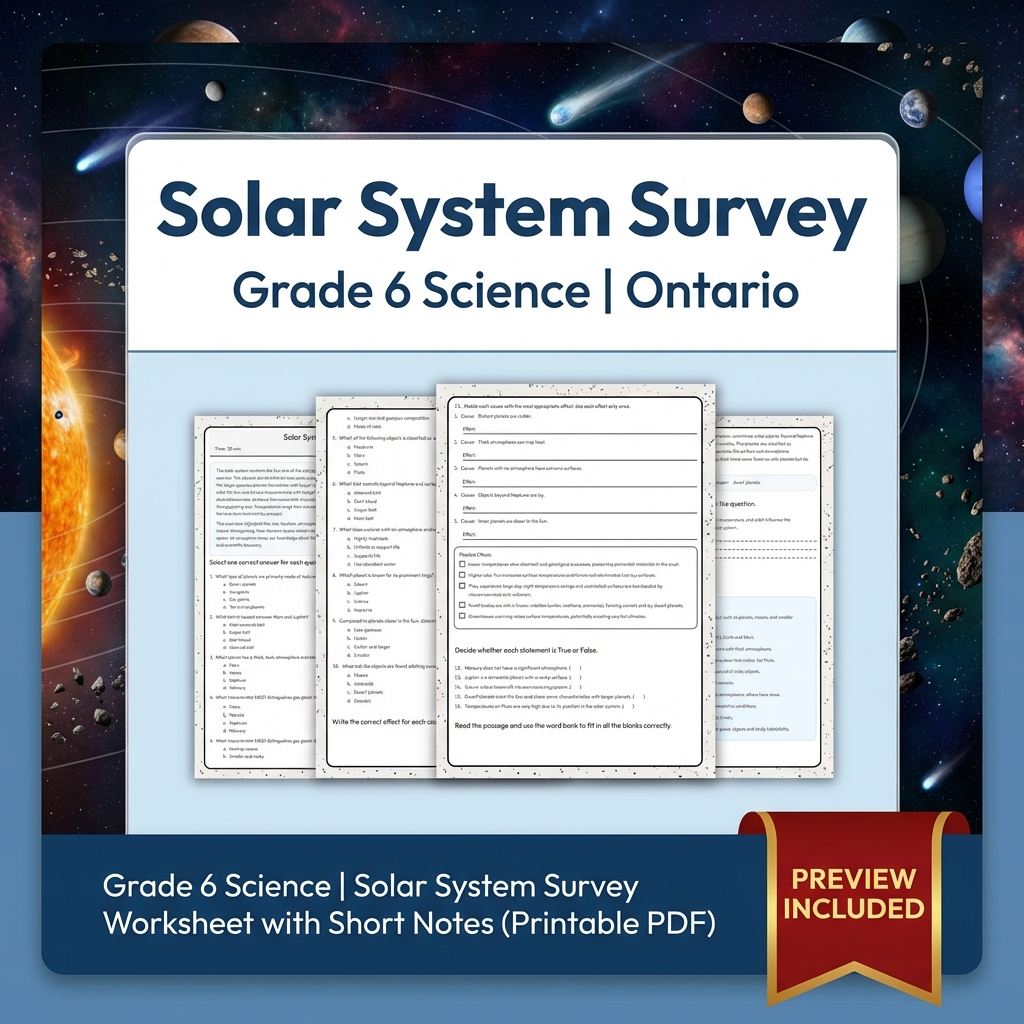
Grade 6 Science | Solar System Survey Worksheet with Short Notes (Printable PDF)
 Created byMeadowlark Worksheets
Learning Objectives
- Identify major components of the solar system and their characteristics.
- Distinguish between terrestrial planets, gas giants, and dwarf planets.
- Understand the locations and features of asteroid and Kuiper belts.
Also included in: Grade 6 Science Lesson Group Bundle – Ontario Curriculum Worksheets +1 more
Instant download

Variables Control Worksheet Pack | Grade 6 Science Activities
Created byPrism Point LearningLearning Objectives
- Identify independent, dependent, and controlled variables in a controlled experiment.
- Use operational definitions to clearly describe what is being measured and manipulated.
- Recognize potential confounding variables and explain how to reduce them using controls, replication, and randomization.
Also included in: Grade 6 Scientific Investigation Practices Science Lesson Bundle TEKS +1 more
Instant download

Grade 6 Science – Understanding Iterative Improvement | Daily Reading Worksheet
Created byBright Mind ResourcesLearning Objectives
- Define iterative improvement and explain its importance in science and engineering.
- Identify how evaluation results guide design refinements.
- Describe the process of testing and fixing in iterative development.
Also included in: Engineering & Technology Grade 6 Science Worksheets Lesson Bundle | General +1 more
Instant download

Science Worksheet Population Change | NGSS Grade 6 Science Assessment
 Created bySkylark Worksheets
Learning Objectives
- Use evidence to explain how ecosystem changes can cause population increases or declines
- Interpret population data (birth/death rates, age structure, and growth patterns) to support claims
- Connect ecosystem interactions (predators, prey, invasive species, disease) to trophic cascades and recovery or collapse
Also included in: Grade 6 Ecosystems Lesson Bundle: NGSS Science Worksheets & Food Webs +1 more
Instant download

Earth Rotation Worksheet | Grade 6 Science Activities
Created byPrism Point LearningLearning Objectives
- Explain how Earth’s rotation about its axis produces alternating daylight and darkness.
- Describe how Earth’s axial rotation creates the apparent daily motion of the Sun and stars.
- Connect the timing of sunrise, solar noon, and sunset to different time zones across Alberta.
Also included in: Celestial Patterns & Seasons Lesson Bundle | Grade 6 Science | Alberta
Instant download

Grade 6 Science – Graph Selection & Data Visualization | Daily Reading Worksheet
Created byBright Mind ResourcesLearning Objectives
- Understand different types of graphs and their uses in science.
- Learn when to use line graphs, bar charts, and scatter plots.
- Recognize the importance of appropriate axis labeling and scaling.
Also included in: Grade 6 Science Data & Inquiry Daily Reading Worksheets Lesson Bundle | Alberta +2 more
Instant download

Drag Types Worksheet | Grade 6 Science Activities
Created byPrism Point LearningLearning Objectives
- Explain how friction and pressure differences contribute to drag.
- Differentiate parasitic drag and induced drag using examples.
- Describe how reducing drag can lower required thrust and energy demands.
Also included in: Aerodynamics and Flight Design Lesson Bundle – Grade 6 Science Alberta
Instant download

Bandwidth and Connection Speed Worksheet Grade 6 Computer Science Activity
Created byPrism Point LearningLearning Objectives
- Explain how bandwidth affects how quickly data moves across a network.
- Describe the difference between connection speed and bandwidth using everyday examples.
- Use vocabulary words (bandwidth, speed, connection, data) accurately in science-focused sentences.
Also included in: Grade 6 How the Internet Works Lesson Bundle | Computer Science | General +1 more
Instant download

Grade 6 Science – Data Tables & Graphs Daily Reading Worksheet | TEKS
Created byBright Mind ResourcesLearning Objectives
- Learn how to organize data in tables and graphs.
- Identify patterns and outliers in data sets.
- Interpret trends from line graphs, bar graphs, and scatter plots.
Also included in: Grade 6 Science Inquiry & Modeling Daily Reading Lesson Bundle | TEKS +2 more
Instant download

6th Grade Science | Data Representations Worksheet (Worksheet + Answer Key)
Created byEvergreen Desk EducationLearning Objectives
- Organize numerical and categorical observations into tables and graphs for comparison
- Use consistent labels, units, and scales to read results accurately
- Identify when to use bar graphs, line graphs, and tables based on the type of data
Also included in: Grade 6 Science Inquiry Lesson Bundle: Variable Control & Models (General) +1 more
Instant download
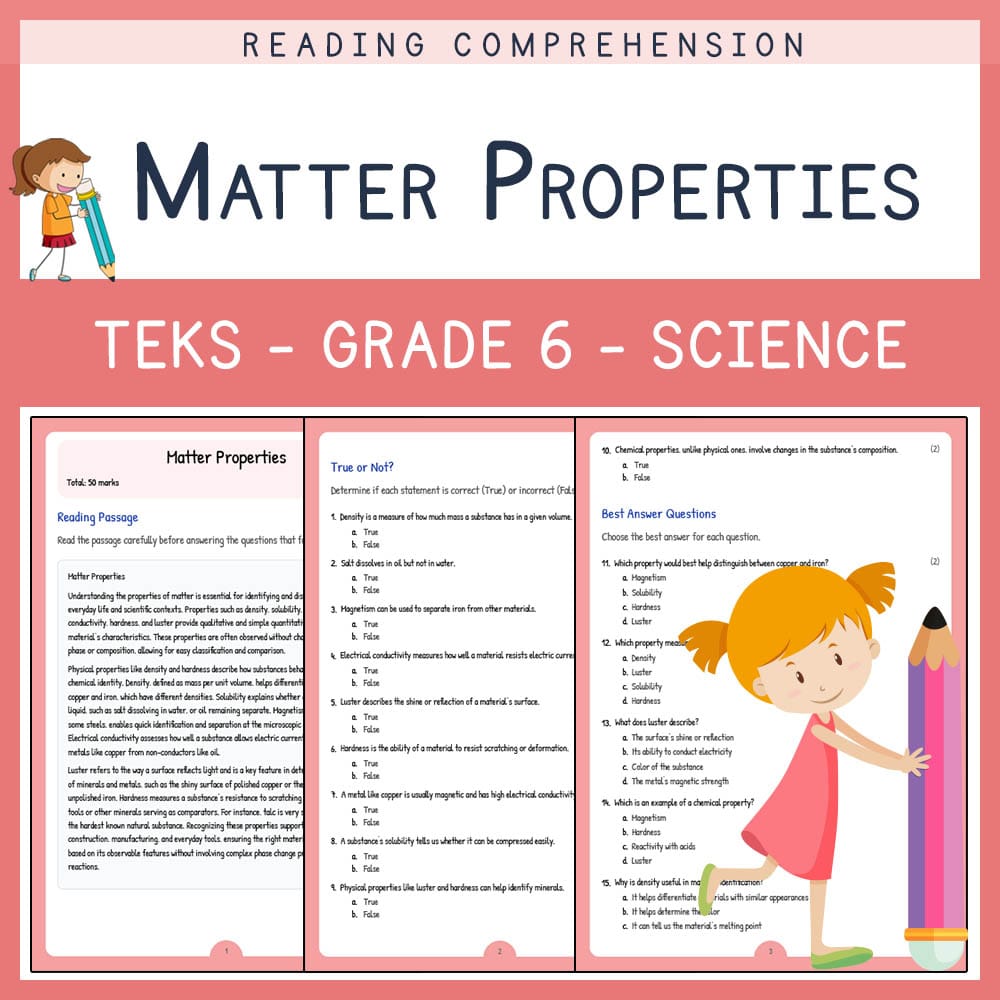
Grade 6 Science | Matter Properties Worksheet | TEKS-Aligned
Created byLumora LearningLearning Objectives
- Understand the different types of physical and chemical properties used to identify substances.
- Learn how to describe properties such as density, solubility, magnetism, electrical conductivity, hardness, and luster.
- Relate observed properties to real-world examples like iron, salt, oil, and copper.
Also included in: Grade 6 Science | Matter and Energy Lesson Bundle | TEKS Aligned
Instant download

Grade 6 Science | Observational Instruments Worksheet (Ontario Standards) (PDF)
Created byEvergreen Desk EducationLearning Objectives
- Describe how different observational instruments (optical, radio, spectrometers, and space-based observatories) collect information about the solar system.
- Explain how wavelength helps determine composition, motion, and temperature of space objects.
- Compare ground-based and space-based observing platforms and identify key advantages of avoiding atmospheric distortion.
Also included in: Grade 6 Solar System Space Science Lesson Bundle – Ontario Worksheets +1 more
Instant download

6th Grade Math | Proportional Applications Worksheet (Ontario PDF)
Created byClear Sky ClassroomLearning Objectives
- Understand how ratios and proportions are used in real-world contexts.
- Apply proportions to solve problems involving recipes, scales, and rates.
- Set up and interpret ratios to compare quantities and calculate missing values.
Also included in: Grade 6 Math Number Bundle | Ontario Standards for Operations & Patterns +1 more
Instant download

Balanced Forces Assessment | NGSSS Florida Grade 6 Science
Created byPrism Point LearningLearning Objectives
- Explain how balanced forces result in a net force of zero and can maintain motion at constant speed or rest
- Describe how unbalanced forces create a net force that changes an object’s speed and/or direction
- Determine the direction of the net force from a force diagram or word description of forces
Also included in: Grade 6 Energy and Matter Science Lesson Bundle Unit: Florida NGSSS
Instant download

Variables Control Assessment | TEKS Science Grade 6 Worksheet
Created byPrism Point LearningLearning Objectives
- Understand the roles of independent, dependent, and controlled variables in experiments.
- Identify operational definitions and potential confounding influences in controlled testing.
- Apply understanding of variable control to plant growth experiments under varied light conditions.
Also included in: Scientific Inquiry and Processes Grade 6 Science Lesson Bundle | TEKS
Instant download

Organizing a Final Digital Product Grade 6 Computer Science Worksheet
Created byPrism Point LearningLearning Objectives
- Explain how to organize a final product so it is clear and easy to follow for an audience.
- Choose readable text and appropriate media for a presentation.
- Use key vocabulary (final product, organize, presentation, audience) when planning to share work.
Also included in: Grade 6 Digital Projects Lesson Bundle | Computer Science | General +1 more
Instant download

Solar System Survey Worksheet | Ontario Grade 6 Science Assessment
 Created byCedar Grove Learning
Learning Objectives
- Identify major components of the solar system (terrestrial planets, gas giants, ice giants, dwarf planets, asteroid belt, and Kuiper belt).
- Describe how distance from the Sun affects temperature and typical surface or atmospheric conditions.
- Explain how planet classification relates to composition and orbital behavior (such as clearing an orbital zone).
Also included in: Grade 6 Earth and Space Systems Science Lesson Bundle: Ontario +1 more
Instant download

Grade 6 Climate Systems Worksheet | NGSS Practice PDF
Created byClear Sky ClassroomLearning Objectives
- Explain how unequal solar heating and planetary rotation create global circulation patterns.
- Identify major atmospheric cells, wind patterns, and ocean currents involved in heat and moisture transport.
- Describe the influence of circulation patterns on regional climates and phenomena like El Niño.
Also included in: Grade 6 Earth's Systems Science Lesson Bundle (NGSS-Aligned) Worksheets +1 more
Instant download
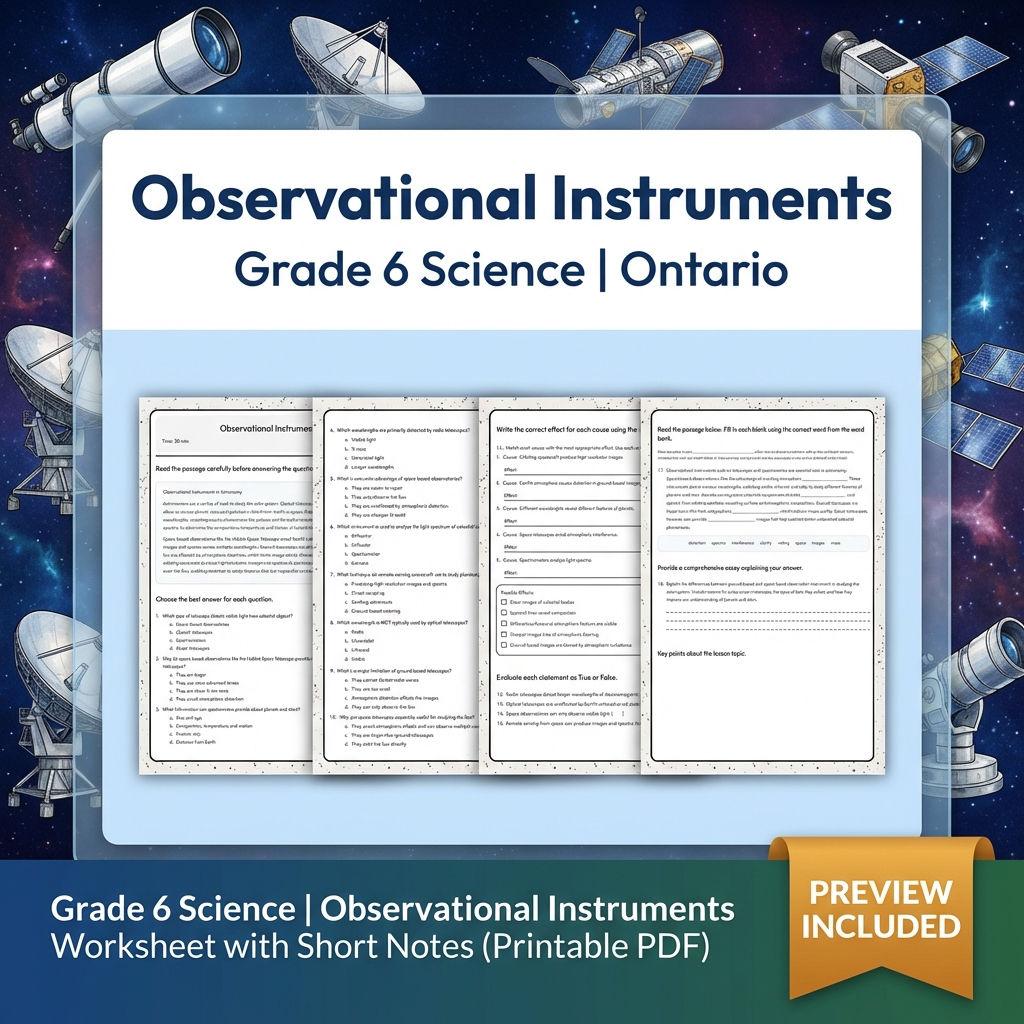
Grade 6 Science | Observational Instruments Worksheet with Short Notes (PDF)
Created byMeadowlark WorksheetsLearning Objectives
- Identify different types of observational instruments used to study the solar system.
- Explain the advantages of space-based observatories over ground-based telescopes.
- Describe how different wavelengths provide information about planetary composition, motion, and temperature.
Also included in: Grade 6 Science Lesson Group Bundle – Ontario Curriculum Worksheets +1 more
Instant download

Cell Functions Worksheet | NGSS Grade 6 Science Practice PDF
JCreated byJ.S SheetsLearning Objectives
- Identify the main organelles in a cell and their functions.
- Explain how organelle structure relates to its role in the cell.
- Differentiate between plant and animal cell organelles and their specialization.
Also included in: Grade 6 Cellular Processes and Feedback Science Lesson Bundle – NGSS +1 more
Instant download

6th Grade Social Studies Worksheet | Technological Innovations (PDF)
 Created bySunny Desk Resources
Learning Objectives
- Explain how major technological innovations, such as the steam engine and the printing press, changed industry and communication.
- Describe how technological change can affect economic growth, social structures, and daily life.
- Use evidence from a text to answer questions about cause and effect in historical technological developments.
Also included in: Grade 6 Technological Innovations Social Studies lesson bundle TEKS worksheets +1 more
Instant download

6th Grade Social Studies – Individual Rights Worksheet (TEKS & PDF)
Created bySunny Desk ResourcesLearning Objectives
- Explain key individual rights (voting, free speech, and property ownership) and why they matter in society.
- Describe how communities balance individual freedoms with responsibilities to protect others.
- Use historical examples to connect rights to social change and civic participation.
Also included in: 6th Grade Civic Laws, Norms & Rights Social Studies Lesson Bundle TEKS +1 more
Instant download

Biodiversity Patterns Worksheet | NGSS Grade 6 Ecosystems Activity
 Created byAmber Owl Education
Learning Objectives
- Explain how species richness and occurrence can be used to identify biodiversity patterns across space and time.
- Compare biodiversity patterns using island faunas, latitudinal gradients, and habitat heterogeneity.
- Describe community turnover, endemism, and colonization using ecological and historical factors.
Also included in: Grade 6 Science Natural Selection & Biodiversity Lesson Bundle | NGSS +1 more
Instant download

Day Night Seasons Worksheet | NGSS Grade 6 Science Practice
JCreated byJ.S SheetsLearning Objectives
- Explain Earth's rotation and its effect on day and night.
- Describe how Earth's orbit and axial tilt cause seasons.
- Identify key observational events like solstices and equinoxes.
Also included in: Grade 6 Earth-Moon Relationships Space Science Lesson Bundle | NGSS +1 more
Instant download

What Is Artificial Intelligence Worksheet | Grade 6 Computer Science
Created byPrism Point LearningLearning Objectives
- Define artificial intelligence and explain how it uses data to make predictions.
- Identify real-life examples of AI in search tools, digital assistants, and recommendation systems.
- Use lesson vocabulary (artificial intelligence, prediction, pattern, data) correctly in sentences.
Also included in: Artificial Intelligence & Digital Ethics Lesson Bundle — Grade 6 Computer Science, General +1 more
Instant download

Air Density Worksheet | Grade 6 Science Activities
Created byPrism Point LearningLearning Objectives
- Explain how temperature, humidity, and altitude affect air density.
- Describe how air density influences buoyancy and aerodynamic lift.
- Use science vocabulary to compare atmospheric conditions in different places.
Also included in: Aerodynamics and Flight Design Lesson Bundle – Grade 6 Science Alberta
Instant download

Grade 6 Species Interactions Worksheet | NGSS Practice PDF
Created byClear Sky ClassroomLearning Objectives
- Construct explanations predicting patterns of species interactions across ecosystems.
- Identify and differentiate mutualism, competition, predation, and parasitism.
- Compare interaction outcomes in forest, grassland, and freshwater environments.
Also included in: Grade 6 Ecosystems Science Lesson Bundle for NGSS: Species, Energy, Biodiversity +1 more
Instant download

6th Grade Holiday Worksheet | Cultural Diversity (PDF)
Created bySilver Birch TeachingLearning Objectives
- Identify ways different cultures are celebrated (traditions, clothing, music, and food).
- Explain how celebrating cultural differences supports inclusion and respect.
- Use information from a text to answer questions about common human values across cultures.
Also included in: 6th Grade Holiday Traditions Lesson Bundle (May Framework) +1 more
Instant download
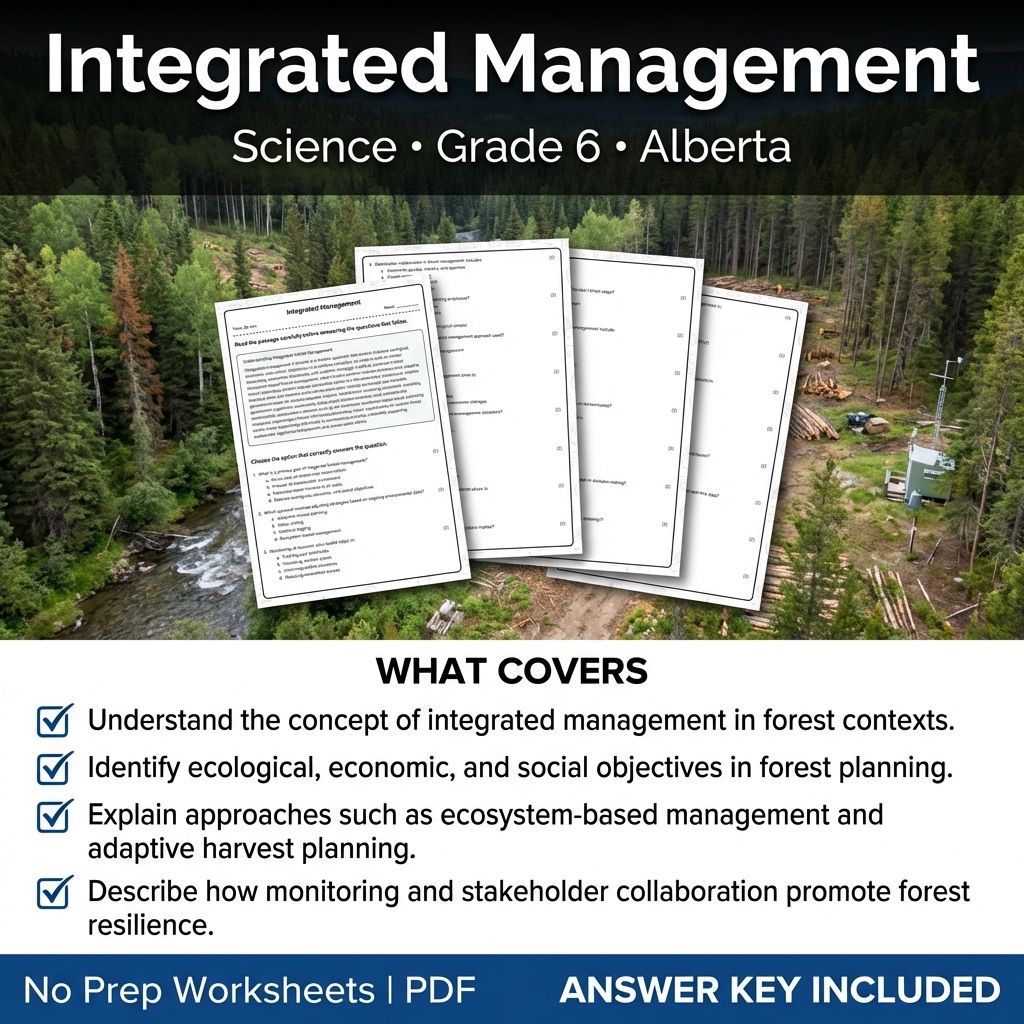
Grade 6 Science Worksheet on Integrated Management Alberta Standards
Created byCoral Reef LearningLearning Objectives
- Understand the concept of integrated management in forest contexts.
- Identify ecological, economic, and social objectives in forest planning.
- Explain approaches such as ecosystem-based management and adaptive harvest planning.
Instant download

Grade 6 Holiday | Securing Personal Data Worksheet | January Standards
Created byLumora LearningLearning Objectives
- Explain why strong, unique passwords help protect personal data online.
- Identify safer online behaviors when sharing information on websites, apps, and social media.
- Apply privacy and security strategies to common real-world scenarios.
Instant download

Comparing Algorithm Efficiency Worksheet | Grade 6 Computer Science
Created byBright Mind ResourcesLearning Objectives
- Compare two strategies for solving the same problem and describe which is more efficient and why
- Use vocabulary such as efficient, compare, optimize, and strategy to explain algorithm steps
- Choose the best algorithm for a scenario based on fewer steps, less time, or less repetition
Instant download

Grade 6 Forms Of Energy Worksheet | Practice & Assessment PDF
Created byClear Sky ClassroomLearning Objectives
- Identify common forms of energy (kinetic, potential, thermal, chemical, electrical) in real-world situations
- Explain how energy transforms when one form changes into another in natural and engineered systems
- Use energy vocabulary to describe what energy is stored, what energy is moving, and what energy results
Instant download

Before After Properties Worksheet | Standards-Aligned Science Grade 6
JCreated byJ.S SheetsLearning Objectives
- Understand how to compare properties of substances before and after interaction.
- Identify evidence that indicates new substances are formed during interactions.
- Recognize changes in color, formation of solids, release of gases, and new material behaviors as signs of chemical change.
Also included in: Grade 6 Physical Science Lesson Bundle for Science – California Standards +1 more
Instant download

Interdependence Roles Worksheet Grade 6 Science NGSSS Florida
Created byPrism Point LearningLearning Objectives
- Explain how predators and prey populations can affect each other in an ecosystem.
- Describe competition and mutualism and how each relationship affects organisms.
- Use evidence to predict how changes in one population can ripple through a community.
Instant download

Grade 6 Holiday | Women’s History Month Kickoff Worksheet | PDF + Answer Key
 Created byShaNova Worksheets
Learning Objectives
- Analyze speeches, writings, or interviews of women advocating for social justice and equality.
- Identify persuasive language and techniques used in activism.
- Understand the importance of voice and activism in social change.
Also included in: Grade 6 Holiday Worksheets for Women's History Month Celebrations
Instant download
Browse more categories
About Grade 6 Worksheets
Browse 8,582 printable Grade 6 worksheets across math, ELA, science, and social studies — each a ready-to-print PDF with optional answer keys.
MyTeachingSheets worksheets are made by real teacher-authors and checked before they go live. Download any as a print-ready PDF for lessons, homework, or independent practice — most include answer keys, and previews are always free.