
Grade 6 Worksheets
8,582 grade resources
Natural Hazards Science Worksheet | NGSS Grade 6 Earth Systems Activity
 Created byAmber Owl Education
Learning Objectives
- Interpret observations and instrumental data to identify patterns in natural hazards.
- Use recurrence intervals and frequency data to estimate how likely events are to occur.
- Explain how hazard magnitude and likely locations are used in risk assessment and response planning.
Also included in: Grade 6 Science Earth Systems & Climate Lesson Bundle | NGSS +1 more
Instant download

Grade 6 Social Studies — Cultural Crossroads Worksheet MCQ Paper
 Created byThe Resource Hub
Learning Objectives
- Understand the historical relationship between Egypt and Kush and their influence on each other's culture.
- Identify key aspects of Kushite and Egyptian art, religion, and political structures.
- Analyze how trade, warfare, and diplomacy affected regional power dynamics in the Nile Valley.
Also included in: Grade 6 Ancient Egypt Trade Resources Social Studies Lesson Bundle California +1 more
Instant download

Change Evidence Worksheet | Grade 6 Science Activities
 Created byPrism Point Learning
Learning Objectives
- Differentiate physical changes from chemical changes by using observable evidence
- Identify common chemical evidence such as gas formation, precipitate, permanent color change, and temperature change
- Explain how conservation of matter applies to both physical and chemical changes
Also included in: Grade 6 Matter, Energy, and Change Science Lesson Bundle TEKS Worksheets +1 more
Instant download

Climate Data Patterns Assessment for Grade 6 Science – Standards-Aligned
Created byPrism Point LearningLearning Objectives
- Understand how graphs of temperature and precipitation reveal climate patterns.
- Identify and interpret trends and variability in climate data over multiple years.
- Differentiate between typical climate patterns and anomalies using historical data.
Also included in: Grade 6 Life Science Science Lesson Bundle – General Framework Unit
Instant download

6th Grade ELA Vocabulary Worksheet – Common Core Practice (PDF)
 Created byGolden Apple Studio
Learning Objectives
- Use word parts (prefixes, suffixes, and root words) to infer the meaning of unfamiliar words.
- Use context clues to confirm or adjust a word-part meaning guess.
- Select more precise vocabulary choices to improve descriptive and explanatory writing.
Also included in: Grade 6 ELA Grammar, Vocabulary & Sentence Variety Lesson Bundle | CCSS +1 more
Instant download

Structures and Functions Worksheet | Grade 6 Science TEKS Practice
Created byPrism Point LearningLearning Objectives
- Identify major plant structures and explain how they help plants survive by acquiring resources, transporting materials, and supporting growth and reproduction.
- Describe how animal organ systems (digestive, respiratory, and circulatory) work together to maintain survival needs such as nutrients, oxygen, and transport of materials.
- Connect structure to function by giving examples of how specific plant and animal parts support homeostasis in different environments.
Also included in: Grade 6 Ecosystem Interactions Science Lesson Bundle Worksheets | TEKS +1 more
Instant download

Puberty Changes Worksheet | Ontario Grade 6 Health Assessment PDF
 Created bySkylark Worksheets
Learning Objectives
- Understand the physical and emotional changes that occur during puberty.
- Recognize normal development patterns and coping strategies during adolescence.
- Learn about the importance of emotional well-being and support during puberty.
Also included in: Grade 6 Health Lesson Group | Ontario Comprehensive Worksheet Bundle
Instant download

Grade 6 Science – Control Surfaces & Flight Mechanisms | Daily Reading Worksheet
 Created byBright Mind Resources
Learning Objectives
- Identify primary and secondary control surfaces such as ailerons, elevators, rudder, and flaps.
- Understand the role of ailerons in controlling roll movement.
- Explain how control surfaces affect airplane stability and maneuverability.
Also included in: Grade 6 Aerodynamics Science Lesson Bundle Daily Reading Worksheets | Ontario +1 more
Instant download

Grade 6 Molecular Processes Science Worksheet | NGSS Life Science Activity
 Created byBRIGHT PATH RESOURCES
Learning Objectives
- Understand key concepts related to Science
- Apply knowledge through practice questions
- Demonstrate comprehension of the material
Also included in: From Molecules to Organisms Lesson Bundle | Grade 6 Science | NGSS +2 more
Instant download

Grade 6 Social Studies – Urban Growth Worksheet (Ontario Standards) (PDF)
 Created bySunny Desk Resources
Learning Objectives
- Explain how industrialization, transportation, and migration contribute to town and city growth
- Describe how demographic shifts affect housing, labor, and public services in urban areas
- Compare how municipal governance and economic policy can shape different outcomes across cities
Also included in: Grade 6 Communities Through Time Social Studies Lesson Bundle for Ontario +1 more
Instant download

Grade 6 Conservation of Mass Worksheet | NGSS Matter Science Activity
Created byBRIGHT PATH RESOURCESLearning Objectives
- Understand key concepts related to Science
- Apply knowledge through practice questions
- Demonstrate comprehension of the material
Also included in: Matter and Its Interactions Grade 6 Science Lesson Bundle | NGSS +2 more
Instant download

Health Credibility Check Sources Evidence and Bias Worksheet Grade 6
Created byPrism Point LearningLearning Objectives
- Evaluate health information by checking the source, date, and author qualifications.
- Distinguish reliable evidence from rumors or opinions.
- Identify common signs of bias or misleading claims in health information.
Instant download

Grade 6 Science – Sun's Apparent Path | Daily Reading Worksheet
Created byBright Mind ResourcesLearning Objectives
- Understand key concepts related to Science
- Apply knowledge through practice questions
- Demonstrate comprehension of the material
Also included in: Grade 6 Solar System & Seasons Science Daily Reading Lesson Bundle | Alberta +2 more
Instant download

6th Grade Science | Drag Types Worksheet ( Answer Key) – Alberta Standards
Learning Objectives
- Describe the two main types of drag: parasitic and induced.
- Explain how surface roughness and wingtip vortices affect drag.
- Identify design features that reduce drag, such as streamlined shapes and fairings.
Also included in: Grade 6 Science Unit Bundle | Flight, Air Pressure & Aerodynamics Worksheets +1 more
Instant download

Energy Decreases Upward Worksheet Grade 6 Science Energy Flow Pack
Created byPrism Point LearningLearning Objectives
- Explain why usable energy decreases from one trophic level to the next.
- Describe how some energy becomes heat and how the rest becomes biomass for organisms at higher levels.
- Use a food chain example to predict how many organisms can be supported at each trophic level.
Also included in: Animals Matter Lesson Bundle | Grade 6 Science | California Standards
Instant download

Communication Skills Worksheet Grade 6 Health Clear Messages & Respect
Created byPrism Point LearningLearning Objectives
- Explain how spoken, written, and non-verbal communication work together in everyday interactions.
- Identify respectful ways to share feelings and ideas during conversations at school and at home.
- Use context clues and listening skills to understand others more clearly.
Also included in: Grade 6 Health Communication & Refusal Skills Lesson Bundle | NHES
Instant download

Earth System Links Worksheet | Standards-Aligned Grade 6 Science Practice
JCreated byJ.S SheetsLearning Objectives
- Identify how the lithosphere, hydrosphere, atmosphere, and biosphere interact as connected Earth systems.
- Explain how energy from the Sun drives cycles that move water, gases, and heat.
- Use cause-and-effect reasoning to describe how changes in one system can affect other systems over different timescales.
Also included in: Grade 6 Earth System Cycles Science Lesson Bundle: General Framework +1 more
Instant download

6th Grade Science Worksheet | Circulatory System Blood Movement (PDF)
 Created byEvergreen Desk Education
Learning Objectives
- Explain how the heart’s rhythmic pumping creates pressure that moves blood through the circulatory system.
- Compare the structure and function of arteries, veins, and capillaries in transporting blood.
- Describe how capillaries enable exchange of oxygen, nutrients, and wastes between blood and body cells.
Also included in: Grade 6 Life Processes & Ecosystem Interactions Science Lesson Bundle: General +1 more
Instant download

Apparent Sky Motions and Cycles Worksheets Grade 6 Science
Created bySunny Desk ResourcesLearning Objectives
- Describe how the Sun, Moon, and stars appear to move across the sky from Earth.
- Use daily records to recognize patterns and cycles in sunrise, sunset, and Moon phases.
- Explain how observations lead to models of Earth’s and the Moon’s motion relative to the Sun.
Also included in: Sky Science Grade 6 Bundle | Alberta Science Worksheets & Activities +1 more
Instant download

Grade 6 Holiday | World Earth Day Community Action Worksheet | PDF + Answer Key
 Created byShaNova Worksheets
Learning Objectives
- Understand how local community actions can help protect the environment.
- Identify ways students can participate in sustainability efforts.
- Recognize stories of community-led environmental projects to inspire action.
Also included in: Grade 6 Holiday Earth Day Worksheets | Environmental Science Bundle
Instant download

Fossil Patterns Worksheet Grade 6 NGSS Evolution & Fossil Evidence
 Created byNorthstar Worksheets
Learning Objectives
- Use stratigraphic order and fossil evidence to describe patterns of change through geologic time
- Compare fossil assemblages from different rock layers to infer biodiversity shifts and environmental change
- Explain how relative dating and radiometric dating support timelines for fossil lineages
Also included in: Grade 6 NGSS Evolution & Common Ancestry Lesson Bundle | Science +1 more
Instant download

Food Webs Worksheet Practice Assessment | Grade 6 Science BC
Created byPrism Point LearningLearning Objectives
- Explain how energy and matter move through interconnected feeding relationships in a food web.
- Describe how removing or reducing one species can cascade through a food web.
- Compare how generalist vs. specialized feeding links can affect ecosystem stability.
Also included in: Ecosystems & Interdependence Lesson Bundle | Grade 6 Science | BC +1 more
Instant download

Matter Properties Worksheet | Standards-Aligned Science Practice for Grade 6
JCreated byJ.S SheetsLearning Objectives
- Describe physical properties and explain how they help identify unknown substances (density, solubility, magnetism, conductivity, hardness, luster).
- Distinguish between qualitative observations and simple quantitative comparisons using measurements and data.
- Use property-based evidence to select materials for familiar tasks and explain why measurements support classification.
Instant download

Grade 6 Measurement Tools & Metric Units Worksheet | Alberta Science
Created byBRIGHT PATH RESOURCESLearning Objectives
- Identify the main idea and key details about why measurement choices matter
- Explain why units must be chosen and recorded consistently
- Use information from a passage to answer questions about measurement tools and data recording
Also included in: Inquiry Data Grade 6 Science Daily Reading Worksheets Lesson Bundle | Alberta +1 more
Instant download

Grade 6 Science | Understanding Wing Shapes - Daily Reading Comprehension
 Created byCoral Reef Learning
Learning Objectives
- Identify different wing features such as camber, thickness, and aspect ratio.
- Explain how wing shape influences lift, stall behavior, and maneuverability.
- Compare high-aspect-ratio wings with low-aspect, robust wings used in regional aircraft.
Also included in: Air and Aerodynamics Lesson Bundle – Grade 6 Science Alberta Reading Comp. +1 more
Instant download

Insulator Comparisons Worksheet | Electricity & Conductors Grade 6
 Created byChalk and Compass
Learning Objectives
- Explain why insulators resist electric charge flow using the ideas of bound electrons and lack of free charge carriers.
- Compare common insulating materials (rubber, glass, dry wood) based on their electron behavior and safety uses.
- Distinguish bulk insulating properties from how charges can behave on a material’s surface.
Also included in: Grade 6 Science Circuits & Electricity Lesson Bundle | Ontario +1 more
Instant download

Grade 6 Science – Angle Effects on Aerodynamics Worksheet for Mastery
Created byThe Resource HubLearning Objectives
- Explain how the angle of attack influences airflow and lift production in wings.
- Identify the different regimes of lift coefficient variation with changing angle.
- Describe how wing incidence and pilot control inputs modify the effective angle of attack.
Also included in: Grade 6 Science | Aerodynamics & Engineering Unit Workbook (Worksheet Pack) +1 more
Instant download

6th Grade Social Studies | Cultural Exchange Worksheet (TEKS) PDF
Created bySunny Desk ResourcesLearning Objectives
- Explain how cultural exchange through trade and communication shared arts, technologies, and traditions between societies.
- Describe how the Silk Road helped spread ideas and practices across Asia, Africa, and Europe.
- Use evidence from a text to identify causes and effects of knowledge transfer during cultural exchange.
Also included in: 6th Grade Culture Social Studies Lesson Bundle for TEKS (2 Worksheets) +1 more
Instant download

Scientific Inquiry Worksheet | Grade 6 Science Activities
Created byPrism Point LearningLearning Objectives
- Explain how observations lead to scientific questions and investigations
- Use evidence and logical reasoning to support or reject an explanation
- Apply measurement and observation vocabulary to describe changes over time
Also included in: Scientific Inquiry Lesson Bundle | Grade 6 Science | Florida NGSSS
Instant download

Grade 6 Science | Food Webs Worksheet – Alberta Standards (PDF)
 Created bySilver Birch Teaching
Learning Objectives
- Explain how energy moves through forest food webs using producers, consumers, and decomposers.
- Identify trophic relationships and describe how predators, herbivores, and decomposers are connected.
- Describe how seasonal changes and disruptions (like invasive species) can affect food web structure and function.
Also included in: Grade 6 Ecosystem Interactions Science Lesson Bundle: Alberta Framework +1 more
Instant download

Grade 6 System Interactions Worksheet | NGSS Earth Science & Answer Key
Created byNorthstar WorksheetsLearning Objectives
- Explain how Earth systems interact through transfers of matter and energy among the geosphere, hydrosphere, atmosphere, and biosphere.
- Describe how feedbacks (such as albedo changes and sediment transport) can amplify or slow system changes.
- Use models to connect sequential processes to observable patterns from seasons to geologic time.
Also included in: Weather, Water Cycle & Climate Systems Lesson Bundle | Grade 6 Science | NGSS +1 more
Instant download

Grade 6 Science | Food Webs Worksheet with Short Notes (Printable PDF)
 Created byMeadowlark Worksheets
Learning Objectives
- Understand the structure and function of food webs in ecosystems.
- Identify producers, consumers, and decomposers in food chains.
- Explain how energy flows and matter cycles through different trophic levels.
Also included in: Grade 6 Science Lesson Bundle for Ontario | Ecosystems & Genetics +1 more
Instant download

Forces Basics Assessment | TEKS Grade 6 Science Standards-Aligned
Created byPrism Point LearningLearning Objectives
- Explain the difference between contact and noncontact forces, including gravity, friction, and normal force.
- Describe how balanced and unbalanced forces affect the motion of objects.
- Understand the concept of net force and its effect on everyday objects.
Also included in: Lesson Bundle Grade 6 Matter and Energy Science Assessment | TEKS
Instant download

Drag Components Worksheet Grade 6 Science | Ontario Standards
 Created byCedar Grove Learning
Learning Objectives
- Categorize drag into parasitic and induced sources
- Identify components of parasitic drag: form drag, skin-friction drag, and interference drag
- Explain how induced drag relates to lift production, span, and speed
Also included in: Grade 6 Aerodynamics | Flight - Science Lesson Bundle – Ontario Framework +1 more
Instant download

Grade 6 Science – Solar Time & Earth Rotation | Daily Reading Worksheet
Created byBright Mind ResourcesLearning Objectives
- Define solar time and local solar noon
- Explain how Earth's position affects solar time
- Identify differences between solar time and clock time
Also included in: Grade 6 Solar System & Seasons Science Daily Reading Lesson Bundle | Alberta +2 more
Instant download
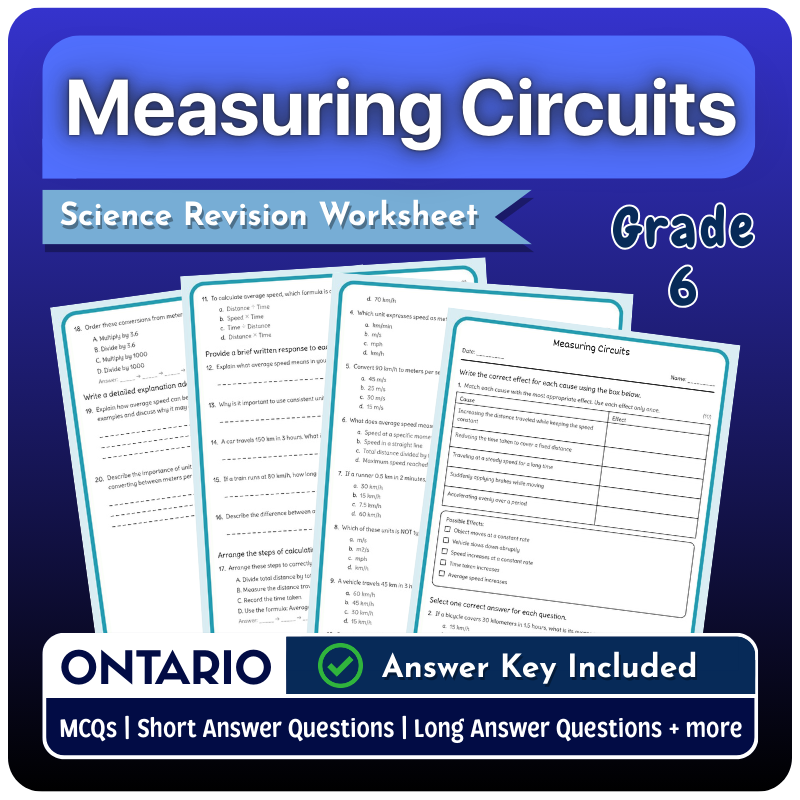
Grade 6 Science | Measuring Circuits Worksheet (PDF) Ontario Standards
Created byBright Mind ResourcesLearning Objectives
- Understand how current and voltage measurements characterize circuit performance.
- Identify proper instrument placement for accurate readings.
- Interpret typical measurement patterns in various circuit configurations.
Instant download
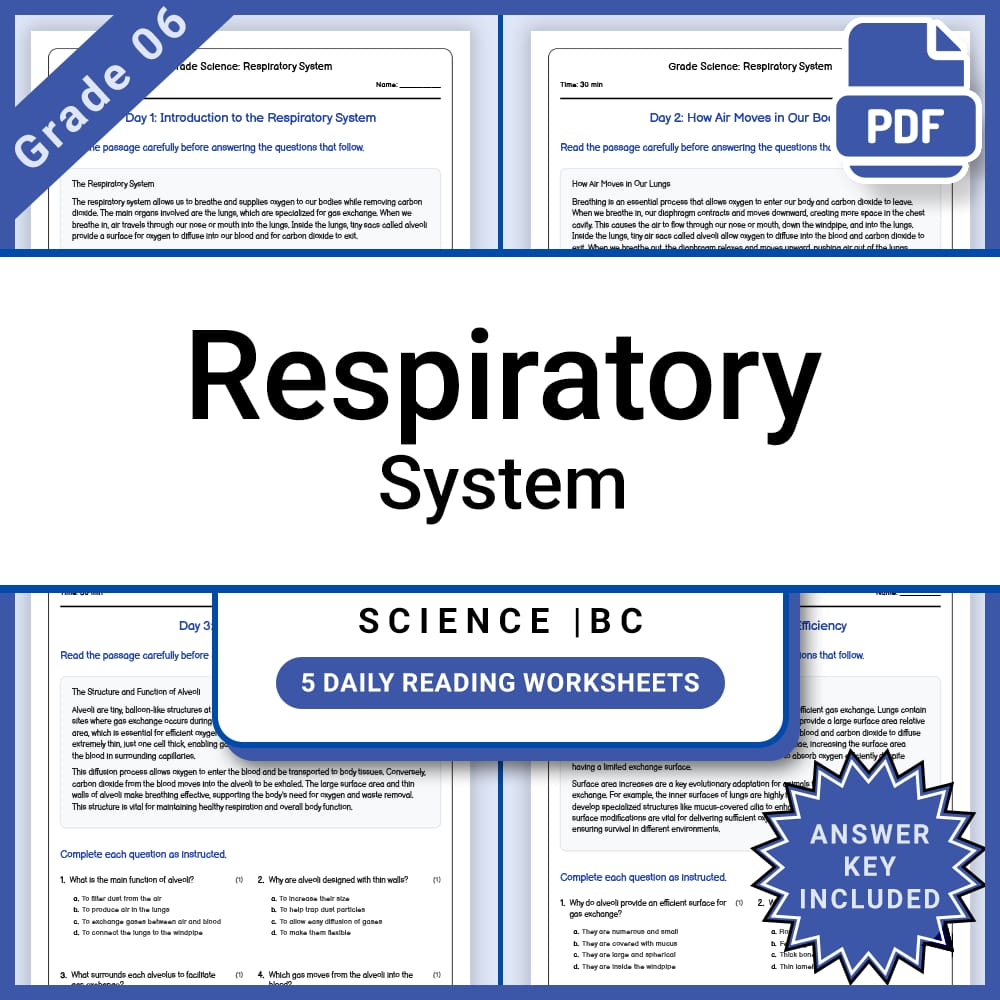
Grade 6 Science – Respiratory System Daily Reading Worksheet + Answer Key
JCreated byJ.S SheetsLearning Objectives
- Understand the basic functions of the respiratory system
- Identify parts of the respiratory system
- Explain how oxygen is exchanged between the environment and the blood
Also included in: Grade 6 Science Lesson Group | Body Systems and Adaptations Bundle +1 more
Instant download
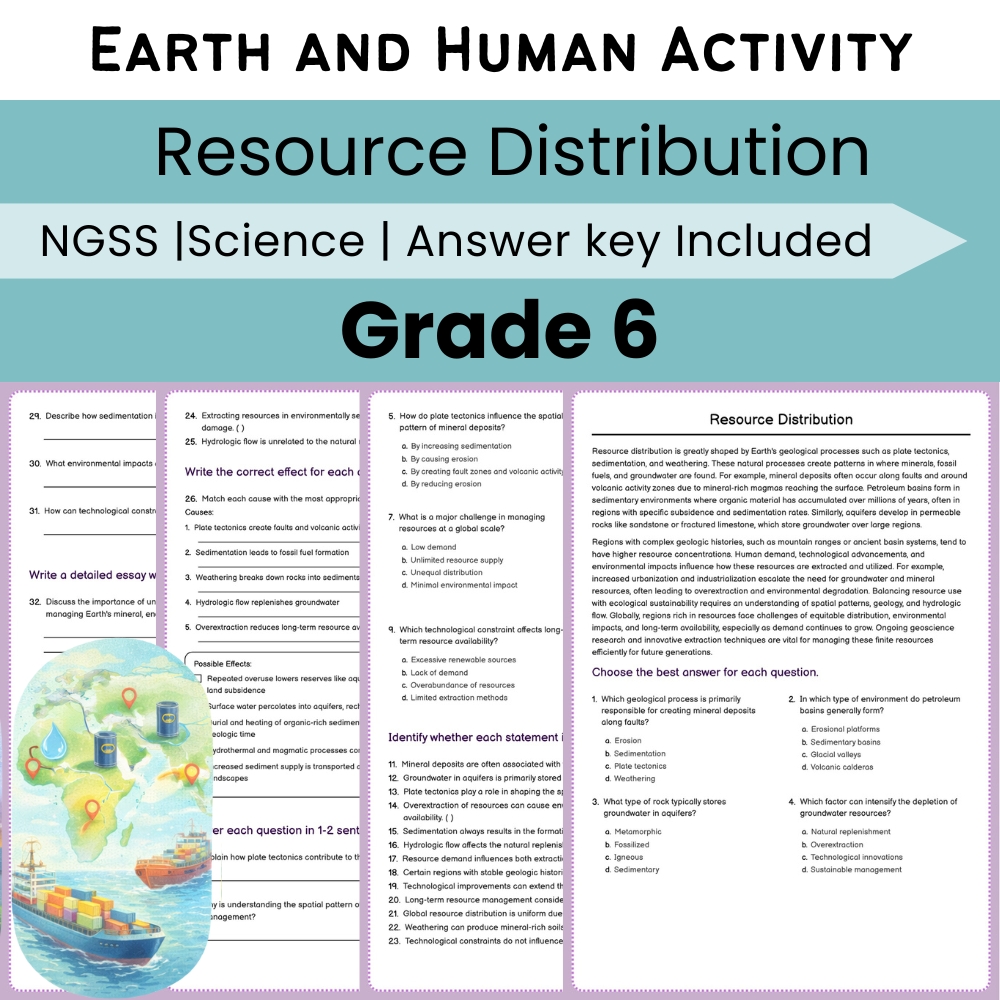
Resource Distribution Worksheet - Grade 6 Science Printable PDF | NGSS
Learning Objectives
- Understand how geological processes influence the distribution of mineral, energy, and groundwater resources.
- Identify spatial patterns in ore deposits, petroleum basins, and aquifers.
- Evaluate the impact of human activity and technology on resource availability and sustainability.
Also included in: Grade 6 Science | Earth & Human Activity NGSS Unit Bundle (4 Worksheets) +1 more
Instant download

Testing and Feedback Worksheet | Digital Project Improvement Grade 6
Created byBright Mind ResourcesLearning Objectives
- Explain how testing helps find problems in a digital project.
- Use the vocabulary test, feedback, improve, and revise accurately in context.
- Identify common strengths and issues found during usability testing.
Instant download

Iteration and Improvement Worksheet | Digital Design Versions Grade 6
Created byBright Mind ResourcesLearning Objectives
- Define iteration and explain how testing feedback leads to improvement across versions.
- Use iteration vocabulary (iteration, revise, improve, version) to describe step-by-step design changes.
- Identify when a process shows repeated revision instead of a one-time change.
Instant download

Testing and Revising Algorithms Worksheet | Grade 6 Computer Science
Created byBright Mind ResourcesLearning Objectives
- Explain how testing an algorithm under different conditions can reveal errors or weak points.
- Use evidence from test results to revise an algorithm to improve reliability.
- Define and use the vocabulary terms test, revise, evaluate, and correct in context.
Instant download

Collecting Reliable Data Worksheet | Grade 6 Computer Science Practice
Created byBright Mind ResourcesLearning Objectives
- Explain why reliable data collection uses careful observation and accurate counting.
- Identify common ways to reduce errors in a simple survey or measurement.
- Use vocabulary related to reliable data: reliable, observe, count, and data.
Instant download

Connections and Distinctions Worksheet for Grade 6 ELA
JCreated byJ.S SheetsLearning Objectives
- Explain how authors create connections between ideas across informational text sections (cause/effect, problem/solution, and related concepts).
- Identify how authors make distinctions between categories, stages, and viewpoints using signal words and structure.
- Use textual clues (signal words and headings) to describe why relationships and contrasts are included.
Instant download

6th Grade Science | Understanding Stability Modes Worksheet (PDF)
Created byEvergreen Desk EducationLearning Objectives
- Explain the difference between static and dynamic stability using center of gravity and aerodynamic effects
- Describe how wing geometry and control surfaces influence longitudinal, lateral, and directional stability
- Identify stability behaviors such as damping, phugoid, and Dutch roll and their implications for safe control
Also included in: Grade 6 Flight & Aerodynamics Science Lesson Bundle Worksheets (Ontario) +1 more
Instant download

Recognizing Scams and Phishing Computer Science Worksheet Grade 6
Created byPrism Point LearningLearning Objectives
- Identify common warning signs of scams and phishing messages.
- Explain safe choices when you see suspicious emails, texts, or pop-ups.
- Use key vocabulary (scam, phishing, suspicious, fraud) accurately in explanations.
Also included in: Digital Citizenship and Online Safety Lesson Bundle | Grade 6 Computer Science | General +1 more
Instant download

Earth-Sun Models Seasonal Sky Changes Worksheet Grade 6 Science Review
Created bySunny Desk ResourcesLearning Objectives
- Describe how Earth’s tilt and orbit affect the apparent Sun position in the sky over the year
- Use a simple Earth–Sun geometry model to predict daylight length and seasonal changes
- Explain how models help forecast timing of events such as sunrise and sunset
Also included in: Sky Science Grade 6 Bundle | Alberta Science Worksheets & Activities +1 more
Instant download

Grade 6 Data Representation Worksheet | Graphing & Data Analysis
Created byChalk and CompassLearning Objectives
- Organize observations into tables and select appropriate graph types for different kinds of data.
- Interpret graphs by using labeled axes, units, and legends to identify trends and outliers.
- Compute and compare simple summary measures such as mean and median and explain how outliers affect them.
Also included in: Grade 6 Science Scientific Inquiry and Evidence Lesson Bundle | Ontario +1 more
Instant download
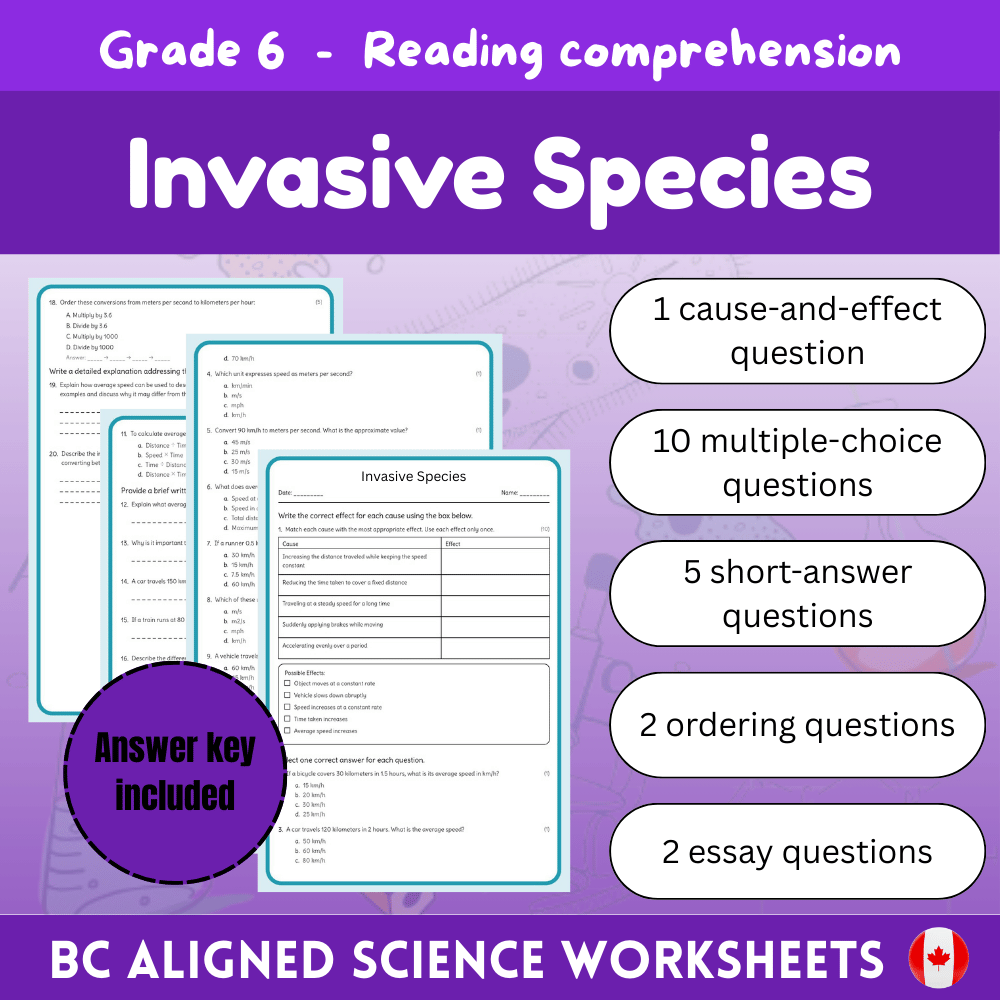
Grade 6 Science | Invasive Species Worksheet + Answer Key (PDF)
Created byBright Mind ResourcesLearning Objectives
- Understand how invasive species impact native ecosystems and biodiversity.
- Identify examples of invasive aquatic and terrestrial species.
- Explore the ecological consequences of invasive species on food webs and habitats.
Instant download
Browse more categories
About Grade 6 Worksheets
Browse 8,582 printable Grade 6 worksheets across math, ELA, science, and social studies — each a ready-to-print PDF with optional answer keys.
MyTeachingSheets worksheets are made by real teacher-authors and checked before they go live. Download any as a print-ready PDF for lessons, homework, or independent practice — most include answer keys, and previews are always free.