
Grade 6 Science Worksheets
5,997 worksheets
6th Grade Science | Systems Thinking in Solutions Worksheet (PDF)
 Created byEvergreen Desk Education
Learning Objectives
- Explain how systems thinking treats a solution as interacting parts with inputs, pathways, and outputs
- Use cause-and-effect reasoning to predict how changes to one component affect overall performance
- Describe how real-world testing can reveal why a design succeeds or fails
Also included in: Grade 6 Prototype Design Science Lesson Bundle: General Systems Thinking +1 more
Instant download
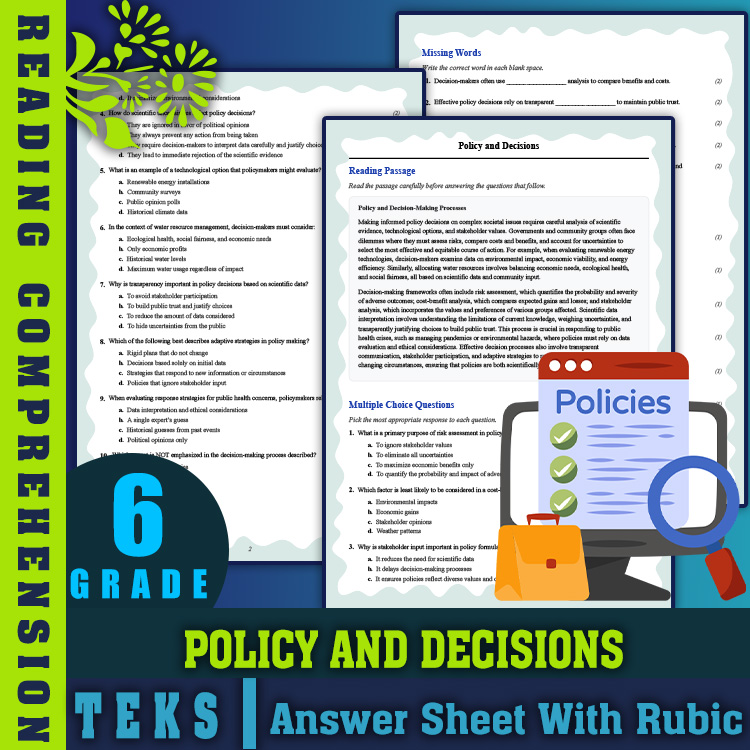
6th Grade Science Reading Worksheets | Policy & Decisions TEKS Practice (PDF)
JCreated byJ.S SheetsLearning Objectives
- Understand how scientific evidence influences policy-making processes.
- Analyze the factors considered in risk assessment and cost-benefit analysis for societal issues.
- Evaluate stakeholder values and how they shape decision outcomes.
Instant download
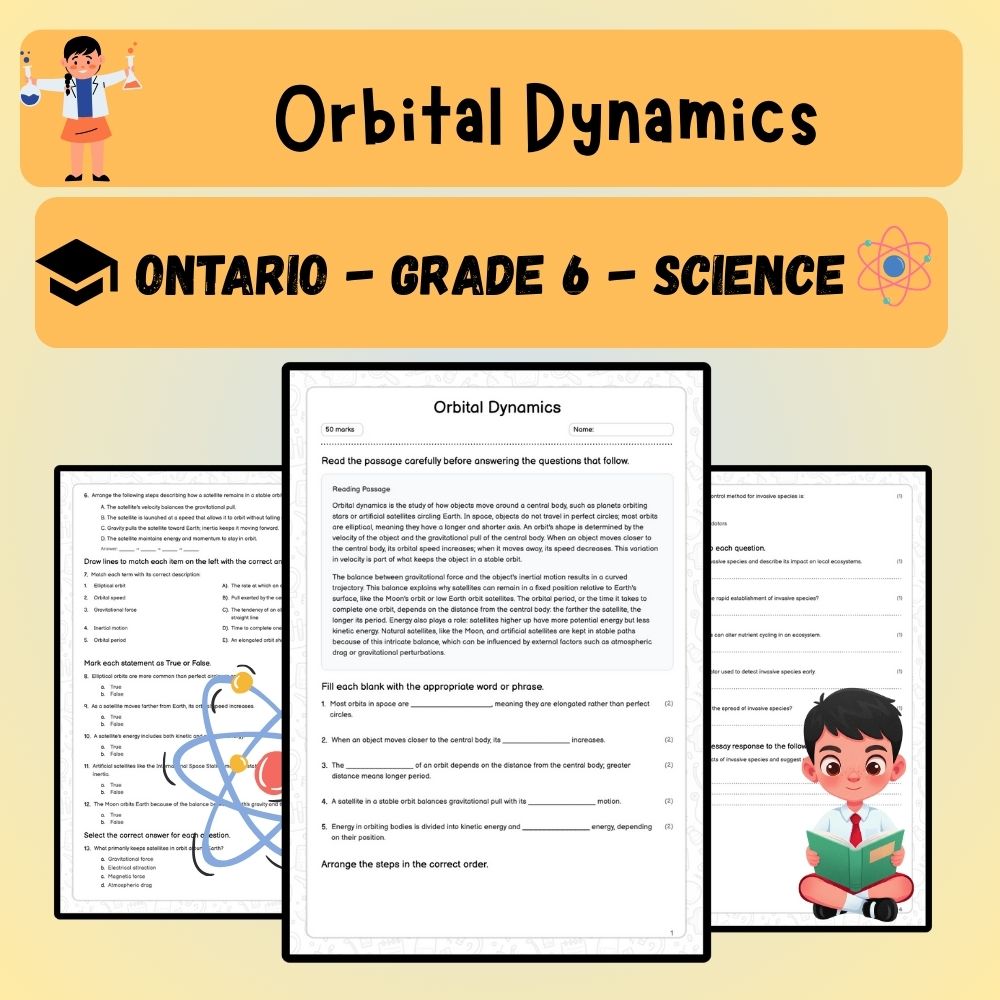
6th Grade Science | Orbital Dynamics Worksheet (PDF )
 Created byPrism Point Learning
Learning Objectives
- Understand the difference between elliptical and near-circular orbits and their characteristics.
- Explain how the orbital speed varies with distance from the central body.
- Describe the balance of gravitational force and inertial motion that produces stable orbits.
Instant download

6th Grade Science | Phase Energy Worksheet (BC Standards) (PDF)
Created byEvergreen Desk EducationLearning Objectives
- Explain how phase changes involve energy transfer without changing chemical identity.
- Use the particle model to connect latent heat to particle motion and particle bonding strength.
- Predict whether energy will be absorbed or released during melting, boiling, freezing, and condensation.
Instant download

6th Grade Science | Series and Parallel Circuits Worksheet & Answer Key (PDF)
JCreated byJ.S SheetsLearning Objectives
- Understand the fundamental differences between series and parallel circuit arrangements.
- Explain how current and voltage distribute in series and parallel circuits.
- Describe how energy flow and device behavior are affected by circuit configurations.
Instant download
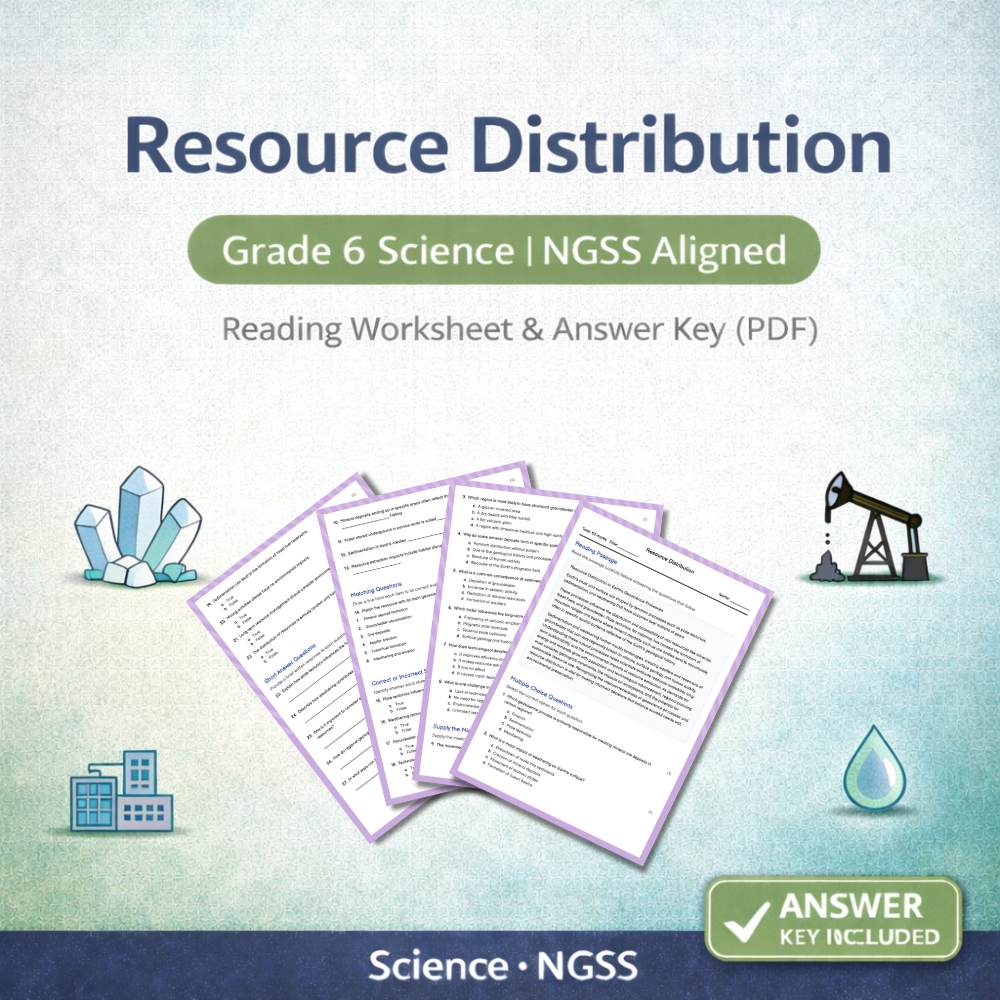
6th Grade Science | Resource Distribution | NGSS Worksheet & Answer Key
 Created byCedar Grove Learning
Learning Objectives
- Understand the geological processes that influence the distribution of mineral, energy, and groundwater resources.
- Analyze spatial patterns of resource deposits and evaluate trade-offs in resource management based on demand and environmental impacts.
- Explore how Earth's history and geoscience processes shape resource availability in regional and global contexts.
Also included in: Grade 6 Science Bundle | Sustainability, Hazards & Earth Systems NGSS Worksheets +1 more
Instant download
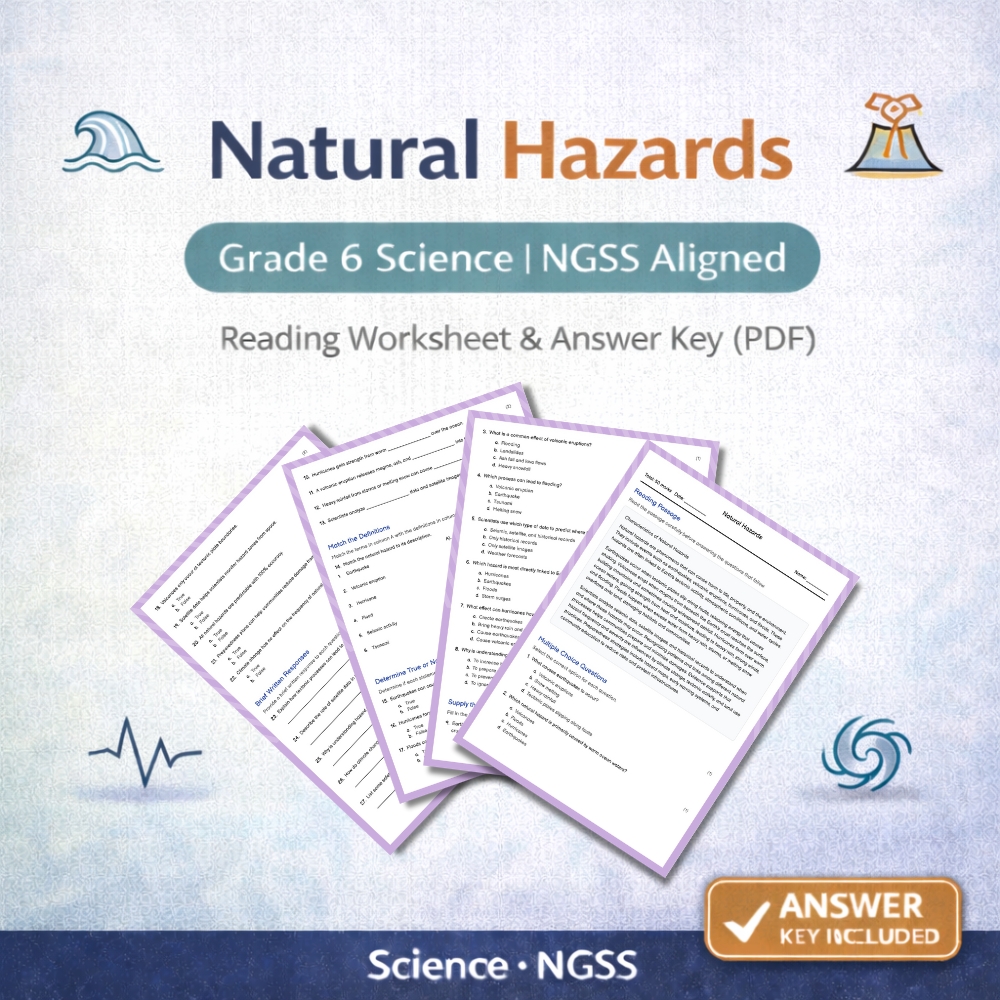
6th Grade Science | Natural Hazards Worksheet | NGSS Alignment
Created byCedar Grove LearningLearning Objectives
- Understand the causes and types of natural hazards such as earthquakes, volcanoes, hurricanes, and floods.
- Analyze patterns and effects of natural hazards on communities and infrastructure.
- Evaluate evidence from scientific data to explain hazard occurrences and severity.
Also included in: Grade 6 Science Bundle | Sustainability, Hazards & Earth Systems NGSS Worksheets +1 more
Instant download
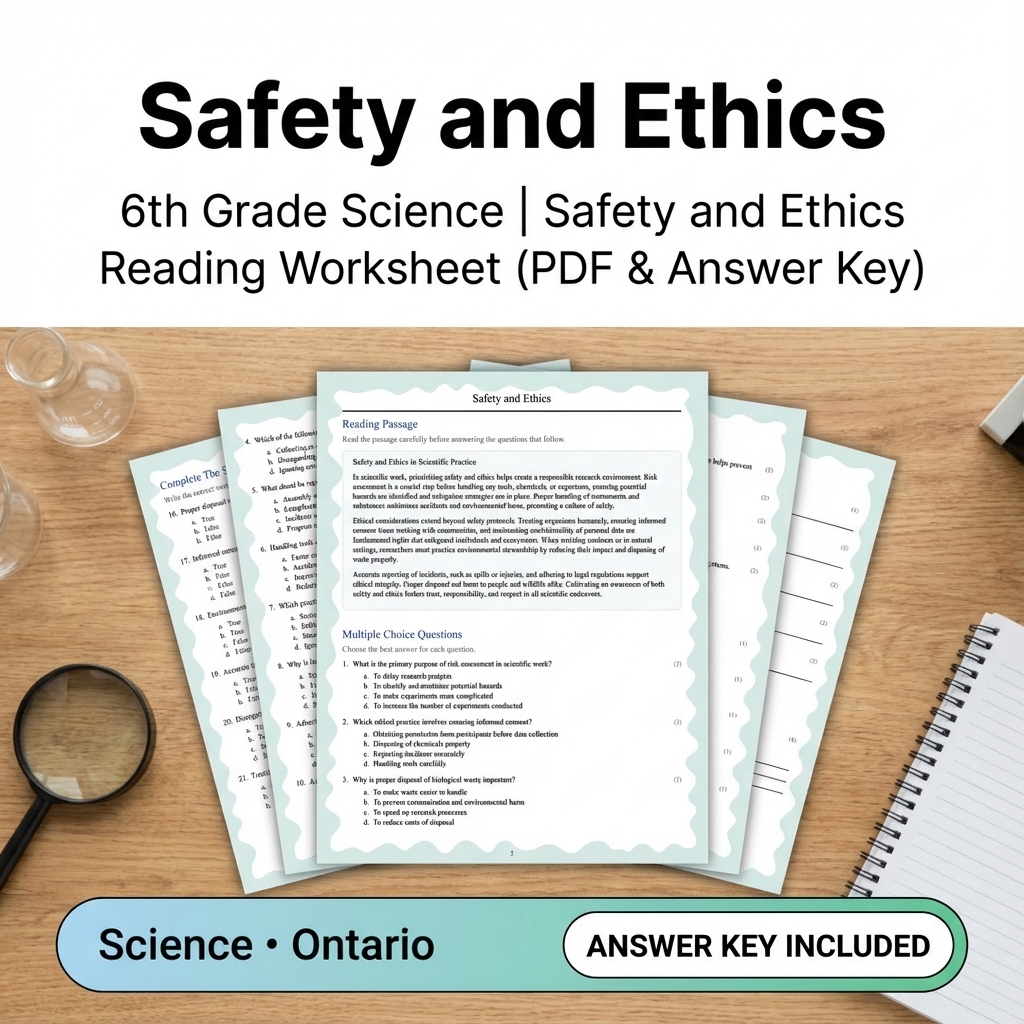
6th Grade Science | Safety and Ethics Reading Worksheet (PDF & Answer Key)
JCreated byJ.S SheetsLearning Objectives
- Understand the importance of risk assessment and hazard prevention in scientific work.
- Recognize ethical practices such as humane treatment, informed consent, and confidentiality.
- Apply safety protocols for handling tools and substances responsibly.
Also included in: Grade 6 Science Unit | Inquiry, Data, & Ethical Practices Worksheet Pack +1 more
Instant download
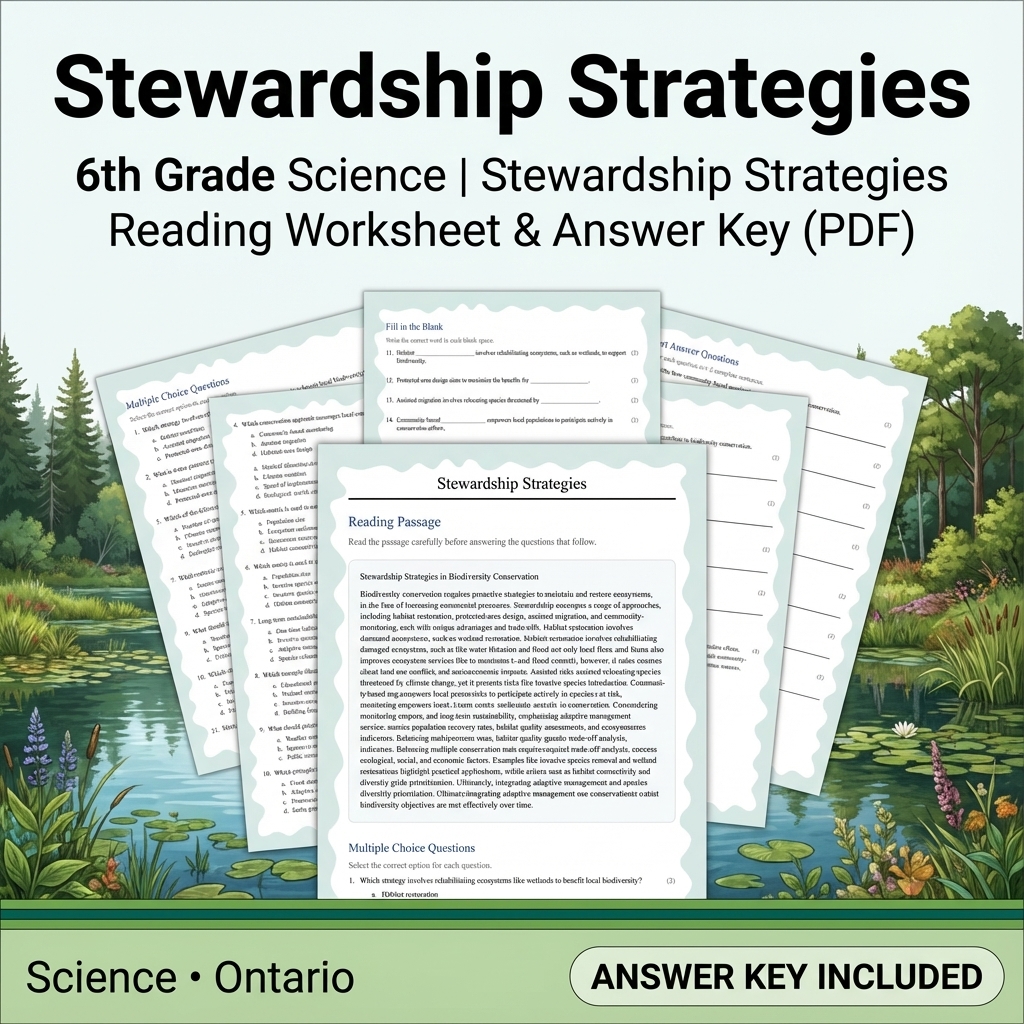
6th Grade Science | Stewardship Strategies Reading Worksheet & Answer Key (PDF)
JCreated byJ.S SheetsLearning Objectives
- Understand the key components of habitat restoration and protected-area design.
- Evaluate different conservation approaches and criteria for prioritization.
- Analyze metrics for measuring success in biodiversity conservation, including adaptive management principles.
Also included in: Grade 6 Science Unit Bundle – Ecosystems, Biodiversity & Environmental Impact +1 more
Instant download
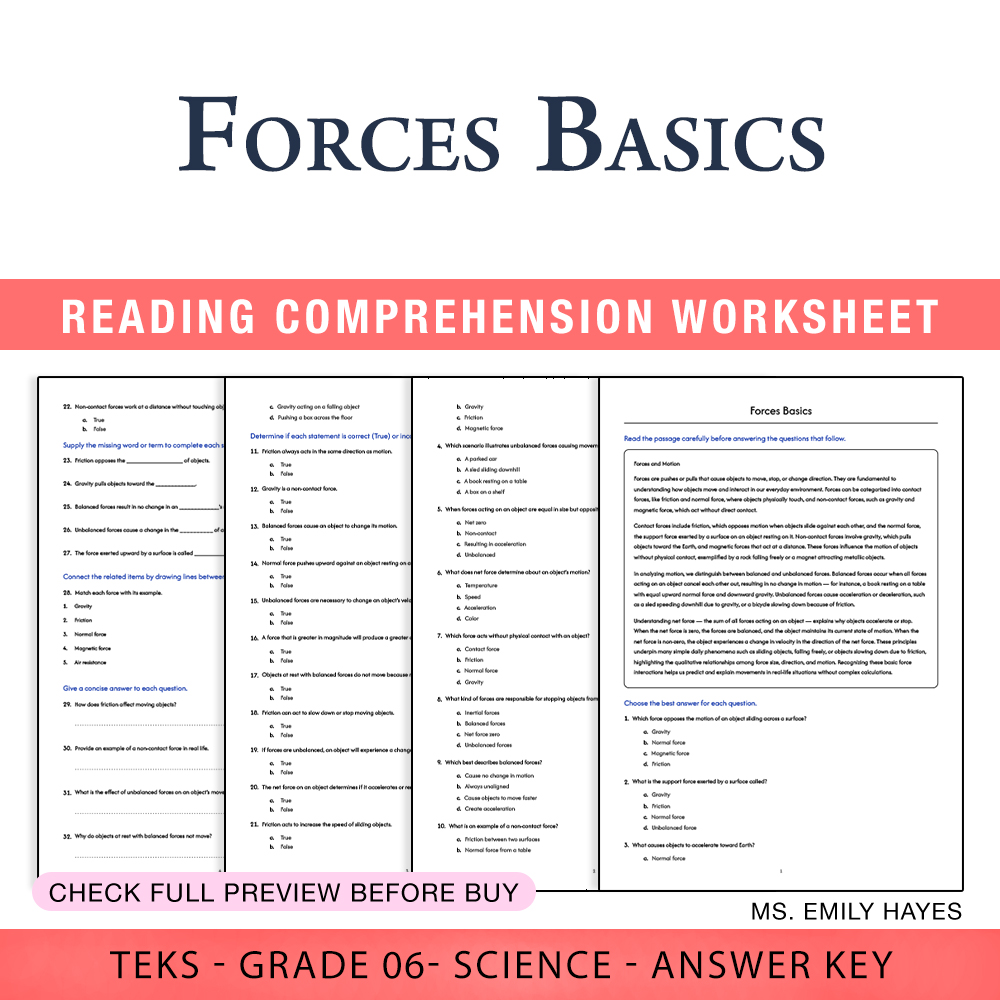
6th Grade Science | Forces Basics Worksheet (PDF+ Answer Key)
 Created byCopper Leaf Classroom
Learning Objectives
- Understand the differences between contact and non-contact forces such as gravity, friction, and normal force.
- Describe how balanced and unbalanced forces affect the motion of objects.
- Introduce the concept of net force and its effects on everyday objects without using vector calculations.
Instant download

6th Grade Science – Biodiversity Patterns Worksheet (PDF) Ontario Standards
Created byEvergreen Desk EducationLearning Objectives
- Explain how species richness, abundance, and evenness describe biodiversity in different ecosystems.
- Use sampling ideas (transects and quadrats) to quantify biodiversity and compare habitats.
- Interpret simple biodiversity indices and relate diversity patterns to ecosystem stability, resilience, and conservation.
Also included in: Grade 6 Biodiversity, Adaptation & Ecology Science Lesson Bundle | Ontario +1 more
Instant download
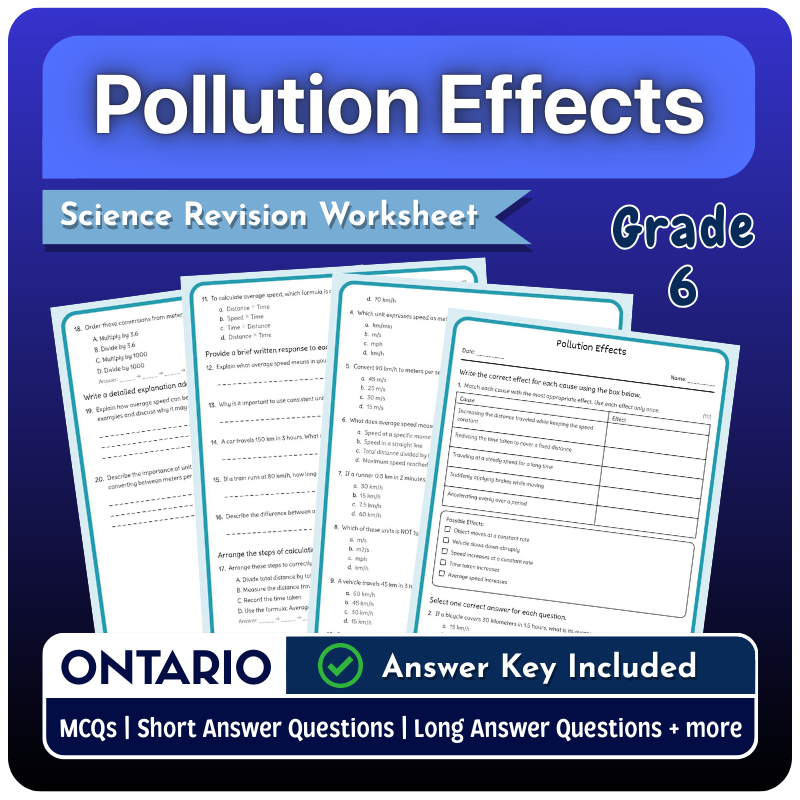
6th Grade Science | Pollution Effects Worksheet (Ontario) (Practice Set)
 Created byBright Mind Resources
Learning Objectives
- Understand the ecological impacts of pollution such as eutrophication, endocrine disruption, and biomagnification.
- Identify measurable indicators like dissolved oxygen, algal biomass, and contaminant residues for assessing pollution effects.
- Analyze how pollution influences species diversity and ecosystem functioning.
Instant download

6th Grade Science | Pattern Analysis Worksheet (PDF) - Alberta Standards
Created byBright Mind ResourcesLearning Objectives
- Identify different methods used for detecting patterns in datasets.
- Explain how environmental factors influence observable patterns in nature.
- Use visual and statistical techniques to interpret data trends and cycles.
Instant download
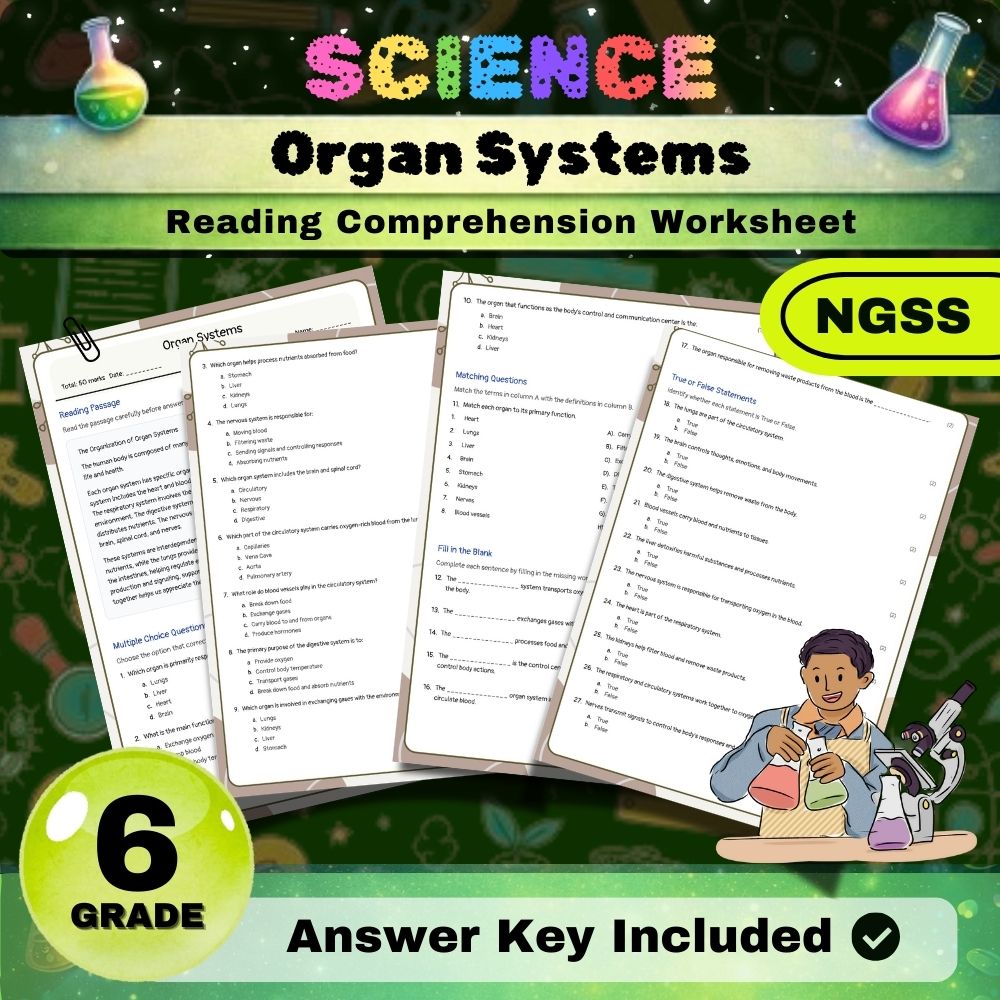
6th Grade Science | Organ Systems Worksheet (PDF) NGSS-Aligned
 Created byMaple Path Learning
Learning Objectives
- Understand the structure and function of key organ systems such as circulatory, respiratory, digestive, and nervous systems.
- Describe how tissues and organs work together to maintain homeostasis and overall health.
- Explain the interdependence of different organs within organ systems and how they contribute to physiological processes.
Also included in: Grade 6 Science Unit Bundle – Cell Functions, Energy & Organ Systems Worksheets +1 more
Instant download

Grade 6 Science | Population Change Worksheet | California Standards
 Created byLumora Learning
Learning Objectives
- Explain how birth rates, death rates, and resource availability affect population size over time.
- Interpret trends in population data to infer why populations increase or decrease in different seasons or habitats.
- Use population-change reasoning to connect environmental conditions to survival and reproduction.
Instant download

6th Grade Science | Reasoning Claims Worksheet (TEKS) PDF
Created byEvergreen Desk EducationLearning Objectives
- Explain the difference between raw observations and explanatory science claims.
- Use evidence to decide whether a scientific claim is strongly supported or weakly supported.
- Interpret patterns in data to strengthen (or question) an inference.
Instant download
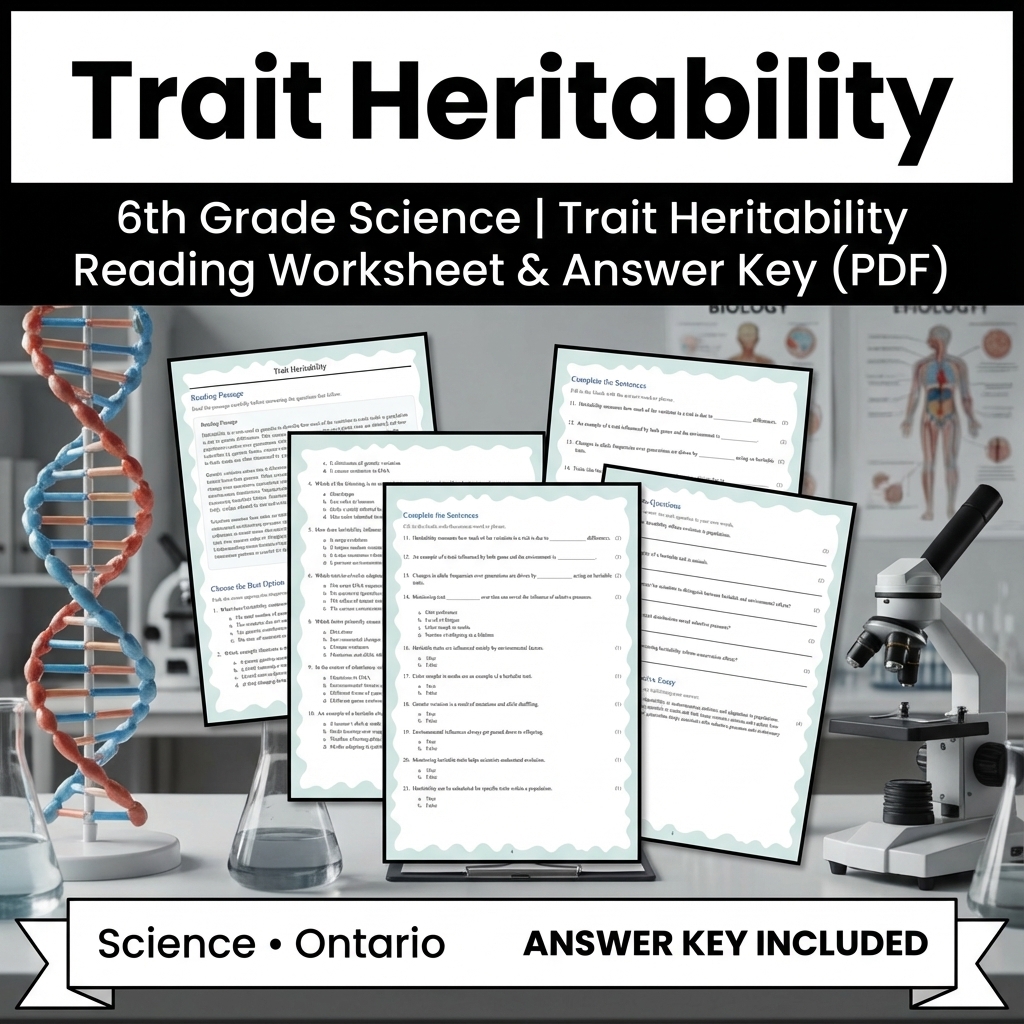
6th Grade Science | Trait Heritability Reading Worksheet & Answer Key (PDF)
JCreated byJ.S SheetsLearning Objectives
- Understand the concept of heritability and its role in genetic variation.
- Distinguish between heritable traits and environmental influences.
- Explain basic mechanisms of inheritance and natural selection in populations.
Also included in: Grade 6 Science Unit Bundle – Ecosystems, Biodiversity & Environmental Impact +1 more
Instant download

Inheritance Modeling Worksheet | NGSS-Aligned Grade 6 Science Practice
JCreated byJ.S SheetsLearning Objectives
- Understand how traits are transmitted from parents to offspring through genes.
- Model inheritance patterns using Punnett squares and probability.
- Differentiate between dominant and recessive traits in inheritance examples.
Also included in: Grade 6 Variation and Inheritance Science Lesson Bundle | NGSS Practice +1 more
Instant download
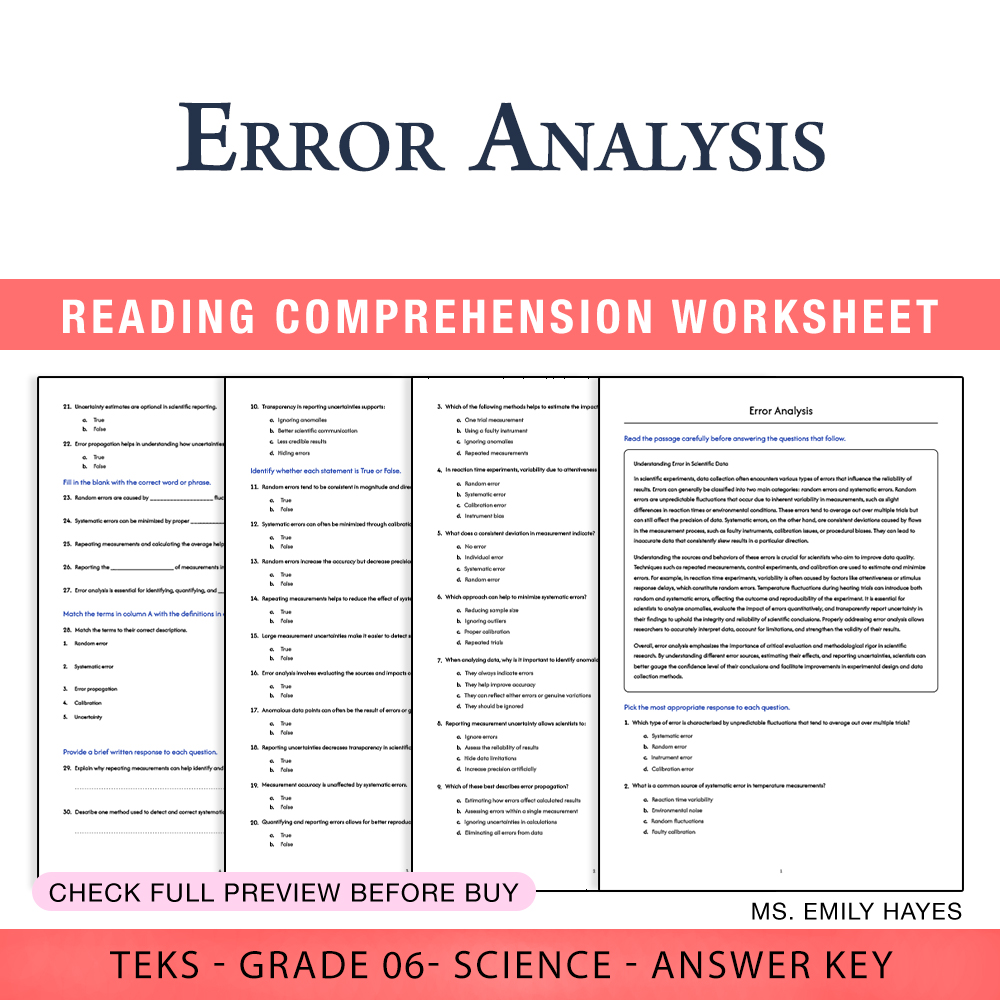
6th Grade Science | Error Analysis Worksheet (PDF+ Answer Key)
Created byCopper Leaf ClassroomLearning Objectives
- Identify different sources of error in experimental data and characterize their impact.
- Distinguish between random errors and systematic errors in scientific measurements.
- Analyze methods for estimating uncertainty and propagating errors through calculations.
Instant download

6th Grade Science Erosion & Deposition Worksheet | California Standards PDF
Created byEvergreen Desk EducationLearning Objectives
- Explain how moving water erodes sediment and transports it downstream.
- Describe how deposition happens when water energy decreases.
- Identify real-world landforms formed by erosion and deposition (such as river terraces and deltas).
Instant download
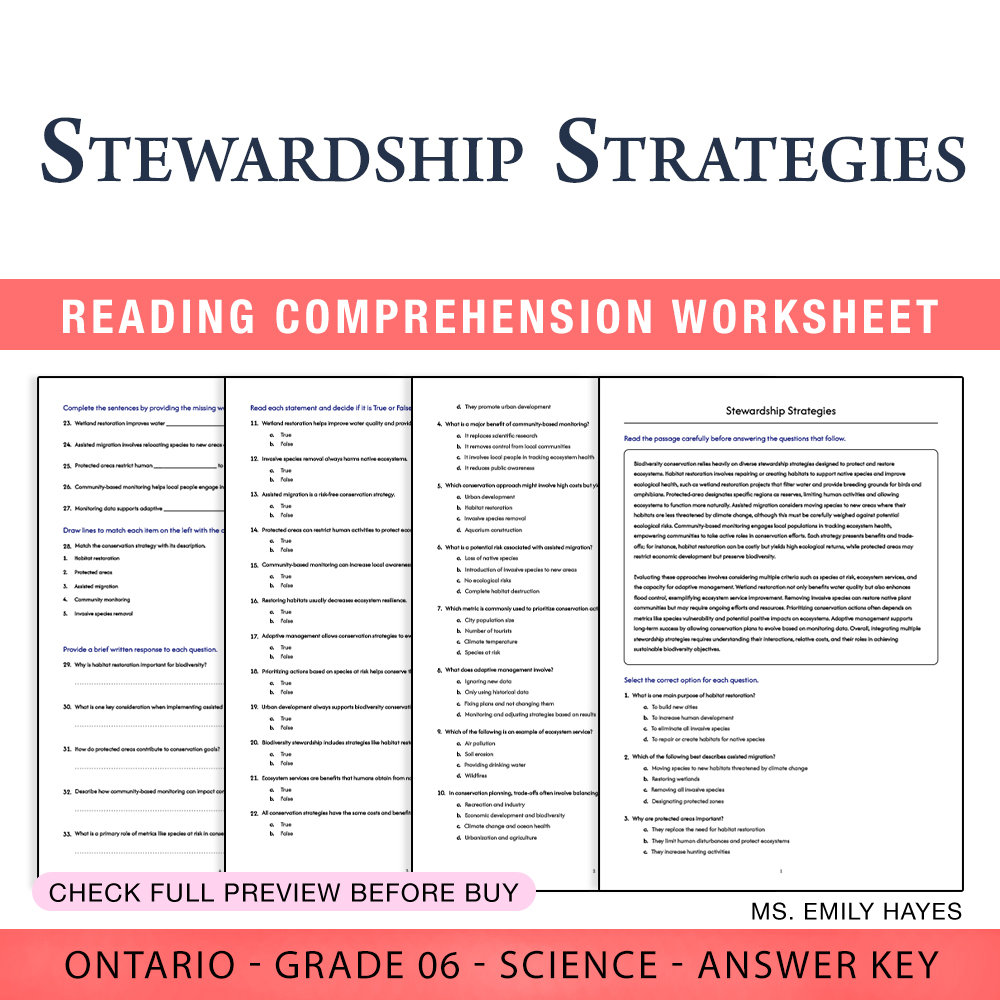
6th Grade Science | Stewardship Strategies Worksheet (PDF + Answer Key)
Created byCopper Leaf ClassroomLearning Objectives
- Understand key concepts and approaches used in biodiversity stewardship.
- Identify and evaluate different conservation strategies and their trade-offs.
- Apply knowledge of stewardship tools to real-world environmental scenarios.
Instant download

6th Grade Science Material Cycling Worksheet | California Standards PDF
Created byEvergreen Desk EducationLearning Objectives
- Explain how rocks break down and form sediments through physical and chemical weathering.
- Describe how sediments move, deposit, and build up layers over time.
- Connect biological processes to the formation of soil and the cycling of water.
Instant download
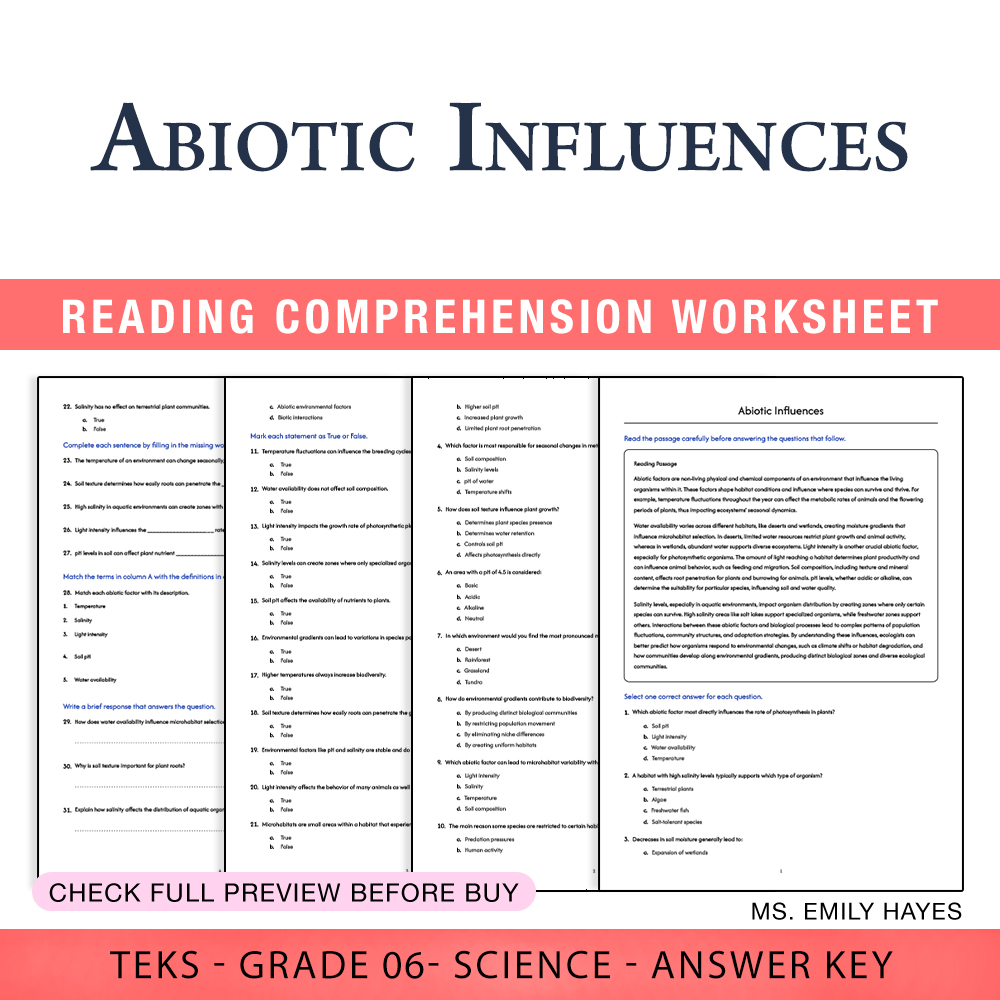
6th Grade Science | Abiotic Influences Worksheet (PDF+ Answer Key)
Created byCopper Leaf ClassroomLearning Objectives
- Identify key abiotic factors that influence habitat conditions and organism distribution.
- Explain how temperature, water availability, and light intensity affect ecosystems.
- Describe the role of soil composition, pH, and salinity in shaping biological communities.
Instant download
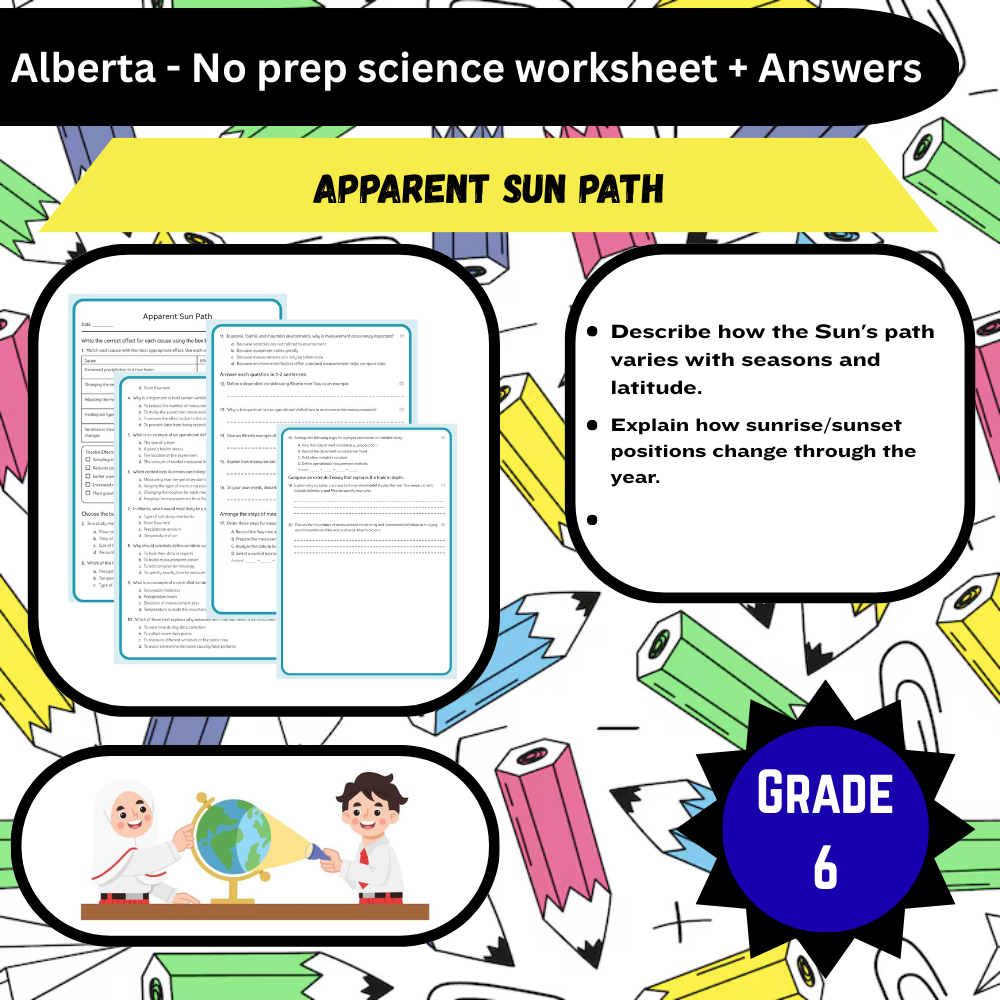
6th Grade Science – Apparent Sun Path Worksheet (Worksheet + Answer Key) – Alberta Standards
Created byBright Mind ResourcesLearning Objectives
- Describe how the Sun's apparent path across the sky varies with seasons and latitude.
- Explain how sunrise and sunset positions change throughout the year and between locations.
Instant download

Grade 6 Organ Definition Worksheet | Practice & Assessment PDF
 Created byClear Sky Classroom
Learning Objectives
- Define an organ and describe how organs are made of multiple tissue types working together.
- Explain how tissue interactions inside an organ help it perform a specific function.
- Use organ structure and function examples (heart, stomach) to describe how specialized cells produce outputs needed for survival.
Instant download
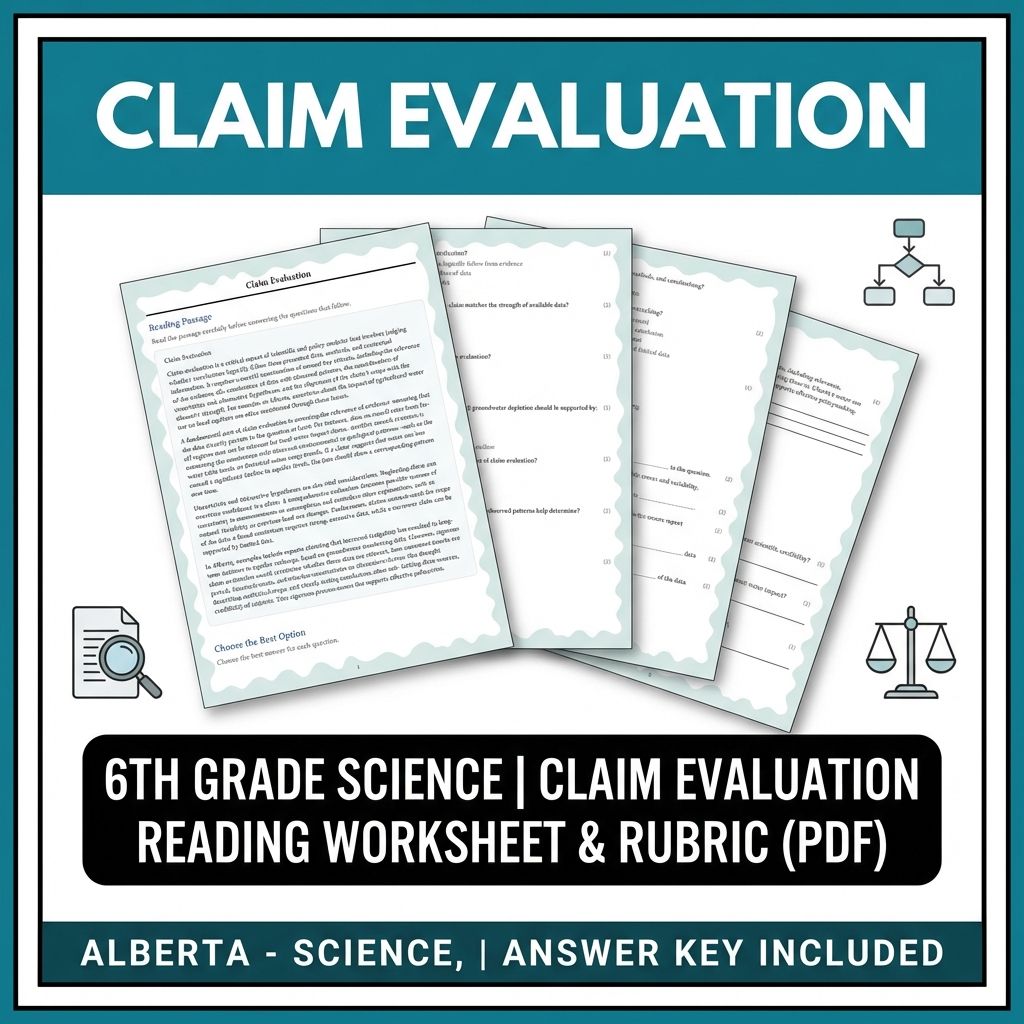
6th Grade Science | Claim Evaluation Reading Worksheet & Rubric (PDF)
JCreated byJ.S SheetsLearning Objectives
- Understand the criteria for assessing the validity of claims based on data and evidence.
- Learn to evaluate relevance, consistency, and scope of evidence in supporting conclusions.
- Recognize the importance of transparency and linkage between data sources, methods, and claims.
Also included in: Grade 6 Science Bundle – Data Analysis, Scientific Inquiry & Measurement Skills +1 more
Instant download
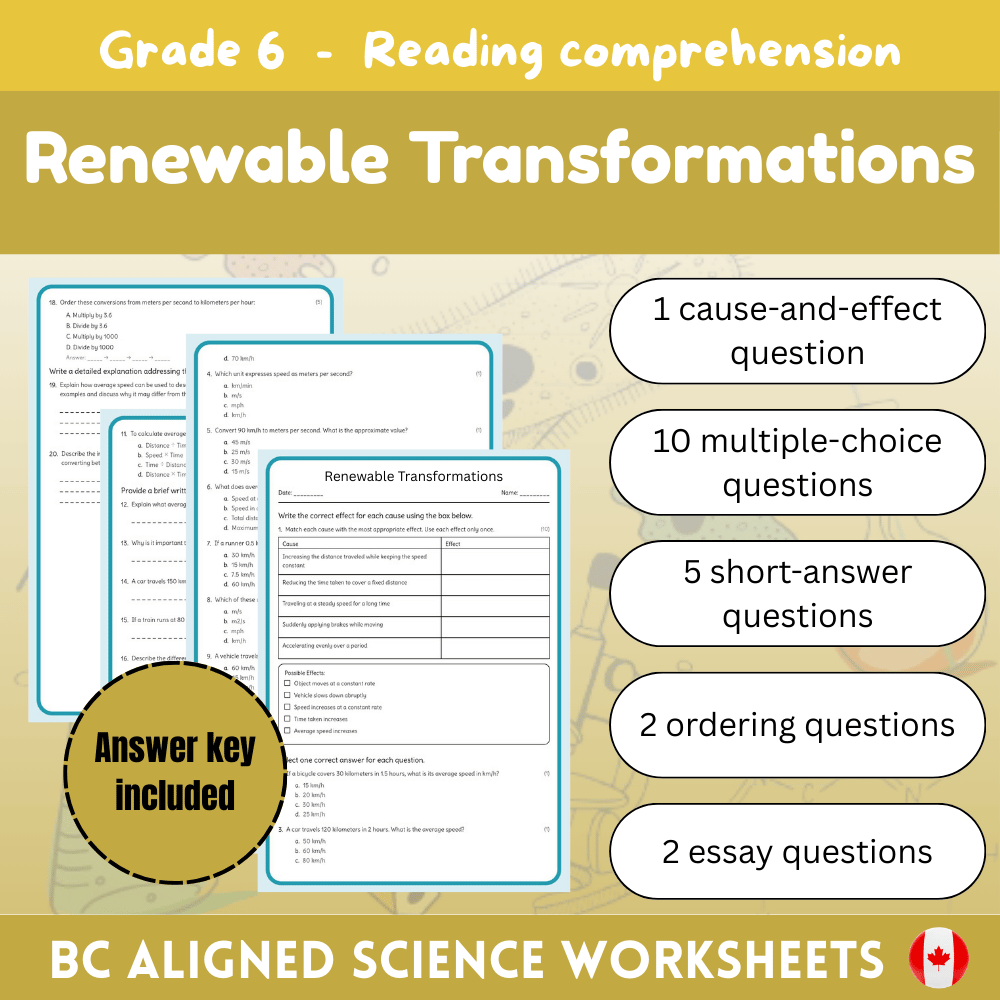
6th Grade Science | Reflection and Refraction Worksheets(Worksheet + Answer Key)
Created byBright Mind ResourcesLearning Objectives
- Explain how light reflects off surfaces and follows the law of reflection.
- Describe how refraction changes the direction of light when it passes through different materials.
- Identify the role of lenses in focusing and dispersing light through refraction.
Instant download
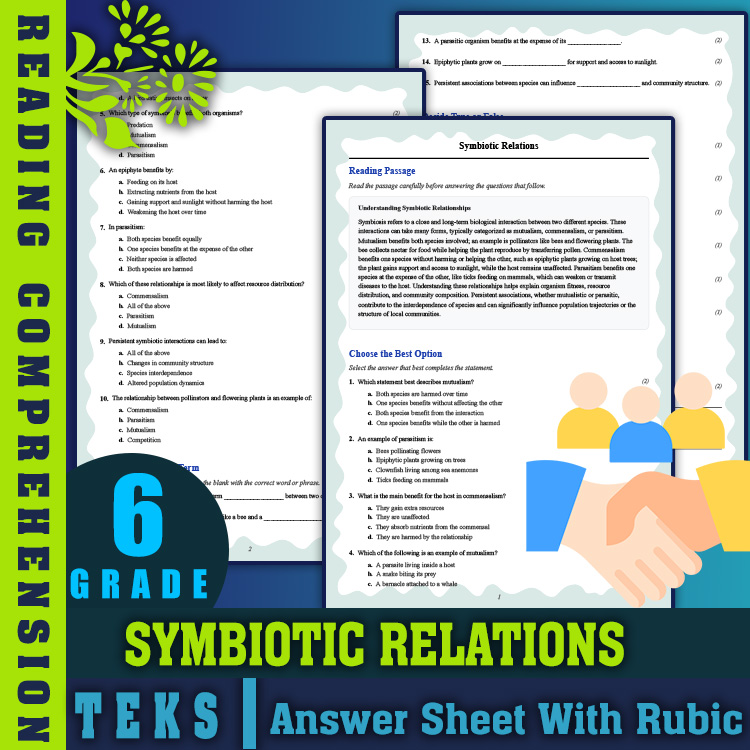
6th Grade Science | Symbiotic Relations Reading Worksheet (PDF & Answer Key)
JCreated byJ.S SheetsLearning Objectives
- Understand the concept of symbiosis and its different types
- Identify examples of mutualism, commensalism, and parasitism in nature
- Analyze how symbiotic relationships affect organism fitness and community structure
Instant download
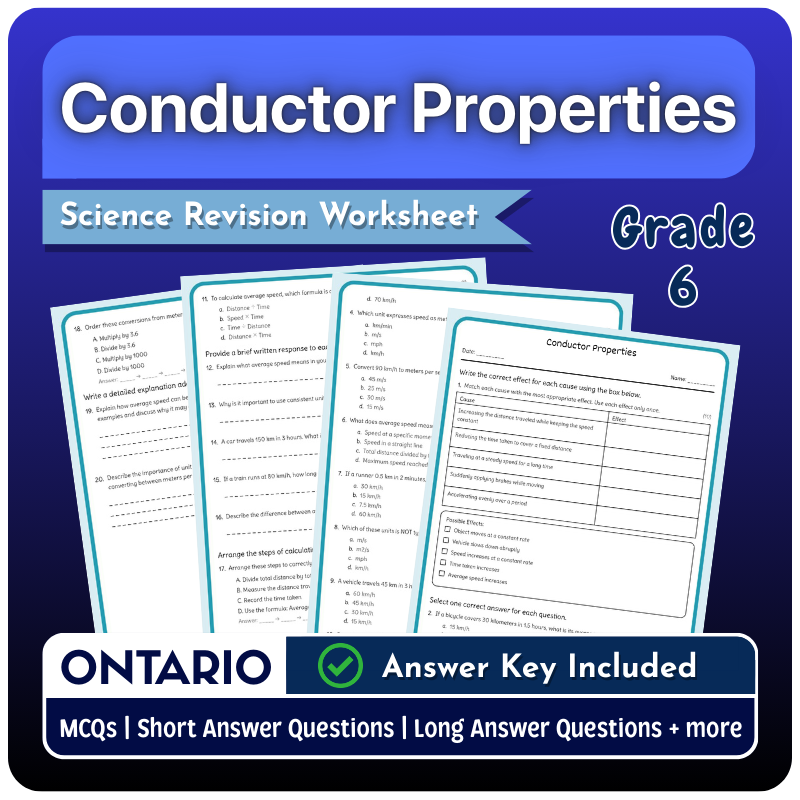
6th Grade Science | Conductor Properties Worksheet (Ontario) PDF
Created byBright Mind ResourcesLearning Objectives
- Understand the concept of electrical conductivity and the role of free electrons in metals.
- Identify common materials that are good conductors and their practical applications.
- Explain the factors affecting electrical conductivity, including material composition, temperature, and cross-sectional area.
Instant download
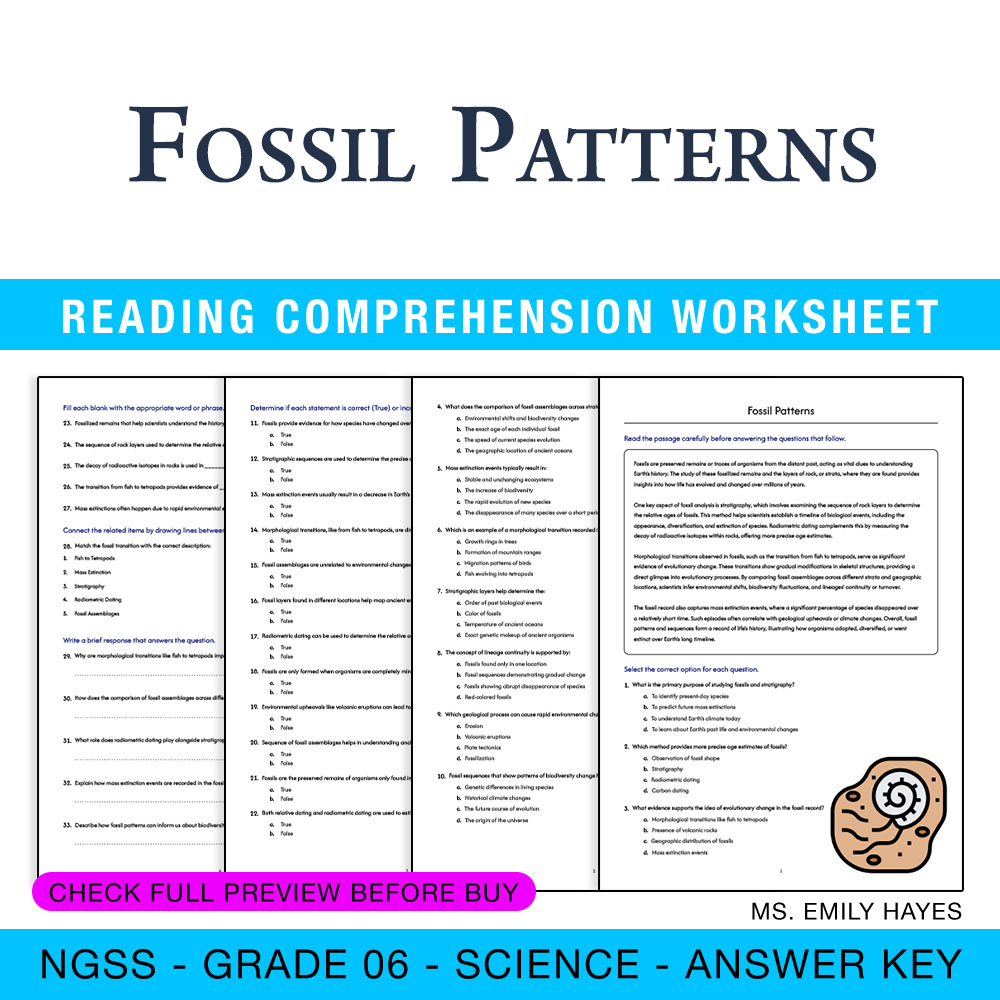
6th Grade Science | Fossil Patterns Worksheet (PDF + Answer Key)
Created byCopper Leaf ClassroomLearning Objectives
- Understand how fossil occurrences and stratigraphy reveal patterns of origin, diversification, and extinction.
- Analyze morphological transitions, such as fish-to-tetrapod examples, in the fossil record.
- Interpret relative and radiometric dating methods to establish the age of fossils.
Instant download

6th Grade Science – Pressure Map Worksheet (Ontario Standards) (PDF)
Created byEvergreen Desk EducationLearning Objectives
- Explain what a pressure map shows about airflow over an airfoil surface
- Identify how stagnation points, suction peaks, and pressure minima relate to lift
- Describe how changes in camber and angle of attack shift pressure coefficient patterns across the chord
Also included in: Grade 6 Flight & Aerodynamics Science Lesson Bundle Worksheets (Ontario) +1 more
Instant download

Population Dynamics Assessment for Grade 6 Science TEKS | Printable Worksheet
Created byPrism Point LearningLearning Objectives
- Explain the principles of population size changes, including exponential and logistic growth.
- Define carrying capacity and limiting factors affecting populations.
- Differentiate between density-dependent and density-independent influences.
Instant download

Synthetic Materials Worksheet | NGSS Grade 6 Science + Doodle Notes
 Created byAmber Owl Education
Learning Objectives
- Explain how natural resources (petroleum, cellulose, and silica) can be transformed into synthetic materials.
- Compare properties of synthetic materials, such as durability, flexibility, conductivity, and biodegradability, for specific uses.
- Describe basic extraction and processing steps and connect material choices to societal needs like durability and recyclability.
Also included in: Grade 6 Science Matter and Chemical Reactions Lesson Bundle | NGSS +1 more
Instant download
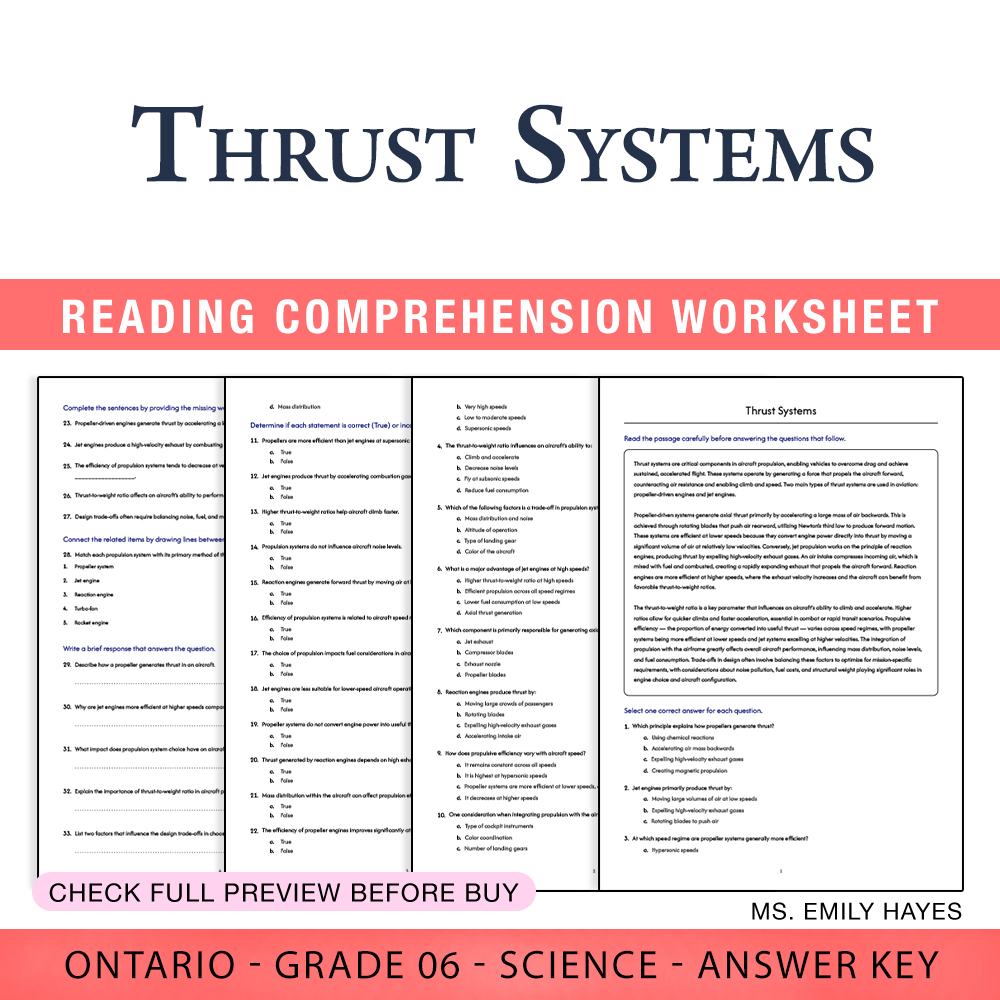
6th Grade Science | Thrust Systems Worksheet (PDF + Answer Key)
Created byCopper Leaf ClassroomLearning Objectives
- Explain the principles of propeller-driven and jet-driven thrust systems.
- Identify the mechanics by which thrust is generated in various propulsion methods.
- Compare the efficiency of different propulsion systems across speed regimes.
Instant download
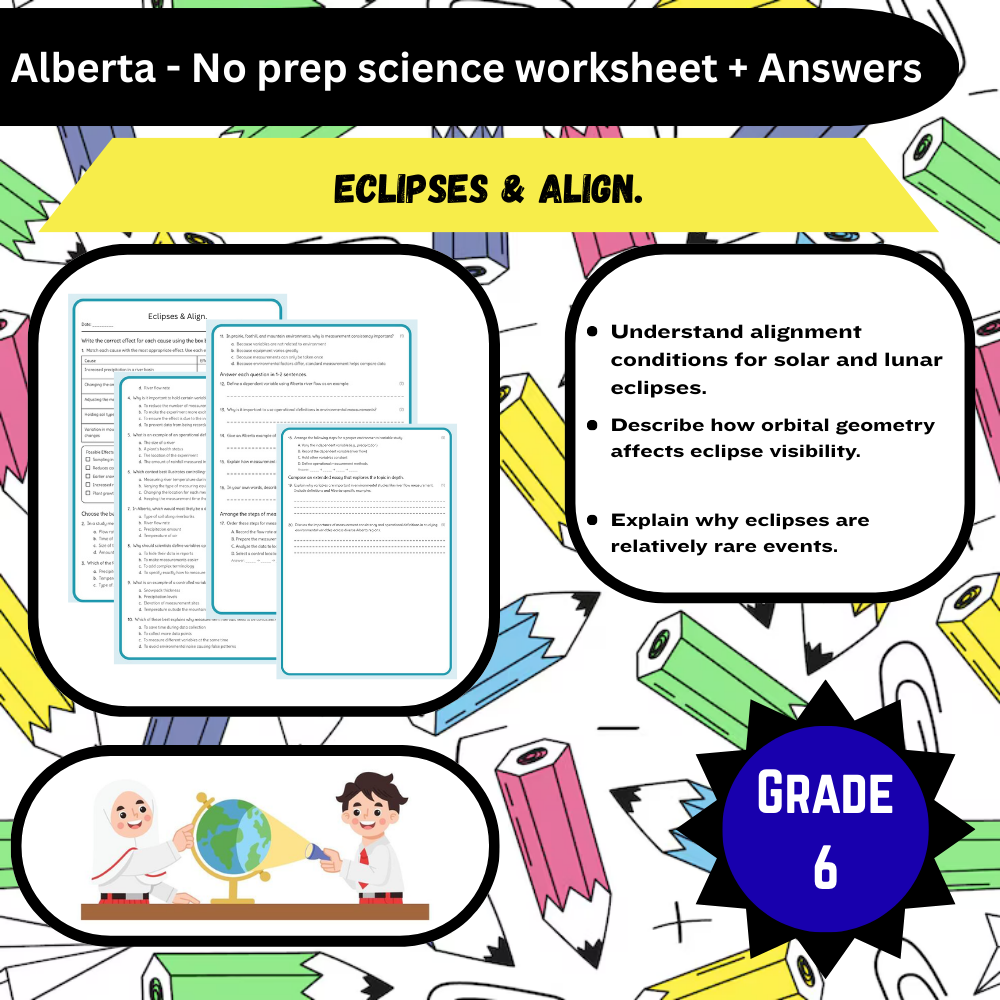
6th Grade Science | Eclipses & Alignments Worksheet (PDF)
Created byBright Mind ResourcesLearning Objectives
- Understand the celestial alignment conditions that lead to solar and lunar eclipses.
- Describe how orbital geometry affects the occurrence and visibility of different types of eclipses.
- Explain why eclipses are relatively rare events at a given location.
Instant download
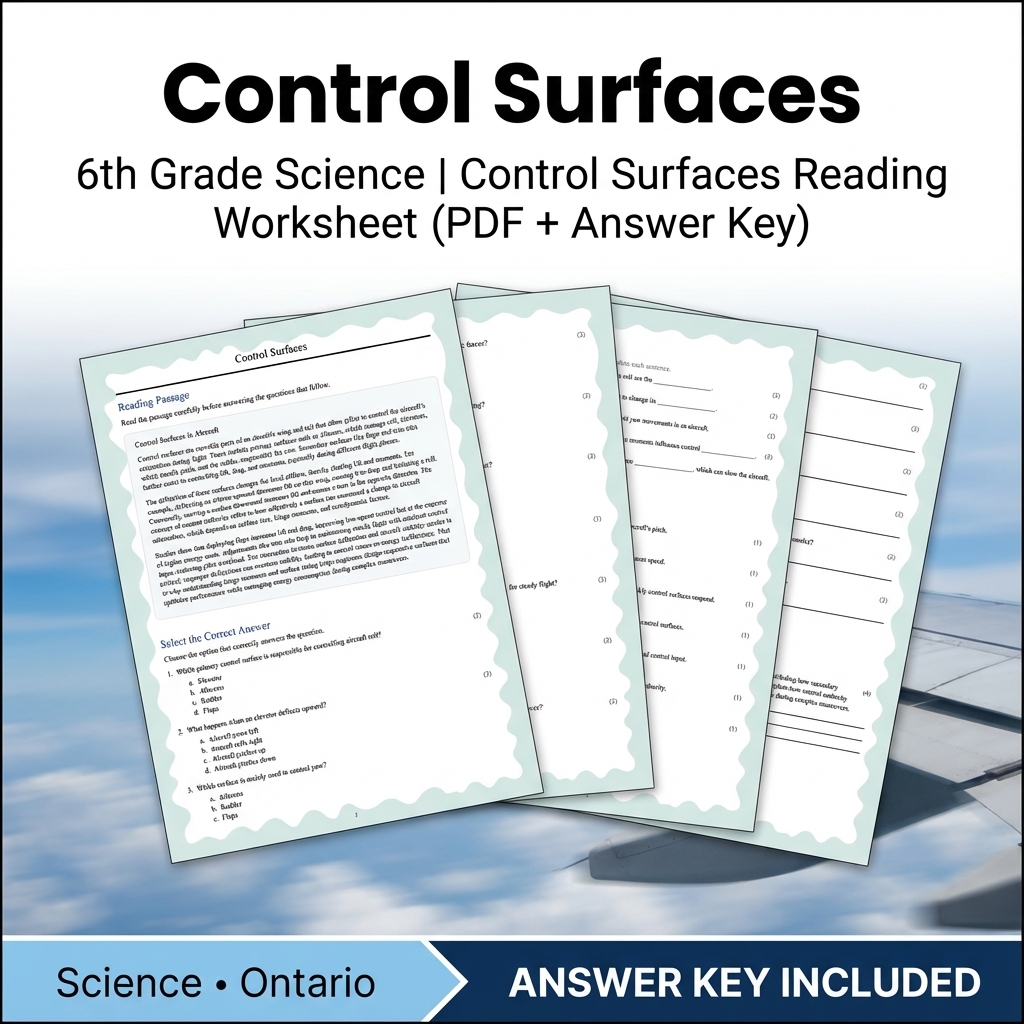
6th Grade Science | Control Surfaces Reading Worksheet (PDF + Answer Key)
JCreated byJ.S SheetsLearning Objectives
- Understand the primary and secondary control surfaces such as ailerons, elevators, rudder, and flaps
- Describe how deflections affect lift, moments, and control authority
- Explain interactions of control inputs with aircraft stability modes
Also included in: Grade 6 Science | Aerodynamics & Flight Unit Worksheet Pack (PDF + Answer Keys) +1 more
Instant download

Grade 6 Science | Heat and Temperature Worksheet | NGSSS Aligned
Created byLumora LearningLearning Objectives
- Explain the difference between heat and temperature using particle motion and energy transfer ideas
- Use temperature differences to predict the direction of heat flow
- Describe how the amount of matter affects how much heat energy an object can store
Instant download
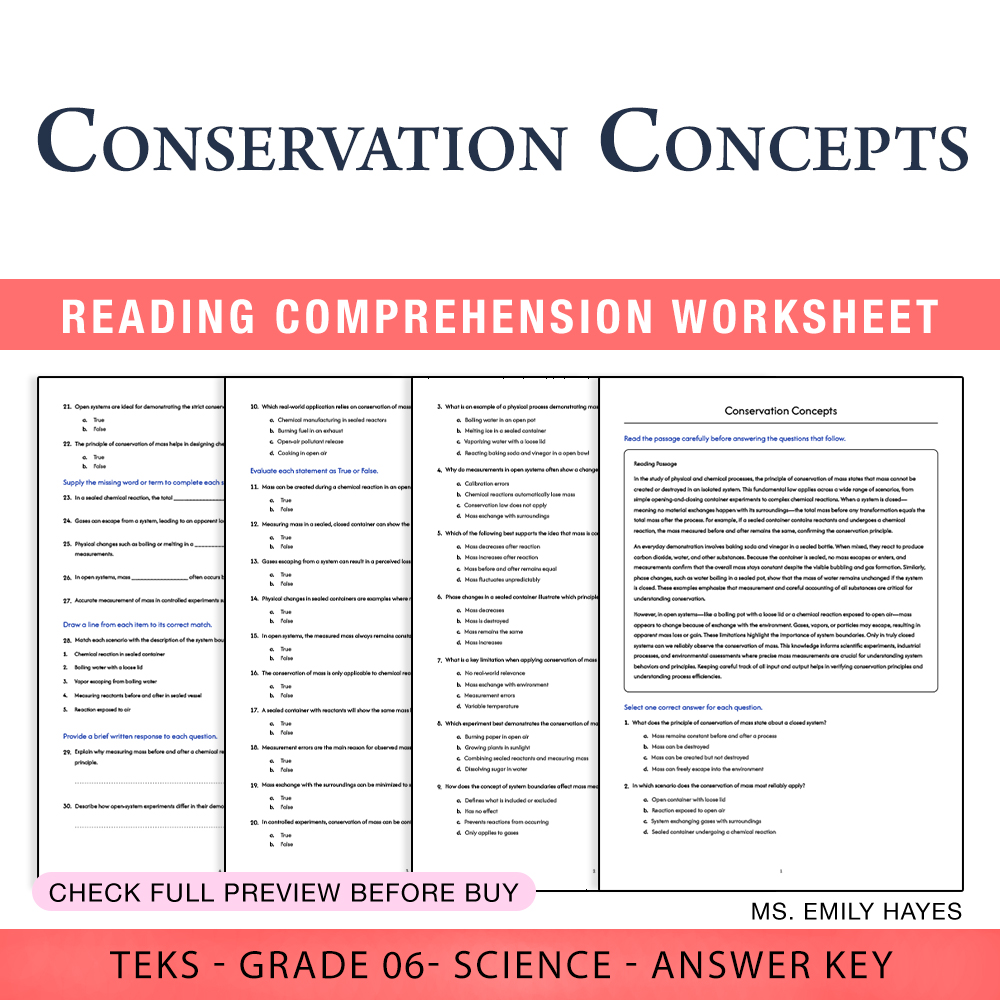
6th Grade Science | Conservation Concepts Worksheet (PDF+ Answer Key)
Created byCopper Leaf ClassroomLearning Objectives
- Understand the principles of mass conservation in closed systems during physical and chemical changes.
- Identify examples of conservation of mass in various real-world scenarios.
- Analyze measurements before and after transformations to support conservation concepts.
Instant download

Grade 6 Science – Earth System Interactions Reading Worksheet | NGSSS Aligned
Created byBright Mind ResourcesLearning Objectives
- Understand how the atmosphere and hydrosphere interact through evaporation and condensation.
- Identify the processes involved in water movement in the air.
- Describe how clouds form and influence weather patterns.
Also included in: Climate Grade 6 Science Daily Reading Worksheets Lesson Bundle | Florida NGSSS +1 more
Instant download
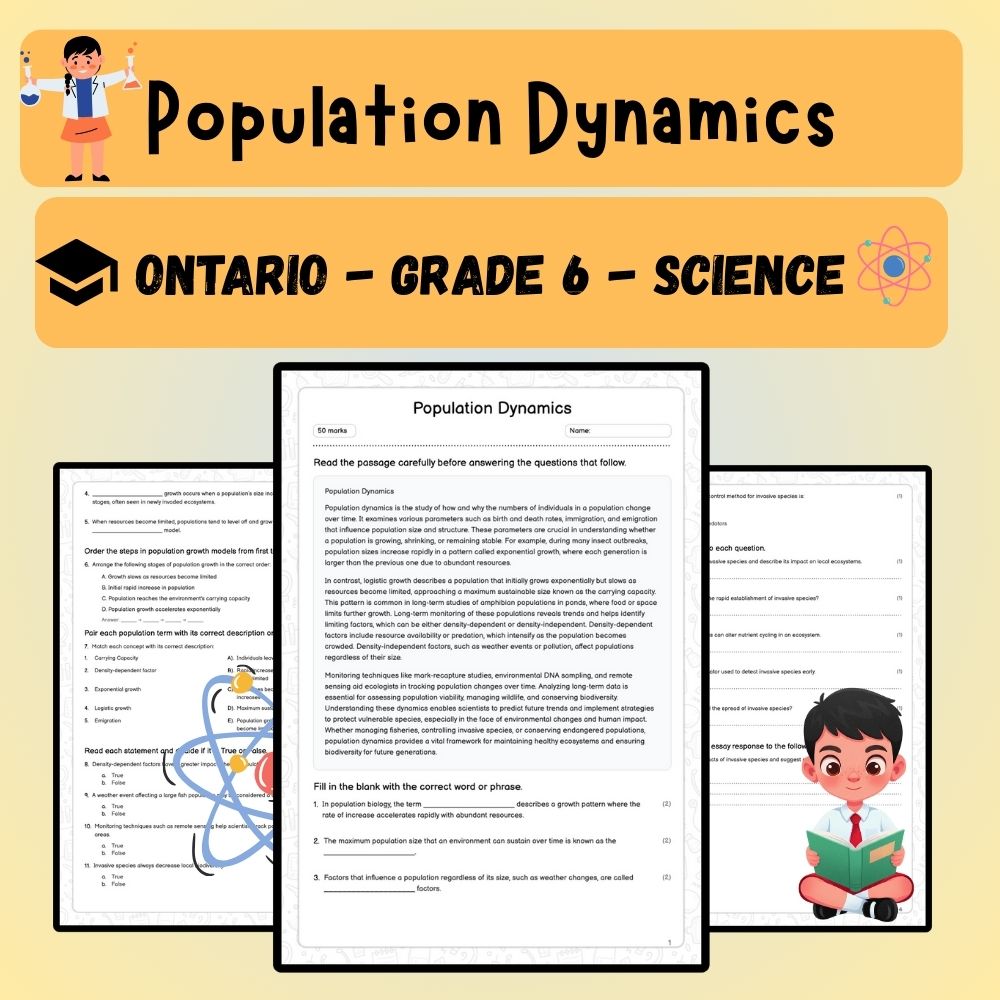
6th Grade Science – Population Dynamics Worksheet (PDF ) – Ontario Standards
Created byPrism Point LearningLearning Objectives
- Understand the factors influencing population growth and decline in terrestrial and aquatic systems.
- Explain the concepts of logistic and exponential growth models through real-world examples.
- Identify density-dependent and density-independent factors affecting populations.
Also included in: Grade 6 Science Unit Bundle – Ecology, Classification & Environment
Instant download
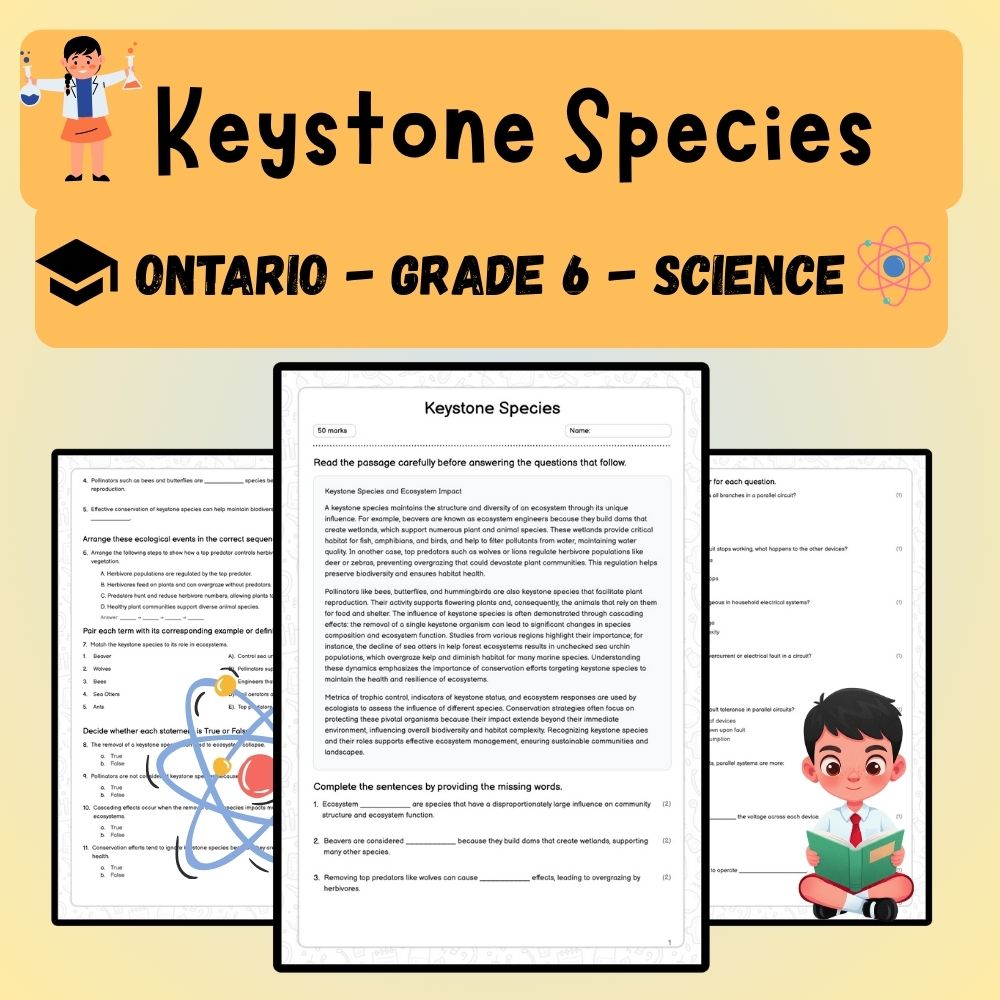
Grade 6 Science | Keystone Species Worksheet (PDF ) – Ontario Standards
Created byPrism Point LearningLearning Objectives
- Understand the concept of keystone species and their role in ecosystems.
- Identify regional case studies illustrating keystone species effects.
- Analyze cascading effects of keystone species on biodiversity and habitat complexity.
Also included in: Grade 6 Science Unit Bundle – Ecology, Classification & Environment
Instant download
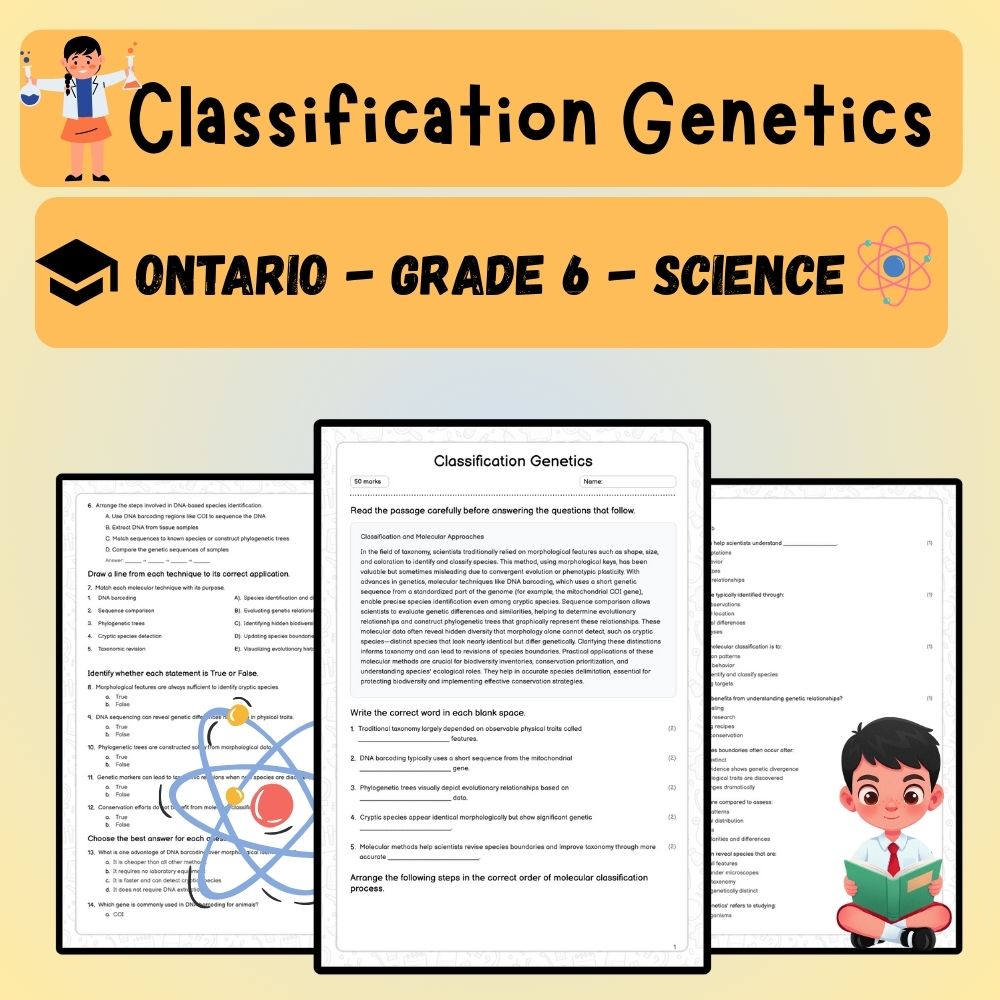
6th Grade Science – Classification & Genetics Worksheet (PDF)
Created byPrism Point LearningLearning Objectives
- Understand molecular methods used in species classification, including DNA barcoding and sequence comparison.
- Differentiate between morphological and genetic approaches to taxonomy.
- Interpret how DNA evidence can reveal cryptic species and influence taxonomy.
Also included in: Grade 6 Science Unit Bundle – Ecology, Classification & Environment
Instant download
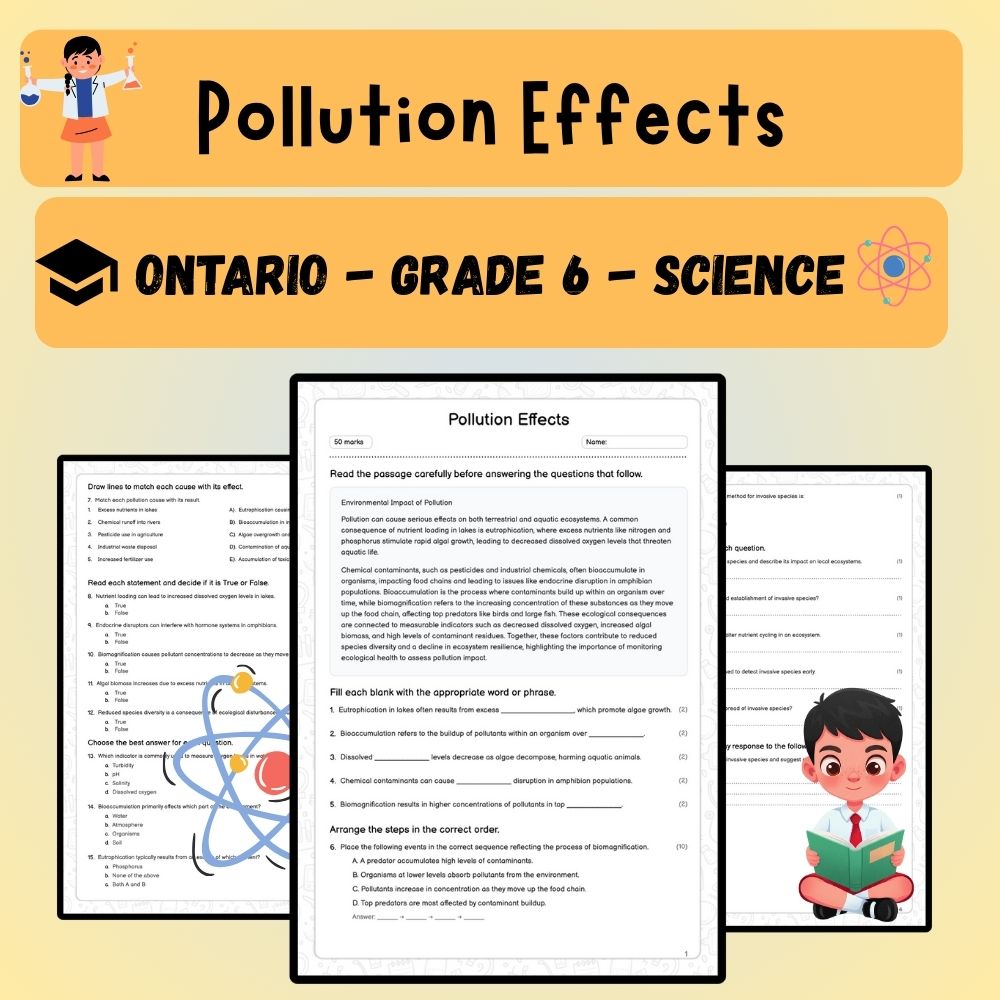
Grade 6 Science | Pollution Effects Worksheet (PDF ) for Ontario Standards
Created byPrism Point LearningLearning Objectives
- Understand how nutrient loading and chemical contaminants impact ecosystems
- Identify indicators used to measure ecological changes due to pollution
- Analyze pathways of bioaccumulation and biomagnification in food chains
Also included in: Grade 6 Science Unit Bundle – Ecology, Classification & Environment
Instant download

Data Tables and Scientific Evidence Worksheets Grade 6 Science
 Created bySunny Desk Resources
Learning Objectives
- Identify how data-table headings, units, and time stamps help interpret measurements
- Use information from a data table to answer questions about accuracy and consistency
- Evaluate statements about good record-keeping using evidence from a data-table context
Also included in: Evidence & Investigation Grade 6 Science Worksheets | Alberta +1 more
Instant download

Mass Conservation Test Prep Worksheets | Grade 6 Science BC
Created byPrism Point LearningLearning Objectives
- Explain the law of conservation of mass in closed systems during physical and chemical changes
- Use mass-conservation reasoning to account for reactants and products in open systems
- Distinguish between true matter loss and apparent mass changes caused by measurement limits or gas escape
Also included in: Matter, Properties & Change Lesson Bundle — Grade 6 Science BC Framework +1 more
Instant download

Solar Motions Worksheet | Grade 6 Science Activities
Created byPrism Point LearningLearning Objectives
- Explain how Earth’s axial tilt and revolution cause seasonal changes and day-length variations.
- Describe how gravity and orbital motion affect the relative positions of Earth, the Moon, and planets.
- Use sky patterns and periodic events (moon phases, eclipses, tides) to interpret observable motion in the solar system.
Also included in: Grade 6 Earth and Space Science Lesson Bundle TEKS (8 worksheets) +1 more
Instant download

6th Grade Science – Design Process Worksheet (Ontario Standards) (PDF)
Created byEvergreen Desk EducationLearning Objectives
- Describe the iterative design process used to improve an aircraft or glider concept.
- Identify how performance specifications and trade-offs affect lift, drag, weight, and stability.
- Interpret the meaning of measured lift and drag coefficients from tests or simulations.
Also included in: Grade 6 Flight & Aerodynamics Science Lesson Bundle Worksheets (Ontario) +1 more
Instant download

6th Grade Science | Body Organization Levels Worksheet – General Standards (PDF)
Created byMaple Path LearningLearning Objectives
- Understand the hierarchy of body organization from cells to systems.
- Identify the roles of tissues, organs, and body systems in maintaining health.
- Explain how changes in one structure can affect overall body function.
Instant download
About Grade 6 Science Worksheets
Explore Grade 6 Science worksheets for classwork, homework, or review. Our 5,997 printables download instantly as PDFs.
MyTeachingSheets worksheets are made by real teacher-authors and checked before they go live. Download any as a print-ready PDF for lessons, homework, or independent practice — most include answer keys, and previews are always free.