
Grade 6 Science Worksheets
5,969 worksheets
Grade 6 Science – Forces & Contact and Non-Contact Forces | Reading Worksheet
 Created byBright Mind Resources
Learning Objectives
- Understand the difference between contact and non-contact forces
- Identify examples of gravity, friction, and normal force
- Explain the concept of balanced and unbalanced forces in simple terms
Also included in: Matter & Energy Grade 6 Science Daily Reading Worksheets Bundle | TEKS +2 more
Instant download

Earth Rotation Worksheet | Grade 6 Science | Alberta Standards
JCreated byJ.S SheetsLearning Objectives
- Understand how Earth's rotation causes day and night cycles.
- Identify the sequence of sunrise, solar noon, and sunset across different time zones.
- Explain the mechanics of Earth's axial rotation and its effects on celestial observations.
Instant download

Grade 6 Physical Changes Worksheet | Practice & Assessment PDF
 Created byClear Sky Classroom
Learning Objectives
- Identify physical changes and explain how they differ from chemical changes.
- Connect everyday examples (melting, freezing, tearing, dissolving) to changes in form or state.
- Use particle-based reasoning to describe why physical changes can be reversible.
Instant download

Electric and Magnetic Forces: Force and Distance Grade 6 Worksheets
 Created byTeachers Club
Learning Objectives
- Describe how electric attraction/repulsion depends on charge strength and separation distance.
- Explain how magnetic forces depend on magnet strength or current and separation distance.
- Use qualitative field representations to predict whether forces strengthen or weaken.
Also included in: Grade 6 Science Forces & Interactions Worksheets | NGSS Bundle +2 more
Instant download

Heritability and Evolution of Traits Worksheets | Grade 6 Science
 Created byPrism Point Learning
Learning Objectives
- Define heritability as genetic contribution to trait variation
- Distinguish genetic influences from environmental influences on traits
- Explain how natural selection changes allele frequencies over generations
Instant download

Aircraft Performance Worksheets | Iterative Design Grade 6 Science
Created byPrism Point LearningLearning Objectives
- Describe the iterative design cycle using specifications and prototypes
- Explain how measurement supports aircraft design refinement
- Explain trade-offs between lift, drag, weight, and stability
Also included in: Flight Lesson Bundle | Grade 6 Science | Ontario Framework
Instant download

Groundwater and Baseflow Assessment | California Standards Grade 6 Science
Created byPrism Point LearningLearning Objectives
- Explain how precipitation can infiltrate, percolate, and recharge groundwater aquifers.
- Describe how groundwater contributes to streamflow as baseflow during dry periods.
- Interpret how permeability and landscape geometry affect the groundwater–surface water connection.
Also included in: Grade 6 Water in Earth Systems Science Lesson Bundle: California Standards +1 more
Instant download

Grade 6 Science Reasoning Claims Worksheet | TEKS-Aligned Practice
JCreated byJ.S SheetsLearning Objectives
- Explain the difference between raw observations and inferential explanatory claims in scientific reasoning.
- Use evidence and patterns in data to support or question a proposed scientific claim.
- Evaluate the strength of inferences by considering evidence sufficiency and alternative explanations.
Instant download

Grade 6 Food Chains Worksheet with Answer Key | Florida NGSSS Science
 Created byEvergreen Desk Education
Learning Objectives
- Explain how energy transfers from producers to consumers in a food chain.
- Identify producers, primary consumers, secondary consumers, and higher trophic levels.
- Interpret food chain arrows to determine who eats whom.
Instant download

Grade 6 Science | Understanding Food Chains - Daily Reading Comprehension
 Created byCoral Reef Learning
Learning Objectives
- Identify the basic structure of a simple food chain.
- Understand the roles of producers, consumers, and decomposers.
- Recognize different organisms involved in food chains.
Instant download

Grade 6 Science | Lunar Motion - Daily Reading Comprehension
Created byCoral Reef LearningLearning Objectives
- Understand the different phases of the Moon and how they occur.
- Identify the sequence of Moon phases from new moon to full moon and back.
- Describe the relationship between the Sun, Earth, and Moon in creating lunar phases.
Also included in: Sky Science Lesson Bundle | Grade 6 Science Daily Reading | Alberta +1 more
Instant download

Grade 6 Coral Reef Conservation Worksheet | Biodiversity Solutions | NGSS
 Created byBRIGHT PATH RESOURCES
Learning Objectives
- Understand the importance of coral reefs to ecosystems.
- Identify different conservation strategies for coral reef protection.
- Evaluate the ecological and economic trade-offs of conservation measures.
Also included in: Ecosystems Interactions Energy Dynamics Lesson Bundle | Grade 6 Science | NGSS +2 more
Instant download

Grade 6 Biodiversity Solutions Worksheet | NGSS Science Activity & Notes
Created byBRIGHT PATH RESOURCESLearning Objectives
- Compare different conservation strategies to protect ecosystems.
- Understand the ecological trade-offs and feasibility of conservation methods.
- Recognize case studies illustrating habitat restoration and invasive species management.
Also included in: Ecosystems Interactions Energy Dynamics Lesson Bundle | Grade 6 Science | NGSS +2 more
Instant download

Earth's Tilt and Seasonal Patterns Worksheets | Grade 6 TEKS
Created byPrism Point LearningLearning Objectives
- Explain how Earth's axial tilt changes sunlight angle during the year
- Compare seasonal sunlight patterns in Earth's two hemispheres
- Describe how daylight length changes with Earth's axial tilt
Instant download

Measurements, Repeated Trials & Data Displays Worksheets Grade 6
Created byPrism Point LearningLearning Objectives
- Distinguish observations from measurements using appropriate SI units
- Calculate a mean from repeated trial measurements
- Choose data displays that reveal patterns and relationships
Instant download

Scientific Investigations & Design Worksheets Grade 6 Science
Created byPrism Point LearningLearning Objectives
- Identify observations that can lead to investigable questions
- Distinguish descriptive, comparative, and experimental approaches
- Explain how tools and safety practices support investigations
Instant download

Earth and Space Science Worksheets: Solar Motions Grade 6
Created byPrism Point LearningLearning Objectives
- Explain how gravity influences motions within the solar system
- Describe how Earth's rotation creates the cycle of day and night
- Explain how axial tilt and revolution contribute to seasonal patterns
Instant download

Scientific Models Worksheets: Using & Evaluating Grade 6 Science
Created byPrism Point LearningLearning Objectives
- Explain how models represent systems, processes, or possible solutions
- Compare model behavior with observations from real systems
- Identify limitations caused by scale, materials, or omitted features
Instant download

Hypotheses, Theories, Laws & Scientific Arguments Worksheets Grade 6
Created byPrism Point LearningLearning Objectives
- Identify hypotheses as testable proposed explanations
- Distinguish the roles of theories and scientific laws
- Identify claims, evidence, and reasoning in scientific arguments
Instant download

Systems Structure and Change Worksheets Grade 6 Science TEKS Texas
Created byPrism Point LearningLearning Objectives
- Identify how connected system parts interact
- Explain how structure supports the function of system parts
- Describe how energy and matter move through systems
Instant download

Net Force in One Dimension Worksheets | Grade 6 Texas Science
Created byPrism Point LearningLearning Objectives
- Calculate net force from opposite forces acting on one object
- Distinguish balanced forces from unbalanced forces using net force
- Interpret force diagrams by identifying magnitude and direction
Instant download

Rock Cycle Pathways Worksheets | Grade 6 Science TEKS
Created byPrism Point LearningLearning Objectives
- Identify processes connecting igneous, sedimentary, and metamorphic rocks
- Construct multiple possible pathways through the rock cycle
- Explain conditions required for different rock-cycle transitions
Instant download

Research, Innovation and STEM Careers Worksheets Grade 6 Science
Created byPrism Point LearningLearning Objectives
- Explain how scientific research can contribute to technological innovation
- Compare sources using creators, evidence, and references
- Identify benefits, costs, safety, and access issues in technology
Instant download

Force Pairs and Interacting Objects Worksheets | Grade 6 Science
Created byPrism Point LearningLearning Objectives
- Identify the objects involved in an interaction force pair
- Describe the magnitude and direction of paired forces
- Explain why force-pair forces do not cancel on one object
Instant download

Patterns, Causes and Scale Worksheets Grade 6 Science TEKS
Created byPrism Point LearningLearning Objectives
- Identify repeated patterns in scientific observations
- Explain why associations do not automatically establish causation
- Describe how changing one factor tests a possible cause
Instant download

Adaptation Patterns and Survival Worksheets | Grade 6 TEKS Science
Created byPrism Point LearningLearning Objectives
- Identify structural, physiological, and behavioral adaptations
- Explain how adaptations help organisms survive environmental conditions
- Compare adaptations such as water storage, insulation, and migration
Instant download

Symbiotic Relationships and Species Interactions Worksheets Grade 6
Created byPrism Point LearningLearning Objectives
- Identify mutualism, commensalism, and parasitism from examples.
- Compare how organisms gain or lose resources through symbiosis.
- Explain how symbiotic relationships affect organisms involved.
Instant download

Human Impacts on Natural Systems Worksheets Grade 6 Science TEKS
Created byPrism Point LearningLearning Objectives
- Identify human activities that change natural systems and communities
- Explain how habitat fragmentation affects population viability
- Describe effects of pollution and land-use change on populations
Instant download

Atmospheric Patterns, Air Masses and Climate Worksheets Grade 6
Created byPrism Point LearningLearning Objectives
- Identify atmospheric features that influence regional weather and climate.
- Explain how air masses and fronts affect weather conditions.
- Describe how pressure systems and prevailing winds influence air movement.
Instant download

Plant and Animal Structures and Functions Worksheets Grade 6
Created byPrism Point LearningLearning Objectives
- Identify major plant structures and describe their functions.
- Explain how xylem and phloem transport materials through plants.
- Describe the functions of digestive, respiratory, and circulatory systems.
Instant download

Earth Structure and Plate Tectonics Worksheets Grade 6 Science
Created byPrism Point LearningLearning Objectives
- Identify the major internal layers of Earth and their basic properties.
- Compare divergent, convergent, and transform plate boundaries.
- Explain how mantle convection contributes to tectonic plate movement.
Instant download

Relative and Absolute Dating Worksheets Grade 6 Science TEKS
Created byPrism Point LearningLearning Objectives
- Explain how stratigraphic relationships establish relative ages of rocks and events.
- Distinguish relative dating from absolute dating methods.
- Describe how radiometric dating estimates numerical ages of rocks.
Instant download

Food Chains and Energy Flow Worksheets Grade 6 Science TEKS
Created byPrism Point LearningLearning Objectives
- Identify producers, consumers, and decomposers in food chains
- Explain how energy moves through different trophic levels
- Distinguish simple food chains from connected food webs
Instant download

Ecosystem Components and Interactions Worksheets Grade 6 TEKS
Created byPrism Point LearningLearning Objectives
- Identify biotic and abiotic components within an ecosystem
- Distinguish populations from communities using ecological examples
- Explain how resources influence organism distribution in habitats
Instant download

Abiotic Factors in Habitats Worksheets | Grade 6 TEKS Science
Created byPrism Point LearningLearning Objectives
- Identify major abiotic factors that influence habitat conditions
- Explain how temperature, water, and light affect organisms
- Describe how soil composition, pH, and salinity influence organisms
Instant download

Population Dynamics Worksheets Grade 6 Science TEKS
Created byPrism Point LearningLearning Objectives
- Explain how births and deaths influence population size
- Describe how immigration and emigration change populations
- Compare exponential and logistic population growth patterns
Instant download

6th Grade Science | Graph Selection Worksheet (Alberta) PDF
 Created bySilver Birch Teaching
Learning Objectives
- Choose an appropriate graph type (line, bar, or scatter plot) for a given science data set.
- Select and justify axis labels and scales that support accurate interpretation without misleading comparisons.
- Identify how annotations can clarify key features or important changes in data.
Also included in: Grade 6 Scientific Inquiry & Data Analysis Science Lesson Bundle: Alberta +1 more
Instant download

Reactants and Products Worksheet | Standards-Aligned Grade 6 Science Practice
JCreated byJ.S SheetsLearning Objectives
- Understand the difference between reactants and products in a chemical reaction.
- Identify properties that change during a chemical reaction and how they indicate a reaction has occurred.
- Interpret particle diagrams showing atoms and molecules before and after reactions.
Also included in: Grade 6 Physical Science Lesson Bundle for Science – California Standards +1 more
Instant download

Mixture Separation Worksheet Grade 6 Science | Filtering & Solutions
Created byPrism Point LearningLearning Objectives
- Explain why mixtures can be separated without forming new substances
- Identify physical properties used to separate mixture components
- Match separation methods to mixtures based on properties like particle size, density, boiling point, and solubility
Also included in: Grade 6 Energy, Matter & Motion Lesson Bundle | Florida NGSSS
Instant download
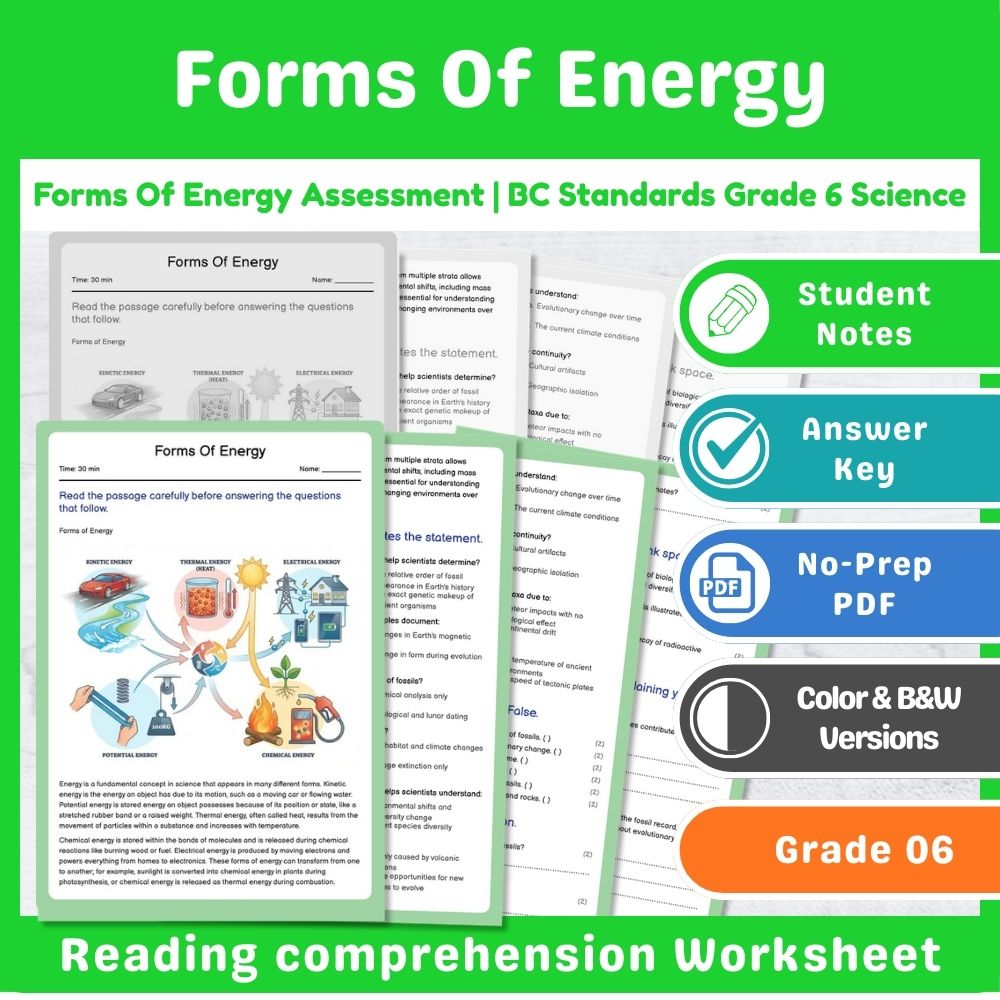
Forms Of Energy Assessment | BC Standards Grade 6 Science
Created byPrism Point LearningLearning Objectives
- Identify different forms of energy such as kinetic, potential, thermal, chemical, and electrical.
- Describe how energy transforms from one form to another in natural and engineered systems.
- Explain examples of energy transformations like sunlight to chemical energy in plants or chemical to thermal energy during combustion.
Instant download

Energy and Power Test Prep Printables | Grade 6 Science
Created byPrism Point LearningLearning Objectives
- Explain power as the rate of energy transfer and connect it to everyday electrical devices.
- Use relationships between current, voltage, and power to describe how circuit elements dissipate energy as heat.
- Describe how efficiency affects how much electrical energy becomes useful output versus wasted heat.
Also included in: Grade 6 Circuits & Electricity Science lesson bundle: Ontario
Instant download

Grade 6 New Substance Properties Worksheet PDF | California Science Standards
Created byEvergreen Desk EducationLearning Objectives
- Explain how new substances can form when atoms rearrange during a chemical change.
- Identify how macroscopic properties (solubility, conductivity, melting behavior) can change after a reaction.
- Use comparisons of properties before and after a reaction to support the idea that a new substance formed.
Instant download
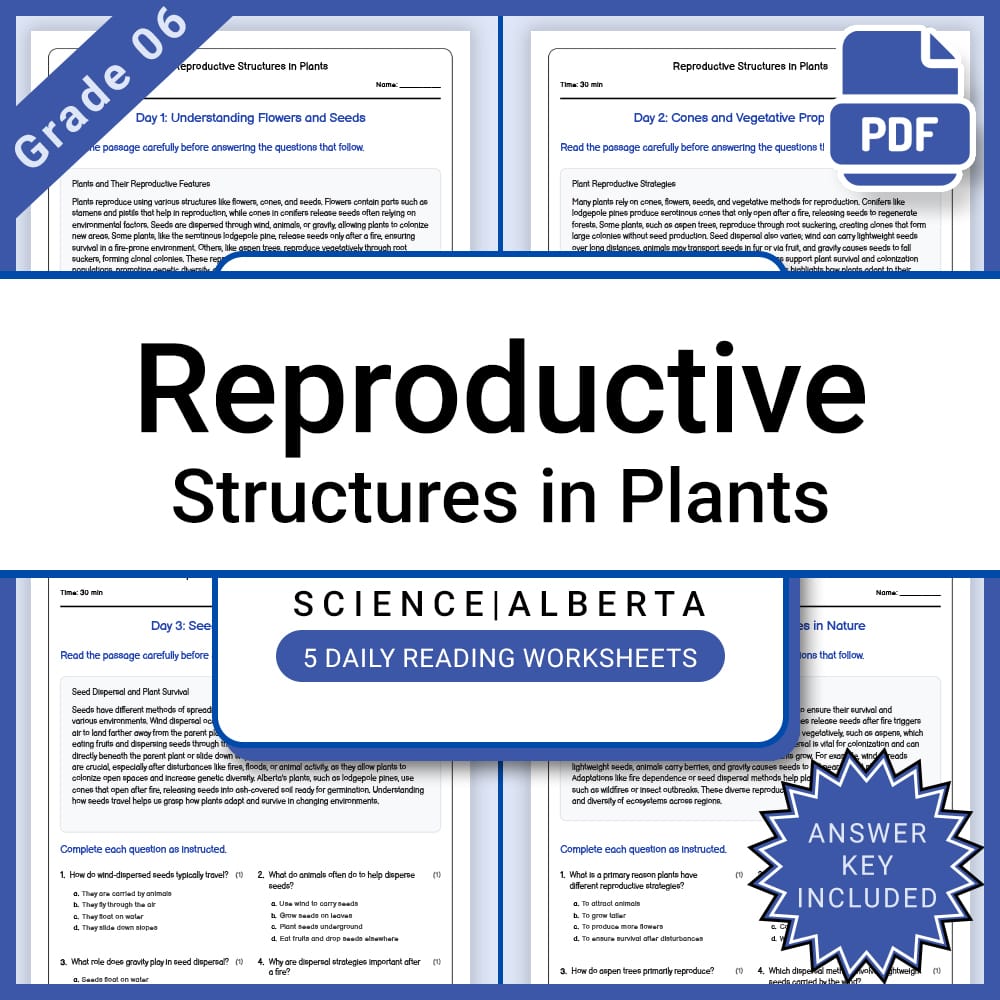
Grade 6 Science – Reproductive Structures in Plants Daily Worksheet + Answer Key
JCreated byJ.S SheetsLearning Objectives
- Identify the parts of flowers related to reproduction
- Understand seed dispersal mechanisms
- Recognize examples of plant regeneration strategies
Also included in: Grade 6 Science Lesson Bundle – Ecosystems, Trees, and Land Management +1 more
Instant download

Grade 6 Science | Water Reservoirs Worksheet Elena | California Standards
 Created byLumora Learning
Learning Objectives
- Describe major Earth water reservoirs (oceans, lakes, rivers, groundwater, glaciers, and the atmosphere).
- Explain how water changes state to move between reservoirs.
- Compare rapid versus gradual reservoir transfers and how they affect water availability over time.
Instant download

Science Insulator Comparisons Worksheet | Ontario Grade 6 Science
JCreated byJ.S SheetsLearning Objectives
- Compare insulating materials by explaining how they limit charge flow through lack of free charge carriers.
- Identify common insulators (such as rubber, glass, and dry wood) and describe how they support electrical safety through isolation.
- Distinguish bulk insulating properties from surface charge behavior and relate this to real-world protective coverings.
Instant download

Grade 6 Material Cycling Worksheet | Practice & Assessment PDF
Created byClear Sky ClassroomLearning Objectives
- Explain how rocks, sediments, water, and living things are connected through material cycling
- Describe physical and chemical weathering as first steps in the cycling of Earth materials
- Use evidence from processes to explain how deposition and biological activity affect soil and landscapes
Instant download
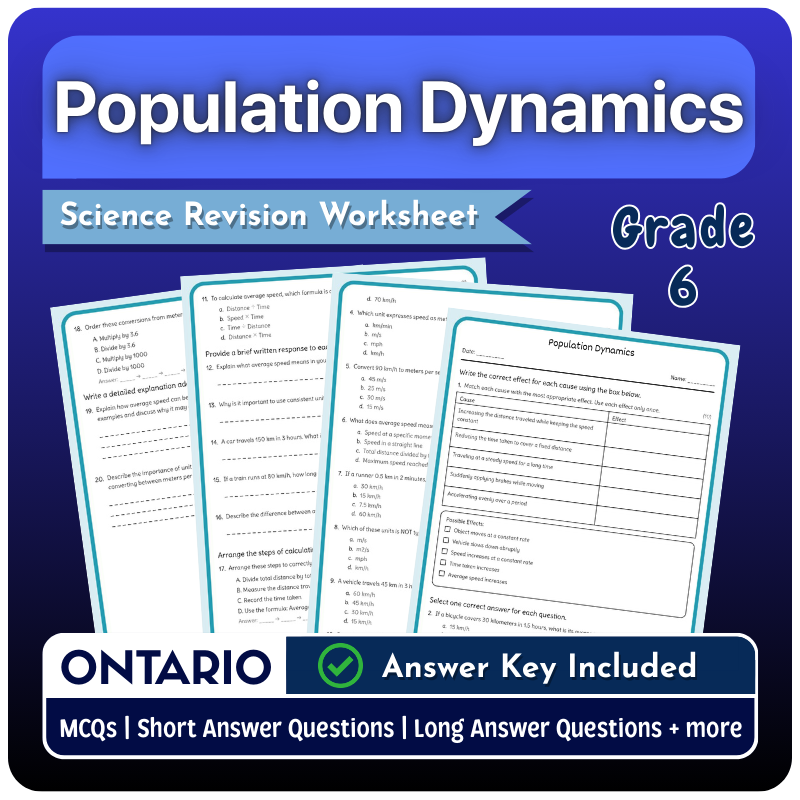
6th Grade Science | Population Dynamics Worksheet (Ontario Standards) (PDF)
Created byBright Mind ResourcesLearning Objectives
- Understand parameters that influence population growth and decline, such as birth rates, death rates, immigration, and emigration.
- Differentiate between logistic and exponential growth models and identify real-world examples.
- Explain the roles of density-dependent and density-independent factors in regulating populations.
Instant download

Particles Worksheets | Solids, Liquids & Gases Particle Model Practice
LCreated byLearnora ResourcesLearning Objectives
- Identify that all matter is made of tiny particles
- Distinguish tiny particles from visible pieces of matter
- Compare particle arrangement and movement in three states
Instant download
About Grade 6 Science Worksheets
Explore Grade 6 Science worksheets for classwork, homework, or review. Our 5,969 printables download instantly as PDFs.
MyTeachingSheets worksheets are made by real teacher-authors and checked before they go live. Download any as a print-ready PDF for lessons, homework, or independent practice — most include answer keys, and previews are always free.