
Grade 6 Science Worksheets
5,969 worksheets
Grade 6 Science | Light Properties - Daily Reading Comprehension
 Created byCoral Reef Learning
Learning Objectives
- Understand that light behaves as both waves and particles.
- Identify the different types of light including visible, ultraviolet, and infrared.
- Learn how wavelength, frequency, and energy relate to different types of light.
Instant download

Rearrangement Explanation Assessment | California Standards Grade 6 Science
 Created byPrism Point Learning
Learning Objectives
- Explain how atoms rearrange during a chemical reaction to form new substances
- Describe how the properties of products depend on new atomic arrangements rather than just mixing
- Use particle and atomic models to predict what changes and what stays the same in chemical reactions
Also included in: Grade 6 Atoms and Chemical Change Science lesson bundle | California Standards +1 more
Instant download

Gas Exchange and Digestion Worksheets Grade 6 Life Science
 Created byBRIGHT PATH RESOURCES
Learning Objectives
- Describe how the respiratory system moves gases using diffusion across exchange surfaces
- Explain how the digestive system breaks food into smaller molecules that enter circulation
- Relate coordinated respiratory and digestive processes to energy release in cells and removal of waste
Also included in: Grade 6 Life Science Worksheets Bundle | Ecosystems & Body Systems +2 more
Instant download

Model to Explain Change Assessment | California Standards Grade 6 Science
Created byPrism Point LearningLearning Objectives
- Explain how particle models describe physical changes using the ideas of particle arrangement and state change.
- Use particle models to describe chemical reactions as rearrangements of atoms into new combinations.
- Connect evidence of new substances to conservation of atoms in both physical changes and chemical reactions.
Also included in: Grade 6 Atoms and Chemical Change Science lesson bundle | California Standards +1 more
Instant download

Grade 6 Functional Classification of Species Worksheet | Alberta Science
Created byBRIGHT PATH RESOURCESLearning Objectives
- Identify how organisms can be classified by function: producers, consumers, and decomposers
- Use key details to explain why classification helps us understand energy flow in ecosystems
- Distinguish native species from invasive or pest species based on their ecosystem effects
Also included in: Forest Ecosystem Adaptations Grade 6 Science Worksheets Lesson Bundle | Alberta +1 more
Instant download

Grade 6 Science | Thermal Energy Transfer Worksheet | NGSSS Aligned
 Created byLumora Learning
Learning Objectives
- Explain how thermal energy transfers through conduction, convection, and radiation
- Identify which thermal energy transfer mechanism is occurring in everyday scenarios
- Use particle and fluid ideas to justify answers about heat movement
Instant download

6th Grade Science Worksheet | Energy and Power - Ontario Standards (PDF)
 Created byEvergreen Desk Education
Learning Objectives
- Explain power as the rate of energy transfer in electrical systems
- Connect power to voltage and current relationships in everyday circuit examples
- Describe how energy use depends on both power and time, and relate this to heat dissipation and efficiency
Also included in: Grade 6 Electricity Circuits Science Lesson Bundle for Ontario Worksheets +1 more
Instant download

6th Grade Science | Matter Properties Worksheet (TEKS) (PDF)
Created byEvergreen Desk EducationLearning Objectives
- Identify physical properties (such as density, solubility, magnetism, conductivity, hardness, and luster) and explain how they help distinguish substances.
- Use qualitative descriptions and simple quantitative comparisons to support material classification without phase-change processes.
- Relate observed property patterns to familiar examples such as iron, salt, oil, and copper.
Instant download

Sound Properties Worksheet | Grade 6 Science Practice
Created byPrism Point LearningLearning Objectives
- Explain how frequency and amplitude affect the pitch and loudness of sound
- Describe how sound speed changes with the medium and temperature
- Connect reflection and absorption to real-world sound behavior (echoes and muffled sounds)
Also included in: Energy, Waves & Circuits Lesson Bundle | Grade 6 Science | BC Framework +1 more
Instant download

Condensation and Clouds Worksheet | Standards-Aligned Grade 6 Science Practice
JCreated byJ.S SheetsLearning Objectives
- Understand the process of condensation and how clouds form in the atmosphere.
- Identify the role of condensation in weather patterns and rainfall.
- Describe how clouds influence sunlight reflection and energy balance in the atmosphere.
Also included in: Grade 6 Earth & Space Science Lesson Bundle: California Standards +1 more
Instant download

6th Grade Science | Streamlining Worksheet (Alberta Standard) (PDF)
Created byEvergreen Desk EducationLearning Objectives
- Explain how streamlined shapes reduce aerodynamic resistance by improving airflow around an object
- Identify design features of streamlining (rounded noses, tapered tails, smooth surfaces) and link them to pressure and drag effects
- Apply streamlining ideas to everyday and engineered examples to predict effects on speed, stability, and energy use
Instant download

Thermal Energy Transfer Assessment for Grade 6 Science | Florida NGSSS
Created byPrism Point LearningLearning Objectives
- Explain how thermal energy is transferred through conduction, convection, and radiation
- Identify the medium involved in each type of thermal energy transfer
- Use evidence from everyday situations to determine which mechanism is occurring
Also included in: Grade 6 Energy and Matter Science Lesson Bundle Unit: Florida NGSSS
Instant download

Grade 6 Science – Food Chains & Energy Flow | Daily Reading Worksheet
 Created byBright Mind Resources
Learning Objectives
- Understand the basic components of a food chain
- Identify producers, consumers, and their roles in an ecosystem
- Describe how energy flows through a food chain
Also included in: Ecosystems Grade 6 Science Daily Reading Worksheets Lesson Bundle |Florida NGSSS +1 more
Instant download
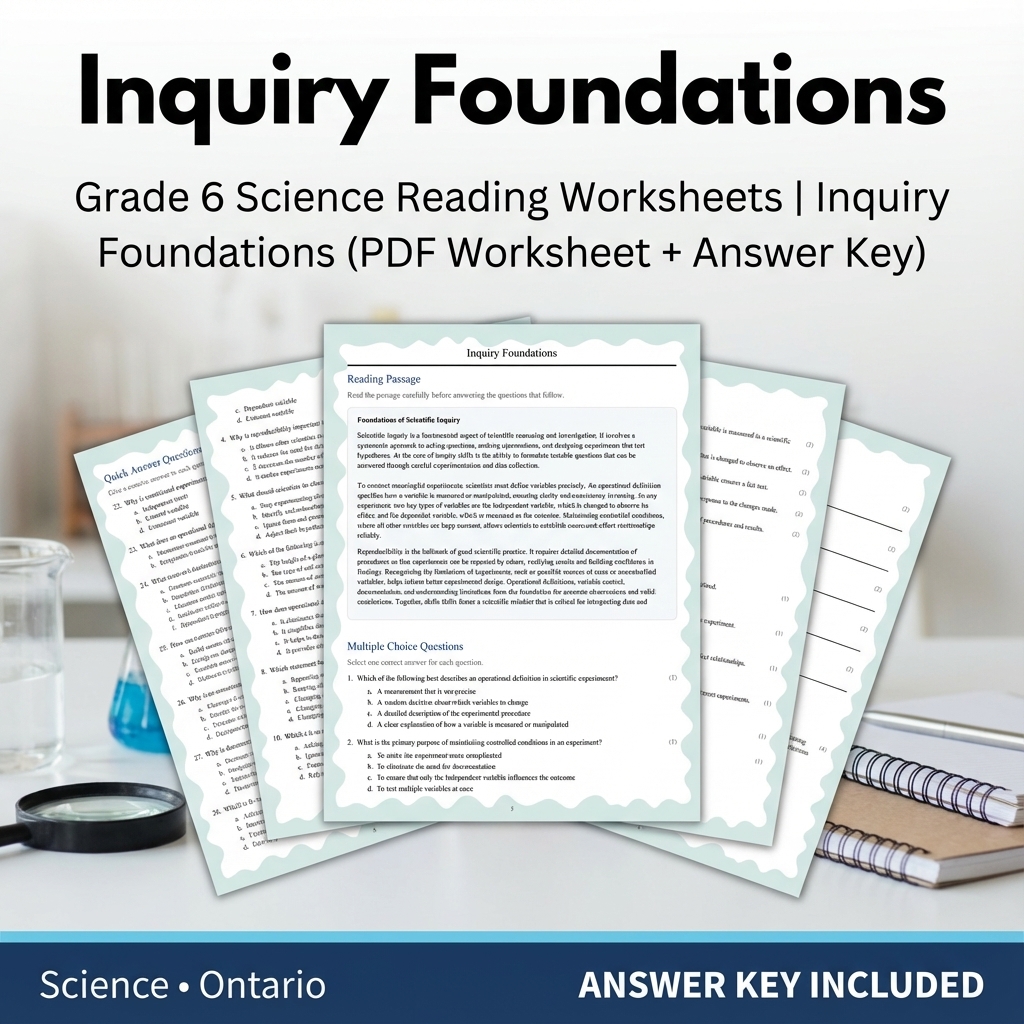
Grade 6 Science Reading Worksheets | Inquiry Foundations
JCreated byJ.S SheetsLearning Objectives
- Understand the key components of scientific inquiry, including operational definitions and variables.
- Learn to distinguish between independent and dependent variables in experiments.
- Develop skills for designing controlled experiments with fair testing conditions.
Also included in: Grade 6 Science Unit | Inquiry, Data, & Ethical Practices Worksheet Pack +1 more
Instant download

Variables Worksheet for Grade 6 Science | Alberta Standards Practice
JCreated byJ.S SheetsLearning Objectives
- Understand the different types of variables: independent, dependent, and controlled.
- Recognize how variables affect observable outcomes in experiments.
- Learn the importance of operational definitions and measurement consistency.
Instant download

Defining Problems Test Prep Worksheet | Grade 6 Science NGSS Review
Created byPrism Point LearningLearning Objectives
- Identify and write clear success measures for a design problem using criteria and constraints.
- Explain how limitations (materials, cost, and safety) affect possible solutions.
- Use cause-and-effect reasoning to predict impacts on people and natural systems.
Also included in: Grade 6 Engineering Design Process Science Lesson Bundle for NGSS
Instant download

Scale of Space in the Solar System Worksheets | Grade 6 Science
 Created byTeachers Club
Learning Objectives
- Compare solar system distances using astronomical units
- Compare planetary sizes and orbital periods
- Distinguish terrestrial planets from gas giant planets
Also included in: Earth's Place in the Universe Grade 6 Science NGSS Bundle +2 more
Instant download

Grade 6 Science | Recrystallization Worksheet | BC Aligned
Created byLumora LearningLearning Objectives
- Understand the process of recrystallization and its role in purifying solids.
- Explain how solubility varies with temperature and influences crystal formation.
- Identify the factors that affect the size and purity of crystals during recrystallization.
Instant download
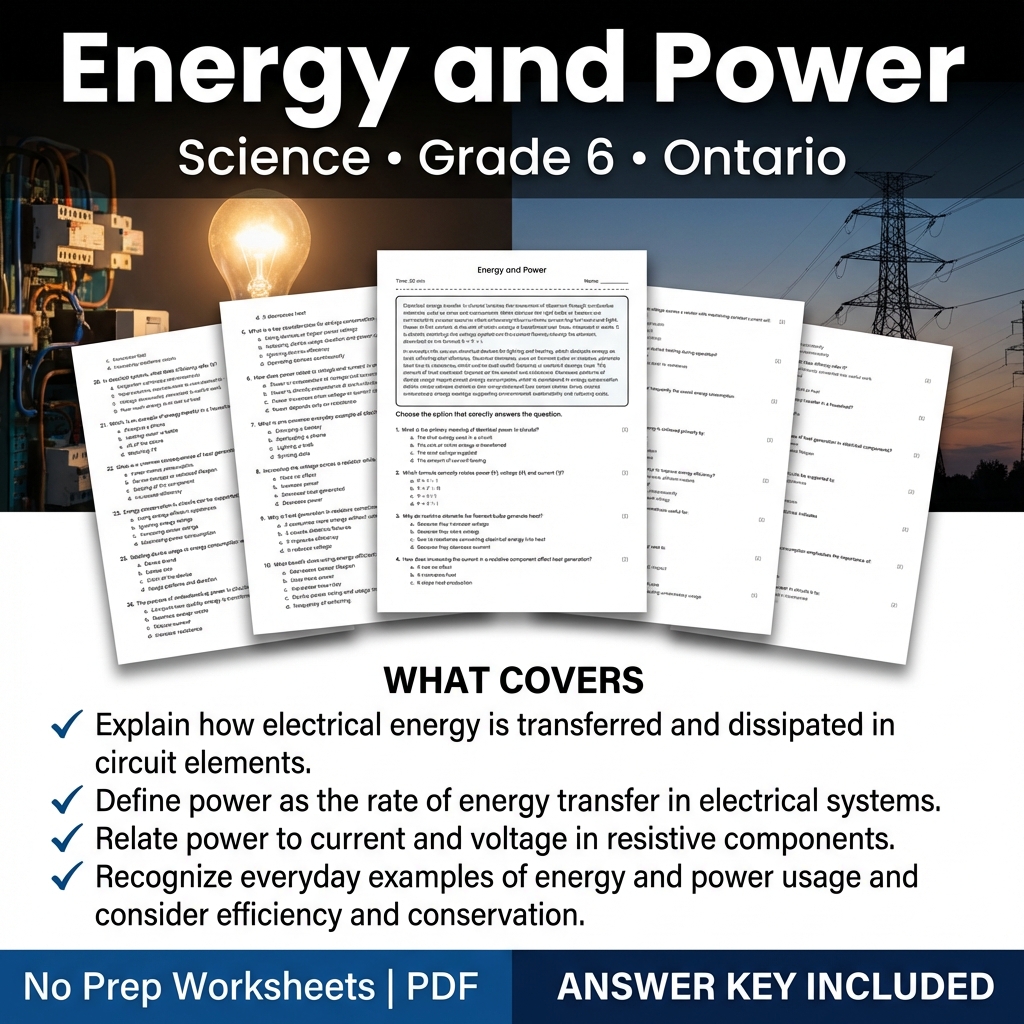
Energy and Power Grade 6 Science Worksheet | Ontario Standards
Created byCoral Reef LearningLearning Objectives
- Explain how electrical energy is transferred and dissipated in circuit elements.
- Define power as the rate of energy transfer in electrical systems.
- Relate power to current and voltage in resistive components.
Instant download

Classification Basics Worksheet & Doodle Notes | Grade 6 Science
 Created byChalk and Compass
Learning Objectives
- Identify how observable characteristics are used to group organisms into categories.
- Use a dichotomous key to classify organisms by following paired choices.
- Explain the hierarchy of biological classification from kingdom to species.
Also included in: Grade 6 Science Ecosystems, Adaptations & Biodiversity Lesson Bundle | Ontario +1 more
Instant download

Grade 6 Chemical Energy Release Worksheet | California Science PDF
Created byEvergreen Desk EducationLearning Objectives
- Explain how chemical energy stored in food can be transformed to power life processes in organisms.
- Describe how energy is conserved during cellular work (energy changes form, not created or destroyed).
- Distinguish between useful energy for body functions and energy lost as heat.
Instant download

Science Grade 6 Worksheet | Circuit Diagnosis Standards-Aligned
JCreated byJ.S SheetsLearning Objectives
- Explain how circuit topology (series vs. parallel) affects expected current and voltage patterns
- Interpret observed symptoms (unequal brightness, open continuity, anomalous meter readings) to narrow down likely faults
- Use comparison of predicted vs. observed behavior to reason about whether a fault is an open, short, or incorrect component behavior
Instant download

Cloud and Precipitation Worksheet | Grade 6 Science | Florida NGSSS Activity
Created byEvergreen Desk EducationLearning Objectives
- Explain how clouds form when water vapor cools and condenses onto tiny particles in the atmosphere.
- Describe how precipitation forms when condensed droplets or ice crystals grow heavy enough to fall.
- Use temperature and moisture information to predict likely types of precipitation.
Instant download
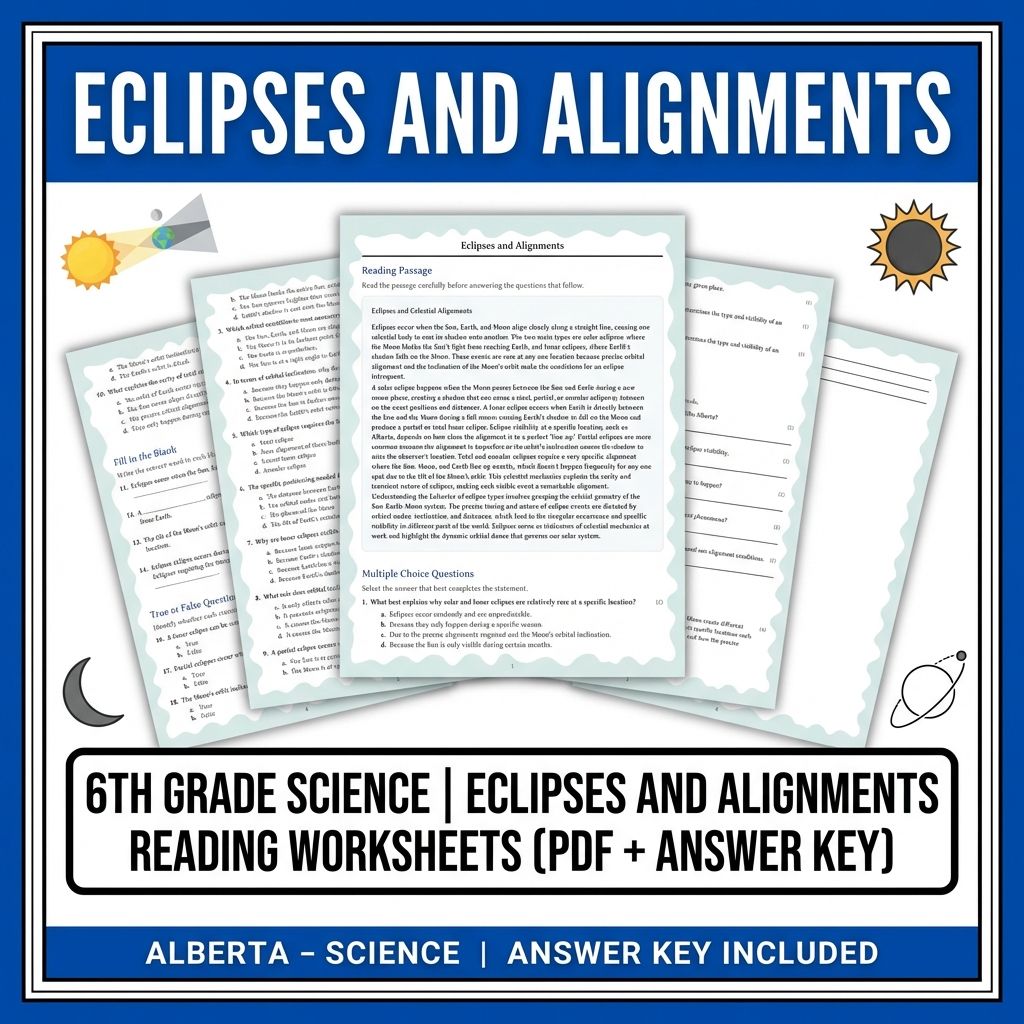
6th Grade Science | Eclipses and Alignments Worksheets (PDF + Answer Key)
JCreated byJ.S SheetsLearning Objectives
- Describe the celestial conditions necessary for solar and lunar eclipses.
- Explain how the orbit and alignment of the Sun, Earth, and Moon influence eclipse types and visibility.
- Understand why eclipses are rare at specific locations like Alberta.
Also included in: Grade 6 Science | Celestial Motion & Sky Observation Worksheets Bundle +1 more
Instant download

Invasive Species Worksheet | Ontario Grade 6 Science Assessment
 Created byCedar Grove Learning
Learning Objectives
- Explain how invasive species are introduced and establish in new ecosystems
- Describe how competition and predation by non-native organisms can alter native food webs
- Identify factors that increase establishment success, including propagule pressure and lack of natural predators
Also included in: Grade 6 Biodiversity and Adaptations Science Lesson Bundle Ontario +1 more
Instant download
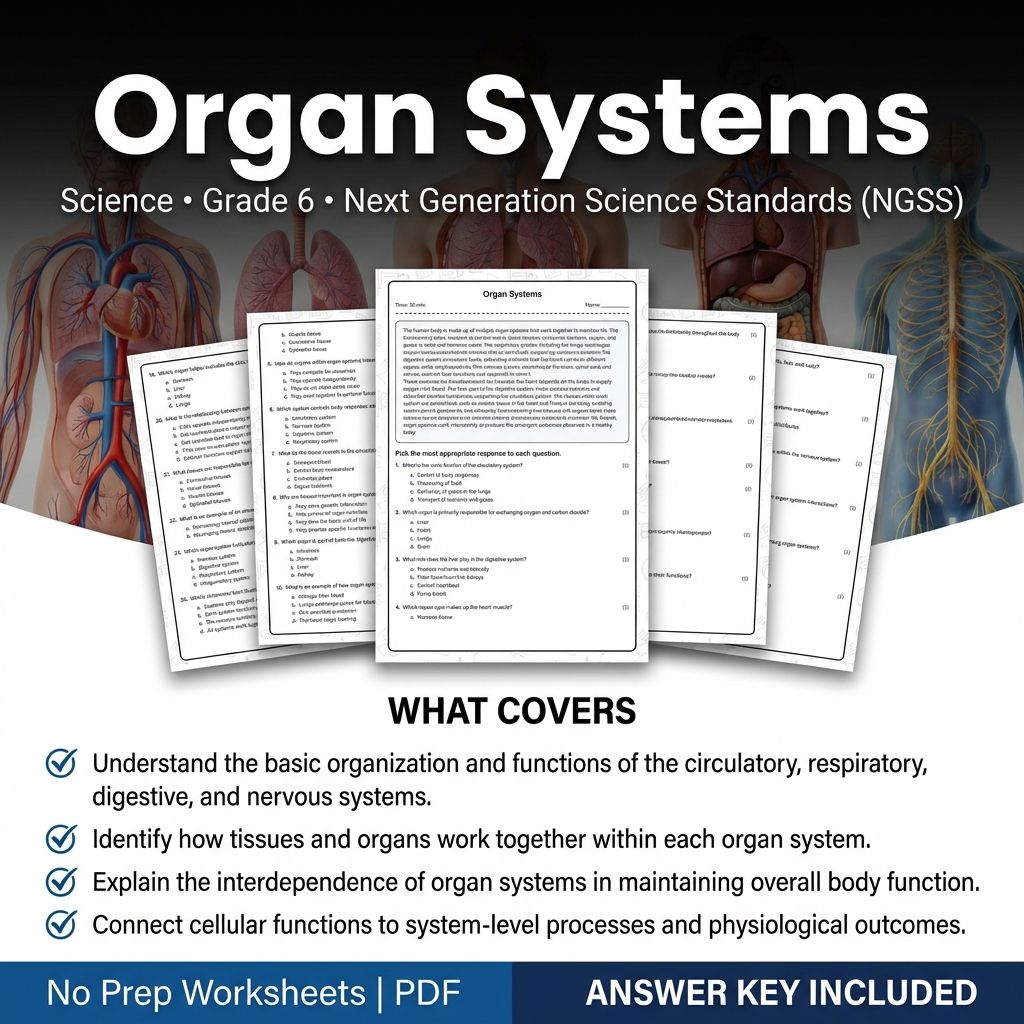
Grade 6 Science | Organ Systems Worksheet & Answer Key (Printable PDF)
Created byCoral Reef LearningLearning Objectives
- Understand the basic organization and functions of the circulatory, respiratory, digestive, and nervous systems.
- Identify how tissues and organs work together within each organ system.
- Explain the interdependence of organ systems in maintaining overall body function.
Instant download
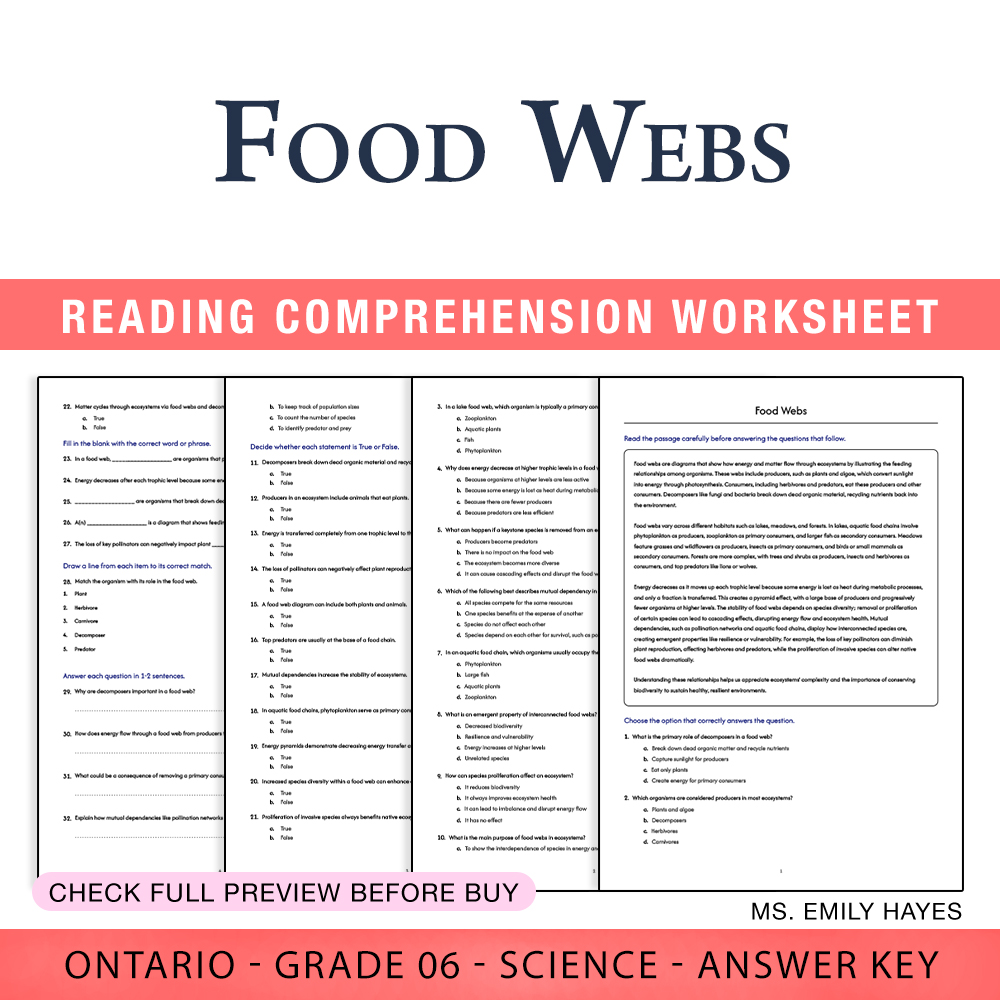
6th Grade Science | Food Webs Worksheet (PDF+ Answer Key)
 Created byCopper Leaf Classroom
Learning Objectives
- Understand the components of food webs including producers, consumers, and decomposers
- Describe energy flow and matter cycling within different ecosystems
- Analyze the effects of species removal or proliferation on food web stability
Instant download

Science Assessment: Climate and Patterns (Grade 6) | NGSSS Assessment
Created byPrism Point LearningLearning Objectives
- Explain how climate differs from short-term weather using long-term averages and typical ranges.
- Identify key factors that influence climate, including latitude, altitude, distance from water, ocean currents, and prevailing winds.
- Use climate ideas to describe why different environments (deserts, grasslands, rain forests) form in different regions.
Instant download

Grade 6 Science | Conservation Principle - Daily Reading Comprehension
Created byCoral Reef LearningLearning Objectives
- Understand the basic concept of energy conservation.
- Identify different forms of energy such as kinetic, potential, and thermal.
- Learn how energy transforms and transfers within a system.
Instant download

Physical Changes Worksheets and Review Activity | Physical Science
LCreated byLearnora ResourcesLearning Objectives
- Identify changes in size, shape, or state as physical changes
- Classify examples as physical changes or non-physical changes
- Describe observable changes before and after a physical change
Instant download
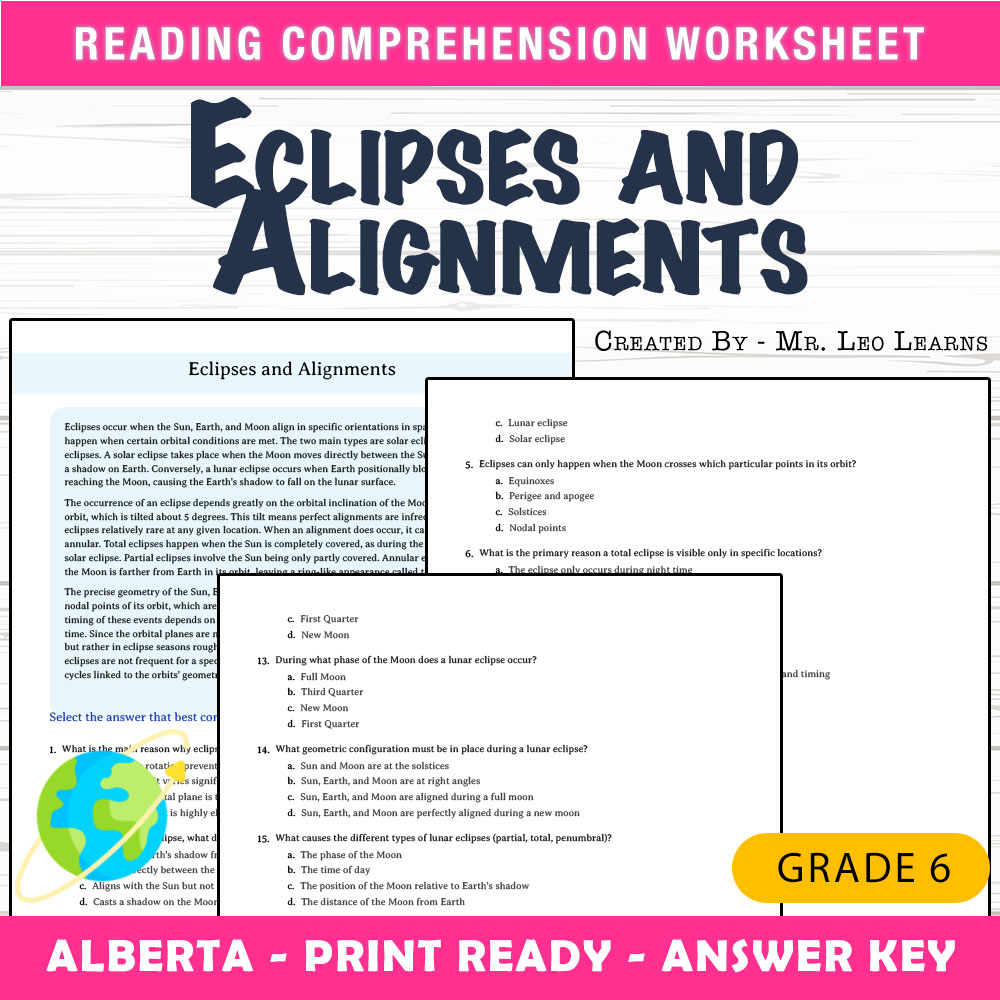
Grade 6 Science — Eclipses and Alignments Worksheet for Mastery
 Created byThe Resource Hub
Learning Objectives
- Understand the conditions leading to solar and lunar eclipses.
- Identify the key celestial alignments necessary for different types of eclipses.
- Explain why eclipses are relatively rare at a specific location and how orbital geometry affects visibility.
Also included in: Grade 6 Science Sky Science Unit Bundle – Celestial Motion & Earth-Sun Relations +1 more
Instant download

Wing Pressure Maps and Lift Worksheets | Grade 6 Flight Science
Created byPrism Point LearningLearning Objectives
- Describe how wing surface pressure variations relate to lift
- Identify stagnation points and suction peaks on pressure maps
- Explain how camber shifts pressure minima across the chord
Also included in: Flight Lesson Bundle | Grade 6 Science | Ontario Framework
Instant download
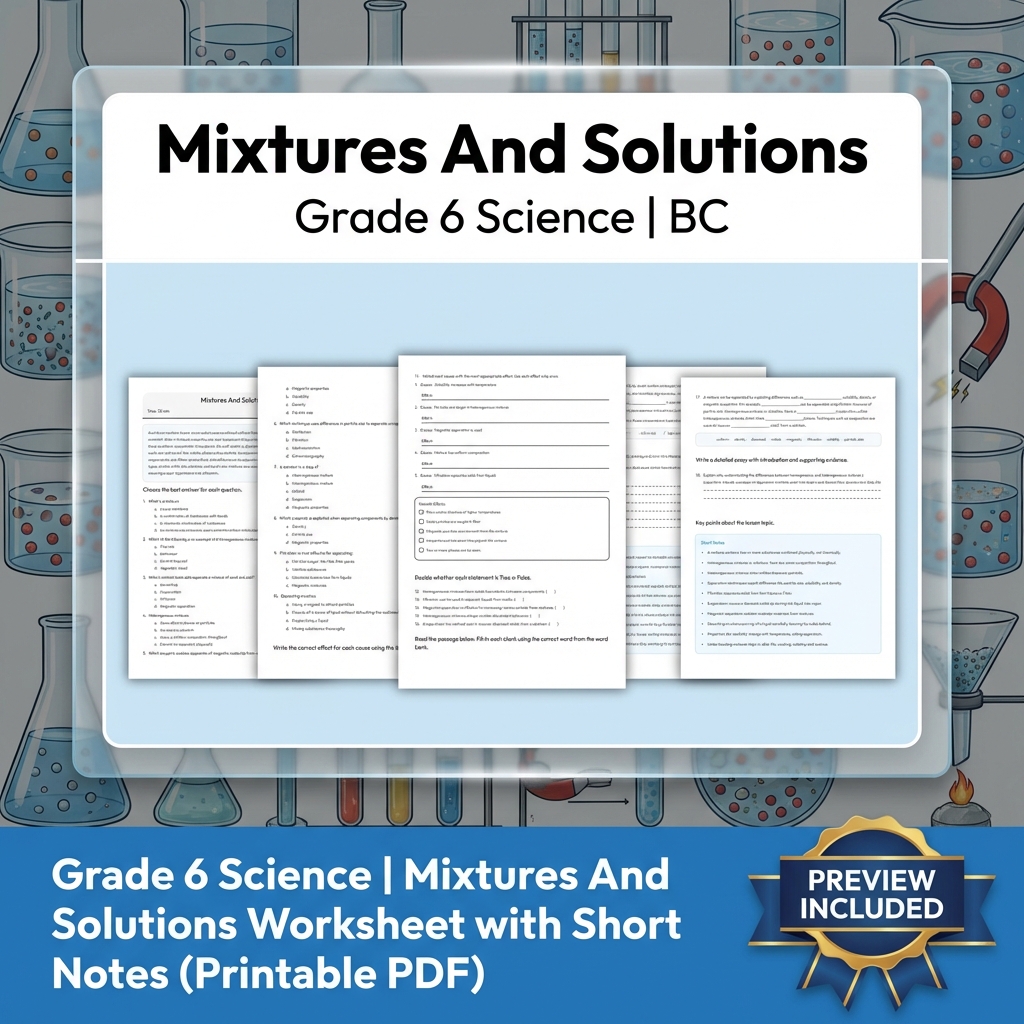
Grade 6 Science | Mixtures And Solutions Worksheet with Short Notes ( PDF)
 Created byMeadowlark Worksheets
Learning Objectives
- Understand the characteristics of mixtures and solutions.
- Differentiate between homogeneous and heterogeneous mixtures.
- Identify methods used to separate components in mixtures.
Also included in: Grade 6 Science | Matter, Properties & Change UNIT Worksheet Bundle +1 more
Instant download

Grade 6 Science Daily Reading Mass and Density TEKS Worksheet
Created byBRIGHT PATH RESOURCESLearning Objectives
- Define mass and volume in simple, accurate terms
- Explain density as a quantitative property that links mass and volume
- Use a basic density calculation with whole numbers and interpret what it means
Also included in: Energy, Matter & Change Grade 6 Science Lesson Bundle | TEKS Daily Reading +1 more
Instant download

Particle Models of Matter and States of Matter Worksheets Grade 6
Created byTeachers ClubLearning Objectives
- Use a particle model to explain how particle motion and spacing relate to phases of matter.
- Describe how collisions and particle kinetic energy change when temperature changes.
- Predict qualitative changes in pressure and volume in gases using the particle model.
Also included in: Matter and Its Interactions Grade 6 Science NGSS Worksheets Bundle +2 more
Instant download

Grade 6 Science – Mass Wasting & Landform Change | Daily Reading Worksheet
Created byBright Mind ResourcesLearning Objectives
- Define mass wasting and identify its different types.
- Explain the causes that trigger mass wasting events.
- Recognize the effects of gravity, water, and other factors on slope stability.
Also included in: Earth Systems Grade 6 Science Daily Reading Worksheets Lesson Bundle | General +1 more
Instant download

6th Grade Science Worksheet | Filtration Methods & Techniques (PDF)
Created byEvergreen Desk EducationLearning Objectives
- Explain how filtration separates mixtures using particle size and whether particles can pass through a barrier.
- Describe what happens to sand and water during filtration and how their positions change.
- Use observable evidence (such as sediment thickness and water clarity) to support a filtration claim.
Also included in: Grade 6 Heat and Matter Science Lesson Bundle for General Framework +1 more
Instant download

6th Grade Science | Measurement Tools Worksheet (PDF) Alberta Standards
Created byEvergreen Desk EducationLearning Objectives
- Explain why choosing a measurement tool and units affects the accuracy of collected data.
- Use measurement tools responsibly by calibrating and recording observations consistently.
- Represent measurement information clearly so it can be compared across time and locations.
Instant download

Orbital Dynamics Practice Worksheet | Grade 6 Science Review
Created byPrism Point LearningLearning Objectives
- Explain how elliptical and near-circular orbits affect distance from a central body and orbital speed
- Describe how gravity and inertial motion balance to keep an object in orbit
- Relate orbital period, distance, and energy qualitatively for real satellites such as the Moon and low Earth orbit satellites
Also included in: Grade 6 Space Systems Science Lesson Bundle for Ontario (10 Worksheets)
Instant download

6th Grade Science | Roots and Water Worksheet (PDF) – Alberta Standards
Created byEvergreen Desk EducationLearning Objectives
- Explain how root systems help trees anchor, absorb water and nutrients, and store energy.
- Compare taproots and lateral roots and describe where each root form is most helpful.
- Describe how mycorrhizal associations can improve drought resilience and nutrient uptake.
Instant download

Advanced Circuit Analysis Test Prep Worksheet | Grade 6 Science BC
Created byPrism Point LearningLearning Objectives
- Explain how power dissipates in resistors and relate it to current and voltage.
- Describe how internal resistance reduces terminal voltage under load and affects battery performance.
- Analyze load interactions and predict heating and safe operation in practical circuits.
Also included in: Energy, Waves & Circuits Lesson Bundle | Grade 6 Science | BC Framework +1 more
Instant download

Grade 6 Science | Nervous System - Daily Reading Comprehension
Created byCoral Reef LearningLearning Objectives
- Identify the key parts of the nervous system
- Describe the functions of neurons, the brain, and the spinal cord
- Understand how signals are transmitted within the nervous system
Instant download

Grade 6 Survival Changes Worksheet | NGSSS Adaptations Science Activity
Created byEvergreen Desk EducationLearning Objectives
- Explain how adaptations help organisms survive when environmental conditions fit their traits.
- Describe how changes in conditions can shift survival and reproduction within a population.
- Connect adaptation over generations to changes in ecosystems and resilience.
Instant download
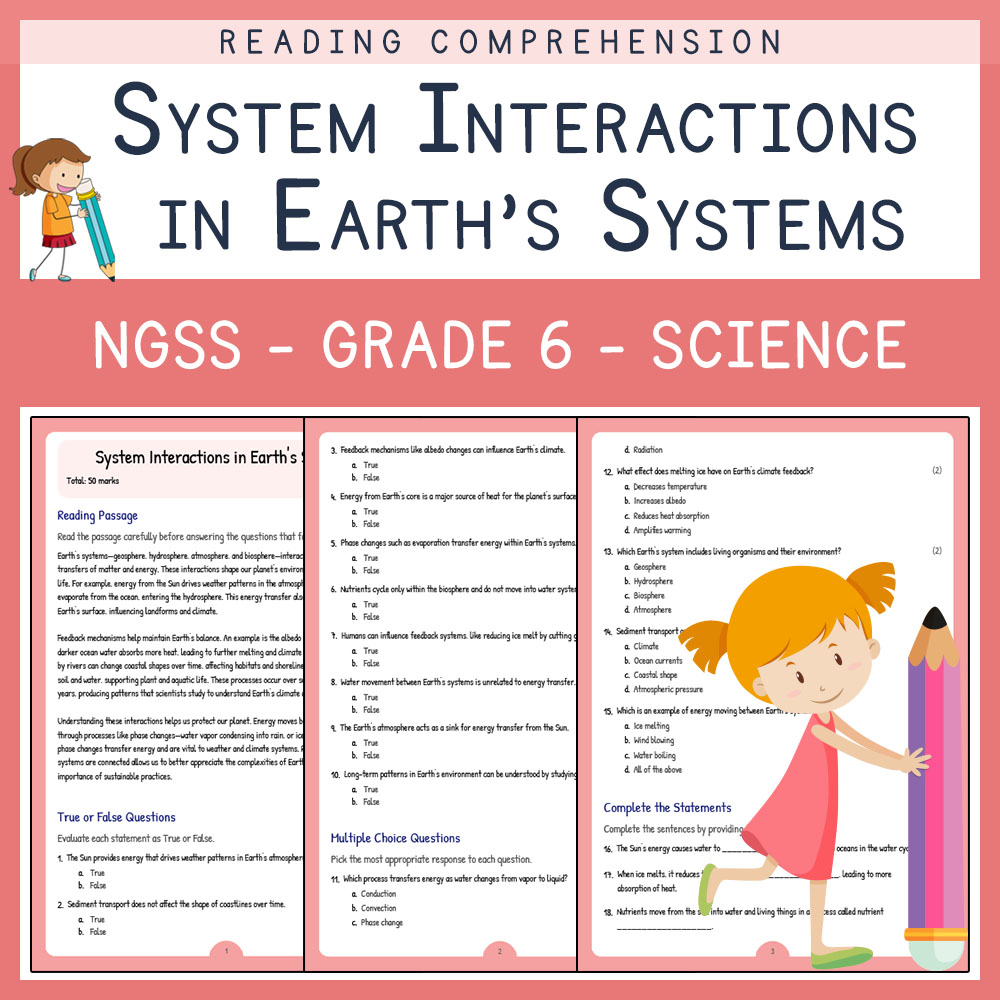
Grade 6 Science | Earth's Systems Interactions Worksheet (PDF) | NGSS Aligned
Created byLumora LearningLearning Objectives
- Understand how Earth's systems interact through the transfer of matter and energy.
- Identify examples of feedback mechanisms like albedo changes, sediment transport, and nutrient movement.
- Describe the flow of energy within Earth's systems including sources, sinks, and phase changes.
Instant download

Water Cycle Practice Worksheet | Grade 6 Science NGSS Review
Created byPrism Point LearningLearning Objectives
- Explain how solar energy and gravity drive the water cycle processes (evaporation, condensation, precipitation, runoff, infiltration, and groundwater storage).
- Identify how water moves between reservoirs (ocean, atmosphere, land/ice, rivers, and aquifers) and how phase changes affect that movement.
- Describe examples such as evapotranspiration, river discharge, aquifer recharge, and seasonal snowmelt and connect them to storage timescales.
Also included in: Grade 6 Weather & Climate Systems Science Lesson Bundle NGSS
Instant download

6th Grade Science Worksheet – Component Functions (Ontario) PDF
Created byEvergreen Desk EducationLearning Objectives
- Identify the function of key circuit components: power sources, resistive loads, switches, and connectors.
- Match physical components to common schematic ideas and explain how symbols represent those functions.
- Describe qualitatively how component behavior affects current and voltage in simple circuits (like lights or small motors).
Also included in: Grade 6 Electricity Circuits Science Lesson Bundle for Ontario Worksheets +1 more
Instant download

Tool Safety for Environmental Measurement Worksheets Grade 6 Science
 Created bySunny Desk Resources
Learning Objectives
- Identify safe handling practices for measurement tools such as thermometers, pH probes, and handheld anemometers
- Explain how to store, clean, and manage batteries to prevent equipment damage and measurement errors
- Describe calibration checks and contamination prevention steps for fieldwork near wetlands and river edges
Also included in: Evidence & Investigation Grade 6 Science Worksheets | Alberta +1 more
Instant download

Grade 6 Decomposers And Nutrient Return Worksheet | Practice & PDF
 Created byClear Sky Classroom
Learning Objectives
- Explain how decomposers break down dead organisms and waste
- Describe how nutrients return to soil and water and become available to producers
- Analyze how decomposer activity affects ecosystem structure and plant growth
Instant download
About Grade 6 Science Worksheets
Explore Grade 6 Science worksheets for classwork, homework, or review. Our 5,969 printables download instantly as PDFs.
MyTeachingSheets worksheets are made by real teacher-authors and checked before they go live. Download any as a print-ready PDF for lessons, homework, or independent practice — most include answer keys, and previews are always free.