
Grade 6 Science Worksheets
5,969 worksheets
Grade 6 Science | Reflection and Refraction Worksheet (PDF) BC Standards
 Created byEvergreen Desk Education
Learning Objectives
- Explain how reflection follows angle relationships when light meets a surface
- Describe how refraction changes the direction of light as it moves between media
- Use ideas about refractive index and lenses to predict what happens to images and light paths
Instant download

Grade 6 Particle Models Worksheet | NGSS Practice PDF
 Created byClear Sky Classroom
Learning Objectives
- Describe matter as composed of tiny particles and explain their behavior.
- Relate particle motion, collisions, and spacing to phases and changes of state.
- Understand how temperature and thermal energy affect particle behavior in gases.
Also included in: Grade 6 Matter & Chemical Reactions Science Lesson Bundle—NGSS Worksheets +1 more
Instant download

Grade 6 Science | System Integration in the Human Body - Reading Comprehension
 Created byCoral Reef Learning
Learning Objectives
- Understand how muscles generate heat to help maintain body temperature.
- Identify feedback mechanisms that regulate internal conditions.
- Explain how muscles interact with other systems to preserve homeostasis.
Instant download

Natural Hazards Data Analysis Worksheets for Risk Grade 6
 Created byTeachers Club
Learning Objectives
- Identify patterns in observational and instrumental data related to natural hazards.
- Explain how recurrence intervals help estimate when hazards may occur again.
- Use hazard clues to estimate likely event locations and likely magnitudes for risk assessment.
Also included in: Earth's Systems Grade 6 Science Worksheets | NGSS Unit Bundle +2 more
Instant download

Grade 6 TEKS Conduction Daily Science Reading Energy Transfer Worksheet
 Created byBRIGHT PATH RESOURCES
Learning Objectives
- Identify evidence of thermal conduction in a real-life example.
- Explain how temperature changes when heat moves through a solid.
- Compare how different materials transfer heat using the idea of thermal conductivity.
Also included in: Energy, Matter & Change Grade 6 Science Lesson Bundle | TEKS Daily Reading +1 more
Instant download

Science: System Interactions on Earth Worksheet | NGSS Grade 6 Science
 Created bySkylark Worksheets
Learning Objectives
- Explain how Earth’s geosphere, hydrosphere, atmosphere, and biosphere interact through transfers of matter and energy.
- Use cause-and-effect reasoning to describe feedbacks (e.g., albedo changes, sediment transport, nutrient cycling).
- Identify energy sources, energy sinks, and phase-change energy transfers in system models over time.
Also included in: Grade 6 Earth & Climate Systems Science Lesson Bundle | NGSS Worksheets +1 more
Instant download

Grade 6 Science – Renewable Transformations & Solar Power | Reading Worksheet
 Created byBright Mind Resources
Learning Objectives
- Understand how sunlight is converted into electrical energy using photovoltaic cells
- Identify different renewable energy sources and their transformation processes
- Recognize the importance of renewable energy for sustainable development
Also included in: Grade 6 Daily Reading Science Worksheets | Lesson Bundle | BC Framework +1 more
Instant download

Grade 6 Science | Hydrologic Cycle - Daily Reading Comprehension
Created byCoral Reef LearningLearning Objectives
- Understand the stages of the hydrologic cycle, including evaporation, condensation, precipitation, runoff, infiltration, and groundwater discharge.
- Identify the processes controlling water movement within watersheds and aquifers.
- Learn how surface and groundwater interact and their importance for water availability.
Instant download

Grade 6 Science | Energy Forms - Daily Reading Comprehension
Created byCoral Reef LearningLearning Objectives
- Identify different forms of energy such as kinetic, potential, thermal, chemical, and electrical.
- Relate specific forms of energy to everyday phenomena.
- Describe how energy is associated with motion, position, and internal activity of molecules.
Instant download

6th Grade Science | Evidence Communication Worksheet (Alberta) (PDF)
 Created bySilver Birch Teaching
Learning Objectives
- Explain how scientists turn analyzed observations into evidence-based claims.
- Summarize patterns in data using descriptive statistics and clear wording.
- Choose and justify appropriate visuals (bar, line, or scatter plots) for common Alberta contexts.
Also included in: Grade 6 Scientific Inquiry & Data Analysis Science Lesson Bundle: Alberta +1 more
Instant download

Grade 6 Science | Competition for Survival in the Forest - Reading Comprehension
Created byCoral Reef LearningLearning Objectives
- Understand what competition means in nature
- Identify how resource availability affects organism survival
- Learn about direct and indirect competition among species
Instant download

Grade 6 Science | Mass Wasting Worksheet | General Standard
 Created byLumora Learning
Learning Objectives
- Explain how gravity drives mass wasting and how materials become unstable on slopes.
- Identify triggers of mass wasting such as heavy rainfall, freeze-thaw, earthquakes, and erosion.
- Describe how deposition at the bottom can change drainage and lead to later erosion and transport.
Instant download

Resource Distribution Practice Worksheets | Grade 6 Science NGSS Review Test Prep
 Created byPrism Point Learning
Learning Objectives
- Explain how past geoscience processes affect where mineral ores, petroleum, and groundwater are found.
- Describe how hydrologic flow and recharge influence groundwater availability.
- Evaluate trade-offs in resource extraction by considering demand, extraction impacts, and technology limits.
Instant download

Electric Current Worksheets: Electricity Grade 6 Science
Created byPrism Point LearningLearning Objectives
- Describe electric current as organized charge movement through a conductor
- Distinguish conventional current direction from electron flow in metals
- Explain potential difference as the driving force for current flow
Also included in: Grade 6 Electricity Lesson Bundle | Ontario Science Framework
Instant download
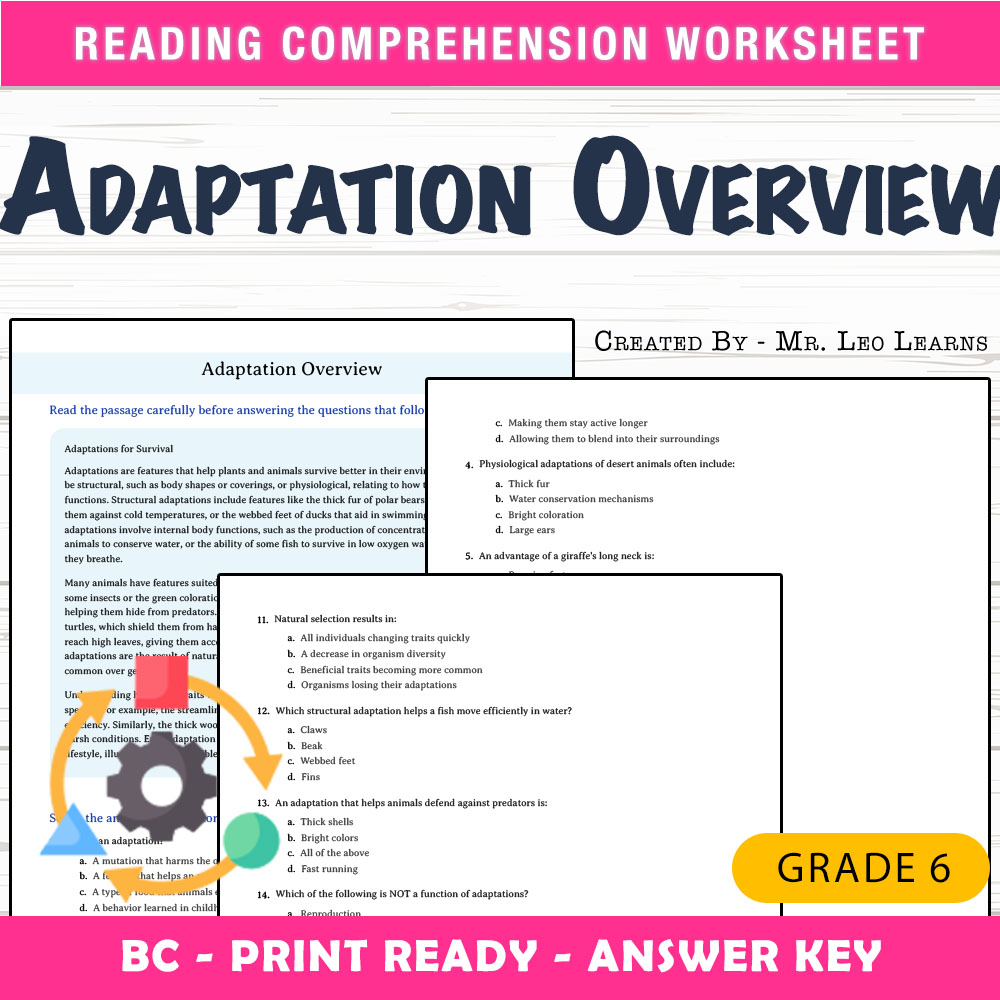
Grade 6 Science — Adaptation Overview Worksheet for Mastery
 Created byThe Resource Hub
Learning Objectives
- Understand the concept of structural and physiological adaptations in organisms.
- Identify examples of adaptations that enhance survival.
- Link specific structural features to their advantages in different environments.
Also included in: Grade 6 Science Unit | Multicellular Systems & Functions Worksheet Bundle +1 more
Instant download

Pure Mixtures Assessment | General Grade 6 Science Standards
Created byPrism Point LearningLearning Objectives
- Understand what constitutes a mixture and recognize different types of mixtures.
- Identify observable properties that distinguish mixtures from pure substances.
- Learn different separation techniques based on mixture properties.
Also included in: Grade 6 Physical Science Science Lesson Bundle: General Framework
Instant download

Grade 6 Science – Understanding Mixture Separation Daily Reading Worksheet
Created byBright Mind ResourcesLearning Objectives
- Define what mixtures are and how they differ from chemical compounds.
- Identify different physical properties used to separate mixtures.
- Explain common separation techniques, such as filtration, evaporation, and density differences.
Also included in: Grade 6 Science Energy & Matter Daily Reading Lesson Bundle | Florida NGSSS +1 more
Instant download

Grade 6 Mixtures and Compounds Worksheet | Particle Models | California
Created byEvergreen Desk EducationLearning Objectives
- Distinguish mixtures from compounds using particle models and ideas about atomic arrangement
- Explain how composition affects properties of substances (separation methods and uniformity)
- Use vocabulary such as mixture, compound, atom, and bonded particles correctly
Instant download
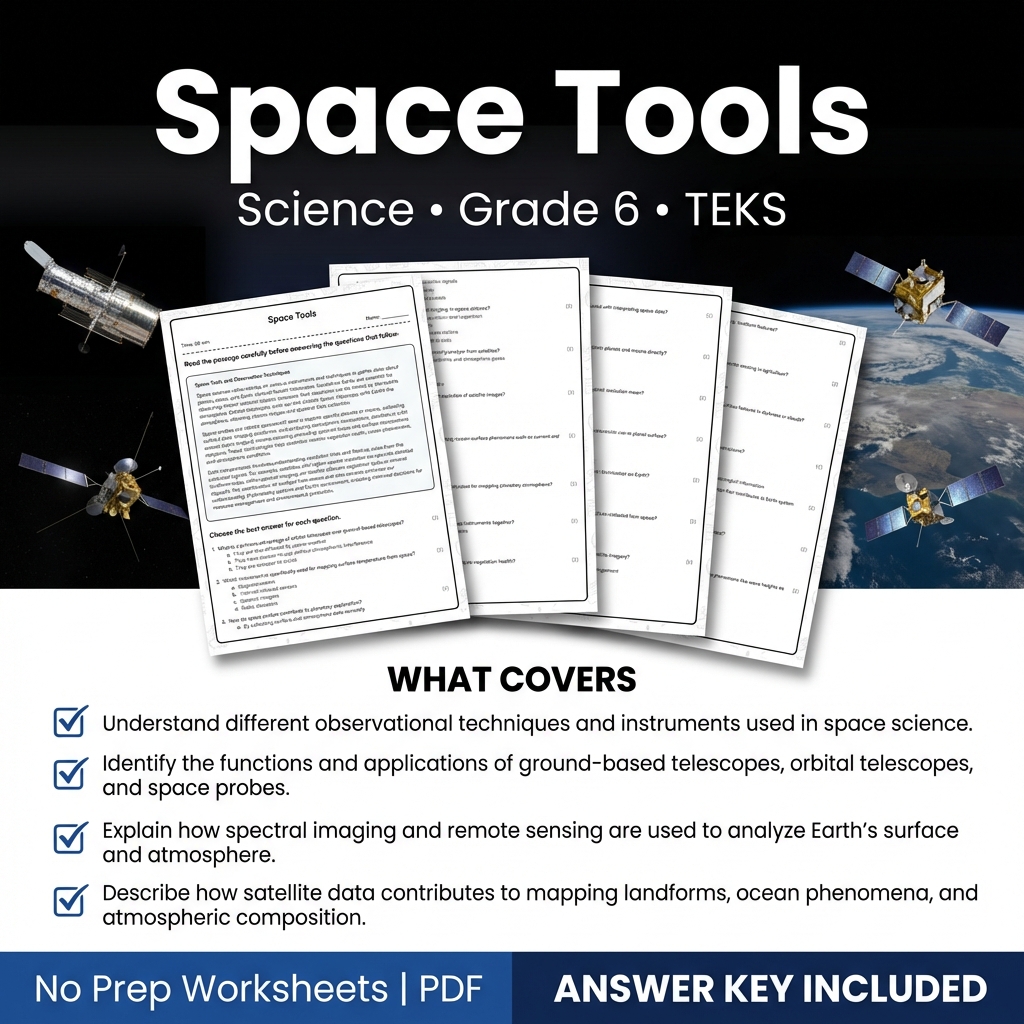
Grade 6 Science Worksheet on Space Tools | TEKS Standards Practice
Created byCoral Reef LearningLearning Objectives
- Understand different observational techniques and instruments used in space science.
- Identify the functions and applications of ground-based telescopes, orbital telescopes, and space probes.
- Explain how spectral imaging and remote sensing are used to analyze Earth's surface and atmosphere.
Instant download
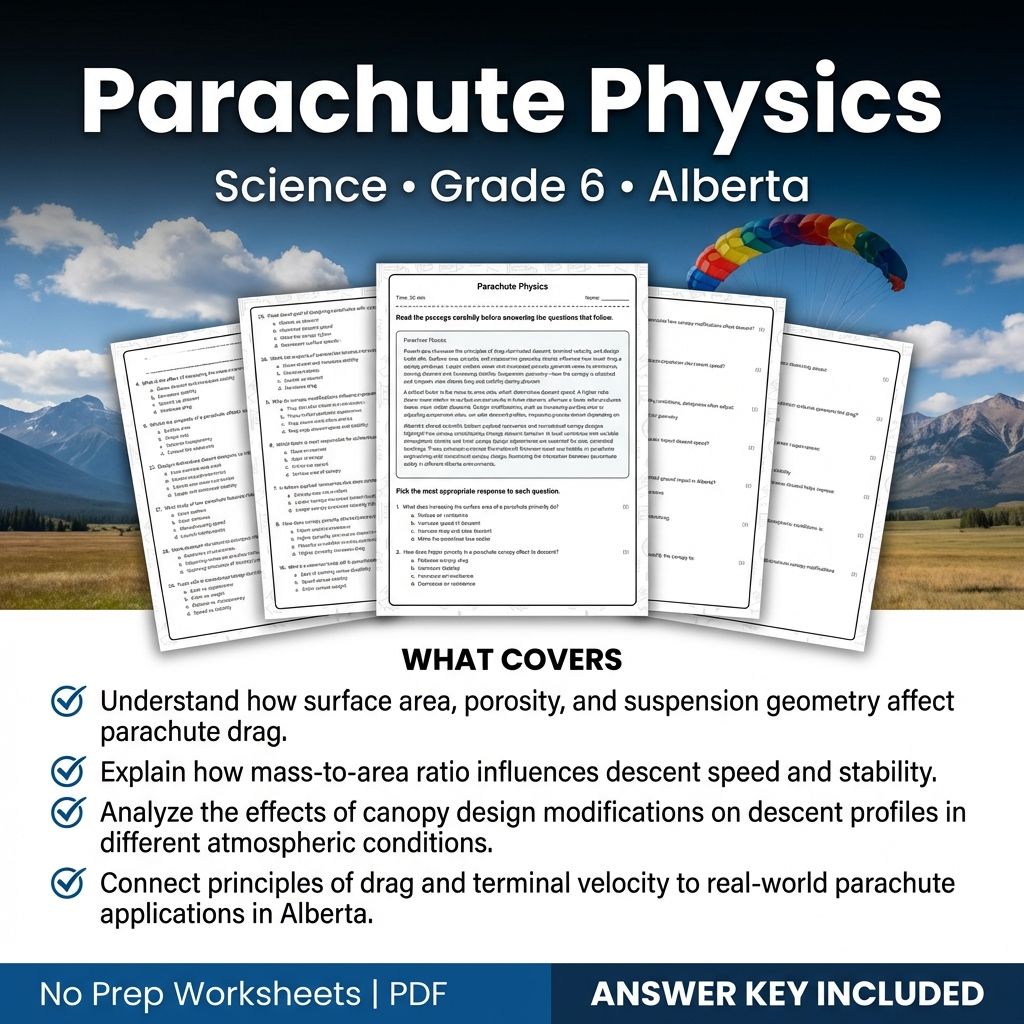
Grade 6 Science Worksheet Parachute Physics Alberta Standards PDF
Created byCoral Reef LearningLearning Objectives
- Understand how surface area, porosity, and suspension geometry affect parachute drag.
- Explain how mass-to-area ratio influences descent speed and stability.
- Analyze the effects of canopy design modifications on descent profiles in different atmospheric conditions.
Instant download

Grade 6 Science | Tree Anatomy & Structure - Daily Reading Comprehension
Created byCoral Reef LearningLearning Objectives
- Identify major parts of a tree: roots, trunk, branches, leaves, buds, and bark
- Understand the roles of different tree structures in support, transport, storage, and protection
- Recognize examples of tree adaptations in Alberta habitats
Also included in: Trees and Forests Lesson Bundle | Grade 6 Science | Alberta +1 more
Instant download

Sustainability Strategies Worksheet | NGSS-Aligned Grade 6 Science Practice
JCreated byJ.S SheetsLearning Objectives
- Evaluate how population trends and resource use impact earth systems.
- Compare renewable energy, conservation, circular use, and land management approaches.
- Identify indicators and policies for measuring and promoting sustainability.
Also included in: Grade 6 Earth Systems and Human Impacts Science Lesson Bundle – NGSS +1 more
Instant download

6th Grade Science Worksheet – Pure Mixtures (General Standards) PDF
Created byEvergreen Desk EducationLearning Objectives
- Explain what a pure mixture is and how mixtures combine two or more substances without forming a new single substance
- Compare uniform (homogeneous) and nonuniform (heterogeneous) mixtures using observable patterns
- Connect visible differences in components to appropriate separation techniques
Also included in: Grade 6 Heat and Matter Science Lesson Bundle for General Framework +1 more
Instant download
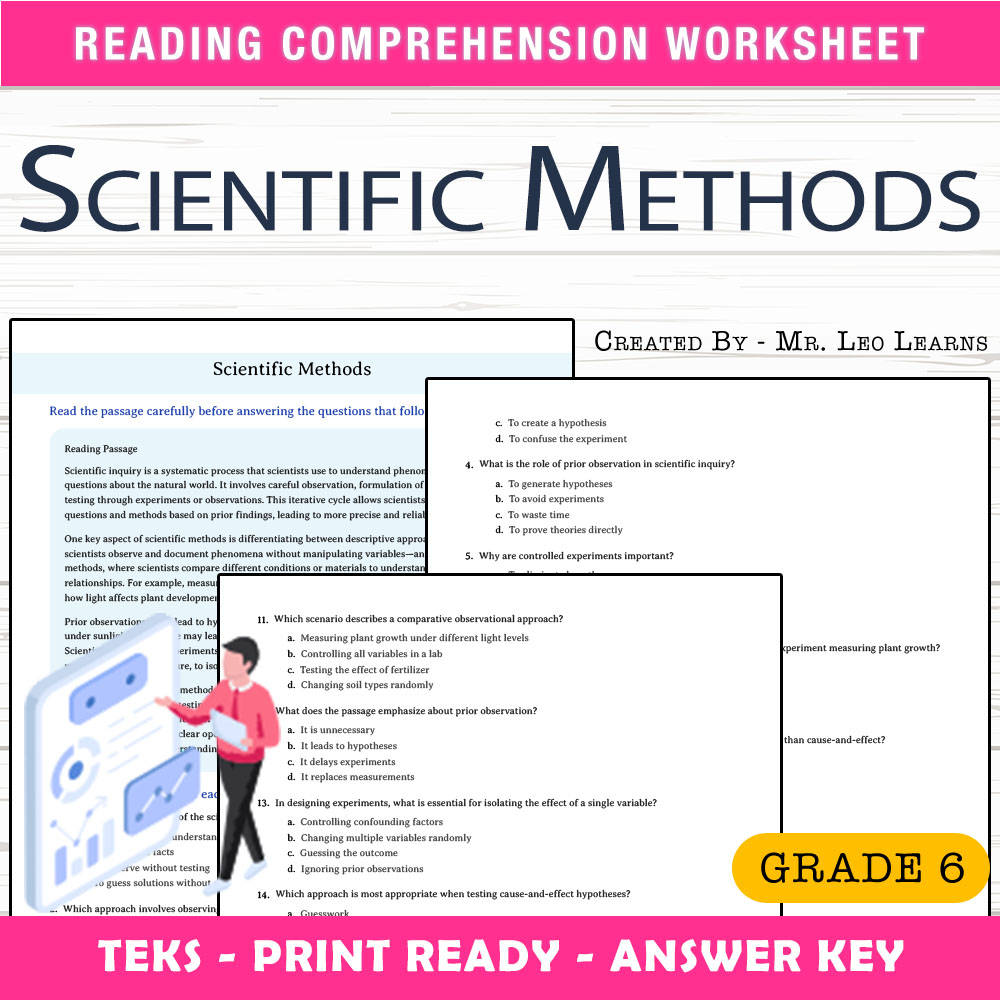
Grade 6 Science – Scientific Methods Worksheet for Mastering Inquiry Skills
Created byThe Resource HubLearning Objectives
- Understand the iterative process of scientific inquiry and how to formulate testable questions.
- Differentiate between descriptive and comparative approaches in scientific experiments.
- Identify the relationship between prior observations, hypotheses, and methodological choices.
Instant download

Grade 6 Science | New Substance Properties Worksheet | California Standards
Created byLumora LearningLearning Objectives
- Explain how new substances can form when atoms rearrange during a chemical reaction
- Describe how macroscopic properties (solubility, conductivity, melting behavior) can change after a reaction
- Use property comparisons before and after a reaction to distinguish chemical changes from physical changes
Instant download

Ohm's Law and Circuit Relationships Worksheets Grade 6 Science
Created byPrism Point LearningLearning Objectives
- Explain how voltage, current, and resistance are proportionally related
- Calculate missing circuit quantities using voltage and resistance
- Predict current changes when resistance changes at fixed voltage
Also included in: Grade 6 Electricity Lesson Bundle | Ontario Science Framework
Instant download

Grade 6 Science – Design Refinement Worksheet (Alberta) (PDF)
Created byEvergreen Desk EducationLearning Objectives
- Explain how incremental design changes (shape, mass distribution, and control surfaces) can improve aerodynamic performance and safety.
- Use criteria and observations to evaluate whether a modification achieves the intended trade-off among speed, stability, and payload.
- Describe how simple measurements and consistent flight-path observations can support evidence-based design refinement.
Instant download
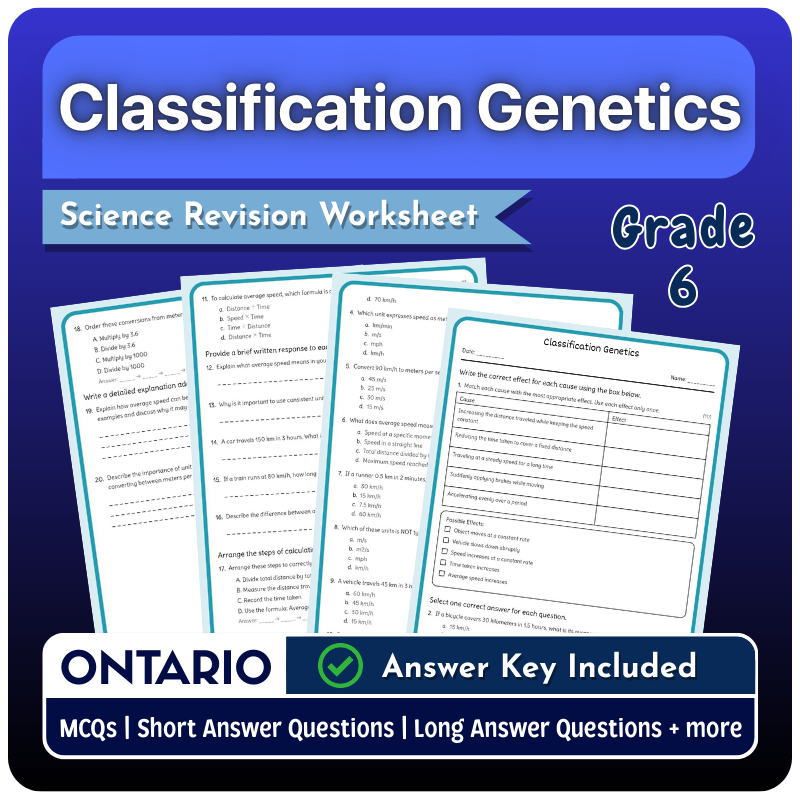
Grade 6 Science | Genetics Classification Worksheet (Ontario PDF)
Created byBright Mind ResourcesLearning Objectives
- Understand molecular tools used in species classification, including DNA barcoding and phylogenetic trees.
- Compare genetic markers with morphological keys in identifying species.
- Explain how molecular evidence can reveal cryptic species and inform taxonomy.
Instant download

Grade 6 Design Refinement Worksheet | Practice & Assessment PDF
Created byClear Sky ClassroomLearning Objectives
- Explain how incremental design changes (shape, mass distribution, and control surfaces) can improve aerodynamic performance and safety.
- Identify criteria and trade-offs involved in refining a design for speed, stability, and payload.
- Describe how consistent observation of flight paths and simple measurements can support design decisions.
Also included in: Grade 6 Air and Aerodynamics Science Lesson Bundle (Alberta Framework) +1 more
Instant download

Interdependence Roles Worksheet | Standards-Aligned Science Assessment Grade 6
JCreated byJ.S SheetsLearning Objectives
- Understand how organisms depend on each other in an ecosystem.
- Identify examples of predator-prey relationships, competition, and mutualism.
- Explain how changes in one population can affect the entire community.
Also included in: Grade 6 Ecosystem Adaptations and Energy Flow Science Lesson Bundle | Florida NGSSS +1 more
Instant download

Science Assessment: Cloud And Precipitation Grade 6 | NGSSS Assessment
Created byPrism Point LearningLearning Objectives
- Explain how clouds form when water vapor cools and condenses
- Describe how precipitation forms and name different types of precipitation
- Use temperature, moisture, and atmospheric conditions to predict precipitation outcomes
Instant download
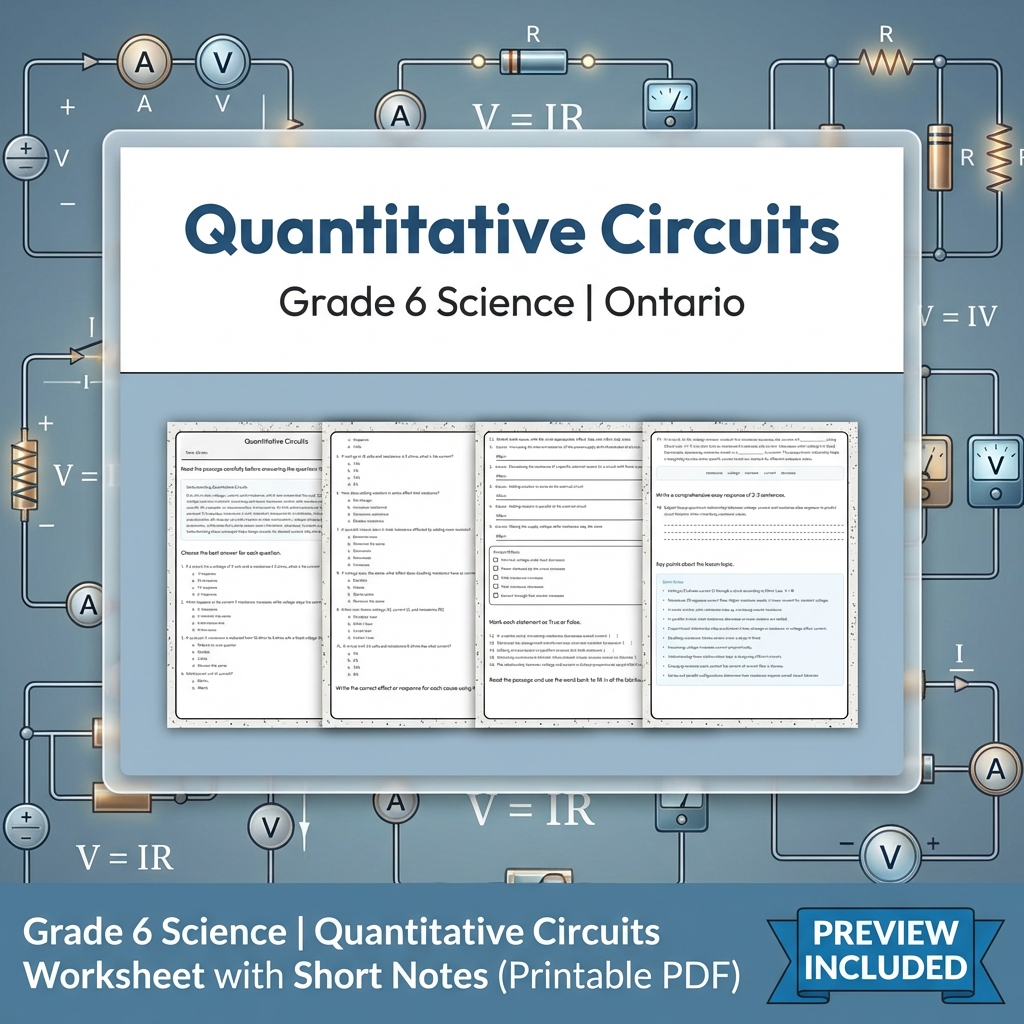
Grade 6 Science | Quantitative Circuits Worksheet with Short Notes (PDF)
 Created byMeadowlark Worksheets
Learning Objectives
- Understand the relationship between voltage, current, and resistance in electrical circuits.
- Learn to perform basic calculations connecting measurable circuit quantities.
- Apply proportional reasoning to predict how changes in resistance affect current in a fixed potential difference.
Also included in: Grade 6 Science Lesson Group on Energy, Circuits & Properties +1 more
Instant download

6th Grade Science Worksheet | Trade-off Decisions in Compact Shelters (PDF)
Created byEvergreen Desk EducationLearning Objectives
- Explain how design improvements can create trade-offs among safety, cost, weight, and comfort.
- Connect material and design properties (strength, insulation, flexibility, friction) to user needs and real constraints.
- Use evidence from a scenario to justify which choice best fits the situation.
Also included in: Grade 6 Prototype Design Science Lesson Bundle: General Systems Thinking +1 more
Instant download

Grade 6 Science – Water Reservoirs & Water Cycle | Daily Reading Worksheet
Created byBright Mind ResourcesLearning Objectives
- Understand the different types of water reservoirs and their characteristics.
- Learn how water moves between reservoirs and changes state.
- Recognize the importance of water distribution and storage on Earth.
Also included in: Water Cycle Grade 6 Science Lesson Bundle Daily Reading | California Standards +1 more
Instant download

Cell Evidence Practice Worksheet | Grade 6 Science NGSS Assessment
Created byPrism Point LearningLearning Objectives
- Explain how microscopy observations and preserved specimens provide evidence that cells are the basic unit of life.
- Distinguish single-celled organisms from multicellular organisms using observable cell features.
- Connect cell characteristics to higher levels of biological organization (cells → tissues → organs → whole organisms).
Also included in: Grade 6 Cellular Systems Science Lesson Bundle NGSS Worksheets
Instant download

6th Grade Science Worksheet – Earth's Rotation & Day-Night Cycle (PDF)
Created byEvergreen Desk EducationLearning Objectives
- Explain how Earth’s rotation about its axis causes alternation of daylight and darkness
- Describe how apparent daily motion of celestial objects is linked to Earth’s rotation
- Use the sequence of sunrise, solar noon, and sunset to connect time-of-day observations to Earth’s rotation
Instant download

Counting Atoms Assessment | California Standards Grade 6 Science Worksheet
Created byPrism Point LearningLearning Objectives
- Explain the conservation of atoms by counting each type of atom on the reactant and product sides of a particle model.
- Use particle-level reasoning to predict whether a chemical reaction forms new combinations while conserving the number of atoms of each element.
- Justify reaction outcomes using evidence based on atom counts rather than mass changes or appearance alone.
Also included in: Grade 6 Atoms and Chemical Change Science lesson bundle | California Standards +1 more
Instant download
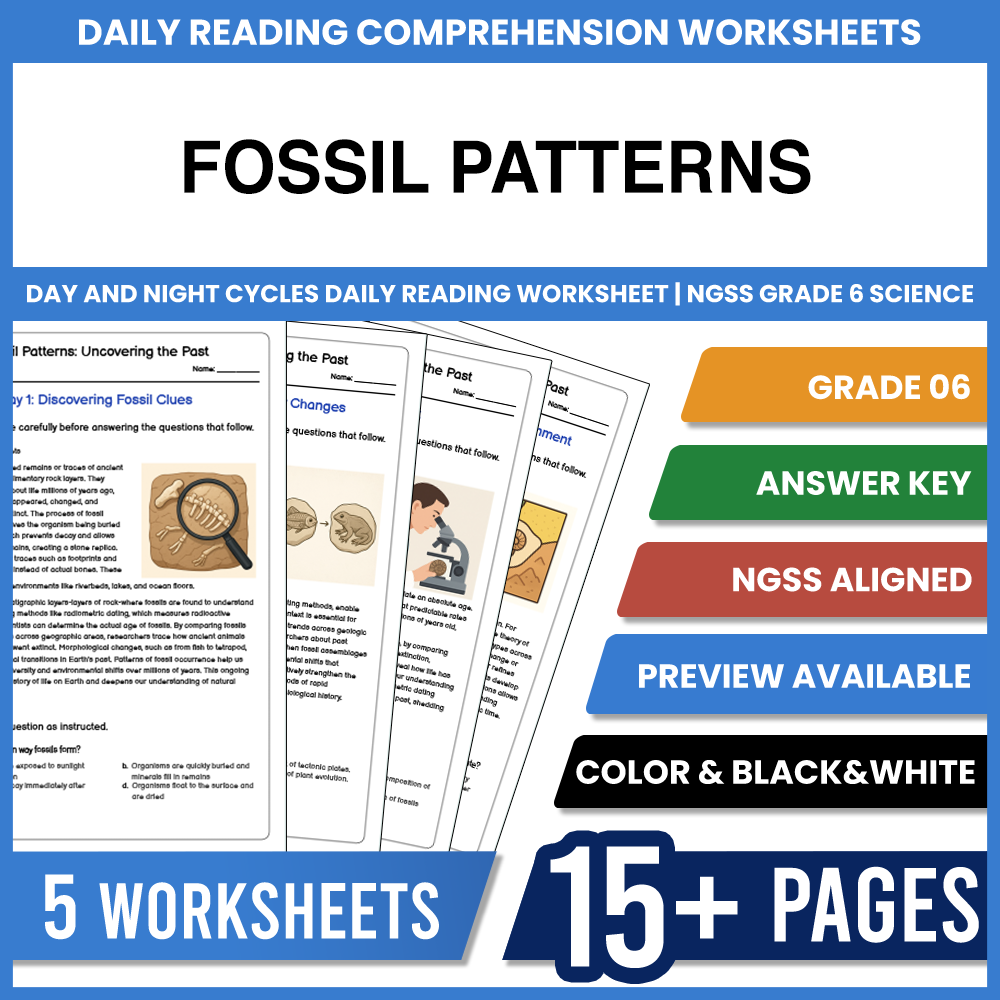
Grade 6 Science – Earthquakes & Natural Hazards | Daily Reading Worksheet
 Created byElena Brooks
Learning Objectives
- Identify the causes of earthquakes
- Understand the effects of earthquakes on landscapes and communities
- Analyze seismic data and hazard zones
Also included in: Grade 6 Science Earth and Human Activity Lesson Bundle | NGSS Aligned +1 more
Instant download

Chemical Reactions Worksheet Grade 6 NGSS Physical Science Activity
 Created byNorthstar Worksheets
Learning Objectives
- Identify chemical reactions using qualitative evidence such as color change, gas production, and precipitate formation.
- Use quantitative measurements (mass and temperature changes) to support whether new substances formed.
- Compare pre-interaction and post-interaction observations to determine signs of chemical change.
Also included in: Grade 6 Matter & Chemical Reactions Lesson Bundle | NGSS | Science +1 more
Instant download

Grade 6 Science | Food Chains Worksheet | BC Standard
Created byLumora LearningLearning Objectives
- Understand the concept of food chains and their role in ecosystems.
- Identify producers, consumers, and decomposers in food chains.
- Analyze the flow of energy through different levels of a food chain.
Instant download
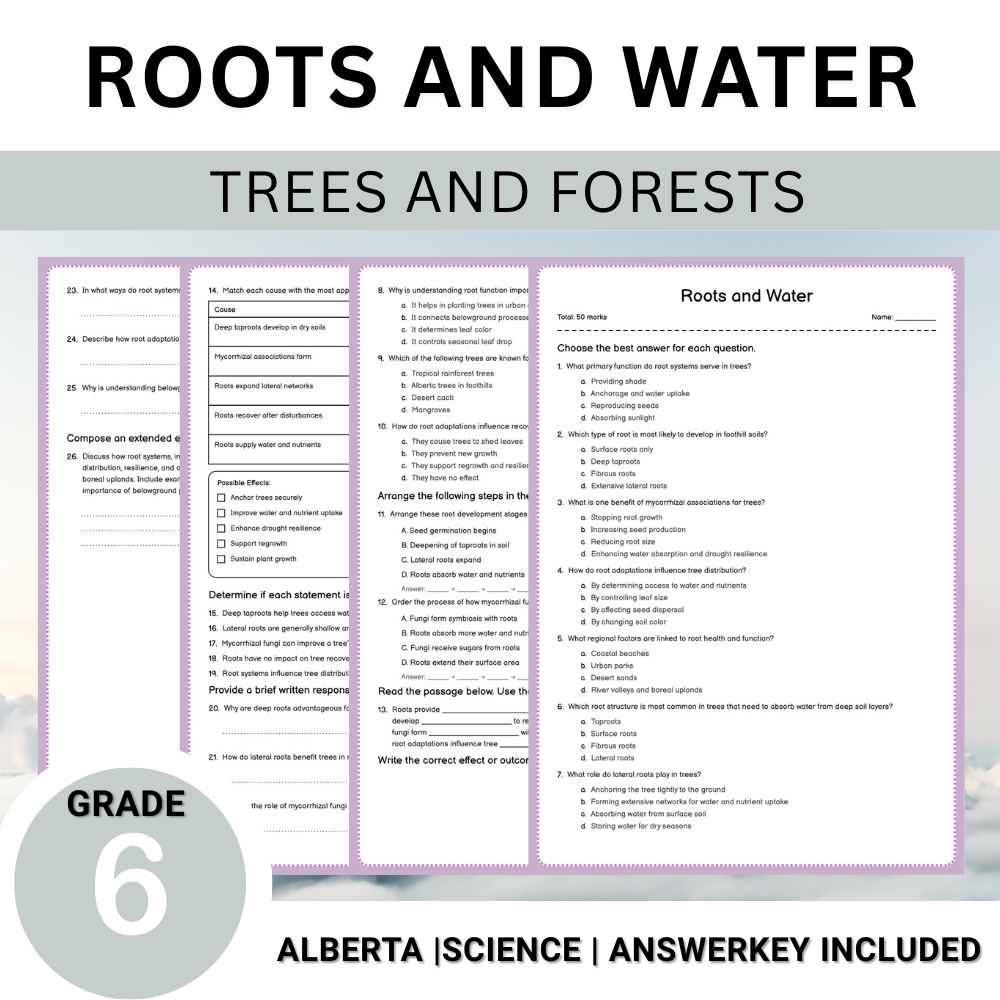
Grade 6 Science | Roots and Water Worksheet (Assessment & Practice PDF)
Learning Objectives
- Understand the roles of root systems in supporting trees.
- Identify different root adaptations and their effects on tree distribution.
- Explore how mycorrhizal associations enhance water and nutrient absorption.
Also included in: Grade 6 Science | Tree Anatomy, Ecology & Conservation Unit Worksheet Bundle +1 more
Instant download

Grade 6 Science | Digital Sources Worksheet (PDF) Alberta Standards
Created byEvergreen Desk EducationLearning Objectives
- Identify examples of digital sources used for local environmental inquiry.
- Explain how to verify key dataset details such as metadata, time resolution, and spatial coverage.
- Describe why licensing and standardized formats matter when combining data from multiple providers.
Instant download
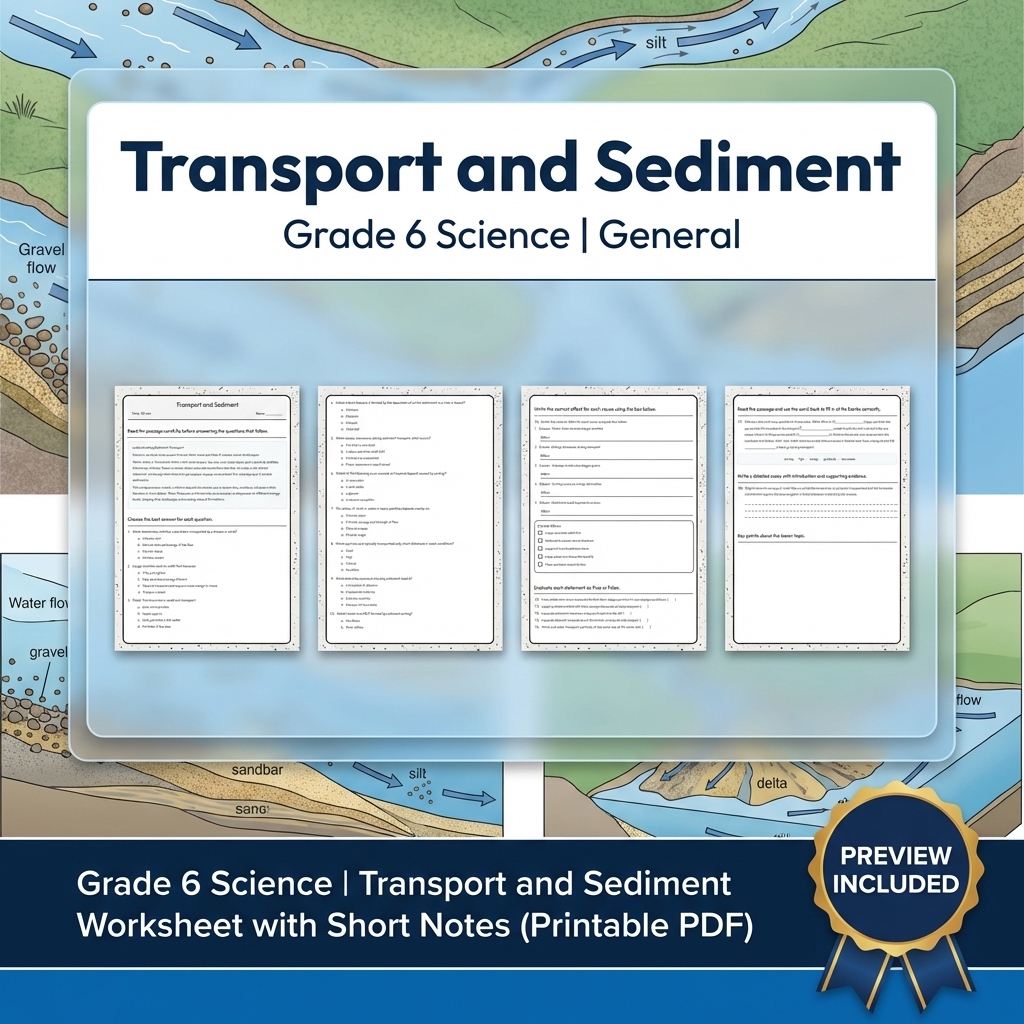
Grade 6 Science | Transport and Sediment Worksheet with Short Notes
Created byMeadowlark WorksheetsLearning Objectives
- Understand how streams and wind transport particles of different sizes based on energy and strength.
- Explain the process of sorting sediments during transportation.
- Identify natural structures formed by sediment deposition, such as sandbars and deltas.
Also included in: Grade 6 Science Lesson Group Weather, Water, Space, Erosion & Climate +1 more
Instant download

Grade 6 Fossil Patterns in Earth's History Worksheet | NGSS Science Activity
Created byBRIGHT PATH RESOURCESLearning Objectives
- Understand how fossils record Earth's past environments and life forms.
- Identify different fossil patterns and their significance in geological studies.
- Analyze the evidence fossils provide for understanding species evolution and extinction.
Also included in: Biological Evolution: Unity & Diversity Grade 6 Science Lesson Bundle | ngss +2 more
Instant download

Chemical Reactions Indicators of New Substances Worksheet | NGSS Grade 6 Science
Created bySkylark WorksheetsLearning Objectives
- Identify evidence of chemical reactions using qualitative indicators such as color change, gas formation, and precipitate formation.
- Use quantitative data (mass, temperature, and measurements of reactants/products) to determine whether a new substance forms.
- Interpret before-and-after observations from common reactions such as acid–carbonate reactions and metal oxidation.
Also included in: Grade 6 Matter and Chemical Reactions Science Lesson Bundle NGSS Worksheets +1 more
Instant download

Grade 6 Science | Sustainability Strategies - Daily Reading Comprehension
Created byCoral Reef LearningLearning Objectives
- Understand the concept of sustainability and its importance.
- Identify different strategies for sustainable resource use.
- Recognize the impact of population trends and resource consumption on earth systems.
Instant download

Grade 6 Scale of Space Worksheet | NGSS Earth Science Activity & Answer Key
Created byNorthstar WorksheetsLearning Objectives
- Use astronomical units (AU) to compare the Earth–Sun distance to other distances in the solar system.
- Compare relative planetary sizes (such as Earth vs. Jupiter) using radii or diameter ratios.
- Interpret tables and charts using orders of magnitude to describe large-scale solar system relationships.
Also included in: Grade 6 Earth Science Scale of Space & Moon Seasons Lesson Bundle – NGSS +1 more
Instant download

Science Worksheet Parallel Characteristics Grade 6 | Standards-Aligned
JCreated byJ.S SheetsLearning Objectives
- Explain how parallel circuits split current into multiple branching pathways
- Describe why each parallel branch has the same potential difference (voltage)
- Use the idea that total current equals the sum of branch currents
Instant download
About Grade 6 Science Worksheets
Explore Grade 6 Science worksheets for classwork, homework, or review. Our 5,969 printables download instantly as PDFs.
MyTeachingSheets worksheets are made by real teacher-authors and checked before they go live. Download any as a print-ready PDF for lessons, homework, or independent practice — most include answer keys, and previews are always free.