
Grade 6 Science Worksheets
5,969 worksheets
Grade 6 Science | Water & Resources - Daily Reading Comprehension
 Created byCoral Reef Learning
Learning Objectives
- Understand the main components of the water cycle.
- Identify how water moves through different Earth systems.
- Describe the processes of evaporation, precipitation, runoff, and groundwater recharge.
Instant download

Engineering Design Worksheets: Design Solutions & Evaluation Criteria
 Created byTeachers Club
Learning Objectives
- Compare design options using quantitative and qualitative metrics
- Apply scoring rubrics to rank prototype solutions
- Justify design refinements using evidence from tests
Also included in: Grade 6 Science Full Year Bundle | NGSS Worksheets & Printables +1 more
Instant download

Grade 6 System Integration Worksheet | BC Practice PDF
 Created byClear Sky Classroom
Learning Objectives
- Explain how feedback mechanisms help the body maintain homeostasis through coordinated system responses
- Identify examples of system integration, such as temperature regulation and blood glucose control
- Use evidence from a passage to determine main ideas and predict how changes affect internal conditions
Instant download
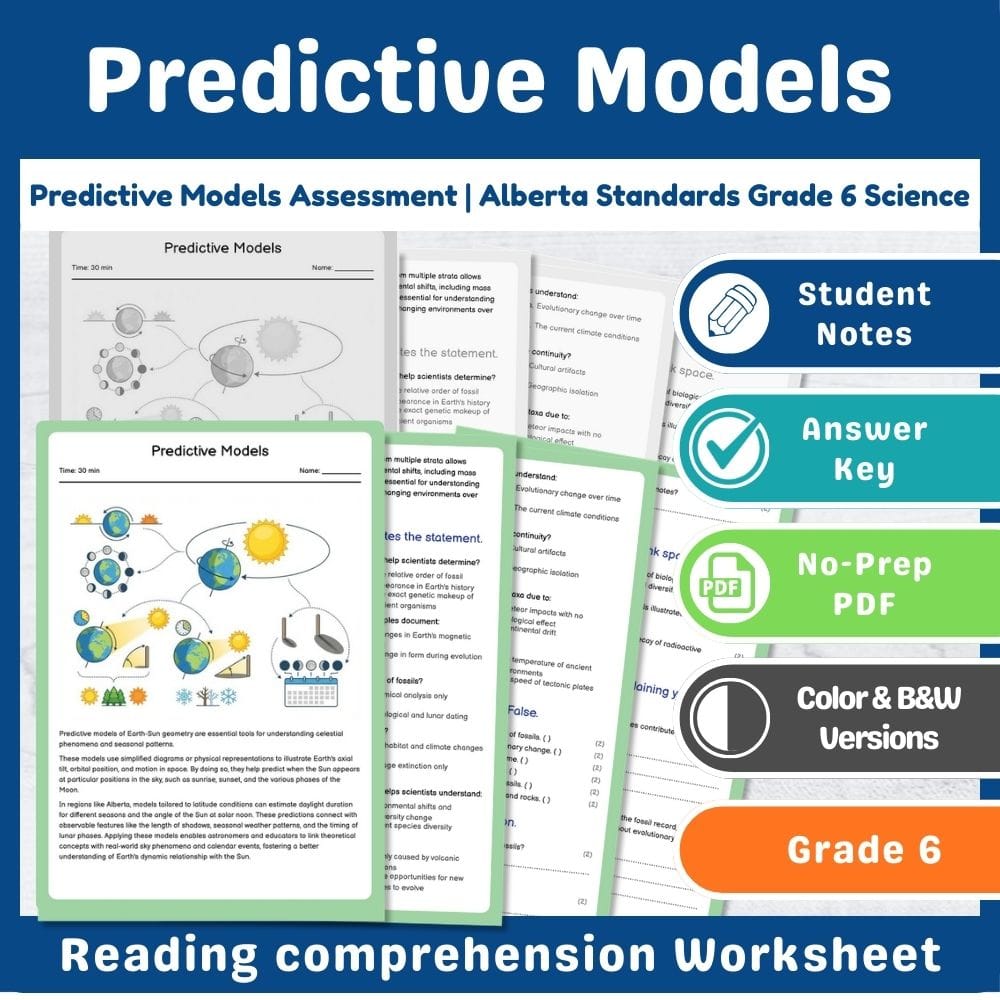
Predictive Models Assessment | Alberta Standards Grade 6 Science
 Created byPrism Point Learning
Learning Objectives
- Understand how models represent Earth–Sun geometry to predict celestial phenomena.
- Identify the use of simplified physical or diagrammatic models for forecasting sunrise, sunset, and lunar phases.
- Explore how latitude-specific models predict daylight hours and seasonal solar angles.
Also included in: Lesson Grade 6 Science Assessment | Celestial & Earth Movements
Instant download

Mixtures And Solutions Worksheet | Standards-Aligned Grade 6 Science Practice
JCreated byJ.S SheetsLearning Objectives
- Define what a mixture and a solution are and identify their properties.
- Differentiate between homogeneous and heterogeneous mixtures.
- Explain methods like filtration, evaporation, and decanting used to separate mixture components.
Instant download
Grade 6 Science – Natural Resources Worksheet for Mastery
 Created byThe Resource Hub
Learning Objectives
- Understand different types of natural resources and their formation.
- Analyze the economic, environmental, and regional implications of resource use.
- Evaluate sustainable practices and trade-offs in resource management.
Instant download

6th Grade Science | Pattern Analysis Worksheet (Alberta Standards) (PDF)
 Created bySilver Birch Teaching
Learning Objectives
- Identify patterns in datasets using descriptive statistics and visual inspection
- Explain how moving averages and seasonal thinking can reveal trends and cycles
- Recognize anomalies and propose plausible environmental explanations while considering limits of data
Also included in: Grade 6 Scientific Inquiry & Data Analysis Science Lesson Bundle: Alberta +1 more
Instant download

Grade 6 Science Worksheet on Digital Instrumentation | Ontario Standards
 Created byCedar Grove Learning
Learning Objectives
- Identify common digital measurement tools (sensors, probes, and data loggers) and explain how they collect numeric data
- Choose appropriate sampling rate and resolution settings to improve accuracy and represent data appropriately
- Apply basic calibration practices and document measurement metadata to support reliable results
Also included in: Grade 6 Scientific Inquiry & Data Practices Science Lesson Bundle | Ontario +1 more
Instant download

Grade 6 Science | Species Classification in Ecosystems - Daily Reading Comprehension
Created byCoral Reef LearningLearning Objectives
- Understand the roles of producers and consumers in ecosystems.
- Identify native and invasive species relevant to Alberta's environment.
- Recognize how species classification helps predict energy flow and ecosystem dynamics.
Also included in: Trees and Forests Lesson Bundle | Grade 6 Science | Alberta +1 more
Instant download

Lunar Motion Worksheet | Science Assessment for Grade 6 | Alberta
JCreated byJ.S SheetsLearning Objectives
- Explain the orbit of the Moon around Earth and how it causes lunar phases.
- Describe observable patterns of the Moon's position and illumination from locations like Alberta.
- Understand the Sun–Earth–Moon relationship and how it affects the night sky.
Instant download

Grade 6 Science | Atmospheric Patterns - Daily Reading Comprehension
Created byCoral Reef LearningLearning Objectives
- Identify the different layers of the atmosphere and describe their roles
- Understand how air masses interact and influence weather
- Explain the concept of climate classification and its regional variations
Instant download

Grade 6 Elements in Compounds Worksheet | NGSS Practice PDF
Created byClear Sky ClassroomLearning Objectives
- Explain how atoms of multiple elements combine in fixed proportions to form compounds
- Use particle models to identify which element counts appear in a compound
- Relate the atomic composition of a compound to observable properties such as density and chemical behavior
Instant download
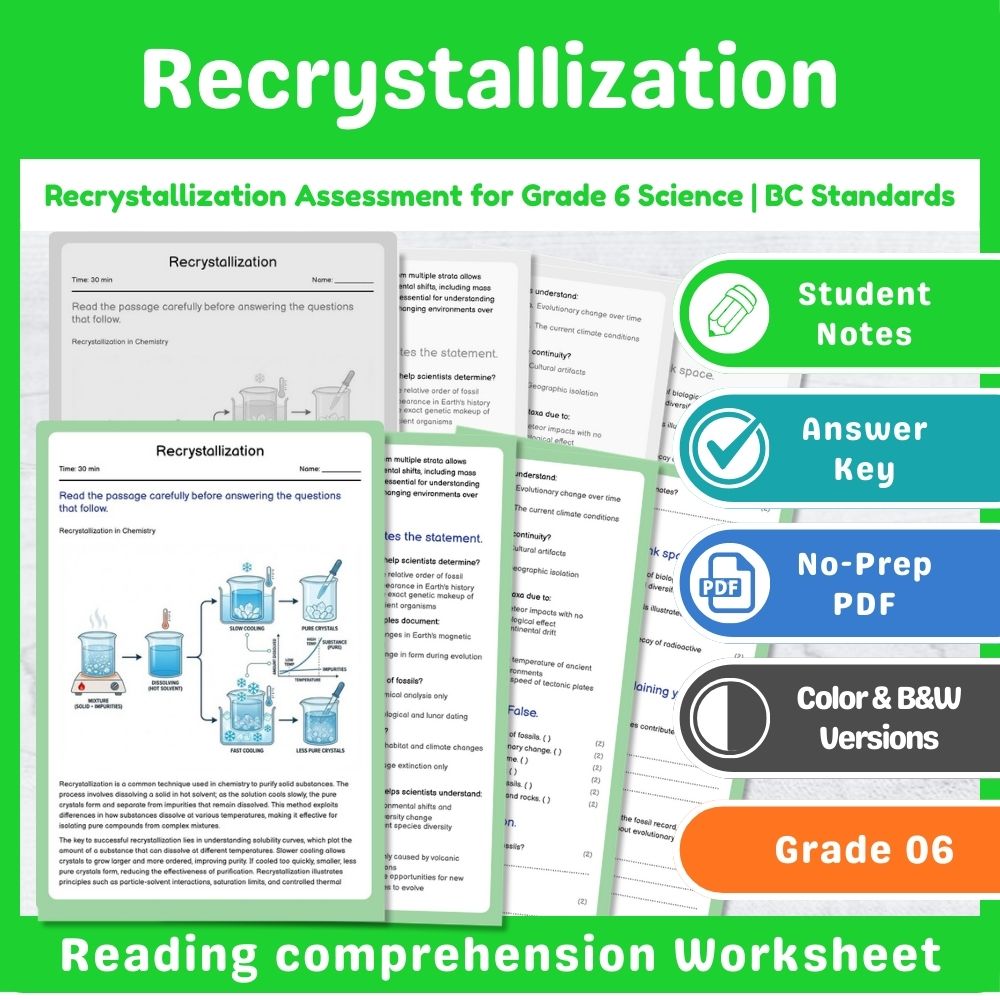
Recrystallization Assessment for Grade 6 Science | BC Standards
Created byPrism Point LearningLearning Objectives
- Understand the process of recrystallization and its role in purifying solids.
- Explain how temperature and solubility affect crystal formation during recrystallization.
- Describe the importance of controlled cooling in obtaining pure, large crystals.
Instant download

Oceans and Climate Regulation Worksheet | NGSSS Grade 6 Science Practice
JCreated byJ.S SheetsLearning Objectives
- Understand how oceans help regulate Earth's climate by absorbing and releasing heat.
- Identify the impact of ocean heat content changes on weather patterns and atmospheric conditions.
- Explain the connection between ocean circulation, moisture supply, and climate moderation.
Also included in: Grade 6 Climate and Atmospheric Systems Science Lesson Bundle: Florida NGSSS +1 more
Instant download

Sky Science Worksheets: Celestial Motion Patterns for Predicting Positions
 Created bySunny Desk Resources
Learning Objectives
- Describe how Earth’s rotation and orbit create predictable sky patterns for the Sun, Moon, and constellations
- Explain how planets appear to move more slowly than background stars over time
- Use observational evidence to predict seasonal star patterns from a fixed location
Also included in: Sky Science Grade 6 Bundle | Alberta Science Worksheets & Activities +1 more
Instant download

Prototype Evaluation Using Data and Constraints Grade 6 Science
 Created byBRIGHT PATH RESOURCES
Learning Objectives
- Explain how prototype evaluation uses evidence, criteria, and constraints to judge performance.
- Identify what kinds of data (measurements and observations) help reveal how a system works.
- Apply evaluation criteria to decide whether a design improvement is acceptable within limits.
Also included in: Grade 6 Engineering Design Worksheets | Criteria & Constraints Bundle +2 more
Instant download
Grade 6 Science | Digital Sources Reading Worksheet & Answer Key (PDF)
JCreated byJ.S SheetsLearning Objectives
- Understand what digital sources are and their relevance to local inquiry.
- Identify examples of digital sources such as datasets, sensors, and remote-sensing products.
- Learn how to verify metadata, temporal resolution, and spatial coverage in digital data.
Also included in: Grade 6 Science Bundle – Data Analysis, Scientific Inquiry & Measurement Skills +1 more
Instant download

Grade 6 Population Change Worksheet | NGSS Practice PDF
Created byClear Sky ClassroomLearning Objectives
- Construct evidence-based arguments linking ecosystem component changes to population fluctuations.
- Analyze case studies involving predator reintroduction, invasive species, habitat fragmentation, and disease outbreaks.
- Interpret empirical data sets and longitudinal observations to infer causal relationships in population dynamics.
Also included in: Grade 6 Ecosystems Science Lesson Bundle for NGSS: Species, Energy, Biodiversity +1 more
Instant download
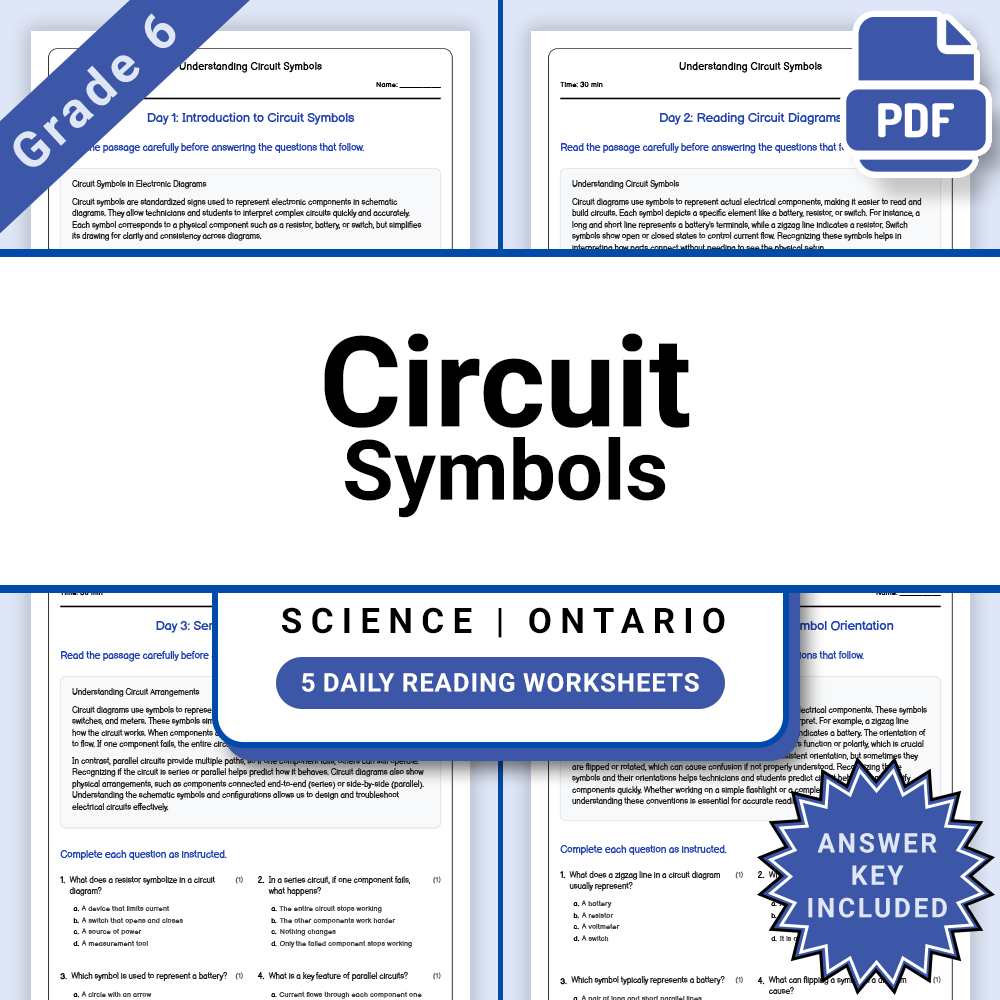
Grade 6 Science Circuit Symbols Daily Reading Worksheet with Answer Key
JCreated byJ.S SheetsLearning Objectives
- Identify common circuit symbols used in schematics
- Understand how symbols represent physical electronic components
- Learn to interpret circuit diagrams to predict circuit behavior
Also included in: Grade 6 Science Lesson Group – Circuits and Energy Ontario Framework +1 more
Instant download

Grade 6 Science | Conservation Strategies for Forest Biodiversity
Created byCoral Reef LearningLearning Objectives
- Understand the concept of conservation strategies and their importance.
- Identify different approaches used in conservation such as protected areas, reforestation, and habitat restoration.
- Recognize examples of conservation efforts in Alberta and their ecological significance.
Also included in: Trees and Forests Lesson Bundle | Grade 6 Science | Alberta +1 more
Instant download

Human Impacts on Earth Systems Worksheets | Grade 6 Science
LCreated byLearnora ResourcesLearning Objectives
- Identify human activities that affect Earth's four major systems
- Classify environmental changes as natural or human-caused
- Trace cause-and-effect chains across multiple Earth systems
Instant download

Scientific Questions Worksheets & Investigation Practice for Grades 6–8
 Created byEmma Carter Resources
Learning Objectives
- Identify whether a question can be investigated scientifically.
- Explain why evidence supports scientific investigations.
- Improve opinion questions into testable scientific questions.
Instant download

6th Grade Science – Ecosystem Components Worksheet (TEKS) PDF
 Created byEvergreen Desk Education
Learning Objectives
- Define an ecosystem as an interacting system of biotic and abiotic components
- Identify examples of biotic and abiotic factors in different habitats (pond, prairie, forest)
- Explain how physical factors affect organisms and community composition over time and space
Instant download

Control Coupling Test Prep Worksheet | Grade 6 Science | Ontario
Created byPrism Point LearningLearning Objectives
- Explain how roll, pitch, and yaw control inputs can interact as coupled responses.
- Describe why adverse yaw occurs during roll and how different aileron designs can reduce unwanted moments.
- Relate mass distribution and inertia to how control inputs affect aircraft motion.
Also included in: Grade 6 Aerodynamics Flight Design Science lesson bundle - Ontario
Instant download

Eclipses And Tides Worksheet | Ontario Grade 6 Science Assessment
Created byCedar Grove LearningLearning Objectives
- Explain how solar and lunar eclipses form using alignment and shadow geometry (umbra and penumbra).
- Distinguish why eclipses happen only sometimes and why visibility depends on location.
- Describe tides as a result of differential gravitational attraction from the Moon and the Sun.
Also included in: Grade 6 Earth and Space Systems Science Lesson Bundle: Ontario +1 more
Instant download

6th Grade Science | Forces Basics Worksheet (PDF) aligned with TEKS
Created byEvergreen Desk EducationLearning Objectives
- Differentiate between contact forces and noncontact forces, with examples involving gravity, friction, and normal force.
- Explain how balanced and unbalanced forces affect changes in motion (start/stop, speed up/slow down, and direction).
- Describe the idea of net force qualitatively using everyday situations without vector calculations.
Instant download

Natural Resources Worksheets: Sustainability & Distribution Grade 6
Created byPrism Point LearningLearning Objectives
- Identify renewable and nonrenewable natural resources
- Explain why natural resources are distributed unevenly across regions
- Describe environmental effects of natural resource extraction
Instant download

Scientific Investigations Worksheets | Fair Tests & Variables Practice Grade 6
Created byBRIGHT PATH RESOURCESLearning Objectives
- Identify independent, dependent, and controlled variables.
- Explain what makes an investigation a fair test.
- Plan a controlled investigation using appropriate variables.
Instant download

Scientific Investigations Worksheets: Planning, Variables & Fair Tests
LCreated byLearnora ResourcesLearning Objectives
- Identify testable questions and key parts of investigations
- Distinguish independent, dependent, and controlled variables
- Construct predictions and organize fair-test procedures
Instant download

Scientific Investigations Worksheets: Planning, Variables & Fair Tests
LCreated byLearnora ResourcesLearning Objectives
- Identify testable questions and key parts of investigations
- Distinguish independent, dependent, and controlled variables
- Construct predictions and organize fair-test procedures
Instant download

Model Limitations Worksheet | Standards-Aligned Grade 6 Science Practice
JCreated byJ.S SheetsLearning Objectives
- Explain what assumptions are in a science model and why they are needed
- Use evidence to judge whether a model’s predictions match observed results
- Describe a model’s limitations and connect limitations to the strength of evidence
Also included in: Grade 6 Scientific Investigation Science lesson bundle: General Framework +1 more
Instant download

Grade 6 Modeling Systems with Assumptions and Boundaries Science Worksheet
 Created byTeacher's Corner
Learning Objectives
- Describe how physical, diagrammatic, and mathematical models represent complex systems
- Identify assumptions and define model boundaries when interpreting model predictions
- Compare model predictions to observable outcomes to evaluate limitations and refine models
Instant download

Grade 6 Science | Biodiversity Patterns Worksheet with Short Notes (PDF)
 Created byMeadowlark Worksheets
Learning Objectives
- Understand measures of biodiversity such as species richness, abundance, and evenness.
- Learn sampling techniques like transects and quadrats for biodiversity assessment.
- Interpret spatial biodiversity patterns and their relation to ecosystems.
Also included in: Grade 6 Science Lesson Bundle for Ontario | Ecosystems & Genetics +1 more
Instant download

Current Fundamentals Science Worksheet Grade 6 Electricity Ontario
 Created byChalk and Compass
Learning Objectives
- Describe electric current as the organized movement of electric charges through a conductor
- Distinguish conventional current direction from electron flow in a simple circuit
- Explain how a potential difference (voltage) drives current and how circuits behave when open versus closed
Also included in: Grade 6 Science Circuits & Electricity Lesson Bundle | Ontario +1 more
Instant download

Iterative Improvement in Engineering Design Worksheets Grade 6
Created byBRIGHT PATH RESOURCESLearning Objectives
- Describe how evaluation results guide iterative improvement in a design process.
- Identify how changes can target causes found during testing while maintaining constraints.
- Explain the trade-off idea: improving one property may affect other properties.
Also included in: Grade 6 Engineering Design Worksheets | Criteria & Constraints Bundle +2 more
Instant download

Grade 6 Angle Effects Worksheet | Practice & Assessment PDF
Created byClear Sky ClassroomLearning Objectives
- Explain how angle of attack affects lift and drag on a wing.
- Describe the role of airflow separation in producing a stall.
- Use examples from gliders and kites to predict how changing angle changes flight performance.
Also included in: Grade 6 Air and Aerodynamics Science Lesson Bundle (Alberta Framework) +1 more
Instant download

Grade 6 Science | Understanding the Particle Model - Daily Reading Comprehension
Created byCoral Reef LearningLearning Objectives
- Describe the basic idea of the particle model of matter.
- Identify different particle arrangements in solids, liquids, and gases.
- Explain how particle motion relates to states of matter.
Instant download

Grade 6 Science | Gas Pressure Worksheet | BC Aligned
 Created byLumora Learning
Learning Objectives
- Explain how gas particles create pressure through collisions.
- Describe how changing temperature and volume affects gas pressure.
- Understand the particle model to connect microscopic behavior with macroscopic gas phenomena.
Instant download

Grade 6 Water and Resources Worksheet | Practice & Assessment PDF
Created byClear Sky ClassroomLearning Objectives
- Explain how the water cycle transfers water among the atmosphere, land, and oceans.
- Describe how evaporation, precipitation, infiltration, runoff, and groundwater recharge affect freshwater availability.
- Analyze how storage in glaciers and aquifers influences where and when usable water collects.
Instant download

Grade 6 Gravitational Orbits of the Sun, Earth & Moon Science Worksheet
Created byTeacher's CornerLearning Objectives
- Compare the relative sizes, masses, and average distances of the Sun, Earth, and Moon.
- Explain how mutual gravitational pull creates orbital motion and a stable Earth–Moon system.
- Describe the Earth–Moon barycenter and how it affects their shared motion around each other.
Instant download

Grade 6 Earth System Spheres Worksheet | NGSS Practice PDF
Created byClear Sky ClassroomLearning Objectives
- Identify the four Earth system spheres: geosphere, hydrosphere, atmosphere, and biosphere.
- Explain how matter and energy move between Earth spheres using examples such as weathering and evaporation.
- Describe how gravity influences the movement of materials within and between spheres.
Instant download
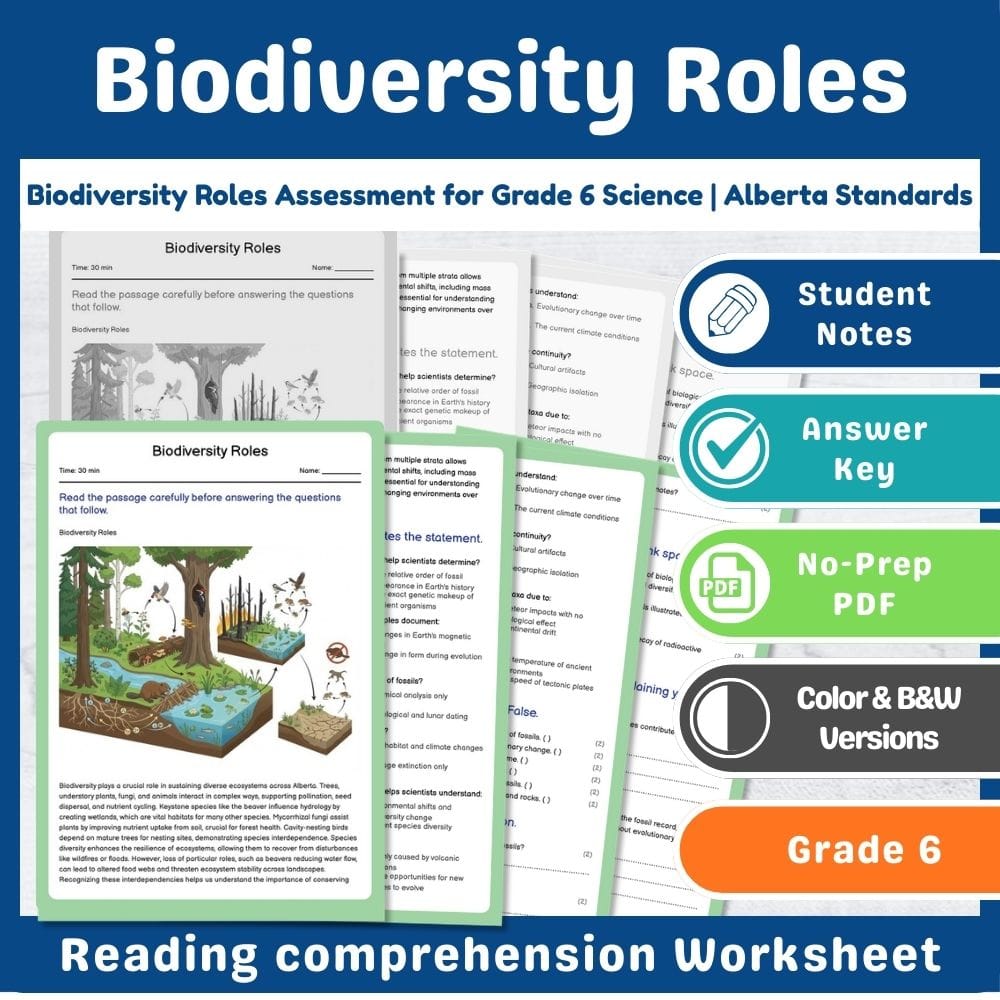
Biodiversity Roles Assessment for Grade 6 Science | Alberta Standards
Created byPrism Point LearningLearning Objectives
- Understand how different species contribute to ecosystem functions like pollination, seed dispersal, and nutrient cycling.
- Identify the roles of keystone and indicator species within Alberta ecosystems.
- Explain how species diversity impacts ecosystem resilience and stability.
Also included in: Lesson Grade 6 Science Mini Bundle Trees and Forests Alberta Standards
Instant download

Science Worksheet: Decomposers and Nutrient Return | Standards Grade 6
JCreated byJ.S SheetsLearning Objectives
- Explain how decomposers break down dead matter and waste to return nutrients to ecosystems.
- Describe the role of fungi and bacteria in releasing chemical components into soil and water.
- Use nutrient cycling ideas to predict how decomposer activity can affect producer growth and ecosystem productivity.
Also included in: Grade 6 Life Processes & Ecosystems Science lesson bundle: General Framework +1 more
Instant download

6th Grade Science Worksheet – Cell Structure & Organelles (PDF)
Created byEvergreen Desk EducationLearning Objectives
- Identify major cell parts (cell membrane, cytoplasm, nucleus, and organelles) and describe their functions.
- Explain how cell structure helps life processes happen in an organized way.
- Compare the roles of shared cell parts and how specialized organelles support controlled chemical reactions.
Also included in: Grade 6 Life Processes & Ecosystem Interactions Science Lesson Bundle: General +1 more
Instant download

Surface Change Worksheet for Grade 6 Science NGSS Standards | Assessment
JCreated byJ.S SheetsLearning Objectives
- Understand the geologic processes that modify Earth's surface over different time scales.
- Identify evidence such as rock strata, fossils, and landforms that indicate landscape evolution.
- Differentiate between rapid events like volcanic eruptions and slow processes like weathering.
Also included in: Grade 6 Earth System Interactions Climate Science Lesson Bundle – NGSS +1 more
Instant download

Grade 6 Science – Decomposer Matter Return & Ecosystem Processes | Worksheet
 Created byBright Mind Resources
Learning Objectives
- Understand the role of decomposers in ecosystems.
- Identify how decomposers recycle matter and nutrients.
- Explain the importance of decomposition for ecosystem health.
Also included in: Grade 6 Ecosystems and Energy Science Lesson Bundle | California Standards +1 more
Instant download

Adaptation Overview Test Prep Printable | Grade 6 Science
Created byPrism Point LearningLearning Objectives
- Explain what adaptations are and how they help organisms survive in different environments
- Distinguish structural and physiological adaptations using real examples
- Describe how natural selection can favor traits that improve survival, feeding, defense, or reproduction
Also included in: Multicellular Systems & Functions Lesson Bundle | Grade 6 Science | BC +1 more
Instant download

Grade 6 Biodiversity Patterns Worksheet | Ontario Science PDF & Key
Created byClear Sky ClassroomLearning Objectives
- Explain how species richness, abundance, and evenness describe biodiversity patterns across ecosystems.
- Use sampling ideas such as transects and quadrats to collect data on biodiversity.
- Interpret spatial patterns of biodiversity and connect them to habitat heterogeneity and ecosystem stability.
Instant download
About Grade 6 Science Worksheets
Explore Grade 6 Science worksheets for classwork, homework, or review. Our 5,969 printables download instantly as PDFs.
MyTeachingSheets worksheets are made by real teacher-authors and checked before they go live. Download any as a print-ready PDF for lessons, homework, or independent practice — most include answer keys, and previews are always free.