
Grade 6 Science Worksheets
5,969 worksheets
Resource Limits and Carrying Capacity Worksheets | Grade 6 Science
 Created byTeachers Club
Learning Objectives
- Explain how limited resources affect population size over time
- Interpret quantitative data (counts and measurements) to identify limiting resources
- Describe how carrying capacity relates to population fluctuations
Also included in: Grade 6 Science Full Year Bundle | NGSS Worksheets & Printables +1 more
Instant download

6th Grade Science | Stem Transport Worksheet (Alberta Standards) (PDF)
 Created bySilver Birch Teaching
Learning Objectives
- Explain how xylem and phloem transport water, minerals, and sugars through a plant stem.
- Describe how freeze–thaw cycles, drought, and pests can affect sap flow and plant survival.
- Connect stem and bark structure to how trees protect transport tissues and respond to environmental change.
Also included in: Grade 6 Ecosystem Interactions Science Lesson Bundle: Alberta Framework +1 more
Instant download

Population Dynamics Growth Limits Monitoring Worksheet | Ontario Grade 6 Science
JCreated byJ.S SheetsLearning Objectives
- Explain how birth rate, death rate, immigration, and emigration affect population size.
- Compare exponential growth with logistic growth using carrying capacity and limiting factors.
- Identify density-dependent and density-independent influences in terrestrial and aquatic systems.
Instant download

Grade 6 Science | Groundwater and Baseflow Worksheet | California Standards
 Created byLumora Learning
Learning Objectives
- Explain how groundwater forms and moves through pore spaces in the geosphere
- Describe how infiltration and percolation recharge aquifers
- Connect groundwater discharge to stream baseflow during dry periods
Instant download

Grade 6 Science | Synthetic Materials - Daily Reading Comprehension
 Created byCoral Reef Learning
Learning Objectives
- Understand the sources of synthetic materials
- Identify properties of common synthetic materials
- Compare natural and synthetic materials based on their uses
Instant download

Cell Evidence Microscopy Worksheet | NGSS Grade 6 Science Assessment
 Created bySkylark Worksheets
Learning Objectives
- Identify evidence from microscopy and preserved specimens that supports the claim that cells are the basic unit of life.
- Differentiate single-celled organisms from multicellular organisms using observable traits such as size, compartments, and organization.
- Explain how characteristics seen in cells and tissues provide evidence for relationships among cells, tissues, organs, and whole organisms.
Also included in: Grade 6 Cell Systems and Energy Pathways Science Lesson Bundle NGSS +1 more
Instant download

Pressure Maps Worksheet | Ontario Grade 6 Science PDF Assessment
 Created byCedar Grove Learning
Learning Objectives
- Explain how surface pressure varies across a wing using pressure-map ideas such as stagnation points and suction peaks.
- Connect pressure-coefficient patterns to lift and pitching moment trends.
- Describe how changing camber or angle of attack shifts pressure minima and changes the pressure distribution.
Also included in: Grade 6 Aerodynamics | Flight - Science Lesson Bundle – Ontario Framework +1 more
Instant download
Grade 6 Science — Pressure Patterns Worksheet for Mastery | PDF + Answer Key
 Created byThe Resource Hub
Learning Objectives
- Understand how pressure differences form low and high pressure zones.
- Identify the impact of topography and uneven heating on regional pressure patterns.
- Explain how pressure gradients drive wind and weather changes.
Also included in: Grade 6 Science | Air and Aerodynamics UNIT Worksheet Bundle (Alberta Framework) +1 more
Instant download
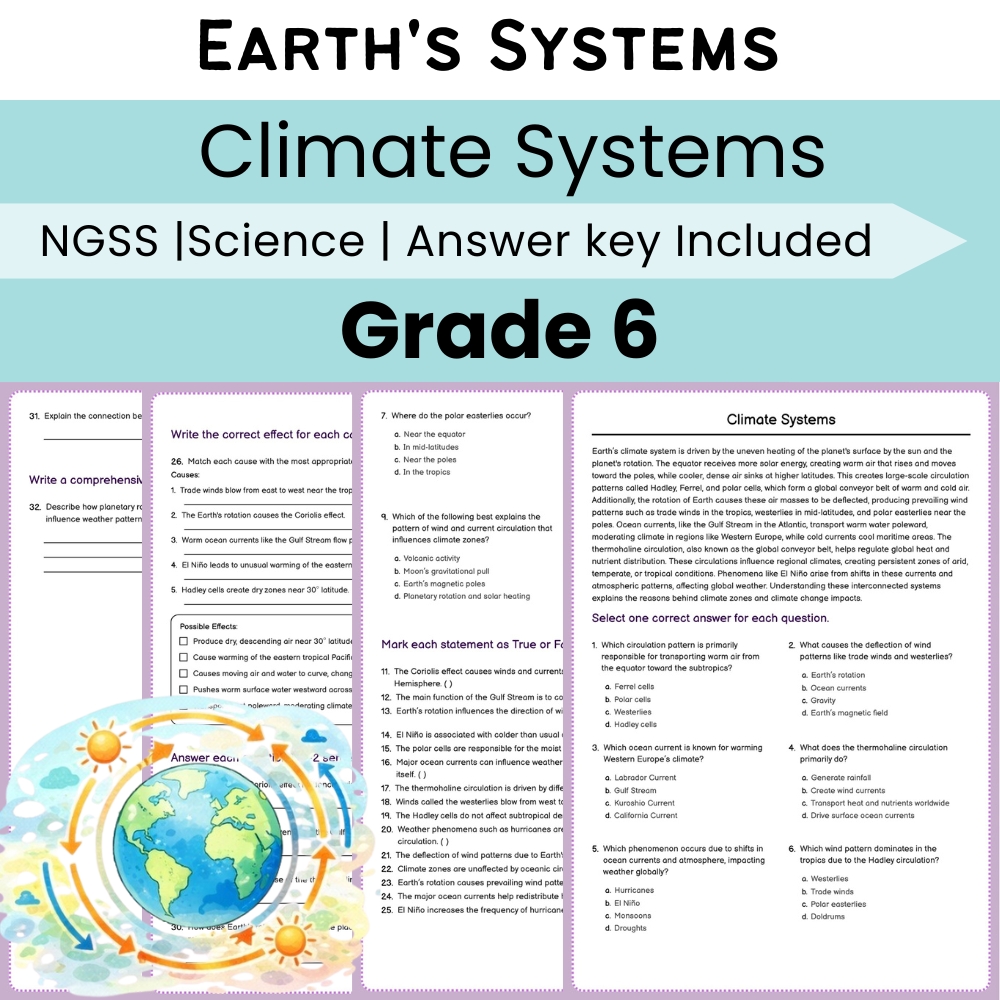
Climate Systems Worksheet | Science Assessment for Grade 6 NGSS Standards
Learning Objectives
- Explain how unequal solar heating and Earth's rotation give rise to global atmospheric and oceanic circulation patterns.
- Identify key circulation models like Hadley, Ferrel, and polar cells, and describe their effects on climate zones.
- Understand major wind patterns such as trade winds and westerlies and their influence on regional climates.
Also included in: Grade 6 Science | Earth's Systems Unit Worksheet Bundle (NGSS Aligned) +1 more
Instant download

Grade 6 Speed and Velocity Worksheet | NGSS Practice PDF
 Created byClear Sky Classroom
Learning Objectives
- Distinguish between speed and velocity using direction and units
- Calculate and interpret average speed from distance and time
- Explain how changing speed and changing direction affect motion
Instant download

Distillation Principles Worksheet | BC Grade 6 Science Assessment
JCreated byJ.S SheetsLearning Objectives
- Understand the basic principles of distillation and how it separates components based on boiling points.
- Differentiate between simple and fractional distillation methods.
- Explain how phase changes and vapor pressure enable separation of liquid mixtures like water and ethanol.
Instant download
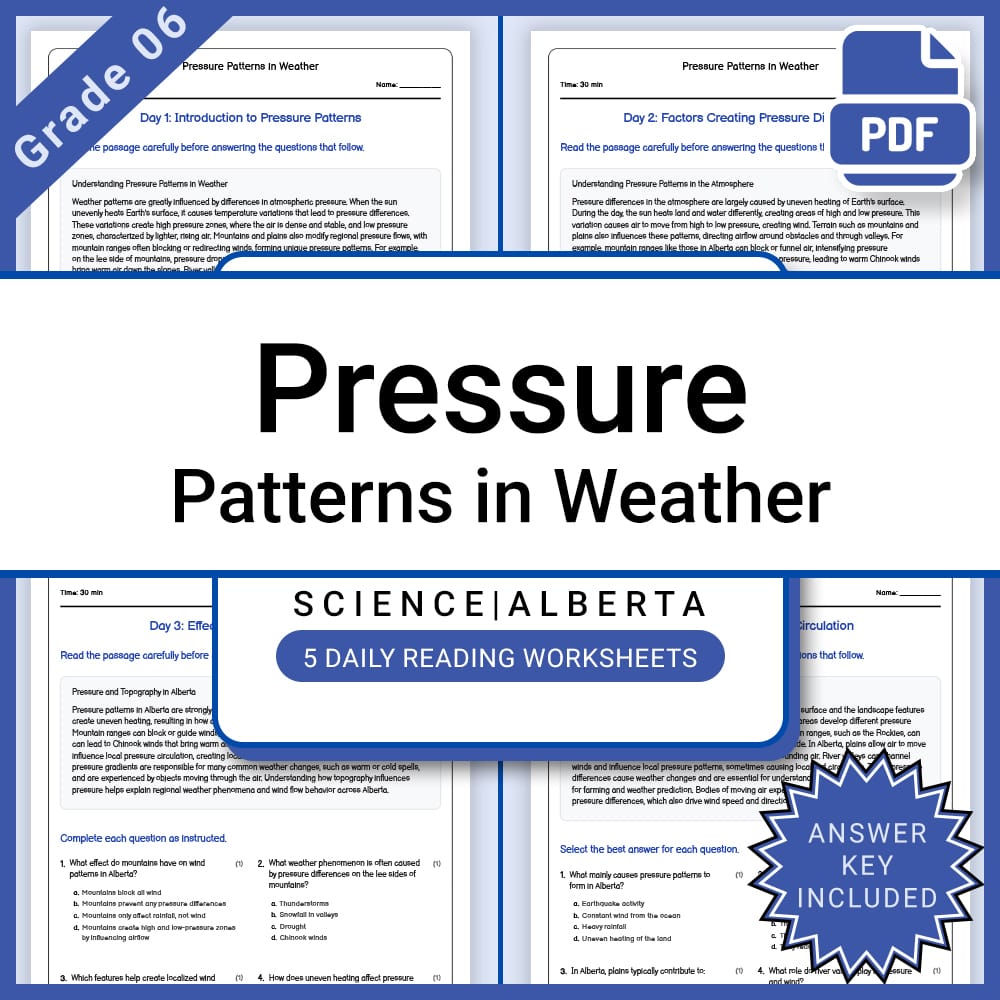
Grade 6 Science – Pressure Patterns in Weather | Daily Worksheet + Answer Key
JCreated byJ.S SheetsLearning Objectives
- Understand how pressure differences form high and low pressure zones
- Identify factors such as topography that influence regional pressure patterns
- Explain how pressure gradients drive wind and affect weather changes
Also included in: Grade 6 Science Lesson Bundle: Flight, Weather, and Aerodynamics +1 more
Instant download

Adaptation Tradeoffs Worksheets: Specialists & Generalists | Grade 6
 Created byPrism Point Learning
Learning Objectives
- Explain how adaptation tradeoffs affect survival
- Compare benefits and costs of specialists and generalists
- Describe how environmental changes favor different strategies
Instant download

Grade 6 Behavioral Strategies Worksheet | Practice & Assessment PDF
Created byClear Sky ClassroomLearning Objectives
- Explain how behavioral adaptations help organisms survive in changing environmental conditions
- Compare different types of behavioral adaptations (migration, hibernation, timing, nesting, burrowing)
- Use evidence from a text to determine main ideas about behavioral strategies
Instant download

Grade 6 Predator Prey Dynamics Worksheet | NGSS Practice PDF
Created byClear Sky ClassroomLearning Objectives
- Explain cause-and-effect relationships between predator and prey population changes in an ecosystem.
- Use evidence to describe how prey behaviors or traits can reduce predation success.
- Interpret food web interactions using appropriate scientific vocabulary such as predator, prey, and population density.
Instant download

Grade 6 Speed and Velocity Worksheet with Answer Key | Florida NGSSS Science
 Created byEvergreen Desk Education
Learning Objectives
- Explain the difference between speed and velocity, including how direction affects velocity.
- Calculate and interpret average speed using total distance and elapsed time.
- Identify how changing speed affects motion and describe motion using consistent measurement units.
Instant download

Heat Transfer and Changes of State Worksheets Grade 6 Science
 Created byBRIGHT PATH RESOURCES
Learning Objectives
- Describe how heating transfers energy and affects temperature and particle motion.
- Explain how energy changes lead to melting, evaporation, and boiling.
- Use vocabulary related to heat and states of matter to interpret everyday observations.
Also included in: Grade 6 Physical Science Worksheets Bundle | Heat, Matter & Forces +2 more
Instant download

Population Dynamics Worksheet Grade 6 NGSS Science Activity with Answer Key
 Created byNorthstar Worksheets
Learning Objectives
- Interpret frequency charts and time-series graphs to describe how populations change over generations.
- Use proportional reasoning to estimate rates of increase or decline from numerical data.
- Explain how environmental factors and demographic events can shift population outcomes over time.
Also included in: Grade 6 NGSS Evolution & Common Ancestry Lesson Bundle | Science +1 more
Instant download

Conservation of Matter Worksheets | Grade 6 Science Practice and Review
LCreated byLearnora ResourcesLearning Objectives
- Identify the principle of conservation of matter
- Explain why matter is not created or destroyed during changes
- Compare matter before and after physical or chemical changes
Instant download

Heat Transfer Mechanisms Worksheets | Conduction, Convection & Radiation
Created byBRIGHT PATH RESOURCESLearning Objectives
- Explain how conduction transfers heat through direct contact
- Describe how convection transfers heat through moving fluids
- Identify how radiation transfers heat using electromagnetic waves
Also included in: Grade 6 Physical Science Worksheets Bundle | Heat, Matter & Forces +2 more
Instant download

Fundamental vs Realized Niches Worksheet | Grade 6 Science
Created byPrism Point LearningLearning Objectives
- Define fundamental and realized niches using environmental parameters
- Explain how abiotic factors affect where a species can live
- Describe how interspecific interactions influence habitat use
Instant download

Grade 6 Pollution Effects Worksheet | Ontario Science & Doodle Notes
 Created byChalk and Compass
Learning Objectives
- Explain how nutrient pollution can cause eutrophication in lakes and ponds and how it affects aquatic life.
- Describe how chemical contaminants can disrupt hormones in amphibians and harm populations.
- Connect biomagnification to contamination effects on top predators in food chains.
Also included in: Grade 6 Science Ecosystems, Adaptations & Biodiversity Lesson Bundle | Ontario +1 more
Instant download

Pollution Effects Practice Worksheet | Grade 6 Science Review
Created byPrism Point LearningLearning Objectives
- Explain how nutrient loading and chemical contaminants affect aquatic and terrestrial ecosystems
- Describe how eutrophication, endocrine disruption, and bioaccumulation can change species survival and diversity
- Connect measurable indicators (like dissolved oxygen and algal biomass) to ecosystem functioning
Also included in: Grade 6 Biodiversity & Adaptation Science Lesson Bundle Ontario
Instant download

Magnetic Separation Worksheets | Sorting Matter Grade 6 Science
Created byBRIGHT PATH RESOURCESLearning Objectives
- Describe how magnetic separation separates a mixture based on magnetic properties.
- Identify which materials in a mixture will move toward a magnet and which will not.
- Explain why magnetic separation does not create new substances.
Also included in: Grade 6 Physical Science Worksheets Bundle | Heat, Matter & Forces +2 more
Instant download
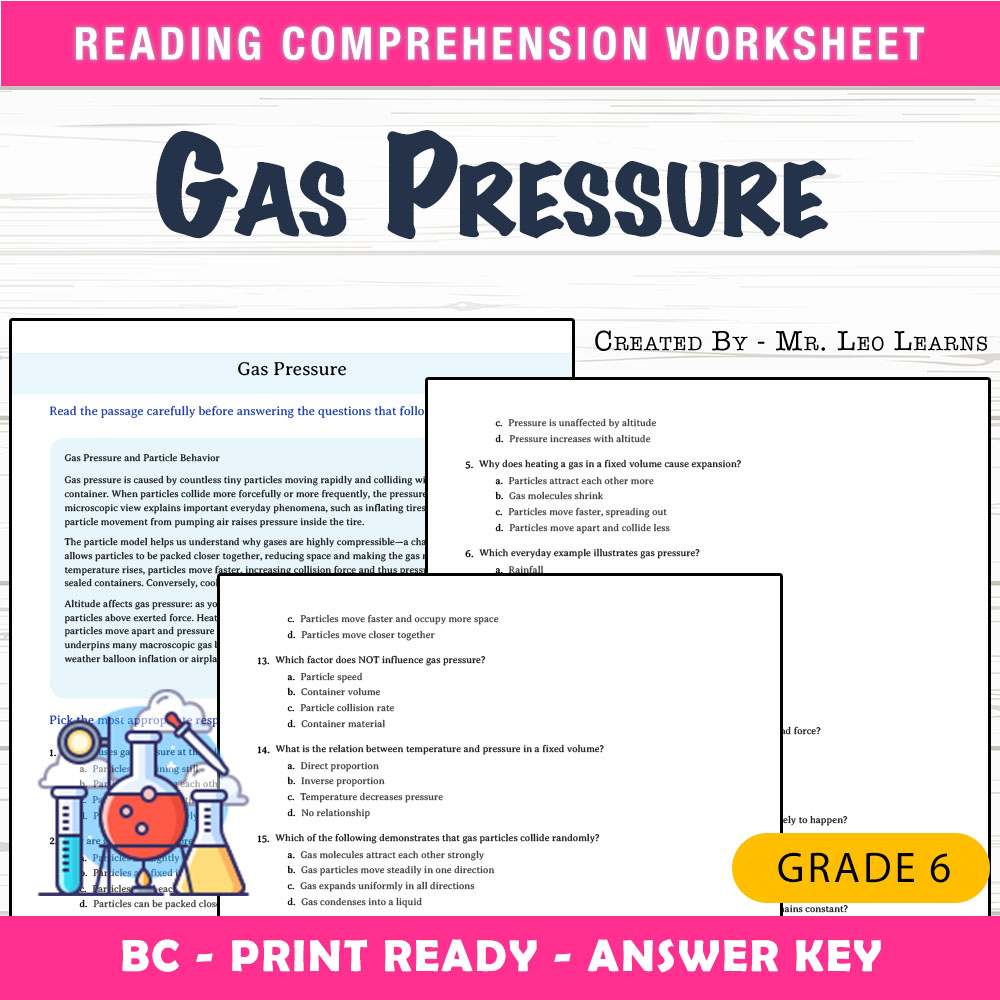
Grade 6 Science — Gas Pressure Worksheet MCQ Paper for Mastery
Created byThe Resource HubLearning Objectives
- Understand how gas particles collide and the effect on pressure.
- Recognize how temperature and volume influence gas pressure and behavior.
- Explain concepts such as gas compressibility and pressure changes with altitude.
Also included in: Grade 6 Science | Matter, Properties & Change Worksheet Bundle (BC Framework) +1 more
Instant download

Grade 6 Science | Science Safety & Reporting - Daily Reading Comprehension
Created byCoral Reef LearningLearning Objectives
- Understand key concepts related to Science
- Apply knowledge through practice questions
- Demonstrate comprehension of the material
Instant download

Potential and Kinetic Energy Worksheets and Review for Physical Science
LCreated byLearnora ResourcesLearning Objectives
- Identify potential energy, kinetic energy, and situations showing both
- Explain how potential and kinetic energy change during motion
- Compare gravitational potential energy using height and mass information
Instant download

Evaporation Separation Worksheets Grade 6 Science
Created byBRIGHT PATH RESOURCESLearning Objectives
- Explain how evaporation can separate a soluble solid from a liquid based on state change
- Identify evidence that separation by evaporation worked, such as the disappearance of liquid and recovered mass
- Compare evaporation with size-based separation methods
Also included in: Grade 6 Physical Science Worksheets Bundle | Heat, Matter & Forces +2 more
Instant download

Forces and Unbalanced Motion Worksheets | Grade 6 Physical Science
Created byBRIGHT PATH RESOURCESLearning Objectives
- Explain how net force affects speed and direction
- Identify balanced versus unbalanced forces from a scenario
- Describe how constant velocity relates to balanced forces
Also included in: Grade 6 Physical Science Worksheets Bundle | Heat, Matter & Forces +2 more
Instant download

Grade 6 Science – Measurement Tools & Techniques | Daily Reading Worksheet
 Created byBright Mind Resources
Learning Objectives
- Identify common temperature measurement instruments such as thermometers.
- Understand how to interpret temperature readings from different devices.
- Recognize the importance of calibration and unit selection in measurement.
Also included in: Grade 6 Science Data & Inquiry Daily Reading Worksheets Lesson Bundle | Alberta +2 more
Instant download

Grade 6 Science | Distillation Principles Worksheet | BC Aligned
Created byLumora LearningLearning Objectives
- Explain the basic principles of distillation and how they are used to separate mixtures.
- Differentiate between simple distillation and fractional distillation.
- Understand how differences in boiling points facilitate the separation of liquids.
Instant download

6th Grade Science Worksheet | Population Dynamics & Growth (Ontario Standard)
Created byEvergreen Desk EducationLearning Objectives
- Explain how birth rate, death rate, immigration, and emigration affect population size over time
- Describe how carrying capacity and limiting factors control whether populations grow exponentially or logistically
- Distinguish density-dependent and density-independent factors using examples from terrestrial and aquatic systems
Also included in: Grade 6 Biodiversity, Adaptation & Ecology Science Lesson Bundle | Ontario +1 more
Instant download
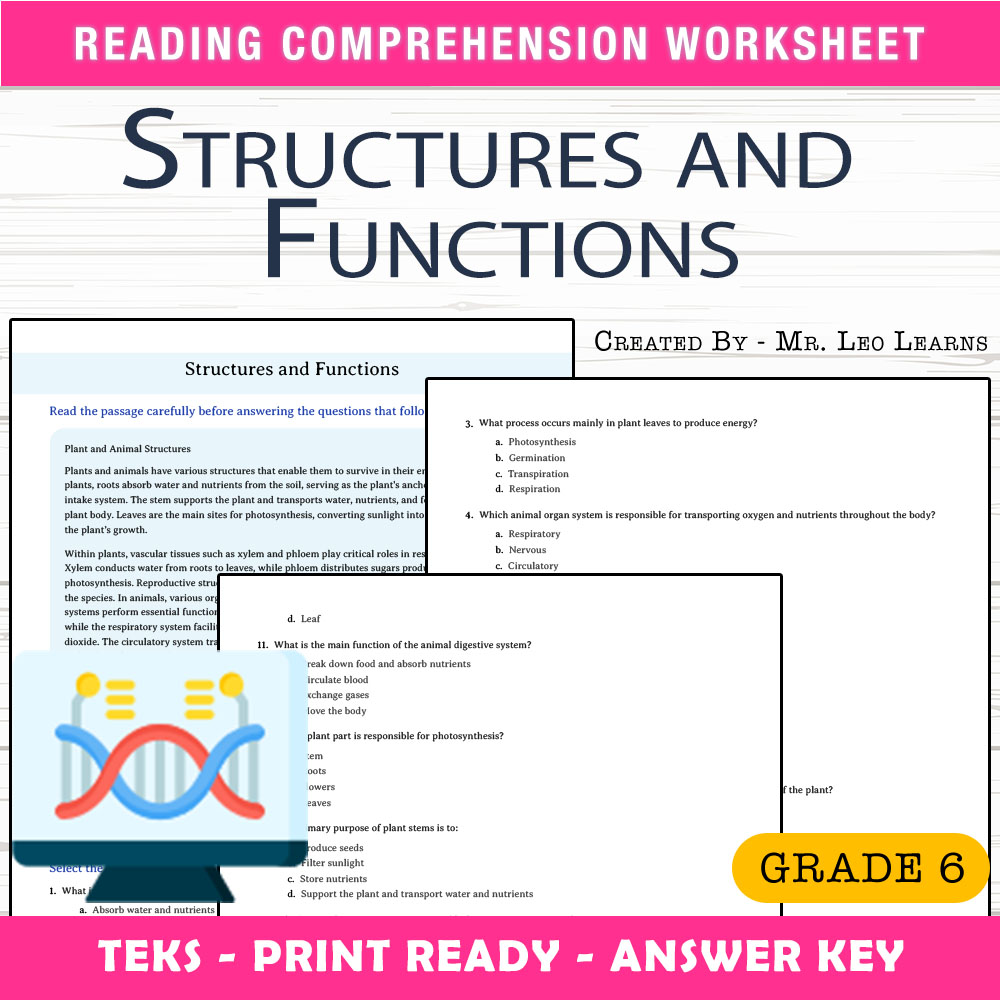
Grade 6 Science — Structures and Functions Worksheet for Mastery
Created byThe Resource HubLearning Objectives
- Identify major plant structures and describe their functions in resource acquisition and transport.
- Understand basic animal organ systems and their roles in maintaining organism survival.
- Connect structural features of plants and animals to their functions in supporting life processes.
Also included in: Grade 6 Science Unit Bundle | Ecosystems & Environmental Relationships
Instant download

Grade 6 Science | Tissue Types Worksheet | BC Aligned
Created byLumora LearningLearning Objectives
- Identify the four main tissue types in multicellular animals.
- Describe the structure and function of epithelial, connective, muscle, and nervous tissues.
- Explain how different tissue types contribute to organ properties and animal functions.
Instant download
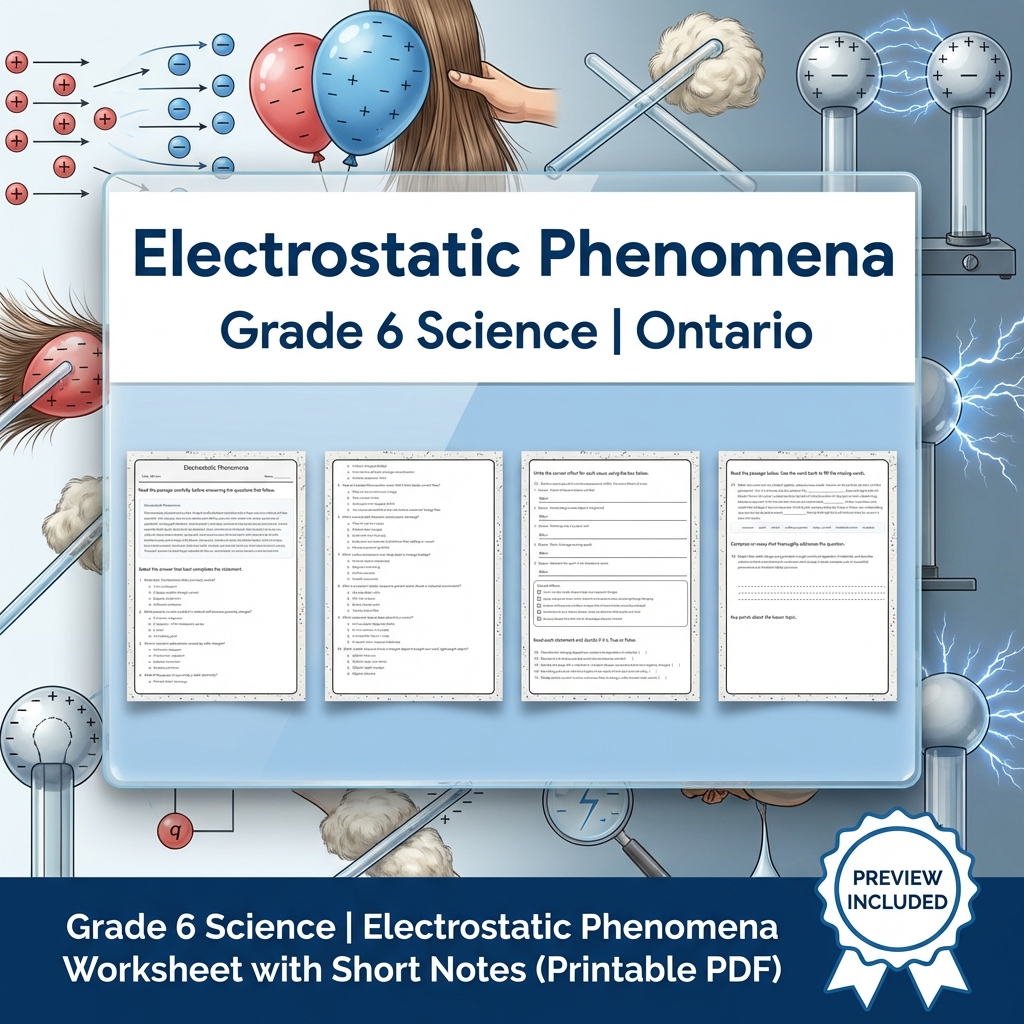
Grade 6 Science | Electrostatic Phenomena Worksheet with Short Notes
 Created byMeadowlark Worksheets
Learning Objectives
- Explain how charge transfer occurs between materials through triboelectric effects.
- Describe the concept of electrostatic discharge and its common manifestations.
- Identify the properties of materials in the triboelectric series and their tendency to gain or lose electrons.
Also included in: Grade 6 Science Lesson Group on Energy, Circuits & Properties +1 more
Instant download

Grade 6 Science – Atmospheric Circulation | Daily Reading Worksheet
Created byBright Mind ResourcesLearning Objectives
- Learn how warm air rises in Earth's atmosphere.
- Identify the effects of warm air rising on weather patterns.
- Understand the movement of air currents due to temperature differences.
Also included in: Climate Grade 6 Science Daily Reading Worksheets Lesson Bundle | Florida NGSSS +1 more
Instant download

Grade 6 Science – Magnetic Separation Worksheet (PDF) | General Standards
Created byEvergreen Desk EducationLearning Objectives
- Explain how a magnet can separate a mixture based on magnetic properties
- Identify which materials are attracted to a magnet and which are not
- Describe observations and results of magnetic separation using scientific language
Also included in: Grade 6 Heat and Matter Science Lesson Bundle for General Framework +1 more
Instant download

Conservation Strategies Worksheet | Grade 6 Science Activities
Created byPrism Point LearningLearning Objectives
- Explain how different conservation strategies help maintain forest biodiversity and ecosystem services
- Describe how habitat protection and restoration support genetic diversity and long-term ecosystem viability
- Use Alberta examples (such as parks, riparian buffers, and replanting seed sources) to support conservation planning
Also included in: Trees and Forests Lesson Bundle | Grade 6 Science | Alberta Framework
Instant download

Grade 6 Understanding Limiting Resources Worksheet | California Science PDF
Created byEvergreen Desk EducationLearning Objectives
- Explain how limiting resources affect population growth in an ecosystem
- Identify examples of limiting factors such as nutrients, water, space, and sunlight
- Describe how organisms may respond to scarcity through competition or changing behavior
Instant download

Grade 6 Human Water Disruptions Worksheet | Practice & NGSS PDF
Created byClear Sky ClassroomLearning Objectives
- Explain how human actions such as dams and water withdrawals can alter river flow timing and water availability.
- Describe how pollutants can change water quality and harm aquatic organisms.
- Analyze how land cover changes can affect infiltration, runoff, and flood risk.
Instant download

Scientific Methods Worksheet Grade 6 Science Activities
Created byPrism Point LearningLearning Objectives
- Explain how scientific methods are iterative and how observations lead to testable questions.
- Differentiate descriptive and comparative approaches in scientific investigations.
- Match research methods to observable phenomena using clear operational definitions and appropriate controls.
Also included in: Grade 6 Scientific Investigation Practices Science Lesson Bundle TEKS +1 more
Instant download

Energy Transformations Worksheet | Grade 6 Science Energy Activity
Created byPrism Point LearningLearning Objectives
- Explain how energy can change forms (such as potential to kinetic) while conserving total energy
- Connect energy transformations to observable changes like motion, temperature, or brightness
- Use everyday examples to describe how different types of energy transfer in real systems
Also included in: Grade 6 Energy, Matter & Motion Lesson Bundle | Florida NGSSS
Instant download

Grade 6 Science | Historical Perspectives on Celestial Motion
Created byCoral Reef LearningLearning Objectives
- Understand how Indigenous communities interpreted star patterns for navigation and cultural practices.
- Recognize the significance of oral knowledge and early astronomical records in understanding celestial motions.
- Explore diverse cultural explanations of seasons and sky phenomena.
Also included in: Sky Science Lesson Bundle | Grade 6 Science Daily Reading | Alberta +1 more
Instant download

Pressure Gradients and Wind Patterns Science Worksheets | Grade 6
 Created bySunny Desk Resources
Learning Objectives
- Explain how uneven heating creates pressure differences over an area
- Describe how topography such as mountains and plains can reshape local wind patterns
- Use pressure-gradient ideas to predict everyday weather changes
Also included in: Air and Aerodynamics Grade 6 Alberta Science Worksheets Bundle +1 more
Instant download

Engineering Design Optimization Using Test Data Worksheets Grade 6
Created byTeachers ClubLearning Objectives
- Identify performance characteristics and trade-offs from comparative test data
- Calculate and interpret averages from design test results
- Explain what variability means for design optimization decisions
Also included in: Engineering Design Grade 6 Science Worksheets | NGSS Bundle +2 more
Instant download

Optimizing Designs with Data Worksheet | NGSS Grade 6 Science Assessment
Created bySkylark WorksheetsLearning Objectives
- Use comparative test data to identify performance patterns and trade-offs between design alternatives
- Interpret graphs and averages to support design decisions within given constraints
- Discuss error, variability, and uncertainty when deciding whether one design is truly better than another
Also included in: Grade 6 Engineering Design Data & Problem-Solving Science Lesson Bundle NGSS +1 more
Instant download

Grade 6 Science | Reaction Rates Worksheet | BC Aligned
Created byLumora LearningLearning Objectives
- Understand the factors that influence chemical reaction rates.
- Explain how concentration, temperature, surface area, and catalysts affect reaction speed.
- Identify observable indicators of reaction rate changes.
Instant download

Resource Limits Worksheet | NGSS-Aligned Science Practice for Grade 6
JCreated byJ.S SheetsLearning Objectives
- Understand how resource availability affects individual organisms and population sizes.
- Interpret quantitative observations related to resource gradients and species distribution.
- Identify limiting resources such as water, soil nutrients, and light in different ecosystems.
Also included in: Grade 6 Ecosystem Interactions Science Lesson Bundle Worksheet Set – NGSS +1 more
Instant download
About Grade 6 Science Worksheets
Explore Grade 6 Science worksheets for classwork, homework, or review. Our 5,969 printables download instantly as PDFs.
MyTeachingSheets worksheets are made by real teacher-authors and checked before they go live. Download any as a print-ready PDF for lessons, homework, or independent practice — most include answer keys, and previews are always free.