
Grade 6 Science Worksheets
5,969 worksheets
Keystone Species Worksheet for Grade 6 Science | Standards-Aligned Practice
JCreated byJ.S SheetsLearning Objectives
- Explain what keystone species are and why their influence is often greater than their abundance
- Describe at least two mechanisms of keystone effects (habitat engineering and trophic control)
- Predict how changes to keystone species can cause cascading effects on biodiversity and ecosystem function
Instant download

Grade 6 Science – Invasive Species & Ecosystem Impact | Daily Reading Worksheet
 Created byBright Mind Resources
Learning Objectives
- Understand what invasive species are and how they differ from native species
- Recognize examples of invasive plants and animals
- Analyze the impacts invasive species have on ecosystems
Also included in: Grade 6 Ecosystem Relationships Science Daily Reading Lesson Bundle | BC +1 more
Instant download

Grade 6 Science – Survival Changes & Adaptations | Daily Reading Worksheet
Created byBright Mind ResourcesLearning Objectives
- Understand key concepts related to Science
- Apply knowledge through practice questions
- Demonstrate comprehension of the material
Also included in: Ecosystems Grade 6 Science Daily Reading Worksheets Lesson Bundle |Florida NGSSS +1 more
Instant download

Grade 6 Keystone Species Worksheet PDF | Ontario Science Assessment
 Created byClear Sky Classroom
Learning Objectives
- Define keystone species and explain why they can strongly influence an ecosystem even if they are not the most abundant.
- Describe how trophic control by predators and mutualisms with pollinators can cause cascading effects.
- Identify evidence that suggests an organism is a keystone species and predict impacts on biodiversity and habitat complexity.
Instant download

6th Grade Science Worksheet | From Need to Solution Design (PDF)
 Created byEvergreen Desk Education
Learning Objectives
- Explain what a design problem is and identify the need behind the problem
- Use measurable requirements and constraints to evaluate potential solutions
- Generate solution ideas using sketches, dimensions, and performance goals
Also included in: Grade 6 Prototype Design Science Lesson Bundle: General Systems Thinking +1 more
Instant download

Grade 6 Safety And Reporting Worksheet | Practice & PDF
Created byClear Sky ClassroomLearning Objectives
- Identify safe lab behaviors and describe when personal protective equipment is needed during investigations.
- Use ethical reporting practices by recording accurate measurements, citing sources when appropriate, and explaining limitations.
- Match safety and reporting choices to real-world science classroom expectations.
Instant download

Grade 6 Chemical Reactions Worksheet | NGSS Physical Science Activity
 Created byBRIGHT PATH RESOURCES
Learning Objectives
- Identify indicators that suggest a chemical reaction is occurring.
- Analyze qualitative data such as color change, gas evolution, and precipitate formation.
- Interpret quantitative measurements like temperature and mass changes to determine chemical reactions.
Also included in: Matter and Its Interactions Grade 6 Science Lesson Bundle | NGSS +2 more
Instant download

Grade 6 Science – Advanced Circuit Analysis & Electricity | Reading Worksheet
Created byBright Mind ResourcesLearning Objectives
- Understand key concepts related to Science
- Apply knowledge through practice questions
- Demonstrate comprehension of the material
Also included in: Grade 6 Daily Reading Science Worksheets | Lesson Bundle | BC Framework +1 more
Instant download

Cycles Of Matter Model Assessment | General Grade 6 Science Standards
 Created byPrism Point Learning
Learning Objectives
- Understand how matter cycles through living and non-living components of ecosystems.
- Identify the roles of plants, consumers, and waste in matter redistribution.
- Explain the concept of reservoirs and flows in matter cycles.
Instant download

Grade 6 Science – Lunar Motion Worksheet (Alberta) PDF
Created byEvergreen Desk EducationLearning Objectives
- Explain how the Moon’s orbit around Earth produces predictable changes in lunar phase and position in the night sky.
- Use Sun–Earth–Moon geometry to describe why the Moon appears to cycle from new to full and back again.
- Interpret observations from different nights to identify where the Moon is relative to the Sun.
Instant download

Mixed Series-Parallel Circuits Worksheets: Grade 6 Electricity Science
Created byPrism Point LearningLearning Objectives
- Identify series and parallel sections within mixed circuit configurations
- Explain how current distributes across parallel branches
- Describe voltage distribution in series and parallel sections
Also included in: Grade 6 Electricity Lesson Bundle | Ontario Science Framework
Instant download

Science Community Stewardship with the Scientific Method Worksheet | Grade 6
JCreated byJ.S SheetsLearning Objectives
- Apply steps of the scientific method to local stewardship issues in a respectful, ethical way
- Explain why consent, cultural sensitivity, and data validation matter when communities contribute observations
- Communicate scientific findings clearly to non-specialist audiences so community stakeholders can make actionable decisions
Instant download

Grade 6 Stewardship Strategies Worksheet | Ontario Science Activity
 Created byChalk and Compass
Learning Objectives
- Explain how different stewardship strategies (habitat restoration, protected areas, assisted migration, and community monitoring) help maintain biodiversity.
- Evaluate trade-offs between conservation approaches and choose actions using criteria such as species at risk and ecosystem services.
- Describe metrics for measuring conservation success and apply the idea of adaptive management to improve outcomes over time.
Also included in: Grade 6 Science Ecosystems, Adaptations & Biodiversity Lesson Bundle | Ontario +1 more
Instant download

6th Grade Science Worksheet – Communication Quality (PDF) TEKS aligned
Created byEvergreen Desk EducationLearning Objectives
- Write clear science claims that are supported by evidence and logical reasoning.
- Use standardized visual summaries (graphs, data tables) to communicate relationships and comparisons.
- Present methods and uncertainties transparently and cite observational records accurately.
Instant download

Grade 6 Science – Sun–Earth–Moon System & Phases Daily Reading Worksheet
Created byBright Mind ResourcesLearning Objectives
- Identify the key positions and movements of the Sun, Earth, and Moon
- Understand how the relative positions cause phases and eclipses
- Explain how gravitational interactions influence tides and celestial events
Also included in: Grade 6 Solar System & Seasons Science Daily Reading Lesson Bundle | Alberta +2 more
Instant download
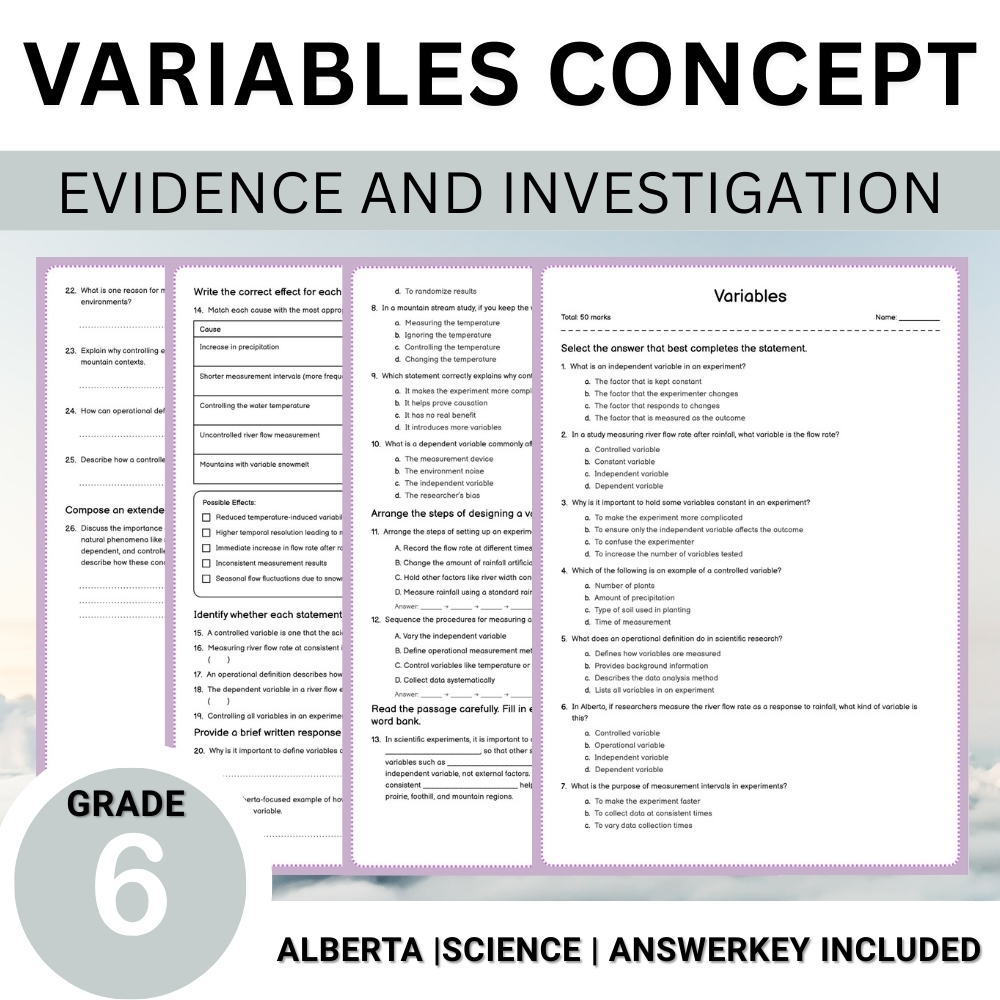
Grade 6 Science | Variables Worksheet – Science A Assessment & Student Practice (Printable PDF)
Learning Objectives
- Identify different types of variables in scientific investigations.
- Understand how independent, dependent, and controlled variables affect experimental outcomes.
- Explain the importance of operational definitions and measurement consistency.
Also included in: Grade 6 Science Unit | Data & Measurement Worksheets Bundle (Assessment & Practice) +1 more
Instant download

Grade 6 Science | Natural Hazards Earthquakes - Daily Reading Practice
 Created byCoral Reef Learning
Learning Objectives
- Explain what causes earthquakes and how tectonic plates move
- Identify the effects of earthquakes on communities and infrastructure
- Analyze patterns and frequency of seismic activity
Instant download

Grade 6 Sustainability Strategies Worksheet | NGSS Practice PDF
Created byClear Sky ClassroomLearning Objectives
- Evaluate how population trends and resource use impact earth systems.
- Compare different sustainable practices such as renewable energy, conservation, and land management.
- Analyze trade-offs among economic, social, and environmental priorities in sustainability.
Also included in: Grade 6 Human Impacts Earth Systems Science Lesson Bundle Resource – NGSS +1 more
Instant download
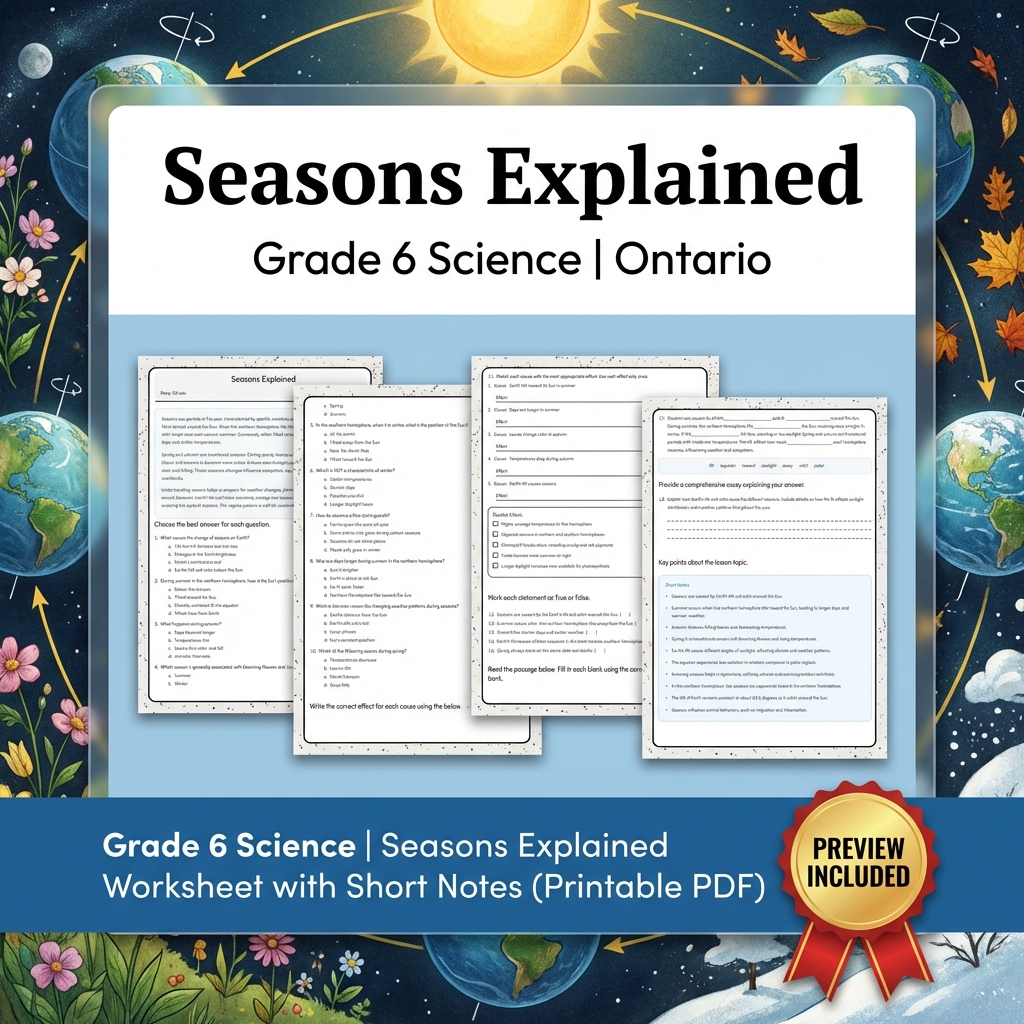
Grade 6 Science | Seasons Explained Worksheet with Short Notes (Printable PDF)
 Created byMeadowlark Worksheets
Learning Objectives
- Understand the different seasons and their characteristics.
- Explain how Earth's tilt and orbit cause seasons.
- Identify key environmental changes during different seasons.
Also included in: Grade 6 Science Lesson Group Bundle – Ontario Curriculum Worksheets +1 more
Instant download

Grade 6 Science Worksheet | Angle Effects (Alberta Standards) PDF
 Created bySilver Birch Teaching
Learning Objectives
- Explain how angle of attack affects lift and drag on a wing
- Describe what happens to airflow at a critical angle and how that relates to stall
- Use examples from kites and gliders to predict how changing wing angle changes performance
Also included in: Grade 6 Aerodynamics & Flight Forces Science Lesson Bundle: Alberta +1 more
Instant download

Energy Forms Worksheet for Grade 6 | Standards-Aligned Science Practice
JCreated byJ.S SheetsLearning Objectives
- Identify and describe kinetic, potential, thermal, chemical, and electrical energy using everyday examples
- Distinguish among energy forms by connecting each one to motion, position, temperature/particle motion, bonds, and moving charges
- Use correct science vocabulary to explain what energy form best matches a described situation
Instant download

Wing Shape and Lift Efficiency Worksheets Grade 6 Science
 Created bySunny Desk Resources
Learning Objectives
- Explain how wing features like camber, thickness, and aspect ratio affect lift and drag.
- Describe how wing geometry influences stall behavior and maneuverability.
- Compare high-aspect-ratio glider wings with low-aspect, robust short-field wings.
Also included in: Air and Aerodynamics Grade 6 Alberta Science Worksheets Bundle +1 more
Instant download

Wing Design Optimization Tradeoffs Worksheets | Grade 6 Science
Created byPrism Point LearningLearning Objectives
- Explain tradeoffs among lift, drag, weight, and stability
- Describe how constraints affect safe flight performance envelopes
- Apply Pareto tradeoffs when selecting viable design configurations
Also included in: Flight Lesson Bundle | Grade 6 Science | Ontario Framework
Instant download

Grade 6 Science | Water Cycle Pathways Worksheet | NGSSS Aligned
 Created byLumora Learning
Learning Objectives
- Describe the major stages of the water cycle and where each stage happens.
- Explain how energy drives changes of state and movement of water in the water cycle.
- Use key terms (evaporation, condensation, precipitation, runoff, infiltration) to trace water pathways.
Instant download

Energy Flow Worksheet Grade 6 Science NGSS Food Webs Answer Key
 Created byNorthstar Worksheets
Learning Objectives
- Explain how energy moves through producers, consumers, and decomposers in food webs
- Describe how photosynthesis and cellular respiration help determine an ecosystem’s energy budget
- Use an energy pyramid idea and trophic transfer efficiency to predict how much energy remains at each trophic level
Also included in: Grade 6 Ecosystems Lesson Bundle | NGSS Science: Species, Energy & Biodiversity +1 more
Instant download

Grade 6 Science – Operational Definitions | Daily Reading Worksheet
Created byBright Mind ResourcesLearning Objectives
- Understand what an operational definition is
- Learn how scientists measure water clarity and snowpack
- Identify different measurement protocols and units used in environmental science
Also included in: Grade 6 Science Data & Inquiry Daily Reading Worksheets Lesson Bundle | Alberta +2 more
Instant download

Data Representation Worksheet | Ontario Grade 6 Science Assessment
 Created byCedar Grove Learning
Learning Objectives
- Organize quantitative and qualitative observations into tables and charts that communicate clearly.
- Select an appropriate graph type for a given data set and purpose (categories vs. change over time).
- Use correct labels, units, scales, and legends to help others interpret graphs accurately.
Also included in: Grade 6 Scientific Inquiry & Data Practices Science Lesson Bundle | Ontario +1 more
Instant download

Grade 6 Science | Optimization Tradeoffs in Engineering - Reading Comprehension
Created byCoral Reef LearningLearning Objectives
- Learn how multiple factors influence engineering design choices.
- Identify key tradeoffs when optimizing structural and aerodynamic features.
- Understand concepts of Pareto trade-offs and performance envelopes.
Instant download

Mineral Identification and Rock Classification Worksheets Grade 6
Created byPrism Point LearningLearning Objectives
- Identify minerals using hardness, cleavage, color, luster, streak, and density.
- Classify rocks as igneous, sedimentary, or metamorphic.
- Explain how grain size provides clues about igneous rock formation.
Instant download

Grade 6 Leaf Functions, Gas Exchange & Photosynthesis Worksheet | Alberta
Created byBRIGHT PATH RESOURCESLearning Objectives
- Identify key leaf parts and describe what each does
- Explain how stomata control gas exchange using cause-and-effect
- Describe how photosynthesis and transpiration support plant growth and water use
Also included in: Forest Ecosystem Adaptations Grade 6 Science Worksheets Lesson Bundle | Alberta +1 more
Instant download

Grade 6 Science | Cellular Respiration Worksheet | California Standards
Created byLumora LearningLearning Objectives
- Explain how cellular respiration converts chemical energy in food into energy cells can use
- Describe the role of oxygen and the exchange of gases during cellular respiration
- Identify what happens to matter and energy products produced during respiration
Instant download
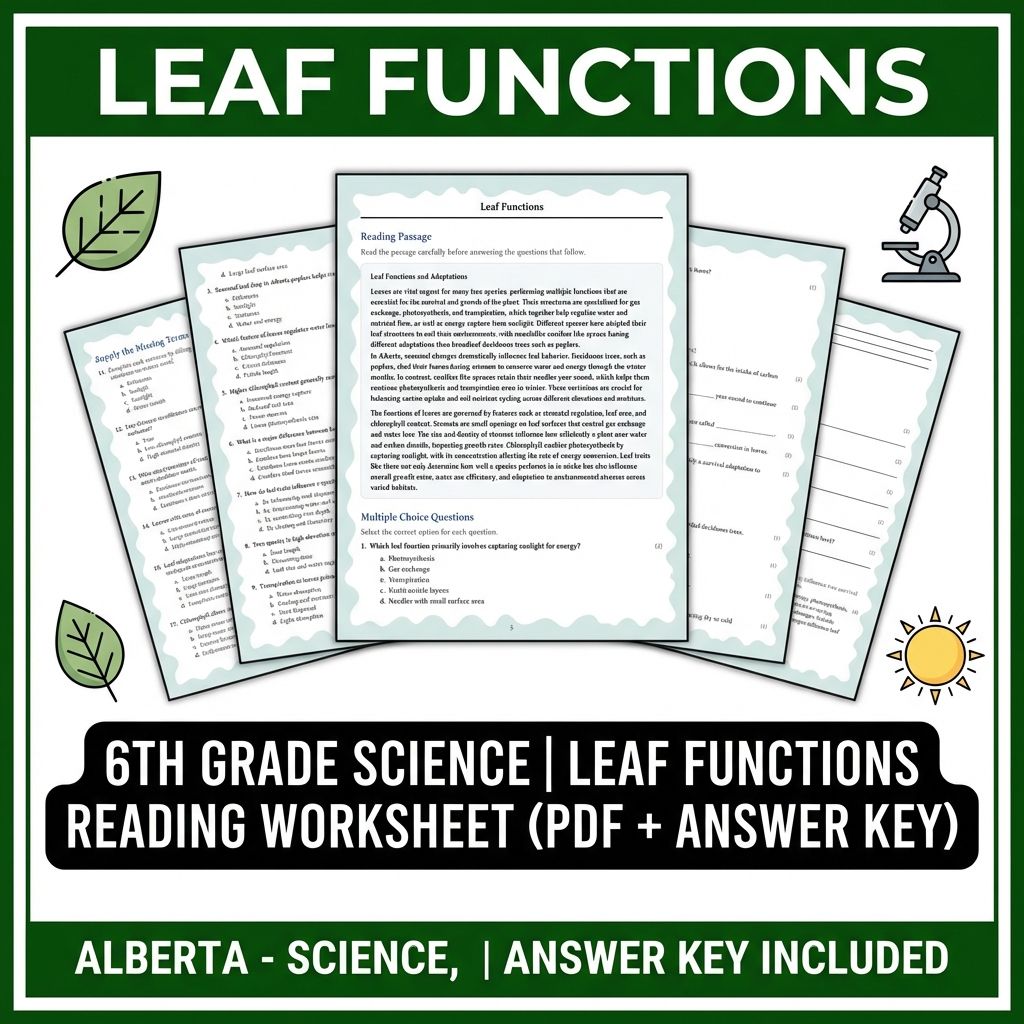
6th Grade Science | Leaf Functions Reading Worksheet (PDF + Answer Key)
JCreated byJ.S SheetsLearning Objectives
- Understand the roles of leaf structures in gas exchange, photosynthesis, and transpiration.
- Identify differences between needlelike conifers and broadleaf deciduous species.
- Explain how seasonal changes affect leaf drop and needle persistence in Alberta trees.
Also included in: Grade 6 Science Unit Bundle | Ecosystems and Biodiversity (Answer Keys Included) +1 more
Instant download

Thrust Systems Practice Worksheets | Grade 6 Science Ontario
Created byPrism Point LearningLearning Objectives
- Compare how propellers and jets produce forward force using different physics ideas
- Explain the role of drag and thrust-to-weight ratio in acceleration and climb
- Describe how propulsive efficiency can change with flight speed and influence design trade-offs
Also included in: Grade 6 Aerodynamics Flight Design Science lesson bundle - Ontario
Instant download

Data Representation Worksheet Pack | Grade 6 Science Activities
Created byPrism Point LearningLearning Objectives
- Use tables and graphs to organize data and communicate meaning clearly.
- Identify correct axis labels and choose an appropriate scale for graphs.
- Recognize patterns and relationships (trends, clusters, or outliers) in data representations.
Also included in: Grade 6 Scientific Investigation Practices Science Lesson Bundle TEKS +1 more
Instant download

Design Problem Worksheet | Grade 6 Science Activities
Created byPrism Point LearningLearning Objectives
- Explain how a design problem starts with a need and measurable requirements.
- Identify how sketches, dimensions, performance goals, and constraints guide possible solutions.
- Use safety and budget constraints to evaluate or improve a design.
Instant download

Grade 6 Science – Wave Interactions & Concepts | Daily Reading Worksheet
Created byBright Mind ResourcesLearning Objectives
- Understand how wave interference affects sound and light.
- Identify examples of constructive and destructive interference.
- Describe the concept of resonance and standing waves.
Also included in: Grade 6 Daily Reading Science Worksheets | Lesson Bundle | BC Framework +1 more
Instant download

Grade 6 Trophic Levels Worksheet | NGSSS Ecosystems Food Web Science Activity
Created byEvergreen Desk EducationLearning Objectives
- Describe how trophic levels organize organisms by where they get energy in an ecosystem.
- Identify producers, primary consumers, secondary consumers, and higher-level consumers.
- Explain why decomposers are not placed neatly into consumer trophic levels.
Instant download

Grade 6 Moon Relationships Worksheet | Practice NGSS PDF
Created byClear Sky ClassroomLearning Objectives
- Describe the geometric relationships among Earth, Moon, and Sun that produce lunar phases and eclipses.
- Explain the sequence of primary lunar phases and the conditions for solar and lunar eclipses.
- Use observational records to understand periodicity and predictability of Earth–Moon–Sun configurations.
Also included in: Grade 6 Earth's Place in the Universe Science Lesson Bundle: NGSS +1 more
Instant download

Balanced and Unbalanced Forces Worksheets | Grade 6 Motion Review
LCreated byLearnora ResourcesLearning Objectives
- Identify balanced and unbalanced forces in everyday situations
- Calculate net force from forces acting in opposite directions
- Determine the direction of a nonzero net force
Instant download

Grade 6 Conservation Principle Worksheet | Practice & PDF
Created byClear Sky ClassroomLearning Objectives
- Explain energy conservation in a closed system and describe energy transfers among forms (kinetic, potential, thermal).
- Use the conservation principle to account for changes that appear to be 'lost' as thermal energy.
- Apply energy-conservation reasoning to real-world processes and systems (collisions, reactions, circuits).
Instant download

Grade 6 Energy Forms Daily Reading Worksheet | TEKS Science Activity
Created byBRIGHT PATH RESOURCESLearning Objectives
- Identify evidence of kinetic energy in everyday situations.
- Describe how kinetic energy relates to motion.
- Use scientific vocabulary (kinetic, potential, thermal, chemical, electrical) to explain simple phenomena.
Also included in: Energy, Matter & Change Grade 6 Science Lesson Bundle | TEKS Daily Reading +1 more
Instant download

Grade 6 Science | Science: Design Problem - Daily Reading Comprehension
Created byCoral Reef LearningLearning Objectives
- Understand the key components of a design problem
- Learn how to analyze design needs and constraints
- Apply measurements and safety considerations in design
Instant download

Grade 6 Science | Air Properties Worksheet (PDF) Alberta Standards
Created byEvergreen Desk EducationLearning Objectives
- Explain how air composition is made of gases and how that composition stays fairly constant in everyday conditions.
- Describe how air density changes with altitude and temperature and how this affects weather and wind.
- Relate air pressure to collisions between gas molecules and predict simple cause-and-effect outcomes.
Instant download
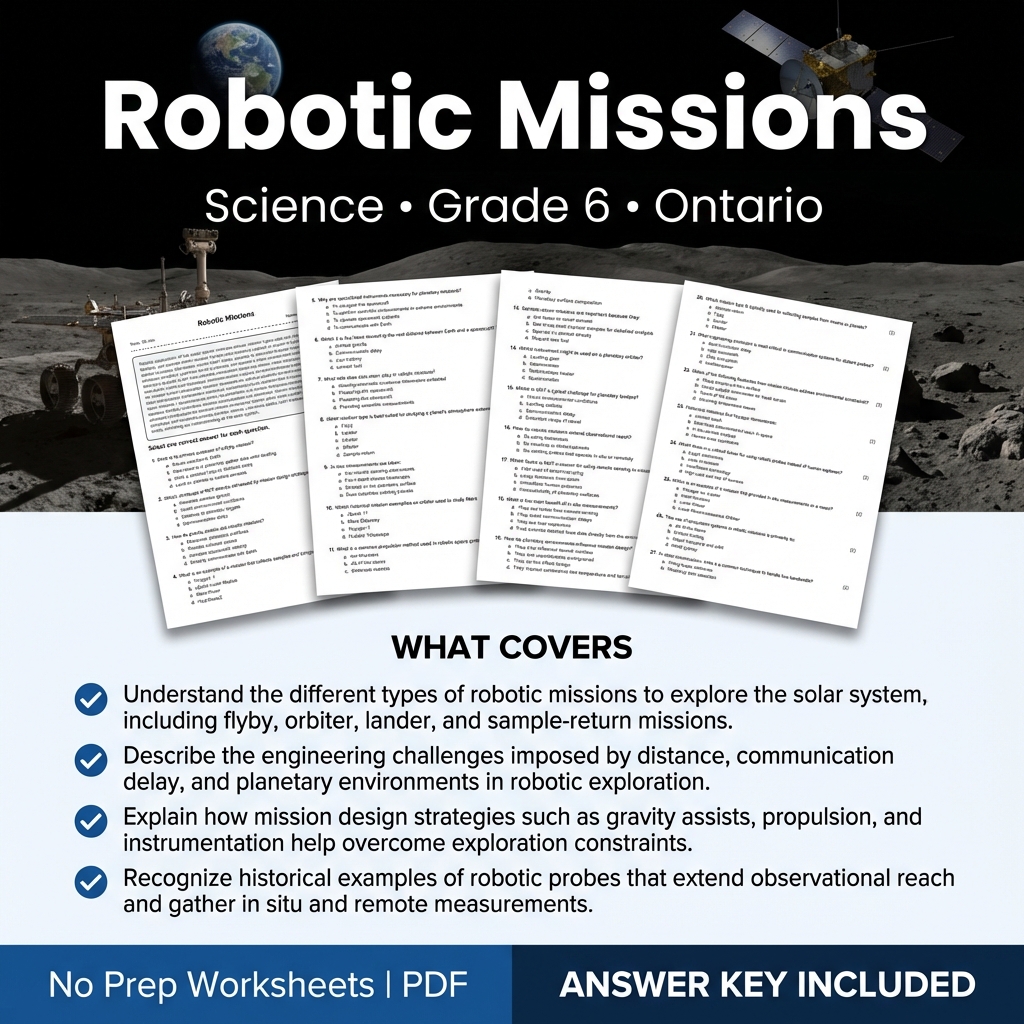
Grade 6 Science Worksheet on Robotic Missions – Ontario Standards
Created byCoral Reef LearningLearning Objectives
- Understand the different types of robotic missions to explore the solar system, including flyby, orbiter, lander, and sample-return missions.
- Describe the engineering challenges imposed by distance, communication delay, and planetary environments in robotic exploration.
- Explain how mission design strategies such as gravity assists, propulsion, and instrumentation help overcome exploration constraints.
Instant download

Grade 6 Science | Interdependence Roles Worksheet | Florida NGSSS Aligned
Created byLumora LearningLearning Objectives
- Explain how predators and prey populations can influence each other in an ecosystem
- Differentiate competition and mutualism by describing how organisms affect each other’s survival and reproduction
- Use cause-and-effect reasoning to predict how changes in one population can ripple through a community
Instant download

Grade 6 Reactants and Products Worksheet | Practice & Standards PDF
Created byClear Sky ClassroomLearning Objectives
- Describe reactants and products as the starting materials and the substances formed in a chemical reaction.
- Identify evidence that a chemical reaction occurred by comparing properties of reactants and products.
- Use particle diagrams to explain how atoms are rearranged during a reaction.
Instant download

Crystal Structures Test Prep Printables | Grade 6 Science
Created byPrism Point LearningLearning Objectives
- Explain how repeating particle patterns produce the characteristic properties of crystalline solids
- Compare crystalline and amorphous solids using evidence such as melting behavior and mechanical properties
- Use the particle model to connect bonding strength and spatial arrangement to observable changes
Also included in: Matter, Properties & Change Lesson Bundle — Grade 6 Science BC Framework +1 more
Instant download

Grade 6 Science – Seasons Explained & Sunlight | Daily Reading Worksheet
Created byBright Mind ResourcesLearning Objectives
- Understand how Earth's axial tilt causes seasonal changes.
- Describe the causes of opposite seasons in hemispheres.
- Explain how Earth's orbit affects day length and solar elevation.
Also included in: Space Systems Grade 6 Science Daily Reading Worksheets Bundle | Ontario +1 more
Instant download
About Grade 6 Science Worksheets
Explore Grade 6 Science worksheets for classwork, homework, or review. Our 5,969 printables download instantly as PDFs.
MyTeachingSheets worksheets are made by real teacher-authors and checked before they go live. Download any as a print-ready PDF for lessons, homework, or independent practice — most include answer keys, and previews are always free.