
Grade 6 Science Worksheets
5,969 worksheets
Reactants and Products Chemical Reactions Worksheet Grade 6 Science
 Created byPrism Point Learning
Learning Objectives
- Identify reactants and products in a chemical reaction scenario
- Explain how product properties can differ from reactant properties as evidence that a reaction occurred
- Use particle diagrams to describe how atoms are rearranged during a reaction
Instant download

Grade 6 Adaptation Tradeoffs Worksheet | BC Use Practice PDF
 Created byClear Sky Classroom
Learning Objectives
- Explain how adaptation trade-offs involve both benefits and costs for survival and reproduction
- Identify examples of traits where increased protection or efficiency causes a different limitation
- Use cost-benefit reasoning to predict how environmental pressures can shape evolutionary outcomes
Instant download

Limiting Resources Assessment | California Standards Grade 6 Science
Created byPrism Point LearningLearning Objectives
- Explain how limiting resources affect population size in ecosystems.
- Identify examples of limiting resources such as water, nutrients, or space.
- Describe how organisms may respond to scarcity, but why population growth eventually slows.
Also included in: Grade 6 Energy and Matter Cycles Science Lesson Bundle | California Standards +1 more
Instant download
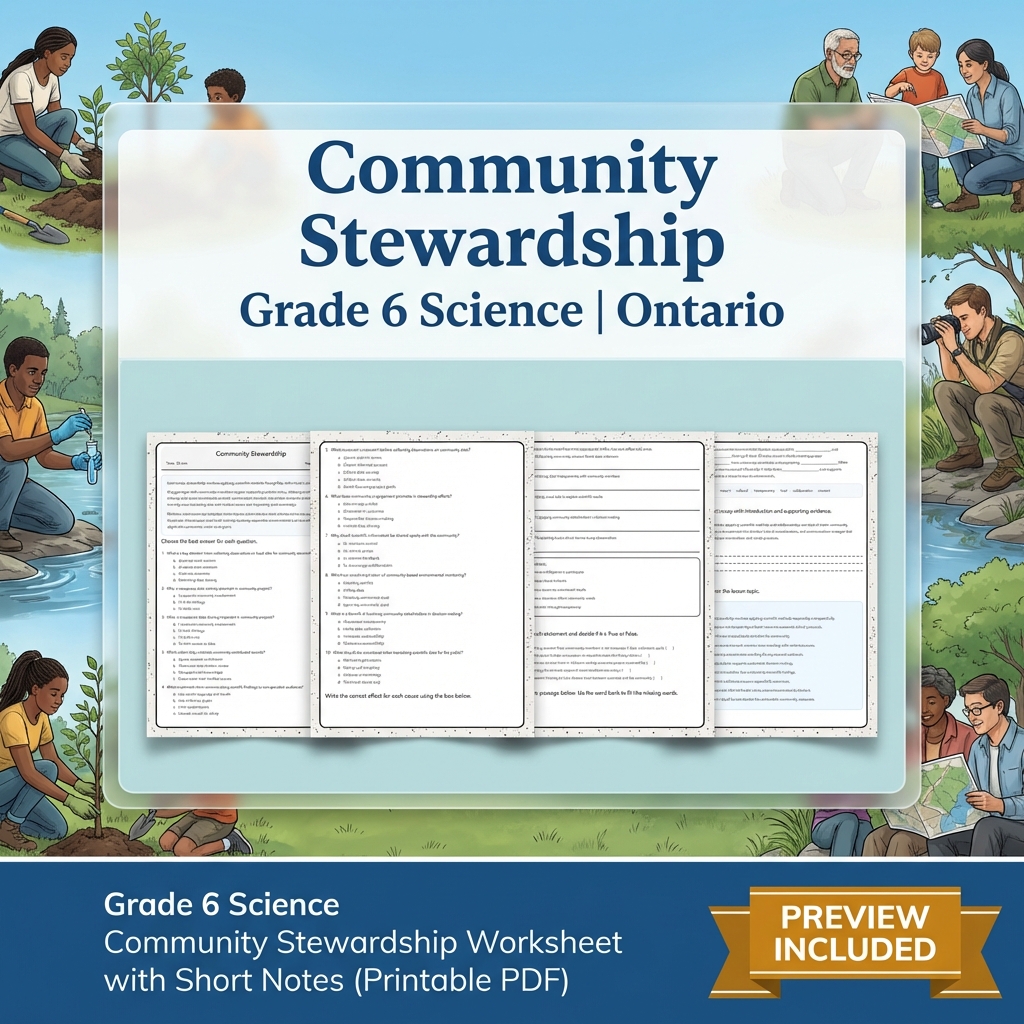
Grade 6 Science Community Stewardship Worksheet with Short Notes (Printable PDF)
 Created byMeadowlark Worksheets
Learning Objectives
- Understand the role of scientific methods in community issues.
- Recognize protocols for ethical data collection and sharing.
- Identify strategies for effective communication of scientific findings to non-experts.
Also included in: Grade 6 Science Lesson Bundle | Ontario Framework & Inquiry Skills +1 more
Instant download
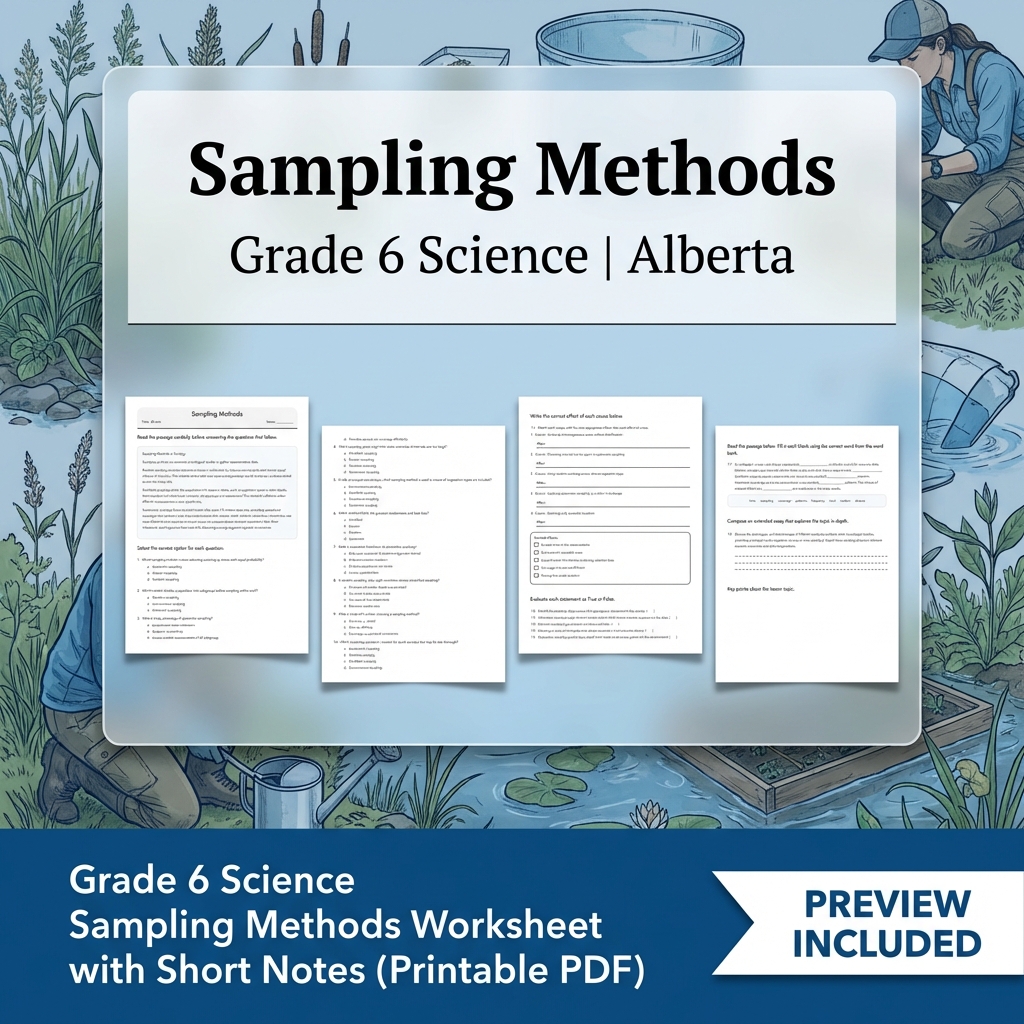
Grade 6 Science Sampling Methods Worksheet with Short Notes (Printable PDF)
Created byMeadowlark WorksheetsLearning Objectives
- Understand different sampling methods and their applications.
- Compare random, stratified, and systematic sampling techniques.
- Analyze trade-offs between coverage and practicality in sampling.
Also included in: Grade 6 Science | Evidence & Investigation Unit Worksheet Bundle +1 more
Instant download
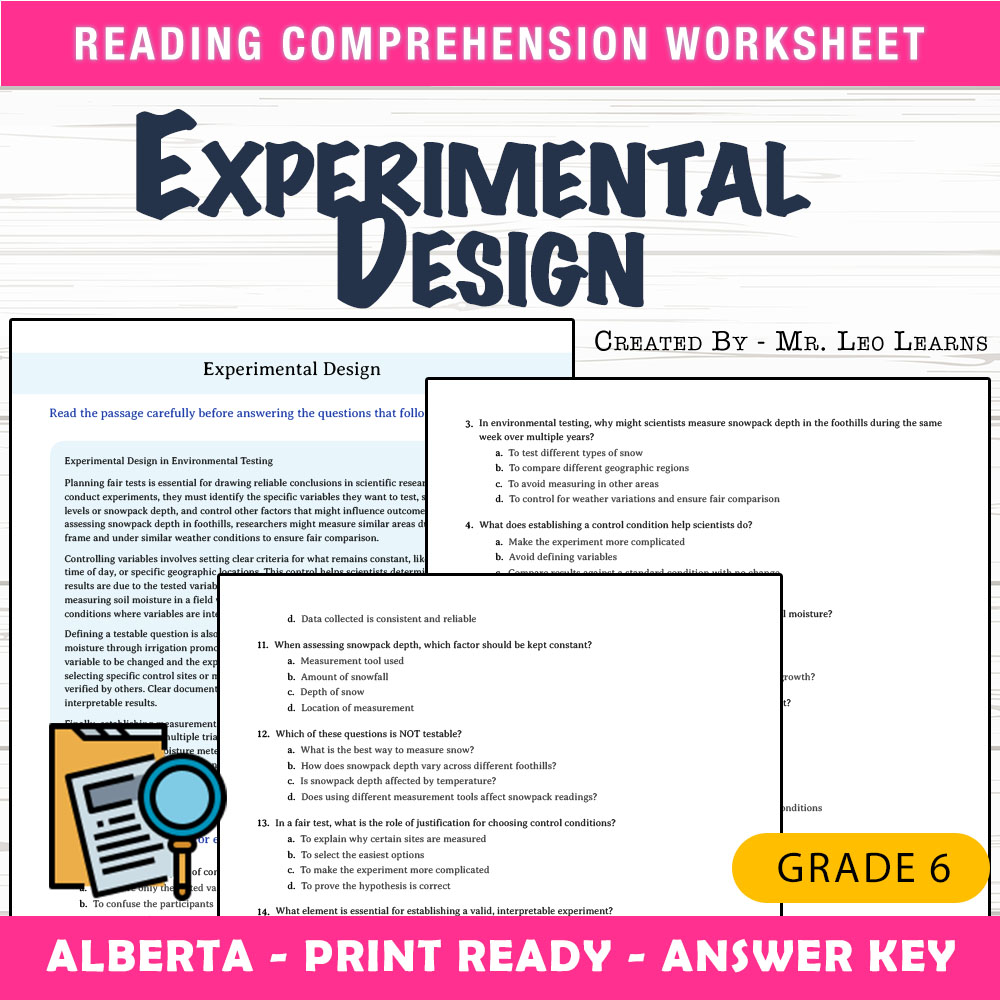
Grade 6 Science — Worksheet MCQ Paper for Mastering Experimental Design
 Created byThe Resource Hub
Learning Objectives
- Understand the key components of designing a fair scientific experiment.
- Identify variables, controls, and measurement methods in environmental testing.
- Develop testable questions relevant to local outdoor environments.
Also included in: Grade 6 Science Unit | Evidence and Investigation Worksheets – Alberta Framework +1 more
Instant download

Niche Relationships Worksheet Grade 6 Science NGSSS Florida Ecology
Created byPrism Point LearningLearning Objectives
- Explain what an ecological niche is and how it relates to how organisms use resources and conditions.
- Describe how two species can live in the same habitat by occupying different niches.
- Evaluate how niche overlap can increase competition when resources become limited.
Instant download

Grade 6 Organ Systems Science Worksheet | NGSS Life Science Activity
 Created byBRIGHT PATH RESOURCES
Learning Objectives
- Understand how the heart and blood vessels work together to circulate blood.
- Identify the major components and functions of the circulatory system.
- Explain how the circulatory system supports other organ systems.
Also included in: From Molecules to Organisms Lesson Bundle | Grade 6 Science | NGSS +2 more
Instant download

6th Grade Science | Pattern From Graphs Worksheet (PDF) Standard General
 Created byEvergreen Desk Education
Learning Objectives
- Identify trends on graphs, such as increasing, decreasing, plateau, and curved change.
- Describe graph patterns using quantitative language (including axis values and units).
- Use evidence from scatter plots and line graphs to make comparisons between conditions.
Also included in: Grade 6 Science Inquiry Lesson Bundle: Variable Control & Models (General) +1 more
Instant download
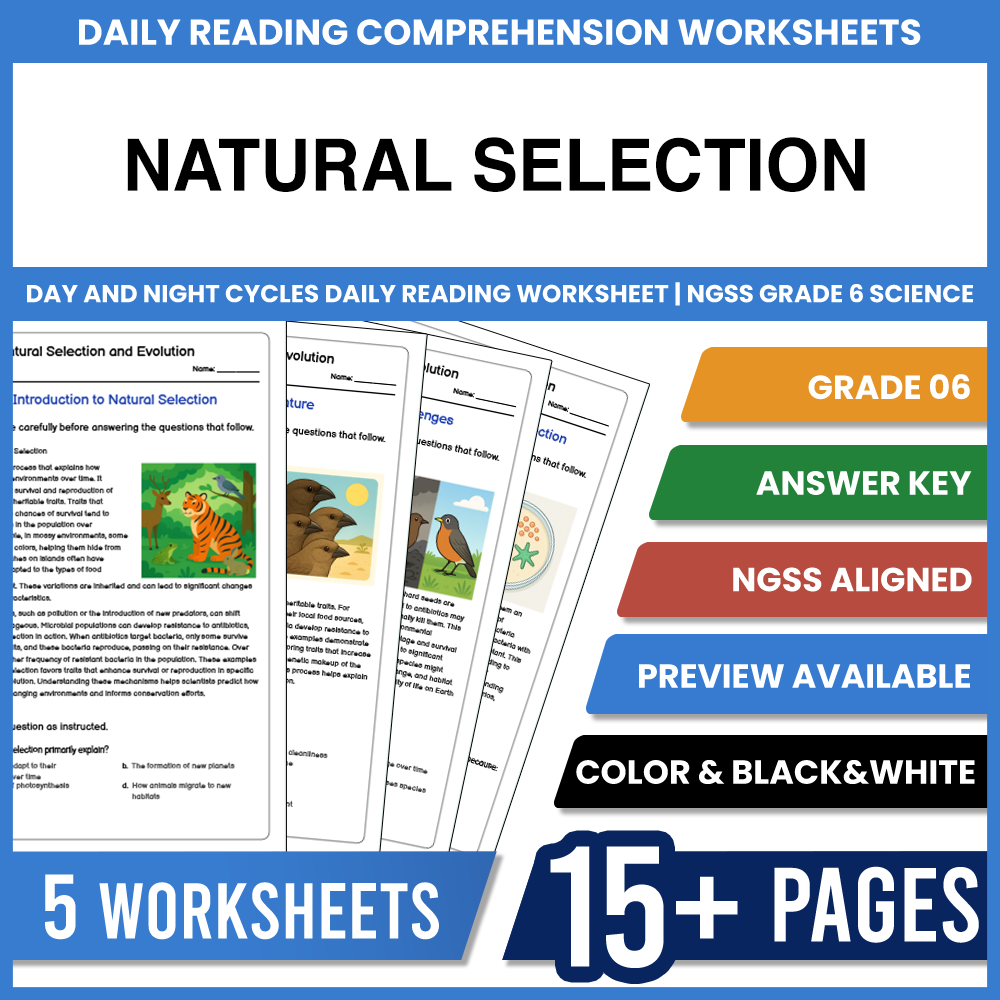
Grade 6 Science – Chemical Reactions & NGSS Daily Reading Worksheet
 Created byElena Brooks
Learning Objectives
- Identify key indicators of chemical reactions such as color change, gas evolution, precipitate formation, and temperature change.
- Analyze qualitative and quantitative data to determine if a chemical reaction has occurred.
- Understand basic examples of chemical reactions like acid–carbonate reactions and metal oxidation.
Also included in: Grade 6 Science Matter and Its Interactions Lesson Bundle | NGSS +1 more
Instant download

Chemical Indicators Worksheet | Standards-Aligned Practice for Grade 6 Science
JCreated byJ.S SheetsLearning Objectives
- Identify observable signs that indicate a chemical reaction has occurred.
- Describe different chemical indicators such as gas production, precipitate formation, color change, energy emission, and light or sound release.
- Explain why multiple indicators are needed to confirm a chemical change rather than relying on a single sign.
Instant download
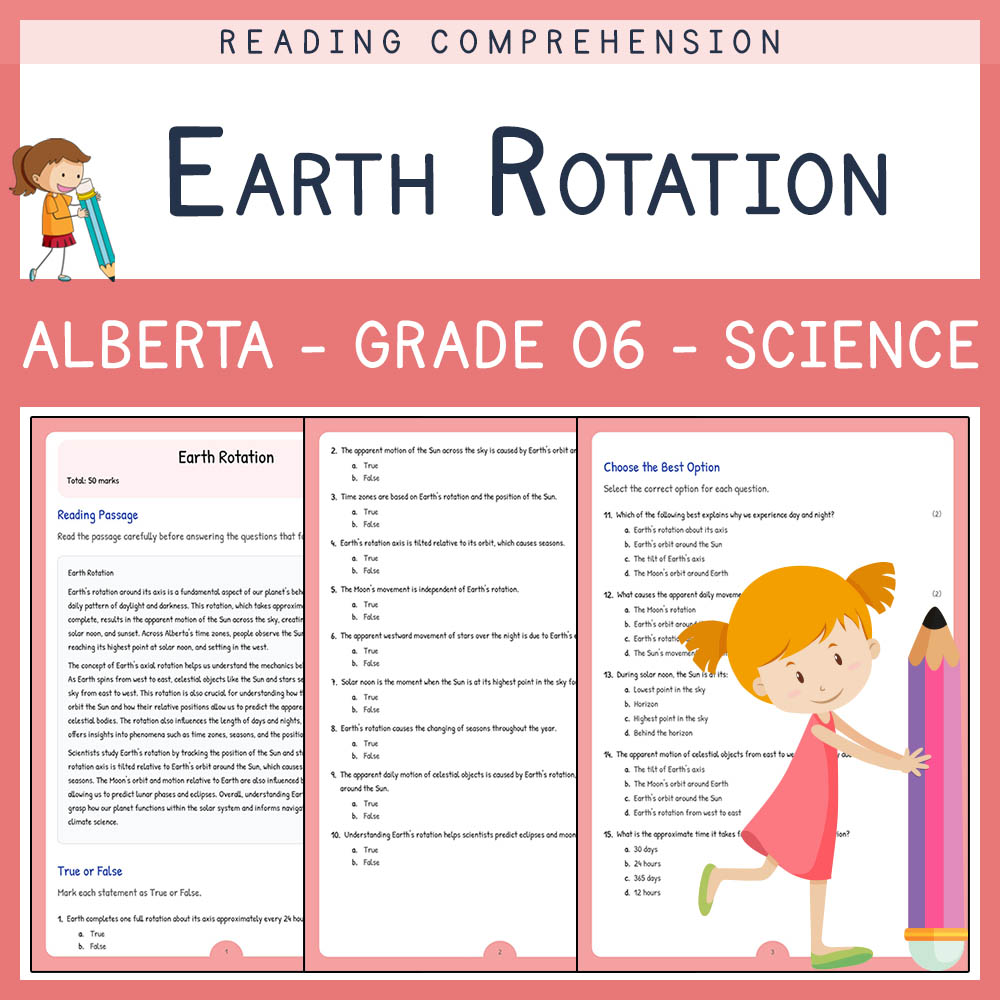
Grade 6 Science Assessment | Earth Rotation Worksheet Elena | Alberta
 Created byLumora Learning
Learning Objectives
- Understand the concept of Earth's rotation and how it causes day and night.
- Explain the apparent motion of celestial objects due to Earth's rotation.
- Describe how Earth's rotation influences the sequence of sunrise, noon, and sunset.
Instant download

Grade 6 Science – Condensation & Clouds | Daily Reading Worksheet
 Created byBright Mind Resources
Learning Objectives
- Understand the process of condensation in the atmosphere
- Identify how clouds form from water vapor
- Explain the effects of clouds on Earth's energy balance
Also included in: Water Cycle Grade 6 Science Lesson Bundle Daily Reading | California Standards +1 more
Instant download

Criteria and Constraints in Engineering Design Worksheets Grade 6
Created byBRIGHT PATH RESOURCESLearning Objectives
- Explain the difference between criteria and constraints in a design process
- Identify criteria and constraints in a scenario and justify each classification
- Describe how constraints shape the possible solutions a designer can choose
Also included in: Grade 6 Engineering Design Worksheets | Criteria & Constraints Bundle +2 more
Instant download

Design Problem Criteria and Constraints Worksheets Grade 6 Science
Created byBRIGHT PATH RESOURCESLearning Objectives
- Identify a design need and measurable requirements in a design scenario
- Describe how sketches, dimensions, and constraints help generate and improve solution ideas
- Use criteria to evaluate which solution best reduces damage while meeting limits
Also included in: Grade 6 Engineering Design Worksheets | Criteria & Constraints Bundle +2 more
Instant download

Science Grade 6 Worksheet | Atomic Composition Models and Formulas NGSS
 Created bySkylark Worksheets
Learning Objectives
- Use ball-and-stick and space-filling models to describe how atoms are arranged in simple molecules and extended structures.
- Interpret chemical formulas to determine relative atom types and counts in H2O and NaCl.
- Explain how repeating units build polymer chains and how ionic lattices differ from molecules.
Also included in: Grade 6 Matter and Chemical Reactions Science Lesson Bundle NGSS Worksheets +1 more
Instant download
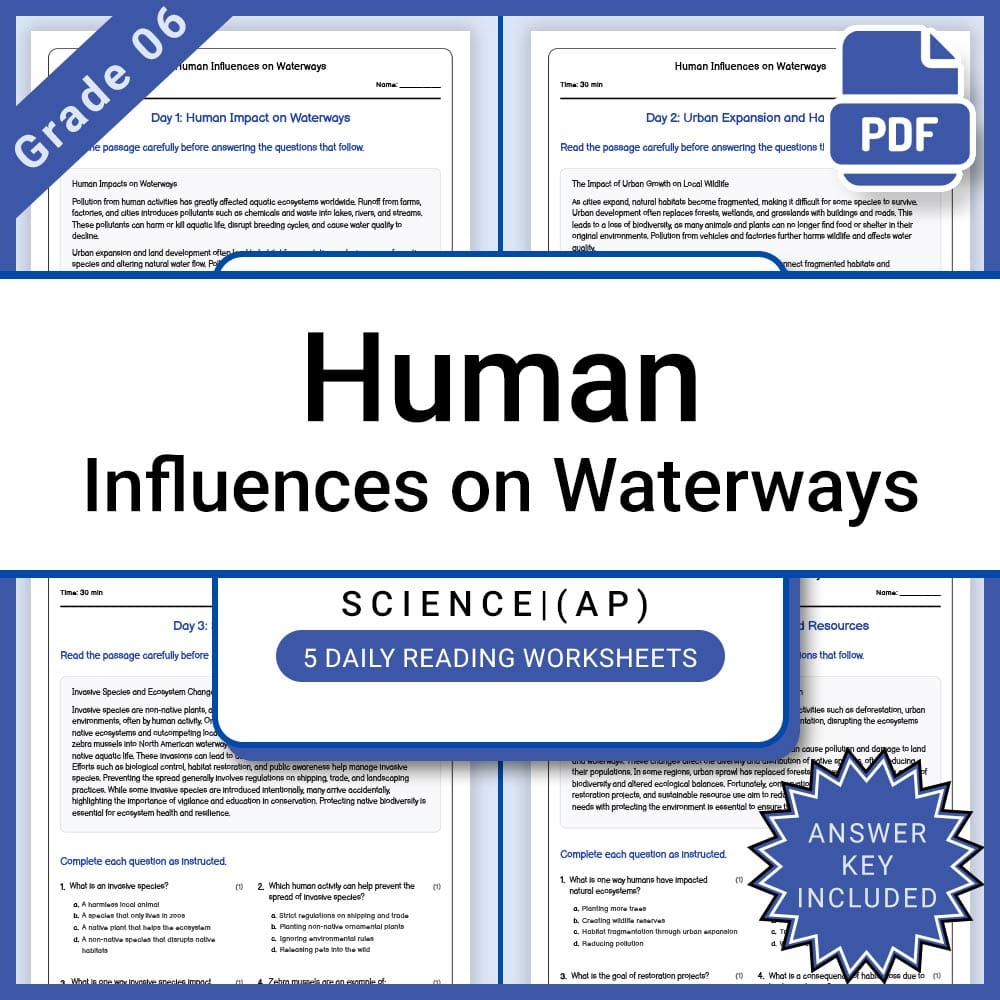
Grade 6 Science – Human Influences on Waterways Worksheet + Answer Key
JCreated byJ.S SheetsLearning Objectives
- Understand how pollution impacts aquatic ecosystems.
- Identify examples of human influence on waterways.
- Learn strategies to reduce pollution and protect water habitats.
Also included in: Grade 6 Science Lesson Bundle: Ecosystems, Food Chains & Environment +1 more
Instant download

Grade 6 Structural Traits Worksheet | NGSSS Life Science Adaptations Resource
Created byEvergreen Desk EducationLearning Objectives
- Describe how structural adaptations help organisms obtain food, move efficiently, and survive predators.
- Explain how physical features relate to an organism’s habitat and survival needs.
- Use evidence from examples (shells, webbed feet, roots, camouflage) to identify the function of a trait.
Instant download

Geologic History Worksheet | Grade 6 Science Activities
Created byPrism Point LearningLearning Objectives
- Explain how relative dating and absolute dating are used to order and estimate the ages of rocks and events.
- Describe how geologic time scale divisions and fossil succession provide evidence for Earth’s history.
- Interpret stratigraphic relationships, including unconformities, to reconstruct past environments and tectonic episodes.
Also included in: Grade 6 Earth and Space Science Lesson Bundle TEKS (8 worksheets) +1 more
Instant download

Grade 6 Science | Filtration and Sieving Worksheet | BC Standards
Created byLumora LearningLearning Objectives
- Understand the processes of filtration and sieving and how they separate mixtures.
- Identify different porous materials used in filtration and sieving.
- Explain the differences and similarities between filtration and sieving.
Instant download

Conductor Properties Science Worksheet Grade 6 Electricity Ontario
 Created byChalk and Compass
Learning Objectives
- Explain how free electrons in metals allow electrical charge to move (conductivity).
- Compare how material type, temperature, and cross-sectional area affect conductivity.
- Describe why high-conductivity materials are useful in real electrical devices.
Also included in: Grade 6 Science Circuits & Electricity Lesson Bundle | Ontario +1 more
Instant download

Grade 6 Aircraft Stability Modes Worksheet | Ontario Science Activities
 Created byTeacher's Corner
Learning Objectives
- Distinguish static and dynamic stability in aircraft motion
- Explain how center of gravity position affects pitch stability
- Describe how wing dihedral angle and tail/fin design support roll and directional stability
Instant download

Grade 6 Science – Trophic Interactions & Ecosystem Relationships | Worksheet
Created byBright Mind ResourcesLearning Objectives
- Understand the basic concepts of trophic interactions including predation, herbivory, parasitism, competition, and mutualism.
- Recognize examples of each trophic interaction in ecosystems.
- Explain how trophic interactions influence community structure and energy flow.
Also included in: Grade 6 Ecosystem Relationships Science Daily Reading Lesson Bundle | BC +1 more
Instant download

Science Worksheet Trait Heritability | Grade 6 Ontario Standards Practice
JCreated byJ.S SheetsLearning Objectives
- Explain what heritability means for variation in a population
- Distinguish genetic (heritable) influences from environmental influences on traits
- Describe how inheritance and natural selection can change allele frequencies over generations
Instant download

Competition and Resource Use Assessment for Grade 6 Science | General
Created byPrism Point LearningLearning Objectives
- Understand how organisms compete for limited resources in their environment.
- Identify different types of competition among species and within populations.
- Explain how resource competition influences population dynamics and community composition.
Instant download
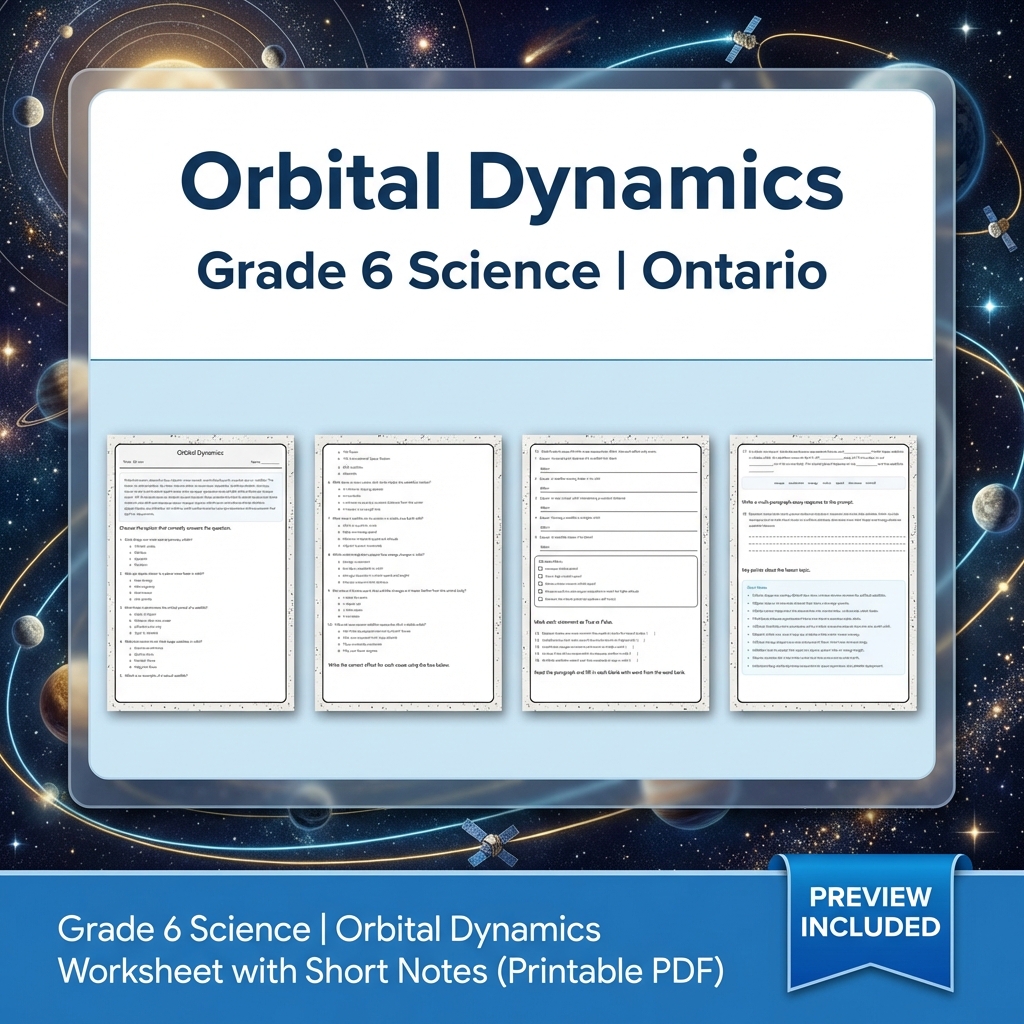
Grade 6 Science | Orbital Dynamics Worksheet with Short Notes (Printable PDF)
Created byMeadowlark WorksheetsLearning Objectives
- Understand the basic concepts of elliptical and near-circular orbits.
- Explain how orbital speed varies with distance from the central body.
- Describe the balance of gravitational force and inertia that maintains orbiting paths.
Also included in: Grade 6 Science Lesson Group Bundle – Ontario Curriculum Worksheets +1 more
Instant download

Grade 6 Science | Design Problem Worksheet | General Standard
Created byLumora LearningLearning Objectives
- Explain what it means to start a design problem with a clear need and measurable requirements
- Identify how sketches, dimensions, performance goals, and constraints guide engineering solutions
- Apply the design process to a real-life example by proposing and justifying design choices
Instant download

Grade 6 Science | Physical Properties Worksheet | BC Aligned
Created byLumora LearningLearning Objectives
- Understand and identify various physical properties of matter.
- Distinguish between physical and chemical changes in substances.
- Learn how to observe and measure properties like mass, volume, density, and hardness.
Instant download

6th Grade Science Workbook – Geologic History & Earth’s Changes (TEKS)
Created byEvergreen Desk EducationLearning Objectives
- Explain how relative dating and stratigraphic principles help determine the sequence of geologic events.
- Describe how absolute dating (radiometric dating) estimates the ages of rocks and geologic events.
- Interpret the geologic time scale and fossil succession to reconstruct Earth’s past environments.
Instant download

Grade 6 Science | Trade-off Decisions Worksheet with Short Notes (Printable PDF)
Created byMeadowlark WorksheetsLearning Objectives
- Understand how design choices involve trade-offs affecting features like strength, flexibility, and cost.
- Identify different properties that influence design decisions and their impact on user needs and constraints.
- Analyze how improvements in one property can affect other properties or limitations.
Also included in: Grade 6 Science Lesson Bundle | Critical Thinking & Problem Solving +1 more
Instant download

Chemical Evidence Assessment | California Standards Grade 6 Science
Created byPrism Point LearningLearning Objectives
- Identify observable indicators that a chemical reaction has occurred.
- Differentiate chemical evidence from signs of physical change.
- Connect evidence of new substances to particle-level rearrangements.
Also included in: Grade 6 Atoms and Chemical Change Science lesson bundle | California Standards +1 more
Instant download
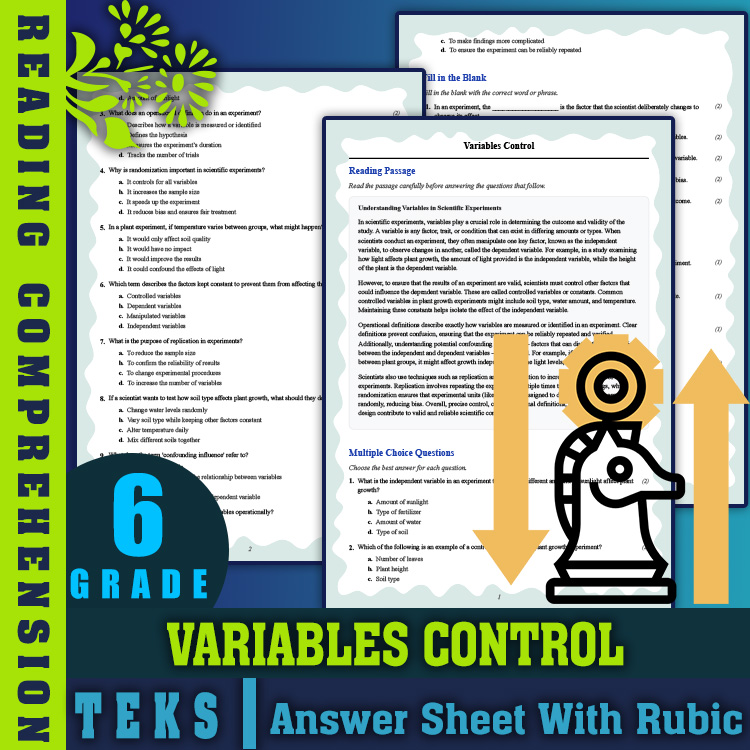
6th Grade Science | Variables Control Reading Worksheet & Answer Key (PDF)
JCreated byJ.S SheetsLearning Objectives
- Understand the roles of independent, dependent, and controlled variables in experiments.
- Identify operational definitions and potential confounding influences in controlled testing designs.
- Apply concepts of control, replication, and randomization to experiments involving plant growth under varied light conditions.
Instant download

6th Grade Science – Forces and Motion Worksheet | Balanced vs. Unbalanced Forces (PDF)
Created byEvergreen Desk EducationLearning Objectives
- Explain how net force affects an object’s motion by changing speed or direction
- Differentiate balanced forces and unbalanced forces using real-life examples
- Use evidence from everyday situations to infer whether forces are balanced or unbalanced
Also included in: Grade 6 Heat and Matter Science Lesson Bundle for General Framework +1 more
Instant download

Grade 6 Disturbance Regimes Worksheet | Practice & Assessment PDF
Created byClear Sky ClassroomLearning Objectives
- Explain what disturbance regimes are and how fire and other disturbances shape forests.
- Describe how frequency, intensity, and spatial extent affect regeneration and succession.
- Use evidence from text to identify main ideas and support claims about forest change.
Also included in: Grade 6 Biodiversity & Plant Ecosystems Science Lesson Bundle | Alberta +1 more
Instant download

Grade 6 Cell Functions Science Worksheet | NGSS Life Science Activity
Created byBRIGHT PATH RESOURCESLearning Objectives
- Understand key concepts related to Science
- Apply knowledge through practice questions
- Demonstrate comprehension of the material
Also included in: From Molecules to Organisms Lesson Bundle | Grade 6 Science | NGSS +2 more
Instant download

6th Grade Science – Understanding Charge Concepts Worksheet (PDF)
Created byEvergreen Desk EducationLearning Objectives
- Define electric charge and explain how charge separation can happen.
- Compare static electricity (accumulated charge on insulators) with current electricity (flowing charge through conductors).
- Use macroscopic observations (hair attraction, sparks) to describe charge imbalance.
Also included in: Grade 6 Electricity Circuits Science Lesson Bundle for Ontario Worksheets +1 more
Instant download

Grade 6 Science – Flight Forces Daily Reading Worksheet | Ontario Standards
Created byBright Mind ResourcesLearning Objectives
- Identify the four main aerodynamic forces that affect flight
- Describe how lift, drag, thrust, and weight interact
- Explain the concept of force vectors in flight
Also included in: Grade 6 Aerodynamics Science Lesson Bundle Daily Reading Worksheets | Ontario +1 more
Instant download

6th Grade Science | Solar Motions Worksheet (TEKS) PDF
Created byEvergreen Desk EducationLearning Objectives
- Explain how Earth’s revolution and axial tilt cause seasons and changes in solar heating.
- Describe orbital and gravitational interactions that produce predictable sky patterns, including day/night and apparent planetary motion.
- Model the Moon’s phases and eclipses using moon-sun-earth geometry.
Instant download

Grade 6 Science | Modeling Systems in Science - Daily Reading Comprehension
 Created byCoral Reef Learning
Learning Objectives
- Understand what physical models are and their purpose
- Identify features of physical models used in science
- Explain how models help us understand complex systems
Instant download

System Interactions Worksheet | NGSS Grade 6 Science Assessment PDF
JCreated byJ.S SheetsLearning Objectives
- Explain how Earth's systems interact through matter and energy transfers.
- Identify feedback mechanisms such as albedo changes, sediment transport, and nutrient movement.
- Describe energy sources, sinks, and phase-change energy transfers in Earth systems.
Also included in: Grade 6 Earth System Interactions Climate Science Lesson Bundle – NGSS +1 more
Instant download

6th Grade Science Worksheet | Earth Rotation & Day-Night Cycle (PDF)
 Created bySilver Birch Teaching
Learning Objectives
- Explain how Earth’s rotation about its axis causes the alternation of daylight and darkness.
- Describe how Earth’s rotation helps explain the apparent daily motion of the Sun and other celestial objects.
- Connect axial rotation to the timing of sunrise, solar noon, and sunset across different Alberta time zones.
Also included in: Grade 6 Celestial Motion & Seasons Science Lesson Bundle | Alberta +1 more
Instant download

Grade 6 Climate Systems Worksheet | NGSS Science Activities & Answer Key
 Created byNorthstar Worksheets
Learning Objectives
- Explain how unequal solar heating and Earth’s rotation create global atmospheric circulation patterns.
- Describe how ocean currents transport heat and moisture and influence regional climates.
- Connect trade winds, westerlies, and major climate-cell models to persistent climate zones.
Also included in: Weather, Water Cycle & Climate Systems Lesson Bundle | Grade 6 Science | NGSS +1 more
Instant download

Conservation Concepts Assessment | TEKS Grade 6 Science Standards
Created byPrism Point LearningLearning Objectives
- Understand the principle of mass conservation in closed systems during physical and chemical processes.
- Identify examples of mass conservation in sealed reactions and phase changes within closed containers.
- Explain how measurements before and after transformations support conservation conclusions.
Also included in: Lesson Bundle Grade 6 Matter and Energy Science Assessment | TEKS
Instant download

Pure Substances and Mixtures Worksheets | Grade 6 Science Review
LCreated byLearnora ResourcesLearning Objectives
- Classify substances as elements, compounds, or mixtures
- Compare homogeneous and heterogeneous mixtures using observable evidence
- Select appropriate physical methods for separating mixtures
Instant download

Grade 6 Science – Natural Resources & Conservation | Daily Reading Worksheet
Created byBright Mind ResourcesLearning Objectives
- Identify different types of natural resources
- Understand the distribution and formation of natural resources
- Recognize environmental and economic implications of resource use
Also included in: Grade 6 Earth and Space Science Lesson Bundle Daily Reading | TEKS +2 more
Instant download

Grade 6 Invasive Species Worksheet | BC Practice & Assessment PDF
Created byClear Sky ClassroomLearning Objectives
- Explain how invasive species spread and why they can grow rapidly in new environments
- Describe how invasive species can change food webs, habitats, and nutrient cycles
- Identify real-world impacts of invasive species on biodiversity and ecosystem services
Instant download

Grade 6 Scale of Space Science Worksheet | NGSS Earth & Space Science Activity
Created byBRIGHT PATH RESOURCESLearning Objectives
- Understand and explain the concept of astronomical units.
- Compare the sizes and distances of planets relative to Earth.
- Interpret data from tables and charts representing the solar system.
Also included in: Earth's Place in the Universe Grade 6 Science Worksheets Bundle | ngss +2 more
Instant download

Grade 6 Science | Conservation Concepts - Daily Reading Comprehension
Created byCoral Reef LearningLearning Objectives
- Identify what constitutes a closed system in physical and chemical processes.
- Observe and measure changes in mass before and after processes within closed containers.
- Understand the principle of conservation of mass in closed systems.
Instant download
About Grade 6 Science Worksheets
Explore Grade 6 Science worksheets for classwork, homework, or review. Our 5,969 printables download instantly as PDFs.
MyTeachingSheets worksheets are made by real teacher-authors and checked before they go live. Download any as a print-ready PDF for lessons, homework, or independent practice — most include answer keys, and previews are always free.