
Grade 6 Science Worksheets
5,969 worksheets
Grade 6 Stability Balance Worksheet | Practice & Assessment PDF
 Created byClear Sky Classroom
Learning Objectives
- Explain how static stability depends on the relationship between the center of mass and the center of pressure.
- Describe how design features such as dihedral angles and tail volume can improve longitudinal and lateral stability.
- Apply balance ideas to real situations involving changing payloads and changing wind conditions.
Also included in: Grade 6 Air and Aerodynamics Science Lesson Bundle (Alberta Framework) +1 more
Instant download

Population Change Worksheet Grade 6 Science Birth Death Rates Activity
 Created byPrism Point Learning
Learning Objectives
- Explain how birth rate, death rate, and resource availability affect population size over time.
- Interpret data trends to infer whether a population is increasing or decreasing and why.
- Use evidence from seasonal or habitat changes to support a population-change claim.
Also included in: Animals Matter Lesson Bundle | Grade 6 Science | California Standards
Instant download

Grade 6 Science – Tissue Types & Structures | Daily Reading Worksheet
 Created byBright Mind Resources
Learning Objectives
- Understand key concepts related to Science
- Apply knowledge through practice questions
- Demonstrate comprehension of the material
Also included in: Grade 6 Science Daily Reading Full-Year Bundle BC Curriculum Resource
Instant download

Grade 6 Science | Habitats & Niches - Daily Reading Comprehension
 Created byCoral Reef Learning
Learning Objectives
- Understand the difference between habitats and niches
- Identify different types of habitats
- Recognize how species compete and coexist within their environments
Instant download

Erosion and Deposition Worksheet Grade 6 Science Earth Processes
Created byPrism Point LearningLearning Objectives
- Explain how moving water erodes materials, transports sediment, and deposits it elsewhere.
- Describe how water volume, flow speed, and surface material affect erosion and deposition.
- Identify real-world landforms and deposits formed by deposition over time.
Also included in: Grade 6 Water Cycle Systems Lesson Bundle | California Standards
Instant download

Sustainability Strategies Worksheets: Earth & Human Activity Grade 6
 Created byTeachers Club
Learning Objectives
- Explain how population trends affect Earth system processes over time
- Compare conservation, renewable energy, and circular resource strategies
- Evaluate trade-offs among environmental, economic, and social priorities
Also included in: Earth and Human Activity Grade 6 Science NGSS Worksheets Bundle +2 more
Instant download

Grade 6 Science | Eclipses and Tides Worksheet (Ontario Standards)
 Created byEvergreen Desk Education
Learning Objectives
- Explain how solar and lunar eclipses happen due to alignment within the Earth–Moon–Sun system.
- Distinguish umbra and penumbra and relate them to what people can see during an eclipse.
- Describe how spring and neap tides result from the changing gravitational alignment of the Moon and Sun.
Also included in: Grade 6 Solar System Space Science Lesson Bundle – Ontario Worksheets +1 more
Instant download

Grade 6 Air Properties Worksheet | Practice & Assessment PDF
Created byClear Sky ClassroomLearning Objectives
- Explain how air composition affects air behavior
- Describe how air density changes with temperature and altitude
- Model how air pressure results from collisions between gas molecules
Also included in: Grade 6 Air and Aerodynamics Science Lesson Bundle (Alberta Framework) +1 more
Instant download

Grade 6 Science | Climate and Patterns Worksheet | NGSSS Aligned
 Created byLumora Learning
Learning Objectives
- Explain how climate differs from weather and why climate changes more slowly
- Identify major climate factors (latitude, altitude, distance from water, ocean currents, and prevailing winds)
- Use climate patterns to predict how different regions develop ecosystems such as deserts, grasslands, and rain forests
Instant download

Grade 6 Water Cycle Science Worksheet | NGSS Earth Science Activity
 Created byBRIGHT PATH RESOURCES
Learning Objectives
- Identify and describe the stages of the water cycle.
- Understand the processes of evaporation, condensation, precipitation, runoff, infiltration, and groundwater storage.
- Explain how solar energy and gravity drive water movement in the hydrosphere.
Also included in: Earth's Systems Grade 6 Science Daily Reading Worksheets Lesson Bundle | NGSS +2 more
Instant download

Grade 6 Science – Sun Earth Moon System & Reading Worksheet | Ontario Standards
Created byBright Mind ResourcesLearning Objectives
- Understand the relative sizes and distances among the Sun, Earth, and Moon
- Describe the gravitational interactions that keep the Earth and Moon in orbit
- Recognize the role of the Sun as the dominant gravitational influence
Also included in: Space Systems Grade 6 Science Daily Reading Worksheets Bundle | Ontario +1 more
Instant download

Food Chains Worksheet for Grade 6 Science | Standards-Aligned Practice
JCreated byJ.S SheetsLearning Objectives
- Understand the concept of food chains and their role in energy transfer.
- Identify producers, consumers, and trophic levels within a food chain.
- Explain how energy moves through different organisms in an ecosystem.
Also included in: Grade 6 Ecosystem Adaptations and Energy Flow Science Lesson Bundle | Florida NGSSS +1 more
Instant download

Behavioral Strategies Worksheet | Standards-Aligned Grade 6 Science Practice
JCreated byJ.S SheetsLearning Objectives
- Understand different behavioral adaptations and their roles in survival.
- Identify examples of behaviors like migration, hibernation, nest building, and burrowing.
- Explain how seasonal behaviors help organisms cope with environmental changes.
Also included in: Grade 6 Ecosystem Adaptations and Energy Flow Science Lesson Bundle | Florida NGSSS +1 more
Instant download

Grade 6 TEKS Structures and Functions Daily Science Reading Worksheet
Created byBRIGHT PATH RESOURCESLearning Objectives
- Identify the main idea and key details about how plant roots and stems help an organism survive.
- Explain how roots take in water and minerals and how stems move substances through vascular tissues.
- Use structure and function vocabulary to describe xylem and phloem.
Also included in: TEKS Ecosystems Grade 6 Science Daily Reading Worksheets Lesson Bundle | TEKS +1 more
Instant download

Grade 6 Science – Defense Interactions & Immune System | Daily Reading Worksheet
Created byBright Mind ResourcesLearning Objectives
- Understand the role of skin and mucous membranes as first-line defenses.
- Identify components of the innate immune response.
- Describe how immune cells coordinate pathogen removal.
Also included in: Grade 6 Science: Organ Systems & Adaptations Daily Reading Lesson Bundle | BC +1 more
Instant download

Grade 6 Science | Diffusion Rates in Science - Daily Reading Comprehension
Created byCoral Reef LearningLearning Objectives
- Understand the concept of diffusion and how particles move from high to low concentration.
- Identify real-life examples of diffusion in everyday situations.
- Explain how temperature, particle size, and medium viscosity influence diffusion rates.
Instant download

Grade 6 Energy Transfer Limits Worksheet with Answer Key | Florida NGSSS Science
Created byEvergreen Desk EducationLearning Objectives
- Explain why energy transfer between trophic levels is not 100% efficient
- Describe how energy loss (especially as heat) limits the number of top predators in food webs
- Predict how removing a key organism can affect populations across multiple trophic levels
Instant download

Grade 6 Science – Structures & Functions in Plants & Animals | Reading Worksheet
Created byBright Mind ResourcesLearning Objectives
- Identify major plant structures such as roots, stems, and leaves
- Understand the functions of plant vascular tissues like xylem and phloem
- Describe basic animal organ systems and their roles in maintaining life
Also included in: Ecosystems Grade 6 Science Daily Reading Worksheets Lesson Bundle | TEKS +2 more
Instant download

Chemical Energy Release Worksheet for Grade 6 Science
JCreated byJ.S SheetsLearning Objectives
- Understand how chemical energy stored in food molecules is transformed to support organism activities.
- Describe the process of energy change and transfer within living organisms during cellular work.
- Explain why feeding is essential for sustained bodily functions over time.
Also included in: Grade 6 Life Science Science Lesson Bundle – California Standards +1 more
Instant download

Grade 6 Science Invasive Species Worksheet with Short Notes PDF
 Created byMeadowlark Worksheets
Learning Objectives
- Understand how invasive species introduce pathways and impacts ecosystems.
- Describe competition, predation, and ecosystem changes caused by non-native organisms.
- Identify regional examples of invasive species and their effects on native food webs.
Also included in: Grade 6 Science Lesson Bundle for Ontario | Ecosystems & Genetics +1 more
Instant download

Grade 6 Science – Science & Technology Daily Reading Worksheet | TEKS Aligned
Created byBright Mind ResourcesLearning Objectives
- Understand how microscopes are tools that extend observation into the tiny world.
- Recognize the reciprocal relationship between scientific investigation and technological development.
- Identify examples of instruments that aid in testing hypotheses and refining models.
Also included in: Grade 6 Science and Society Lesson Bundle Daily Reading Worksheets | TEKS +2 more
Instant download

Adaptation and Speciation Worksheet | NGSS Grade 6 Evolution Activity
 Created byNorthstar Worksheets
Learning Objectives
- Explain how adaptations can spread through populations over generations
- Describe how reproductive isolation contributes to speciation
- Identify evidence scientists use to support claims that new species formed
Also included in: Grade 6 NGSS Evolution & Common Ancestry Lesson Bundle | Science +1 more
Instant download

Science Communicating Evidence Worksheet | Standards-Aligned Grade 6
JCreated byJ.S SheetsLearning Objectives
- Explain how claims, evidence, and reasoning are connected in a scientific argument.
- Identify what makes evidence relevant and how visuals (graphs, diagrams, models) support conclusions.
- Use audience-appropriate formats to communicate scientific ideas clearly and credibly.
Instant download

Patterns in the Fossil Record Worksheets NGSS Grade 6 Science Activity
 Created byWorld Paper Hub
Learning Objectives
- Explain how stratigraphic order supports relative dating of fossils
- Describe how fossil occurrences can show patterns of diversification and extinction over time
- Use evidence from fossil transitions and geographic distribution to support lineage continuity and turnover
Instant download

Grade 6 Science | Data Representations in Science - Reading Comprehension Practice
Created byCoral Reef LearningLearning Objectives
- Understand key concepts related to Science
- Apply knowledge through practice questions
- Demonstrate comprehension of the material
Instant download

Grade 6 Optimizing Designs Worksheet | NGSS Practice & PDF
Created byClear Sky ClassroomLearning Objectives
- Analyze data from comparative tests to identify performance characteristics and trade-offs.
- Use graphs, averages, and error discussions to support design optimization.
- Evaluate strategies that balance competing goals such as strength versus weight or cost versus durability.
Also included in: Grade 6 Engineering Design Science Lesson Bundle for NGSS +1 more
Instant download

6th Grade Science | Policy and Decisions Worksheet (TEKS PDF)
Created byEvergreen Desk EducationLearning Objectives
- Explain how scientific evidence is used to inform policy decisions about complex societal problems.
- Describe how risk assessment and uncertainty affect decision-making choices.
- Use cost-benefit reasoning and stakeholder values to justify a policy or response strategy.
Instant download

Grade 6 Science – Circuits Series & Parallel | Daily Reading Worksheet
Created byBright Mind ResourcesLearning Objectives
- Understand the difference between series and parallel electrical circuits.
- Identify components in series and parallel arrangements.
- Explain how current and voltage behave in different circuit types.
Also included in: Grade 6 Daily Reading Science Worksheets | Lesson Bundle | BC Framework +1 more
Instant download

Grade 6 Science | Adaptation and Speciation Daily Reading Worksheet
Created byCoral Reef LearningLearning Objectives
- Understand the basic concepts of adaptation and speciation
- Identify examples of adaptation in nature
- Recognize evidence for speciation events
Instant download

Grade 6 Comparing Kite Flight in Prairie Crosswinds Science Worksheet
Created byBRIGHT PATH RESOURCESLearning Objectives
- Identify the main idea of a passage about kite flight performance.
- Use key details to explain how lift and drag affect glide behavior in kites.
- Describe how control responsiveness differs when wind direction changes.
Also included in: Aerodynamics & Flight Physics Grade 6 Science Worksheets Bundle | Alberta +1 more
Instant download

Energy Transfer Limits Worksheet Grade 6 Science NGSSS Florida
Created byPrism Point LearningLearning Objectives
- Explain how energy transfer between trophic levels is limited by energy used for life processes and energy lost as heat.
- Describe how energy loss affects the number of trophic levels and the size of populations in food webs.
- Interpret cause-and-effect relationships in ecosystems when a key food source is removed.
Instant download

Grade 6 Science | Operational Definitions in Science - Reading Comprehension
Created byCoral Reef LearningLearning Objectives
- Learn how operational definitions specify measurement methods for scientific concepts.
- Identify different measurement protocols used in environmental science.
- Understand the importance of clarity and consistency in scientific measurements.
Also included in: Evidence and Investigation Lesson Bundle | Grade 6 Science | Alberta +1 more
Instant download

Grade 6 Science | Material Cycling Worksheet | California Standards
Created byLumora LearningLearning Objectives
- Explain how weathering breaks down rocks into sediments.
- Describe how sediments are transported and deposited to rebuild layers over time.
- Connect biological processes to the formation of soil and nutrient cycling.
Instant download

Measurement Uncertainty Worksheet | Grade 6 Science Activities
Created byPrism Point LearningLearning Objectives
- Explain what measurement uncertainty means and why measurements can vary.
- Identify common sources of uncertainty in scientific observations and instruments.
- Use simple strategies (repeated measures, ranges, and percent error) to estimate uncertainty.
Instant download

6th Grade Science Worksheet | Plant Matter Inputs Aligned to California Standards (PDF)
Created byEvergreen Desk EducationLearning Objectives
- Explain how plants use matter from the environment to build plant structures and biomass.
- Describe the roles of carbon dioxide, water, and oxygen exchange in plant growth and functioning.
- Model how plant systems take in inputs and transform them into living tissue.
Instant download

Human Impacts on Forest Ecosystems Worksheets Grade 6 Science
 Created bySunny Desk Resources
Learning Objectives
- Describe how human activities can change forest habitats over time
- Explain how fragmentation, pollution, and invasive species can affect species and ecosystems
- Use evidence from a passage to answer questions about ecological impacts
Also included in: Trees and Forests Grade 6 Alberta Science Worksheets Bundle +1 more
Instant download

Grade 6 Science – Alberta Seasons Daily Reading Worksheet | Standards-Aligned
Created byBright Mind ResourcesLearning Objectives
- Understand the concepts of seasonal changes in Alberta.
- Identify how latitude, climate, and solar geometry influence seasonal patterns.
- Describe environmental effects of spring in Alberta, including ecosystem and agricultural impacts.
Also included in: Grade 6 Solar System & Seasons Science Daily Reading Lesson Bundle | Alberta +2 more
Instant download

Adaptation Basics Worksheet Grade 6 Science | Ontario Curriculum Activity
 Created byChalk and Compass
Learning Objectives
- Explain how adaptations (structural, behavioral, and physiological) help organisms survive and reproduce in specific niches.
- Distinguish inherited traits from acquired characteristics and identify examples of each.
- Describe how environmental pressures can change which traits become more common in a population over generations.
Also included in: Grade 6 Science Ecosystems, Adaptations & Biodiversity Lesson Bundle | Ontario +1 more
Instant download

Series and Parallel Circuits Practice Worksheet | Grade 6 Science Assessment
Created byPrism Point LearningLearning Objectives
- Compare how current and voltage behave in series versus parallel circuits
- Explain how circuit breaks affect series circuits and how branches behave in parallel circuits
- Use circuit reasoning to predict changes in brightness and device reliability
Also included in: Energy, Waves & Circuits Lesson Bundle | Grade 6 Science | BC Framework +1 more
Instant download

Inherited Adaptations Assessment | NGSSS Grade 6 Science Standards
Created byPrism Point LearningLearning Objectives
- Explain how inherited adaptations help organisms survive and reproduce in specific environments.
- Identify examples of adaptations related to feeding, protection, and tolerance to temperature or moisture.
- Distinguish inherited adaptations from individual behaviors or short-term responses.
Also included in: Grade 6 Ecosystems Science Lesson Bundle | Florida NGSSS Assessment
Instant download

Science Grade 6 Worksheet | Combined Circuits Series-Parallel Networks
JCreated byJ.S SheetsLearning Objectives
- Identify series and parallel sections within a mixed (combined) circuit by using circuit nodes and shared current paths
- Explain how current and voltage distribute in series versus parallel parts of a combined circuit
- Predict changes in brightness and meter readings when a component in series or in parallel fails
Instant download

Streamlining Science Worksheet | Grade 6 Assessment & Practice PDF
JCreated byJ.S SheetsLearning Objectives
- Understand how shape influences aerodynamic resistance and flow.
- Identify principles such as tapered tails, rounded noses, and surface smoothness in streamlining.
- Connect design features to practical examples like aircraft cowlings and farm equipment.
Instant download

Grade 6 Science | Decomposers and Nutrients Worksheet | BC Aligned
Created byLumora LearningLearning Objectives
- Understand the role of decomposers in nutrient cycling and ecosystem health.
- Identify different types of decomposers and their functions.
- Explain factors that influence decomposer efficiency and activity.
Instant download

Science Worksheet: Population Dynamics Grade 6 | NGSS Science Assessment
 Created bySkylark Worksheets
Learning Objectives
- Use proportional reasoning to interpret how trait frequencies and population sizes change over generations.
- Analyze time-series and frequency patterns to describe growth, decline, stabilization, and bottlenecks.
- Connect allele-frequency tables and simple models to predictions about traits in offspring.
Also included in: Grade 6 Evolution Evidence and Natural Selection Science Lesson Bundle NGSS +1 more
Instant download

Grade 6 Water Cycle Worksheet | NGSS Practice & PDF
Created byClear Sky ClassroomLearning Objectives
- Describe the processes involved in the water cycle, including evaporation, condensation, precipitation, runoff, infiltration, and groundwater storage.
- Explain how solar energy and gravity drive the movement of water through different reservoirs in the hydrosphere.
- Use conceptual and graphical models to trace water mass transfer and energy flows within the water cycle.
Also included in: Grade 6 Earth's Systems Science Lesson Bundle (NGSS-Aligned) Worksheets +1 more
Instant download

Abiotic Influences in Habitats Assessment | TEKS Grade 6 Science
Created byPrism Point LearningLearning Objectives
- Identify key abiotic factors that influence habitat conditions.
- Explain how temperature, water, light, soil, pH, and salinity affect organism distribution.
- Analyze examples of abiotic impacts on ecosystems and species behavior.
Instant download
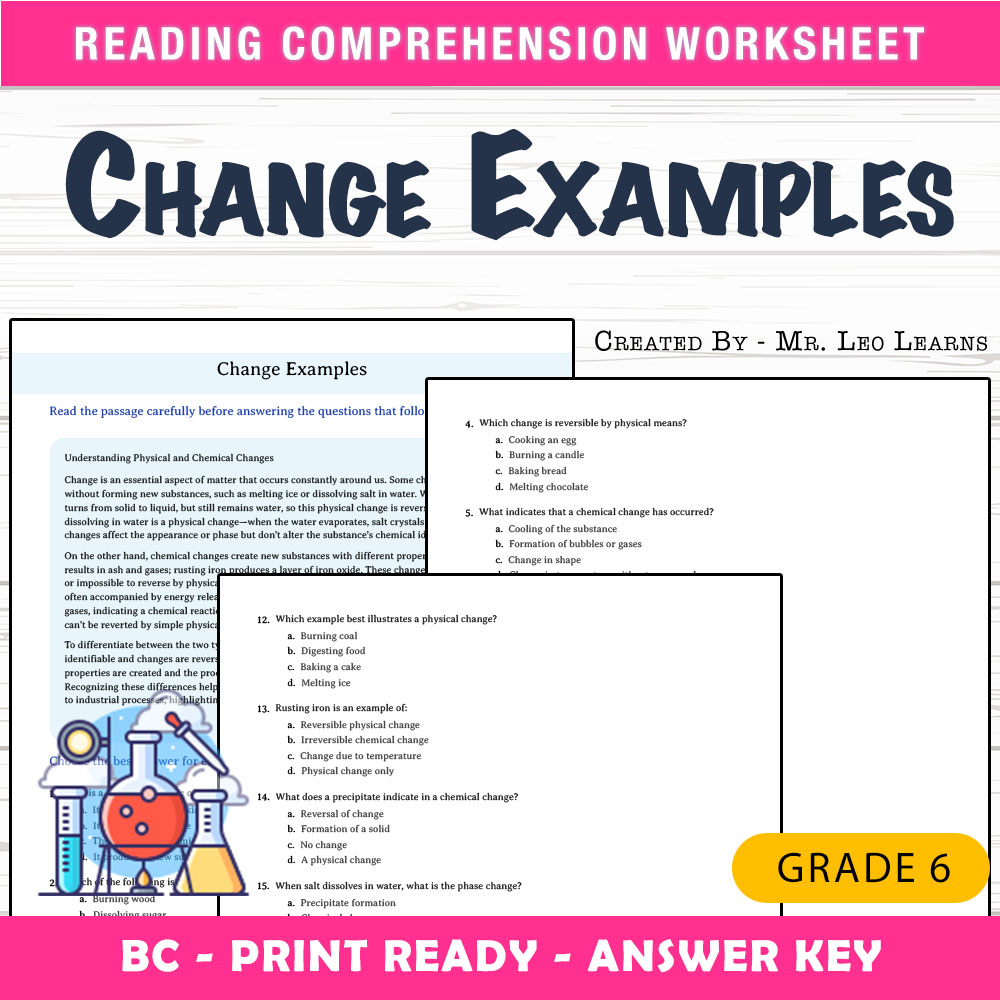
Grade 6 Science — Change Examples Worksheet MCQ Paper
 Created byThe Resource Hub
Learning Objectives
- Identify different types of physical and chemical changes through concrete examples.
- Distinguish between reversible physical changes and often irreversible chemical changes.
- Analyze products of changes to determine if a new substance has been formed.
Also included in: Grade 6 Science | Matter, Properties & Change Worksheet Bundle (BC Framework) +1 more
Instant download

Apparent Motion Practice Worksheet | Grade 6 Science | Ontario
Created byPrism Point LearningLearning Objectives
- Explain how Earth’s rotation and orbit make the Sun, Moon, and stars appear to move across the sky.
- Define diurnal rising and setting and describe what observers see from Earth.
- Describe the roles of the horizon and the celestial sphere in understanding apparent stellar paths.
Also included in: Grade 6 Space Systems Science Lesson Bundle for Ontario (10 Worksheets)
Instant download
About Grade 6 Science Worksheets
Explore Grade 6 Science worksheets for classwork, homework, or review. Our 5,969 printables download instantly as PDFs.
MyTeachingSheets worksheets are made by real teacher-authors and checked before they go live. Download any as a print-ready PDF for lessons, homework, or independent practice — most include answer keys, and previews are always free.