
Grade 7 Science Worksheets
6,039 worksheets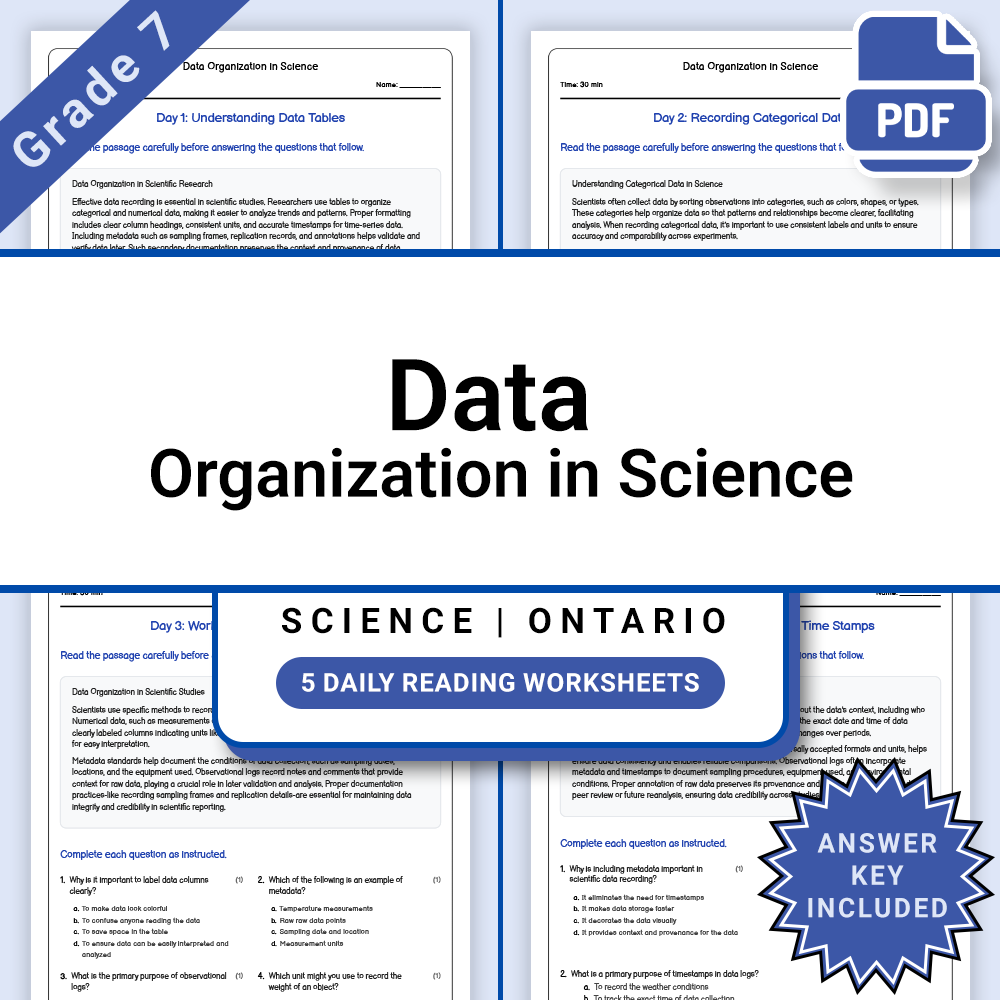
Grade 7 Science – Data Organization Daily Reading Worksheet with Answer Key
JCreated byJ.S SheetsLearning Objectives
- Understand the importance of organized data presentation in scientific research.
- Identify different types of data structures such as tables and logs.
- Learn proper formatting standards including units, column headings, and timestamps.
Also included in: Grade 7 Science Lesson Bundle | Ontario Curriculum Reading Worksheets +1 more
Instant download
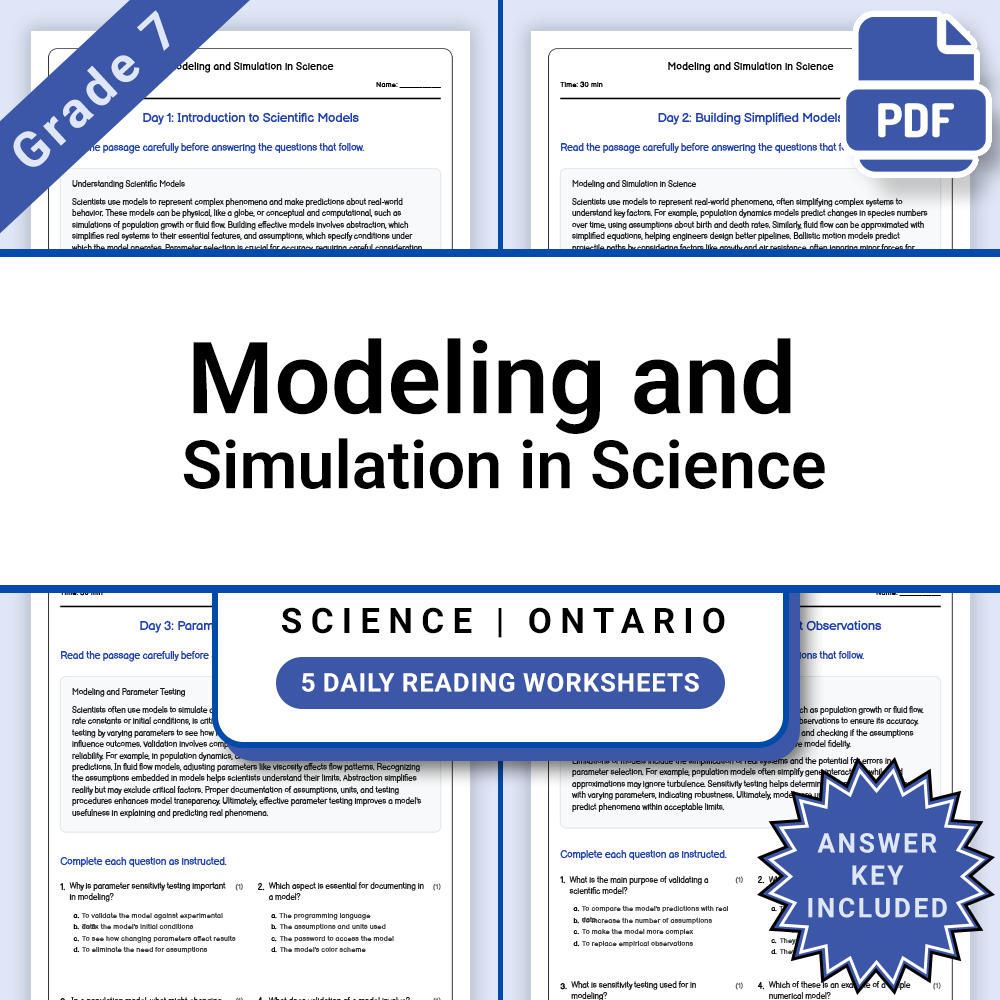
Grade 7 Science – Modeling and Simulation Daily Reading Worksheet + Answer Key
JCreated byJ.S SheetsLearning Objectives
- Understand key concepts related to Science
- Apply knowledge through practice questions
- Demonstrate comprehension of the material
Also included in: Grade 7 Science Lesson Bundle | Ontario Curriculum Reading Worksheets +1 more
Instant download
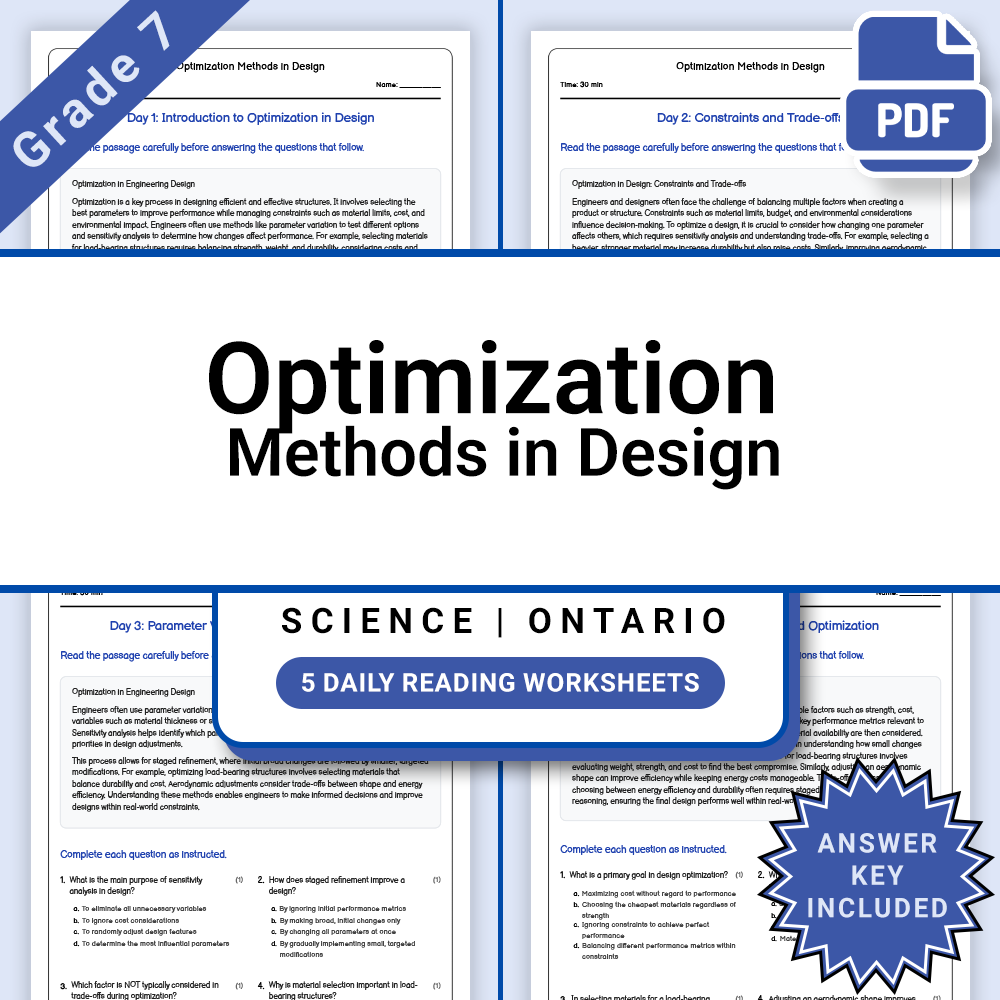
Grade 7 Science – Optimization Methods in Design Daily Worksheet + Answer Key
JCreated byJ.S SheetsLearning Objectives
- Understand the concept of optimization in engineering design.
- Identify what performance metrics are and how they are used.
- Learn how to manage constraints during optimization.
Also included in: Grade 7 Science Lesson Bundle | Ontario Curriculum Reading Worksheets +1 more
Instant download
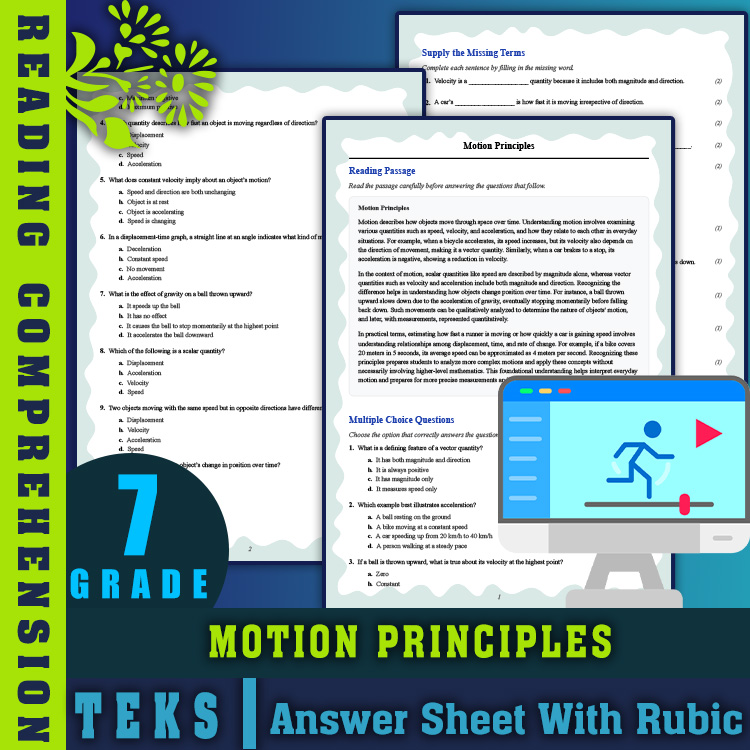
7th Grade Science | Motion Principles Reading Worksheet & Answer Key (PDF)
JCreated byJ.S SheetsLearning Objectives
- Understand the difference between speed, velocity, and acceleration
- Identify scalar and vector quantities related to motion
- Interpret motion scenarios qualitatively, including constant and changing motion
Instant download
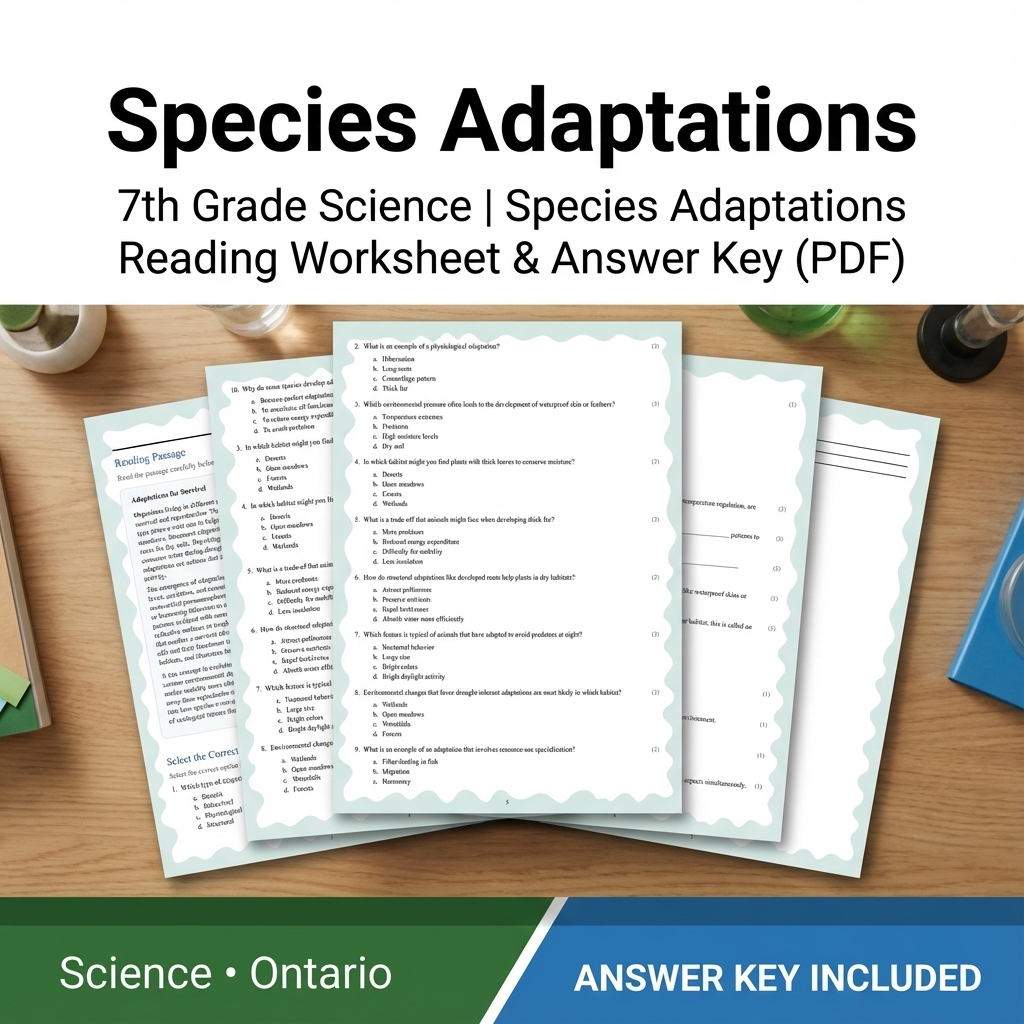
7th Grade Science | Species Adaptations Reading Worksheet & Answer Key (PDF)
JCreated byJ.S SheetsLearning Objectives
- Identify different types of adaptations: structural, physiological, and behavioral.
- Understand how environmental pressures influence adaptation traits.
- Relate adaptation traits to specific habitats such as wetlands, forests, and open meadows.
Also included in: Grade 7 Science | Ecosystems, Biodiversity & Environmental Stewardship +1 more
Instant download

Grade 7 Science Worksheet | Understanding Balanced Forces (PDF)
 Created byEvergreen Desk Education
Learning Objectives
- Explain equilibrium as a state where net force is zero and motion does not change
- Differentiate static equilibrium from dynamic equilibrium using examples and force diagrams
- Identify balanced force pairs and predict how structures respond to gravity and wind
Instant download
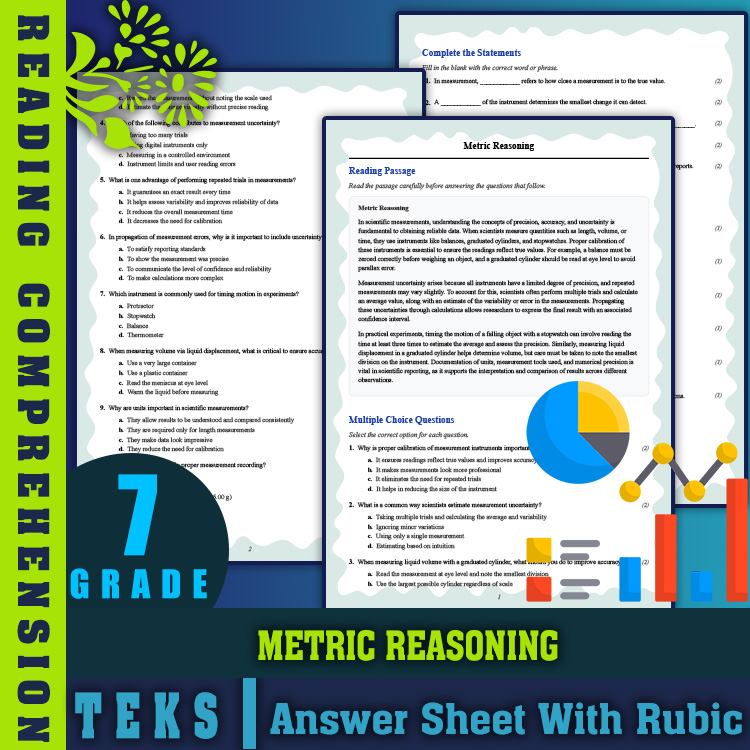
7th Grade Science | Metric Reasoning Reading Worksheets with Answer Key (PDF)
JCreated byJ.S SheetsLearning Objectives
- Understand the importance of measurement precision and uncertainty in scientific observations.
- Learn how to properly calibrate and select measurement instruments for accurate data collection.
- Develop skills in estimating measurement uncertainty and propagating errors in calculations.
Instant download

Design Optimization Worksheet | NGSS Grade 7 Science Assessment
 Created byCedar Grove Learning
Learning Objectives
- Analyze test data to identify factors affecting design performance.
- Refine design parameters through iterative testing and data comparison.
- Use quantitative data to justify modifications that improve design within constraints.
Instant download
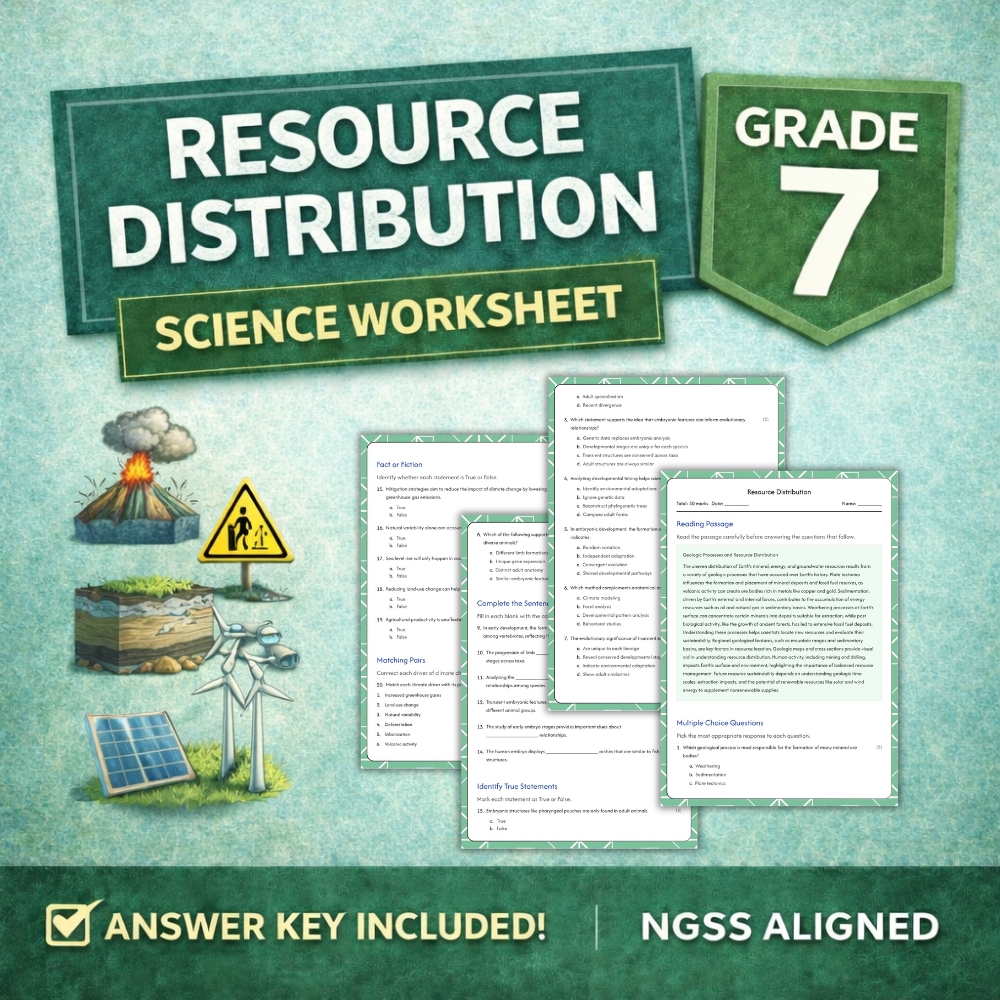
Grade 7 Science | Resource Distribution NGSS Worksheet & Answer Key (Printable)
Created byCedar Grove LearningLearning Objectives
- Explain how geologic processes and Earth history influence the distribution of mineral, energy, and groundwater resources.
- Connect plate tectonics, sedimentation, weathering, and past biological activity to the locations of resource deposits.
- Analyze the impacts of resource extraction and evaluate renewable versus nonrenewable resources.
Instant download
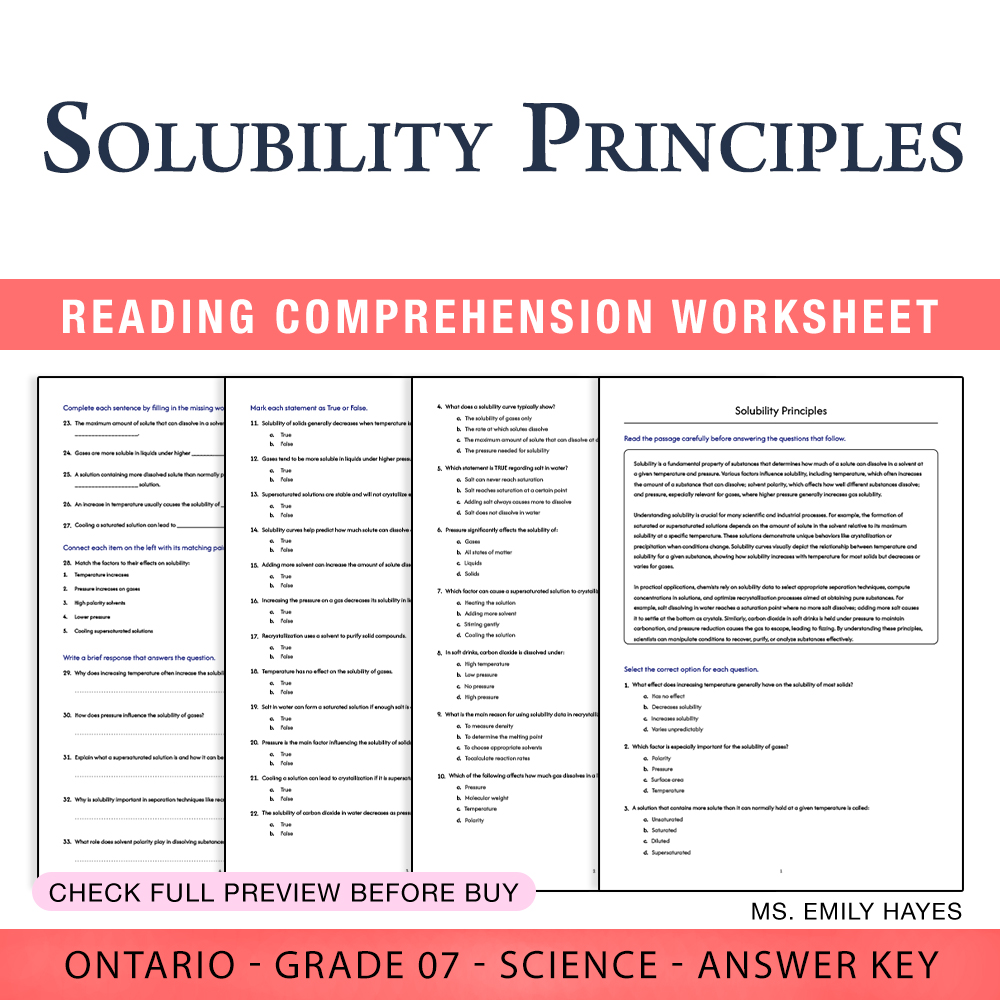
7th Grade Science | Solubility Principles Worksheet (PDF+ Answer Key)
 Created byCopper Leaf Classroom
Learning Objectives
- Understand the basic concepts of solubility and factors affecting dissolution.
- Interpret solubility curves and concepts of saturation and supersaturation.
- Identify how temperature, pressure, and solvent polarity influence solubility.
Instant download

Grade 7 Equilibrium Forces Worksheet | NGSS Science Activity Pack
 Created byAmber Owl Education
Learning Objectives
- Explain equilibrium as the condition where the vector sum of forces equals zero
- Differentiate static equilibrium from dynamic equilibrium using acceleration and velocity
- Analyze forces such as weight, normal force, and tension to predict an object’s motion
Also included in: Grade 7 Science Forces and Motion Lesson Bundle – NGSS Worksheets +1 more
Instant download

Rock Cycle Worksheet Grade 7 NGSS | Igneous Sedimentary Metamorphic
Created byAmber Owl EducationLearning Objectives
- Explain how igneous, sedimentary, and metamorphic rocks transform through the rock cycle.
- Describe key energy-driven processes (melting, crystallization, burial, metamorphism, and weathering).
- Trace a material pathway using examples from subduction zones and mid-ocean ridges.
Also included in: Earth's Systems Lesson Bundle | Grade 7 Science | Next-Gen Science Standards +1 more
Instant download

Surface Processes Worksheet Grade 7 NGSS | Weathering & Erosion
Created byAmber Owl EducationLearning Objectives
- Explain how weathering, erosion, transport, and deposition change Earth’s surface across short and long timescales
- Compare mechanical vs. chemical weathering and identify agent-specific evidence in landscapes
- Describe how moving water, waves, and glaciers create characteristic landforms and sediment deposits
Also included in: Earth's Systems Lesson Bundle | Grade 7 Science | Next-Gen Science Standards +1 more
Instant download

Population Impacts Worksheet | Grade 7 NGSS Human Impact Activity
Created byAmber Owl EducationLearning Objectives
- Explain how population growth and per-capita consumption increase demand for water, energy, land, and raw materials
- Describe how these demands can change ecosystems, biodiversity, and resource cycles
- Use quantitative ideas (cause-and-effect links) to compare environmental pressures across regions
Also included in: Grade 7 Science Human Impacts and Climate Interactions Lesson Bundle – NGSS +1 more
Instant download

Grade 7 Human Impacts Worksheet | NGSS Ecosystems & Environmental Change
Created byAmber Owl EducationLearning Objectives
- Identify common human activities that affect ecosystems (deforestation, urban expansion, agriculture, groundwater use, and fossil-fuel emissions).
- Use evidence from water-quality, air-quality, and ecological indicators to describe impacts and trends.
- Explain how mitigation strategies can reduce harm while considering trade-offs and resilience.
Also included in: Grade 7 Science Human Impacts and Climate Interactions Lesson Bundle – NGSS +1 more
Instant download

Grade 7 Cell Structures Worksheet | Plant & Animal Cells NGSS
Created byAmber Owl EducationLearning Objectives
- Identify major organelles in plant and animal eukaryotic cells and describe what each organelle does.
- Explain how cell structures support key processes such as transport, synthesis, and compartmentalization.
- Compare plant vs. animal cell organization using structural features (e.g., chloroplasts and lysosome vs. central vacuole and chloroplasts).
Also included in: Grade 7 Science Matter Cycling & Energy Transformations Lesson Bundle | NGSS +1 more
Instant download

Grade 7 Collisions Worksheet | Momentum & Conservation of Momentum
Created byAmber Owl EducationLearning Objectives
- Explain how momentum depends on mass and velocity and how momentum transfers during collisions.
- Use conservation of momentum to predict motion after one-dimensional impacts.
- Differentiate elastic and inelastic collisions using changes in kinetic energy and the meaning of “equal and opposite” contact forces.
Also included in: Grade 7 Science Forces and Motion Lesson Bundle – NGSS Worksheets +1 more
Instant download

Cell Evidence Worksheet | Grade 7 Science NGSS Cells & Microscopy
Created byAmber Owl EducationLearning Objectives
- Use microscopy observations to explain how cells provide direct evidence that organisms are made of discrete cellular units
- Compare unicellular and multicellular organization using cell boundaries, tissues, and examples such as onion epidermis and protists
- Interpret cell structures (cell walls, plasma membranes, nuclei, cytoplasm, vacuoles) and connect them to what is seen under a microscope
Also included in: Grade 7 Science Matter Cycling & Energy Transformations Lesson Bundle | NGSS +1 more
Instant download

Water Cycle Worksheet | Grade 7 NGSS Science Activities & Doodle Note
Created byAmber Owl EducationLearning Objectives
- Describe the main processes in the water cycle, including evaporation, condensation, precipitation, infiltration, runoff, and groundwater flow.
- Explain how solar energy and gravity drive movement of water among Earth’s spheres.
- Model how water moves through a river basin and into oceans, and how groundwater contributes to springs.
Also included in: Earth's Systems Lesson Bundle | Grade 7 Science | Next-Gen Science Standards +1 more
Instant download

Grade 7 Interactions Worksheet | NGSS Forces at a Distance Activity
Created byAmber Owl EducationLearning Objectives
- Explain how gravity, electric, and magnetic forces can act over a distance without direct contact.
- Describe how mass and distance qualitatively affect gravitational attraction.
- Identify examples of attractive and repulsive electromagnetic interactions using everyday situations.
Also included in: Grade 7 Science Forces and Motion Lesson Bundle – NGSS Worksheets +1 more
Instant download

Synthetic Materials Science Worksheet | Grade 7 NGSS Activity Pack
Created byAmber Owl EducationLearning Objectives
- Explain how synthetic materials can be produced from natural resources through feedstock selection, polymerization, and refining steps.
- Describe how chemical composition changes can affect material functions such as strength, flexibility, and melting behavior.
- Compare benefits and trade-offs of synthetic materials, including durability, recyclability, and environmental impacts.
Also included in: Grade 7 Science Stoichiometry, Mixtures & Material Properties Lesson Bundle | NGSS +1 more
Instant download

Biodiversity Solutions Worksheet | Grade 7 NGSS Ecosystem Management
Created byAmber Owl EducationLearning Objectives
- Explain how different biodiversity management strategies (protected areas, restoration, corridors, and invasive species control) can affect ecosystem services.
- Evaluate trade-offs among ecological, economic, and social constraints when planning biodiversity solutions.
- Use evidence from case examples to predict likely outcomes for species persistence and ecosystem functions.
Also included in: Grade 7 Science Ecosystems and Food Webs Lesson Bundle | NGSS +1 more
Instant download

Grade 7 Energy Transformations Worksheet NGSS Photosynthesis & Cellular Respiration
Created byAmber Owl EducationLearning Objectives
- Explain how energy and matter are transformed during photosynthesis and cellular respiration
- Describe how cells convert chemical energy in food into ATP for cellular work
- Compare energy use in active versus resting tissues and relate it to metabolism
Also included in: Grade 7 Science Matter Cycling & Energy Transformations Lesson Bundle | NGSS +1 more
Instant download

Grade 7 Rock Strata Worksheet | Relative Dating, Fossils & NGSS Science
Created byAmber Owl EducationLearning Objectives
- Explain how principles such as superposition, original horizontality, and cross-cutting relationships can be used for relative dating of rock strata
- Identify how fossils, unconformities, and intrusive contacts help geologists correlate layers and establish relative ages
- Construct a logical sequence of tectonic, depositional, and erosional events using stratigraphic evidence
Also included in: Grade 7 Science Space, Gravity, and Earth History Lesson Bundle | NGSS +1 more
Instant download

Crustal Movement, Folding, Faulting and Landforms Science 7 Worksheets
 Created bythe curious pencil
Learning Objectives
- Identify tectonic plates and describe their role in crustal change.
- Compare folding and faulting by explaining their effects on rock layers.
- Explain how crustal movement contributes to earthquakes and volcanoes.
Also included in: Planet Earth Science Lesson Bundle: Grade 7 Science Alberta
Instant download

Material Strength and Joints Worksheets | Grade 7 Science Structures
Created bythe curious pencilLearning Objectives
- Distinguish strength, stiffness, and flexibility during material tests.
- Explain the functions of fixed and movable structural joints.
- Identify variables to control in fair material load tests.
Also included in: Grade 7 Structures and Forces Lesson Bundle | Alberta Science
Instant download

Environmental Choices and Ecosystems Worksheet | Grade 7 Science
Created bythe curious pencilLearning Objectives
- Compare environmental interventions using scientific evidence and community observations
- Identify intended benefits and unintended consequences of waste-reduction proposals
- Explain how consistent methods improve comparisons of environmental observations
Also included in: Grade 7 Ecosystems & Land Use Decisions Lesson Bundle | Alberta Science
Instant download

Fossil Preservation and Geological Time Worksheets | Grade 7 Science
Created bythe curious pencilLearning Objectives
- Explain how burial and mineral processes preserve fossil evidence.
- Compare the preservation of hard parts and soft tissues.
- Interpret fossil positions in undisturbed sedimentary rock layers.
Also included in: Planet Earth Science Lesson Bundle: Grade 7 Science Alberta
Instant download

Planet Earth Science Worksheets Grade 7 | Evidence and Investigations
Created bythe curious pencilLearning Objectives
- Develop testable predictions about environmental questions and design problems
- Compare litter observations collected consistently across sites and dates
- Explain how uncertainty and alternative interpretations affect conclusions
Also included in: Planet Earth Science Lesson Bundle: Grade 7 Science Alberta
Instant download

Heating Technologies and Energy Sources Worksheet | Grade 7 Science
Created bythe curious pencilLearning Objectives
- Identify energy sources used in common heating technologies.
- Interpret source-to-use diagrams showing energy pathways.
- Explain how thermostats regulate heating systems.
Also included in: Grade 7 Heat and Temperature Science Lesson Bundle | Alberta
Instant download

Earth Materials and Earth's Interior Worksheet Activities Grade 7 Science
Created bythe curious pencilLearning Objectives
- Compare rocks and minerals using observable properties and consistent tests
- Explain how hardness, lustre, streak, and texture support mineral identification
- Describe the evidence and limitations provided by drilling operations
Also included in: Planet Earth Science Lesson Bundle: Grade 7 Science Alberta
Instant download

Energy Sources and Conservation Worksheets | Grade 7 Science
Created bythe curious pencilLearning Objectives
- Compare heating sources by resource needs, safety, and environmental effects
- Explain how insulation and lids reduce unwanted heat loss
- Identify variables needed for a fair heating comparison
Also included in: Grade 7 Heat and Temperature Science Lesson Bundle | Alberta
Instant download

Loads, Stresses and Structural Stability Worksheets | Grade 7 Science
Created bythe curious pencilLearning Objectives
- Identify applied loads using force arrows in structural examples.
- Distinguish tension, compression, shear, and bending.
- Explain how mass distribution affects structural stability.
Also included in: Grade 7 Structures and Forces Lesson Bundle | Alberta Science
Instant download

Rock Types, Weathering, Erosion and Deposition Worksheets Grade 7
Created bythe curious pencilLearning Objectives
- Identify igneous, sedimentary, and metamorphic rocks by how they form
- Differentiate weathering, erosion, and deposition using geological examples
- Explain possible pathways through the rock cycle
Also included in: Planet Earth Science Lesson Bundle: Grade 7 Science Alberta
Instant download

Habitat and Land Use Decisions Worksheet for Grade 7 Science
Created bythe curious pencilLearning Objectives
- Identify resources and environmental conditions organisms need from habitats.
- Explain how vegetation removal can change habitat conditions.
- Describe feeding, competition, and pollination relationships among organisms.
Also included in: Grade 7 Ecosystems & Land Use Decisions Lesson Bundle | Alberta Science
Instant download

Heat and Temperature Worksheets: Particles and Thermal Expansion Grade 7
Created bythe curious pencilLearning Objectives
- Describe particle motion and spacing in solids, liquids, and gases.
- Explain how heating and cooling change average particle kinetic energy.
- Distinguish temperature from thermal energy transfer between objects.
Also included in: Grade 7 Heat and Temperature Science Lesson Bundle | Alberta
Instant download

Plant Products and Sustainable Land Use Worksheet for Grade 7 Science
Created bythe curious pencilLearning Objectives
- Identify plant products and explain their uses in meeting human needs.
- Compare natural land with managed land used for plant production.
- Interpret crop yield and resource use when evaluating farming practices.
Also included in: Plants for Food and Fibre Lesson Bundle | Grade 7 Science | Alberta
Instant download

Heat and Temperature Science Worksheets | Grade 7 Investigation
Created bythe curious pencilLearning Objectives
- Distinguish heat transfer from temperature measurement.
- Identify variables in a fair insulation investigation.
- Describe safe procedures for measuring water temperature.
Also included in: Grade 7 Heat and Temperature Science Lesson Bundle | Alberta
Instant download

Food Webs and Matter Cycles Worksheet | Grade 7 Ecosystems Science
Created bythe curious pencilLearning Objectives
- Trace energy transfer among producers, consumers, and decomposers
- Explain how carbon moves through organisms and the environment
- Describe water movement through the water cycle
Also included in: Grade 7 Ecosystems & Land Use Decisions Lesson Bundle | Alberta Science
Instant download

Heat Transfer Worksheets: Conduction, Convection & Radiation Grade 7
Created bythe curious pencilLearning Objectives
- Distinguish conduction, convection, and radiation as energy transfer mechanisms.
- Explain how particle interactions transfer thermal energy through solids.
- Describe how moving fluids create convection currents.
Also included in: Grade 7 Heat and Temperature Science Lesson Bundle | Alberta
Instant download

Frame and Shell Structures Worksheets | Grade 7 Science Alberta
Created bythe curious pencilLearning Objectives
- Compare frame and shell structures by form and function
- Explain how material properties influence structural performance
- Identify potential failure points in structural designs
Also included in: Grade 7 Structures and Forces Lesson Bundle | Alberta Science
Instant download

Structural Design and Safety Margins Worksheets for Grade 7 Science
Created bythe curious pencilLearning Objectives
- Explain why structures need safety margins under uncertain conditions.
- Compare how shape and bracing improve structural stability.
- Describe how connections transfer forces between structural parts.
Also included in: Grade 7 Structures and Forces Lesson Bundle | Alberta Science
Instant download

Structures and Forces Science Worksheets | Grade 7 Engineering
Created bythe curious pencilLearning Objectives
- Describe how materials and shapes affect structural strength.
- Develop testable predictions about model-bridge performance.
- Identify variables and hazards in structural investigations.
Also included in: Grade 7 Structures and Forces Lesson Bundle | Alberta Science
Instant download

Ecological Change and Habitat Observations Worksheet Grade 7 Science
Created bythe curious pencilLearning Objectives
- Compare species distribution and environmental conditions across habitats.
- Distinguish ecological succession from temporary weather-related changes.
- Explain why observations alone may not establish ecological causation.
Also included in: Grade 7 Ecosystems & Land Use Decisions Lesson Bundle | Alberta Science
Instant download

Ecosystem Investigations and Evidence-Based Decisions Worksheet Grade 7
Created bythe curious pencilLearning Objectives
- Develop testable predictions about questions involving ecosystem conditions
- Plan safe and fair investigations using consistent sampling methods
- Interpret patterns in observations and measurements while recognising uncertainty
Also included in: Grade 7 Ecosystems & Land Use Decisions Lesson Bundle | Alberta Science
Instant download
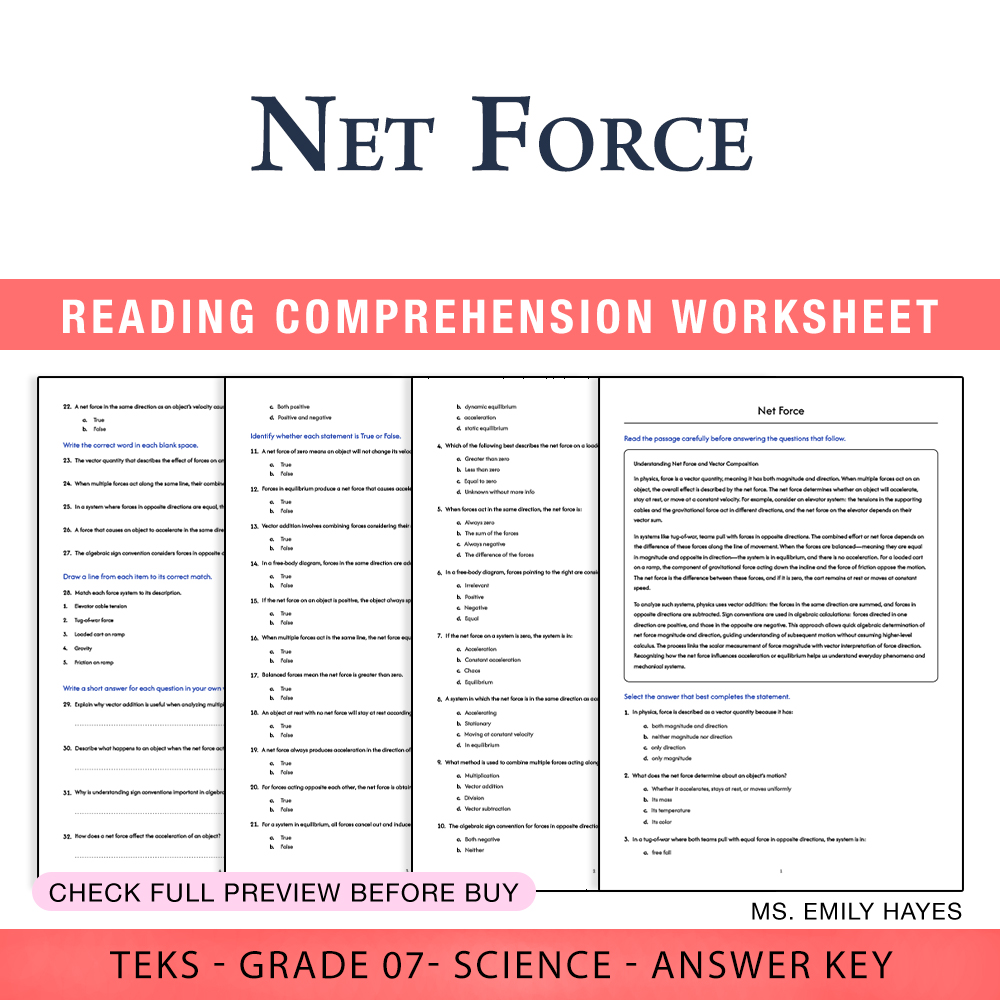
7th Grade Science | Net Force Worksheet (PDF+ Answer Key)
Created byCopper Leaf ClassroomLearning Objectives
- Understand the concept of net force and how it affects the motion of objects.
- Learn to analyze free-body diagrams for systems such as elevators and tug-of-war scenarios.
- Apply vector addition principles to determine the resultant force in one-dimensional systems.
Instant download
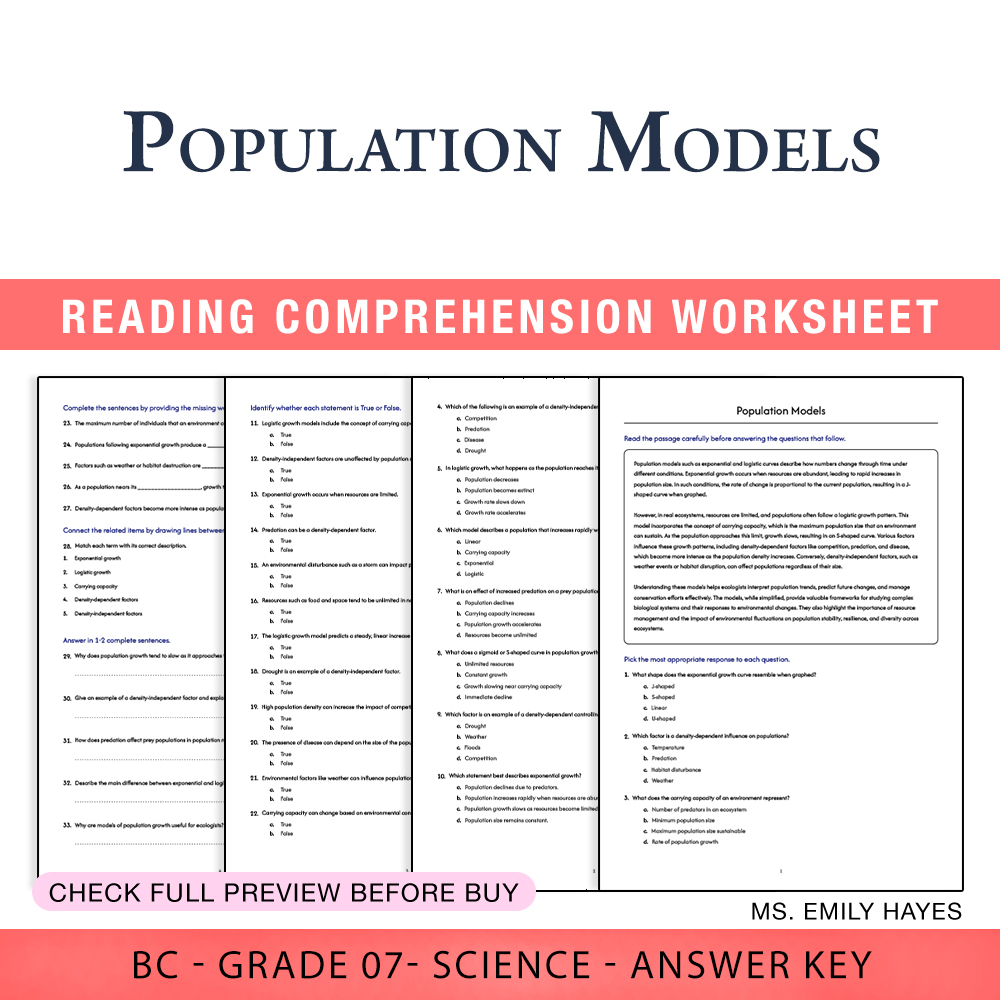
Grade 7 Science | Population Models Worksheet (PDF+ Answer Key)
Created byCopper Leaf ClassroomLearning Objectives
- Understand the differences between exponential and logistic population growth models.
- Identify factors influencing population changes, including density-dependent and density-independent factors.
- Interpret graphs and data related to population dynamics in ecosystems.
Also included in: Grade 7 Science Bundle | Ecosystem Dynamics & Population (PDF+ Answer Key) +1 more
Instant download
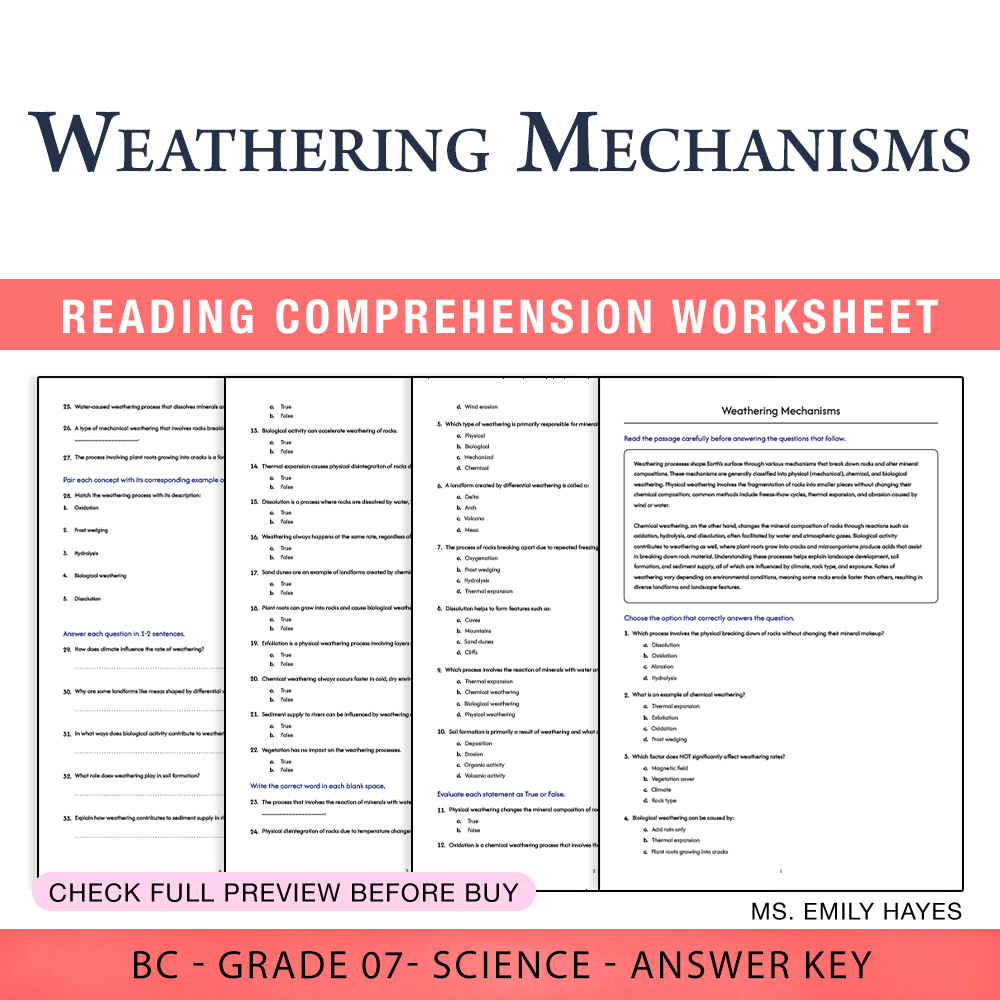
7th Grade Science | Weathering Mechanisms Worksheet (PDF+ Answer Key)
Created byCopper Leaf ClassroomLearning Objectives
- Describe the different types of weathering and how they affect rocks and landscapes.
- Explain the factors that influence weathering rates and landform development.
- Identify examples of physical, chemical, and biological weathering processes.
Also included in: Grade 7 Science | Earth Systems & Geology Unit (PDF+ Answer Keys) +1 more
Instant download
About Grade 7 Science Worksheets
Browse 6,039 printable Grade 7 Science worksheets — ready-to-print PDFs with answer keys where available.
Every worksheet on MyTeachingSheets is created by independent teacher-authors and reviewed before publication. All resources download as printable PDFs for classroom, homework, or at-home practice, and many include answer keys. Preview any worksheet free before buying.