
Grade 7 Science Worksheets
6,039 worksheets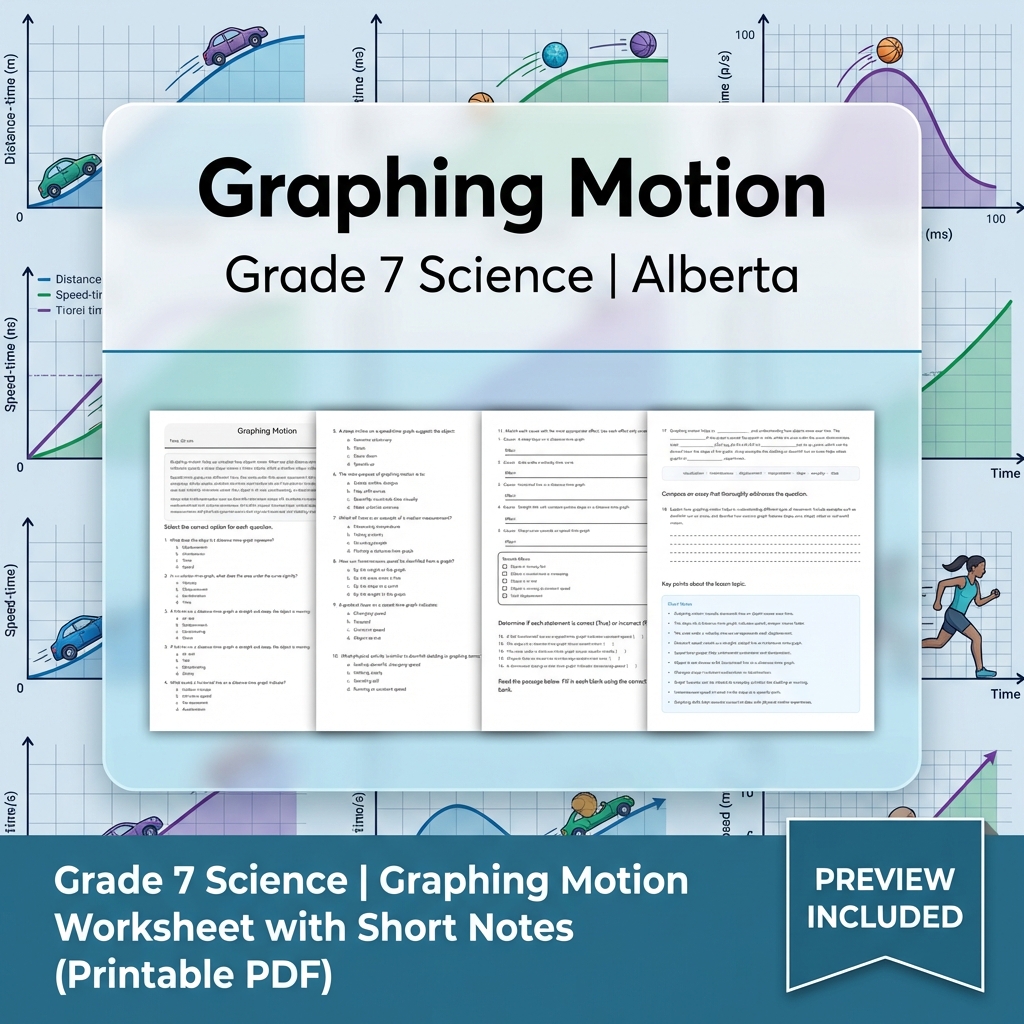
Grade 7 Science | Graphing Motion Worksheet with Short Notes (Printable PDF)
 Created byMeadowlark Worksheets
Learning Objectives
- Understand how to interpret distance–time and speed–time graphs
- Learn to calculate and analyze the slope of a motion graph
- Identify the area under a velocity-time graph as displacement
Also included in: Grade 7 Science | Forces, Structures & Motion UNIT Worksheet Bundle
Instant download
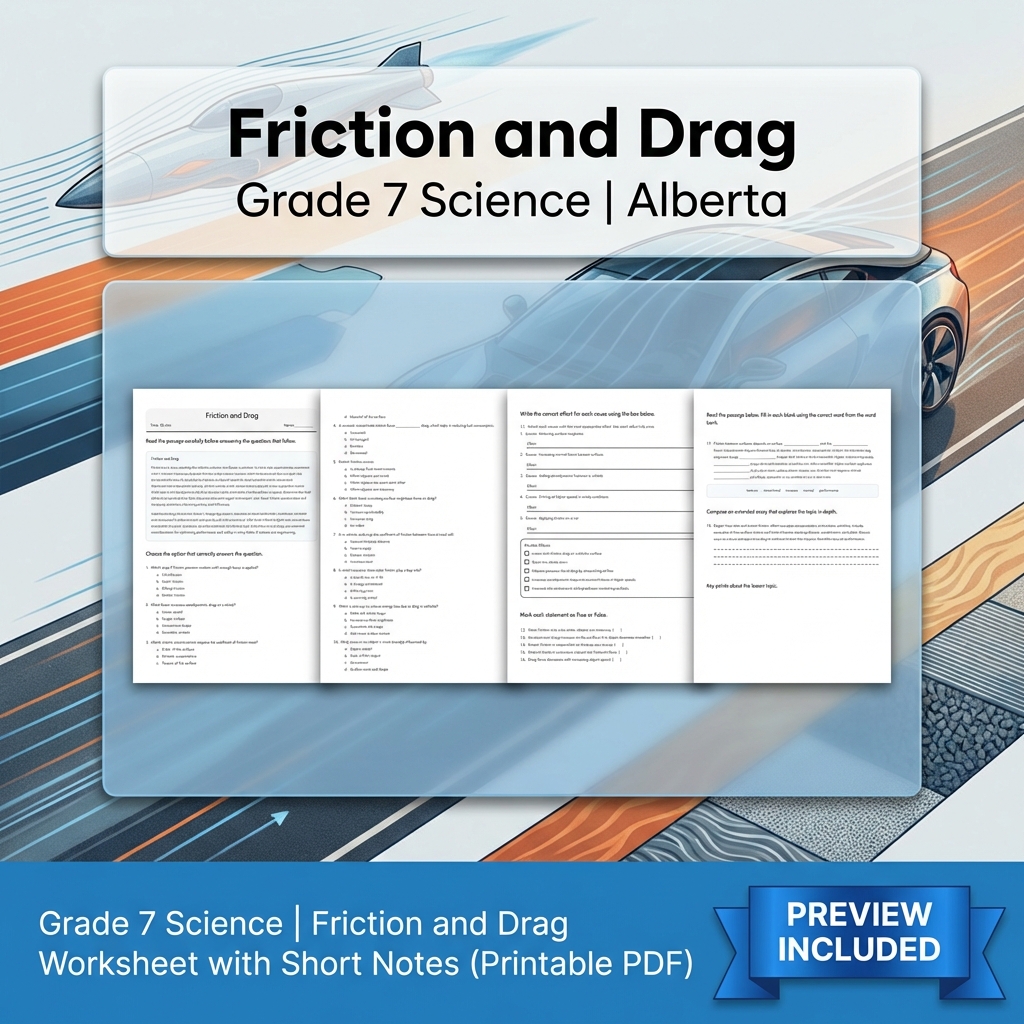
Grade 7 Science | Friction and Drag Worksheet with Short Notes (Printable PDF)
Created byMeadowlark WorksheetsLearning Objectives
- Understand how static and kinetic friction operate in real-world scenarios.
- Explore the effects of aerodynamic drag on moving objects such as vehicles and outdoor equipment.
- Analyze the relationship between surface texture, normal force, and frictional force.
Also included in: Grade 7 Science | Forces, Structures & Motion UNIT Worksheet Bundle
Instant download
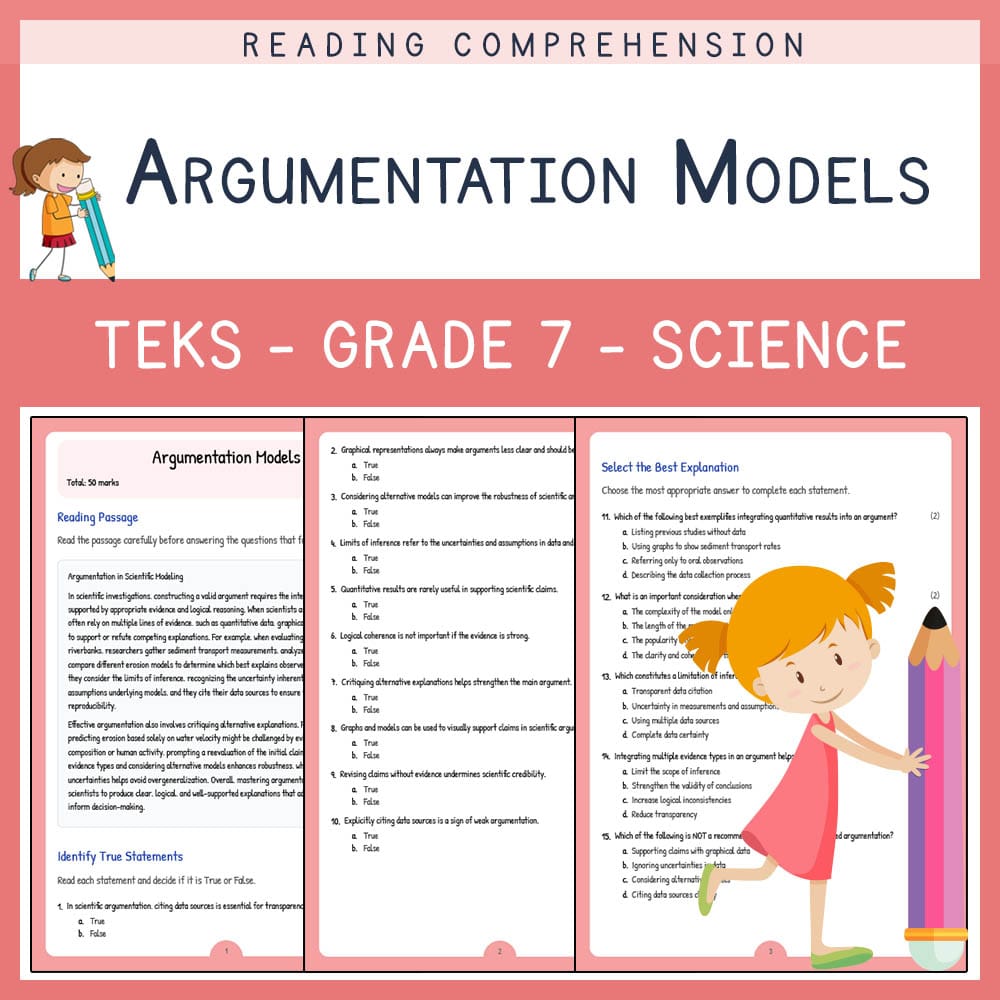
Grade 7 Science | Argumentation Models Worksheet | TEKS Alligned
 Created byLumora Learning
Learning Objectives
- Understand the components of evidence-based arguments including claims, evidence, and reasoning.
- Critically analyze and construct logical, coherent arguments supported by data and graphical representations.
- Evaluate alternative models and recognize limits of inference in argumentation.
Instant download

Grade 7 Science | Reaction Observations - Reading Comprehension Practice
 Created byCoral Reef Learning
Learning Objectives
- Identify signs of chemical reactions such as gas production, heat exchange, and color change.
- Observe and describe the formation of gases during chemical reactions.
- Connect observable indicators to the underlying particle interactions and reaction pathways.
Also included in: Matter and Chemical Change Lesson Bundle: Grade 7 Science Alberta +1 more
Instant download
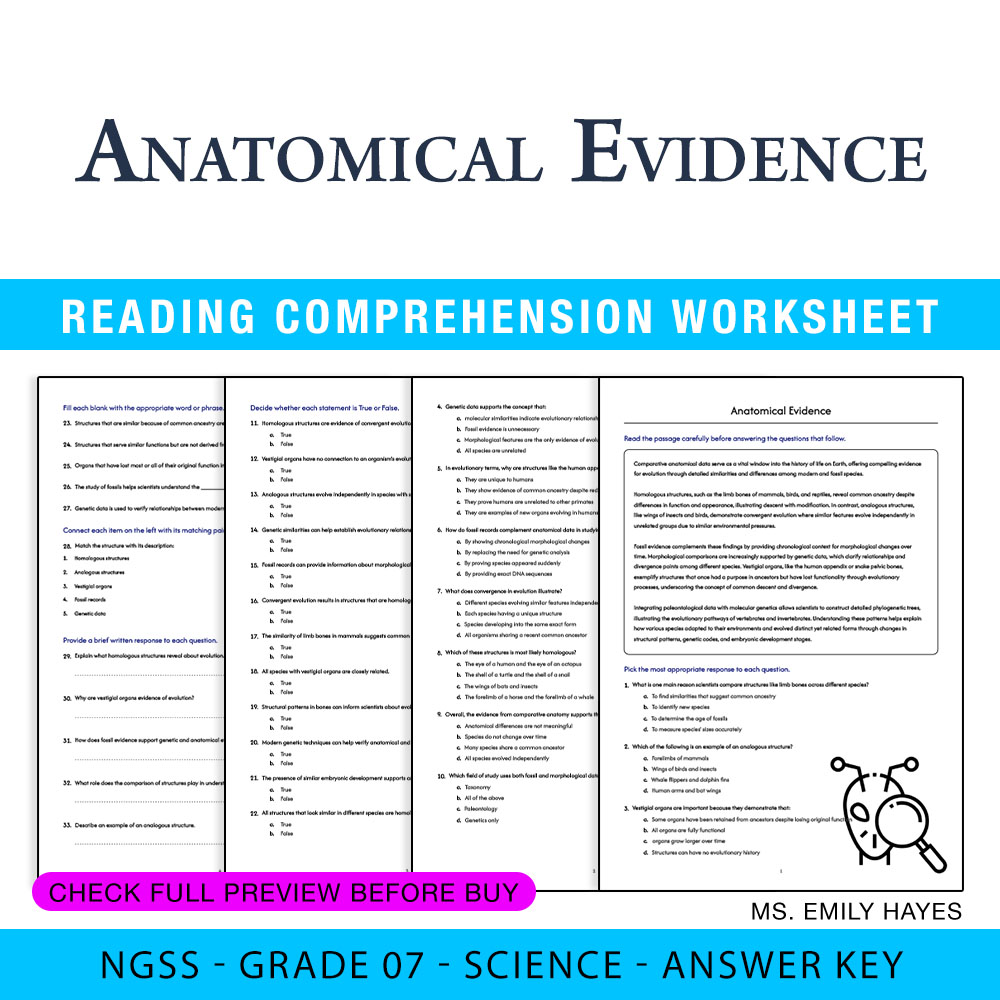
Grade 7 Science | Anatomical Evidence Worksheet (PDF + Answer Key)
 Created byCopper Leaf Classroom
Learning Objectives
- Understand how comparative anatomy provides evidence for evolution.
- Identify homologous and analogous structures in different species.
- Explain how morphological, genetic, and paleontological data are integrated in evolutionary studies.
Instant download
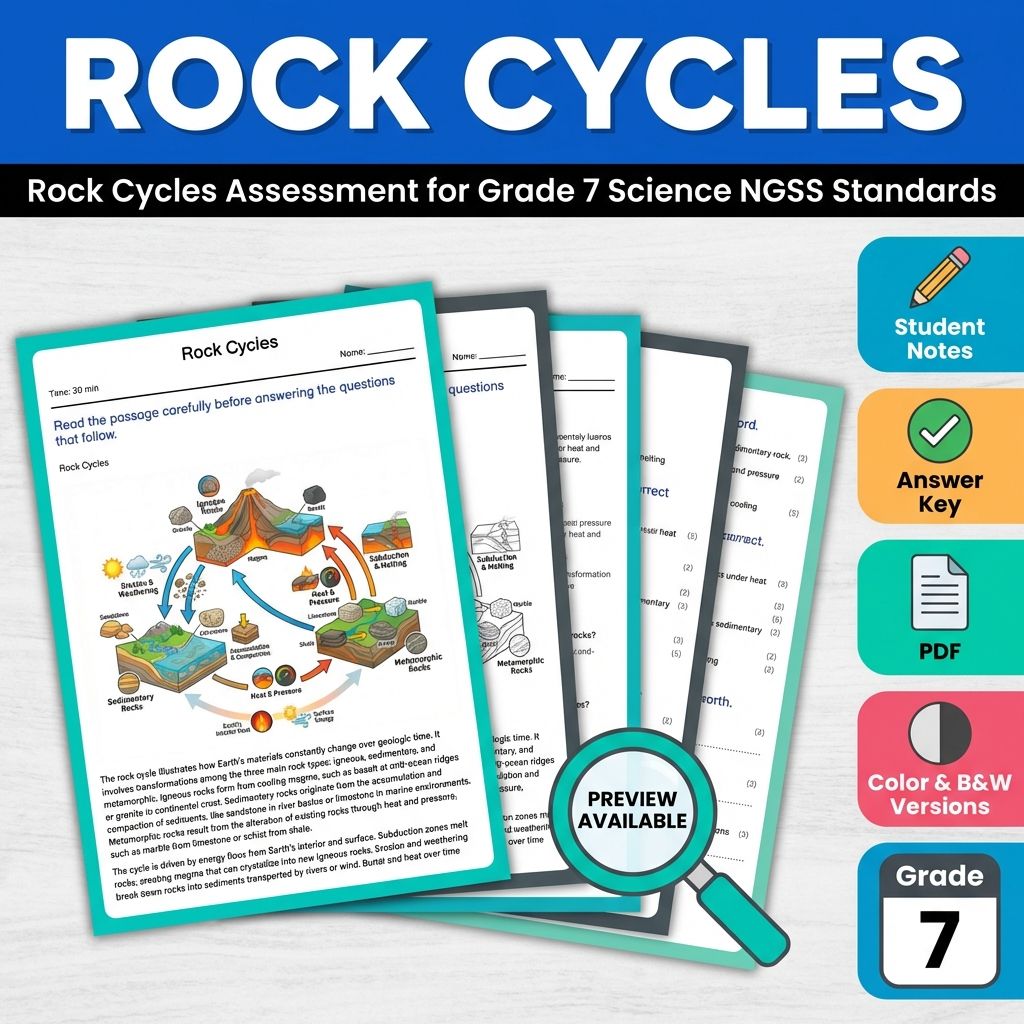
Rock Cycles Assessment for Grade 7 Science NGSS Standards
 Created byPrism Point Learning
Learning Objectives
- Understand the processes involved in the cycling of Earth's rocks.
- Identify the stages of igneous, sedimentary, and metamorphic rock formation.
- Explain how plate tectonics and energy flow drive rock transformations.
Also included in: Grade 7 Science Lesson | Earth's Systems NGSS Not specified Unit +1 more
Instant download
Grade 7 Science | Abiotic Influences Reading Worksheet & Answer Key (PDF)
JCreated byJ.S SheetsLearning Objectives
- Understand how abiotic factors such as temperature, moisture, and light affect species distribution.
- Describe the interactions between abiotic conditions and population dynamics.
- Explain how seasonal and extreme environmental changes impact ecosystems.
Instant download
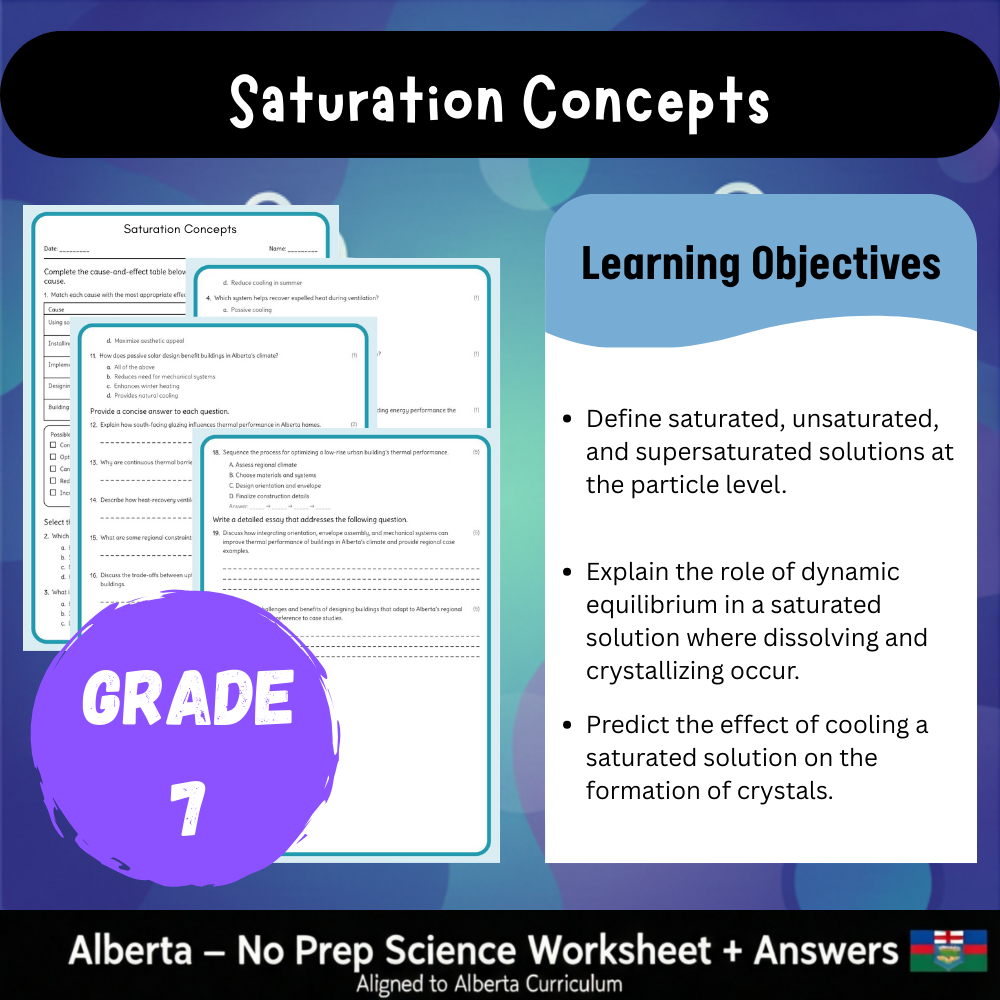
Grade 7 Science | Saturation Concepts Worksheet (PDF) – Alberta Standard
 Created byBright Mind Resources
Learning Objectives
- Understand the definition of saturation and supersaturation in solutions.
- Identify conditions that lead to saturation and crystallization.
- Analyze real-world examples of saturation phenomena.
Instant download

Diffusion and Osmosis Worksheet | Grade 7 Science | Standard BC
JCreated byJ.S SheetsLearning Objectives
- Understand the processes of diffusion and osmosis and how they differ.
- Describe how concentration gradients drive passive transport in cells.
- Explain the effects of diffusion and osmosis on cell volume and plant turgor pressure.
Instant download

Grade 7 Revision From Results Worksheet | Practice & Support PDF
 Created byClear Sky Classroom
Learning Objectives
- Explain how test data guide specific design changes toward a success criterion
- Describe how evidence-based revisions can improve performance while meeting constraints
- Use measurements and comparisons to justify why a revised design works better
Instant download
Grade 7 Science – Inquiry Foundations Worksheet for Mastery
 Created byThe Resource Hub
Learning Objectives
- Understand the components of scientific inquiry including observation, question formulation, and hypothesis development.
- Distinguish between quantitative and qualitative observations in scientific experiments.
- Identify appropriate measurement units and instruments for length, mass, and volume.
Also included in: Grade 7 Science Unit Bundle | Experimental Design & Data Analysis Worksheets +1 more
Instant download
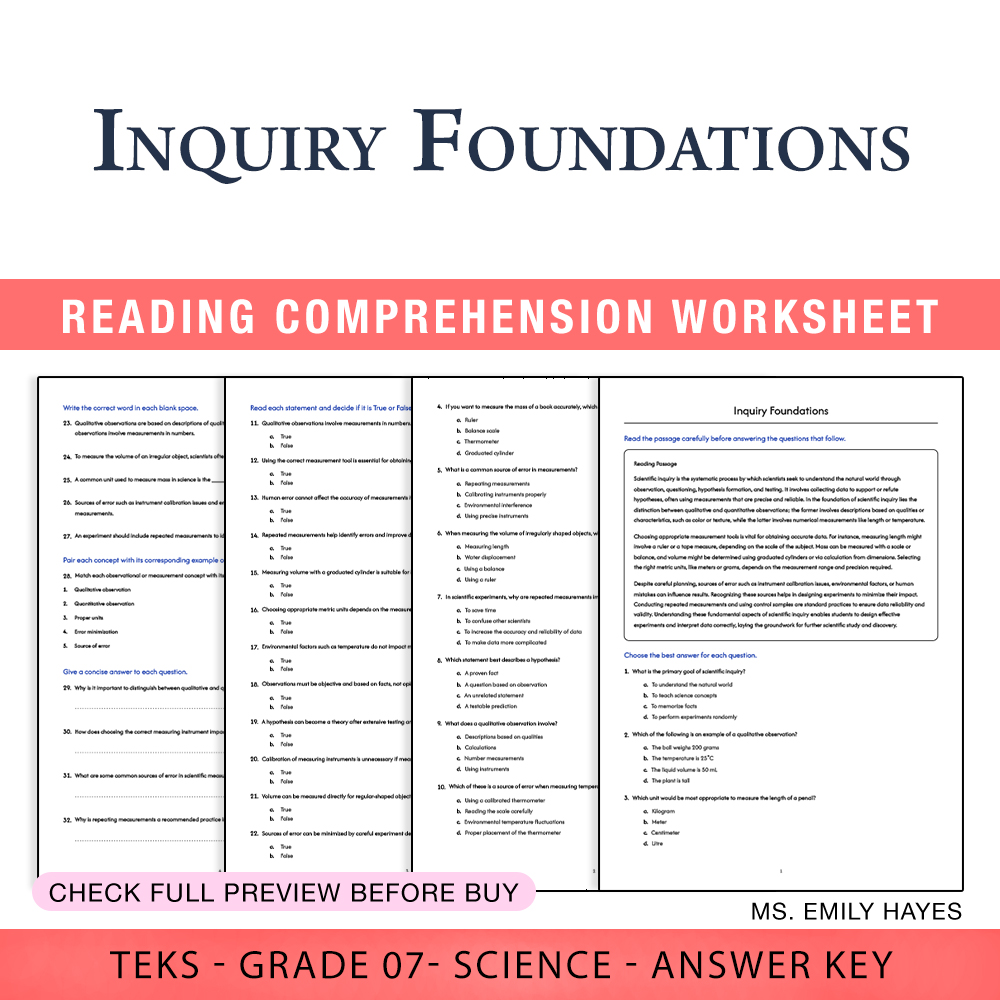
7th Grade Science | Inquiry Foundations Worksheet (PDF+ Answer Key)
Created byCopper Leaf ClassroomLearning Objectives
- Understand the main components of the scientific inquiry process.
- Distinguish between qualitative and quantitative observations.
- Select appropriate measurement tools for length, mass, and volume.
Instant download

Grade 7 Science – Integrated Design Worksheet (PDF) Alberta Standards
 Created byEvergreen Desk Education
Learning Objectives
- Analyze how forces produce motion and affect structural members in real-world systems.
- Evaluate how machine function (mechanical advantage and force transfer) influences design performance.
- Compare design alternatives using consistent criteria for safety under wind, snow, and load scenarios.
Instant download

Grade 7 Separation Methods Worksheet | Practice & Standard PDF
Created byClear Sky ClassroomLearning Objectives
- Explain how physical properties (size, solubility, magnetism, boiling point) are used to separate mixtures without changing substances.
- Identify suitable separation methods for common mixtures and justify choices using observable evidence.
- Describe how separation efficiency can be evaluated by comparing starting materials to recovered products.
Instant download

Sedimentary Processes Practice Worksheet | Grade 7 Science Review
Created byPrism Point LearningLearning Objectives
- Explain how weathering, transport, deposition, and lithification form sedimentary rocks
- Distinguish mechanical weathering from chemical weathering and how each produces sediment
- Describe how depositional environments can create distinctive bedding and sedimentary structures
Also included in: Earth's Systems & Processes Lesson Bundle | Grade 7 Science | BC +1 more
Instant download
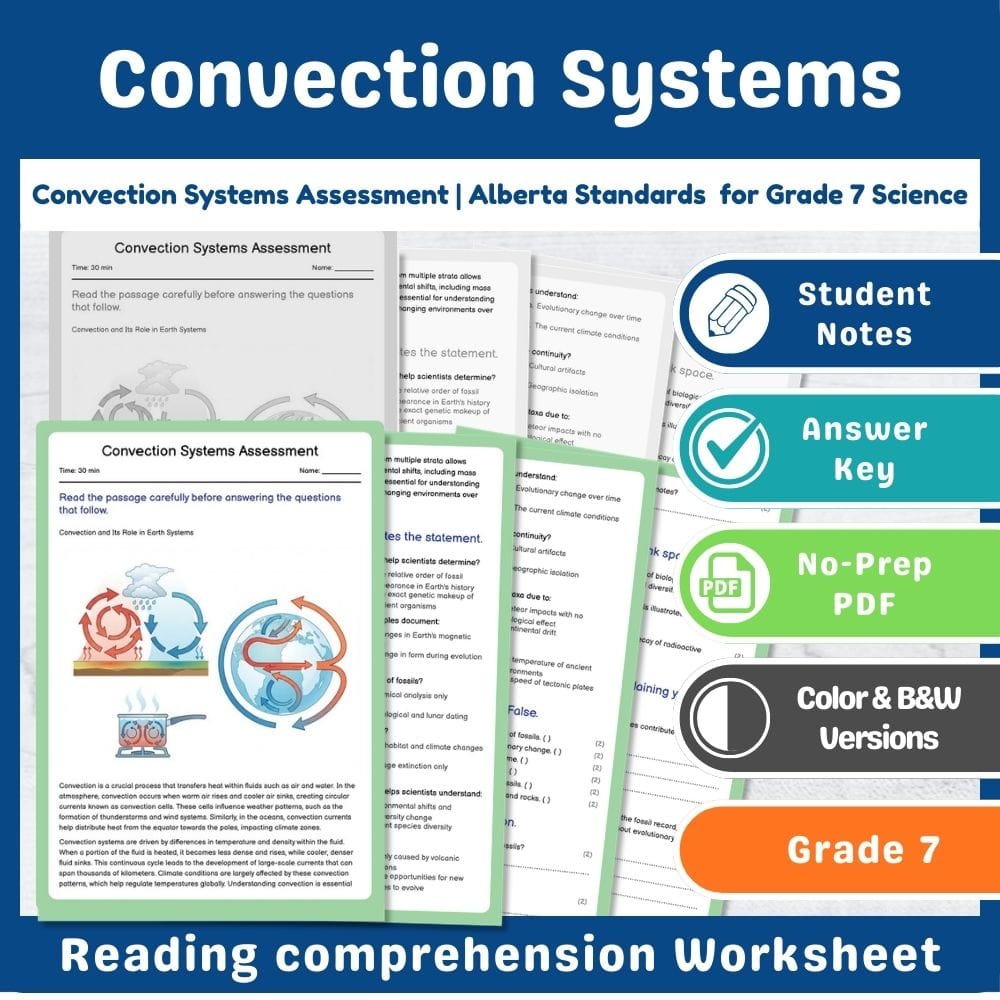
Convection Systems Assessment | Alberta Standards Assessment for Grade 7 Science
Created byPrism Point LearningLearning Objectives
- Understand the fundamental principles of convection currents in atmospheric and oceanic systems.
- Identify the factors that influence convection in different environments.
- Analyze the effects of convection currents on weather patterns and climate.
Also included in: Lesson Grade 7 Science Mini Bundle | Energy, Heat & Thermal Processes +1 more
Instant download
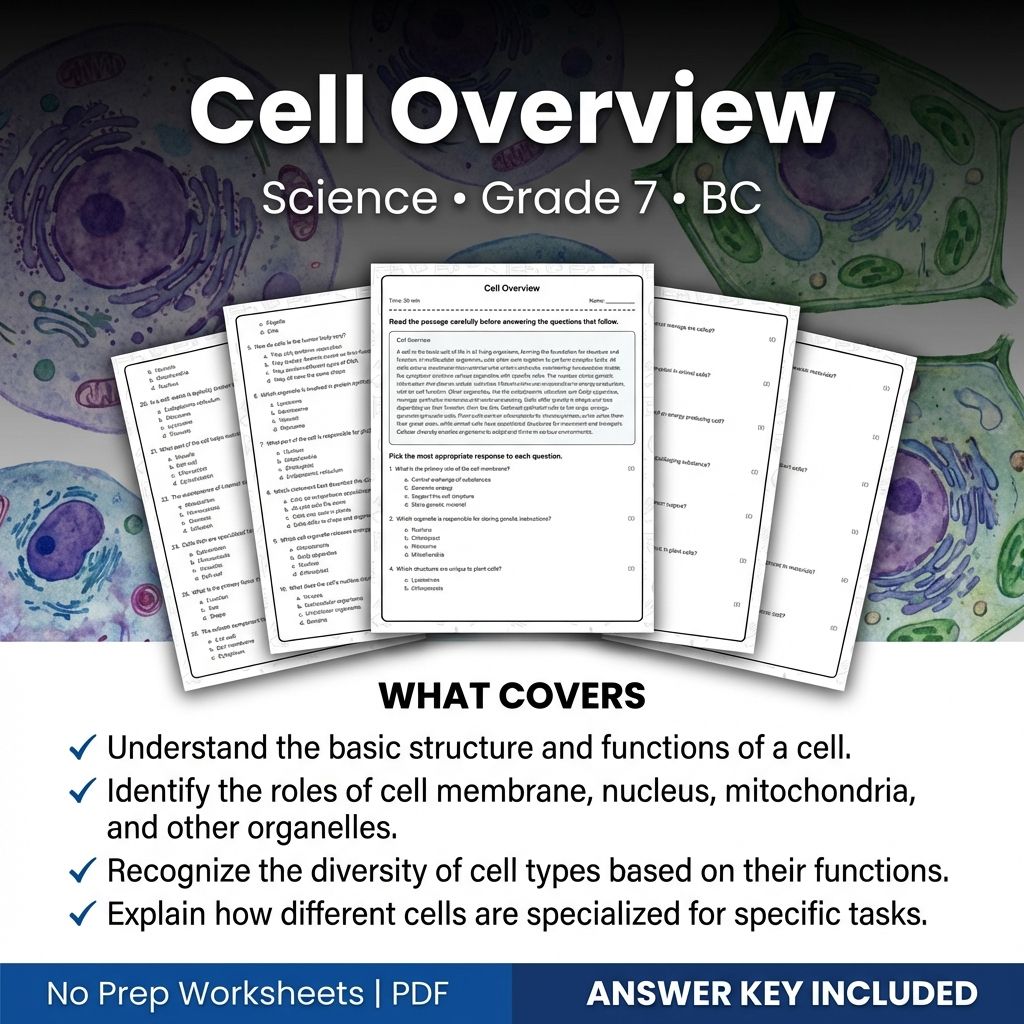
7th Grade Science Worksheet | Cell Overview Practice PDF & Answer Key
Created byCoral Reef LearningLearning Objectives
- Understand the basic structure and functions of a cell.
- Identify the roles of cell membrane, nucleus, mitochondria, and other organelles.
- Recognize the diversity of cell types based on their functions.
Instant download
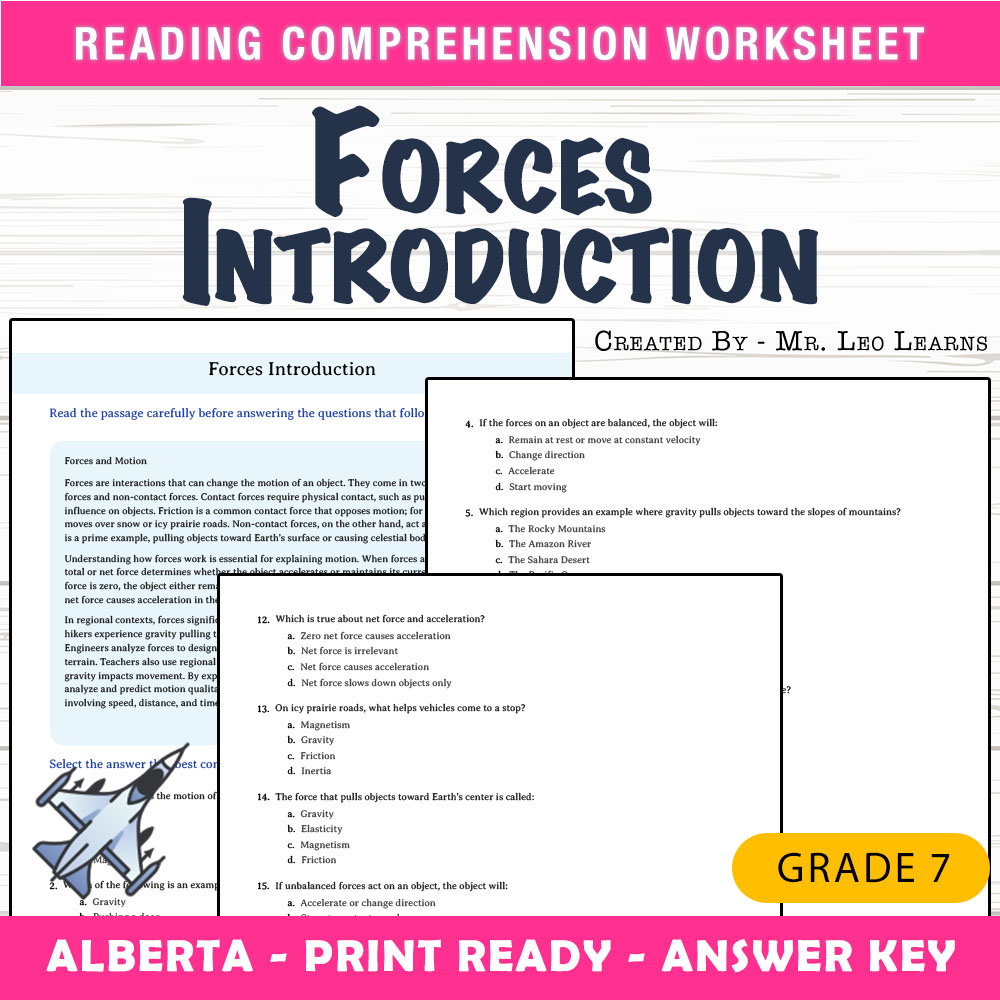
Grade 7 Science — Forces Introduction Worksheet MCQ Paper
Created byThe Resource HubLearning Objectives
- Understand different types of contact and non-contact forces such as friction and gravity.
- Explain how net force influences an object's acceleration.
- Apply qualitative reasoning to regional examples of forces affecting motion.
Also included in: Grade 7 Science Alberta Forces Structures and Motion Worksheet Bundle +1 more
Instant download
Grade 7 Science — Beam Behavior Worksheet MCQ Paper for Mastery
Created byThe Resource HubLearning Objectives
- Understand the concepts of span, support conditions, and load types in beams.
- Identify factors affecting beam performance such as span-to-depth ratio and material stiffness.
- Relate beam behavior principles to real-world examples like highway girders and building floor joists.
Also included in: Grade 7 Science Alberta Forces Structures and Motion Worksheet Bundle +1 more
Instant download
Grade 7 Science — MCQ Worksheet on Integrated Design
Created byThe Resource HubLearning Objectives
- Analyze integrated systems by synthesizing mechanical data, structural assessments, and material choices.
- Evaluate design alternatives based on criteria such as safety, efficiency, and regional applicability.
- Apply quantitative motion analysis and structural calculations to compare different engineering solutions.
Also included in: Grade 7 Science Alberta Forces Structures and Motion Worksheet Bundle +1 more
Instant download
Grade 7 Science — Structural Basics Worksheet MCQ Paper for Mastery
Created byThe Resource HubLearning Objectives
- Understand the functions of supports, foundations, and load paths in structures.
- Identify how compression, tension, and shear forces act on beams, columns, and foundations.
- Recognize material properties such as stiffness, strength, and durability relevant to structural safety.
Also included in: Grade 7 Science Alberta Forces Structures and Motion Worksheet Bundle +1 more
Instant download
Grade 7 Science — Friction and Drag Worksheet MCQ Paper for Mastery
Created byThe Resource HubLearning Objectives
- Understand the concepts of static and kinetic friction and their effects on motion.
- Identify examples of friction and drag in everyday scenarios.
- Explain how surface texture and normal force influence frictional force.
Also included in: Grade 7 Science Alberta Forces Structures and Motion Worksheet Bundle +1 more
Instant download
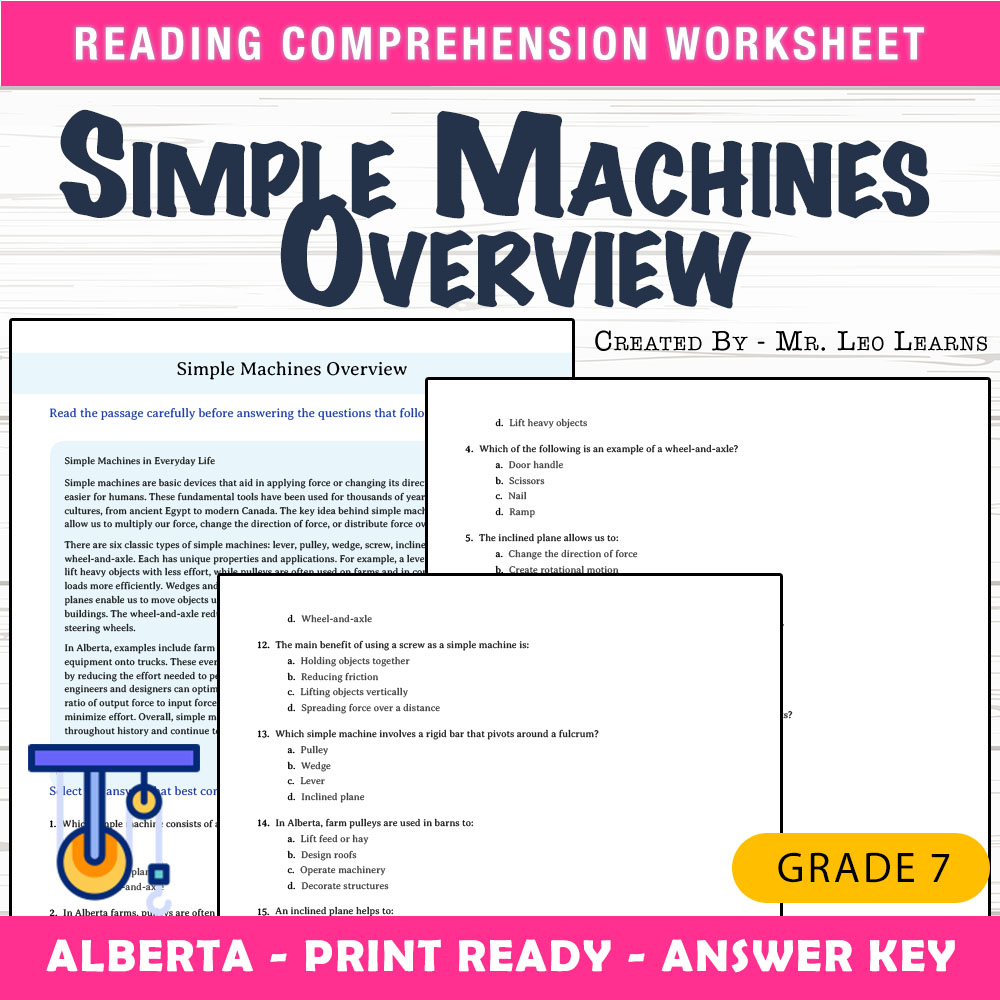
Grade 7 Science — Simple Machines Overview Worksheet for Mastery
Created byThe Resource HubLearning Objectives
- Identify different types of simple machines and their functions.
- Understand how simple machines provide mechanical advantage.
- Calculate mechanical advantage for various simple machines.
Also included in: Grade 7 Science Alberta Forces Structures and Motion Worksheet Bundle +1 more
Instant download
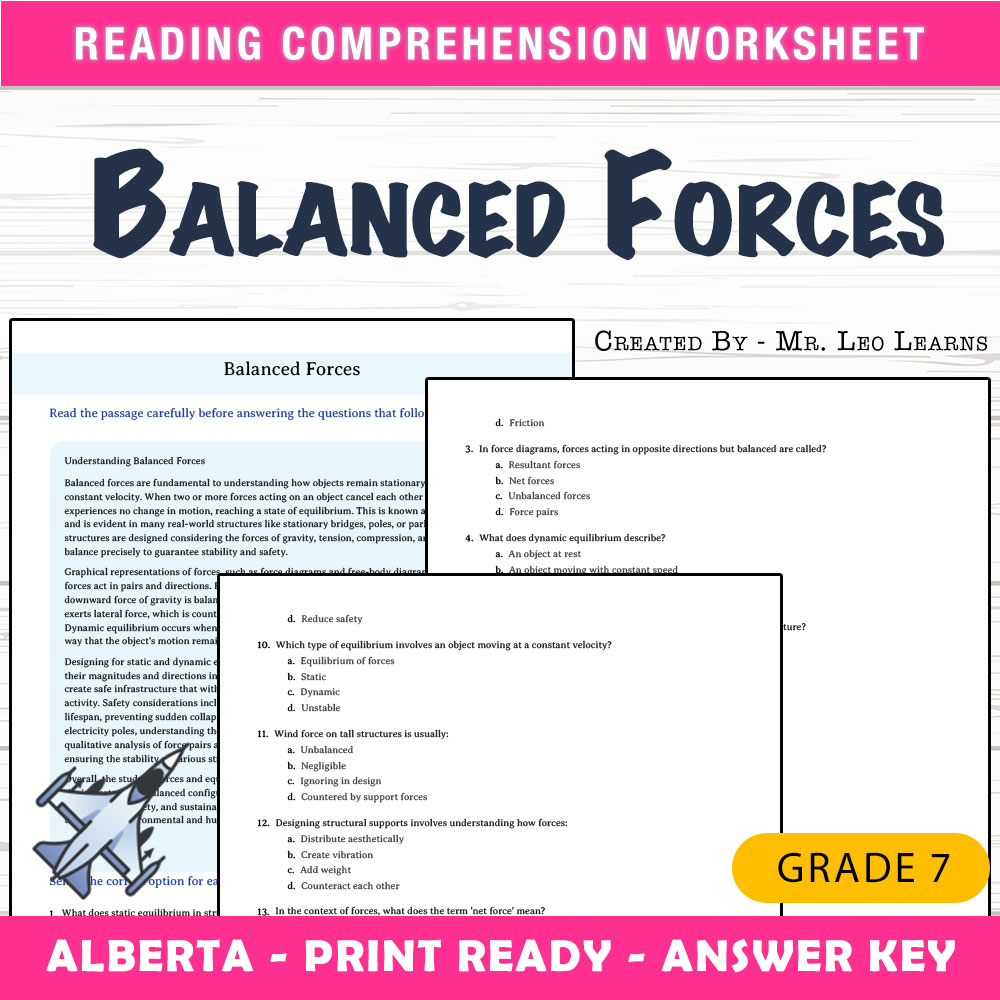
Grade 7 Science — Balanced Forces Worksheet MCQ Paper for Mastery
Created byThe Resource HubLearning Objectives
- Understand the concept of equilibrium and static balance in structures.
- Identify different types of forces acting on objects and their graphical representations.
- Explain how balanced force pairs contribute to safety and durability in infrastructure.
Also included in: Grade 7 Science Alberta Forces Structures and Motion Worksheet Bundle +1 more
Instant download
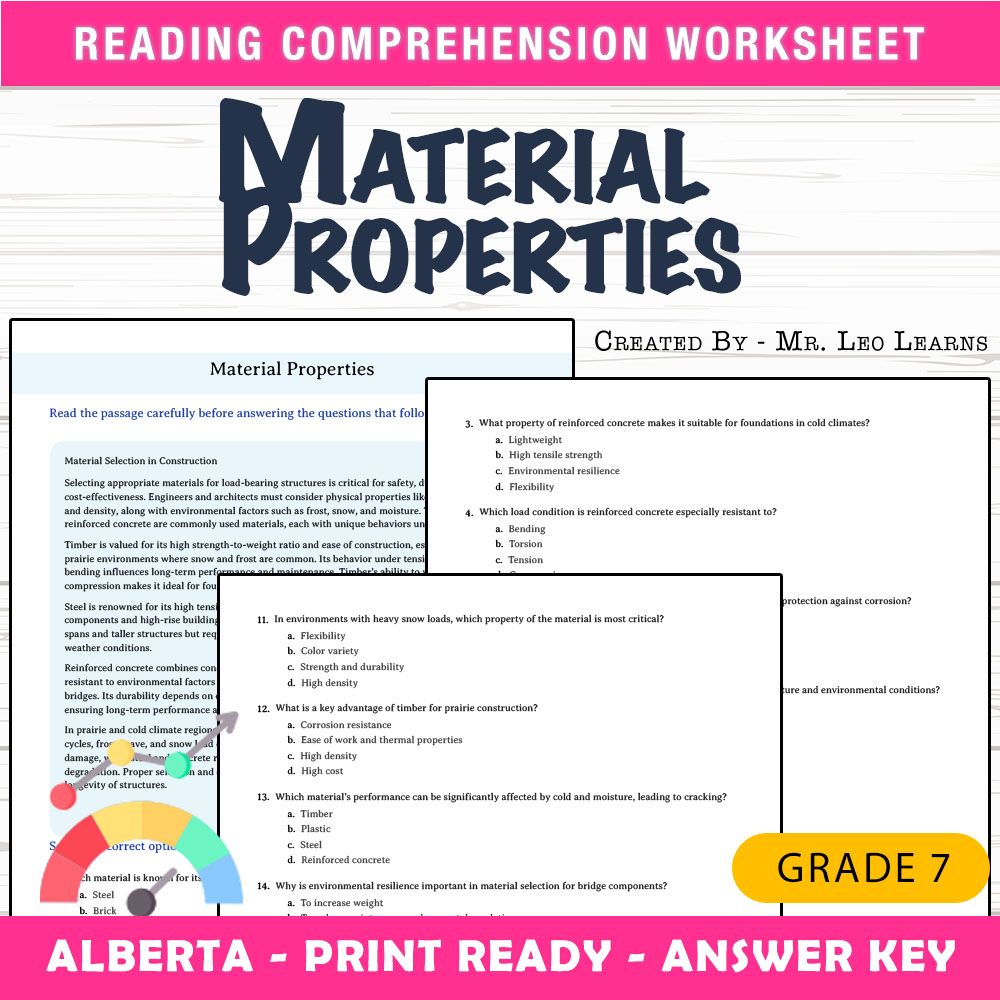
Grade 7 Science — Material Properties Worksheet MCQ Paper for Mastery
Created byThe Resource HubLearning Objectives
- Understand how material properties such as strength, stiffness, and density influence construction choices.
- Analyze the behavior of timber, steel, and concrete under various loads in different environmental conditions.
- Evaluate how environmental resilience affects long-term performance of load-bearing structures.
Also included in: Grade 7 Science Alberta Forces Structures and Motion Worksheet Bundle +1 more
Instant download
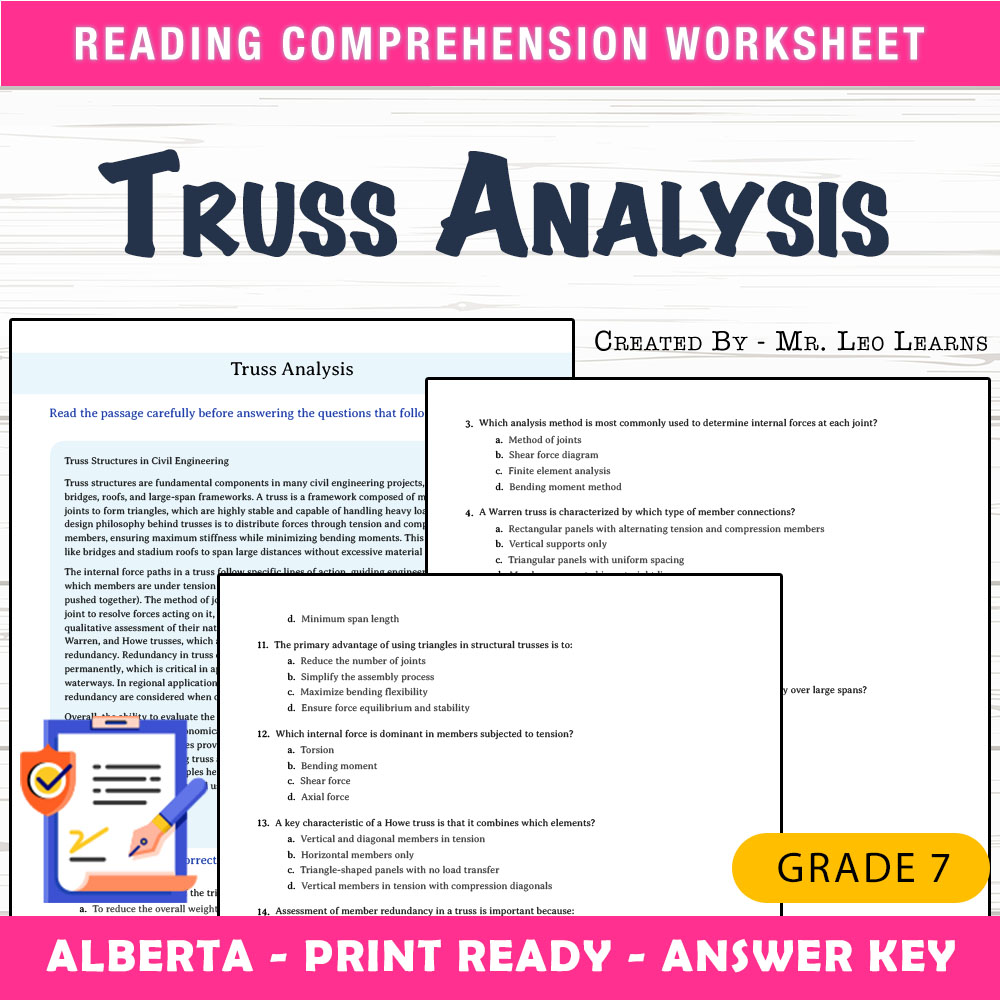
Grade 7 Science — Truss Analysis Worksheet MCQ Paper for Practice
Created byThe Resource HubLearning Objectives
- Understand the distribution of loads in truss structures through triangular elements.
- Identify the internal force paths, tension, and compression in different truss members.
- Apply the method of joints to analyze forces in truss members.
Also included in: Grade 7 Science Alberta Forces Structures and Motion Worksheet Bundle +1 more
Instant download
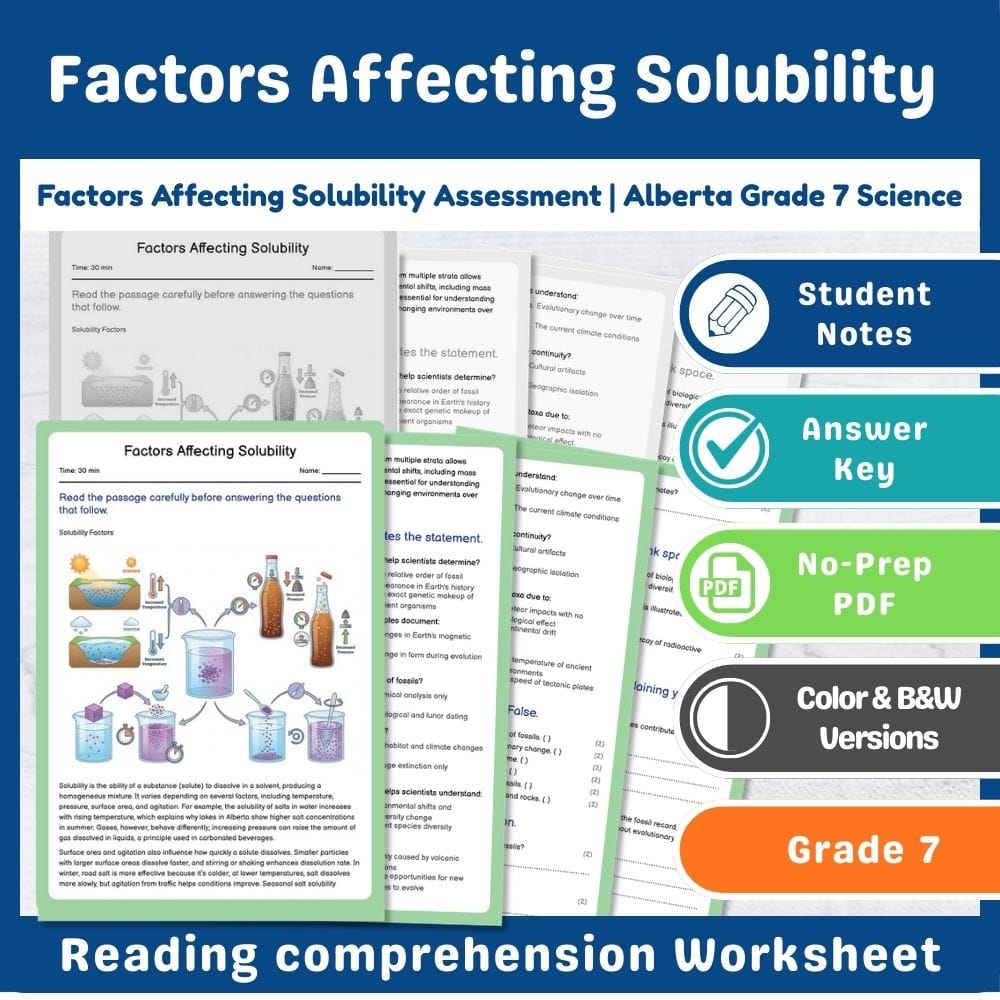
Factors Affecting Solubility Assessment | Alberta Grade 7 Science
Created byPrism Point LearningLearning Objectives
- Understand how temperature influences the solubility of solids and gases in liquids.
- Identify the effects of surface area and agitation on the rate of dissolution.
- Explore how pressure impacts the solubility of gases in liquids under different conditions.
Also included in: Lesson Grade 7 Science Mini Bundle | Matter and Chemical Change +1 more
Instant download

Grade 7 Science | Thermal Basics Worksheet | Alberta Standards
Created byLumora LearningLearning Objectives
- Understand the particles' kinetic motion and how it relates to temperature and heat.
- Identify common heat transfer methods: conduction, convection, and radiation.
- Explain how environmental examples like winter heating and snowpack reflectivity demonstrate thermal processes.
Instant download

Species Conservation Status Worksheets | Grade 7 Science Ecosystems
 Created bySunny Desk Resources
Learning Objectives
- Describe how population trends, threats, and recovery potential are used to evaluate conservation risk.
- Identify how land use, genetic diversity, and habitat connectivity affect a species' vulnerability.
- Interpret evidence from examples such as the swift fox and at-risk plants to explain regional persistence.
Also included in: Interactions & Ecosystems Grade 7 Alberta Science Worksheets Bundle +1 more
Instant download

Conservation of Mass Worksheet for Grade 7 Science | Standards-Aligned Practice
JCreated byJ.S SheetsLearning Objectives
- Understand the principle of conservation of mass in chemical reactions.
- Explain how atoms are conserved and rearranged during reactions.
- Identify the characteristics of closed systems in chemical processes.
Instant download
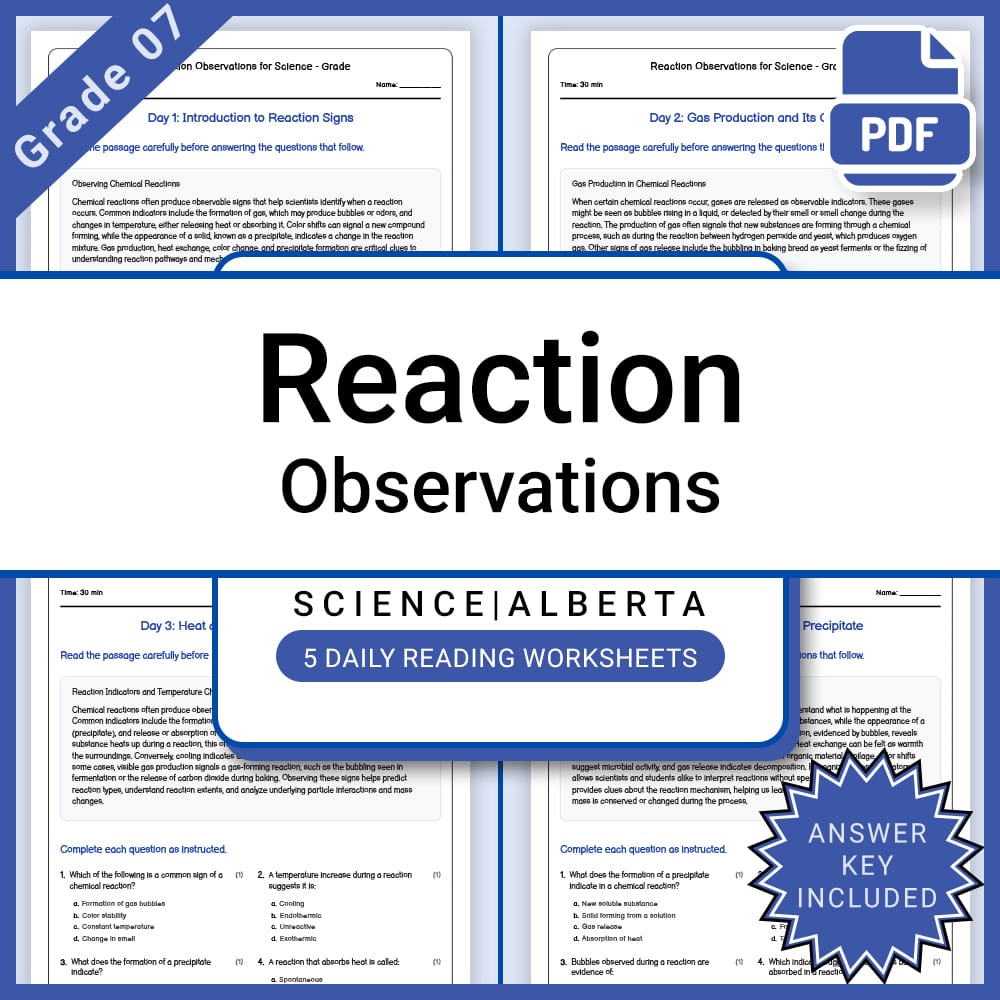
Grade 7 Science – Reaction Observation Daily Reading Worksheet + Answer Key
JCreated byJ.S SheetsLearning Objectives
- Identify different observable indicators of chemical reactions
- Describe how to recognize gas production, heat exchange, colour changes, and precipitate formation
- Connect observable signs to reaction pathways and processes
Also included in: Grade 7 Science Lesson Bundle | Alberta Framework for Classroom Use +1 more
Instant download

Science Graphical Representation Worksheet Grade 7 | Standards-Aligned
JCreated byJ.S SheetsLearning Objectives
- Choose an appropriate graph type (bar chart, histogram, line graph, or scatter plot) for categorical vs. continuous data.
- Construct graphs using correct axis labels, sensible scaling, and proportional representation.
- Interpret patterns, slope, and correlation without implying causation.
Instant download
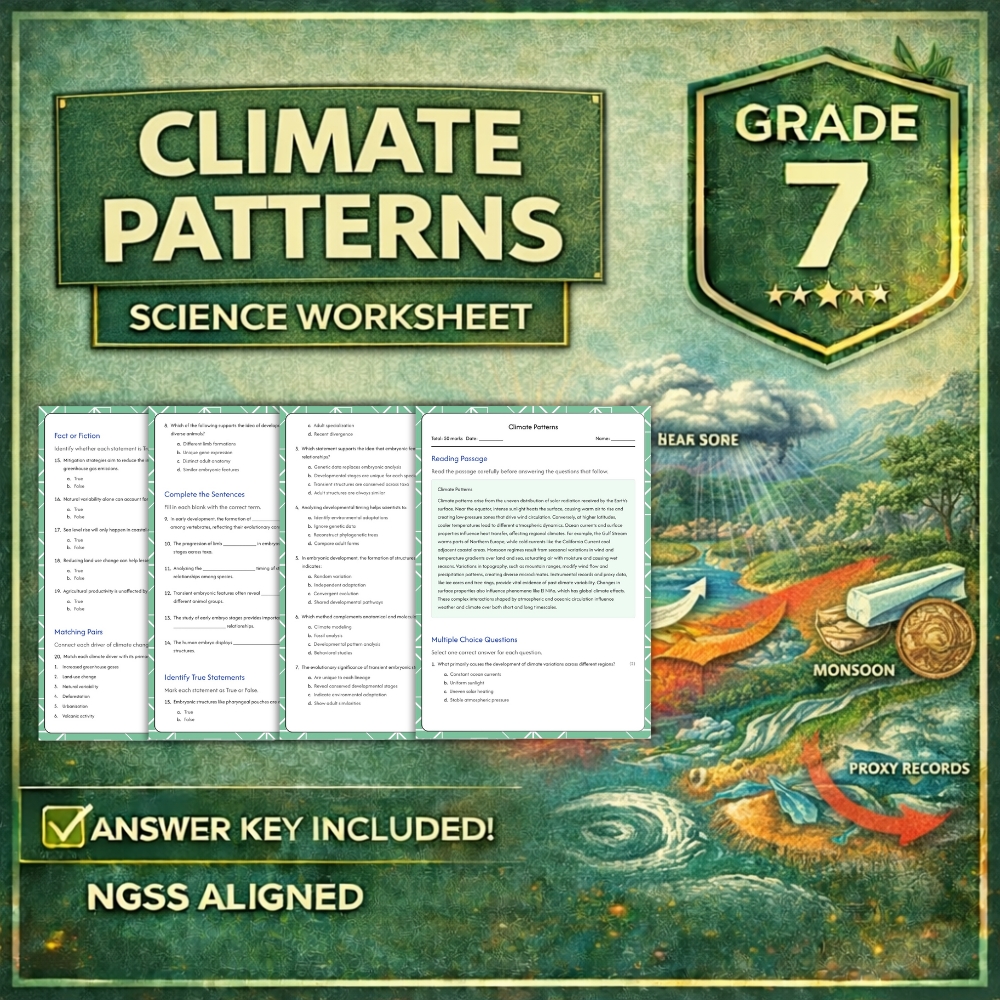
Grade 7 Science | Climate Patterns Worksheet (NGSS + Answer Key)
 Created byCedar Grove Learning
Learning Objectives
- Understand how uneven solar heating influences regional climate variations.
- Identify atmospheric and oceanic circulation patterns such as El Niño and monsoons.
- Analyze the impact of topography and ocean currents on local climate conditions.
Also included in: Grade 7 Science Bundle | Earth Systems & Processes NGSS (Worksheet Pack)
Instant download
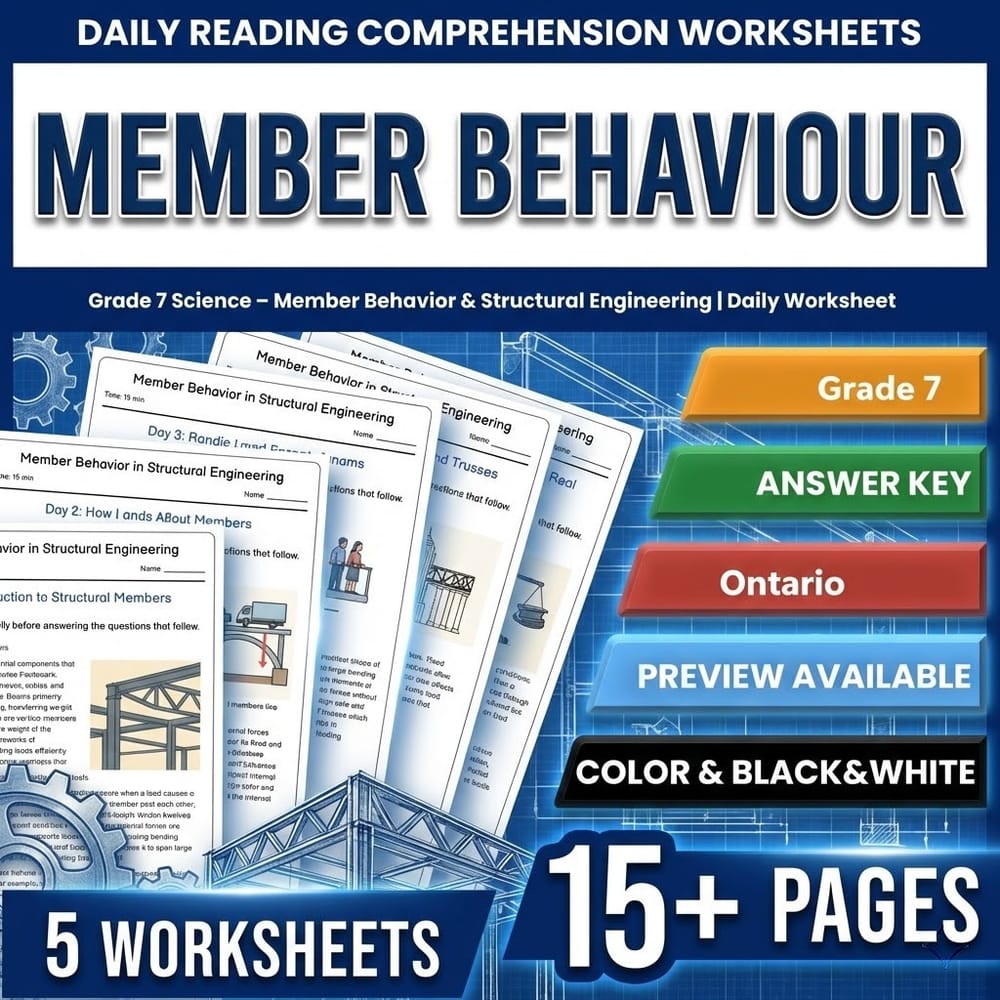
Grade 7 Science – Member Behavior & Structural Engineering | Daily Worksheet
 Created byQuiet Forest Education
Learning Objectives
- Identify different types of structural members such as beams, columns, trusses, and cantilevers.
- Understand how structural members respond to loads through bending, shear, axial force, and torsion.
- Relate geometry and support conditions to internal force distribution in structures.
Also included in: Structural Engineering Grade 7 Science Daily Reading Worksheets Bundle | Ontario +1 more
Instant download
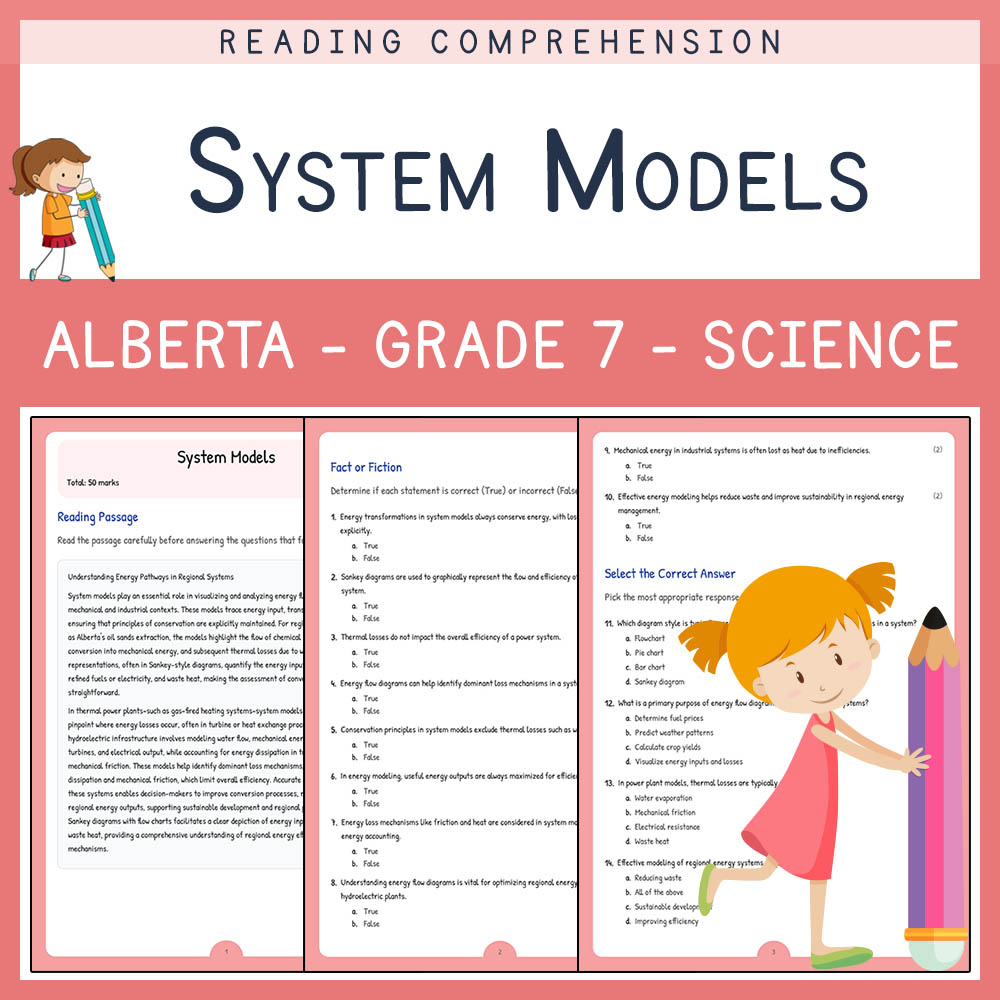
Grade 7 Science | System Models Worksheet | Alberta Standards
Created byLumora LearningLearning Objectives
- Explain how energy pathways are traced and modeled in industrial systems.
- Identify different components and representations used in energy flow diagrams.
- Analyze efficiency and loss mechanisms in regional energy systems such as oil sands extraction and hydroelectric plants.
Instant download

Motion Principles Worksheet for Grade 7 Science | Standards-Aligned Practice
JCreated byJ.S SheetsLearning Objectives
- Distinguish speed, velocity, and acceleration using real-life motion examples
- Identify scalar versus vector quantities and explain how direction affects velocity
- Use qualitative reasoning to interpret constant velocity versus changing motion
Instant download
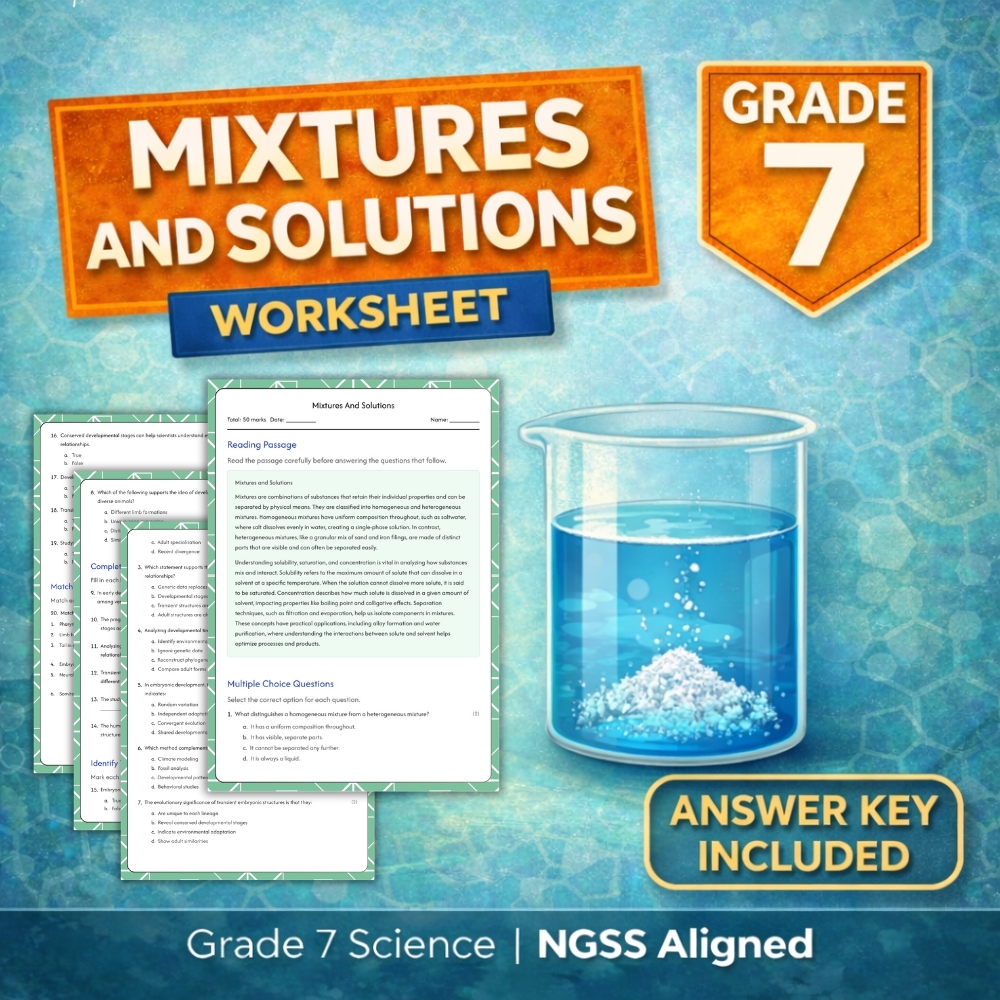
Grade 7 Science | Mixtures And Solutions Worksheet (NGSS Standards + Answer Key)
Created byCedar Grove LearningLearning Objectives
- Differentiate between homogeneous and heterogeneous mixtures based on their properties.
- Explain solubility, saturation, and concentration in solutions.
- Identify practical examples of mixtures and solutions, such as saltwater, oil-water emulsions, and granular mixtures.
Instant download
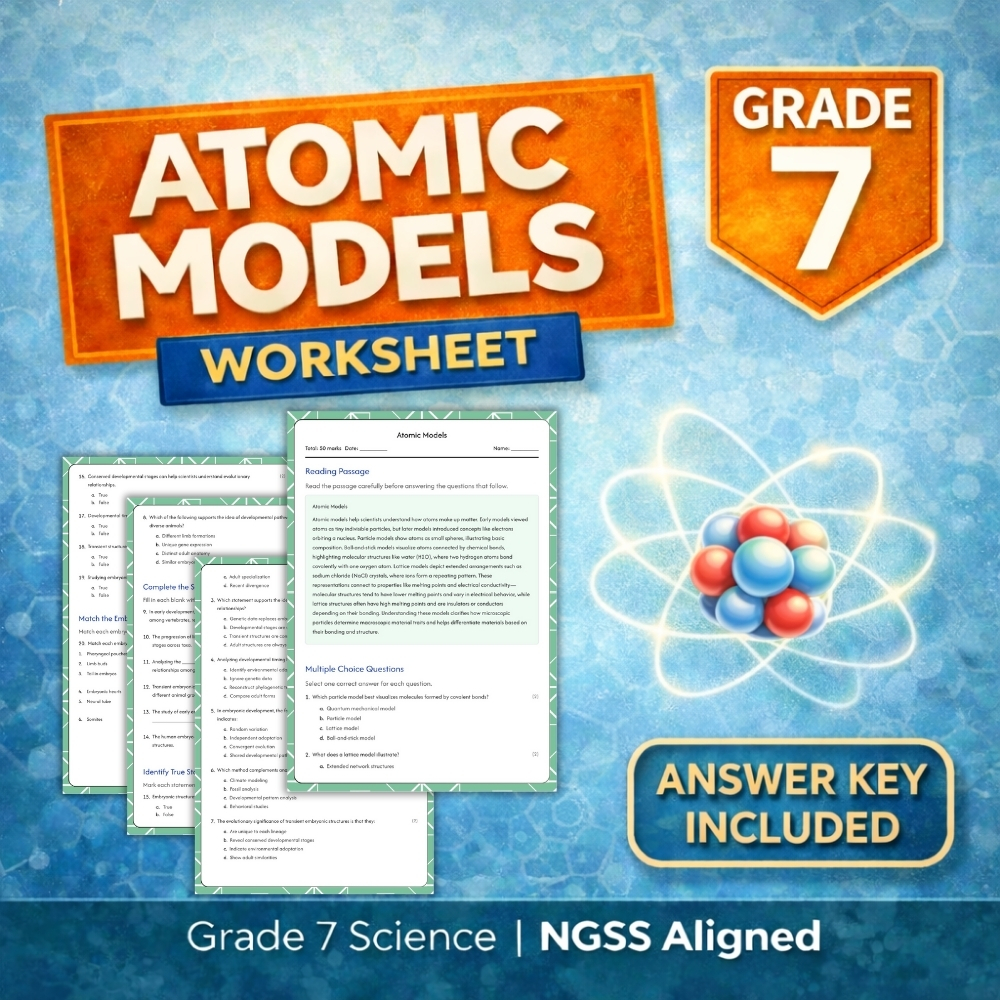
Grade 7 Science – Atomic Models (Worksheet + Answer Key) NGSS Aligned
Created byCedar Grove LearningLearning Objectives
- Describe different representations of atoms, including particle, ball-and-stick, and lattice models.
- Explain how atoms form molecules via covalent and ionic bonding.
- Connect subatomic particles, atomic number, and chemical formulas to the properties of materials.
Instant download
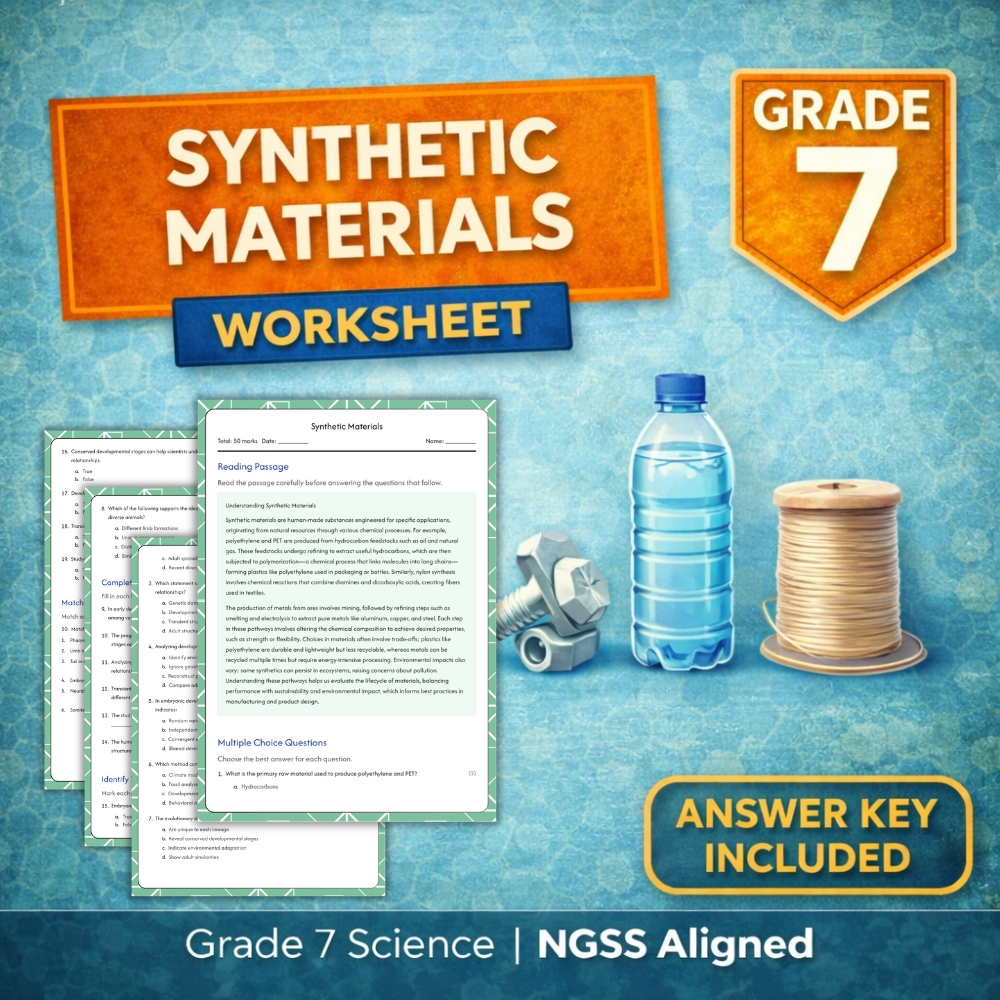
7th Grade Science | Synthetic Materials Worksheet (NGSS) & Answer Key
Created byCedar Grove LearningLearning Objectives
- Describe the production pathways from natural resources to common synthetic materials, including feedstocks, polymerization, and refining steps.
- Identify different synthetic materials like polyethylene, PET, nylon, and metals produced from ores.
- Evaluate trade-offs such as durability, recyclability, and environmental impact linked to material choices.
Instant download
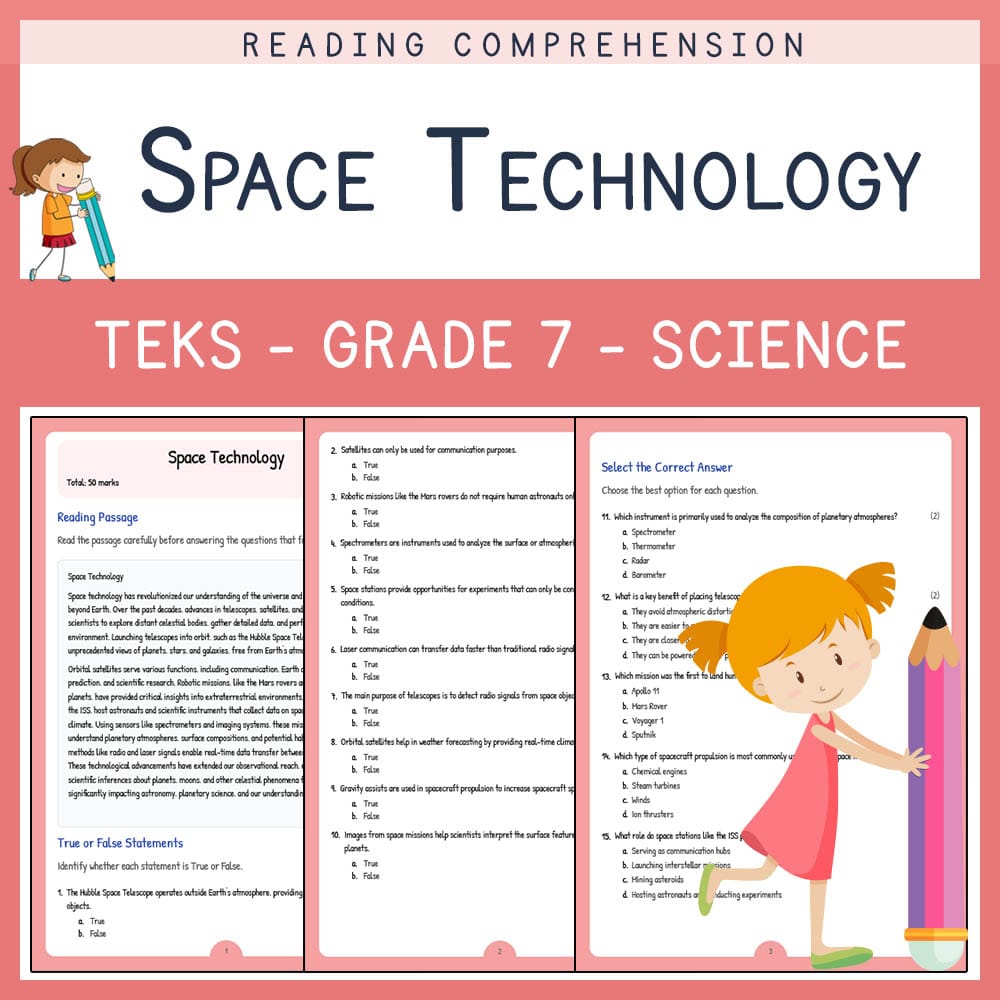
Grade 7 Science | Space Technology Worksheet | TEKS-Aligned
Created byLumora LearningLearning Objectives
- Understand the types of technologies used in space observation and exploration.
- Identify key historical space missions and their contributions.
- Explain how satellites, telescopes, and spacecraft gather data beyond Earth.
Also included in: Grade 7 Science | Earth and Space Systems Unit Bundle | TEKS Standard
Instant download

Grade 7 Science | Understanding Friction & Resistance - Reading Practice
Created byCoral Reef LearningLearning Objectives
- Identify different types of friction
- Explain how surface textures influence resistance
- Describe how air resistance affects moving objects
Instant download
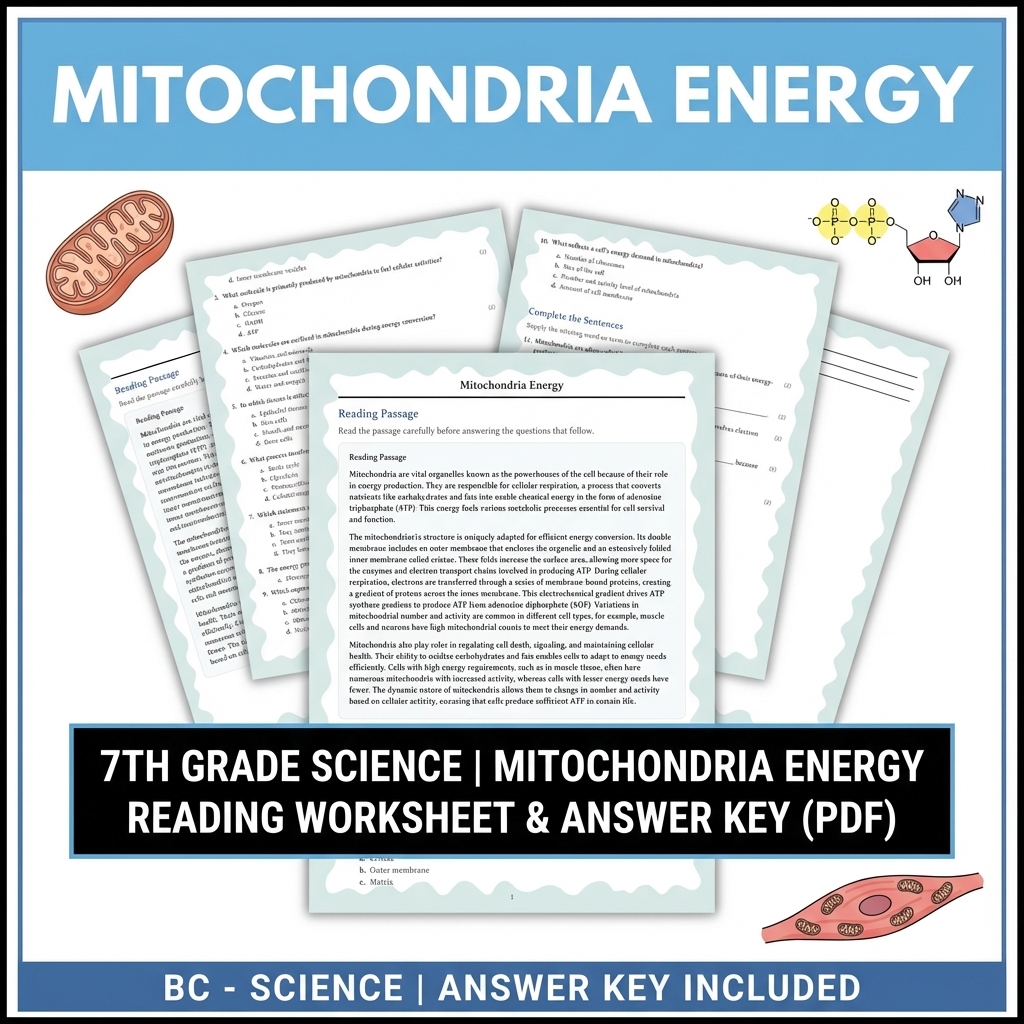
7th Grade Science | Mitochondria Energy Reading Worksheet & Answer Key (PDF)
JCreated byJ.S SheetsLearning Objectives
- Understand the structure and function of mitochondria in energy production.
- Explain the process of cellular respiration and ATP synthesis.
- Describe how mitochondrial activity varies with cellular energy demands.
Instant download
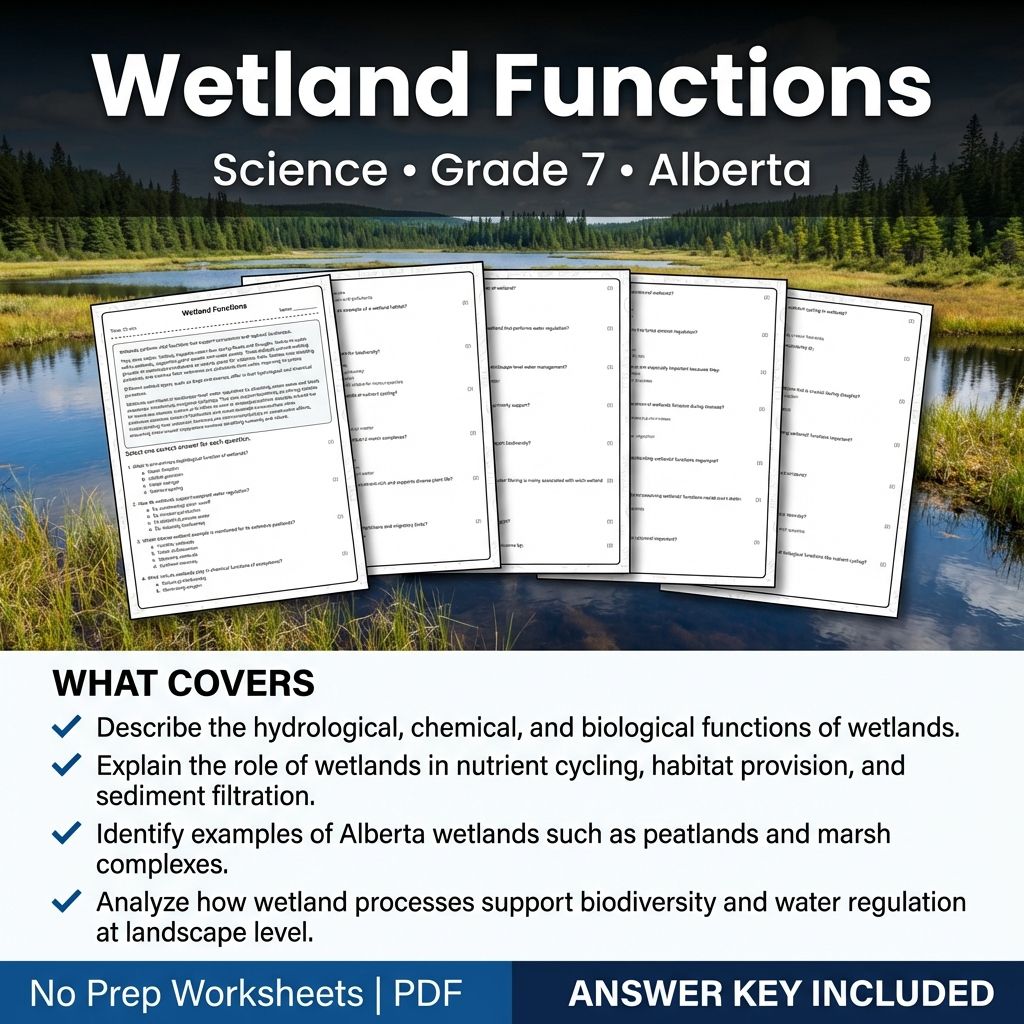
Wetland Functions Worksheet Grade 7 Science | Alberta Standards
Created byCoral Reef LearningLearning Objectives
- Describe the hydrological, chemical, and biological functions of wetlands.
- Explain the role of wetlands in nutrient cycling, habitat provision, and sediment filtration.
- Identify examples of Alberta wetlands such as peatlands and marsh complexes.
Instant download
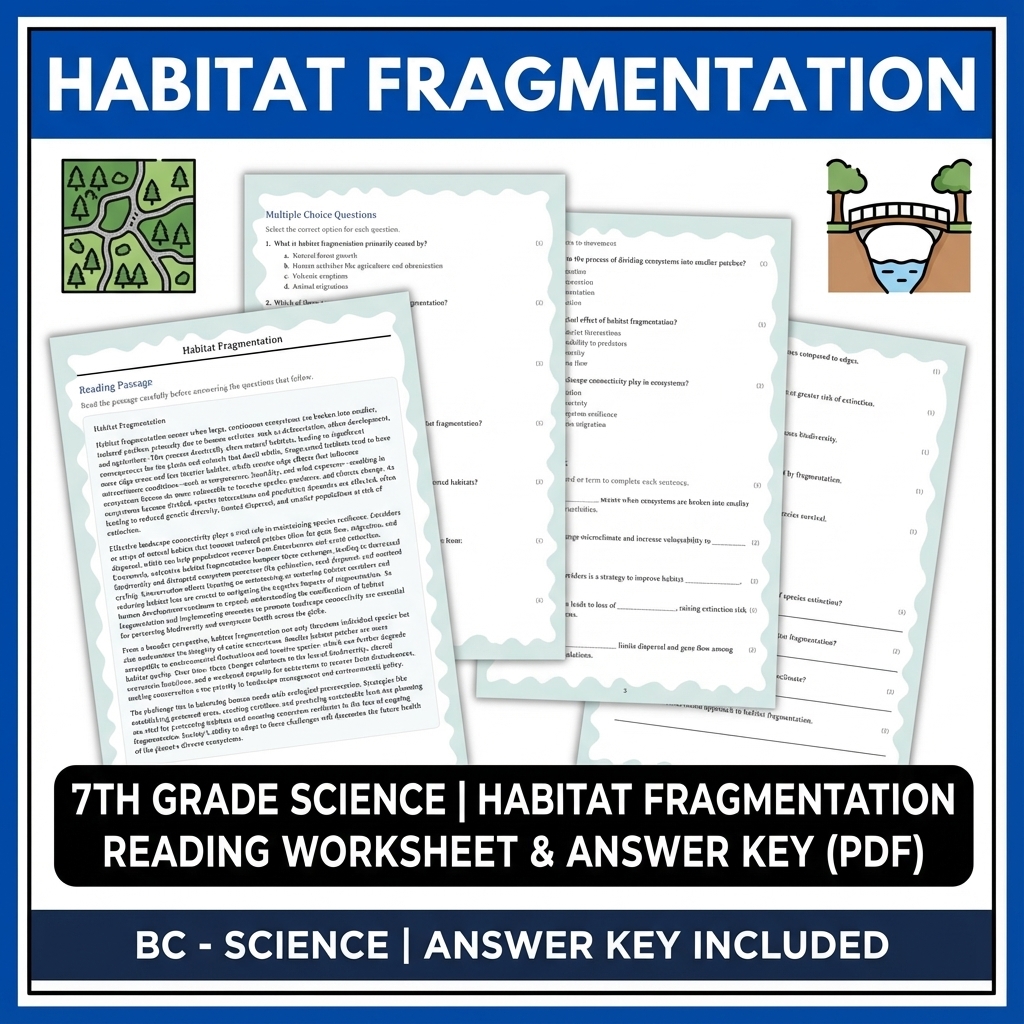
7th Grade Science | Habitat Fragmentation Reading Worksheet & Answer Key (PDF)
JCreated byJ.S SheetsLearning Objectives
- Understand what habitat fragmentation is and how it affects ecosystems.
- Identify the effects of habitat fragmentation on species survival and biodiversity.
- Analyze landscape connectivity and its role in ecosystem resilience.
Instant download
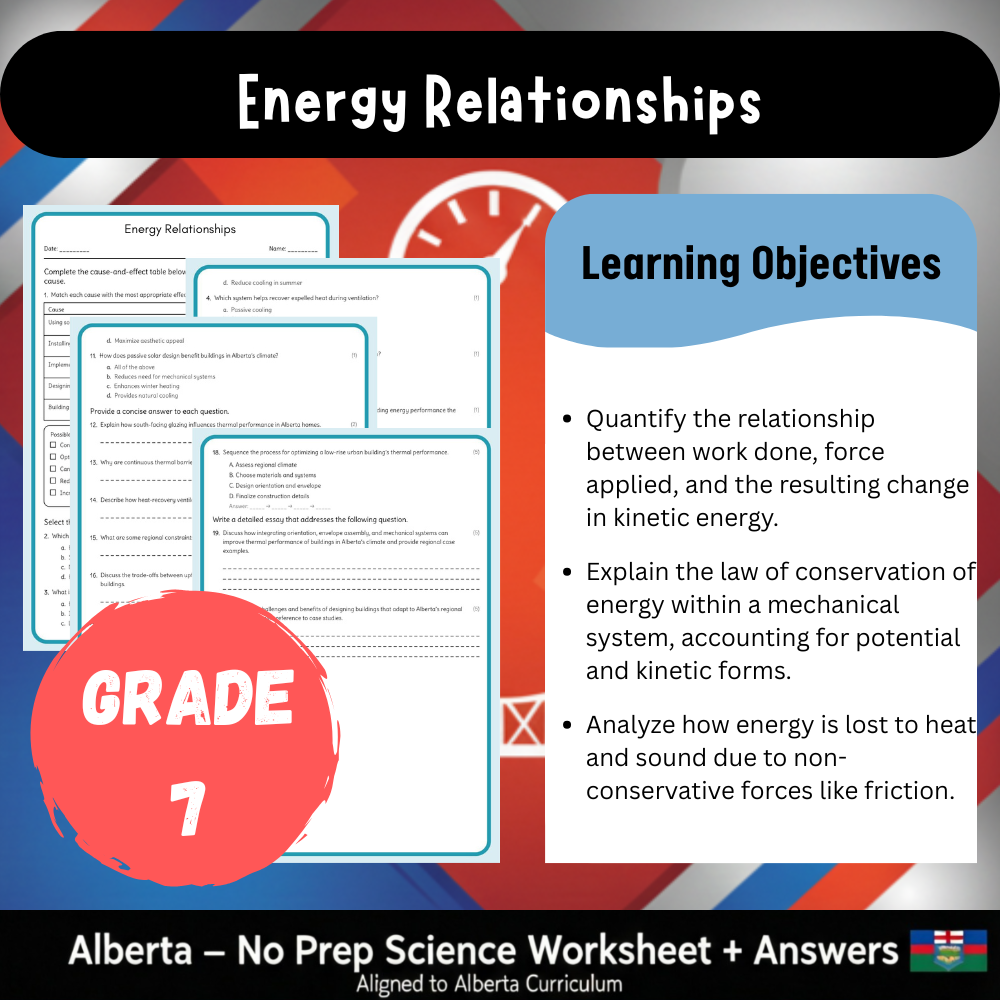
Grade 7 Science – Inclined Planes Worksheet (PDF) | Alberta Standards
Created byBright Mind ResourcesLearning Objectives
- Explain how inclined planes change the force required to move loads by increasing distance.
- Analyze the force components parallel and perpendicular to an inclined plane.
- Calculate the mechanical advantage of ramps used in real-world Alberta contexts.
Instant download
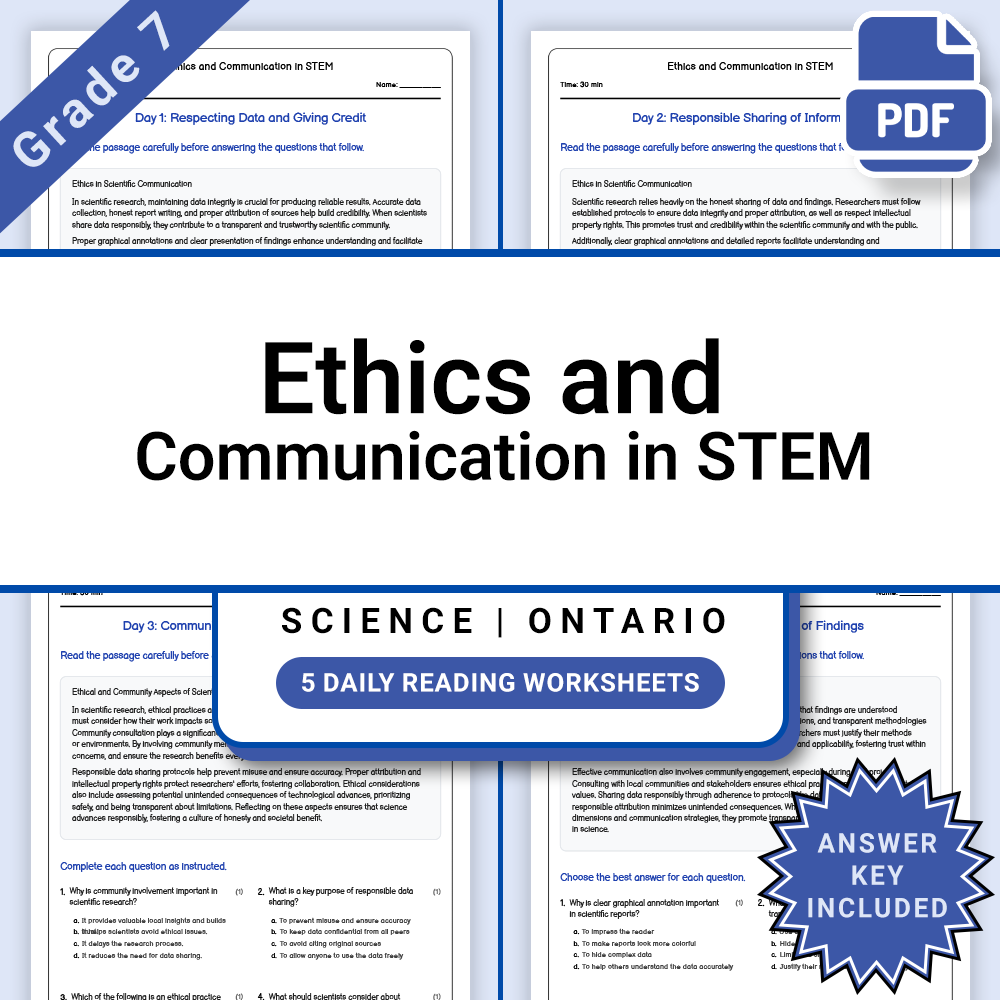
Grade 7 Science – Ethics and Communication Daily Reading Worksheet + Answer Key
JCreated byJ.S SheetsLearning Objectives
- Understand the importance of data integrity and proper attribution in scientific work.
- Identify conventions for effective technical reporting and graphical annotation.
- Recognize the significance of peer review and transparent communication of findings.
Also included in: Grade 7 Science Lesson Bundle | Ontario Curriculum Reading Worksheets +1 more
Instant download
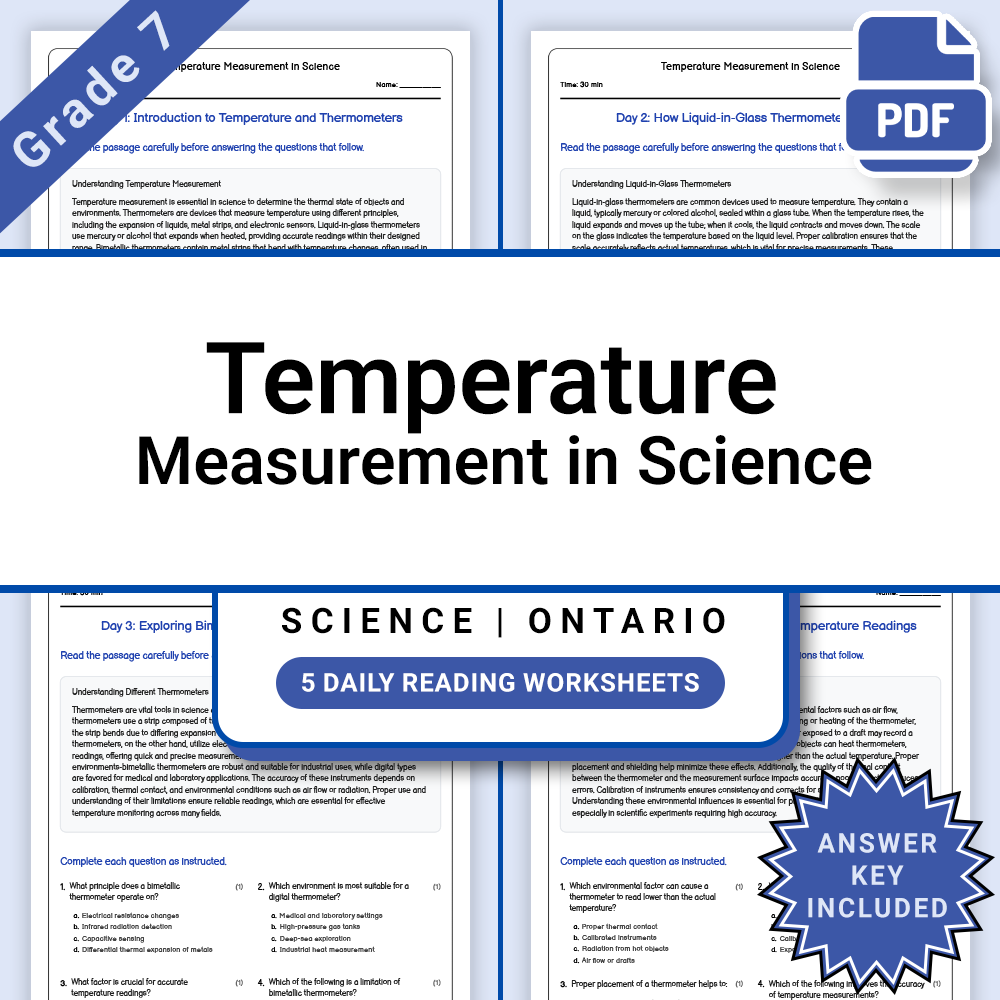
Grade 7 Science – Measurement Uncertainty Daily Reading Worksheet + Answer Key
JCreated byJ.S SheetsLearning Objectives
- Understand the importance of standard measurement units in science.
- Identify different measurement instruments and scales.
- Comprehend concepts of accuracy, precision, and sources of measurement uncertainty.
Also included in: Grade 7 Science Lesson Bundle | Ontario Curriculum Reading Worksheets +1 more
Instant download
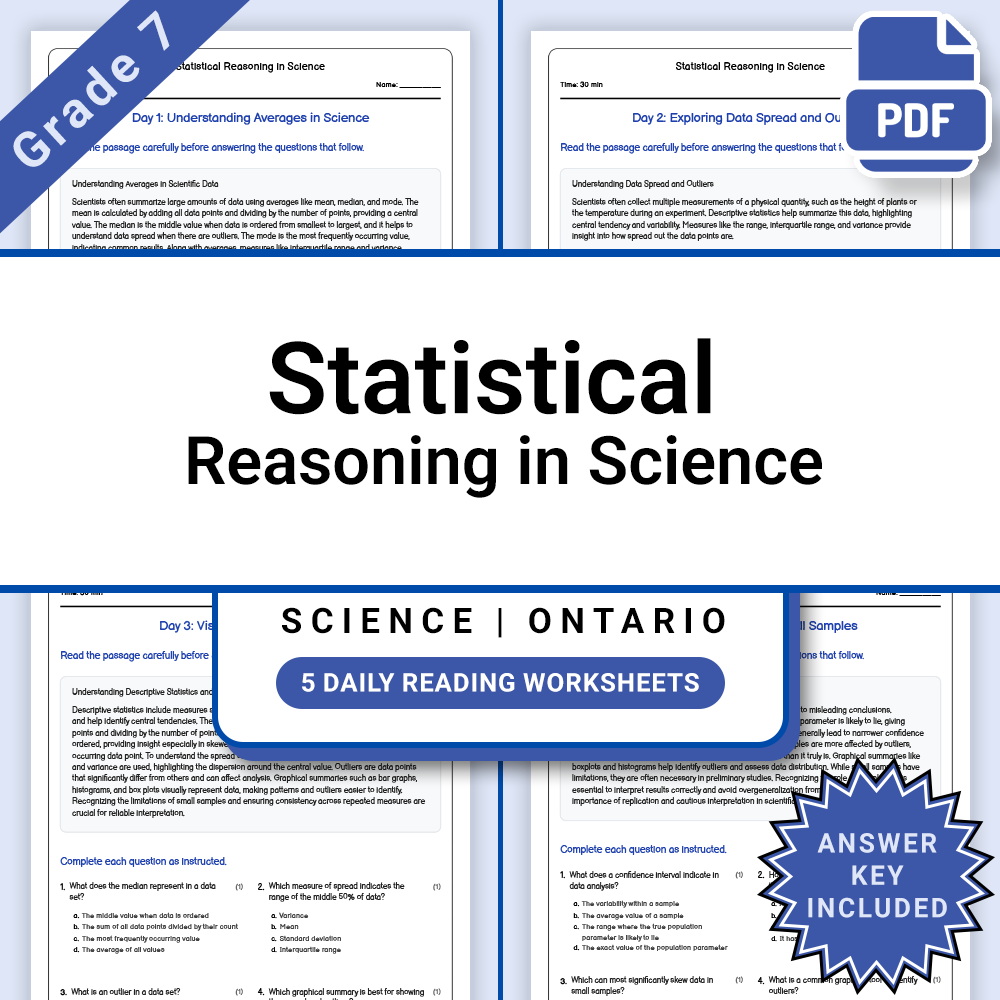
Grade 7 Science – Statistical Reasoning Daily Reading Worksheet with Answer Key
JCreated byJ.S SheetsLearning Objectives
- Understand and define mean, median, and mode
- Interpret measures of dispersion such as interquartile range and variance
- Recognize the role of outliers and their impact on data
Also included in: Grade 7 Science Lesson Bundle | Ontario Curriculum Reading Worksheets +1 more
Instant download
About Grade 7 Science Worksheets
Browse 6,039 printable Grade 7 Science worksheets — ready-to-print PDFs with answer keys where available.
Every worksheet on MyTeachingSheets is created by independent teacher-authors and reviewed before publication. All resources download as printable PDFs for classroom, homework, or at-home practice, and many include answer keys. Preview any worksheet free before buying.