
Grade 7 Science Worksheets
6,039 worksheets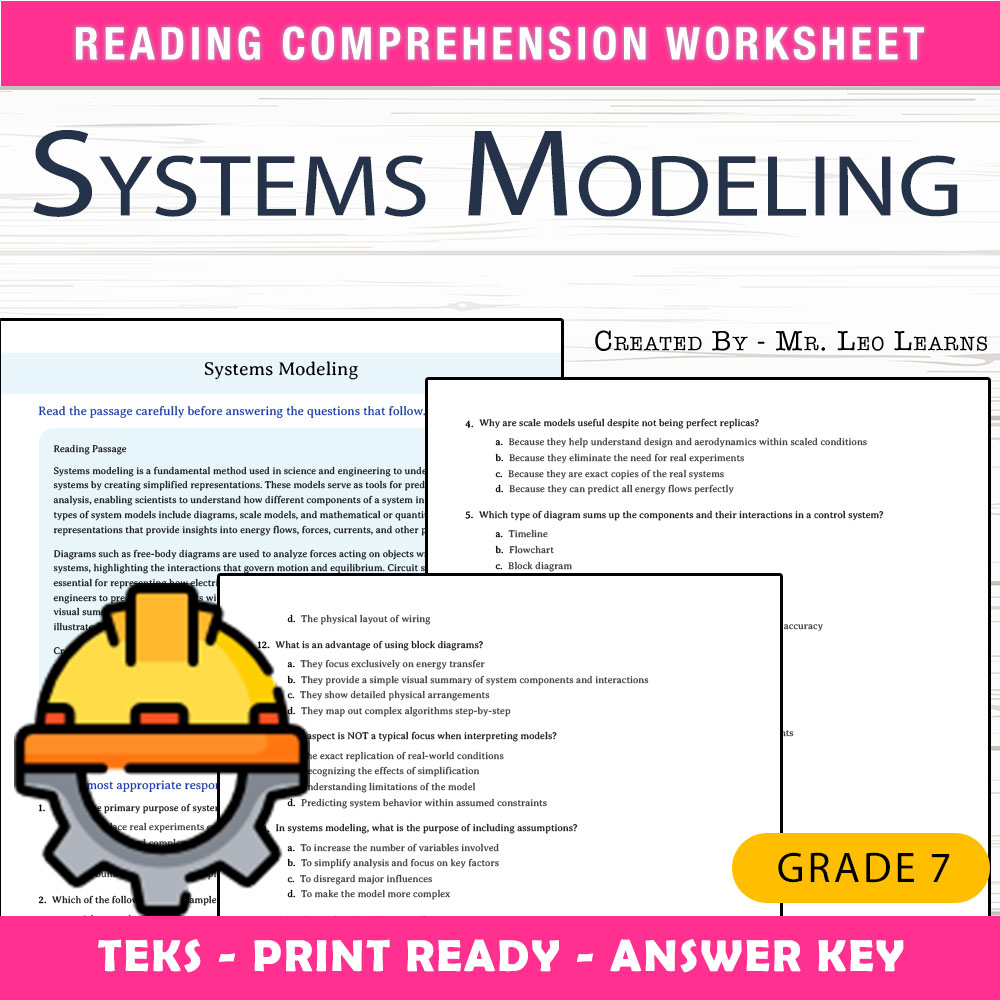
Grade 7 Science – Systems Modeling Worksheet for Mastery
 Created byThe Resource Hub
Learning Objectives
- Explain the concept of systems modeling and its purpose in scientific analysis.
- Identify different types of system models such as diagrams, scale models, and quantitative representations.
- Describe the use of diagrams like free-body diagrams, circuit schematics, and block diagrams.
Also included in: Grade 7 Science Unit | Engineering, Technology & Innovation Worksheet Bundle +1 more
Instant download
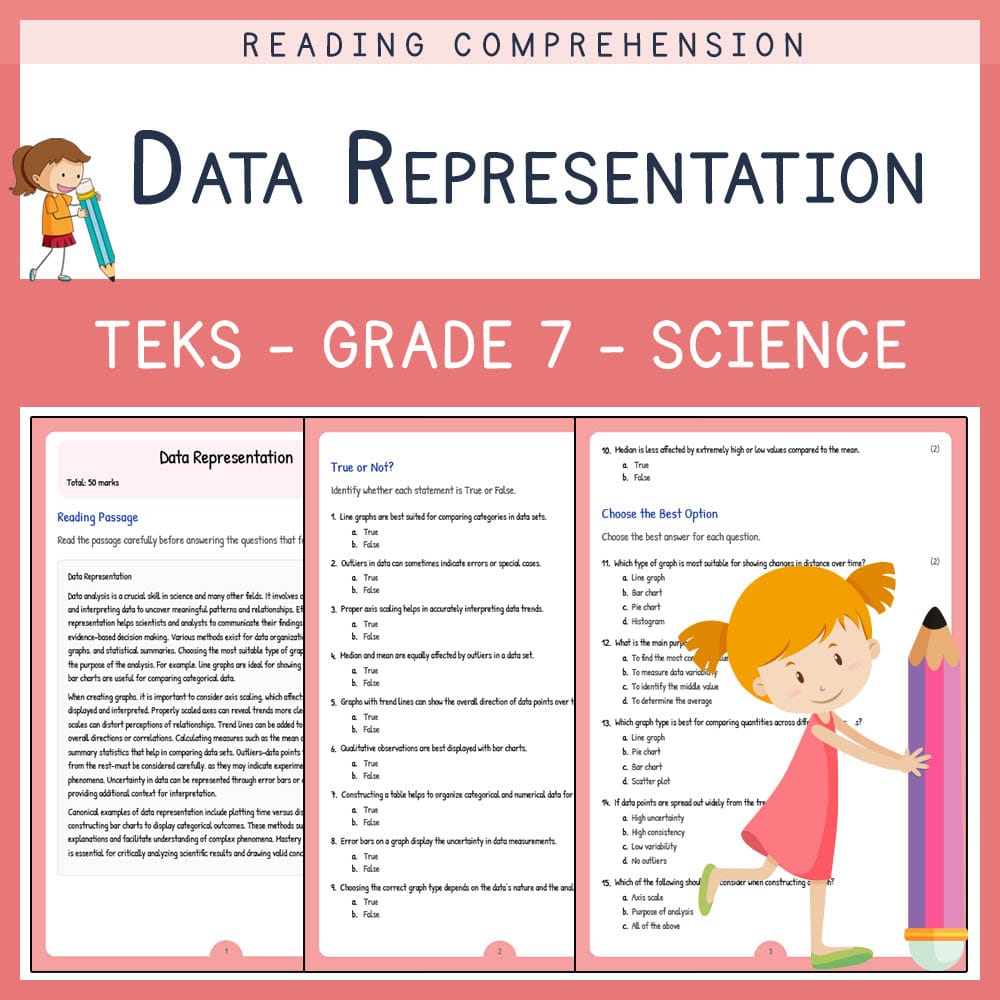
Grade 7 Science | Data Representation Worksheet | TEKS Alligned
 Created byLumora Learning
Learning Objectives
- Understand how to organize data into tables and graphs for analysis.
- Identify appropriate graph types for different data sets.
- Interpret trends and relationships from charts and summary statistics.
Instant download

Grade 7 Science | Introduction to Truss Structures - Daily Reading Comprehension
 Created byCoral Reef Learning
Learning Objectives
- Understand the basic parts of a truss
- Identify how loads are distributed in a truss
- Recognize the significance of triangle shapes in structural stability
Also included in: Forces, Structures and Motion Lesson Bundle | Grade 7 Science Alberta +1 more
Instant download

Thermal Expansion Worksheet Grade 7 Science | Heat and Matter
 Created byPrism Point Learning
Learning Objectives
- Explain how increasing temperature increases particle motion and average spacing, causing thermal expansion in solids and liquids.
- Describe how heating changes gas particle motion and increases pressure in a confined space.
- Use particle theory to predict contraction when temperature decreases.
Instant download
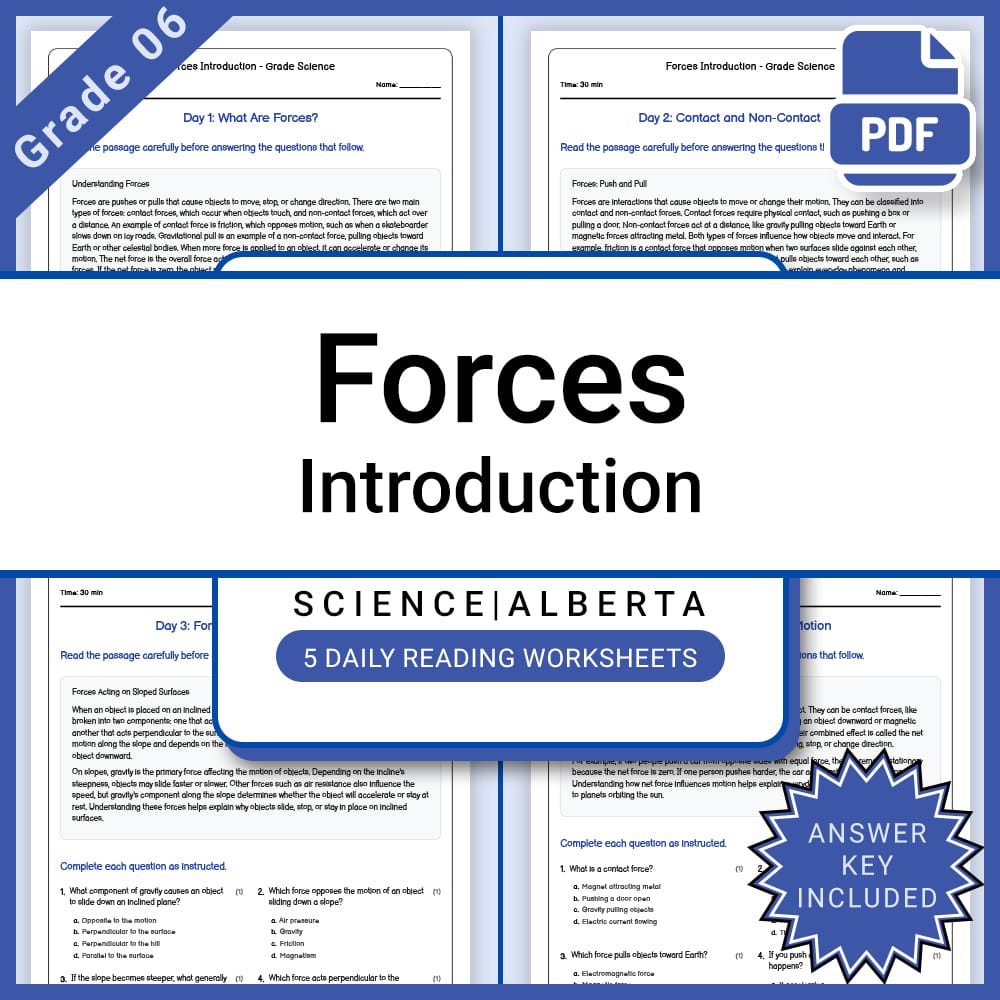
Grade 7 Science – Forces Introduction Daily Reading Worksheet with Answer Key
JCreated byJ.S SheetsLearning Objectives
- Identify different types of forces, including contact and non-contact forces.
- Understand how forces change the motion of objects.
- Explain the concept of net force and its effect on acceleration.
Also included in: Grade 7 Science Lesson Group | Structural Engineering & Motion Worksheets +1 more
Instant download

Predator Prey Dynamics Worksheet | Grade 7 Science Practice
Created byPrism Point LearningLearning Objectives
- Explain how predator and prey populations can change over time due to cause-and-effect feedback.
- Use population dynamics vocabulary (predator, prey, growth, decline, community composition) to describe ecological cycles.
- Predict how changes in one species can ripple to other organisms in a community.
Instant download
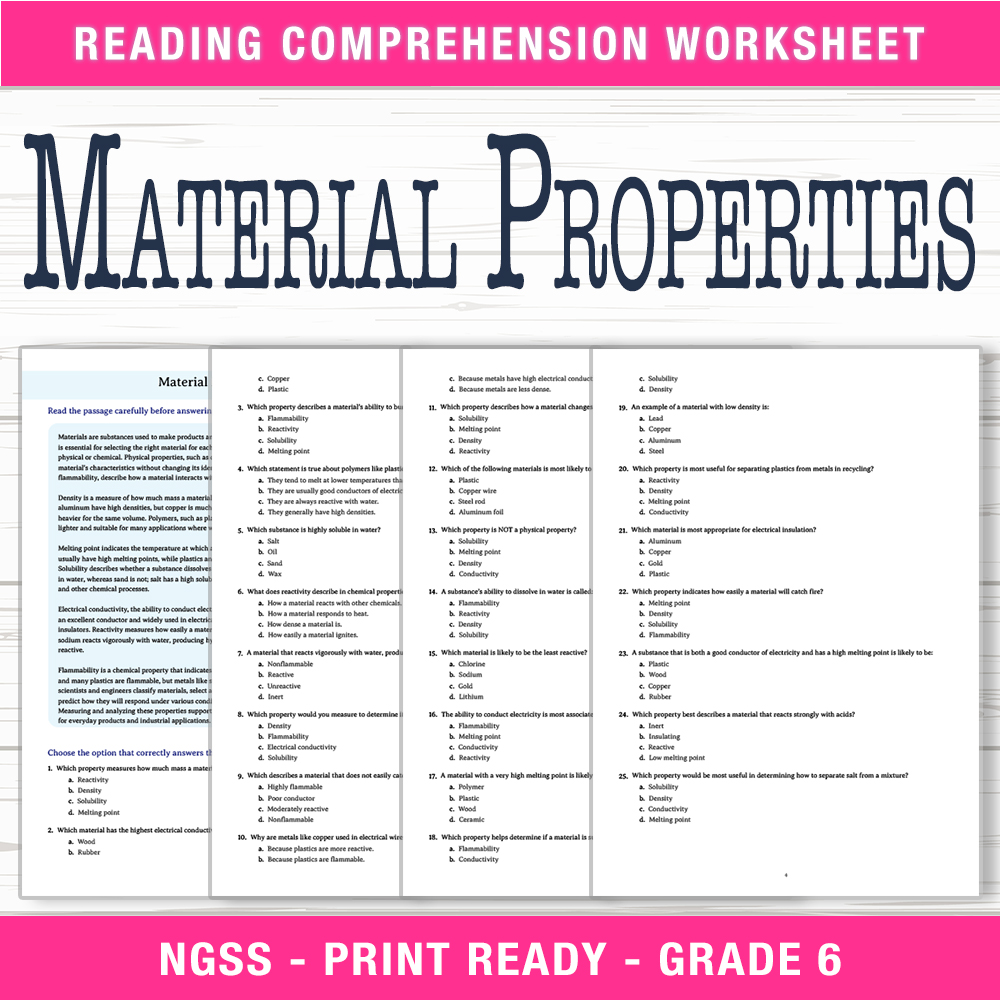
Grade 7 Science | Material Properties Worksheet (PDF + Answer Key)
 Created byRiverstone Classroom
Learning Objectives
- Identify and distinguish between physical and chemical properties of materials.
- Analyze property data such as density, melting point, solubility, electrical conductivity, reactivity, and flammability.
- Use measurable attributes to classify materials and predict their responses to temperature and chemical contact.
Instant download

Grade 7 Science | Prototyping Methods in Engineering - Reading Comprehension
Created byCoral Reef LearningLearning Objectives
- Understand different prototyping approaches including scaled physical models, digital finite-element models, and laboratory load rigs
- Recognize the advantages and limitations of each prototyping method in assessing structural strength, stiffness, and failure modes
- Identify instrumentation techniques such as strain gauges and displacement transducers used to quantify responses
Instant download

Human Impacts Worksheet Pack | Grade 7 Science Activities
Created byPrism Point LearningLearning Objectives
- Explain how habitat fragmentation, pollution, and invasive species change ecosystems.
- Describe how human activities can alter abiotic conditions and shift biodiversity and trophic structure.
- Evaluate how mitigation and restoration actions affect ecosystem recovery over time.
Also included in: Ecosystems & Adaptations Grade 7 Science Lesson Bundle TEKS Worksheets
Instant download
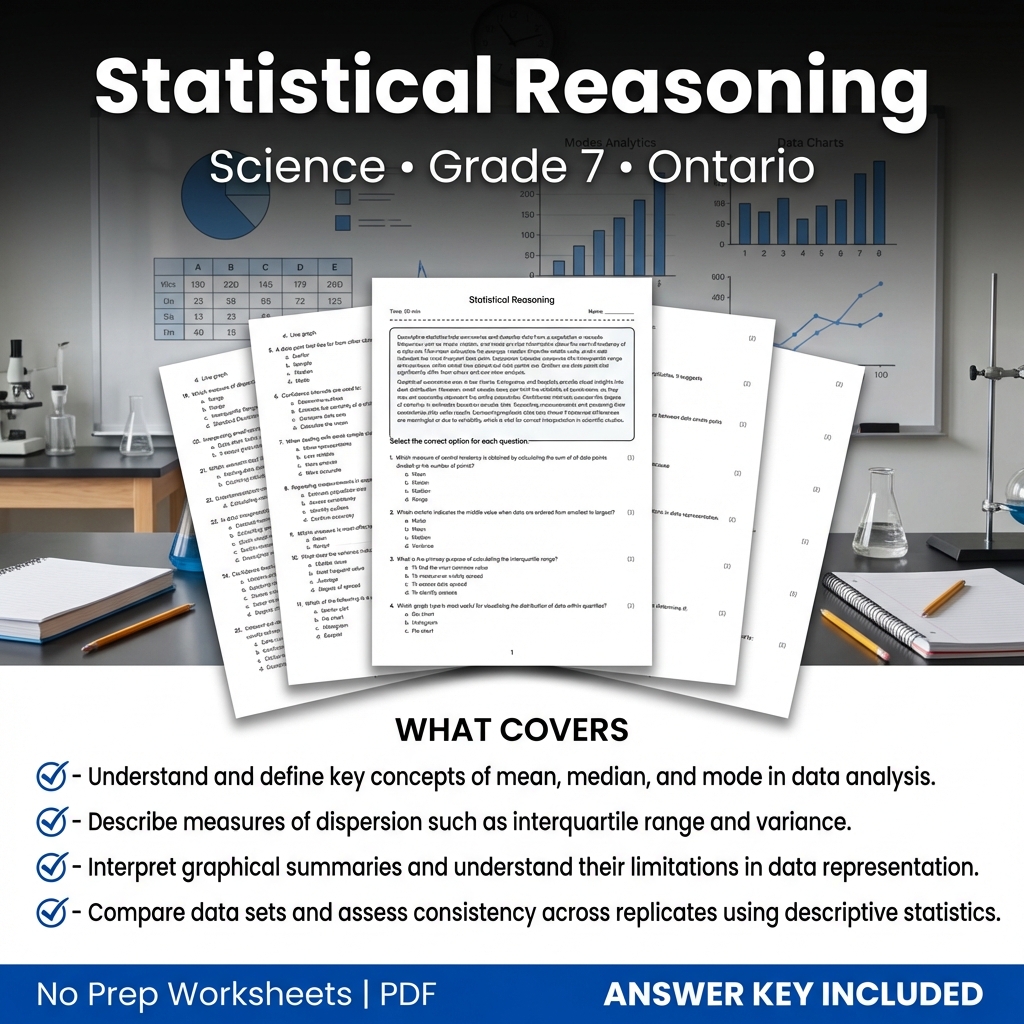
Grade 7 Science Worksheet on Statistical Reasoning | Ontario Standards
Created byCoral Reef LearningLearning Objectives
- Understand and define key concepts of mean, median, and mode in data analysis.
- Describe measures of dispersion such as interquartile range and variance.
- Interpret graphical summaries and understand their limitations in data representation.
Instant download

Grade 7 Science – Abiotic Drivers & Ecosystems | Daily Reading Worksheet
 Created byBright Mind Resources
Learning Objectives
- Understand how temperature gradients influence different environmental conditions
- Identify the effects of temperature on organisms and habitats
- Recognize the importance of abiotic factors in shaping ecosystems
Also included in: Grade 7 Ecosystem Stewardship Science Daily Reading lesson bundle | Ontario +1 more
Instant download

Grade 7 Science – Trophic Energy Flow & Ecosystem | Daily Reading Worksheet
Created byBright Mind ResourcesLearning Objectives
- Identify the different trophic levels in an ecosystem.
- Explain how energy flows from one trophic level to the next.
- Understand the concept of energy loss and efficiency in ecological pyramids.
Also included in: Grade 7 Ecosystem Stewardship Science Daily Reading lesson bundle | Ontario +1 more
Instant download

Grade 7 Science – Biodiversity Indices & Species Richness | Reading Worksheet
Created byBright Mind ResourcesLearning Objectives
- Define species richness and understand its role in biodiversity
- Identify factors that influence species richness in different habitats
- Analyze the importance of species richness for ecological stability
Also included in: Grade 7 Ecosystem Stewardship Science Daily Reading lesson bundle | Ontario +1 more
Instant download

Grade 7 Science – Ecological Succession & Ecosystem Change | Reading Worksheet
Created byBright Mind ResourcesLearning Objectives
- Define ecological succession and distinguish between primary and secondary succession.
- Identify the stages of succession in different ecosystems.
- Explain the environmental factors that drive succession, such as soil development and seed dispersal.
Also included in: Grade 7 Ecosystem Stewardship Science Daily Reading lesson bundle | Ontario +1 more
Instant download

Fossil Evidence Worksheet Grade 7 Earth Science Florida NGSSS Activity
 Created byEvergreen Desk Education
Learning Objectives
- Explain how different types of fossils (remains, traces, and imprints) provide evidence of past life and environments.
- Describe how fossil formation depends on preservation conditions such as rapid burial and sediment chemistry.
- Use fossil assemblages to infer whether an area was once aquatic, influenced by climate shifts, or altered by ecological change.
Instant download
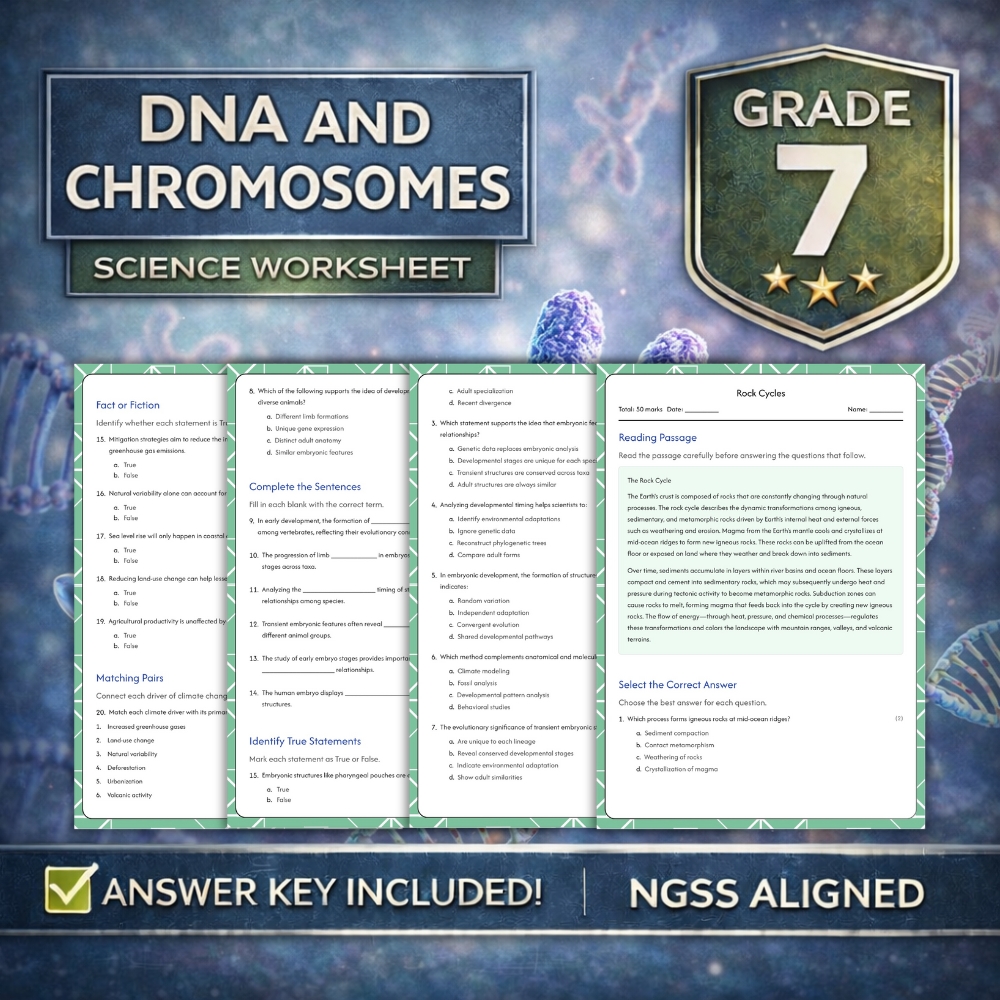
7th Grade Science | DNA and Chromosomes Worksheet (NGSS Printable PDF)
 Created byCedar Grove Learning
Learning Objectives
- Understand how DNA molecules encode genes that influence observable traits.
- Describe the organization of DNA into chromosomes and how they relate to inheritance.
- Explain the process of chromosome segregation during gamete formation and fusion.
Instant download
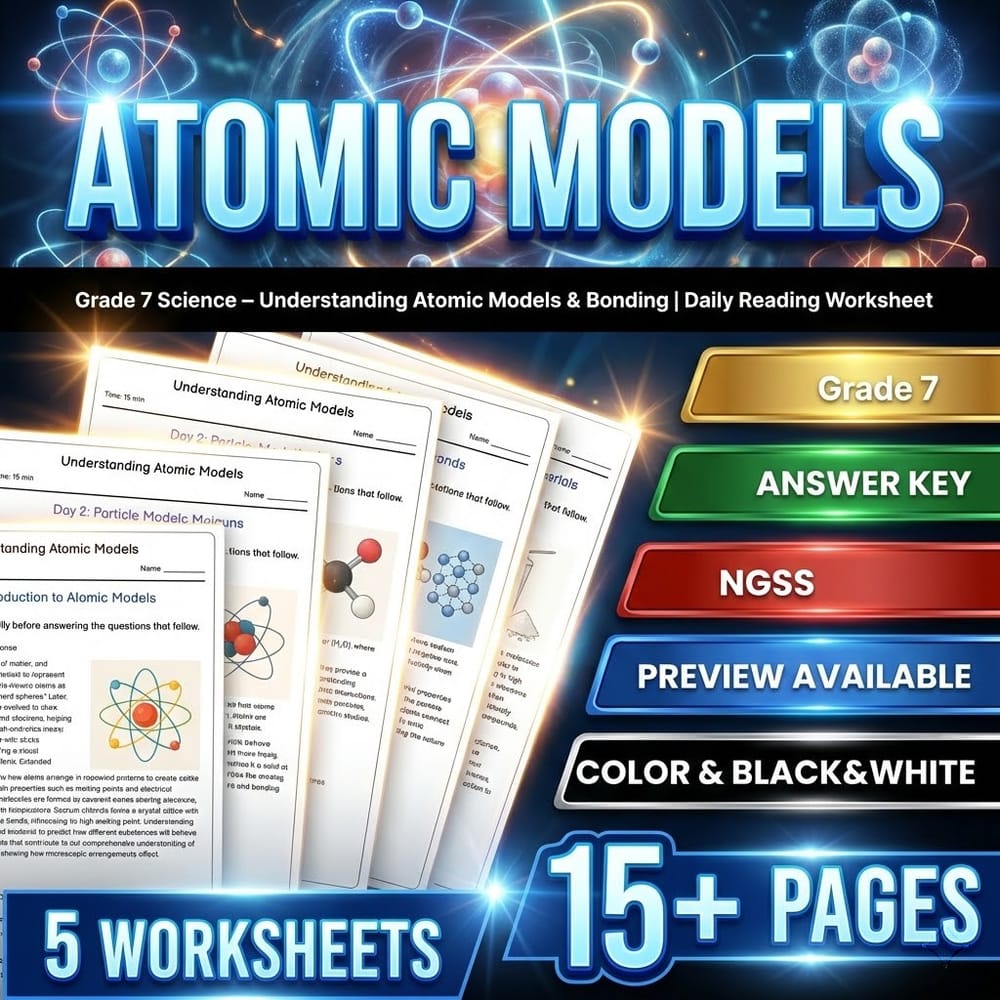
Grade 7 Science – Atomic Models & Bonding | Daily Reading Worksheet
 Created byElena Brooks
Learning Objectives
- Identify different atomic models such as particle, ball-and-stick, and lattice representations
- Understand how atoms form molecules and extended structures
- Recognize examples like water molecules and sodium chloride crystals
Also included in: Materials and Chemical Reactions Grade 7 Science Worksheets Bundle | NGSS +1 more
Instant download
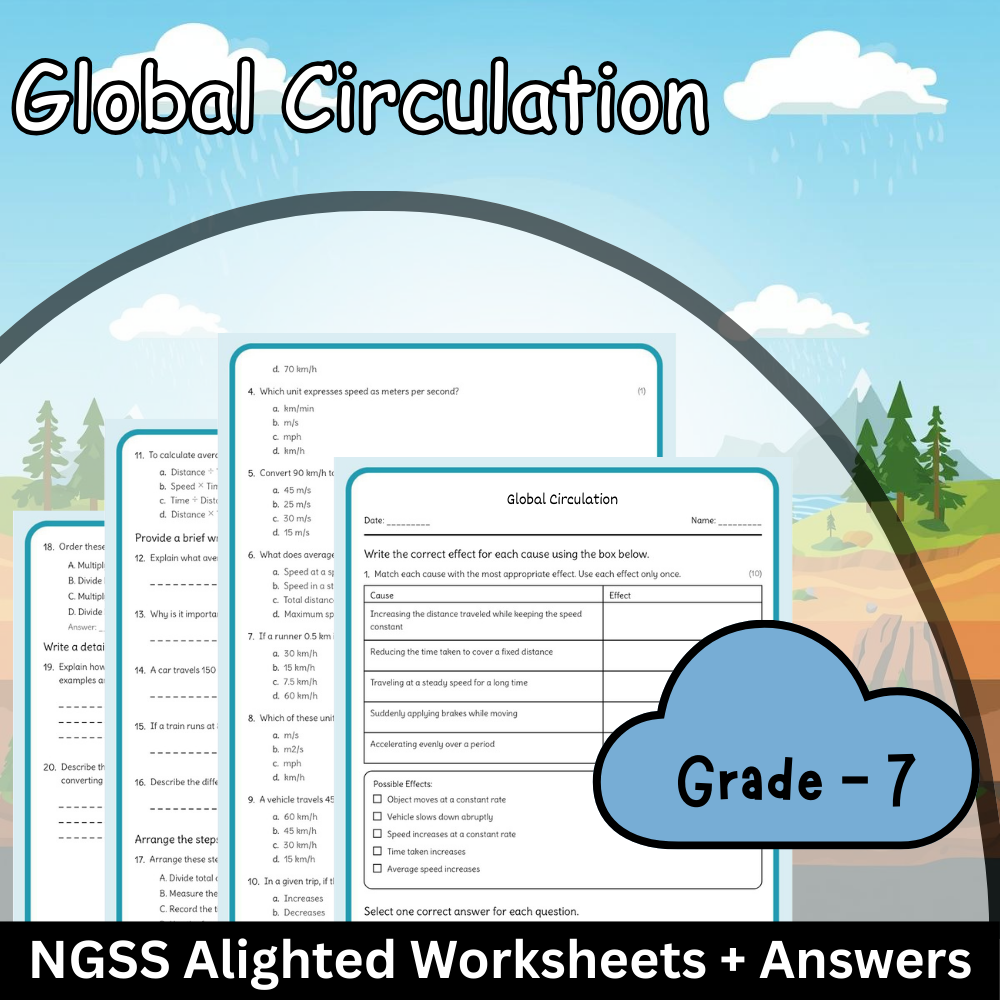
Grade 7 Science | Global Circulation Worksheet (Answer Key) NGSS-Aligned
Created byBright Mind ResourcesLearning Objectives
- Describe the main components of Earth's atmospheric and oceanic circulation systems.
- Explain how solar heating and Earth's rotation influence global wind and current patterns.
- Connect atmospheric cells and ocean gyres to regional climate and weather patterns.
Instant download
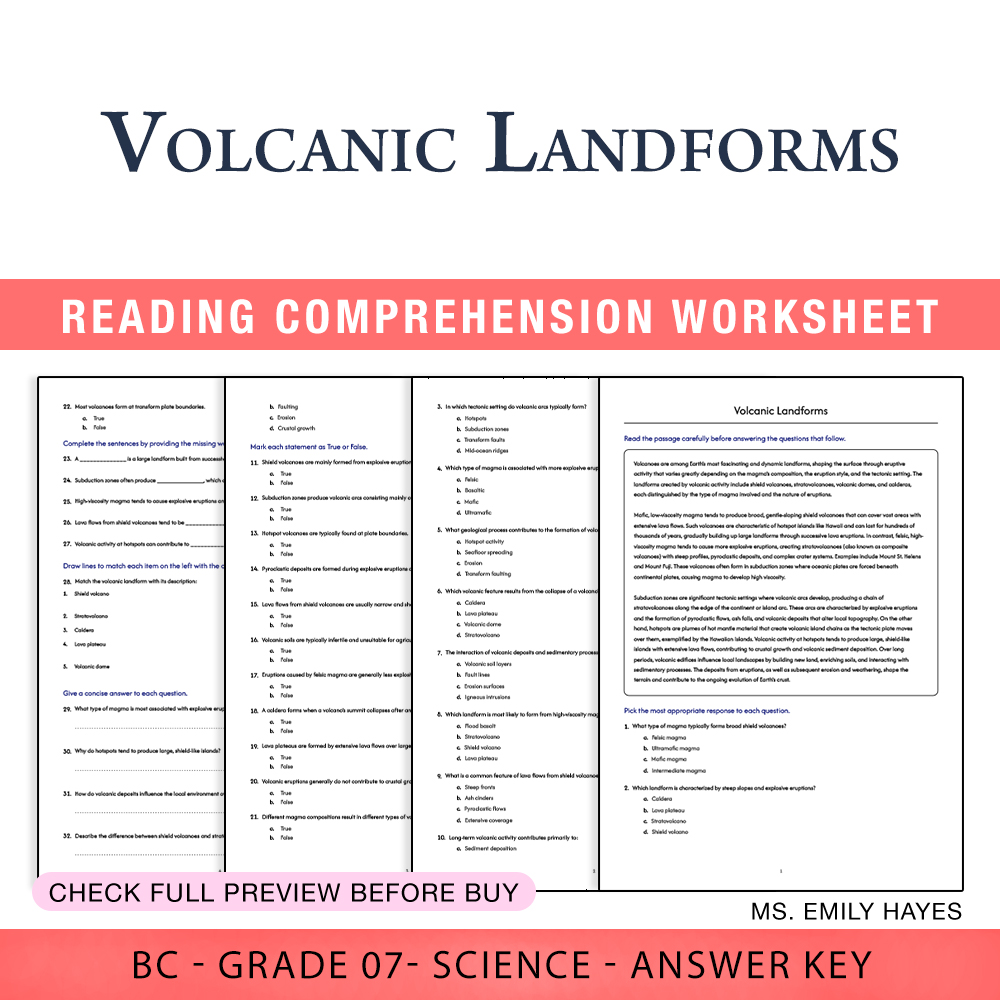
7th Grade Science | Volcanic Landforms Worksheet (PDF + Answer Key)
 Created byCopper Leaf Classroom
Learning Objectives
- Describe the types of landforms created by volcanic activity and how magma composition influences volcano shape.
- Identify the different tectonic settings where volcanic landforms are produced, such as subduction zones and hotspots.
- Explain how volcanic activity contributes to crater formation, soil creation, and crustal growth.
Also included in: Grade 7 Science | Earth Systems & Geology Unit (PDF+ Answer Keys) +1 more
Instant download
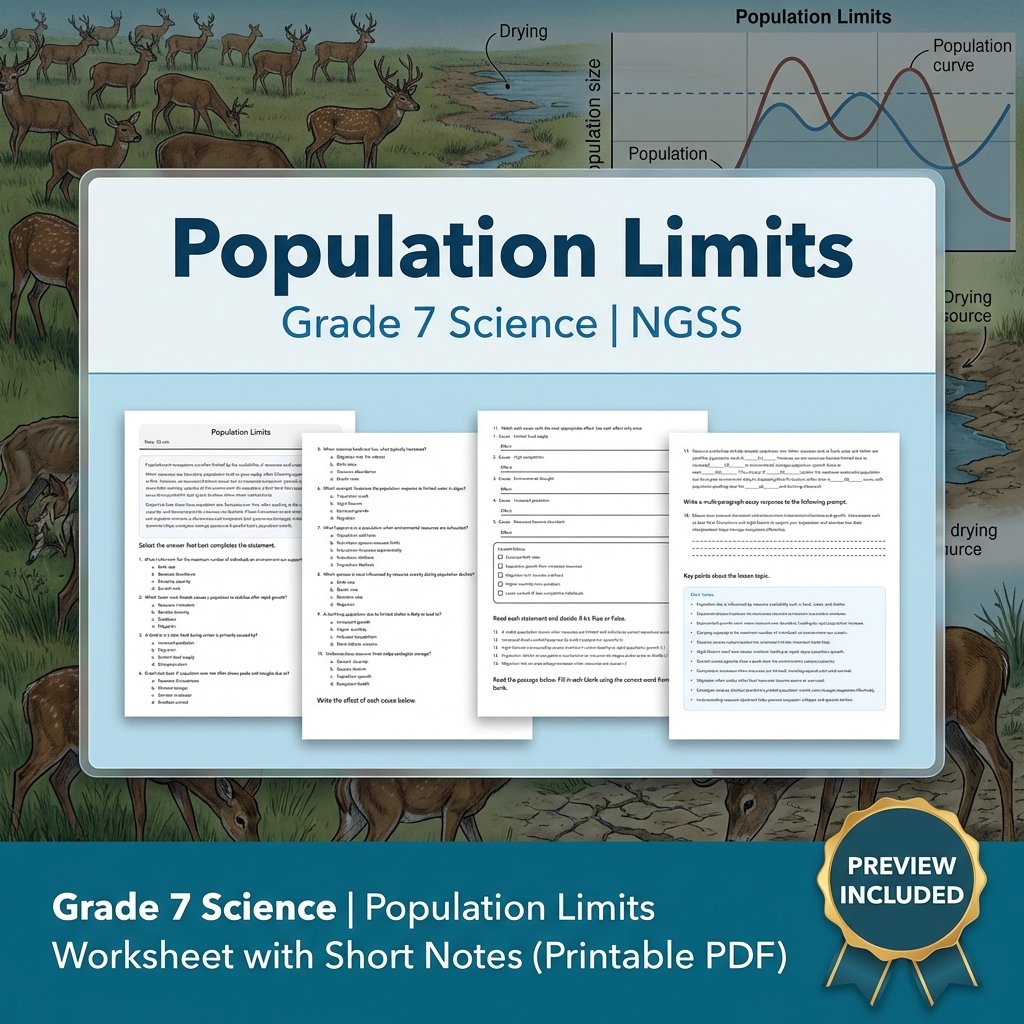
Grade 7 Science | Population Limits Worksheet with Short Notes (Printable PDF)
 Created byMeadowlark Worksheets
Learning Objectives
- Understand how resource availability influences population growth.
- Interpret quantitative data and graphical representations related to ecosystems.
- Analyze the effects of competition, food, water, and shelter limitations on populations.
Also included in: Grade 7 Science Ecosystems Unit | Interactions, Energy & Dynamics NGSS Bundle +1 more
Instant download
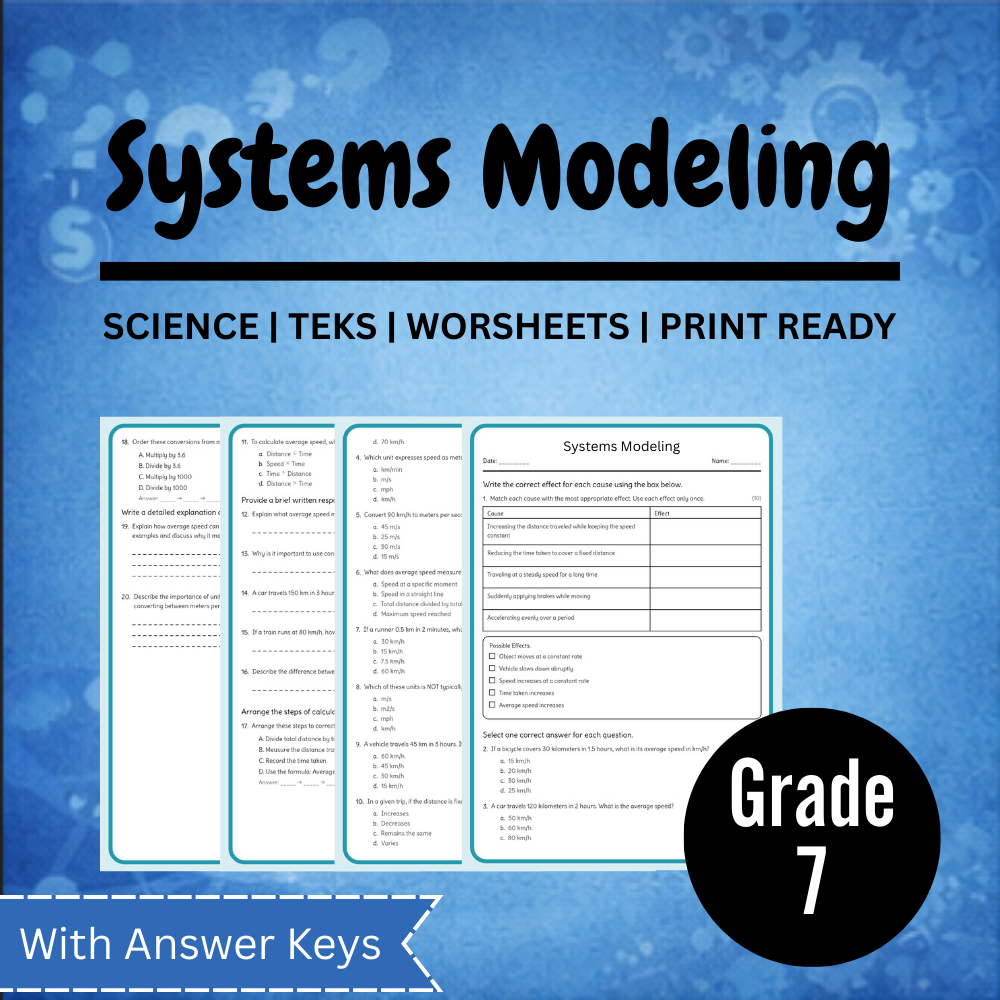
Grade 7 Science – Systems Modeling Worksheets (PDF) | TEKS Standards
Created byBright Mind ResourcesLearning Objectives
- Explain the purpose of systems modeling in understanding complex interactions.
- Identify different types of system diagrams and their use cases.
- Describe the importance of scaling and assumptions in modeling systems.
Also included in: Grade 7 Science Unit Bundle | Standards, Safety, Innovation & Systems Aligned TEKS +2 more
Instant download

Grade 7 Heat Transfer Worksheet | Conduction Convection Radiation | NGSS
 Created byBRIGHT PATH RESOURCES
Learning Objectives
- Understand the mechanisms of heat transfer: conduction, convection, radiation
- Identify examples of heat transfer in everyday life
- Describe measurable evidence of heat transfer
Also included in: Energy & Heat Transfer Grade 7 Science Lesson Bundle Daily Reading | NGSS +2 more
Instant download
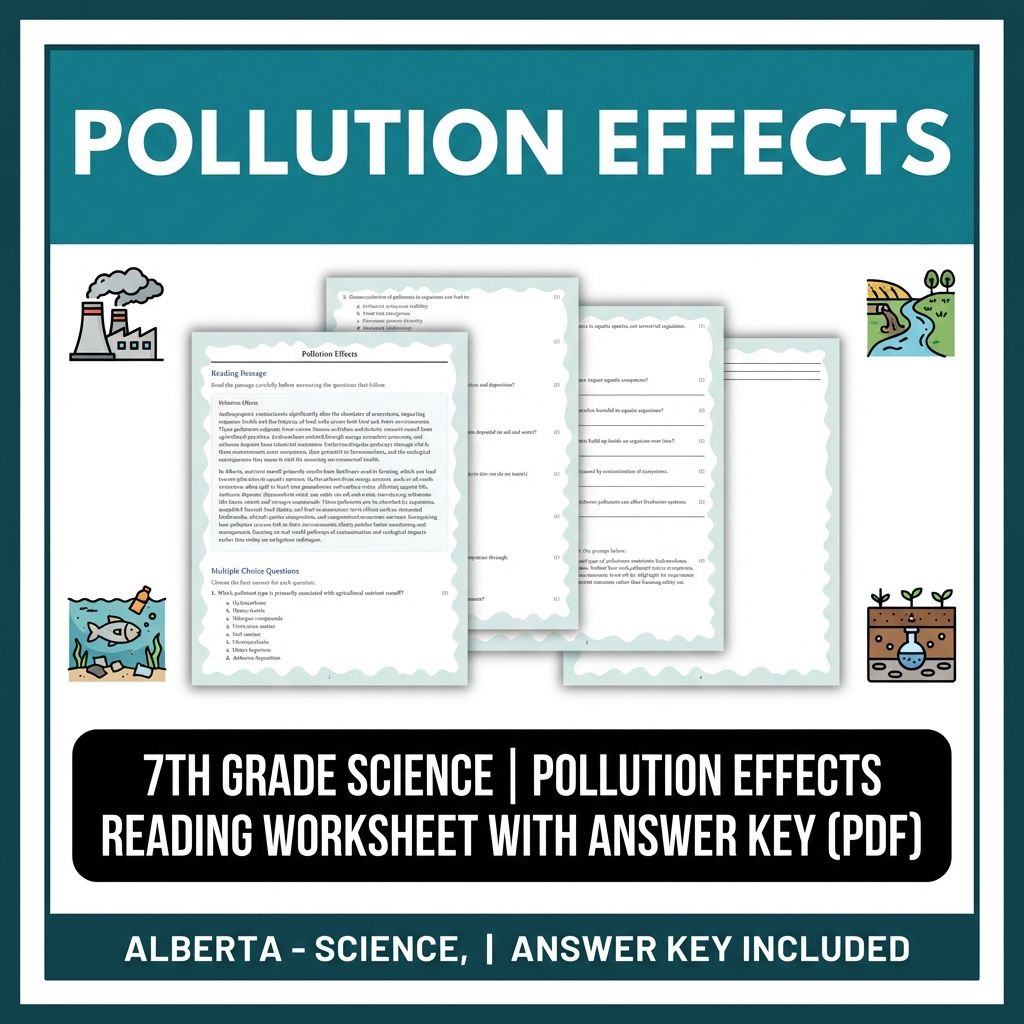
7th Grade Science | Pollution Effects Reading Worksheet with Answer Key (PDF)
JCreated byJ.S SheetsLearning Objectives
- Understand how different pollutants affect ecosystems and organisms.
- Identify sources and pathways of pollutant exposure in terrestrial and aquatic systems.
- Recognize ecological consequences such as bioaccumulation and food web disruptions.
Also included in: Grade 7 Science Bundle | Ecology, Ecosystems & Environmental Topics (Pack) +1 more
Instant download
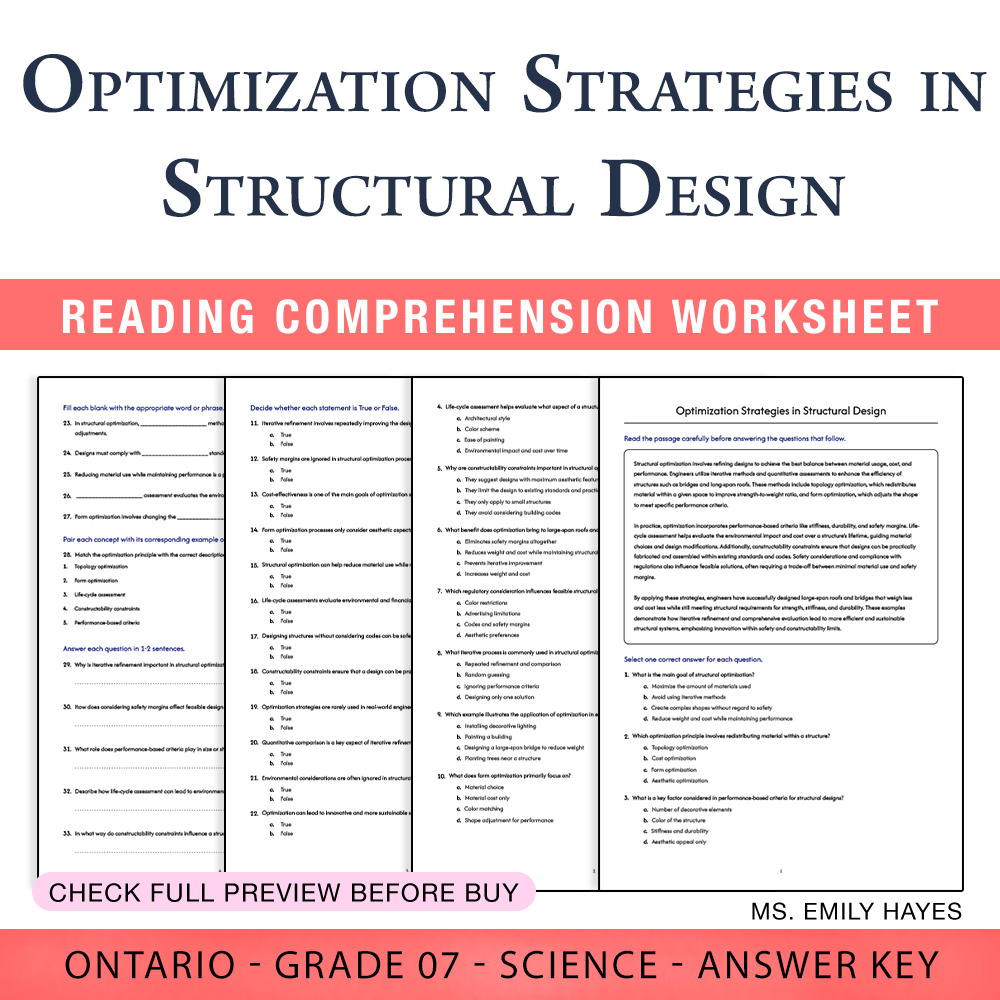
7th Grade Science | Optimization Strategies Worksheet (PDF+ Answer Key)
Created byCopper Leaf ClassroomLearning Objectives
- Understand the principles of structural optimization, including topology and form optimization.
- Learn how performance-based criteria, life-cycle assessments, and constructability constraints influence design choices.
- Analyze real-world examples of optimization in large-span roofs and bridges to reduce weight and cost while maintaining strength.
Instant download

Grade 7 Comparative Anatomical Evidence Worksheet | NGSS Practice PDF
 Created byClear Sky Classroom
Learning Objectives
- Identify different types of anatomical structures that provide evidence for evolution.
- Differentiate between homologous and analogous structures through examples.
- Understand how morphological and genetic data contribute to phylogenetic analysis.
Also included in: Grade 7 Natural Selection & Adaptation Science Lesson Bundle for NGSS +1 more
Instant download

Grade 7 Science Cosmic Scale Worksheet | NGSS Solar System & Space Science
 Created byNorthstar Worksheets
Learning Objectives
- Compare distances and sizes in space using astronomical units, planetary diameters, and light-years
- Interpret orders of magnitude and explain how scale affects what we can observe
- Use scaled representations to reason about relative positions of the Sun, planets, and nearby stars
Also included in: Grade 7 Space Science Lesson Bundle | NGSS Solar System & Gravity +1 more
Instant download
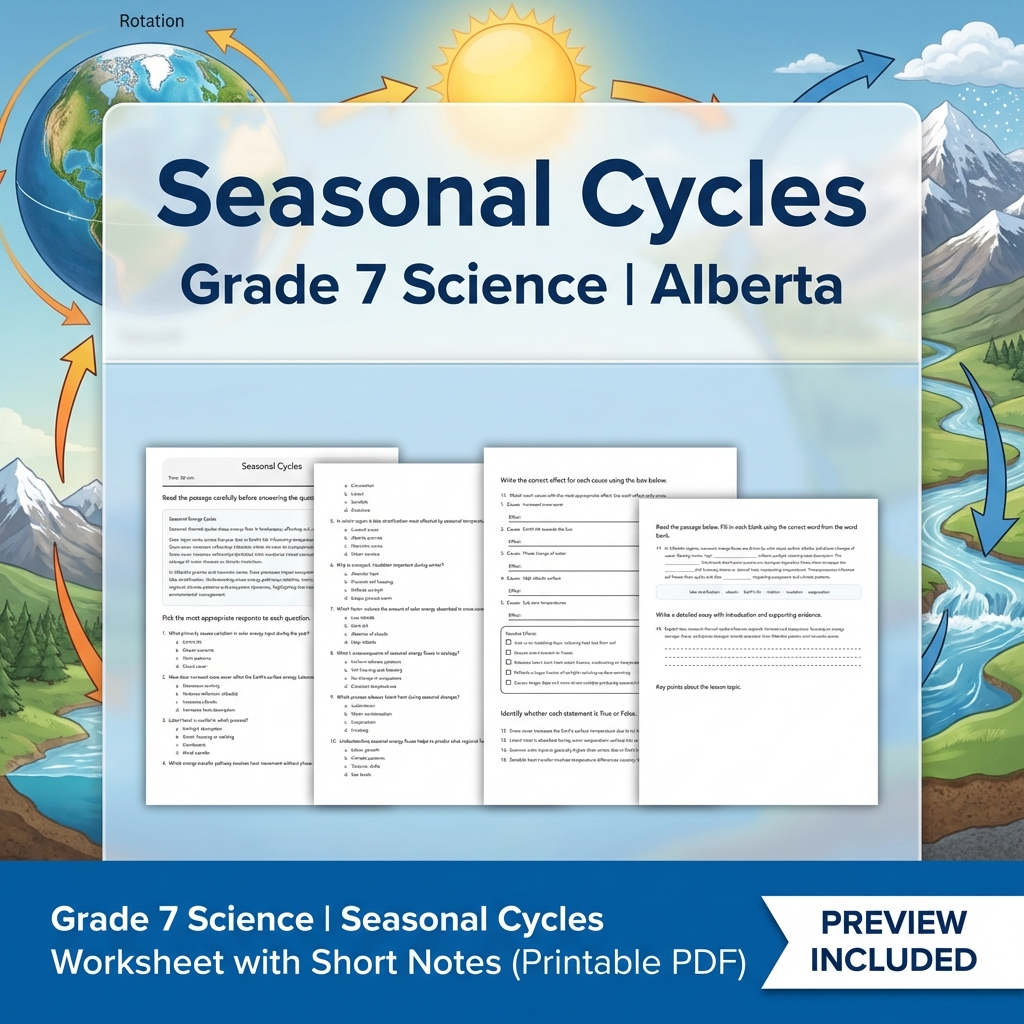
Grade 7 Science | Seasonal Cycles Worksheet with Short Notes (Printable PDF)
Created byMeadowlark WorksheetsLearning Objectives
- Explain how seasonal thermal cycles influence energy storage and transfer in regional landscapes.
- Identify the key factors driving seasonal climate patterns, including solar input and phase changes.
- Describe how energy fluxes—radiative, latent, and sensible—interact in regional ecosystems.
Instant download

Grade 7 Problem Definition Worksheet | NGSS Engineering Design Activity
 Created byAmber Owl Education
Learning Objectives
- Define a design problem by stating clear criteria and measurable constraints.
- Identify performance metrics, material limits, cost ceilings, and safety restrictions in a real-world scenario.
- Translate societal or environmental needs into quantitative targets and acceptable limits.
Also included in: Grade 7 Science Engineering Design Lesson Bundle – NGSS +1 more
Instant download
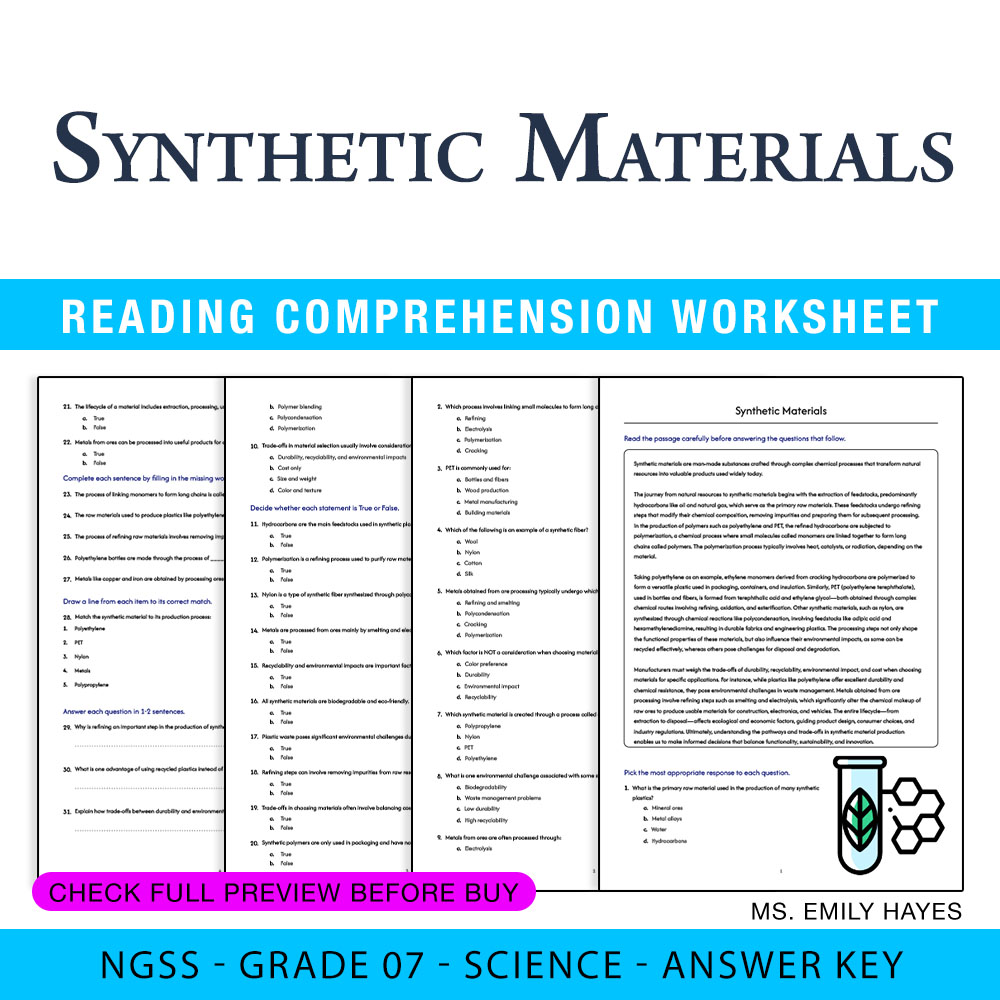
7th Grade Science | Synthetic Materials Worksheet (PDF +Answer Key)
Created byCopper Leaf ClassroomLearning Objectives
- Describe the production pathways from natural resources to common synthetic materials, including feedstocks, polymerization, and refining steps.
- Identify examples of synthetic materials such as polyethylene, PET, nylon, and metals processed from ores.
- Explain the trade-offs involved in synthetic material choices, including durability, recyclability, and environmental impacts.
Instant download
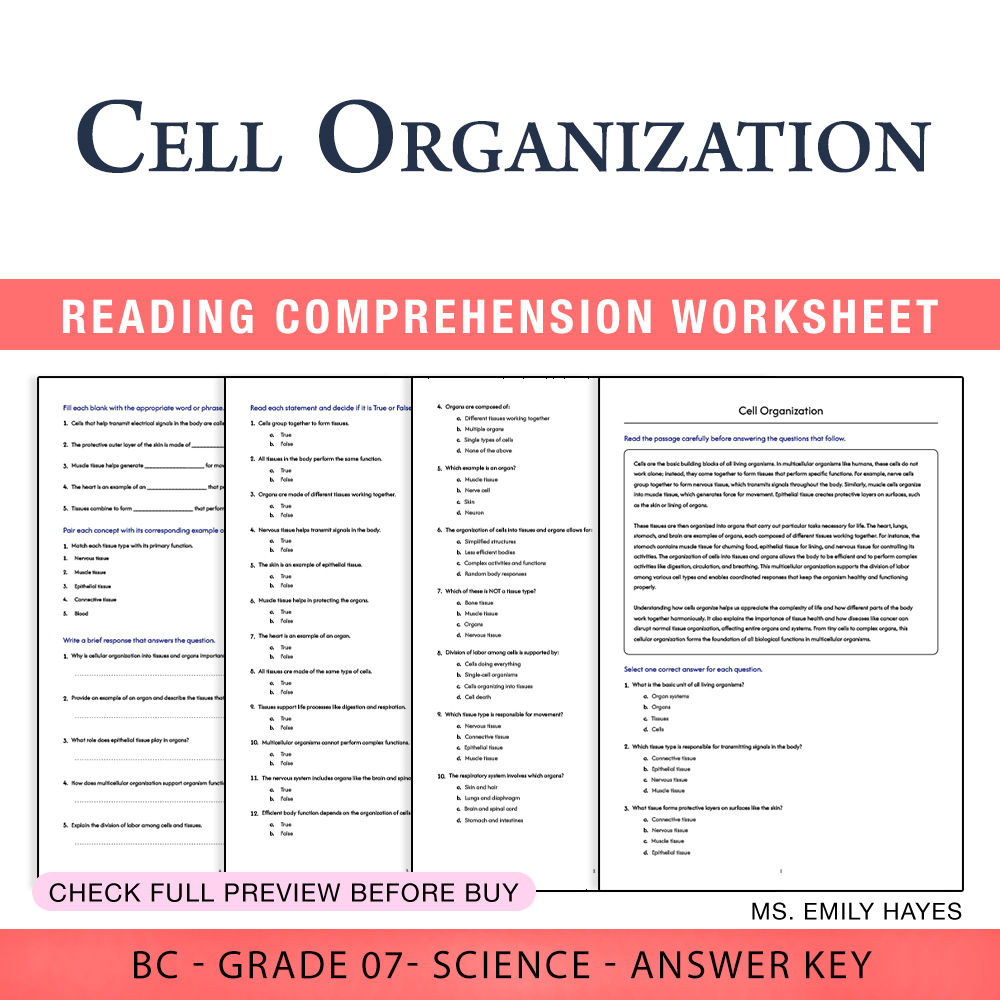
Grade 7 Science | Cell Organization Worksheet (PDF+ Answer Key)
Created byCopper Leaf ClassroomLearning Objectives
- Understand how cells group into tissues and organs to perform vital functions.
- Identify different tissue types and their roles in the body.
- Explain how multicellular organization supports complex activities and organism survival.
Also included in: Grade 7 Science Unit – Cells, Organ Systems & Surface Area (PDF+ Answer Key) +1 more
Instant download
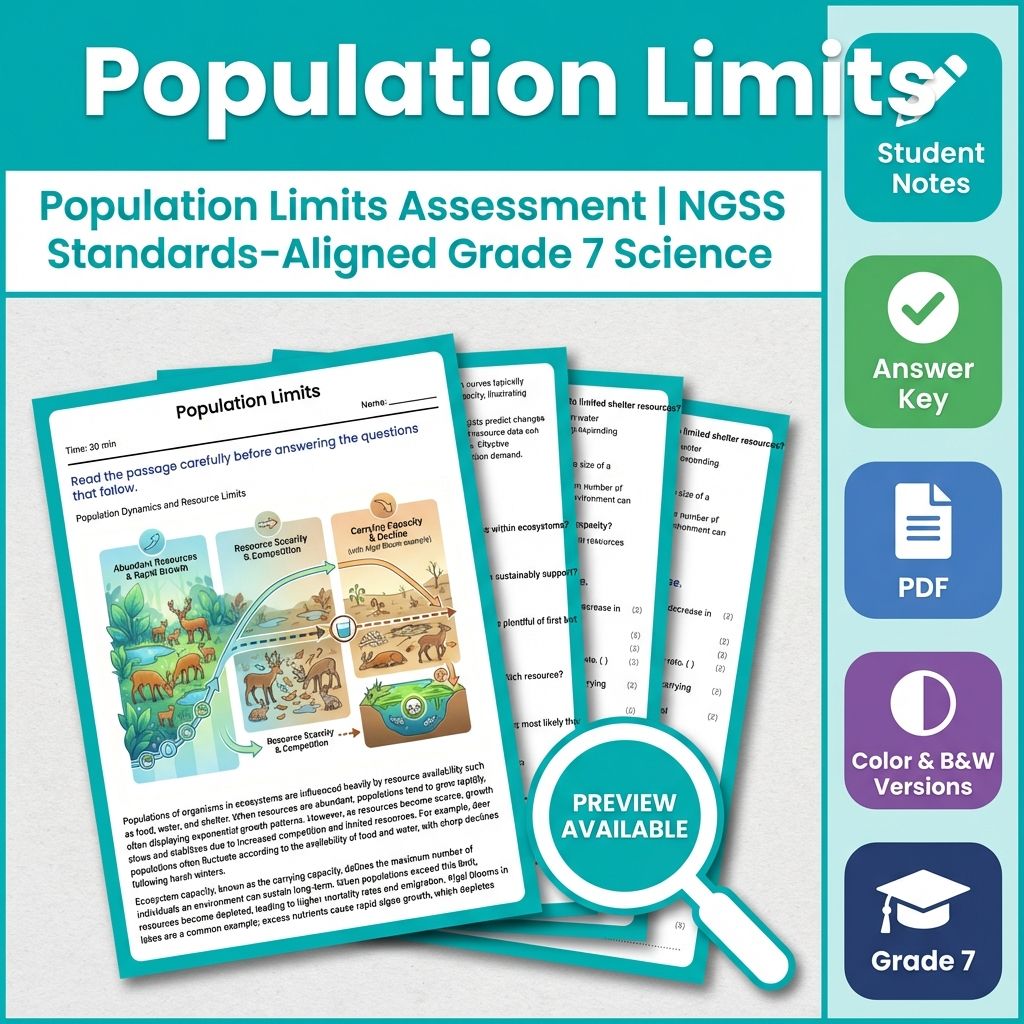
Population Limits Assessment | NGSS Standards-Aligned Grade 7 Science
Created byPrism Point LearningLearning Objectives
- Understand how resource availability influences population growth and decline.
- Interpret data on population changes and relate them to resources and competition.
- Analyze graphs and data sets related to ecosystem carrying capacity.
Also included in: Grade 7 Science Mini Bundle | Ecosystems: Interactions & Energy – NGSS +1 more
Instant download
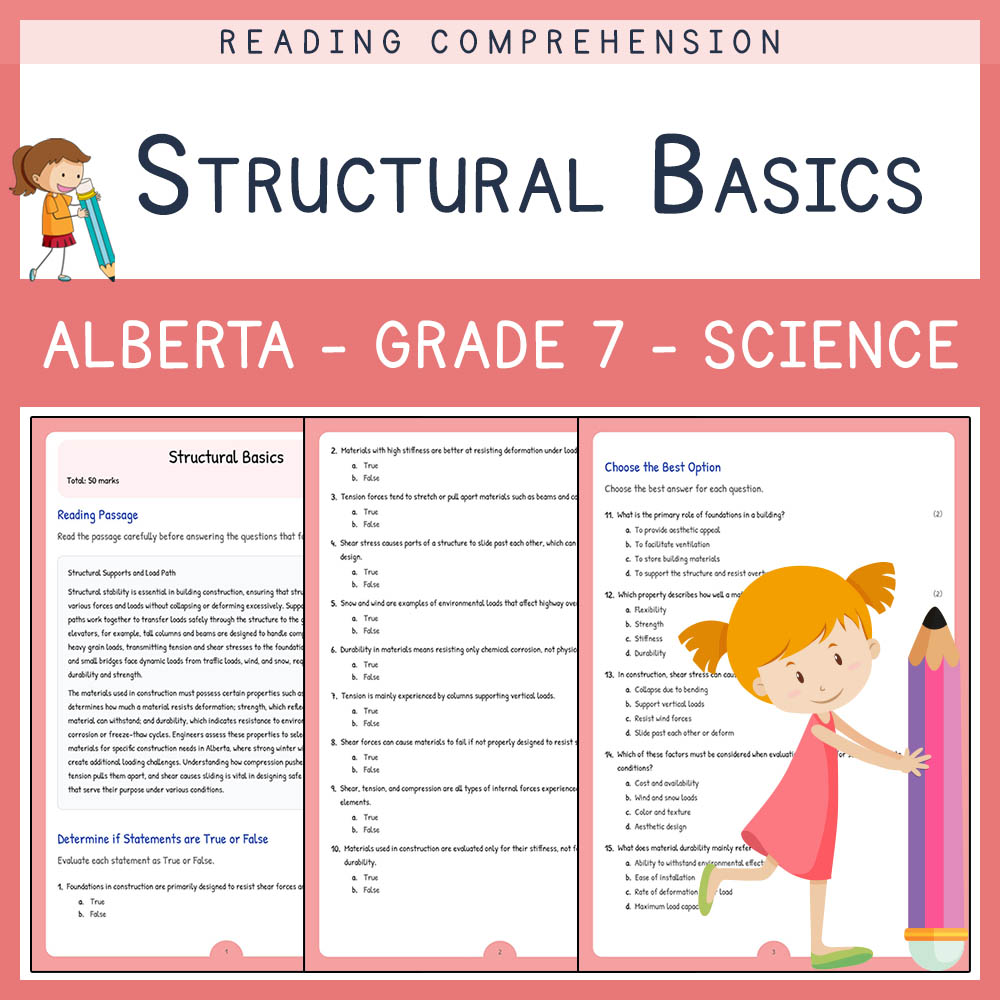
Grade 7 Science | Structural Basics Worksheet | Alberta Standard
Created byLumora LearningLearning Objectives
- Understand the roles of supports, foundations, and load paths in construction.
- Identify how compression, tension, and shear affect different building components.
- Evaluate material properties such as stiffness, strength, and durability when designing structures.
Instant download
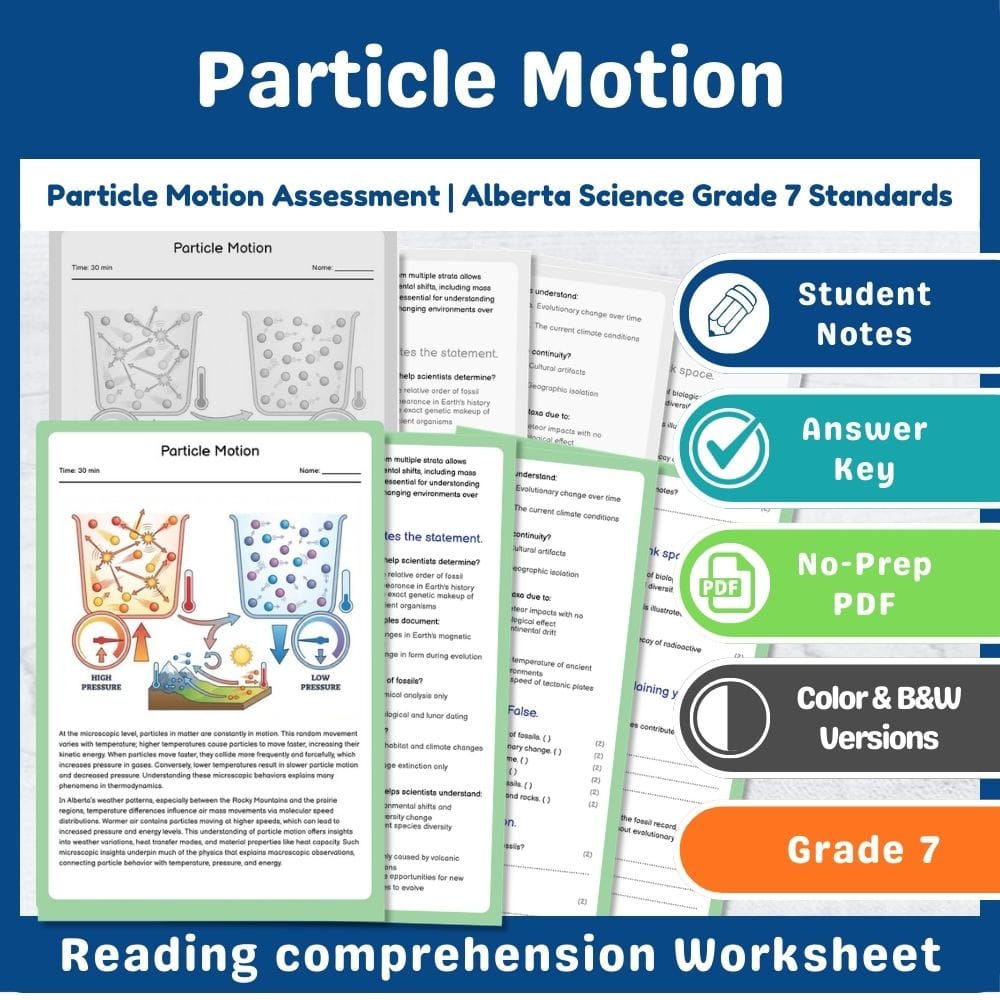
Particle Motion Assessment | Alberta Science Grade 7 Standards
Created byPrism Point LearningLearning Objectives
- Understand how microscopic particle motion relates to temperature, thermal energy, and pressure.
- Explain how molecular speed distributions vary with temperature and phase.
- Apply kinetic theory concepts to interpret temperature differences in different environments.
Also included in: Lesson Grade 7 Science Mini Bundle | Energy, Heat & Thermal Processes +1 more
Instant download

Reaction Types Worksheet | Standards-Aligned Grade 7 Science Practice
JCreated byJ.S SheetsLearning Objectives
- Identify and describe different reaction types such as synthesis, decomposition, single and double displacement, acid–base neutralization, and combustion.
- Understand how atoms are rearranged during chemical reactions while conserving total atom counts.
- Predict products and classify reactions based on particle-level explanations of bond breaking and forming.
Instant download
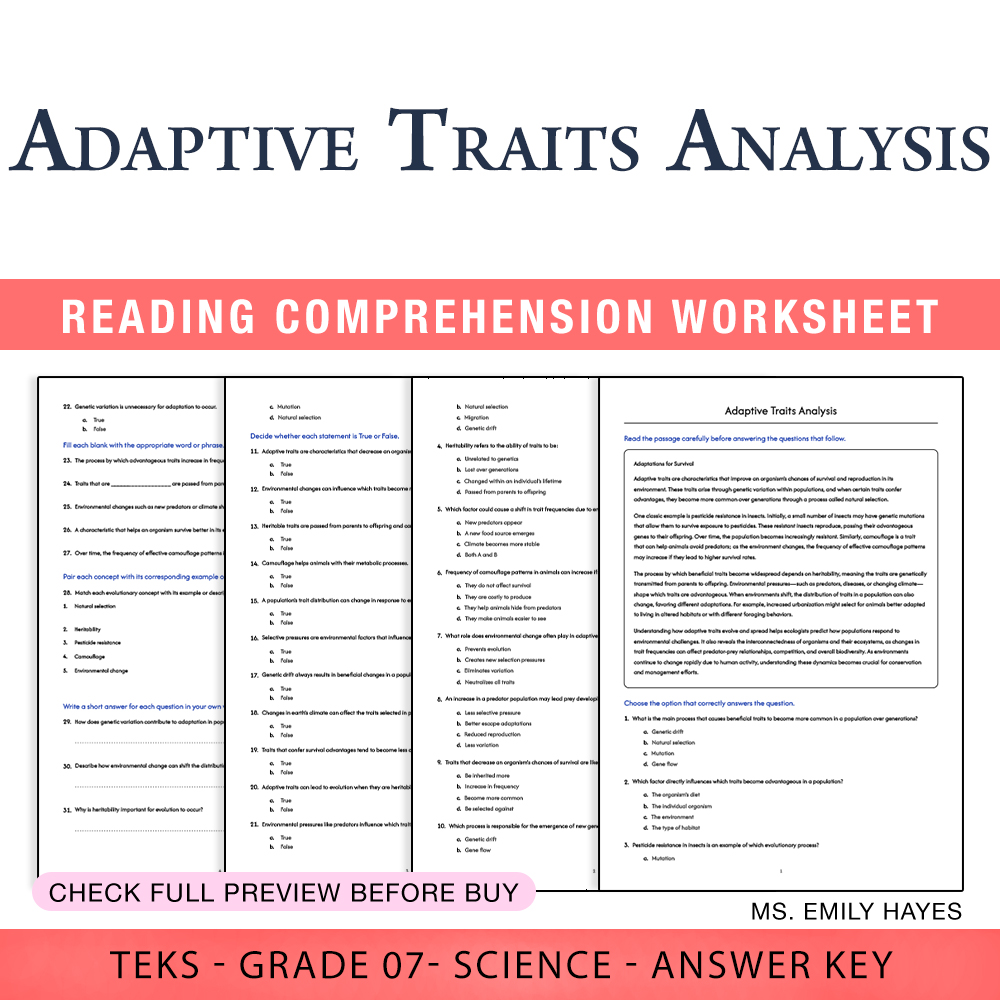
7th Grade Science | Adaptive Traits Analysis Worksheet (PDF+ Answer Key)
Created byCopper Leaf ClassroomLearning Objectives
- Explain how differential survival and reproduction influence the frequency of adaptive traits in populations.
- Describe the roles of variation, heritability, and selective pressures in evolution.
- Illustrate how environmental changes can shift trait distributions in populations.
Instant download
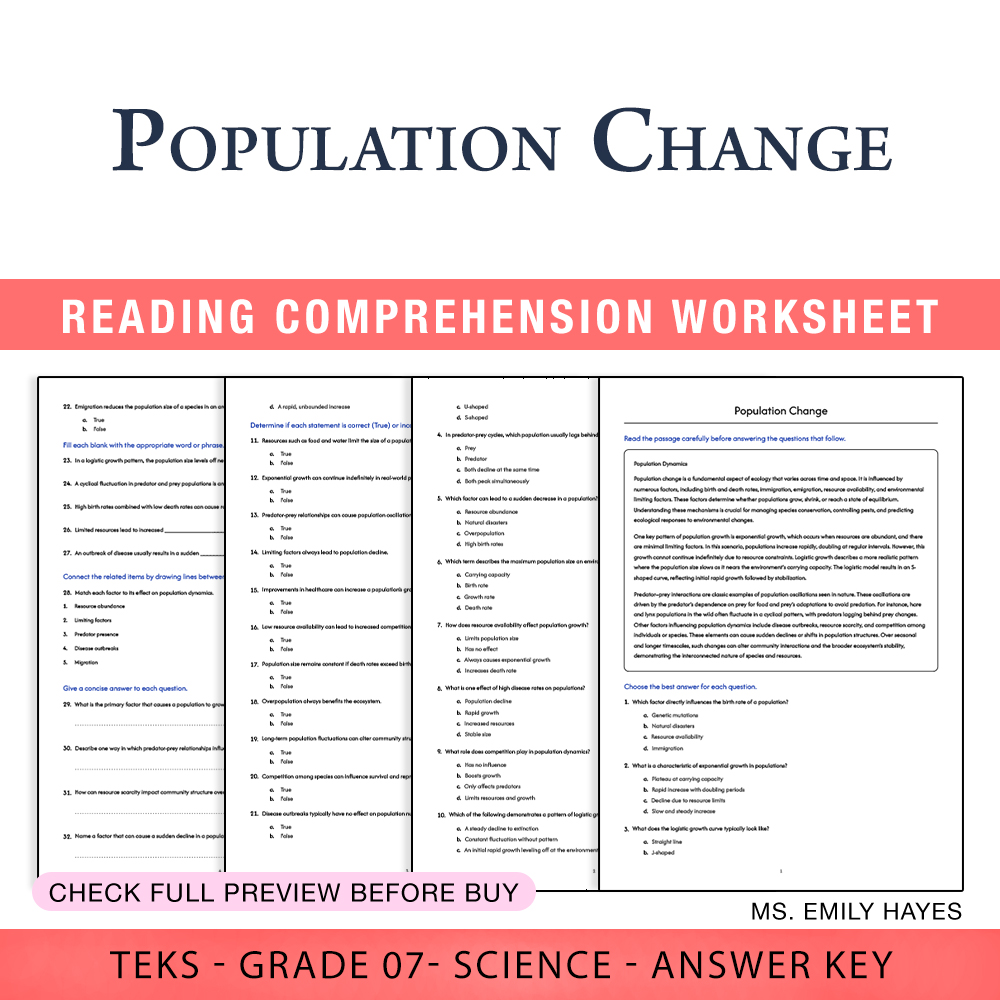
7th Grade Science | Population Change Worksheet (PDF+ Answer Key)
Created byCopper Leaf ClassroomLearning Objectives
- Identify factors influencing population size and distribution.
- Describe patterns of exponential and logistic growth.
- Explain how predator-prey relationships affect populations.
Instant download
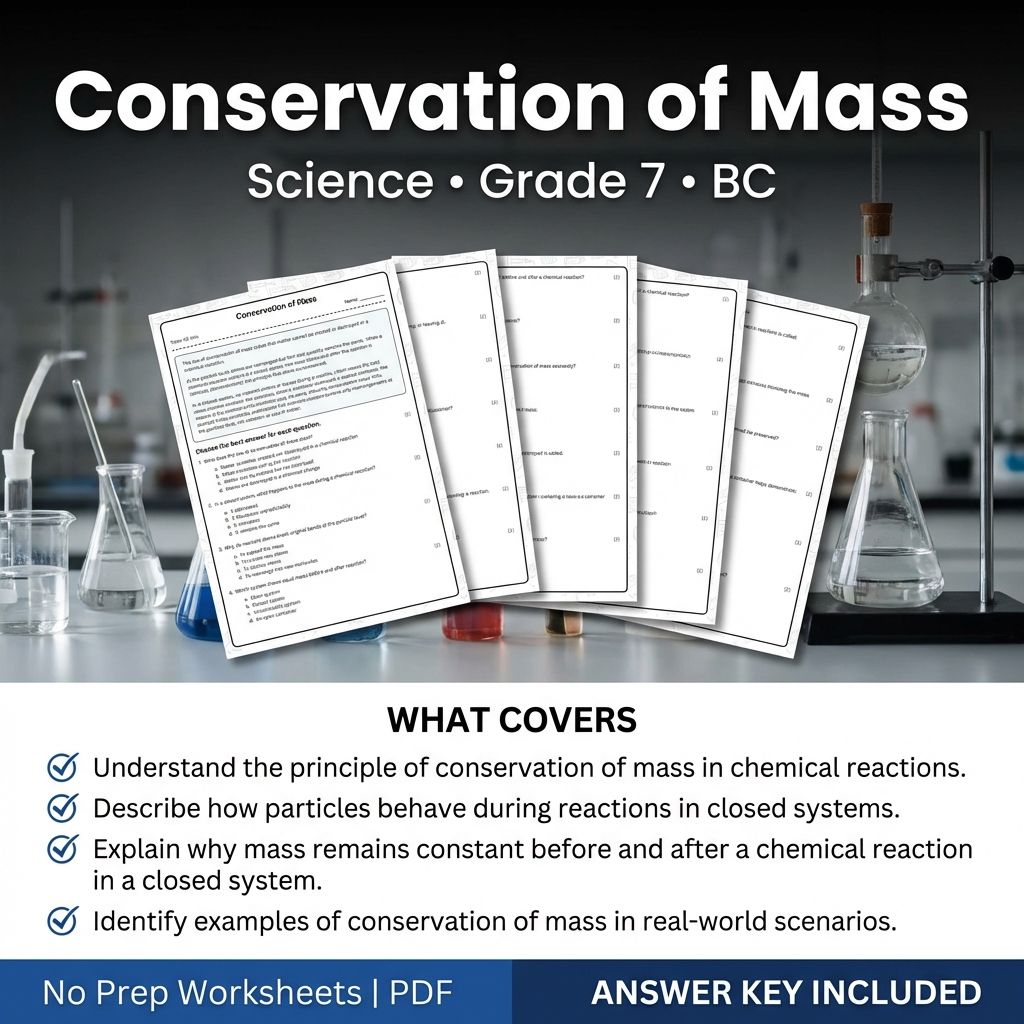
7th Grade Science | Conservation of Mass Worksheet & Answer Key (Printable PDF)
Created byCoral Reef LearningLearning Objectives
- Understand the principle of conservation of mass in chemical reactions.
- Describe how particles behave during reactions in closed systems.
- Explain why mass remains constant before and after a chemical reaction in a closed system.
Instant download
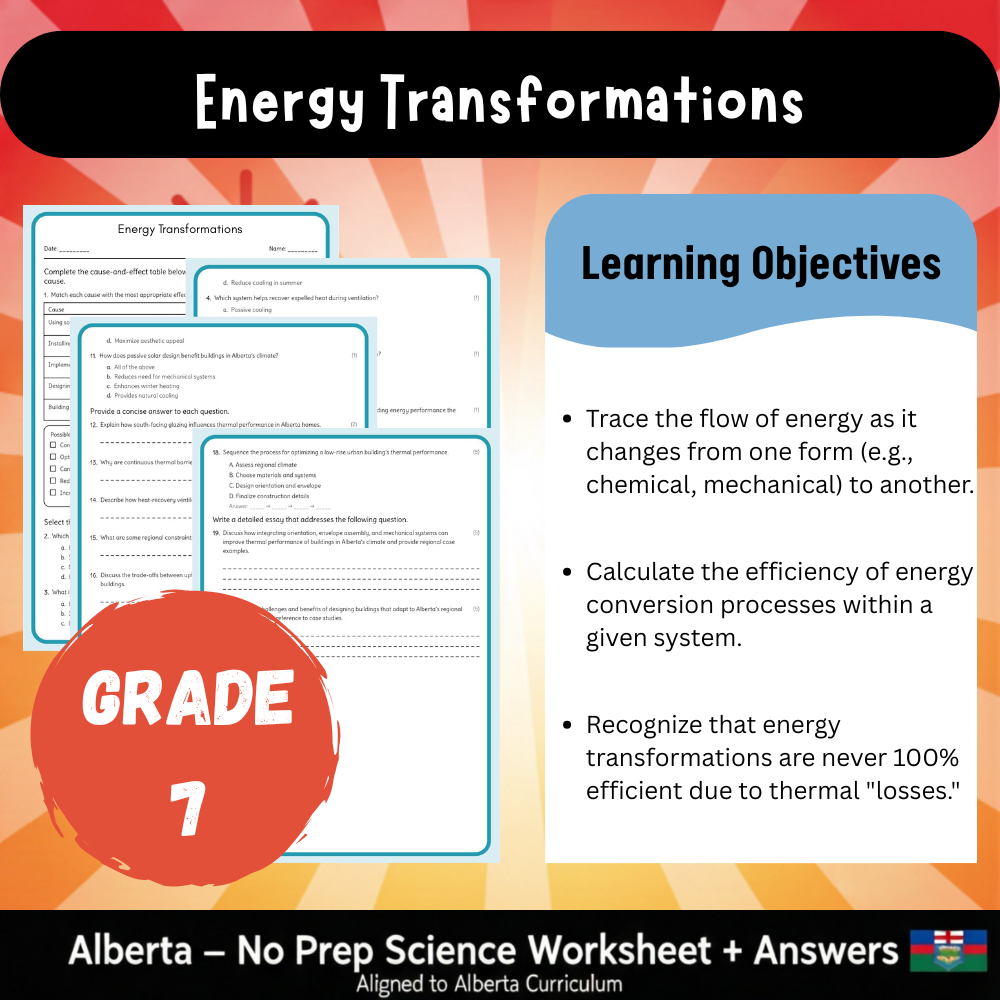
Grade 7 Science – Energy Transformations Worksheet (PDF) – Alberta Standards
Created byBright Mind ResourcesLearning Objectives
- Identify different forms of energy and how they change from one form to another
- Explain the concept of energy conservation during transformations
- Recognize real-world examples of energy transformation pathways like hydroelectric and wind power
Instant download
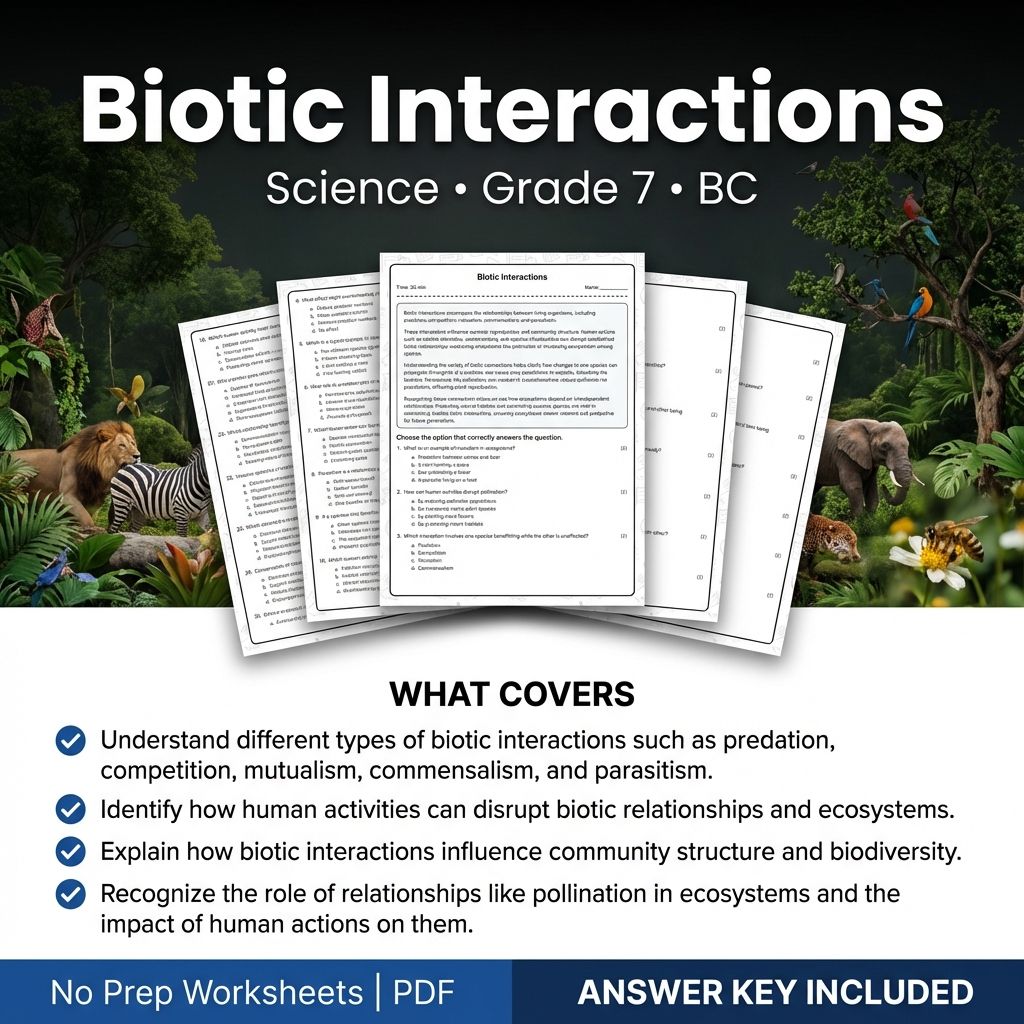
7th Grade Science | Biotic Interactions Worksheet with Answer Key (Printable PDF)
Created byCoral Reef LearningLearning Objectives
- Understand different types of biotic interactions such as predation, competition, mutualism, commensalism, and parasitism.
- Identify how human activities can disrupt biotic relationships and ecosystems.
- Explain how biotic interactions influence community structure and biodiversity.
Instant download

Grade 7 Adaptation Traits Worksheet | Practice & Assessment PDF
Created byClear Sky ClassroomLearning Objectives
- Define adaptations as structural, physiological, and behavioural traits that improve survival and reproduction in specific environments
- Explain how selective pressures influence which traits become more common in a population
- Describe how trade-offs in resource allocation can affect the success of an adaptation
Instant download

Grade 7 Science | Modeling Ecosystems Worksheet (Alberta Standards)
Created byEvergreen Desk EducationLearning Objectives
- Explain what ecological models are and why scientists use them to study ecosystems.
- Distinguish conceptual models from quantitative models and identify appropriate inputs for each.
- Describe how model assumptions and limitations affect predictions and how verification with observations improves model reliability.
Instant download
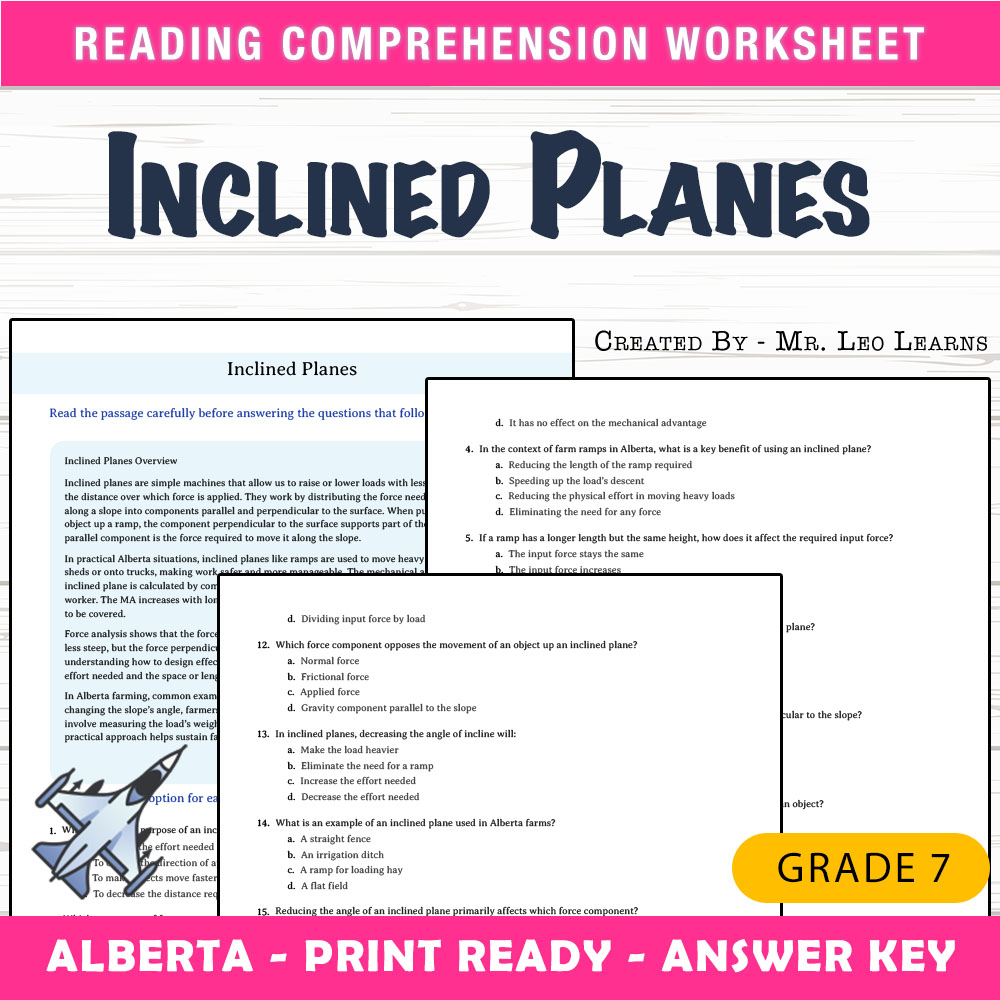
Grade 7 Science — Inclined Planes MCQ Worksheet for Mastering Simple Machines
Created byThe Resource HubLearning Objectives
- Understand how inclined planes reduce the effort needed to lift loads by changing force components.
- Identify the parts of force parallel and perpendicular to an inclined plane.
- Calculate mechanical advantage of inclined planes using input force and load.
Also included in: Grade 7 Science Alberta Forces Structures and Motion Worksheet Bundle +1 more
Instant download
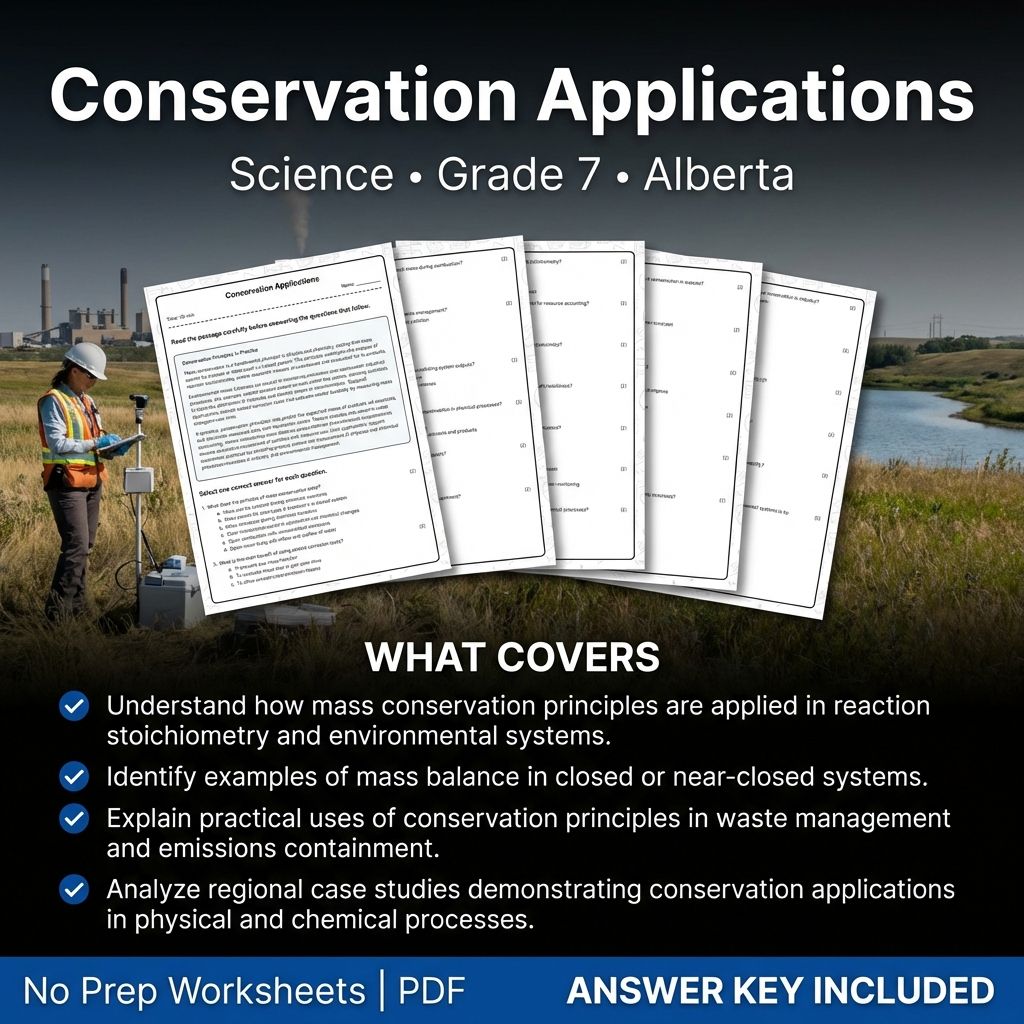
Grade 7 Science Worksheet on Conservation Applications | Alberta Standards
Created byCoral Reef LearningLearning Objectives
- Understand how mass conservation principles are applied in reaction stoichiometry and environmental systems.
- Identify examples of mass balance in closed or near-closed systems.
- Explain practical uses of conservation principles in waste management and emissions containment.
Instant download
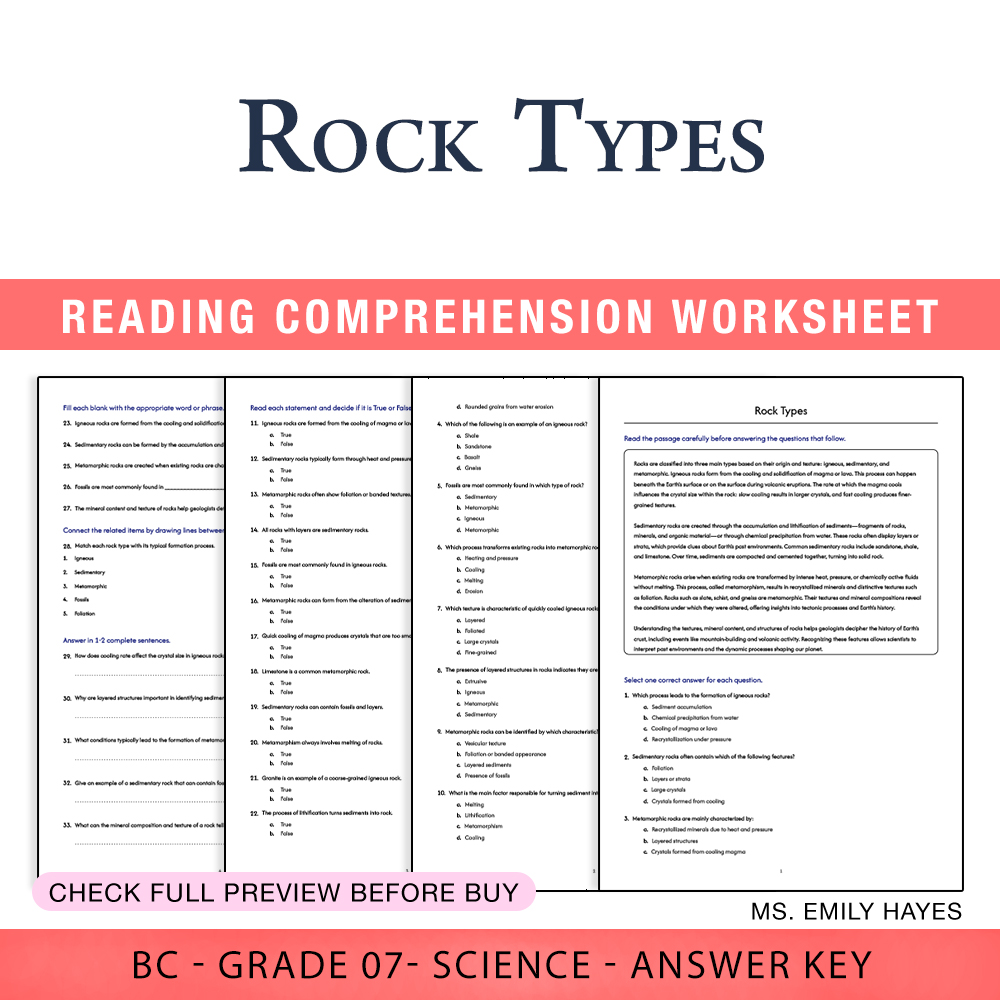
7th Grade Science | Rock Types Worksheet (PDF+ Answer Key)
Created byCopper Leaf ClassroomLearning Objectives
- Describe the three main types of rocks: igneous, sedimentary, and metamorphic.
- Identify features and textures characteristic of each rock type.
- Explain how rocks are classified based on their origin and appearance.
Also included in: Grade 7 Science | Earth Systems & Geology Unit (PDF+ Answer Keys) +1 more
Instant download
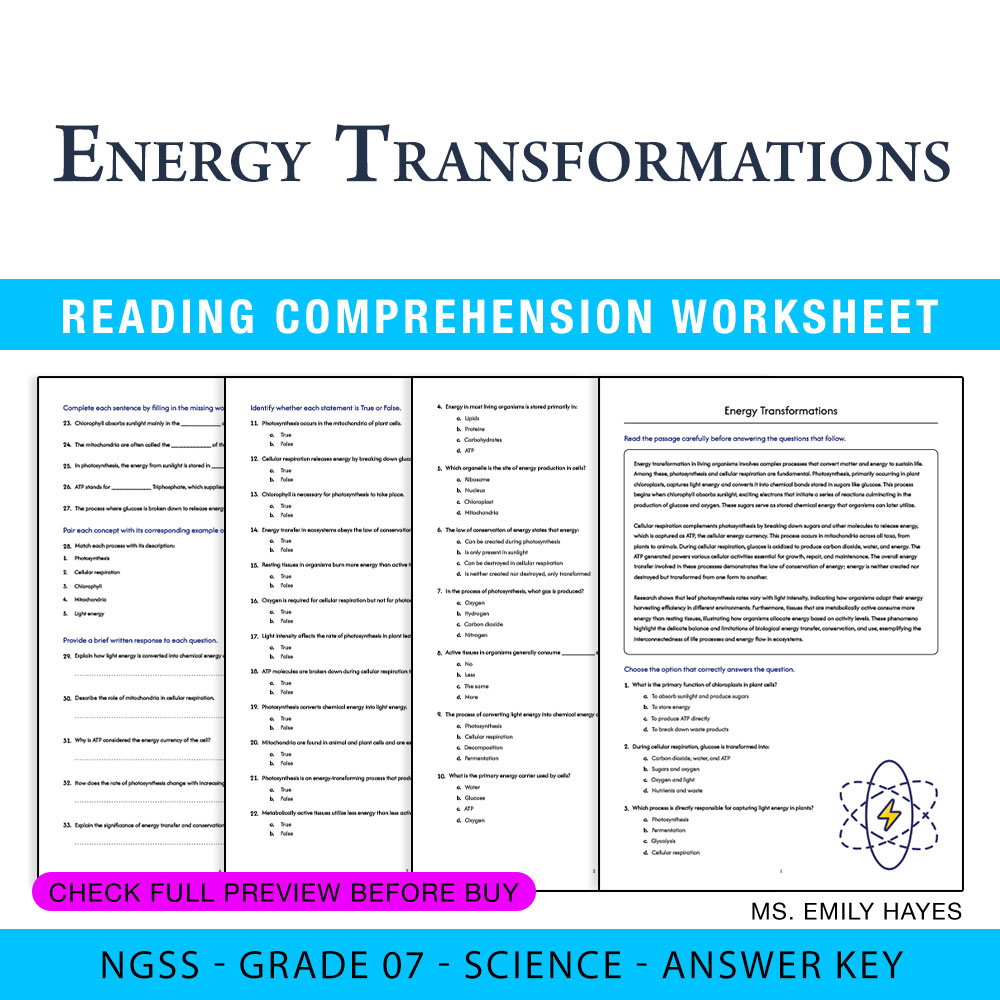
7th Grade Science | Energy Transformations Worksheet (PDF + Answer Key)
Created byCopper Leaf ClassroomLearning Objectives
- Explain how light energy is converted into chemical energy during photosynthesis.
- Describe how cellular respiration releases energy stored in food molecules.
- Connect processes of sugar production in chloroplasts to ATP generation in mitochondria across different organisms.
Instant download

Energy Transformations Worksheet | Grade 7 Science Practice
Created byPrism Point LearningLearning Objectives
- Explain how energy can change forms (mechanical, chemical, electrical, and thermal) while total energy is conserved.
- Use cause-and-effect reasoning to describe energy transformations in everyday systems.
- Identify examples of energy transformations, including hydroelectric and wind power, and combustion for heating.
Instant download

Grade 7 Conservation Strategies Worksheet | BC Use Practice PDF
Created byClear Sky ClassroomLearning Objectives
- Explain how conservation strategies such as protected areas, habitat restoration, invasive species control, and sustainable harvesting reduce human impacts.
- Use ecological ideas (food webs, population dynamics, and abiotic constraints) to predict why conservation actions help ecosystems.
- Evaluate and propose conservation strategies using adaptive monitoring and evidence-based decision-making.
Instant download
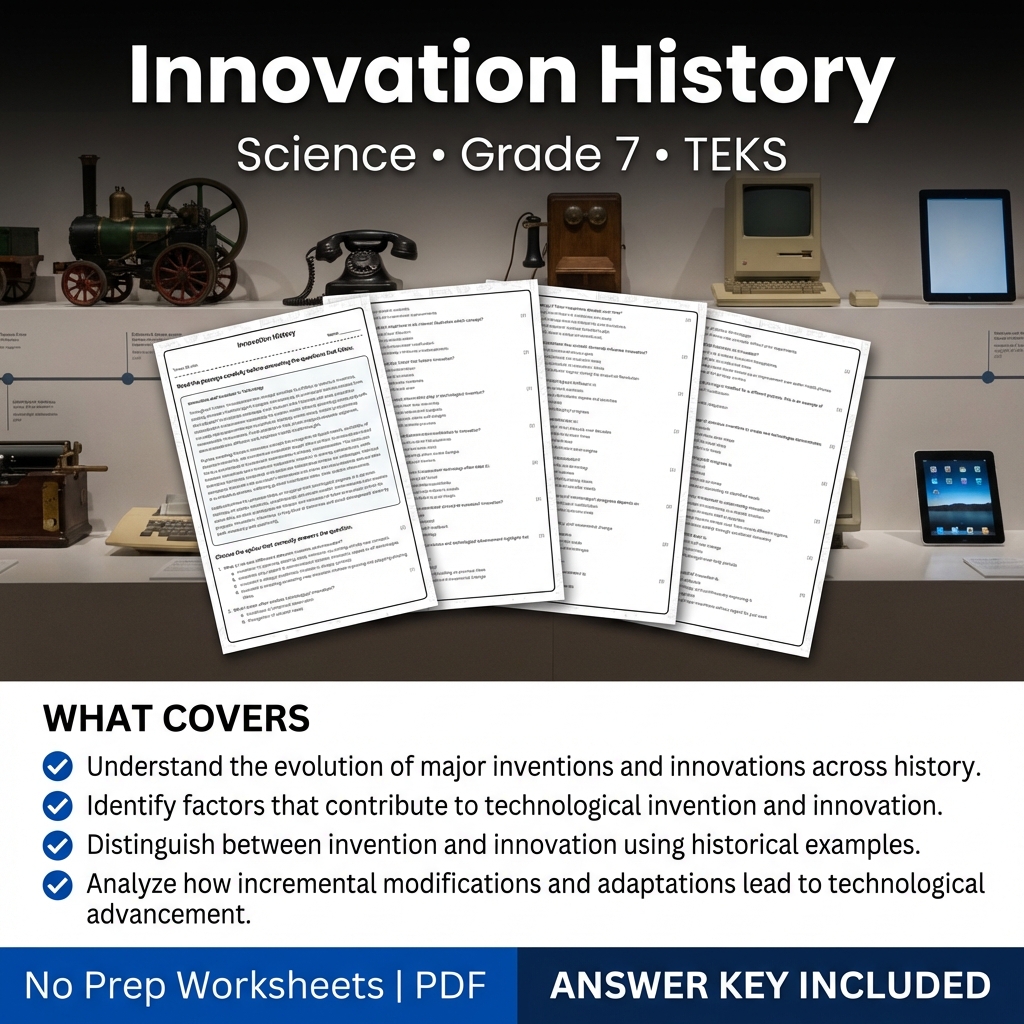
Grade 7 Science Worksheet on Innovation History | TEKS Standards Practice
Created byCoral Reef LearningLearning Objectives
- Understand the evolution of major inventions and innovations across history.
- Identify factors that contribute to technological invention and innovation.
- Distinguish between invention and innovation using historical examples.
Instant download
About Grade 7 Science Worksheets
Browse 6,039 printable Grade 7 Science worksheets — ready-to-print PDFs with answer keys where available.
Every worksheet on MyTeachingSheets is created by independent teacher-authors and reviewed before publication. All resources download as printable PDFs for classroom, homework, or at-home practice, and many include answer keys. Preview any worksheet free before buying.