
Grade 7 Science Worksheets
6,039 worksheets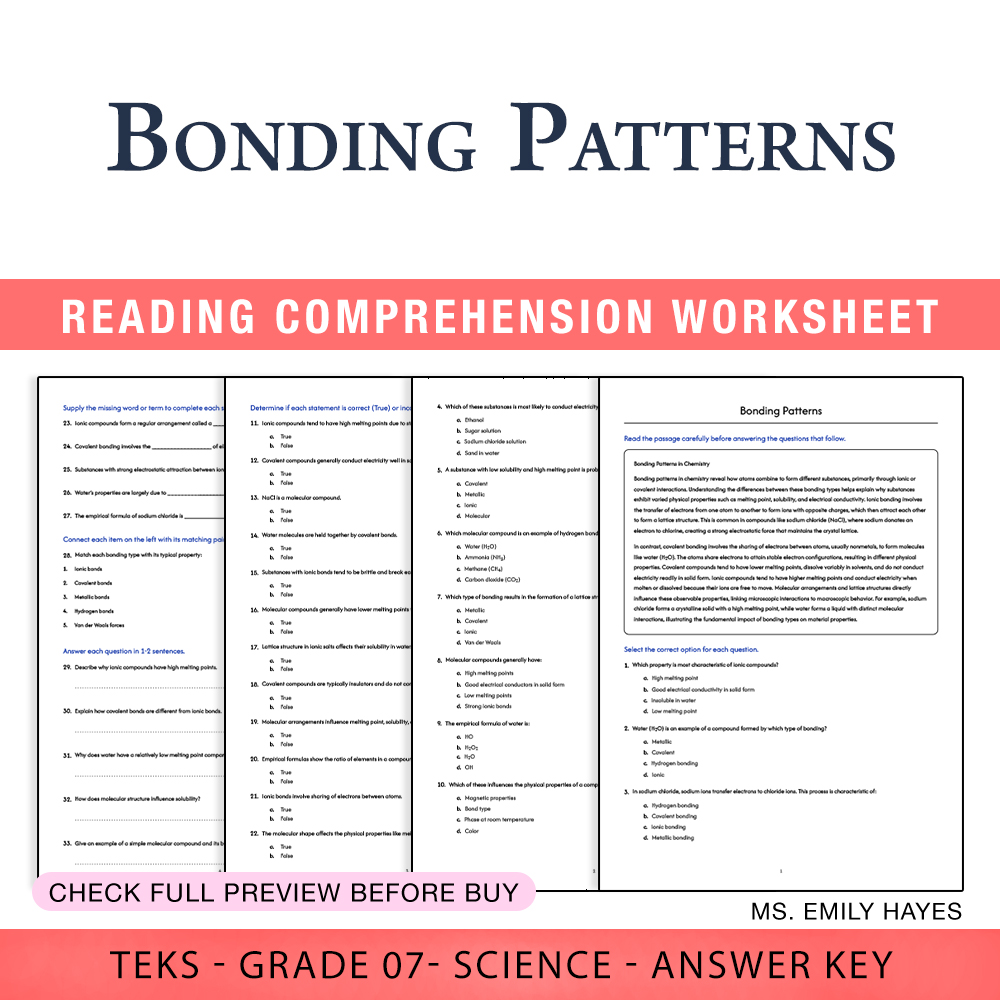
7th Grade Science | Bonding Patterns Worksheet (PDF+ Answer Key)
 Created byCopper Leaf Classroom
Learning Objectives
- Distinguish between ionic and covalent bonding based on properties and formation.
- Relate bonding types to macroscopic properties such as melting point, solubility, and electrical conductivity.
- Describe the formation of simple binary ionic salts and molecular compounds using empirical formulas.
Instant download

Grade 7 Science Worksheet: Plate Tectonics and Continental Movement Assessment
 Created bySkylark Worksheets
Learning Objectives
- Explain how evidence such as fossils, rock types, and continental shapes supports plate tectonics.
- Identify key seafloor features (mid-ocean ridges, trenches) and relate them to plate motion.
- Use earthquake, volcanic, and magnetic striping patterns to describe how plates move over time.
Also included in: Grade 7 Earth Systems Science Worksheet Lesson Bundle for NGSS Assessment +1 more
Instant download

Science Worksheet: Temperature Measurement Grade 7 | Ontario Standards
JCreated byJ.S SheetsLearning Objectives
- Compare common temperature-measuring instruments (liquid-in-glass, bimetallic, and digital) by how they work and when they are appropriate.
- Explain Celsius scale conventions, including fixed points and why calibration is necessary.
- Describe how thermal contact and environmental factors (radiation and air flow) can affect temperature readings.
Instant download
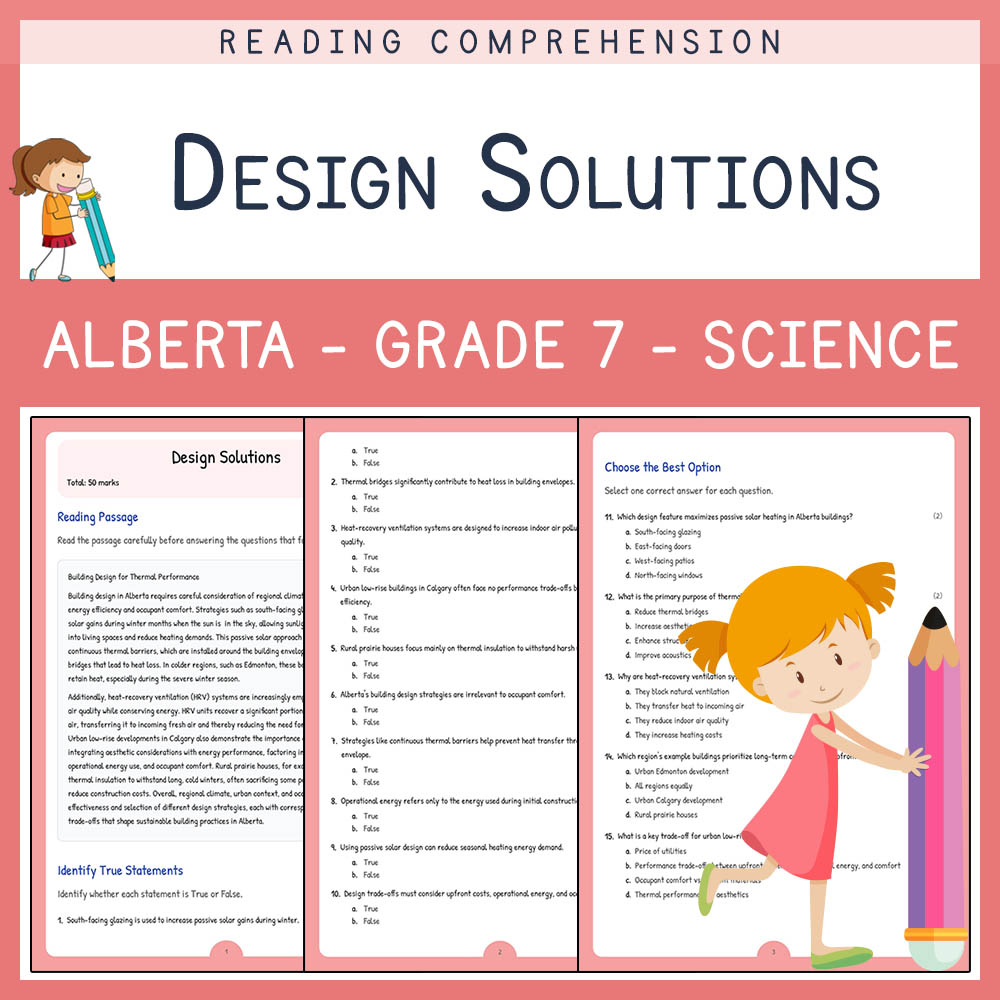
Grade 7 Science | Design Solutions Worksheet | Alberta Standards
 Created byLumora Learning
Learning Objectives
- Understand how building design strategies enhance thermal performance across Alberta's climate zones.
- Identify passive solar, thermal barriers, and ventilation methods that improve energy efficiency.
- Analyze case examples to evaluate design trade-offs in regional building contexts.
Instant download

Design Thinking Worksheet | Grade 7 Science Assessment for Ontario
 Created byPrism Point Learning
Learning Objectives
- Explain how problem definition guides a design project using clear criteria and realistic constraints.
- Identify how trade-off matrices and feasibility criteria help compare conceptual solutions.
- Describe how iteration improves alignment between objectives and available materials, cost, and environmental factors.
Instant download
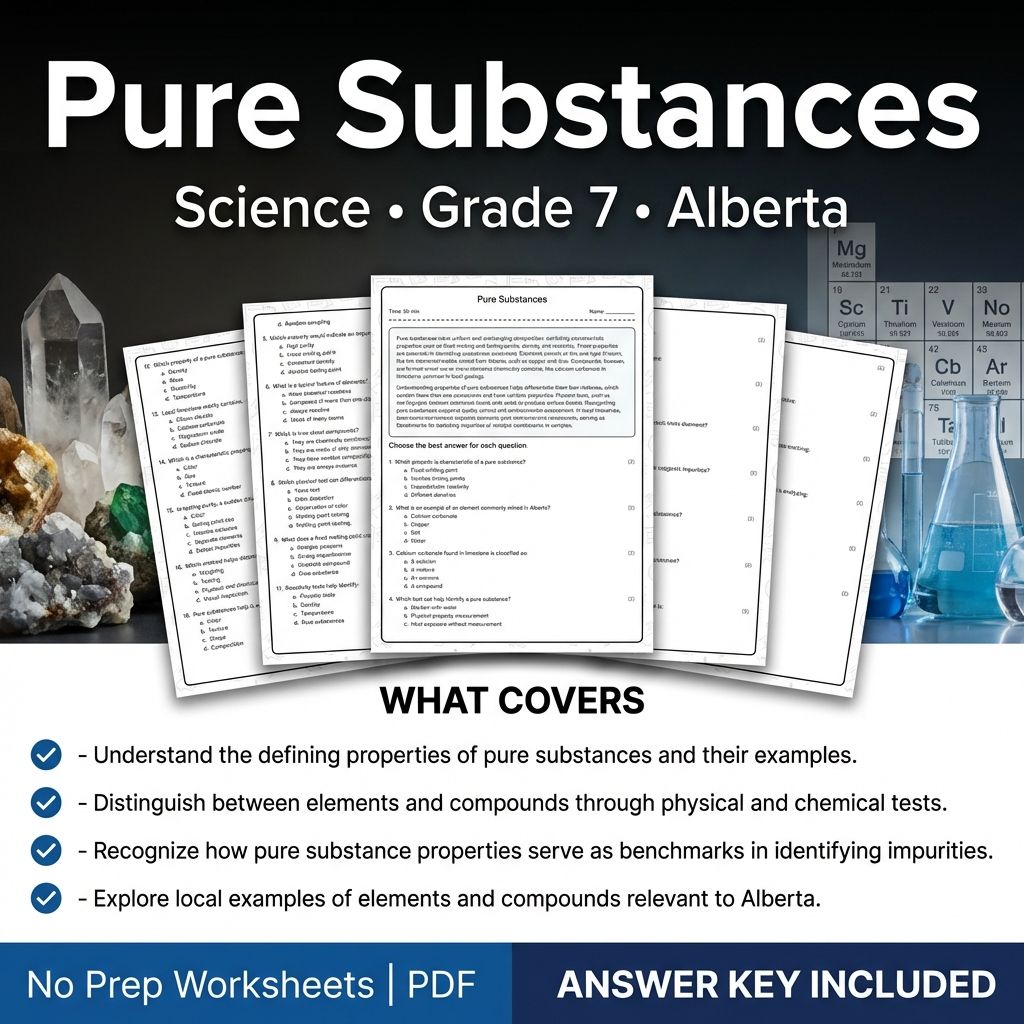
Grade 7 Science Worksheet | Pure Substances | Alberta Standards
 Created byCoral Reef Learning
Learning Objectives
- Understand the defining properties of pure substances and their examples.
- Distinguish between elements and compounds through physical and chemical tests.
- Recognize how pure substance properties serve as benchmarks in identifying impurities.
Instant download
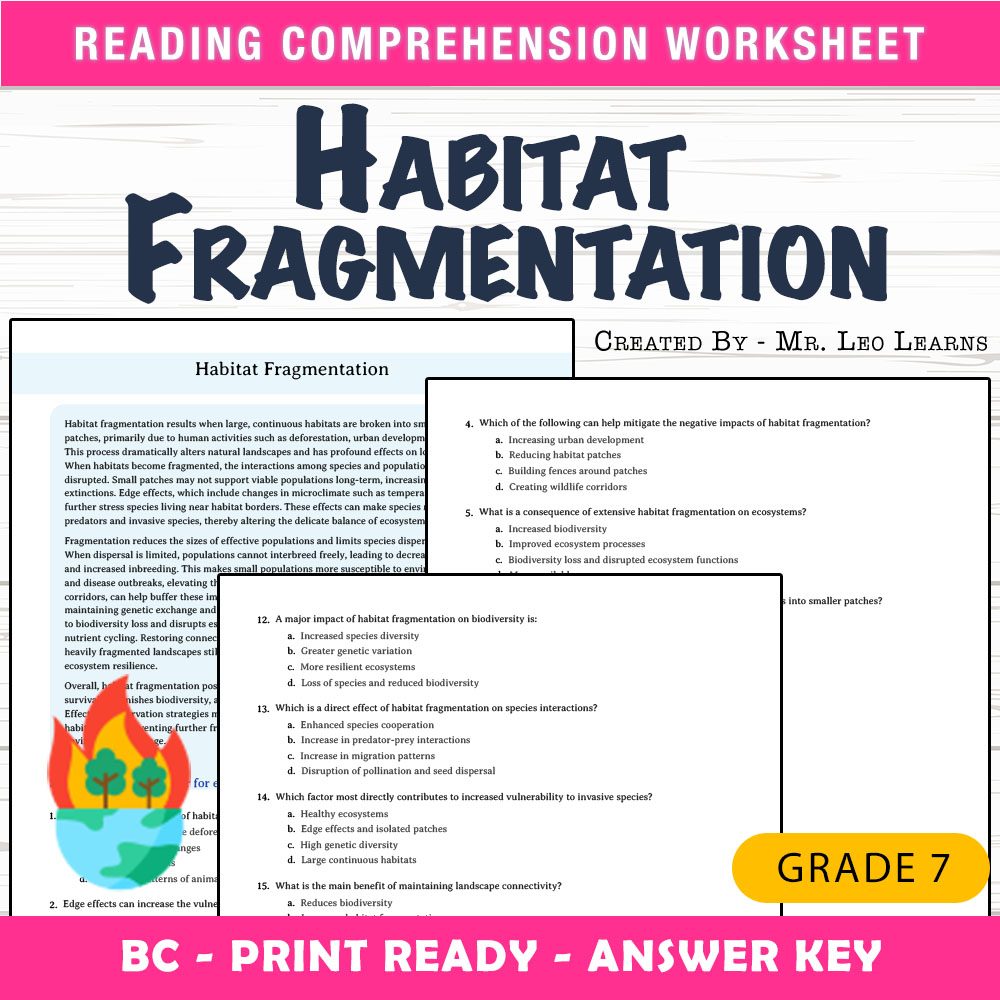
Grade 7 Science — Habitat Fragmentation Worksheet for Mastery
 Created byThe Resource Hub
Learning Objectives
- Understand what habitat fragmentation is and its effects on ecosystems.
- Identify factors that contribute to habitat fragmentation and its consequences.
- Explain the concept of landscape connectivity and its role in ecosystem resilience.
Also included in: Grade 7 Science Ecosystems & Interactions Worksheet Bundle +1 more
Instant download
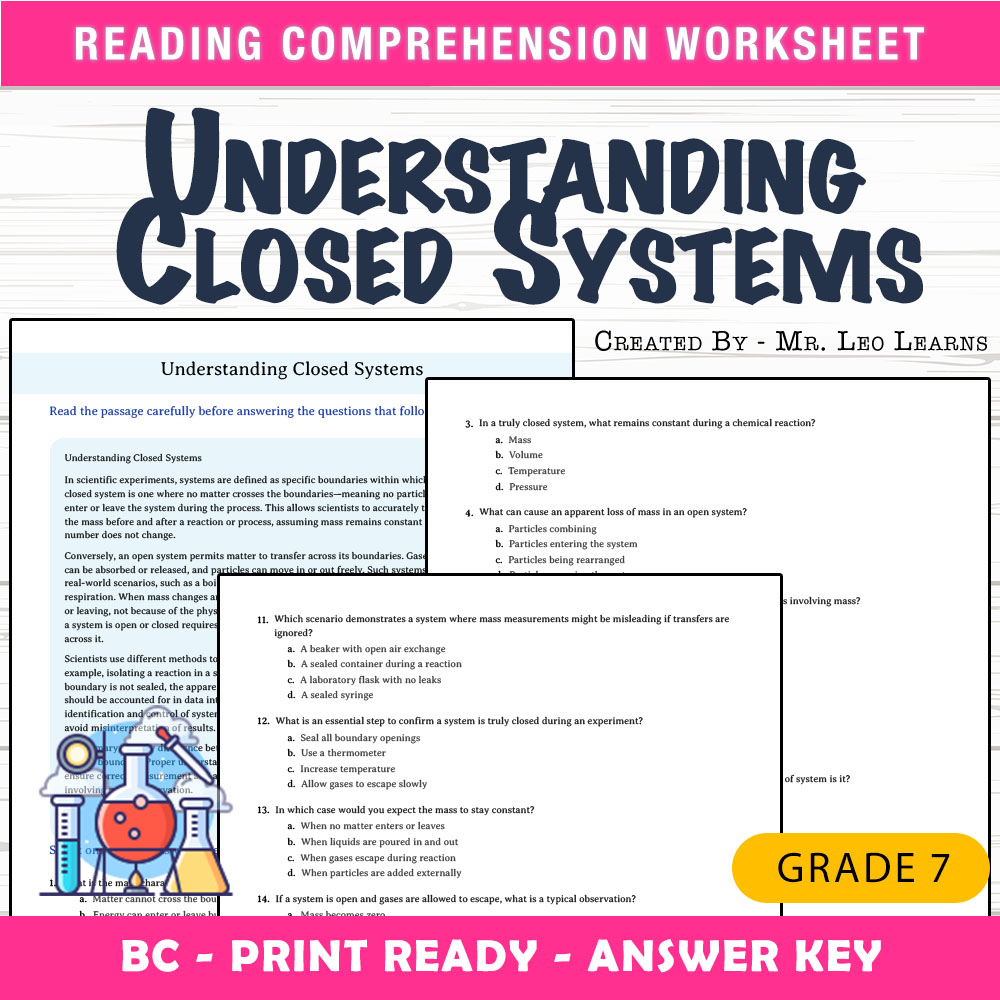
Grade 7 Science — Understanding Closed Systems Worksheet for Mastery
Created byThe Resource HubLearning Objectives
- Explain the difference between closed and open systems in terms of matter transfer.
- Identify the effects of system boundaries on mass conservation.
- Analyze real-world examples of closed and open systems in scientific processes.
Also included in: Grade 7 Science | Matter & Chemical Change Worksheet Bundle – BC Framework +1 more
Instant download
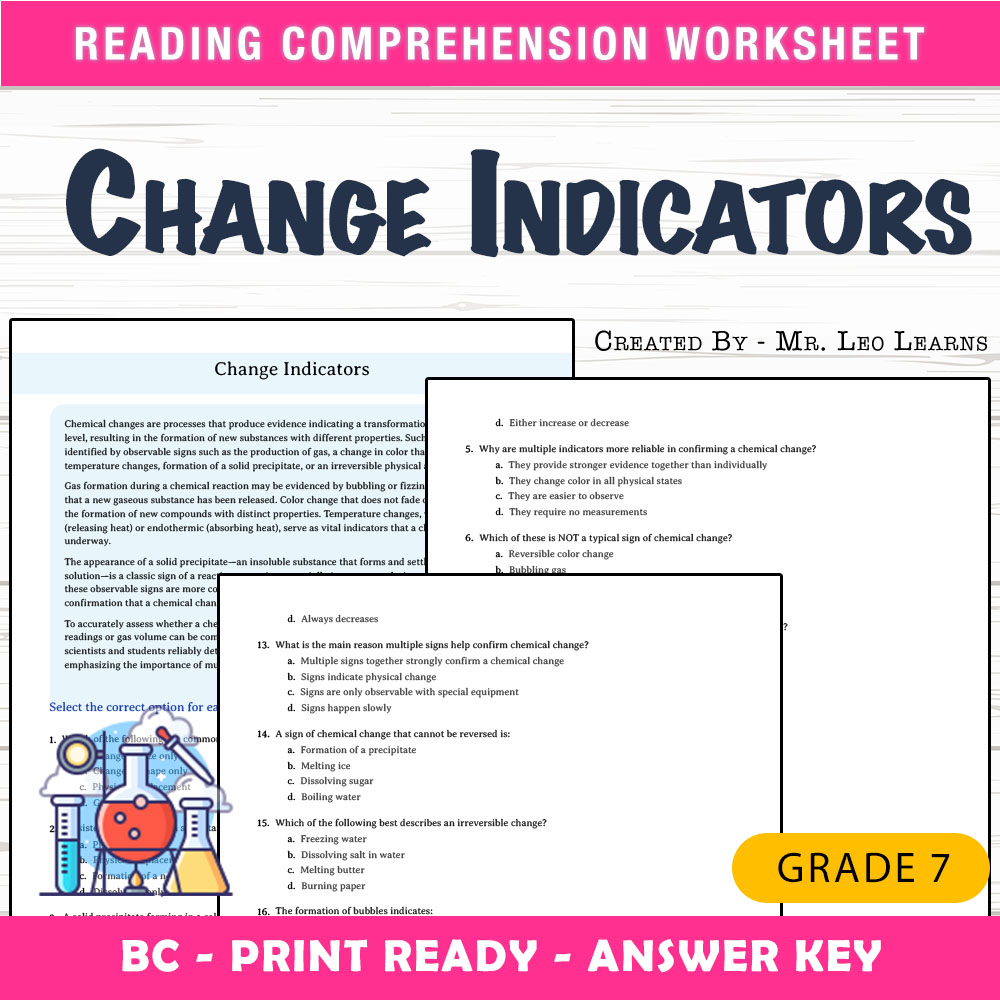
Grade 7 Science — Change Indicators Worksheet MCQ Paper PDF + Answer Key
Created byThe Resource HubLearning Objectives
- Identify observable signs of chemical change such as gas formation, color change, temperature change, and precipitate formation.
- Understand that multiple indicators together provide stronger evidence of chemical change than any single sign.
- Recognize the importance of measurements alongside observations to confirm chemical changes.
Also included in: Grade 7 Science | Matter & Chemical Change Worksheet Bundle – BC Framework +1 more
Instant download
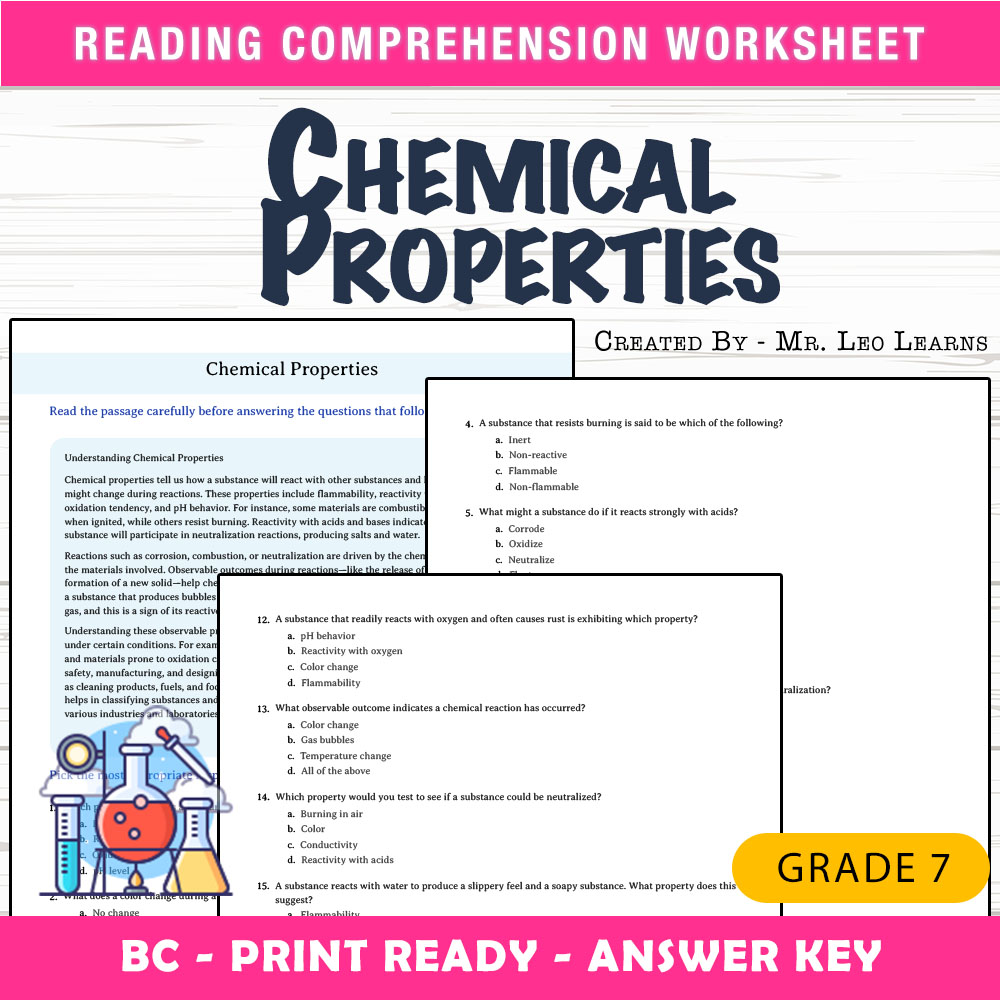
Grade 7 Science — Worksheet MCQ Paper for Mastering Chemical Properties
Created byThe Resource HubLearning Objectives
- Understand the concept of chemical properties and how they describe substances.
- Identify different types of chemical reactions based on properties such as flammability and reactivity.
- Observe and infer chemical properties from experimental outcomes such as color change and gas evolution.
Also included in: Grade 7 Science | Matter & Chemical Change Worksheet Bundle – BC Framework +1 more
Instant download
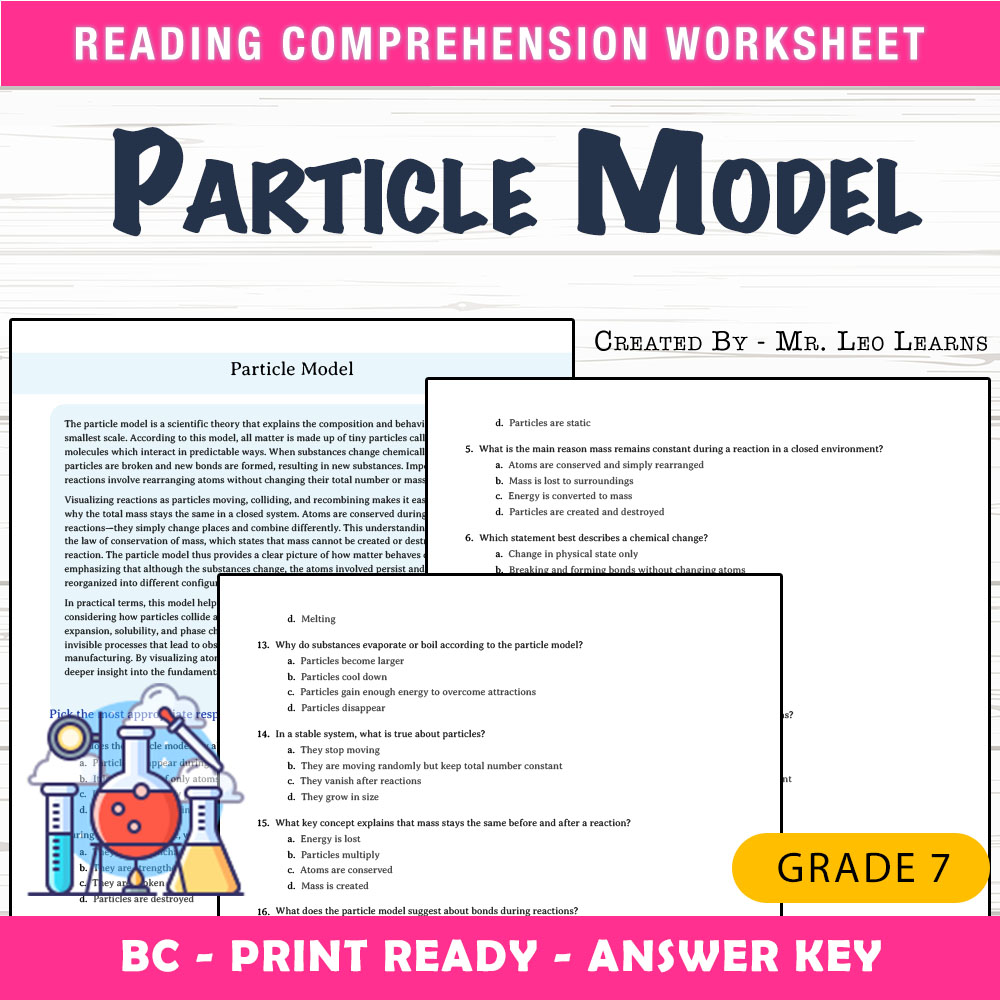
Grade 7 Science — Particle Model Worksheet MCQ Paper for Mastery
Created byThe Resource HubLearning Objectives
- Understand the particle model as a representation of matter and its components.
- Describe how particles behave during chemical changes and why mass remains constant.
Also included in: Grade 7 Science | Matter & Chemical Change Worksheet Bundle – BC Framework +1 more
Instant download
Grade 7 Science — Predicting Reactions Worksheet for Mastery
Created byThe Resource HubLearning Objectives
- Understand how to predict chemical reactions using physical and chemical properties.
- Identify properties such as reactivity, solubility, flammability, and acid-base behavior.
- Learn how reactivity patterns help anticipate products and energy changes in reactions.
Also included in: Grade 7 Science | Matter & Chemical Change Worksheet Bundle – BC Framework +1 more
Instant download
Grade 7 Science — Phase Changes Worksheet MCQ Paper for Mastery
Created byThe Resource HubLearning Objectives
- Understand the different types of phase changes and what causes them.
- Identify the effects of temperature and pressure on states of matter.
- Explain the concepts of latent heat and energy transfer during phase transitions.
Also included in: Grade 7 Science | Matter & Chemical Change Worksheet Bundle – BC Framework +1 more
Instant download
Grade 7 Science — Physical Change Worksheet MCQ Paper
Created byThe Resource HubLearning Objectives
- Identify examples of physical changes in everyday life.
- Differentiate between physical and chemical changes based on observable attributes.
- Understand the concepts of reversibility and particle behavior during physical changes.
Also included in: Grade 7 Science | Matter & Chemical Change Worksheet Bundle – BC Framework +1 more
Instant download
Grade 7 Science — Reaction Types Worksheet MCQ Paper for Mastery
Created byThe Resource HubLearning Objectives
- Identify and classify different types of chemical reactions including synthesis, decomposition, and displacement.
- Understand particle-level explanations of mass conservation during chemical transformations.
- Predict products of various reaction types based on reactant information.
Also included in: Grade 7 Science | Matter & Chemical Change Worksheet Bundle – BC Framework +1 more
Instant download
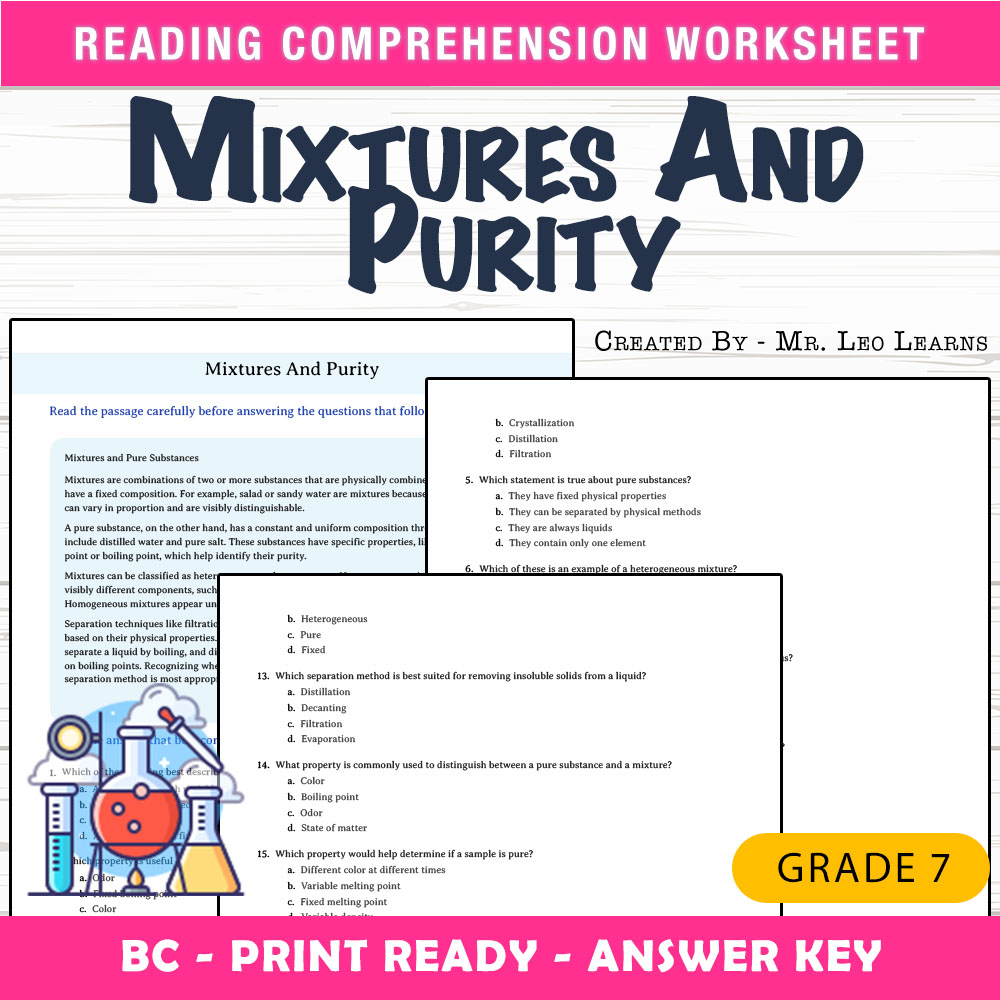
Grade 7 Science — Mixtures & Purity Worksheet MCQ Paper
Created byThe Resource HubLearning Objectives
- Understand the difference between mixtures and pure substances.
- Identify different types of mixtures based on observable traits.
- Learn methods of separation such as filtration, evaporation, and distillation.
Also included in: Grade 7 Science | Matter & Chemical Change Worksheet Bundle – BC Framework +1 more
Instant download
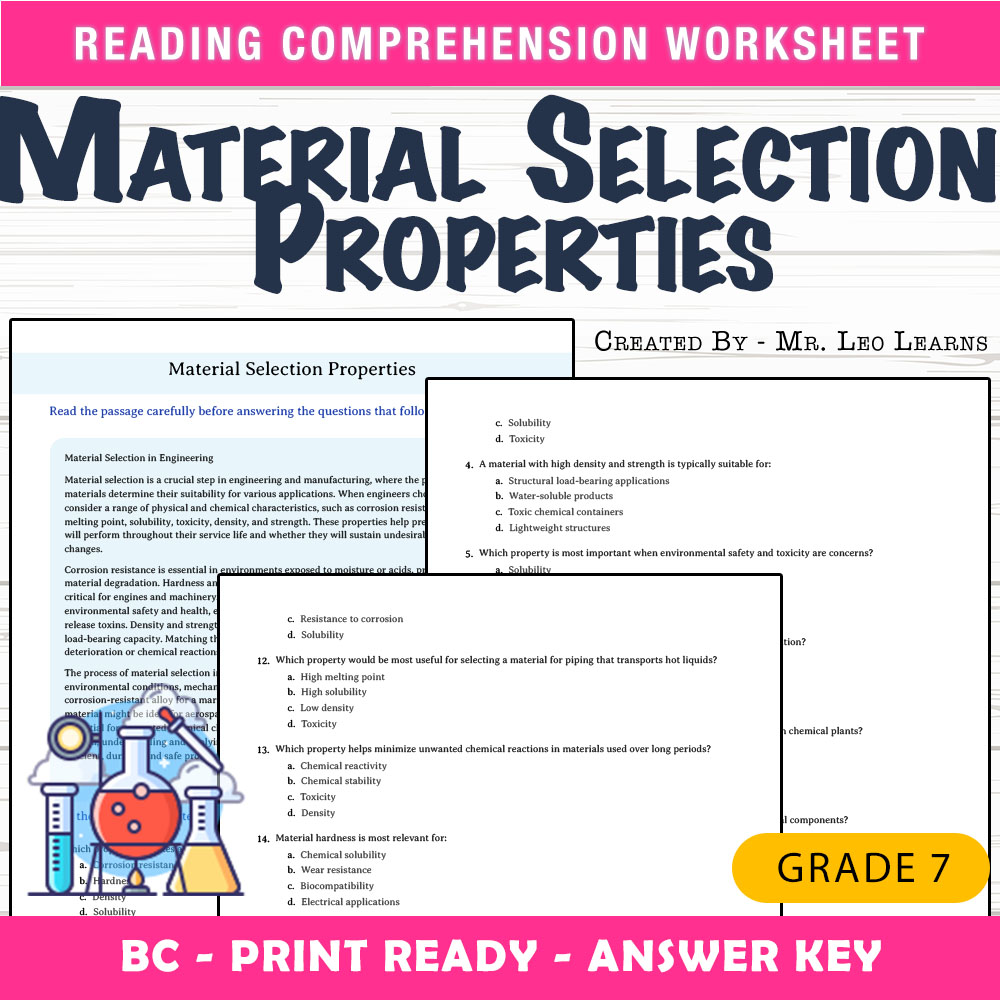
Grade 7 Science — Material Selection Properties Worksheet MCQ PDF + Answer Key
Created byThe Resource HubLearning Objectives
- Understand the criteria used for selecting materials for specific applications.
- Identify various physical and chemical properties relevant to material suitability.
- Evaluate how properties like corrosion resistance, hardness, and solubility impact application performance.
Also included in: Grade 7 Science | Matter & Chemical Change Worksheet Bundle – BC Framework +1 more
Instant download

Grade 7 Science — Energy and Change Worksheet MCQ Paper for Mastery
Created byThe Resource HubLearning Objectives
- Understand how energy is involved in chemical reactions and changes.
- Distinguish between exothermic and endothermic reactions based on energy transfer.
- Explain the link between energy exchange, bond breaking, and bond formation.
Also included in: Grade 7 Science | Matter & Chemical Change Worksheet Bundle – BC Framework +1 more
Instant download
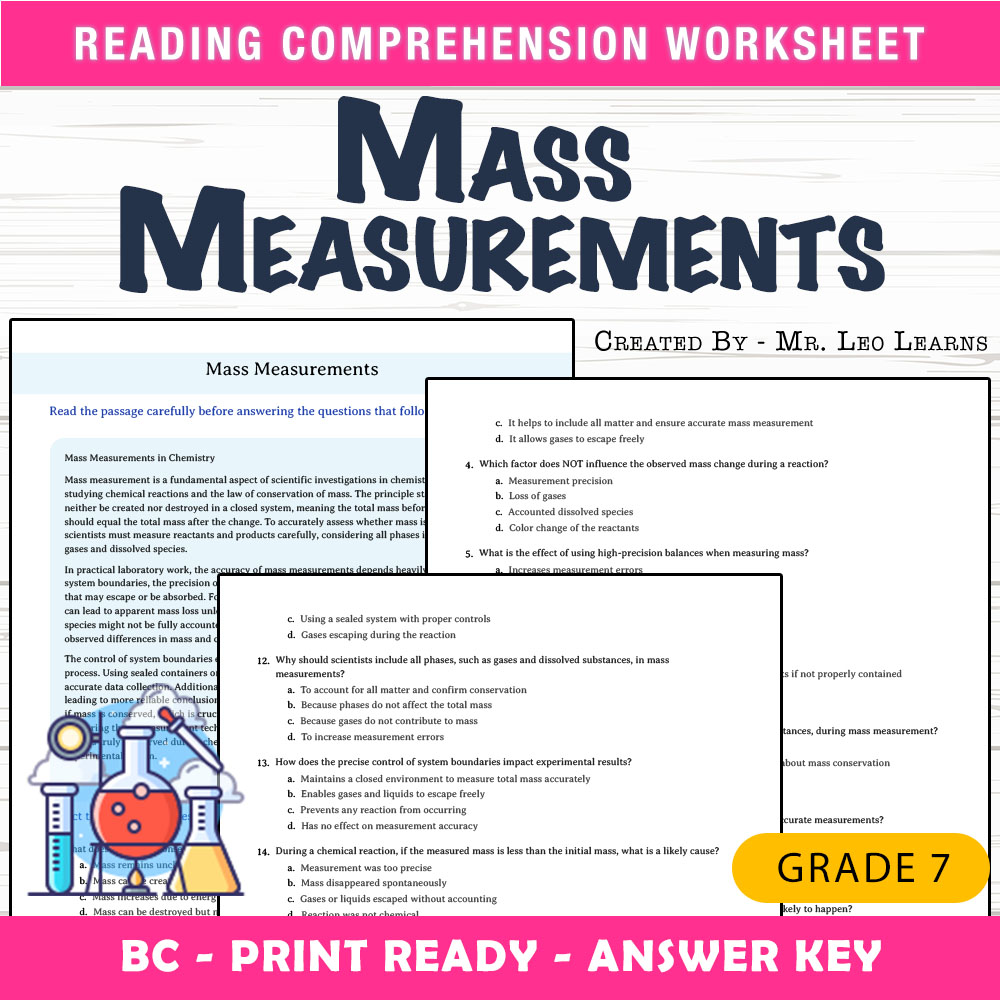
Grade 7 Science — Mass Measurements Worksheet for Mastery
Created byThe Resource HubLearning Objectives
- Understand the concept of mass measurement and its role in chemical reactions.
- Identify the factors affecting the conservation of mass in closed systems.
- Apply principles of accurate measurement to prevent errors involving gases or dissolved species.
Also included in: Grade 7 Science | Matter & Chemical Change Worksheet Bundle – BC Framework +1 more
Instant download
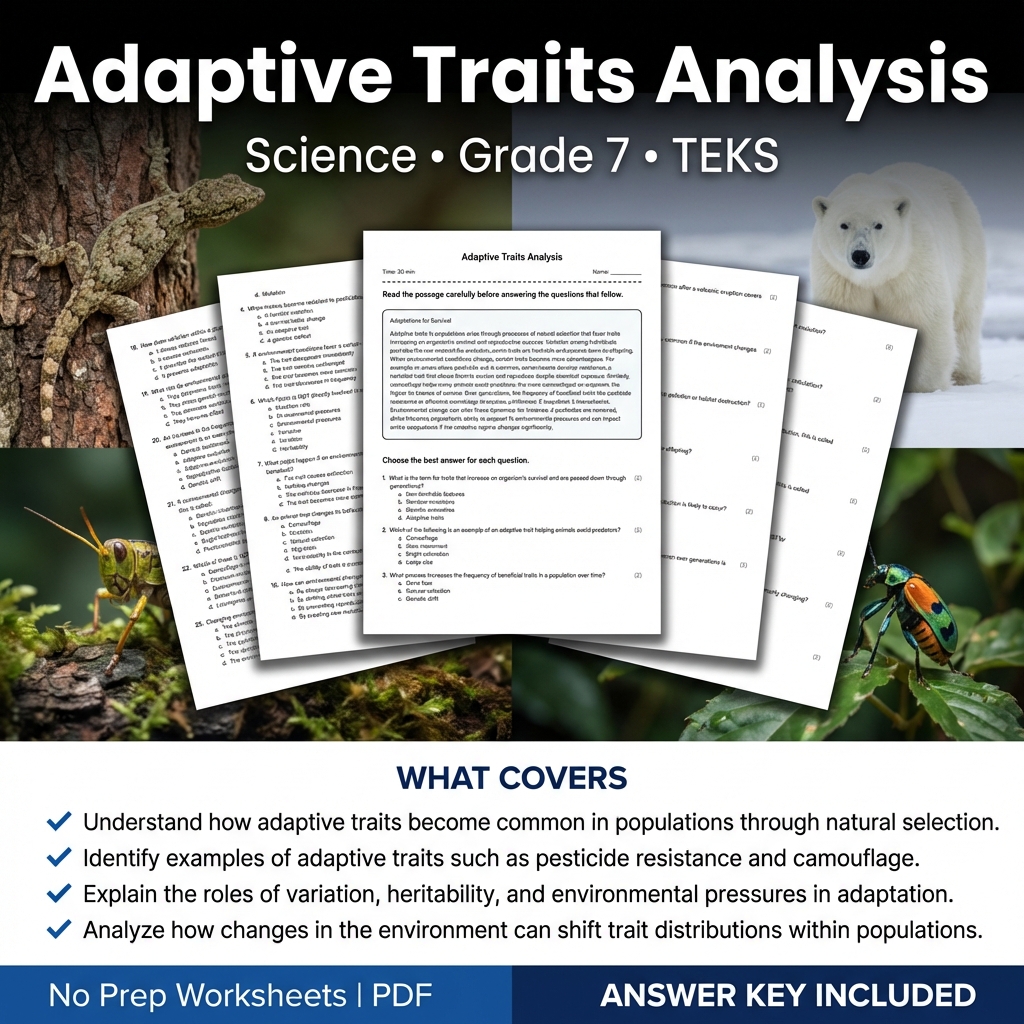
Grade 7 Science Worksheet on Adaptive Traits Analysis | TEKS Aligned
Created byCoral Reef LearningLearning Objectives
- Understand how adaptive traits become common in populations through natural selection.
- Identify examples of adaptive traits such as pesticide resistance and camouflage.
- Explain the roles of variation, heritability, and environmental pressures in adaptation.
Instant download
Grade 7 Science – Bitumen Separation Daily Reading Worksheet + Answer Key
JCreated byJ.S SheetsLearning Objectives
- Learn how physical separation methods are used in extracting bitumen from oil sands.
- Identify differences between physical and chemical separation processes.
- Understand the role of density, particle size, and temperature in mixture separation.
Also included in: Grade 7 Science Lesson Bundle | Alberta Framework for Classroom Use +1 more
Instant download
Grade 7 Science – Seasonal Cycles Daily Reading Worksheet + Answer Key
JCreated byJ.S SheetsLearning Objectives
- Explain the concept of seasonal changes and their effects on the environment.
- Identify the key factors driving seasonal thermal cycles.
- Understand how solar input, snow cover, and phase changes influence regional climates.
Also included in: Grade 7 Science Lesson Bundle | Thermal Energy and Systems Alberta Framework +1 more
Instant download
Grade 7 – Exploring Energy Transfer Modes Daily Worksheet with Answer Key
JCreated byJ.S SheetsLearning Objectives
- Understand the fundamental methods of energy transfer: conduction, convection, and radiation.
- Identify real-world examples of each energy transfer mode.
- Explain how different transfer modes contribute to energy exchange in systems like buildings and natural environments.
Also included in: Grade 7 Science Lesson Bundle | Thermal Energy and Systems Alberta Framework +1 more
Instant download
Grade 7 – Simple Machines Overview Daily Reading Worksheet with Answer Key
JCreated byJ.S SheetsLearning Objectives
- Understand how levers operate and how to calculate their mechanical advantage
- Identify different simple machines and their functions
- Describe how simple machines make work easier in daily life
Also included in: Grade 7 Science Lesson Group | Structural Engineering & Motion Worksheets +1 more
Instant download
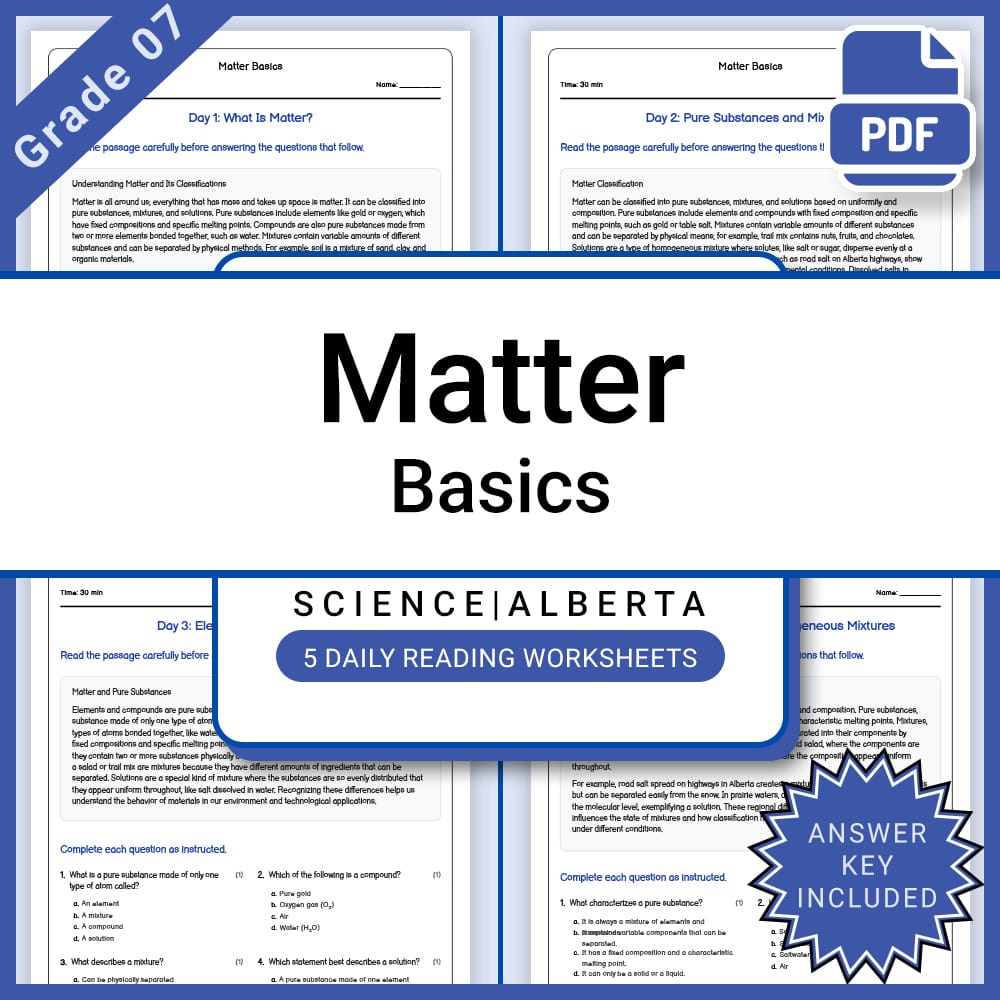
Grade 7 Science – Matter Basics Daily Reading Worksheet with Answer Key
JCreated byJ.S SheetsLearning Objectives
- Understand the different classifications of matter: pure substances, mixtures, and solutions.
- Identify characteristics of elements and compounds as pure substances.
- Describe how mixtures have variable composition and can be separated.
Also included in: Grade 7 Science Lesson Bundle | Alberta Framework for Classroom Use +1 more
Instant download
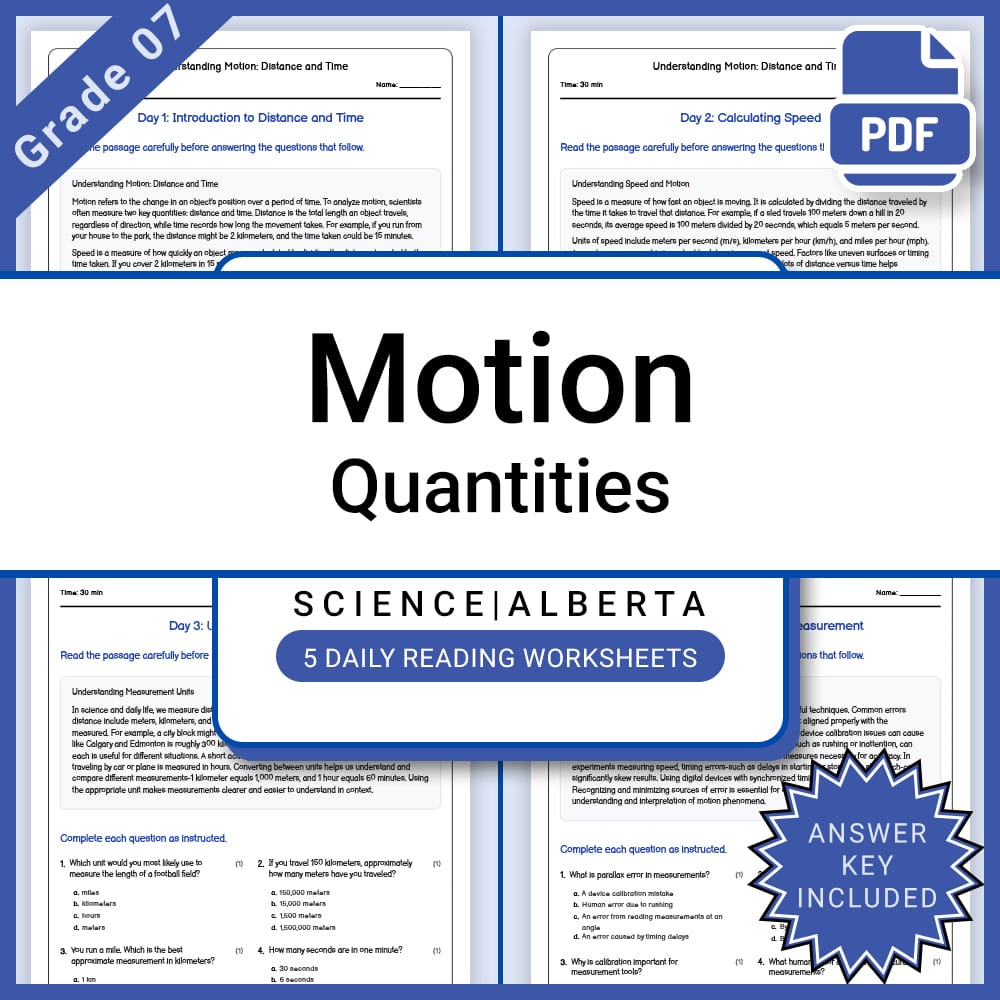
Grade 7 Science – Motion Distance and Time Daily Reading Worksheet + Answer Key
JCreated byJ.S SheetsLearning Objectives
- Explain the concepts of distance, time, and speed.
- Calculate average speed using distance and time.
- Identify measurement errors that can occur when recording motion data.
Also included in: Grade 7 Science Lesson Group | Structural Engineering & Motion Worksheets +1 more
Instant download
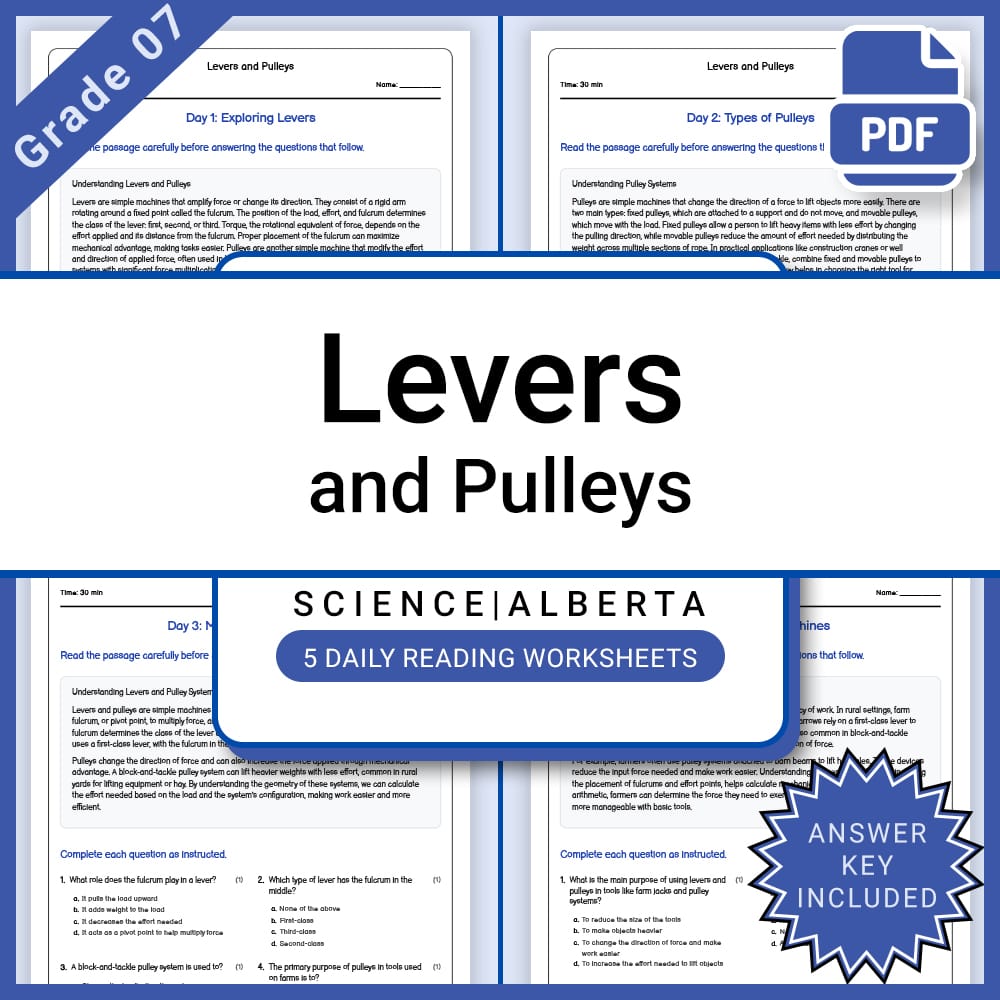
Grade 7 Science – Levers and Pulleys Daily Reading Worksheet with Answer Key
JCreated byJ.S SheetsLearning Objectives
- Understand the different classes of levers and their characteristics.
- Explain how torque affects lever operation.
- Calculate mechanical advantage of lever and pulley systems.
Also included in: Grade 7 Science Lesson Group | Structural Engineering & Motion Worksheets +1 more
Instant download
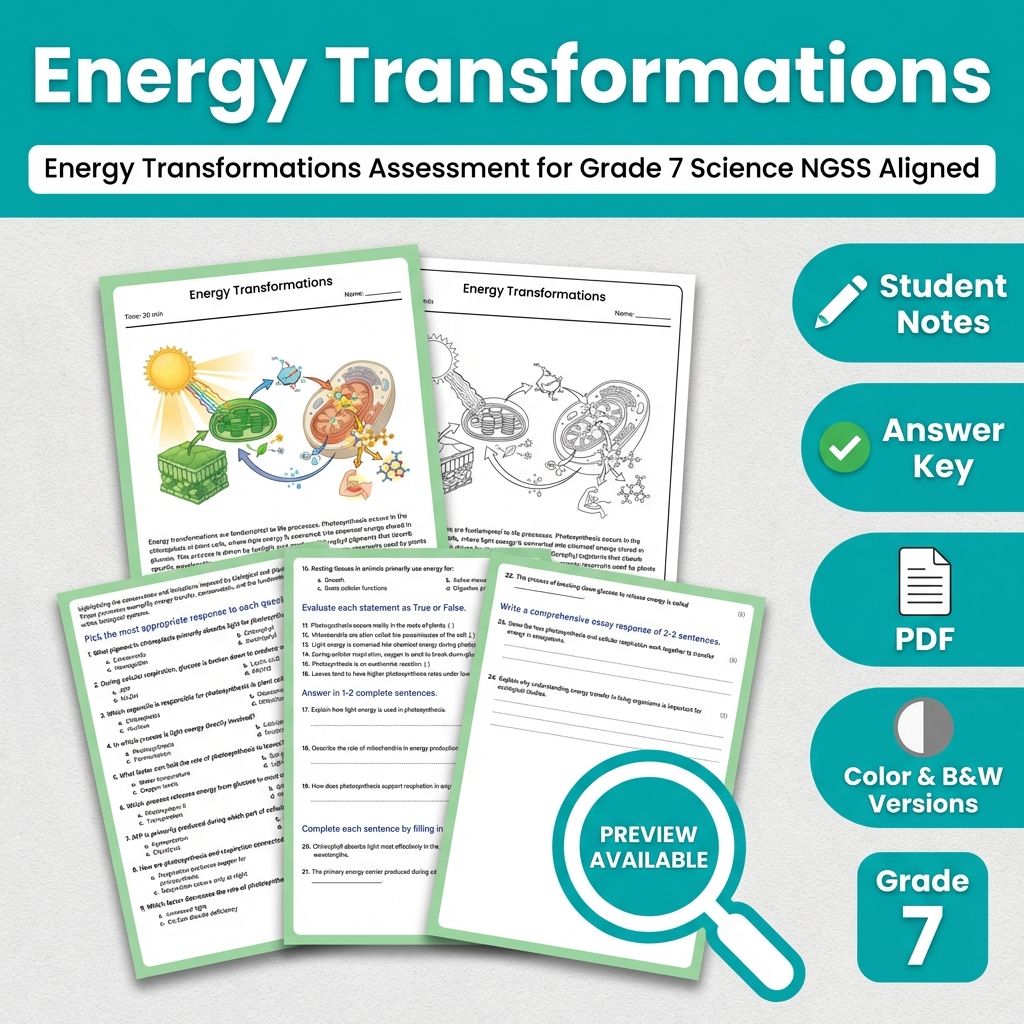
Energy Transformations Assessment for Grade 7 Science NGSS Aligned
Created byPrism Point LearningLearning Objectives
- Explain how light energy is converted into chemical bonds during photosynthesis.
- Describe how cellular respiration releases energy stored in glucose.
- Connect the processes in chloroplasts and mitochondria across different organisms.
Also included in: Grade 7 Science Mini Bundle – From Molecules to Organisms Structures & Processes +1 more
Instant download
Cell Structures Assessment | NGSS Grade 7 Science Standards Aligned
Created byPrism Point LearningLearning Objectives
- Identify and describe the roles of key organelles in plant and animal cells.
- Connect cell structure to function, including processes like transport, synthesis, and compartmentalization.
- Compare eukaryotic and prokaryotic cells using examples of leaf mesophyll and muscle cells.
Also included in: Grade 7 Science Mini Bundle – From Molecules to Organisms Structures & Processes +1 more
Instant download
Organ Interactions Assessment | NGSS Standards Grade 7 Science Worksheet
Created byPrism Point LearningLearning Objectives
- Describe the functions of circulatory, respiratory, digestive, and nervous systems in multicellular animals.
- Explain how organ systems cooperate to support processes like gas exchange, nutrient transport, and homeostasis.
- Illustrate system-level dependencies and feedback mechanisms in organ interactions.
Also included in: Grade 7 Science Mini Bundle – From Molecules to Organisms Structures & Processes +1 more
Instant download
Cell Evidence Assessment for Grade 7 Science | NGSS-Aligned Assessment
Created byPrism Point LearningLearning Objectives
- Understand how microscopy provides evidence for cellular organization in organisms.
- Identify differences between unicellular and multicellular organisms through observations of plant and protist cells.
- Recognize cellular features such as cell boundaries, plasma membranes, and cell walls in microscopic images.
Also included in: Grade 7 Science Mini Bundle – From Molecules to Organisms Structures & Processes +1 more
Instant download
Matter Cycling Assessment for Grade 7 Science NGSS Standards
Created byPrism Point LearningLearning Objectives
- Explain how matter is transferred and transformed within organisms during digestion, biosynthesis, and respiration.
- Describe the flow of carbon and nitrogen through biological systems.
- Identify key biochemical pathways involved in matter recycling within ecosystems.
Also included in: Grade 7 Science Mini Bundle – From Molecules to Organisms Structures & Processes +1 more
Instant download
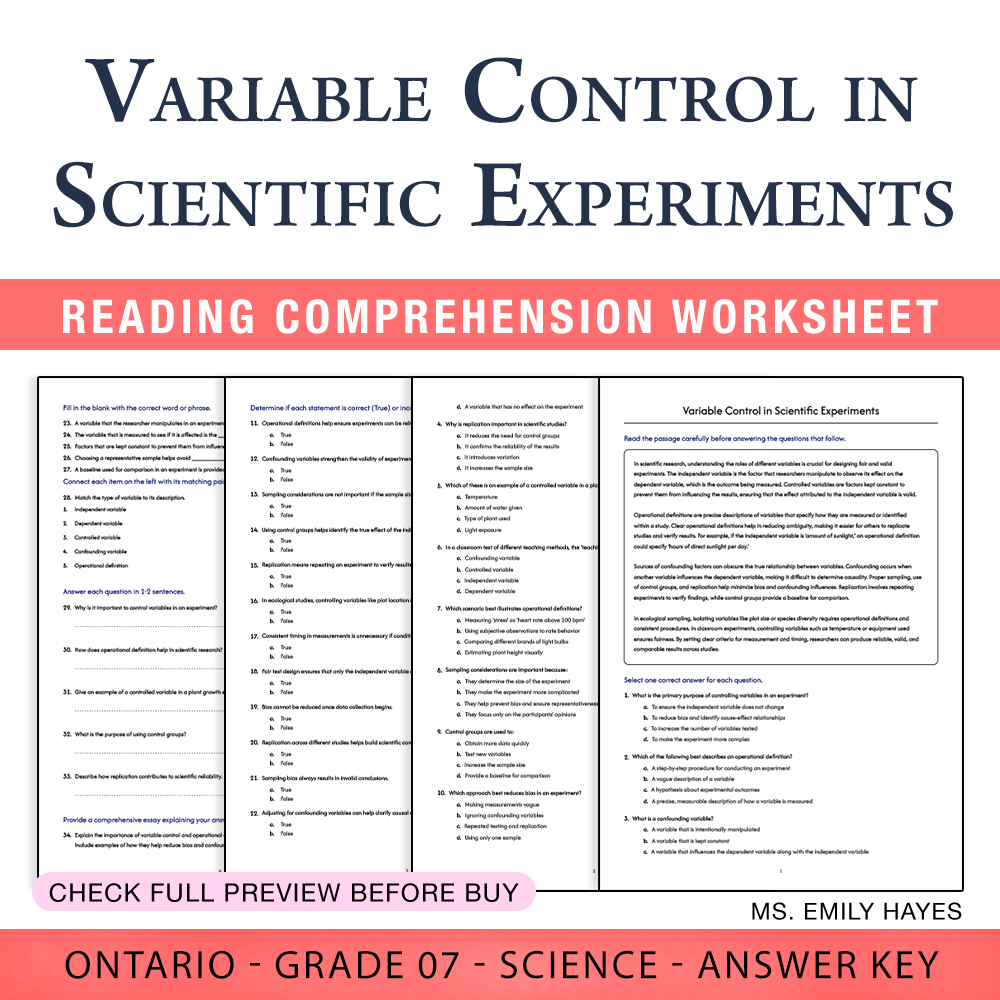
7th Grade Science | Variable Control in Experiments Worksheet (PDF+ Answer Key)
Created byCopper Leaf ClassroomLearning Objectives
- Define independent, dependent, and controlled variables in scientific experiments.
- Explain the importance of operational definitions and fair test design to obtain valid causal inferences.
- Identify sources of confounding, sampling considerations, and the role of control groups in reducing bias.
Instant download

Grade 7 Science Reading Worksheets | Population Basics – Standards-Aligned PDF
JCreated byJ.S SheetsLearning Objectives
- Understand the fundamental concepts of populations, including size, growth, and distribution.
- Identify and explain the impact of demographic factors such as births, deaths, immigration, and emigration.
- Describe key metrics used to measure population characteristics like density and distribution patterns.
Instant download
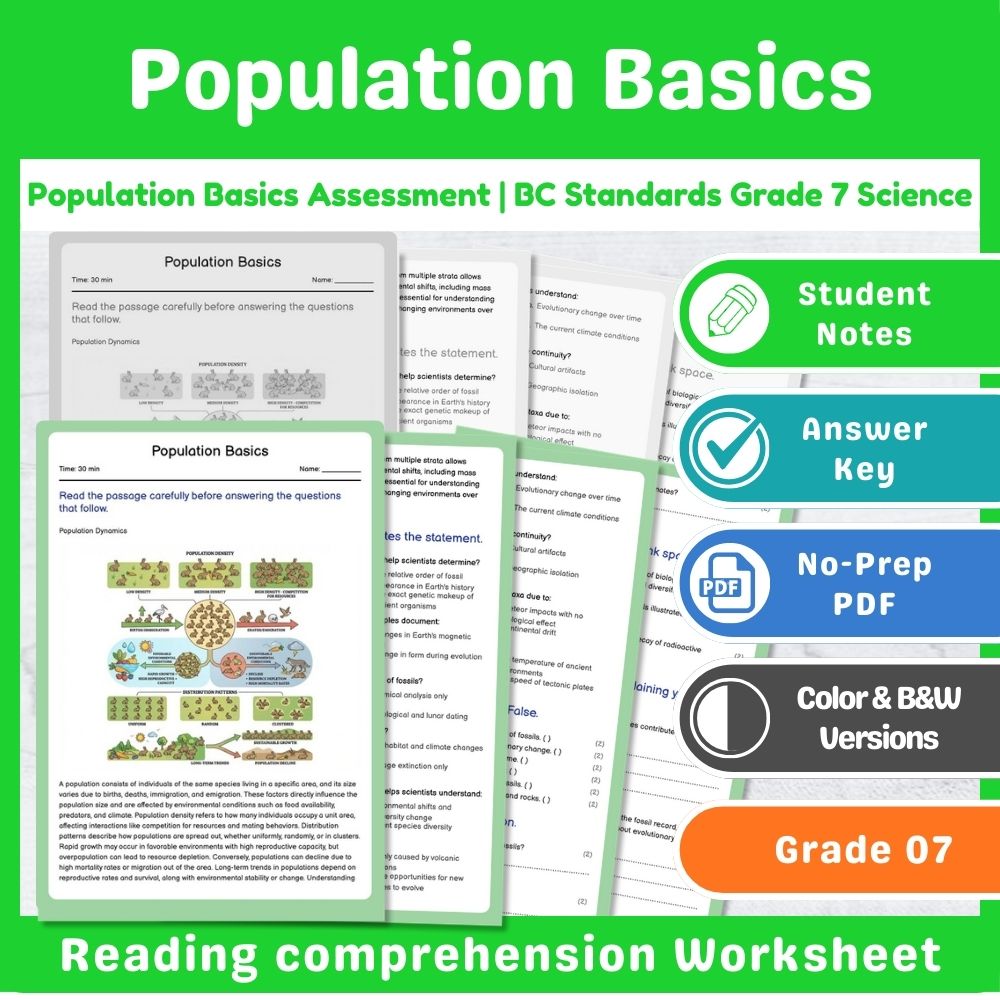
Population Basics Assessment | BC Standards Grade 7 Science
Created byPrism Point LearningLearning Objectives
- Understand the core metrics used to describe populations, such as size, density, and distribution patterns.
- Explain how demographic factors like births, deaths, immigration, and emigration influence population change.
- Analyze how environmental conditions interact with population dynamics over short-term and long-term scales.
Instant download

Grade 7 Science – Population Basics & Concepts | Daily Reading Worksheet
 Created byBright Mind Resources
Learning Objectives
- Understand the definition of a population in biology.
- Identify factors that influence population size and distribution.
- Recognize key metrics used to describe populations.
Also included in: Grade 7 Ecosystems & Population Ecology Science Lesson Bundle | BC +1 more
Instant download
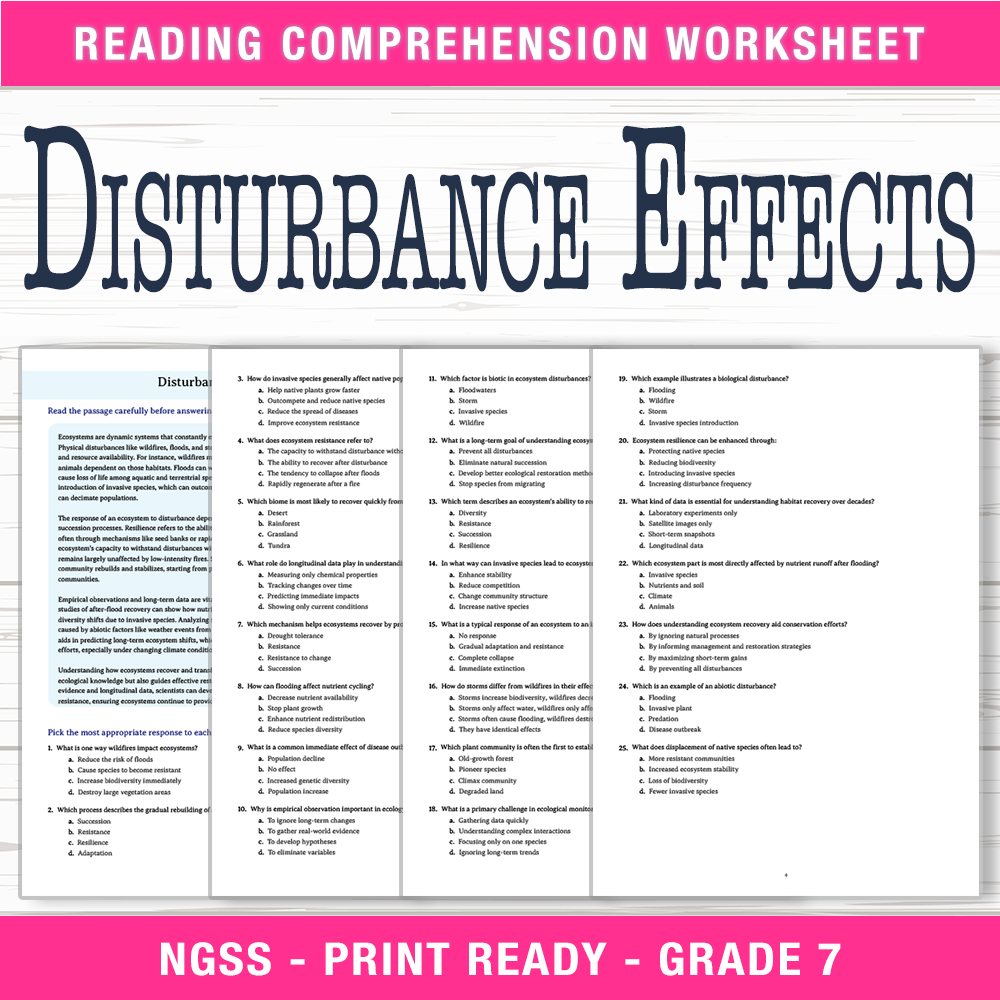
Grade 7 Science – Disturbance Effects Worksheet (PDF + Answer Key)
 Created byRiverstone Classroom
Learning Objectives
- Understand how physical and biological disturbances impact ecosystems and populations
- Interpret empirical observations and longitudinal data to analyze ecosystem changes
- Explain mechanisms of resilience, resistance, and succession after disturbances
Also included in: Grade 7 Science | Ecosystems & Biodiversity Unit Worksheet Pack
Instant download

Model-Based Predictions Worksheet | Grade 7 Science Practice
Created byPrism Point LearningLearning Objectives
- Explain how models turn observations into representations that support predictions.
- Distinguish physical, diagrammatic, and computational models by what each shows.
- Use model assumptions to reason about expected outcomes under new conditions.
Instant download
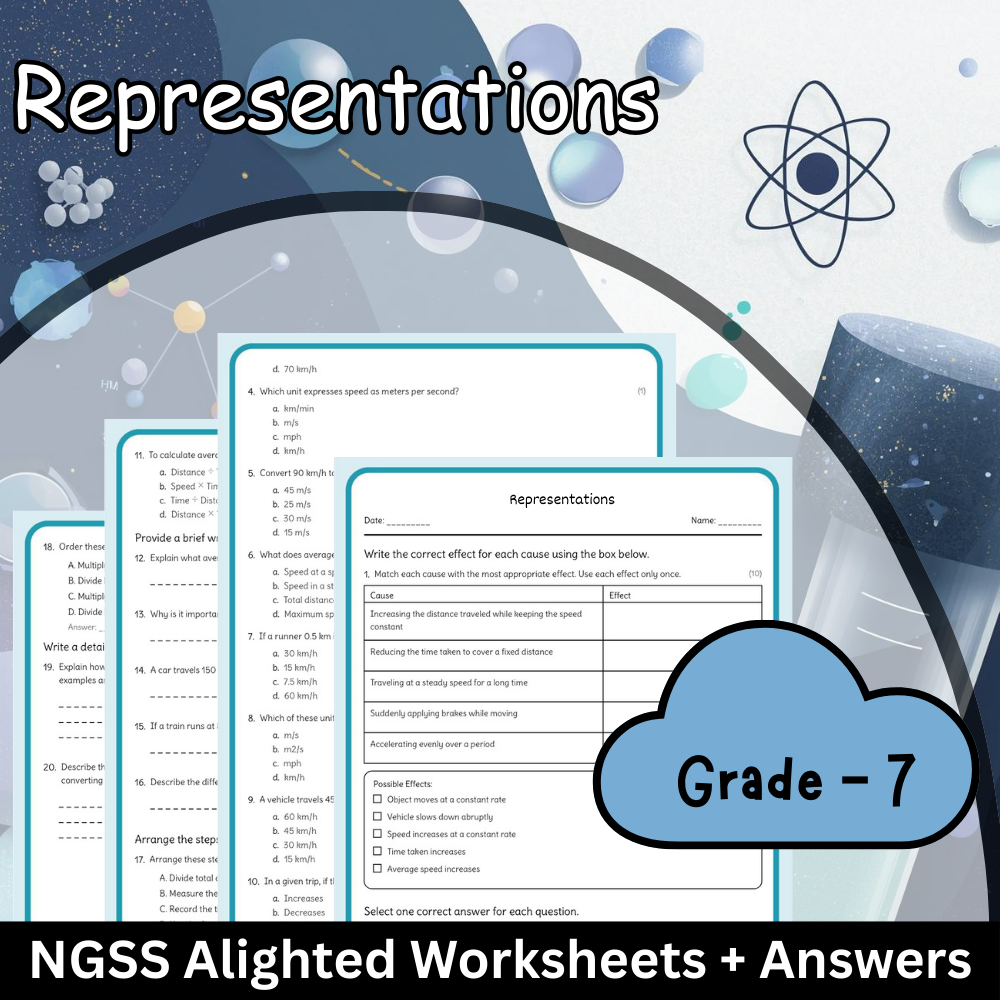
Grade 7 Science | Representations Worksheet (Answer Key) – NGSS Alignment
Created byBright Mind ResourcesLearning Objectives
- Characterize how multiple representations convey matter interactions, including symbolic chemical equations, graphs, and tabulated data.
- Interpret reaction rate graphs, stoichiometric ratios, and phase diagrams to communicate quantitative relationships.
- Select appropriate representations for quantitative comparison without assuming microscopic mechanisms.
Instant download
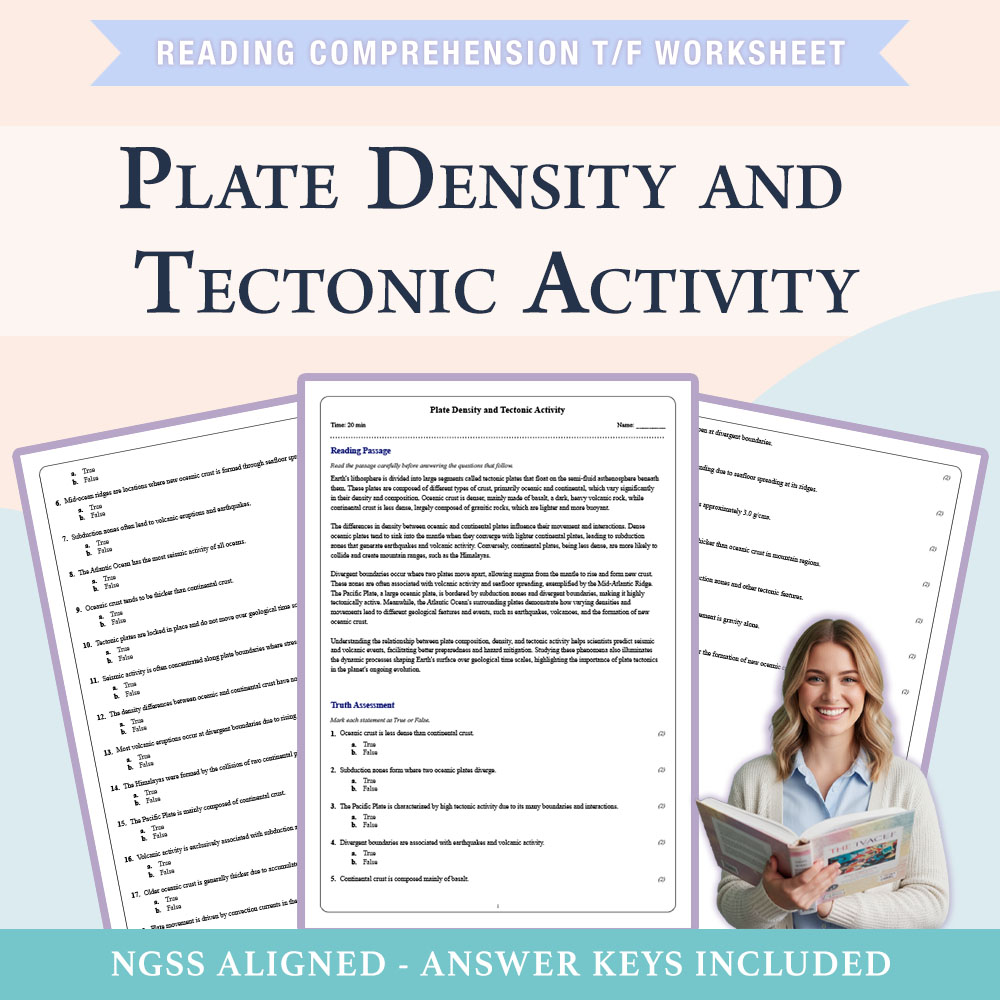
7th Grade Science |Plate Density & Tectonic Activity Worksheet (PDF +Answer Key)
Created byCopper Leaf ClassroomLearning Objectives
- Understand the differences between oceanic and continental crust in terms of density and composition.
- Explain how plate density influences tectonic movements such as subduction zones and divergent boundaries.
- Identify real-world examples of tectonic activity related to plate characteristics, including seismic and volcanic phenomena.
Instant download
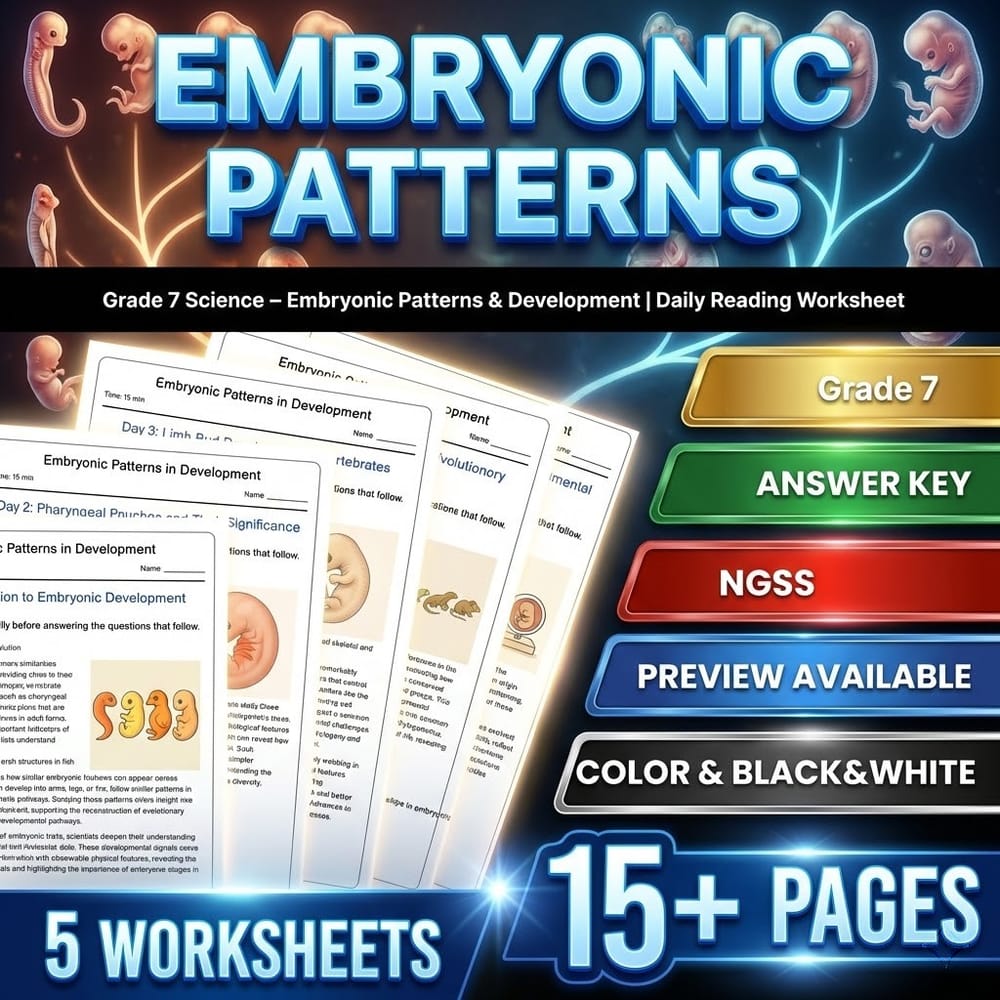
Grade 7 Science – Embryonic Patterns & Development | Daily Reading Worksheet
 Created byElena Brooks
Learning Objectives
- Identify the key stages of embryonic development across different species
- Understand the significance of conserved developmental features
- Compare similarities and differences in embryonic structures
Also included in: Evolution and Natural Selection Grade 7 Science Worksheets Bundle | NGSS +1 more
Instant download
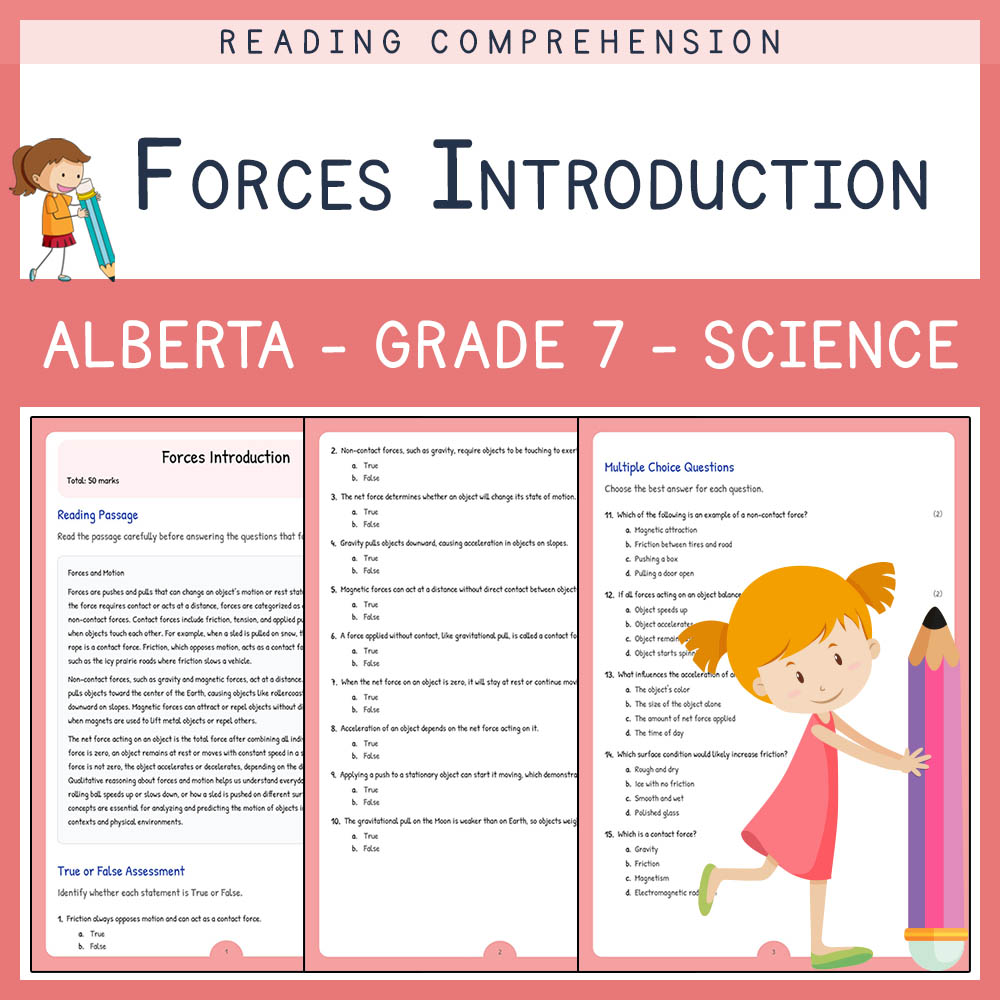
Grade 7 Science | Forces Introduction Worksheet | Alberta Standard
Created byLumora LearningLearning Objectives
- Define and distinguish between contact and non-contact forces.
- Understand how net force influences the acceleration of objects.
- Explain real-world examples of forces such as friction and gravity.
Instant download
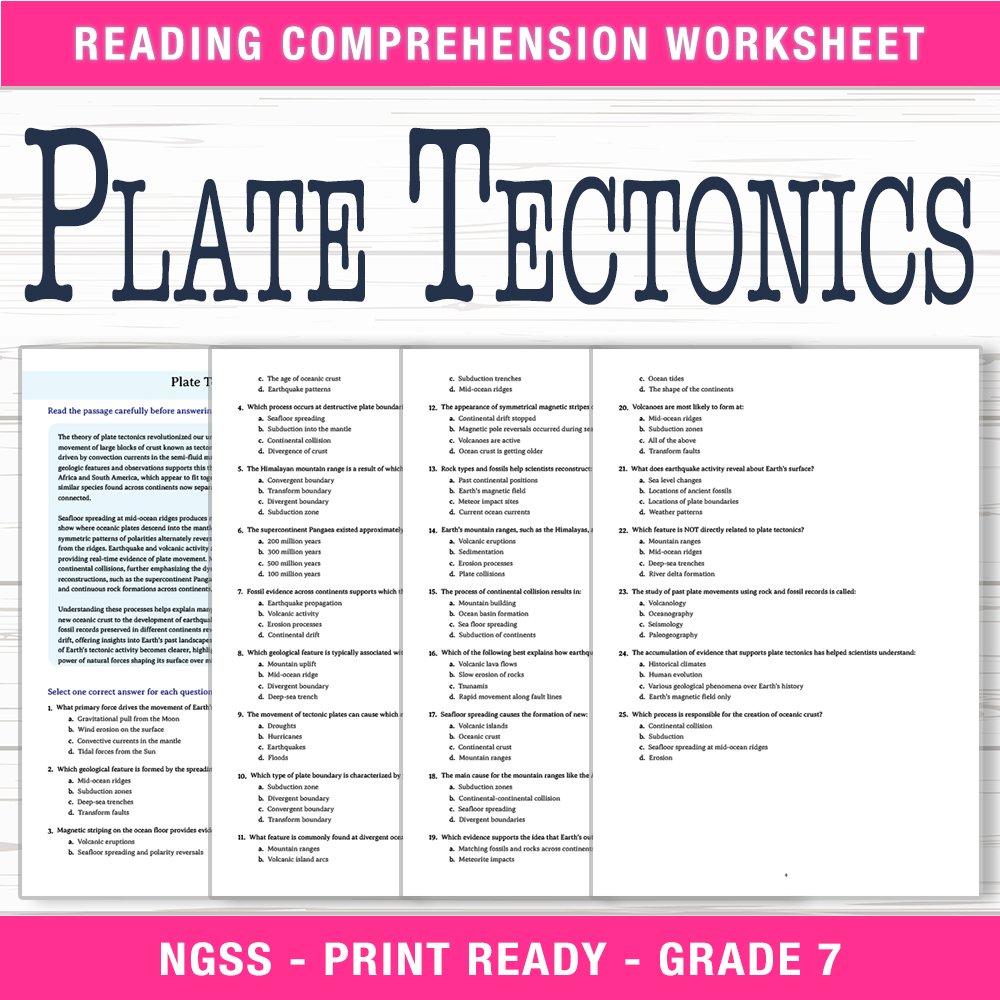
Grade 7 Science | Plate Tectonics Worksheets (PDF + Answer Key)
Created byRiverstone ClassroomLearning Objectives
- Explain the evidence supporting the theory of plate tectonics, including fossil distribution and matching continental margins.
- Identify key geologic features such as mid-ocean ridges, trenches, and mountain ranges related to plate movements.
- Describe how magnetic striping, earthquake, and volcanic activity provide evidence for seafloor spreading and plate motion.
Instant download

Grade 7 Science Adaptations in Living Things Worksheet | CA Standards PDF
 Created byEvergreen Desk Education
Learning Objectives
- Explain how adaptations help organisms survive and reproduce in their environments
- Differentiate structural, behavioral, and physiological adaptations
- Use evidence from a text to identify examples of adaptations
Instant download
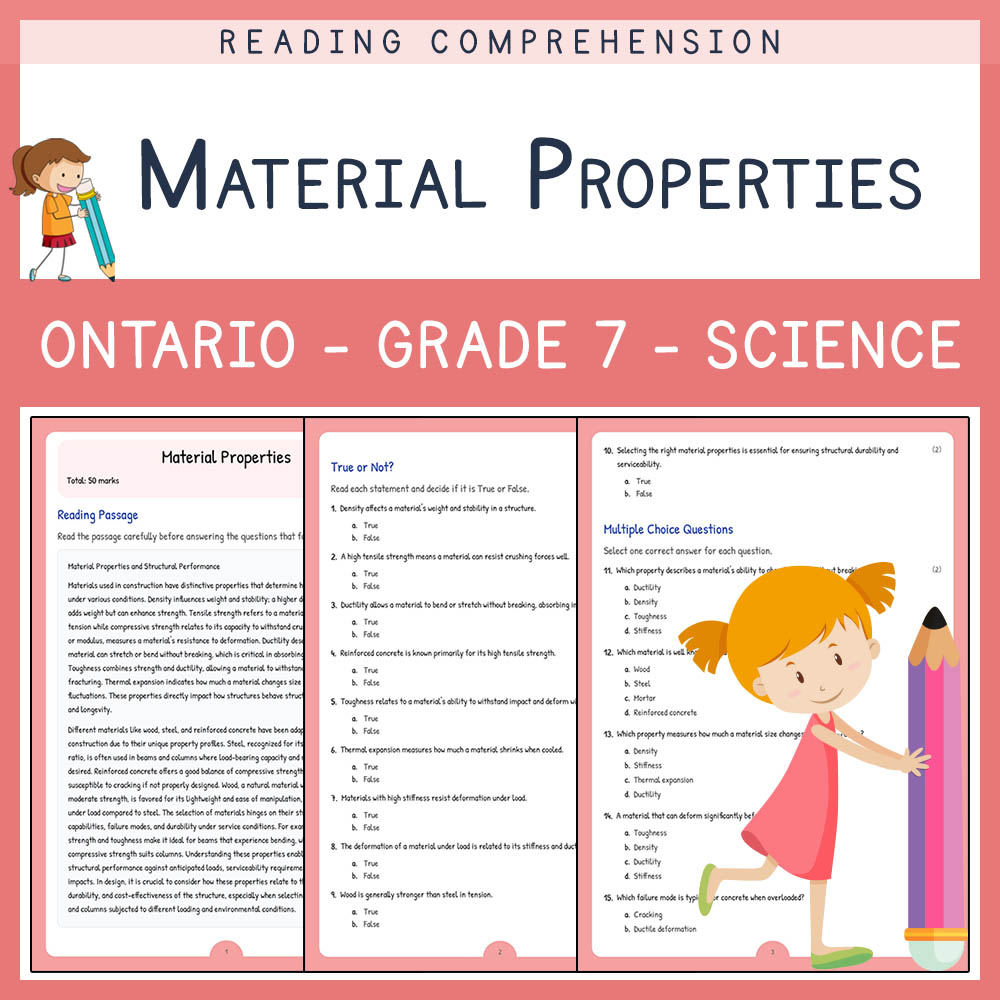
Grade 7 Science | Material Properties Worksheet & Answer Key (PDF)
Created byLumora LearningLearning Objectives
- Define key material properties such as density, tensile and compressive strength, stiffness, ductility, toughness, and thermal expansion.
- Explain how these properties influence the performance of structural materials.
- Contrast common construction materials—wood, steel, and reinforced concrete—in terms of strength-to-weight ratio, deformation, and failure modes.
Also included in: Grade 7 Science | Form Function Design Structures Unit Bundle | Ontario
Instant download
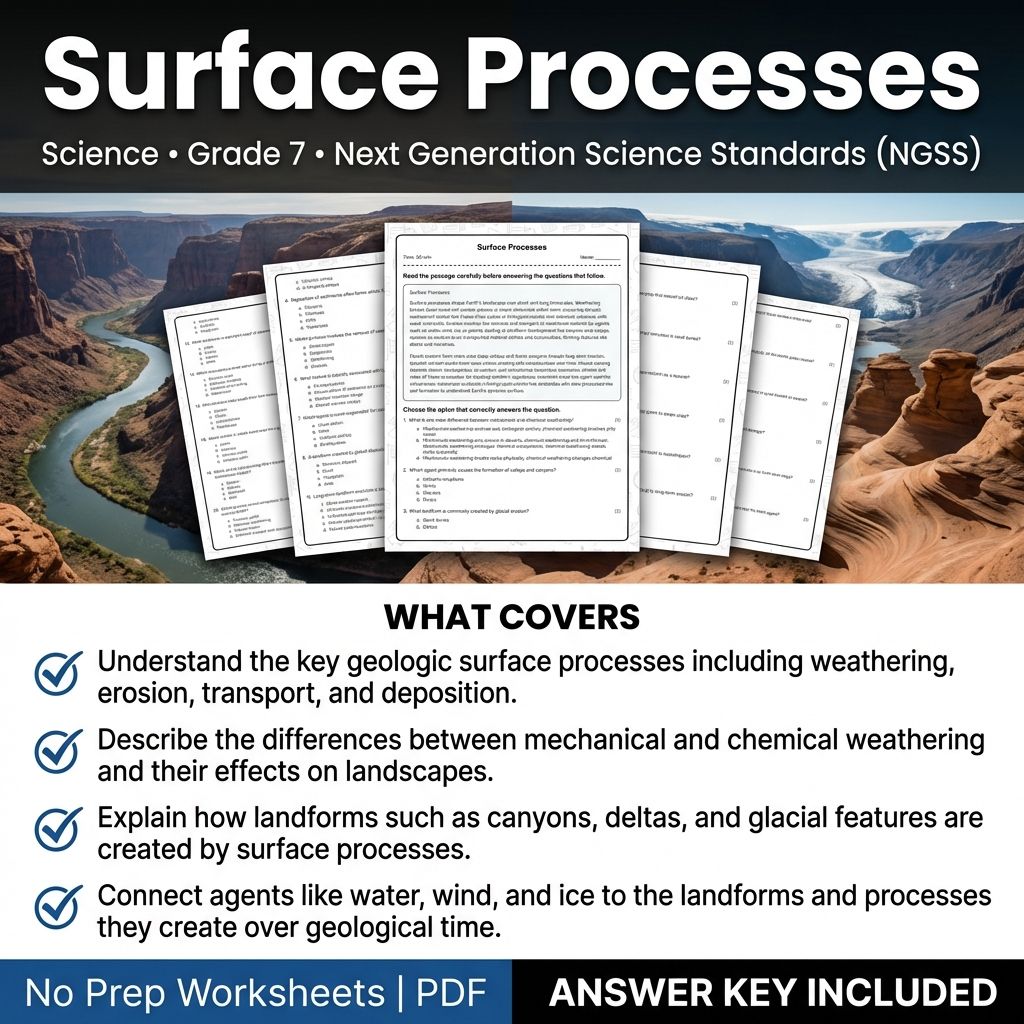
7th Grade Science Worksheet | Surface Processes Practice PDF & Answer Key
Created byCoral Reef LearningLearning Objectives
- Understand the key geologic surface processes including weathering, erosion, transport, and deposition.
- Describe the differences between mechanical and chemical weathering and their effects on landscapes.
- Explain how landforms such as canyons, deltas, and glacial features are created by surface processes.
Instant download

Measurement Uncertainty Worksheet Practice | Grade 7 Science
Created byPrism Point LearningLearning Objectives
- Identify standard metric units and choose suitable instruments for a measurement task
- Read scales accurately and report measurements using appropriate significant figures
- Distinguish between systematic and random error and explain how uncertainty affects results
Instant download

Population Factors Worksheet for Grade 7 Science | Alberta Standards Practice
JCreated byJ.S SheetsLearning Objectives
- Understand how birth, death, immigration, and emigration influence population size and distribution.
- Identify regional drivers such as water availability, fire regimes, and disease outbreaks that affect populations.
- Analyze how population trends inform species status and biodiversity assessments.
Instant download
About Grade 7 Science Worksheets
Browse 6,039 printable Grade 7 Science worksheets — ready-to-print PDFs with answer keys where available.
Every worksheet on MyTeachingSheets is created by independent teacher-authors and reviewed before publication. All resources download as printable PDFs for classroom, homework, or at-home practice, and many include answer keys. Preview any worksheet free before buying.