
Grade 7 Science Worksheets
6,039 worksheets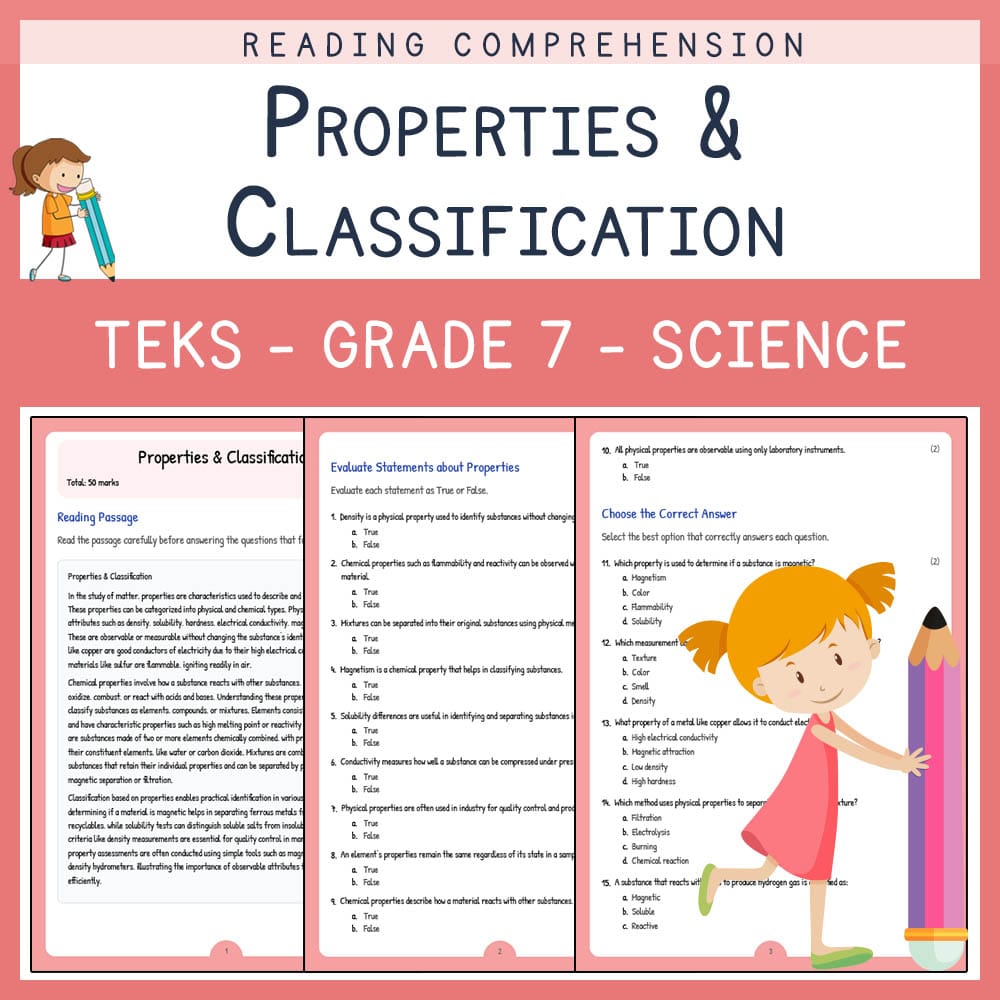
Grade 7 Science | Properties and Classification Worksheet | TEKS-Aligned
 Created byLumora Learning
Learning Objectives
- Define and differentiate between physical and chemical properties of substances.
- Identify measurable attributes such as density, solubility, hardness, and conductivity.
- Classify substances as elements, compounds, or mixtures based on their properties.
Also included in: Grade 7 Science | Matter and Energy Lesson Bundle | TEKS Aligned
Instant download
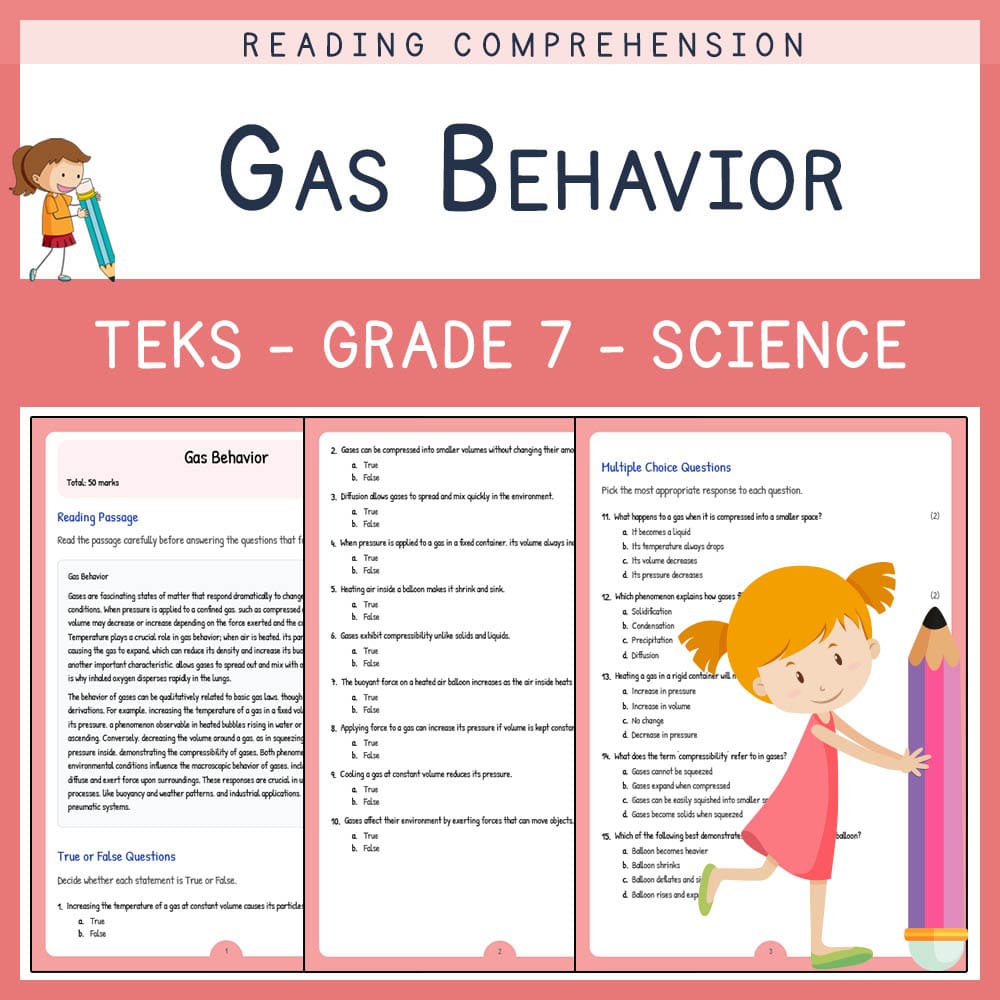
Grade 7 Science | Gas Behavior Worksheet | TEKS-Aligned
Created byLumora LearningLearning Objectives
- Describe qualitatively how pressure, volume, and temperature interrelate in gases.
- Explain phenomena such as diffusion and compressibility in gases.
- Relate macroscopic observations like pressure variation and buoyant behavior to gas responses.
Also included in: Grade 7 Science | Matter and Energy Lesson Bundle | TEKS Aligned
Instant download
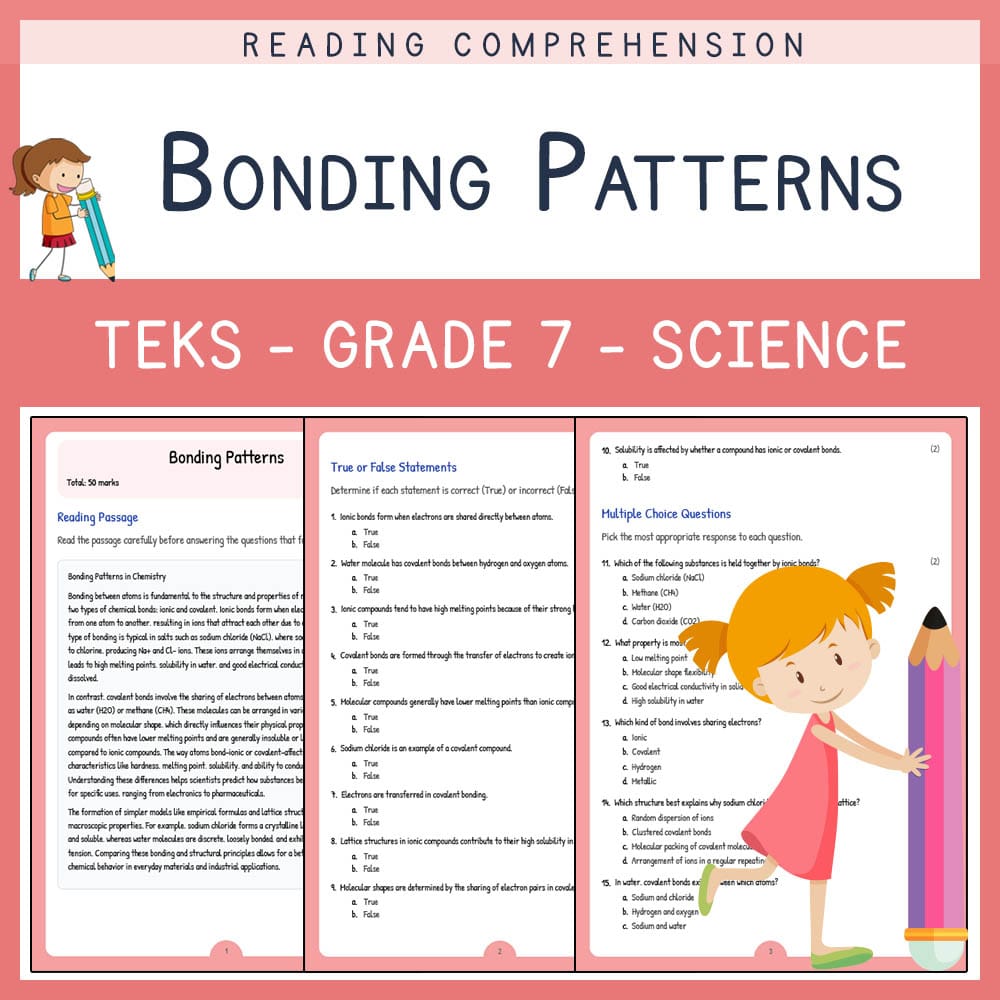
Grade 7 Science | Bonding Patterns Worksheet | TEKS-Aligned
Created byLumora LearningLearning Objectives
- Understand the differences between ionic and covalent bonding and their effects on macroscopic properties.
- Identify and describe simple formation of binary ionic salts and molecular compounds using empirical formulas.
- Relate bonding types to observable properties such as melting point, solubility, and electrical conductivity.
Also included in: Grade 7 Science | Matter and Energy Lesson Bundle | TEKS Aligned
Instant download
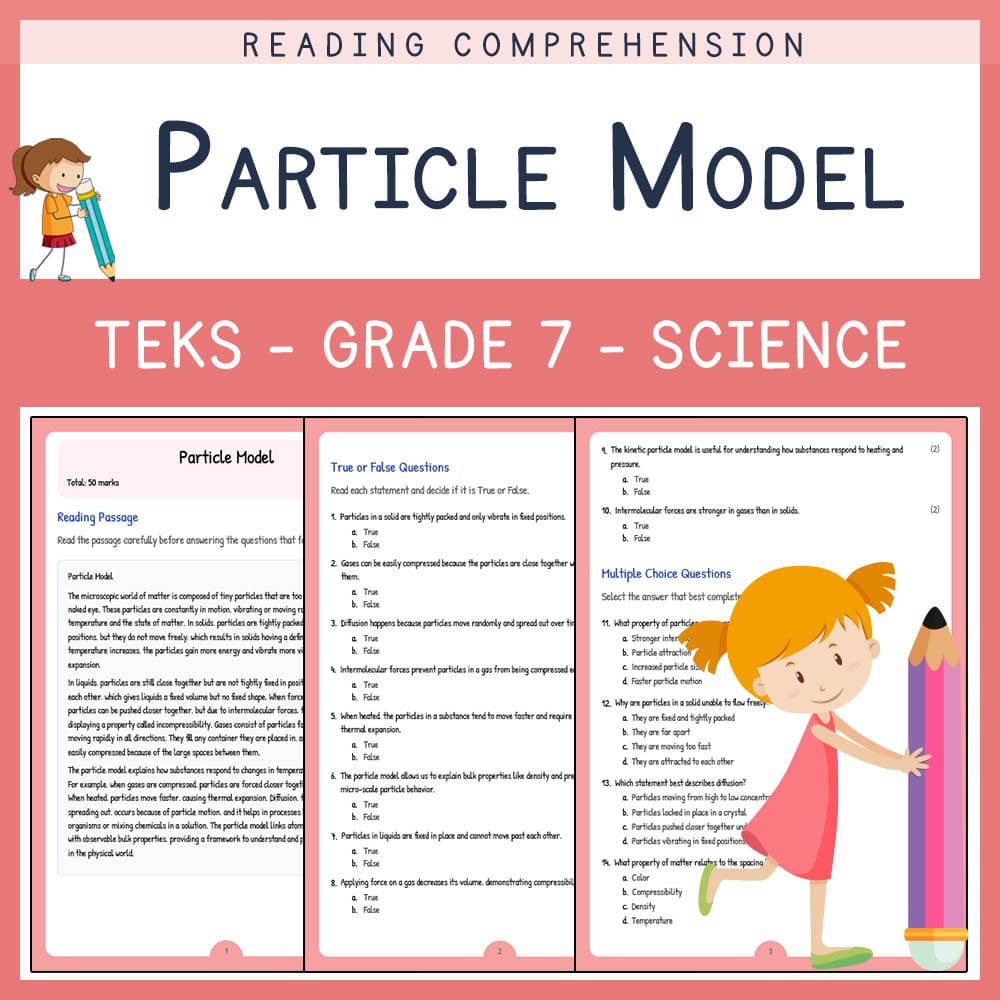
Grade 7 Science | Particle Model Worksheet | TEKS Alligned
Created byLumora LearningLearning Objectives
- Understand the particle model as an explanation for properties of matter.
- Describe particle spacing, motion, and forces in different states of matter.
- Relate micro-scale particle behavior to macro-scale measurements such as density and pressure.
Also included in: Grade 7 Science | Matter and Energy Lesson Bundle | TEKS Aligned
Instant download
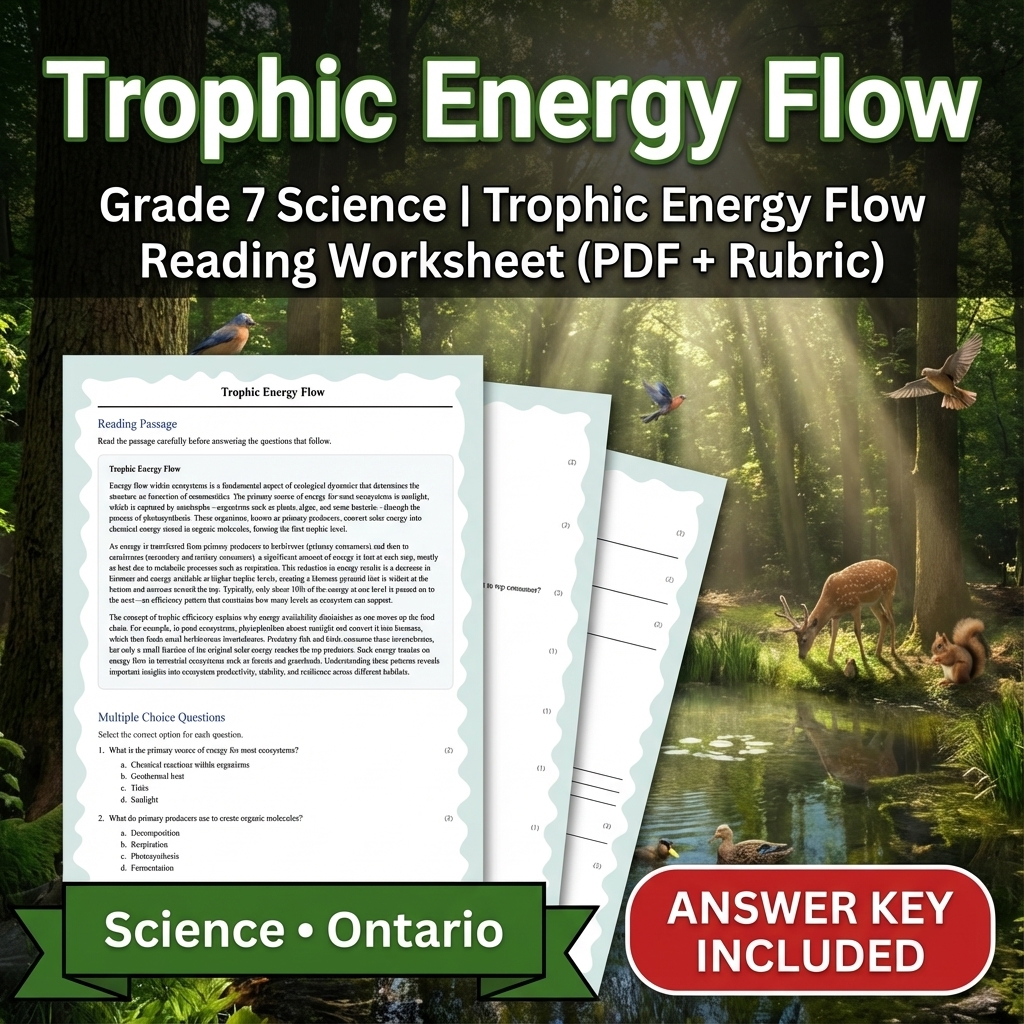
Grade 7 Science | Trophic Energy Flow Reading Worksheet (PDF + Rubric)
JCreated byJ.S SheetsLearning Objectives
- Understand how energy moves through trophic levels in ecosystems.
- Explain the concepts of energy efficiency, biomass pyramids, and energy transfer limitations.
- Describe how solar energy is captured by primary producers and lost through respiration and heat.
Also included in: Grade 7 Science | Ecosystems, Biodiversity & Environmental Stewardship +1 more
Instant download
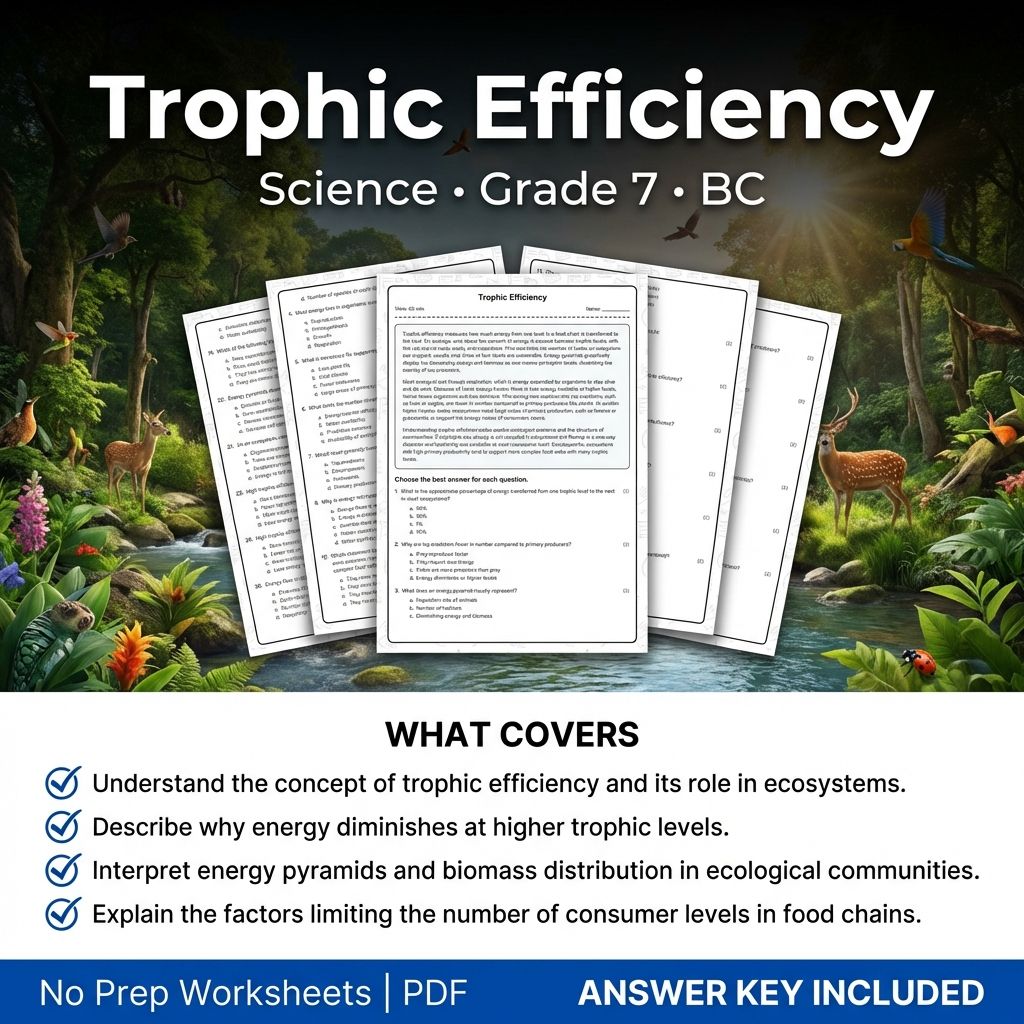
7th Grade Science | Trophic Efficiency Worksheet & Answer Key (PDF Printable)
 Created byCoral Reef Learning
Learning Objectives
- Understand the concept of trophic efficiency and its role in ecosystems.
- Describe why energy diminishes at higher trophic levels.
- Interpret energy pyramids and biomass distribution in ecological communities.
Instant download

Adaptation Forms Worksheet for Grade 7 Science | Standards-Aligned Practice
JCreated byJ.S SheetsLearning Objectives
- Define morphological, physiological, and behavioral adaptations and identify examples from different habitats.
- Explain how specific traits improve survival and reproductive success under particular selective pressures.
- Differentiate adaptations from acclimation and describe at least one adaptive trade-off.
Instant download
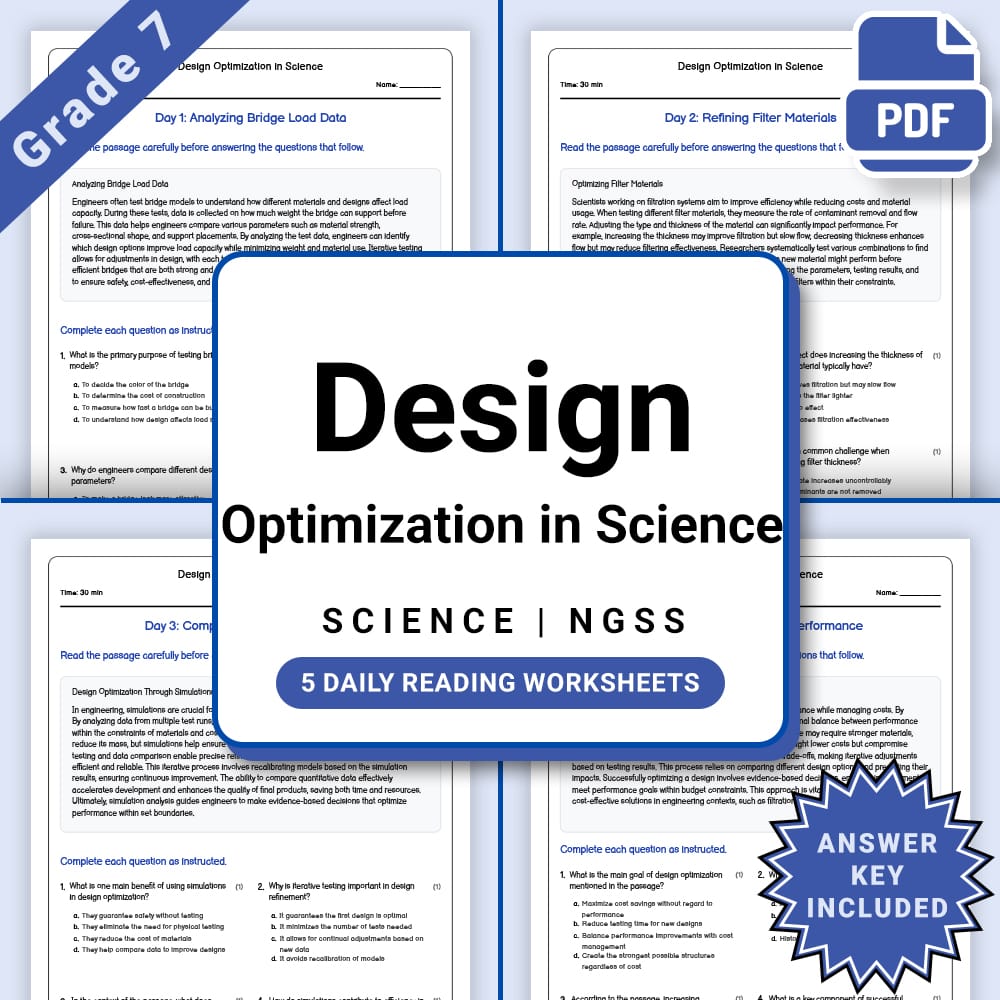
Grade 7 Science – Design Optimization Worksheet(PDF + Answer Key)
 Created byCopper Leaf Classroom
Learning Objectives
- Interpret data from testing experiments related to bridge design.
- Compare different design parameters to assess performance.
- Identify how iterative testing improves design solutions.
Instant download

Science Grade 7 Interaction Types in Ecosystems Worksheet | Standards-Aligned
JCreated byJ.S SheetsLearning Objectives
- Explain how competition, predation, and symbiosis affect survival and population changes in an ecosystem.
- Distinguish mutualism, commensalism, and parasitism as types of symbiosis.
- Use evidence from examples to predict how an interaction can change resource availability over time.
Also included in: Grade 7 Ecosystem Dynamics Science Lesson Bundle Worksheets – General +1 more
Instant download

Rock Cycle Integration Worksheet | Grade 7 Science Practice
JCreated byJ.S SheetsLearning Objectives
- Explain the processes involved in the rock cycle and how they connect tectonics, magmatism, and surface processes.
- Identify different types of rocks and the transformations they undergo during geological processes.
- Describe how surface agents and internal Earth processes contribute to the recycling of crustal materials.
Instant download
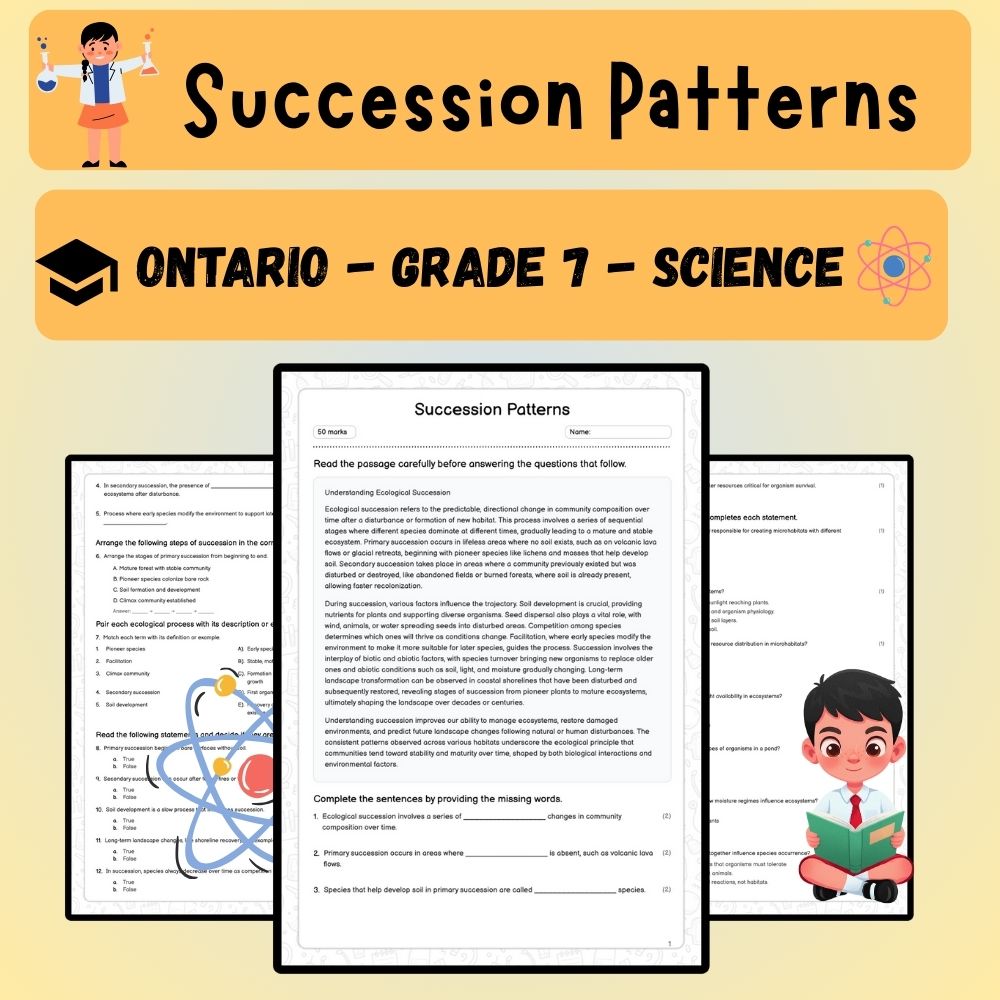
Grade 7 Science | Understanding Succession Patterns Worksheet (PDF )
 Created byPrism Point Learning
Learning Objectives
- Describe the process of ecological succession and distinguish between primary and secondary succession.
- Identify and explain characteristic stages of succession and the environmental drivers influencing it.
- Analyze examples of succession in real-world landscapes, such as abandoned fields and disturbed shorelines.
Also included in: Grade 7 Science UNIT Bundle | Ecosystems & Biodiversity Worksheets +1 more
Instant download
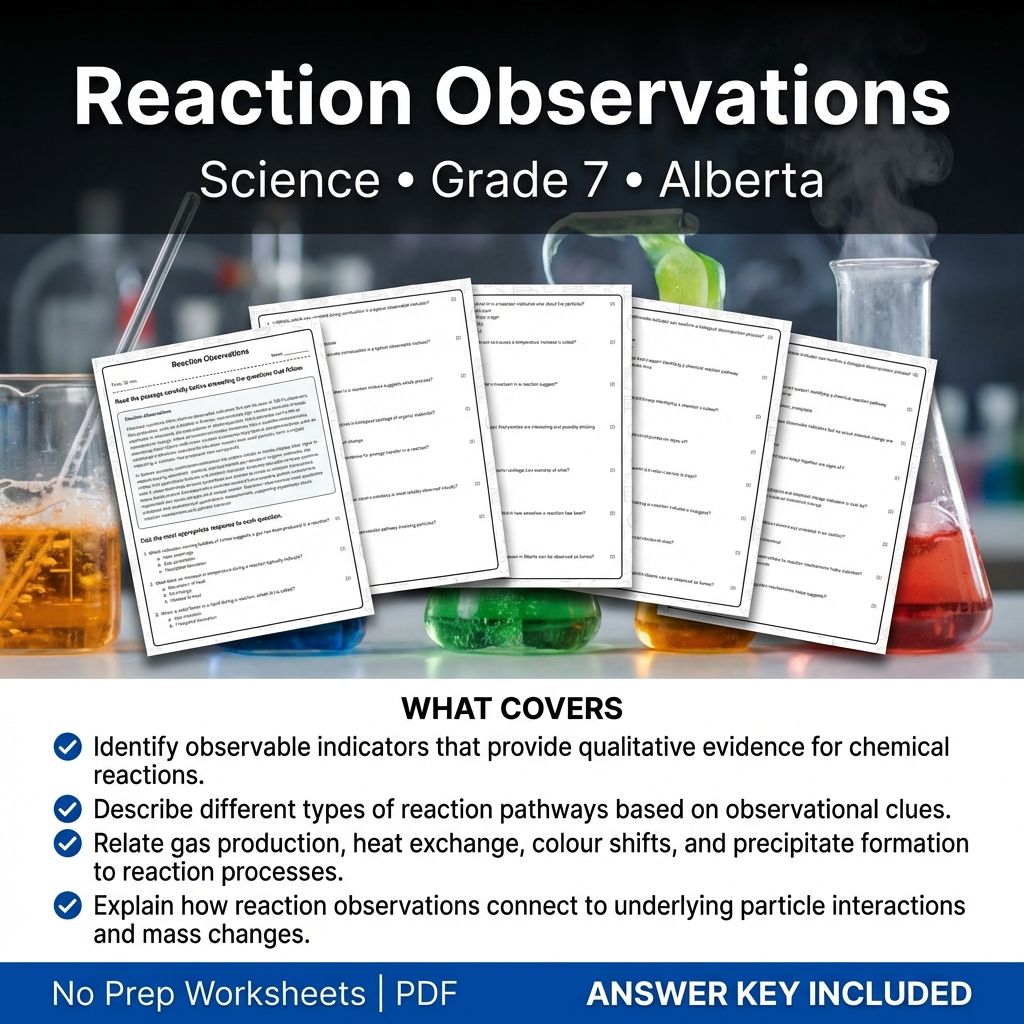
Reaction Observations Worksheet | Alberta Grade 7 Science Practice
Created byCoral Reef LearningLearning Objectives
- Identify observable indicators that provide qualitative evidence for chemical reactions.
- Describe different types of reaction pathways based on observational clues.
- Relate gas production, heat exchange, colour shifts, and precipitate formation to reaction processes.
Instant download
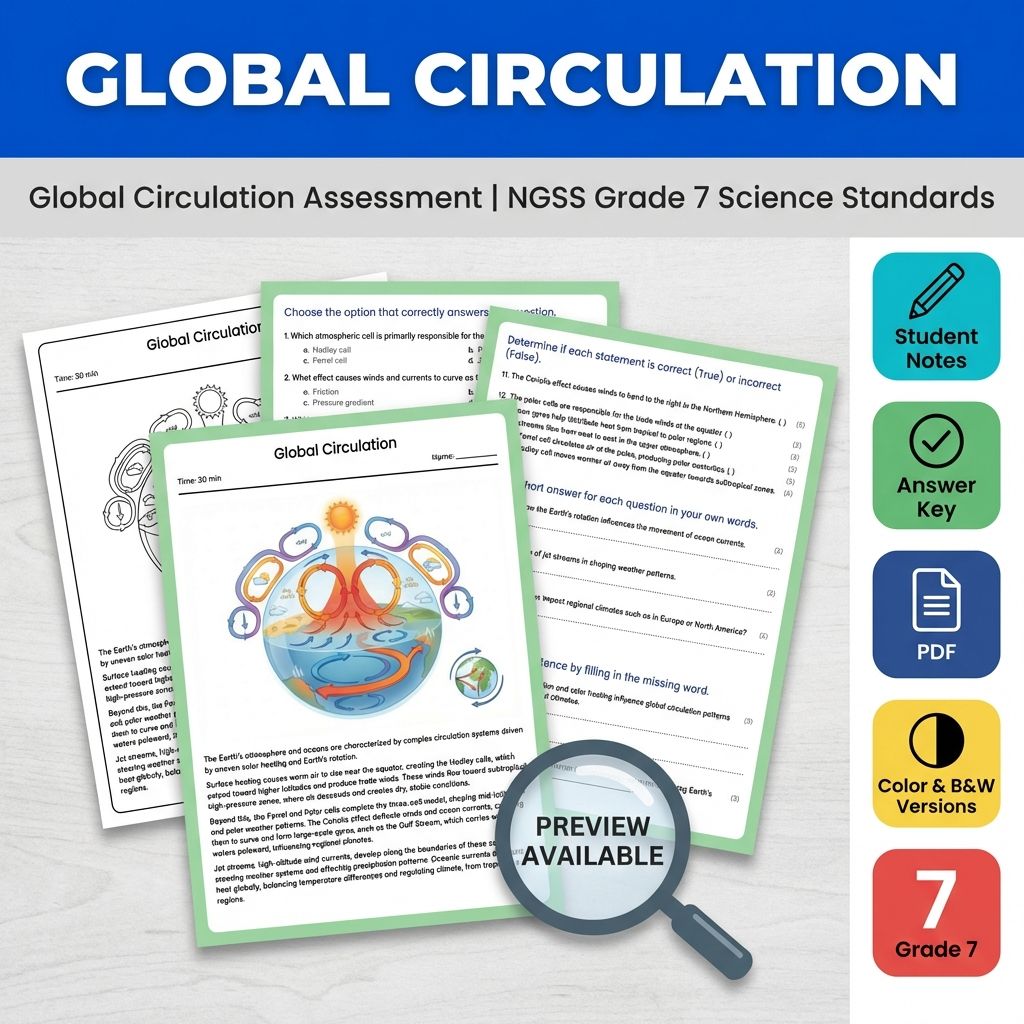
Global Circulation Assessment | NGSS Grade 7 Science Standards
Created byPrism Point LearningLearning Objectives
- Explain the basic principles of Earth's atmospheric and oceanic circulation patterns.
- Identify the main cells, wind belts, and ocean currents associated with global climate.
- Understand the influence of Coriolis effect and jet streams on weather and climate zones.
Also included in: Grade 7 Science Lesson | Earth's Systems NGSS Not specified Unit +1 more
Instant download
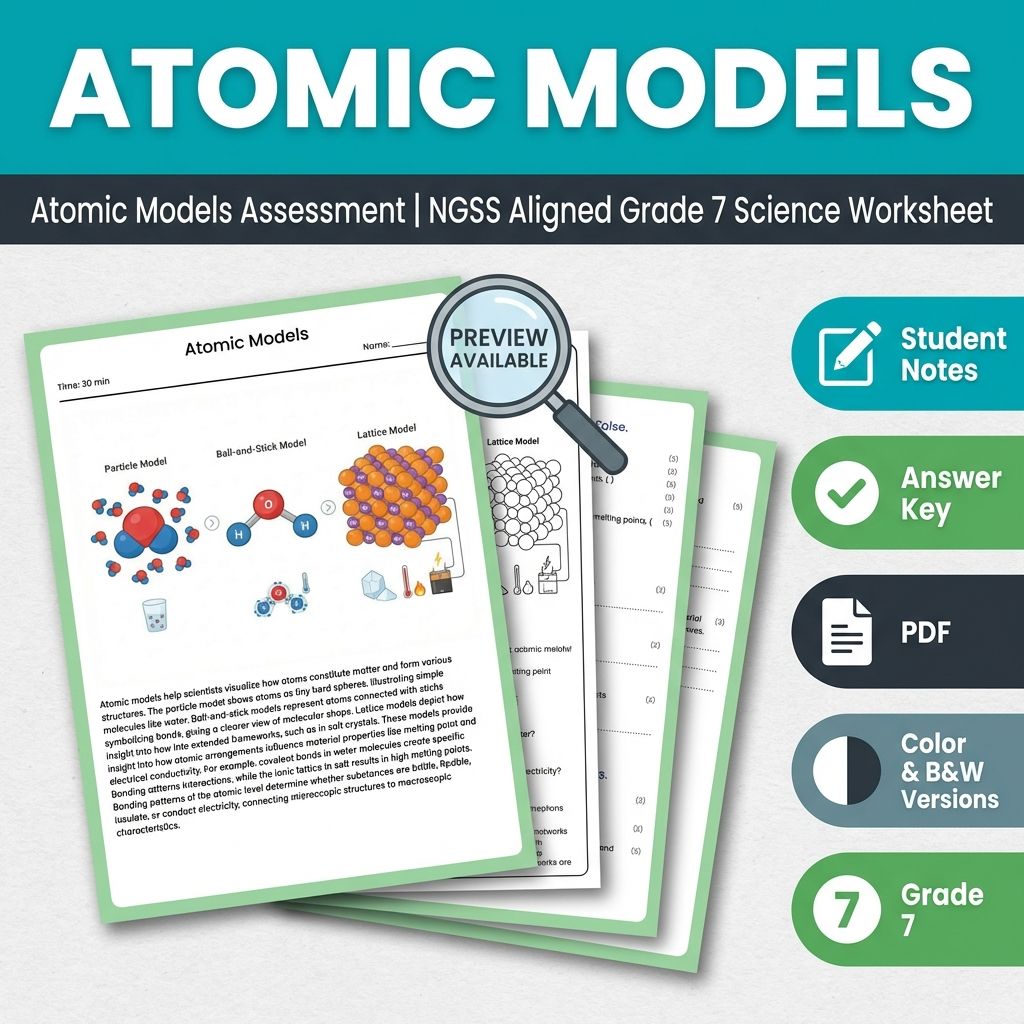
Atomic Models Assessment | NGSS Aligned Grade 7 Science Worksheet
Created byPrism Point LearningLearning Objectives
- Understand different atomic model representations such as particle, ball-and-stick, and lattice models.
- Identify how atoms form molecules and extended structures through bonding patterns.
- Explain the relationship between subatomic particles, atomic number, and material properties.
Also included in: Grade 7 Science Lesson | Matter and Its Interactions Standards +1 more
Instant download
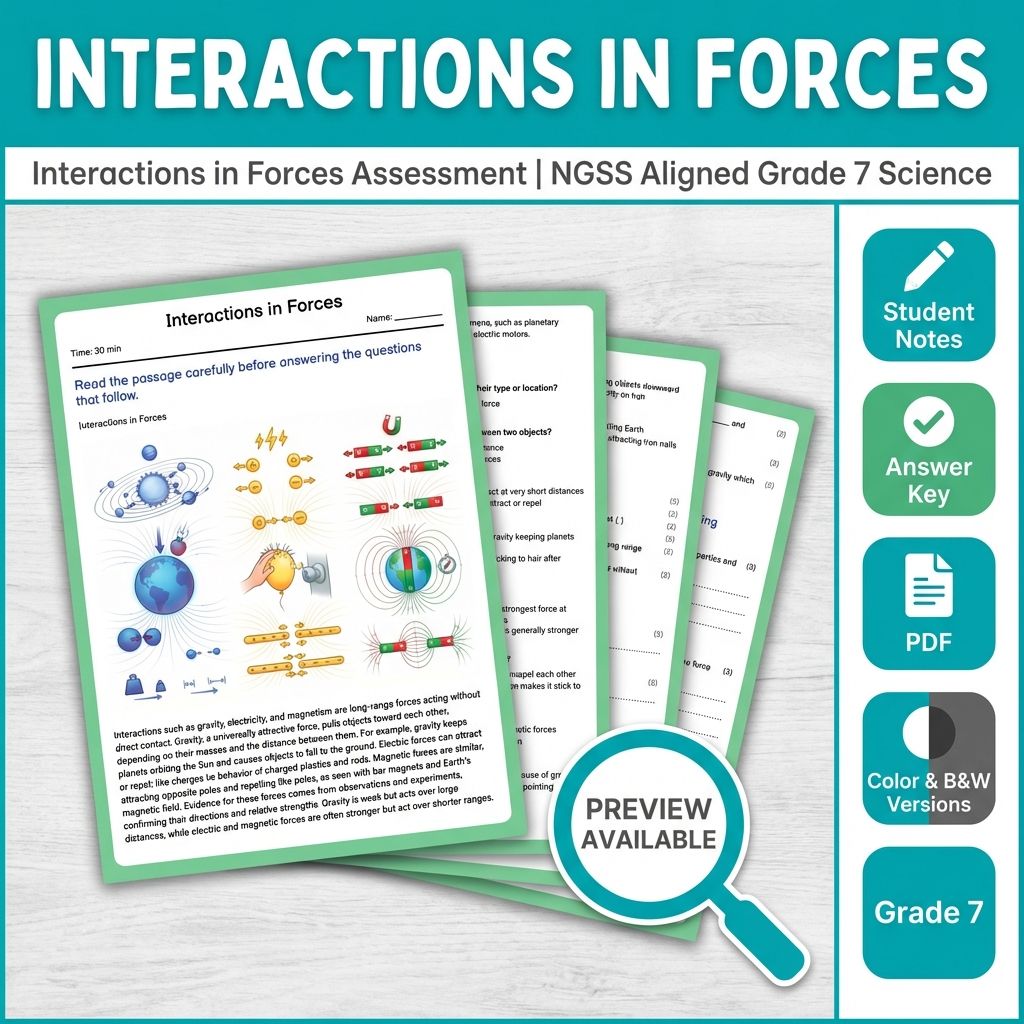
Interactions in Forces Assessment | NGSS Aligned Grade 7 Science
Created byPrism Point LearningLearning Objectives
- Describe gravitational, electric, and magnetic interactions as long-range forces that act without contact.
- Explain the universal attraction of gravity and how electric and magnetic forces can be attractive or repulsive.
- Relate gravitational attraction to mass and distance in qualitative terms using evidence-based reasoning.
Also included in: Grade 7 Science Mini Bundle – Forces & Interactions NGSS Unit (Printable) +1 more
Instant download
Plate Tectonics Assessment for Grade 7 Science – NGSS Standards-Aligned
Created byPrism Point LearningLearning Objectives
- Understand how geologic and fossil evidence supports the theory of plate tectonics and continental movement.
- Identify features such as mid-ocean ridges, trenches, and mountain ranges as evidence of tectonic activity.
- Explain how rock types, fossil distribution, and seafloor structures record Earth's geological history.
Also included in: Grade 7 Science Lesson | Earth's Systems NGSS Not specified Unit +1 more
Instant download
Synthetic Materials Assessment for Grade 7 Science | NGSS Standards
Created byPrism Point LearningLearning Objectives
- Describe how natural resources are transformed into synthetic materials through production pathways including feedstocks, polymerization, and refining steps.
- Identify examples such as polyethylene, PET, nylon, and metals derived from ores, and explain their manufacturing processes.
- Discuss the advantages and disadvantages, including durability, recyclability, and environmental impacts, of various synthetic materials.
Also included in: Grade 7 Science Lesson | Matter and Its Interactions Standards +1 more
Instant download
Water Cycle Assessment for Grade 7 Science | NGSS Standards-Aligned
Created byPrism Point LearningLearning Objectives
- Describe the processes involved in the water cycle, including evaporation, condensation, and precipitation.
- Explain how water moves through Earth's spheres via processes such as infiltration, runoff, and groundwater flow.
- Identify the interactions among rivers, aquifers, and ocean exchange in the water cycle, especially seasonal and seasonal variations.
Also included in: Grade 7 Science Lesson | Earth's Systems NGSS Not specified Unit +1 more
Instant download
Disturbance Effects Assessment | NGSS Standards-Aligned Grade 7 Science
Created byPrism Point LearningLearning Objectives
- Understand how physical and biological disturbances impact ecosystems and populations.
- Identify mechanisms such as resilience, resistance, and succession that influence ecosystem recovery.
- Interpret empirical data and observations to determine causes of population changes.
Also included in: Grade 7 Science Mini Bundle | Ecosystems: Interactions & Energy – NGSS +1 more
Instant download
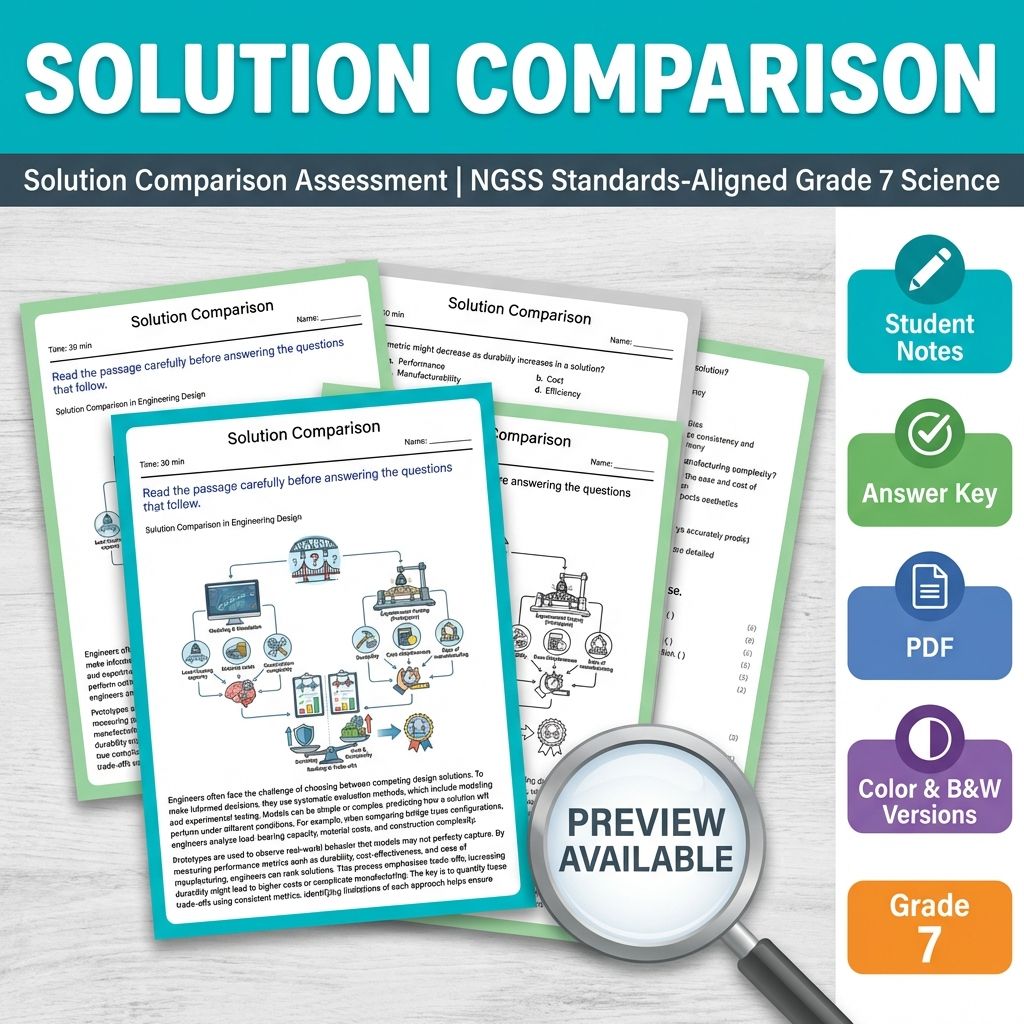
Solution Comparison Assessment | NGSS Standards-Aligned Grade 7 Science
Created byPrism Point LearningLearning Objectives
- Understand systematic evaluation of different design solutions using modeling and analysis.
- Identify and quantify trade-offs among performance, cost, durability, and manufacturability.
- Apply models to predict and observe behaviors of prototypes in engineering contexts.
Also included in: Grade 7 Science Lesson Unit: Engineering Design Standards-Aligned Not Specified +1 more
Instant download
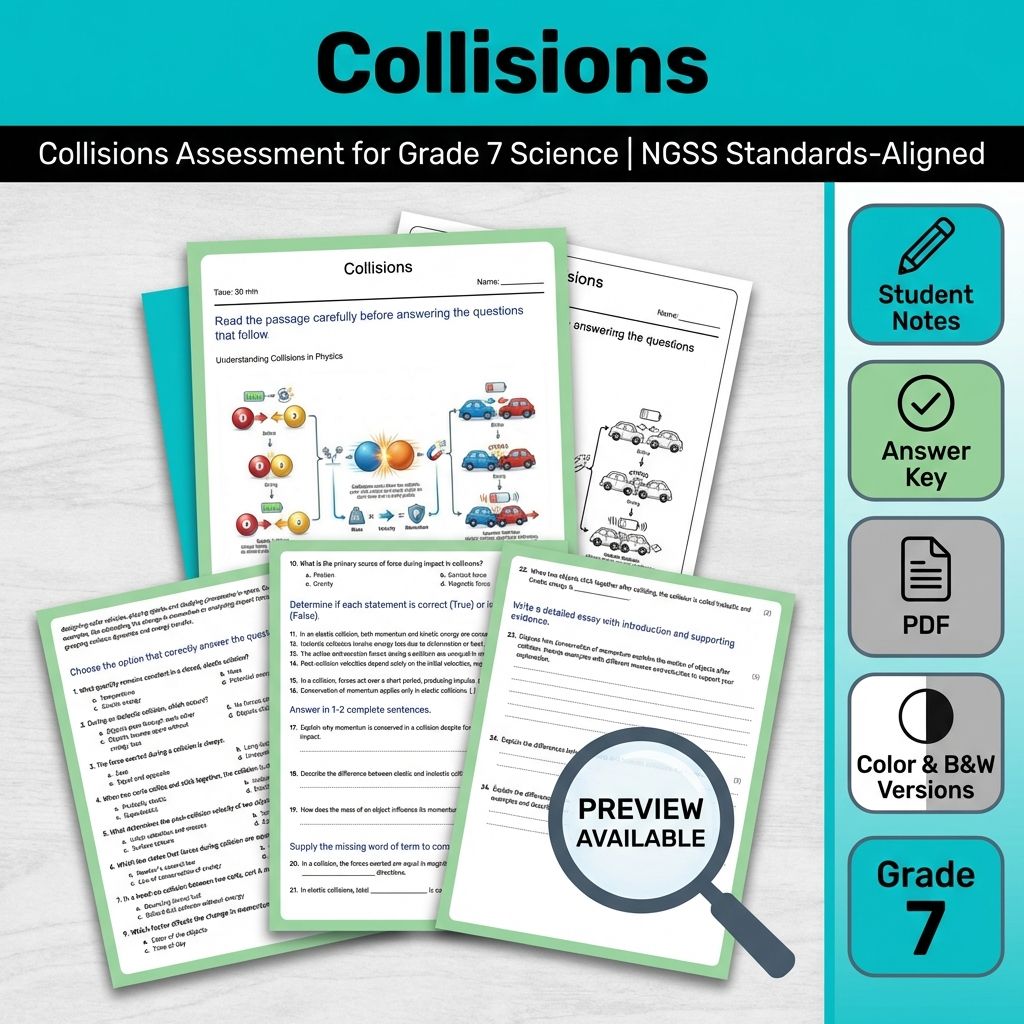
Collisions Assessment for Grade 7 Science | NGSS Standards-Aligned
Created byPrism Point LearningLearning Objectives
- Explain the principles of momentum conservation during collisions.
- Differentiate between elastic and inelastic collisions.
- Calculate post-collision velocities using mass and velocity data.
Also included in: Grade 7 Science Mini Bundle – Forces & Interactions NGSS Unit (Printable) +1 more
Instant download
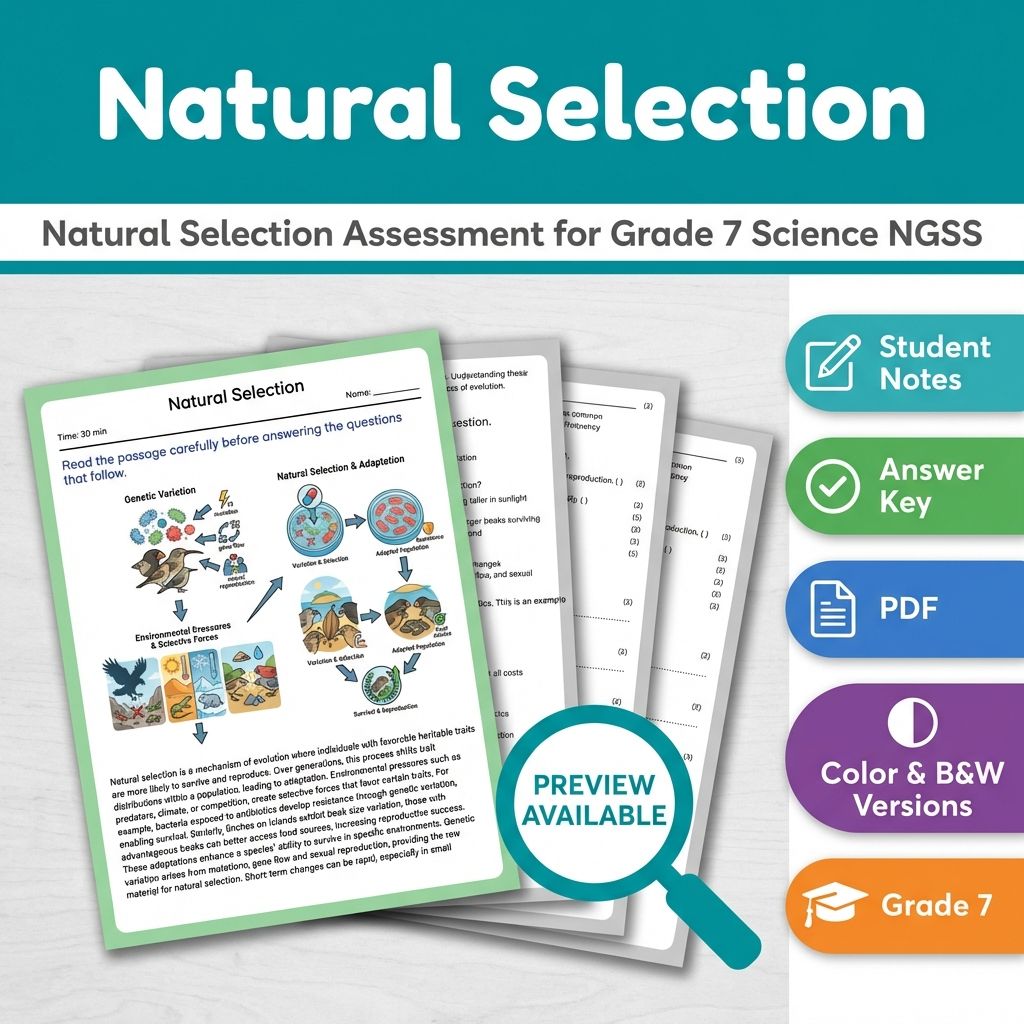
Natural Selection Assessment for Grade 7 Science NGSS
Created byPrism Point LearningLearning Objectives
- Explain how heritable variation and environmental pressures influence natural selection.
- Identify examples of adaptation in different species.
- Describe how reproductive success and selective pressures shape evolution.
Also included in: Grade 7 Science Mini Bundle – Biological Evolution: Unity & Diversity +1 more
Instant download
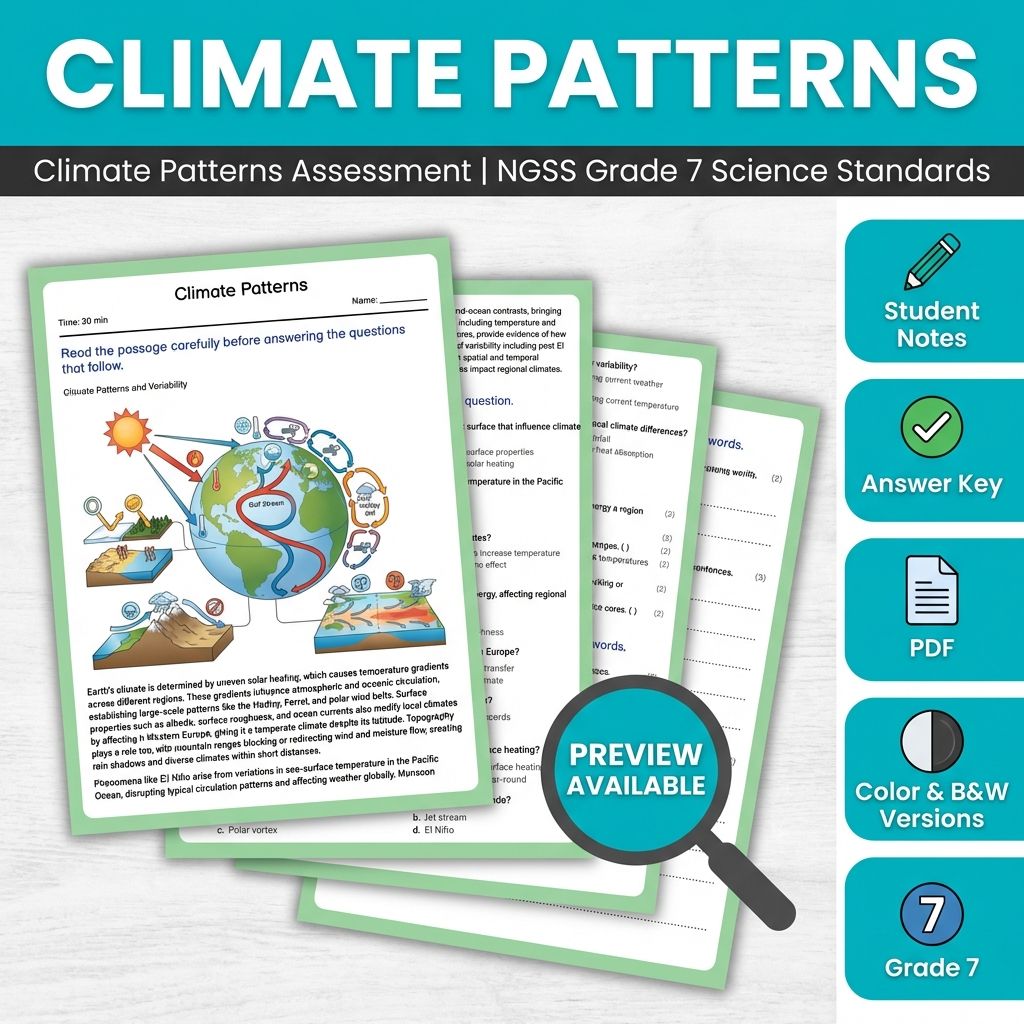
Climate Patterns Assessment | NGSS Grade 7 Science Standards
Created byPrism Point LearningLearning Objectives
- Understand how uneven solar heating influences regional climate patterns.
- Identify key features such as El Niño, monsoon regimes, and wind belts that affect climate zones.
- Analyze how surface properties and topography modify local climates.
Also included in: Grade 7 Science Lesson | Earth's Systems NGSS Not specified Unit +1 more
Instant download
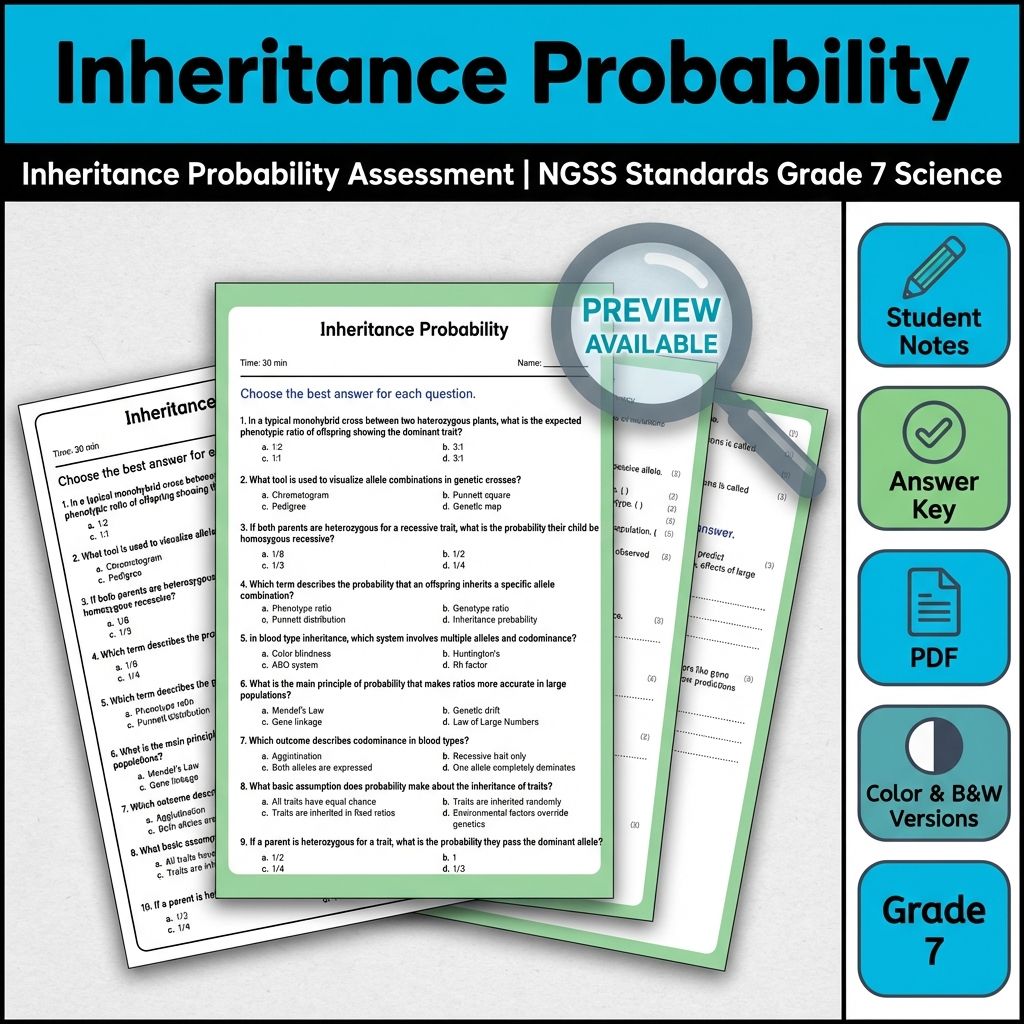
Inheritance Probability Assessment | NGSS Standards Grade 7 Science
Created byPrism Point LearningLearning Objectives
- Understand how probability concepts apply to predicting genetic variation among offspring.
- Interpret genotype and phenotype ratios resulting from monohybrid crosses using Punnett squares.
- Calculate expected proportions of different genotypes and phenotypes in genetic crosses.
Also included in: Grade 7 Science Mini Bundle – Heredity: Inheritance and Variation of Traits +1 more
Instant download
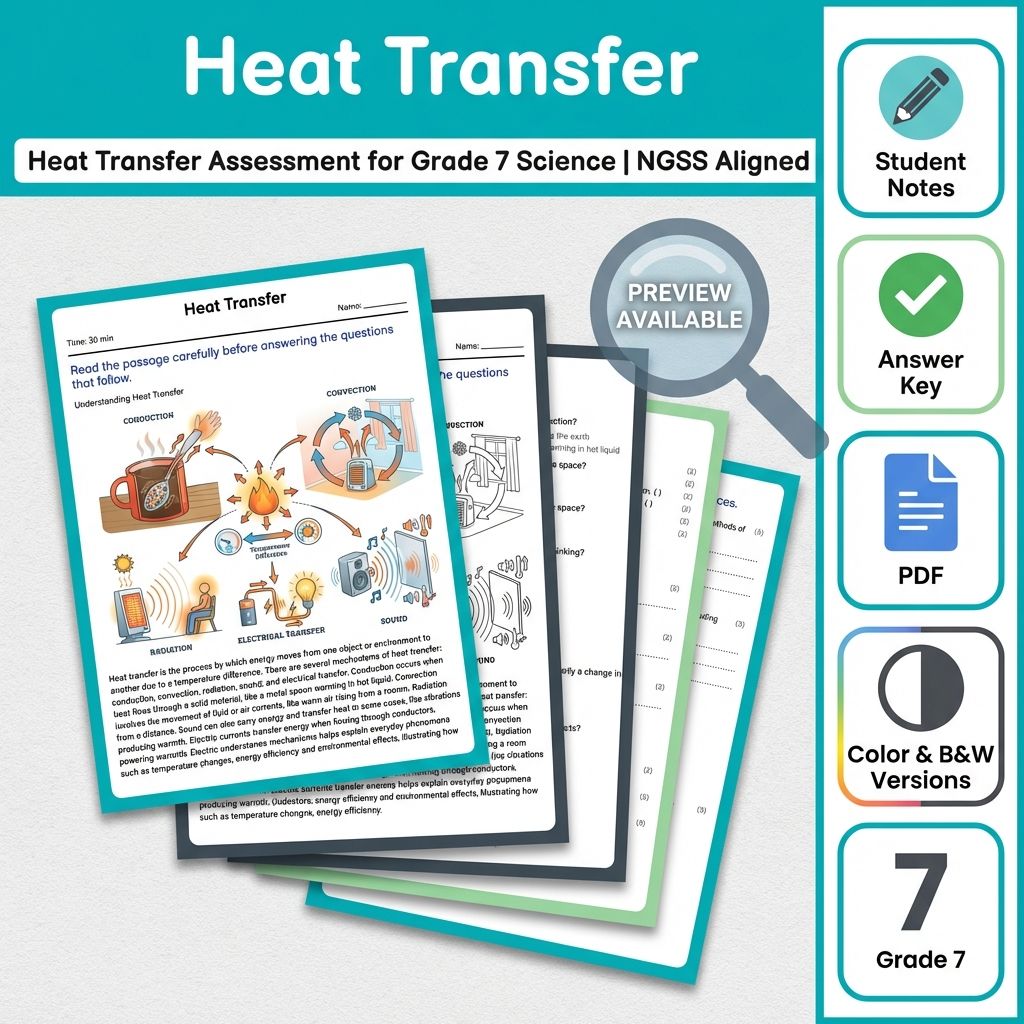
Heat Transfer Assessment for Grade 7 Science | NGSS Aligned
Created byPrism Point LearningLearning Objectives
- Understand the different mechanisms of heat transfer: conduction, convection, radiation, sound, and electric current.
- Identify examples of each heat transfer process in real-life situations.
- Describe observable evidence of energy transfer such as temperature changes and rate differences.
Also included in: Grade 7 Science Mini Bundle | Energy Unit & NGSS Standards-Aligned Resources +1 more
Instant download

Freshwater Dynamics Worksheet | Ontario Grade 7 Science Assessment
 Created byCedar Grove Learning
Learning Objectives
- Describe how stratification, light penetration, and oxygen gradients form in ponds and lakes
- Explain how abiotic gradients affect community composition and vertical zonation
- Compare the effects of summer stratification and seasonal turnover on dissolved oxygen and nutrient distribution
Also included in: Grade 7 Ecosystem Dynamics Science worksheets lesson bundle Ontario +1 more
Instant download
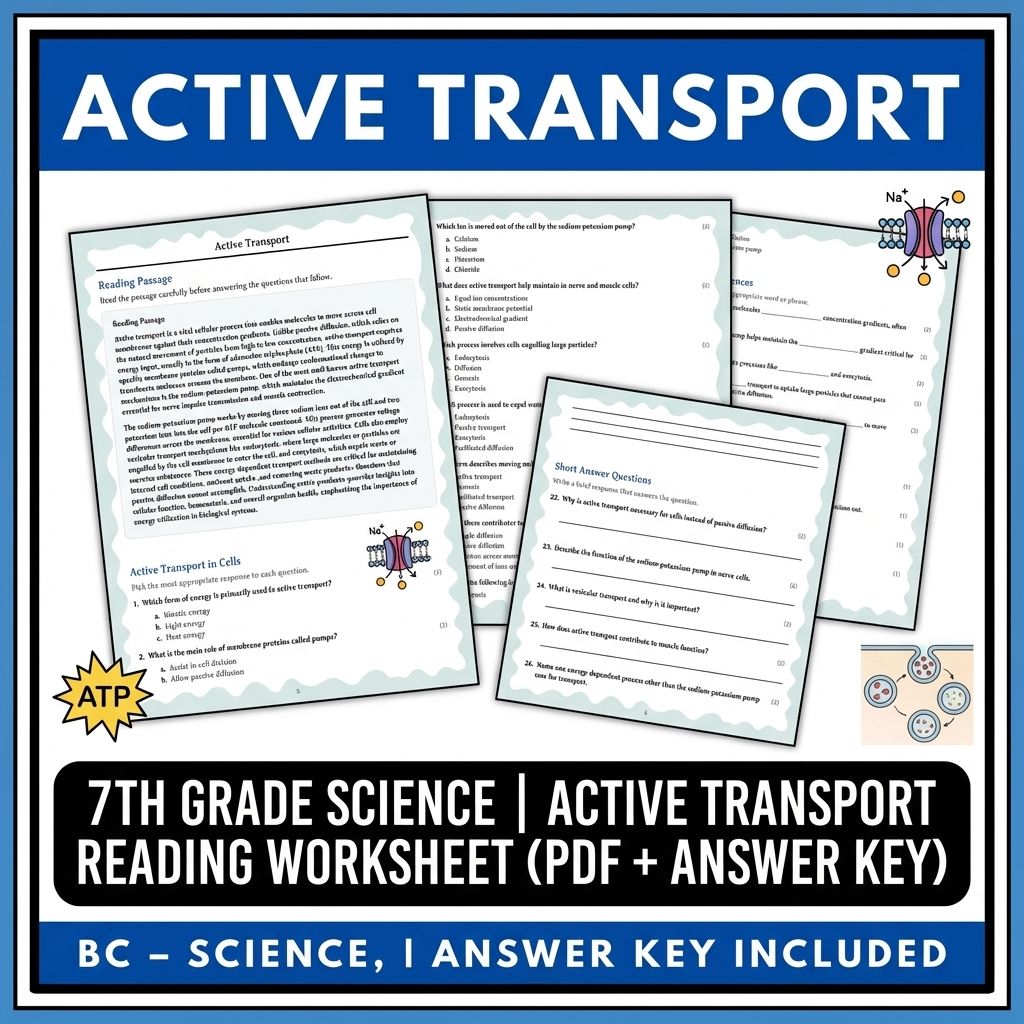
7th Grade Science | Active Transport Reading Worksheet (PDF + Answer Key)
JCreated byJ.S SheetsLearning Objectives
- Understand the concept of active transport and how it moves molecules against concentration gradients.
- Identify the role of ATP and membrane proteins such as pumps in cellular transport.
- Explain the function of the sodium-potassium pump in maintaining electrochemical gradients.
Instant download
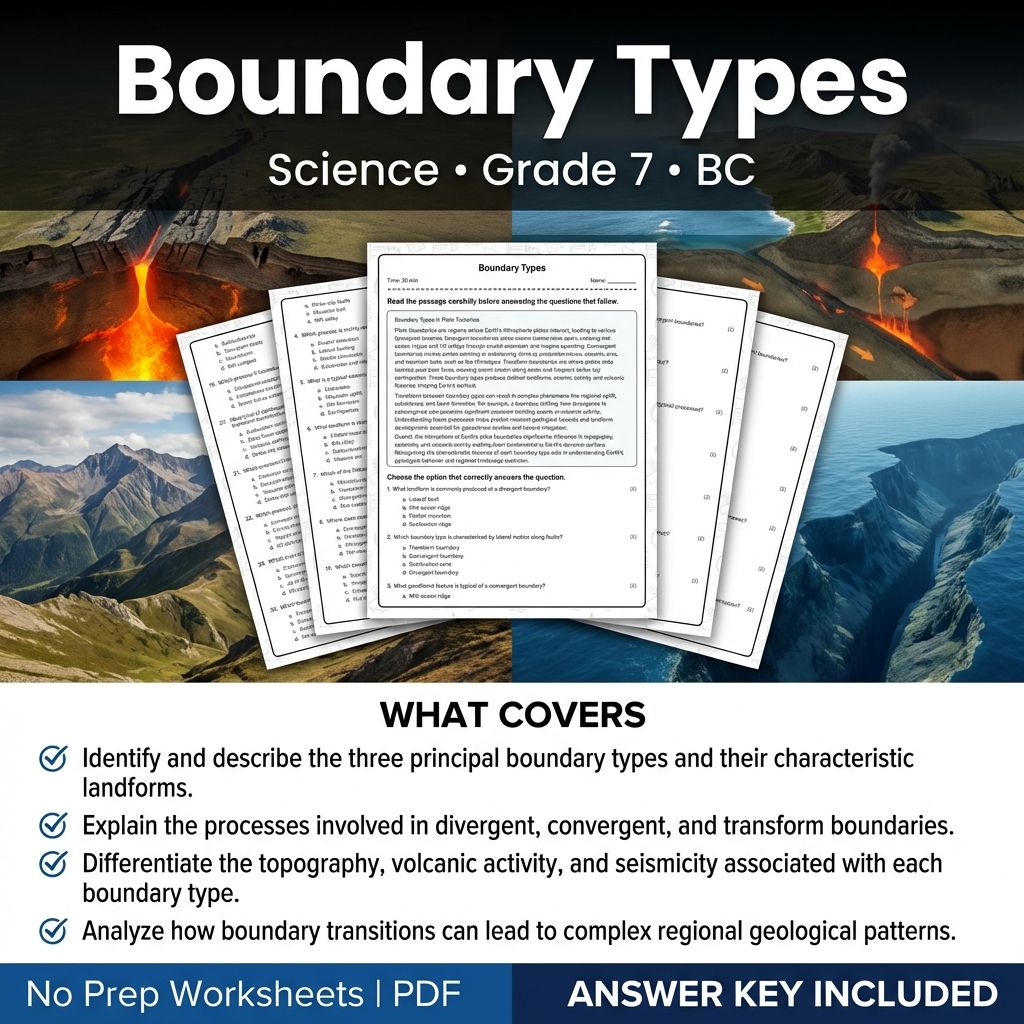
7th Grade Science | Boundary Types Worksheet & Answer Key (Printable PDF)
Created byCoral Reef LearningLearning Objectives
- Identify and describe the three principal boundary types and their characteristic landforms.
- Explain the processes involved in divergent, convergent, and transform boundaries.
- Differentiate the topography, volcanic activity, and seismicity associated with each boundary type.
Instant download
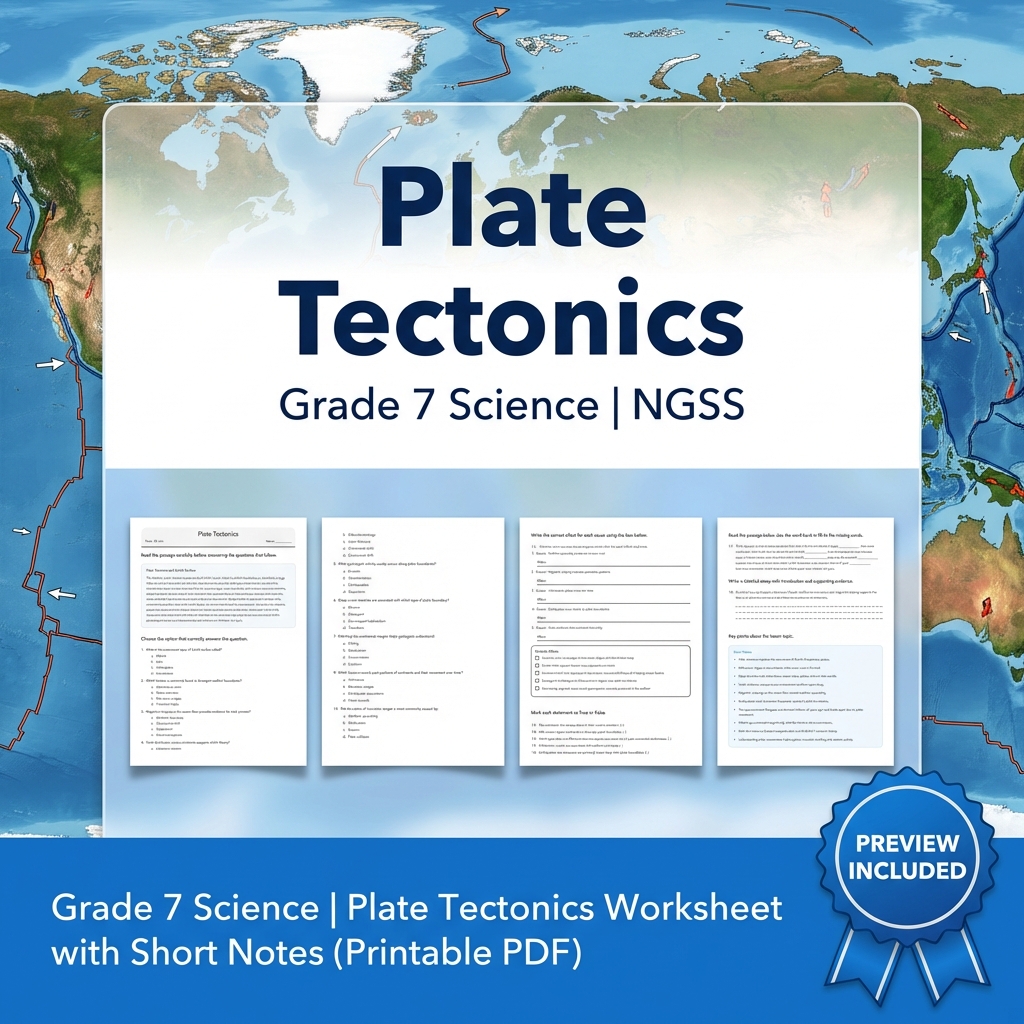
Grade 7 Science | Plate Tectonics Worksheet with Short Notes (Printable PDF)
 Created byMeadowlark Worksheets
Learning Objectives
- Understand the evidence supporting the theory of plate tectonics and continental movement.
- Identify geological features and processes related to plate motion, such as earthquakes, volcanoes, and seafloor structures.
- Explain how fossils, rock types, and geologic formations record Earth's past continental arrangements.
Also included in: Grade 7 Science | Earth's Systems Unit Worksheets Pack – NGSS Aligned +1 more
Instant download
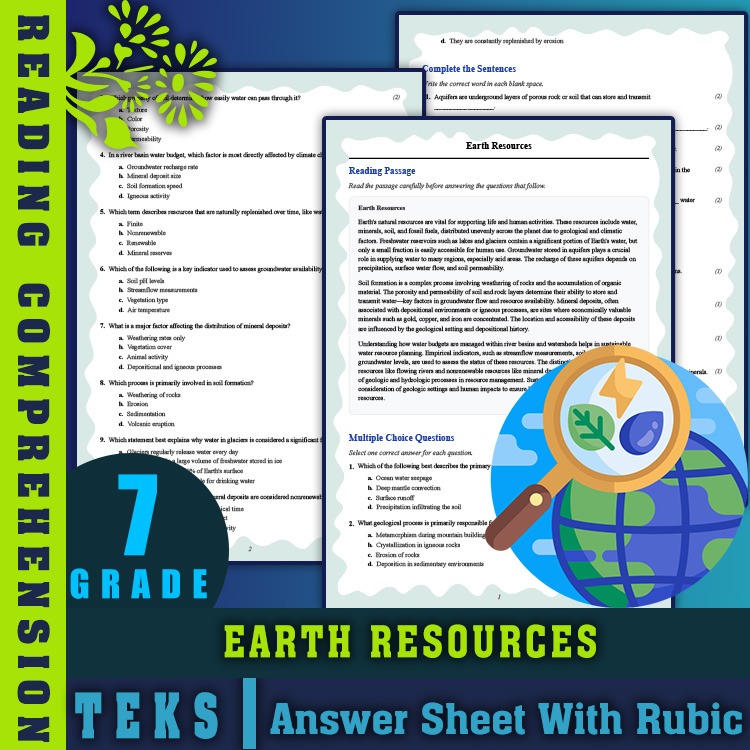
7th Grade Science | Earth Resources Reading Worksheet with Answer Key (PDF)
JCreated byJ.S SheetsLearning Objectives
- Understand the distribution and types of natural resources on Earth, including freshwater, minerals, and groundwater.
- Explain the processes involved in hydrologic systems such as aquifer recharge, soil formation, and mineral deposit formation.
- Evaluate resource sustainability considering geological settings and processes.
Instant download

Grade 7 Science | Ecological Succession Patterns & Processes - Reading Practice
Created byCoral Reef LearningLearning Objectives
- Define ecological succession and distinguish between primary and secondary succession.
- Identify the characteristic stages of succession.
- Understand the factors that drive succession such as soil development, seed dispersal, competition, and facilitation.
Instant download
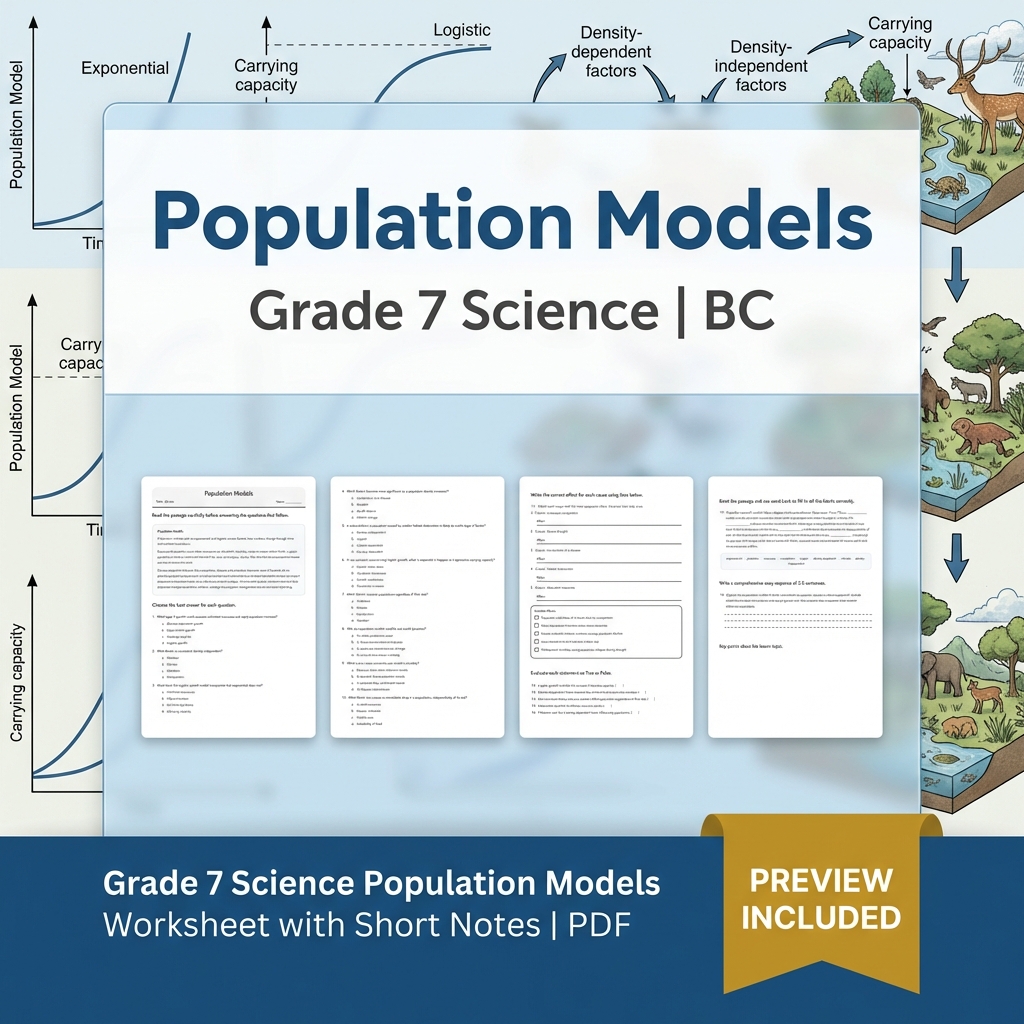
Grade 7 Science Population Models Worksheet with Short Notes | PDF
Created byMeadowlark WorksheetsLearning Objectives
- Understand the differences between exponential and logistic population growth models.
- Identify factors affecting population dynamics such as density-dependent and density-independent factors.
- Interpret how models predict changes in populations over time in various ecosystems.
Also included in: Grade 7 Science Lesson Bundle: Ecosystems and Population Dynamics Worksheets +1 more
Instant download
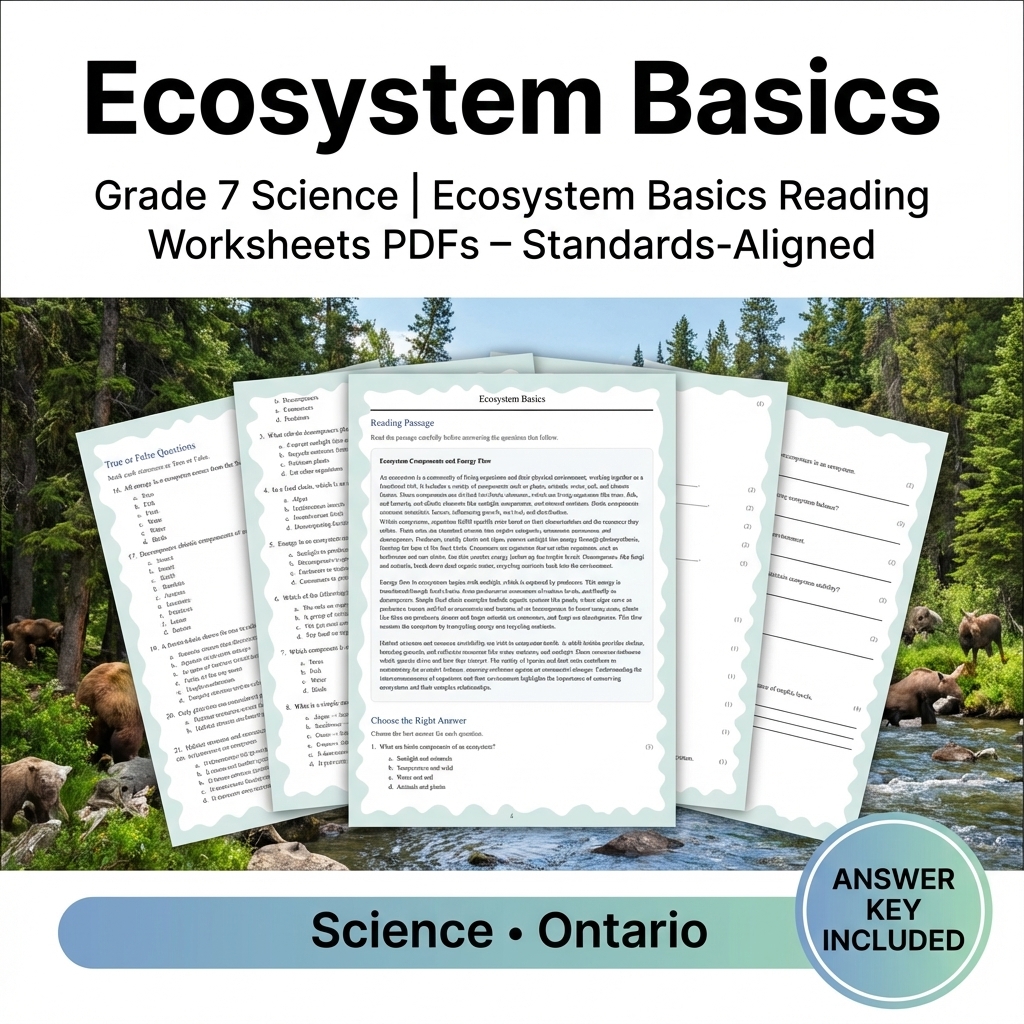
7th Grade Science | Ecosystem Basics Reading Worksheet with Answer Key (PDF)
JCreated byJ.S SheetsLearning Objectives
- Understand the components and functions of ecosystems, including biotic and abiotic elements.
- Identify trophic categories such as producers, consumers, and decomposers, and explain their roles in energy flow.
- Recognize simple food chains in pond and forest environments and understand how matter cycles through these systems.
Also included in: Grade 7 Science | Ecosystems, Biodiversity & Environmental Stewardship +1 more
Instant download
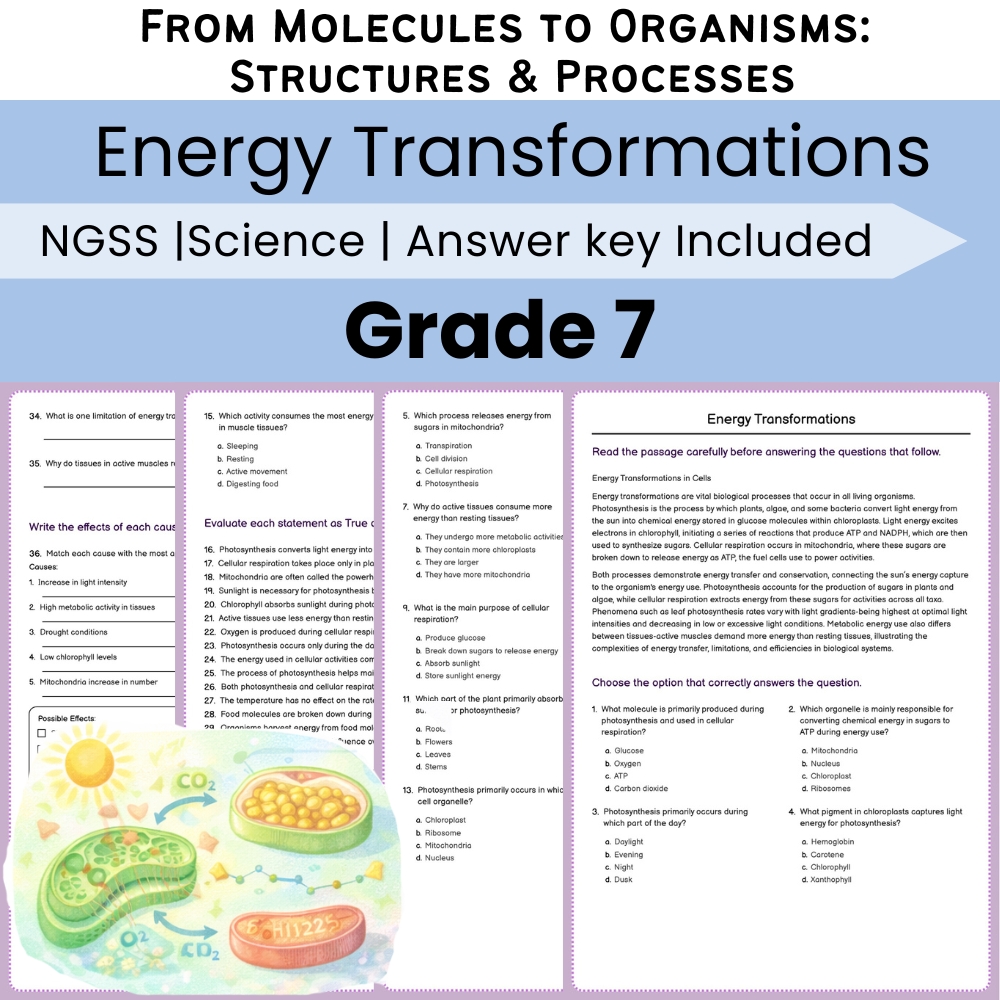
Energy Transformations Worksheet | Grade 7 Science printable PDF NGSS
Learning Objectives
- Explain how light energy is converted into chemical energy during photosynthesis.
- Describe how organisms harvest energy from food through cellular respiration.
- Connect processes in chloroplasts and mitochondria related to energy flow in autotrophs and heterotrophs.
Also included in: Grade 7 Science Lesson Bundle | From Molecules to Organisms NGSS +1 more
Instant download

Grade 7 Science Worksheet on Variable Control | Ontario Standards Practice
Created byCoral Reef LearningLearning Objectives
- Understand the roles of independent, dependent, and controlled variables in experiments.
- Explain the importance of operational definitions and fair test design for valid causal conclusions.
- Identify sources of confounding and how to minimize bias in sampling and experimentation.
Instant download
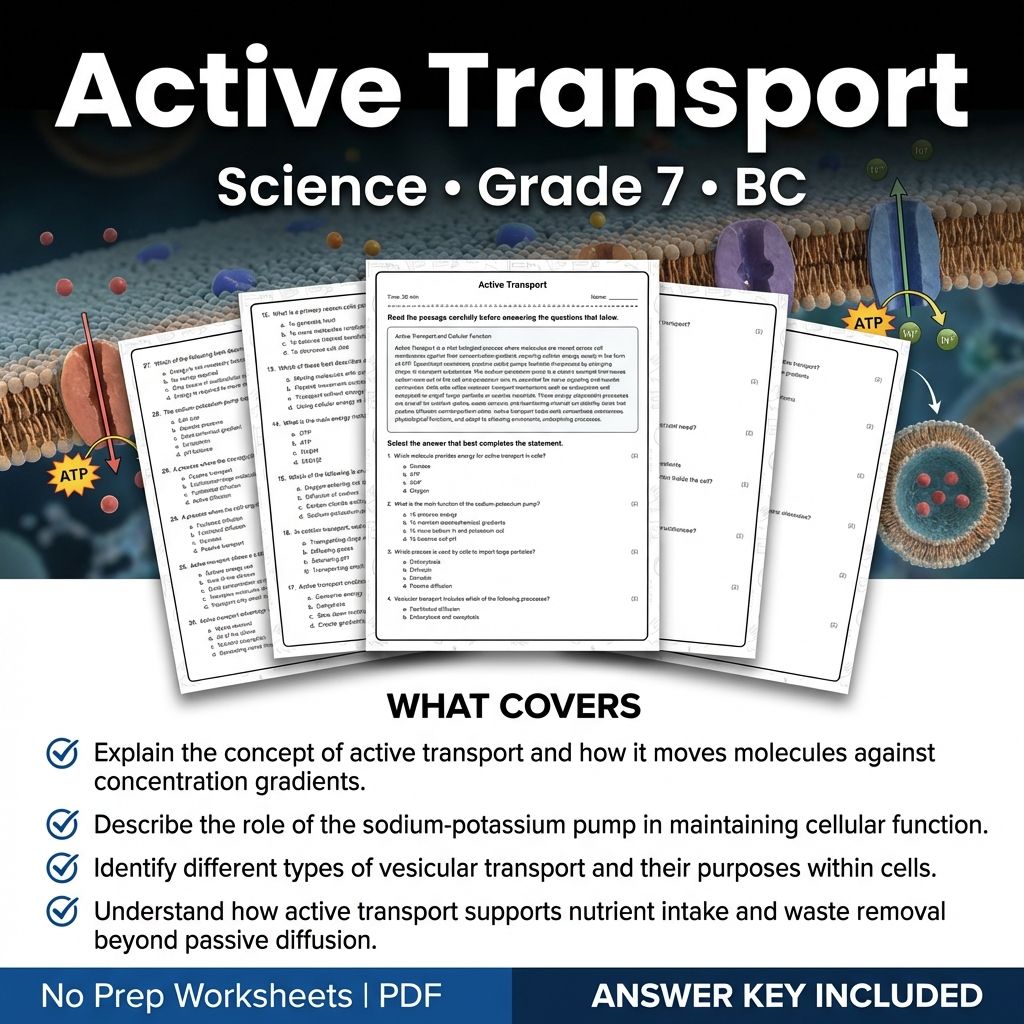
7th Grade Science | Active Transport Worksheet & Answer Key (Printable PDF)
Created byCoral Reef LearningLearning Objectives
- Explain the concept of active transport and how it moves molecules against concentration gradients.
- Describe the role of the sodium-potassium pump in maintaining cellular function.
- Identify different types of vesicular transport and their purposes within cells.
Instant download

Grade 7 Science Worksheet | Active Transport & Cell Movement (BC Standards) (PDF)
 Created byEvergreen Desk Education
Learning Objectives
- Explain how active transport moves substances against a concentration gradient using cellular energy and membrane proteins.
- Describe the sodium-potassium pump and its role in maintaining electrochemical gradients for nerve and muscle function.
- Compare active transport with passive diffusion and identify examples of vesicular transport (endocytosis and exocytosis).
Instant download

Grade 7 Science | Change Indicators Worksheet | BC Standards
Created byLumora LearningLearning Objectives
- Understand the signs that indicate a chemical change has occurred.
- Identify observable evidence such as gas formation, color change, and temperature change.
- Explain why multiple indicators together provide stronger evidence of a chemical change.
Also included in: Grade 7 Science | Matter & Chemical Change Unit Bundle | BC Aligned
Instant download
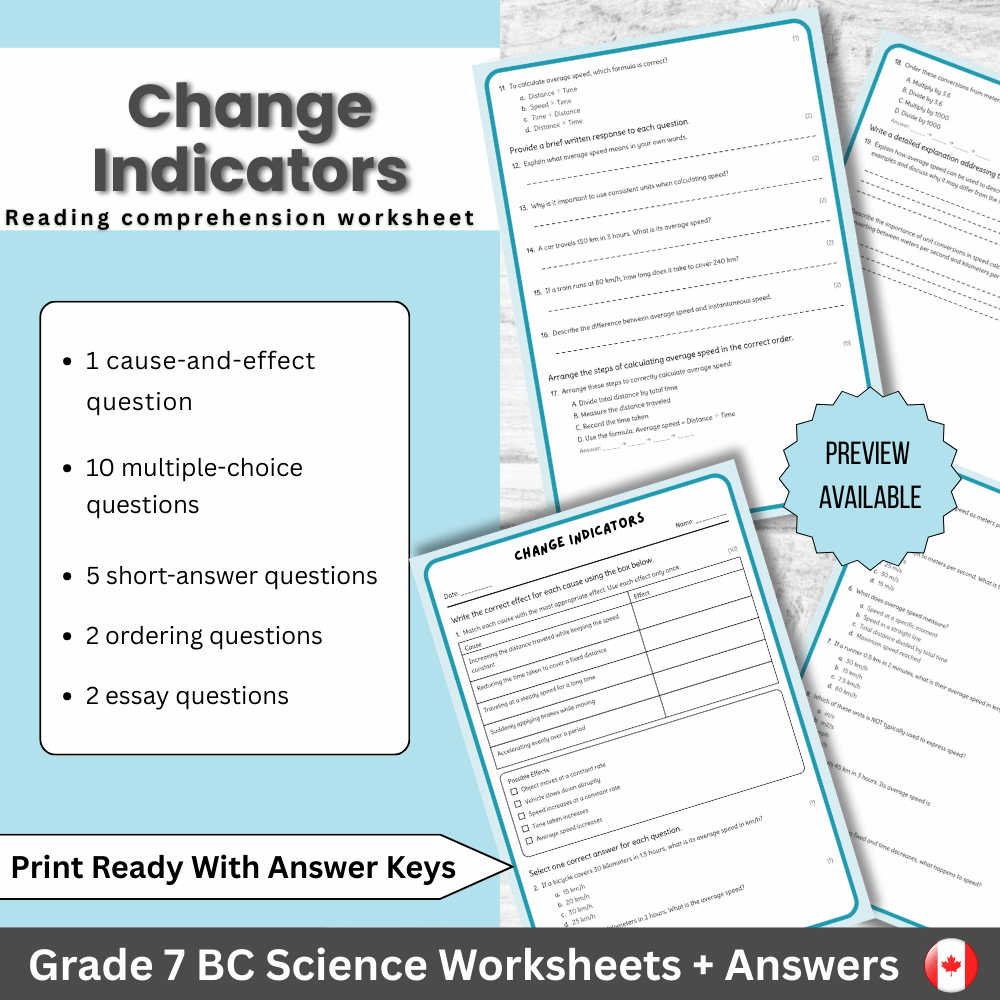
Grade 7 Science | Change Indicators Worksheet (Answer Key) for BC Standards
 Created byBright Mind Resources
Learning Objectives
- Identify observable signs that indicate a chemical change has occurred.
- Understand the importance of multiple indicators in confirming chemical reactions.
- Describe different types of evidence such as gas formation, color change, and temperature change.
Instant download
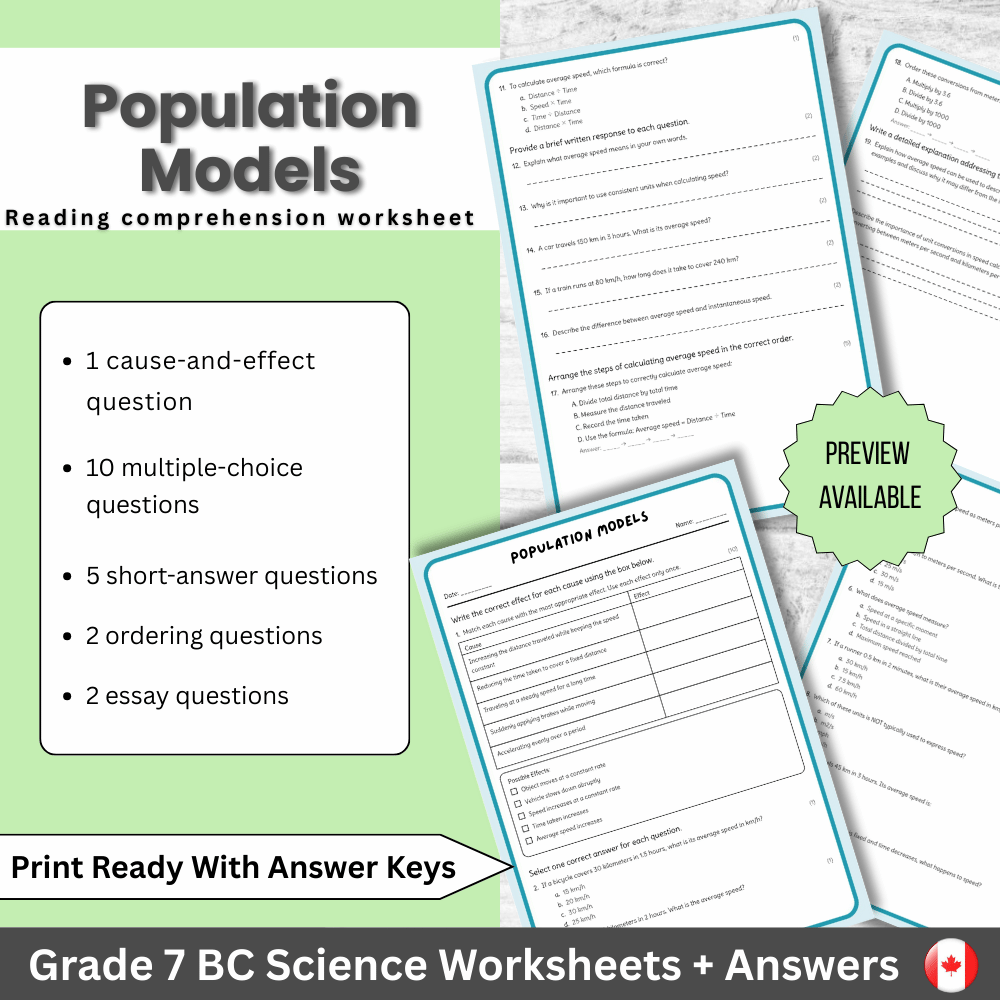
Grade 7 Science | Population Models Worksheet + Answer Key (BC Standards)
Created byBright Mind ResourcesLearning Objectives
- Describe the differences between exponential and logistic population growth models.
- Identify factors that influence population size, including density-dependent and density-independent factors.
- Interpret how models predict population patterns under various conditions.
Instant download
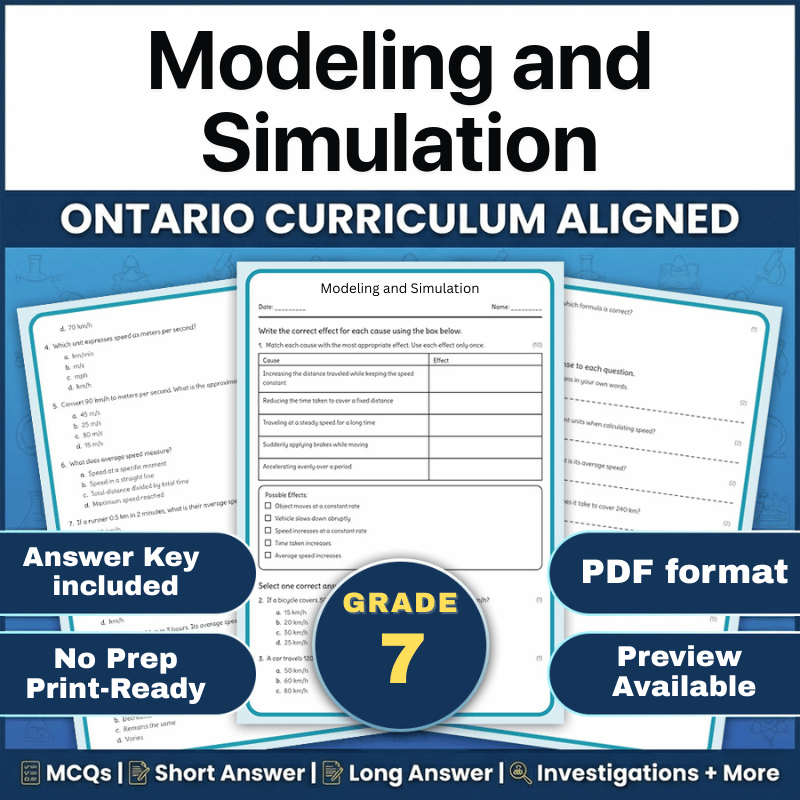
Grade 7 Science | Modeling and Simulation Worksheet (Ontario Standard) (PDF)
Created byBright Mind ResourcesLearning Objectives
- Understand the key concepts and practices involved in scientific modeling and simulation.
- Identify the importance of abstraction, assumptions, and validation in models.
- Describe examples of simple numerical models and their applications.
Instant download
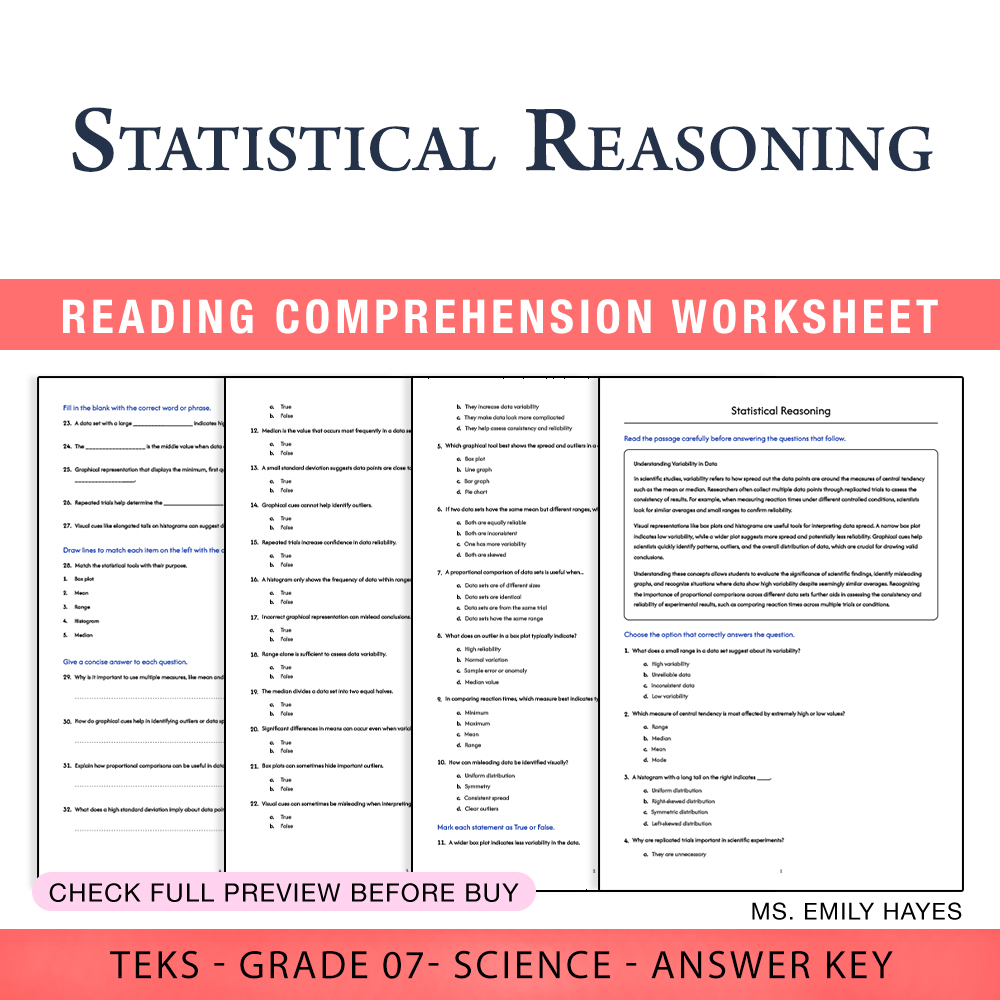
7th Grade Science | Statistical Reasoning Worksheet (PDF+ Answer Key)
Created byCopper Leaf ClassroomLearning Objectives
- Interpret variability and measures of central tendency in data sets.
- Use graphical cues to assess data reliability and significance.
- Compare data sets using mean, median, and range.
Instant download
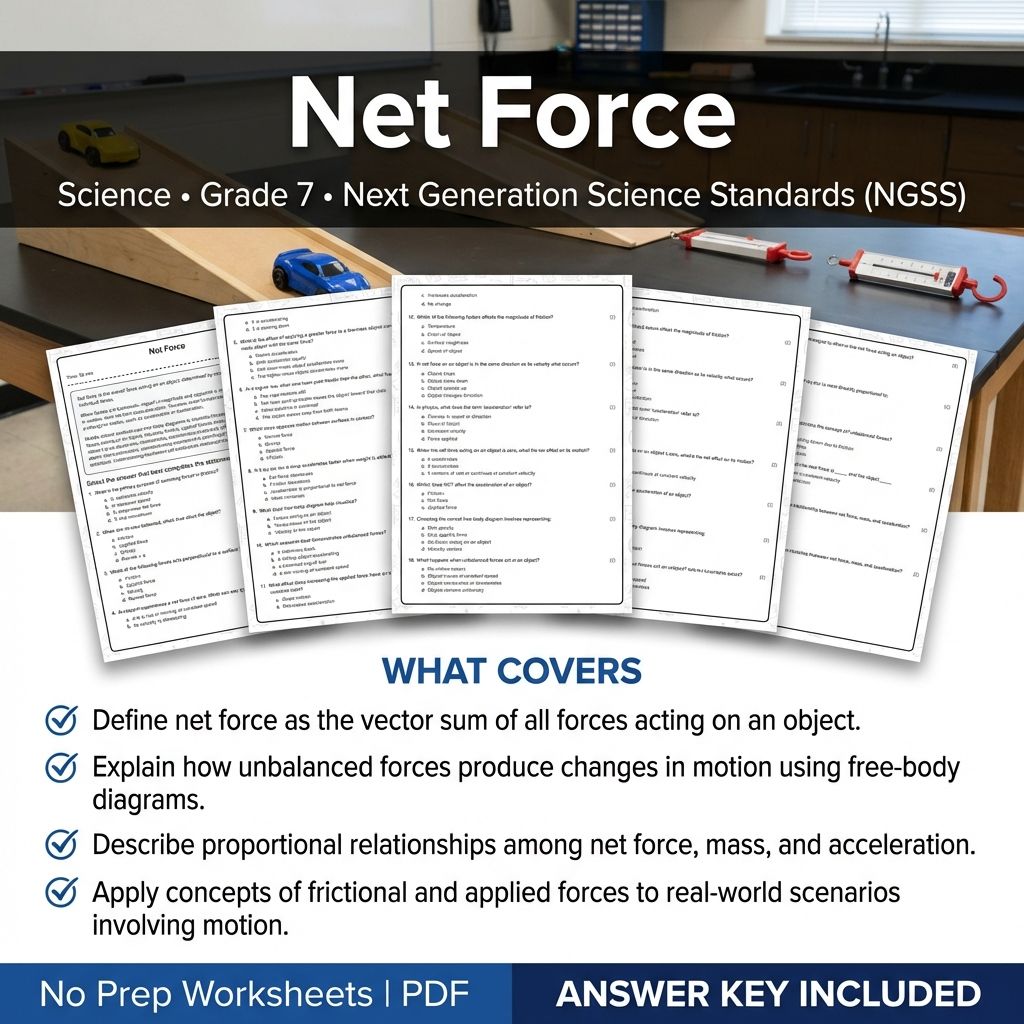
7th Grade Science | Net Force Worksheet & Answer Key (Printable PDF)
Created byCoral Reef LearningLearning Objectives
- Define net force as the vector sum of all forces acting on an object.
- Explain how unbalanced forces produce changes in motion using free-body diagrams.
- Describe proportional relationships among net force, mass, and acceleration.
Instant download

Grade 7 Symbiosis Types Worksheet | Alberta Practice PDF
 Created byClear Sky Classroom
Learning Objectives
- Define mutualism, commensalism, and parasitism using evidence from interactions between species.
- Explain how symbiosis types can affect population size, resource distribution, and community structure.
- Apply symbiosis concepts to Alberta-relevant examples in local ecosystems.
Instant download
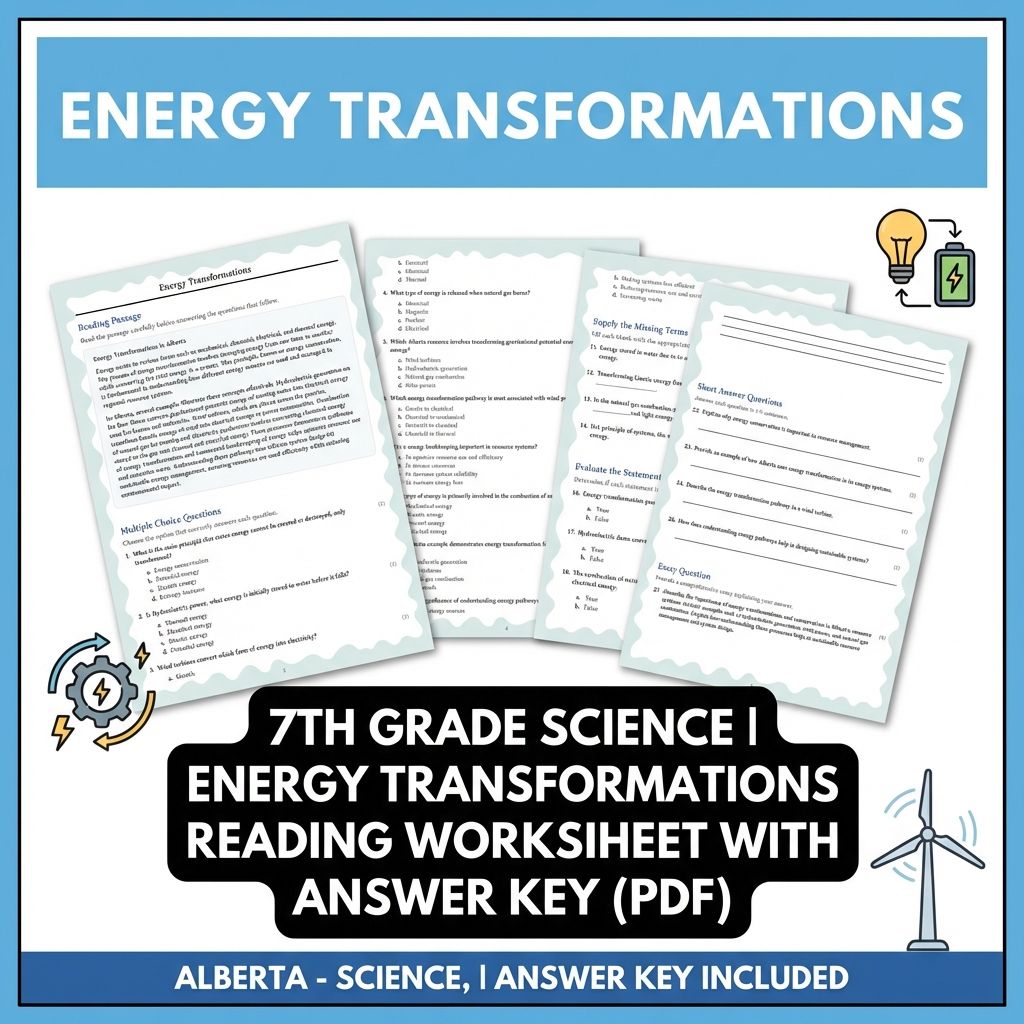
7th Grade Science | Energy Transformations Worksheet with Answer Key (PDF)
JCreated byJ.S SheetsLearning Objectives
- Understand different forms of energy and how they transform from one type to another.
- Identify real-world examples of energy transformations in Alberta's resource systems.
- Explain the principle of energy conservation during transformations.
Also included in: Grade 7 Science UNIT Bundle | Heat Transfer, Convection & Energy Worksheets +1 more
Instant download

Grade 7 Science – Systems Modeling Worksheet (TEKS PDF)
Created byEvergreen Desk EducationLearning Objectives
- Explain how diagrams, scale models, and quantitative representations help predict the behavior of a system.
- Interpret model outputs and identify assumptions, limitations, and scaling effects that affect accuracy.
- Distinguish between different model types (e.g., free-body diagrams, circuit schematics, and block diagrams) and what each is used for.
Instant download
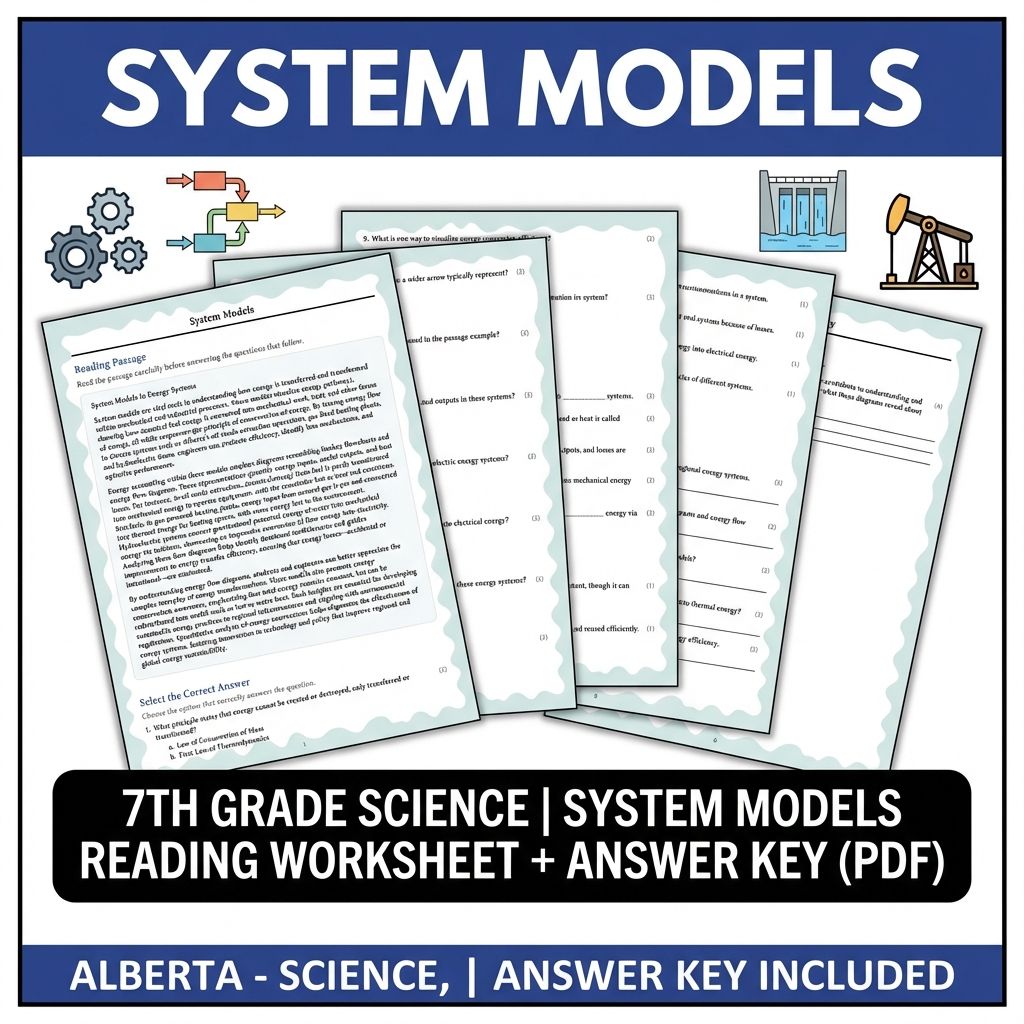
7th Grade Science | System Models Reading Worksheet + Answer Key (PDF)
JCreated byJ.S SheetsLearning Objectives
- Understand how energy flows and transforms within mechanical and industrial systems.
- Interpret energy flow diagrams and Sankey diagrams to quantify inputs, useful outputs, and waste heat.
- Explain the conservation of energy principles in various energy systems such as oil sands extraction, heating plants, and hydroelectric infrastructure.
Also included in: Grade 7 Science UNIT Bundle | Heat Transfer, Convection & Energy Worksheets +1 more
Instant download
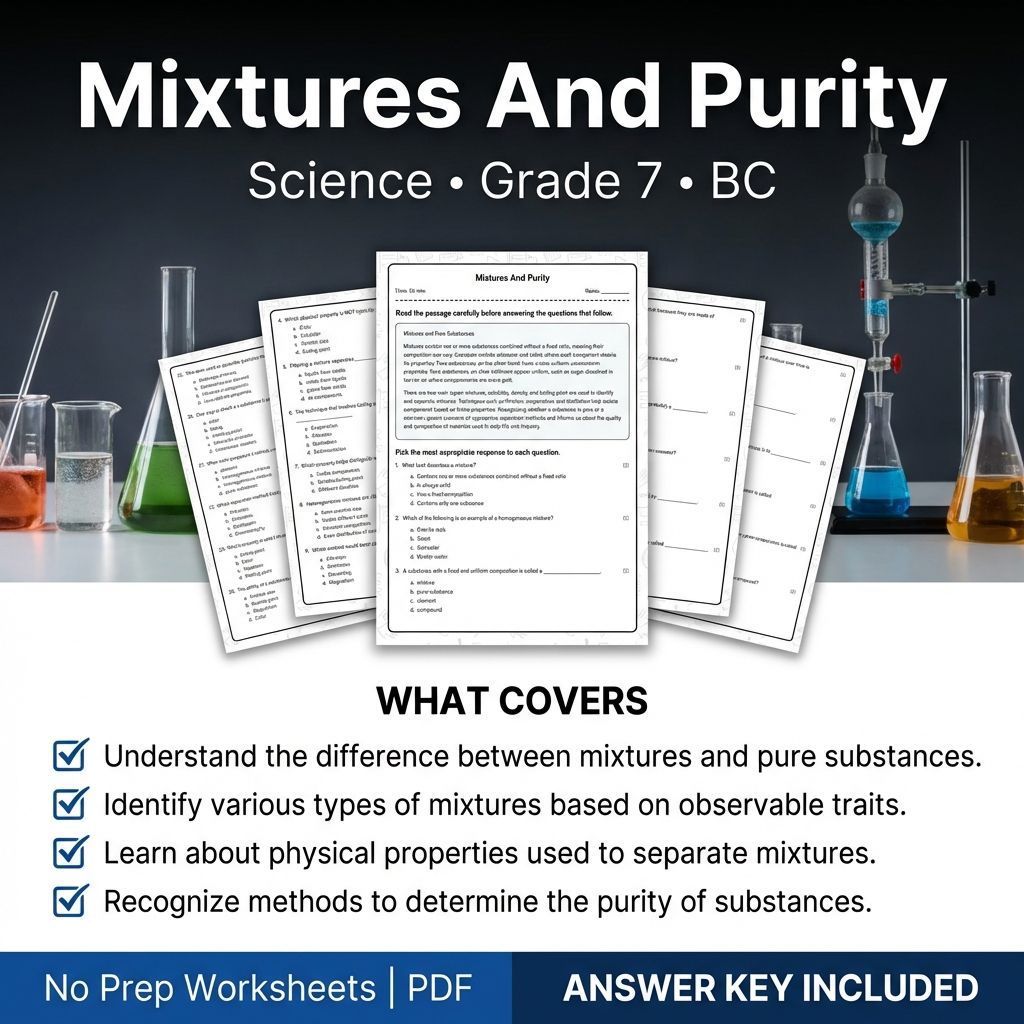
7th Grade Science | Mixtures and Purity Worksheet with Answer Key (Printable PDF)
Created byCoral Reef LearningLearning Objectives
- Understand the difference between mixtures and pure substances.
- Identify various types of mixtures based on observable traits.
- Learn about physical properties used to separate mixtures.
Instant download
About Grade 7 Science Worksheets
Browse 6,039 printable Grade 7 Science worksheets — ready-to-print PDFs with answer keys where available.
Every worksheet on MyTeachingSheets is created by independent teacher-authors and reviewed before publication. All resources download as printable PDFs for classroom, homework, or at-home practice, and many include answer keys. Preview any worksheet free before buying.