
Grade 7 Science Worksheets
6,039 worksheets
Grade 7 Gravity and Weight Worksheet NGSSS Science Forces Practice
 Created byEvergreen Desk Education
Learning Objectives
- Differentiate between mass and weight and explain how weight changes with gravity.
- Describe how gravity affects the motion of falling objects near Earth.
- Use evidence from comparing objects with different masses to support ideas about net force and motion.
Instant download
Abiotic Influences Assessment | BC Grade 7 Science Standards-Aligned
 Created byPrism Point Learning
Learning Objectives
- Understand how abiotic factors such as temperature, moisture, light, soil nutrients, and pH influence species distribution and population dynamics.
- Recognize the effects of seasonal and daily fluctuations on environmental stress and opportunities for organisms.
- Explain how extreme events impact population resilience and survival in ecosystems.
Instant download
7th Grade Science | Material Testing Worksheet (PDF+ Answer Key)
 Created byCopper Leaf Classroom
Learning Objectives
- Understand characteristic methods used in testing material behavior such as tensile, compression, and bending assessments.
- Learn about non-destructive testing techniques including ultrasonic and hardness measurements.
- Explain the concept of anisotropy in timber and composites and understand strain localization.
Instant download
Grade 7 Science | Species Interactions Worksheet (PDF + Answer Key)
 Created byRiverstone Classroom
Learning Objectives
- Understand different patterns of species interactions such as predation, competition, parasitism, mutualism, and commensalism.
- Analyze how species interactions influence community structure and ecosystem dynamics in terrestrial and aquatic systems.
- Interpret food webs and trophic diagrams to identify direct and indirect effects among species.
Also included in: Grade 7 Science | Ecosystems & Biodiversity Unit Worksheet Pack
Instant download
Grade 7 Science | Biodiversity Solutions Worksheet (PDF + Answer Key)
Created byRiverstone ClassroomLearning Objectives
- Understand management strategies used to maintain biodiversity and ecosystem services.
- Evaluate the benefits and trade-offs of habitat corridors, protected areas, and restoration efforts.
- Analyze case examples of wetland restoration and corridor establishment for ecological and social outcomes.
Also included in: Grade 7 Science | Ecosystems & Biodiversity Unit Worksheet Pack
Instant download

Science Climate Patterns Worksheet | NGSS Grade 7 Science Assessment
 Created bySkylark Worksheets
Learning Objectives
- Interpret climate patterns using temperature gradients, sea-surface temperatures, wind, and precipitation records.
- Explain how uneven solar heating and surface properties drive atmospheric and ocean circulation.
- Describe how topography and ocean currents create regional climate differences.
Also included in: Grade 7 Earth Systems Science Worksheet Lesson Bundle for NGSS Assessment +1 more
Instant download
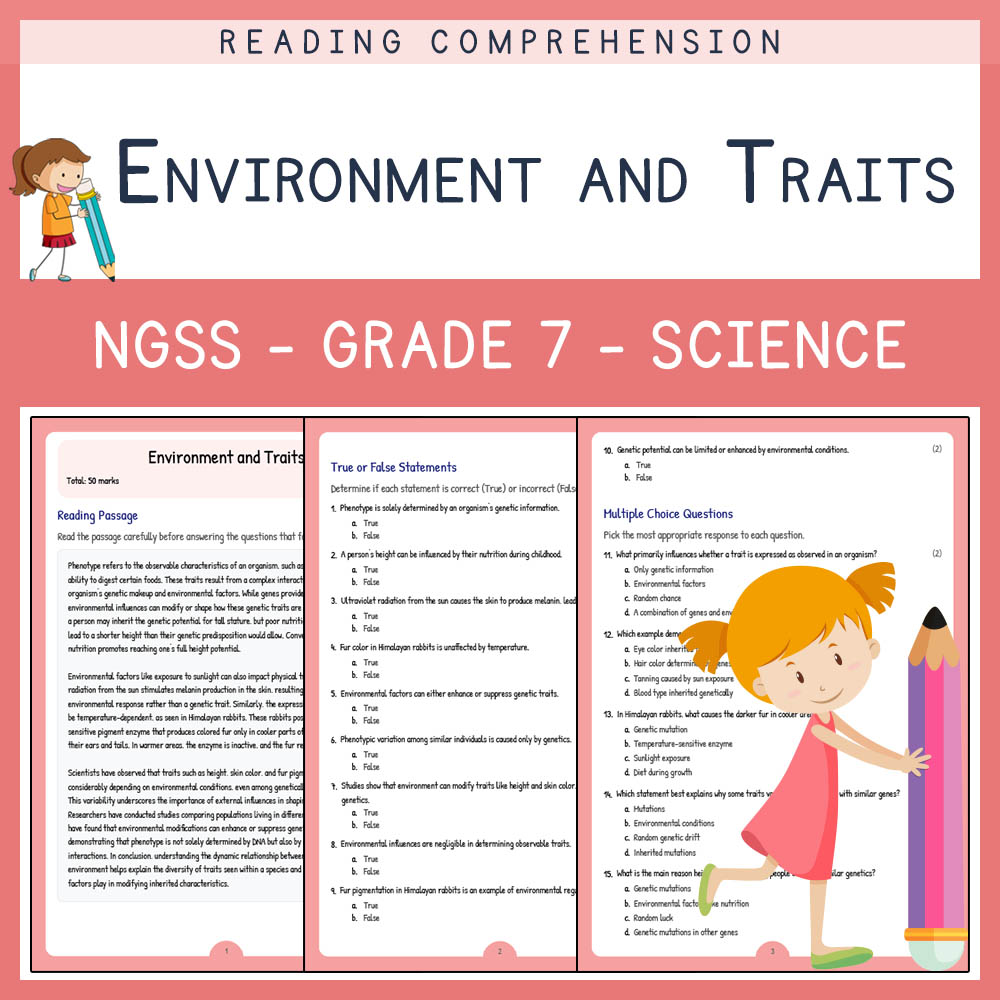
Grade 7 Science | Environment and Traits Worksheet (NGSS Aligned + Answer Key)
 Created byLumora Learning
Learning Objectives
- Explain how phenotype results from both genetic and environmental factors.
- Describe examples showing environmental influence on traits.
- Distinguish inherited genetic traits from environmentally modulated traits.
Instant download
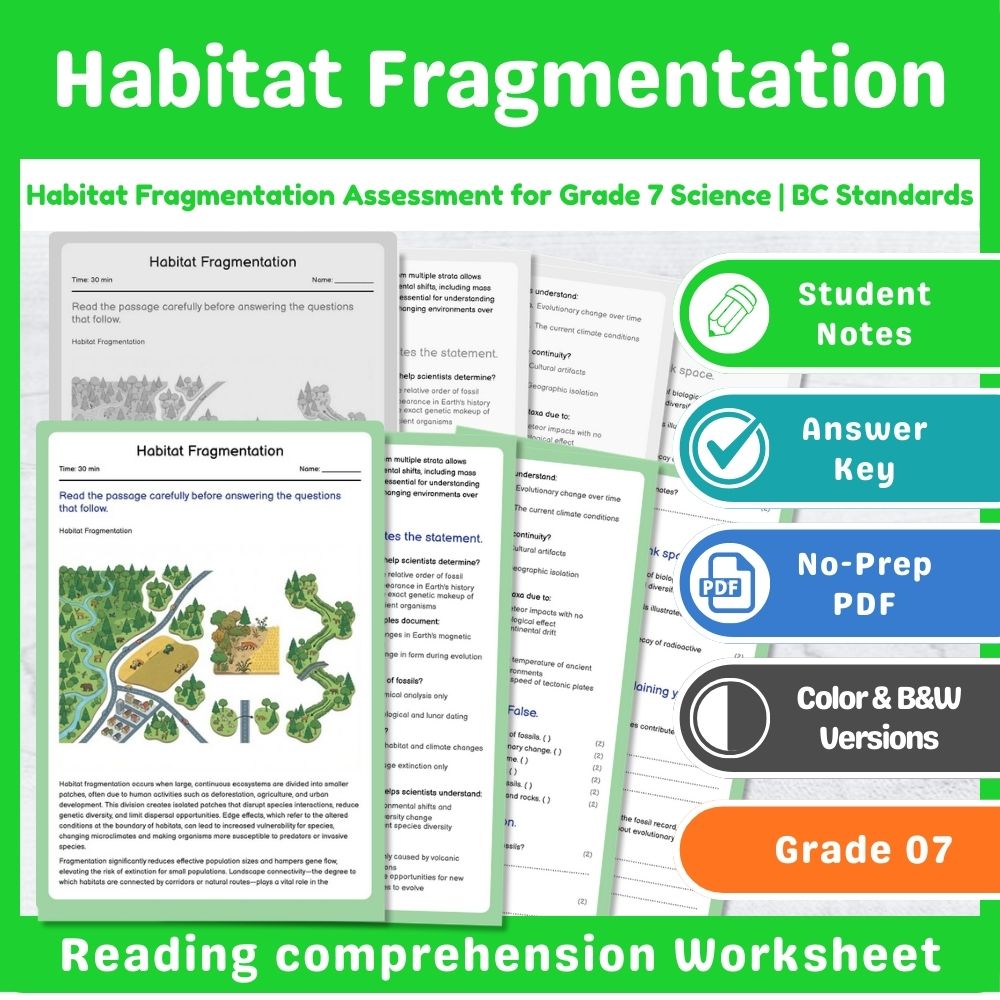
Habitat Fragmentation Assessment for Grade 7 Science | BC Standards
Created byPrism Point LearningLearning Objectives
- Understand the concept of habitat fragmentation and its effects on ecosystems.
- Identify how edge effects influence species and microclimate in fragmented habitats.
- Explain the impact of landscape connectivity and corridors on biodiversity conservation.
Instant download

Plate Mechanisms Practice Worksheet | Grade 7 Science | Review
Created byPrism Point LearningLearning Objectives
- Explain how mantle convection, slab pull, and ridge push contribute to plate motion.
- Describe how different plate-mechanism strengths can affect plate velocity and direction.
- Use evidence and vocabulary to interpret tectonic events connected to plate motion.
Also included in: Earth's Systems & Processes Lesson Bundle | Grade 7 Science | BC +1 more
Instant download

Grade 7 Plate Mechanisms Worksheet | BC Practice PDF
 Created byClear Sky Classroom
Learning Objectives
- Explain how mantle convection, slab pull, and ridge push contribute to plate motion
- Describe the role of density differences and buoyancy in driving convection cells
- Use evidence and vocabulary to compare the relative effects of different plate mechanisms
Instant download
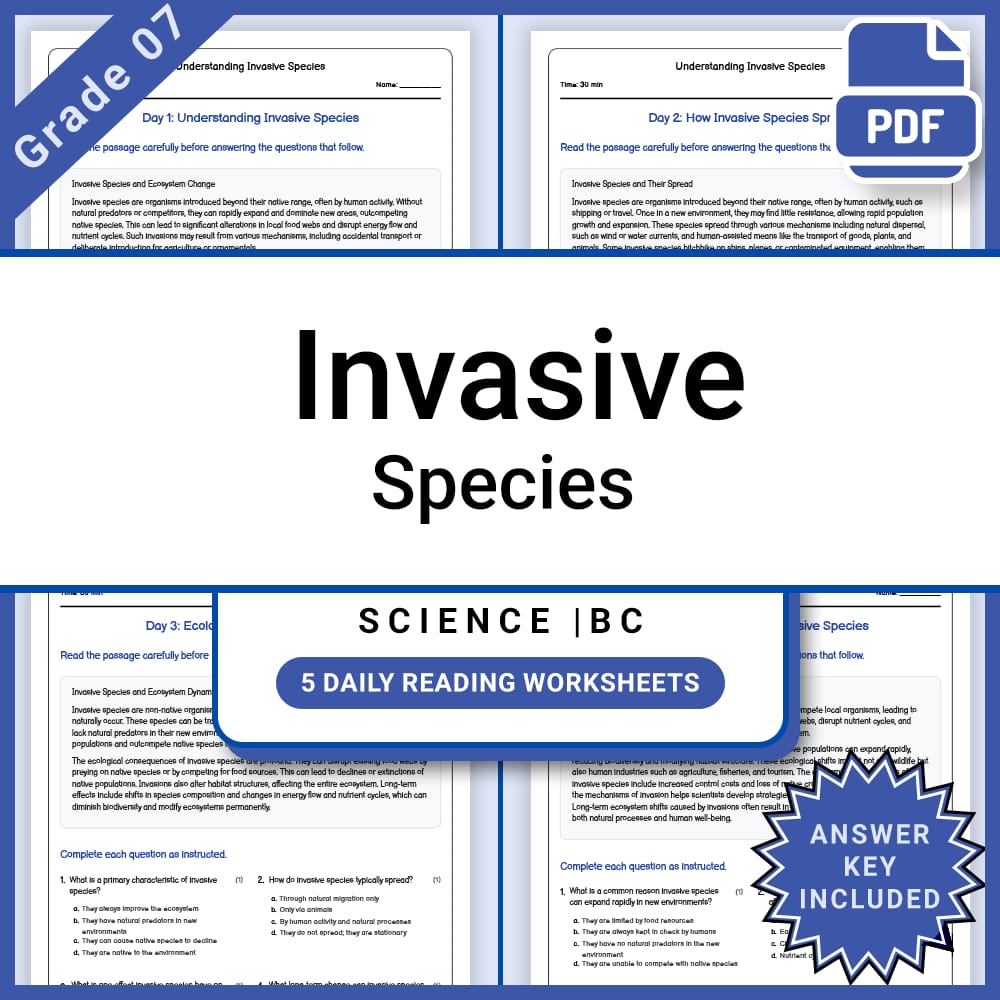
Grade 7 Science – Invasive Species Daily Reading Worksheet + Answer Key
JCreated byJ.S SheetsLearning Objectives
- Identify key ideas about invasive species and their ecological impact.
- Evaluate understanding through multiple choice, true/false, short answer, and essay questions.
- Summarize the mechanisms and consequences of invasive species invasion.
Also included in: Grade 7 Science Lesson Group: Ecosystems and Population Framework +1 more
Instant download

Grade 7 Science | Density & Volume - Daily Reading Comprehension
 Created byCoral Reef Learning
Learning Objectives
- Understand the concept of density and how it relates mass and volume.
- Identify and compare density and volume in different materials.
- Recognize that density is an intensive property that does not depend on the amount of material.
Instant download
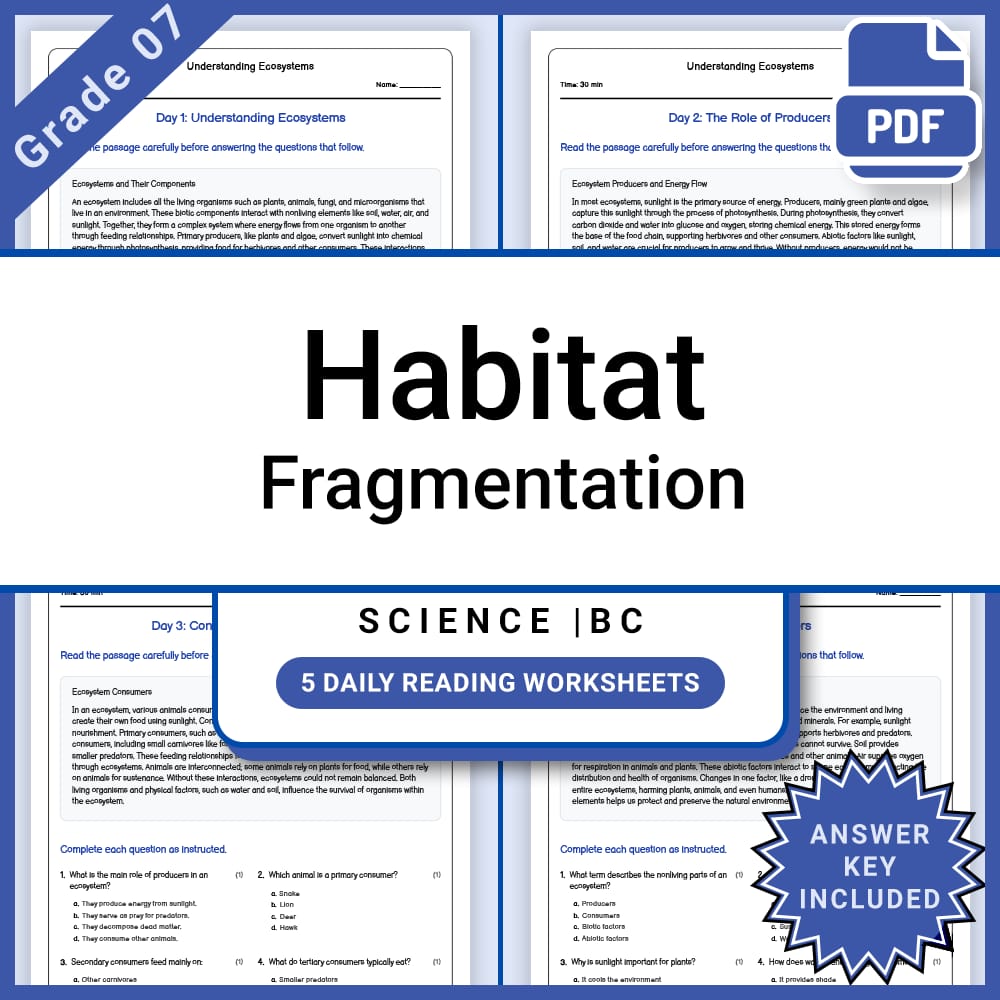
Grade 7 Science – Habitat Fragmentation Daily Reading Worksheet + Answer Key
JCreated byJ.S SheetsLearning Objectives
- Define habitat fragmentation and explain its causes.
- Describe how fragmentation affects ecosystems and species.
- Identify strategies to mitigate negative effects of habitat fragmentation.
Also included in: Grade 7 Science Lesson Group: Ecosystems and Population Framework +1 more
Instant download

Equilibrium Grade 7 Science Worksheet | NGSS-Aligned Assessment & Practice
JCreated byJ.S SheetsLearning Objectives
- Understand the concept of equilibrium as the state where forces balance and the vector sum of forces equals zero.
- Differentiate between static and dynamic equilibrium in various physical situations.
- Identify and analyze forces such as normal force, gravitational force, tension, and their role in achieving equilibrium.
Also included in: Grade 7 Forces and Interactions Science Lesson Bundle: NGSS Practice Set +1 more
Instant download
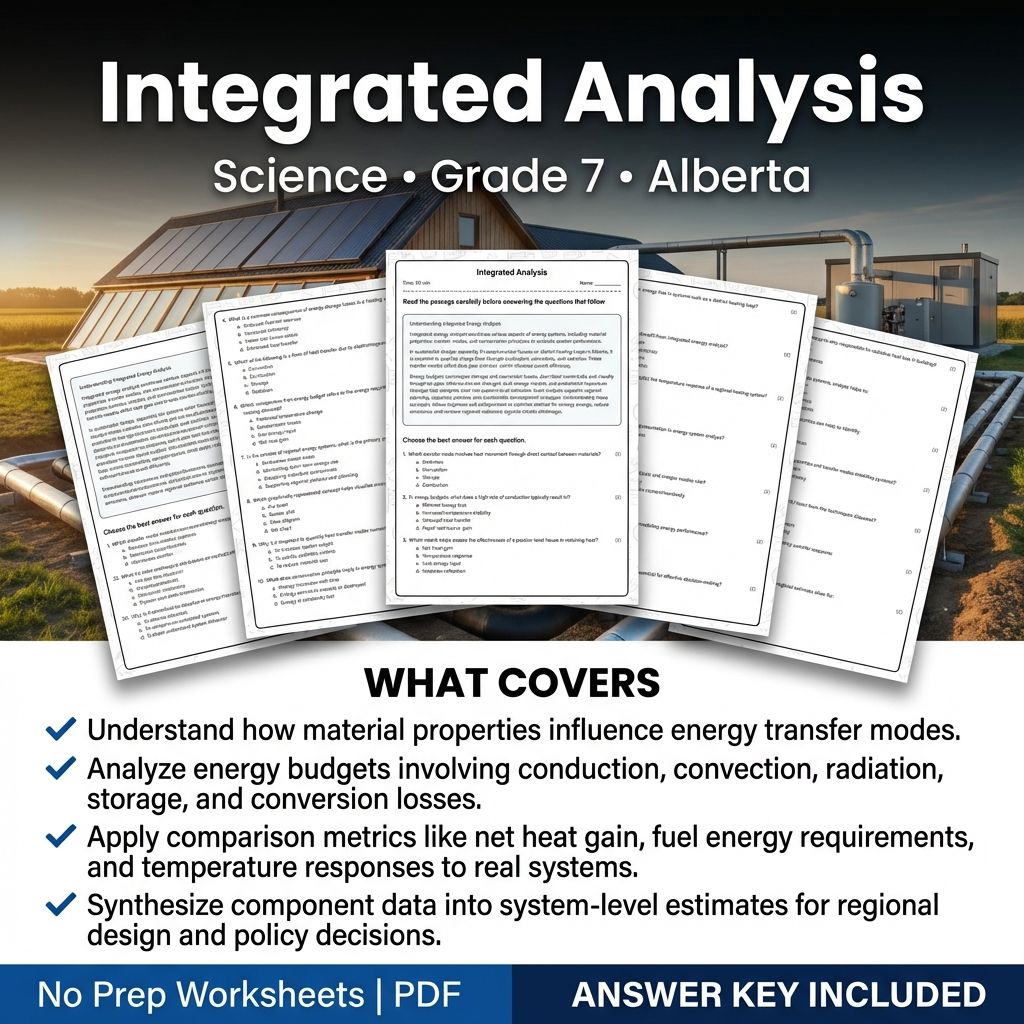
Grade 7 Science Worksheet | Integrated Analysis Practice and Assessment
Created byCoral Reef LearningLearning Objectives
- Understand how material properties influence energy transfer modes.
- Analyze energy budgets involving conduction, convection, radiation, storage, and conversion losses.
- Apply comparison metrics like net heat gain, fuel energy requirements, and temperature responses to real systems.
Instant download

Grade 7 Science Worksheet | Physical Property Clues (PDF) for Practice
Created byEvergreen Desk EducationLearning Objectives
- Explain how physical properties (such as color, density, melting point, boiling point, magnetism, conductivity, and solubility) help describe substances.
- Use observed physical behavior to distinguish between substances or identify likely components of mixtures.
- Apply physical-property reasoning to suggest how mixtures can be separated.
Also included in: Grade 7 Energy Transfer & Motion Science Lesson Bundle Worksheets (General) +1 more
Instant download
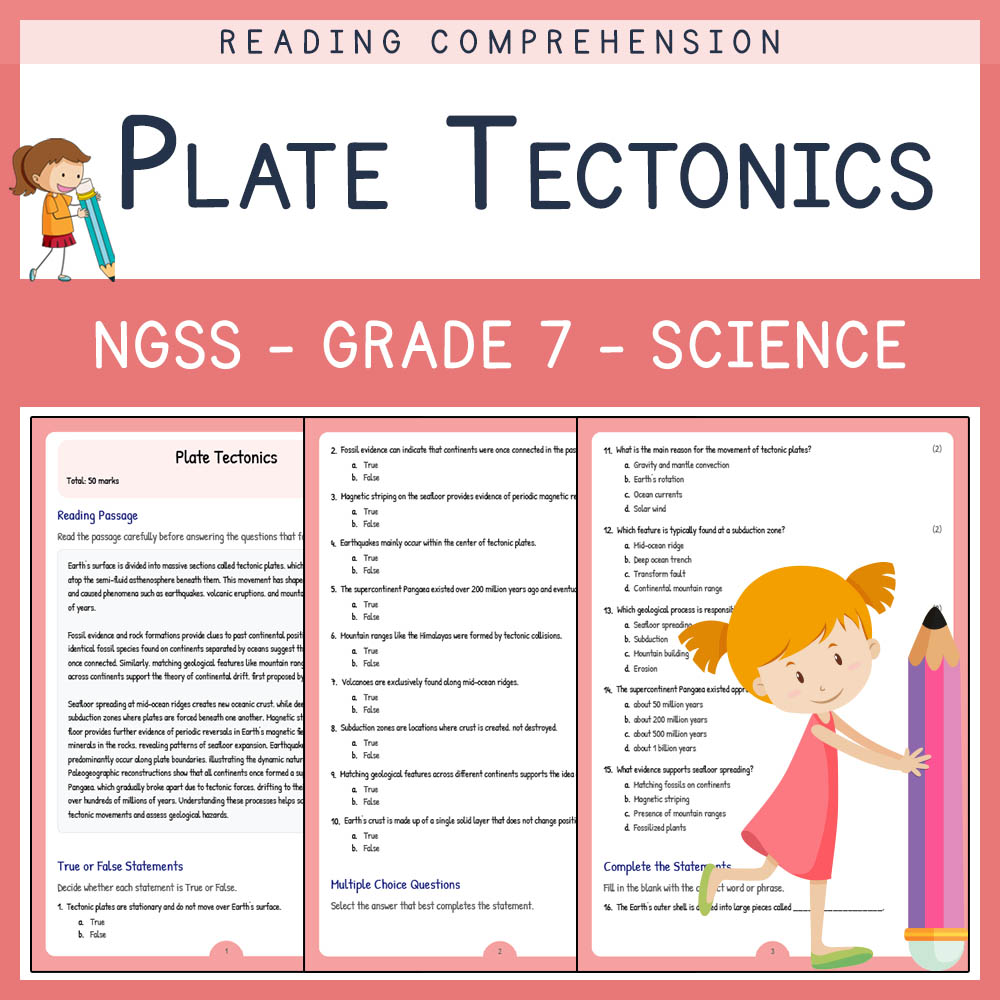
Grade 7 Science | Plate Tectonics Worksheet & Answer Key (NGSS Aligned)
Created byLumora LearningLearning Objectives
- Understand the geologic evidence supporting plate tectonics and continental movement.
- Explain how fossils, rock types, and seafloor structures record Earth's tectonic history.
- Analyze spatial patterns such as mid-ocean ridges, trenches, and mountain ranges to infer plate motions.
Instant download

Grade 7 Science Plate Mechanisms Worksheet | Standards-Aligned Practice
JCreated byJ.S SheetsLearning Objectives
- Understand the different force systems that drive plate motion within the Earth.
- Describe how mantle convection, slab pull, and ridge push operate and interact.
- Explain the scale and relative strength of each plate mechanism.
Instant download

Grade 7 Science | Particle Model of Matter Worksheet | California Standards
Created byLumora LearningLearning Objectives
- Explain how the particle model describes matter as made of tiny particles in constant motion
- Relate temperature to the average kinetic energy (average motion) of particles
- Predict how changes in temperature affect pressure, diffusion, and other observable properties
Instant download
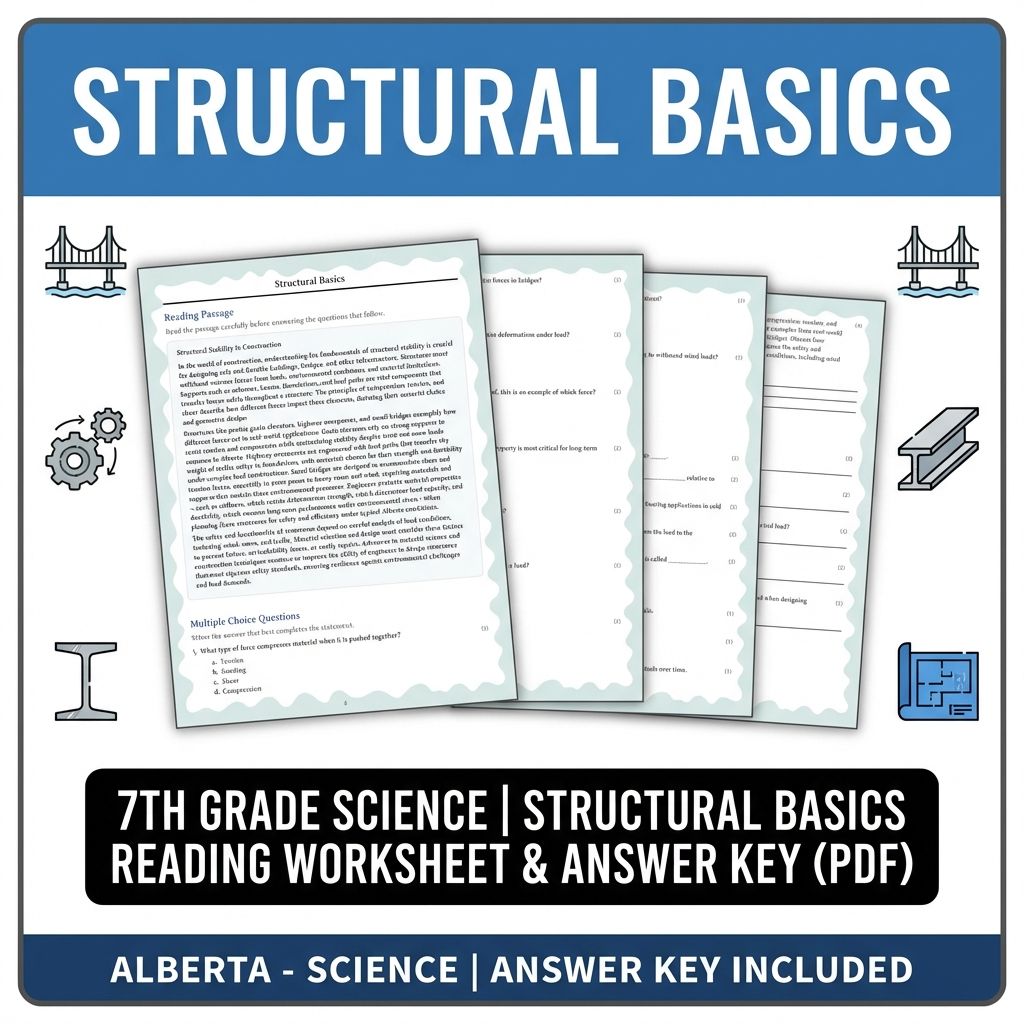
7th Grade Science | Structural Basics Reading Worksheet & Answer Key (PDF)
JCreated byJ.S SheetsLearning Objectives
- Understand the roles of supports, foundations, and load paths in construction.
- Explain how compression, tension, and shear forces affect different structural elements.
- Identify material properties such as stiffness, strength, and durability used in evaluating structural safety.
Also included in: Grade 7 Science | Forces, Motion & Structural Concepts (Answer Keys Included) +1 more
Instant download
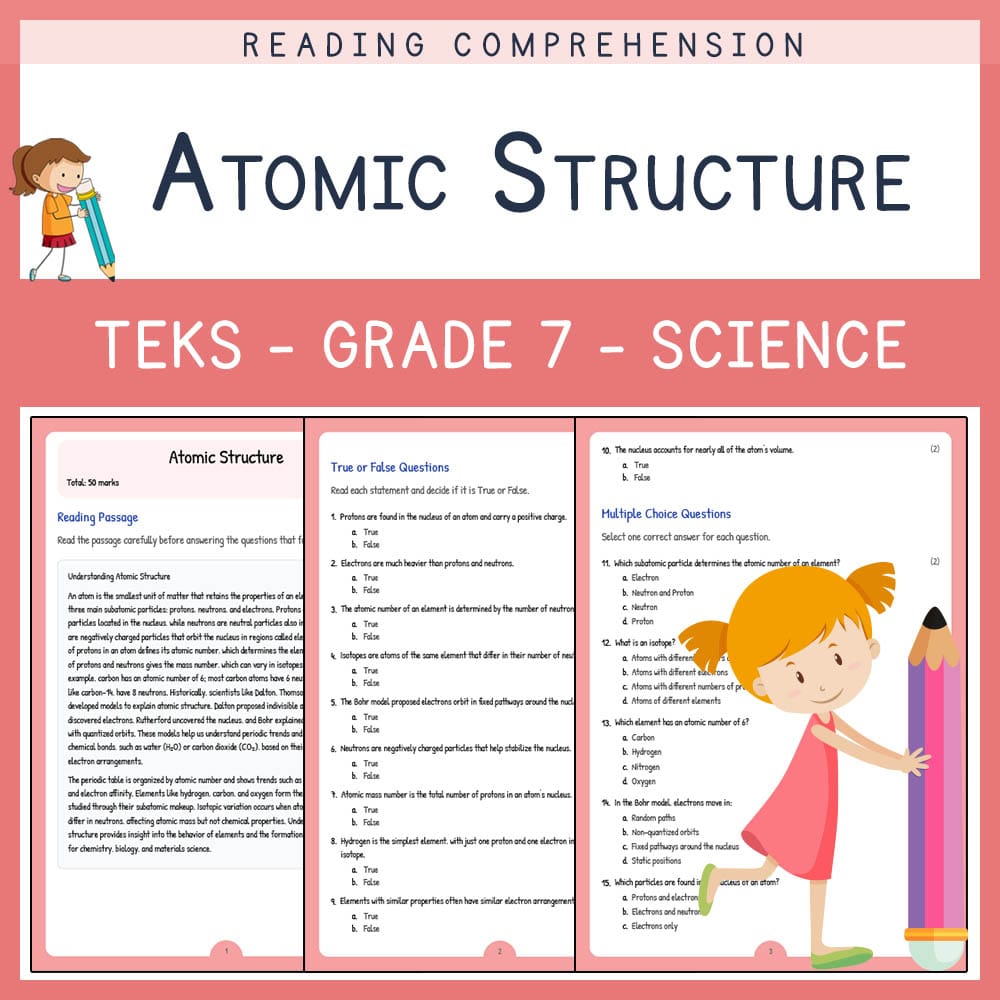
Grade 7 Science | Atomic Structure Worksheet | TEKS Alligned
Created byLumora LearningLearning Objectives
- Describe the basic components of an atom: protons, neutrons, and electrons.
- Explain how atomic number and mass number relate to element identity and isotopic variation.
- Identify simple electron arrangements for common elements.
Also included in: Grade 7 Science | Matter and Energy Lesson Bundle | TEKS Aligned
Instant download

Gas Behavior Worksheet for Grade 7 Science | Standards-Aligned Practice
JCreated byJ.S SheetsLearning Objectives
- Explain qualitatively how gas pressure, volume, and temperature are interdependent during everyday situations.
- Describe how diffusion spreads gas particles from areas of higher to lower concentration.
- Connect compressibility and pressure changes to the behavior of gases in confined spaces.
Instant download
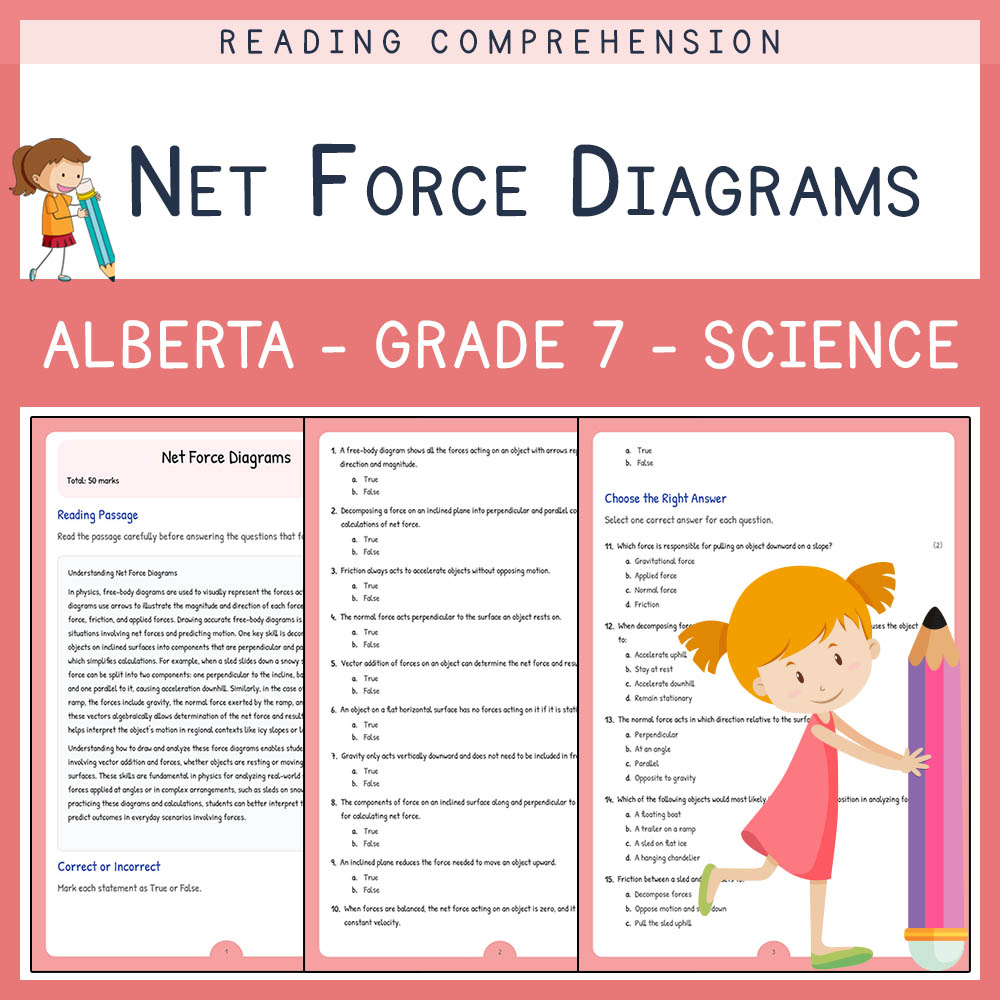
Grade 7 Science Assessment | Net Force Diagrams Worksheet | Alberta
Created byLumora LearningLearning Objectives
- Understand the concept of net force and how to represent it using free-body diagrams.
- Learn how to decompose forces on inclined surfaces into perpendicular components.
- Apply vector addition to determine the magnitude and direction of net force.
Instant download
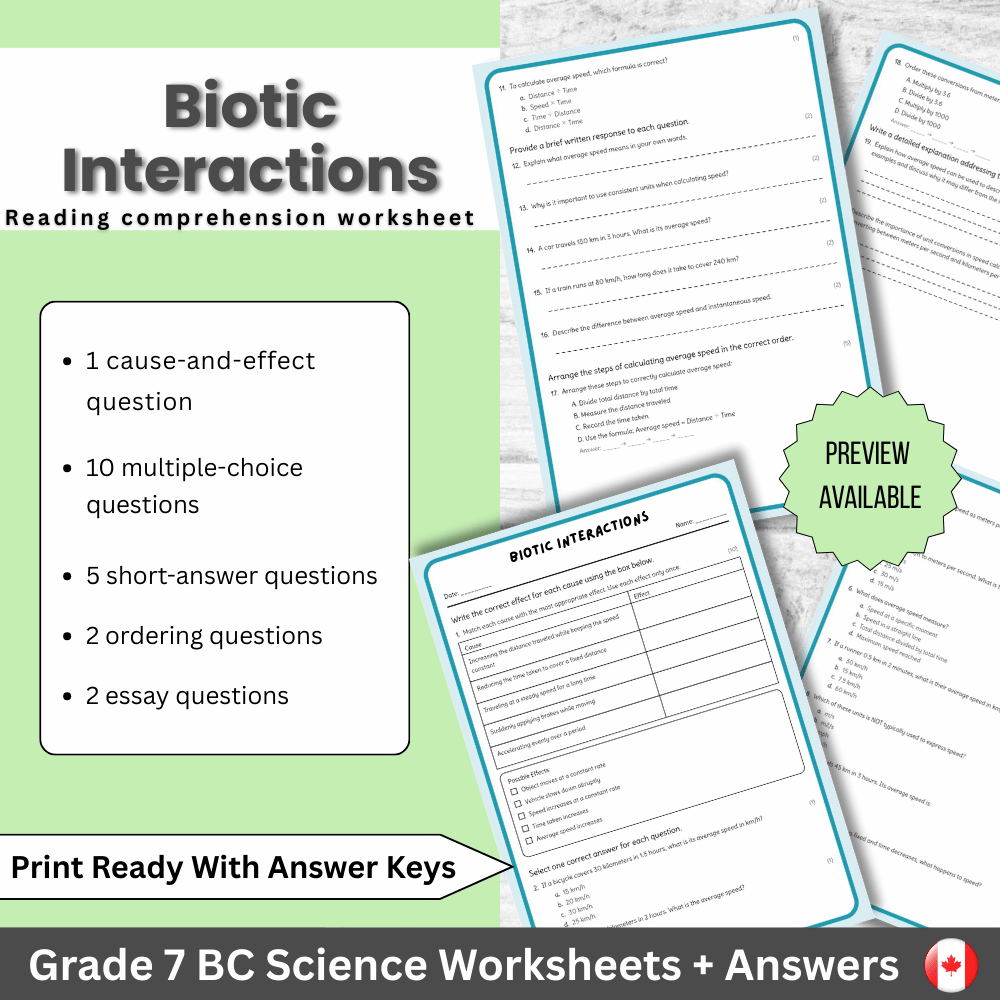
Grade 7 Science | Biotic Interactions Worksheet (Answer Key) – BC Standards
 Created byBright Mind Resources
Learning Objectives
- Describe various types of biotic interactions such as predation, competition, mutualism, commensalism, and parasitism.
- Explain how human activities can disrupt natural biotic relationships.
- Understand how changes in one species can affect entire ecosystems and biodiversity.
Instant download
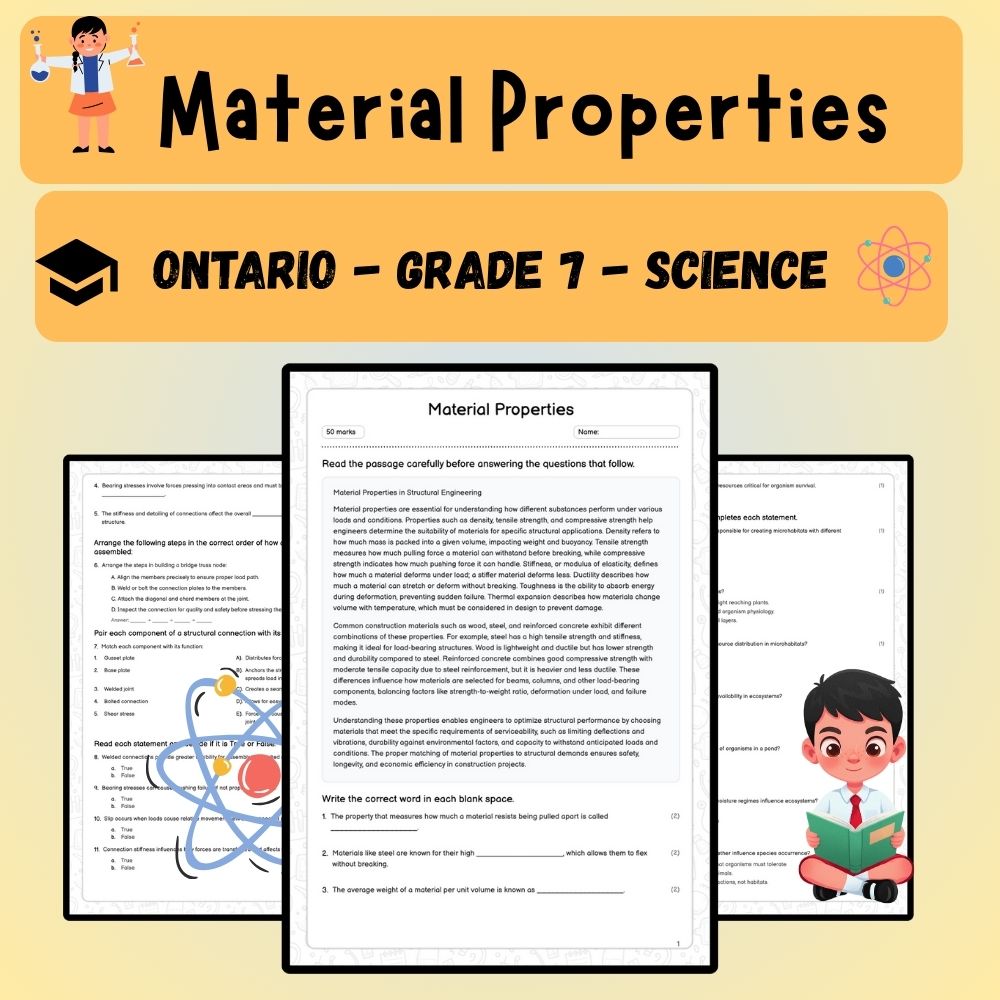
Grade 7 Science – Understanding Material Properties Worksheet (PDF )
Created byPrism Point LearningLearning Objectives
- Define key material properties such as density, tensile strength, compressive strength, stiffness (modulus), ductility, toughness, and thermal expansion.
- Explain how these properties influence the structural performance of materials.
- Compare construction materials like wood, steel, and reinforced concrete in terms of strength-to-weight ratio, deformation, and failure modes.
Also included in: Grade 7 Science Unit | Structural Engineering & Material Testing Worksheets Bundle +1 more
Instant download

Grade 7 Air Masses and Fronts Science Worksheet | Florida NGSSS Answer Key
Created byEvergreen Desk EducationLearning Objectives
- Explain what air masses are and how their temperature and moisture help determine weather.
- Describe how fronts form when air masses with different properties meet.
- Compare the typical weather effects of cold fronts and warm fronts.
Instant download
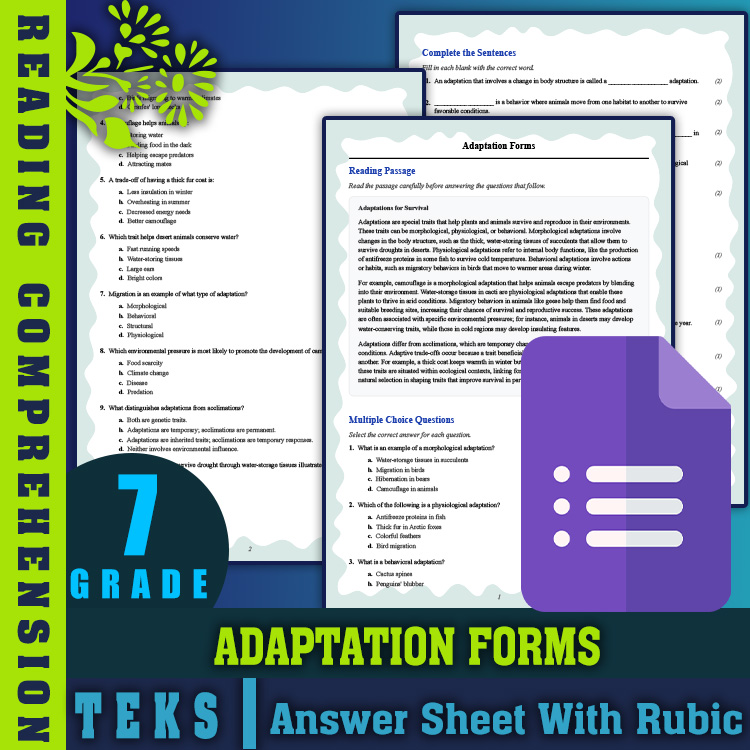
7th Grade Science | Adaptation Forms Reading Worksheet & Answer Key (PDF)
JCreated byJ.S SheetsLearning Objectives
- Understand the different types of adaptations: morphological, physiological, and behavioral.
- Identify examples of adaptations and explain how they enhance survival in specific environments.
- Distinguish adaptations from acclimations and understand the concept of trade-offs.
Instant download
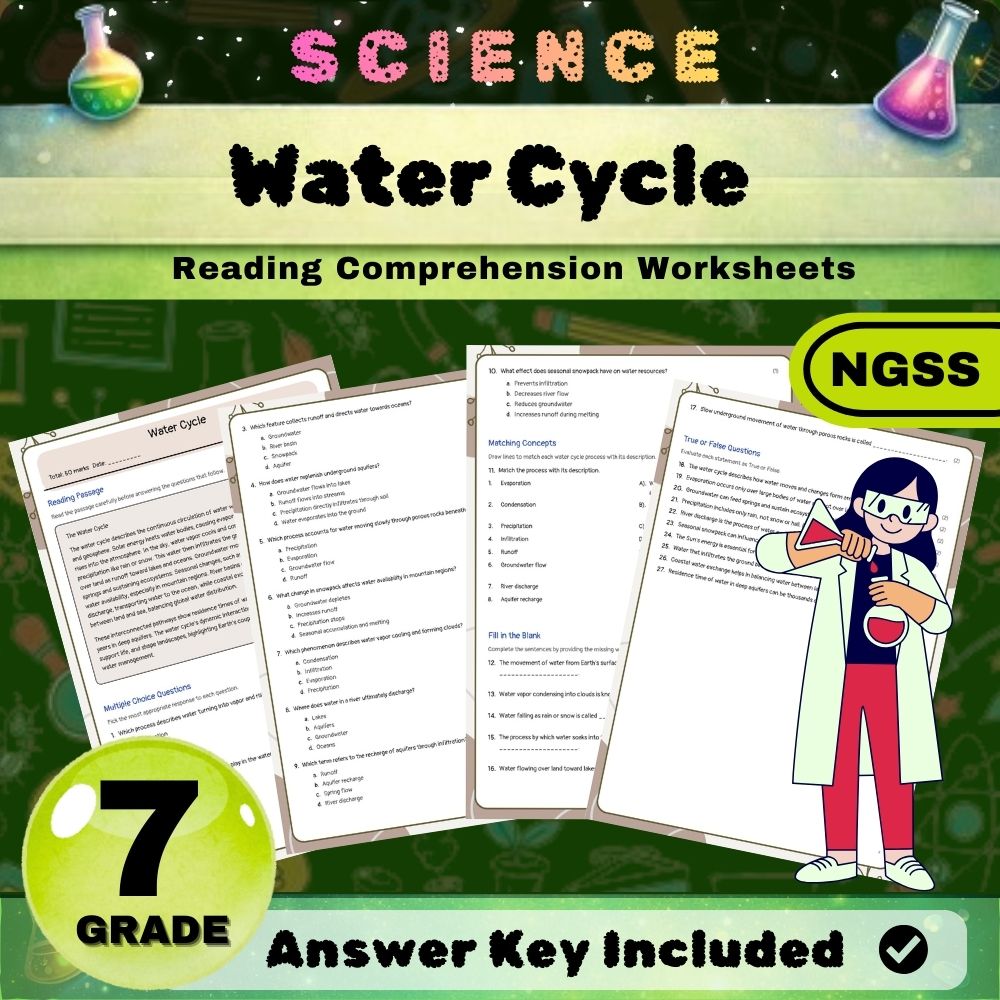
7th Grade Science | Water Cycle Worksheet (NGSS) + Answer Key for Teach
 Created byMaple Path Learning
Learning Objectives
- Describe the processes involved in the water cycle, including evaporation, condensation, precipitation, infiltration, runoff, and groundwater flow.
- Explain how solar energy and gravity drive water movement among Earth's spheres.
- Identify and illustrate interactions such as river discharge, groundwater contributions, and seasonal snowpack changes.
Instant download
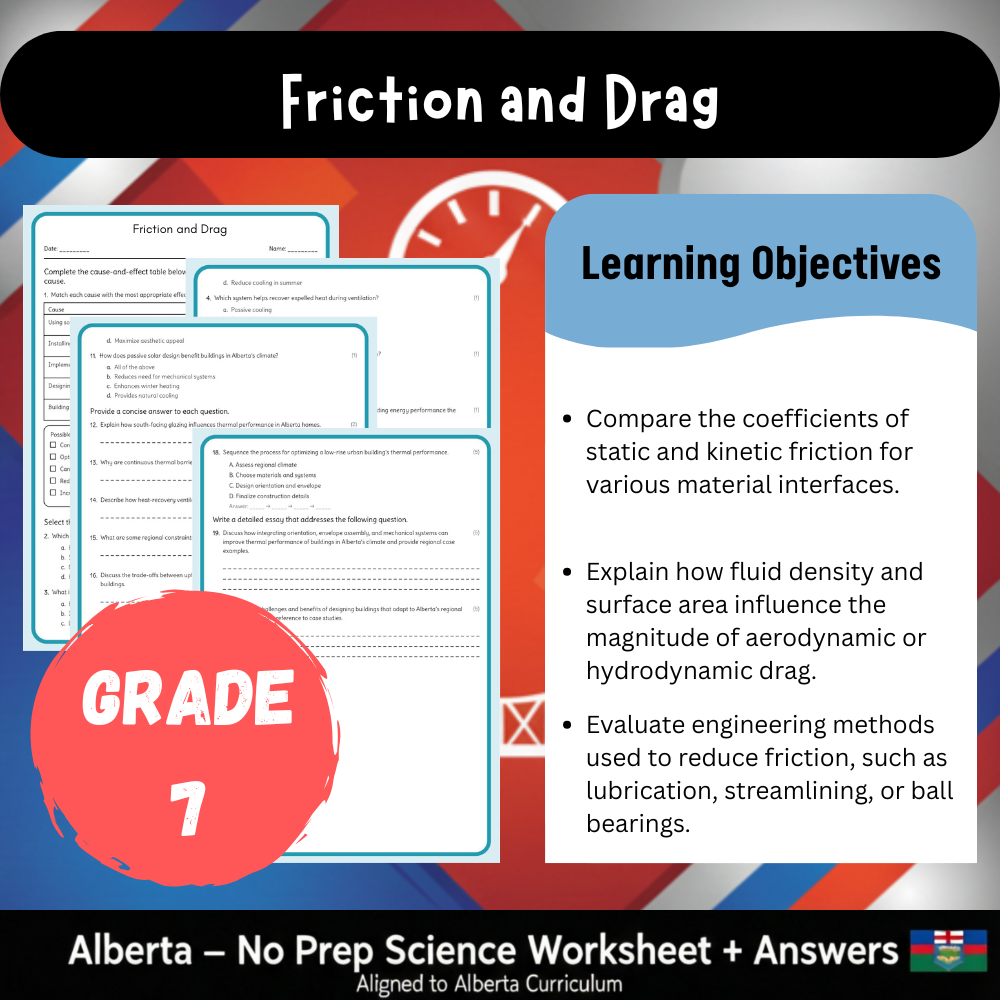
Grade 7 Science | Friction and Drag (Worksheet + Answer Key) – Alberta Standards
Created byBright Mind ResourcesLearning Objectives
- Explain the differences between static and kinetic friction and provide real-world examples.
- Describe how surface texture and normal force affect the magnitude of friction.
- Understand the concept of aerodynamic drag and how it impacts motion, especially in outdoor transportation.
Instant download
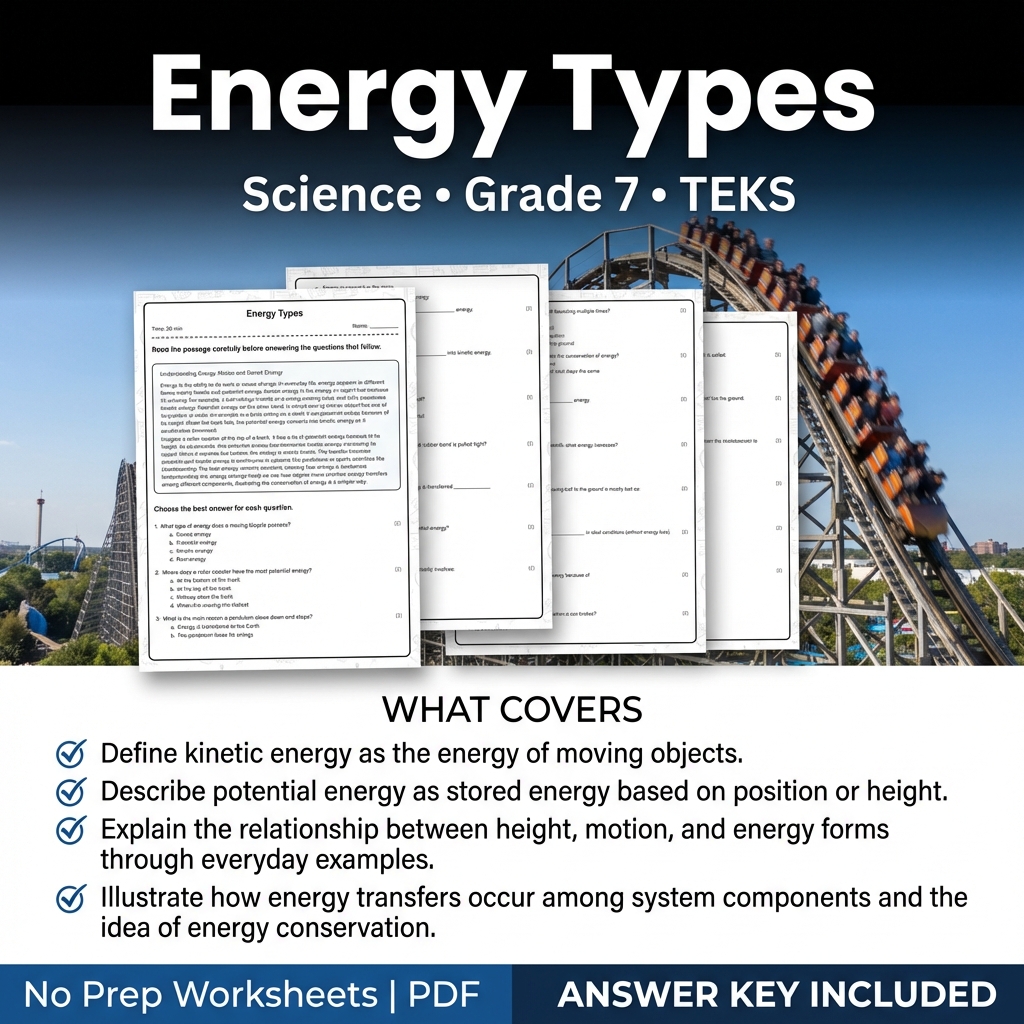
Energy Types Science Worksheet for Grade 7 | TEKS Standards Practice
Created byCoral Reef LearningLearning Objectives
- Define kinetic energy as the energy of moving objects.
- Describe potential energy as stored energy based on position or height.
- Explain the relationship between height, motion, and energy forms through everyday examples.
Instant download
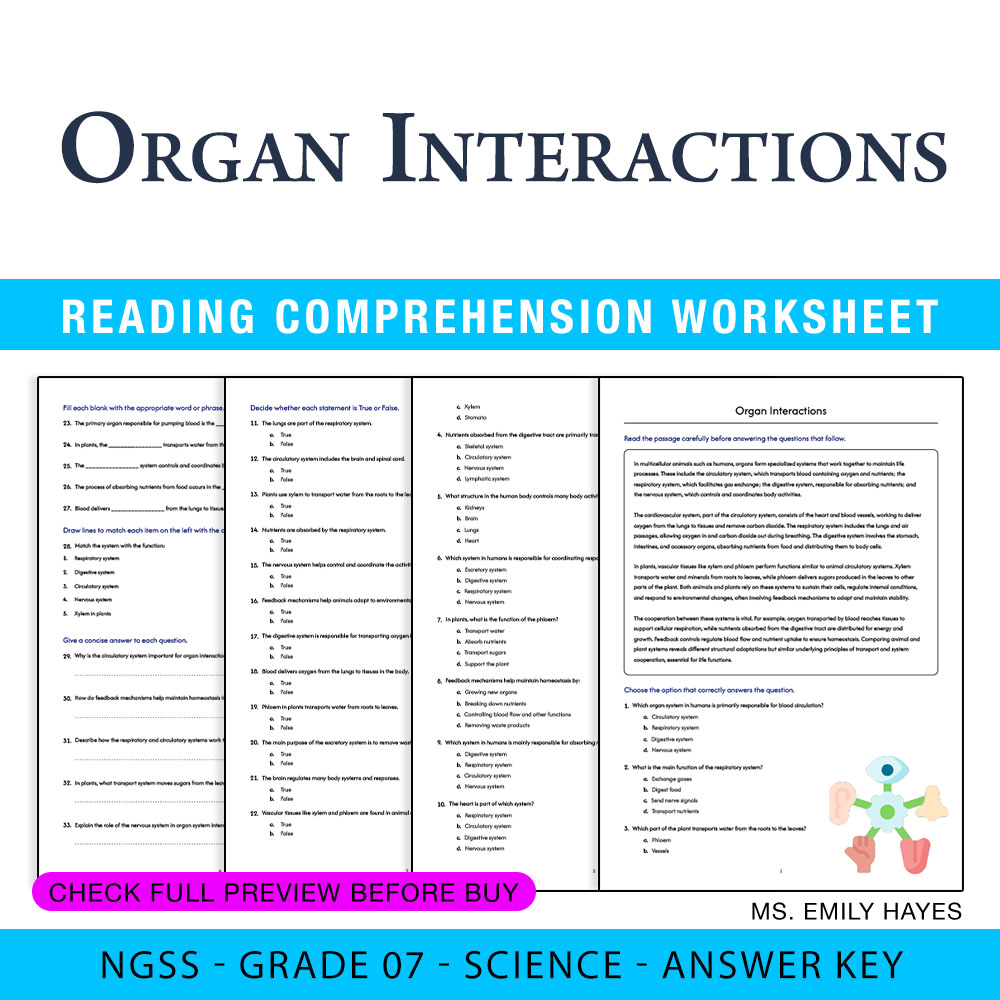
7th Grade Science | Organ Interactions Worksheet (PDF + Answer Key)
Created byCopper Leaf ClassroomLearning Objectives
- Describe the functions of the circulatory, respiratory, digestive, and nervous systems in multicellular animals.
- Explain how organ systems cooperate to support gas exchange, nutrient distribution, and homeostasis.
- Identify examples of system-level dependencies and feedback mechanisms in animal and plant systems.
Instant download

Grade 7 Science | Conservation Status Worksheet (PDF) – Alberta Standards
 Created bySilver Birch Teaching
Learning Objectives
- Explain how conservation status assessments combine population trends, threat severity, and recovery potential to estimate risk
- Identify how land use, genetic diversity, and habitat connectivity can increase or decrease vulnerability
- Interpret evidence used in conservation status and describe how results can guide regional priorities
Also included in: Grade 7 Ecosystems & Biodiversity Science Lesson Bundle for Alberta Framework +1 more
Instant download

Grade 7 Science | Cell Communication Worksheet (BC Standards) (PDF)
Created byEvergreen Desk EducationLearning Objectives
- Explain how cells communicate using chemical and electrical signals.
- Describe how receptor proteins and signal pathways can change metabolism and gene expression.
- Compare gap junctions and plasmodesmata as direct cell-to-cell connections.
Instant download

Ecosystem Dynamics Worksheet | Standards-Based Practice for Grade 7 Science
JCreated byJ.S SheetsLearning Objectives
- Understand how matter cycling and energy flow influence ecosystem stability.
- Identify factors that cause shifts in nutrient availability and biomass.
- Explain the cascading effects of resource input changes on consumer populations.
Also included in: Grade 7 Ecosystem Energy & Matter Cycles Science Lesson Bundle +1 more
Instant download
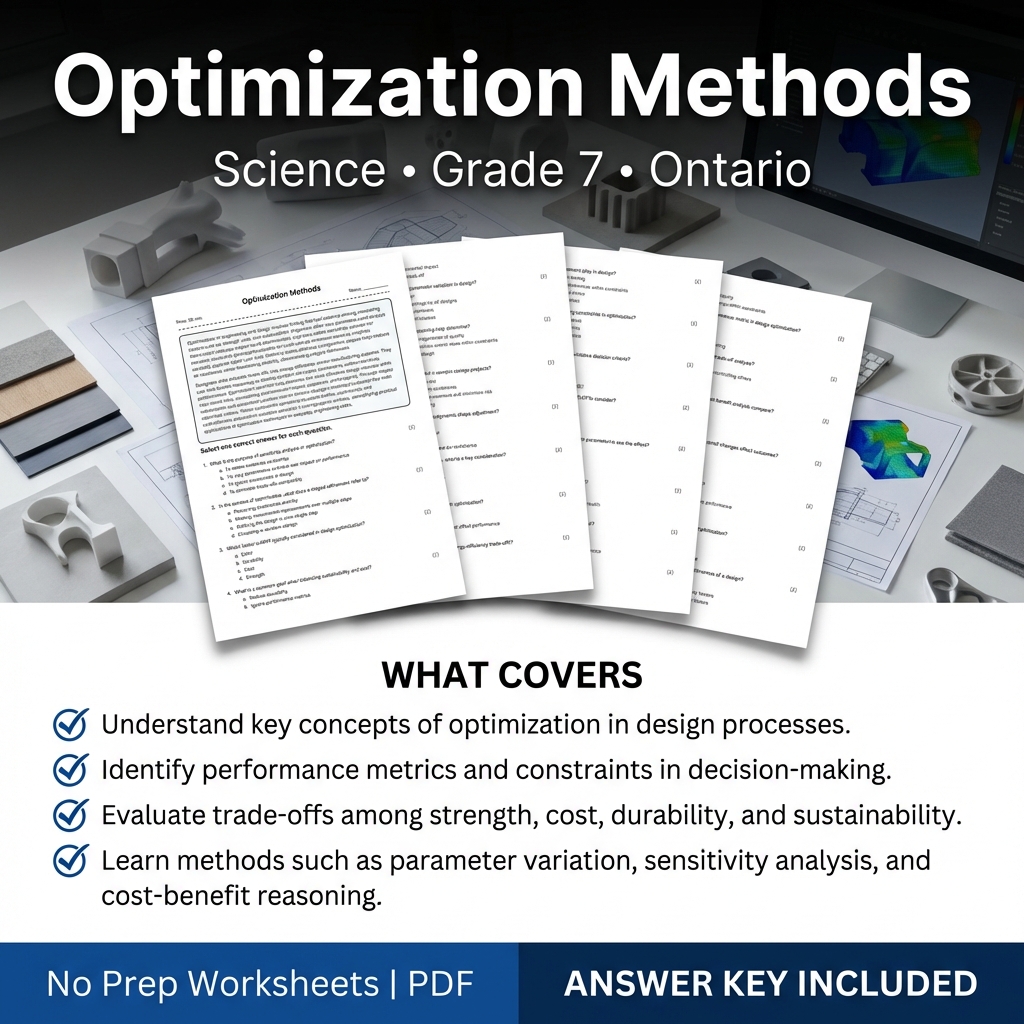
Grade 7 Science Worksheet on Optimization Methods | Ontario Standards
Created byCoral Reef LearningLearning Objectives
- Understand key concepts of optimization in design processes.
- Identify performance metrics and constraints in decision-making.
- Evaluate trade-offs among strength, cost, durability, and sustainability.
Instant download
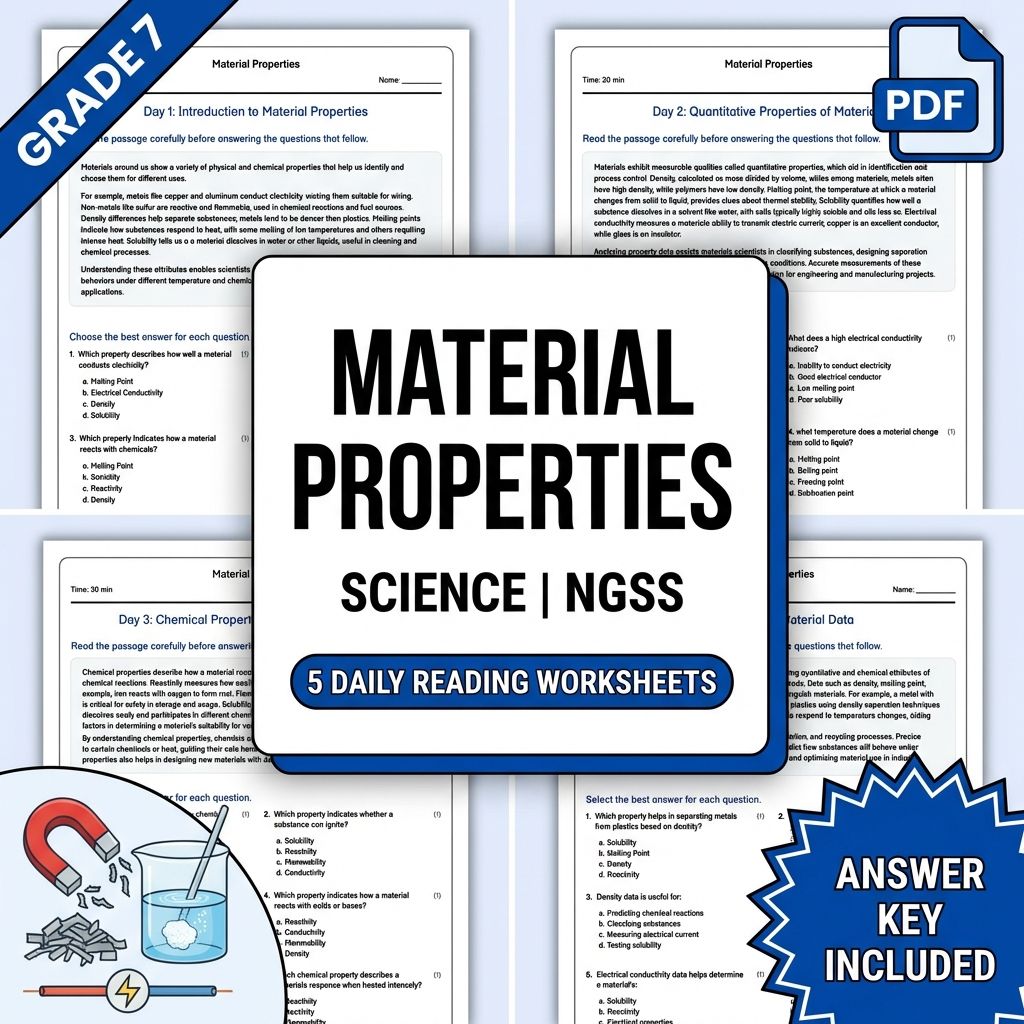
7th Grade Science | Material Properties Worksheet(PDF + Answer Key)
Created byCopper Leaf ClassroomLearning Objectives
- Distinguish physical and chemical properties of materials with descriptive attributes.
- Identify measurable properties such as density, melting point, solubility, electrical conductivity, reactivity, and flammability.
- Analyze property data to aid in material identification and separation strategies.
Instant download

Grade 7 Science – Space Technology Worksheet (TEKS) Practice Set (PDF)
Created byEvergreen Desk EducationLearning Objectives
- Explain how space technology extends observation beyond Earth using telescopes, satellites, and spacecraft instruments
- Describe how propulsion, power, and human exploration hardware enable missions and support safe exploration
- Use examples of robotic missions and space stations to infer how data collection leads to scientific understanding
Instant download

Grade 7 Science – Inquiry Foundations Daily Reading Worksheet with Answer Key
JCreated byJ.S SheetsLearning Objectives
- Distinguish between qualitative and quantitative observations in scientific inquiry.
- Select appropriate metric units and measurement instruments for length, mass, and volume.
- Recognize common sources of error in measurement and data collection.
Also included in: Grade 7 Science Lesson Group TEKS Bundle | Daily Reading Worksheets +1 more
Instant download
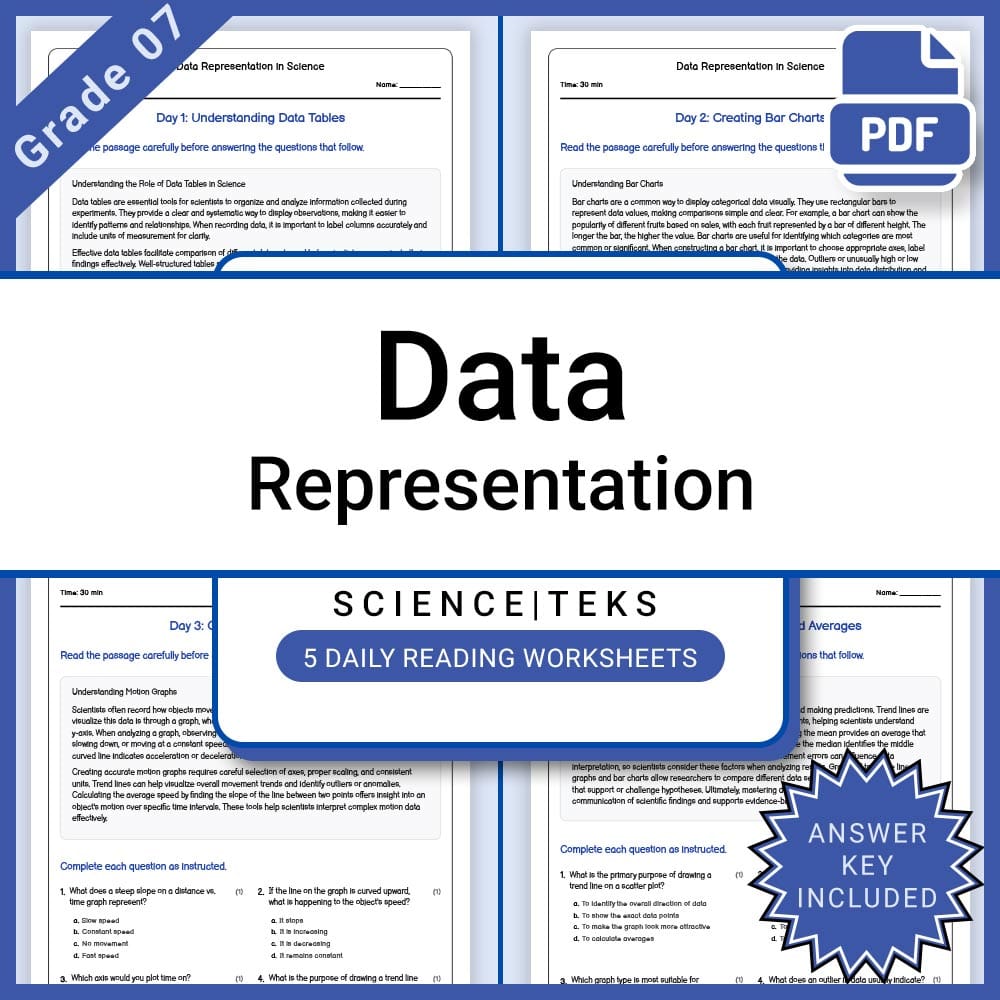
Grade 7 Science Data Representation Daily Reading Worksheet with Answer Key
JCreated byJ.S SheetsLearning Objectives
- Understand the purpose of data tables in organizing observations
- Identify appropriate graph types for different data sets
- Learn how to interpret trend lines and outliers in graphs
Also included in: Grade 7 Science Lesson Group TEKS Bundle | Daily Reading Worksheets +1 more
Instant download
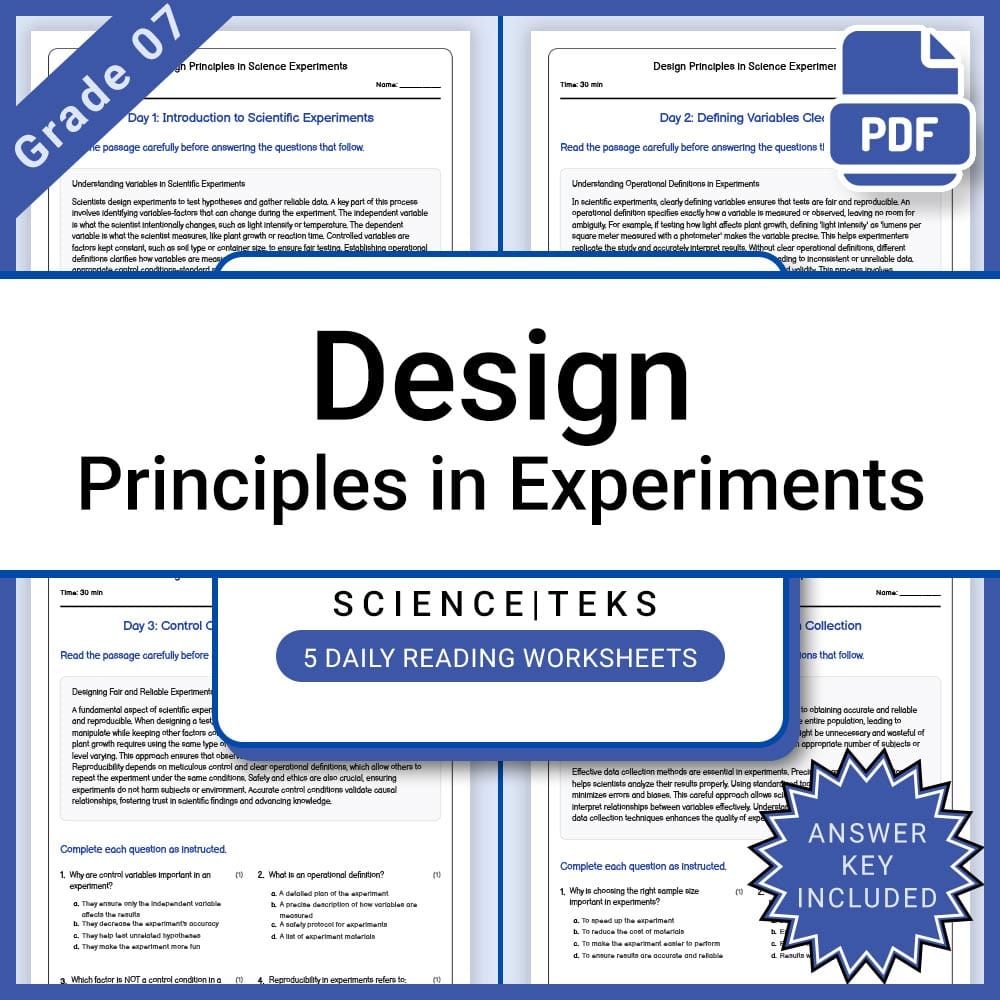
Grade 7 – Design Principles in Science Experiments Worksheet + Answer Key
JCreated byJ.S SheetsLearning Objectives
- Understand the key variables in scientific experiments
- Identify independent, dependent, and controlled variables
- Recognize the importance of operational definitions and control conditions
Also included in: Grade 7 Science Lesson Group TEKS Bundle | Daily Reading Worksheets +1 more
Instant download
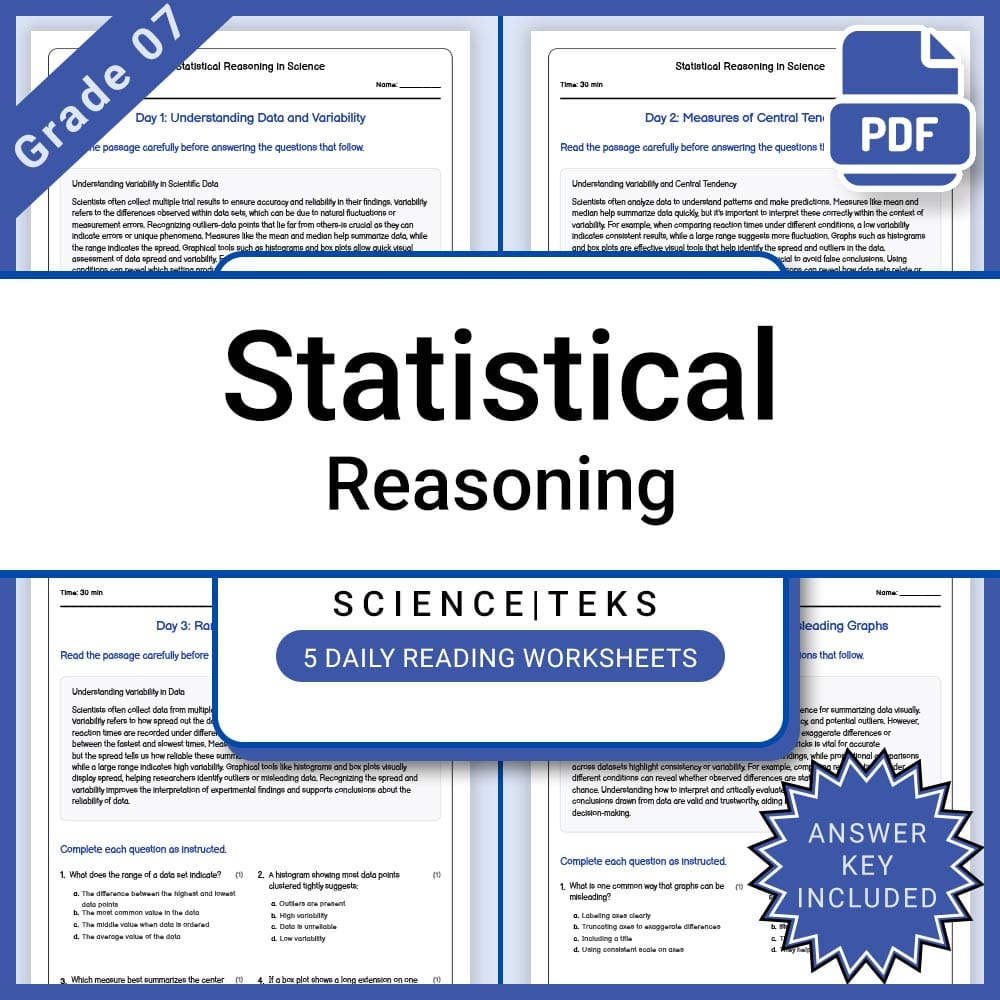
Grade 7 Science – Statistical Reasoning Daily Reading Worksheet + Answer Key
JCreated byJ.S SheetsLearning Objectives
- Interpret data sets to find measures of central tendency (mean, median).
- Assess variability and identify outliers in data distributions.
- Use graphical representations like box plots and histograms to analyze data spread.
Also included in: Grade 7 Science Lesson Group TEKS Bundle | Daily Reading Worksheets +1 more
Instant download
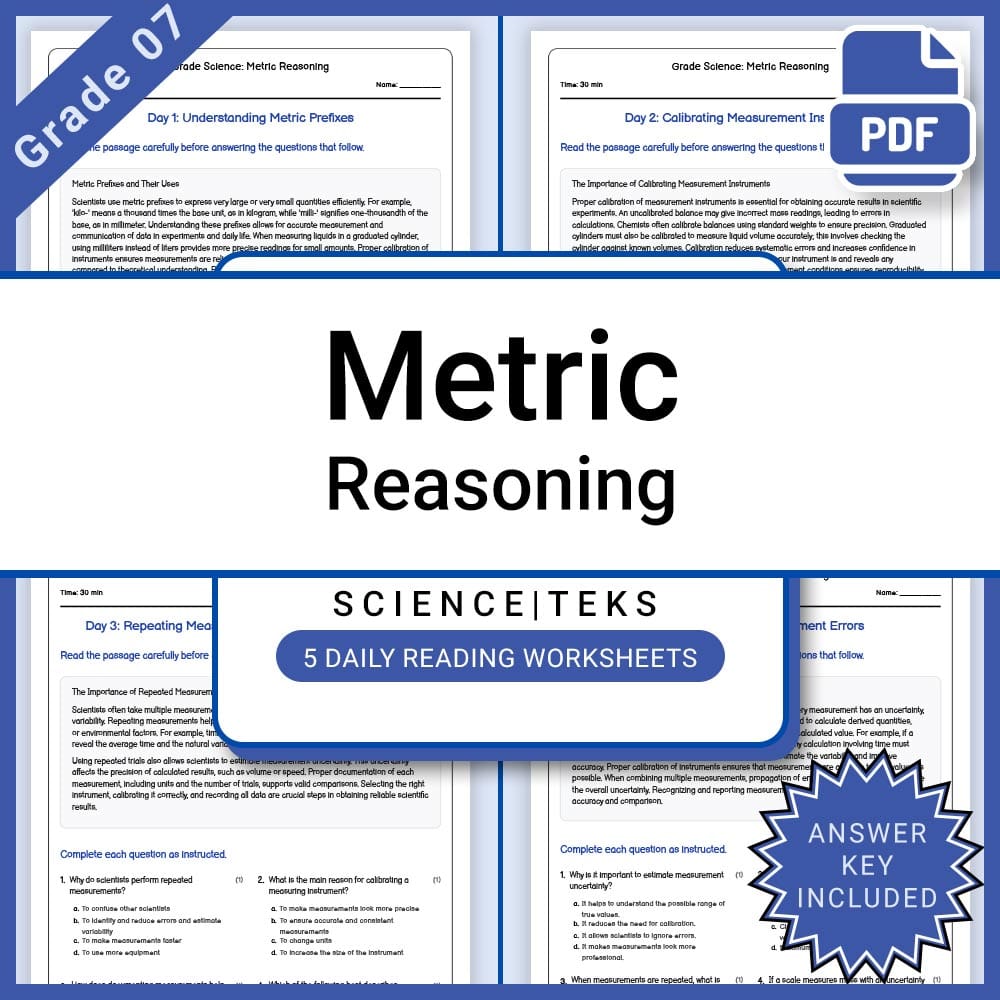
Grade 7 Science – Metric Reasoning Daily Reading Worksheet with Answer Key
JCreated byJ.S SheetsLearning Objectives
- Recognize and understand the use of metric prefixes in measurements.
- Convert between different metric units using prefixes.
- Learn proper calibration techniques for balances and measuring cylinders.
Also included in: Grade 7 Science Lesson Group TEKS Bundle | Daily Reading Worksheets +1 more
Instant download
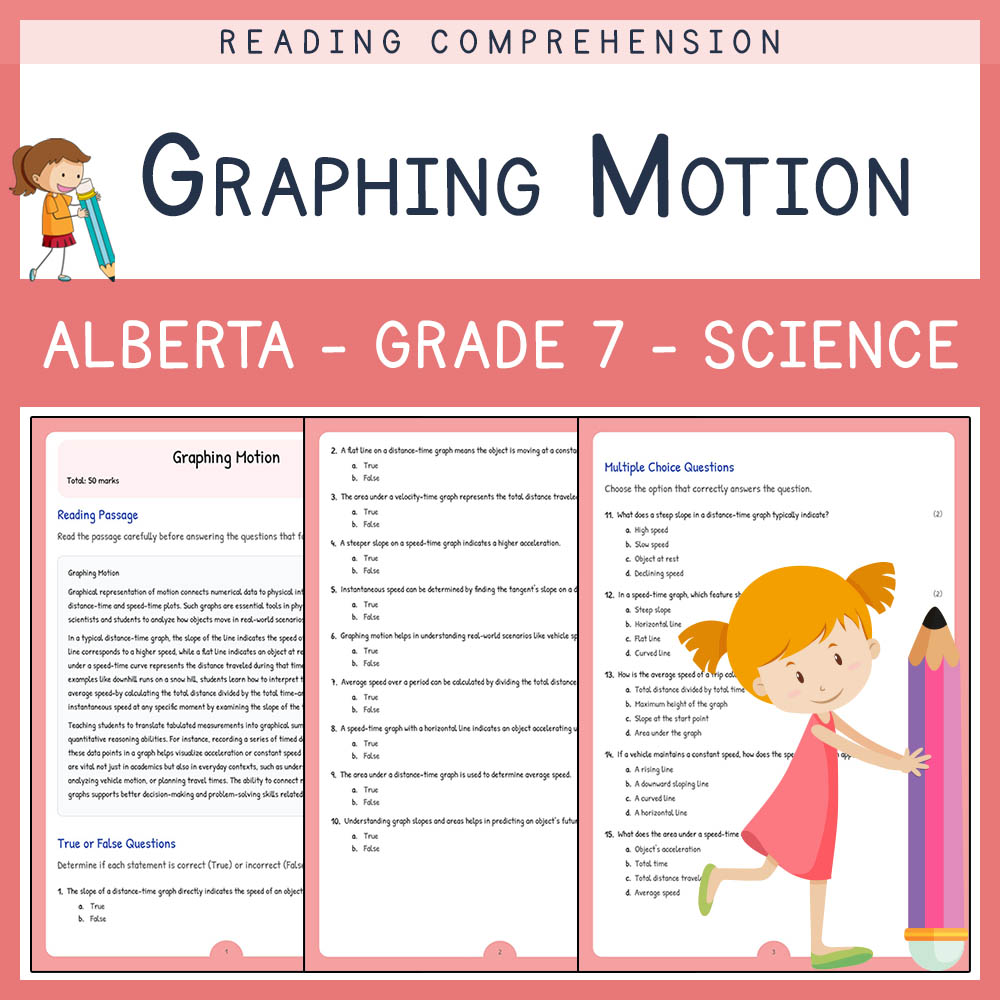
Grade 7 Science Assessment | Graphing Motion Worksheet | Alberta
Created byLumora LearningLearning Objectives
- Understand how to represent motion visually through distance–time and speed–time graphs.
- Interpret slope meanings in motion graphs to determine speed and rate of change.
- Learn methods to calculate average and instantaneous speeds from graphs.
Instant download
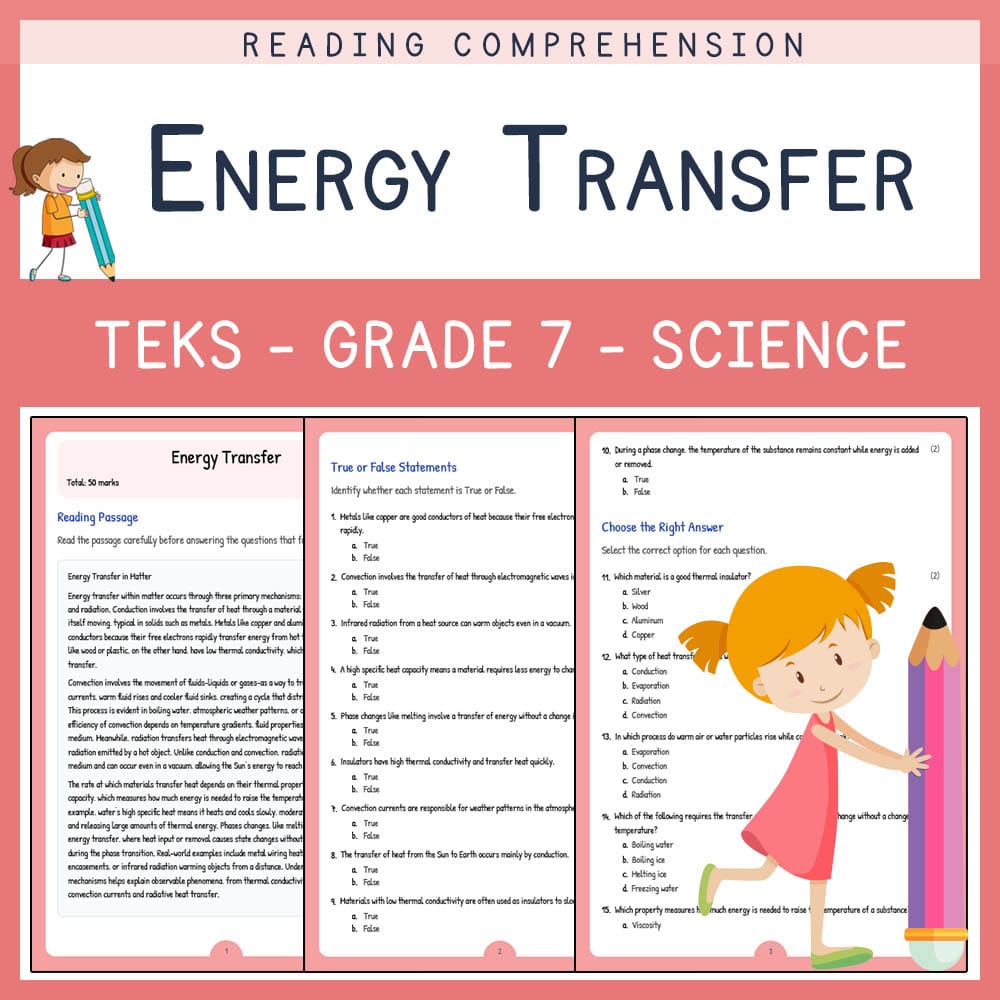
Grade 7 Science | Energy Transfer Worksheet | TEKS-Aligned
Created byLumora LearningLearning Objectives
- Explain the mechanisms of heat transfer: conduction, convection, and radiation.
- Relate energy transfer processes to real-world phenomena such as thermal conductivity differences and radiant warming.
- Describe how temperature gradients, specific heat, and phase changes influence energy flow.
Also included in: Grade 7 Science | Matter and Energy Lesson Bundle | TEKS Aligned
Instant download
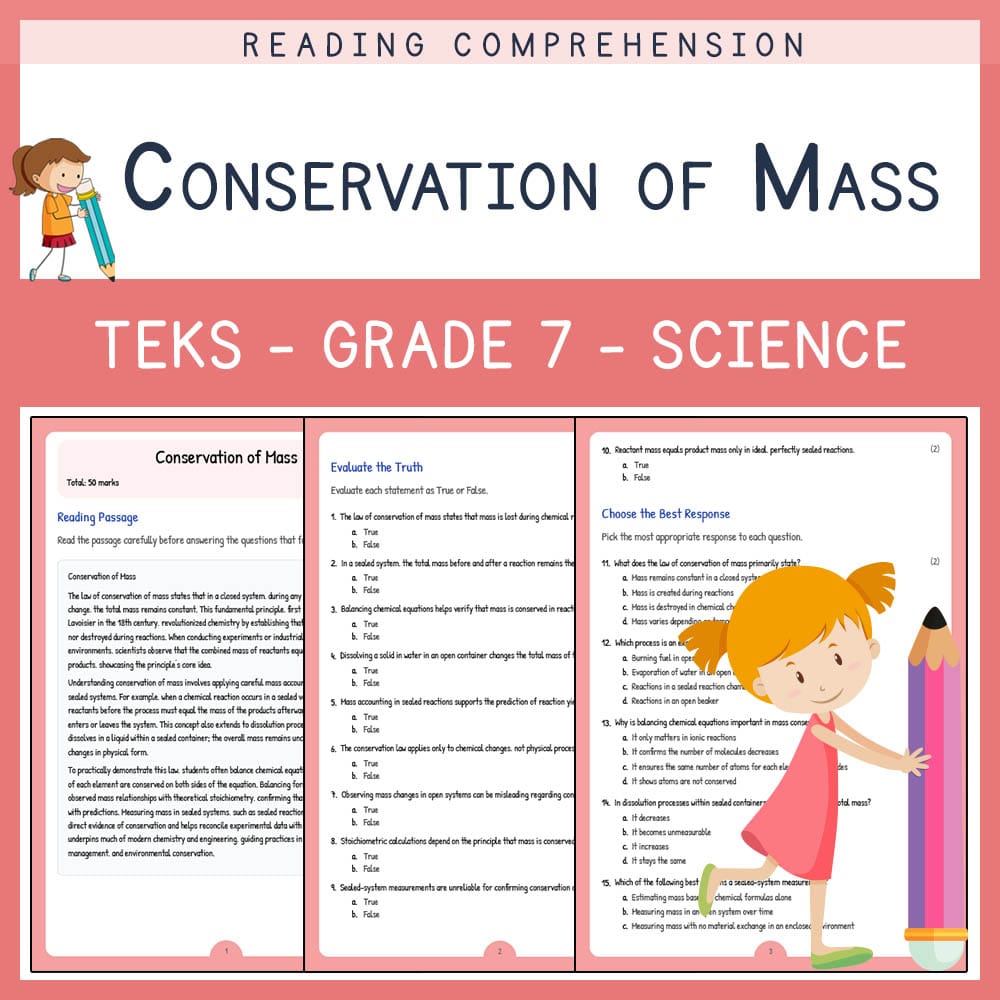
Grade 7 Science | Conservation of Mass Worksheet | TEKS-Aligned
Created byLumora LearningLearning Objectives
- Understand the principle of conservation of mass in physical and chemical transformations.
- Apply mass accounting techniques to reactions and dissolution processes.
- Balance simple chemical formulas to illustrate mass relationships.
Also included in: Grade 7 Science | Matter and Energy Lesson Bundle | TEKS Aligned
Instant download
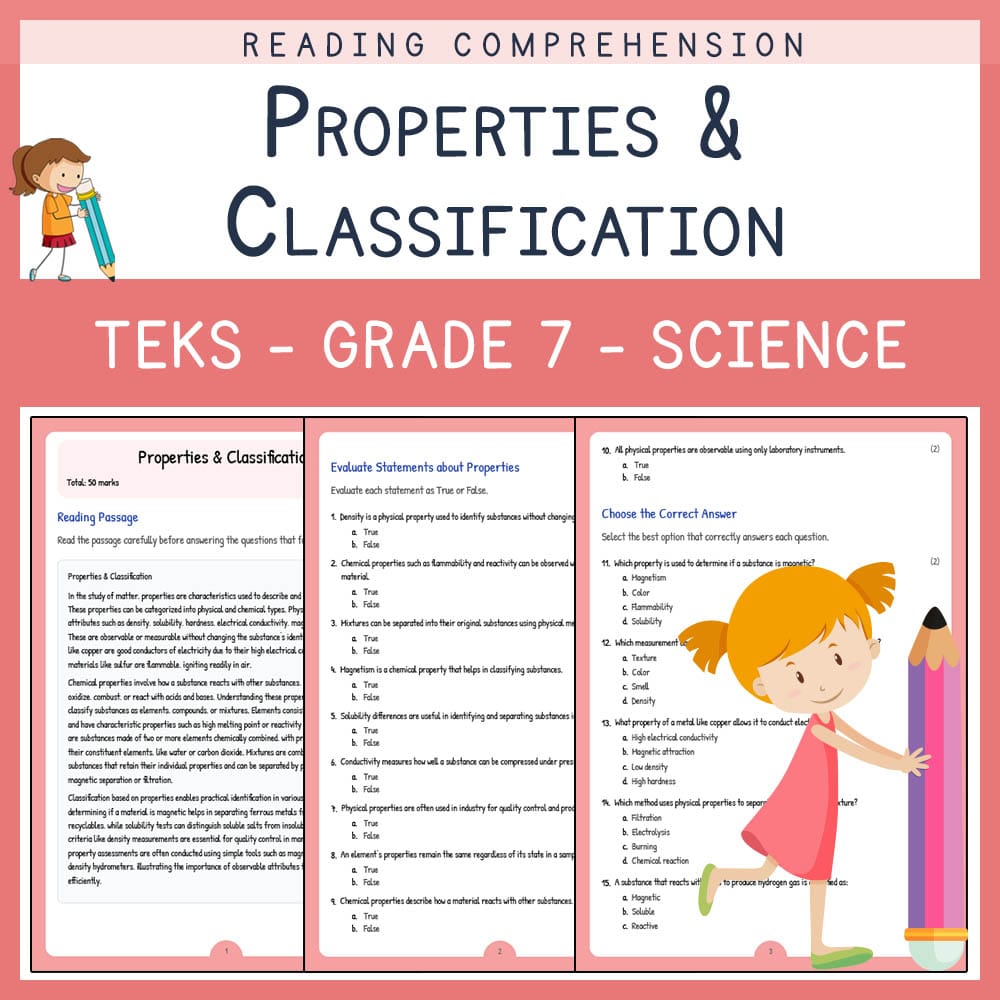
Grade 7 Science | Properties and Classification Worksheet | TEKS-Aligned
Created byLumora LearningLearning Objectives
- Define and differentiate between physical and chemical properties of substances.
- Identify measurable attributes such as density, solubility, hardness, and conductivity.
- Classify substances as elements, compounds, or mixtures based on their properties.
Also included in: Grade 7 Science | Matter and Energy Lesson Bundle | TEKS Aligned
Instant download
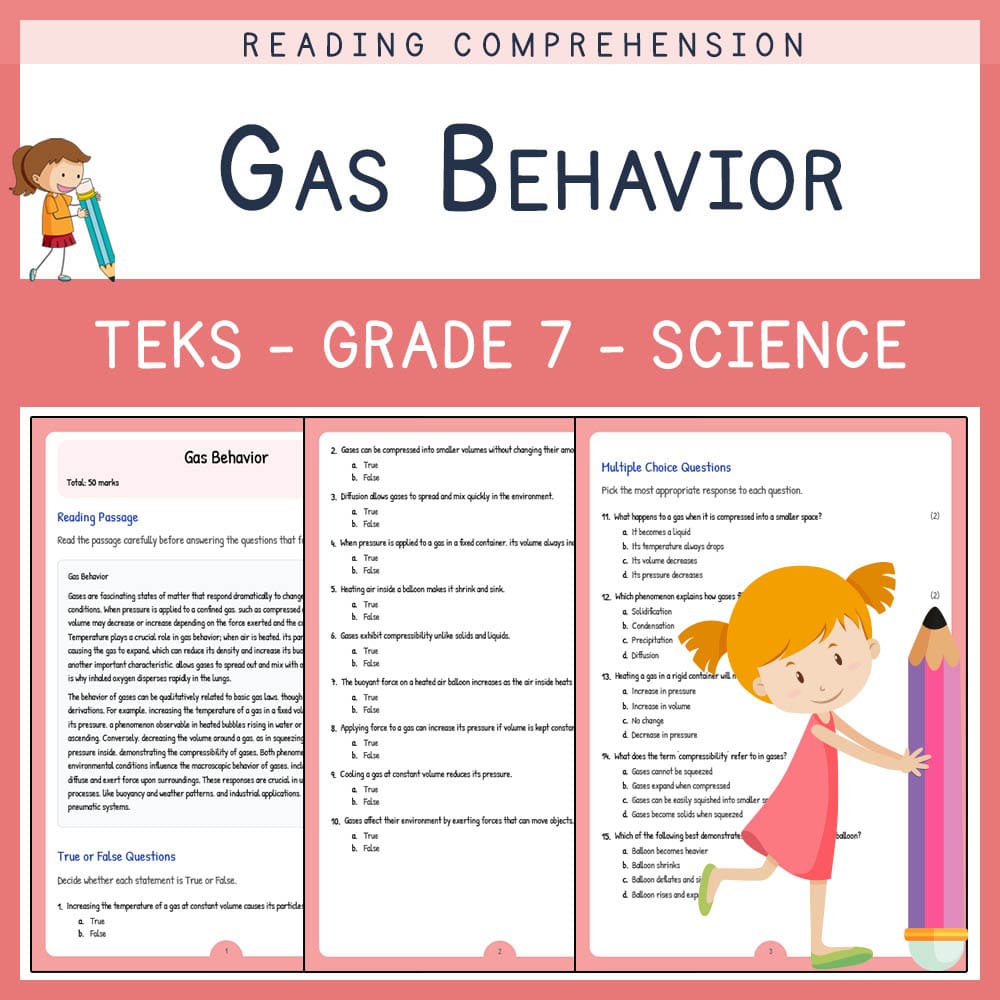
Grade 7 Science | Gas Behavior Worksheet | TEKS-Aligned
Created byLumora LearningLearning Objectives
- Describe qualitatively how pressure, volume, and temperature interrelate in gases.
- Explain phenomena such as diffusion and compressibility in gases.
- Relate macroscopic observations like pressure variation and buoyant behavior to gas responses.
Also included in: Grade 7 Science | Matter and Energy Lesson Bundle | TEKS Aligned
Instant download
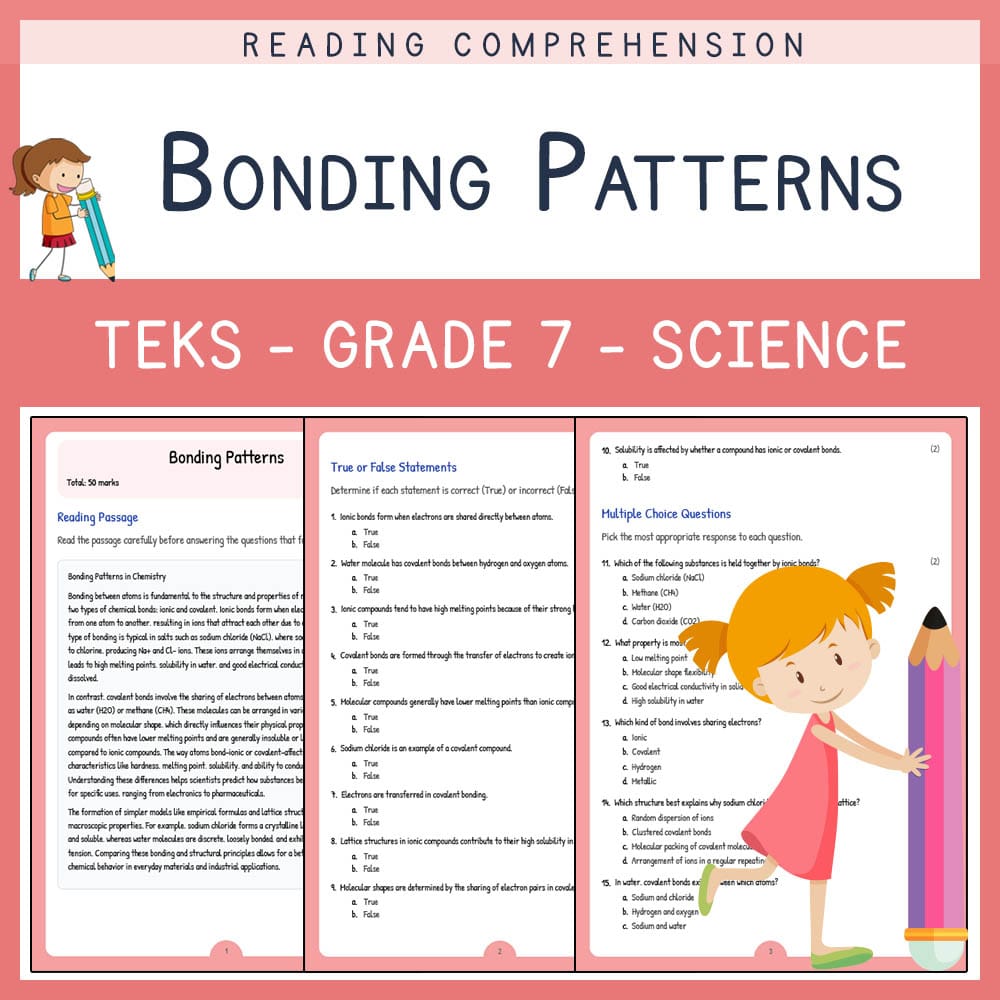
Grade 7 Science | Bonding Patterns Worksheet | TEKS-Aligned
Created byLumora LearningLearning Objectives
- Understand the differences between ionic and covalent bonding and their effects on macroscopic properties.
- Identify and describe simple formation of binary ionic salts and molecular compounds using empirical formulas.
- Relate bonding types to observable properties such as melting point, solubility, and electrical conductivity.
Also included in: Grade 7 Science | Matter and Energy Lesson Bundle | TEKS Aligned
Instant download
About Grade 7 Science Worksheets
Browse 6,039 printable Grade 7 Science worksheets — ready-to-print PDFs with answer keys where available.
Every worksheet on MyTeachingSheets is created by independent teacher-authors and reviewed before publication. All resources download as printable PDFs for classroom, homework, or at-home practice, and many include answer keys. Preview any worksheet free before buying.