
Grade 7 Science Worksheets
6,039 worksheets
Grade 7 Science – Physical Properties Daily Reading Worksheet + Answer Key
JCreated byJ.S SheetsLearning Objectives
- Define and describe the concepts of density and melting point.
- Compare and contrast the physical properties of different substances based on density and melting point.
- Recognize the importance of physical properties in identifying and separating materials.
Also included in: Grade 7 Science Lesson Group Bundle | States, Reactions & Properties +1 more
Instant download
Grade 7 Science – Material Selection Daily Reading Worksheet + Answer Key
JCreated byJ.S SheetsLearning Objectives
- Understand how physical and chemical properties influence material suitability
- Identify observable properties such as corrosion resistance, hardness, melting point, solubility, and reactivity
- Explain the importance of chemical stability and environmental considerations in material choice
Also included in: Grade 7 Science Lesson Group Bundle | States, Reactions & Properties +1 more
Instant download
Grade 7 Science – States of Matter Solids Daily Reading Worksheet + Answer Key
JCreated byJ.S SheetsLearning Objectives
- Understand the physical properties of solids.
- Identify how particles are arranged in solids.
- Learn how temperature and pressure affect the state of matter.
Also included in: Grade 7 Science Lesson Group Bundle | States, Reactions & Properties +1 more
Instant download
Grade 7 Science – Physical Changes | Daily Reading Worksheet + Answer Key
JCreated byJ.S SheetsLearning Objectives
- Define what a physical change is.
- Identify examples of physical changes in everyday life.
- Distinguish between physical and chemical changes.
Also included in: Grade 7 Science Lesson Group Bundle | States, Reactions & Properties +1 more
Instant download
Grade 7 Science – Understanding Mass and Measurement Daily Reading Worksheet + Answer Key
JCreated byJ.S SheetsLearning Objectives
- Learn the basic concepts of mass and why accurate measurement is important in science.
- Identify different tools used to measure mass and understand their functions.
- Explore how conservation of mass applies during chemical changes and physical processes.
Also included in: Grade 7 Science Lesson Group Bundle | States, Reactions & Properties +1 more
Instant download
Grade 7 Science – Predicting Reactions Daily Reading Worksheet + Answer Key
JCreated byJ.S SheetsLearning Objectives
- Identify physical and chemical properties of substances
- Understand how properties indicate reactivity
- Predict possible chemical reactions based on properties
Also included in: Grade 7 Science Lesson Group Bundle | States, Reactions & Properties +1 more
Instant download
7th Grade Science | Rock Strata Worksheet (PDF+ Answer Key)
 Created byCopper Leaf Classroom
Learning Objectives
- Understand the principles of relative dating such as superposition, original horizontality, and cross-cutting relationships.
- Identify and interpret various stratigraphic markers including fossils, unconformities, and intrusions.
- Analyze field observations and stratigraphic data to establish the sequence of geological events.
Instant download
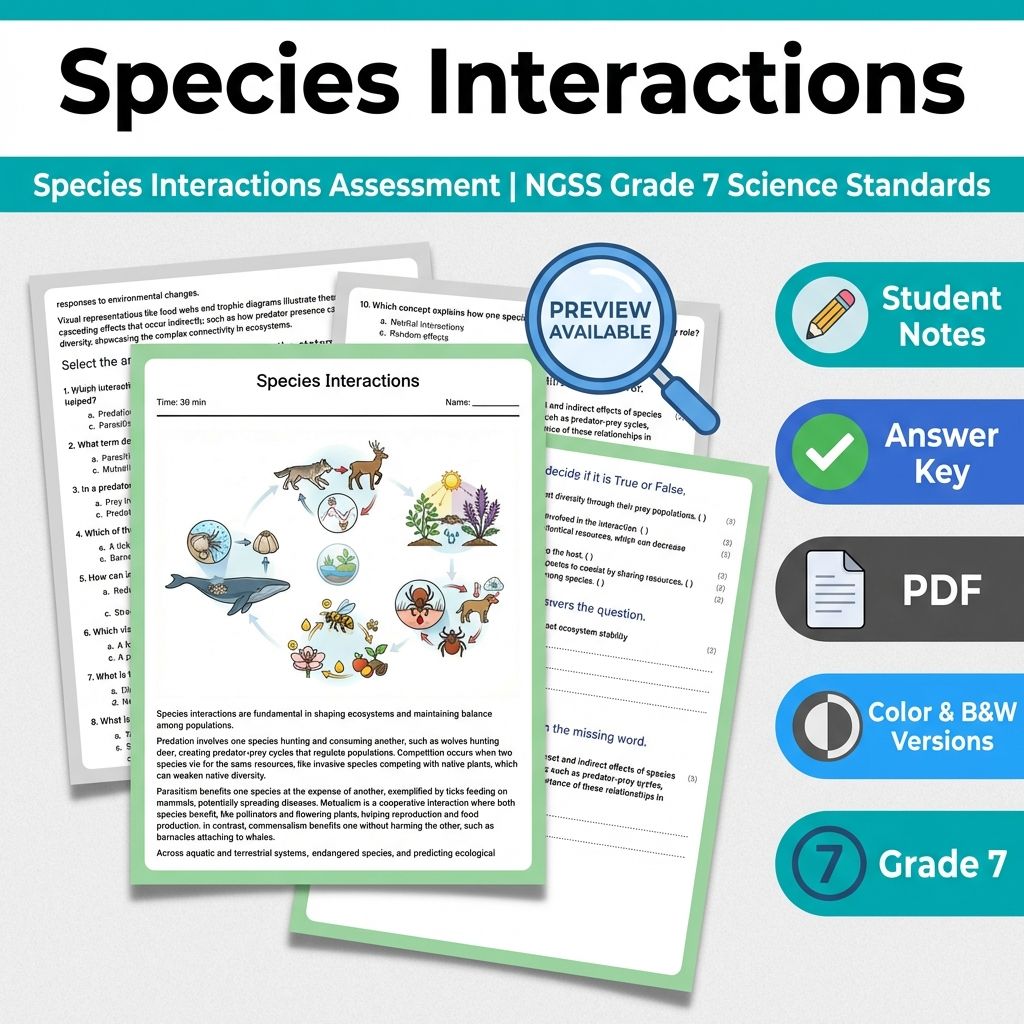
Species Interactions Assessment | NGSS Grade 7 Science Standards
 Created byPrism Point Learning
Learning Objectives
- Understand different types of species interactions such as predation, competition, parasitism, mutualism, and commensalism.
- Analyze influences of species behaviors on community structure and resource sharing in ecosystems.
- Interpret food webs, trophic diagrams, and interaction networks to evaluate direct and indirect effects.
Also included in: Grade 7 Science Mini Bundle | Ecosystems: Interactions & Energy – NGSS +1 more
Instant download
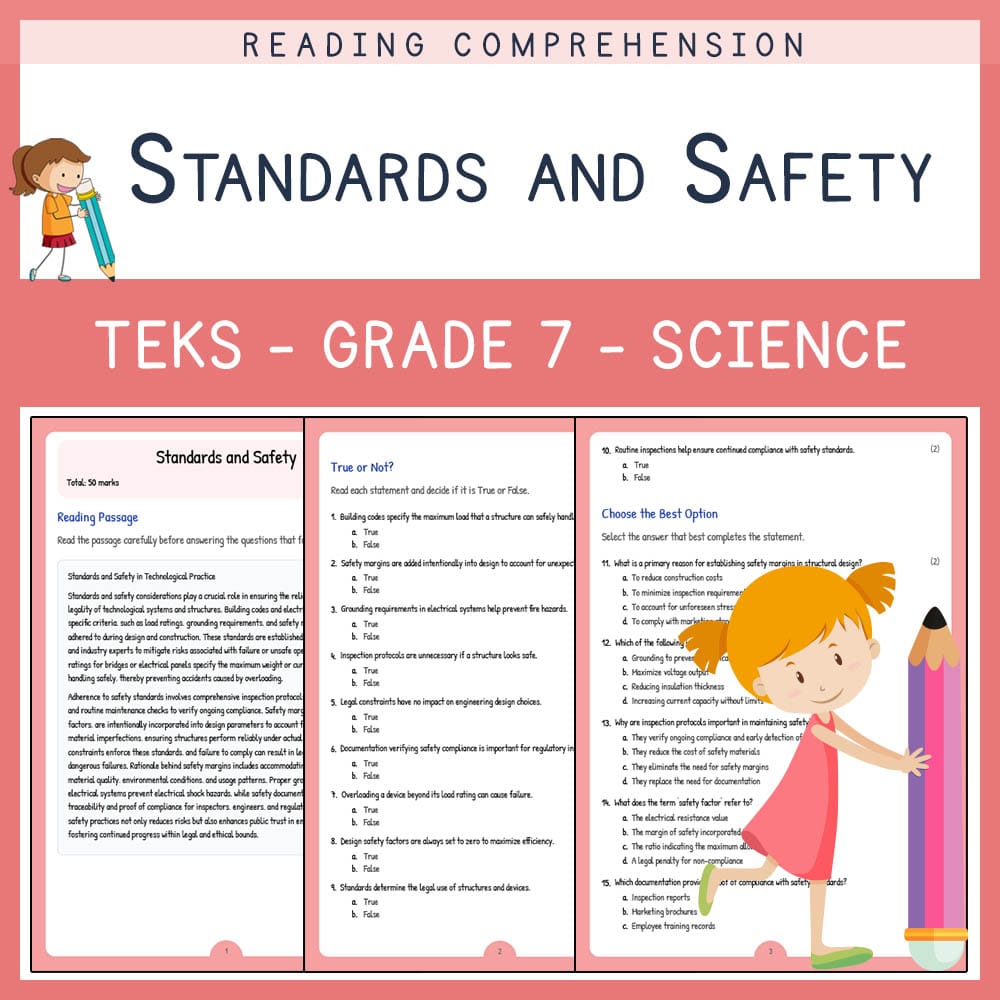
Grade 7 Science | Standards and Safety Worksheet | TEKS Alligned
 Created byLumora Learning
Learning Objectives
- Understand the role of building codes and safety standards in technological practice.
- Identify key safety measures such as grounding requirements and load ratings.
- Explain the importance of safety margins, inspection protocols, and documentation for safety compliance.
Instant download
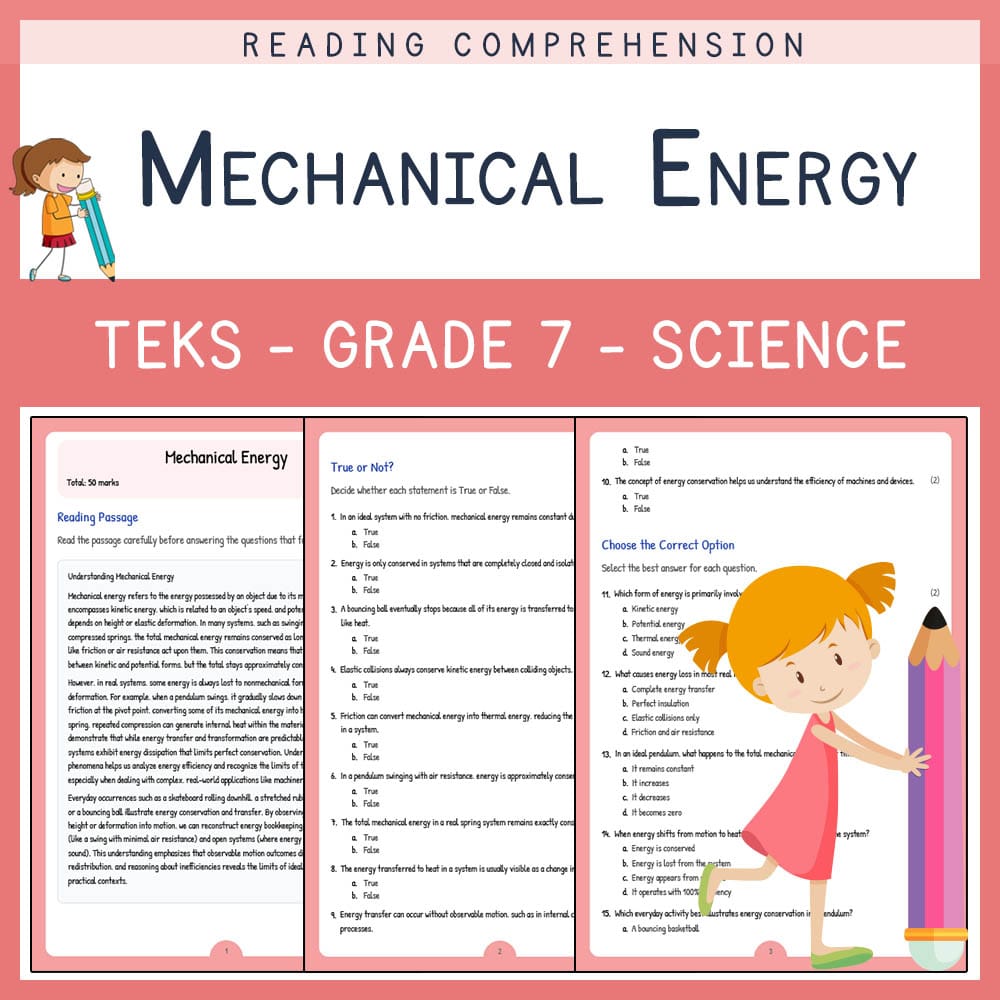
Grade 7 Science | Mechanical Energy Worksheet Elena | TEKS Alligned
Created byLumora LearningLearning Objectives
- Understand the principles of mechanical energy conservation.
- Describe energy transfer processes in pendulums and springs.
- Identify observable signs of energy loss to nonmechanical forms.
Also included in: Grade 7 Science | Force, Motion, and Energy Lesson Bundle | TEKS Aligned
Instant download
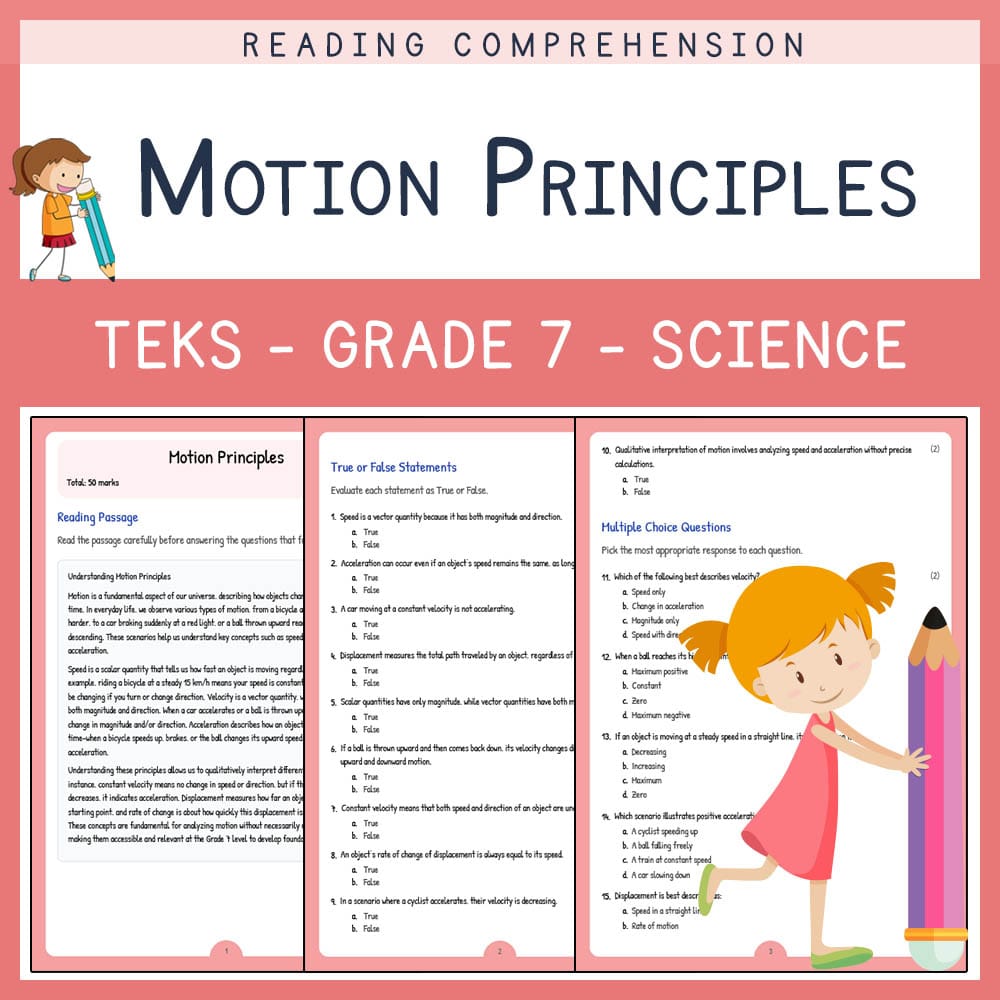
Grade 7 Science | Motion Principles Worksheet | TEKS Aligned
Created byLumora LearningLearning Objectives
- Understand and distinguish between speed, velocity, and acceleration through real-world examples.
- Identify scalar versus vector quantities in motion scenarios.
- Analyze how displacement, time, and rate of change relate in various motion contexts.
Also included in: Grade 7 Science | Force, Motion, and Energy Lesson Bundle | TEKS Aligned
Instant download
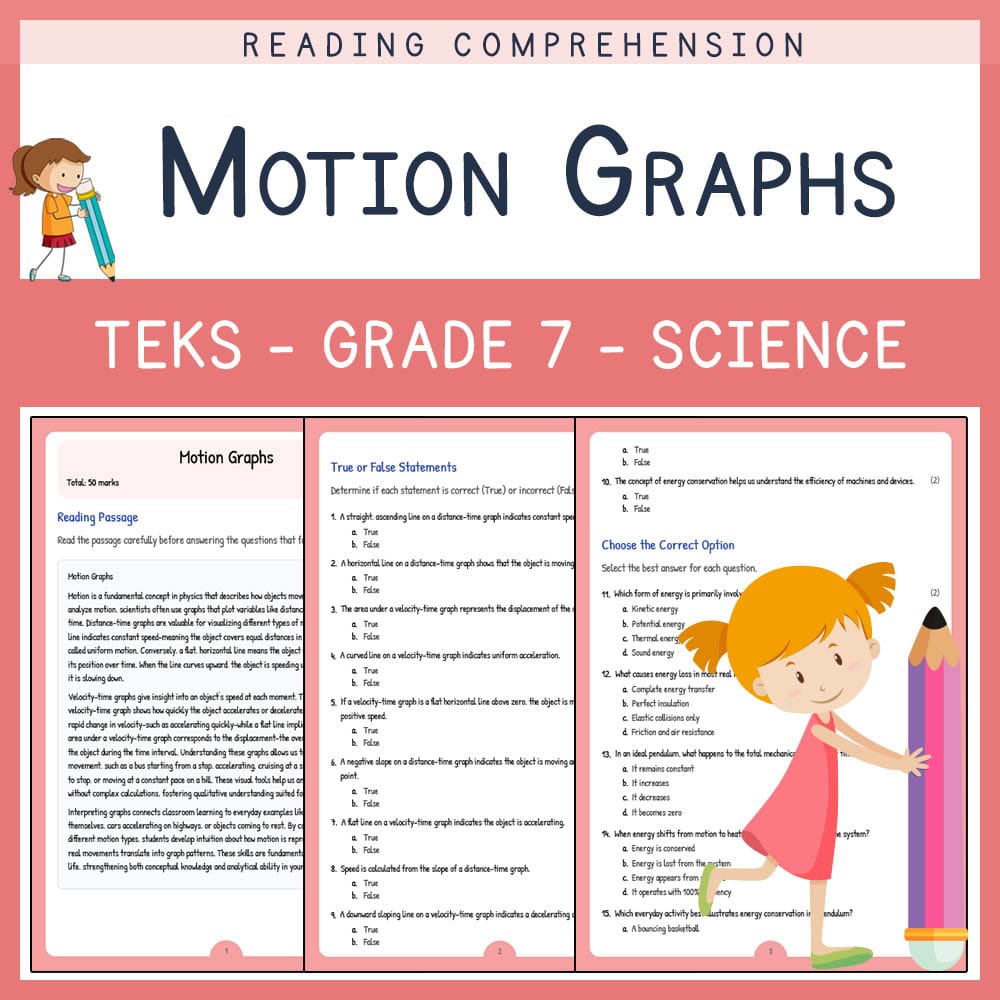
Grade 7 Science | Motion Graphs Worksheet | TEKS Aligned
Created byLumora LearningLearning Objectives
- Interpret distance–time graphs to describe types of motion, including uniform motion, acceleration, and rest.
- Understand velocity–time graphs and relate slopes to speed and area under curves to displacement.
- Compare different graphs qualitatively and connect graphical patterns to real-world motion scenarios.
Also included in: Grade 7 Science | Force, Motion, and Energy Lesson Bundle | TEKS Aligned
Instant download
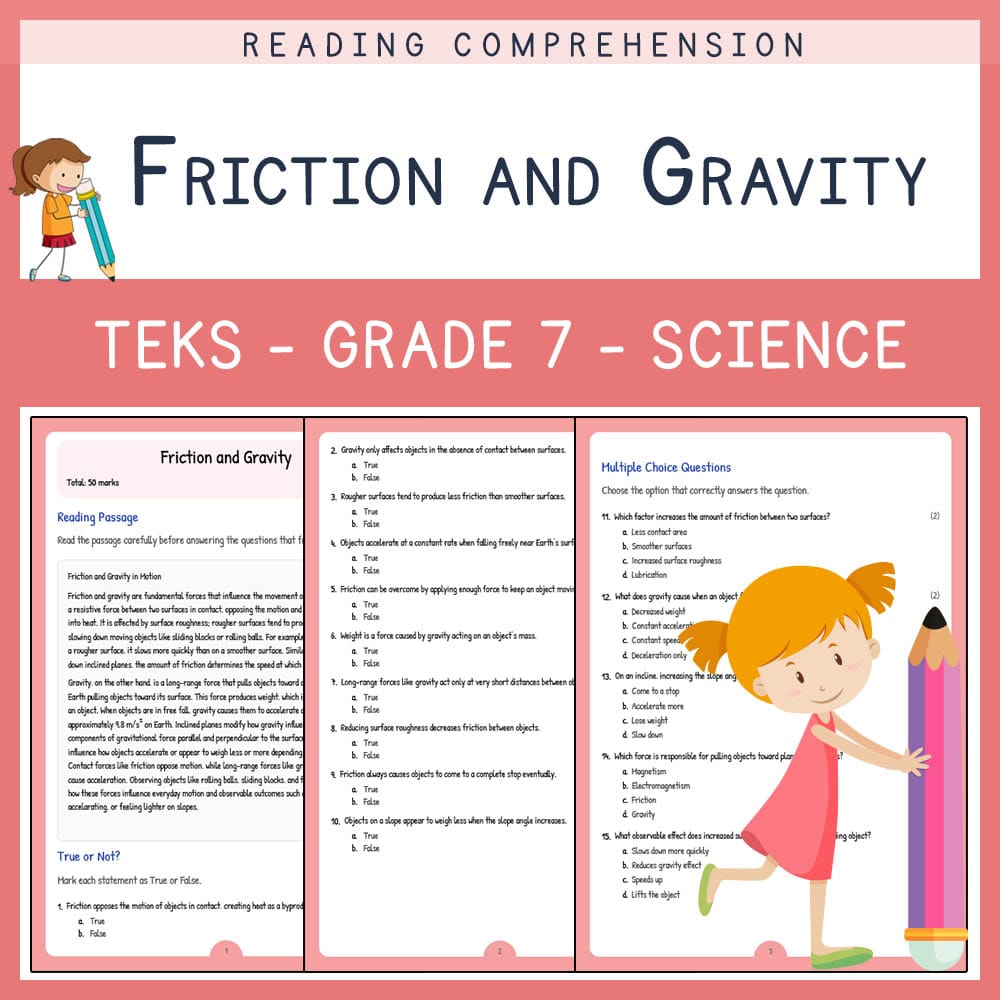
Grade 7 Science | Friction and Gravity Worksheet | TEKS Aligned
Created byLumora LearningLearning Objectives
- Understand how friction opposes motion and how surface roughness influences resistance.
- Describe how gravity affects objects in free fall and on inclined planes.
- Differentiate between contact forces like friction and long-range forces like gravity.
Also included in: Grade 7 Science | Force, Motion, and Energy Lesson Bundle | TEKS Aligned
Instant download
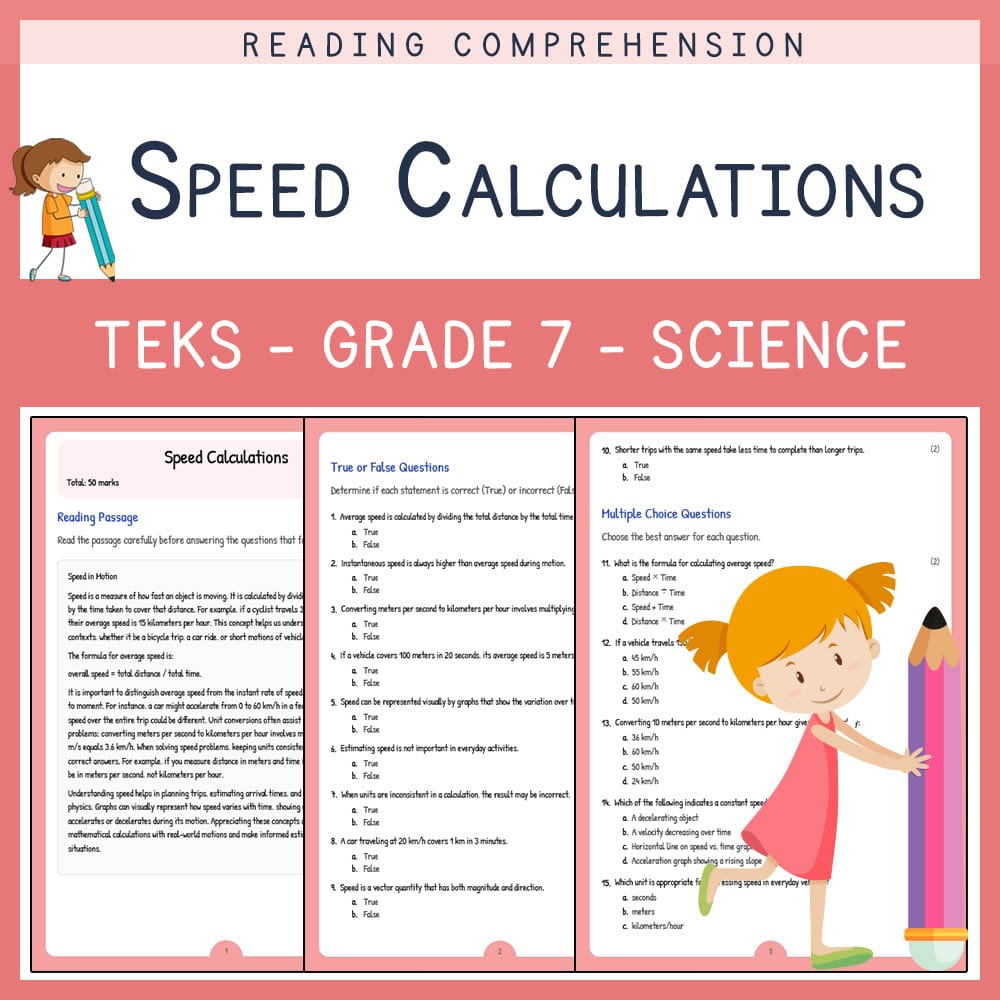
Grade 7 Science | Speed Calculations Worksheet | TEKS-Aligned
Created byLumora LearningLearning Objectives
- Understand how to compute average speed using distance and time data.
- Differentiate between average speed and instantaneous rate.
- Apply unit conversions between meters per second and kilometers per hour.
Also included in: Grade 7 Science | Force, Motion, and Energy Lesson Bundle | TEKS Aligned
Instant download
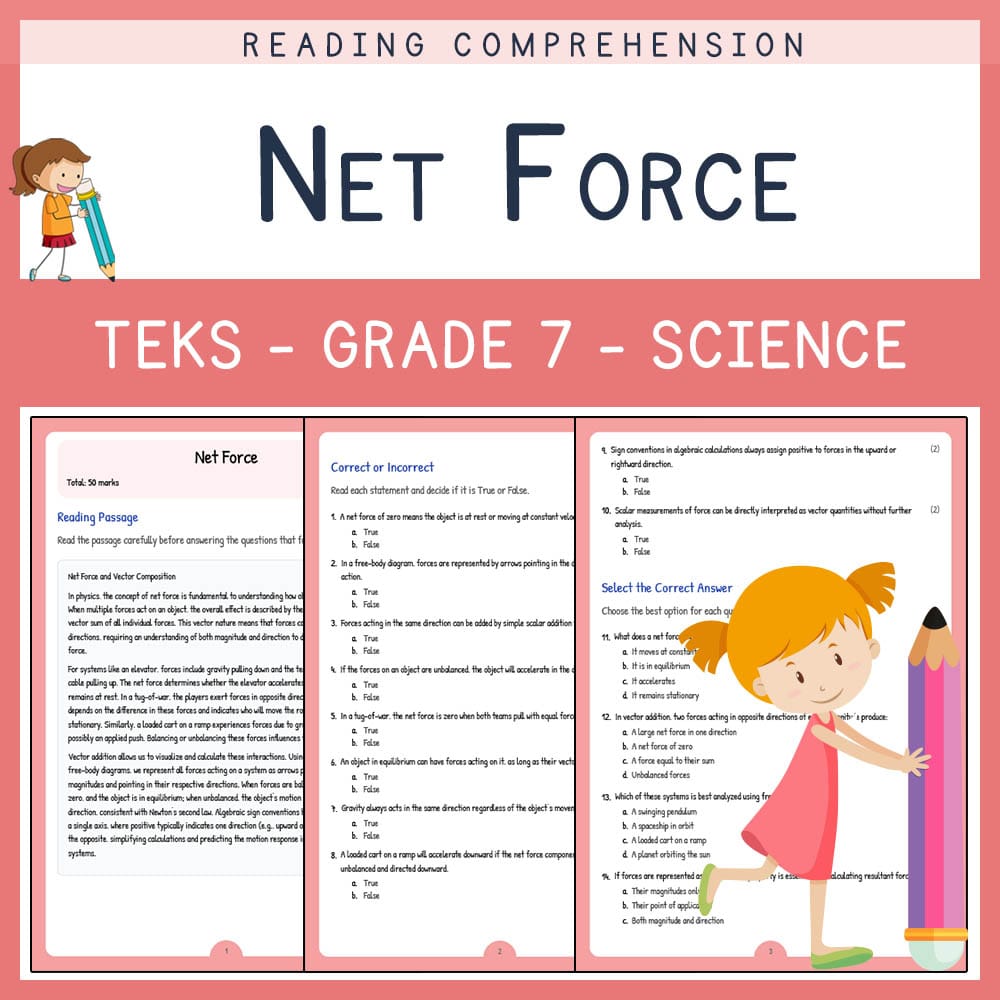
Grade 7 Science | Net Force Worksheet | TEKS-Aligned
Created byLumora LearningLearning Objectives
- Understand how forces combine using vector addition to determine net force.
- Interpret free-body diagrams to analyze systems like elevators, tug-of-war, and loaded carts.
- Apply algebraic sign conventions to solve for net force in one-dimensional systems.
Also included in: Grade 7 Science | Force, Motion, and Energy Lesson Bundle | TEKS Aligned
Instant download
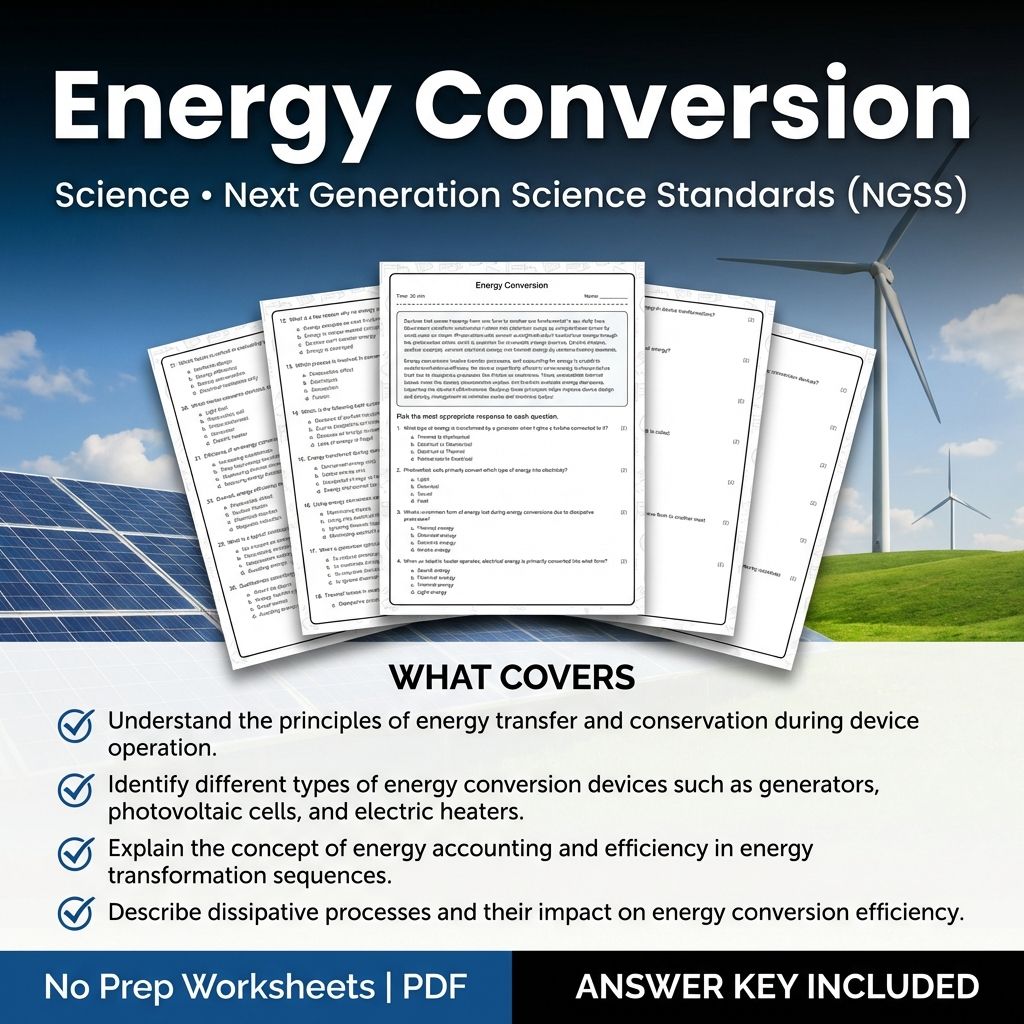
7th Grade Science | Energy Conversion Worksheet & Answer Key (Printable PDF)
 Created byCoral Reef Learning
Learning Objectives
- Understand the principles of energy transfer and conservation during device operation.
- Identify different types of energy conversion devices such as generators, photovoltaic cells, and electric heaters.
- Explain the concept of energy accounting and efficiency in energy transformation sequences.
Instant download
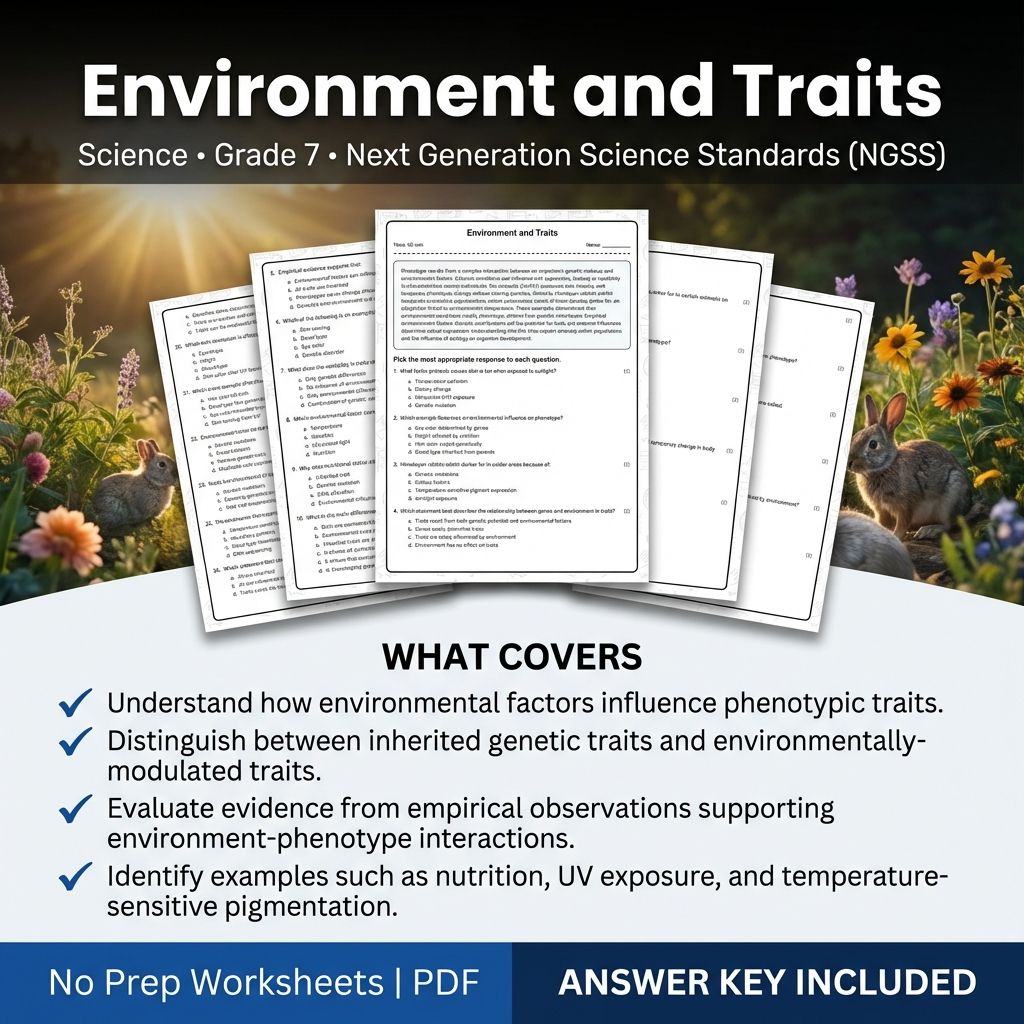
7th Grade Science | Environment and Traits Worksheet & Answer Key (Printable PDF)
Created byCoral Reef LearningLearning Objectives
- Understand how environmental factors influence phenotypic traits.
- Distinguish between inherited genetic traits and environmentally-modulated traits.
- Evaluate evidence from empirical observations supporting environment-phenotype interactions.
Instant download

Grade 7 Science | Energy Transfer Overview - Daily Reading Comprehension
Created byCoral Reef LearningLearning Objectives
- Define energy transfer and transformation.
- Identify examples of energy transfer in daily life.
- Explain the difference between energy flow and energy transformation.
Instant download

Metric Reasoning Worksheet | Standards-Aligned Grade 7 Science Practice
JCreated byJ.S SheetsLearning Objectives
- Use metric prefixes and unit analysis to report measurements with appropriate numerical precision and units
- Explain how calibration and instrument choice affect measurement accuracy and uncertainty
- Estimate variability using repeating trials and incorporate uncertainty into calculations
Instant download
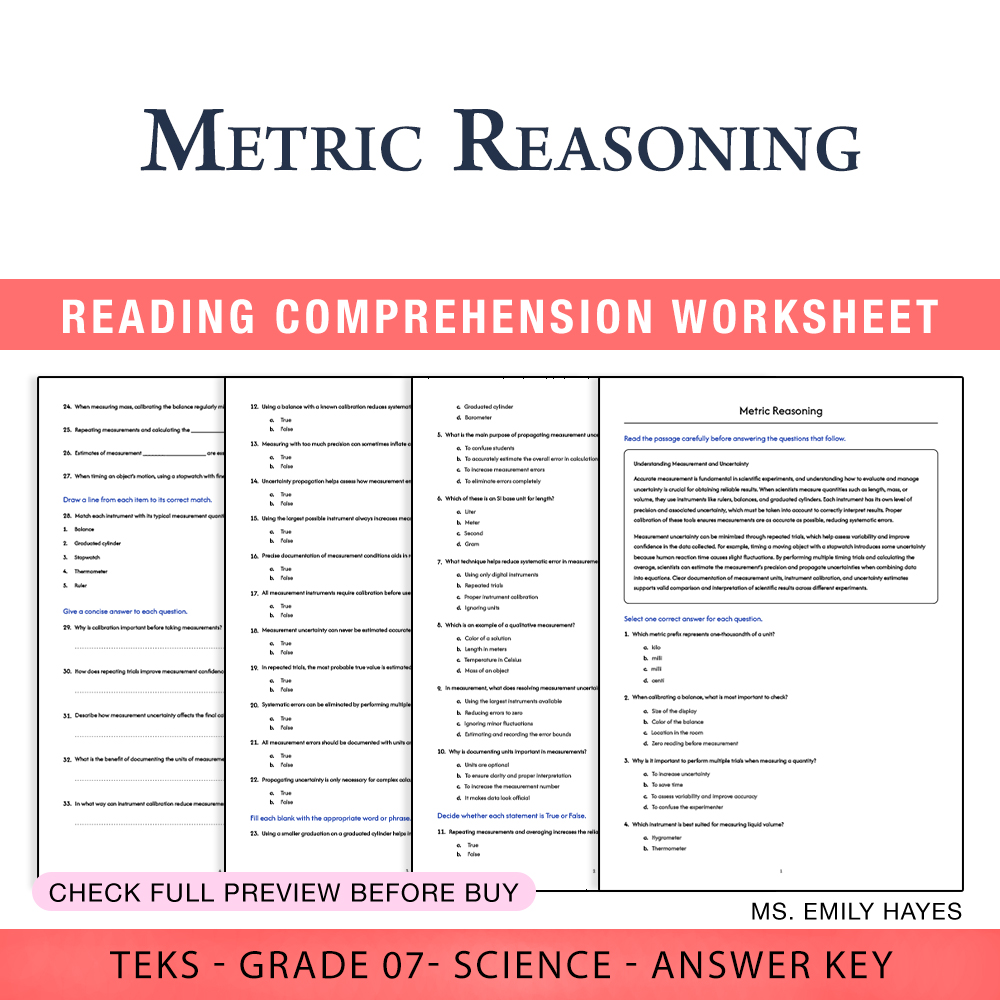
7th Grade Science | Metric Reasoning Worksheet (PDF+ Answer Key)
Created byCopper Leaf ClassroomLearning Objectives
- Understand measurement precision and propagate measurement uncertainties.
- Learn how to select appropriate measurement instruments and calibrate them.
- Apply concepts of repeating trials and documenting units for reliable data.
Instant download

Grade 7 Calorimetry Variables & Heat Transfer Science Worksheet Alberta
 Created byBRIGHT PATH RESOURCES
Learning Objectives
- Identify key variables in a calorimetry situation (mass, temperature change, and specific heat) and explain what each one means
- Relate rising or falling temperature to heat absorbed or released in a calorimetry setup
Also included in: Grade 7 Alberta Science Energy Heat and Thermal Processes Worksheet Bundle +1 more
Instant download
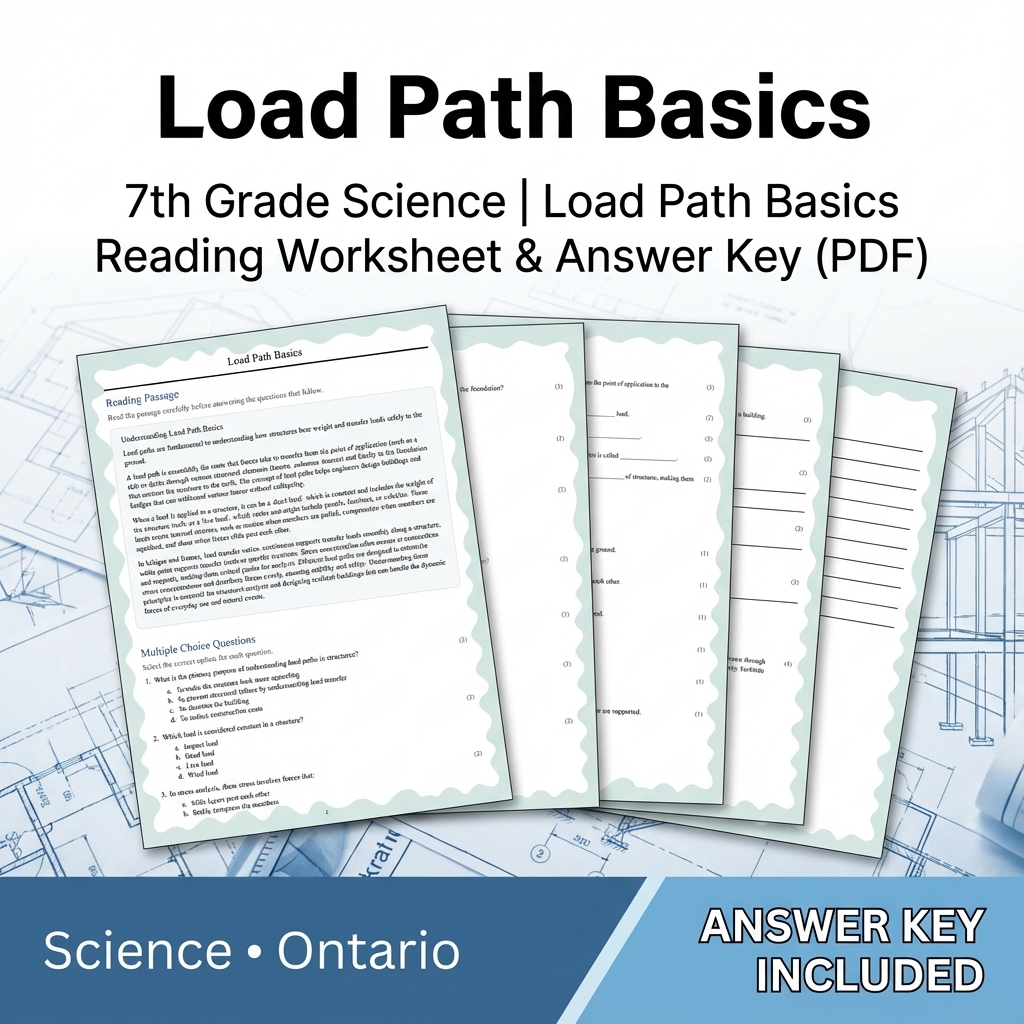
7th Grade Science | Load Path Basics Reading Worksheet & Answer Key (PDF)
JCreated byJ.S SheetsLearning Objectives
- Define the primary structural elements involved in load transfer within structures.
- Distinguish between dead loads and live loads and explain how they affect structures.
- Identify the types of stress—tension, compression, shear—in structural members.
Also included in: Grade 7 Science Unit Bundle – Structural Engineering & Material Testing +1 more
Instant download

Science Grade 7: Solution Comparison Worksheet | NGSS Assessment
 Created bySkylark Worksheets
Learning Objectives
- Compare competing design solutions by using consistent metrics and model-based reasoning.
- Identify and quantify trade-offs among performance, cost, durability, and manufacturability.
- Use predicted vs. observed behavior from simple prototypes to rank options and document limitations.
Also included in: Grade 7 Engineering Design Science Lesson Bundle: NGSS +1 more
Instant download

States of Matter Worksheet Grade 7 Science | Matter and Phase Changes
Created byPrism Point LearningLearning Objectives
- Explain how energy transfer during phase changes affects particle motion and arrangement
- Distinguish melting, freezing, evaporation, and condensation using the particle model
- Describe why temperature stays relatively steady during a phase change
Instant download
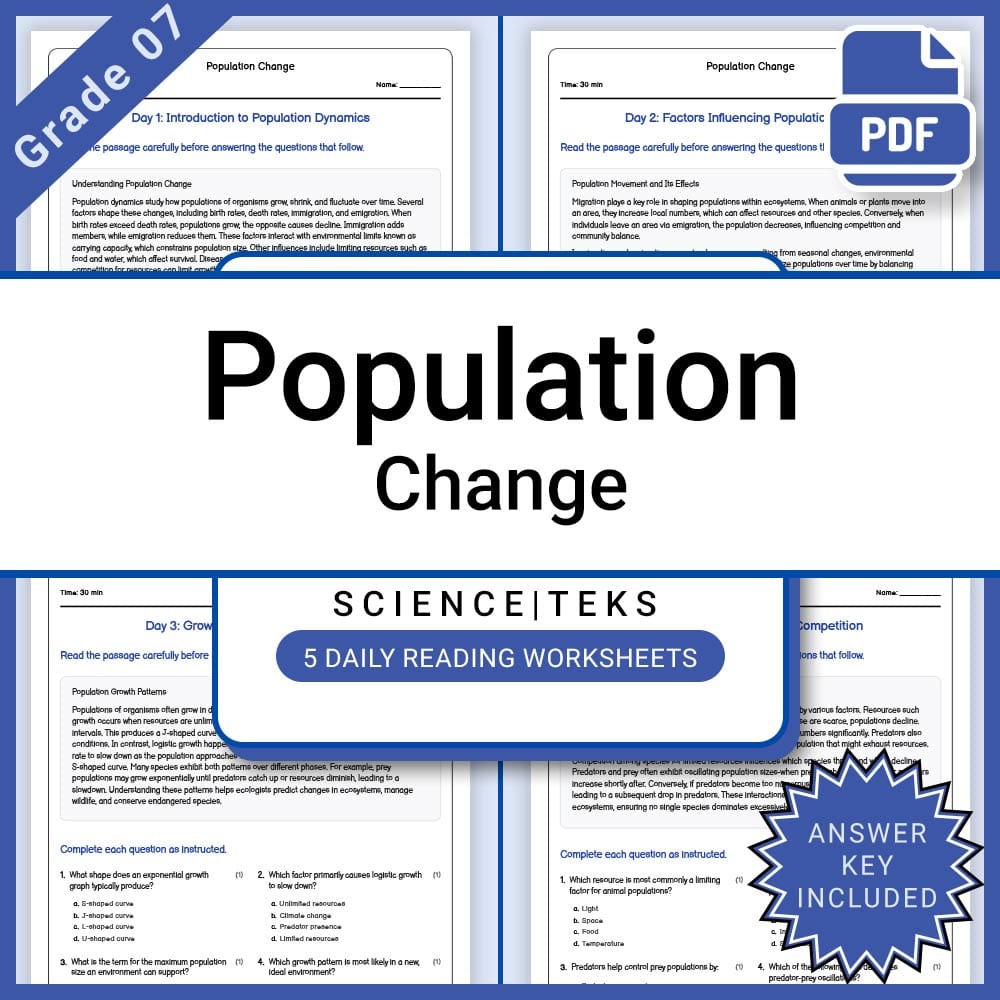
Grade 7 Science – Population Change Daily Reading Worksheet with Answer Key
JCreated byJ.S SheetsLearning Objectives
- Understand the key factors that influence population size and distribution.
- Differentiate between exponential and logistic growth patterns.
- Identify how predator-prey relationships affect population oscillations.
Also included in: Grade 7 Science Lesson Bundle | Ecosystems, Cell Structure & Adaptations +1 more
Instant download
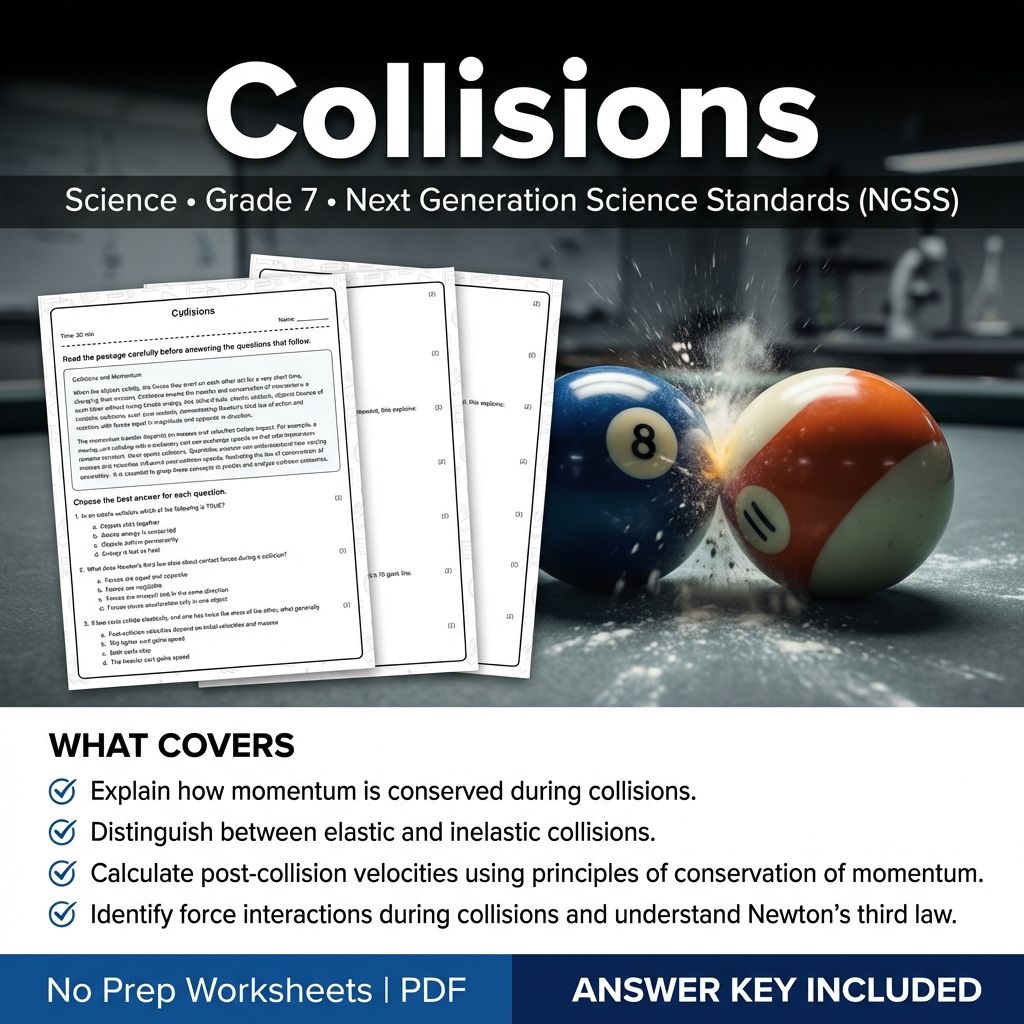
7th Grade Science | Collisions Worksheet & Answer Key (Printable PDF)
Created byCoral Reef LearningLearning Objectives
- Explain how momentum is conserved during collisions.
- Distinguish between elastic and inelastic collisions.
- Calculate post-collision velocities using principles of conservation of momentum.
Instant download
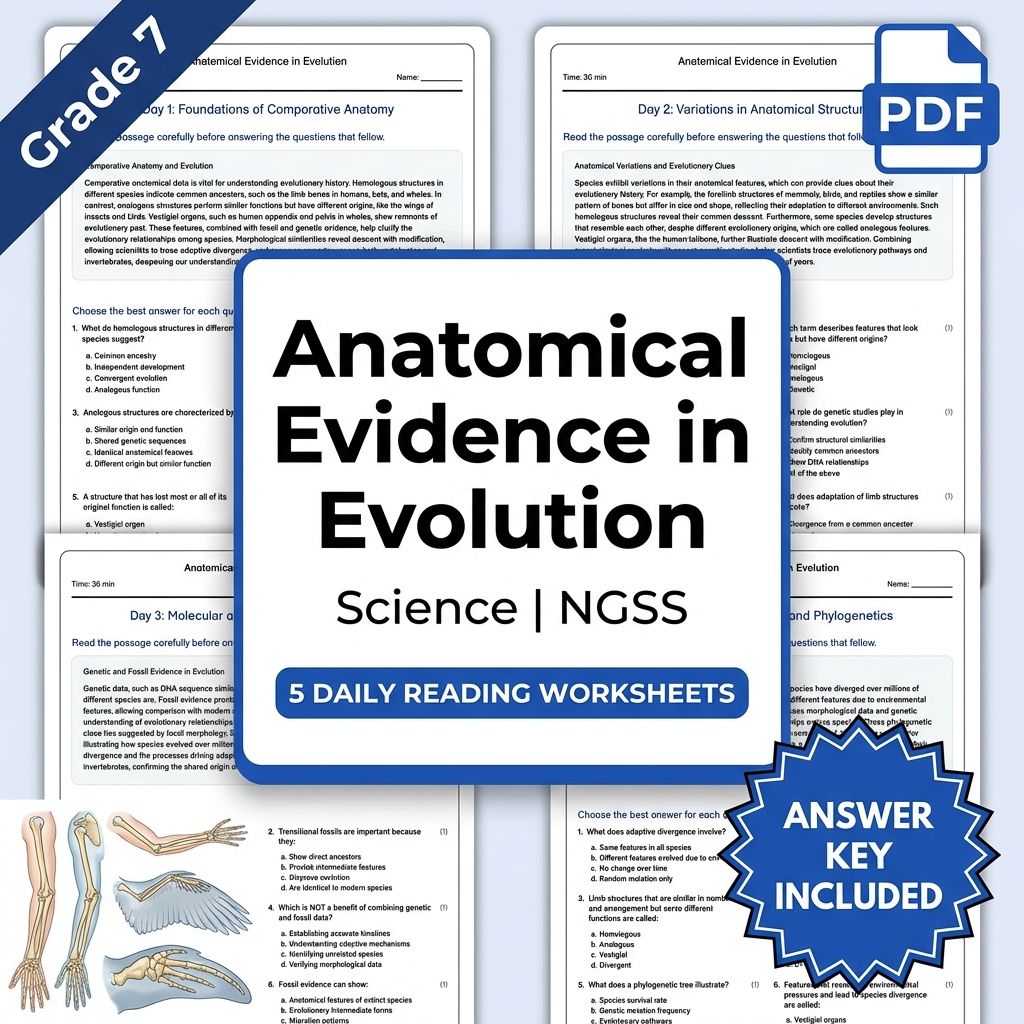
7th Grade Science | Anatomical Evidence in Evolution (PDF + Answer Key)
Created byCopper Leaf ClassroomLearning Objectives
- Understand how comparative anatomy provides evidence for evolution.
- Identify homologous and analogous structures in different species.
- Examine morphological features like limb bones, skulls, and vestigial organs.
Instant download

Grade 7 Science – Levels of Organization & Ecosystems | Daily Reading Worksheet
 Created byBright Mind Resources
Learning Objectives
- Understand the hierarchy of biological organization from cells to ecosystems.
- Identify roles of producers, consumers, and decomposers within food webs.
- Explain how energy flows through trophic levels.
Also included in: Grade 7 Ecosystems & Adaptations Science Daily Reading Lesson Bundle | TEKS +2 more
Instant download

Physical Properties Test Prep Printables | Grade 7 Science
Created byPrism Point LearningLearning Objectives
- Identify physical properties that can be measured to help classify and sort substances.
- Explain how density and solubility describe materials and how they support separating mixtures.
- Use physical property information to make predictions about materials in real-world situations.
Also included in: Matter & Chemical Change Lesson Bundle — Grade 7 Science British Columbia +1 more
Instant download
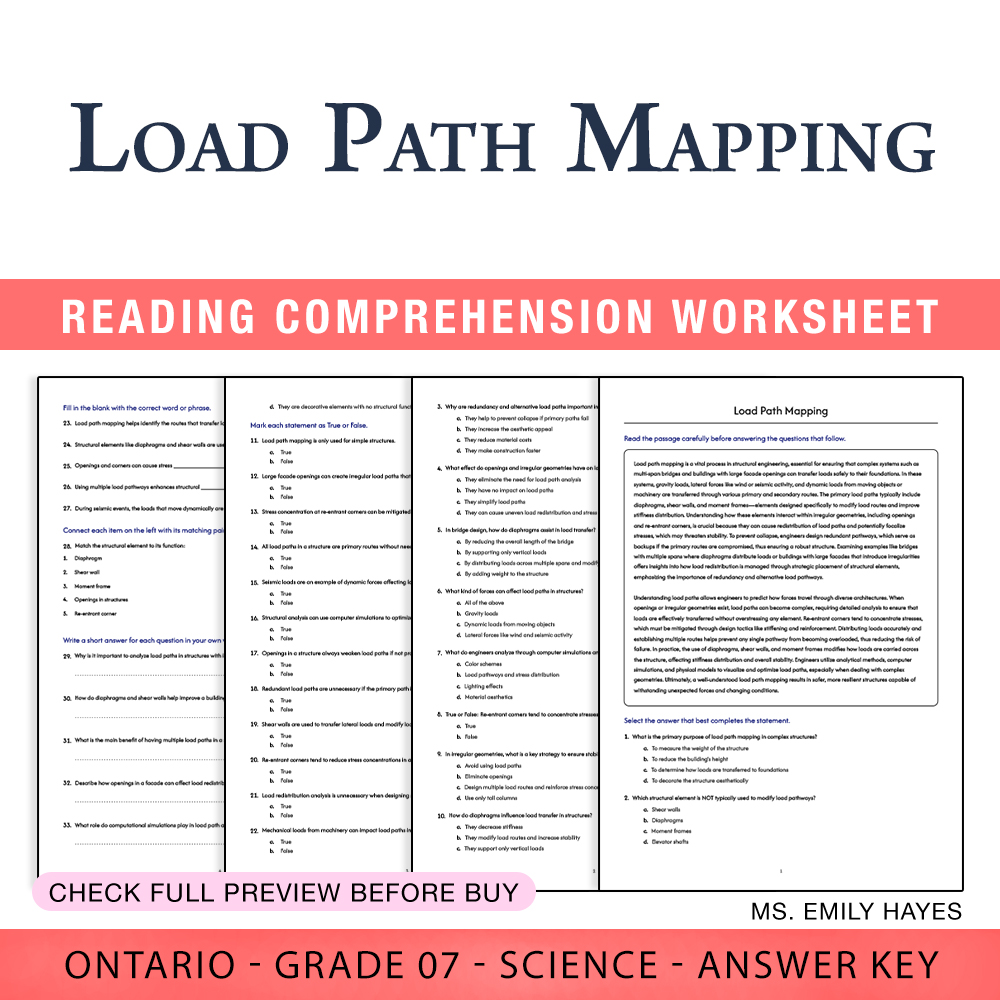
7th Grade Science | Load Path Mapping Worksheet (PDF+ Answer Key)
Created byCopper Leaf ClassroomLearning Objectives
- Understand methods for mapping load paths in complex structures.
- Identify primary and secondary load routes transferring various loads to foundations.
- Analyze how openings, corners, and irregular geometries affect load redistribution.
Instant download
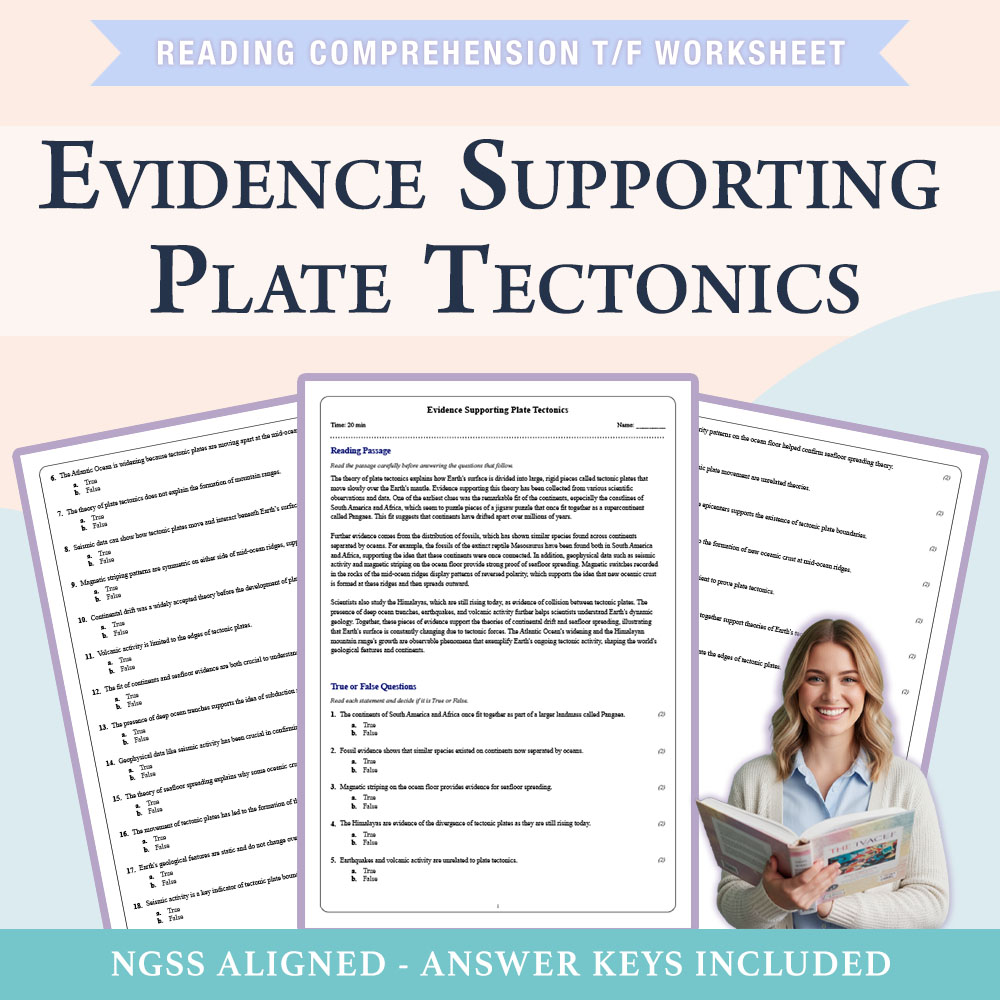
7th Grade Science | Evidence Supporting Plate Tectonics Worksheet (PDF +Answers)
Created byCopper Leaf ClassroomLearning Objectives
- Understand the evidence that supports the theory of plate tectonics
- Identify key geological and geophysical data related to Earth's tectonic activity
- Explain how evidence such as fossils, seafloor spreading, and seismic data support continental drift
Instant download
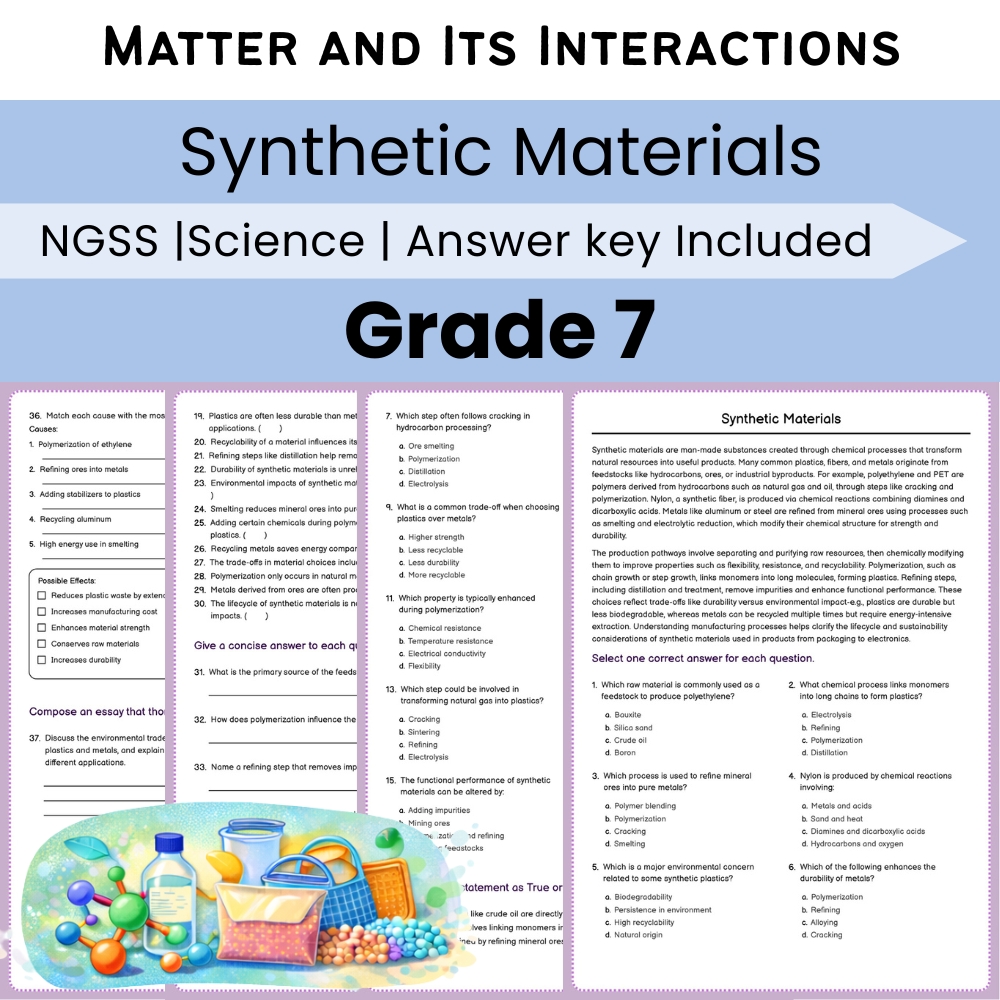
Synthetic Materials Worksheet | Grade 7 Science Printable PDF Assessment
Learning Objectives
- Describe the production pathways of common synthetic materials from natural resources.
- Explain processes such as polymerization and refining steps that alter chemical composition.
- Identify examples like polyethylene, PET, nylon, and how materials are derived from feedstocks.
Also included in: Grade 7 Science Lesson Bundle – Matter and Its Interactions NGSS-Aligned +1 more
Instant download

Grade 7 Trophic Energy Flow Through Ecosystems Worksheet | Ontario Science
 Created byTeacher's Corner
Learning Objectives
- Describe how solar energy captured by primary producers becomes energy available to consumers through trophic levels.
- Calculate and interpret trophic efficiency patterns using given percentage values and energy/biomass examples.
- Explain why energy availability decreases at higher trophic levels using respiration and heat losses.
Instant download

Mixtures And Purity Worksheet | Grade 7 Science | Standards-Aligned Practice
JCreated byJ.S SheetsLearning Objectives
- Understand the difference between mixtures and pure substances.
- Identify the types of mixtures: homogeneous and heterogeneous.
- Learn how physical properties enable separation methods like filtration, evaporation, and distillation.
Instant download
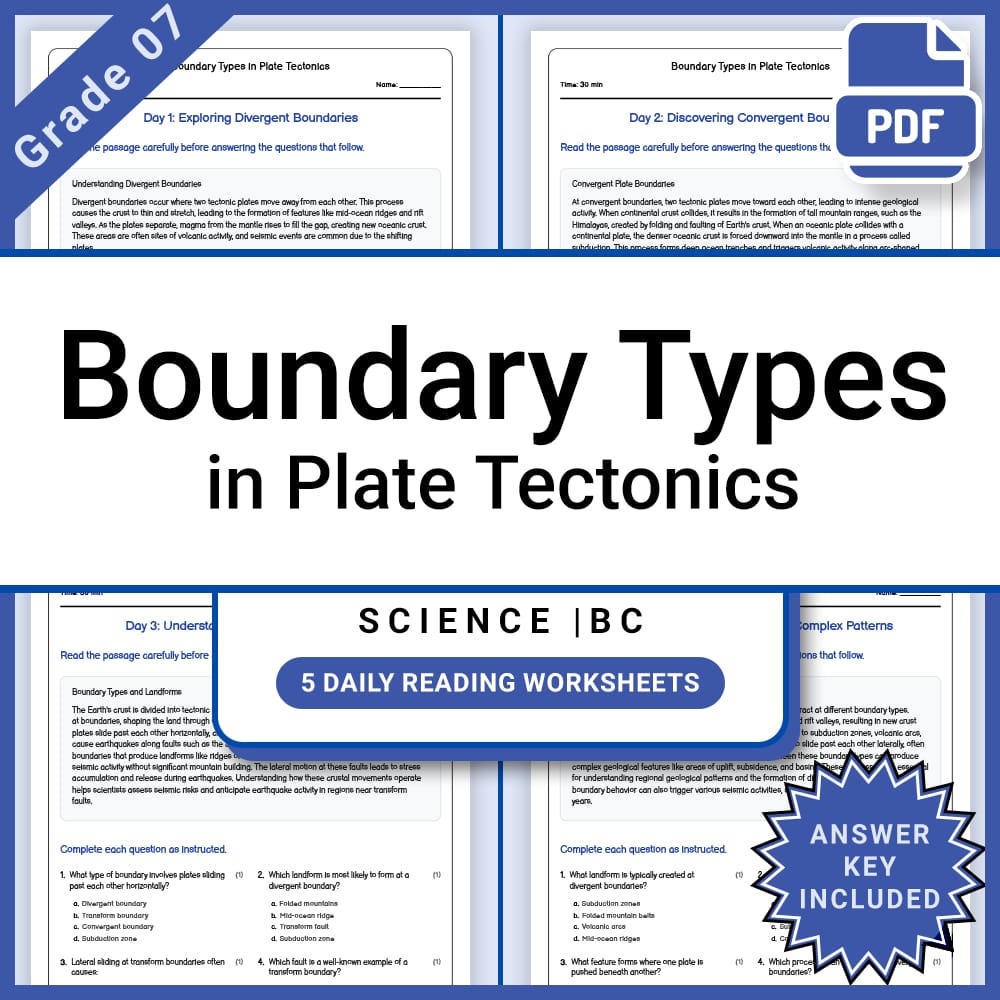
Grade 7 Science – Plate Tectonics Daily Reading Worksheet + Answer Key
JCreated byJ.S SheetsLearning Objectives
- Describe the structure of Earth's outer shell and its division into plates.
- Identify and explain the three main types of plate boundaries: divergent, convergent, and transform.
- Understand how plate movements influence geological features like earthquakes, volcanoes, and mountain ranges.
Also included in: Grade 7 Science Lesson Group: Earth Processes & Landforms Bundle +1 more
Instant download
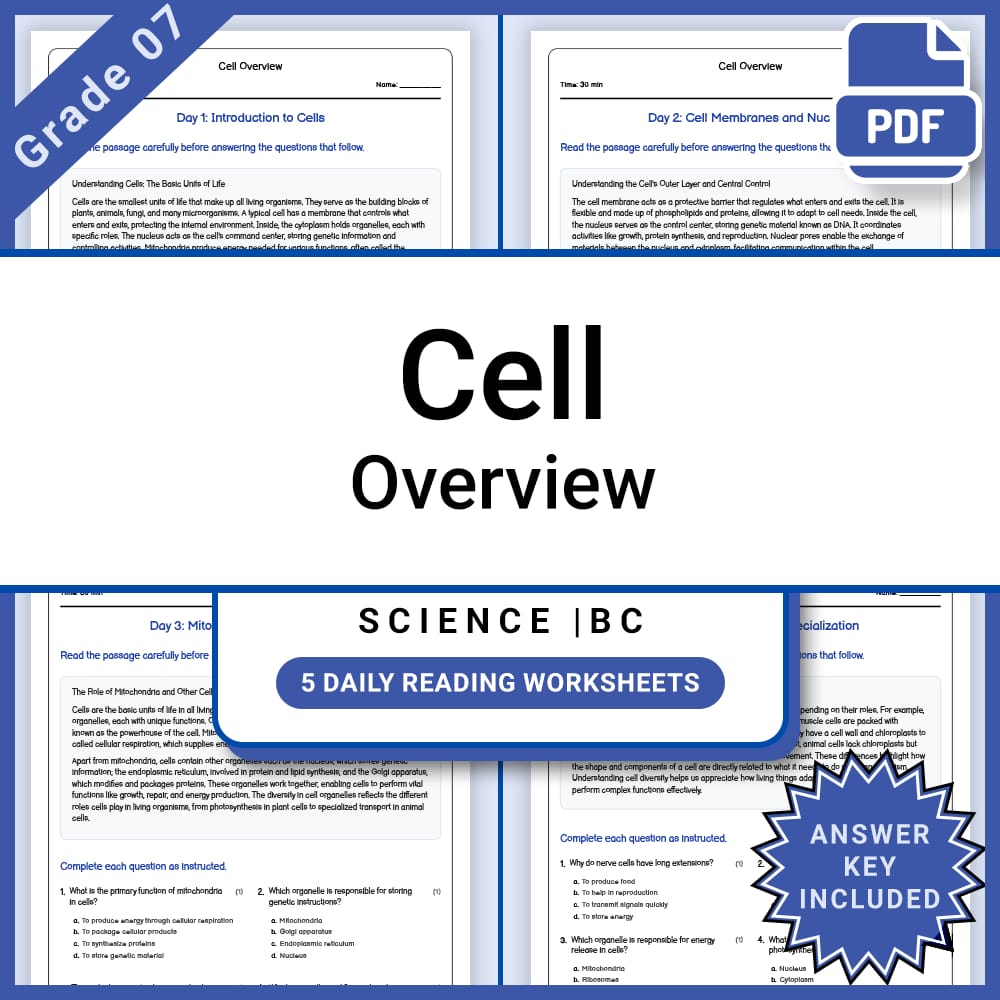
Grade 7 Science – Cell Overview Daily Reading Worksheet with Answer Key
JCreated byJ.S SheetsLearning Objectives
- Identify the main parts of a cell
- Describe the functions of cell components
- Understand the diversity of cell structures in living organisms
Also included in: Grade 7 Science Lesson Group Bundle | Cell Structures and Processes +1 more
Instant download
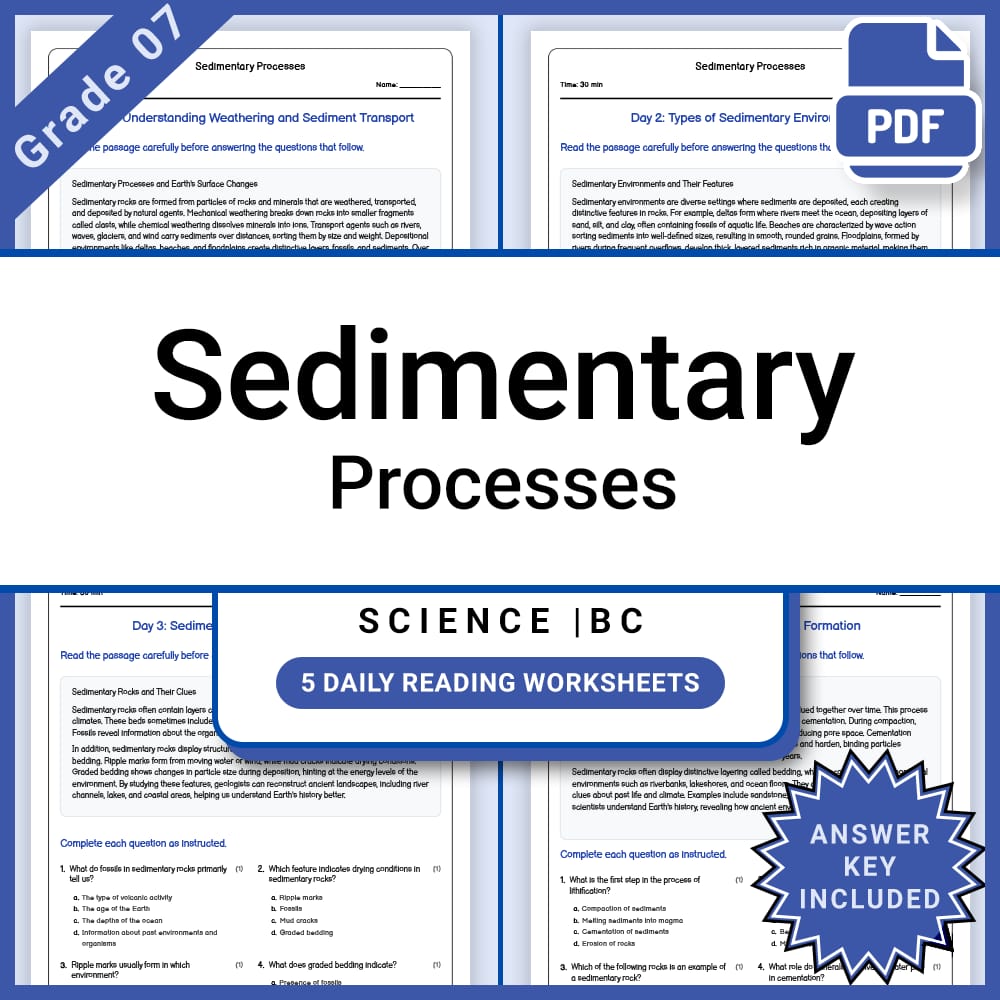
Grade 7 Science – Sedimentary Processes Daily Reading Worksheet + Answer Key
JCreated byJ.S SheetsLearning Objectives
- Understand the processes of weathering, transport, and deposition of sediments
- Identify different depositional environments such as deltas, beaches, and floodplains
- Explain how sediments are transformed into rocks through lithification
Also included in: Grade 7 Science Lesson Group: Earth Processes & Landforms Bundle +1 more
Instant download
Grade 7 Science – Rock Types Daily Reading Worksheet with Answer Key
JCreated byJ.S SheetsLearning Objectives
- Identify different types of rocks based on their features
- Understand how igneous, sedimentary, and metamorphic rocks form
- Recognize key characteristics of each rock type
Also included in: Grade 7 Science Lesson Group: Earth Processes & Landforms Bundle +1 more
Instant download
Grade 7 – Membrane Transport Passive Diffusion Daily Worksheet + Answer Key
JCreated byJ.S SheetsLearning Objectives
- Understand the process of passive diffusion across the cell membrane.
- Identify the role of concentration gradients in diffusion.
- Differentiate between passive and active transport mechanisms.
Also included in: Grade 7 Science Lesson Group Bundle | Cell Structures and Processes +1 more
Instant download
Grade 7 – Conservation Strategies in Ecosystems Daily Worksheet + Answer Key
JCreated byJ.S SheetsLearning Objectives
- Understand basic concepts of ecosystems and biodiversity
- Identify various conservation strategies and their purposes
- Recognize the importance of habitat protection and restoration
Also included in: Grade 7 Science Lesson Group: Ecosystems and Population Framework +1 more
Instant download
Grade 7 Science – Mountain Building Daily Reading Worksheet with Answer Key
JCreated byJ.S SheetsLearning Objectives
- Understand the geological processes involved in mountain formation
- Identify different types of tectonic plate movements
- Analyze the role of erosion and uplift in shaping mountains
Also included in: Grade 7 Science Lesson Group: Earth Processes & Landforms Bundle +1 more
Instant download
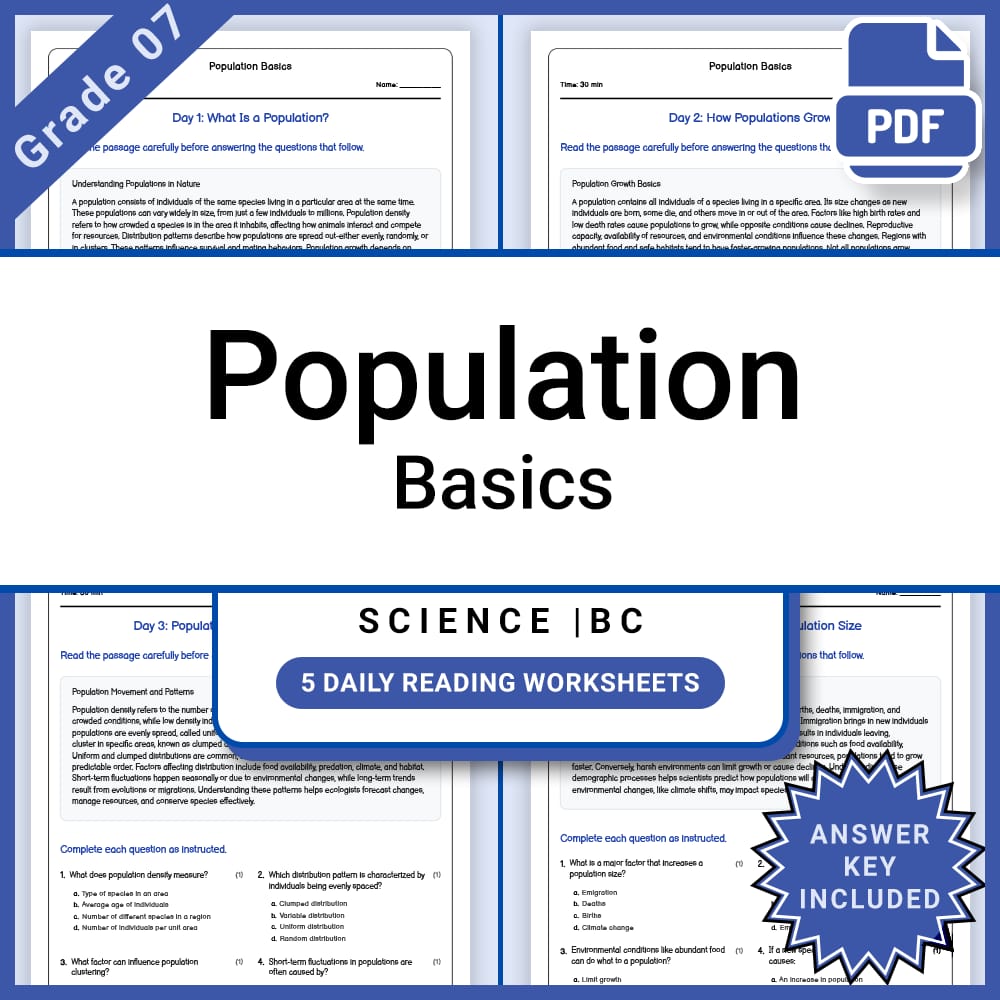
Grade 7 Science – Population Basics Daily Reading Worksheet with Answer Key
JCreated byJ.S SheetsLearning Objectives
- Understand key concepts related to Science
- Apply knowledge through practice questions
- Demonstrate comprehension of the material
Also included in: Grade 7 Science Lesson Group: Ecosystems and Population Framework +1 more
Instant download
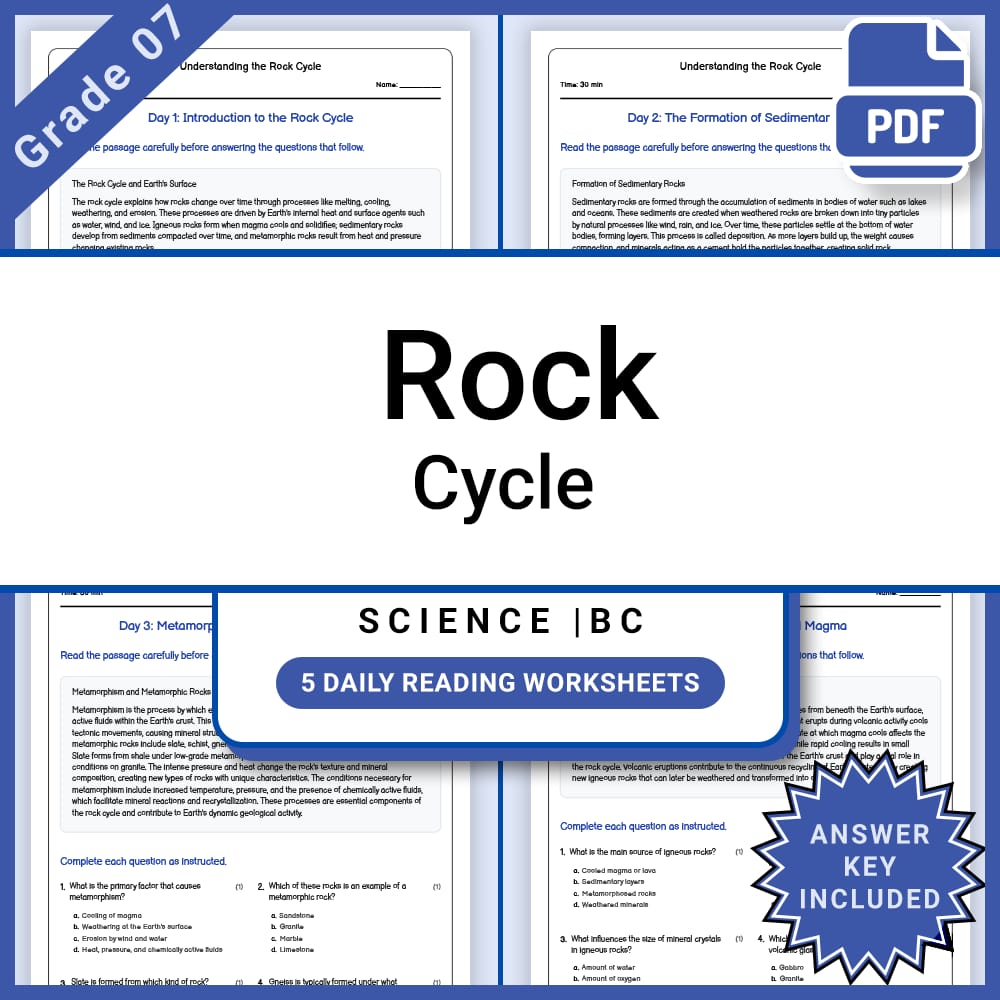
Grade 7 Science – Rock Cycle Daily Reading Worksheet with Answer Key
JCreated byJ.S SheetsLearning Objectives
- Describe the process of the rock cycle
- Identify different types of rocks: igneous, sedimentary, and metamorphic
- Explain how Earth's surface processes contribute to rock transformation
Also included in: Grade 7 Science Lesson Group: Earth Processes & Landforms Bundle +1 more
Instant download
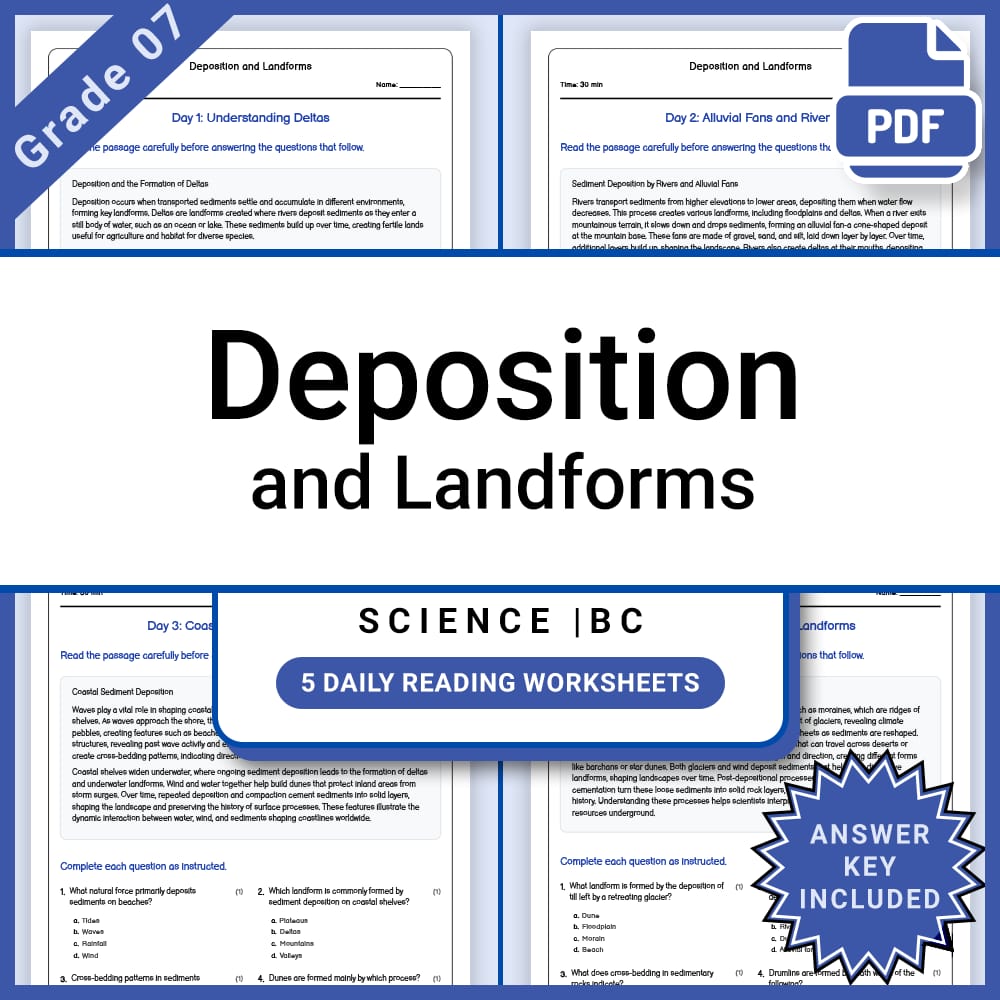
Grade 7 Science – Deposition and Landforms Daily Worksheet with Answer Key
JCreated byJ.S SheetsLearning Objectives
- Understand how deposition contributes to landform development.
- Identify features of a delta and explain the deposition process.
- Recognize different depositional environments and sediment characteristics.
Also included in: Grade 7 Science Lesson Group: Earth Processes & Landforms Bundle +1 more
Instant download

Grade 7 Science Worksheet | Metric Reasoning & Precision (PDF)
 Created byEvergreen Desk Education
Learning Objectives
- Use metric prefixes and scientific notation to express measurements with appropriate units and precision.
- Calibrate common instruments (balance and graduated cylinder) and record measurements correctly using the correct number of significant digits.
- Use repeating trials to estimate variability and describe uncertainty in quantitative observations.
Instant download
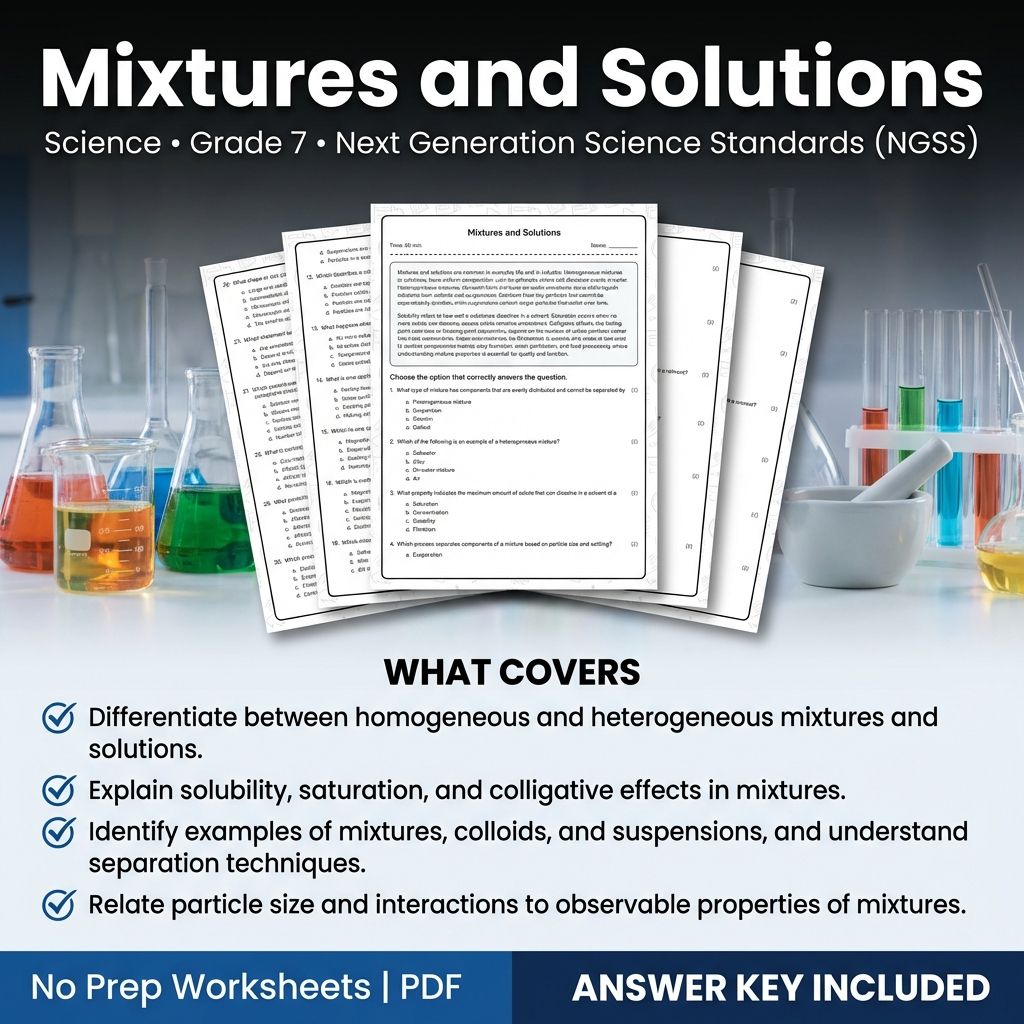
7th Grade Science Worksheet | Mixtures and Solutions NGSS Practice PDF
Created byCoral Reef LearningLearning Objectives
- Differentiate between homogeneous and heterogeneous mixtures and solutions.
- Explain solubility, saturation, and colligative effects in mixtures.
- Identify examples of mixtures, colloids, and suspensions, and understand separation techniques.
Instant download

Mass Measurements Worksheet | Grade 7 Science Review & Assessment BC
Created byPrism Point LearningLearning Objectives
- Explain how comparing mass of reactants and products helps test the conservation of mass in chemical reactions.
- Describe how closed systems and accurate system boundaries affect measured mass changes.
- Use measurement concepts like precision, accounting for gases, and dissolved species to interpret apparent mass loss.
Also included in: Matter & Chemical Change Lesson Bundle — Grade 7 Science British Columbia +1 more
Instant download
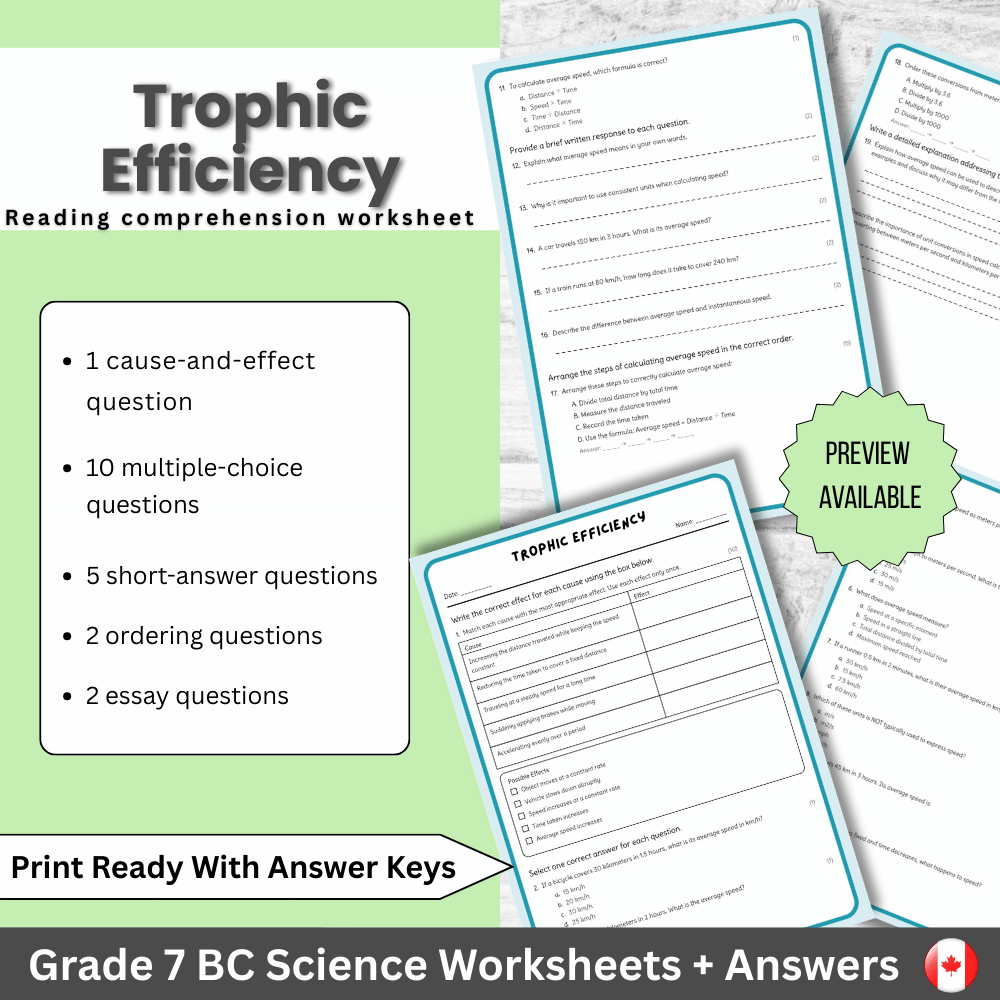
Grade 7 Science | Trophic Efficiency Worksheet (Answer Key) – BC Standards
Created byBright Mind ResourcesLearning Objectives
- Explain what trophic efficiency measures and why it is important in ecosystems.
- Describe how energy diminishes through trophic levels in an energy pyramid.
- Analyze reasons why top predators are fewer in number within ecological communities.
Instant download
About Grade 7 Science Worksheets
Browse 6,039 printable Grade 7 Science worksheets — ready-to-print PDFs with answer keys where available.
Every worksheet on MyTeachingSheets is created by independent teacher-authors and reviewed before publication. All resources download as printable PDFs for classroom, homework, or at-home practice, and many include answer keys. Preview any worksheet free before buying.