
Grade 7 Science Worksheets
6,039 worksheets
Fair Testing Measurements Assessment | Standards-Aligned Grade 7 Science Worksheet
 Created byPrism Point Learning
Learning Objectives
- Understand the principles of fair testing in scientific experiments.
- Identify appropriate measurement tools and units for testing variables.
- Explain how consistent measurement allows valid comparisons of results.
Also included in: Grade 7 Science Assessment Practices Lesson Bundle | General Framework
Instant download

Simple Systems And Mechanisms Assessment | General Grade 7 Science
Created byPrism Point LearningLearning Objectives
- Understand how simple systems and mechanisms transfer motion and force.
- Identify components like gears, pulleys, levers, and linkages in mechanisms.
- Explain how connecting components affect performance, such as gear ratios.
Also included in: Grade 7 Science Assessment Practices Lesson Bundle | General Framework
Instant download

Data Reasoning and Reliability Assessment | Standards-Aligned Grade 7 Science
Created byPrism Point LearningLearning Objectives
- Understand how patterns and variability influence data interpretation.
- Identify sources of error and their impact on measurement reliability.
- Evaluate the quality of data based on measurement consistency.
Also included in: Grade 7 Science Assessment Practices Lesson Bundle | General Framework
Instant download

Design Criteria Assessment | General Standards + Grade 7 Science
Created byPrism Point LearningLearning Objectives
- Understand the concept of design criteria and how they guide project development.
- Identify measurable and observable criteria in design solutions.
- Analyze trade-offs when meeting multiple design constraints.
Also included in: Grade 7 Science Assessment Practices Lesson Bundle | General Framework
Instant download

Grade 7 Rock Cycle Worksheet | NGSS Earth Science Activity with Answer Key
 Created byNorthstar Worksheets
Learning Objectives
- Describe how igneous, sedimentary, and metamorphic rocks can transform through the rock cycle.
- Explain how heat, pressure, and plate tectonics drive key processes such as melting, crystallization, burial, and metamorphism.
- Trace how weathering and erosion move rock materials and form sedimentary layers over time.
Also included in: Grade 7 Earth Systems Processes Lesson Bundle | NGSS Earth Science +1 more
Instant download
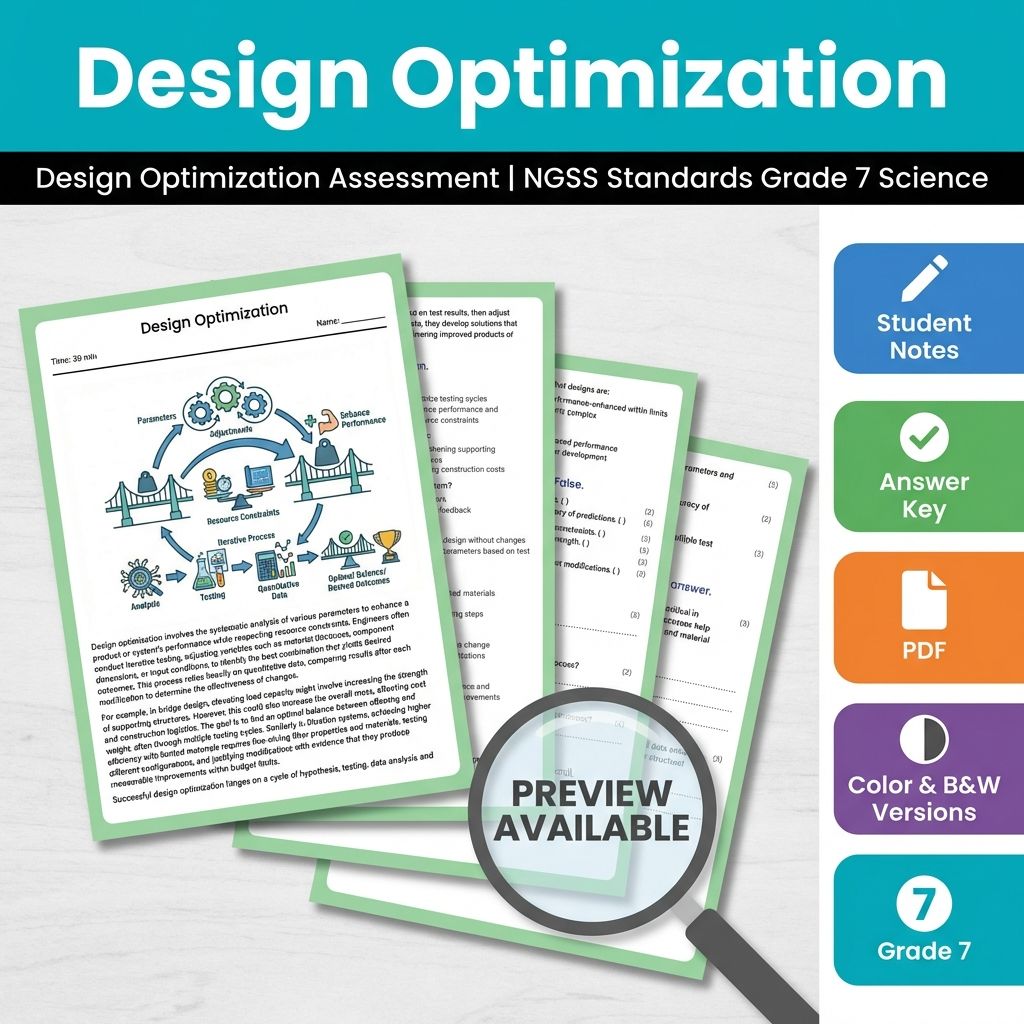
Design Optimization Assessment | NGSS Standards Grade 7 Science
Created byPrism Point LearningLearning Objectives
- Analyze test data and refine parameters to improve design solutions.
- Apply quantitative comparisons to assess performance changes.
- Use evidence-based justification for iterative modifications within constraints.
Also included in: Grade 7 Science Lesson Unit: Engineering Design Standards-Aligned Not Specified +1 more
Instant download
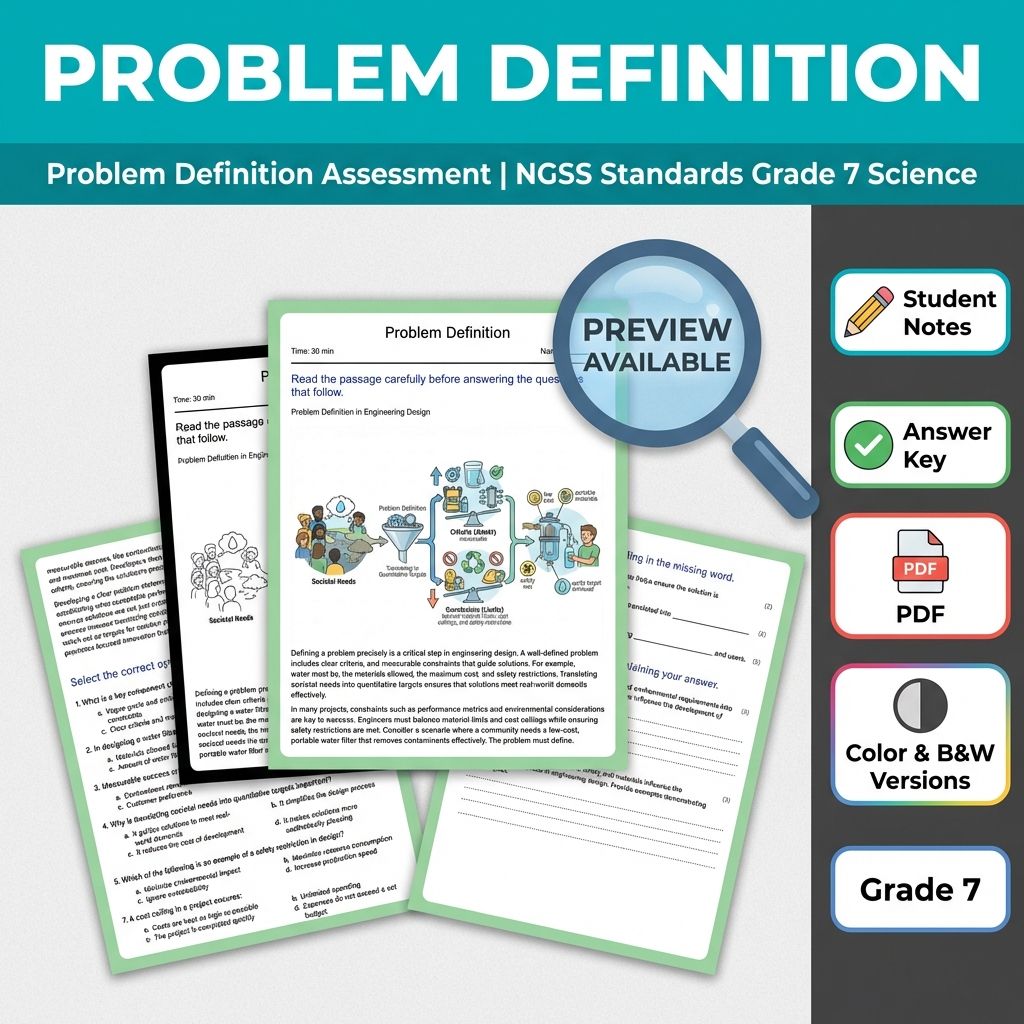
Problem Definition Assessment | NGSS Standards Grade 7 Science
Created byPrism Point LearningLearning Objectives
- Understand how to define design problems with clear criteria and measurable constraints.
- Learn to translate societal and environmental needs into quantitative targets.
- Identify real-world examples of specifying success measures and constraints in product design.
Also included in: Grade 7 Science Lesson Unit: Engineering Design Standards-Aligned Not Specified +1 more
Instant download
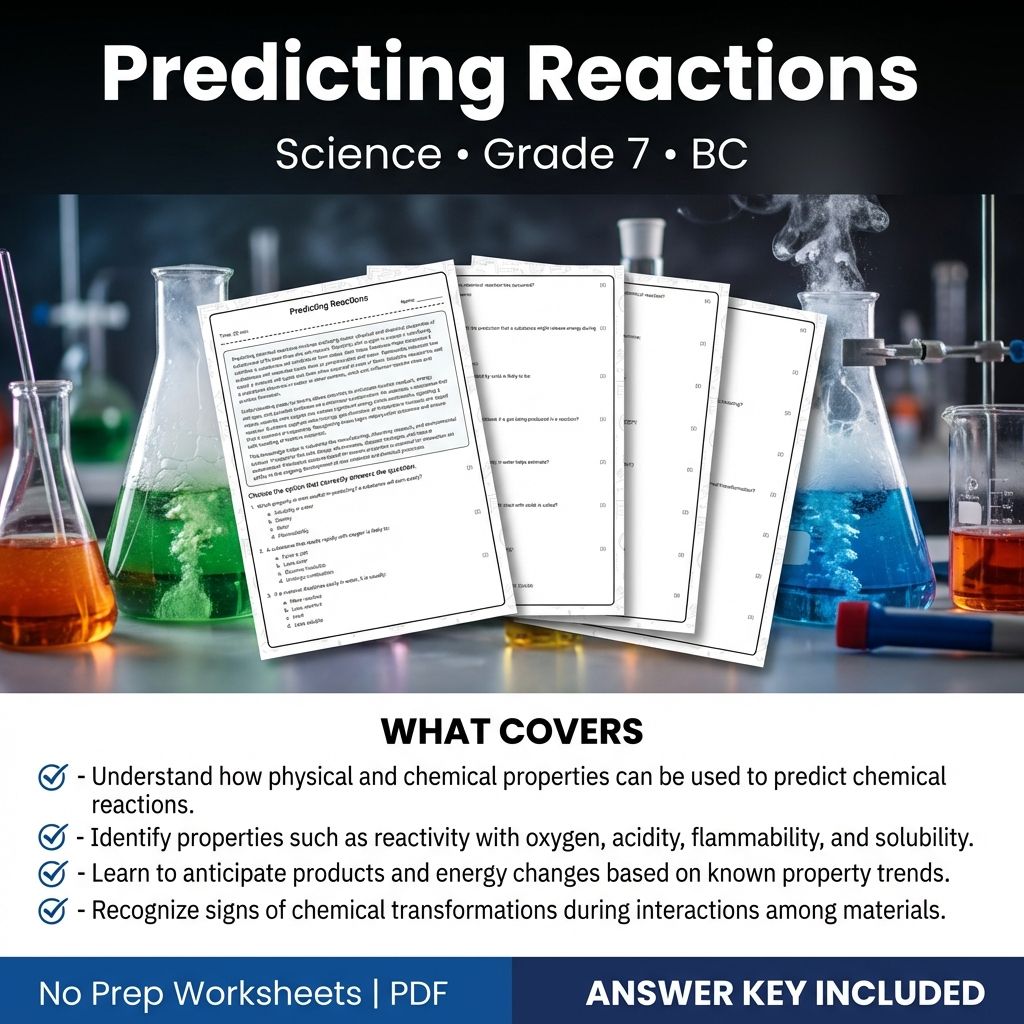
Grade 7 Science | Predicting Reactions Worksheet & Answer Key (Printable PDF)
 Created byCoral Reef Learning
Learning Objectives
- Understand how physical and chemical properties can be used to predict chemical reactions.
- Identify properties such as reactivity with oxygen, acidity, flammability, and solubility.
- Learn to anticipate products and energy changes based on known property trends.
Instant download

Grade 7 Science | Climate Interactions - Daily Reading Comprehension
Created byCoral Reef LearningLearning Objectives
- Interpret temperature and CO2 records related to climate change.
- Identify evidence indicating climate change drivers.
- Understand how land-use change affects climate.
Instant download
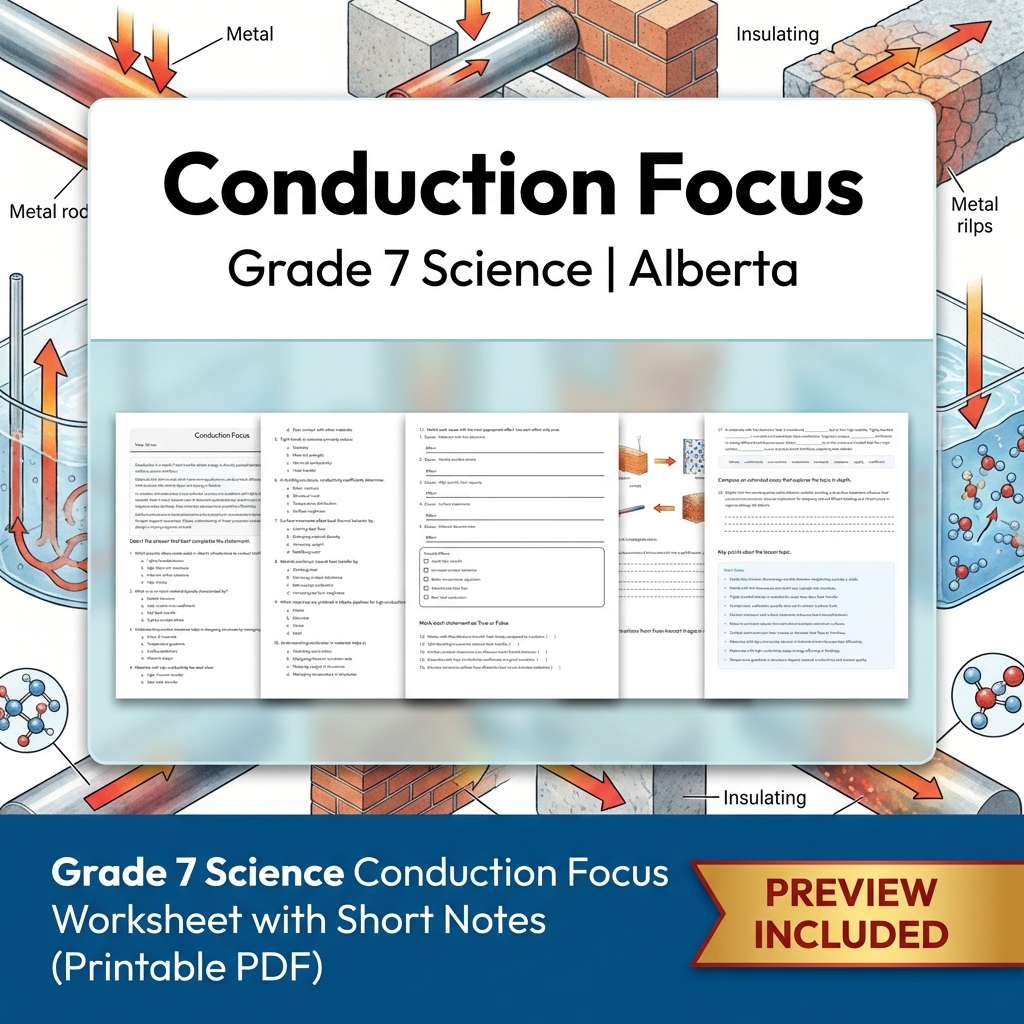
Grade 7 Science Conduction Focus Worksheet with Short Notes (Printable PDF)
 Created byMeadowlark Worksheets
Learning Objectives
- Explain the process of conduction and how particles transfer kinetic energy within solids.
- Identify materials with high and low thermal conductivity and their applications in infrastructure.
- Understand the concepts of conductivity coefficients and contact resistance in heat transfer.
Instant download

Grade 7 Science DNA and Chromosomes Worksheet | NGSS Genetics Activity
Created byNorthstar WorksheetsLearning Objectives
- Explain how DNA forms genes and how genes influence observable traits.
- Describe how DNA is organized into chromosomes inside cells.
- Model how chromosomes are segregated during gamete formation and recombined at fertilization.
Also included in: NGSS Genetics & Inheritance Lesson Bundle – Grade 7 Science (NGSS) +1 more
Instant download
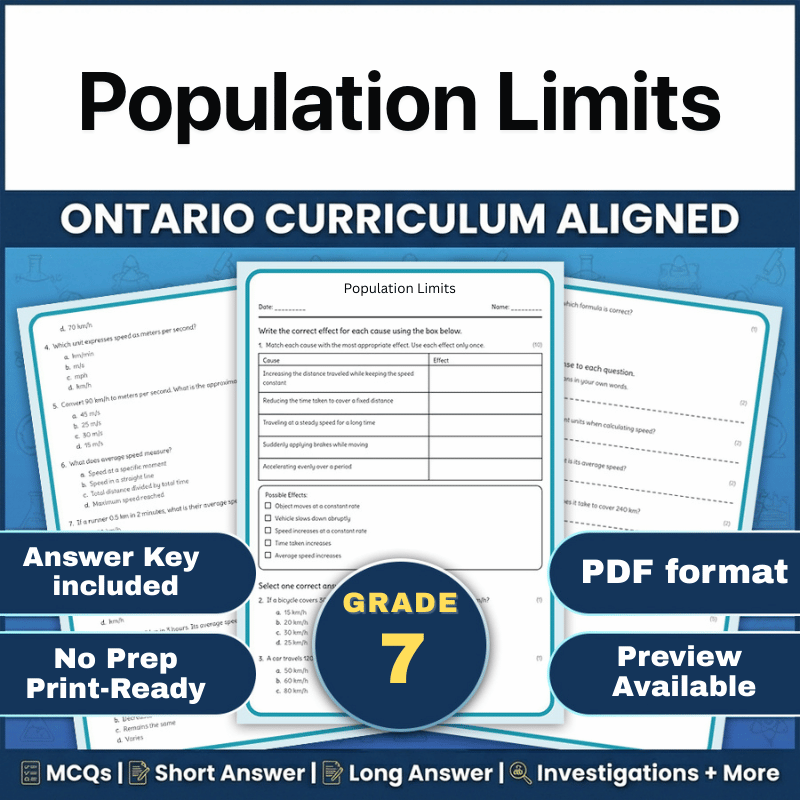
Grade 7 Science | Population Limits Worksheet (Ontario) – Science 1 (PDF)
 Created byBright Mind Resources
Learning Objectives
- Understand basic population growth models, including exponential and logistic growth.
- Identify factors that limit population size such as food availability, predation, disease, and abiotic stresses.
- Distinguish between density-dependent and density-independent factors affecting populations.
Instant download
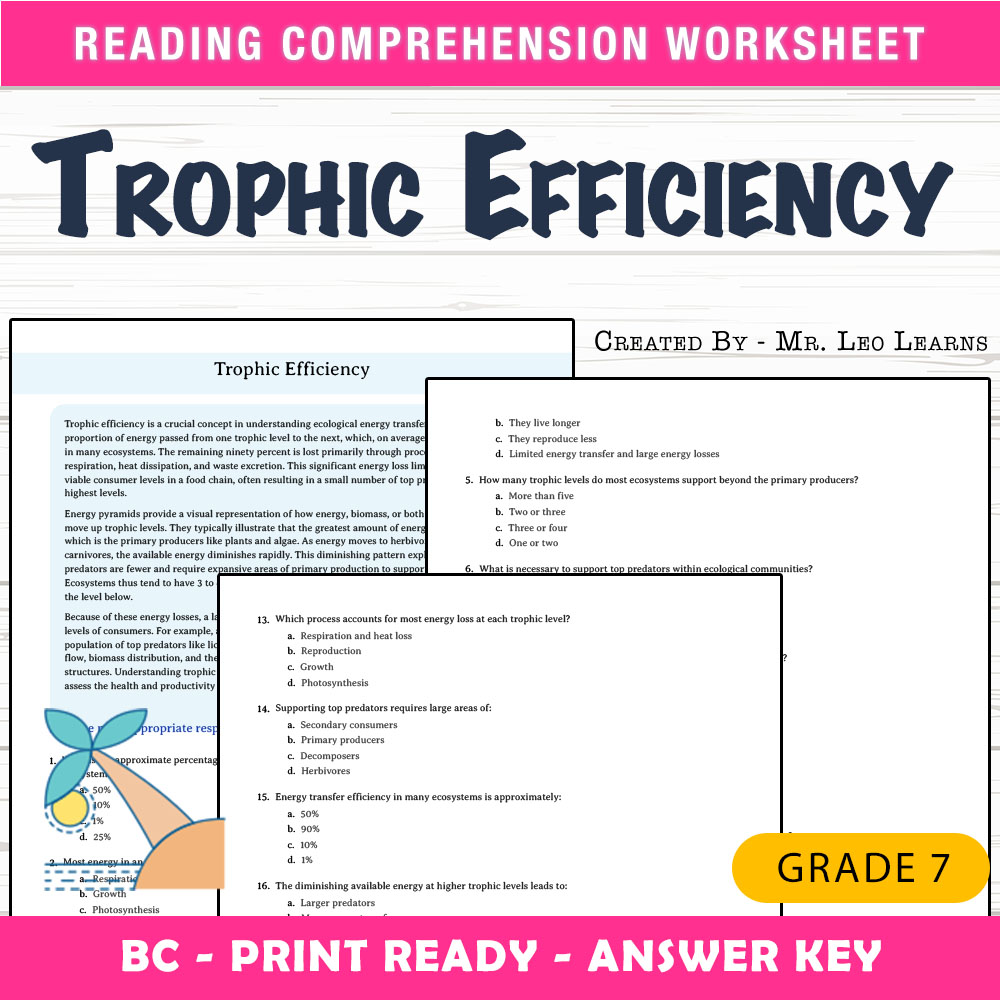
Grade 7 Science — Trophic Efficiency Worksheet for Mastery
 Created byThe Resource Hub
Learning Objectives
- Understand the concept of trophic efficiency and its role in energy transfer.
- Identify factors that lead to energy loss at each trophic level.
- Interpret energy pyramids and their significance in ecosystems.
Also included in: Grade 7 Science Ecosystems & Interactions Worksheet Bundle +1 more
Instant download
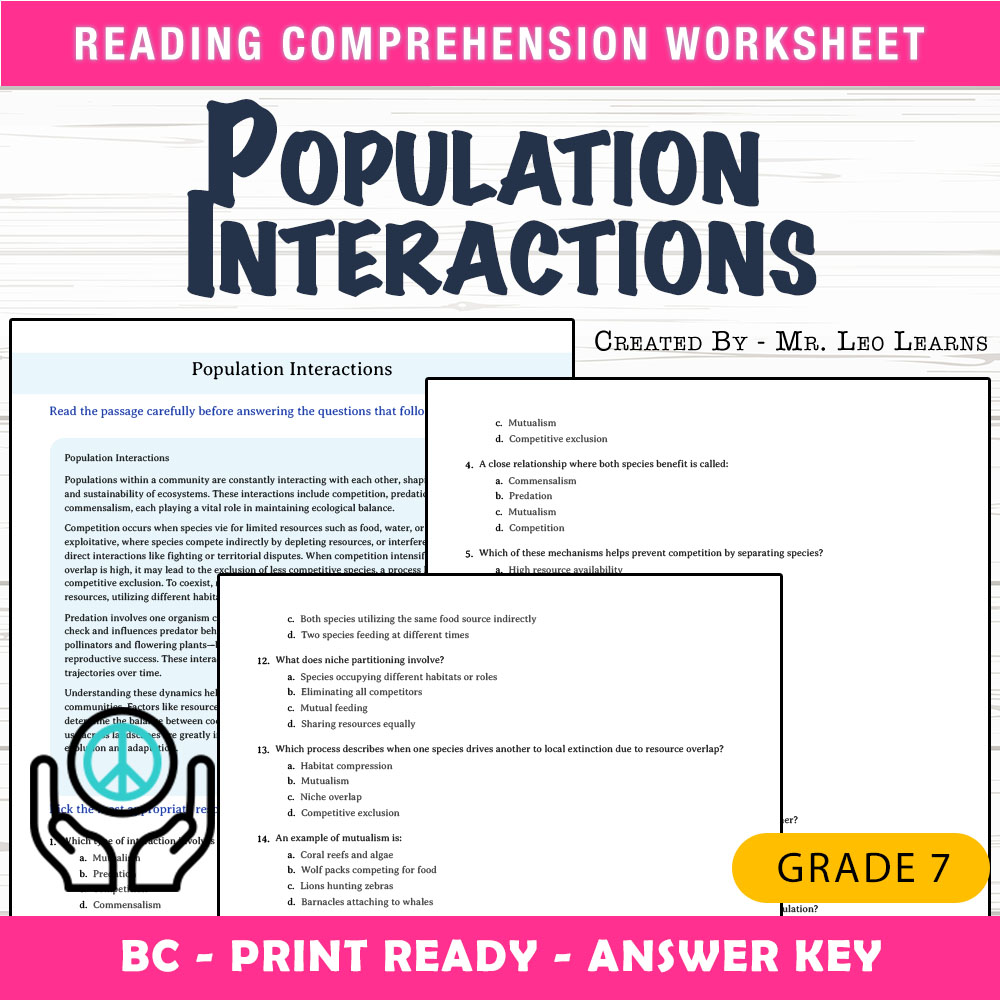
Grade 7 Science — Population Interactions Worksheet MCQ Paper
Created byThe Resource HubLearning Objectives
- Understand the different types of population interactions such as competition, predation, and mutualism.
- Identify how resource partitioning, habitat differentiation, and temporal separation allow species to coexist.
- Analyze the impact of interactions on community stability and diversity.
Also included in: Grade 7 Science Ecosystems & Interactions Worksheet Bundle +1 more
Instant download
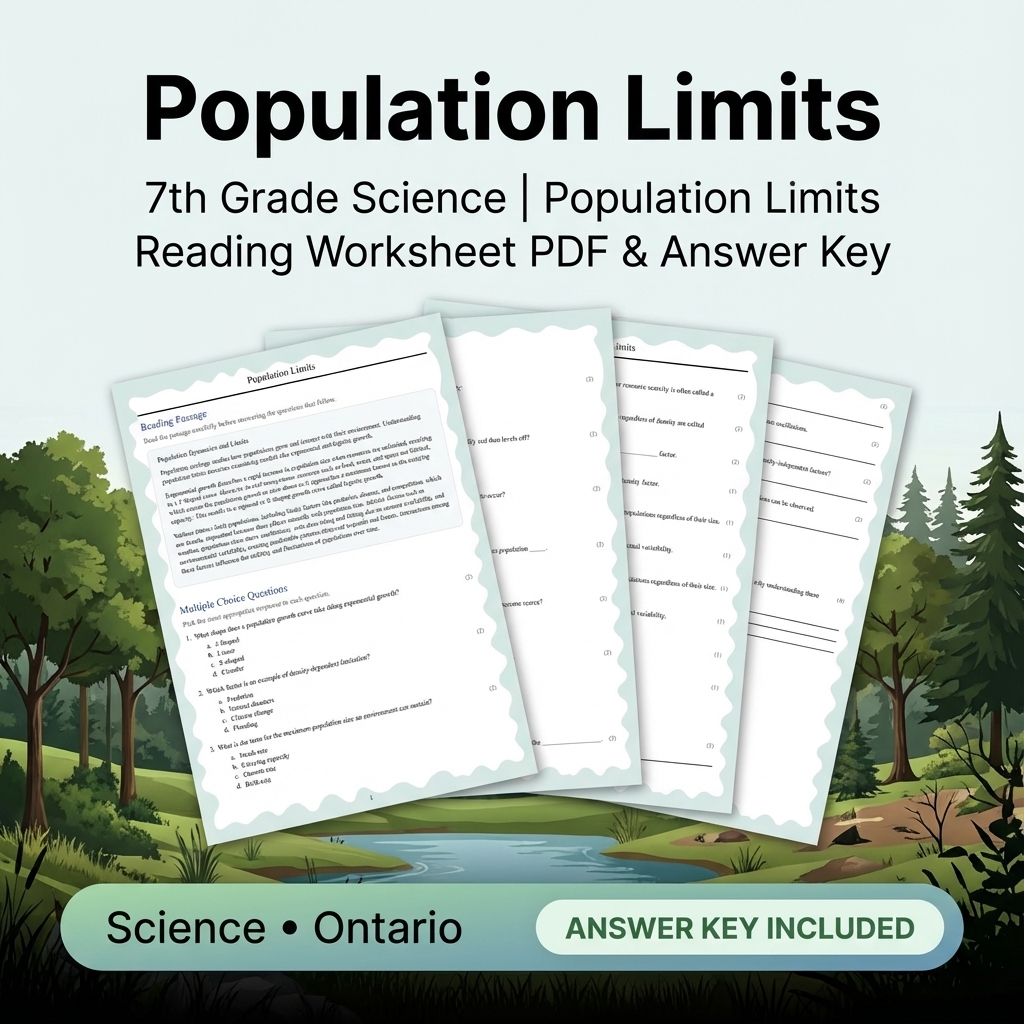
7th Grade Science | Population Limits Reading Worksheet PDF & Answer Key
JCreated byJ.S SheetsLearning Objectives
- Understand basic population growth models, including exponential and logistic growth.
- Identify and distinguish between limiting factors affecting populations.
- Differentiate between density-dependent and density-independent influences on populations.
Also included in: Grade 7 Science | Ecosystems, Biodiversity & Environmental Stewardship +1 more
Instant download
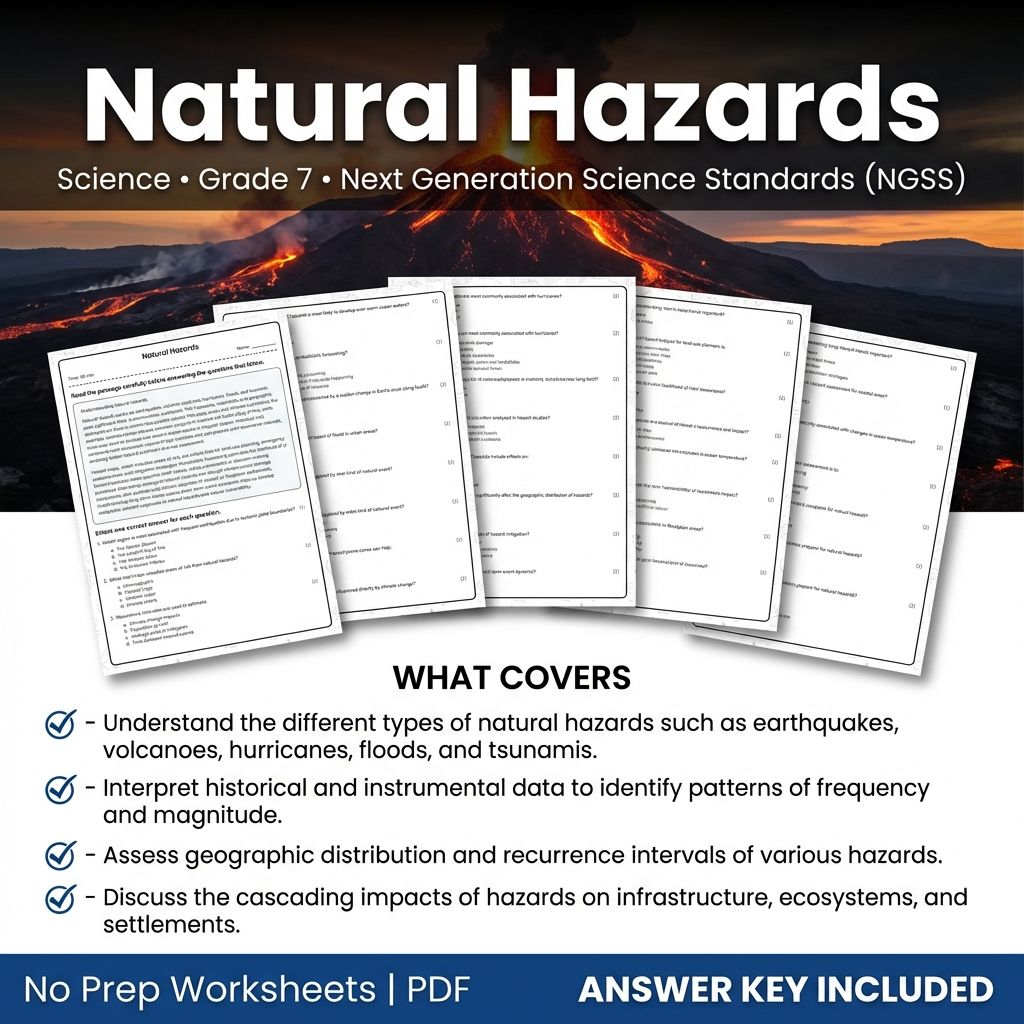
7th Grade Science | Natural Hazards Worksheet & Answer Key (Printable PDF)
Created byCoral Reef LearningLearning Objectives
- Understand the different types of natural hazards such as earthquakes, volcanoes, hurricanes, floods, and tsunamis.
- Interpret historical and instrumental data to identify patterns of frequency and magnitude.
- Assess geographic distribution and recurrence intervals of various hazards.
Instant download
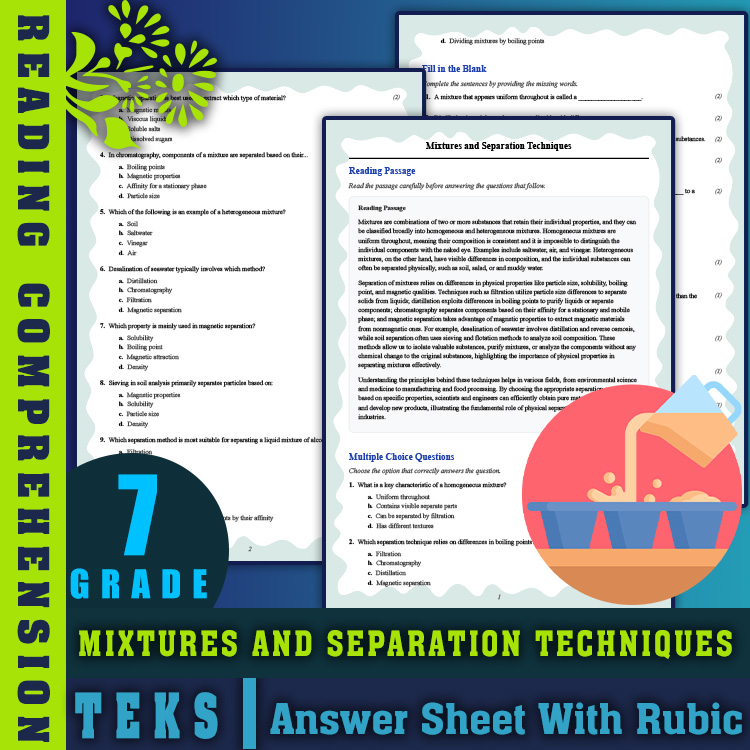
7th Grade Science | Mixtures and Separation Techniques Reading Worksheet
JCreated byJ.S SheetsLearning Objectives
- Understand the difference between homogeneous and heterogeneous mixtures.
- Describe common physical separation methods such as filtration, distillation, chromatography, and magnetic separation.
- Relate properties like solubility, particle size, and boiling point differences to the choice of separation method.
Instant download

Grade 7 Science | Adaptation Function Worksheet | General Standard
 Created byLumora Learning
Learning Objectives
- Explain how structural and behavioral adaptations link form to function in living things.
- Identify examples of adaptations that support life processes such as gas exchange, protection, and water regulation.
- Describe how trade-offs can constrain the performance of traits in different conditions.
Instant download
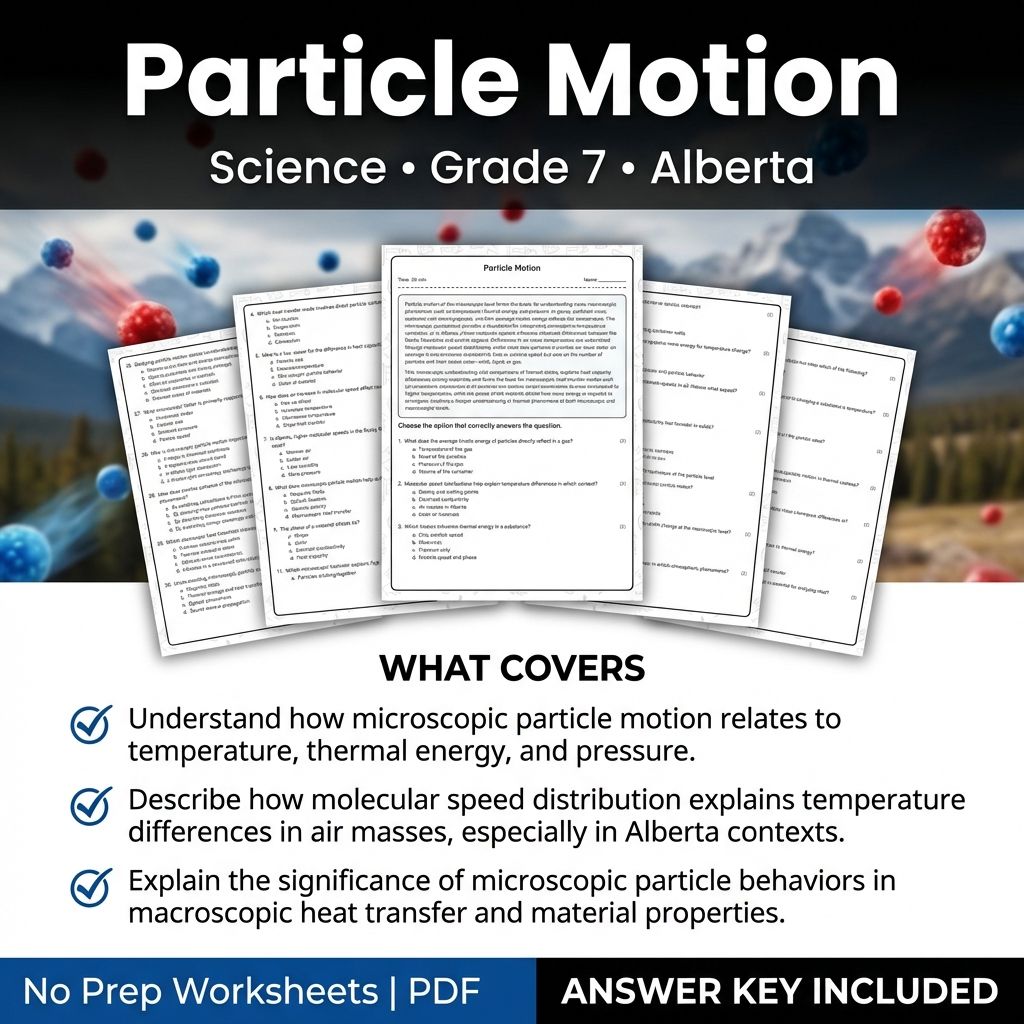
Particle Motion Worksheet for Grade 7 Science | Alberta Standards
Created byCoral Reef LearningLearning Objectives
- Understand how microscopic particle motion relates to temperature, thermal energy, and pressure.
- Describe how molecular speed distribution explains temperature differences in air masses, especially in Alberta contexts.
- Explain the significance of microscopic particle behaviors in macroscopic heat transfer and material properties.
Instant download
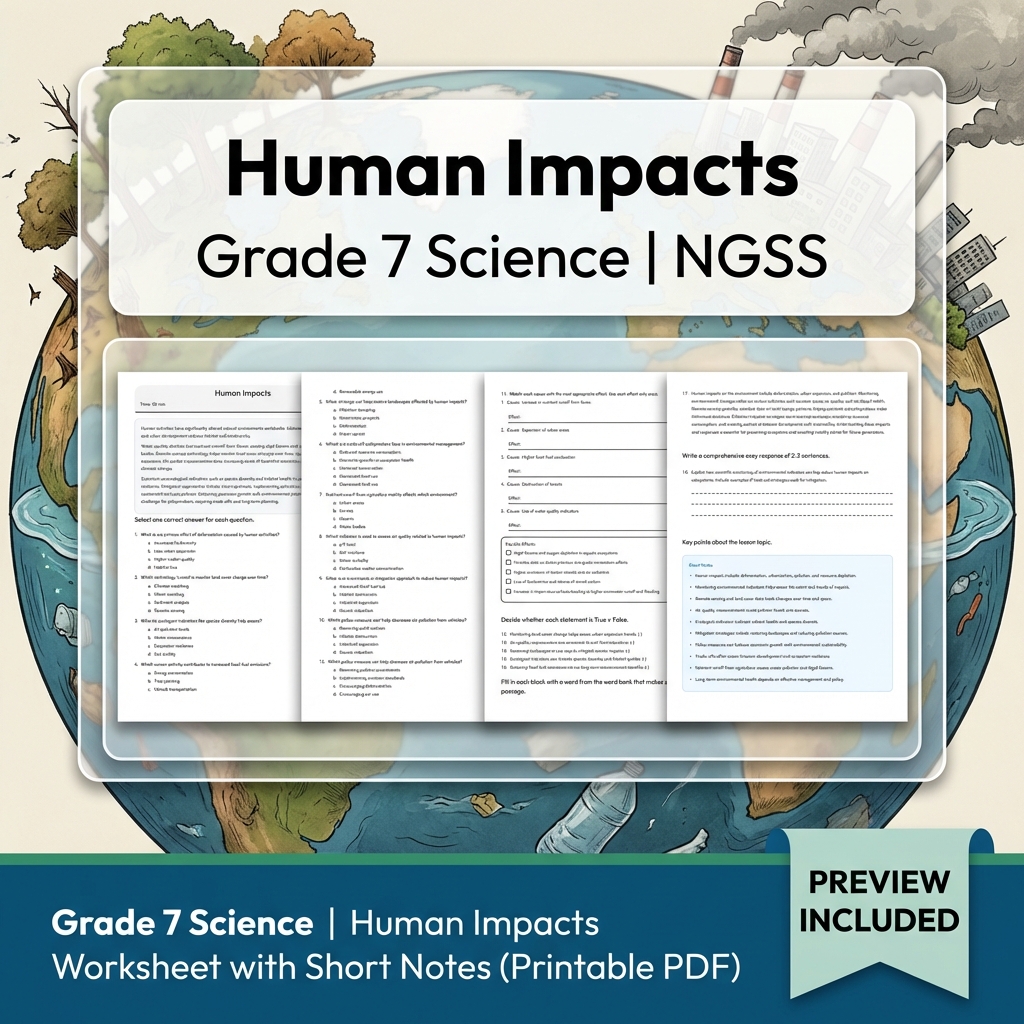
Grade 7 Science | Human Impacts Worksheet with Short Notes (Printable PDF)
Created byMeadowlark WorksheetsLearning Objectives
- Understand how human activities affect the environment through deforestation, urban expansion, and pollution.
- Use scientific indicators and data to monitor environmental changes caused by human impacts.
- Identify mitigation strategies to reduce negative human effects on ecosystems.
Also included in: Grade 7 Science | Earth and Human Activity NGSS Unit Bundle (Worksheet Pack) +1 more
Instant download

Grade 7 Science | Meiosis Variation Worksheet | NGSSS Aligned
Created byLumora LearningLearning Objectives
- Explain how meiosis creates genetic variation through independent assortment and random fertilization.
- Identify key events in meiosis that lead to differences among offspring.
- Use cause-and-effect reasoning to connect chromosome behavior in meiosis to traits in populations.
Instant download
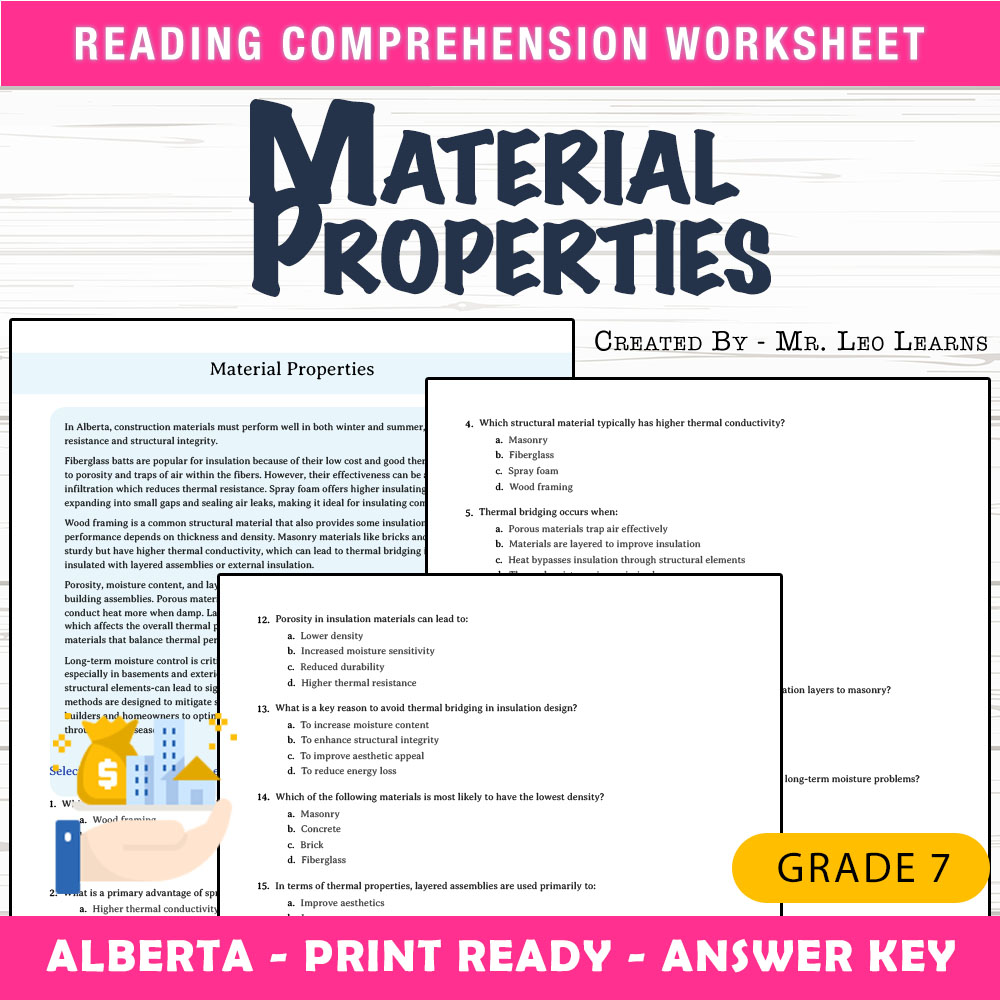
Grade 7 Science — Material Properties Worksheet MCQ Paper for Mastery
Created byThe Resource HubLearning Objectives
- Understand the thermal properties of common building materials.
- Compare the thermal resistance and structural considerations of fiberglass, spray foam, wood framing, and masonry.
- Identify how porosity, moisture content, and layer configurations affect conductivity.
Also included in: Grade 7 Science Alberta Energy Heat Thermal Processes Worksheet Bundle +1 more
Instant download

Innovation History Worksheet | TEKS Grade 7 Science Practice and Assessment
JCreated byJ.S SheetsLearning Objectives
- Differentiate innovation from invention using historical examples and causes of change over time.
- Explain how diffusion and adaptation spread technological ideas across contexts and lead to new versions.
- Describe how empirical observation and design choices work together to produce incremental improvements.
Instant download
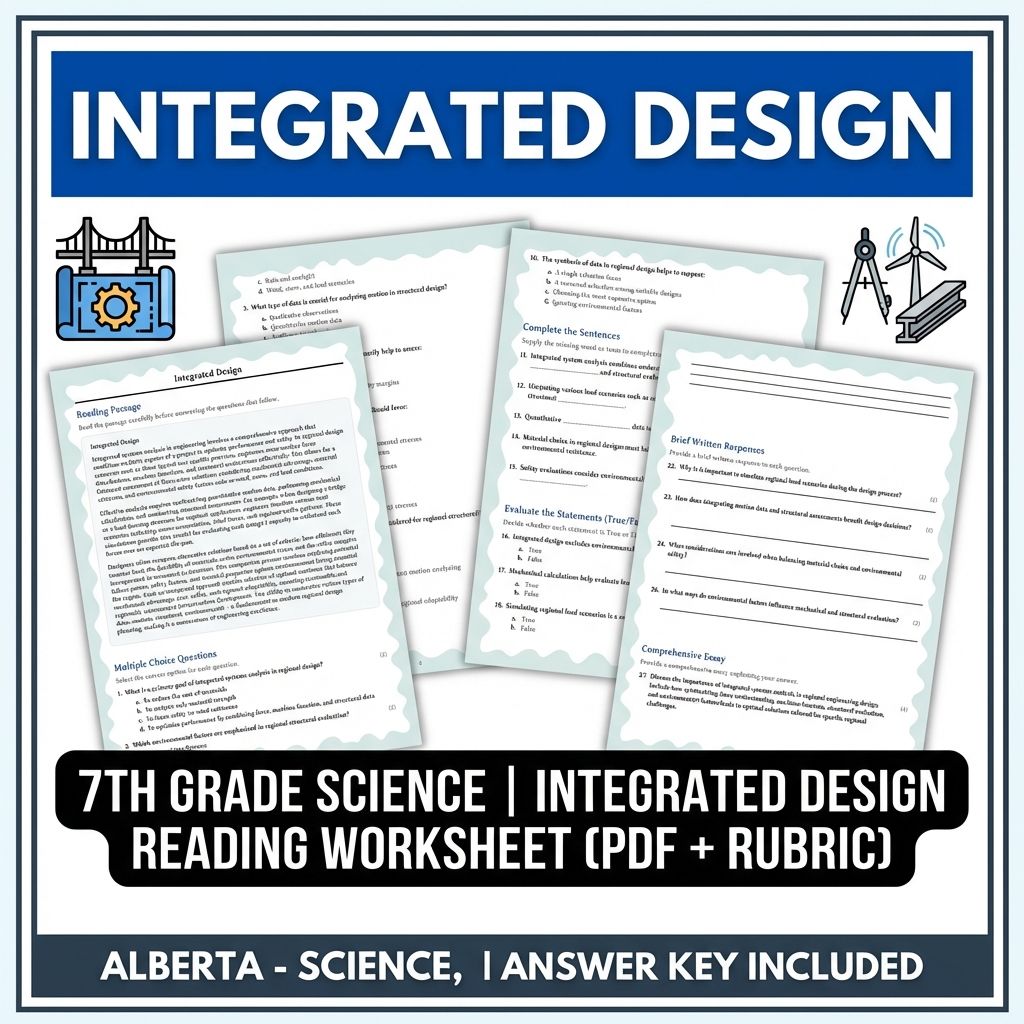
7th Grade Science | Integrated Design Reading Worksheet (PDF + Rubric)
JCreated byJ.S SheetsLearning Objectives
- Understand how integrated systems analyze force, machine function, and structural evaluation.
- Compare alternative designs based on criteria such as mechanical advantage, material choice, and safety.
- Synthesize motion data, mechanical calculations, and structural assessments to support design choices.
Also included in: Grade 7 Science | Forces, Motion & Structural Concepts (Answer Keys Included) +1 more
Instant download

Grade 7 Population Limits in Ecosystems Worksheet | NGSS Life Science
 Created byBRIGHT PATH RESOURCES
Learning Objectives
- Understand the concept of population growth and carrying capacity.
- Analyze graphical data representing population changes over time.
- Identify factors that influence population size, such as resources and competition.
Also included in: Ecosystems & Biodiversity Grade 7 Science Daily Reading Lesson Bundle | NGSS +2 more
Instant download
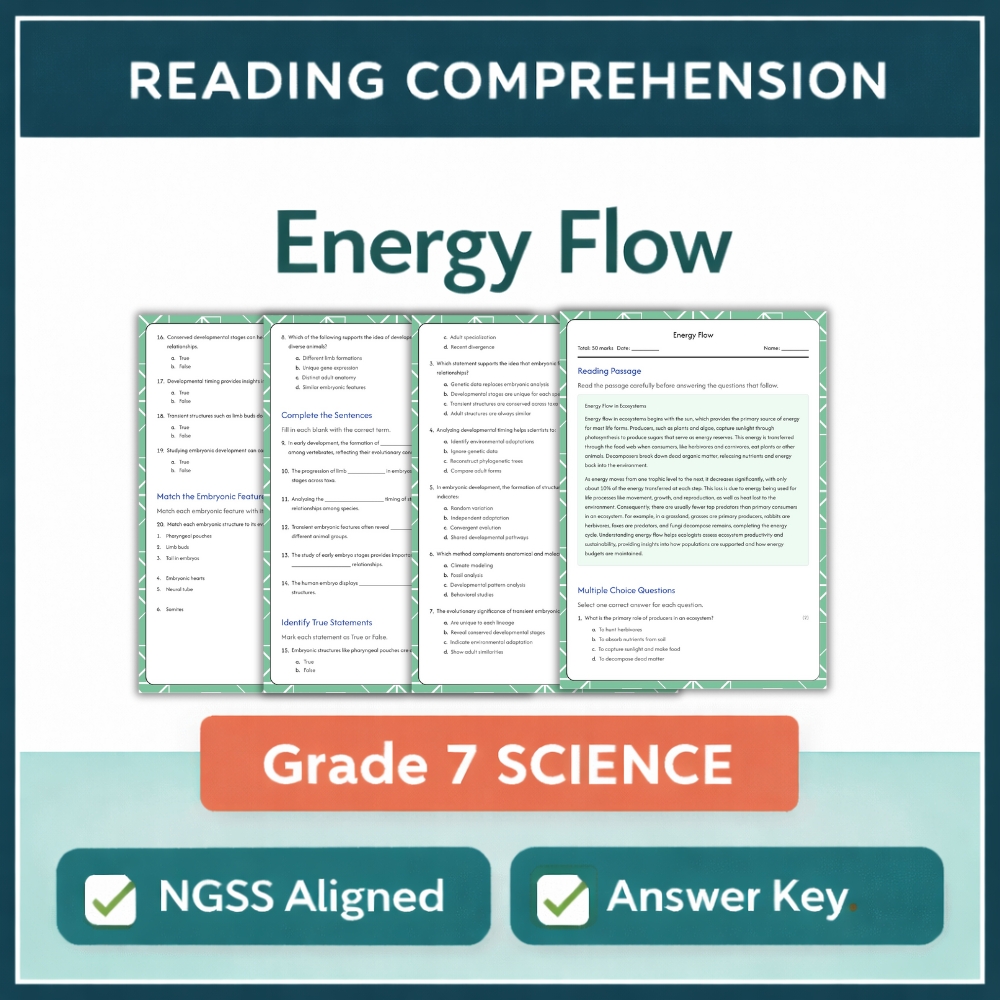
7th Grade Science | Energy Flow Worksheet (NGSS Aligned) - Printable PDF
 Created byCedar Grove Learning
Learning Objectives
- Describe how energy is transferred through trophic levels in food webs.
- Explain the roles of producers, consumers, and decomposers in ecosystems.
- Understand photosynthesis and cellular respiration as mechanisms for energy capture and release.
Instant download
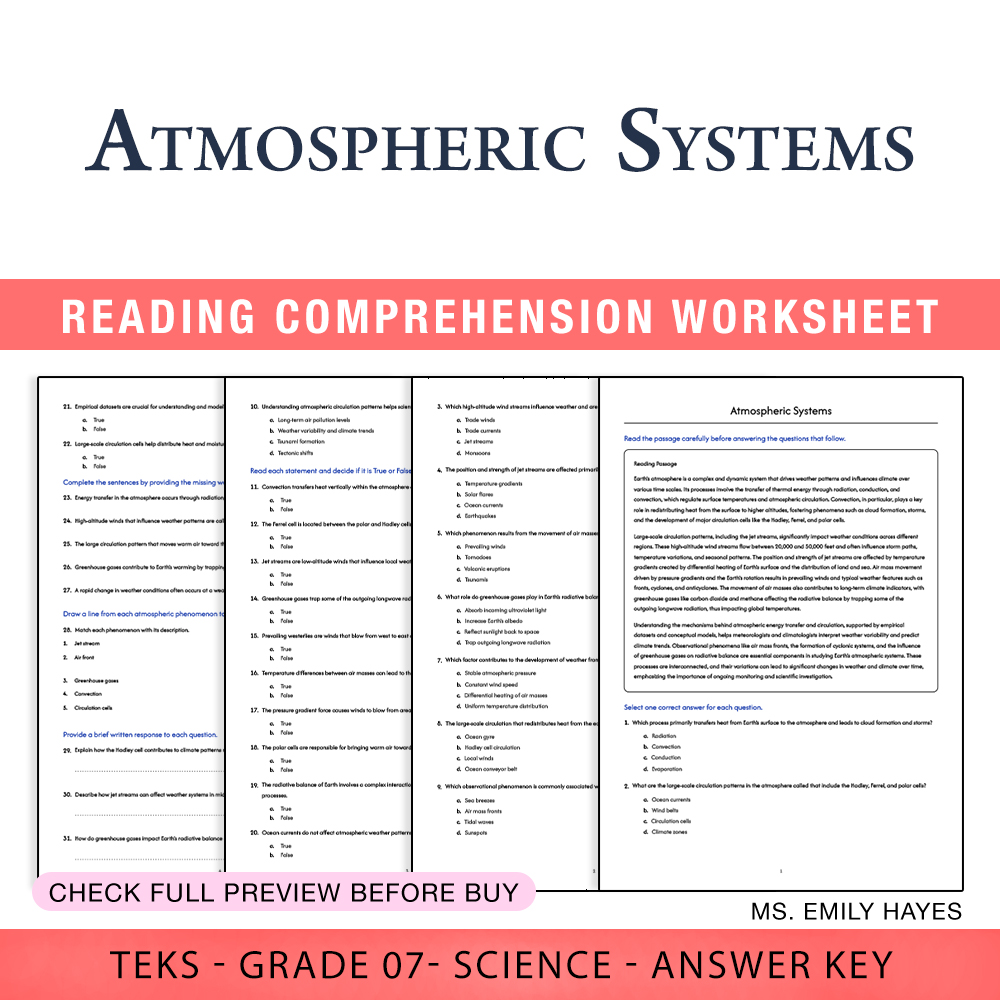
7th Grade Science | Atmospheric Systems Worksheet (PDF+ Answer Key)
 Created byCopper Leaf Classroom
Learning Objectives
- Understand the fundamental processes governing atmospheric circulation and energy transfer.
- Identify the roles of pressure gradients, convection, and large-scale circulation patterns like the Hadley cell.
- Connect atmospheric phenomena such as fronts, jet streams, and greenhouse gases to climate variability.
Instant download

Signs of Physical Change Worksheet | Grade 7 Science | Alberta
JCreated byJ.S SheetsLearning Objectives
- Identify key signs indicating a physical change has occurred.
- Differentiate between physical and chemical changes based on observable indicators.
- Explain particle behavior during physical changes using real-world examples.
Instant download
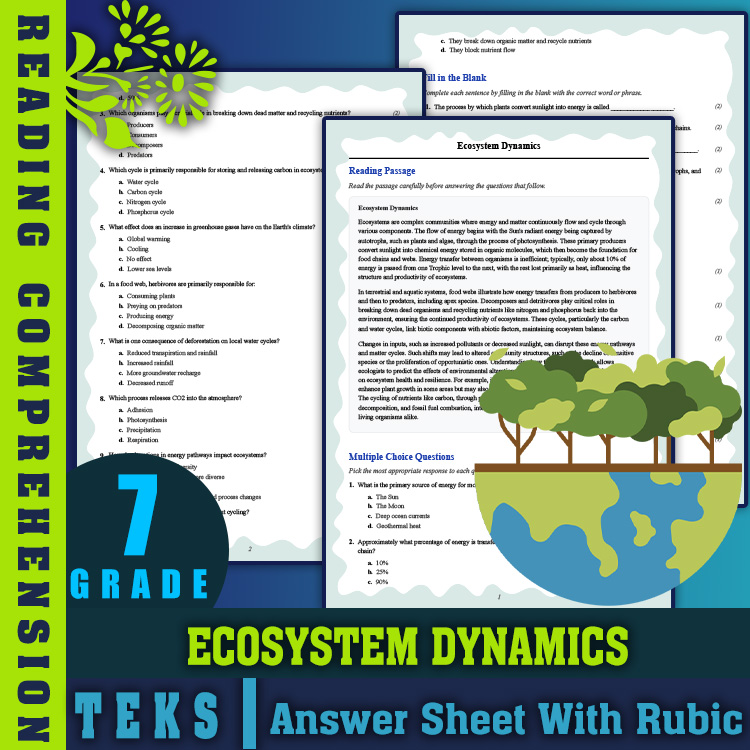
Grade 7 Science | Ecosystem Dynamics Reading Worksheet (PDF + Rubric)
JCreated byJ.S SheetsLearning Objectives
- Describe how energy flows through food chains, webs, and trophic pyramids in ecosystems.
- Explain the cycling of matter, such as carbon and water, within ecosystems.
- Analyze the impact of environmental changes on community composition and ecosystem processes.
Instant download
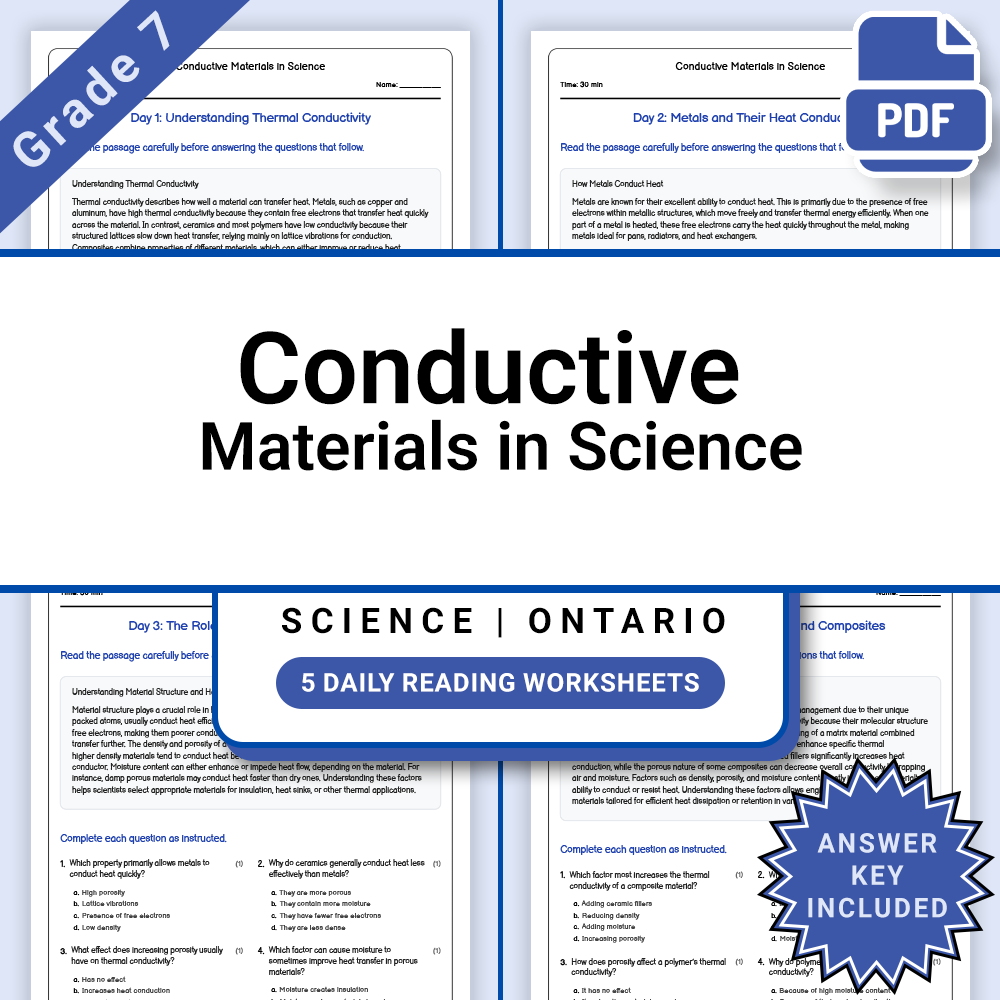
Grade 7 Science – Conductive Materials Daily Reading Worksheet with Answer Key
JCreated byJ.S SheetsLearning Objectives
- Understand the concept of thermal conductivity.
- Identify materials with high and low heat transfer properties.
- Explain how material structure affects heat conduction.
Also included in: Grade 7 Science Lesson Group: Ontario Curriculum | Thermal & Heat Transfer +1 more
Instant download

Producers and Consumers Test Prep Worksheet | Grade 7 Science BC
Created byPrism Point LearningLearning Objectives
- Explain how producers capture energy through photosynthesis and why they form the base of energy pyramids.
- Differentiate between primary, secondary, and tertiary consumers based on what they eat.
- Describe why energy transfer between trophic levels is inefficient and how that affects population sizes.
Also included in: Ecosystems & Interactions Lesson Bundle – Grade 7 Science BC Framework +1 more
Instant download
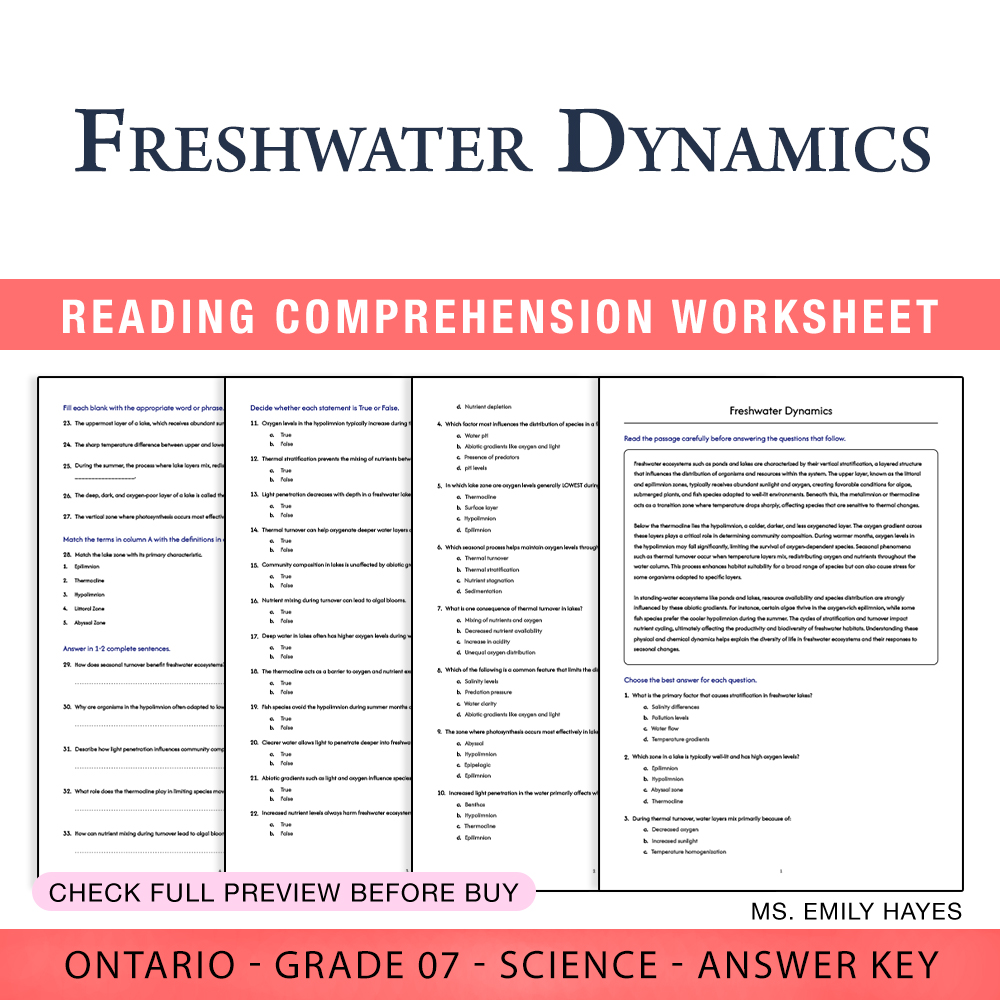
7th Grade Science | Freshwater Dynamics Worksheet (PDF+ Answer Key)
Created byCopper Leaf ClassroomLearning Objectives
- Describe the structure and stratification of freshwater systems such as ponds and lakes.
- Explain how abiotic gradients like oxygen levels, light penetration, and temperature influence community composition and species distribution.
- Analyze seasonal phenomena such as thermal turnover and their effects on dissolved oxygen and nutrient mixing.
Instant download

Grade 7 Science | Material Properties in Structural Materials - Comprehension
Created byCoral Reef LearningLearning Objectives
- Understand the concepts of density and tensile strength.
- Compare different construction materials based on their density and tensile strength.
- Recognize how these properties influence material selection in construction.
Instant download

Phase Changes Worksheet | Grade 7 Science Practice & Assessment
JCreated byJ.S SheetsLearning Objectives
- Describe different types of phase changes and how energy transfer affects them.
- Identify the effects of temperature and pressure on phase transitions.
- Explain the concepts of latent heat and particle arrangement during phase changes.
Instant download
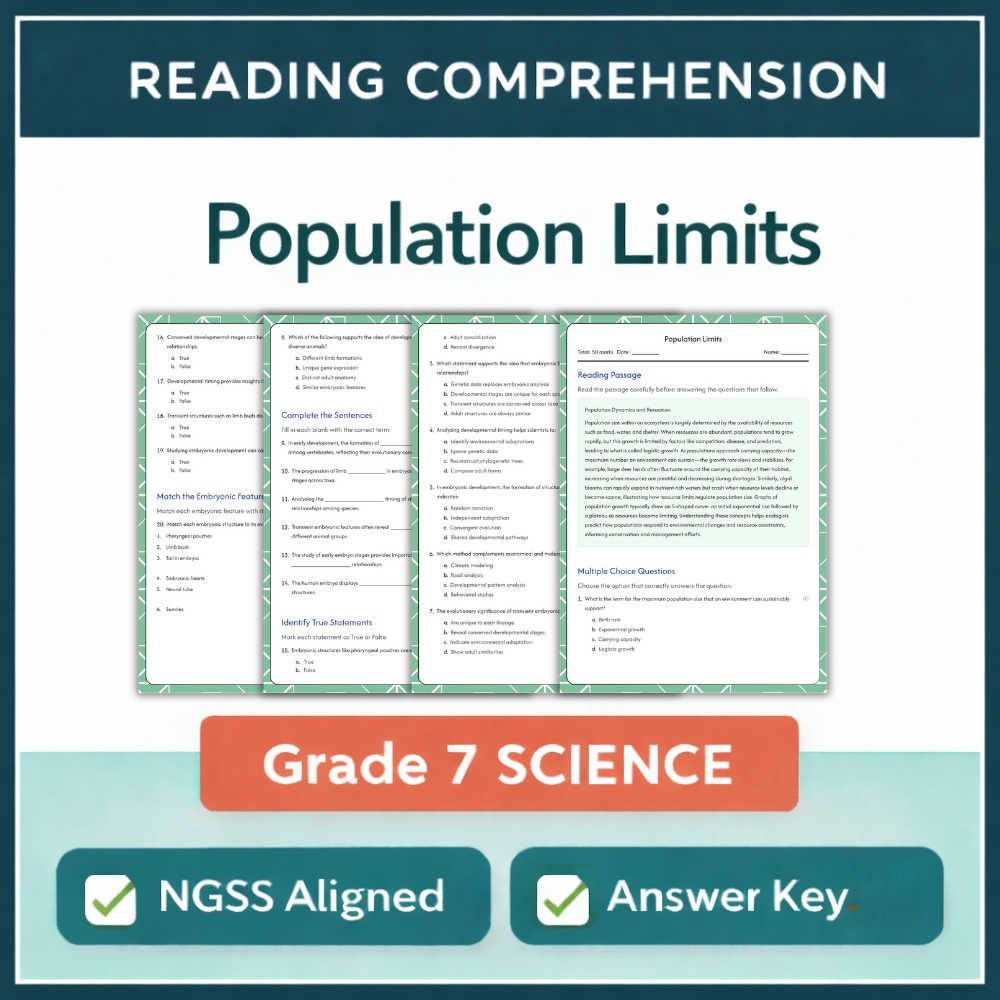
7th Grade Science | Population Limits Worksheet (NGSS Practice PDF)
Created byCedar Grove LearningLearning Objectives
- Understand how resource availability influences population growth and decline.
- Interpret logistic growth curves and concepts of carrying capacity.
- Analyze data on population responses to limited resources such as food, water, and shelter.
Instant download
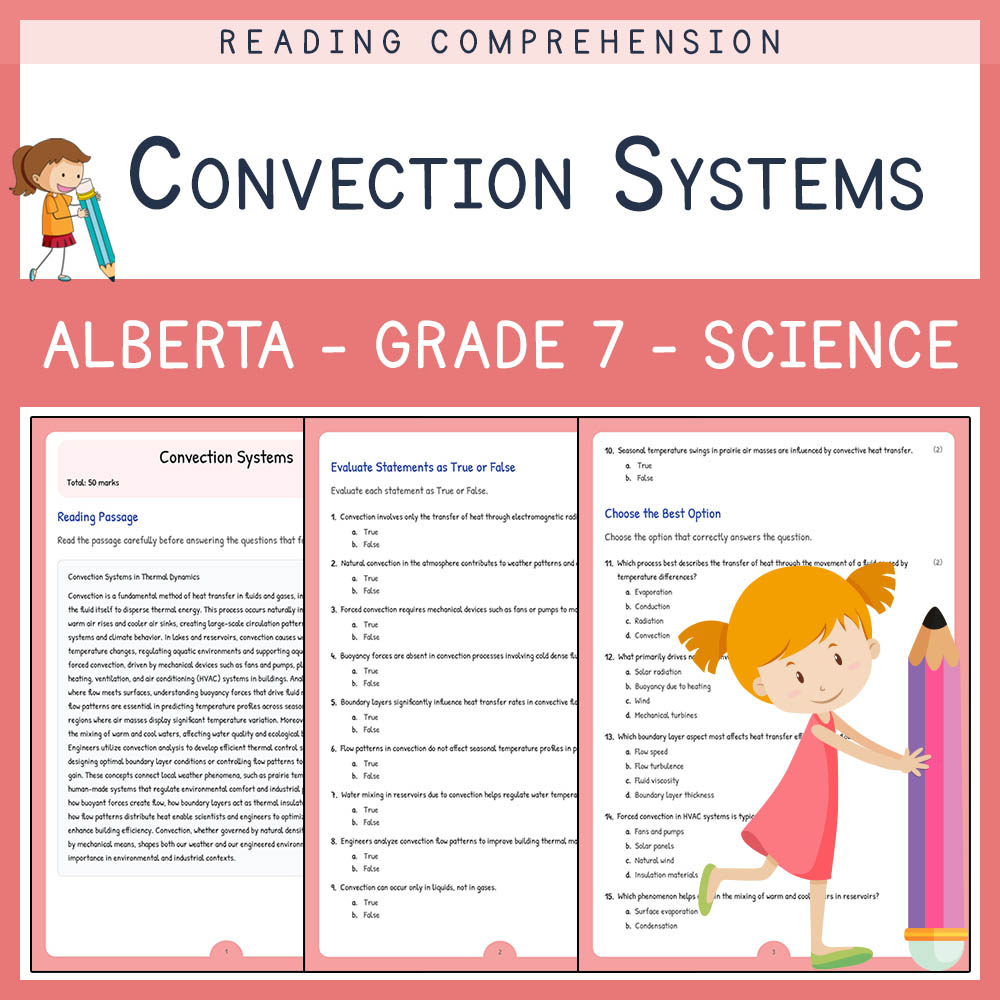
Grade 7 Science | Convection Systems Worksheet | Alberta Standard
Created byLumora LearningLearning Objectives
- Explain how heat is transferred through convection in fluids.
- Identify real-world examples of natural and forced convection.
- Describe the roles of buoyancy forces and boundary layers in convection flow.
Instant download

Grade 7 Science – Conservation Applications Worksheet (Alberta) PDF
 Created bySilver Birch Teaching
Learning Objectives
- Explain how conservation of mass is used to create mass budgets in closed or near-closed systems
- Connect conservation of mass to reaction stoichiometry and balanced chemical equations
- Use environmental mass balances to interpret measured versus expected masses in real situations
Also included in: Grade 7 Matter, Concentration & Reactions Science Lesson Bundle - Alberta +1 more
Instant download
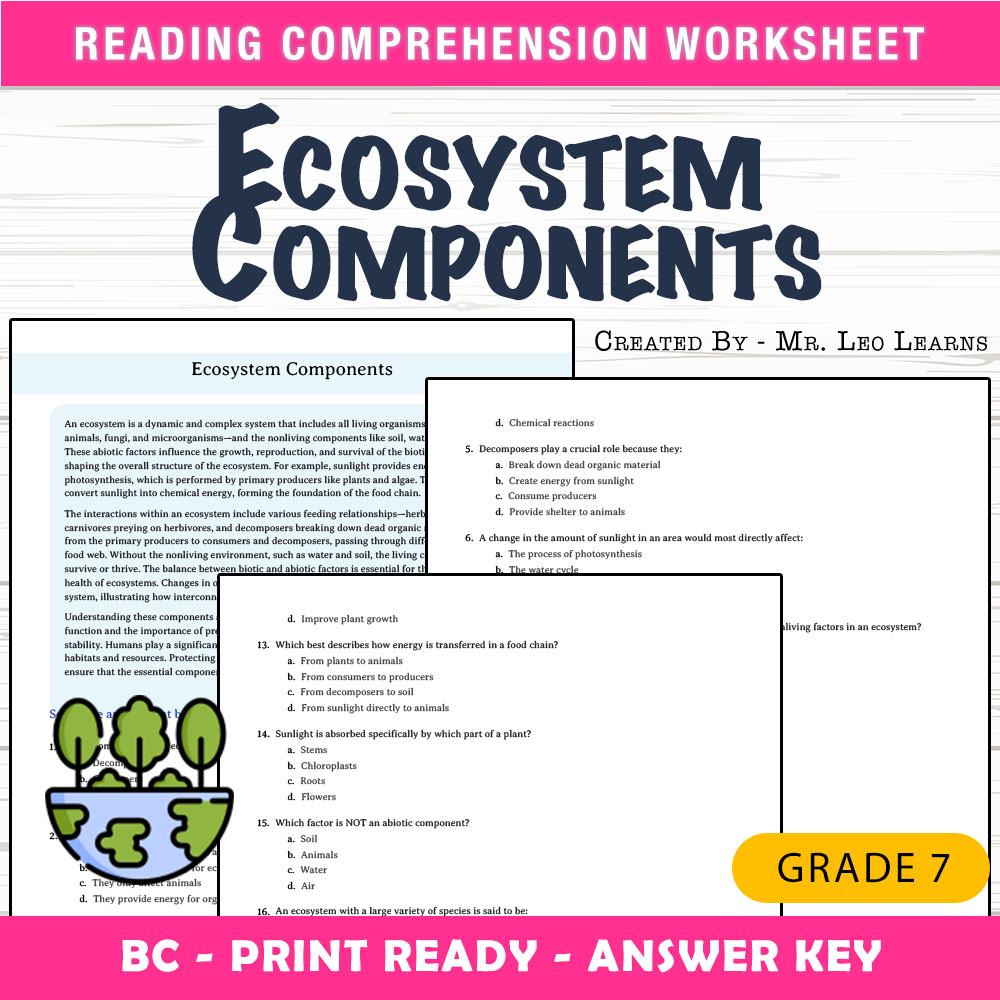
Grade 7 Science — Ecosystem Components Worksheet for Mastery
Created byThe Resource HubLearning Objectives
- Understand the roles of biotic and abiotic components in an ecosystem.
- Identify the flow of energy through producers and consumers.
- Recognize the interactions between living organisms and their environment.
Also included in: Grade 7 Science Ecosystems & Interactions Worksheet Bundle +1 more
Instant download

Grade 7 Science Worksheet – Chemical Change Evidence (Alberta Standards) (PDF)
Created bySilver Birch TeachingLearning Objectives
- Identify observable evidence that a chemical change has occurred (color change, gas production, precipitate formation, temperature/energy change, odor change).
- Explain chemical change at the particle level as bond breaking and bond forming, not just particle rearrangement.
- Use evidence from real-world examples (rusting iron, combustion of natural gas) to support claims about chemical vs. physical changes.
Also included in: Grade 7 Matter, Concentration & Reactions Science Lesson Bundle - Alberta +1 more
Instant download

Grade 7 Science – Solution Concentration Practice Worksheet (Alberta Standards) (PDF)
Created bySilver Birch TeachingLearning Objectives
- Define solution concentration and describe how solute and solvent relate to it
- Identify and use common concentration measures such as mass percent and grams per litre
- Explain how concentration affects physical properties like boiling point elevation and freezing point depression
Also included in: Grade 7 Matter, Concentration & Reactions Science Lesson Bundle - Alberta +1 more
Instant download

Grade 7 Science – Solubility Factors Worksheet (Alberta Standards) (Answer Key)
Created bySilver Birch TeachingLearning Objectives
- Explain how solute/solvent nature affects solubility and dissolution
- Describe how temperature, pressure, and agitation influence the amount and rate of dissolving
- Use particle size and surface area ideas to predict how quickly solids dissolve
Also included in: Grade 7 Matter, Concentration & Reactions Science Lesson Bundle - Alberta +1 more
Instant download

Grade 7 Science Worksheet | Matter Basics (PDF) – Alberta Standards
Created bySilver Birch TeachingLearning Objectives
- Differentiate between pure substances, mixtures, and solutions using measurable properties and uniformity.
- Explain why pure substances have characteristic melting points while mixtures do not.
- Describe solutions as homogeneous mixtures in which solute particles are dispersed at the molecular scale.
Also included in: Grade 7 Matter, Concentration & Reactions Science Lesson Bundle - Alberta +1 more
Instant download
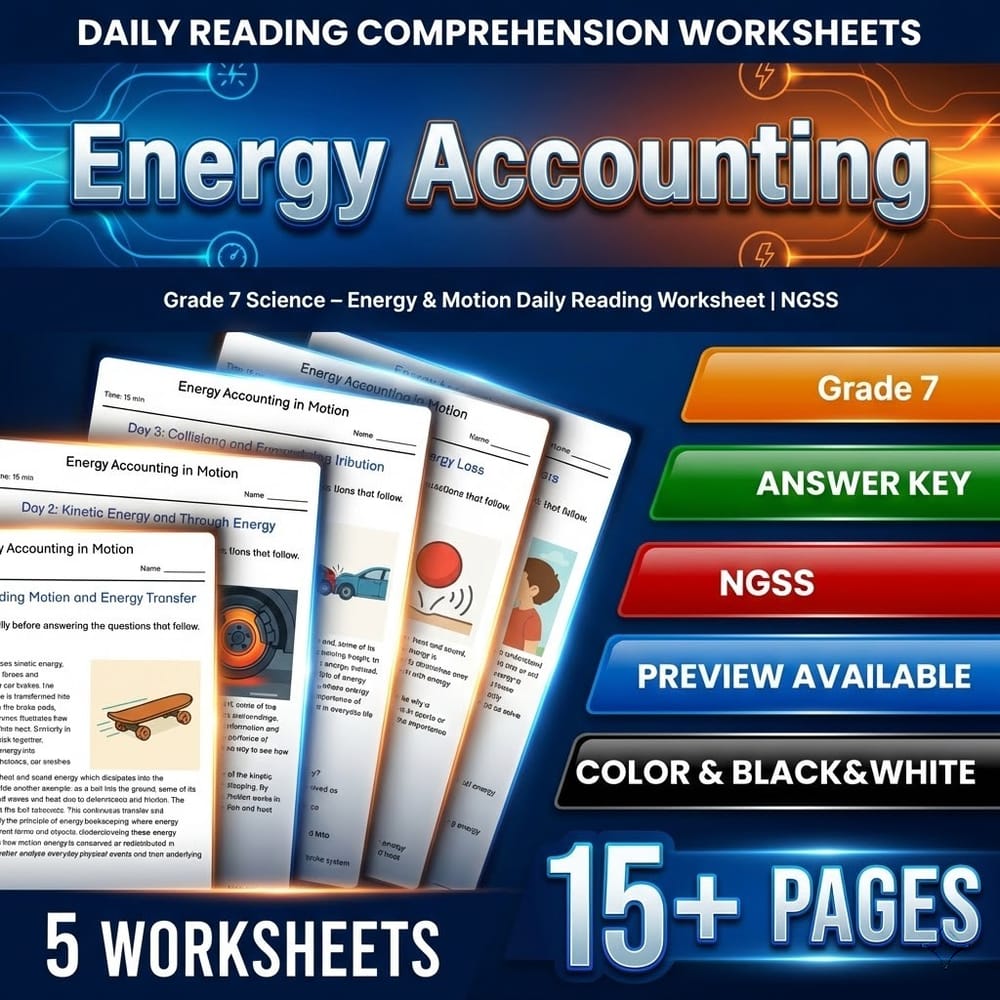
Grade 7 Science – Energy & Motion Daily Reading Worksheet | NGSS
 Created byElena Brooks
Learning Objectives
- Understand how energy transfers occur during an object's change in motion
- Identify examples of motion energy being converted into thermal and sound energy
- Recognize scenarios involving energy transfer and redistribution during collisions and bouncing
Also included in: Energy Grade 7 Science Daily Reading Worksheets Bundle | NGSS +1 more
Instant download

Cell Structures Worksheet for Grade 7 Science NGSS Aligned | PDF Practice
JCreated byJ.S SheetsLearning Objectives
- Identify the main organelles in plant and animal cells and explain their functions.
- Connect cell structure to its role in processes such as transport, synthesis, and compartmentalization.
- Compare eukaryotic and prokaryotic cells using examples like leaf mesophyll and muscle cells.
Also included in: Grade 7 Cellular and Organ Systems Science Lesson Bundle: NGSS Practice +1 more
Instant download

Grade 7 Science | Abiotic Drivers in Ecosystems - Daily Reading Comprehension
Created byCoral Reef LearningLearning Objectives
- Understand the concept of abiotic factors such as temperature, light, soil, moisture, and pH.
- Analyze how temperature gradients influence species distribution and ecosystem structure.
- Identify how abiotic variability creates microhabitats within different environments.
Instant download
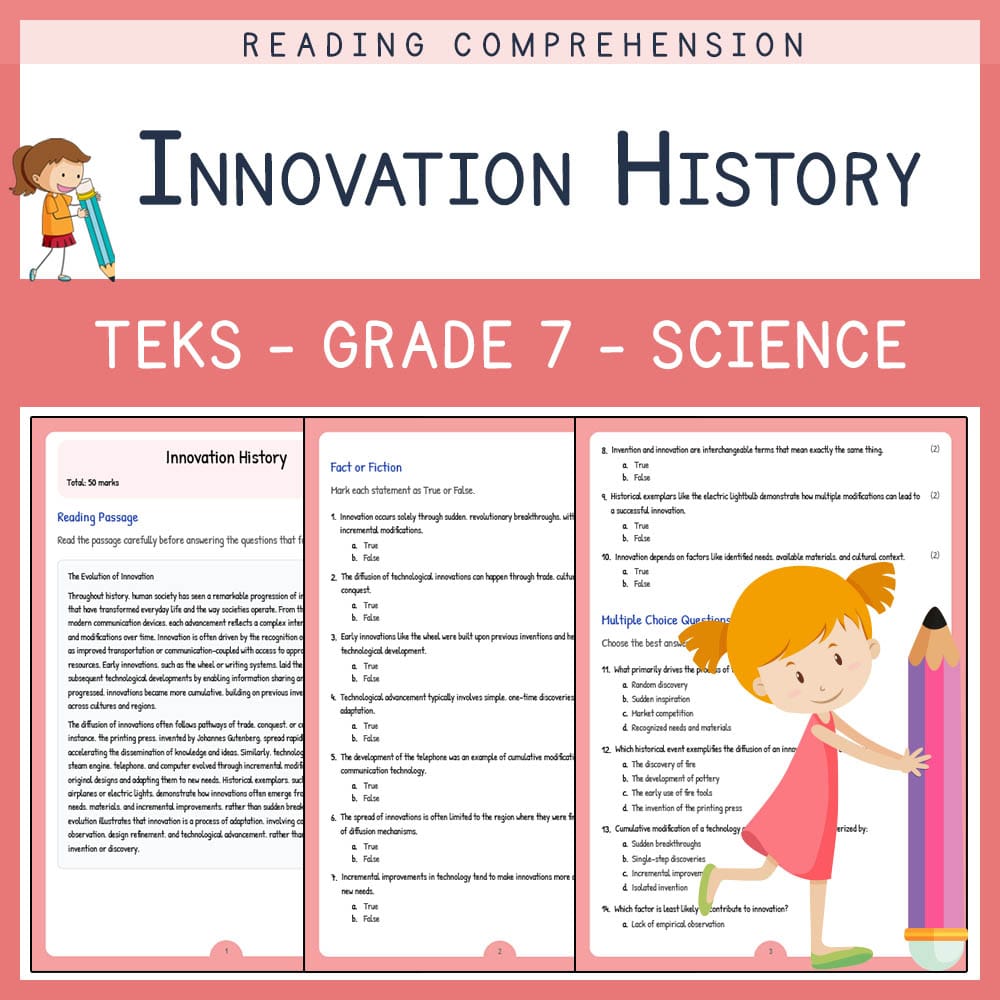
Grade 7 Science | Innovation History Worksheet | TEKS-Aligned
Created byLumora LearningLearning Objectives
- Understand the process and factors that contribute to technological innovation over time.
- Identify examples of inventions and innovations across different historical periods.
- Analyze causes, diffusion, and modifications that lead to technological advancements.
Instant download
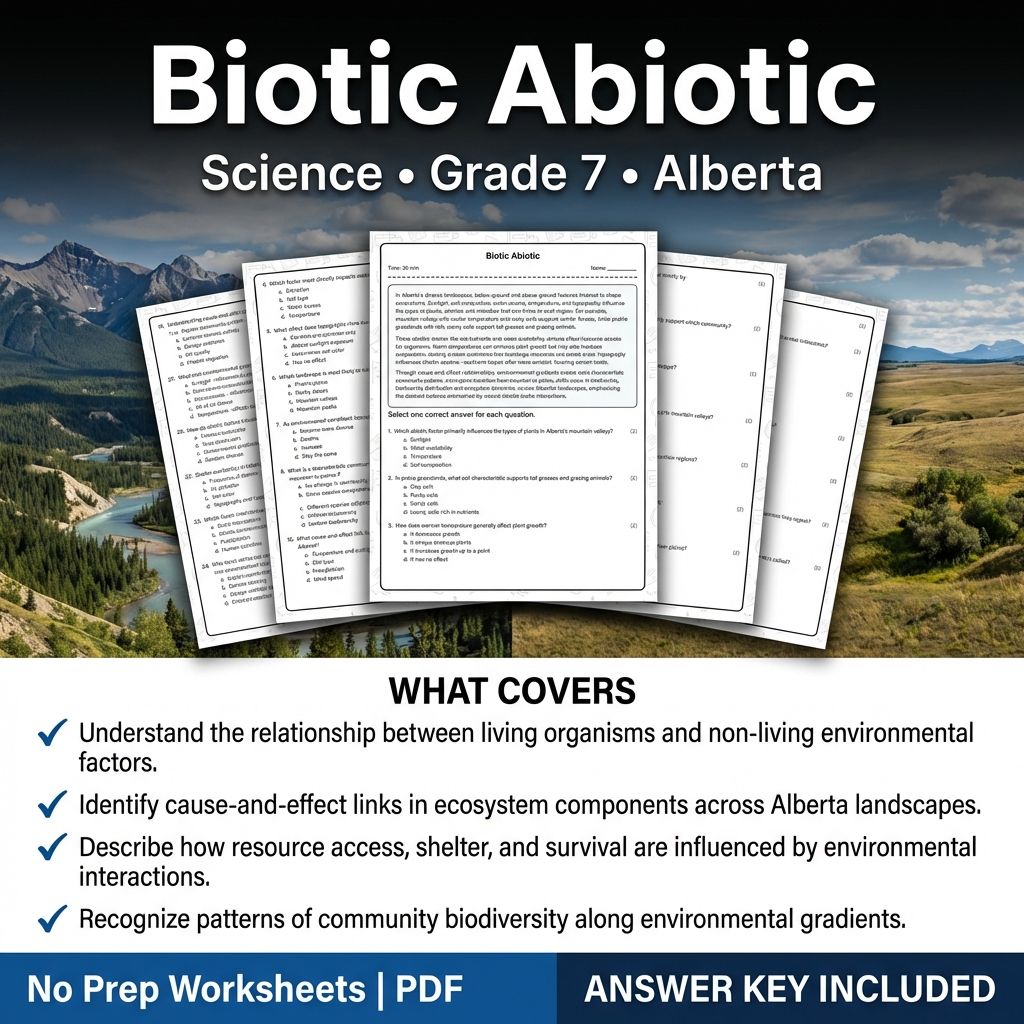
Grade 7 Science Worksheet | Biotic Abiotic | Alberta Standards | Worksheet
Created byCoral Reef LearningLearning Objectives
- Understand the relationship between living organisms and non-living environmental factors.
- Identify cause-and-effect links in ecosystem components across Alberta landscapes.
- Describe how resource access, shelter, and survival are influenced by environmental interactions.
Instant download
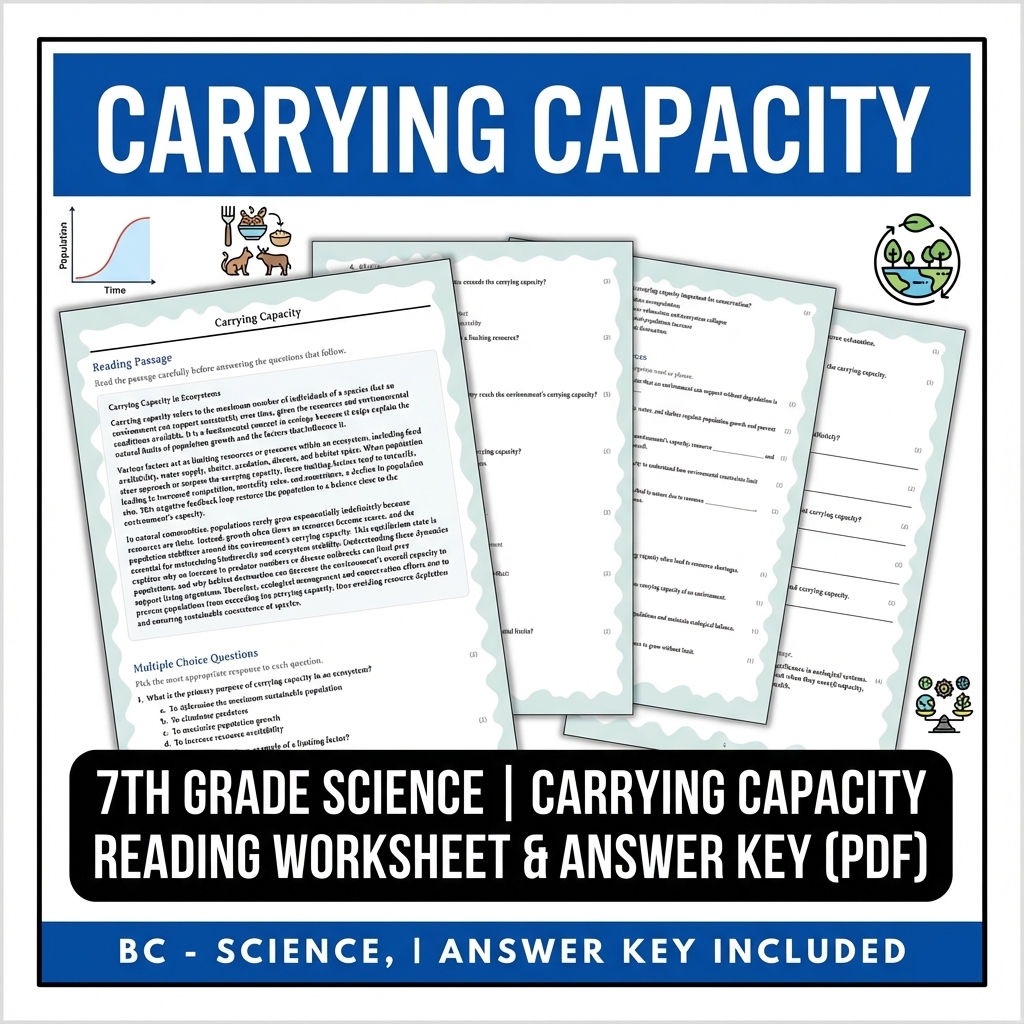
7th Grade Science | Carrying Capacity Reading Worksheet & Answer Key (PDF)
JCreated byJ.S SheetsLearning Objectives
- Define carrying capacity and explain its significance in ecosystems.
- Identify limiting factors that regulate population growth.
- Describe how populations adjust when exceeding the environment's carrying capacity.
Instant download
About Grade 7 Science Worksheets
Browse 6,039 printable Grade 7 Science worksheets — ready-to-print PDFs with answer keys where available.
Every worksheet on MyTeachingSheets is created by independent teacher-authors and reviewed before publication. All resources download as printable PDFs for classroom, homework, or at-home practice, and many include answer keys. Preview any worksheet free before buying.