
Grade 8 Science Worksheets
6,006 worksheets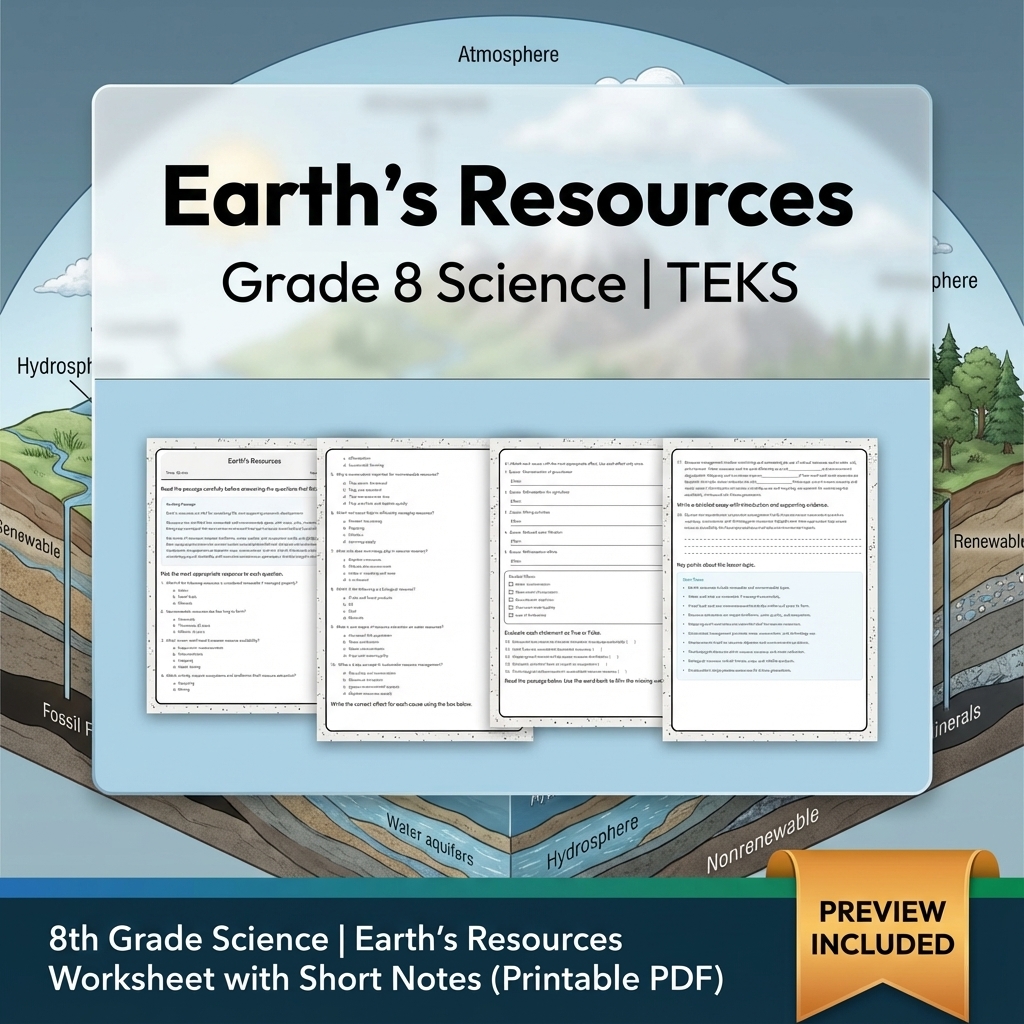
8th Grade Science | Earth's Resources Worksheet with Short Notes (Printable PDF)
 Created byMeadowlark Worksheets
Learning Objectives
- Understand the distribution and classification of renewable and nonrenewable resources.
- Identify the impacts of resource extraction on landforms, water, and ecosystems.
- Explore methods for assessing resource availability such as mapping and inventories.
Instant download

Grade 8 Organ Formation Worksheet | BC Practice & PDF
 Created byClear Sky Classroom
Learning Objectives
- Explain how different tissue types work together to form an organ with specialized functions.
- Describe how an organ’s structure supports its role in transport, mechanical work, or chemistry.
- Use text evidence to identify main ideas and evaluate statements about tissue interactions.
Instant download

Organ Formation Worksheet | Grade 8 Science Activities
 Created byPrism Point Learning
Learning Objectives
- Explain how different tissue types work together to form an organ with specialized functions.
- Describe how organ architecture (layers, cell junctions, and transport channels) supports physiological tasks.
- Use tissue-level evidence to reason about organ-level properties that cannot be predicted from single cells alone.
Also included in: Grade 8 Science Full-Year Bundle | BC Science Framework
Instant download
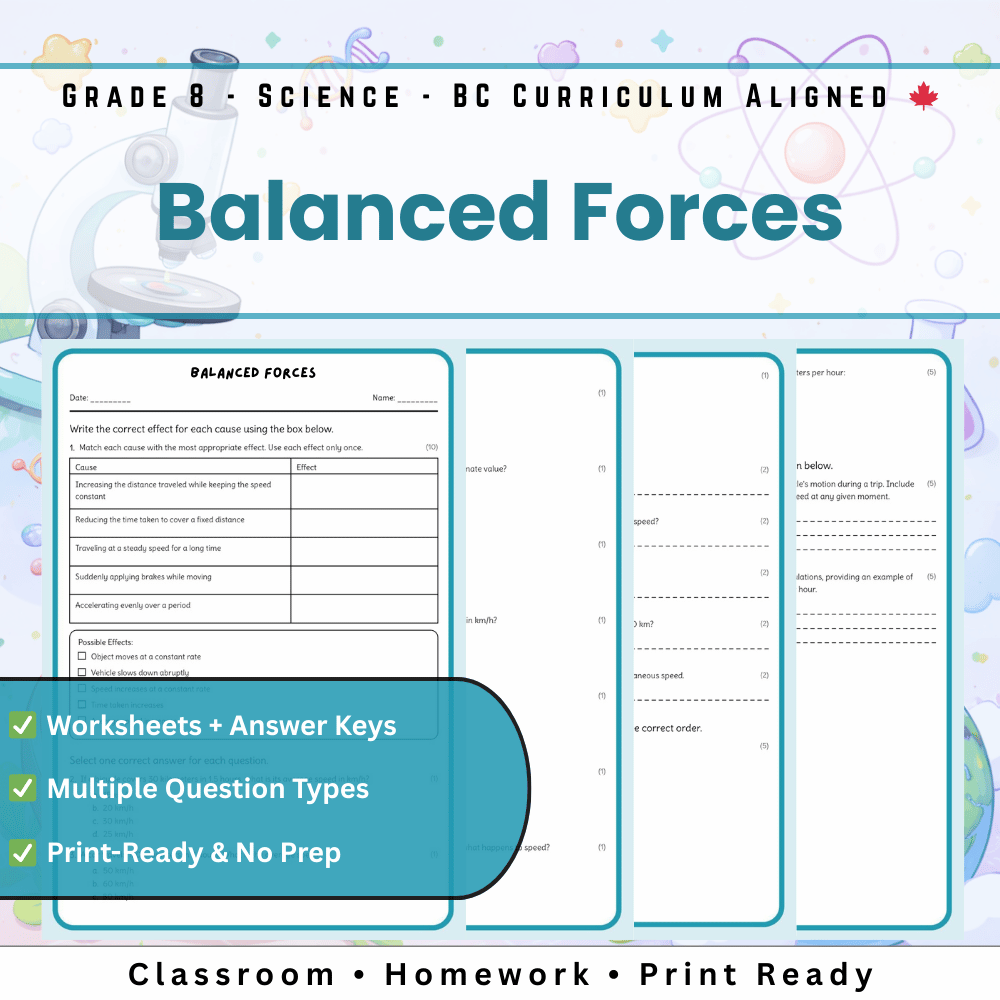
Grade 8 Science | Balanced Forces Worksheet + Answer Key – BC Standards
 Created byBright Mind Resources
Learning Objectives
- Understand the concept of balanced and unbalanced forces.
- Identify examples of static and dynamic equilibrium.
- Explain how balanced forces result in no change in motion.
Instant download
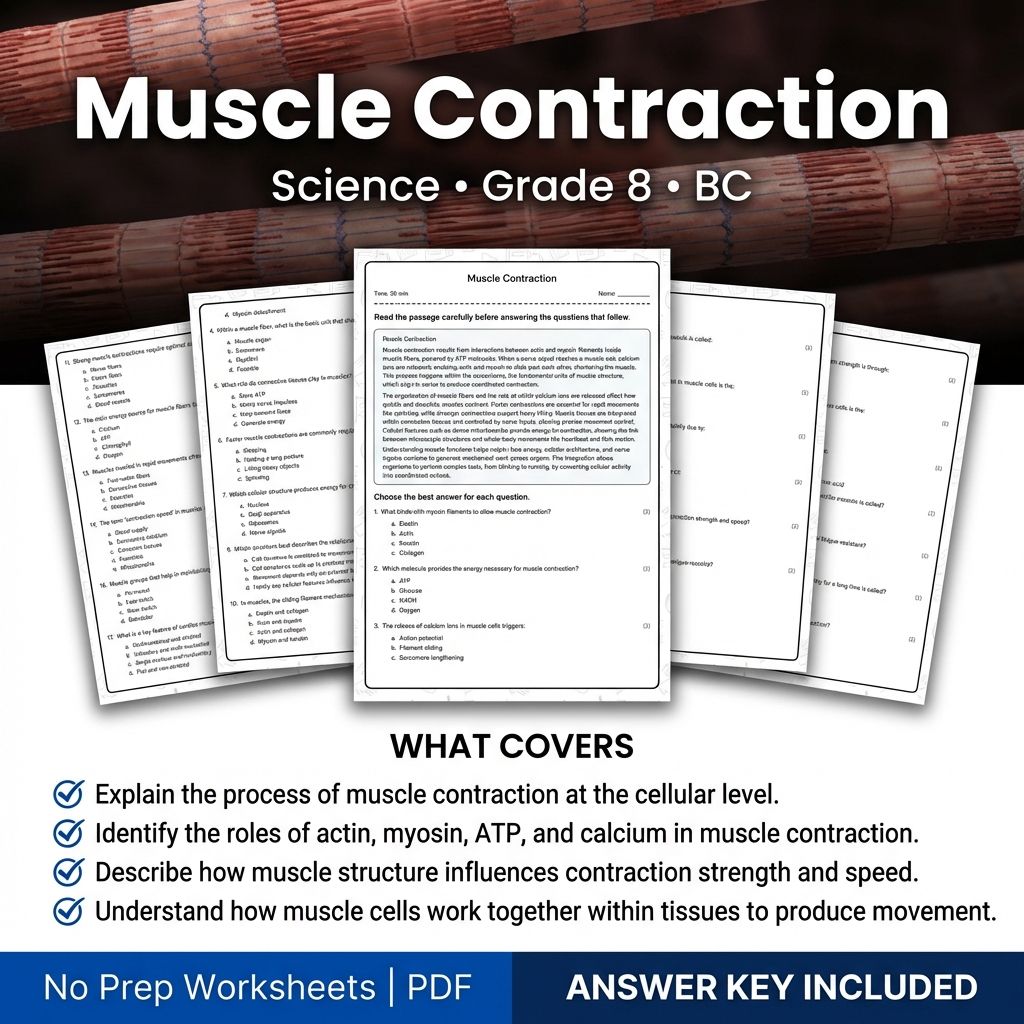
8th Grade Science | Muscle Contraction Worksheet & Answer Key (Printable PDF)
 Created byCoral Reef Learning
Learning Objectives
- Explain the process of muscle contraction at the cellular level.
- Identify the roles of actin, myosin, ATP, and calcium in muscle contraction.
- Describe how muscle structure influences contraction strength and speed.
Instant download
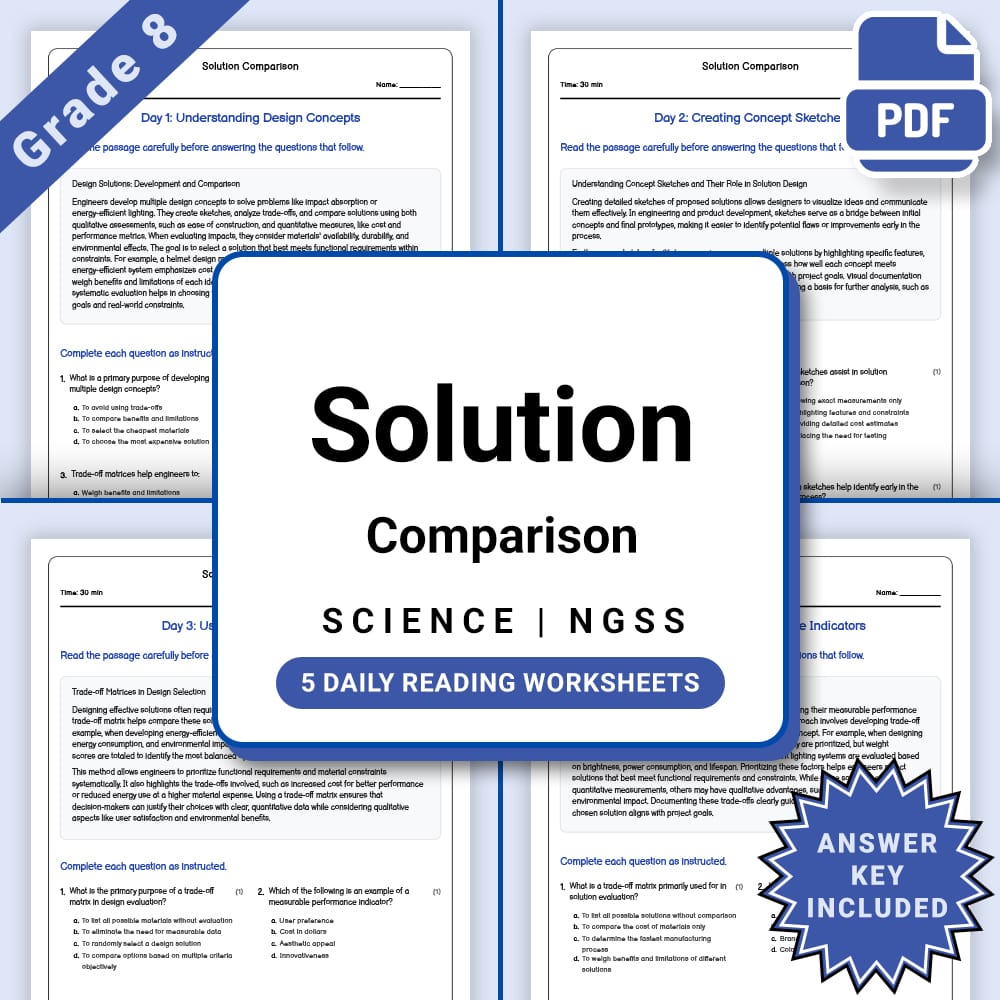
Grade 8 Science – Solution Comparison Worksheet(PDF + Answer Key)
 Created byCopper Leaf Classroom
Learning Objectives
- Understand the key features of different design concepts for solutions such as impact absorption and energy efficiency.
- Evaluate design solutions using criteria like benefits, limitations, materials, and performance indicators.
- Differentiate between qualitative and quantitative assessments in solution evaluation.
Instant download

Grade 8 Science – Ecosystem Structure Daily Reading Worksheet with Answer Key
JCreated byJ.S SheetsLearning Objectives
- Identify key components of an ecosystem
- Explain abiotic factors influencing ecosystems
- Describe the roles of producers, consumers, and decomposers
Also included in: Grade 8 Science Lesson Bundle – TEKS-aligned Reading Worksheets +1 more
Instant download

Grade 8 Science | Density Principles for Grade Science - Reading Comprehension
Created byCoral Reef LearningLearning Objectives
- Understand the concept of density as a property derived from mass and volume.
- Learn to identify real-world examples of density differences in liquids and solids.
- Calculate the density of objects using mass and volume measurements.
Instant download

Grade 8 Science | Energy Forms Worksheet (Ontario) – (PDF)
 Created byEvergreen Desk Education
Learning Objectives
- Identify kinetic and potential energy in mechanical systems and describe how they affect motion.
- Use quantitative relationships to compare gravitational potential energy and kinetic energy.
- Explain energy conversions in real systems, including common energy sinks such as thermal and acoustic energy.
Also included in: Grade 8 Work, Energy & Forces Science lesson bundle Ontario worksheet set +1 more
Instant download

Grade 8 TEKS Reaction Rates Science Daily Reading Worksheet & Notes
 Created byBRIGHT PATH RESOURCES
Learning Objectives
- Explain how temperature, concentration, surface area, and catalysts can change the rate of a chemical reaction.
- Connect reaction rates to collision frequency and activation energy.
- Use evidence from a text to identify cause-and-effect in reaction rate changes.
Also included in: Grade 8 Matter and Energy Science Reading Worksheets Bundle | TEKS +1 more
Instant download

Grade 8 Bernoulli Principle Worksheet | Ontario Science + Doodle Notes
 Created byChalk and Compass
Learning Objectives
- Explain how Bernoulli’s principle relates fluid speed and pressure for ideal, incompressible flow.
- Use the continuity idea to describe how speed changes when a fluid moves through a constricted pipe.
- Apply Bernoulli’s principle to qualitatively explain reduced pressure near faster airflow and airfoil lift.
Also included in: Fluids, Pressure & Flow Lesson Bundle — Grade 8 Science Ontario +1 more
Instant download
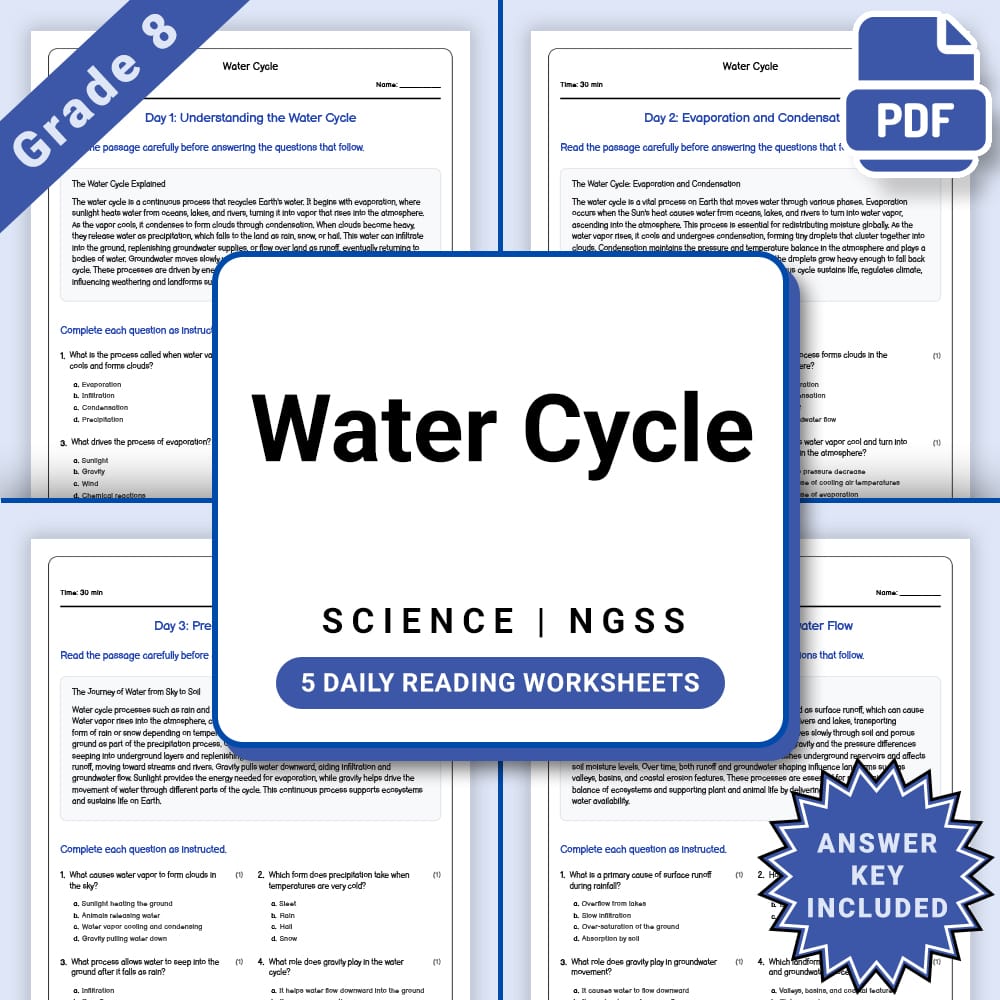
Grade 8 Science – Water Cycle Daily Reading Worksheet(PDF + Answer Key)
Created byCopper Leaf ClassroomLearning Objectives
- Understand key concepts related to Science
- Apply knowledge through practice questions
- Demonstrate comprehension of the material
Instant download

Force and Motion Assessment for Grade 8 Science | NGSSS Standards-Aligned
Created byPrism Point LearningLearning Objectives
- Explain how forces can change an object’s motion, including starting, stopping, and changing direction
- Describe how net force determines whether an object accelerates and the direction of that acceleration
- Use evidence from real-life examples (pushes, pulls, friction, gravity) to predict changes in motion
Instant download

Grade 8 Science Worksheet on Grid Context | Standards-Aligned Practice
JCreated byJ.S SheetsLearning Objectives
- Understand the components and functions of electrical power grids.
- Identify regional characteristics influencing energy generation.
- Explain grid operations including voltage conversion and losses.
Also included in: Grade 8 Electricity & Circuits Science Lesson Bundle: Alberta Framework +1 more
Instant download

Magnetic Fields Worksheet | Grade 8 Science | Alberta Standards
JCreated byJ.S SheetsLearning Objectives
- Understand the origin and nature of magnetic fields from different sources.
- Identify how magnetic field lines represent strength and polarity.
- Explain how electromagnets are constructed and used in real-world applications.
Also included in: Grade 8 Electricity & Circuits Science Lesson Bundle: Alberta Framework +1 more
Instant download

Motors and Generators PDF Worksheet | Alberta Grade 8 Science Practice
JCreated byJ.S SheetsLearning Objectives
- Understand the basic principles of electric motors and generators.
- Identify how coil turns, flux strength, and load affect motor and generator efficiency.
- Describe real-world applications of motors and generators in regional infrastructure.
Also included in: Grade 8 Electricity & Circuits Science Lesson Bundle: Alberta Framework +1 more
Instant download

Series and Parallel Circuits Worksheet | Grade 8 Science Standards-Aligned
JCreated byJ.S SheetsLearning Objectives
- Understand the differences between series and parallel circuit arrangements.
- Analyze how resistance, current, and voltage behave in series and parallel circuits.
- Predict the effects of circuit configurations on brightness and redundancy.
Also included in: Grade 8 Electricity & Circuits Science Lesson Bundle: Alberta Framework +1 more
Instant download

Circuit Analysis Worksheet | Grade 8 Science Standards-Aligned
JCreated byJ.S SheetsLearning Objectives
- Understand the principles of circuit analysis including conservation laws and relationships between voltages, currents, and power.
- Learn to interpret schematic diagrams and apply reduction techniques to simplify complex networks.
- Develop skills in systematic calculation methods for predicting network responses to source changes or component variations.
Also included in: Grade 8 Electricity & Circuits Science Lesson Bundle: Alberta Framework +1 more
Instant download

Electric Charge Worksheet | Standards-Aligned Grade 8 Science Practice
JCreated byJ.S SheetsLearning Objectives
- Understand the concept of electric charge and its properties.
- Differentiate between static and current electricity based on origin and effects.
- Describe real-world phenomena related to electrostatic effects and electric currents.
Also included in: Grade 8 Electricity & Circuits Science Lesson Bundle: Alberta Framework +1 more
Instant download

Voltage Concepts Worksheet | Grade 8 Science | Alberta Standards
JCreated byJ.S SheetsLearning Objectives
- Understand the concept of voltage and how it drives current in circuits.
- Identify sources of voltage such as batteries and generators.
- Analyze multi-source circuits and compare household voltages and renewable outputs.
Also included in: Grade 8 Electricity & Circuits Science Lesson Bundle: Alberta Framework +1 more
Instant download

Magnetic Materials Worksheet for Grade 8 Science | Standards-Aligned Practice
JCreated byJ.S SheetsLearning Objectives
- Understand the classification of materials based on their magnetic response: diamagnetic, paramagnetic, and ferromagnetic.
- Explain how microstructural properties and domain alignment influence magnetic behavior such as coercivity and remanence.
- Identify applications of magnetic materials in industry, including separation, lifting, and electrical machinery.
Also included in: Grade 8 Electricity & Circuits Science Lesson Bundle: Alberta Framework +1 more
Instant download

Electromagnetic Induction Worksheet | Grade 8 Science | Alberta Standards
JCreated byJ.S SheetsLearning Objectives
- Understand the principle of electromagnetic induction and how changing magnetic flux generates voltage.
- Identify the factors affecting the magnitude of induced electromotive force in circuits.
- Explain real-world applications of electromagnetic induction in generators and transformers.
Also included in: Grade 8 Electricity & Circuits Science Lesson Bundle: Alberta Framework +1 more
Instant download

Atmospheric Structure Worksheet | Standards-Aligned Grade 8 Science Practice
JCreated byJ.S SheetsLearning Objectives
- Identify the main atmospheric layers and describe how temperature and density change with altitude.
- Explain how pressure decreases with height and how this affects weather observations.
- Describe the role of ozone in the stratosphere and greenhouse gases in Earth’s energy balance.
Instant download
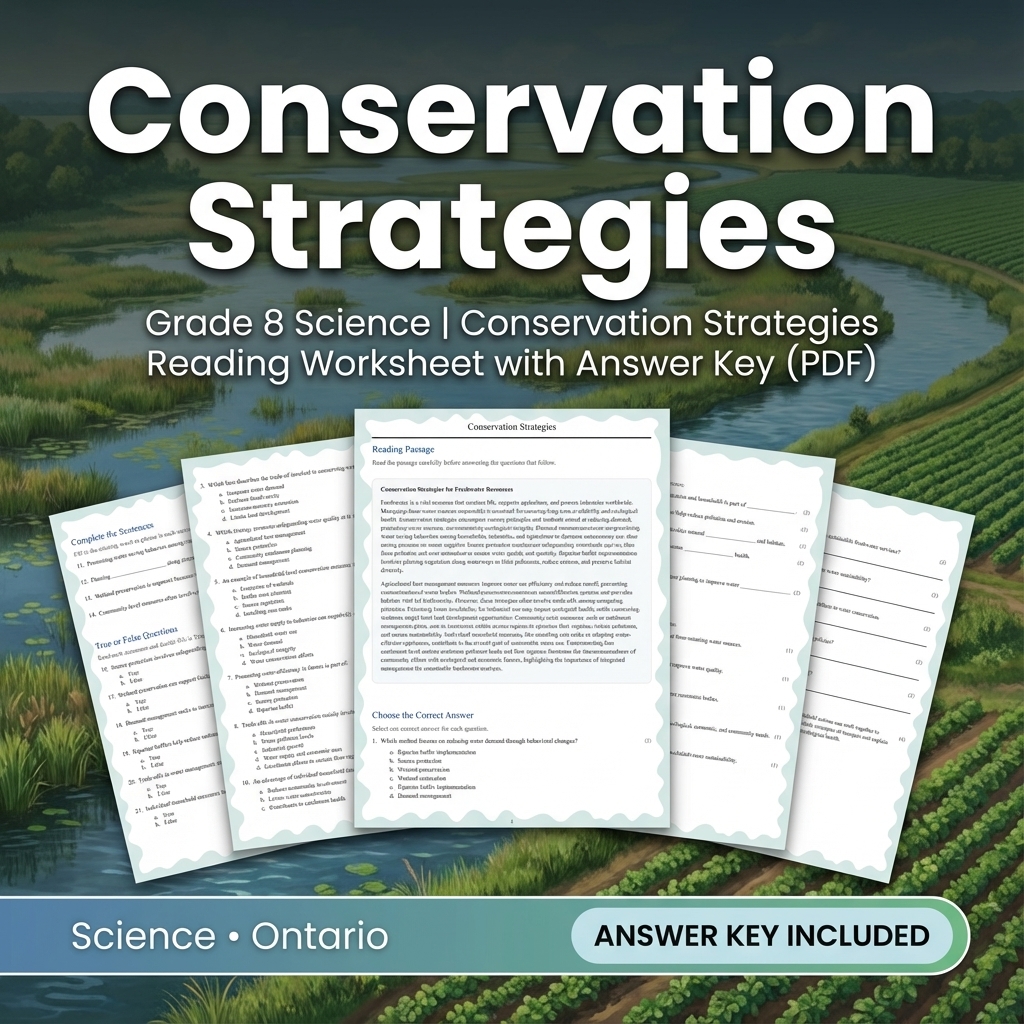
Grade 8 Science | Conservation Strategies Reading Worksheet with Answer Key
JCreated byJ.S SheetsLearning Objectives
- Understand principles and methods for sustainable management of freshwater resources.
- Identify various conservation techniques, including demand management and source protection.
- Analyze trade-offs between water supply, ecological health, and economic uses.
Also included in: Grade 8 Science Bundle | Water Systems Hydrology Concepts (Answer Key Included) +1 more
Instant download
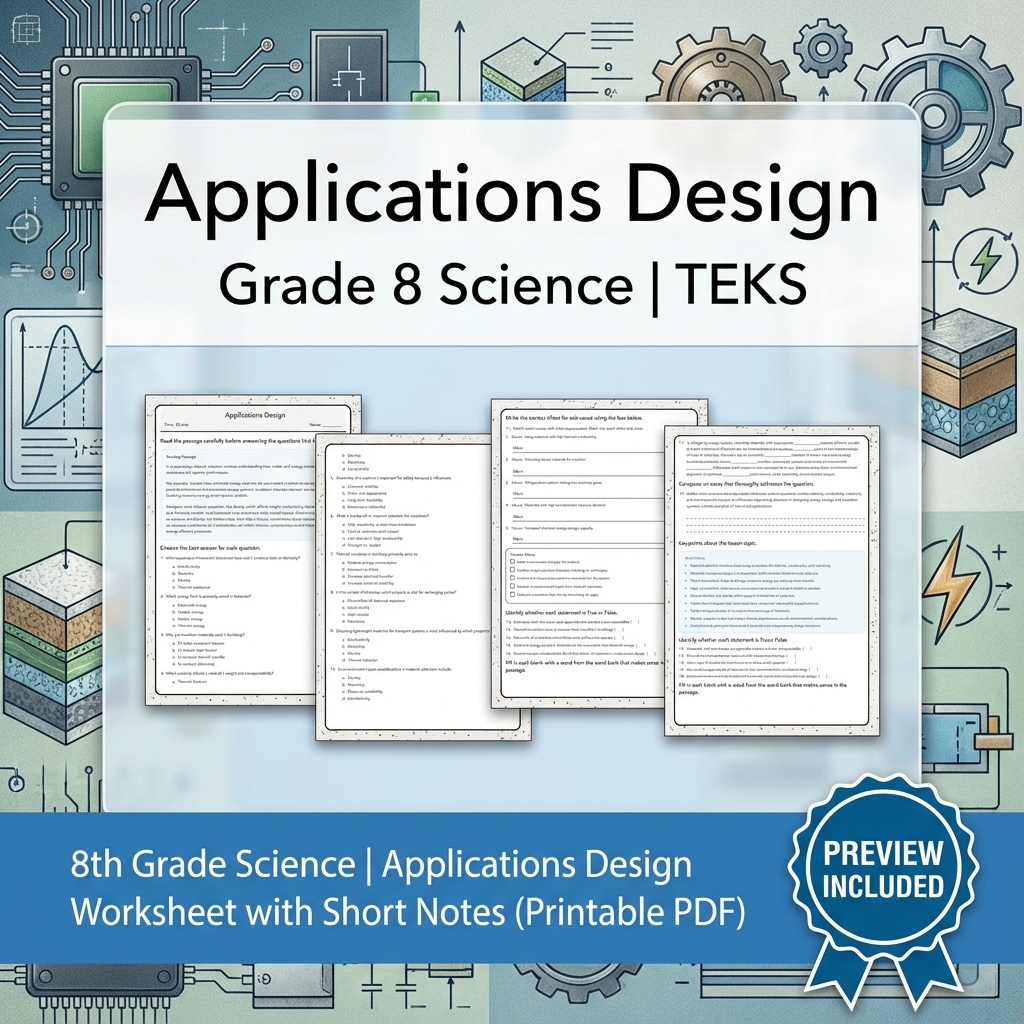
8th Grade Science Applications Design Worksheet with Short Notes (Printable PDF)
Created byMeadowlark WorksheetsLearning Objectives
- Understand how matter and energy influence material choices in engineering applications.
- Analyze trade-offs among material properties such as density, conductivity, and reactivity.
- Evaluate real-world examples of energy storage and insulation with conceptual reasoning.
Instant download
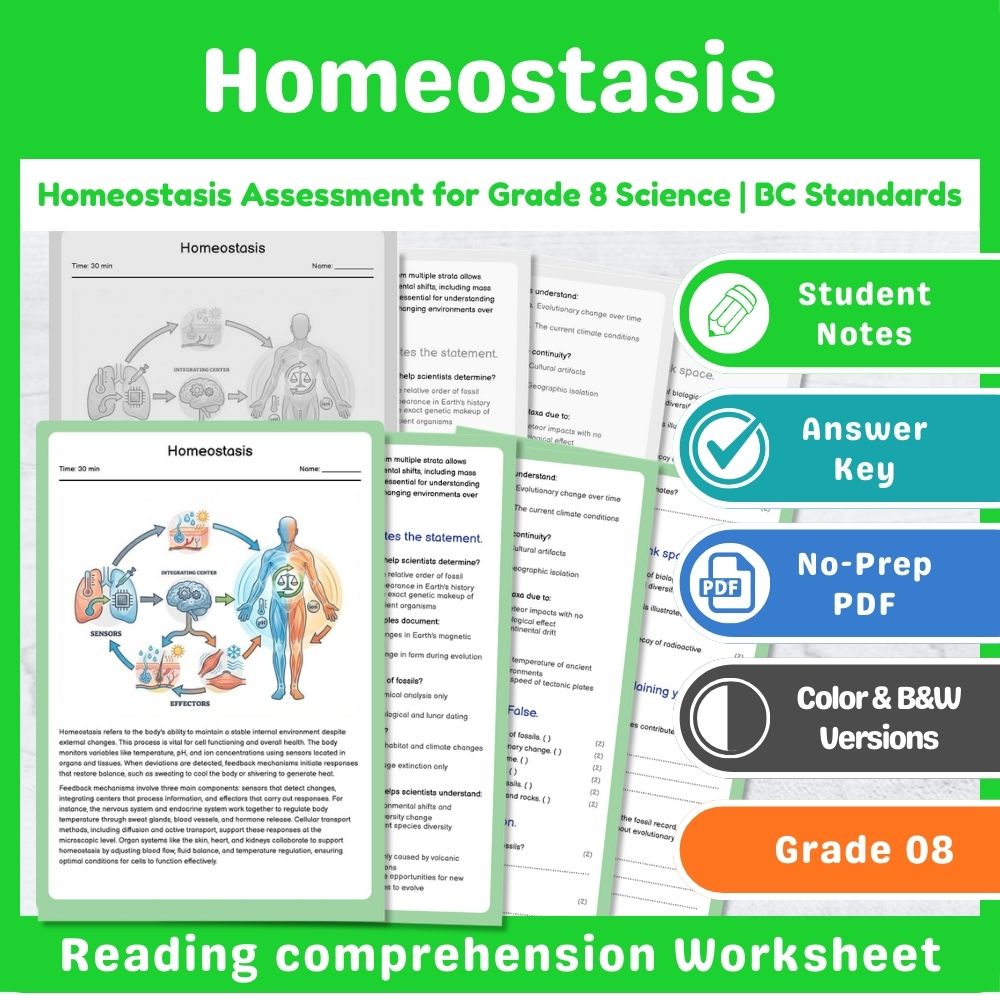
Homeostasis Assessment for Grade 8 Science | BC Standards
Created byPrism Point LearningLearning Objectives
- Understand the concept of homeostasis and its importance in maintaining internal conditions.
- Identify feedback mechanisms involved in physiological regulation.
- Describe how cellular processes and organ systems work together to sustain stability.
Instant download
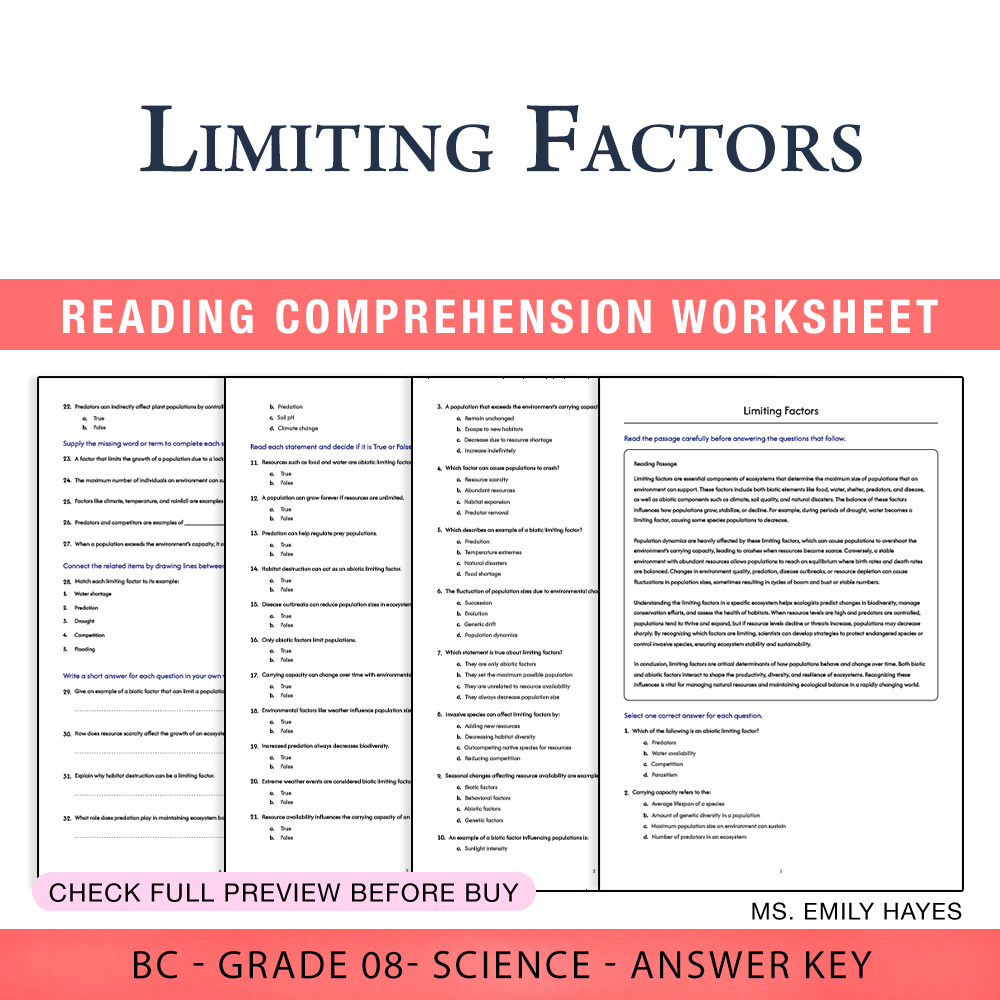
8th Grade Science | Limiting Factors Worksheet (PDF+ Answer Key)
Created byCopper Leaf ClassroomLearning Objectives
- Understand the concept of limiting factors and their role in population dynamics.
- Identify biotic and abiotic factors that limit populations in ecosystems.
- Explain how resource availability influences carrying capacity and population stability.
Also included in: Grade 8 Science– Ecology, Biodiversity & Environmental Impact (PDF + Answer Key) +1 more
Instant download

Adaptation Mechanisms Worksheet | Grade 8 Science Activities
Created byPrism Point LearningLearning Objectives
- Describe structural, behavioral, and physiological adaptations and explain how each can improve survival and reproduction.
- Explain how natural selection changes trait frequencies over generations using the ideas of variation, heritability, and selective pressures.
- Differentiate adaptation from acclimation using examples from ecological contexts.
Also included in: Grade 8 Ecosystems & Cellular Processes Science Lesson Bundle TEKS +1 more
Instant download

Density Principles Worksheet | Grade 8 Science Activities
Created byPrism Point LearningLearning Objectives
- Explain density as the relationship between mass and volume and predict whether an object sinks or floats using qualitative density reasoning.
- Use the density formula (density = mass ÷ volume) to solve straightforward quantitative problems.
- Connect density differences to buoyancy, displacement, and fluid layering in real-world contexts.
Also included in: Grade 8 Matter & Reactions Science Lesson Bundle (TEKS Worksheets) +1 more
Instant download
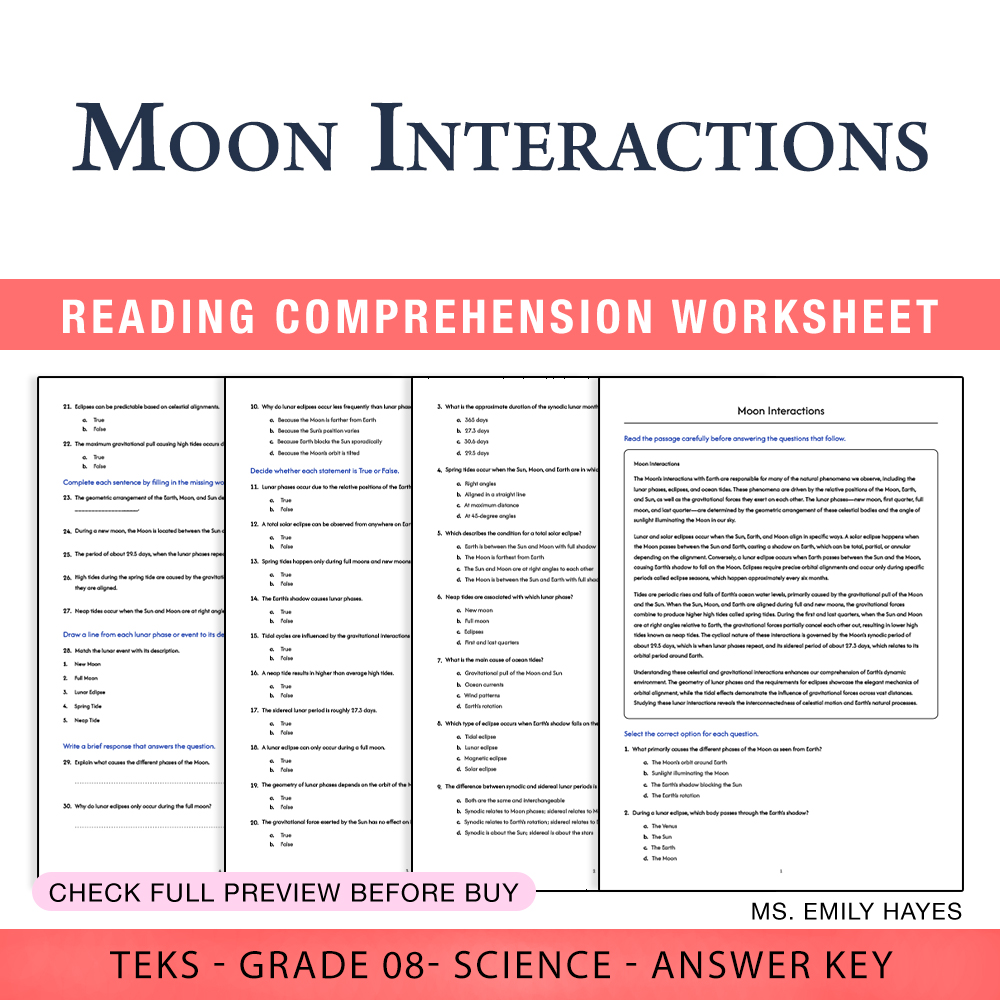
8th Grade Science | Moon Interactions Worksheet (PDF+ Answer Key)
Created byCopper Leaf ClassroomLearning Objectives
- Explain how the relative positions of the Moon, Earth, and Sun result in phases, eclipses, and tides.
- Distinguish between synodic and sidereal lunar periods and their significance.
- Describe the geometry of lunar phases and the conditions needed for eclipses.
Instant download
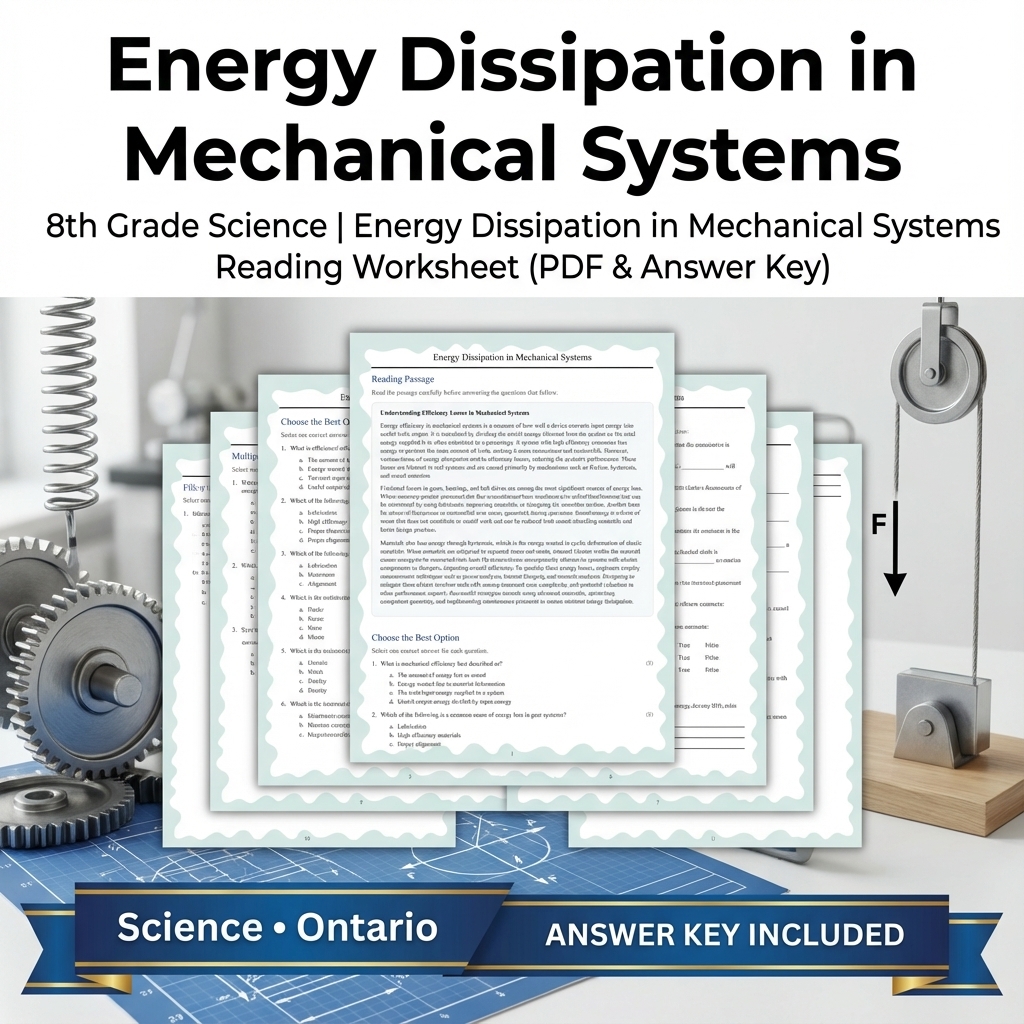
8th Grade | Energy Dissipation in Mechanical Systems Reading (PDF & Answer Key)
JCreated byJ.S SheetsLearning Objectives
- Define mechanical efficiency and explain its significance.
- Identify various types of energy losses in mechanical systems.
- Describe mechanisms such as frictional heating, sound emission, and hysteresis that contribute to efficiency loss.
Also included in: Grade 8 Science | Energy & Forces Unit Worksheet Pack (Answer Keys Included) +1 more
Instant download
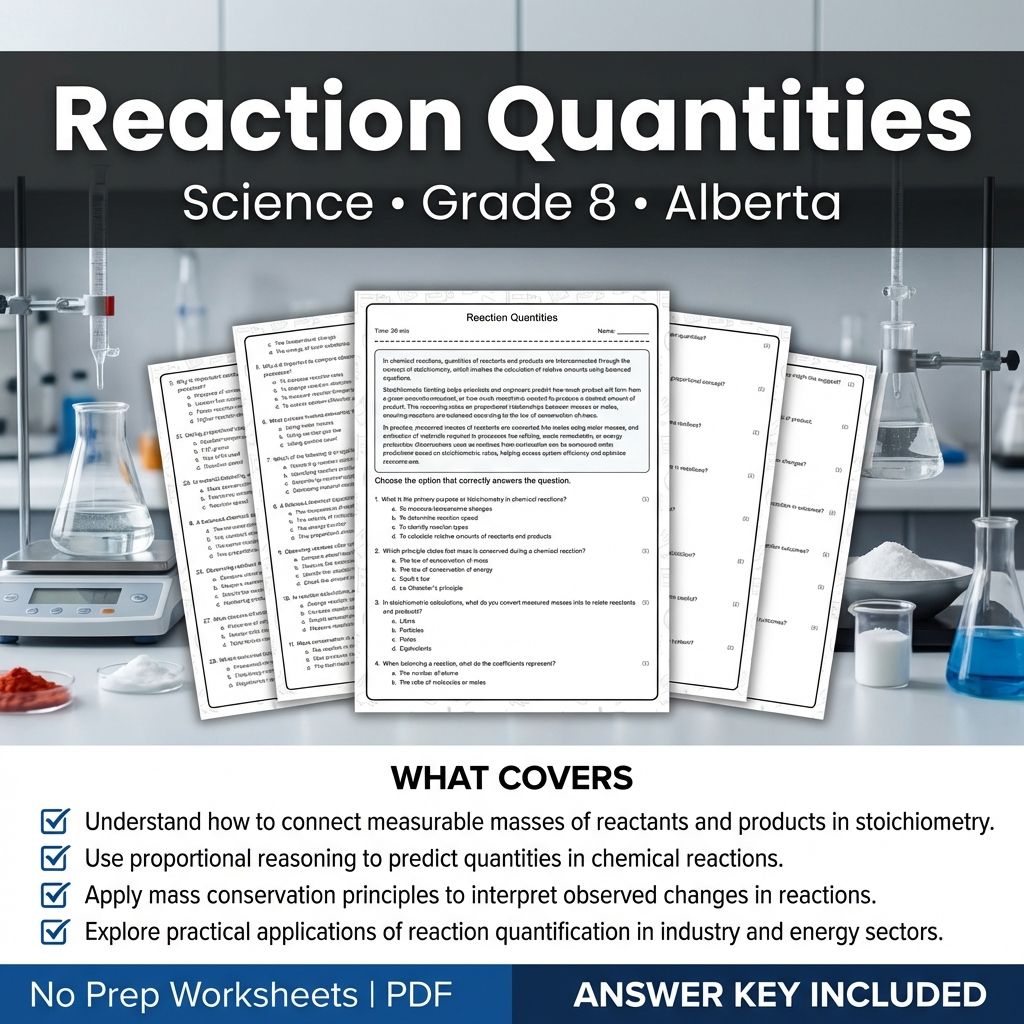
Reaction Quantities Worksheet for Grade 8 Science – Alberta Standards
Created byCoral Reef LearningLearning Objectives
- Understand how to connect measurable masses of reactants and products in stoichiometry.
- Use proportional reasoning to predict quantities in chemical reactions.
- Apply mass conservation principles to interpret observed changes in reactions.
Instant download
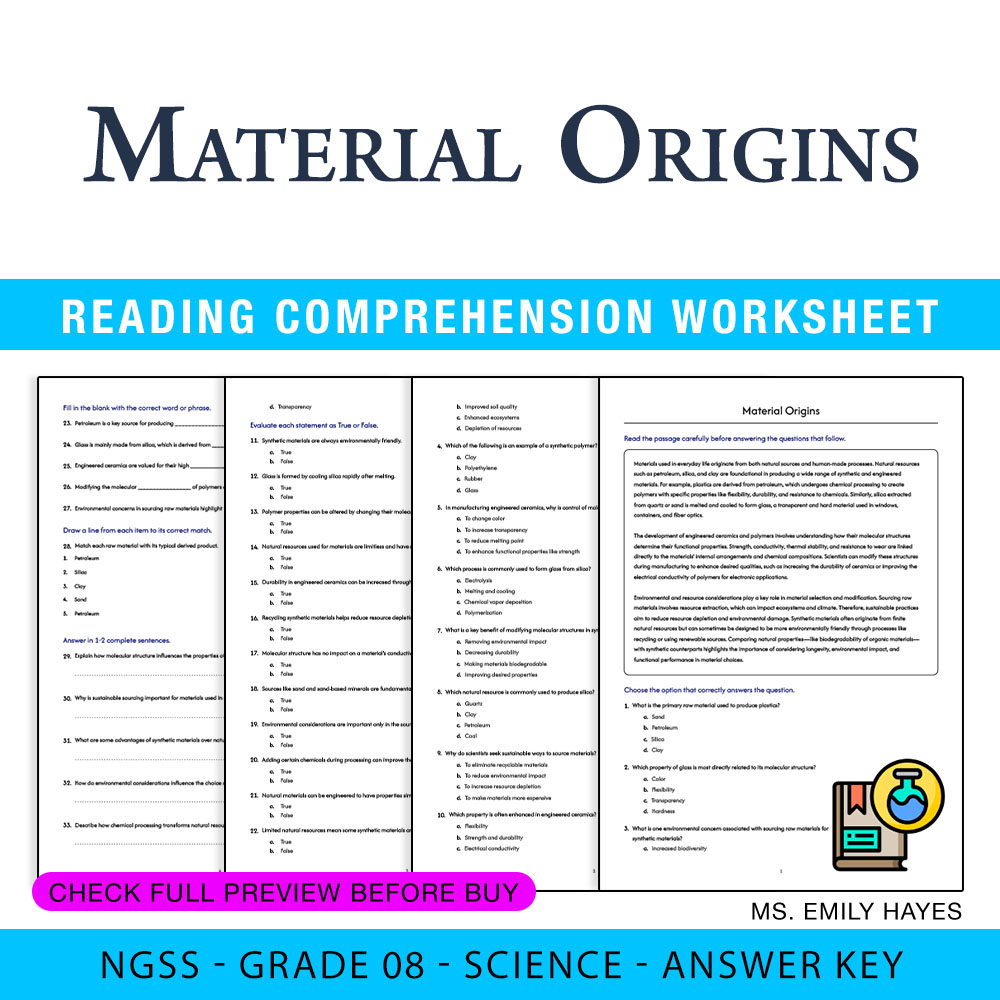
8th Grade Science | Material Origins Worksheet (PDF+ Answer Key)
Created byCopper Leaf ClassroomLearning Objectives
- Understand how natural resources are transformed into synthetic materials.
- Recognize the influence of processing and molecular structure on material properties.
- Analyze environmental and resource considerations in sourcing and modifying materials.
Instant download
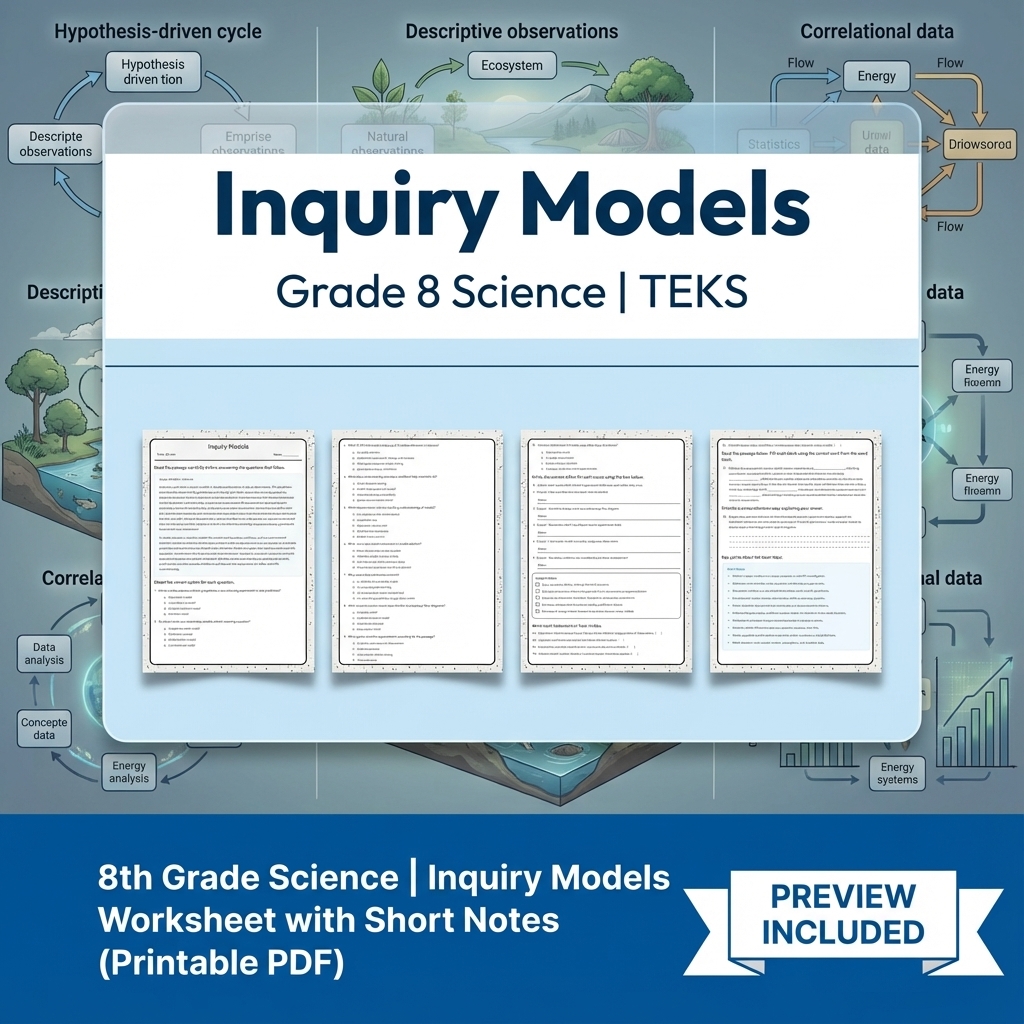
8th Grade Science | Inquiry Models Worksheet with Short Notes (Printable PDF)
Created byMeadowlark WorksheetsLearning Objectives
- Understand the differences between hypothesis-driven, descriptive, and correlational inquiry models.
- Identify typical contexts and applications of each inquiry model in science.
- Analyze model boundary conditions, assumptions, and testable predictions.
Instant download
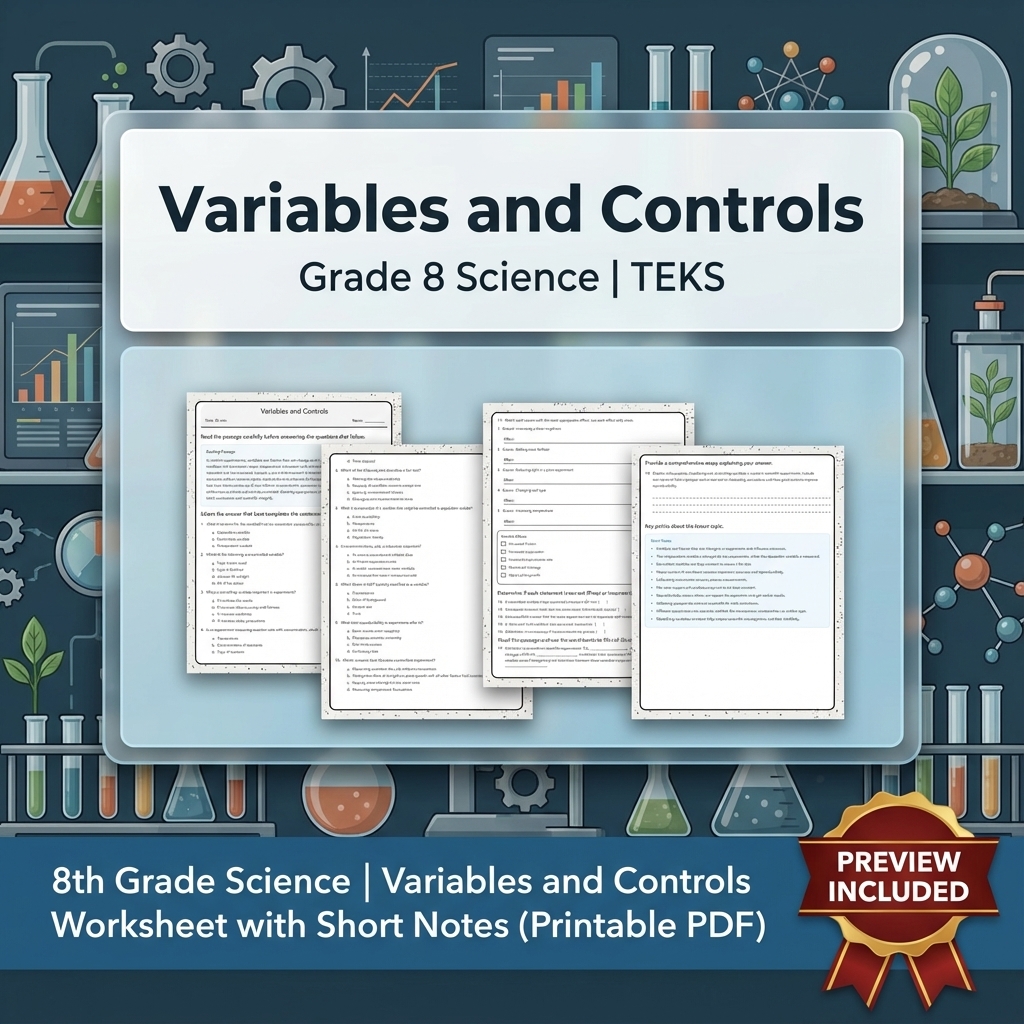
8th Grade Science Variables and Controls Worksheet with Short Notes (PDF)
Created byMeadowlark WorksheetsLearning Objectives
- Identify and classify independent, dependent, and controlled variables in experiments.
- Understand the importance of fair testing and control selection in scientific investigations.
- Analyze how variables affect experiment results and reproducibility.
Instant download
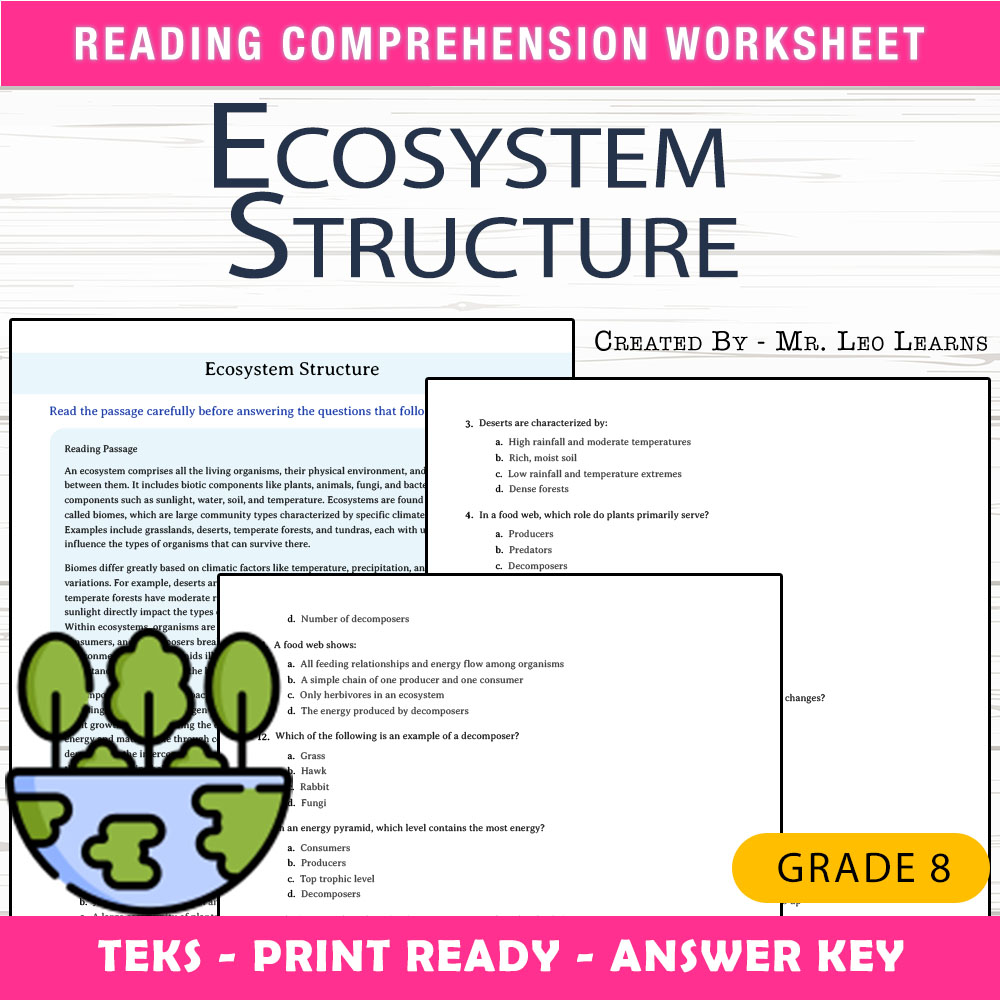
8th Grade Science – Ecosystem Structure Worksheet for Mastery | PDF + Answer Key
 Created byThe Resource Hub
Learning Objectives
- Describe the components and types of ecosystems and biomes.
- Identify abiotic factors influencing ecosystems.
- Explain the roles of producers, consumers, and decomposers in energy flow and nutrient cycling.
Also included in: Grade 8 Science Unit | Ecosystems, Evolution & Cell Processes Worksheet Pack +1 more
Instant download
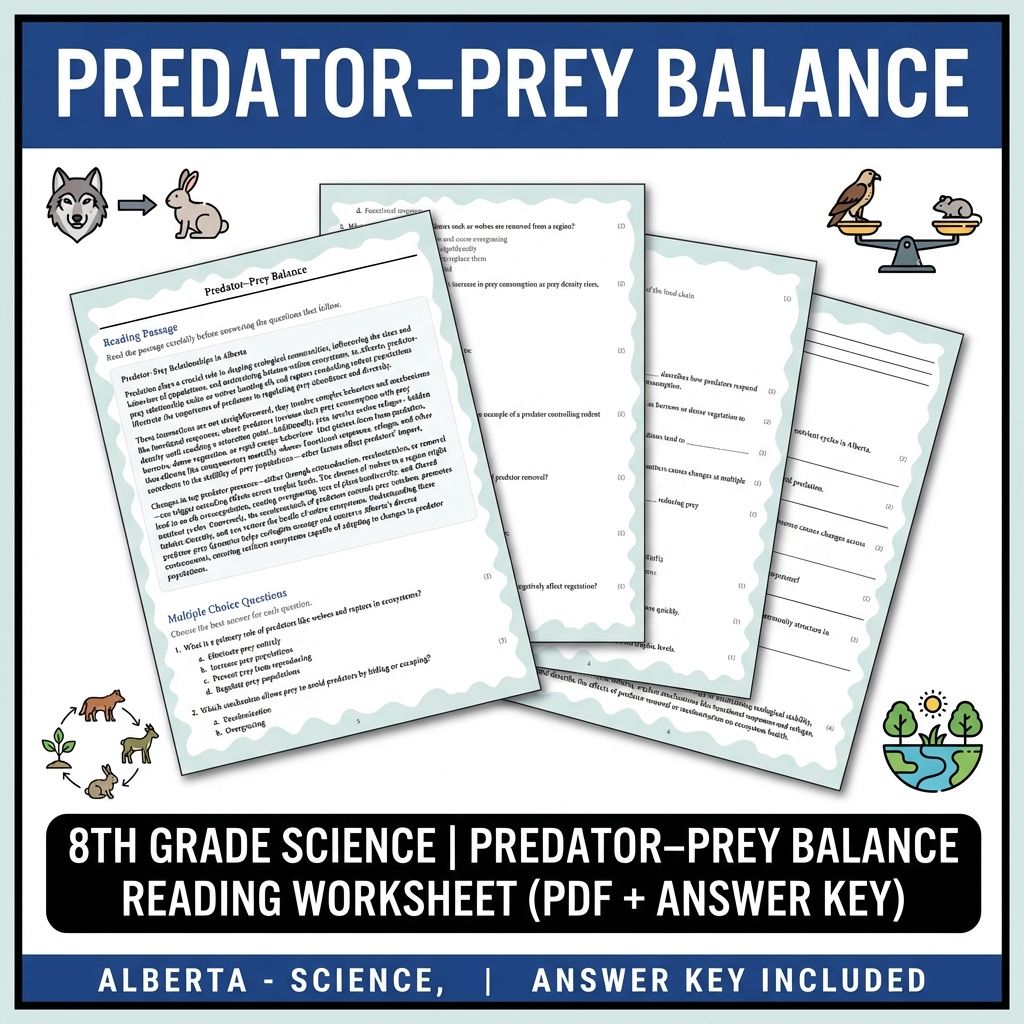
8th Grade Science | Predator–Prey Balance Reading Worksheet (PDF + Answer Key)
JCreated byJ.S SheetsLearning Objectives
- Understand how predator-prey relationships influence population dynamics
- Identify behavioral adaptations used by predators and prey
- Explain the cascading effects of predator absence or recolonization on ecosystems
Also included in: Grade 8 Science Bundle | Ecosystem Dynamics & Environmental Impact Worksheets +1 more
Instant download
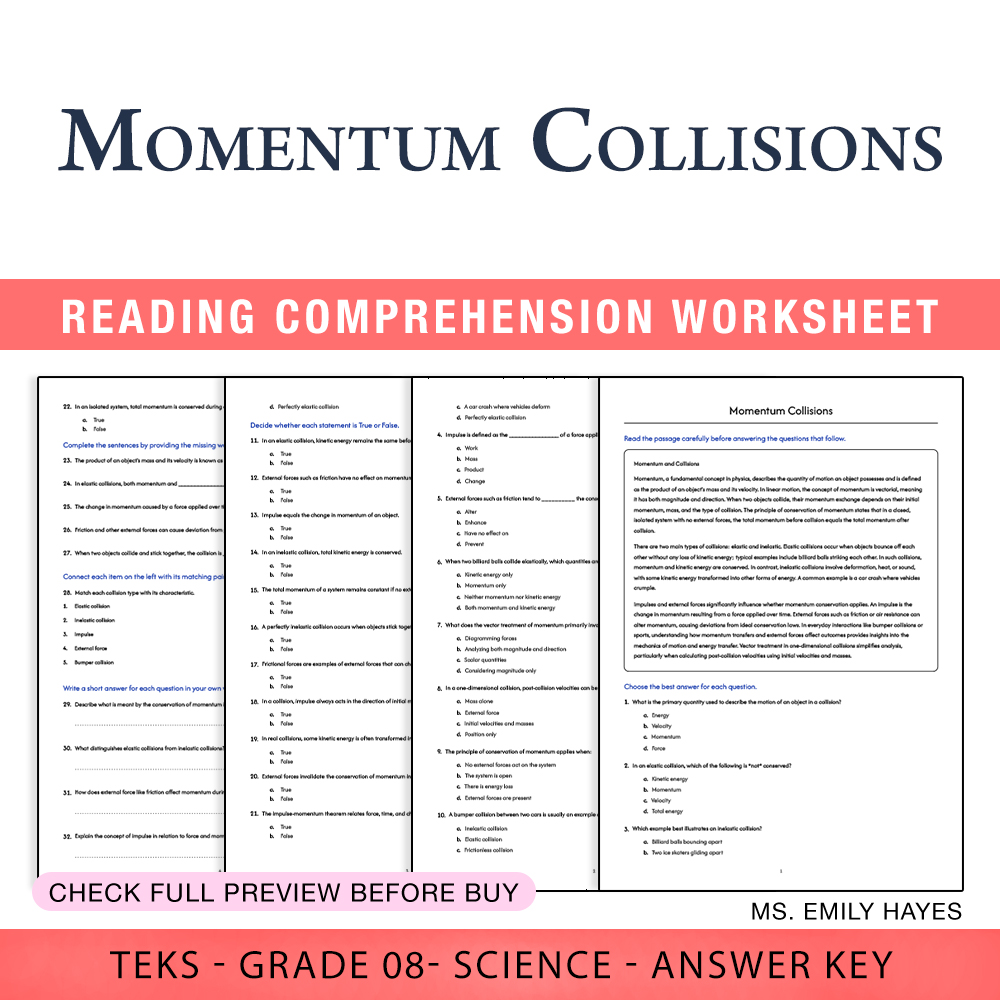
8th Grade Science | Momentum Collisions Worksheet (PDF+ Answer Key)
Created byCopper Leaf ClassroomLearning Objectives
- Understand the concepts of linear momentum and impulse in collisions.
- Apply conservation principles to analyze elastic and inelastic collisions.
- Differentiate between elastic and inelastic collisions with real-world examples.
Instant download
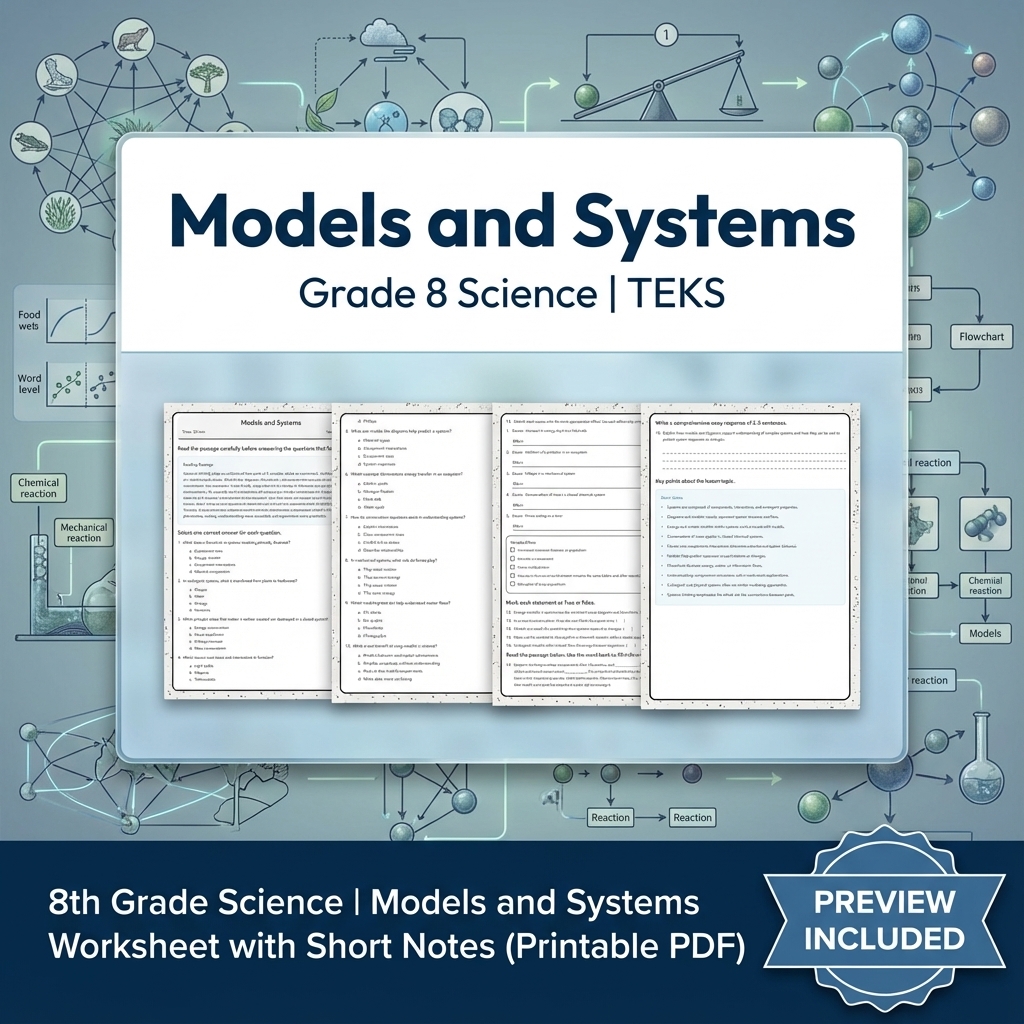
8th Grade Science Models and Systems Worksheet with Short Notes (Printable PDF)
Created byMeadowlark WorksheetsLearning Objectives
- Understand the components and interactions within physical and ecological systems.
- Explain the concept of energy transfer, matter conservation, and forces in systems.
- Use diagrams and models to trace system flows and predict responses.
Instant download
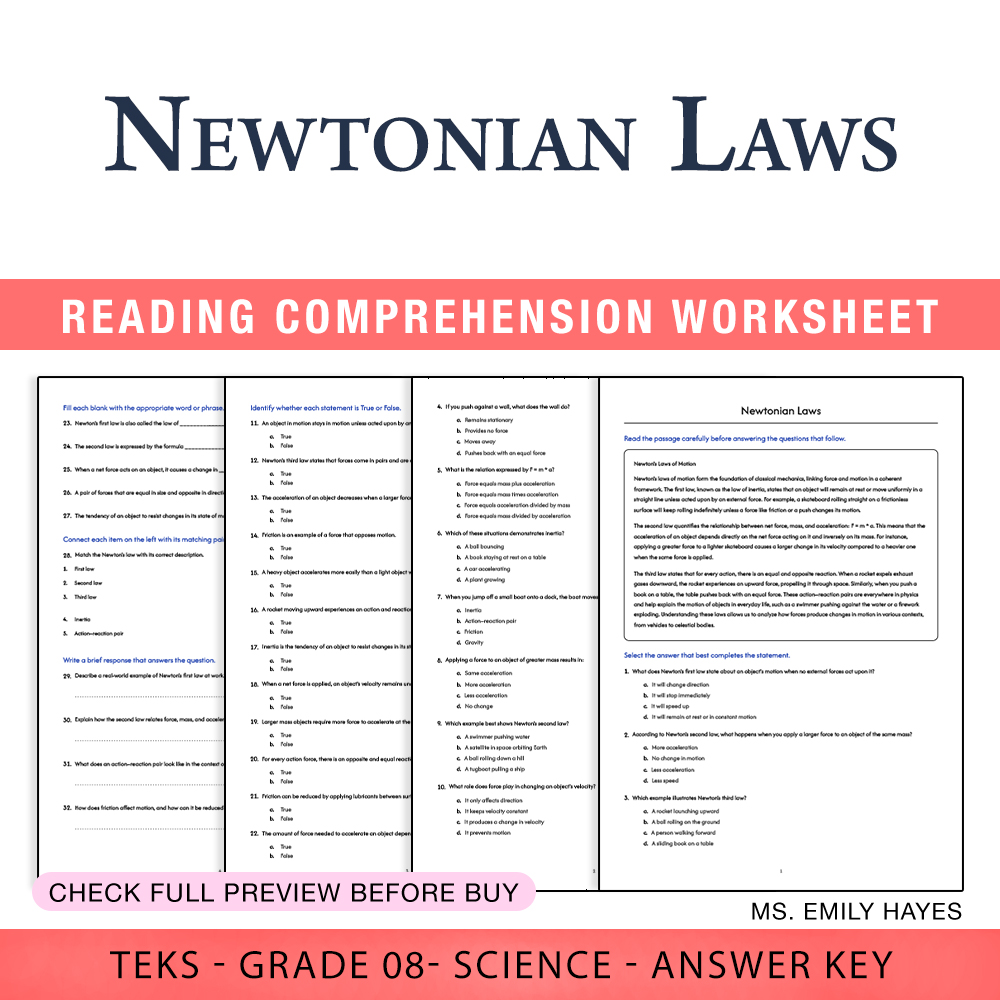
8th Grade Science | Newtonian Laws Worksheet (PDF+ Answer Key)
Created byCopper Leaf ClassroomLearning Objectives
- Explain Newton's three laws of motion and their significance.
- Identify examples of each law in real-world situations.
- Analyze how forces affect motion using proportional reasoning.
Instant download

Grade 8 Science | Muscle Contraction & Movement - Daily Reading Comprehension
Created byCoral Reef LearningLearning Objectives
- Identify the main components involved in muscle contraction.
- Understand how actin and myosin filaments interact during contraction.
- Recognize the role of ATP and calcium in muscle activity.
Instant download

Grade 8 Science – Measurement Uncertainty Daily Reading Worksheet + Answer Key
JCreated byJ.S SheetsLearning Objectives
- Understand the concept of measurement uncertainty and its factors
- Identify sources of error in measurement instruments and techniques
- Learn to report measurement data with appropriate significant figures and precision
Also included in: Grade 8 Science Lesson Group Bundle | TEKS Standards-Aligned Worksheets +1 more
Instant download

Grade 8 Science – Data Analysis Daily Reading Worksheet with Answer Key
JCreated byJ.S SheetsLearning Objectives
- Understand the concepts of mean, median, and mode in data sets.
- Learn how to calculate and interpret statistical measures.
- Apply averages to analyze scientific data effectively.
Also included in: Grade 8 Science Lesson Group Bundle | TEKS Standards-Aligned Worksheets +1 more
Instant download

Grade 8 Science – Models and Systems Daily Reading Worksheet + Answer Key
JCreated byJ.S SheetsLearning Objectives
- Identify components in physical and ecological systems.
- Understand how parts interact within a system.
- Recognize emergent properties resulting from system interactions.
Also included in: Grade 8 Science Lesson Group Bundle | TEKS Standards-Aligned Worksheets +1 more
Instant download

Grade 8 Science – Measurement Basics Daily Reading Worksheet with Answer Key
JCreated byJ.S SheetsLearning Objectives
- Understand key concepts related to Science
- Apply knowledge through practice questions
- Demonstrate comprehension of the material
Also included in: Grade 8 Science Lesson Group Bundle | TEKS Standards-Aligned Worksheets +1 more
Instant download

Grade 8 Science – Statistical Reasoning Daily Reading Worksheet + Answer Key
JCreated byJ.S SheetsLearning Objectives
- Understand key concepts related to Science
- Apply knowledge through practice questions
- Demonstrate comprehension of the material
Also included in: Grade 8 Science Lesson Group Bundle | TEKS Standards-Aligned Worksheets +1 more
Instant download

Grade 8 Science – Scientific Method Worksheet + Answer Key
JCreated byJ.S SheetsLearning Objectives
- Identify the different steps of the scientific method
- Understand how scientists form hypotheses and conduct experiments
- Recognize the importance of evidence and controlled comparisons in scientific investigations
Also included in: Grade 8 Science Lesson Group Bundle | TEKS Standards-Aligned Worksheets +1 more
Instant download

Grade 8 Science – Sources of Error Daily Reading Worksheet + Answer Key
JCreated byJ.S SheetsLearning Objectives
- Understand different types of measurement errors
- Recognize systematic and random errors
- Learn methods to identify and minimize errors
Also included in: Grade 8 Science Lesson Group Bundle | TEKS Standards-Aligned Worksheets +1 more
Instant download
About Grade 8 Science Worksheets
Explore Grade 8 Science worksheets for classwork, homework, or review. Our 6,006 printables download instantly as PDFs.
Each resource here is built by an independent educator and reviewed for quality. Worksheets print straight from PDF and suit classroom use, homework, or extra practice; most come with answer keys, and you can preview before purchasing.