
Grade 8 Science Worksheets
5,999 worksheets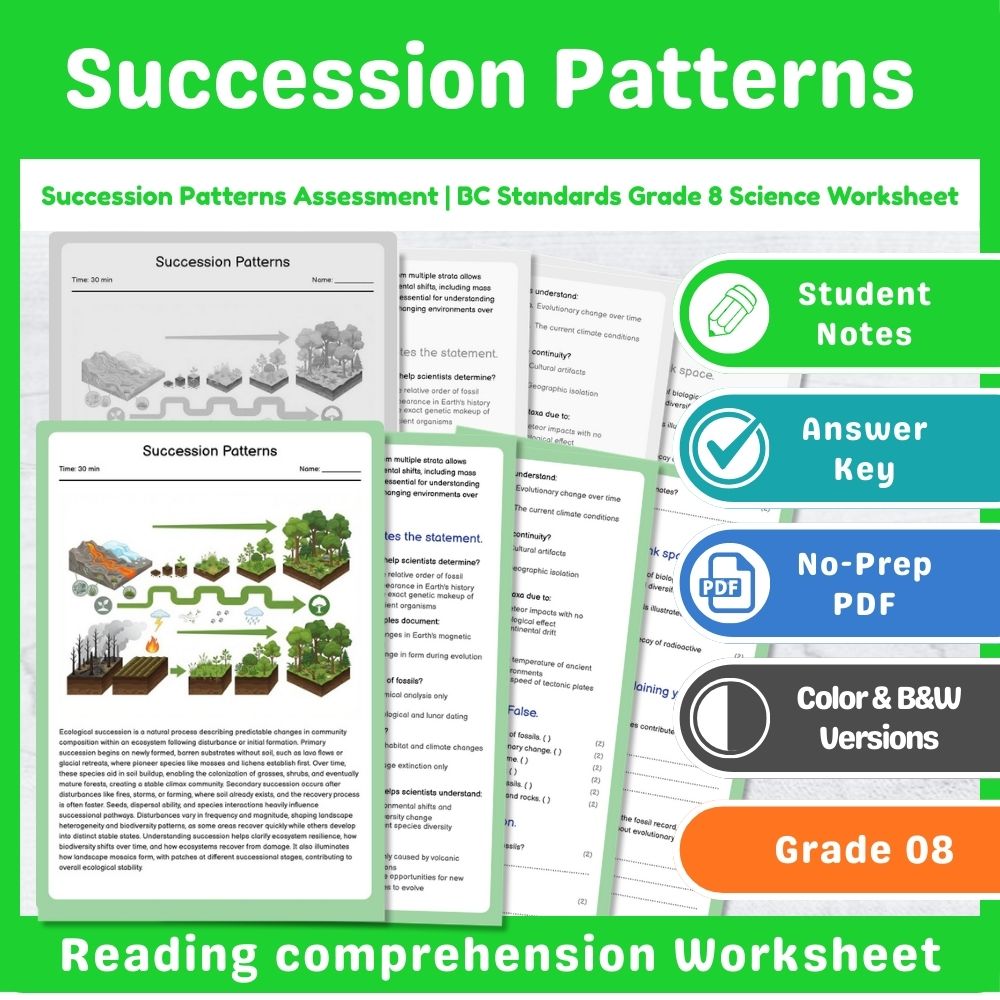
Succession Patterns Assessment | BC Standards Grade 8 Science Worksheet
 Created byPrism Point Learning
Learning Objectives
- Understand the stages and types of ecological succession, including primary and secondary succession.
- Identify factors that influence successional pathways in ecosystems.
- Analyze how disturbances impact landscape heterogeneity and community development.
Instant download

Succession Patterns Worksheet | Grade 8 Science Standards-Aligned
JCreated byJ.S SheetsLearning Objectives
- Describe the stages and types of ecological succession, including primary and secondary succession.
- Explain how species traits and disturbances influence successional pathways.
- Analyze how succession impacts biodiversity and ecosystem stability.
Instant download

Inclined Planes Review Worksheet | Grade 8 Science Ontario
Created byPrism Point LearningLearning Objectives
- Explain how an inclined plane reduces the input force needed to lift an object compared with lifting it vertically.
- Calculate ideal mechanical advantage using slope length and height, and relate it to real-world situations involving friction.
- Describe how the normal force and the component of gravitational force along the slope affect whether an object slides.
Also included in: Grade 8 Work, Energy & Forces Science Lesson Bundle – Ontario Test Prep
Instant download
Grade 8 Science – Hydrostatic Pressure Daily Reading Worksheet + Answer Key
JCreated byJ.S SheetsLearning Objectives
- Understand key concepts related to Science
- Apply knowledge through practice questions
- Demonstrate comprehension of the material
Also included in: Grade 8 Science Lesson Bundle: Fluids, Pressure, and Density Topics +1 more
Instant download
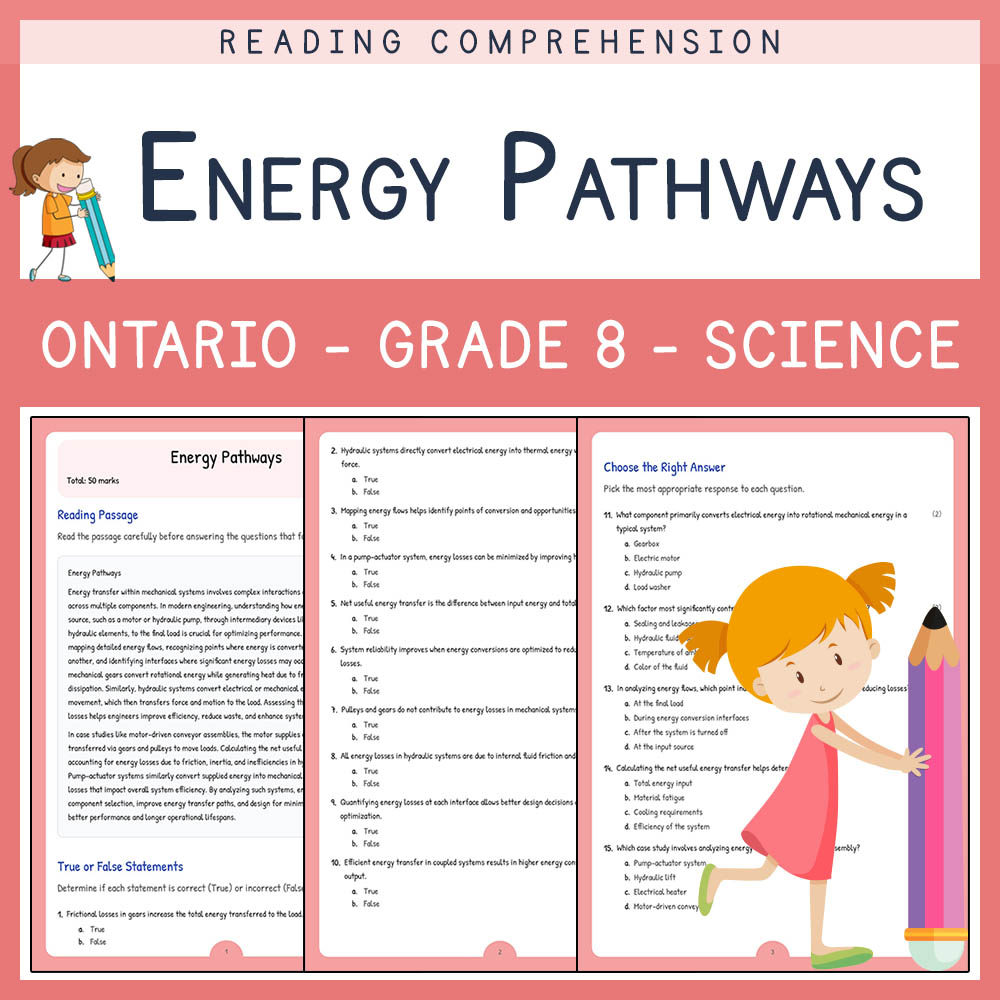
Grade 8 Science Assessment | Energy Pathways Worksheet Elena | Ontario
 Created byLumora Learning
Learning Objectives
- Understand how energy is transferred through coupled mechanical systems such as gears, pulleys, and hydraulic elements.
- Identify points of energy conversion and quantify energy losses at each interface.
- Analyze case studies involving motor-driven conveyors and pump–actuator systems to assess system efficiency.
Also included in: Grade 8 Science | Systems in Action Lesson Bundle | Ontario Framework
Instant download
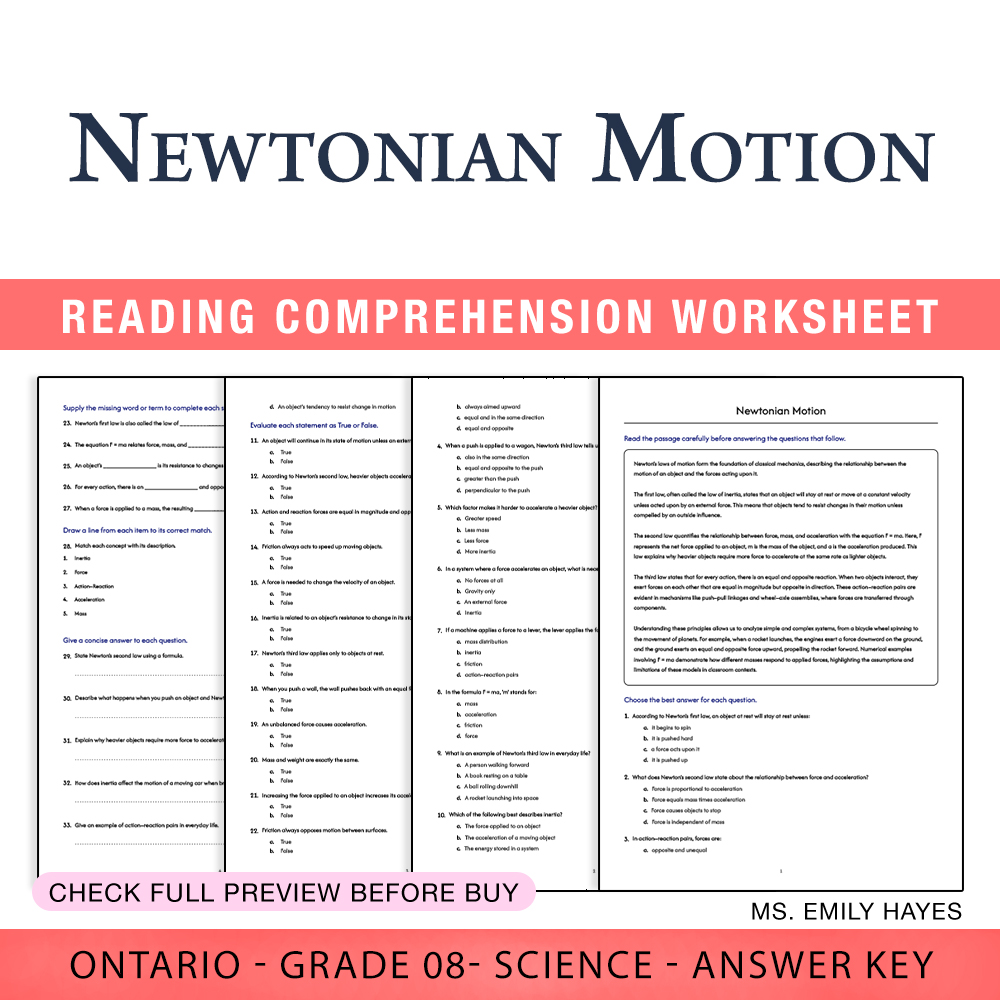
Grade 8 Science | Newtonian Motion Worksheet (PDF+ Answer Key)
 Created byCopper Leaf Classroom
Learning Objectives
- Explain Newton’s three laws of motion and their application to mechanical systems.
- Quantitatively relate force, mass, and acceleration using F = ma in different scenarios.
- Understand the concepts of inertia and action-reaction pairs within mechanical mechanisms.
Instant download
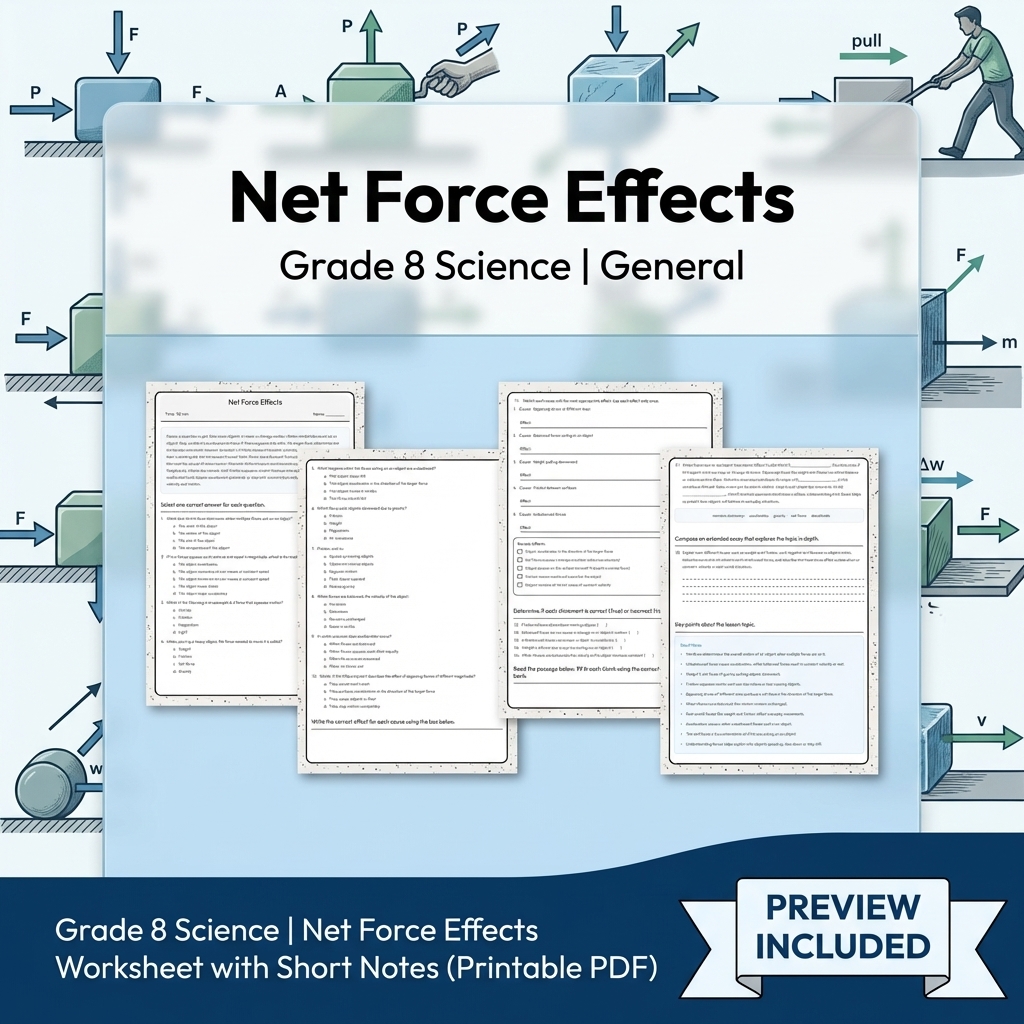
Grade 8 Science | Net Force Effects Worksheet with Short Notes (Printable PDF)
 Created byMeadowlark Worksheets
Learning Objectives
- Understand how multiple forces acting together influence an object's motion.
- Identify the effects of opposing forces and how they determine net force.
- Connect real-world examples like weight and friction to force patterns and velocity changes.
Also included in: Grade 8 Matter and Chemical Reactions Science lesson bundle +1 more
Instant download
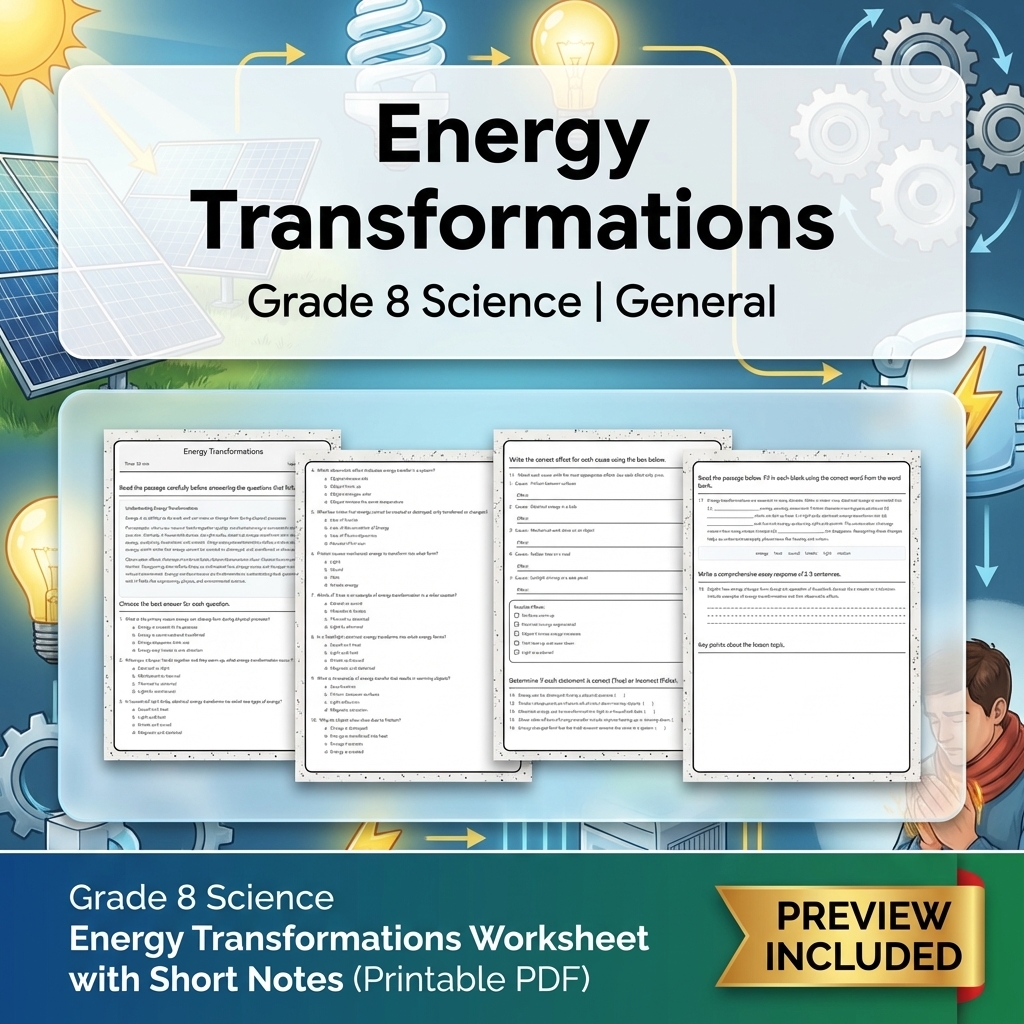
Grade 8 Science Energy Transformations Worksheet with Short Notes
Created byMeadowlark WorksheetsLearning Objectives
- Understand how energy changes form during physical processes.
- Identify examples of energy transformations in real-world scenarios.
- Explain the law of conservation of energy in different contexts.
Also included in: Grade 8 Matter and Chemical Reactions Science lesson bundle +1 more
Instant download
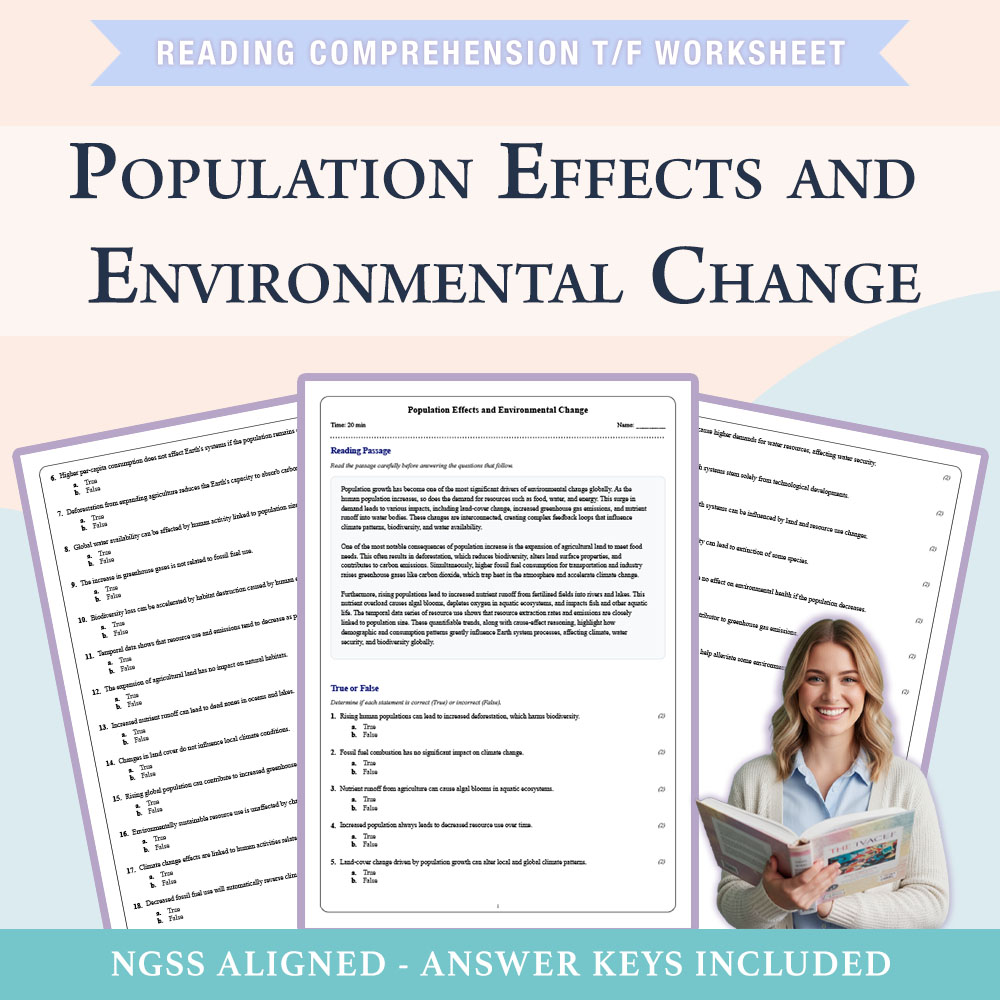
8th Grade Science | Population Effects & Environmental Change (PDF +Answer Key)
Created byCopper Leaf ClassroomAlso included in: Grade 8 Science Unit | Environmental Change & Climate Drivers (PDF +Answer Key) +1 more
Instant download

Grade 8 Science | Variables & Controls in Science - Daily Reading Comprehension
 Created byCoral Reef Learning
Learning Objectives
- Understand the different types of variables in scientific investigations: independent, dependent, and controlled.
- Identify variables in experimental scenarios.
- Recognize the importance of controls in conducting fair tests.
Instant download

Momentum and Collision Interactions Worksheets | Grade 8 Science
 Created bythe curious pencil
Learning Objectives
- Explain how momentum changes during collisions
- Compare elastic and inelastic collisions using energy changes
- Relate impulse, force, and contact time to momentum change
Also included in: Motion and Stability Forces Grade 8 Science NGSS Worksheets Bundle +2 more
Instant download
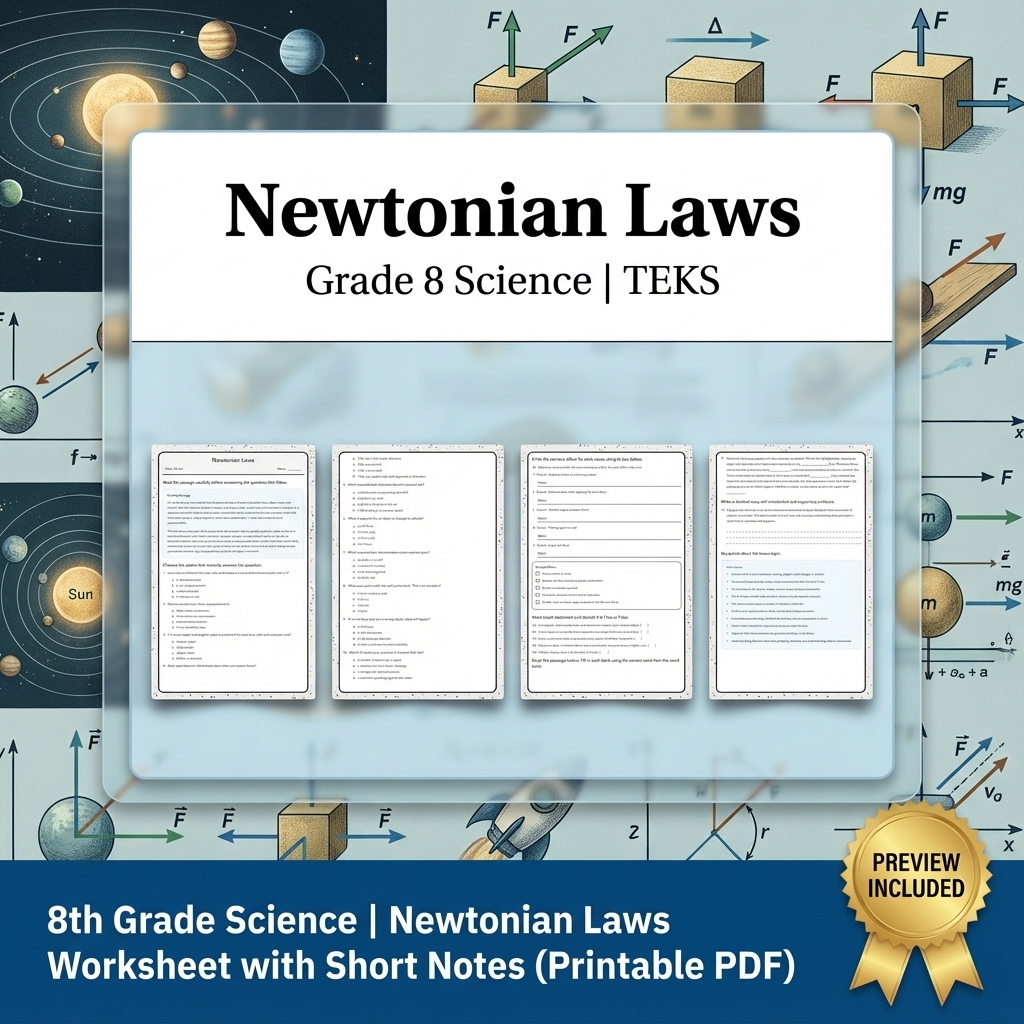
8th Grade Science | Newtonian Laws Worksheet with Short Notes (Printable PDF)
Created byMeadowlark WorksheetsLearning Objectives
- Understand and explain Newton's three laws of motion.
- Identify examples of each law in real-world situations.
- Analyze how net force affects an object's acceleration.
Instant download
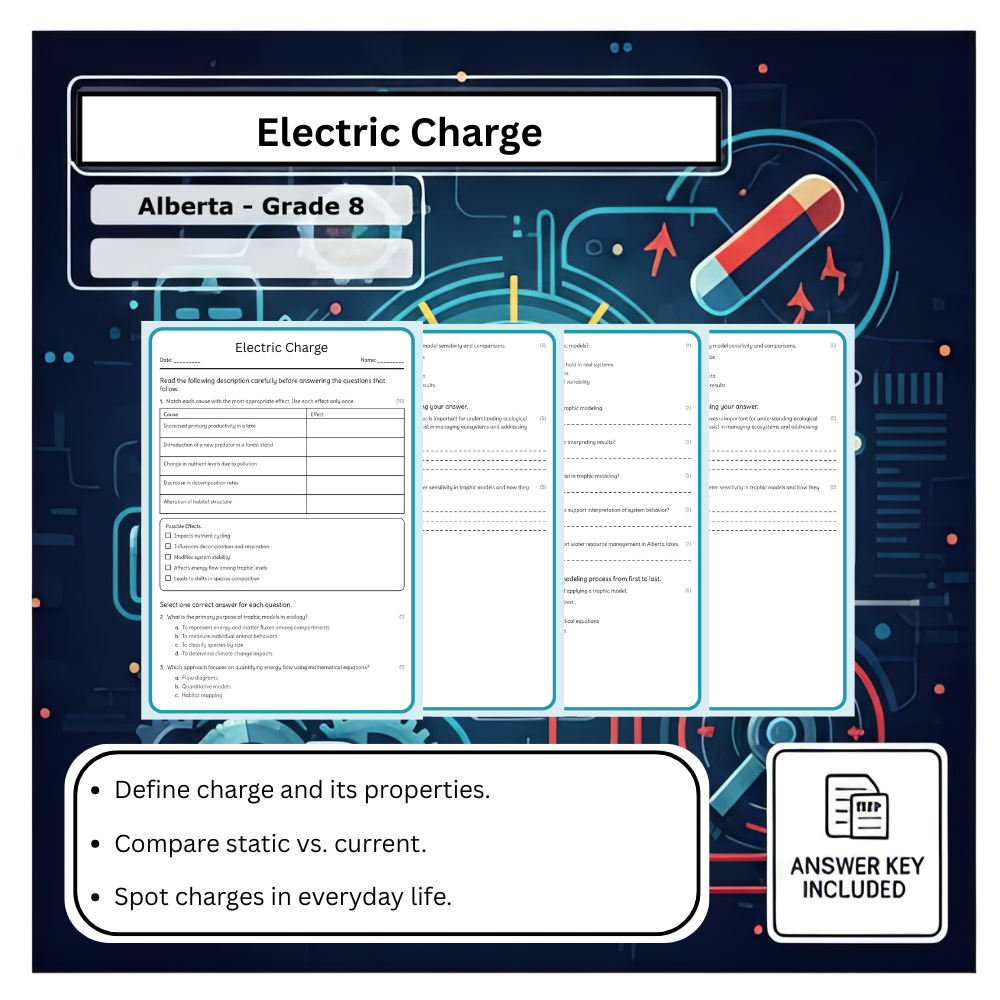
Grade 8 Science – Electric Charge Worksheets (PDF) | Alberta Standards
 Created byBright Mind Resources
Learning Objectives
- Describe what electric charge is and its properties.
- Differentiate between static electricity and current electricity.
- Identify effects of static and current charges in everyday life.
Instant download
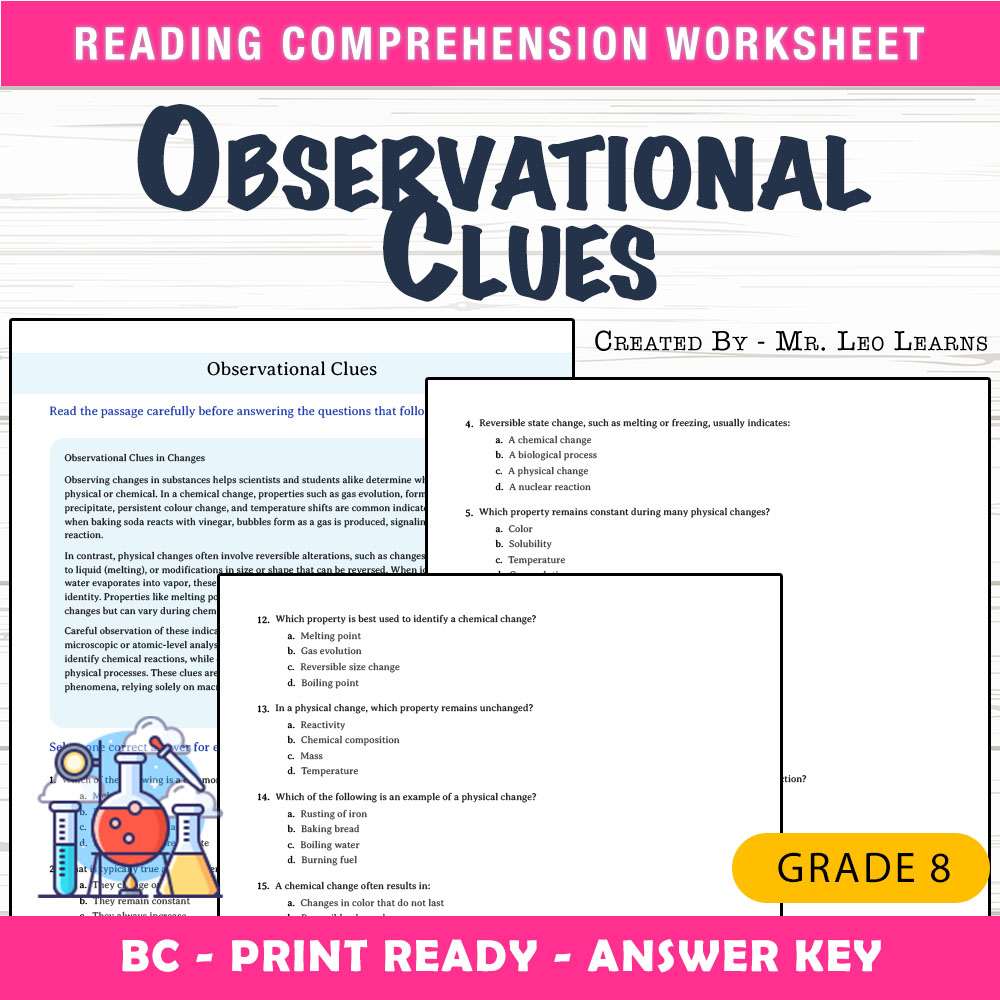
Grade 8 Science — Worksheet MCQ Paper for Mastering Observational Clues
 Created byThe Resource Hub
Learning Objectives
- Identify different indicators that distinguish physical from chemical changes.
- Understand properties that remain constant or change during different types of changes.
- Apply observation skills to differentiate between physical and chemical reactions.
Also included in: Grade 8 Science | Matter & Chemical Change UNIT Worksheet Pack (BC Framework) +1 more
Instant download
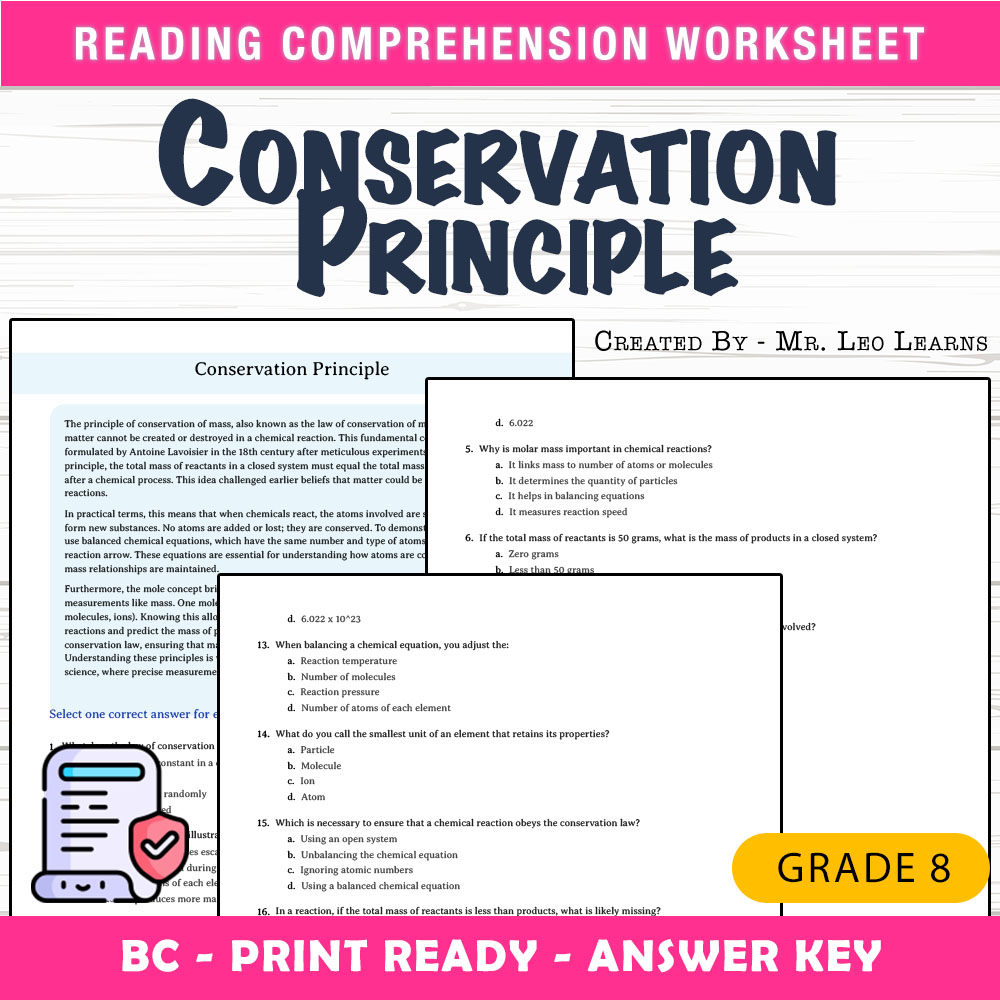
Grade 8 Science — Worksheet MCQ Paper for Mastering Conservation Principle
Created byThe Resource HubLearning Objectives
- Understand the Law of Conservation of Mass as it applies to chemical reactions.
- Recognize balanced chemical equations that reflect mass conservation.
- Link the mole concept to mass and particle count in chemical processes.
Also included in: Grade 8 Science | Matter & Chemical Change UNIT Worksheet Pack (BC Framework) +1 more
Instant download
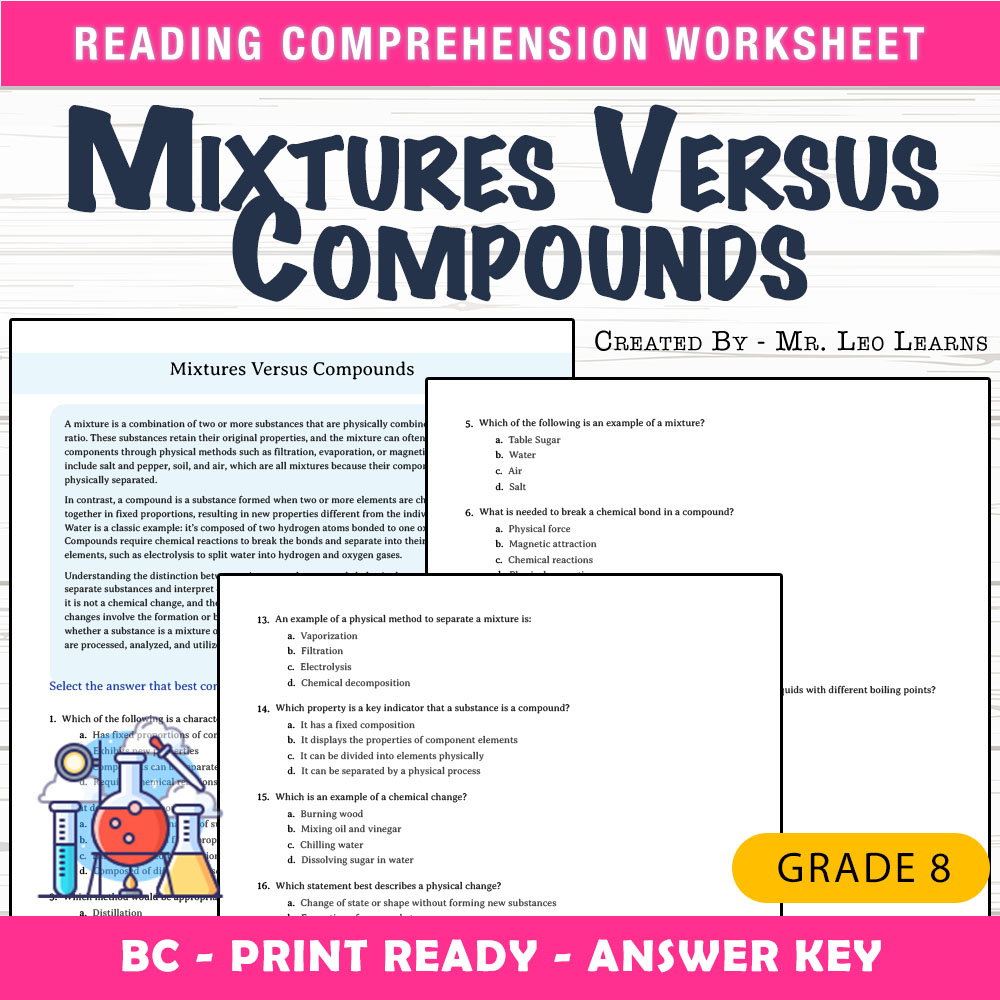
Grade 8 Science — Worksheet MCQ Paper for Mastering Mixtures & Compounds
Created byThe Resource HubLearning Objectives
- Understand the differences between mixtures and compounds.
- Identify properties of mixtures and compounds.
- Distinguish between physical and chemical methods of separation.
Also included in: Grade 8 Science | Matter & Chemical Change UNIT Worksheet Pack (BC Framework) +1 more
Instant download
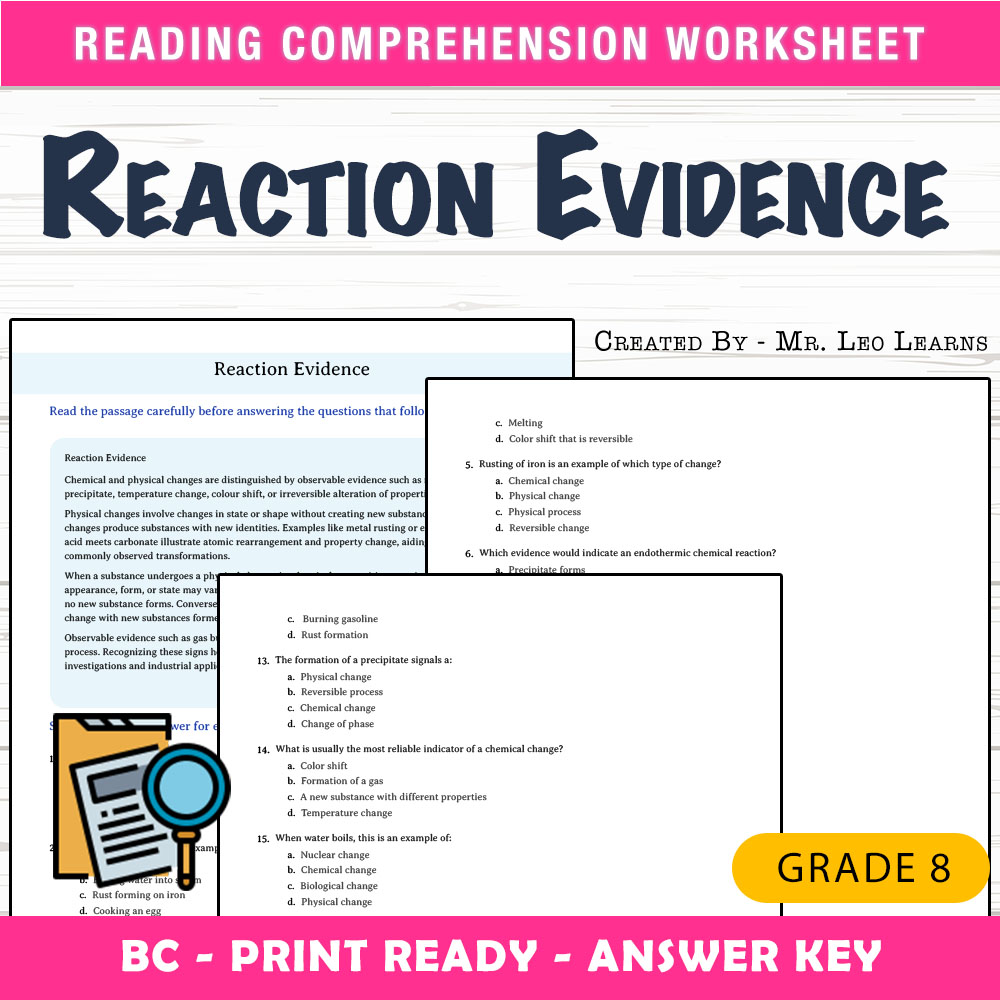
Grade 8 Science — Worksheet MCQ Paper for Mastering Reaction Evidence
Created byThe Resource HubLearning Objectives
- Identify observable signs of physical and chemical changes.
- Differentiate between physical and chemical transformations based on evidence.
- Recognize common examples of chemical and physical reactions in everyday life.
Also included in: Grade 8 Science | Matter & Chemical Change UNIT Worksheet Pack (BC Framework) +1 more
Instant download
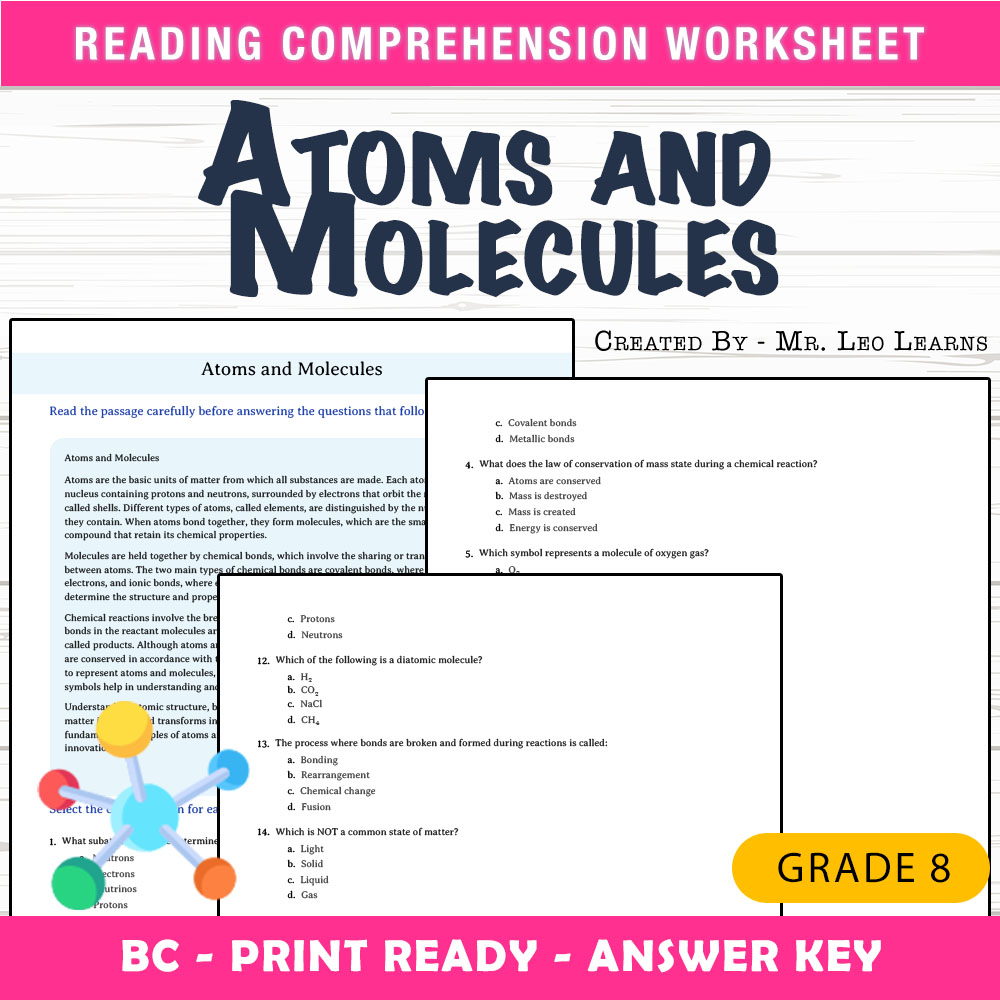
Grade 8 Science — Atoms and Molecules Worksheet MCQ Paper
Created byThe Resource HubLearning Objectives
- Understand the fundamental structure of atoms and how atoms combine to form molecules.
- Describe the process of chemical bonding and how it affects chemical properties.
- Explain what a chemical reaction is and how atoms are conserved during this process.
Also included in: Grade 8 Science | Matter & Chemical Change UNIT Worksheet Pack (BC Framework) +1 more
Instant download
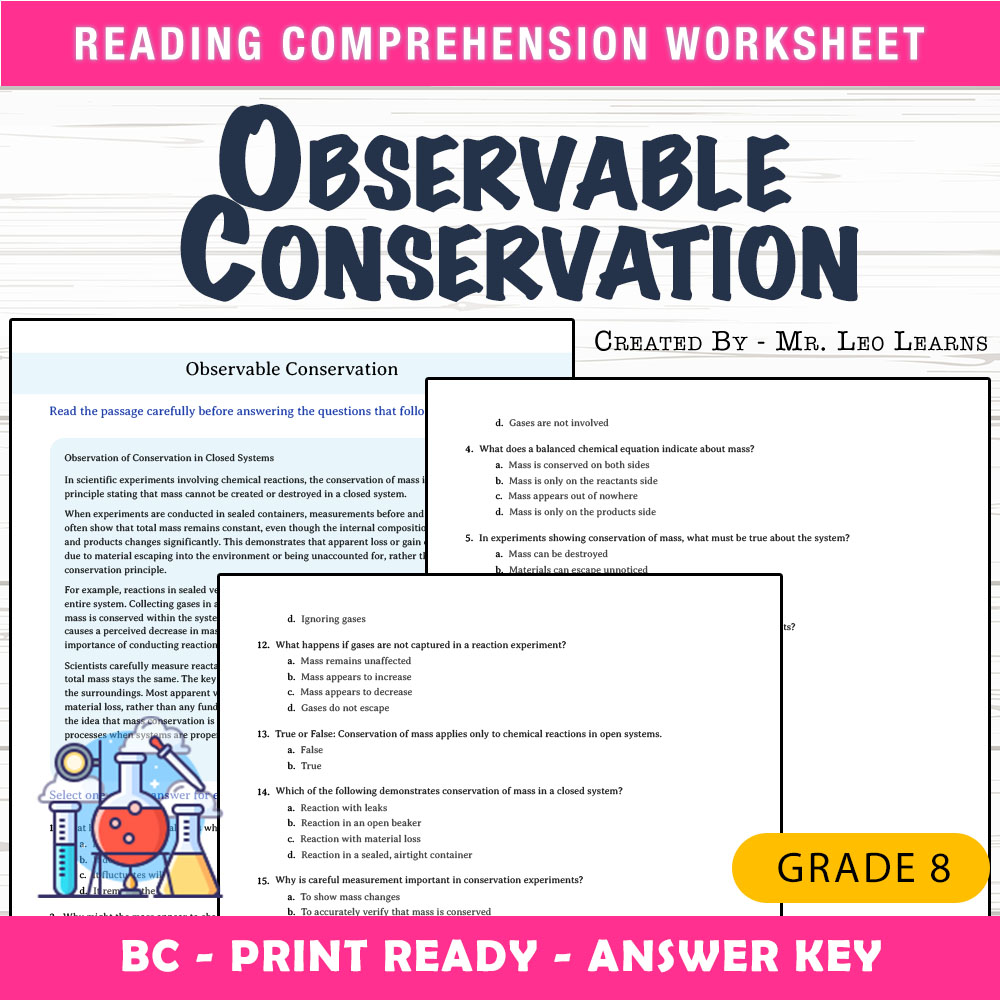
Grade 8 Science — Worksheet MCQ Paper for Mastering Conservation of Mass
Created byThe Resource HubLearning Objectives
- Understand the principle of conservation of mass through experimental observations.
- Identify scenarios where mass appears to change and analyze reasons for these changes.
- Interpret balanced chemical equations in the context of mass conservation.
Also included in: Grade 8 Science | Matter & Chemical Change UNIT Worksheet Pack (BC Framework) +1 more
Instant download
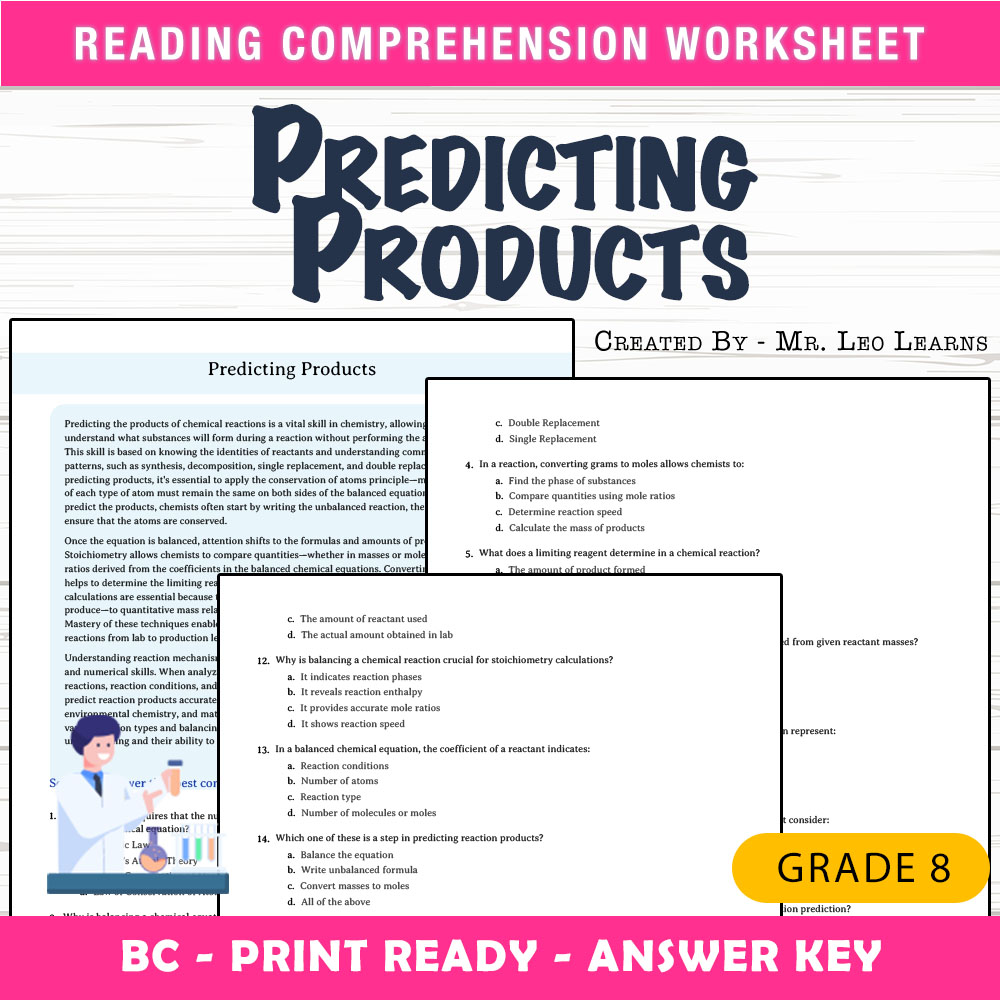
Grade 8 Science — Worksheet MCQ for Predicting Products
Created byThe Resource HubLearning Objectives
- Understand how to identify reaction products based on reactant identities and reaction patterns.
- Apply conservation of atoms to determine possible formulas and amounts of products.
- Use balanced chemical equations to analyze atom ratios and predict yields.
Also included in: Grade 8 Science | Matter & Chemical Change UNIT Worksheet Pack (BC Framework) +1 more
Instant download
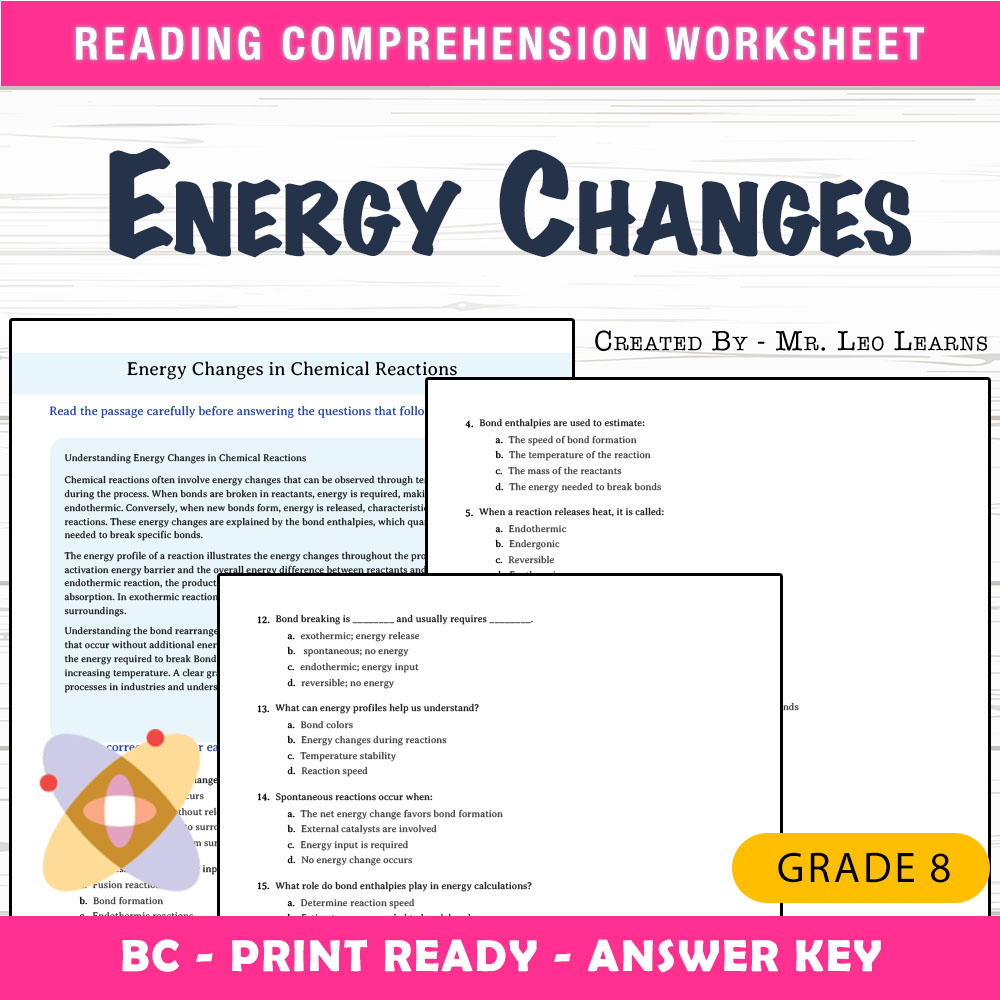
Grade 8 Science — Worksheet MCQ Paper for Mastering Energy Changes
Created byThe Resource HubLearning Objectives
- Understand that chemical reactions involve energy changes due to bond breaking and forming.
- Differentiate between endothermic and exothermic reactions based on energy transfer.
- Explain how energy profiles and bond enthalpies relate to temperature changes during reactions.
Also included in: Grade 8 Science | Matter & Chemical Change UNIT Worksheet Pack (BC Framework) +1 more
Instant download
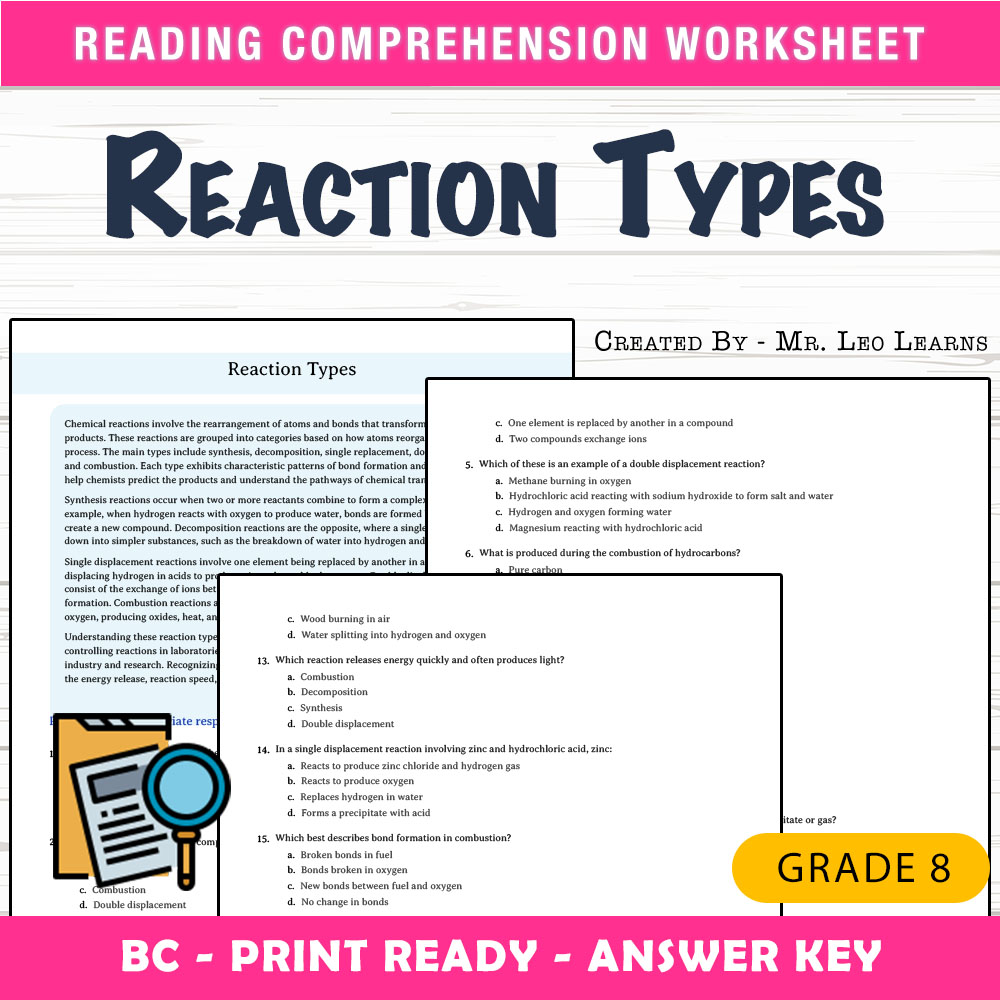
Grade 8 Science — Worksheet MCQ Paper for Mastering Reaction Types
Created byThe Resource HubLearning Objectives
- Identify different categories of chemical reactions.
- Understand characteristic bond-making and bond-breaking patterns.
- Recognize examples of synthesis, decomposition, displacement, and combustion reactions.
Also included in: Grade 8 Science | Matter & Chemical Change UNIT Worksheet Pack (BC Framework) +1 more
Instant download

Grade 8 Science — Worksheet MCQ Paper for Mastering Balancing Equations
Created byThe Resource HubLearning Objectives
- Understand the concept of balancing chemical equations to uphold the law of conservation of mass.
- Identify the meaning and role of coefficients in chemical reactions.
- Learn how to correctly place coefficients without altering chemical formulas.
Also included in: Grade 8 Science | Matter & Chemical Change UNIT Worksheet Pack (BC Framework) +1 more
Instant download

Grade 8 Biotech Considerations Worksheet | Ontario Science + Doodle Notes
 Created byChalk and Compass
Learning Objectives
- Explain how cell culture and controlled differentiation help produce specialized cell types.
- Describe how molecular markers and scaffold interactions support tissue engineering.
- Summarize key ethical, safety, and regulatory considerations for biotech therapies.
Also included in: Grade 8 Science Cell Organization, Transport & Homeostasis Lesson Bundle – Ontario +1 more
Instant download
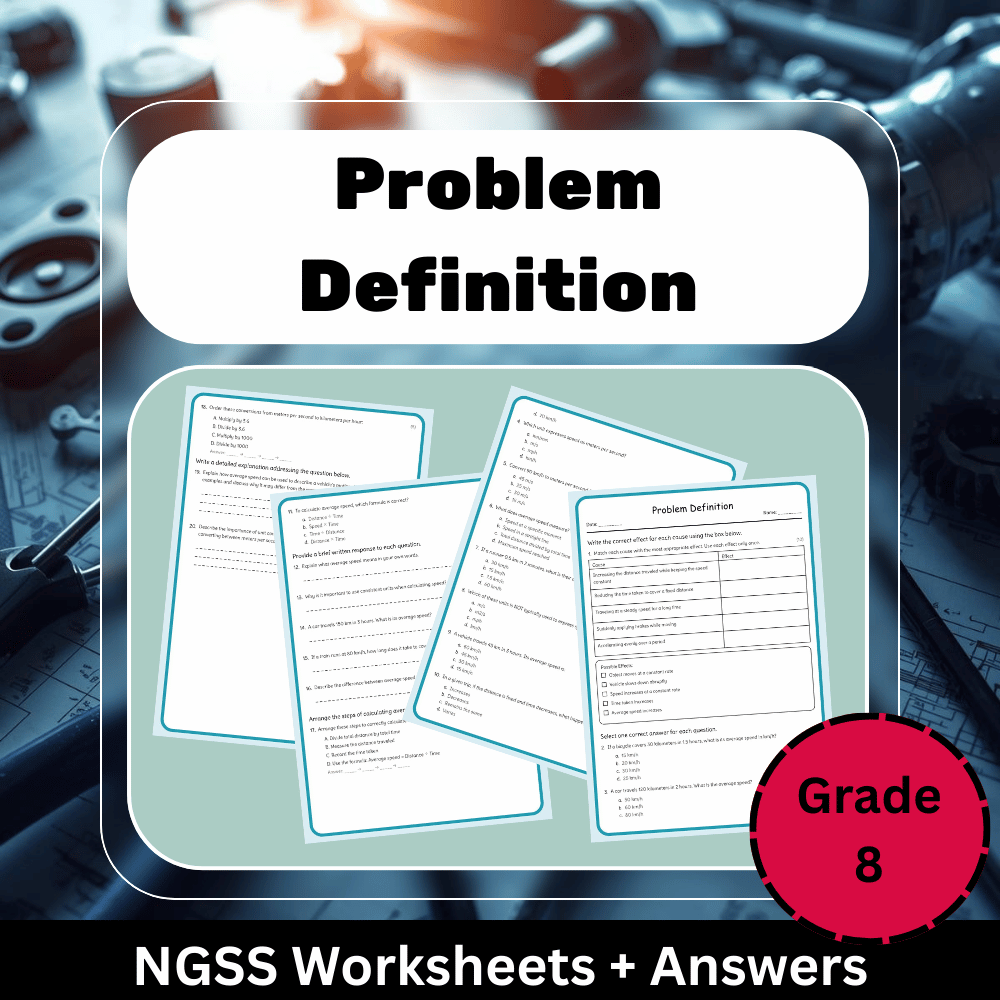
Grade 8 Science | Problem Definition Worksheet (NGSS & STEM) - PDF
Created byBright Mind ResourcesLearning Objectives
- Understand the criteria and constraints involved in defining engineering problems.
- Identify measurable performance goals, safety, and environmental considerations.
- Analyze trade-offs between time, cost, and durability in problem scenarios.
Also included in: Grade 8 Science | Data Analysis & Engineering Design Unit Worksheet Bundle +2 more
Instant download
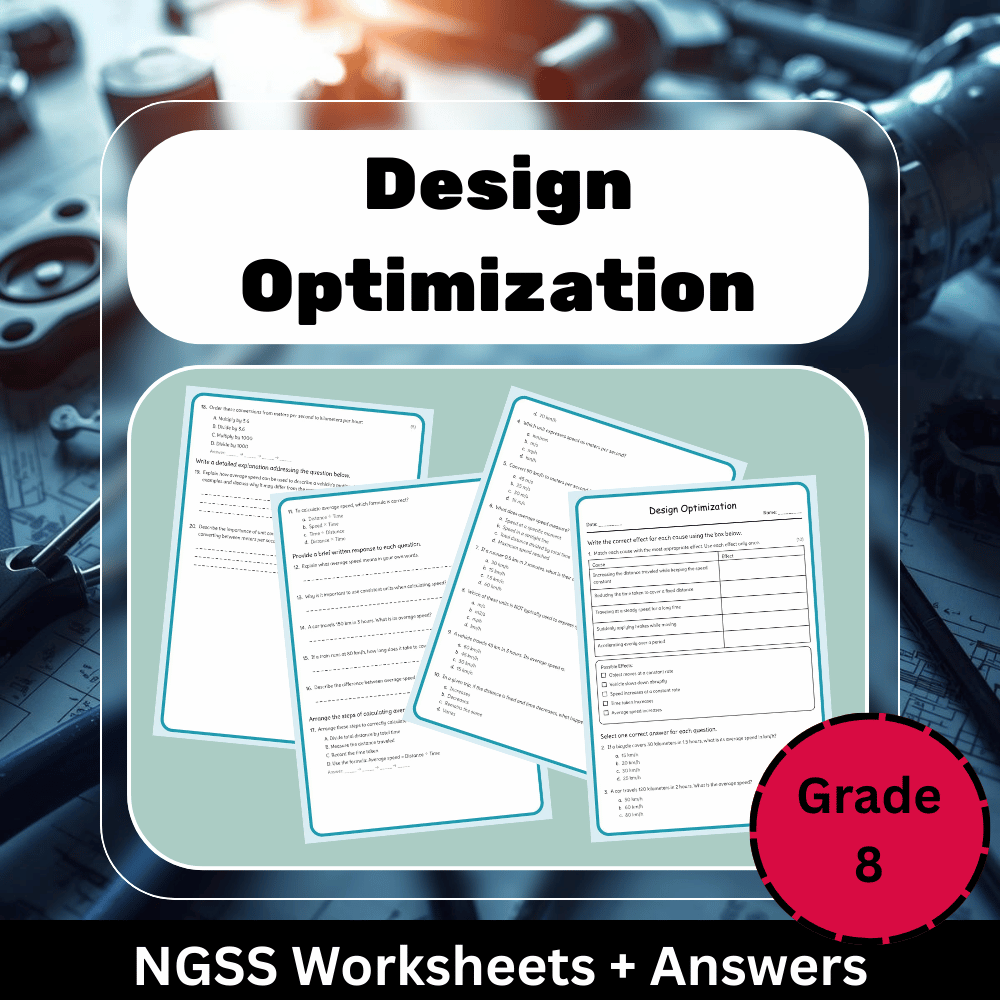
Grade 8 Science – Design Optimization Worksheet (Answer Key) | NGSS Alignment
Created byBright Mind ResourcesLearning Objectives
- Analyze test data to identify performance trends in design modifications.
- Use graphical and statistical summaries to evaluate design improvements.
- Quantify trade-offs among efficiency, strength, and durability in iterative design processes.
Also included in: Grade 8 Science | Data Analysis & Engineering Design Unit Worksheet Bundle +2 more
Instant download
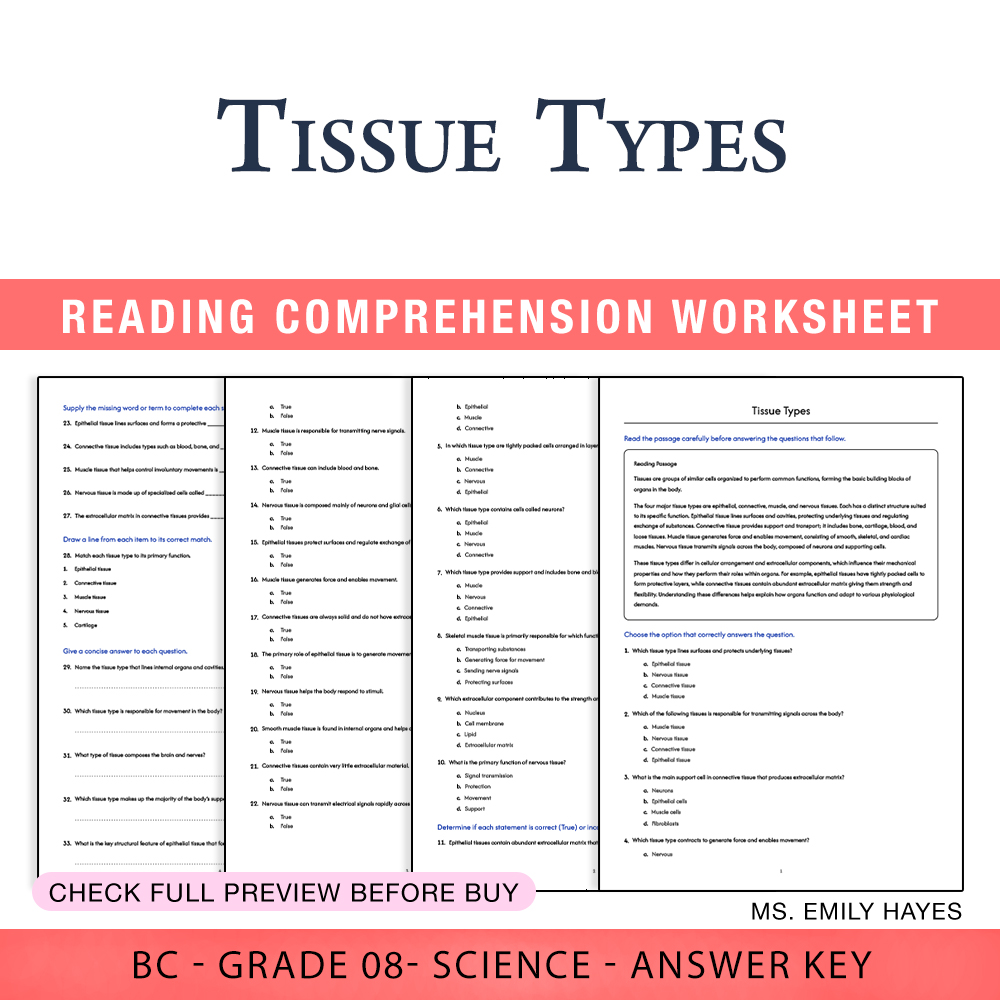
8th Grade Science | Tissue Types Worksheet (PDF+ Answer Key)
Created byCopper Leaf ClassroomLearning Objectives
- Identify and describe the four main tissue types: epithelial, connective, muscle, and nervous.
- Compare the structure and functions of different tissue types in organs.
- Explain how cellular arrangement and extracellular components influence tissue properties.
Also included in: Grade 8 Science Bundle – Cell Structure, Systems & Organisms (PDF + Answer Key) +1 more
Instant download

Energy Transformations Worksheet | Grade 8 Science Activities
Created byPrism Point LearningLearning Objectives
- Describe how electrical energy can transform into thermal, radiant, and mechanical energy in everyday devices
- Explain why energy losses occur and how efficiency affects how much useful energy we get
- Relate Alberta’s electricity generation and the power grid to real-world supply, demand, and performance
Also included in: Grade 8 Science Electricity & Electromagnetism Lesson Bundle | Alberta
Instant download
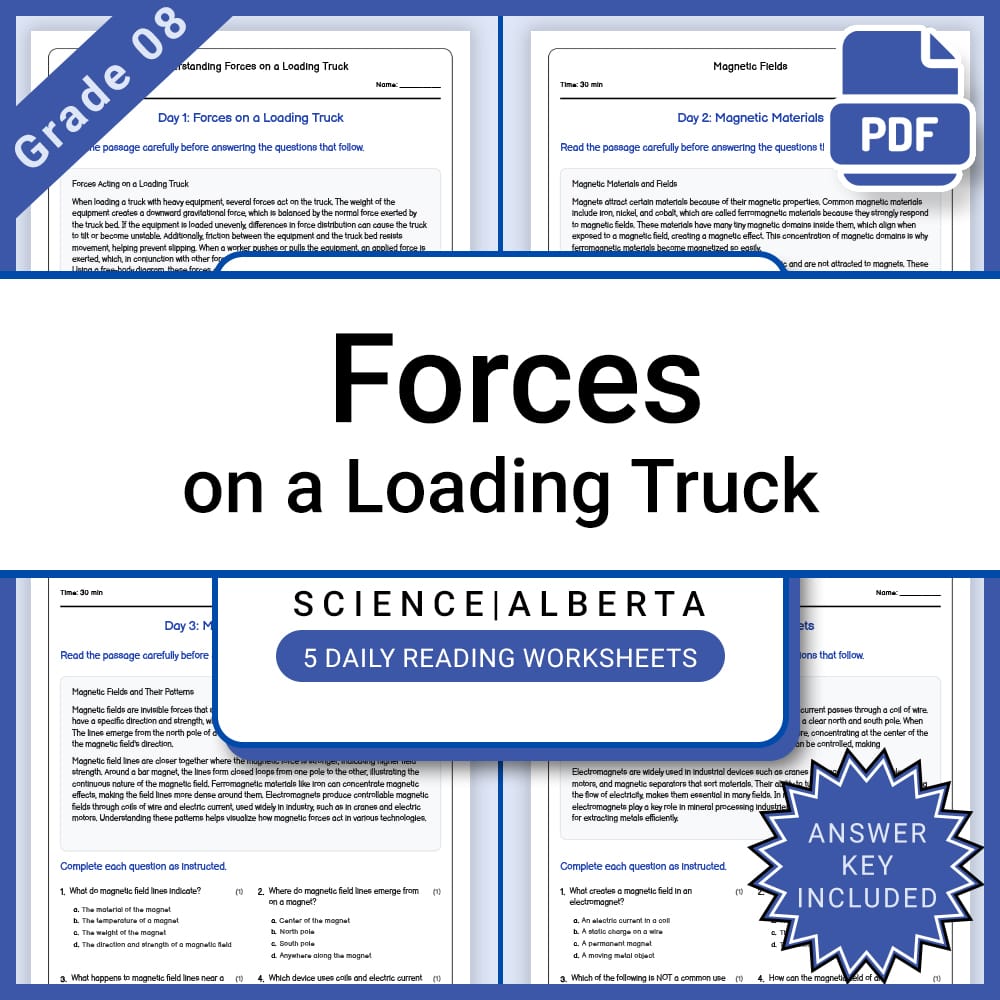
Grade 8 Science – Forces on a Loading Truck Daily Reading Worksheet + Answer Key
JCreated byJ.S SheetsLearning Objectives
- Explain the concept of a free body diagram.
- Identify different forces acting on an object.
- Represent forces visually using vectors.
Also included in: Grade 8 Science Lesson Bundle | Forces, Motion, and Energy +1 more
Instant download
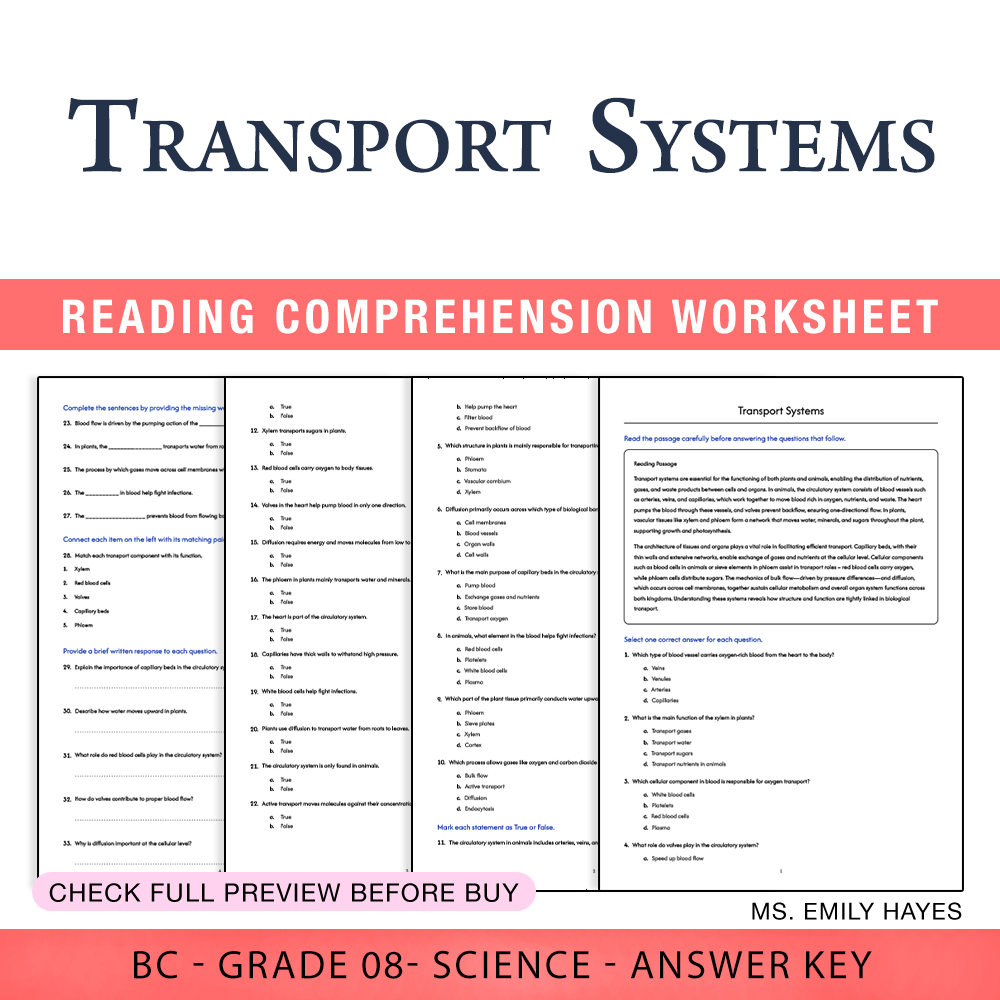
Grade 8 Science | Transport Systems Worksheet (PDF+ Answer Key)
Created byCopper Leaf ClassroomLearning Objectives
- Understand the structure and function of vascular networks in plants and circulatory systems in animals.
- Identify key structural features such as vessels, valves, capillary beds, and their roles in transport.
- Explain how transport components like blood cells, xylem, and phloem facilitate nutrient, gas, and waste exchange.
Also included in: Grade 8 Science Bundle – Cell Structure, Systems & Organisms (PDF + Answer Key) +1 more
Instant download
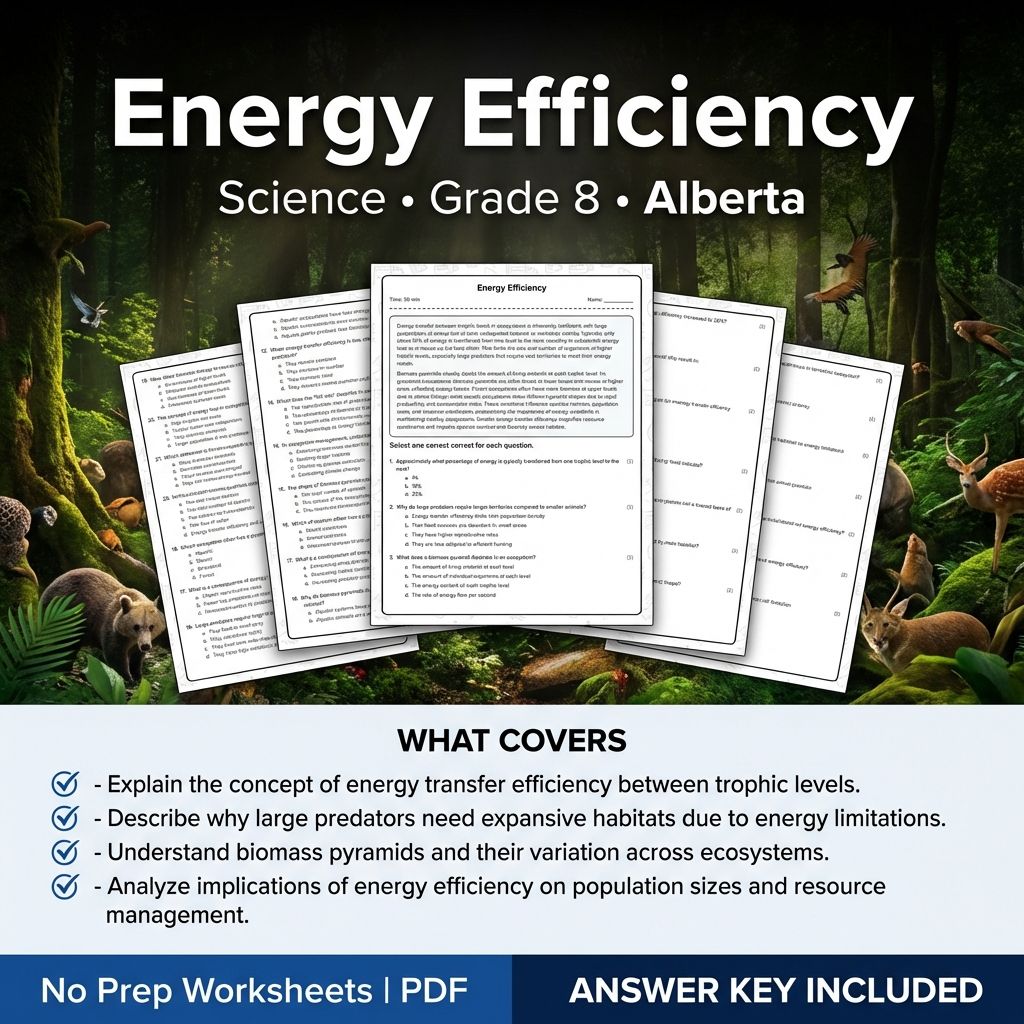
Energy Efficiency Worksheet | Grade 8 Science Standard Alberta
Created byCoral Reef LearningLearning Objectives
- Explain the concept of energy transfer efficiency between trophic levels.
- Describe why large predators need expansive habitats due to energy limitations.
- Understand biomass pyramids and their variation across ecosystems.
Instant download

Grade 8 Water Cycle Worksheet | NGSS Practice & PDF
 Created byClear Sky Classroom
Learning Objectives
- Describe the processes involved in the water cycle, including evaporation, condensation, precipitation, infiltration, runoff, and groundwater flow.
- Explain how the water cycle connects to weathering processes such as river incision, karst formation, and coastal erosion.
- Analyze the fluxes, residence times, and observable effects of water movement on land and in basins.
Also included in: Grade 8 Earth Systems Science Lesson Bundle for NGSS Worksheet B Practice +1 more
Instant download

Grade 8 Science | Transport Systems Worksheet (BC Standard) (PDF)
 Created byEvergreen Desk Education
Learning Objectives
- Explain how bulk flow and diffusion move nutrients, gases, and wastes through transport systems.
- Compare plant vascular transport (xylem and phloem) with animal circulatory transport (heart, vessels, and capillaries).
- Describe how structural features such as vessels, valves, and capillary beds support directional flow and efficient exchange.
Instant download

Trophic Energy Transfer Worksheet | Grade 8 Food Web Practice
Created byPrism Point LearningLearning Objectives
- Explain how energy moves one direction through trophic levels in an ecosystem.
- Describe how photosynthesis captures energy and how feeding transfers only a portion of it.
- Use ideas like energy loss and energy pyramids to predict patterns in food chains.
Instant download

Grade 8 Science – Technology & Impacts Reading Worksheet | Standards-Aligned
Created byBright Mind ResourcesLearning Objectives
- Understand how different energy sources affect the environment
- Analyze the long-term effects of energy-related technology choices
- Evaluate the environmental trade-offs of clean and traditional energy options
Also included in: Tech Tradeoffs Grade 8 Science Daily Reading Worksheets Lesson Bundle | General +1 more
Instant download
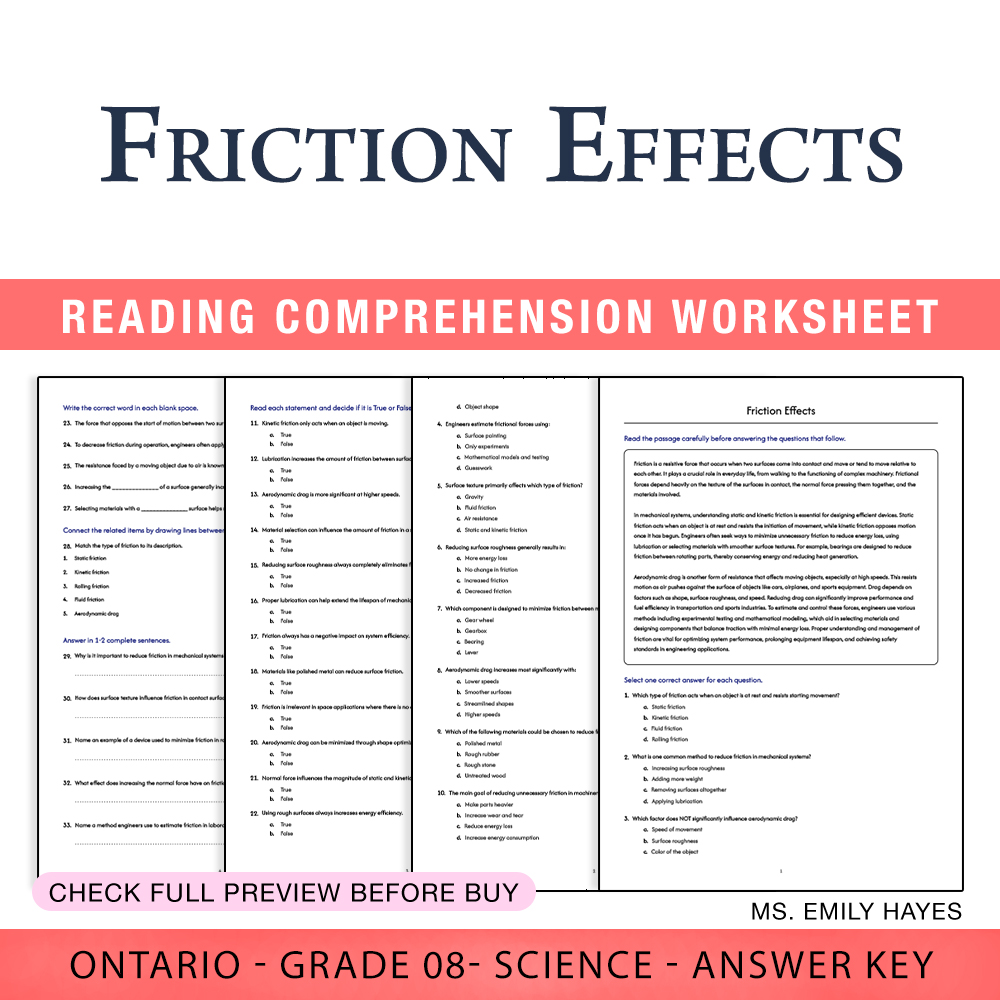
Grade 8 Science | Friction Effects Worksheet (PDF+ Answer Key)
Created byCopper Leaf ClassroomLearning Objectives
- Explain the differences between static and kinetic friction and how they affect moving objects.
- Describe the role of surface texture, normal force, and material choice in frictional forces.
- Analyze how aerodynamic drag influences the performance of moving systems.
Instant download

Grade 8 Forces Overview Worksheet | Practice & Assessment PDF
Created byClear Sky ClassroomLearning Objectives
- Explain what a force is and how forces can change an object's motion (speed or direction)
- Identify force types (contact and non-contact) and describe examples from everyday situations
- Use qualitative reasoning to compare how larger vs. smaller net forces can affect motion and explain how opposing forces can cancel
Instant download

Grade 8 Friction Effects Worksheet | Ontario Science Activities & Teacher Guide
Created byChalk and CompassLearning Objectives
- Explain how static and kinetic friction oppose motion and how they depend on normal force and surface texture
- Describe how aerodynamic drag can reduce system performance for moving objects
- Estimate frictional force magnitude using simple relationships and interpret how design choices reduce unwanted energy loss
Also included in: Grade 8 Science Mechanical Systems Lesson Bundle | Ontario +1 more
Instant download

Grade 8 Efficiency Losses Worksheet | Mechanical Efficiency Ontario Science
Created byChalk and CompassLearning Objectives
- Define mechanical efficiency as useful output energy divided by input energy
- Identify common mechanisms of efficiency loss in mechanical systems (frictional heating, sound emission, and material hysteresis)
- Explain how engineers can measure and reduce energy dissipation while considering cost and complexity trade-offs
Also included in: Grade 8 Science Mechanical Systems Lesson Bundle | Ontario +1 more
Instant download

Grade 8 Energy Forms Worksheet | Ontario Science with Doodle Notes
Created byChalk and CompassLearning Objectives
- Identify kinetic and potential energy in everyday mechanical systems
- Explain how energy transfers between potential and kinetic energy during motion
- Recognize thermal and acoustic energy as common energy sinks in mechanical systems
Also included in: Grade 8 Science Mechanical Systems Lesson Bundle | Ontario +1 more
Instant download

Grade 8 Work and Energy Worksheet | Ontario Science with Doodle Note
Created byChalk and CompassLearning Objectives
- Explain how work depends on the component of force parallel to displacement
- Calculate work for constant forces and reason about variable forces using force–displacement ideas
- Connect net work to change in kinetic energy using the work–energy theorem
Also included in: Grade 8 Science Mechanical Systems Lesson Bundle | Ontario +1 more
Instant download

Grade 8 Science | Adaptation Mechanisms Worksheet | TEKS Aligned
Created byLumora LearningLearning Objectives
- Describe the various types of adaptation—structural, behavioral, and physiological—and their roles in survival.
- Identify examples of adaptation mechanisms in different species and environments.
- Explain the process of natural selection and how it influences trait frequencies across generations.
Also included in: Grade 8 Science | Organisms and Environments Unit Bundle | TEKS Aligned
Instant download
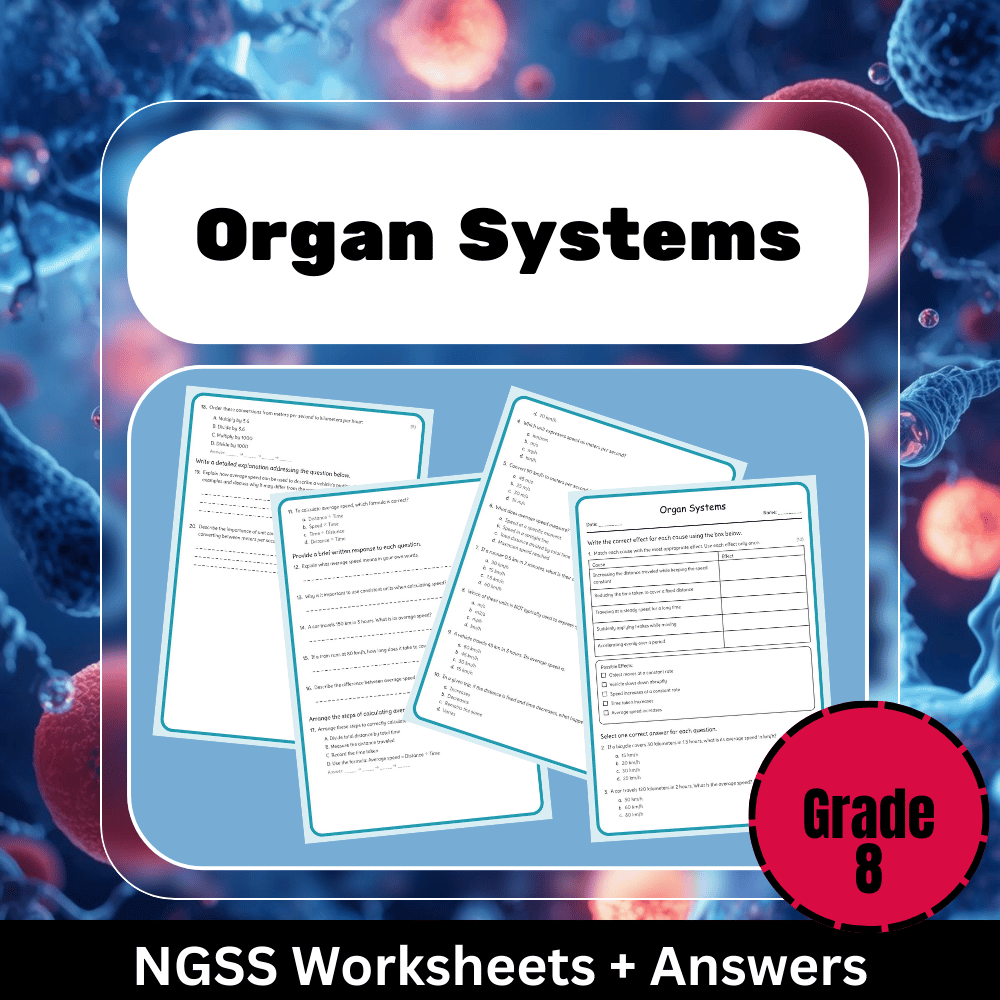
Grade 8 Science | Organ Systems Worksheet (NGSS) with Answer Key (PDF)
Created byBright Mind ResourcesLearning Objectives
- Describe how different body systems interact to maintain homeostasis.
- Identify the functions of the circulatory, respiratory, digestive, nervous, and endocrine systems.
- Explain feedback mechanisms such as insulin-glucagon signaling and thermoregulation.
Also included in: Grade 8 Science Unit: Cell & Organ Systems Worksheets Pack (NGSS Aligned) +2 more
Instant download
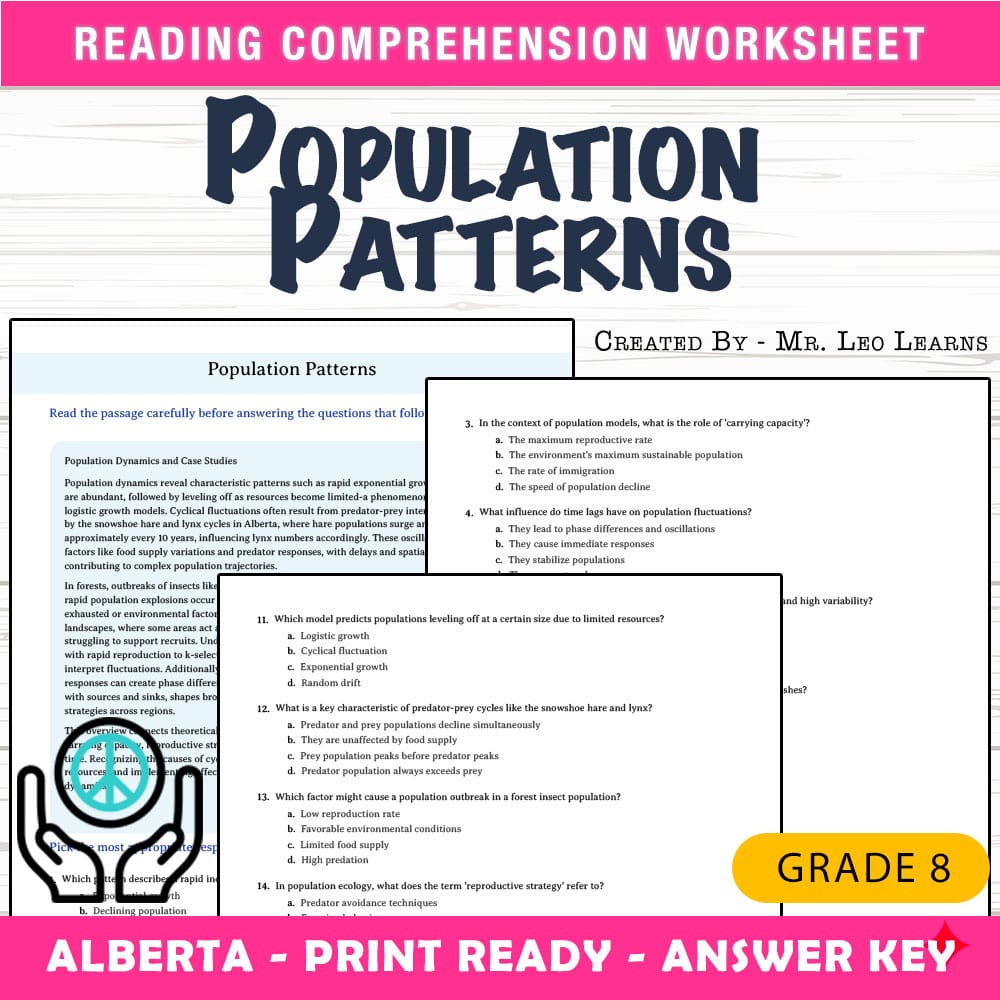
Grade 8 Science — Population Patterns Worksheet MCQ Paper
Created byThe Resource HubLearning Objectives
- Understand different types of population growth curves including exponential, logistic, and cyclical patterns.
- Recognize factors such as food supply, predation, and carrying capacity that influence population dynamics.
- Link theoretical population models to real-world case studies like snowshoe hare–lynx cycles and insect outbreaks.
Also included in: Grade 8 Science Bundle | Interactions and Ecosystems Worksheets +1 more
Instant download

Grade 8 Science – Force Diagrams & Physics | Daily Reading Worksheet
Created byBright Mind ResourcesLearning Objectives
- Understand the concept of force and how to represent it using vectors
- Learn to create and interpret free-body diagrams for different systems
- Distinguish between contact and non-contact forces
Also included in: Grade 8 Mechanical Systems Science Reading Worksheets – Lesson Bundle | Ontario +1 more
Instant download
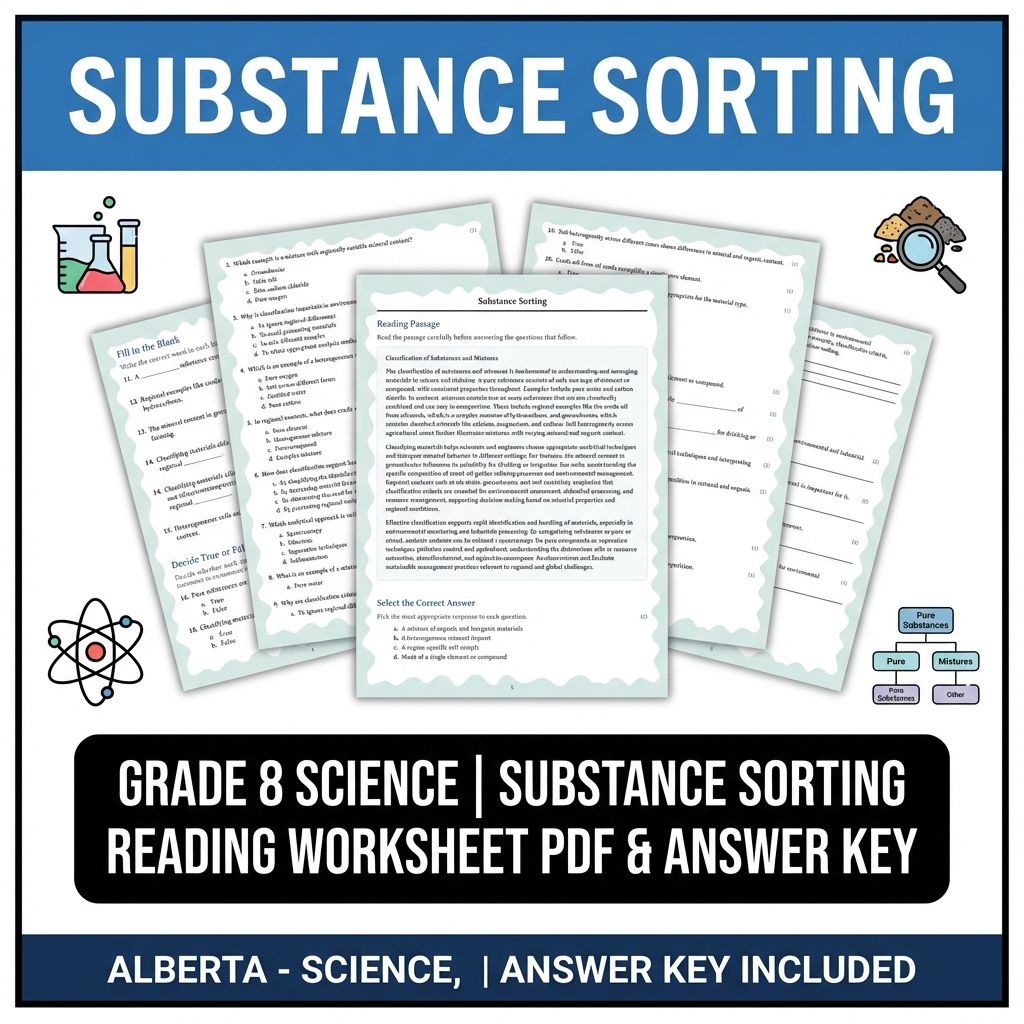
Grade 8 Science | Substance Sorting Reading Worksheet PDF & Answer Key
JCreated byJ.S SheetsLearning Objectives
- Understand classifications of pure substances and mixtures.
- Identify criteria used for classifying materials in environmental contexts.
- Analyze regional examples of substances and mixtures.
Also included in: Grade 8 Science | Essential Concepts & Processes Pack (Answer Key Included) +1 more
Instant download
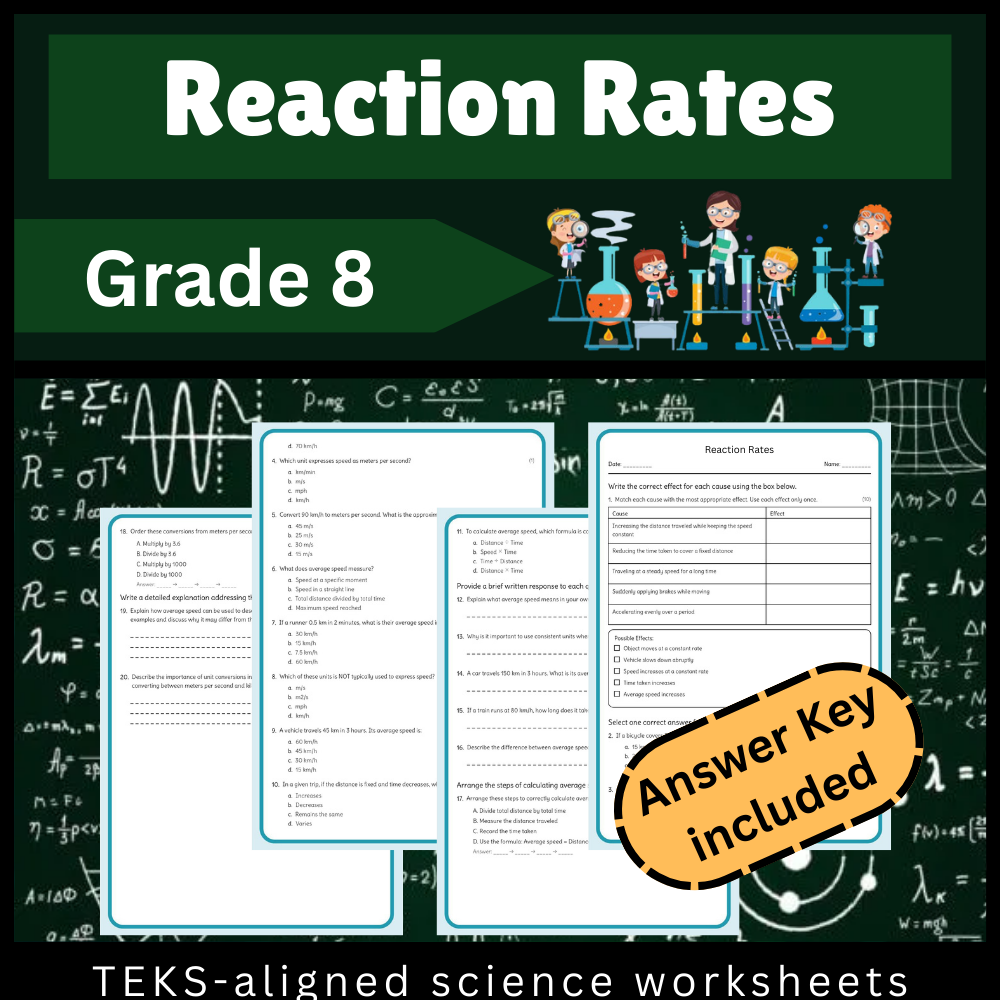
Grade 8 Science | Reaction Rates Worksheet (Answer Key) – TEKS Aligned
Created byBright Mind ResourcesLearning Objectives
- Identify factors that influence the speed of chemical reactions
- Explain how temperature, concentration, surface area, and catalysts affect reaction rates
- Connect molecular collision frequency and activation energy to observable rate changes
Also included in: Grade 8 Science Unit Bundle | States of Matter & Reaction Rates Worksheets- TEKS +1 more
Instant download
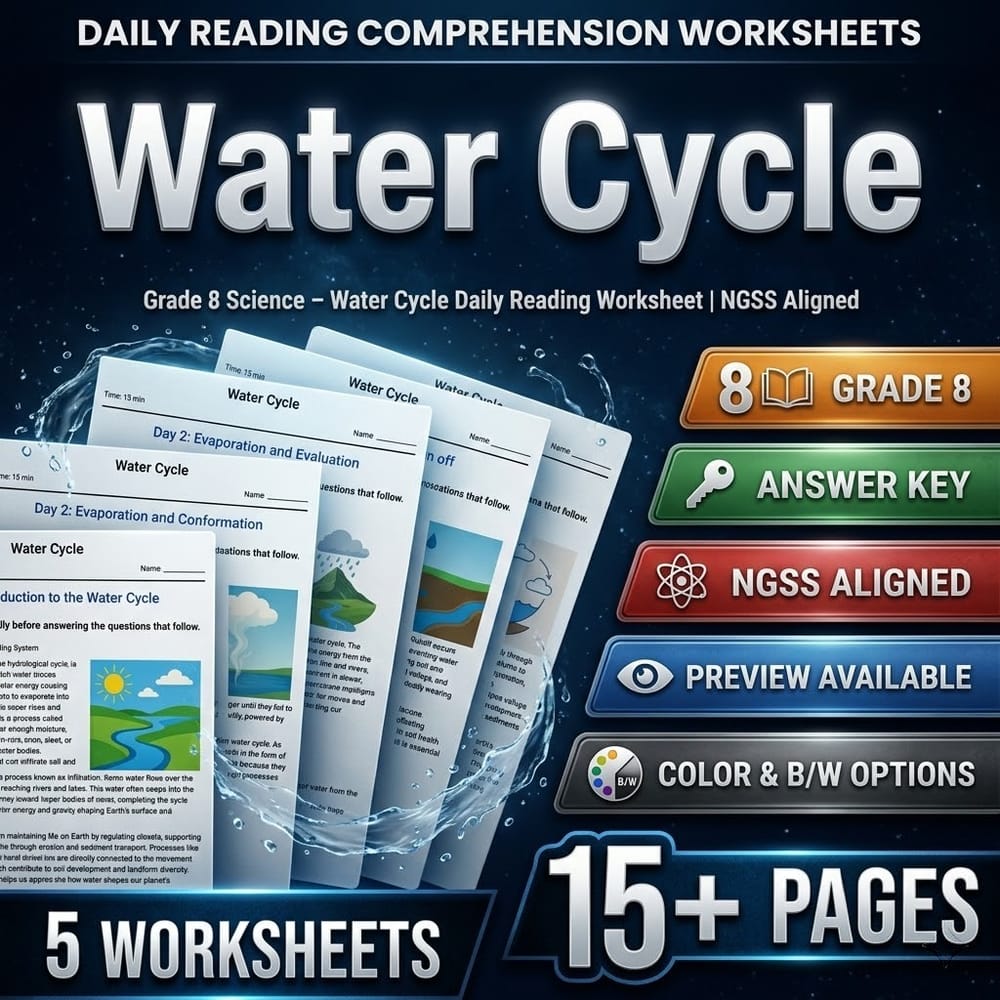
Grade 8 Science – Water Cycle Daily Reading Worksheet | NGSS Aligned
 Created byElena Brooks
Learning Objectives
- Understand the basic processes of the water cycle, including evaporation, condensation, precipitation, infiltration, runoff, and groundwater flow.
- Recognize the role of sunlight and gravity in driving the water cycle.
- Identify how water cycle processes influence landforms and weathering.
Instant download
About Grade 8 Science Worksheets
Explore Grade 8 Science worksheets for classwork, homework, or review. Our 5,999 printables download instantly as PDFs.
Each resource here is built by an independent educator and reviewed for quality. Worksheets print straight from PDF and suit classroom use, homework, or extra practice; most come with answer keys, and you can preview before purchasing.