
Grade 8 Science Worksheets
6,006 worksheets
Grade 8 Science – Speed & Motion | Daily Reading Worksheet
 Created byBright Mind Resources
Learning Objectives
- Understand the concept of speed and how it is calculated
- Differentiate between constant and average speed
- Apply proportional reasoning to speed, distance, and time relationships
Also included in: Grade 8 Motion Forces Energy Science Daily Reading Lesson Bundle | BC +1 more
Instant download

Tradeoff Analysis Worksheet | Grade 8 Science Practice & Review
 Created byPrism Point Learning
Learning Objectives
- Use weighted scoring to compare design options when multiple constraints compete.
- Estimate costs and benefits and explain how uncertainty affects a decision.
- Perform sensitivity analysis to test how results change with different assumptions.
Also included in: Grade 8 NGSS Science Practice Lesson Bundle: Modeling & Tradeoff Review
Instant download

Ecosystem Components Worksheet | Grade 8 Science Activities
Created byPrism Point LearningLearning Objectives
- Identify biotic and abiotic components of an ecosystem and explain how they affect living organisms
- Describe how producers, consumers, and decomposers help cycle energy and matter
- Explain how physical conditions such as sunlight, water, soil, and temperature influence where species live
Also included in: Ecosystems & Biodiversity Lesson Bundle | Grade 8 Science | BC +1 more
Instant download

Grade 8 Science | Membrane Transport - Daily Reading Comprehension
 Created byCoral Reef Learning
Learning Objectives
- Understand the different mechanisms of membrane transport.
- Distinguish between passive and active transport.
- Identify examples of diffusion, osmosis, facilitated diffusion, and active transport.
Instant download

Grade 8 Mechanical Advantage Science Daily Reading Worksheet | TEKS
 Created byBRIGHT PATH RESOURCES
Learning Objectives
- Define input force, output force, and mechanical advantage (MA).
- Interpret MA as a ratio using a simple example.
- Distinguish ideal mechanical advantage from real mechanical advantage using efficiency ideas.
Also included in: Grade 8 Force Motion and Energy Science Reading Worksheets Bundle | TEKS +1 more
Instant download

Grade 8 Population Drivers and Carrying Capacity Worksheet | Alberta
Created byBRIGHT PATH RESOURCESLearning Objectives
- Explain how abiotic factors and biotic factors affect population growth
- Describe carrying capacity and density-dependent limits
- Use cause-and-effect language to interpret population changes
Also included in: Grade 8 Alberta Science Interactions and Ecosystems Worksheet Bundle +1 more
Instant download

Gravity and Motion Worksheet | NGSS Grade 8 Science Assessment
 Created bySkylark Worksheets
Learning Objectives
- Explain how gravity acts as the primary force that governs orbital motion in the solar system and beyond.
- Describe how inertia and gravity work together to produce orbital paths and periods, including why orbits can be elliptic.
- Use examples such as planets, moons, comets, and asteroids to connect gravitational attraction with observable motion and perturbations.
Also included in: Grade 8 Earth’s Place in the Universe Science Lesson Bundle (NGSS) +1 more
Instant download
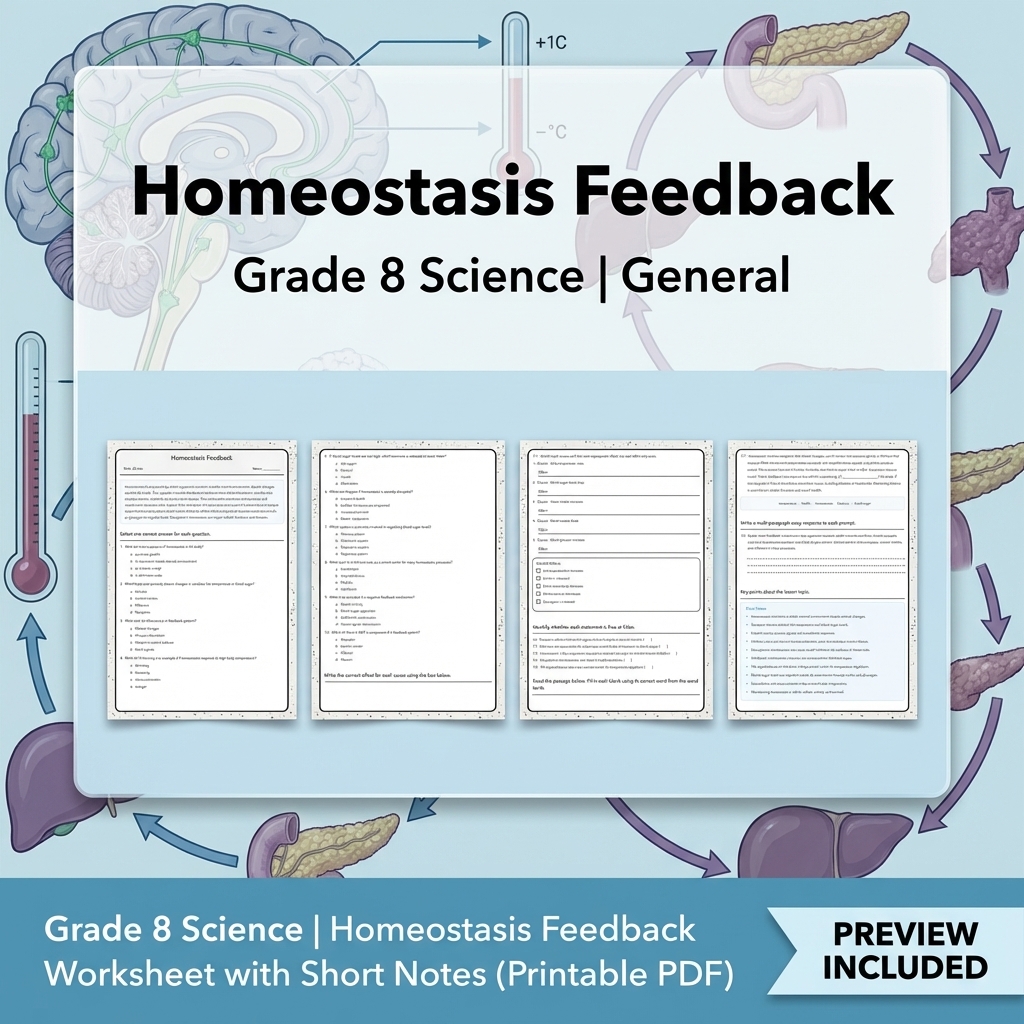
Grade 8 Science | Homeostasis Feedback Worksheet with Short Notes
 Created byMeadowlark Worksheets
Learning Objectives
- Understand the concept of homeostasis and its importance in organisms.
- Identify the roles of receptors, control centers, and effectors in feedback systems.
- Explain how internal variables are regulated to maintain stability.
Also included in: Grade 8 Interactions, Homeostasis & Genetics Science Lesson Bundle (General) +1 more
Instant download

Grade 8 Science | Rock Cycle - Daily Reading Comprehension
Created byCoral Reef LearningLearning Objectives
- Understand the processes involved in the formation of igneous rocks.
- Identify key characteristics of igneous rocks.
- Explain how cooling magma leads to the formation of igneous rocks.
Instant download

Food Web Energy Worksheet Grade 8 Science | Ecosystems & Energy Flow
Created byPrism Point LearningLearning Objectives
- Explain how energy enters ecosystems through producers and moves through food chains and food webs.
- Distinguish the roles of producers, consumers, and decomposers in energy flow and matter recycling.
- Describe how energy decreases at each trophic level and how this creates an energy pyramid pattern.
Also included in: Grade 8 Genetics, Evolution & Ecosystems Lesson Bundle | Florida NGSSS
Instant download
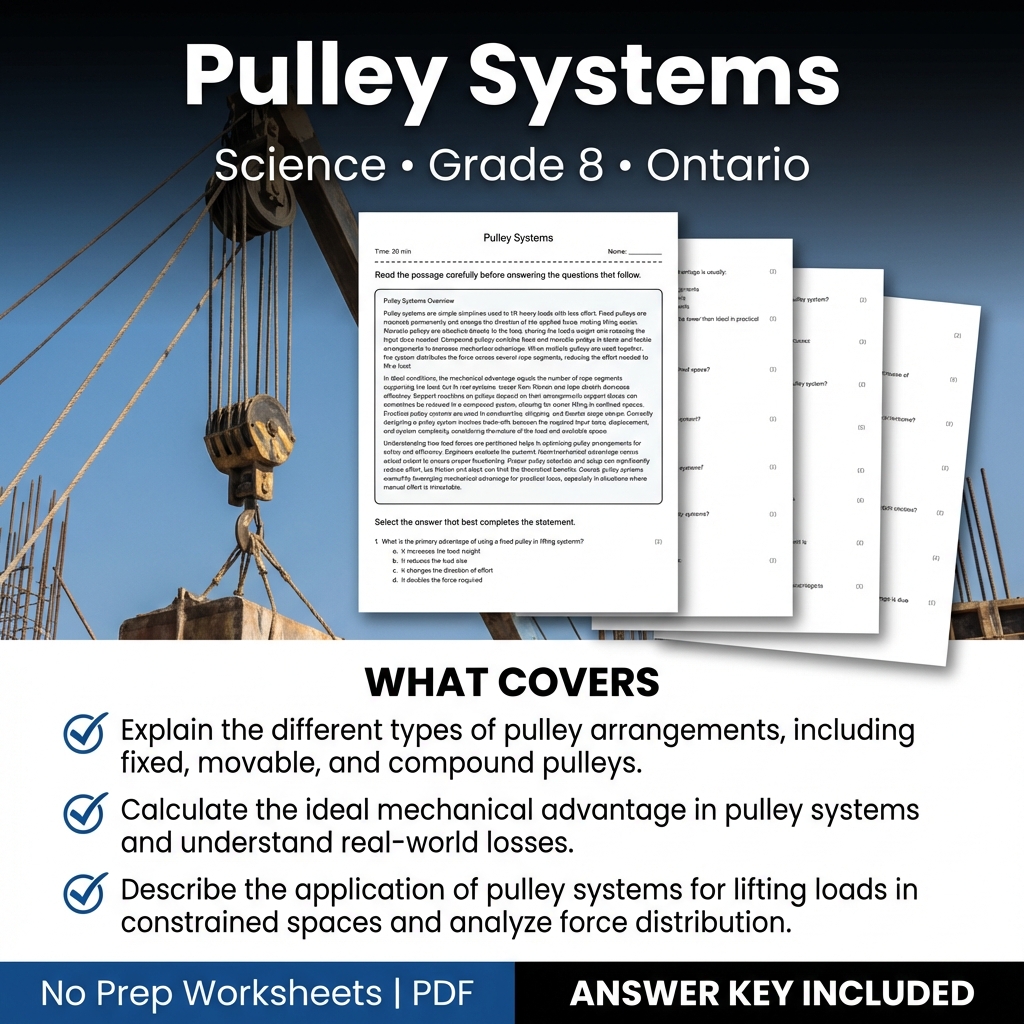
Pulley Systems Worksheet for Grade 8 Science | Ontario Standards
Created byCoral Reef LearningLearning Objectives
- Explain the different types of pulley arrangements, including fixed, movable, and compound pulleys.
- Calculate the ideal mechanical advantage in pulley systems and understand real-world losses.
- Describe the application of pulley systems for lifting loads in constrained spaces and analyze force distribution.
Instant download

Electromagnetic Induction Worksheets | Grade 8 Science Electricity
 Created bySunny Desk Resources
Learning Objectives
- Describe electromagnetic induction as the production of an induced voltage from changing magnetic flux.
- Identify factors that affect the size of induced current or voltage in a circuit.
- Explain how relative motion between a conductor and a magnetic field can produce an electric current.
Also included in: Electricity and Magnetism Grade 8 Alberta Unit Lesson Bundle +1 more
Instant download

Food Web Complexity & Ecosystem Resilience Worksheets Grade 8
Created bySunny Desk ResourcesLearning Objectives
- Explain how food webs combine multiple feeding relationships to show energy pathways in communities
- Describe how indirect interactions and redundancy affect an ecosystem after a species is lost
- Interpret how seasonal movement and life-cycle stages change link strengths in food webs
Also included in: Interactions & Ecosystems Grade 8 Science Worksheets Alberta Bundle +1 more
Instant download

Grade 8 Science – Variation From Meiosis & Genetic Diversity | Reading Worksheet
Created byBright Mind ResourcesLearning Objectives
- Understand the basic process of meiosis and its role in genetic variation.
- Identify how chromosome separation and recombination increase genetic diversity.
- Explain the importance of variation in populations for evolution.
Also included in: Genetics Grade 8 Science Daily Reading Worksheets lesson bundle | Florida NGSSS +1 more
Instant download

Grade 8 Science – Testable Claims & Hypotheses | Daily Reading Worksheet
Created byBright Mind ResourcesLearning Objectives
- Define what makes a scientific claim testable.
- Identify variables involved in a hypothesis.
- Differentiate between observations and hypotheses.
Also included in: Scientific Thinking & Evidence Grade 8 Science Lesson Bundle | General +1 more
Instant download

Grade 8 Science Worksheet on Pressure Basics – Ontario Standards (PDF)
 Created byEvergreen Desk Education
Learning Objectives
- Define fluid pressure as force per unit area and identify the SI unit for pressure.
- Differentiate surface contact pressure from internal fluid pressure in liquids and gases.
- Use and interpret pressure equations and convert between newtons per square metre (N/m²) and kilopascals (kPa).
Also included in: Grade 8 Fluid Pressure & Forces Science Lesson Bundle: Ontario Worksheet Set +1 more
Instant download

Grade 8 Science | Energy Changes in Chemical Reactions - Reading Comprehension
Created byCoral Reef LearningLearning Objectives
- Understand how energy is absorbed or released during chemical reactions.
- Identify endothermic and exothermic reactions based on energy changes.
- Describe how bond breaking and forming contribute to energy changes.
Instant download

Grade 8 Science – Force & Motion | Daily Reading Worksheet
Created byBright Mind ResourcesLearning Objectives
- Understand how net force influences the acceleration of objects
- Interpret the relationship between mass, force, and acceleration using mathematical models
- Apply concepts to real-world examples like toys, bicycles, and friction effects
Also included in: Physical Science Grade 8 Science Daily Reading Worksheets Lesson Bundle | NGSS +1 more
Instant download

Grade 8 Trophic Levels & Consumer Roles Worksheet | Alberta Science
Created byBRIGHT PATH RESOURCESLearning Objectives
- Identify herbivores, omnivores, and carnivores and their trophic positions
- Explain how feeding relationships form food chains and energy transfer patterns
- Describe how omnivory can blur discrete trophic levels
Also included in: Grade 8 Alberta Science Interactions and Ecosystems Worksheet Bundle +1 more
Instant download
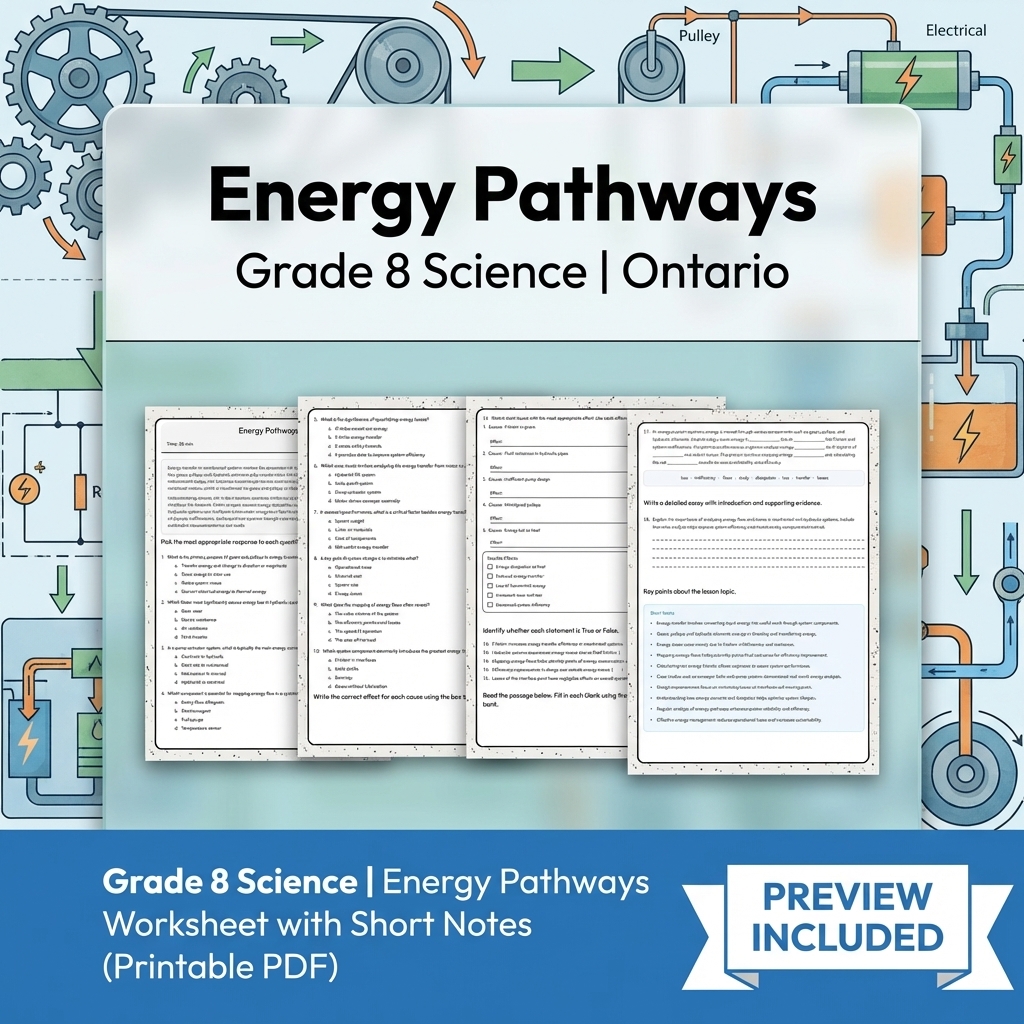
Grade 8 Science | Energy Pathways Worksheet with Short Notes (Printable PDF)
Created byMeadowlark WorksheetsLearning Objectives
- Understand how energy transfers through mechanical and hydraulic systems.
- Identify points of energy conversion and quantify losses at each stage.
- Analyze case studies involving motor-driven and pump-actuator systems.
Also included in: Grade 8 Science Lesson Group Bundle for Ontario Curriculum +1 more
Instant download

Grade 8 Science | Organ Systems Worksheet (Ontario) (PDF)
Created byEvergreen Desk EducationLearning Objectives
- Explain how specialized tissues form organs and how organ structure supports organ function in major systems.
- Describe how the circulatory, respiratory, and digestive systems coordinate to move gases, nutrients, and wastes.
- Use the ideas of transport mechanisms and surface area to justify why organs work efficiently.
Also included in: Grade 8 Cell Structure & Homeostasis Science Lesson Bundle (Ontario) +1 more
Instant download
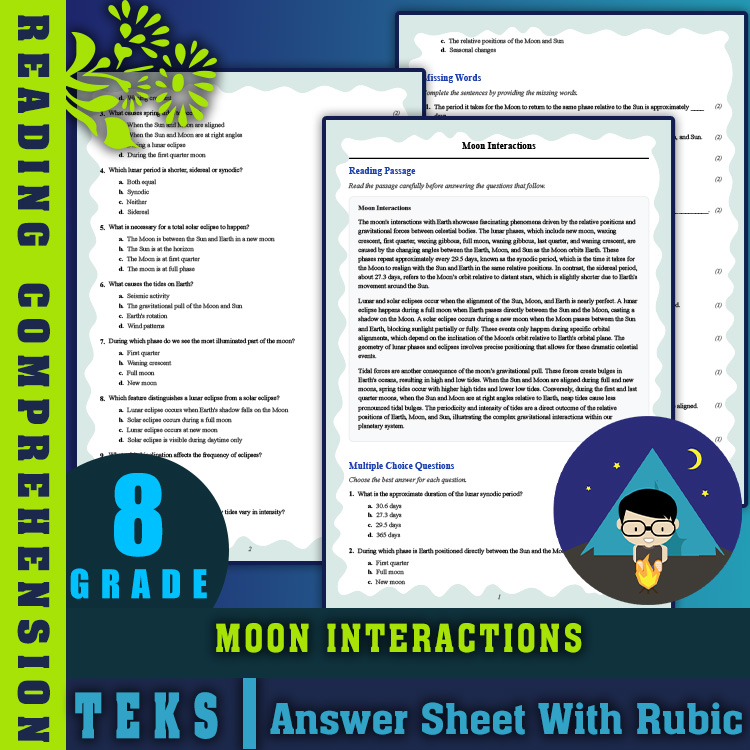
Grade 8 Science Reading Worksheets | Moon Interactions TEKS (PDF + Answer Key)
JCreated byJ.S SheetsLearning Objectives
- Describe the phases of the moon and their causes.
- Explain the conditions that lead to lunar and solar eclipses.
- Understand tidal phenomena and their relationship to the moon's position.
Instant download

Momentum Collisions Worksheet Grade 8 Science | NGSS G8 Assessment
 Created byCedar Grove Learning
Learning Objectives
- Understand the principles of momentum exchange during collisions.
- Differentiate between elastic and inelastic collisions based on energy transfer.
- Apply the conservation of linear momentum to analyze collision scenarios.
Instant download

Grade 8 Science – Cell Theory & Structures | Daily Reading Worksheet
Created byBright Mind ResourcesLearning Objectives
- Understand the historical development of cell theory.
- Identify the core principles of cell theory.
- Explain how microscopic evidence supports cell theory.
Also included in: Grade 8 Life Systems Science Daily Reading Worksheets Lesson Bundle | Ontario +1 more
Instant download

Grade 8 Science – Density Effects & Population Regulation | Reading Worksheet
Created byBright Mind ResourcesLearning Objectives
- Understand how density-dependent factors influence populations
- Identify examples of resource competition and disease transmission
- Differentiate between density-dependent and density-independent factors
Also included in: Grade 8 Ecosystems Science Daily Reading Worksheets Lesson Bundle | Alberta +2 more
Instant download
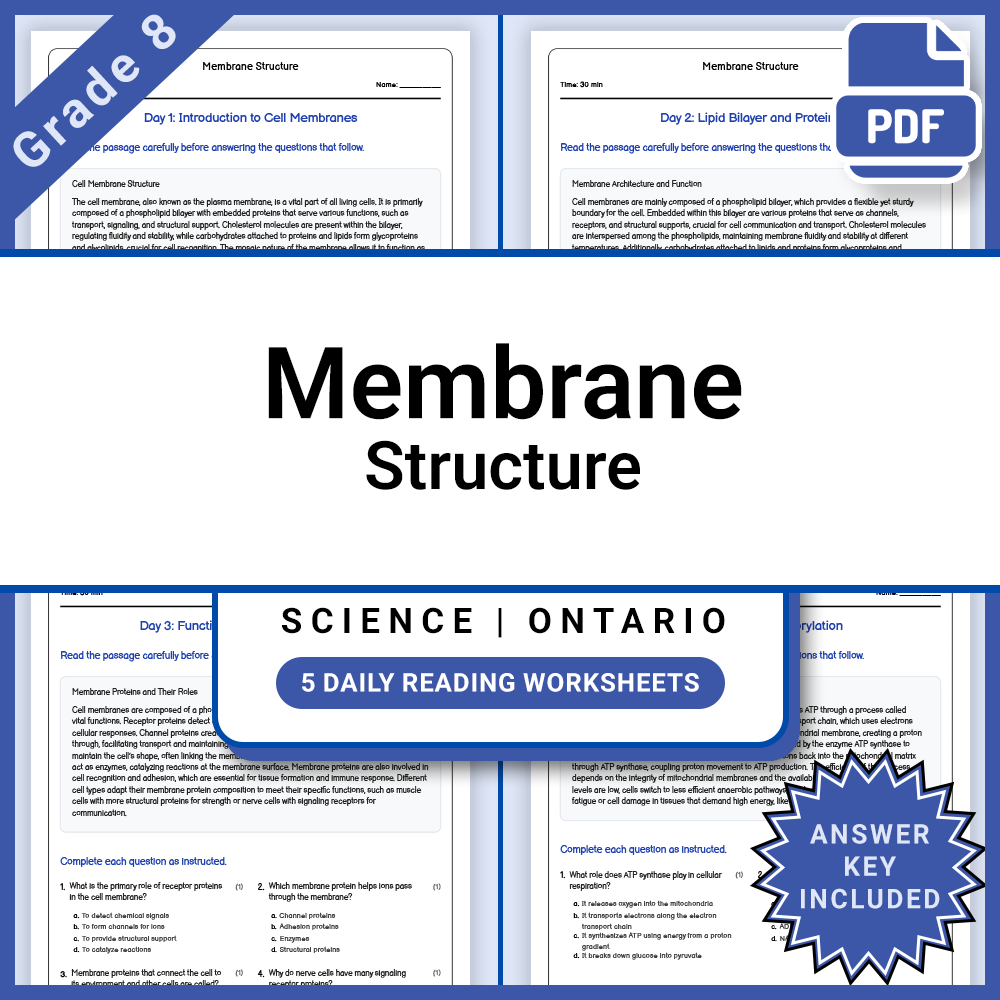
Grade 8 Science – Membrane Structure Daily Reading Worksheet + Answer Key
JCreated byJ.S SheetsLearning Objectives
- Understand the basic components of the cell membrane, including phospholipids, proteins, cholesterol, and carbohydrates.
- Explain the functions of membrane proteins in transport and signaling.
- Compare membrane structures in different cell types and their impact on permeability and resilience.
Also included in: Grade 8 Science Lesson Group: Ontario Curriculum Reading Worksheets Bundle +1 more
Instant download

Testable Questions Assessment | Florida NGSSS Grade 8 Science Standards
Created byPrism Point LearningLearning Objectives
- Distinguish observations, claims, and assumptions when analyzing a science question.
- Write and evaluate testable questions that can be supported by measurable or observable evidence.
- Identify independent and dependent variables in relationships described by scientific questions.
Instant download
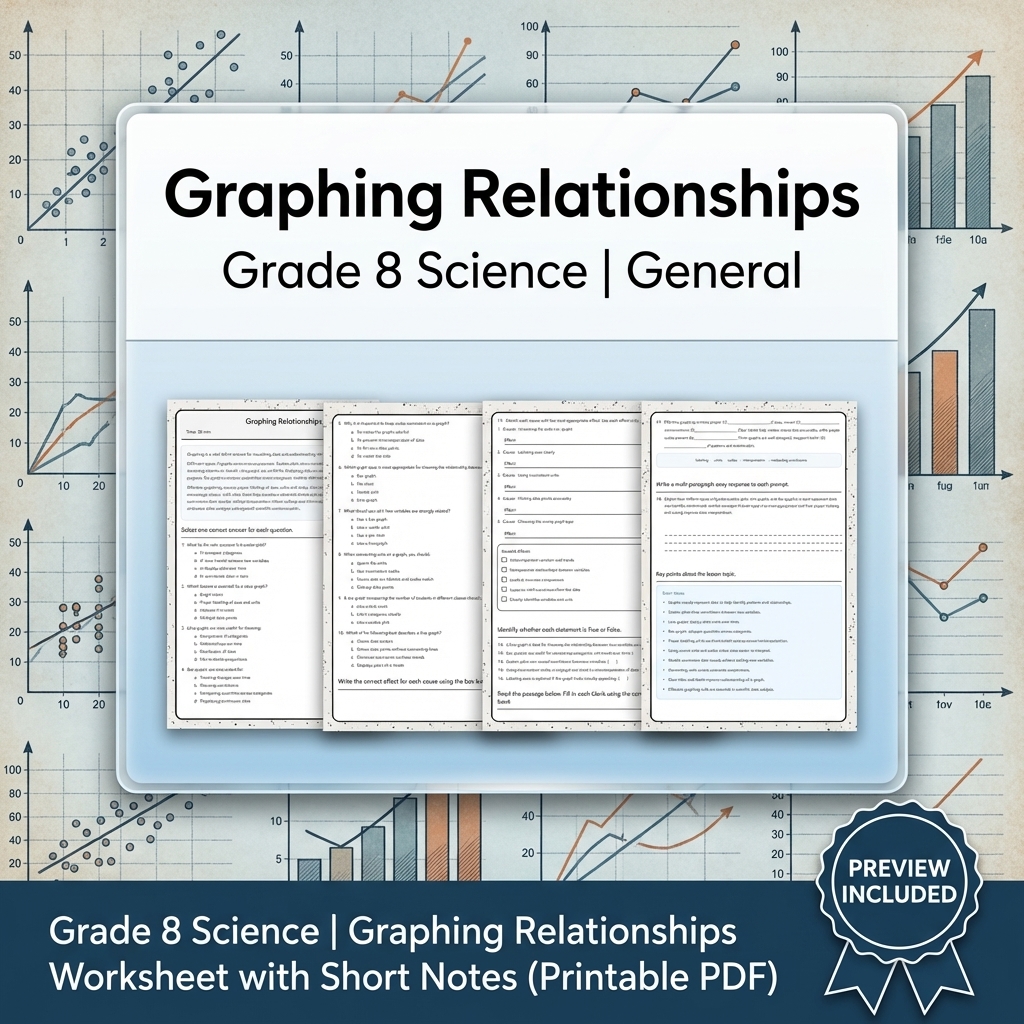
Grade 8 Science | Graphing Relationships Worksheet with Short Notes
Created byMeadowlark WorksheetsLearning Objectives
- Understand how to represent data visually using different types of graphs.
- Identify patterns, trends, and relationships between variables in graphs.
- Learn to interpret scatter plots, line graphs, and bar graphs accurately.
Also included in: Grade 8 Scientific Reasoning Science Lesson Bundle: General Framework +1 more
Instant download

Energy Temperature Link Worksheet | Standards-Aligned Grade 8 Science Practice
JCreated byJ.S SheetsLearning Objectives
- Understand the relationship between temperature change and energy transfer.
- Explain how energy transfer affects the thermal state of materials.
- Relate everyday observations of warming and cooling to energy flow.
Also included in: Grade 8 Forces, Energy & Matter Science Lesson Bundle | California Standards +1 more
Instant download

Grade 8 Science – Bernoulli's Principle & Fluid Dynamics | Daily Worksheet
 Created byQuiet Forest Education
Learning Objectives
- Explain the relationship between fluid speed and pressure.
- Describe the Bernoulli equation for ideal fluids.
- Identify real-world applications of Bernoulli's principle, such as airplane lift and fluid flow in pipes.
Also included in: Fluid Dynamics Grade 8 Science Daily Reading Worksheets Bundle | Ontario +1 more
Instant download

Contaminant Transport Worksheet Practice for Grade 8 Science | Ontario
Created byPrism Point LearningLearning Objectives
- Explain how advection, dispersion, diffusion, and dilution affect contaminant movement in water
- Describe how sorption, partitioning, biodegradation, and redox-driven reactions control contaminant fate
- Use the idea of contaminant plumes and attenuation timescales to predict how contamination changes with time
Also included in: Grade 8 Water Systems Science Lesson Bundle for Ontario Framework
Instant download

Pressure and Temperature Assessment for Grade 8 Science – Standards-Aligned
Created byPrism Point LearningLearning Objectives
- Explain how particle motion relates to gas pressure and temperature.
- Describe how increased particle speed at higher temperatures affects collisions with container walls.
- Connect microscopic particle behavior to macroscopic gas properties.
Also included in: Grade 8 Physical Science Science Lesson Bundle – General Framework
Instant download

Grade 8 Science – Earthquakes & Volcanoes | Daily Reading Worksheet
Created byBright Mind ResourcesLearning Objectives
- Understand what causes earthquakes and volcanic eruptions
- Recognize the effects of seismic activity and volcanic features
- Identify the relationship between tectonic plate movements and surface changes
Also included in: Grade 8 Earth Science Daily Reading Worksheets Lesson Bundle | Florida NGSSS +1 more
Instant download

Grade 8 Food Webs Worksheet | NGSS Ecosystems Activity with Doodle Notes
 Created byAmber Owl Education
Learning Objectives
- Describe how energy moves through terrestrial and aquatic food webs using producers, consumers, and decomposers.
- Explain trophic levels and why energy decreases at each step in a food web.
- Use ecological efficiency and primary production/respiration ideas to interpret patterns in population size and community structure.
Also included in: Grade 8 Science Ecosystem Dynamics Lesson Bundle | NGSS +1 more
Instant download

Moon Interactions Assessment | TEKS Grade 8 Science Standards-Aligned
Created byPrism Point LearningLearning Objectives
- Identify the phases of the Moon and explain their causes.
- Describe different types of lunar and solar eclipses based on orbital alignment.
- Explain tidal phenomena, including spring and neap tides, in relation to the Moon's gravitational pull.
Also included in: Grade 8 Weather and Earth-Space Science Assessment Lesson Bundle TEKS
Instant download

Grade 8 Science – Properties Overview & Density | Daily Reading Worksheet
Created byBright Mind ResourcesLearning Objectives
- Understand the concept of density and how it varies among materials.
- Identify different physical properties of matter such as solubility, melting point, and conductivity.
- Compare materials based on measurable characteristics to classify and separate them.
Also included in: Grade 8 Energy Transfer & Heat Transfer Science Lesson Bundle | TEKS Daily +2 more
Instant download

Grade 8 Scale and Patterns in the Solar System Worksheet | NGSS Practice PDF
 Created byClear Sky Classroom
Learning Objectives
- Interpret scale relationships among solar system objects using quantitative data.
- Compare sizes, distances, and orbital periods of planets, dwarf planets, and moons.
- Understand the use of astronomical units and relative scaling in astronomy.
Also included in: Grade 8 Solar System Scale, Orbits & Gravity Science Lesson Bundle (NGSS) +1 more
Instant download

Science Worksheet Species Interactions Grade 8 | Standards-Aligned Practice
JCreated byJ.S SheetsLearning Objectives
- Explain how predation, competition, mutualism, and parasitism affect survival and reproduction.
- Describe how species interactions can change population sizes and community structure.
- Use evidence from a passage to identify the type of interaction and predict its effects.
Also included in: Grade 8 Biology Systems & Ecosystem Adaptations Science Lesson Bundle – General +1 more
Instant download

Grade 8 Momentum Transfer Worksheet | Collisions, Impulse & Ontario Science
 Created byChalk and Compass
Learning Objectives
- Explain linear momentum and impulse in terms of collisions and interactions.
- Use conservation of momentum to predict post-interaction velocities in classroom-scale systems.
- Distinguish elastic vs. inelastic collisions using momentum and kinetic energy ideas.
Also included in: Grade 8 Science Mechanical Systems Lesson Bundle | Ontario +1 more
Instant download

Grade 8 Science – Food Web Energy & Producers Daily Reading Worksheet
Created byBright Mind ResourcesLearning Objectives
- Understand the role of producers in an ecosystem's food web.
- Identify the importance of producers in starting energy flow.
- Describe how energy moves through feeding relationships starting with producers.
Also included in: Genetics Grade 8 Science Daily Reading Worksheets lesson bundle | Florida NGSSS +1 more
Instant download
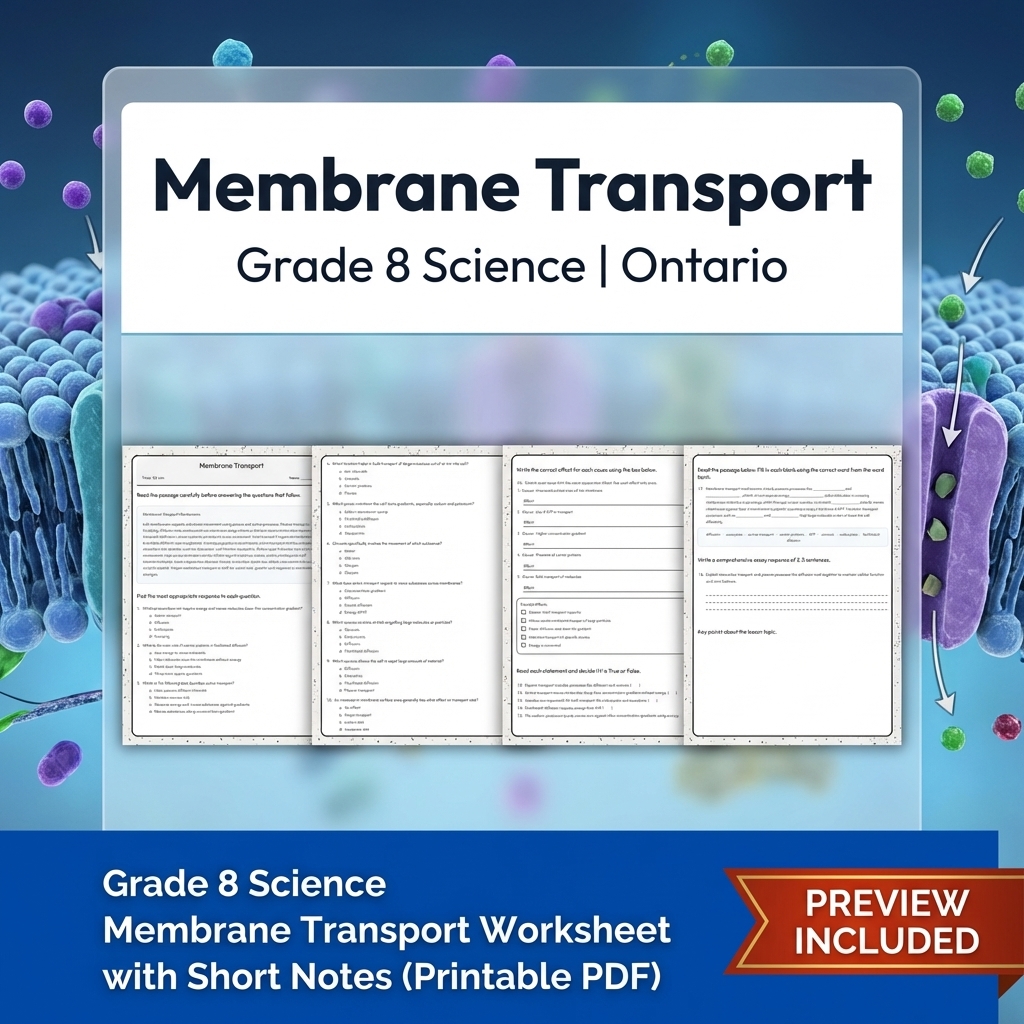
Grade 8 Science Membrane Transport Worksheet with Short Notes (Printable PDF)
Created byMeadowlark WorksheetsLearning Objectives
- Describe the processes of passive and active transport across cell membranes.
- Identify different mechanisms such as diffusion, osmosis, facilitated diffusion, and active transport.
- Explain the role of carrier proteins and pumps in maintaining cellular function.
Also included in: Grade 8 Science Lesson Group Bundle | Ontario Curriculum Worksheets +1 more
Instant download

Grade 8 Earth Materials Worksheet | NGSS Practice PDF
Created byClear Sky ClassroomLearning Objectives
- Understand the processes involved in Earth's material cycles, including the rock cycle and mantle convection.
- Identify interactions among geosphere, hydrosphere, and atmosphere in surface processes.
- Recognize energy sources driving Earth's internal and surface changes, such as internal heat and gravity.
Also included in: Grade 8 Earth Systems Science Lesson Bundle for NGSS Worksheet B Practice +1 more
Instant download

Digestive Integration Worksheet | Grade 8 Science Practice
Created byPrism Point LearningLearning Objectives
- Explain how mechanical and chemical digestion work together to break food into absorbable molecules
- Describe how specialized tissues along the digestive tract support specific functions
- Connect nutrient absorption to circulatory transport and cellular use for energy, growth, and repair
Also included in: Grade 8 Science Full-Year Bundle | BC Science Framework
Instant download

Grade 8 Gravitational Interactions Worksheet | NGSS Forces Science Activity
Created byBRIGHT PATH RESOURCESLearning Objectives
- Define gravity and understand its universal attraction
- Explain how mass and distance influence gravitational force
- Describe real-world phenomena resulting from gravity
Also included in: Forces & Electromagnetism Grade 8 Science Daily Reading Lesson Bundle | NGSS +2 more
Instant download

Grade 8 Science – Intermolecular Forces Worksheet (Alberta Standards PDF)
 Created bySilver Birch Teaching
Learning Objectives
- Explain how intermolecular forces affect melting point, boiling point, and vapour pressure
- Use particle-level reasoning to predict changes in phase transitions and volatility
- Connect molecular interactions to real Alberta conditions such as freeze–thaw cycles, humidity, and hydrocarbon volatility
Also included in: Grade 8 Matter & Chemical Change Science Lesson Bundle | Alberta Framework +1 more
Instant download

Stored Energy Worksheet | NGSS Grade 8 Science Assessment
Created bySkylark WorksheetsLearning Objectives
- Explain gravitational, elastic, and magnetic potential energy as energy stored by the arrangement of objects or fields
- Predict how changing relative position or configuration changes the amount of stored energy
- Describe how stored potential energy can become kinetic energy when constraints are released
Also included in: Grade 8 Energy Science Lesson Bundle: NGSS Assessment & Practice Worksheets +1 more
Instant download

Climate Drivers Test Prep Printable | Grade 8 Science
Created byPrism Point LearningLearning Objectives
- Evaluate evidence for changes in global temperature over time using multiple lines of data.
- Explain how greenhouse gas concentrations, volcanic aerosols, solar variability, and climate feedbacks can influence Earth’s energy balance.
- Distinguish between natural and anthropogenic causes by comparing observations with model-scenario expectations.
Instant download

Ecosystem Structure Worksheet | Grade 8 Science Activities
Created byPrism Point LearningLearning Objectives
- Identify ecosystem components (biotic and abiotic) and explain how abiotic factors shape habitats.
- Describe trophic roles of producers, consumers, and decomposers in an ecosystem.
- Model and interpret patterns of energy flow and matter cycling using examples from different biomes.
Also included in: Grade 8 Ecosystems & Cellular Processes Science Lesson Bundle TEKS +1 more
Instant download
About Grade 8 Science Worksheets
Explore Grade 8 Science worksheets for classwork, homework, or review. Our 6,006 printables download instantly as PDFs.
Each resource here is built by an independent educator and reviewed for quality. Worksheets print straight from PDF and suit classroom use, homework, or extra practice; most come with answer keys, and you can preview before purchasing.