
Grade 9 Science Worksheets
6,926 worksheets
Grade 9 Science | Thermoregulation - Daily Reading Comprehension
 Created byCoral Reef Learning
Learning Objectives
- Identify the key parts involved in thermoregulation
- Understand how body systems work together to maintain temperature
- Explain the functions of skin, vasculature, muscles, and the hypothalamus
Instant download

Simple Machines Worksheet | Grade 9 Science Practice for Alberta Standards
 Created byPrism Point Learning
Learning Objectives
- Explain how simple machines transfer forces to change effort, direction, or displacement
- Compare ideal mechanical advantage with real-world outcomes caused by friction and support geometry
- Apply relationships among input force, load, and displacement to common machine examples
Also included in: Forces, Motion & Energy Lesson Bundle | Grade 9 Science (Alberta)
Instant download

Grade 9 Science – Levels Of Organization & Structures | Daily Reading Worksheet
 Created byQuiet Forest Education
Learning Objectives
- Understand the hierarchical levels of biological organization from cells to systems.
- Describe the functions of different tissues, organs, and systems.
- Explain how cell specialization contributes to organ functions.
Also included in: Human Body Science Grade 9 Daily Reading Worksheets Bundle | Ontario +1 more
Instant download

Inheritance Patterns Worksheet | Grade 9 Science Activities
Created byPrism Point LearningLearning Objectives
- Explain how alleles form genotypes and how genotypes determine observable traits (phenotypes).
- Use dominant and recessive relationships to predict which traits appear in offspring.
- Interpret heredity evidence across generations using genotype–phenotype reasoning.
Instant download

Grade 9 Science – Understanding Epithelial Tissue Daily Reading Worksheet
Created byQuiet Forest EducationLearning Objectives
- Identify different types of epithelial tissues
- Understand the functions of epithelial tissues in the body
- Recognize example structures of epithelial tissue in organs
Also included in: Human Body Science Grade 9 Daily Reading Worksheets Bundle | Ontario +1 more
Instant download

Free Body Diagrams Worksheet | Grade 9 Science Activities
Created byPrism Point LearningLearning Objectives
- Draw a correct free body diagram by identifying all external forces acting on a single object
- Resolve forces into components and determine the net force and direction of acceleration
- Use Newton’s second law (net force = mass × acceleration) to predict motion qualitatively and quantitatively
Also included in: Forces and Motion Lesson Bundle – Grade 9 Science Framework BC +1 more
Instant download

Grade 9 Science | Physical Properties in Science - Daily Reading Comprehension
Created byCoral Reef LearningLearning Objectives
- Define physical properties and understand their importance
- Identify common physical properties such as density, melting point, boiling point, colour, hardness, and conductivity
- Differentiate between intensive and extensive properties
Instant download

Uncertainty in Graphs Worksheet | Grade 9 Science Practice
Created byPrism Point LearningLearning Objectives
- Explain what uncertainty shows on graphs and why it matters for interpreting trends
- Use overlap (or non-overlap) of uncertainty ranges to judge whether differences are likely meaningful
- Select appropriate ways to represent uncertainty, such as error bars or uncertainty bands
Instant download

Design Cycle Worksheet Practice | Grade 9 Science Activities
Created byPrism Point LearningLearning Objectives
- Explain the steps of a design cycle and how feedback leads to design improvement.
- Identify requirements and constraints in an engineering problem and connect them to evaluation criteria.
- Use evidence from testing to refine a solution and justify changes in a design.
Instant download

Grade 9 Science – Temperature Control & Homeostasis | Daily Reading Worksheet
 Created byBright Mind Resources
Learning Objectives
- Understand how the body maintains internal temperature through various mechanisms
- Identify functions of skin blood flow, sweating, shivering, and metabolic adjustments
- Describe the role of the hypothalamus in thermoregulation
Also included in: Grade 9 Cell and Human Body Systems Science Daily Reading Lesson Bundle | BC +1 more
Instant download

Grade 9 Science | Heat and Work Worksheet | General Standard
 Created byLumora Learning
Learning Objectives
- Differentiate heat transfer from work transfer as two distinct pathways for energy movement.
- Explain how energy changes in a system can be described as coming from or going to surroundings through heat and/or work.
- Apply heat and work ideas to physical and chemical changes using correct scientific reasoning.
Instant download

Grade 9 Science | System Interactions Worksheet (Ontario Standard) (PDF)
 Created byEvergreen Desk Education
Learning Objectives
- Explain how body systems interact to maintain homeostasis during normal activity and acute stress.
- Describe circulation–respiration coupling and how neural and endocrine signals coordinate cardiac output.
- Use feedback mechanisms, set points, and examples (thermoregulation and acid–base balance) to predict system responses.
Also included in: Grade 9 Human Body Systems & Cellular Processes Science Lesson Bundle: Ontario +1 more
Instant download

Grade 9 Science – Introduction to Population Genetics Daily Reading Worksheet
Created byBright Mind ResourcesLearning Objectives
- Understand the concept of allele frequency and genetic variation
- Learn about Hardy-Weinberg equilibrium assumptions
- Explore genetic drift, bottlenecks, and founder effects
Also included in: Grade 9 Genetics & Inheritance Science Daily Reading Lesson Bundle | Alberta +1 more
Instant download

Evolution Basics Worksheet for Grade 9 Science | Standards-Aligned Practice
JCreated byJ.S SheetsLearning Objectives
- Define evolution and explain how allele frequencies can change over generations
- Identify and compare the mechanisms of natural selection and genetic drift
- Describe how mutation and gene flow contribute to genetic variation and evolutionary change
Instant download

Classification Overview Worksheet Grade 9 Science | Standards-Aligned Practice
JCreated byJ.S SheetsLearning Objectives
- Differentiate elements, compounds, and mixtures using macroscopic observations and compositional criteria
- Define pure substances as having fixed composition and mixtures as having variable composition
- Interpret and use symbols and formulas to represent elements and compounds (e.g., O, NaCl)
Instant download

Grade 9 Gravity and Orbits Worksheet | California Science + Answer Key
Created byEvergreen Desk EducationLearning Objectives
- Explain how gravitational attraction influences the motion of planets and moons.
- Use relationships between mass, distance, and orbital speed to predict orbital behavior.
- Connect observed orbital patterns to the idea of predictable trajectories under gravity.
Instant download

Grade 9 Science Resource Choices Worksheet | NGSS Activities & Doodle Note
 Created byAmber Owl Education
Learning Objectives
- Compare energy and mineral resource options using criteria such as emissions, water use, and land disturbance.
- Explain how extraction impacts can be evaluated using life-cycle thinking and remediation practices.
- Use supply constraints and cost trade-offs to justify sustainable resource management choices.
Also included in: Grade 9 Science Sustainability & Climate Risk Lesson Bundle | NGSS +1 more
Instant download

Grade 9 Science – Reaction Evidence Daily Reading Worksheet | Florida NGSSS
Created byBright Mind ResourcesLearning Objectives
- Identify observable signs of chemical reactions, such as gas formation, precipitate production, color change, temperature change, and odor change.
- Understand how these signs relate to changes in atomic arrangements and bonding patterns.
- Recognize examples of oxidation and combustion reactions based on observable evidence.
Also included in: Grade 9 Forces, Energy & Matter Science lesson bundle Florida NGSSS +1 more
Instant download

Ecological Succession Assessment for Grade 9 Science | TEKS Standards
Created byPrism Point LearningLearning Objectives
- Understand the concepts of primary and secondary succession in ecosystems.
- Identify factors influencing succession dynamics and trajectories.
- Describe how species traits, dispersal, and disturbance regimes affect ecosystem recovery.
Also included in: Grade 9 Ecology & Environmental Interactions Science lesson bundle: TEKS
Instant download

Grade 9 Science | Design Communication Worksheet | Assessment PDF
Created byLumora LearningLearning Objectives
- Explain how data, labeled diagrams, and reasoning work together to communicate design decisions.
- Use evidence from testing to justify redesign changes and address trade-offs.
- Summarize results in a way that compares performance to requirements and acknowledges uncertainty.
Instant download

Grade 9 Science Worksheet The Rock Cycle | Standards-Aligned Practice
JCreated byJ.S SheetsLearning Objectives
- Explain how igneous, sedimentary, and metamorphic rocks transform through interconnected rock-cycle processes.
- Identify the energy sources and rates that drive rock-cycle transitions, including melting, crystallization, weathering, erosion, deposition, and metamorphism.
- Describe how plate tectonics influences rock-cycle pathways through uplift, burial, and igneous intrusion.
Instant download

Device Systems Assessment for Grade 9 Science | Standards-Aligned Assessment
Created byPrism Point LearningLearning Objectives
- Understand how device systems are composed of interacting parts that serve specific functions.
- Identify and map inputs, outputs, energy transfers, and material flows within device systems.
- Explain the importance of system boundaries and how constraints affect device performance.
Instant download

Grade 9 States of Energy Worksheet | Ontario Science Lesson + Answer Key
 Created byClear Sky Classroom
Learning Objectives
- Explain phase changes using energy transfer (kinetic vs. potential energy) and particle motion.
- Interpret qualitative heating and cooling curves, including temperature plateaus and latent heat.
- Relate specific phase transitions (melting, vaporization, sublimation, condensation) to characteristic temperatures without changing chemical identity.
Instant download
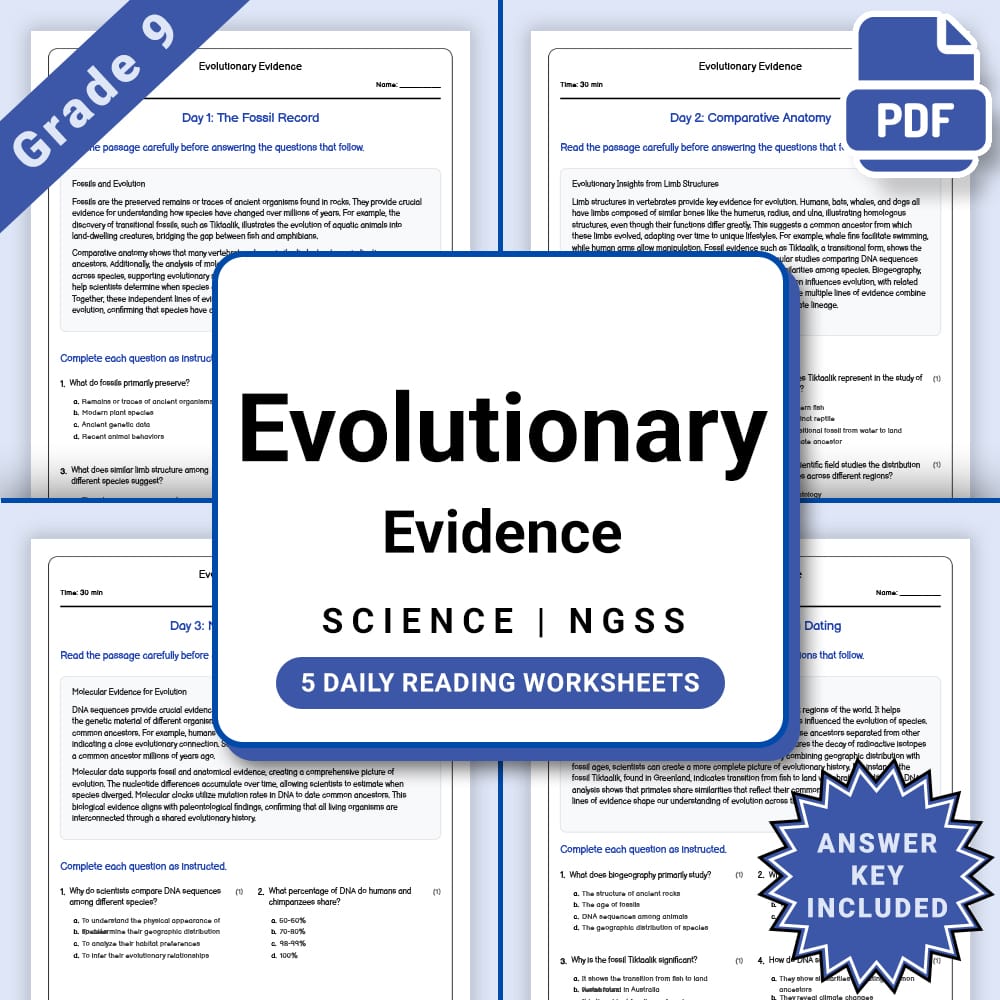
Grade 9 Science – Evolutionary Evidence Worksheet(PDF + Answer Key)
 Created byCopper Leaf Classroom
Learning Objectives
- Understand how fossils provide evidence for evolution
- Recognize the significance of transitional fossils and homologous structures
- Learn how molecular sequences support common ancestry
Instant download

Grade 9 Science | Evidence Chains in Science - Reading Comprehension Practice
Created byCoral Reef LearningLearning Objectives
- Understand the concept of evidence chains and their role in scientific reasoning.
- Identify basic components involved in linking observations to scientific claims.
- Recognize the importance of clarity, sufficiency, and consistency in evidence.
Also included in: Science Practices Lesson Bundle – Grade 9 Science, Advanced Placement Reading +1 more
Instant download

Grade 9 Science – Evidence for Scientific Claims | Daily Reading Worksheet
Created byBright Mind ResourcesLearning Objectives
- Understand what constitutes relevant evidence in scientific claims.
- Identify patterns in data that support or weaken claims.
- Evaluate alternative explanations based on evidence.
Also included in: Uncertainty in Graphs & Evidence Lesson Bundle | Grade 9 Science General +1 more
Instant download

Renal Regulation Assessment | TEKS Standards Grade 9 Science
Created byPrism Point LearningLearning Objectives
- Understand the structure and function of nephrons in renal regulation.
- Explain how hormonal feedback mechanisms control kidney function and blood pressure.
- Identify the roles of key hormones like antidiuretic hormone and the renin-angiotensin-aldosterone system.
Also included in: Grade 9 Regulation & Communication Science Assessment Lesson Bundle TEKS
Instant download

Grade 9 Science | Power and Efficiency Worksheet (Alberta | PDF)
Created byEvergreen Desk EducationLearning Objectives
- Explain the relationship between power, energy transfer, and time using real-world examples.
- Calculate or interpret efficiency as the fraction of input energy converted to useful output.
- Identify common sources of energy loss and describe how design choices affect operational performance.
Instant download

Grade 9 Science | Balancing Equations Worksheet (PDF) – BC Standards
Created byEvergreen Desk EducationLearning Objectives
- Explain why chemical equations must be balanced to conserve atoms during a reaction.
- Use coefficients and subscripts to determine how many atoms of each element appear on both sides of an equation.
- Apply balancing strategies to write correct balanced chemical equations, including state symbols.
Instant download

Grade 9 Science – Developmental Processes & Gene Regulation | Reading Worksheet
Created byBright Mind ResourcesLearning Objectives
- Understand how gene regulation influences developmental processes
- Describe the roles of regulatory networks, timing changes, and epigenetic modulation in development
- Link genetic variation to trait expression and phenotypic diversity
Also included in: Grade 9 Daily Reading Science Worksheets Lesson Bundle | AP +2 more
Instant download

Grade 9 Science – Design Communication & Structural Engineering | Worksheet
Created byBright Mind ResourcesLearning Objectives
- Interpret diagrams to explain design choices
- Analyze data summaries to evaluate design performance
- Provide reasoning connecting test outcomes to design decisions
Also included in: Engineering & Technology Lesson Bundle | Grade 9 Science | General +1 more
Instant download

Grade 9 Science – Scientific Argumentation & Reading Practice | Worksheet
Created byBright Mind ResourcesLearning Objectives
- Identify claims, evidence, and reasoning within scientific texts
- Analyze how coherence and relevance strengthen scientific arguments
- Evaluate the role of quantitative evidence and model comparisons
Also included in: Grade 9 Science Data Analysis Daily Reading Worksheets Lesson Bundle | AP +2 more
Instant download

Grade 9 Science – Endocrine Feedback Mechanisms Daily Reading Worksheet
Created byQuiet Forest EducationLearning Objectives
- Understand the role of hormones in regulating physiological processes.
- Identify feedback loops involved in glucose homeostasis.
- Describe hormone synthesis, transport, and cellular effects.
Also included in: Human Body Science Grade 9 Daily Reading Worksheets Bundle | Ontario +1 more
Instant download

Grade 9 Science – Energy & Matter Flow | Daily Reading Worksheet
Created byBright Mind ResourcesLearning Objectives
- Understand how energy flows through food chains in ecosystems.
- Identify the different roles of producers, consumers, and decomposers.
- Describe how matter cycles through living organisms and the environment.
Also included in: Cells Genetics & Ecosystems Grade 9 Science Reading Lesson Bundle | General +1 more
Instant download

Grade 9 Science – Power & Efficiency in Mechanical Systems | Daily Worksheet
Created byQuiet Forest EducationLearning Objectives
- Define power as the rate of energy transfer or work per unit time.
- Calculate average and instantaneous power in mechanical contexts.
- Understand the concept of mechanical efficiency and how it relates to energy losses.
Also included in: Forces and Energy Grade 9 Science Daily Reading Worksheets Bundle | Ontario +1 more
Instant download

Grade 9 Science | Understanding DNA & Genes - Daily Reading Comprehension
Created byCoral Reef LearningLearning Objectives
- Identify the structure and function of DNA
- Explain what genes are and where they are located
- Describe how chromosomes carry genetic information
Instant download

Grade 9 Science | Environmental Tradeoffs Worksheet | California Standards
Created byLumora LearningLearning Objectives
- Explain how human actions can affect air, water, and land systems through identifiable mechanisms of harm.
- Evaluate environmental solutions by comparing benefits, side effects, and feasibility across interconnected systems.
- Use scientific reasoning to weigh evidence and uncertainty when predicting environmental outcomes.
Instant download

Grade 9 Science – Energy Transfer & Earth's Systems | Daily Reading Worksheet
Created byQuiet Forest EducationLearning Objectives
- Identify different sources of energy that influence Earth's processes.
- Describe how energy is transferred through conduction, convection, and radiation.
- Understand the role of internal heat and radioactive decay in Earth's dynamics.
Also included in: Earth and Space Systems Grade 9 Science Daily Worksheets Bundle | Ontario +1 more
Instant download

Grade 9 Science – Stellar Origins & Birth of Stars | Daily Reading Worksheet
Created byBright Mind ResourcesLearning Objectives
- Explain how stars are formed from gas and dust in space.
- Describe the process of nuclear fusion in stars.
- Identify the types of elements produced during a star's lifecycle.
Also included in: Grade 9 Science Worksheets: Space-to-Climate Lesson Bundle | Calif. Standards +1 more
Instant download

Atmospheric Weather Processes Worksheet Grade 9 Science | NGSSS
Created byPrism Point LearningLearning Objectives
- Explain how air temperature differences and air pressure gradients drive atmospheric circulation.
- Describe how moisture changes through condensation and evaporation lead to clouds and precipitation.
- Connect heat transfer (radiation, conduction, convection) to local weather patterns and larger storm systems.
Also included in: Grade 9 Earth, Weather & Climate Systems Lesson Bundle | Florida ngsss
Instant download

Organelle Interactions Assessment for Grade 9 Science | TEKS Standards
Created byPrism Point LearningLearning Objectives
- Describe how different organelles coordinate to facilitate cellular functions.
- Explain the pathways of genetic information flow within a cell.
- Identify the roles of mitochondria, lysosomes, and the Golgi apparatus in maintaining cellular homeostasis.
Instant download

Grade 9 Models And Theories Worksheet | NGSS Practice PDF
Created byClear Sky ClassroomLearning Objectives
- Distinguish between models, explanations, and scientific theories in science
- Identify how evidence supports scientific ideas and how theories can be revised
- Apply vocabulary to interpret scenarios involving models and predictions
Instant download

Grade 9 Science – Thermoregulation & Body Systems | Daily Reading Worksheet
Created byBright Mind ResourcesLearning Objectives
- Understand the different systems involved in maintaining body temperature
- Identify physiological responses to cold and hot environments
- Explain how feedback loops regulate thermoregulation
Also included in: Grade 9 Homeostasis & Body Systems Science Lesson Bundle Daily Reading | TEKS +2 more
Instant download

Grade 9 Science | Trophic Transfers And Efficiency Worksheet | General Standard
Created byLumora LearningLearning Objectives
- Explain how energy moves between trophic levels and why transfer efficiency differs among organisms.
- Interpret biomass trends to evaluate the effects of trophic transfers on producer and consumer populations.
- Use evidence such as nutrient concentrations and decomposition to describe how matter cycles continue in ecosystems.
Instant download

Grade 9 Science – Newton First Law Worksheet (Ontario Standards) (PDF)
Created byEvergreen Desk EducationLearning Objectives
- Explain Newton’s First Law using the idea of inertia and the relationship between net external force and changes in motion.
- Distinguish between an object at rest and an object moving at constant velocity in terms of net external force.
- Identify examples of static and dynamic equilibrium where balanced forces produce no net change in motion.
Also included in: Grade 9 Forces, Motion & Energy Science Lesson Bundle (Ontario) +1 more
Instant download

Grade 9 Science – Understanding Newton's Second Law & Daily Reading Worksheet
Created byBright Mind ResourcesLearning Objectives
- Explain the relationship between net force, mass, and acceleration.
- Distinguish between mass and weight.
- Apply Newton's second law to real-world scenarios involving force and motion.
Also included in: Grade 9 Work, Energy & Forces Science Daily Reading Lesson Bundle | Ontario +1 more
Instant download

Grade 9 Science Reaction Types Worksheet (Ontario Standard) (PDF)
Created byEvergreen Desk EducationLearning Objectives
- Classify common chemical reactions (synthesis, decomposition, single displacement, double displacement, and combustion) using reactant–product patterns and observable clues.
- Predict likely products from balanced reaction-type patterns and explain why conservation of mass constrains what can happen.
- Connect reaction type to real-world outcomes, including safety and environmental impacts (e.g., burning fuels, reactivity, and salt formation).
Also included in: Grade 9 States & Energy to Chemical Reactions Science Lesson Bundle (Ontario) +1 more
Instant download

Grade 9 Science | Representation Models in Science - Daily Reading Comprehension
Created byCoral Reef LearningLearning Objectives
- Understand different types of scientific models: mathematical, graphical, schematic, and computational.
- Evaluate criteria for selecting appropriate models based on fidelity, simplicity, and predictive ability.
- Interpret how models link to measurable observables and empirical evidence.
Also included in: Science Practices Lesson Bundle – Grade 9 Science, Advanced Placement Reading +1 more
Instant download
About Grade 9 Science Worksheets
Find Science worksheets built for Grade 9. All 6,926 cover core skills, practice, and review, each an instant PDF download.
Every worksheet on MyTeachingSheets is created by independent teacher-authors and reviewed before publication. All resources download as printable PDFs for classroom, homework, or at-home practice, and many include answer keys. Preview any worksheet free before buying.