
Grade 9 Science Worksheets
6,926 worksheets
Grade 9 Science | Tissue Types Worksheet | BC Aligned
 Created byLumora Learning
Learning Objectives
- Understand the different types of tissues and their functions.
- Identify characteristics of epithelial, connective, muscle, and nervous tissues.
- Explain how tissue structure relates to function in organs.
Instant download
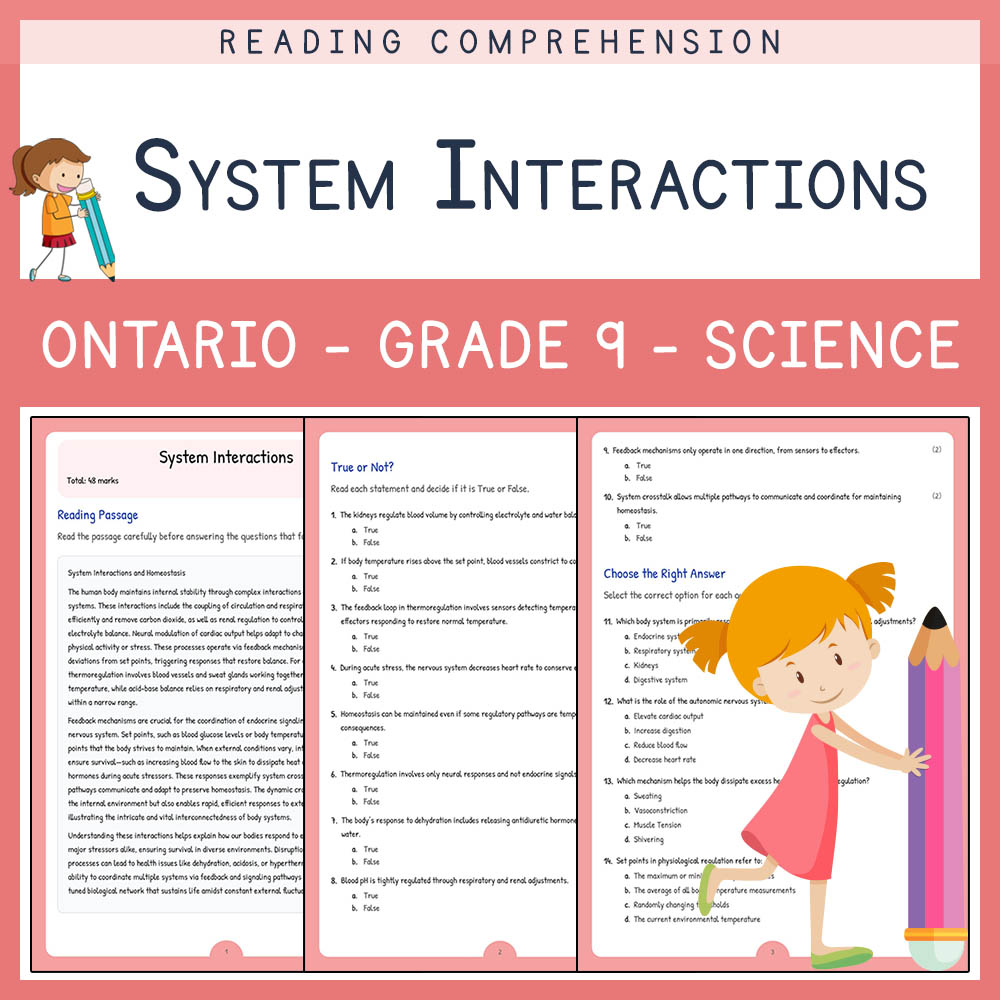
Grade 9 Science Assessment | System Interactions Worksheet | Ontario Standard
Created byLumora LearningLearning Objectives
- Analyze how body systems interact to maintain homeostasis under various conditions.
- Explain feedback mechanisms, set points, and the coordination between endocrine and autonomic responses.
- Describe examples such as thermoregulation, acid-base balance, and responses to stress.
Also included in: Grade 9 Science | Life Systems Lesson Bundle | Ontario Framework
Instant download
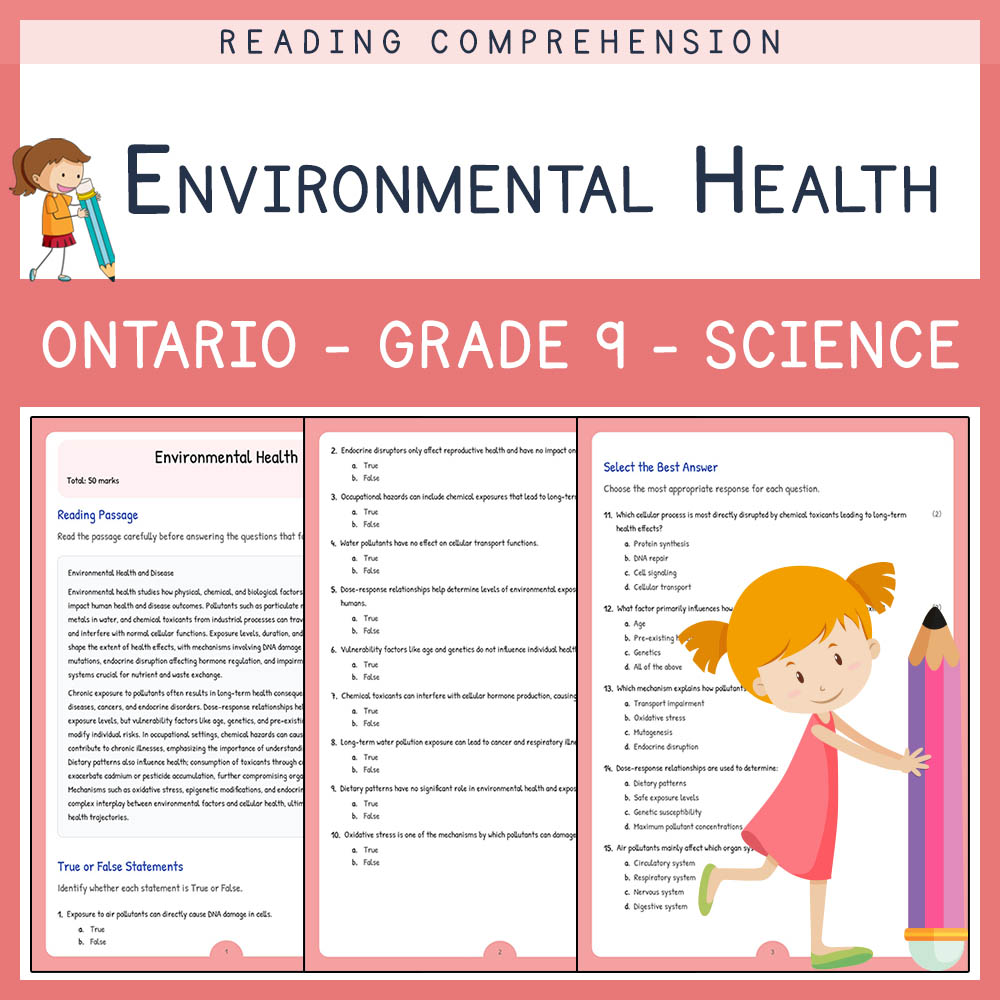
Grade 9 Science | Environmental Health Worksheet Elena | Ontario Standards
Created byLumora LearningLearning Objectives
- Understand how environmental exposures influence cellular processes and long-term health.
- Identify types of pollutants and hazards affecting human health.
- Describe mechanisms by which pollutants cause DNA damage, endocrine disruption, and transport impairment.
Also included in: Grade 9 Science | Life Systems Lesson Bundle | Ontario Framework
Instant download
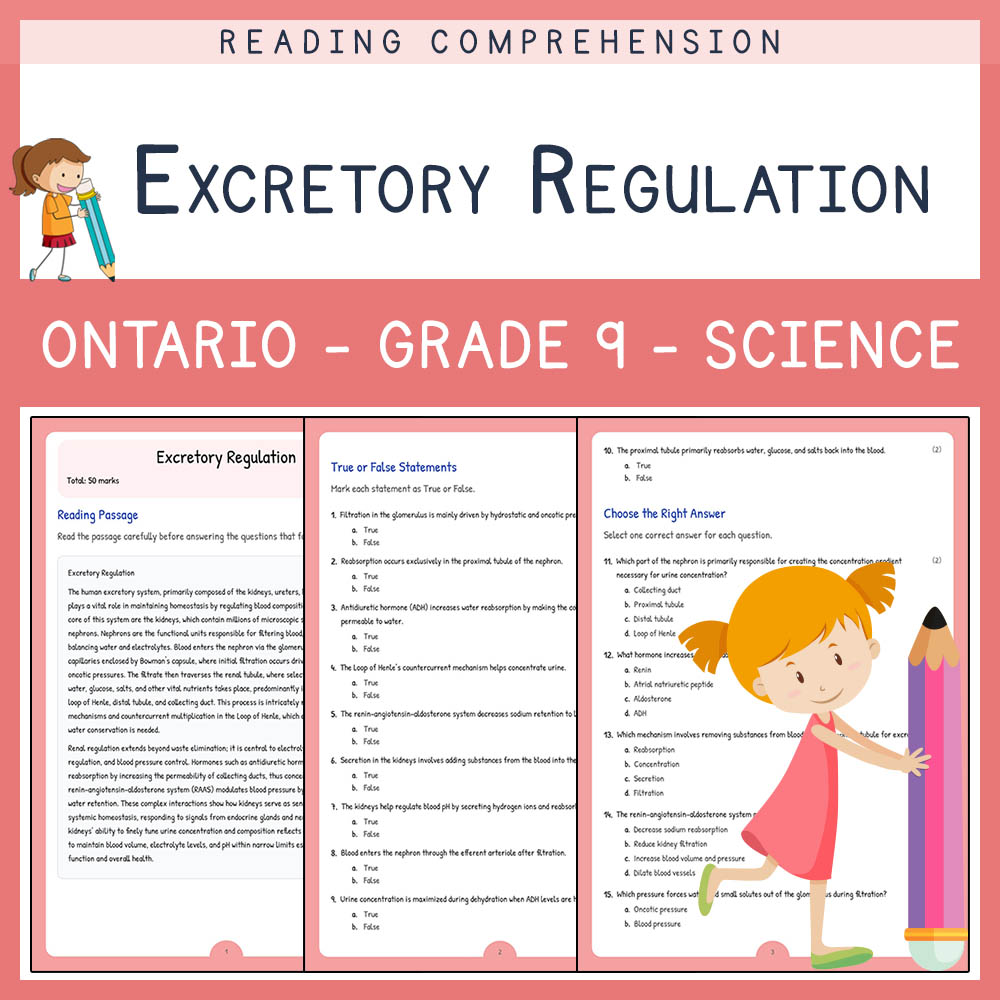
Grade 9 Science | Excretory Regulation Worksheet Elena | Ontario Standard
Created byLumora LearningLearning Objectives
- Analyze the structure and function of nephrons in blood filtration and urine formation.
- Describe the processes of glomerular filtration, reabsorption, secretion, and concentration of urine.
- Explain how renal regulation maintains electrolyte balance, acid-base homeostasis, and blood pressure.
Also included in: Grade 9 Science | Life Systems Lesson Bundle | Ontario Framework
Instant download

Grade 9 Science | Earth Season Causes Worksheet | NGSSS Aligned
Created byLumora LearningLearning Objectives
- Explain how Earth’s axial tilt and orbital motion change the Sun’s angle and the length of day for each hemisphere.
- Describe why seasons are predictable periodic patterns caused by Sun–Earth geometry rather than Earth’s distance from the Sun.
- Connect seasonal sunlight changes to temperature cycles and real-world weather and environmental impacts.
Instant download

Grade 9 Science | Greenhouse Effect Worksheet | NGSSS Standards
Created byLumora LearningLearning Objectives
- Explain how greenhouse gases affect the flow of energy in Earth’s atmosphere.
- Describe the process of infrared absorption and re-emission and how it changes outgoing heat.
- Interpret how changes in greenhouse gas concentration can alter Earth’s energy balance and surface temperature.
Instant download

Grade 9 Science | Measurement Practices Worksheet | NGSSS Assessment
Created byLumora LearningLearning Objectives
- Explain how measurement practices turn observations into usable scientific data.
- Distinguish between accuracy and precision using real measurement examples.
- Describe how calibration and repeatability improve reliability of experimental data.
Instant download

Grade 9 Science | Evolution Evidence Worksheet | NGSSS Aligned
Created byLumora LearningLearning Objectives
- Explain how the fossil record can support gradual evolution over geological time
- Distinguish homologous structures from analogous structures caused by convergent evolution
- Describe how genetic data (DNA similarity) helps infer relatedness and shared ancestry
Instant download
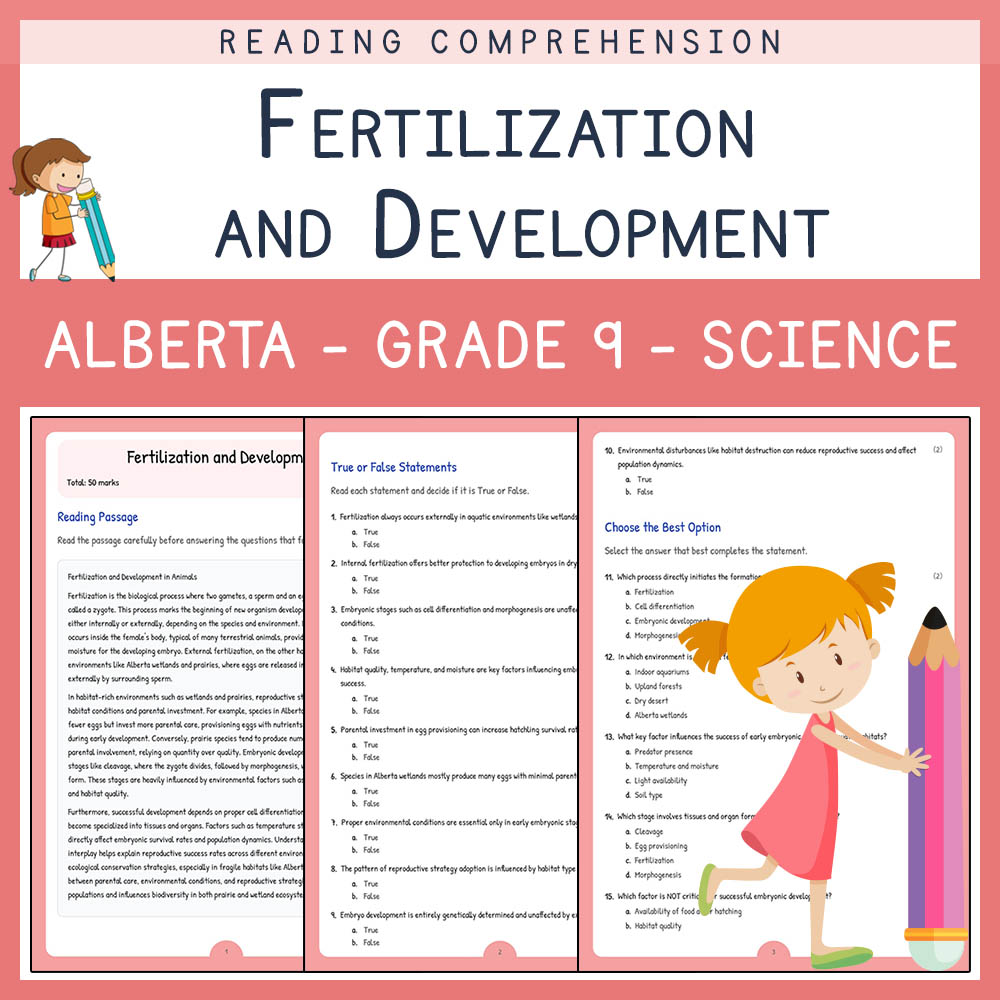
Grade 9 Science | Fertilization and Development Worksheet | Alberta Standards
Created byLumora LearningLearning Objectives
- Explain the process of fertilization and its role in forming a zygote.
- Differentiate between internal and external fertilization strategies with examples.
- Describe embryonic stages such as cell differentiation and morphogenesis.
Instant download

Grade 9 Science | Limiting Factors Worksheet | Florida NGSSS-Aligned
Created byLumora LearningLearning Objectives
- Explain how limiting factors affect population growth in an ecosystem
- Describe carrying capacity and how populations stabilize when limiting factors intensify
- Analyze how limiting factors influence species interactions and biodiversity over time
Instant download
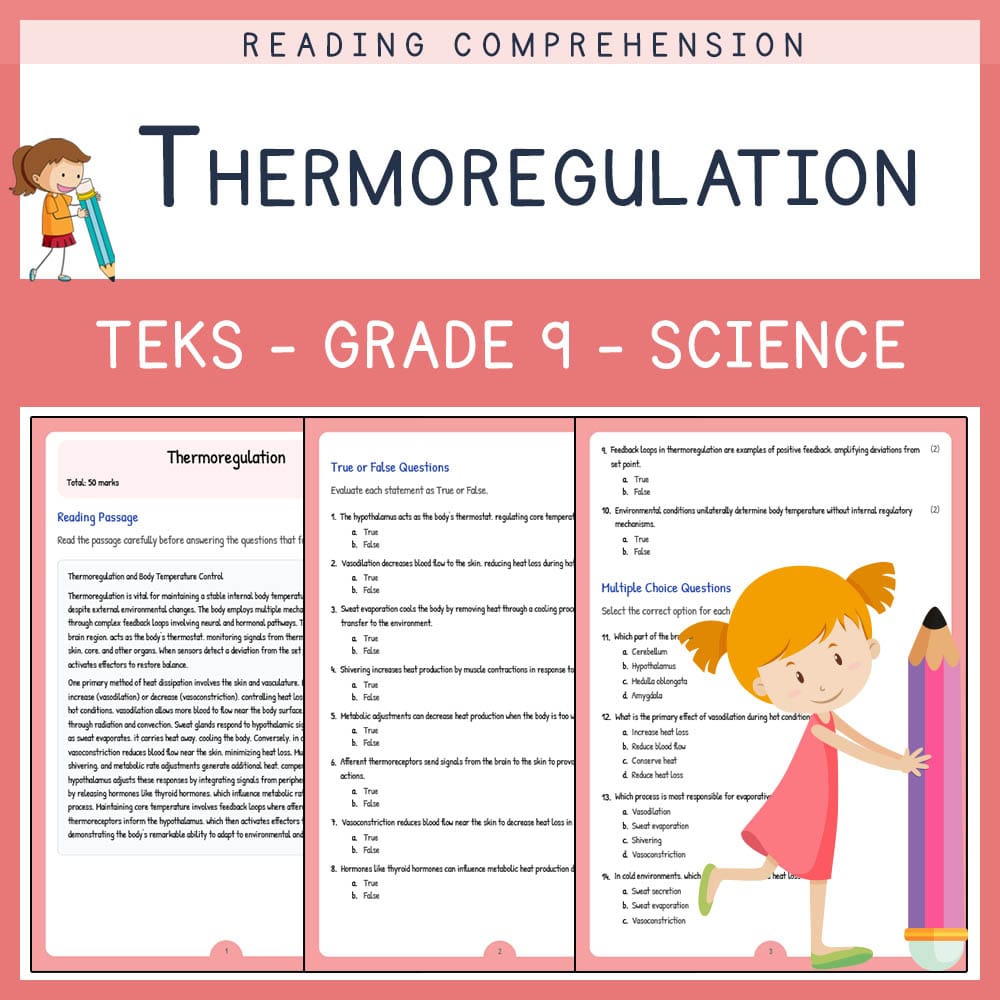
Grade 9 Science | Thermoregulation Worksheet | TEKS Aligned
Created byLumora LearningLearning Objectives
- Explain the role of skin, vasculature, and sweat glands in maintaining body temperature.
- Describe the neural and hormonal pathways involved in thermoregulation.
- Differentiate between mechanisms that increase heat production and those that promote heat loss.
Instant download

Grade 9 Science | Climate Variability Worksheet | Florida NGSSS Aligned
Created byLumora LearningLearning Objectives
- Explain how climate variability affects weather averages over months to years
- Describe ocean-atmosphere interactions (El Niño and La Niña) and their impacts on temperature and rainfall
- Distinguish natural variability from long-term climate trends using evidence across timescales and regions
Instant download
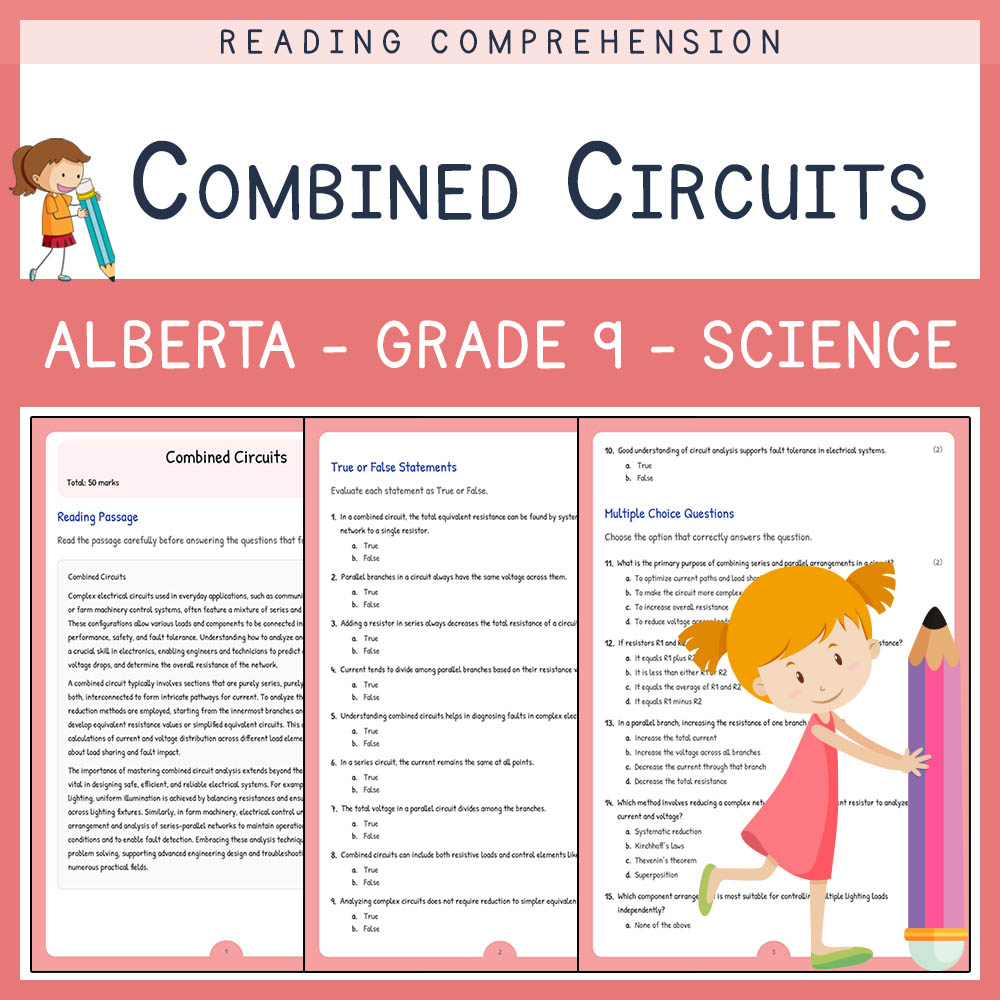
Grade 9 Science | Combined Circuits Worksheet Elena | Alberta Standards
Created byLumora LearningLearning Objectives
- Understand how series and parallel circuits combine within complex networks.
- Apply systematic methods to simplify mixed circuit arrangements.
- Identify equivalent resistances and analyze current and voltage distributions.
Instant download

Grade 9 Science | Risks and Benefits Worksheet | Alberta Standards
Created byLumora LearningLearning Objectives
- Understand the ecological, economic, and health risks associated with genetic technologies.
- Evaluate potential benefits and trade-offs of adopting genetic approaches.
- Explain risk assessment, mitigation strategies, and long-term monitoring in biotechnology.
Instant download

Grade 9 Science | Earth Magnetism Worksheet (Alberta Standards) (PDF)
 Created byEvergreen Desk Education
Learning Objectives
- Explain how the Earth’s magnetic field is related to compass direction and navigation.
- Describe dip (inclination) and declination and how they change with location.
- Connect auroras and ionospheric phenomena to Earth’s magnetism.
Instant download

Grade 9 Science | Complex Inheritance Worksheet (TEKS) Practice Set
Created byEvergreen Desk EducationLearning Objectives
- Explain how polygenic inheritance, epistasis, and pleiotropy can cause deviations from simple Mendelian ratios
- Describe how variable penetrance and expressivity affect whether and how genotypes show up as phenotypes
- Evaluate how linkage and environmental factors can change observed inheritance patterns in families and populations
Instant download

Grade 9 Science Worksheet | Mountain Building Activities (BC Standards PDF)
Created byEvergreen Desk EducationLearning Objectives
- Explain how plate convergence and continental collision produce mountain building through folding, thrust faulting, and crustal shortening.
- Identify key tectonic processes (magmatic intrusion and isostatic rebound) and describe how they change rock structure and elevation.
- Use rock types, structural patterns, and timing clues to infer tectonic history and reconstruct past plate motions.
Instant download

Grade 9 Science – Mixtures and Solutions Worksheet (Alberta Standards) (PDF)
Created byEvergreen Desk EducationLearning Objectives
- Differentiate homogeneous solutions from heterogeneous mixtures based on uniformity and particle distribution.
- Identify the roles of solute and solvent in solutions and describe how concentration relates to appearance and behavior.
- Select appropriate physical separation methods using differences in physical properties such as size, solubility, or boiling point.
Instant download

Grade 9 Climate Modeling Worksheet | California Science Earth Science + Answer Key
Created byEvergreen Desk EducationLearning Objectives
- Explain how climate models represent Earth’s energy balance and atmospheric circulation.
- Describe how greenhouse gas scenarios influence temperature and precipitation projections.
- Evaluate the role of feedbacks and uncertainty when interpreting model results.
Instant download

Natural Hazards Worksheet | NGSS Grade 9 Science Assessment
 Created bySkylark Worksheets
Learning Objectives
- Explain how geologic and atmospheric indicators are used to characterize the origin, frequency, and potential impacts of natural hazards.
- Analyze spatial patterns and triggering mechanisms to describe why some places experience higher hazard and risk.
- Evaluate how recurrence intervals and paleoevidence support risk assessment for human and ecological systems.
Also included in: Grade 9 Science Lesson Bundle Earth Systems & Tectonic Forces | NGSS +1 more
Instant download

Net Force and Acceleration Worksheet Grade 9 Science NGSSS Physics
Created byEvergreen Desk EducationLearning Objectives
- Explain how net force determines the direction and magnitude of acceleration
- Use the relationship between net force, mass, and acceleration to predict motion
- Analyze real-world scenarios with multiple forces acting on an object
Instant download

Grade 9 Science | Nucleic Acid Structure Worksheet (TEKS) PDF
Created byEvergreen Desk EducationLearning Objectives
- Compare DNA and RNA structural features, including strand structure, sugar type, and base composition
- Explain how complementary base pairing and strand directionality relate to replication and transcription
- Describe how structural differences influence the stability and functions of DNA and RNA
Instant download

Grade 9 Earth Material Cycling Worksheet | California Science + Answer Key
Created byEvergreen Desk EducationLearning Objectives
- Explain how matter cycles through Earth’s reservoirs using geologic and biological processes.
- Describe how water, carbon, and nutrients move through the atmosphere, hydrosphere, biosphere, and geosphere.
- Use evidence-based reasoning and simple models to predict how changes in cycles can affect surface conditions and climate.
Instant download

Kinetic and Potential Energy Worksheet Grade 9 NGSSS Science Physics
Created byEvergreen Desk EducationLearning Objectives
- Differentiate kinetic energy and gravitational potential energy in terms of motion and position
- Explain how height and speed affect potential and kinetic energy in everyday systems like roller coasters
- Use reference levels and energy transfer ideas to interpret energy changes during motion
Instant download

Molecular Regulation Worksheet | NGSS Grade 9 Science Assessment
Created bySkylark WorksheetsLearning Objectives
- Explain how molecular signals regulate gene expression and protein activity in cells
- Describe how receptor-ligand binding and signal transduction cascades control cellular responses
- Use examples such as insulin signaling to connect molecular regulation to physiological outcomes
Also included in: Cellular Systems and Regulation Lesson Bundle | Grade 9 Science | NGSS +1 more
Instant download

Grade 9 Science | Environmental Chemistry Worksheet (PDF) – Alberta Standards
Created byEvergreen Desk EducationLearning Objectives
- Explain how environmental chemical changes can be analyzed using mass conservation and measurable mass flows
- Connect acid deposition chemistry to observable effects on limestone using particulate and atomic explanations
- Describe how tailings chemistry and nutrient cycling involve system boundaries and chemical transformations
Instant download

Grade 9 Science | Newtonian Concepts Worksheet (Alberta Standards) (PDF)
Created byEvergreen Desk EducationLearning Objectives
- Explain Newton’s three laws using force–motion relationships and real-world examples.
- Use Newton’s laws to predict and justify how changes in force affect acceleration and motion.
- Apply action–reaction reasoning to systems involving recoil and anchoring loads.
Instant download

Grade 9 Science – Lunar Phases Worksheet (BC Standard) (PDF)
Created byEvergreen Desk EducationLearning Objectives
- Explain how the changing geometry between the Sun, Earth, and Moon causes the visible lunar phases.
- Describe the synodic month and why lunar phases repeat in a predictable sequence.
- Use illuminated fraction and viewing perspective to predict which phase comes next.
Instant download

Mutation Sources Worksheet Grade 9 Science NGSSS Genetics Activity
Created byEvergreen Desk EducationLearning Objectives
- Explain major sources of mutations, including replication errors and environmental mutagens such as radiation and chemicals.
- Describe how different types of DNA mutations (point mutations, insertions/deletions, and chromosomal changes) can affect gene function or regulation.
- Connect heritable mutations to how genetic variation becomes the raw material for natural selection and evolution.
Instant download

Grade 9 Science | Graph Interpretation Worksheet (Alberta Standards PDF)
Created byEvergreen Desk EducationLearning Objectives
- Interpret slopes on displacement–time and velocity–time graphs as physical quantities (velocity and acceleration).
- Use the area under a velocity–time graph to determine displacement and describe motion histories.
- Identify features such as constant segments, sign changes, discontinuities, and curved sections in real-world motion data.
Instant download

Grade 9 Science Limiting Factors Ecology Worksheet | Florida NGSSS Activity
Created byEvergreen Desk EducationLearning Objectives
- Explain how limiting factors (resources, predation, disease, and environment) constrain population growth.
- Describe the relationship between limiting factors and carrying capacity.
- Analyze how changes in limiting factors can shift community interactions and biodiversity.
Instant download

Grade 9 Science Worksheets | Adaptation and Selection (PDF)
Created byEvergreen Desk EducationLearning Objectives
- Explain how natural selection increases the frequency of heritable traits that improve reproductive success in a specific environment.
- Describe selective pressure, fitness, and adaptive trade-offs using examples from Alberta.
- Compare artificial selection in agriculture with natural selection and infer how adaptation can accumulate over generations.
Instant download

Grade 9 Science – Cardiopulmonary Interaction Worksheet (TEKS PDF)
Created byEvergreen Desk EducationLearning Objectives
- Explain how pulmonary ventilation and cardiovascular transport work together to deliver oxygen and remove carbon dioxide.
- Describe how heart rate, stroke volume, and vascular resistance can change in response to respiratory and metabolic demands.
- Use chemoreceptor feedback to predict how changes in blood gases affect ventilation and circulation.
Instant download

Grade 9 Biodiversity Change Worksheet | Florida NGSSS Science Activity PDF
Created byEvergreen Desk EducationLearning Objectives
- Explain how biodiversity includes species diversity and genetic variation within ecosystems.
- Describe how environmental and human-caused changes can alter population sizes and species interactions.
- Evaluate how changes in biodiversity can affect ecosystem stability and functions.
Instant download

Power and Rates Worksheet Grade 9 Science NGSSS Physics Practice
Created byEvergreen Desk EducationLearning Objectives
- Explain power as the rate of energy transfer or the rate of doing work
- Use time and energy information to compare power in different situations
- Interpret real-world examples (such as appliances and motors) using rate reasoning
Instant download

Grade 9 Science – Cell Signaling Worksheet (TEKS) (PDF)
Created byEvergreen Desk EducationLearning Objectives
- Explain how ligands bind to receptors and initiate signal transduction inside cells
- Describe how second messengers and phosphorylation help relay and amplify signals
- Compare autocrine, paracrine, endocrine, and synaptic signaling by distance and time scale
Instant download

Grade 9 Science Light Reactions Worksheet (TEKS) – PDF
Created byEvergreen Desk EducationLearning Objectives
- Explain how photons drive charge separation in photosystems during the light reactions.
- Describe how an electron transport chain creates a proton gradient that powers ATP synthase.
- Connect water splitting to electron replenishment and oxygen release.
Instant download

Grade 9 Science | DNA Replication Worksheet (TEKS) Practice Set
Created byEvergreen Desk EducationLearning Objectives
- Explain how DNA replication produces two DNA molecules using a semi-conservative mechanism.
- Describe the roles of helicase, primase, DNA polymerase, and Okazaki fragments during replication.
- Compare leading-strand and lagging-strand synthesis and predict how errors can affect genome stability.
Instant download

Grade 9 Science | Organelle Roles Worksheet (TEKS) (Worksheet + Answer Key)
Created byEvergreen Desk EducationLearning Objectives
- Identify major eukaryotic cell organelles and describe their primary functions
- Explain how an organelle’s structure and molecules relate to the cell task it performs
- Compare how organelle roles support different tissue needs in plants and animals
Instant download

Grade 9 Science | Energy Conservation Worksheet (Ontario Standard) PDF
Created byEvergreen Desk EducationLearning Objectives
- Explain when total mechanical energy (kinetic + potential) is conserved in the presence of negligible non-conservative forces
- Describe how kinetic energy and gravitational potential energy interconvert in real-world motion under gravity
- Use non-conservative work (such as friction) to predict how mechanical energy changes in a system
Also included in: Grade 9 Forces, Motion & Energy Science Lesson Bundle (Ontario) +1 more
Instant download

Grade 9 Science – Climate Drivers Worksheet (PDF) BC Standards
Created byEvergreen Desk EducationLearning Objectives
- Explain how solar energy and Earth’s energy balance influence long-term climate patterns.
- Describe how interactions among the atmosphere, hydrosphere, cryosphere, lithosphere, and biosphere shape regional climate.
- Analyze how natural variability and external forcings (aerosols, greenhouse gases, ocean circulation, land surface properties) affect temperature, precipitation, and extremes.
Instant download

Climate Drivers Worksheet | NGSS Grade 9 Science Assessment PDF
Created bySkylark WorksheetsLearning Objectives
- Explain how Earth's energy budget is influenced by solar flux and albedo
- Describe how greenhouse gases affect outgoing longwave radiation and surface-atmosphere energy balance
- Use ideas about ocean heat transport and climate feedbacks to interpret regional variability
Also included in: Grade 9 Science Lesson Bundle Earth Systems & Tectonic Forces | NGSS +1 more
Instant download

Grade 9 Science Work and Energy Worksheet (Ontario) | PDF
Created byEvergreen Desk EducationLearning Objectives
- Define mechanical work and express it using force and displacement (including when work is zero or negative).
- Identify major energy forms and distinguish kinetic and potential energy using qualitative and quantitative reasoning.
- Calculate work for constant forces and explain how energy transfer relates to conservation of energy in simple isolated systems.
Also included in: Grade 9 Forces, Motion & Energy Science Lesson Bundle (Ontario) +1 more
Instant download

Grade 9 Science | Compound Formulas Worksheet (Ontario Standards) (PDF)
Created byEvergreen Desk EducationLearning Objectives
- Explain that compounds contain two or more elements in fixed ratios and how this is reflected in chemical formulas.
- Differentiate ionic and covalent bonding and predict how bonding affects macroscopic properties like melting point and conductivity.
- Apply the law of definite composition and use formulas to reason about predictable mass relationships in compounds.
Also included in: Grade 9 States & Energy to Chemical Reactions Science Lesson Bundle (Ontario) +1 more
Instant download

Grade 9 Science – Respiratory Exchange Worksheet (Ontario Standards) (PDF)
Created byEvergreen Desk EducationLearning Objectives
- Explain how alveolar–capillary diffusion depends on partial pressure gradients, surface area, and membrane thickness.
- Describe how ventilation, anatomical dead space, and ventilation–perfusion matching affect oxygen uptake and carbon dioxide removal.
- Evaluate how haemoglobin affinity and perfusion limitations influence oxygen delivery to tissues for aerobic metabolism.
Also included in: Grade 9 Human Body Systems & Cellular Processes Science Lesson Bundle: Ontario +1 more
Instant download

Grade 9 Atmospheric Energy Worksheet | California Science + Answer Key
Created byEvergreen Desk EducationLearning Objectives
- Explain how unequal solar heating drives temperature differences, air pressure differences, and atmospheric circulation
- Describe how energy transfers between Earth’s surface and the atmosphere influence humidity, cloud formation, and precipitation
- Use a weather model to predict how changes in temperature and moisture can affect short-term weather patterns
Instant download

Grade 9 Science Worksheet | Molecular Bonding (PDF) Alberta Standards
Created byEvergreen Desk EducationLearning Objectives
- Differentiate ionic, covalent, and metallic bonding based on electron interactions.
- Predict some macroscopic properties (melting point, conductivity, structure/solubility patterns) from bonding type.
- Apply bonding ideas to real-world examples such as sodium chloride and metal ores.
Instant download

Greenhouse Effect Worksheet Grade 9 Science NGSSS Climate Learning
Created byEvergreen Desk EducationLearning Objectives
- Explain how greenhouse gases affect Earth’s energy flow by absorbing and re-emitting infrared radiation.
- Describe how energy balance depends on absorption, re-emission, and the altitude where radiation escapes to space.
- Use greenhouse-effect concepts to predict how changes in greenhouse gas concentrations can change surface temperature.
Instant download
About Grade 9 Science Worksheets
Find Science worksheets built for Grade 9. All 6,926 cover core skills, practice, and review, each an instant PDF download.
Every worksheet on MyTeachingSheets is created by independent teacher-authors and reviewed before publication. All resources download as printable PDFs for classroom, homework, or at-home practice, and many include answer keys. Preview any worksheet free before buying.